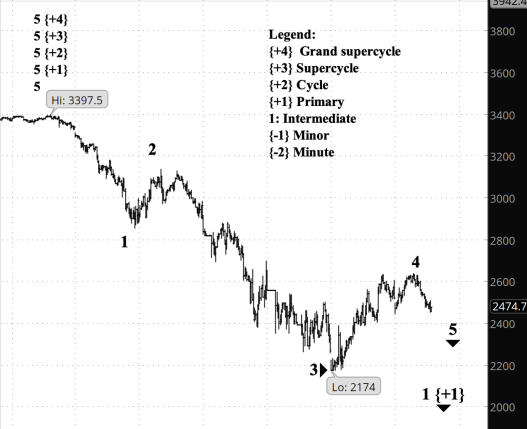
Live: Monday, April 13, 2020

10:30 a.m. New York time

What’s happening now? The S&P 500 in trading before the opening bell last night dropped by a bit more than 100 points within a 5-minute span, and since then has been meandering sideways.

What does it mean? The upward correction has not yet run its course. My target for its highest mark remains in the 2900s, with 2930 more or less being the most likely end point. But that’s an informed guess, not an analytical necessity.

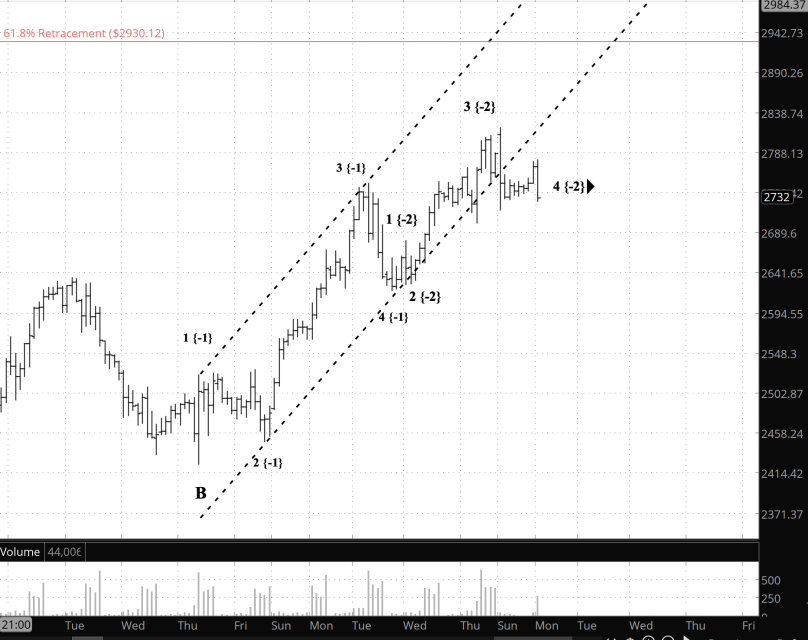
What does Elliott wave theory say? When the S&P 500 price spiked overnight I was ready to mark that peak as the end of the Minute 5th wave within the Minor 5th within the Intermediate C wave within the Primary 2nd wave. The end of the Minute 5th would mean the end of the Minor, Intermediate and Primary waves as well, launching the Primary 3rds wave.
Screen Shot 2020-04-13 at 7.24.17 AM

But, after falling the price began meandering sideways, a typical pattern for a 4th wave. And the early spike was higher than where I had previously placed the Minute 3rd wave top. So I moved the top of the 3rd on my chart to the new high, and numbered the decline and meandering as a Minute 4th wave, setting up for the 5th wave up to the 2900s.

What is the alternative? There is ambiguity on this chart. If the price moves beyond the end of wave 1, at 2680.50, then I would mark last night’s high as the end of the minor 5th and the decline and meandering as the beginning of the Primary 3rd wave down. The rule in Elliott wave analysis is that a 4th wave cannot move beyond the end of the 1st wave of the same degree. If it rises from its sideways meanderings, then I would accept my count as correct.

What about my trades? I shall continue to hold on to my short bear call options spreads, waiting for the fall.

By Tim Bovee, Portland, Oregon, April 13, 2020
Read More »

Live: Thursday, April 9, 2020

10:10 a.m. New York time

What’s happening now? The S&P 500 continues to rise in an upward correction within the larger downtrend. The price shortly after the opening bell moved above the 50% retracement, a Fibonacci level.

What does it mean? Completion of the correction will signal a powerful resumption of the downtrend. In retrospect, the present movement to the upside will be seen as a sucker play that drew people back into the market too early. One tip-off to the weakness of the rise is the volume of SPY, the exchange-traded fund that tracks the S&P 500. Volume has been declining through the price rise that began March 23. (Each bar represents one day in the chart below. The yellow line shows the volume trend.)

Screen Shot 2020-04-09 at 6.53.15 AM

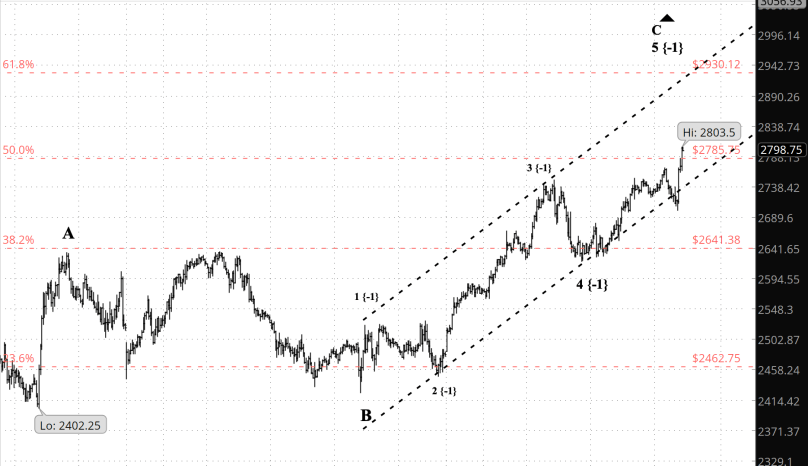
What does Elliott wave theory say? The S&P 500 remains in a Minor 5th wave to the upside within an Intermediate C wave to the upside, part of a Primary 2nd wave correction to the upside within a downtrending Cycle 1st wave. The channel suggests that the 5th wave could reach above 2900, although there is no guarantee. (Each bar in the chart is 30 minutes.)

Screen Shot 2020-04-09 at 7.00.24 AM

The end of the Minor 5th within Intermediate C will mark the end of the Primary 2nd wave and the beginning of the Primary 3rd wave down, which will carry the price below 2174, and most likely quite a distance below, although there’s no way to set a target yet.

What is the alternative? A 2nd wave can never move beyond the start of wave 1. In this case, Primary wave 1 on February 19 began the crash, from 3397.50. If the price were to move above that level, then the chart would demand a re-analysis of everything that has happened in the market since mid-February. I don’t expect this to happen, but it could.

What about my trades? I shall continue to hold my short bear call options spreads on SPY. The short call strike prices are $261 and $263.

By Tim Bovee, Portland, Oregon, April 9, 2020

Read More »

Live: Wednesday, April 8, 2020

3:54 p.m. New York time

And, six minutes before the closing bell, the S&P 500 futures move above 2744, confirming that Intermediate wave C of Primary wave 2 is still in effect. There’s more upside to to come before the Primary wave 3 decline begins.

11:25 a.m. New York Time

What’s happening now? The S&P 500 futures declined by 129.25, or 4.7%, from yesterday’s peak and then bounced slightly. The peak fell short of a 50% retracement, and the pullback brought the price to a Fibonacci 31.8% retracement.

What does it mean? The market is either pausing before resuming its upward correction, or has completed its rise and is resuming its downward course.

What does Elliott wave theory say? The peak came in an Intermediate C wave, a subwave of a Primary 2nd wave. The question is how many subwaves does the C wave have?

Screen Shot 2020-04-08 at 8.06.56 AM

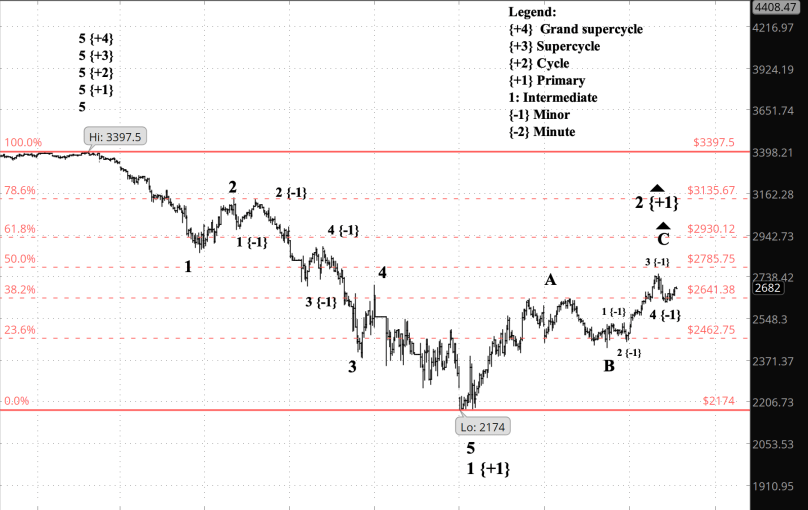
As is often the case in Elliott, the internals of wave C can be interpreted several different ways. my best count is four waves, as shown in the chart above, which shows S&P 500 futures back to the beginning of the crash with two-hour bars.

How high will it go? If my interpretation is correct, then prices will resume the rise in wave 5 {-1} within C within wave 2 {+1}. A target level often seen in 2nd waves is the 61.8% Fibonaccci level, which would be 2930.12. That would be a 6.6% rise, or 180.12 points, from the beginning of wave 5 {-1} at 2750. Under the rules of Elliott wave theory, the price cannot move above the start of the 1st wave, 3397.50.

What’s the alternative? If my count within wave C is incorrect and the wave has reached its peak, then the present decline is the start of wave 1 within wave 3 {+1} to the downside. Third waves are powerful beasts, and this one will carry below the start of the 2nd wave correction, 2174, and perhaps a long distance below.

How will we know which is right? If the S&P 500 futures price moves above 2750, the peak of wave 3 {-1}, then wave 2 is still underway to the upside. If the price drops below 2449, the start of wave 3 {-1}, then wave 3 of the Intermediate degree is underway and the price will decline rapidly thereafter.

What about my trades? My short bear call options spreads, with strike prices at 261 and 263, make money when the market goes down. I shall continue to hold in the expectation that wave 3 to the downside will begin before the options expire on May 15.

By Tim Bovee, Portland, Oregon, April 8, 2020

Read More »

Live: Tuesday, April 7, 2020

12:10 a.m. New York time

I mentioned early in my switch to a bear market strategy, in a run-through of how Elliott wave analysis works, that the method is often ambiguous. And that’s where we are today.

We’ve been in a major downtrend from 3397.50 on the S&P 500 futures since February 19, and we hit a low, 2744, in the downtrend on March 22. Of those two facts I have no doubts. At that point, it gets difficult.

We’re clearly in an upward correction. The main question is, what is being corrected?

  1. In the first scenario, the low at 2744 represents the end of wave 1 of the Primary degree and the correction is the 2nd Primary wave . If that’s the case, then we are presently in the 3rd wave of Intermediate degree within the A wave of the correction. The price is approaching a 50% retracement (2785.75). Generally a 2nd wave can be expected to end near the 61.8% Fibonacci point, which would be 2930.12. It’s a tendency, not a requirement. If the correction form is a zig-zag — common in 2nd waves — the A wave is followed by a B wave to the downside, and then a powerful C wave to a higher level that marks the end of the correction.
  2. The second scenario, which was my count until very recently, is that the low at 2744 represents the end of wave 3 of the Intermediate degree, and that the 1st Primary wave is still in force. The third wave would then have begun on March 13 at 2697.25. This scenario was proven false on Monday when the price moved above the end of wave 1 of the same degree, which is not allowed in Elliott wave analysis.

So the 1st scenario is correct, and as I count Primary wave 2 to the upside, we are now in the final section of its progress, Minor wave C.

It is possible that wave A is still in progress, and what I’m counting as waves B and the start of C are subwaves of A. If that proves to be true, then we’re not as far along in the process as I thought. By that count, we’re already 28 days into A, so it seems to me that the C-wave hypothesis is more likely to be correct.

What about my short bear call spread options positions, which are now at more than 80% of maximum potential loss? Well, the positions have 38 days to go before they expire. At this point, I hang on to them. They are entirely in the money — which is loss-making — but a lot an happen in 38 days.

If that’s the case, then the question is how long will that C wave take to complete its work. Within the entire decline from February 19, the longest minor wave was the 4th wave correction to the upside, which took 26 days to run, and the second longest was the 5th wave, which took 23 days. The shortest was the 2nd wave correction, which took only four days.

So I judge that I have time. The worst case scenario is that  the options get assigned and I have stock placed in my account. That hassle doesn’t outweigh the losses I would take if I exited now.

That’s where things stand: Keep cool, keep an eye on the chart, and watch the market work its will without taking action until Intermediate wave 3 has brought the price down.

By Tim Bovee, Portland, Oregon, April 7, 2020

Read More »

Live: Monday, April 6, 2020

3:50 p.m. New York time

A short time ago the S&P 500 broke above its March 26 high, which means my count must be revised. So it may be that the 5th wave down has not yet begun and instead the 4th wave, a combination of corrective patterns, is continuing to run its course. Or, conceivably, the 5th wave down is complete, and we are witnessing the beginning of the larger Primary degree’s 2nd degree to the upside. More tomorrow.

12:20 p.m. New York time

The S&P 500 continued its rise today. I shall hold on to my short bear call spread options positions, which expire May 15, in the expectation of a decline that will carry the index down by at least 200 points.

Based on Elliott wave analysis, I count the rise today as a 2nd wave upward correction at the Minor degree of a 5th wave downtrend of the Intermediate degree that began on March 26, at 2634.50 on the S&P 500 index futures. As of this moment the price is 2606.00, and a move above 2634.50 would invalidate my 5th wave count. Instead, I would count this rise as part of an Intermediate 4th wave to the upside, a composite structure that began March 22.

Screen Shot 2020-04-06 at 9.10.53 AM

All of this is happening within a larger 1st wave to the downside of Primary degree that began on February 19, and perhaps of higher degree waves as well. The markets’ wave structures are fractal, so that a wave of smaller degree can be correcting to the upside while its parent and grandparent degrees are moving in a downtrend.

Bottom line: The markets are a complex beast. Therein lies the fascination.

An interesting week ahead: The Federal Open Market Committee release minutes on Wednesday, a detailed glimpse at what went into their stimulus decisions in relation to the crash, and the Consumer Price Index on Friday, a look at one aspect of the impact on the economy of our coronavirus mitigations efforts.

By Tim Bovee, Portland, Oregon, April 6, 2020

Read More »

Live: Friday, April 3, 2020

2:15 p.m. New York time

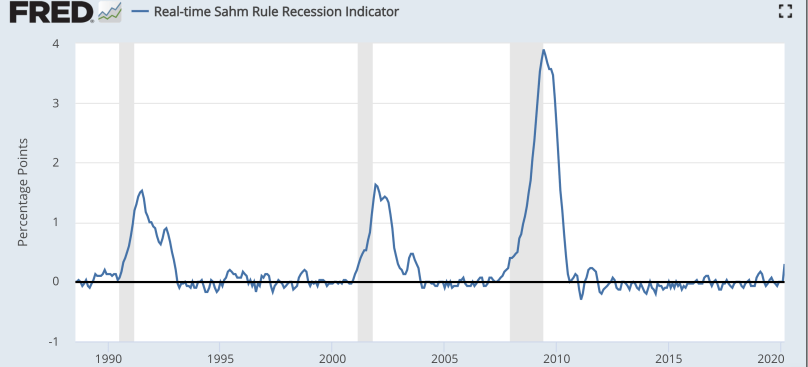
My go-to recession indicator is the Sahm Rule, which was developed a year ago by a Federal Reserve economist, Claudia Sahm. It is tracked by the Federal Reserve’s charting system, FRED. I’ve set the chart to show how the Rule responded to the last three recessions, in 1991, 2002 and the big one, the Great Recession of 2008 to 2010.

Screen Shot 2020-04-03 at 11.25.43 AM

(Click here for a fully interactive chart.)

The goal of Sahm’s rule is to give the government early warning that it would need to start pumping money into the economy. It is a leading indicator compared to the official declaration of a recession, which normally comes a year after the downturn began.

Under Sahm’s rule, a reading 0.5 means the recession is underway. The reading for March was 0.3, and data gathering for the Rule’s underlying report, the Employment Situation, began before the coronavirus layoffs had become widespread.

As the chart shows, the reading we had for March is unusually high and corresponds to just before the Great Recession kicked in.

So Sahm’s Rule says, No recession yet, but we’re heading that way. And I say, We’re in a recession already, and next month’s indicator will clearly show that.

1:55 p.m. New York time

We’re nearing the end of the fourth hour of decline in the S&P 500 today, and my inclination, using Elliott wave analysis, is to interpret it as a continuation of the 5th wave down  in the Intermediate degree decline that began this morning. A move below 2174.00 would confirm that interpretation. Under the Elliott wave model, it need not move below that level to count as a valid 5th wave.

My short bear call options spread position from 51% down to 45% of their maximum potential loss. They are well out of the money — where the profit is — with 42 days to go before expiration, on May 15. So this represents a return to more normal trading, for the moment at least, compared to the rapid panic selling of later February and early March, when I was rolling positions forward within a week, sometimes after only a day.

Management day, when I exit all profitable positions, is April 24, which is 21 days before expiration.

By Tim Bovee, Portland, Oregon, April 3, 2020

Read More »

Live: Thursday, April 2, 2020

10:25 a.m. New York time

The S&P 500 futures continue to stair-step their way down, and I shall continue to hold my short bear call options spreads on SPY, which expire May 15.

Elliott wave analysis: With Intermediate wave 5 to the downside, Minor wave 1 ended yesterday (April 1) at 2434.25, a wave 2 correction to the upside ended this morning, in pre-market trading, at 2502.00, and the price has subsequently dropped in a Minor 3rd wave to below the end of the Minor 1st.

My strategy is to hold through Minor wave 3 and exit in Minor wave 5, if the timing of things permits it. Otherwise, I shall exit in Minor wave 3.

The first strategy, a Minor 5th exit, is also what I’ll use for my shares of SDS, an inverse exchange traded fund that moves the opposite of the SPY and at double the size of its movements.

By Tim Bovee, Portland, Oregon, April 2, 2020

Read More »

Live: Wednesday, April 1, 2020

2:40 p.m. New York time

So where are we? The upward correction began on March 22, at 2174 on the S&P 500 futures. I’m placing the end at 2635.75, a high set on March 31. We have since then fallen to a low today of 2453.50, a decline of 6.9%.

In Elliott wave analysis terms, the upward correction is Intermediate wave 4 within Primary wave 1, and the fall since yesterday is the beginning of Intermediate wave 5, also within Primary 1.Screen Shot 2020-04-01 at 10.57.28 AM

Or is it?

As the chart to the left shows, we’re at the low point of a flat that was the second component of a combination correction — basically a cut-and-paste that puts several corrective forms together. It’s not an unusual thing to see in a 4th wave. I want to see a more robust decline to remove my doubts about declaring this move to be the 5th wave, rather than a continuation of the combination of patterns.

One metric we can use is the VIX, the implied volatility of SPY. It peaked on March 18 at 85.47, marking the end of the panic selling and a return to a more measured market. It then dropped to a low yesterday, March 31, of 50.88, a decline of 40.5%. If the wave 5 decline is truly underway, I would expect the VIX to kick up to a higher level, not necessarily back into the 80s but surely around 70.

Another tell-tale is the form of the present decline. Does it fit R.N. Elliott’s observations of what a 5th wave looks like?

We know that a 5th wave can be either a five wave decline (down-up-down-up-down), at the Minute level, with each down wave itself composed of five sub-waves, or a horizontal triangle, with the same down-up pattern but with each down wave composed of three sub-waves.

So far I see three short waves within the downward movement, two very short ones and a longer 3rd. Given the look-and-feel, I’m betting on a 5-wave decline, but a three-wave upward movement after the present third-wave of the downward movement would point toward a triangle.

One other thing we know from Elliott is that there’s no rule that says the 5th wave must move beyond the end of wave three — below 2174 in this case. In first writing about Elliott wave analysis after the crash began, I said that it was filled ambiguities. This is an example.

In any case, I’m positioned so that if the market goes down, I’m in good shape. And if it goes up, I have plenty of time to wait for a reversal, since my short bear call options spread don’t expire until May 15.

And the market will go down, because that’s the major trend. And ambiguities aside, that’s the value of Elliott wave analysis. It allows us to say with certainty what the main trend is.

By Tim Bovee, Portland, Oregon, April 1, 2020

Read More »

Live: Tuesday, March 31, 2020

1:55 p.m. New York time

On the S&P 500 futures chart, the upward correction appears to not yet be complete, as the peak today, 2635.75 before the opening bell, exceeds the peak of 2,634.50, on March 26, which I had tentatively labeled as the end of Elliott wave 4.

Using Elliott wave analysis, what is happening, I think, is a combination of some sort that is still underway. The alternative is that today’s high was the end of wave 4 and wave 5 has begun.

Combinations are more common in 4th waves than in 2nd waves, so that pattern would come as no surprise.

I shall continue to hold my short bear call options spread positions, in anticipation of a 5th wave decline.

By Tim Bovee, Portland, Oregon, March 31, 2020

Read More »

Live: Monday, March 30, 2020

11:15 a.m. New York time

The Elliott wave analysis of the S&P futures chart remains ambiguous, as the price declined by 7% from its high of March 26, and then rose again.

I’ve tentatively labeled the movement as the beginning of wave 5 to the downside at the Intermediate level. If the price declines below the beginning of wave 4, at 2174, then that interpretation will be confirmed. If the price rises above the tentative end of wave 4, at 2634.50, then the movement is most likely a combination, a pattern in Elliott that consists of several of the simpler three-wave corrective moves, and wave 4 has not ended.

Time will tell. In any case, my bear call options spreads on SPY are already well positioned whichever way it goes.  If the movement turns out to be a 5th wave, then my positions will return to current profitability. If it’s a combination, then my positions are unlikely to add to the loss, and since the the strike price is out-of-the money (the good spot for short options), they’ll benefit a little from time decay.

In either case, the options don’t expire until May 15, giving them 46 days of life for the downtrend to continue. I anticipate no trades today.

By Tim Bovee, Portland, Oregon, March 30, 2020

Read More »