SPY (lot 6)

SPDR S&P 500 ETF Trust (SPY)

Update 3/18/2020: I exited my short bear call spread position on SPY for 52.1% of maximum potential profit, for $0.68 per contract/share, a profit of $0.74, with the stock trading at $244.92, down $10.60 from the entry price. 

SPY hit a peak the day after I entered the position and then declined quickly. The implied volatility rank was 86.5% at exit, down 17.9 percentage points from entry.

Shares declined by 4.2% over six days, or a -18% annual rate. The options position produced a 105.96% return for a +6,620% annual rate.


I have entered a short bear call spread on SPY, using options that trade for the last time 36 days hence, on April 17. The premium is a $1.42 credit and the stock at the time of entry was priced at $255.56

The position is profitable below $288.58.

The implied volatility rank (IVR) stands at 104.4%.

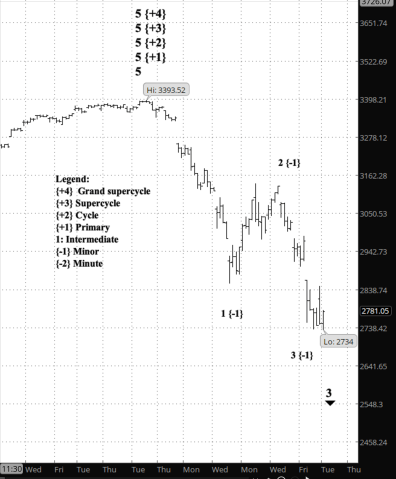
In terms of Elliott wave analysis, the position was opened during Minor wave 3 to the downside.

Premium: $1.42 Expire OTM
SPY-bear call spread Strike Odds Delta
Calls
Long 296.00 90.0% 11
Break-even 288.58 87.5% 16
Short 290.00 85.0% 20

The premium is 47.3% of the width of the position’s wing.

The profit zone covers a 12.9% move to the upside and an unlimited move to the downside of the entry price.

The risk/reward ratio is 3.2:1, with maximum risk of $458 and maximum reward of $142 per contract.

By Tim Bovee, Portland, Oregon, March 12, 2020
Read More »

Live: Thursday, March 12, 2020

3:30 p.m. New York time

I’ve updated the analysis of SPY lot 5 with results.

3:20 p.m. New York time

I’ve exited ny short bear call options spread on SPY, called lot 5 — to distinguish from the many other SPY options positions I’m doing. Results shortly.

10:55 p.m. New York time

I’ve posted two analyses of short bear call spread options positions I entered this morning, SPY lot 6 and SPY lot 7.

10:15 a.m. New York time

The S&P 500 opened below its March 9 low, eliminating the risk that, using Elliott wave terminology, the reversal that ensured was the beginning of a Minor-wave 4 upside correction. I’m counting the continuing downward move as a continuation of the Minor wave 3 impulse wave.

I have entered new short bear call options spread positions on the exchange-traded fund SPY, which tracks the S&P 500, and have also re-entered SDS, an inverse ETF that goes up, double, when SPY goes down, and vice versa.

I’ll post analysis of the two options positions shortly.

As for the stocks, I entered SDS for a debit of $36.55 per share.

My trading was blocked for 15 minutes because the market hit a circuit breaker — again. So the options position in one account (SPY lot 6) was pre-circuit breaker, and in another account (lot 7) was post-circuit breaker. Same entry credit but different strike prices.

By Tim Bovee, Portland, Oregon, March 12, 2020
Read More »

Live: Tuesday, March 10, 2020

3 p.m. New York time

The markets haven’t declared themselves yet, and so I’m deferring entering new bear call spread trades until there’s greater clarity. If SPY (tracking the S&P 500) resumes its downward course, then I see it as a continuation of wave 3 to the downside, and will place trades. If it continues the net sideways path that we’re seeing today, then I shall conclude that we’re in the Minor 4th wave within the Intermediate 1st wave that began February 19. I don’t plan to trade the 4th wave and shall sit it out until the 5th comes along.

12:15 p.m. New York time

I shall begin the day with an Elliott wave analysis of the S&P 500 chart (SPX). As everyone knows, Monday saw an intense decline followed this morning by a bounce and a retreat.

I have only one short bear call options spread position at present, and need to add another so I can continue to capture Minor wave 3 to the downside. Yet, the bounce the troubling, since if it means an upward correction, that cause losses to my bear plays.

Everything is in motion, nothing is for certain, and analysts draw conclusions at their peril. None the less, let’s try to at least think of the possibilities.

Screen Shot 2020-03-10 at 9.12.07 AM

The bounce this morning was 4.2%, and the drop back has moved below yesterday’s low. Before the drop back I was inclined to see the bounce as possibly being the beginning of a wave 4 correction to the upside, ending the 3rd wave down that began March 4.

However, within Intermediate wave 1, that would make Minor wave 3 shorter than the Minor 1st wave, creating an assumption that the future wave 5 would be shorter still. It requires a truncation of Intermediate wave 1 that seems contrary to the power of its decline.

So I’m inclined at this point to see the bounce as just another smaller wave within the continuing 3rd wave decline. I’ll watch things for awhile, and then add more bearish spreads if the SPX chart is playing out as I think it will.

By Tim Bovee, Portland, Oregon, March 10, 2020

Read More »

SPY Analysis (lot 5)

SPDR S&P 500 ETF Trust (SPY)

Note: This post was originally, and incorrectly, labeled as lot 6. “Lot 5” is correct.

Update 3/12/2020I have exited my short bear call options spread, three days after entry, for a $0.49 debit per contract share, a $0.94 profit, as shares were trading for $252.11 per share, down $23.50 from the entry level. The exit came at 64.7% of maximum potential profit.

After I entered the position, SPY did a mini-bump to the upside before continuing its downward movement. The implied volatility rank at the close was 113.8%, 23.9 percentage points higher than at entry.

Shares declined by 8.5% over three days, for a -1,037% annual rate. The options position produced a 189.2% return for an annual rate of +23,2340%.


I have entered a short bear call spread on SPY, using options that trade for the last time 39 days hence, on April 17. The premium is a $1.43 credit and the stock at the time of entry was priced at $276.41

The position is profitable below $300.57.

The implied volatility rank (IVR) stands at 89.8%.

The entry came after a 7-1/2% price drop at the opening. From my Elliott wave analysis, I expect that the present Minor 3rd wave will continue down within an Intermediate 3rd wave.

Premium: $1.43 Expire OTM
SPY-bear call spread Strike Odds Delta
Calls
Long 307.00 90.0% 13
Break-even 300.57 87.5% 17
Short 302.00 85.0% 20

The premium is 57.2% of the width of the position’s wing.

The profit zone covers an 8.7% move to the upside and an unlimited move to the downside of the entry price.

The risk/reward ratio is 2.5:1, with maximum risk of $357 and maximum reward of $143 per contract.

By Tim Bovee, Portland, Oregon, March 9, 2020

Read More »

Live: Monday, March 9, 2020

3:40 p.m. New York time

I’ve exited my shares position in SDS for a $32.19 credit, up $3.23 from the entry price, producing a return of 11.2% over three days, or a +1,357% annual rate.

2:35 p.m. New York time

What I originally labeled as lot 6 of my SPY positions this year should have been numbered lot 5. I’ve corrected this post and the analysis post.

11:15 a.m. New York time

I’ve updated my SPY Analysis (lot 4) posting with results and also posted an analysis for today’s entry, SPY (lot 5).

10:30 a.m. New York time

The markets opened with a powerful push to the downside, almost immediately triggering one of the market circuit breakers that halted trading for 15 minutes.

By my count, the S&P 500 is in the Minor 3rd wave of an Intermediate 3rd wave, which tends to be a powerful combination.

My trades during this phase of the new bear market are limited to short bear call spread positions on SPY, an exchange-traded fund that tracks the S&P 500 index. My options holdings are spread across several brokerage accounts.

I exited my holdings from one account, SPY Lot 4, that I had entered last Thursday, and I entered a new position in another account, SPY Lot 5, after the market resumed trading. All of this within the first half hour after the opening bell.

I plan no further trades today. I’ll defer until tomorrow, or later, trades using the funds from Lot 4 to create a SPY Lot 5 position.

I shall post the results from the Lot 4 exit and analysis of the Lot 6 entry later this morning.

All of the SPYs so far expire April 17. I also have eight short iron condor positions that I entered before the February 19 market downtrend began. They expire March 17 and are poised to lose the maximum possible. They require no action this week but will next week.

By Tim Bovee, Portland, Oregon, March 9, 2020

Read More »

Live: Friday, March 6, 2020

1:55 p.m. New York time

The Federal Reserve’s Sahm Rule Recession Indicator has come in at zero for the third month in a row. The indictor points to a recession when it reaches 0.50 percentage points. I start paying attention at 0.20, although, this time around, with the markets tanking my trading is already positioned for recession.

11:25 a.m. New York time

I’ve posted updates to my analyses of two lots of SPY with results of the trades. The lots are SPY lot 1 and SPY lot 2.

I’m going to wait until Monday before considering replacements for those positions.

10:25 a.m. New York time

By my analysis of the chart, SPY (based on the S&P 500) has entered the 3rd wave of the downtrend, at the Minor level. The 3rd wave will go beyond, perhaps considerably beyond, the low so far in the crash of $285.54.

An alternative reading would have the 2nd wave extending in a more complex pattern. It was the strength of the fall this morning, an opening gap, that persuades me that the 3rd wave interpretation in is most likely.

In response, I’ve enter a share position on SDS, an inverse fund based on the S&P500 that moves double the distance of the underlying, for a $28.96 debit.

My short bear call options spreads on SPY (lots 1 and 2) that I entered on March 3 have half of their maximum potential profit. By my rules, I exit at that point, and did so. I shall update their analyses later this morning.

By Tim Bovee, Portland, Oregon, March 6, 2020

Read More »

Live: Thursday, March 5, 2020

2:35 p.m. New York time

I’ve entered another bear call options spread on SPY, expiring April 20, to replace the similar position, exited for a profit on Wednesday, that mistakenly had a  March 17 expiration. I’ve posted the analysis.

Today’s decline on the chart, through the lens of Elliott wave analysis, looks like the beginning of the 3rd wave of the downward trend. The spread’s entry price on the chart was about $302.

If I’m correct, the price should go below SPY’s  the February 27 low of $285.54, and then continue its downward trek, producing a rapid profit. If I’m wrong and wave C of the 2nd wave correction is still underway, then the expect the price will rise again to around the $310-$312 level. With expiration 43 days away, I think that leaves plenty of time for the position to return to profitability.

By Tim Bovee, Portland, Oregon, March 5, 2020

Read More »

SPY Analysis (lot 4)

SPRD S&P 500 ETF Trust (SPY)

Update 3/9/2020The broad market downtrend, having completed its countertrend correction, resumed its rapid decline. I exited two trading days after entering, at 64% of maximum potential profit. The debit at exit was $0.50 per contract share, down 89 cents from the entry credit of $1.32. Shares were trading at $279.83 when I exited, $22.10 below their entry level.

The Elliott wave analysis shows the corrective 2nd wave peaking on March 4, the day I entered the position, and declining rapidly thereafter, with two opening gaps on the daily chart. I count the declining wave as a Minor 3rd wave within an Intermediate 3rd wave, generally a powerful combination. The implied volatility rank, already high, continue to rise, standing at 125.7% at exit, up 48.2 points from the entry level.

Shares declined by 7.3% over four days, or a -66,613% annual rate. The options position produced a 178% return for a 16,242.5% annual rate.


I have entered a short bear call spread on SPY, using options that trade for the last time 43 days hence, on April 17. The premium is a $1.39 credit and the stock at the time of entry was priced at $301.96

The implied volatility rank (IVR) stands at 77.1%.

This is lot 4 of SPY options traded on March 3.

Premium: $1.39 Expire OTM
SPY-bear call spread Strike Odds Delta
Calls
Long 333.00 91.0% 10
Break-even 323.61 87.0% 15
Short 325.00 83.0% 19

The premium is 34.8% of the width of the position’s wing.

The profit zone covers a 7.2% move to the upside.

The risk/reward ratio is 4.8:1, with maximum risk of $661 and maximum reward of $139 per contract.

By Tim Bovee, Portland, Oregon, March 5, 2020

Read More »

Live: Wednesday, March 4, 2020

12:25 p.m. New York time

I’ve exited my short iron condor position on XBI for a small profit and have updated the analysis with results.

11:25 a.m. New York time

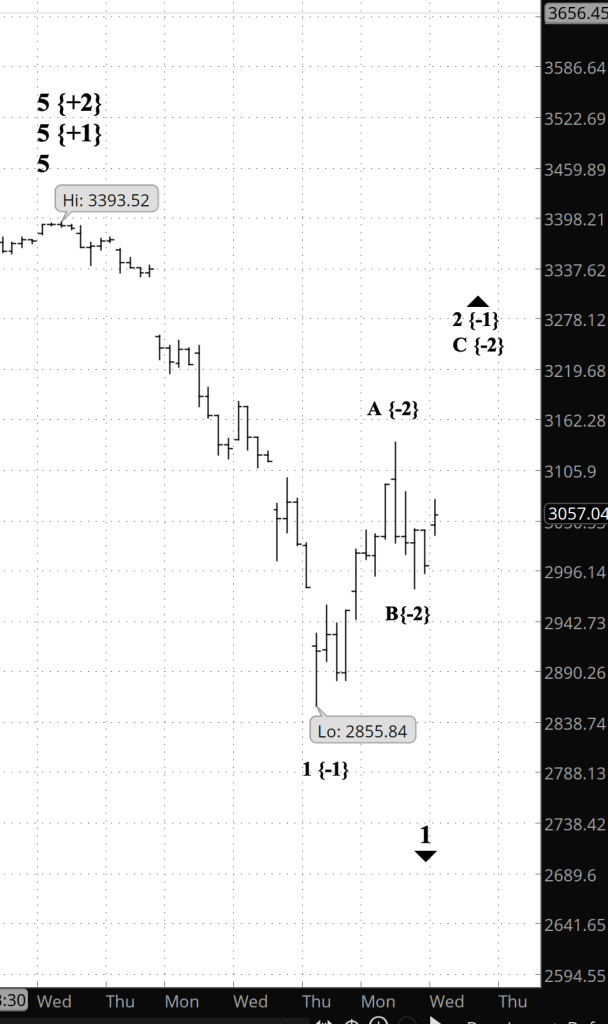
Here’s my current Elliott wave count of the S&P 500 (2-hour bars).

Screen Shot 2020-03-04 at 8.25.48 AM

The wave numbering works like this: On the descending side, no subscript for the Intermediate level, {-1} for Minor and {-2} for Minuette, and on the ascending side, {+1} for Primary and {+2} for Cycle.

The ongoing A-B-C pattern to the right are waves within a Minor counter-trend corrective wave (a 2nd wave). The larger trend is down.

9:45 a.m. New York time

I have exited lot 3 of my SPY short bear call spreads. This was the “March Mistake” position that I mistakenly entered as a March 20 expiration, when I had intended to use the next month’s series, expiring April 17. Under my rules, any position with less than 21 days to go before expiration is to be exited whenever it shows a profit. The lot 3 position, with 16 days to go, was profitable, and so I followed the rule. Results to come soon.

I shall replace it with a position expiring April 17, perhaps IWM or QQQ, to avoid the U.S. tax code’s wash sale rule.

By Tim Bovee, Portland, Oregon, March 4, 2020

Read More »