Trader’s Notebook

3:30 p.m. New York time

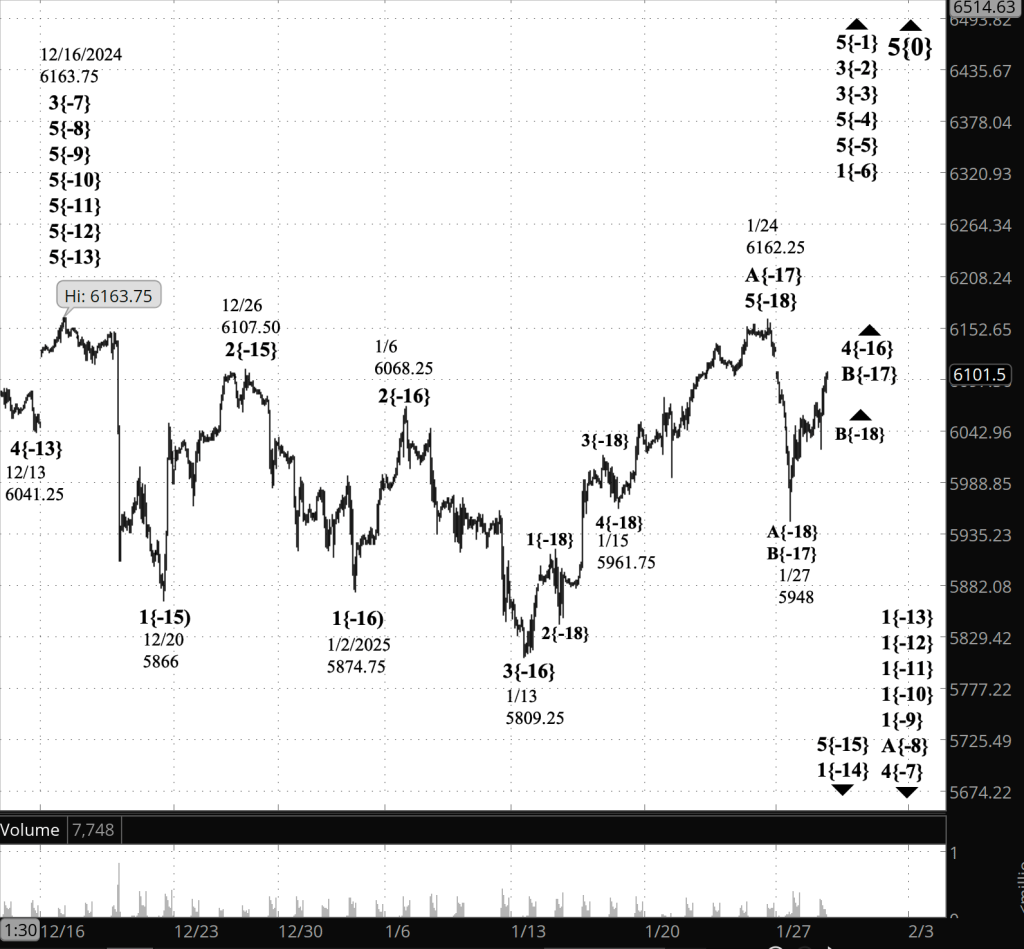
Half an hour before the closing bell. The S&P 500 rose during the session, reaching into the 5990s.

The extent of the rise since January 2 suggests that a 4th-wave upward correction has begun. It seems slightly odd to have the impulse wave declining and the corrective wave rising, but that’s where we have been since the peak on December 16, which marked the end of a very deep series of 5th waves ending a large 3rd wave and beginning a large 4th-wave downward correction that contains a large number of impulse subwaves, each nested within the next larger wave.

How does that work? Remember that the A wave of a correction contains five or three subwaves, depending upon whether the structure is a Zigzag or a Flat. If a Zigzag, then those A wave contains a series of impulse waves, a five-wave structure trending upward, and each of those subwaves contains smaller subwave structure — five waves, three of which contain even smaller subwave structures.

Bottom line: It will take some time for us all, myself included, to become accustomed to the reality of this major-downturn.

9:35 a.m. New York time

What’s happening now? The S&P 500 E-mini futures traded sideways overnight, for the most part fluctuating between the 5920s and the 5950s.

What does it mean? Elliott Wave Theory analysis sees yesterday’s switch from a rise to a sideways trend as being the start a corrective subwave as the downtrending 3rd wave that began on December 26, 2024 has reached its end.

[S&P 500 E-mini futures at 3:30 p.m., 30-minute bars, with volume]

What are the alternatives? There are ambiguities within the 1st-wave’s subwaves but the larger wave count is clear.

What does Elliott wave theory say? Here are the waves that underly the analyses.

Principal Analysis:

  • Rising wave 5{0} is underway. It is a wave of Intermediate degree that began in December 2018.
  • It is in its final subwave, wave 5{-1}.
  • Within wave 5{-1}, rising waves 5{-2}, 5{-3} and 5{-4} are underway, as is wave 5{-5}.
  • Wave 5{-5} is in its initial subwave, wave 1{-6}, which in turn is in its middle subwave, wave 3{-7}.
  • Wave 4{-7} is in its initial; subwave, uptrending wave A{-8}.
  • Wave 1{-8} is in its initial subwave, wave 1{-9}, which is in its final subwave, uptrending wave 5{-10}.
  • Wave 1{-10} is in its initial subwave, as are waves 1{-11}, 1{-12}, and 1{-13}.
  • Wave 4{-14} is presently underway and is rising

Long-term Waves.

These are the waves currently in progress under my principal analysis. Each line on the list shows the wave number, with the subscript in curly brackets, the traditional degree name, the starting date, the starting price of the S&P 500 E-mini futures, and the direction of the wave.

  • S&P 500 Index:
  • 5{+3} Supercycle, 7/8/1932, 4.40 (up)
  • 5{+2} Cycle, 12/9/1974, 60.96 (up)
  • 5{+1} Primary, 3/6/2009, 666.79 (up)
  • 5{0} Intermediate, 12/26/2018, 2346.58 (up)
  • S&P 500 Futures
  • 5{-1} Minor, 10/27/2023, 4127.25 (up)
  • 3{-2} Minute, 10/27/23, 4127.75 (up)
  • 3{-3} Minuette, 10/27/23, 4127.75 (up)
  • 5{-4} Subminuette, 4/18/2024, 4963.50 (up)
  • 5{-5} Micro, 8/5/2024, 5120 (up)
  • 1{-6} Submicro, 8/5/2024, 5120 (up)
  • 4{-7} Minuscule, 12/16/2024, 6163.75 (down)
  • A{-8} (unnamed), 12/16/2024, 6163.75 (down)
  • 1{-9} (unnamed), 12/16/2024, 6163.75 (down)
  • 1{-10} (unnamed), 12/16/2024, 6163.75 (down)
  • 1{-11} (unnamed), 12/16/2024, 6163.75 (down)
  • 1{-12} (unnamed), 12/16/2024, 6163.75 (down)
  • 1{-13} (unnamed), 12/16/2024, 6163.75 (down)
  • 4[-14} (unnamed), 1/2/20245874.75 (up)

Reading the chart. Price movements — waves – – in Elliott wave analysis are labeled with numbers within trending waves and letters with corrective waves. The subscripts — numbers in curly brackets — designate the wave’s degree, which, in Elliott wave analysis, means the relative position of a wave within the larger and smaller structures that make up the chart. R.N. Elliott, who in the 1930s developed the form of analysis that bears his name, viewed the chart as a complex structure of smaller waves nested within larger waves, which in turn are nested within still larger waves. In mathematics it’s called a fractal structure, where at every scale the pattern is similar to the others.

Learning and other resources. Elliott wave analysis provides context, not prophecy. As the 20th century semanticist Alfred Korzybski put it in his book Science and Sanity (1933), “The map is not the territory … The only usefulness of a map depends on similarity of structure between the empirical world and the map.” And I would add, in the ever-changing markets, we can judge that similarity of structure only after the fact.

See the menu page Analytical Methods for a rundown on where to go for information on Elliott wave analysis.

By Tim Bovee, Portland, Oregon, January 3, 2025

Disclaimer

Tim Bovee, Private Trader tracks the analysis and trades of a private trader for his own accounts. Nothing in this blog constitutes a recommendation to buy or sell stocks, options or any other financial instrument. The only purpose of this blog is to provide education and entertainment.

No trader is ever 100 percent successful in his or her trades. Trading in the stock and option markets is risky and uncertain. Each trader must make trading decisions for his or her own account, and take responsibility for the consequences.

License
Creative Commons License

All content on Tim Bovee, Private Trader by Timothy K. Bovee is licensed under a Creative Commons Attribution-ShareAlike 4.0 International License.

Based on a work at www.timbovee.com.

Trader’s Notebook

3:30 p.m. New York time

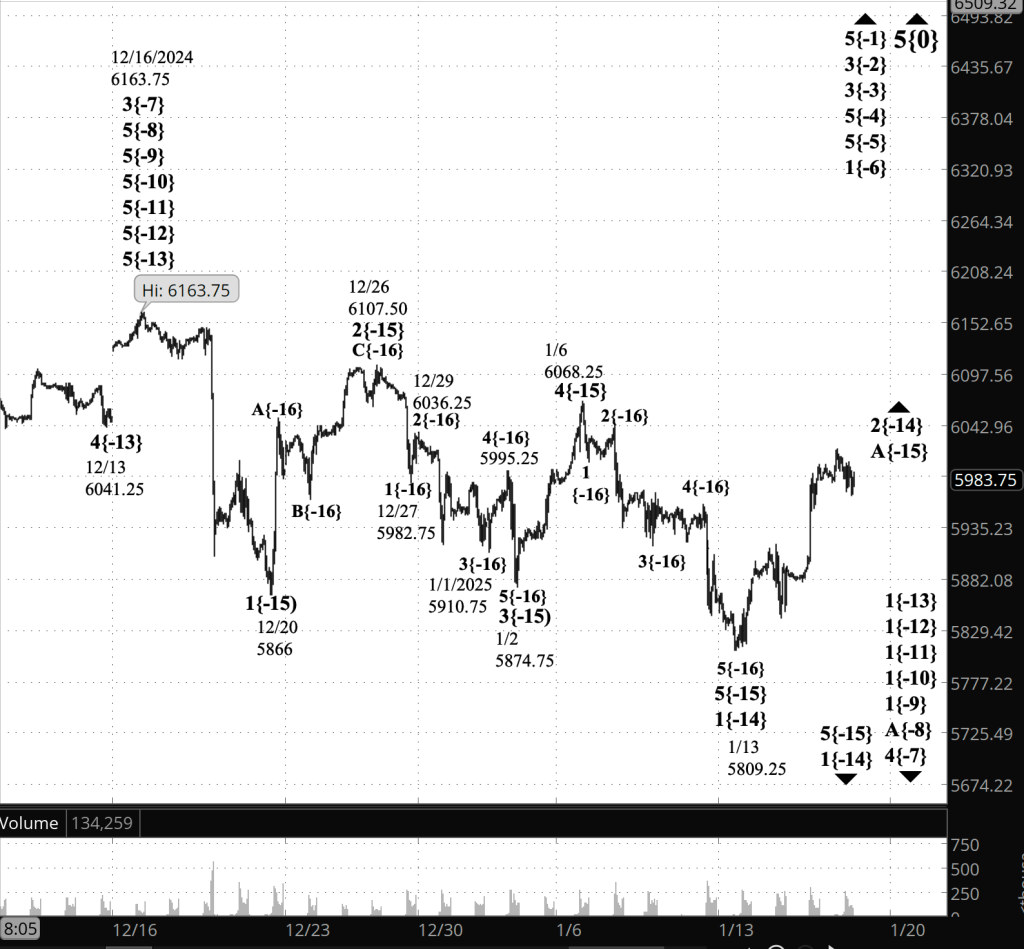
Half an hour before the closing bell. The S&P 500 futures fell during the session, reaching into the 5870s. Elliott Wave Theory: The price remained above the end of the preceding downtrending 1st wave on December 20 — just barely. If the price falls below that endpoint, 5866, it will confirm this morning’s principal analysis, that sees the 3rd-wave downtrend as having begun December 26 2024.

If the price stays above that level, then the alternative analysis may well stand a chance; the 2nd-wave upward correction may still be underway.

9:35 a.m. New York time

What’s happening now? The S&P 500 E-mini futures rose gently after trading resumed overnight, from the 5910s to the 5990s and the reversed.

What does it mean? It depends. For my principal analysis using Elliott Wave Theory, I’ve labeled the rising 2nd-wave correction since the the December 16, 2024 peak as having ended on December 26. The declne that followed is the middle subwave — wave 3 — within a larger declining 1st wave. There is an alternative. See “What are the alternatives” below.

Whichever alternatve we choose, what is clear s that the December 16 peak marked a significant turning point covering seven degrees within the fractal structure of the chart, marking the end of wave 3 of the Minuscule degree, to use the traditional naming structure and the beginning of wave 4.

What are the alternatives? It is possible to see the December 26 reversal as the end of wave A within the 2nd-wave upward correction and the decline as wave B, the middle wave of the correction. A decline below the end of the preceding 1st wave would knock out the alternative analysis and confirm the principal analysis.

[S&P 500 E-mini futures at 3:30 p.m., 30-minute bars, with volume]

What does Elliott wave theory say? Here are the waves that underly the analyses.

Principal Analysis:

  • Rising wave 5{0} is underway. It is a wave of Intermediate degree that began in December 2018.
  • It is in its final subwave, wave 5{-1}.
  • Within wave 5{-1}, rising waves 5{-2}, 5{-3} and 5{-4} are underway, as is wave 5{-5}.
  • Wave 5{-5} is in its initial subwave, wave 1{-6}, which in turn is in its middle subwave, wave 3{-7}.
  • Wave 4{-7} is in its initial; subwave, uptrending wave A{-8}.
  • Wave 1{-8} is in its initial subwave, wave 1{-9}, which is in its final subwave, uptrending wave 5{-10}.
  • Wave 1{-10} is in its initial subwave, as are waves 1{-11}, 1{-12}, and 1{-13}.
  • Wave 3{-14} is presently underway and is declining

Alternative Analysis:

  • Wave 1{-10} is in its initial subwave, as are waves 1{-11}, 1{-12}, and 1{-13}.
  • Wave 2{-14} is presently underway and is in its decling wave B{-15}

Long-term Waves.

These are the waves currently in progress under my principal analysis. Each line on the list shows the wave number, with the subscript in curly brackets, the traditional degree name, the starting date, the starting price of the S&P 500 E-mini futures, and the direction of the wave.

  • S&P 500 Index:
  • 5{+3} Supercycle, 7/8/1932, 4.40 (up)
  • 5{+2} Cycle, 12/9/1974, 60.96 (up)
  • 5{+1} Primary, 3/6/2009, 666.79 (up)
  • 5{0} Intermediate, 12/26/2018, 2346.58 (up)
  • S&P 500 Futures
  • 5{-1} Minor, 10/27/2023, 4127.25 (up)
  • 3{-2} Minute, 10/27/23, 4127.75 (up)
  • 3{-3} Minuette, 10/27/23, 4127.75 (up)
  • 5{-4} Subminuette, 4/18/2024, 4963.50 (up)
  • 5{-5} Micro, 8/5/2024, 5120 (up)
  • 1{-6} Submicro, 8/5/2024, 5120 (up)
  • 4{-7} Minuscule, 12/16/2024, 6163.75 (down)
  • A{-8} (unnamed), 12/16/2024, 6163.75 (down)
  • 1{-9} (unnamed), 12/16/2024, 6163.75 (down)
  • 1{-10} (unnamed), 12/16/2024, 6163.75 (down)
  • 1{-11} (unnamed), 12/16/2024, 6163.75 (down)
  • 1{-12} (unnamed), 12/16/2024, 6163.75 (down)
  • 1{-13} (unnamed), 12/16/2024, 6163.75 (down)
  • 3[-14} (unnamed), 12/26/20245866 (down)

Reading the chart. Price movements — waves – – in Elliott wave analysis are labeled with numbers within trending waves and letters with corrective waves. The subscripts — numbers in curly brackets — designate the wave’s degree, which, in Elliott wave analysis, means the relative position of a wave within the larger and smaller structures that make up the chart. R.N. Elliott, who in the 1930s developed the form of analysis that bears his name, viewed the chart as a complex structure of smaller waves nested within larger waves, which in turn are nested within still larger waves. In mathematics it’s called a fractal structure, where at every scale the pattern is similar to the others.

Learning and other resources. Elliott wave analysis provides context, not prophecy. As the 20th century semanticist Alfred Korzybski put it in his book Science and Sanity (1933), “The map is not the territory … The only usefulness of a map depends on similarity of structure between the empirical world and the map.” And I would add, in the ever-changing markets, we can judge that similarity of structure only after the fact.

See the menu page Analytical Methods for a rundown on where to go for information on Elliott wave analysis.

By Tim Bovee, Portland, Oregon, January 2, 2025

Disclaimer

Tim Bovee, Private Trader tracks the analysis and trades of a private trader for his own accounts. Nothing in this blog constitutes a recommendation to buy or sell stocks, options or any other financial instrument. The only purpose of this blog is to provide education and entertainment.

No trader is ever 100 percent successful in his or her trades. Trading in the stock and option markets is risky and uncertain. Each trader must make trading decisions for his or her own account, and take responsibility for the consequences.

License
Creative Commons License

All content on Tim Bovee, Private Trader by Timothy K. Bovee is licensed under a Creative Commons Attribution-ShareAlike 4.0 International License.

Based on a work at www.timbovee.com.
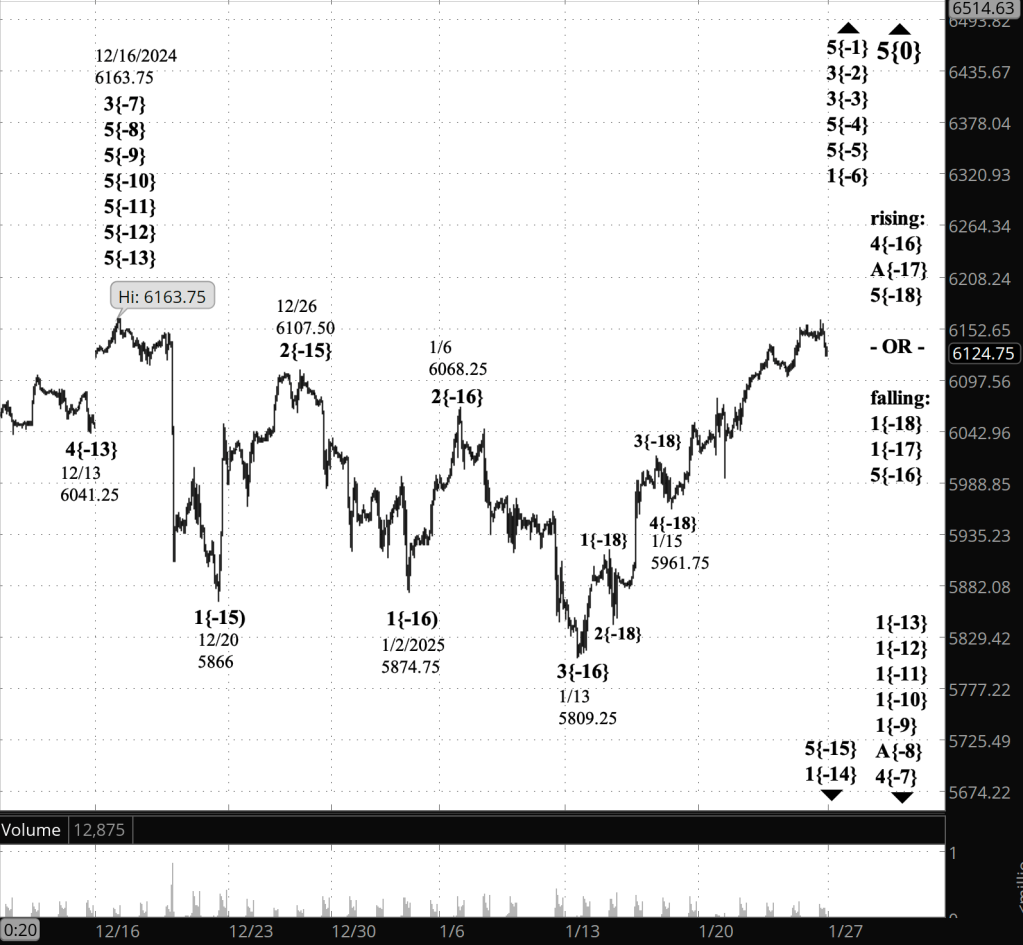
Trader’s Notebook

The New Year’s Holiday is on Wednesday, January 1. All financial markets will be closed on on that day as 2025 starts its run. All market schedules will return to normal on Thursday, January 2.

3:30 p.m. New York time

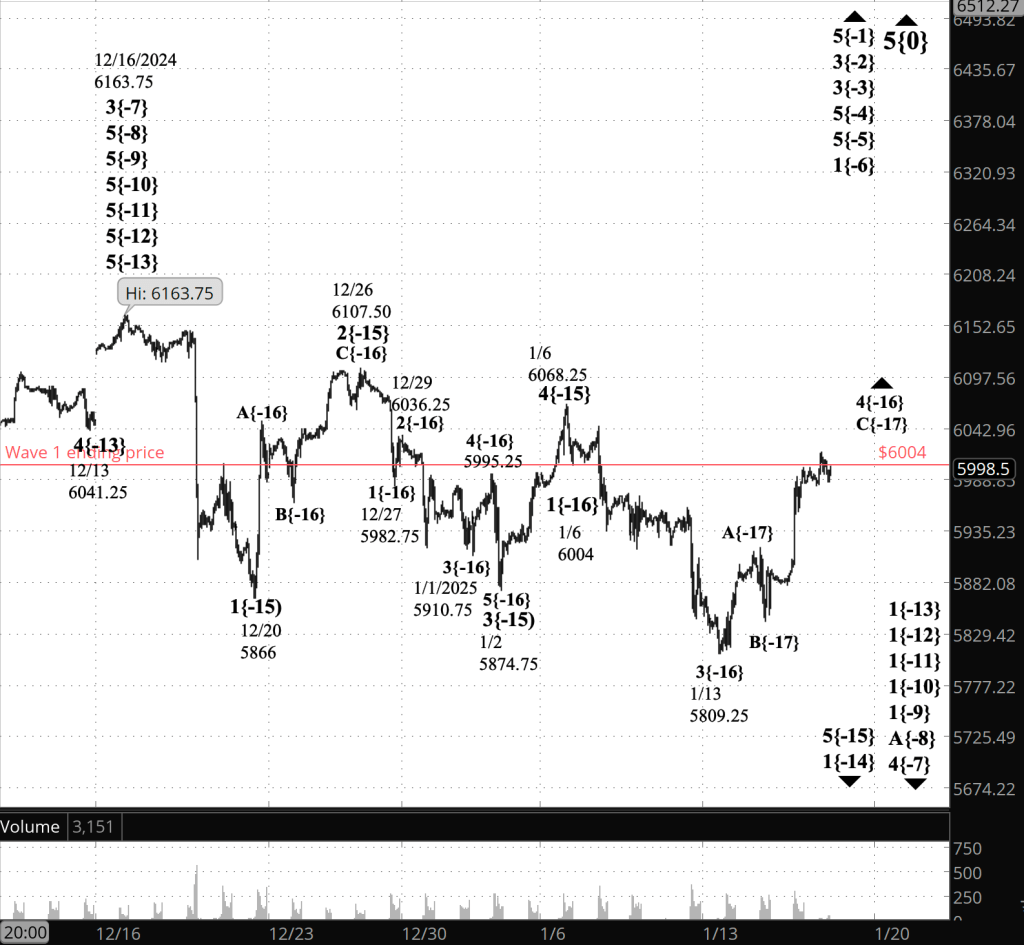
Half an hour before the closing bell. The S&P 500 futures continued to fall during the session, reaching into the 5910s. Elliott Wave Theory: The downtrending 3rd wave that began on December 26 continues.

9:35 a.m. New York time

What’s happening now? The S&P 500 E-mini futures rose overnight, from the 5940s to the 5980s.

What does it mean? I’ve reworked my principal analysis somewhat. Under the new analysis, Elliott Wave Theory sees the rise a part of a downtrending 3rd wave that began on December 26. It is in turn is happening within a nested series of downtrending impulse waves, all of them 1st waves, within a very large 4th-wave downward correction that began on December 16.

[S&P 500 E-mini futures at 3:30 p.m., 30-minute bars, with volume]

What are the alternatives? Not at present. Ambiguities will develop.

What does Elliott wave theory say? Here are the waves that underly the analyses.

Principal Analysis:

  • .Rising wave 5{0} is underway. It is a wave of Intermediate degree that began in December 2018.
  • It is in its final subwave, wave 5{-1}.
  • Within wave 5{-1}, rising waves 5{-2}, 5{-3} and 5{-4} are underway, as is wave 5{-5}.
  • Wave 5{-5} is in its initial subwave, wave 1{-6}, which in turn is in its middle subwave, wave 3{-7}.
  • Wave 4{-7} is in its initial; subwave, uptrending wave A{-8}.
  • Wave 1{-8} is in its initial subwave, wave 1{-9}, which is in its final subwave, uptrending wave 5{-10}.
  • Wave 1{-10} is in its initial subwave, as are waves 1{-11}, 1{-12}, and 1{-13}.
  • Wave 3{-14} is presently underway and is declining

Long-term Waves.

These are the waves currently in progress under my principal analysis. Each line on the list shows the wave number, with the subscript in curly brackets, the traditional degree name, the starting date, the starting price of the S&P 500 E-mini futures, and the direction of the wave.

  • S&P 500 Index:
  • 5{+3} Supercycle, 7/8/1932, 4.40 (up)
  • 5{+2} Cycle, 12/9/1974, 60.96 (up)
  • 5{+1} Primary, 3/6/2009, 666.79 (up)
  • 5{0} Intermediate, 12/26/2018, 2346.58 (up)
  • S&P 500 Futures
  • 5{-1} Minor, 10/27/2023, 4127.25 (up)
  • 3{-2} Minute, 10/27/23, 4127.75 (up)
  • 3{-3} Minuette, 10/27/23, 4127.75 (up)
  • 5{-4} Subminuette, 4/18/2024, 4963.50 (up)
  • 5{-5} Micro, 8/5/2024, 5120 (up)
  • 1{-6} Submicro, 8/5/2024, 5120 (up)
  • 4{-7} Minuscule, 12/16/2024, 6163.75 (down)
  • A{-8} (unnamed), 12/16/2024, 6163.75 (down)
  • 1{-9} (unnamed), 12/16/2024, 6163.75 (down)
  • 1{-10} (unnamed), 12/16/2024, 6163.75 (down)
  • 1{-11} (unnamed), 12/16/2024, 6163.75 (down)
  • 1{-12} (unnamed), 12/16/2024, 6163.75 (down)
  • 1{-13} (unnamed), 12/16/2024, 6163.75 (down)
  • 3[-14} (unnamed), 12/26/20245866 (down)

Reading the chart. Price movements — waves – – in Elliott wave analysis are labeled with numbers within trending waves and letters with corrective waves. The subscripts — numbers in curly brackets — designate the wave’s degree, which, in Elliott wave analysis, means the relative position of a wave within the larger and smaller structures that make up the chart. R.N. Elliott, who in the 1930s developed the form of analysis that bears his name, viewed the chart as a complex structure of smaller waves nested within larger waves, which in turn are nested within still larger waves. In mathematics it’s called a fractal structure, where at every scale the pattern is similar to the others.

Learning and other resources. Elliott wave analysis provides context, not prophecy. As the 20th century semanticist Alfred Korzybski put it in his book Science and Sanity (1933), “The map is not the territory … The only usefulness of a map depends on similarity of structure between the empirical world and the map.” And I would add, in the ever-changing markets, we can judge that similarity of structure only after the fact.

See the menu page Analytical Methods for a rundown on where to go for information on Elliott wave analysis.

By Tim Bovee, Portland, Oregon, December 31, 2024

Disclaimer

Tim Bovee, Private Trader tracks the analysis and trades of a private trader for his own accounts. Nothing in this blog constitutes a recommendation to buy or sell stocks, options or any other financial instrument. The only purpose of this blog is to provide education and entertainment.

No trader is ever 100 percent successful in his or her trades. Trading in the stock and option markets is risky and uncertain. Each trader must make trading decisions for his or her own account, and take responsibility for the consequences.

License
Creative Commons License

All content on Tim Bovee, Private Trader by Timothy K. Bovee is licensed under a Creative Commons Attribution-ShareAlike 4.0 International License.

Based on a work at www.timbovee.com.
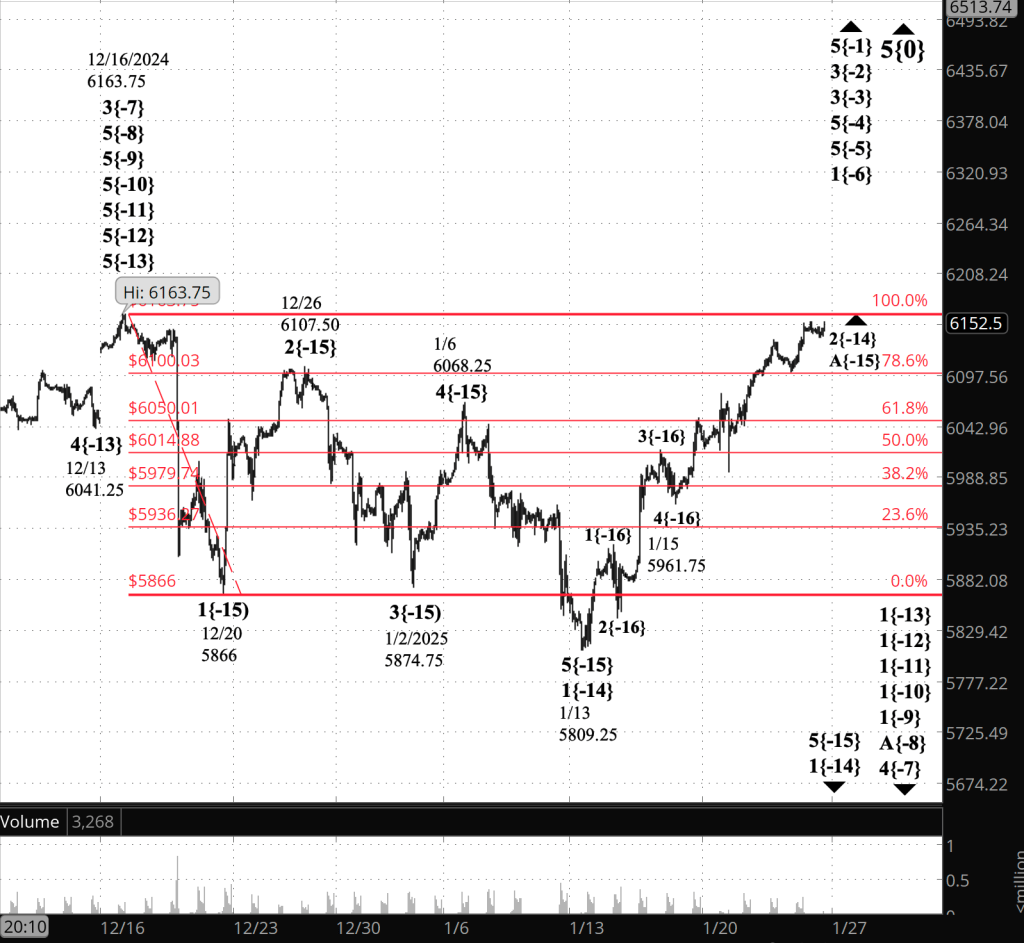
Trader’s Notebook

3:30 p.m. New York time

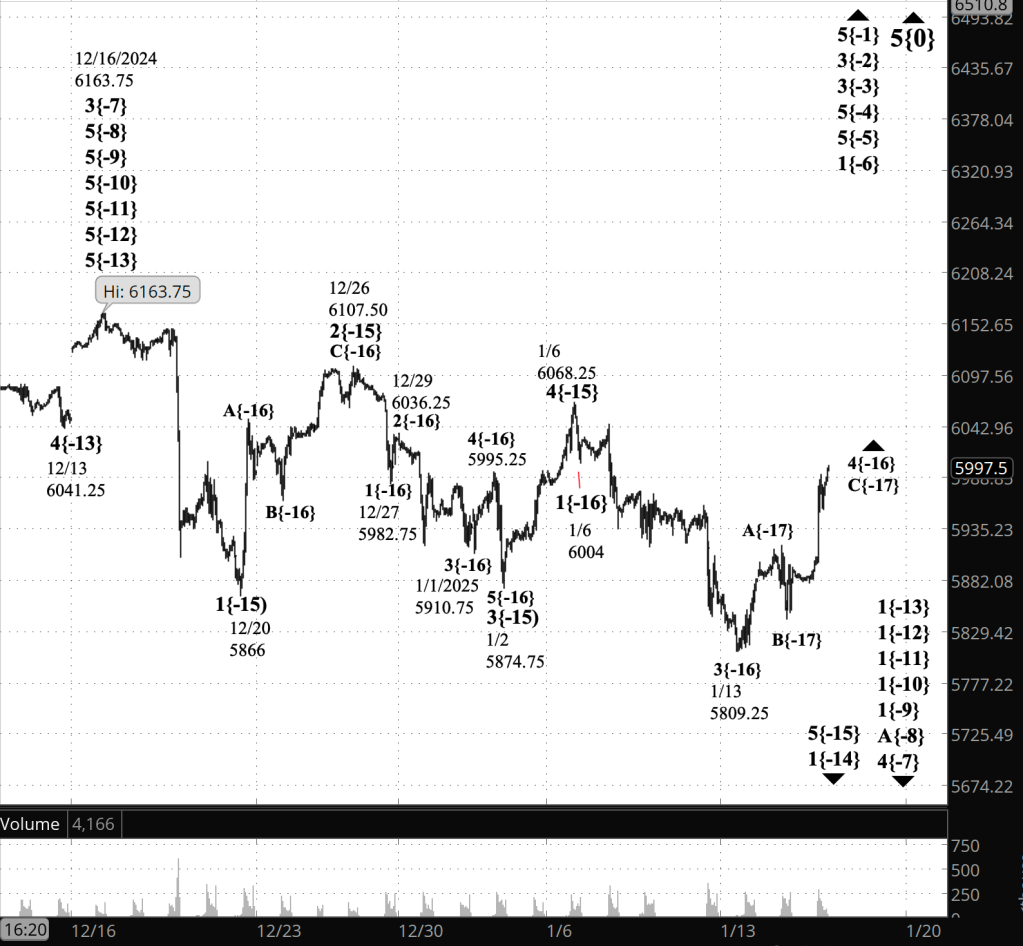
Half an hour before the closing bell. The S&P 500 futures reached 5918.25 early in the session and the reversed, rising back into the 5970s.

Elliott Wave Theory can interpret the chart in two ways: Either the 4th-wave correction is a Zigzag and session low point is the end of the third of five subwaves within the correction’s wave A. Or the correction is a Flat and the low is the end of the A wave’s final subwave. In the latter case, the A wave has ended and wave B is underway.

I’ve chosen to use the second scenario — wave A is over and wave B has begun. But I could just as easily gone with the first one — wave A continues. There’s no way to know for sure from this chart. If the price moves below the session low, 5918.85, then wave A continues. If instead it moves higher, then wave B has begun.

9:35 a.m. New York time

What’s happening now? The S&P 500 E-mini futures drifted lower after trading resumed overnight, beginning a sharp decline two hours before the opening bell.

What does it mean? Seen through the lens of Elliott Wave Theory, the sharp decline is the next-to-the-last subwave — wave 4 –within the final subwave — wave C — within the 2nd-wave upward correction that began on December 20.

The rising 2nd wave is in turn a subwave of a 1st waves that began on December 16, the smallest of a nested series of five 1st waves within a falling A wave, the initial subwave within a 4th-wave downward correction. It’s part of a significant decline that began with the completion on December 16 of a nested series of 5th waves within a rising 3rd wave that began on August 7 from 5182.

[S&P 500 E-mini futures at 3:30 p.m., 30-minute bars, with volume]

What are the alternatives? The decline resolved the ambiguity with which we closed the week. The December 26 peak was the end of wave 3 within wave C.

What does Elliott wave theory say? Here are the waves that underly the analyses.

Principal Analysis:

  • .Rising wave 5{0} is underway. It is a wave of Intermediate degree that began in December 2018.
  • It is in its final subwave, wave 5{-1}.
  • Within wave 5{-1}, rising waves 5{-2}, 5{-3} and 5{-4} are underway, as is wave 5{-5}.
  • Wave 5{-5} is in its initial subwave, wave 1{-6}, which in turn is in its middle subwave, wave 3{-7}.
  • Wave 4{-7} is in its initial; subwave, uptrending wave A{-8}.
  • Wave 1{-8} is in its initial subwave, wave 1{-9}, which is in its final subwave, uptrending wave 5{-10}.
  • Wave 1{-10} is in its initial subwave, as are waves 1{-11}, 1{-12}, and 1{-13}.
  • Wave 2{-14} appears to be underway and is in its final subwave, wave C{-15}
  • Wave C-15) is in its next-to-the-last subwave, wave 4{-16}.

Long-term Waves.

These are the waves currently in progress under my principal analysis. Each line on the list shows the wave number, with the subscript in curly brackets, the traditional degree name, the starting date, the starting price of the S&P 500 E-mini futures, and the direction of the wave.

  • S&P 500 Index:
  • 5{+3} Supercycle, 7/8/1932, 4.40 (up)
  • 5{+2} Cycle, 12/9/1974, 60.96 (up)
  • 5{+1} Primary, 3/6/2009, 666.79 (up)
  • 5{0} Intermediate, 12/26/2018, 2346.58 (up)
  • S&P 500 Futures
  • 5{-1} Minor, 10/27/2023, 4127.25 (up)
  • 3{-2} Minute, 10/27/23, 4127.75 (up)
  • 3{-3} Minuette, 10/27/23, 4127.75 (up)
  • 5{-4} Subminuette, 4/18/2024, 4963.50 (up)
  • 5{-5} Micro, 8/5/2024, 5120 (up)
  • 1{-6} Submicro, 8/5/2024, 5120 (up)
  • 4{-7} Minuscule, 12/16/2024, 6163.75 (down)
  • A{-8} (unnamed), 12/16/2024, 6163.75 (down)
  • 1{-9} (unnamed), 12/16/2024, 6163.75 (down)
  • 1{-10} (unnamed), 12/16/2024, 6163.75 (down)
  • 1{-11} (unnamed), 12/16/2024, 6163.75 (down)
  • 1{-12} (unnamed), 12/16/2024, 6163.75 (down)
  • 1{-13} (unnamed), 12/16/2024, 6163.75 (down)
  • 2[-14} (unnamed), 12/20/20245866 (up)
  • C{-15} (unnamed), 12/23/2024, 5965 (up)

Reading the chart. Price movements — waves – – in Elliott wave analysis are labeled with numbers within trending waves and letters with corrective waves. The subscripts — numbers in curly brackets — designate the wave’s degree, which, in Elliott wave analysis, means the relative position of a wave within the larger and smaller structures that make up the chart. R.N. Elliott, who in the 1930s developed the form of analysis that bears his name, viewed the chart as a complex structure of smaller waves nested within larger waves, which in turn are nested within still larger waves. In mathematics it’s called a fractal structure, where at every scale the pattern is similar to the others.

Learning and other resources. Elliott wave analysis provides context, not prophecy. As the 20th century semanticist Alfred Korzybski put it in his book Science and Sanity (1933), “The map is not the territory … The only usefulness of a map depends on similarity of structure between the empirical world and the map.” And I would add, in the ever-changing markets, we can judge that similarity of structure only after the fact.

See the menu page Analytical Methods for a rundown on where to go for information on Elliott wave analysis.

By Tim Bovee, Portland, Oregon, December 30, 2024

Disclaimer

Tim Bovee, Private Trader tracks the analysis and trades of a private trader for his own accounts. Nothing in this blog constitutes a recommendation to buy or sell stocks, options or any other financial instrument. The only purpose of this blog is to provide education and entertainment.

No trader is ever 100 percent successful in his or her trades. Trading in the stock and option markets is risky and uncertain. Each trader must make trading decisions for his or her own account, and take responsibility for the consequences.

License
Creative Commons License

All content on Tim Bovee, Private Trader by Timothy K. Bovee is licensed under a Creative Commons Attribution-ShareAlike 4.0 International License.

Based on a work at www.timbovee.com.

Trader’s Notebook

The market schedules return to normal. The session closes at 3:30 p.m. New York time.

3:30 p.m. New York time.

Half an hour before the closing bell. The S&P 500 futures continued to fall during the session, into the 5980s so far. The decline is part of the 4th-wave downward correction within the final subwave — wave C — within the 2nd-wave upward correction that that began on December 20.

9:35 a.m. New York time

What’s happening now? The S&P 500 E-mini futures fell from the 6090s to 6050 overnight.

What does it mean? In the terminology of Elliott Wave Theory, the decline is part of the wave 4 within wave C, the final subwave within the 2nd-wave upward correction that began on December 20.

Wave 5, the final subwave within wave C, will follow, rising to complete the final wave within the correction’s three-wave structure.

[S&P 500 E-mini futures at 3:30 p.m., hourly bars, with volume]

What are the alternatives? The continued rise and then downward turn left the internal structure of wave C, continuing yesterday’s ambiguity: Was the December 26 peak the end of wave 5 or wave 3. I chose wave 3 as my principal analysis.

What does Elliott wave theory say? Here are the waves that underly the analyses.

Principal Analysis:

  • Rising wave 5{0} is underway. It is a wave of Intermediate degree that began in December 2018.
  • It is in its final subwave, wave 5{-1}.
  • Within wave 5{-1}, rising waves 5{-2}, 5{-3} and 5{-4} are underway, as is wave 5{-5}.
  • Wave 5{-5} is in its initial subwave, wave 1{-6}, which in turn is in its middle subwave, wave 3{-7}.
  • Wave 4{-7} is in its initial; subwave, uptrending wave A{-8}.
  • Wave 1{-8} is in its initial subwave, wave 1{-9}, which is in its final subwave, uptrending wave 5{-10}.
  • Wave 1{-10} is in its initial subwave, as are waves 1{-11}, 1{-12}, and 1{-13}.
  • Wave 2{-14} appears to be underway and is in its final subwave, wave C{-15}
  • Wave C-15) is in its next-to-the-last subwave, wave 4{-16}.

Long-term Waves.

These are the waves currently in progress under my principal analysis. Each line on the list shows the wave number, with the subscript in curly brackets, the traditional degree name, the starting date, the starting price of the S&P 500 E-mini futures, and the direction of the wave.

  • S&P 500 Index:
  • 5{+3} Supercycle, 7/8/1932, 4.40 (up)
  • 5{+2} Cycle, 12/9/1974, 60.96 (up)
  • 5{+1} Primary, 3/6/2009, 666.79 (up)
  • 5{0} Intermediate, 12/26/2018, 2346.58 (up)
  • S&P 500 Futures
  • 5{-1} Minor, 10/27/2023, 4127.25 (up)
  • 3{-2} Minute, 10/27/23, 4127.75 (up)
  • 3{-3} Minuette, 10/27/23, 4127.75 (up)
  • 5{-4} Subminuette, 4/18/2024, 4963.50 (up)
  • 5{-5} Micro, 8/5/2024, 5120 (up)
  • 1{-6} Submicro, 8/5/2024, 5120 (up)
  • 4{-7} Minuscule, 12/16/2024, 6163.75 (down)
  • A{-8} (unnamed), 12/16/2024, 6163.75 (down)
  • 1{-9} (unnamed), 12/16/2024, 6163.75 (down)
  • 1{-10} (unnamed), 12/16/2024, 6163.75 (down)
  • 1{-11} (unnamed), 12/16/2024, 6163.75 (down)
  • 1{-12} (unnamed), 12/16/2024, 6163.75 (down)
  • 1{-13} (unnamed), 12/16/2024, 6163.75 (down)
  • 2[-14} (unnamed), 12/20/20245866 (up)
  • C{-15} (unnamed), 12/23/2024, 5965 (up)

Reading the chart. Price movements — waves – – in Elliott wave analysis are labeled with numbers within trending waves and letters with corrective waves. The subscripts — numbers in curly brackets — designate the wave’s degree, which, in Elliott wave analysis, means the relative position of a wave within the larger and smaller structures that make up the chart. R.N. Elliott, who in the 1930s developed the form of analysis that bears his name, viewed the chart as a complex structure of smaller waves nested within larger waves, which in turn are nested within still larger waves. In mathematics it’s called a fractal structure, where at every scale the pattern is similar to the others.

Learning and other resources. Elliott wave analysis provides context, not prophecy. As the 20th century semanticist Alfred Korzybski put it in his book Science and Sanity (1933), “The map is not the territory … The only usefulness of a map depends on similarity of structure between the empirical world and the map.” And I would add, in the ever-changing markets, we can judge that similarity of structure only after the fact.

See the menu page Analytical Methods for a rundown on where to go for information on Elliott wave analysis.

By Tim Bovee, Portland, Oregon, December 27, 2024

Disclaimer

Tim Bovee, Private Trader tracks the analysis and trades of a private trader for his own accounts. Nothing in this blog constitutes a recommendation to buy or sell stocks, options or any other financial instrument. The only purpose of this blog is to provide education and entertainment.

No trader is ever 100 percent successful in his or her trades. Trading in the stock and option markets is risky and uncertain. Each trader must make trading decisions for his or her own account, and take responsibility for the consequences.

License
Creative Commons License

All content on Tim Bovee, Private Trader by Timothy K. Bovee is licensed under a Creative Commons Attribution-ShareAlike 4.0 International License.

Based on a work at www.timbovee.com.

Trader’s Notebook

U.S. Markets will close early today, at 1 p.m. New York time.

12:30 p.m. New York time

Half an hour before the closing bell. The S&P 500 futures rose to 6107.50, a few points above the morning high. The C-wave within the 2nd-wave upward correction that began on December 20 continues.

9:35 a.m. New York time

What’s happening now? When trading resumed overnight after the Christmas holiday, the S&P 500 E-mini futures peaked early, at 6105, and then drifted lower into the 6060s as the opening bell approached..

What does it mean? The Elliott Wave Theory question of the day is whether that peak was the end of the 2nd-wave upward correction that began on December 20. The correction is in its final subwave — wave C — which in turn will have five subwaves. Is the peak the the end of wave 3 or of wave 5?

This is one of those subjective points that make Elliott Wave Theory difficult at times. Wave 1 within wave C is either very small, in the 5th-wave scenario, or it is the longest of the five subwaves, in the 3rd-wave scenario. Under the Theory’s rules, a 3rd wave can never be the longest of the five-wave struture.

My inclination is to be go with the 3rd-wave scenario, but it is far from being a certainty, with wave C in its middle subwave, wave 3.

[S&P 500 E-mini futures at 9:35 a.m., hourly bars, with volume]

What are the alternatives? See the ambiguity described above in the “What does it mean?” section.

What does Elliott wave theory say? Here are the waves that underly the analyses.

Principal Analysis:

  • .Rising wave 5{0} is underway. It is a wave of Intermediate degree that began in December 2018.
  • It is in its final subwave, wave 5{-1}.
  • Within wave 5{-1}, rising waves 5{-2}, 5{-3} and 5{-4} are underway, as is wave 5{-5}.
  • Wave 5{-5} is in its initial subwave, wave 1{-6}, which in turn is in its middle subwave, wave 3{-7}.
  • Wave 4{-7} is in its initial; subwave, uptrending wave A{-8}.
  • Wave 1{-8} is in its initial subwave, wave 1{-9}, which is in its final subwave, uptrending wave 5{-10}.
  • Wave 1{-10} is in its initial subwave, as are waves 1{-11}, 1{-12}, and 1{-13}.
  • Wave 2{-14} appears to be underway and is in its final subwave, wave C{-15}.

Long-term Waves.

These are the waves currently in progress under my principal analysis. Each line on the list shows the wave number, with the subscript in curly brackets, the traditional degree name, the starting date, the starting price of the S&P 500 E-mini futures, and the direction of the wave.

  • S&P 500 Index:
  • 5{+3} Supercycle, 7/8/1932, 4.40 (up)
  • 5{+2} Cycle, 12/9/1974, 60.96 (up)
  • 5{+1} Primary, 3/6/2009, 666.79 (up)
  • 5{0} Intermediate, 12/26/2018, 2346.58 (up)
  • S&P 500 Futures
  • 5{-1} Minor, 10/27/2023, 4127.25 (up)
  • 3{-2} Minute, 10/27/23, 4127.75 (up)
  • 3{-3} Minuette, 10/27/23, 4127.75 (up)
  • 5{-4} Subminuette, 4/18/2024, 4963.50 (up)
  • 5{-5} Micro, 8/5/2024, 5120 (up)
  • 1{-6} Submicro, 8/5/2024, 5120 (up)
  • 4{-7} Minuscule, 12/16/2024, 6163.75 (down)
  • A{-8} (unnamed), 12/16/2024, 6163.75 (down)
  • 1{-9} (unnamed), 12/16/2024, 6163.75 (down)
  • 1{-10} (unnamed), 12/16/2024, 6163.75 (down)
  • 1{-11} (unnamed), 12/16/2024, 6163.75 (down)
  • 1{-12} (unnamed), 12/16/2024, 6163.75 (down)
  • 1{-13} (unnamed), 12/16/2024, 6163.75 (down)
  • 2[-14} (unnamed), 12/20/20245866 (up)
  • C{-15} (unnamed), 12/23/2024, 5965 (up)

Reading the chart. Price movements — waves – – in Elliott wave analysis are labeled with numbers within trending waves and letters with corrective waves. The subscripts — numbers in curly brackets — designate the wave’s degree, which, in Elliott wave analysis, means the relative position of a wave within the larger and smaller structures that make up the chart. R.N. Elliott, who in the 1930s developed the form of analysis that bears his name, viewed the chart as a complex structure of smaller waves nested within larger waves, which in turn are nested within still larger waves. In mathematics it’s called a fractal structure, where at every scale the pattern is similar to the others.

Learning and other resources. Elliott wave analysis provides context, not prophecy. As the 20th century semanticist Alfred Korzybski put it in his book Science and Sanity (1933), “The map is not the territory … The only usefulness of a map depends on similarity of structure between the empirical world and the map.” And I would add, in the ever-changing markets, we can judge that similarity of structure only after the fact.

See the menu page Analytical Methods for a rundown on where to go for information on Elliott wave analysis.

By Tim Bovee, Portland, Oregon, December 26, 2024

Disclaimer

Tim Bovee, Private Trader tracks the analysis and trades of a private trader for his own accounts. Nothing in this blog constitutes a recommendation to buy or sell stocks, options or any other financial instrument. The only purpose of this blog is to provide education and entertainment.

No trader is ever 100 percent successful in his or her trades. Trading in the stock and option markets is risky and uncertain. Each trader must make trading decisions for his or her own account, and take responsibility for the consequences.

License
Creative Commons License

All content on Tim Bovee, Private Trader by Timothy K. Bovee is licensed under a Creative Commons Attribution-ShareAlike 4.0 International License.

Based on a work at www.timbovee.com.

Trader’s Notebook

The markets close early today. The U.S. stock markets will close at 1 p.m. New York time. The bond markets will close an hour later. All markets will be closed on Wednesday for the Christmas holiday and will resume regular hours on Thursday. The Trader’s Notebook afternoon analysis will be posted at 12:30 p.m. New York time today.

12:30 p.m. New York time

Half an hour before the closing bell. The S&P 500 futures rose further during the truncated session, reaching into the 6090s

Elliott Wave Theory: The final wave within the 2nd-wave upward correction that began on December 20 continues.

9:35 a.m. New York time

What’s happening now? The S&P 500 E-mini futures slowly stair-stepped its way higher overnight, from a low of 6030 shortly after yesterday’s closing bell to the 6050s as today’s opening bell approached.

What does it mean?

In Elliott Wave Theory, the final subwave — wave C — within the 2nd-wave upward correction that began on December 20 continues. The correction will be followed by a downtrending 3rd wave, typically the strongest and longest of a five-wave trend.

[S&P 500 E-mini futures at 12:30 p.m., hourly bars, with volume]

What are the alternatives? No ambiguities yet. They will come.

What does Elliott wave theory say? Here are the waves that underly the analyses.

Principal Analysis:

  • .Rising wave 5{0} is underway. It is a wave of Intermediate degree that began in December 2018.
  • It is in its final subwave, wave 5{-1}.
  • Within wave 5{-1}, rising waves 5{-2}, 5{-3} and 5{-4} are underway, as is wave 5{-5}.
  • Wave 5{-5} is in its initial subwave, wave 1{-6}, which in turn is in its middle subwave, wave 3{-7}.
  • Wave 4{-7} is in its initial; subwave, uptrending wave A{-8}.
  • Wave 1{-8} is in its initial subwave, wave 1{-9}, which is in its final subwave, uptrending wave 5{-10}.
  • Wave 1{-10} is in its initial subwave, as are waves 1{-11}, 1{-12}, and 1{-13}.
  • Wave 2{-14} appears to be underway and is in its final subwave, wave C{-15}.

Long-term Waves.

These are the waves currently in progress under my principal analysis. Each line on the list shows the wave number, with the subscript in curly brackets, the traditional degree name, the starting date, the starting price of the S&P 500 E-mini futures, and the direction of the wave.

  • S&P 500 Index:
  • 5{+3} Supercycle, 7/8/1932, 4.40 (up)
  • 5{+2} Cycle, 12/9/1974, 60.96 (up)
  • 5{+1} Primary, 3/6/2009, 666.79 (up)
  • 5{0} Intermediate, 12/26/2018, 2346.58 (up)
  • S&P 500 Futures
  • 5{-1} Minor, 10/27/2023, 4127.25 (up)
  • 3{-2} Minute, 10/27/23, 4127.75 (up)
  • 3{-3} Minuette, 10/27/23, 4127.75 (up)
  • 5{-4} Subminuette, 4/18/2024, 4963.50 (up)
  • 5{-5} Micro, 8/5/2024, 5120 (up)
  • 1{-6} Submicro, 8/5/2024, 5120 (up)
  • 4{-7} Minuscule, 12/16/2024, 6163.75 (down)
  • A{-8} (unnamed), 12/16/2024, 6163.75 (down)
  • 1{-9} (unnamed), 12/16/2024, 6163.75 (down)
  • 1{-10} (unnamed), 12/16/2024, 6163.75 (down)
  • 1{-11} (unnamed), 12/16/2024, 6163.75 (down)
  • 1{-12} (unnamed), 12/16/2024, 6163.75 (down)
  • 1{-13} (unnamed), 12/16/2024, 6163.75 (down)
  • 2[-14} (unnamed), 12/20/20245866 (up)
  • C{-15} (unnamed), 12/23/2024, 5965 (up)

Reading the chart. Price movements — waves – – in Elliott wave analysis are labeled with numbers within trending waves and letters with corrective waves. The subscripts — numbers in curly brackets — designate the wave’s degree, which, in Elliott wave analysis, means the relative position of a wave within the larger and smaller structures that make up the chart. R.N. Elliott, who in the 1930s developed the form of analysis that bears his name, viewed the chart as a complex structure of smaller waves nested within larger waves, which in turn are nested within still larger waves. In mathematics it’s called a fractal structure, where at every scale the pattern is similar to the others.

Learning and other resources. Elliott wave analysis provides context, not prophecy. As the 20th century semanticist Alfred Korzybski put it in his book Science and Sanity (1933), “The map is not the territory … The only usefulness of a map depends on similarity of structure between the empirical world and the map.” And I would add, in the ever-changing markets, we can judge that similarity of structure only after the fact.

See the menu page Analytical Methods for a rundown on where to go for information on Elliott wave analysis.

By Tim Bovee, Portland, Oregon, December 24, 2024

Disclaimer

Tim Bovee, Private Trader tracks the analysis and trades of a private trader for his own accounts. Nothing in this blog constitutes a recommendation to buy or sell stocks, options or any other financial instrument. The only purpose of this blog is to provide education and entertainment.

No trader is ever 100 percent successful in his or her trades. Trading in the stock and option markets is risky and uncertain. Each trader must make trading decisions for his or her own account, and take responsibility for the consequences.

License
Creative Commons License

All content on Tim Bovee, Private Trader by Timothy K. Bovee is licensed under a Creative Commons Attribution-ShareAlike 4.0 International License.

Based on a work at www.timbovee.com.
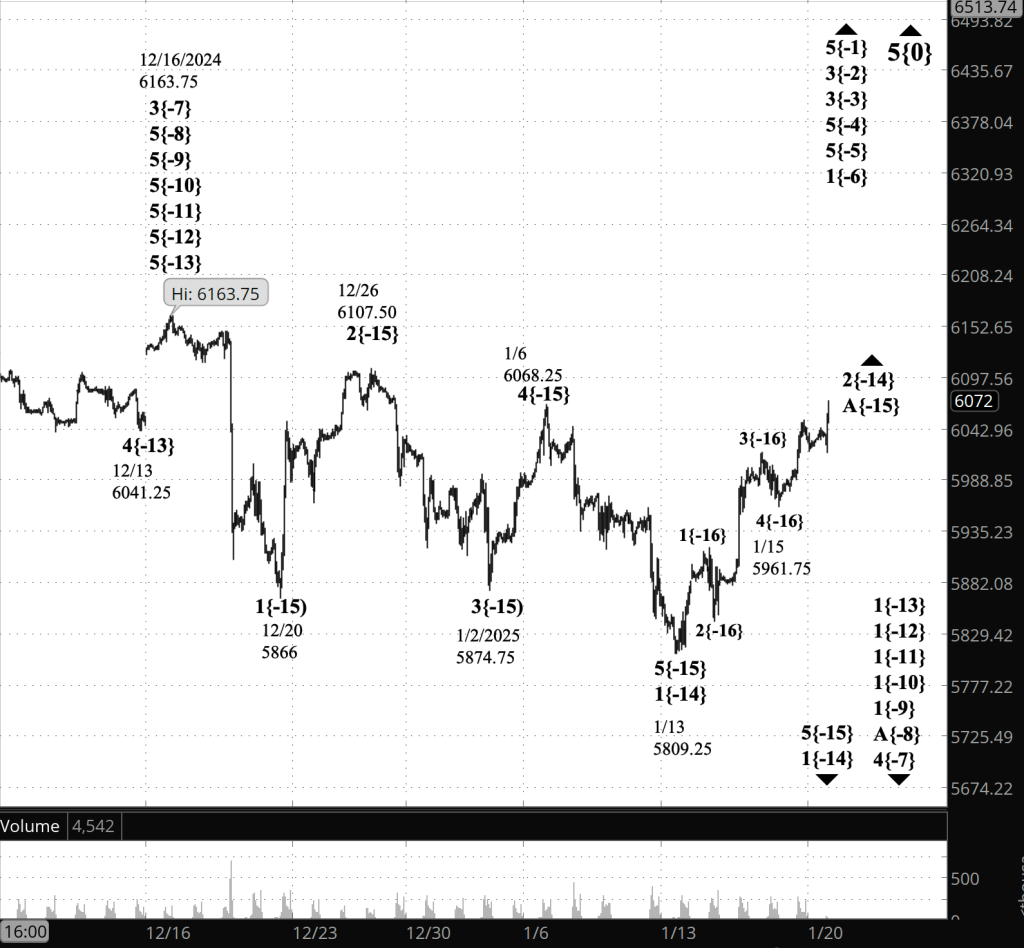
Trader’s Notebook

Weekend study. Over the weekend I developed a rule set for using HYG, an ETF tracking high-risk corporate bonds, as a buy and sell signal suitable for trading short vertical options spreads, based on the idea that the high-risk bonds’ pricing provides an insight into trader’s willingness to take on risk. Read about it here.

3:30 p.m. New York time

Half an hour before the closing bell. The S&P 500 futures reversed to the upside during the session. Elliott Wave Theory: The reversal point, 5965, ended declining wave B and began rising wave C, the final subwave in the 2nd-wave upward correction that began on December 20.

An ambiguity. It’s possible that the reversal is a subwave withib an ongoing wave B, which has not ended. Under this scenario, wave C has yet to begin,

9:35 a.m. New York time

What’s happening now? The S&P 500 E-mini futures decline after trading resumed overnight, from the 6030s to the 5980s as the opening bell approached.

What does it mean? In Elliott Wave Theory, a small 2nd-wave downward correction is underway, a subwave within a larger declining 1st wave that began December 16. That parent wave is part of a series of 1st waves following the end of a nested series of rising 5th waves covering six degrees within the fractal structure of the chart.

[S&P 500 E-mini futures at 9:35 a.m., hourly bars, with volume]

What are the alternatives? Ambiguities always appear, just not yet.

What does Elliott wave theory say? Here are the waves that underly the analyses.

Principal Analysis:

  • Rising wave 5{0} is underway. It is a wave of Intermediate degree that began in December 2018.
  • It is in its final subwave, wave 5{-1}.
  • Within wave 5{-1}, rising waves 5{-2}, 5{-3} and 5{-4} are underway, as is wave 5{-5}.
  • Wave 5{-5} is in its initial subwave, wave 1{-6}, which in turn is in its middle subwave, wave 3{-7}.
  • Wave 4{-7} is in its initial; subwave, uptrending wave A{-8}.
  • Wave 1{-8} is in its initial subwave, wave 1{-9}, which is in its final subwave, uptrending wave 5{-10}.
  • Wave 1{-10} is in its initial subwave, as are waves 1{-11}, 1{-12}, and 1{-13}.
  • Wave 2{-14} appears to be underway and is in its initial subwave, wave A{-15}.

Long-term Waves.

These are the waves currently in progress under my principal analysis. Each line on the list shows the wave number, with the subscript in curly brackets, the traditional degree name, the starting date, the starting price of the S&P 500 E-mini futures, and the direction of the wave.

  • S&P 500 Index:
  • 5{+3} Supercycle, 7/8/1932, 4.40 (up)
  • 5{+2} Cycle, 12/9/1974, 60.96 (up)
  • 5{+1} Primary, 3/6/2009, 666.79 (up)
  • 5{0} Intermediate, 12/26/2018, 2346.58 (up)
  • S&P 500 Futures
  • 5{-1} Minor, 10/27/2023, 4127.25 (up)
  • 3{-2} Minute, 10/27/23, 4127.75 (up)
  • 3{-3} Minuette, 10/27/23, 4127.75 (up)
  • 5{-4} Subminuette, 4/18/2024, 4963.50 (up)
  • 5{-5} Micro, 8/5/2024, 5120 (up)
  • 1{-6} Submicro, 8/5/2024, 5120 (up)
  • 4{-7} Minuscule, 12/16/2024, 6163.75 (down)
  • A{-8} (unnamed), 12/16/2024, 6163.75 (down)
  • 1{-9} (unnamed), 12/16/2024, 6163.75 (down)
  • 1{-10} (unnamed), 12/16/2024, 6163.75 (down)
  • 1{-11} (unnamed), 12/16/2024, 6163.75 (down)
  • 1{-12} (unnamed), 12/16/2024, 6163.75 (down)
  • 1{-13} (unnamed), 12/16/2024, 6163.75 (down)
  • 2[-14} (unnamed), 12/20/20245866 (up)
  • B{-15} (unnamed), 12/20/2024, 5866 (up)

Reading the chart. Price movements — waves – – in Elliott wave analysis are labeled with numbers within trending waves and letters with corrective waves. The subscripts — numbers in curly brackets — designate the wave’s degree, which, in Elliott wave analysis, means the relative position of a wave within the larger and smaller structures that make up the chart. R.N. Elliott, who in the 1930s developed the form of analysis that bears his name, viewed the chart as a complex structure of smaller waves nested within larger waves, which in turn are nested within still larger waves. In mathematics it’s called a fractal structure, where at every scale the pattern is similar to the others.

Learning and other resources. Elliott wave analysis provides context, not prophecy. As the 20th century semanticist Alfred Korzybski put it in his book Science and Sanity (1933), “The map is not the territory … The only usefulness of a map depends on similarity of structure between the empirical world and the map.” And I would add, in the ever-changing markets, we can judge that similarity of structure only after the fact.

See the menu page Analytical Methods for a rundown on where to go for information on Elliott wave analysis.

By Tim Bovee, Portland, Oregon, December 23, 2024

Disclaimer

Tim Bovee, Private Trader tracks the analysis and trades of a private trader for his own accounts. Nothing in this blog constitutes a recommendation to buy or sell stocks, options or any other financial instrument. The only purpose of this blog is to provide education and entertainment.

No trader is ever 100 percent successful in his or her trades. Trading in the stock and option markets is risky and uncertain. Each trader must make trading decisions for his or her own account, and take responsibility for the consequences.

License
Creative Commons License

All content on Tim Bovee, Private Trader by Timothy K. Bovee is licensed under a Creative Commons Attribution-ShareAlike 4.0 International License.

Based on a work at www.timbovee.com.

Trader’s Notebook

Happy Solstice, everyone! That most optimistic day of the year, because from this day forward, each day is just a little bit longer. Here in my home in Portland, where we’re closer to the North Pole than the equator, today was super short compared to places I’ve lived before, such as Oklahoma, the Washington, D.C. area, Tokyo, and even Michigan, which is also a northern place.

So naturally, with the markets closed and Portland buried in its December gloom and me, a bit bored, I designed a set of trading rules: the HYG Vertical Spread Rule Set. I enlisted one of my research assistants, ChatGPT-4, to help the project along, with great success.

The project started with an essay by Jack Roshi, a mathematician who posts on Substack under the name The Signals Doctor. The essay was titled “The Bond Market’s Secret Key to Predicting Stock Rallies.”

In his essay, he made the case for using HYG, which is an ETF tracking risky corporate bonds, as a leading indicator for trading options. Basically, he said that if HYG is up, then the ETF SPY, which tracks the S&P 500, is also likely to rise in the next couple of days. If HYG is down, then the same correlation applies to the downside. If that were consistent, it would be one of the best trading systems I could imagine.

I put my research assistant to work. My assistant’s conclusion:

“While HYG exhibits a moderate positive correlation with SPY, its success rate of 60% as a leading indicator suggests that it provides correct signals slightly more often than chance. However, this level of accuracy may not be sufficient for reliable trading decisions. Traders should consider using HYG in conjunction with other indicators and analyses to enhance decision-making.”

Good points, yes? As a leading indicator, it would be a useful entry and exit signal, but it makes sense to have other technical indicators. Happily, committed traders always have a toolbox filled with technical indicators.

My research assistant kicked the problem around for a while, and we finally came up with our new rule set.


The HYG Rule Set for Trading Short Vertical Option Spreads

Entry Signal:
Enter when HYG provides a significant signal (e.g., ≥1% movement) in the direction of the trade.

Confirm with Elliott Wave Theory (EWT):
Only trade in the direction of the impulsive wave (Wave 3 or Wave 5 for bullish; Wave C for bearish).

Exit Signal:

  • Exit when Ehlers Stochastic or RSI signals overbought/oversold conditions.
  • Use EWT to anticipate wave completion (e.g., Wave 5 or Wave C ending).

Risk Management:

  • Set stop-loss at the trade’s breakeven point or based on EWT invalidation levels.
  • Limit position size to a predefined percentage of your trading capital (e.g., 1-2%).

Trade Filters:

  • Avoid trades during high-volatility events or when HYG and EWT signals conflict.
  • Prefer trades when SPY’s technical indicators (e.g., moving averages) confirm trend direction.

Backtesting & Adjustment:
Regularly backtest the system and refine parameters based on performance data.


This concise rule set integrates HYG, EWT, and technical indicators to optimize short vertical spread trading.

Happily, given the nature of my daily analysis of the S&P 500 futures, I was able to integrate Elliott Wave Theory into the analysis. I think it will improve the success rate, despite its subjective nature.

How much of an improvement? Again, my research assistant provided insights:


Reasons for Improved Success Rate

Filtering False Signals:
Using Elliott Wave Theory (EWT) to confirm HYG signals filters out trades where market structure contradicts the signal. For instance:

  • A bullish HYG signal ignored during a corrective wave likely avoids false entries.

This step alone could reduce the number of false trades, improving success rates.

Precise Exits:
Exiting based on Ehlers Stochastic or RSI adds precision, as these indicators excel at identifying overbought/oversold conditions.

  • This reduces the risk of staying in trades too long and giving back profits.

Risk Management:
Incorporating stop-losses based on EWT invalidation levels minimizes losses on trades that fail, further increasing the overall win rate.

Market Conditions Alignment:
The rule set avoids trades during periods of conflicting signals (e.g., HYG vs. EWT), reducing noise and unnecessary losses.


Estimated Improvement

Based on these enhancements:

  • Conservative Estimate: A success rate of 65–70% if the rule set is applied consistently, accounting for real-world challenges such as market noise and execution errors.
  • Optimistic Estimate: A success rate of 75% or higher in favorable market conditions where trends and signals align more frequently.

Why It’s Plausible

The system effectively blends a leading indicator (HYG), trend confirmation (EWT), and precise exit tools (Ehlers Stochastic/RSI). This multi-layered approach mitigates weaknesses in relying solely on HYG while leveraging its predictive strength.


Next Steps for Validation

Backtesting: Test the rule set on historical SPY and HYG data over at least 1–3 years to calculate the exact success rate.
Forward Testing: Use the system in real-time trading with a small allocation to gauge performance under current market conditions.


The improved structure of this system should deliver meaningful gains over the standalone HYG strategy, both in success rate and overall profitability.

By Tim Bovee, Portland, Oregon, December 21, 2024

Disclaimer

Tim Bovee, Private Trader tracks the analysis and trades of a private trader for his own accounts. Nothing in this blog constitutes a recommendation to buy or sell stocks, options or any other financial instrument. The only purpose of this blog is to provide education and entertainment.

No trader is ever 100 percent successful in his or her trades. Trading in the stock and option markets is risky and uncertain. Each trader must make trading decisions for his or her own account, and take responsibility for the consequences.

License
Creative Commons License

All content on Tim Bovee, Private Trader by Timothy K. Bovee is licensed under a Creative Commons Attribution-ShareAlike 4.0 International License.

Based on a work at www.timbovee.com.

Trader’s Notebook

3:30 p.m. New York time

Half an hour before the closing bell. The S&P 500 futures continued to rise during the session, reaching into the 6050s.

Elliott Wave Theory: The 2nd wave upward correction that began overnight continues.

9:35 a.m. New York time (updated at 11:20 a.m.)

What’s happening now? The S&P 500 E-mini futures reached a low 5866 overnight and then reversed and returned to the 5900s.

What does it mean? The movements of the last few days, under the rules of Elliott Wave Theory, have prompted a reanalysis of the chart beginning with the wave that began on December 13 and ended December 16.

On the chart each wave has a number and a subscript in curly brackets showing the wave’s distance from Intermediate degree in the fractal structure of the chart. The present Intermediate degree is wave 5{0}, which began in December 2019.

The wave that began on December 13 under the prior analysis had been labeled an initial subwave — wave 1{-14} within uptrending wave 5{-13}. That analysis was no longer defensible after the 2nd-wave downward correction that followed fell below the start of that subwave, wave 1{-14}, something forbidden to 2nd waves under the rules of Elliott Wave Analysis.

Under the new analysis, I’ve renumbered the former wave wave 1{-14} as wave 5{-13}. As I’ve mentioned in previous analyses, when wave 5{-13} ends, as it now has, it is also the end for a series of larger 5th waves, travelling up the fractal structue from wave 5{-12} to wave 5{-8}, and up one more degree, wave 3{-7}, which began on August 7 from 5182.

What follows is wave 4{-7}, a downward correction of larger proportions than we’ve seen for the past few months.

[S&P 500 E-mini futures at 11:20 a.m., 55-minute bars, with volume]

What are the alternatives? I suspect there are ambiguities, but it will require more analysis to understand them.

What does Elliott wave theory say? Here are the waves that underly the analyses.

Principal Analysis:

  • Rising wave 5{0} is underway. It is a wave of Intermediate degree that began in December 2018.
  • It is in its final subwave, wave 5{-1}.
  • Within wave 5{-1}, rising waves 5{-2}, 5{-3} and 5{-4} are underway, as is wave 5{-5}.
  • Wave 5{-5} is in its initial subwave, wave 1{-6}, which in turn is in its middle subwave, wave 3{-7}.
  • Wave 4{-7} is in its initial; subwave, uptrending wave A{-8}.
  • Wave 1{-8} is in its initial subwave, wave 1{-9}, which is in its final subwave, uptrending wave 5{-10}.
  • Wave 1{-10} is in its initial subwave, as are waves 1{-11}, 1{-12}, and 1{-13}.
  • Wave 2{-14} appears to be under and is in its initial subwave, wave A{-15}.

Long-term Waves.

These are the waves currently in progress under my principal analysis. Each line on the list shows the wave number, with the subscript in curly brackets, the traditional degree name, the starting date, the starting price of the S&P 500 E-mini futures, and the direction of the wave.

  • S&P 500 Index:
  • 5{+3} Supercycle, 7/8/1932, 4.40 (up)
  • 5{+2} Cycle, 12/9/1974, 60.96 (up)
  • 5{+1} Primary, 3/6/2009, 666.79 (up)
  • 5{0} Intermediate, 12/26/2018, 2346.58 (up)
  • S&P 500 Futures
  • 5{-1} Minor, 10/27/2023, 4127.25 (up)
  • 3{-2} Minute, 10/27/23, 4127.75 (up)
  • 3{-3} Minuette, 10/27/23, 4127.75 (up)
  • 5{-4} Subminuette, 4/18/2024, 4963.50 (up)
  • 5{-5} Micro, 8/5/2024, 5120 (up)
  • 1{-6} Submicro, 8/5/2024, 5120 (up)
  • 4{-7} Minuscule, 12/16/2024, 6163.75 (down)
  • A{-8} (unnamed), 12/16/2024, 6163.75 (down)
  • 1{-9} (unnamed), 12/16/2024, 6163.75 (down)
  • 1{-10} (unnamed), 12/16/2024, 6163.75 (down)
  • 1{-11} (unnamed), 12/16/2024, 6163.75 (down)
  • 1{-12} (unnamed), 12/16/2024, 6163.75 (down)
  • 1{-13} (unnamed), 12/16/2024, 6163.75 (down)
  • 2[-14} (unnamed), 12/20/2024, 5866 (up)
  • A{-15} (unnamed), 12/20/2024, 5866 (up)

Reading the chart. Price movements — waves – – in Elliott wave analysis are labeled with numbers within trending waves and letters with corrective waves. The subscripts — numbers in curly brackets — designate the wave’s degree, which, in Elliott wave analysis, means the relative position of a wave within the larger and smaller structures that make up the chart. R.N. Elliott, who in the 1930s developed the form of analysis that bears his name, viewed the chart as a complex structure of smaller waves nested within larger waves, which in turn are nested within still larger waves. In mathematics it’s called a fractal structure, where at every scale the pattern is similar to the others.

Learning and other resources. Elliott wave analysis provides context, not prophecy. As the 20th century semanticist Alfred Korzybski put it in his book Science and Sanity (1933), “The map is not the territory … The only usefulness of a map depends on similarity of structure between the empirical world and the map.” And I would add, in the ever-changing markets, we can judge that similarity of structure only after the fact.

See the menu page Analytical Methods for a rundown on where to go for information on Elliott wave analysis.

By Tim Bovee, Portland, Oregon, December 20, 2024

Disclaimer

Tim Bovee, Private Trader tracks the analysis and trades of a private trader for his own accounts. Nothing in this blog constitutes a recommendation to buy or sell stocks, options or any other financial instrument. The only purpose of this blog is to provide education and entertainment.

No trader is ever 100 percent successful in his or her trades. Trading in the stock and option markets is risky and uncertain. Each trader must make trading decisions for his or her own account, and take responsibility for the consequences.

License

All content on Tim Bovee, Private Trader by Timothy K. Bovee is licensed under a Creative Commons Attribution-ShareAlike 4.0 International License.

Based on a work at www.timbovee.com.