Trader’s Notebook

3:30 p.m. New York time

Half an hour before the closing bell. The S&P 500 futures rose during the session, to 6107.25, reaching above the high attained the prior day. Clearly the price is searching for a top, launching persuasive reversals that turn out not to amount to much.

Under this afternoon’s Elliott Wave Theory analysis, the 5th wave that began on December 1 is still its middle subwave — wave 3. I’ve redone the chart to conform.

9:35 a.m. New York time

What’s happening now? The S&P 500 E-mini futures peaked on December 4 at 6102.25 shortly before the session ended and then swung into a sideways movement that continued overnight.

What does it mean? The sideways movement is a 4th-wave downward correction, the next-to-the-last subwave of the 5th-wave uptrend that began on December 1 from 6000.25.

The correction will be followed by a low-degree 5th-wave uptrend, the final subwave of the rise that began on December 1.

Waves within waves. Waves of the chart are labeled with the wave number followed by a subscript in curly brackets showing the wave’s position in the fractal structure of the chart relative to the Intermediate Degree. The present intermediate degree is wave 5{0}, which began on December 26, 2018. A stock’s movement is always structured as waves within waves, small waves within larger waves that are in turrn subwaves of even larger waves.

Here are the present waves as labeled on the chart.

The December 4 peak, 6102.25, is the end of wave 3{-14} and the start of wave 4{-14} within wave 5{-13}, which began on December 1.

Wave 5{-13} is the smallest of a series of nested 5th waves, up to wave 5{-8}, which in turn is nested within wave 3{-7}.

Wave 4{-14} will be followed by wave 5{-14}. When wave 5{-14} ends, it will simultaneously be the end of wave 5{-13} and the whole series of nested 5th waves up to wave 5{-8}, and also the end of wave 3{-7).

A relatively large downward correction, wave 4{-7}, will ensue.

[S&P 500 E-mini futures at 3:30 p.m., 45-minute bars, with volume]

What are the alternatives? The wave structure has clarified, resolving yesterday’s alternative. There are at present no ambiguities.

What does Elliott wave theory say? Here are the waves that underly the analyses.

Principal Analysis:

  • .Rising wave 5{0} is underway. It is a wave of Intermediate degree that began in December 2018.
  • It is in its final subwave, wave 5{-1}.
  • Within wave 5{-1}, rising waves 5{-2}, 5{-3} and 5{-4} are underway, as is wave 5{-5}.
  • Wave 5{-5} is in its initial subwave, wave 1{-6}, which in turn is in its middle subwave, wave 3{-7}.
  • Wave 3{-7} is in its final; subwave, uptrending wave 5{-8}.
  • Wave 5{-8} is in its final subwave, wave 5{-9}, which is in its final subwave, uptrending wave 5{-10}.
  • Wave 5{-10} is in its final subwave, wave 5{-11}, which appears to have completed its middle subwave, wave 3{-12}, within wave 5{-13}.
  • Wave 5{-13} is now underway and is in its middle subwave, wave 3{-14}

Long-term Waves.

These are the waves currently in progress under my principal analysis. Each line on the list shows the wave number, with the subscript in curly brackets, the traditional degree name, the starting date, the starting price of the S&P 500 E-mini futures, and the direction of the wave.

  • S&P 500 Index:
  • 5{+3} Supercycle, 7/8/1932, 4.40 (up)
  • 5{+2} Cycle, 12/9/1974, 60.96 (up)
  • 5{+1} Primary, 3/6/2009, 666.79 (up)
  • 5{0} Intermediate, 12/26/2018, 2346.58 (up)
  • S&P 500 Futures
  • 5{-1} Minor, 10/27/2023, 4127.25 (up)
  • 3{-2} Minute, 10/27/23, 4127.75 (up)
  • 3{-3} Minuette, 10/27/23, 4127.75 (up)
  • 5{-4} Subminuette, 4/18/2024, 4963.50 (up)
  • 5{-5} Micro, 8/5/2024, 5120 (up)
  • 1{-6} Submicro, 8/5/2024, 5120 (up)
  • 3{-7} Minuscule, 8/7/2024, 5182 (up)
  • 5{-8} (unnamed), 9/6/2024, 5394 (up)
  • 5{-9} (unnamed), 10/2/2024, 5724 (up)
  • 5{-10} (unnamed), 11/4/2024, 5824.25 (up)
  • 5{-11} (unnamed), 11/19/2024, 5933 (up)
  • 5{-12} (unnamed), 11/27/2024, 6000.25 (up)
  • 5{-13} (unnamed), 12/1/2024, 6036 (up)

Reading the chart. Price movements — waves – – in Elliott wave analysis are labeled with numbers within trending waves and letters with corrective waves. The subscripts — numbers in curly brackets — designate the wave’s degree, which, in Elliott wave analysis, means the relative position of a wave within the larger and smaller structures that make up the chart. R.N. Elliott, who in the 1930s developed the form of analysis that bears his name, viewed the chart as a complex structure of smaller waves nested within larger waves, which in turn are nested within still larger waves. In mathematics it’s called a fractal structure, where at every scale the pattern is similar to the others.

Learning and other resources. Elliott wave analysis provides context, not prophecy. As the 20th century semanticist Alfred Korzybski put it in his book Science and Sanity (1933), “The map is not the territory … The only usefulness of a map depends on similarity of structure between the empirical world and the map.” And I would add, in the ever-changing markets, we can judge that similarity of structure only after the fact.

See the menu page Analytical Methods for a rundown on where to go for information on Elliott wave analysis.

By Tim Bovee, Portland, Oregon, December 5, 2024

Disclaimer

Tim Bovee, Private Trader tracks the analysis and trades of a private trader for his own accounts. Nothing in this blog constitutes a recommendation to buy or sell stocks, options or any other financial instrument. The only purpose of this blog is to provide education and entertainment.

No trader is ever 100 percent successful in his or her trades. Trading in the stock and option markets is risky and uncertain. Each trader must make trading decisions for his or her own account, and take responsibility for the consequences.

License
Creative Commons License

All content on Tim Bovee, Private Trader by Timothy K. Bovee is licensed under a Creative Commons Attribution-ShareAlike 4.0 International License.

Based on a work at www.timbovee.com.

Trader’s Notebook

3:30 p.m. New York time

Half an hour before the closing bell. The S&P 500 futures continued to rise during the session, coming close to 6100.

A series of six 5th waves, each larger than the one before, are drawing close to a simultaneous end. The smallest of them began on December 1 from 6036.

9:35 a.m. New York time

What’s happening now? The S&P 500 rose steadily overnight, from the 6060s to the 6080s.

What does it mean? Based on Elliott Wave Theory analysis, I’ve concluded that the uptrending 5th wave that began on November 27 from 6000.25 is now in its 5th and final subwave. That subwave began on December 1 from 6036.

What is an alternative? The subwave structure within that rising 5th wave lacks clarity. It’s possible that the rise is the middle subwave, wave 3.

What lies ahead? Fifth wave are endings, and a glance at waves further up the fractal structure of the chart show plenty of endings, five, to be precise, followed by a six, which is a 3rd wave. When the present 5th wave that began on December 1 ends, the five larger subwaves and the 3rd wave will also end. A 4th-wave downtrend will begin, at the same degree as the 3rd wave, which began on August 7 from 5182.

[S&P 500 E-mini futures at 3:30 p.m., 40-minute bars, with volume]

What does Elliott wave theory say? Here are the waves that underly the analyses.

Principal Analysis:

  • Rising wave 5{0} is underway. It is a wave of Intermediate degree that began in December 2018.
  • It is in its final subwave, wave 5{-1}.
  • Within wave 5{-1}, rising waves 5{-2}, 5{-3} and 5{-4} are underway, as is wave 5{-5}.
  • Wave 5{-5} is in its initial subwave, wave 1{-6}, which in turn is in its middle subwave, wave 3{-7}.
  • Wave 3{-7} is in its final; subwave, uptrending wave 5{-8}.
  • Wave 5{-8} is in its final subwave, wave 5{-9}, which is in its final subwave, uptrending wave 5{-10}.
  • Wave 5{-10} is in its final subwave, wave 5{-11}, which appears to have completed its middle subwave, wave 3{-12}, within wave 5{-13}.
  • Wave 5{-12} is now underway and is in its final subwave, wave 5{-13}

Alternative Analysis:

  • Wave 5{-12} is now underway and is in its middle subwave, wave 3{-13}

Long-term Waves.

These are the waves currently in progress under my principal analysis. Each line on the list shows the wave number, with the subscript in curly brackets, the traditional degree name, the starting date, the starting price of the S&P 500 E-mini futures, and the direction of the wave.

  • S&P 500 Index:
  • 5{+3} Supercycle, 7/8/1932, 4.40 (up)
  • 5{+2} Cycle, 12/9/1974, 60.96 (up)
  • 5{+1} Primary, 3/6/2009, 666.79 (up)
  • 5{0} Intermediate, 12/26/2018, 2346.58 (up)
  • S&P 500 Futures
  • 5{-1} Minor, 10/27/2023, 4127.25 (up)
  • 3{-2} Minute, 10/27/23, 4127.75 (up)
  • 3{-3} Minuette, 10/27/23, 4127.75 (up)
  • 5{-4} Subminuette, 4/18/2024, 4963.50 (up)
  • 5{-5} Micro, 8/5/2024, 5120 (up)
  • 1{-6} Submicro, 8/5/2024, 5120 (up)
  • 3{-7} Minuscule, 8/7/2024, 5182 (up)
  • 5{-8} (unnamed), 9/6/2024, 5394 (up)
  • 5{-9} (unnamed), 10/2/2024, 5724 (up)
  • 5{-10} (unnamed), 11/4/2024, 5824.25 (up)
  • 5{-11} (unnamed), 11/19/2024, 5933 (up)
  • 5{-12} (unnamed), 11/27/2024, 6000.25 (up)
  • 5{-13} (unnamed), 12/1/2024, 6036 (up)

Reading the chart. Price movements — waves – – in Elliott wave analysis are labeled with numbers within trending waves and letters with corrective waves. The subscripts — numbers in curly brackets — designate the wave’s degree, which, in Elliott wave analysis, means the relative position of a wave within the larger and smaller structures that make up the chart. R.N. Elliott, who in the 1930s developed the form of analysis that bears his name, viewed the chart as a complex structure of smaller waves nested within larger waves, which in turn are nested within still larger waves. In mathematics it’s called a fractal structure, where at every scale the pattern is similar to the others.

Learning and other resources. Elliott wave analysis provides context, not prophecy. As the 20th century semanticist Alfred Korzybski put it in his book Science and Sanity (1933), “The map is not the territory … The only usefulness of a map depends on similarity of structure between the empirical world and the map.” And I would add, in the ever-changing markets, we can judge that similarity of structure only after the fact.

See the menu page Analytical Methods for a rundown on where to go for information on Elliott wave analysis.

By Tim Bovee, Portland, Oregon, December 4, 2024

Disclaimer

Tim Bovee, Private Trader tracks the analysis and trades of a private trader for his own accounts. Nothing in this blog constitutes a recommendation to buy or sell stocks, options or any other financial instrument. The only purpose of this blog is to provide education and entertainment.

No trader is ever 100 percent successful in his or her trades. Trading in the stock and option markets is risky and uncertain. Each trader must make trading decisions for his or her own account, and take responsibility for the consequences.

License
Creative Commons License

All content on Tim Bovee, Private Trader by Timothy K. Bovee is licensed under a Creative Commons Attribution-ShareAlike 4.0 International License.

Based on a work at www.timbovee.com.
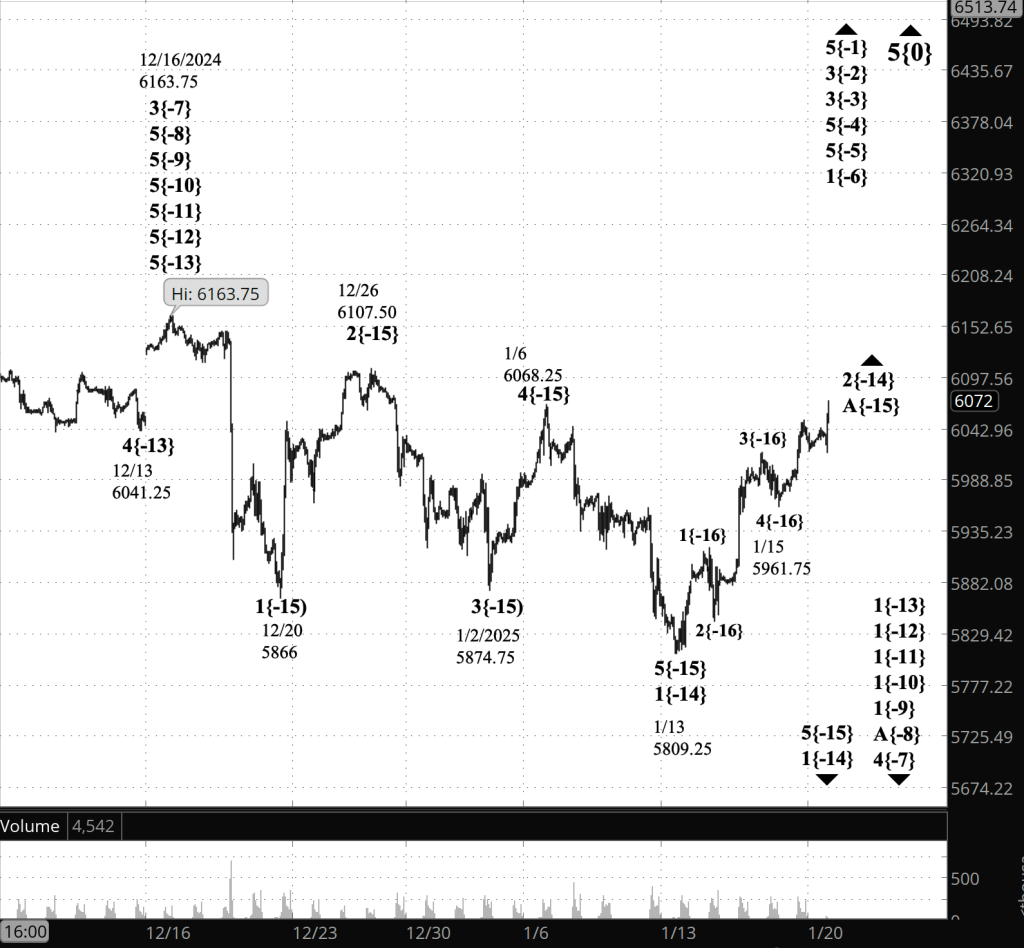
Trader’s Notebook

3:30 p.m. New York time

Half an hour before the closing bell. The S&P 500 futures dropped to the 6040s during the session and then retraced much of the decline. Elliott Wave Theory: A small corrective wave continues within a 5th-wave uptrend that began on November 27 from 6000.25.

9:35 a.m. New York time

What’s happening now? The S&P 500 E-mini futures traded sideways in a relatively narrow range, bouncing between the 6060s and the 6050s

What does it mean? The overnight sideways movement was a continuation of a larger pattern that began on December 2. In the terminology of Elliott Wave Theory, the movement represents a low-degree correction, a subwave within a series of nested rising 5th waves, each one degree larger than the previous one.

So far this week, traders have had little economic motivation to bid the S&P 500 higher or lower. The first major report of the week, the private-sector ADP Employment Report, will be published on December 4 (Wednesday), serving as a sneak preview of the even more significant Employment Situation Report, which will be released by the federal government on December 6 (Friday). Each report will be issued before the opening bell.

The presumption is that higher unemployment results are bearish, signaling economic weakness, while a lower unemployment rate is generally bullish, reflecting economic strength. However, exceptionally low unemployment can raise inflationary concerns, potentially leading to tighter monetary policy.

When the present lower-degree 5th wave is complete, it will simultaneously mark the end of five increasingly larger 5th waves, each one degree higher than the previous one.

It will also signify the end of a 3rd wave of one degree higher still and the beginning of a 4th-wave downward correction, which will be larger than those seen recently. The 3rd wave began on August 7 at 5182 and has so far carried the price up by slightly more than $900 per share.

[S&P 500 E-mini futures at 3:30 p.m., 40-minute bars, with volume]

What are the alternatives?  None at present.

What does Elliott wave theory say? Here are the waves that underly the analyses.

Principal Analysis:

  • .Rising wave 5{0} is underway. It is a wave of Intermediate degree that began in December 2018.
  • It is in its final subwave, wave 5{-1}.
  • Within wave 5{-1}, rising waves 5{-2}, 5{-3} and 5{-4} are underway, as is wave 5{-5}.
  • Wave 5{-5} is in its initial subwave, wave 1{-6}, which in turn is in its middle subwave, wave 3{-7}.
  • Wave 3{-7} is in its final; subwave, uptrending wave 5{-8}.
  • Wave 5{-8} is in its final subwave, wave 5{-9}, which is in its final subwave, uptrending wave 5{-10}.
  • Wave 5{-10} is in its final subwave, wave 5{-11}, which appears to have completed its middle subwave, wave 3{-12}, within wave 5{-13}.
  • Wave 5{-12} is now underway.

Long-term Waves.

These are the waves currently in progress under my principal analysis. Each line on the list shows the wave number, with the subscript in curly brackets, the traditional degree name, the starting date, the starting price of the S&P 500 E-mini futures, and the direction of the wave.

  • S&P 500 Index:
  • 5{+3} Supercycle, 7/8/1932, 4.40 (up)
  • 5{+2} Cycle, 12/9/1974, 60.96 (up)
  • 5{+1} Primary, 3/6/2009, 666.79 (up)
  • 5{0} Intermediate, 12/26/2018, 2346.58 (up)
  • S&P 500 Futures
  • 5{-1} Minor, 10/27/2023, 4127.25 (up)
  • 3{-2} Minute, 10/27/23, 4127.75 (up)
  • 3{-3} Minuette, 10/27/23, 4127.75 (up)
  • 5{-4} Subminuette, 4/18/2024, 4963.50 (up)
  • 5{-5} Micro, 8/5/2024, 5120 (up)
  • 1{-6} Submicro, 8/5/2024, 5120 (up)
  • 3{-7} Minuscule, 8/7/2024, 5182 (up)
  • 5{-8} (unnamed), 9/6/2024, 5394 (up)
  • 5{-9} (unnamed), 10/2/2024, 5724 (up)
  • 5{-10} (unnamed), 11/4/2024, 5824.25 (up)
  • 5{-11} (unnamed), 11/19/2024, 5933 (up)
  • 5{-12} (unnamed), 11/27/2024, 6000.25 (up)

Reading the chart. Price movements — waves – – in Elliott wave analysis are labeled with numbers within trending waves and letters with corrective waves. The subscripts — numbers in curly brackets — designate the wave’s degree, which, in Elliott wave analysis, means the relative position of a wave within the larger and smaller structures that make up the chart. R.N. Elliott, who in the 1930s developed the form of analysis that bears his name, viewed the chart as a complex structure of smaller waves nested within larger waves, which in turn are nested within still larger waves. In mathematics it’s called a fractal structure, where at every scale the pattern is similar to the others.

Learning and other resources. Elliott wave analysis provides context, not prophecy. As the 20th century semanticist Alfred Korzybski put it in his book Science and Sanity (1933), “The map is not the territory … The only usefulness of a map depends on similarity of structure between the empirical world and the map.” And I would add, in the ever-changing markets, we can judge that similarity of structure only after the fact.

See the menu page Analytical Methods for a rundown on where to go for information on Elliott wave analysis.

By Tim Bovee, Portland, Oregon, December 3, 2024

Disclaimer

Tim Bovee, Private Trader tracks the analysis and trades of a private trader for his own accounts. Nothing in this blog constitutes a recommendation to buy or sell stocks, options or any other financial instrument. The only purpose of this blog is to provide education and entertainment.

No trader is ever 100 percent successful in his or her trades. Trading in the stock and option markets is risky and uncertain. Each trader must make trading decisions for his or her own account, and take responsibility for the consequences.

License
Creative Commons License

All content on Tim Bovee, Private Trader by Timothy K. Bovee is licensed under a Creative Commons Attribution-ShareAlike 4.0 International License.

Based on a work at www.timbovee.com.

Trader’s Notebook

3:30 p.m. New York time

Half an hour before the closing bell. Elliott Wave Theory: The S&P 500 futures reached into the 6060s during the session, as the 5th-wave uptrend that began on November 27 continued its rise.

9:35 a.m. New York time

What’s happening now? The S&P 500 E- mini futures opened in the 6050s trading resumed overnight, fell to the 6030, and then once again rose into the 6050s.

What does it mean? The rise is Elliott wave 5, the final subwave of an uptrend that began on November 27. The high points since trading resumed have both been just above a 100% retracement the preceding 4th wave downward correction.

A 5th wave can move well above the 100% retracement level, or it can fall short. This 5th appears to have some upside left.

Wave 5, when complete, will also be the end of parent wave, a larger 5th wave that began on November 19, and of three more 5th waves of increasing size. And it will be the end of 3rd wave, one more degree larger, that began on August 7 from 5182, and the start of a 4th wave, much larger than what we’ve seen of late.

[S&P 500 E-mini futures at 3:30 p.m., 40-minute bars, with volume]

What are the alternatives? None at present.

What does Elliott wave theory say? Here are the waves that underly the analyses.

Principal Analysis:

  • .Rising wave 5{0} is underway. It is a wave of Intermediate degree that began in December 2018.
  • It is in its final subwave, wave 5{-1}.
  • Within wave 5{-1}, rising waves 5{-2}, 5{-3} and 5{-4} are underway, as is wave 5{-5}.
  • Wave 5{-5} is in its initial subwave, wave 1{-6}, which in turn is in its middle subwave, wave 3{-7}.
  • Wave 3{-7} is in its final; subwave, uptrending wave 5{-8}.
  • Wave 5{-8} is in its final subwave, wave 5{-9}, which is in its final subwave, uptrending wave 5{-10}.
  • Wave 5{-10} is in its final subwave, wave 5{-11}, which appears to have completed its middle subwave, wave 3{-12}, within wave 5{-13}.
  • Wave 5{-12} is now underway.

Long-term Waves.

These are the waves currently in progress under my principal analysis. Each line on the list shows the wave number, with the subscript in curly brackets, the traditional degree name, the starting date, the starting price of the S&P 500 E-mini futures, and the direction of the wave.

  • S&P 500 Index:
  • 5{+3} Supercycle, 7/8/1932, 4.40 (up)
  • 5{+2} Cycle, 12/9/1974, 60.96 (up)
  • 5{+1} Primary, 3/6/2009, 666.79 (up)
  • 5{0} Intermediate, 12/26/2018, 2346.58 (up)
  • S&P 500 Futures
  • 5{-1} Minor, 10/27/2023, 4127.25 (up)
  • 3{-2} Minute, 10/27/23, 4127.75 (up)
  • 3{-3} Minuette, 10/27/23, 4127.75 (up)
  • 5{-4} Subminuette, 4/18/2024, 4963.50 (up)
  • 5{-5} Micro, 8/5/2024, 5120 (up)
  • 1{-6} Submicro, 8/5/2024, 5120 (up)
  • 3{-7} Minuscule, 8/7/2024, 5182 (up)
  • 5{-8} (unnamed), 9/6/2024, 5394 (up)
  • 5{-9} (unnamed), 10/2/2024, 5724 (up)
  • 5{-10} (unnamed), 11/4/2024, 5824.25 (up)
  • 5{-11} (unnamed), 11/19/2024, 5933 (up)
  • 5{-12} (unnamed), 11/27/2024, 6000.25 (up)

Reading the chart. Price movements — waves – – in Elliott wave analysis are labeled with numbers within trending waves and letters with corrective waves. The subscripts — numbers in curly brackets — designate the wave’s degree, which, in Elliott wave analysis, means the relative position of a wave within the larger and smaller structures that make up the chart. R.N. Elliott, who in the 1930s developed the form of analysis that bears his name, viewed the chart as a complex structure of smaller waves nested within larger waves, which in turn are nested within still larger waves. In mathematics it’s called a fractal structure, where at every scale the pattern is similar to the others.

Learning and other resources. Elliott wave analysis provides context, not prophecy. As the 20th century semanticist Alfred Korzybski put it in his book Science and Sanity (1933), “The map is not the territory … The only usefulness of a map depends on similarity of structure between the empirical world and the map.” And I would add, in the ever-changing markets, we can judge that similarity of structure only after the fact.

See the menu page Analytical Methods for a rundown on where to go for information on Elliott wave analysis.

By Tim Bovee, Portland, Oregon, December 2, 2024

Disclaimer

Tim Bovee, Private Trader tracks the analysis and trades of a private trader for his own accounts. Nothing in this blog constitutes a recommendation to buy or sell stocks, options or any other financial instrument. The only purpose of this blog is to provide education and entertainment.

No trader is ever 100 percent successful in his or her trades. Trading in the stock and option markets is risky and uncertain. Each trader must make trading decisions for his or her own account, and take responsibility for the consequences.

License
Creative Commons License

All content on Tim Bovee, Private Trader by Timothy K. Bovee is licensed under a Creative Commons Attribution-ShareAlike 4.0 International License.

Based on a work at www.timbovee.com.

Trader’s Notebook

After the holiday. U.S. markets will close early today, at 1 p.m. New York time.

12:30 p.m. New York time

Half an hour before the closing bell. The S&P 500 futures used the truncated post-holiday session to do something interesting under the rules of Elliott Wave Theory.

Those rules say that a B-wave can’t move beyond the start of the preceding A wave. If it does, then its not a B wave.

During today’s session what I had labeled a B wave violated that rule, a possibility recognised as an alternative in this morning’s analysis, and I’ve redone the analysis.

What had been wave B ended on November 27, and wave C swiftly followed on the same day. That marked the end of the 4th-wave downward correction that began on November 26.

Rising wave 5 began, within the larger 5th-wave uptrend that began on November 19.

I’ve added a new chart that allows a view of what changed.

[S&P 500 E-mini futures at 12:30 p.m., 35-minute bars, with volume]

9:35 a.m. New York time

What’s happening now? The S&P 500 E-mini futures remained range bound, from the 6010s to the 6030s, after trading resumed overnight in what was a net sideways movement.

What does it mean? The price stayed below the November 26 high, which Elliott Wave Theory interprets as meaning that the 4th-wave downward correction that began on that date continues and is in its middle subwave, wave B.

Now outdated: [S&P 500 E-mini futures at 9:35 a.m., 35-minute bars, with volume]

S&P 500 E-mini futures at 9:35 a.m., 35-minute bars, with volume]

What are the alternatives? There is a bit ambiguity over the subwaves of the 3rd-wave uptrend that began on November 20. My present labeling appears to best match the size of earlier movements of the same degrees. Also, it’s possible that wave B ended at the overnight high, 6035.50.

What does Elliott wave theory say? Here are the waves that underly the analyses, updated with the afternoon analysis.

Principal Analysis:

  • .Rising wave 5{0} is underway. It is a wave of Intermediate degree that began in December 2018.
  • It is in its final subwave, wave 5{-1}.
  • Within wave 5{-1}, rising waves 5{-2}, 5{-3} and 5{-4} are underway, as is wave 5{-5}.
  • Wave 5{-5} is in its initial subwave, wave 1{-6}, which in turn is in its middle subwave, wave 3{-7}.
  • Wave 3{-7} is in its final; subwave, uptrending wave 5{-8}.
  • Wave 5{-8} is in its final subwave, wave 5{-9}, which is in its final subwave, uptrending wave 5{-10}.
  • Wave 5{-10} is in its final subwave, wave 5{-11}, which appears to have completed its middle subwave, wave 3{-12}, within wave 5{-13}.
  • Wave 5{-12} is now underway.

Long-term Waves.

These are the waves currently in progress under my principal analysis. Each line on the list shows the wave number, with the subscript in curly brackets, the traditional degree name, the starting date, the starting price of the S&P 500 E-mini futures, and the direction of the wave.

  • S&P 500 Index:
  • 5{+3} Supercycle, 7/8/1932, 4.40 (up)
  • 5{+2} Cycle, 12/9/1974, 60.96 (up)
  • 5{+1} Primary, 3/6/2009, 666.79 (up)
  • 5{0} Intermediate, 12/26/2018, 2346.58 (up)
  • S&P 500 Futures
  • 5{-1} Minor, 10/27/2023, 4127.25 (up)
  • 3{-2} Minute, 10/27/23, 4127.75 (up)
  • 3{-3} Minuette, 10/27/23, 4127.75 (up)
  • 5{-4} Subminuette, 4/18/2024, 4963.50 (up)
  • 5{-5} Micro, 8/5/2024, 5120 (up)
  • 1{-6} Submicro, 8/5/2024, 5120 (up)
  • 3{-7} Minuscule, 8/7/2024, 5182 (up)
  • 5{-8} (unnamed), 9/6/2024, 5394 (up)
  • 5{-9} (unnamed), 10/2/2024, 5724 (up)
  • 5{-10} (unnamed), 11/4/2024, 5824.25 (up)
  • 5{-11} (unnamed), 11/19/2024, 5933 (up)
  • 5{-12} (unnamed), 11/27/2024, 6000.25 (up)

Reading the chart. Price movements — waves – – in Elliott wave analysis are labeled with numbers within trending waves and letters with corrective waves. The subscripts — numbers in curly brackets — designate the wave’s degree, which, in Elliott wave analysis, means the relative position of a wave within the larger and smaller structures that make up the chart. R.N. Elliott, who in the 1930s developed the form of analysis that bears his name, viewed the chart as a complex structure of smaller waves nested within larger waves, which in turn are nested within still larger waves. In mathematics it’s called a fractal structure, where at every scale the pattern is similar to the others.

Learning and other resources. Elliott wave analysis provides context, not prophecy. As the 20th century semanticist Alfred Korzybski put it in his book Science and Sanity (1933), “The map is not the territory … The only usefulness of a map depends on similarity of structure between the empirical world and the map.” And I would add, in the ever-changing markets, we can judge that similarity of structure only after the fact.

See the menu page Analytical Methods for a rundown on where to go for information on Elliott wave analysis.

By Tim Bovee, Portland, Oregon, November 29, 2024

Disclaimer

Tim Bovee, Private Trader tracks the analysis and trades of a private trader for his own accounts. Nothing in this blog constitutes a recommendation to buy or sell stocks, options or any other financial instrument. The only purpose of this blog is to provide education and entertainment.

No trader is ever 100 percent successful in his or her trades. Trading in the stock and option markets is risky and uncertain. Each trader must make trading decisions for his or her own account, and take responsibility for the consequences.

License
Creative Commons License

All content on Tim Bovee, Private Trader by Timothy K. Bovee is licensed under a Creative Commons Attribution-ShareAlike 4.0 International License.

Based on a work at www.timbovee.com.
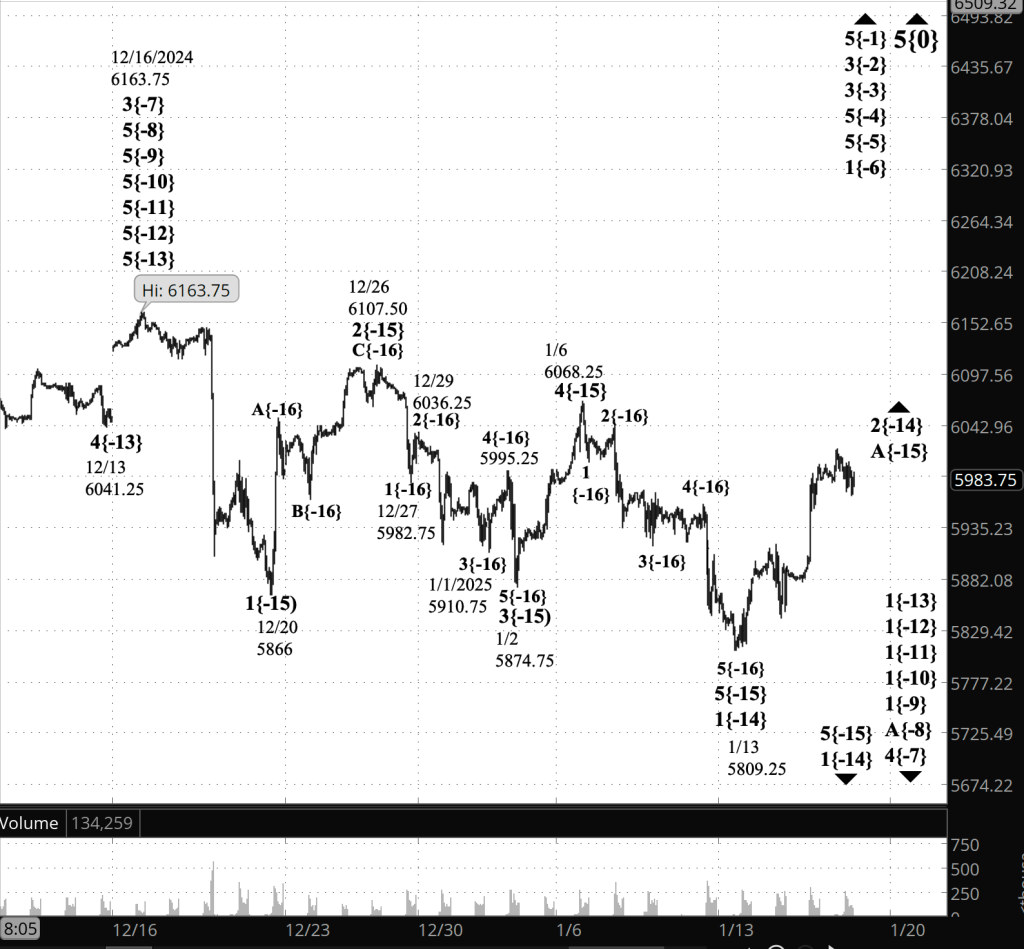
Trader’s Notebook

U.S. markets will be closed on Thursday, November 28. Trading will resume on Friday with the markets closing early, at 1 p.m. New York time.

3:30 p.m. New York time

Half an hour before the closing bell. The S&P 500 futures fell during the session, reaching 25 cents above 6000. Elliott Wave Theory: The 4th-wave downward within a rising 5th wave continues.

9:35 a.m. New York time

What’s happening now? The S&P 500 E-mini Futures reached a high overnight of 6047 and then fell slightly as the opening bell approached.

What does it mean? Elliott Wave Theory interprets the earlier rise as the end of a small 3rd wave and the subsequent decline as a 4th-wave downward correction within the middle subwave of an uptrending 5th wave that began on November 19.

The early rise brought the price to within six points of the 100% retracement level, at 6053.25.

[S&P 500 E-mini futures at 3:30 p.m., 30-minute bars, with volume]

What are the alternatives? There is a bit ambiguity over the subwaves of the 3rd-wave uptrend that began on November 20. My present labeling appears to best match the size of earlier movements of the same degrees.

What does Elliott wave theory say? Here are the waves that underly the analyses.

Principal Analysis:

  • .Rising wave 5{0} is underway. It is a wave of Intermediate degree that began in December 2018.
  • It is in its final subwave, wave 5{-1}.
  • Within wave 5{-1}, rising waves 5{-2}, 5{-3} and 5{-4} are underway, as is wave 5{-5}.
  • Wave 5{-5} is in its initial subwave, wave 1{-6}, which in turn is in its middle subwave, wave 3{-7}.
  • Wave 3{-7} is in its final; subwave, uptrending wave 5{-8}.
  • Wave 5{-8} is in its final subwave, wave 5{-9}, which is in its final subwave, uptrending wave 5{-10}.
  • Wave 5{-10} is in its final subwave, wave 5{-11}, which appears to have completed its middle subwave, wave 3{-12}, within wave 5{-13}.
  • Wave 4{-12} is now underway.

Long-term Waves.

These are the waves currently in progress under my principal analysis. Each line on the list shows the wave number, with the subscript in curly brackets, the traditional degree name, the starting date, the starting price of the S&P 500 E-mini futures, and the direction of the wave.

  • S&P 500 Index:
  • 5{+3} Supercycle, 7/8/1932, 4.40 (up)
  • 5{+2} Cycle, 12/9/1974, 60.96 (up)
  • 5{+1} Primary, 3/6/2009, 666.79 (up)
  • 5{0} Intermediate, 12/26/2018, 2346.58 (up)
  • S&P 500 Futures
  • 5{-1} Minor, 10/27/2023, 4127.25 (up)
  • 3{-2} Minute, 10/27/23, 4127.75 (up)
  • 3{-3} Minuette, 10/27/23, 4127.75 (up)
  • 5{-4} Subminuette, 4/18/2024, 4963.50 (up)
  • 5{-5} Micro, 8/5/2024, 5120 (up)
  • 1{-6} Submicro, 8/5/2024, 5120 (up)
  • 3{-7} Minuscule, 8/7/2024, 5182 (up)
  • 5{-8} (unnamed), 9/6/2024, 5394 (up)
  • 5{-9} (unnamed), 10/2/2024, 5724 (up)
  • 5{-10} (unnamed), 11/4/2024, 5824.25 (up)
  • 5{-11} (unnamed), 11/19/2024, 5933 (up)

Reading the chart. Price movements — waves – – in Elliott wave analysis are labeled with numbers within trending waves and letters with corrective waves. The subscripts — numbers in curly brackets — designate the wave’s degree, which, in Elliott wave analysis, means the relative position of a wave within the larger and smaller structures that make up the chart. R.N. Elliott, who in the 1930s developed the form of analysis that bears his name, viewed the chart as a complex structure of smaller waves nested within larger waves, which in turn are nested within still larger waves. In mathematics it’s called a fractal structure, where at every scale the pattern is similar to the others.

Learning and other resources. Elliott wave analysis provides context, not prophecy. As the 20th century semanticist Alfred Korzybski put it in his book Science and Sanity (1933), “The map is not the territory … The only usefulness of a map depends on similarity of structure between the empirical world and the map.” And I would add, in the ever-changing markets, we can judge that similarity of structure only after the fact.

See the menu page Analytical Methods for a rundown on where to go for information on Elliott wave analysis.

By Tim Bovee, Portland, Oregon, November 27, 2024

Disclaimer

Tim Bovee, Private Trader tracks the analysis and trades of a private trader for his own accounts. Nothing in this blog constitutes a recommendation to buy or sell stocks, options or any other financial instrument. The only purpose of this blog is to provide education and entertainment.

No trader is ever 100 percent successful in his or her trades. Trading in the stock and option markets is risky and uncertain. Each trader must make trading decisions for his or her own account, and take responsibility for the consequences.

License
Creative Commons License

All content on Tim Bovee, Private Trader by Timothy K. Bovee is licensed under a Creative Commons Attribution-ShareAlike 4.0 International License.

Based on a work at www.timbovee.com.
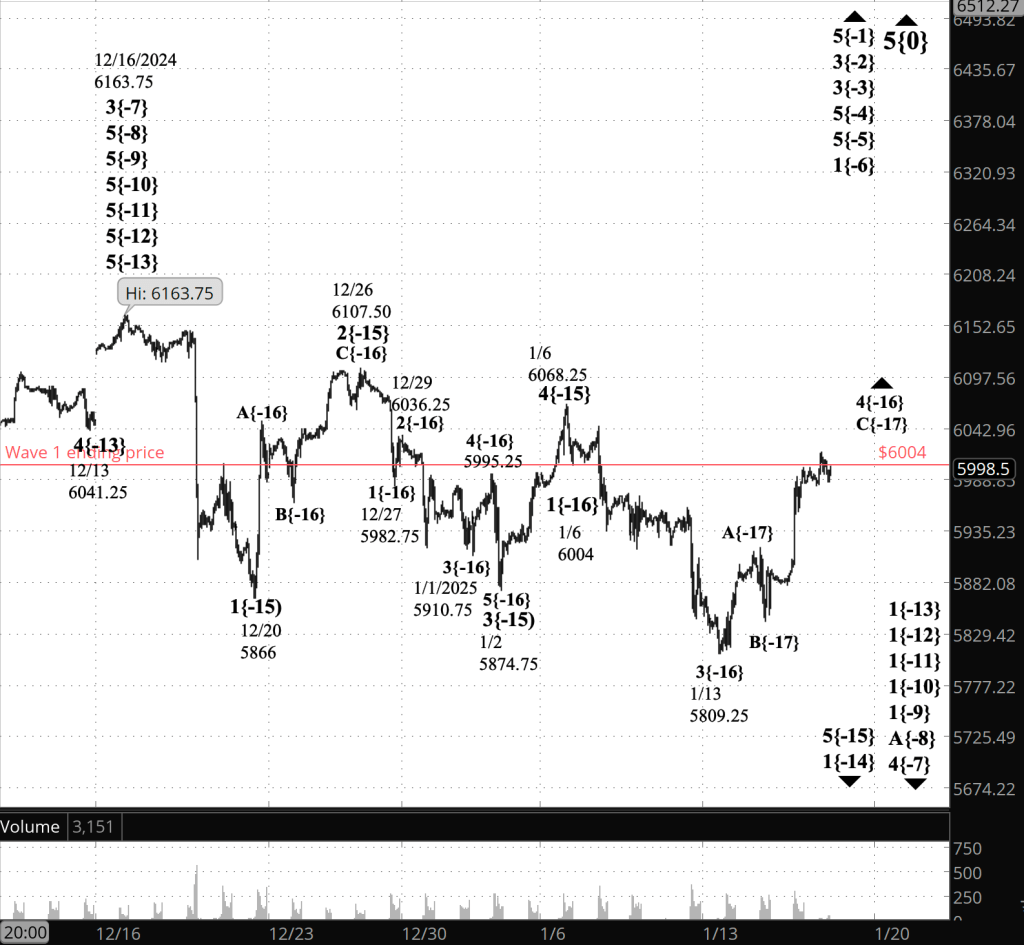
Trader’s Notebook

3:30 p.m. New York time

Half an hour before the closing bell. The S&P 500 futures continued to rise during the session, peaking in the 6030s.

Elliott WaveTheory: The low-degree 5th wave uptrend that began on November 25 continues within the larger 5th wave, three degrees larger, that began on November 19.

9:35 a.m. New York time

What’s happening now? The S&P 500 E-mini futures rose overnigjt, moving beyond the 78.6% Fibonacci retracement level into the 6020s.

What does it mean? Elliott Wave Theory analysis sees a low-degree 4th-wave downward correction that began on at the session open on November 25 as having ended the same day after the closing bell.

The 5th-degree uptrend is now underway.

These are tiny degrees, barely worth a glance except for the most aggressive of day traders. However, when this small 5th wave ends, it will be the end of the parent 5th wave one degree higher and of the grand-parent 3rd wave that began on November 20, a wave of a more useful size for traders.

That 3rd wave is a subwave of the 5th-wave uptrend that began on November 19, whose end will trigger still larger 5th waves that are one to four degrees larger, and a 3rd degree, one more degree larger, that began on August 7.

[S&P 500 E-mini futures at 3:30 p.m., 30-minute bars, with volume]

What are the alternatives? None at present. Typically some will develop.

What does Elliott wave theory say? Here are the waves that underly the analyses.

Principal Analysis:

  • Rising wave 5{0} is underway. It is a wave of Intermediate degree that began in December 2018.
  • It is in its final subwave, wave 5{-1}.
  • Within wave 5{-1}, rising waves 5{-2}, 5{-3} and 5{-4} are underway, as is wave 5{-5}.
  • Wave 5{-5} is in its initial subwave, wave 1{-6}, which in turn is in its middle subwave, wave 3{-7}.
  • Wave 3{-7} is in its final; subwave, uptrending wave 5{-8}.
  • Wave 5{-8} is in its final subwave, wave 5{-9}, which is in its final subwave, uptrending wave 5{-10}.
  • Wave 5{-10} is in its final subwave, wave 5{-11}, which is in its middle subwave, wave 3{-12}, within wave 5{-13}.

Long-term Waves.

These are the waves currently in progress under my principal analysis. Each line on the list shows the wave number, with the subscript in curly brackets, the traditional degree name, the starting date, the starting price of the S&P 500 E-mini futures, and the direction of the wave.

  • S&P 500 Index:
  • 5{+3} Supercycle, 7/8/1932, 4.40 (up)
  • 5{+2} Cycle, 12/9/1974, 60.96 (up)
  • 5{+1} Primary, 3/6/2009, 666.79 (up)
  • 5{0} Intermediate, 12/26/2018, 2346.58 (up)
  • S&P 500 Futures
  • 5{-1} Minor, 10/27/2023, 4127.25 (up)
  • 3{-2} Minute, 10/27/23, 4127.75 (up)
  • 3{-3} Minuette, 10/27/23, 4127.75 (up)
  • 5{-4} Subminuette, 4/18/2024, 4963.50 (up)
  • 5{-5} Micro, 8/5/2024, 5120 (up)
  • 1{-6} Submicro, 8/5/2024, 5120 (up)
  • 3{-7} Minuscule, 8/7/2024, 5182 (up)
  • 5{-8} (unnamed), 9/6/2024, 5394 (up)
  • 5{-9} (unnamed), 10/2/2024, 5724 (up)
  • 5{-10} (unnamed), 11/4/2024, 5824.25 (up)
  • 5{-11} (unnamed), 11/19/2024, 5933 (up)

Reading the chart. Price movements — waves – – in Elliott wave analysis are labeled with numbers within trending waves and letters with corrective waves. The subscripts — numbers in curly brackets — designate the wave’s degree, which, in Elliott wave analysis, means the relative position of a wave within the larger and smaller structures that make up the chart. R.N. Elliott, who in the 1930s developed the form of analysis that bears his name, viewed the chart as a complex structure of smaller waves nested within larger waves, which in turn are nested within still larger waves. In mathematics it’s called a fractal structure, where at every scale the pattern is similar to the others.

Learning and other resources. Elliott wave analysis provides context, not prophecy. As the 20th century semanticist Alfred Korzybski put it in his book Science and Sanity (1933), “The map is not the territory … The only usefulness of a map depends on similarity of structure between the empirical world and the map.” And I would add, in the ever-changing markets, we can judge that similarity of structure only after the fact.

See the menu page Analytical Methods for a rundown on where to go for information on Elliott wave analysis.

By Tim Bovee, Portland, Oregon, November 26, 2024

Disclaimer

Tim Bovee, Private Trader tracks the analysis and trades of a private trader for his own accounts. Nothing in this blog constitutes a recommendation to buy or sell stocks, options or any other financial instrument. The only purpose of this blog is to provide education and entertainment.

No trader is ever 100 percent successful in his or her trades. Trading in the stock and option markets is risky and uncertain. Each trader must make trading decisions for his or her own account, and take responsibility for the consequences.

License
Creative Commons License

All content on Tim Bovee, Private Trader by Timothy K. Bovee is licensed under a Creative Commons Attribution-ShareAlike 4.0 International License.

Based on a work at www.timbovee.com.
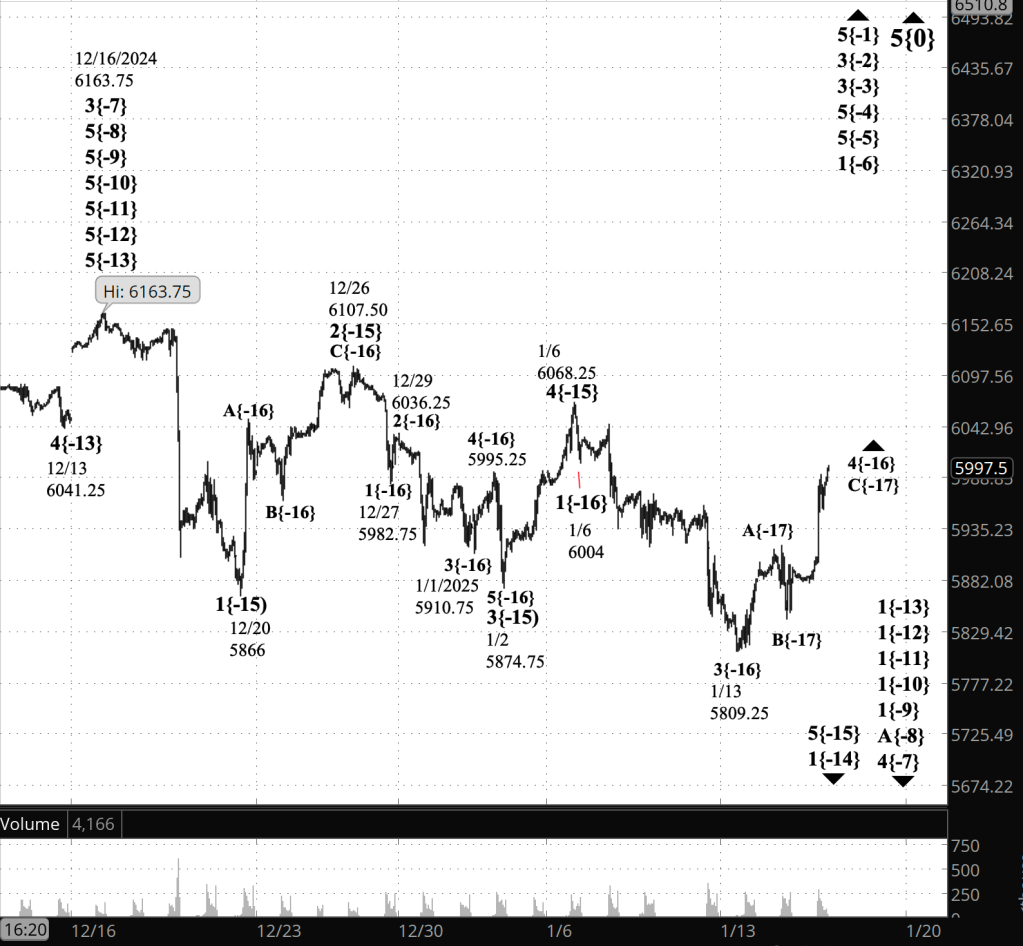
Trader’s Notebook

3:30 p.m. New York time

Half an hour before the closing bell. The S&P 500 futures rose to 6040 early in the session and then reversed, reaching into the 5980s.

Elliott Wave Theory: The 6040 peak was the end of the small 3rd wave buried three levels deep within the 5th-wave uptrend that began on November 19. A small 4th-wave downward correction began at that point and is now underway.

9:35 a.m. New York time

What’s happening now? The S&P 500 E-mini futures gapped higher when trading resumed overnight. The rise continued, reaching into the 6030s as the opening bell approached.

What does it mean? The leap carried the price to the 78.6% Fibonacci retracement level, the final level below 100%. Elliott Wave Theory applied to the chart indicates that the 5th-wave uptrend, which began on November 19, is currently in its 3rd of five subwaves. This subwave, in turn, is within its smaller 5th subwave.

Looking at the broader context, the largest wave in play—the 5th wave that started on November 19—is approaching completion. Once finished, it will also mark the end of its parent wave, another 5th wave of a larger degree.

At the top of the fractal structure is a rising 3rd wave that began on August 7 from 5192. This wave will conclude simultaneously with the smaller 5th waves, ushering in a significant 4th-wave downward correction.

The Question of the Moment: How High Can It Go? Fifth waves typically retrace the entirety of the preceding 4th wave, reaching the 100% Fibonacci level. In some cases, the 5th wave can move significantly beyond the start of wave 4, which in this instance is at 6053.25. However, in Elliott Wave Theory, 5th waves are often unpredictable, leaving their ultimate endpoint a puzzle.

[S&P 500 E-mini futures at 3:30 p.m., 25-minute bars, with volume]

What are the alternatives? None at present, and typically some will develop.

What does Elliott wave theory say? Here are the waves that underly the analyses.

Principal Analysis:

  • .Rising wave 5{0} is underway. It is a wave of Intermediate degree that began in December 2018.
  • It is in its final subwave, wave 5{-1}.
  • Within wave 5{-1}, rising waves 5{-2}, 5{-3} and 5{-4} are underway, as is wave 5{-5}.
  • Wave 5{-5} is in its initial subwave, wave 1{-6}, which in turn is in its middle subwave, wave 3{-7}.
  • Wave 3{-7} is in its final; subwave, uptrending wave 5{-8}.
  • Wave 5{-8} is in its final subwave, wave 5{-9}, which is in its final subwave, uptrending wave 5{-10}.
  • Wave 5{-10} is in its final subwave, wave 5{-11}, which is in its middle subwave, wave 3{-12}, within wave 5{-13}.

Long-term Waves.

These are the waves currently in progress under my principal analysis. Each line on the list shows the wave number, with the subscript in curly brackets, the traditional degree name, the starting date, the starting price of the S&P 500 E-mini futures, and the direction of the wave.

  • S&P 500 Index:
  • 5{+3} Supercycle, 7/8/1932, 4.40 (up)
  • 5{+2} Cycle, 12/9/1974, 60.96 (up)
  • 5{+1} Primary, 3/6/2009, 666.79 (up)
  • 5{0} Intermediate, 12/26/2018, 2346.58 (up)
  • S&P 500 Futures
  • 5{-1} Minor, 10/27/2023, 4127.25 (up)
  • 3{-2} Minute, 10/27/23, 4127.75 (up)
  • 3{-3} Minuette, 10/27/23, 4127.75 (up)
  • 5{-4} Subminuette, 4/18/2024, 4963.50 (up)
  • 5{-5} Micro, 8/5/2024, 5120 (up)
  • 1{-6} Submicro, 8/5/2024, 5120 (up)
  • 3{-7} Minuscule, 8/7/2024, 5182 (up)
  • 5{-8} (unnamed), 9/6/2024, 5394 (up)
  • 5{-9} (unnamed), 10/2/2024, 5724 (up)
  • 5{-10} (unnamed), 11/4/2024, 5824.25 (up)
  • 5{-11} (unnamed), 11/19/2024, 5933 (up)

Reading the chart. Price movements — waves – – in Elliott wave analysis are labeled with numbers within trending waves and letters with corrective waves. The subscripts — numbers in curly brackets — designate the wave’s degree, which, in Elliott wave analysis, means the relative position of a wave within the larger and smaller structures that make up the chart. R.N. Elliott, who in the 1930s developed the form of analysis that bears his name, viewed the chart as a complex structure of smaller waves nested within larger waves, which in turn are nested within still larger waves. In mathematics it’s called a fractal structure, where at every scale the pattern is similar to the others.

Learning and other resources. Elliott wave analysis provides context, not prophecy. As the 20th century semanticist Alfred Korzybski put it in his book Science and Sanity (1933), “The map is not the territory … The only usefulness of a map depends on similarity of structure between the empirical world and the map.” And I would add, in the ever-changing markets, we can judge that similarity of structure only after the fact.

See the menu page Analytical Methods for a rundown on where to go for information on Elliott wave analysis.

By Tim Bovee, Portland, Oregon, November 25, 2024

Disclaimer

Tim Bovee, Private Trader tracks the analysis and trades of a private trader for his own accounts. Nothing in this blog constitutes a recommendation to buy or sell stocks, options or any other financial instrument. The only purpose of this blog is to provide education and entertainment.

No trader is ever 100 percent successful in his or her trades. Trading in the stock and option markets is risky and uncertain. Each trader must make trading decisions for his or her own account, and take responsibility for the consequences.

License
Creative Commons License

All content on Tim Bovee, Private Trader by Timothy K. Bovee is licensed under a Creative Commons Attribution-ShareAlike 4.0 International License.

Based on a work at www.timbovee.com.
Trader’s Notebook

3:30 p.m. New York time

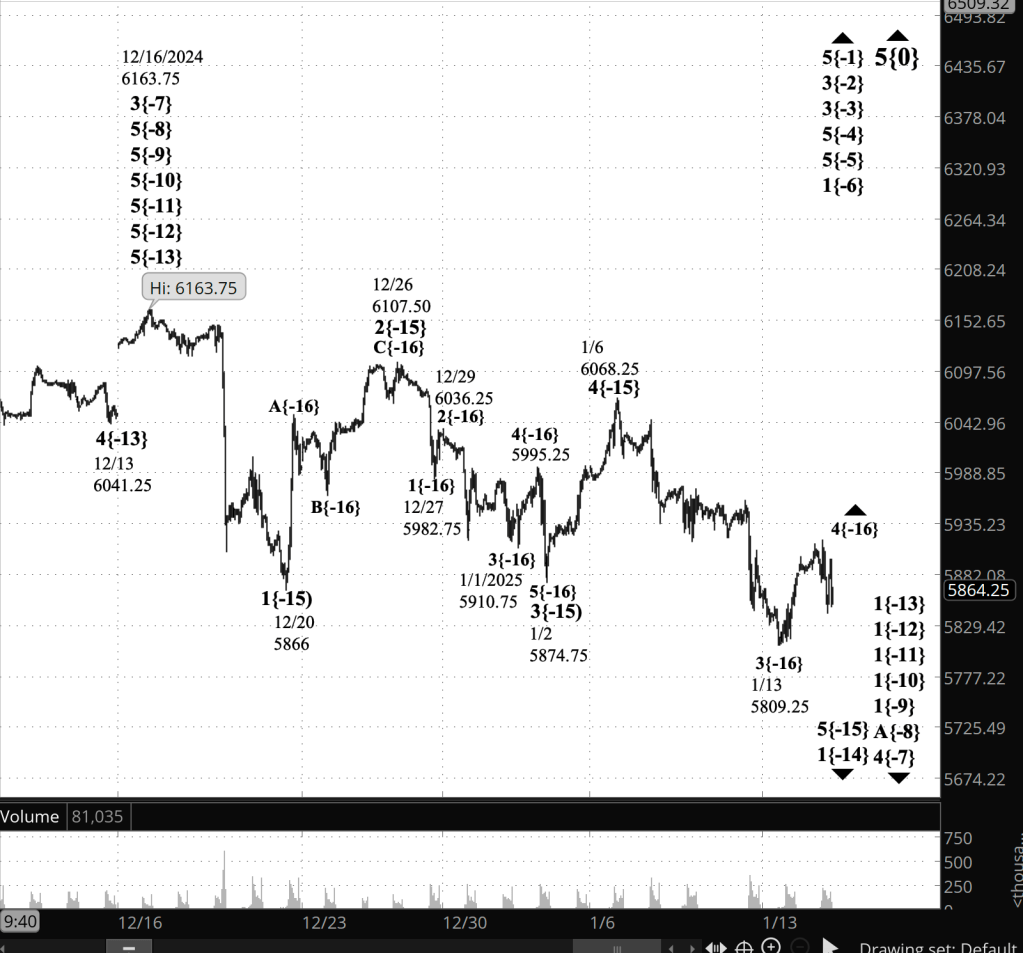
Half an hour before the closing bell. The S&P 500 futures rose into the 5990s amid a largely sideways pattern mostly above the 61.8% Fibonacci level.

Elliott Wave Theory: The pattern was a corrective subwave within a larger 3rd-wave uptrend within a still larger 5th-wave uptrend that began on November 19.

9:35 a.m. New York time

What’s happening now? The S&P 500 E-mini futures fell from the 5970s down to the 5940s, then rose again, approaching the 61.8% Fibonacci level as the opening bell approached.

What does it mean? The rising 3rd Elliott Wave within the rising 5th wave that began on November 19 continues. The 3rd wave is in its 4th subwave—a downward correction that will be followed by a 5th and final subwave, completing the 3rd wave within the 5th wave.

Each wave on the chart is labeled with a wave number followed by a subscript in curly brackets, showing the wave’s position in relation to the Intermediate wave, wave 5{0}, which began in December 2018.

The smallest ongoing wave within the series discussed above appears on the chart as wave 4{-13} within wave 3{-12} within wave 5{-11}.

When wave 5{-11} is complete, it will also mark the end of waves 5{-10}, 5{-9}, and 5{-8}, as well as the even larger wave 3{-7}, which began on August 7. A large 4th-wave downward correction, wave 4{-7}, will follow.

[S&P 500 E-mini futures at 3:30.m., 25-minute bars, with volume]

What are the alternatives? I’ve labeled the first subwave of the rising 5th wave as being one degree smaller than the parent wave. It’s possible it is two degrees smaller, making them subwaves of wave 1 within wave 5.

What does Elliott wave theory say? Here are the waves that underly the analyses.

Principal Analysis:

  • Rising wave 5{0} is underway. It is a wave of Intermediate degree that began in December 2018.
  • It is in its final subwave, wave 5{-1}.
  • Within wave 5{-1}, rising waves 5{-2}, 5{-3} and 5{-4} are underway, as is wave 5{-5}.
  • Wave 5{-5} is in its initial subwave, wave 1{-6}, which in turn is in its middle subwave, wave 3{-7}.
  • Wave 3{-7} is in its final; subwave, uptrending wave 5{-8}.
  • Wave 5{-8} is in its final subwave, wave 5{-9}, which is in its final subwave, uptrending wave 5{-10}.
  • Wave 5{-10} is in its final subwave, wave 5{-11}, which is in its middle subwave, wave 3{-12}

Long-term Waves.

These are the waves currently in progress under my principal analysis. Each line on the list shows the wave number, with the subscript in curly brackets, the traditional degree name, the starting date, the starting price of the S&P 500 E-mini futures, and the direction of the wave.

  • S&P 500 Index:
  • 5{+3} Supercycle, 7/8/1932, 4.40 (up)
  • 5{+2} Cycle, 12/9/1974, 60.96 (up)
  • 5{+1} Primary, 3/6/2009, 666.79 (up)
  • 5{0} Intermediate, 12/26/2018, 2346.58 (up)
  • S&P 500 Futures
  • 5{-1} Minor, 10/27/2023, 4127.25 (up)
  • 3{-2} Minute, 10/27/23, 4127.75 (up)
  • 3{-3} Minuette, 10/27/23, 4127.75 (up)
  • 5{-4} Subminuette, 4/18/2024, 4963.50 (up)
  • 5{-5} Micro, 8/5/2024, 5120 (up)
  • 1{-6} Submicro, 8/5/2024, 5120 (up)
  • 3{-7} Minuscule, 8/7/2024, 5182 (up)
  • 5{-8} (unnamed), 9/6/2024, 5394 (up)
  • 5{-9} (unnamed), 10/2/2024, 5724 (up)
  • 5{-10} (unnamed), 11/4/2024, 5824.25 (up)
  • 5{-11} (unnamed), 11/19/2024, 5933 (up)

Reading the chart. Price movements — waves – – in Elliott wave analysis are labeled with numbers within trending waves and letters with corrective waves. The subscripts — numbers in curly brackets — designate the wave’s degree, which, in Elliott wave analysis, means the relative position of a wave within the larger and smaller structures that make up the chart. R.N. Elliott, who in the 1930s developed the form of analysis that bears his name, viewed the chart as a complex structure of smaller waves nested within larger waves, which in turn are nested within still larger waves. In mathematics it’s called a fractal structure, where at every scale the pattern is similar to the others.

Learning and other resources. Elliott wave analysis provides context, not prophecy. As the 20th century semanticist Alfred Korzybski put it in his book Science and Sanity (1933), “The map is not the territory … The only usefulness of a map depends on similarity of structure between the empirical world and the map.” And I would add, in the ever-changing markets, we can judge that similarity of structure only after the fact.

See the menu page Analytical Methods for a rundown on where to go for information on Elliott wave analysis.

By Tim Bovee, Portland, Oregon, November 22, 2024

Disclaimer

Tim Bovee, Private Trader tracks the analysis and trades of a private trader for his own accounts. Nothing in this blog constitutes a recommendation to buy or sell stocks, options or any other financial instrument. The only purpose of this blog is to provide education and entertainment.

No trader is ever 100 percent successful in his or her trades. Trading in the stock and option markets is risky and uncertain. Each trader must make trading decisions for his or her own account, and take responsibility for the consequences.

License
Creative Commons License

All content on Tim Bovee, Private Trader by Timothy K. Bovee is licensed under a Creative Commons Attribution-ShareAlike 4.0 International License.

Based on a work at www.timbovee.com.
Trader’s Notebook

3:30 p.m. New York time

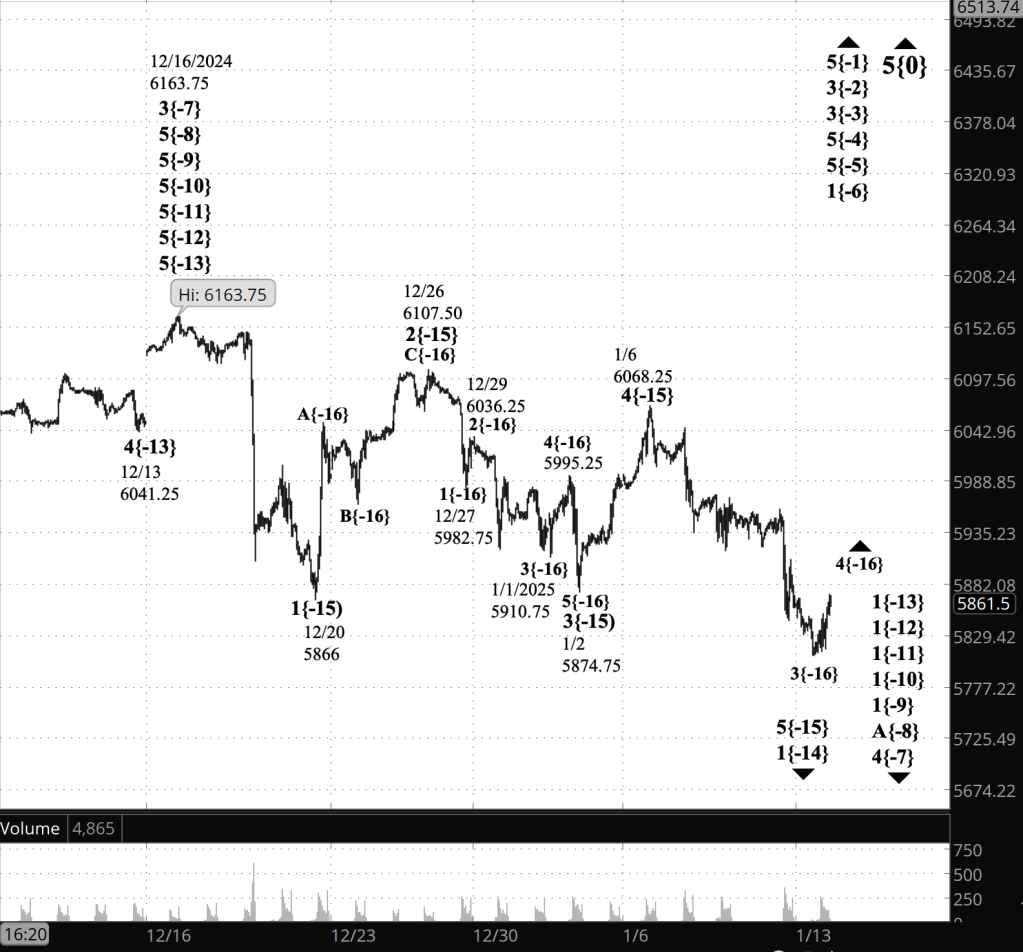
Half an hour before the closing bell. The S&P 500 futures rose during the session reaching into the 5980s, and stalled at that level.

Elliott Wave Theory. The price is fluctuating at the 61.8% Fibonacci retracement level, where prices often tend to stall or switch directions.

The 5th-wave uptrend that began on November 19 continues to work through its 3rd subwave.

9:35 a.m. New York time

What’s happening now? The S&P 500 E-mini futures rose from its overnight low of 5905.25 into the 5970s.

What does it mean? Based on Elliott Wave Theory, the uptrending 5th wave that began on November 19 is in its initial subwave, wave 1. I considered labelling it wave 3, but that would have given wave 1 only three subwaves, and it must have five.

I’ve placed a Fibonacci retracement ladder on the chart, in red. It shows that the 5th-wave uptrend has so far retraced more than half of the of the preceding 4th-wave downward correction and is pushing toward 61.8%, a Fibonacci retracement level around which price often turn.

[S&P 500 E-mini futures at 3:30 p.m., 20-minute bars, with volume]

What are the alternatives? I’ve labeled the first subwave of the rising 5th wave as being one degree smaller than the parent wave. It’s possible it is two degrees smaller, making them subwaves of wave 1 within wave 5.

What does Elliott wave theory say? Here are the waves that underly the analyses.

Principal Analysis:

  • .Rising wave 5{0} is underway. It is a wave of Intermediate degree that began in December 2018.
  • It is in its final subwave, wave 5{-1}.
  • Within wave 5{-1}, rising waves 5{-2}, 5{-3} and 5{-4} are underway, as is wave 5{-5}.
  • Wave 5{-5} is in its initial subwave, wave 1{-6}, which in turn is in its middle subwave, wave 3{-7}.
  • Wave 3{-7} is in its final; subwave, uptrending wave 5{-8}.
  • Wave 5{-8} is in its final subwave, wave 5{-9}, which is in its final subwave, uptrending wave 5{-10}.
  • Wave 5{-10} is in its final subwave, wave 5{-11}, which is in its middle subwave, wave 3{-12}

Long-term Waves.

These are the waves currently in progress under my principal analysis. Each line on the list shows the wave number, with the subscript in curly brackets, the traditional degree name, the starting date, the starting price of the S&P 500 E-mini futures, and the direction of the wave.

  • S&P 500 Index:
  • 5{+3} Supercycle, 7/8/1932, 4.40 (up)
  • 5{+2} Cycle, 12/9/1974, 60.96 (up)
  • 5{+1} Primary, 3/6/2009, 666.79 (up)
  • 5{0} Intermediate, 12/26/2018, 2346.58 (up)
  • S&P 500 Futures
  • 5{-1} Minor, 10/27/2023, 4127.25 (up)
  • 3{-2} Minute, 10/27/23, 4127.75 (up)
  • 3{-3} Minuette, 10/27/23, 4127.75 (up)
  • 5{-4} Subminuette, 4/18/2024, 4963.50 (up)
  • 5{-5} Micro, 8/5/2024, 5120 (up)
  • 1{-6} Submicro, 8/5/2024, 5120 (up)
  • 3{-7} Minuscule, 8/7/2024, 5182 (up)
  • 5{-8} (unnamed), 9/6/2024, 5394 (up)
  • 5{-9} (unnamed), 10/2/2024, 5724 (up)
  • 5{-10} (unnamed), 11/4/2024, 5824.25 (up)
  • 5{-11} (unnamed), 11/19/2024, 5933 (up)

Reading the chart. Price movements — waves – – in Elliott wave analysis are labeled with numbers within trending waves and letters with corrective waves. The subscripts — numbers in curly brackets — designate the wave’s degree, which, in Elliott wave analysis, means the relative position of a wave within the larger and smaller structures that make up the chart. R.N. Elliott, who in the 1930s developed the form of analysis that bears his name, viewed the chart as a complex structure of smaller waves nested within larger waves, which in turn are nested within still larger waves. In mathematics it’s called a fractal structure, where at every scale the pattern is similar to the others.

Learning and other resources. Elliott wave analysis provides context, not prophecy. As the 20th century semanticist Alfred Korzybski put it in his book Science and Sanity (1933), “The map is not the territory … The only usefulness of a map depends on similarity of structure between the empirical world and the map.” And I would add, in the ever-changing markets, we can judge that similarity of structure only after the fact.

See the menu page Analytical Methods for a rundown on where to go for information on Elliott wave analysis.

By Tim Bovee, Portland, Oregon, November 21, 2024

Disclaimer

Tim Bovee, Private Trader tracks the analysis and trades of a private trader for his own accounts. Nothing in this blog constitutes a recommendation to buy or sell stocks, options or any other financial instrument. The only purpose of this blog is to provide education and entertainment.

No trader is ever 100 percent successful in his or her trades. Trading in the stock and option markets is risky and uncertain. Each trader must make trading decisions for his or her own account, and take responsibility for the consequences.

License
Creative Commons License

All content on Tim Bovee, Private Trader by Timothy K. Bovee is licensed under a Creative Commons Attribution-ShareAlike 4.0 International License.

Based on a work at www.timbovee.com.