Trader’s Notebook

3:30 p.m. New York time

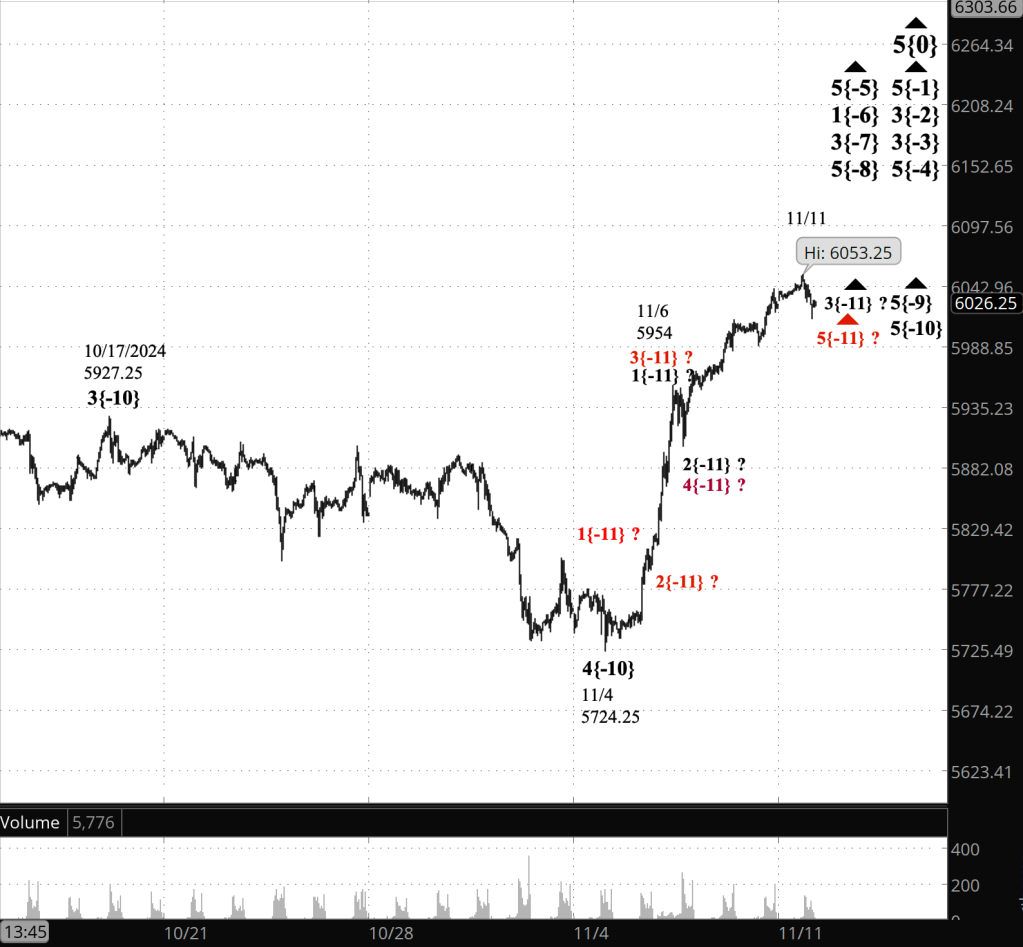
Half an hour before the closing bell. The S&P 500 futures continued to fluctuate in a narrow range during the session. Elliott Wave Theory: The 4th-wave upward upward correction that began on September 6 continues to work through its endgame.

9:35 a.m. New York time

What’s happening now? Another day, another overnight trading session where the S&P 500 E-mini futures traded within a narrow range, between the 5770s and the 5790s. As the opening bell sounded, the price rose above the September 19 high, reaching 5798

What does it mean? What it meant yesterday, and the day before yesterday. The 4th-wave upward correction that began on September 6 continues to work through its endgame. Internally, from larger degrees to smaller degrees: The September 6 Wave 4 is in its final subwave, wave C, which is in its final subwave, wave 5, which is in its next-to-the-last subwave, a 4th-wave upward correction that began on September 18, which is in its final subwave, wave C.

That’s a lot of final waves. At some point, a smaller final wave will reach its end, and that finality will cascade up the fractal structure, ending the larger 4th-wave upward correction and ushering in a 5th-wave uptrend

[S&P 500 E-mini futures at 3:30 p.m., hourly bars, with volume]

What are the alternatives? There are three.

Alternative #1:

The 4th-wave upward correction that began on September 6 ended on September 19. A 5th-wave downtrend has begun.

Alternative #2:

This alternative is a future possibility, after wave C is complete. Typically, a 4th-wave correction will have three subwaves — A, B and C — and then will be complete. Occasionally a subwave will take a compound form, containing two or three corrective patterns, each composed of three subwaves and connected to the prior pattern by a wave called an X wave. This would delay the start of the following 5th wave uptrend.

Alternative #3:

This alternative has to do with how best to interpret the chart’s position within wave C. It plays off of the fact that the 2nd subwave within C under the Principal Analysis is quite small. It is possible that the decline we’ve seen since September 2 is a degree smaller within the fractal structure of the chart than the principal analysis would have. Under this scenario, wave 1 within wave C is underway. This would delay the end of the 4th-wave downward correction and the start of the ensuing 5th wave uptrend.

What does Elliott wave theory say? Here are the waves that underly the analyses.

Principal Analysis:

  • Rising wave 5{0} is underway. It is a wave of Intermediate degree that began in December 2018.
  • It is in its final subwave, wave 5{-1}.
  • Within wave 5{-1}, rising waves 5{-2}, 5{-3} and 5{-4} are underway, as is wave 5{-5}.
  • Wave 5{-5} is in its initial subwave, wave 1{-6}, which in turn is in its middle subwave, wave 3{-7}.
  • Wave 3{-7} is in its next-to-the-last subwave, wave 4{-8}, a downward correction.
  • Wave 4{-8} is in its final subwave, wave C{-9}, which is within wave 5{-10}.
  • Wave 5{-10} is in its final subwave, rising wave 5{-11}.
  • Within rising wve 5{-11}, the subwaves are rising wave C{-12}, rising wave 5{-13} and falling wave 4{-14}

Alternative Analysis #1, upward correction ended

  • Wave 4{-8} has ended and falling wave 5{-8} has begun.

Alternative Analysis #2, compound correction scenario:

  • Wave 4{-8} is in its final subwave, wave C{-9}, which is in its middle subwave, wave 3{-10}.
  • Wave 5{-10}, still in the future, will be the end of wave C{-9} but not of the wave 4{-8} downward correction, which under this scenario will take a compound form containing two or three corrective patterns.
  • The present wave C{-9} will be followed by a rising connector wave X{-9} and then a declining wave A{-9}, the first wave of the second corrective pattern.

Alternative Analysis #3, wave 1 scenario:

  • Wave 4{-8} is in its final subwave, wave C{-9}, which is in its initial subwave wave 1{-10}, which in turn is in its final subwave, wave 3{-11}. And wave 3{-11} is in its final subwave, wave 5{-12}.

Reading the chart. Price movements — waves – – in Elliott wave analysis are labeled with numbers within trending waves and letters with corrective waves. The subscripts — numbers in curly brackets — designate the wave’s degree, which, in Elliott wave analysis, means the relative position of a wave within the larger and smaller structures that make up the chart. R.N. Elliott, who in the 1930s developed the form of analysis that bears his name, viewed the chart as a complex structure of smaller waves nested within larger waves, which in turn are nested within still larger waves. In mathematics it’s called a fractal structure, where at every scale the pattern is similar to the others.

Learning and other resources. Elliott wave analysis provides context, not prophecy. As the 20th century semanticist Alfred Korzybski put it in his book Science and Sanity (1933), “The map is not the territory … The only usefulness of a map depends on similarity of structure between the empirical world and the map.” And I would add, in the ever-changing markets, we can judge that similarity of structure only after the fact.

See the menu page Analytical Methods for a rundown on where to go for information on Elliott wave analysis.

By Tim Bovee, Portland, Oregon, September 25, 2024

Disclaimer

Tim Bovee, Private Trader tracks the analysis and trades of a private trader for his own accounts. Nothing in this blog constitutes a recommendation to buy or sell stocks, options or any other financial instrument. The only purpose of this blog is to provide education and entertainment.

No trader is ever 100 percent successful in his or her trades. Trading in the stock and option markets is risky and uncertain. Each trader must make trading decisions for his or her own account, and take responsibility for the consequences.

License
Creative Commons License

All content on Tim Bovee, Private Trader by Timothy K. Bovee is licensed under a Creative Commons Attribution-ShareAlike 4.0 International License.

Based on a work at www.timbovee.com.
Trader’s Notebook

3:30 p.m. New York time

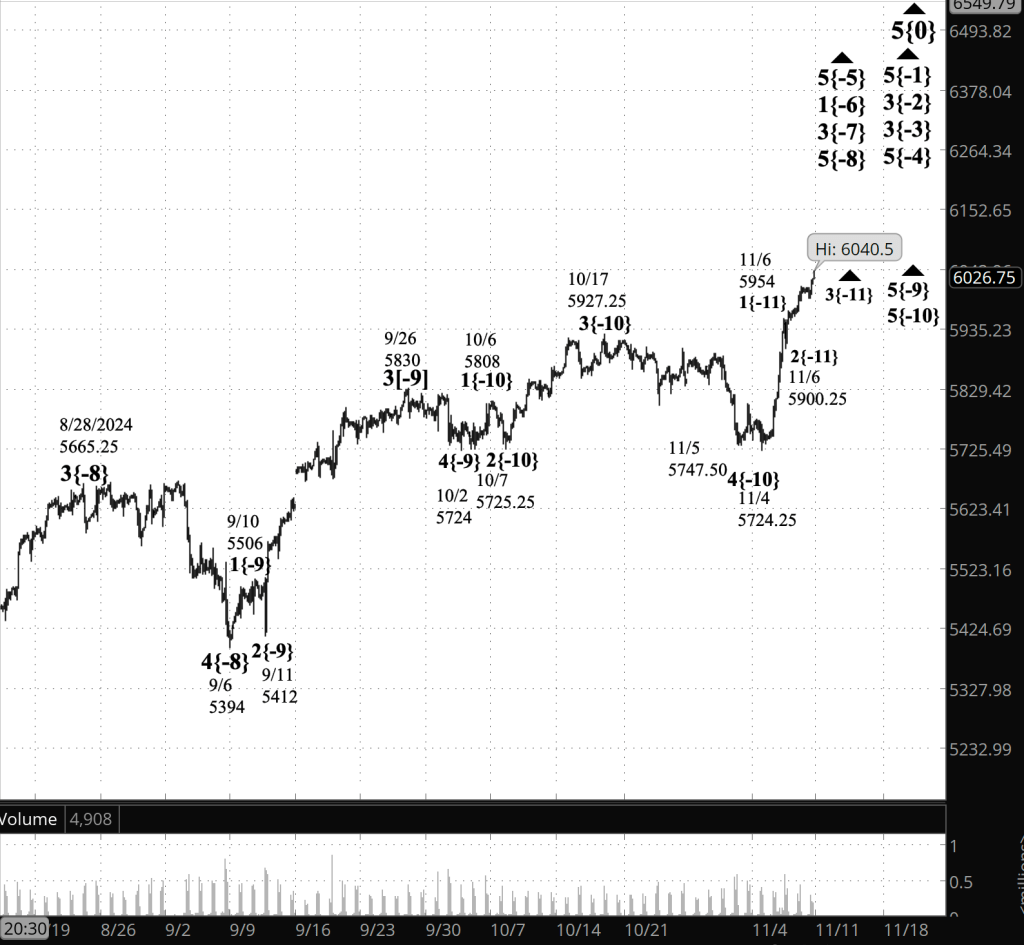
Half an hour before the closing bell. The S&P 500 futures remained in the 5790s and 5780s during the session, with a brief dip into the 5770s.

A small downward correction that began on September 19 continues, a subwave within the final subwave of the larger upward correction that began on September 6.

9:35 a.m. New York time

What’s happening now? The S&P 500 E-mini futures continued to trace a sideways path, fluctuating within a narrow range.

What does it mean? Elliott Wave Theory sees the range so far this week as a low-degree 4th-wave downward correction following the 3rd-wave uptrend that ended September 19 at 5797.50.

Next, a 5th-wave uptrend that is likely to carry the price above that peak. Caveat: Sometimes a 5th wave will be truncated, falling short of the 3rd-wave high,

The end of that uptrend will also be the end of a the parent wave, also a rising 5th wave, and of the grand-parent wave, a C wave within the larger 4th-wave uptrend that began on September 6.

[S&P 500 E-mini futures at 3:30 o.m., hourly bars, with volume]

What are the alternatives? There are three.

Alternative #1:

The 4th-wave upward correction that began on September 6 ended on September 19. A 5th-wave downtrend has begun.

Alternative #2:

This alternative is a future possibility, after wave C is complete. Typically, a 4th-wave correction will have three subwaves — A, B and C — and then will be complete. Occasionally a subwave will take a compound form, containing two or three corrective patterns, each composed of three subwaves and connected to the prior pattern by a wave called an X wave. This would delay the start of the following 5th wave uptrend.

Alternative #3:

This alternative has to do with how best to interpret the chart’s position within wave C. It plays off of the fact that the 2nd subwave within C under the Principal Analysis is quite small. It is possible that the decline we’ve seen since September 2 is a degree smaller within the fractal structure of the chart than the principal analysis would have. Under this scenario, wave 1 within wave C is underway. This would delay the end of the 4th-wave downward correction and the start of the ensuing 5th wave uptrend.

What does Elliott wave theory say? Here are the waves that underly the analyses.

Principal Analysis:

  • Rising wave 5{0} is underway. It is a wave of Intermediate degree that began in December 2018.
  • It is in its final subwave, wave 5{-1}.
  • Within wave 5{-1}, rising waves 5{-2}, 5{-3} and 5{-4} are underway, as is wave 5{-5}.
  • Wave 5{-5} is in its initial subwave, wave 1{-6}, which in turn is in its middle subwave, wave 3{-7}.
  • Wave 3{-7} is in its next-to-the-last subwave, wave 4{-8}, a downward correction.
  • Wave 4{-8} is in its final subwave, wave C{-9}, which is within wave 5{-10}.
  • Wave 5{-10} is in its final subwave, rising wave 5{-11}.
  • Within rising wve 5{-11}, the subwaves are rising wave C{-12}, rising wave 5{-13} and falling wave 4{-14}

Alternative Analysis #1, upward correction ended

  • Wave 4{-8} has ended and falling wave 5{-8} has begun.

Alternative Analysis #2, compound correction scenario:

  • Wave 4{-8} is in its final subwave, wave C{-9}, which is in its middle subwave, wave 3{-10}.
  • Wave 5{-10}, still in the future, will be the end of wave C{-9} but not of the wave 4{-8} downward correction, which under this scenario will take a compound form containing two or three corrective patterns.
  • The present wave C{-9} will be followed by a rising connector wave X{-9} and then a declining wave A{-9}, the first wave of the second corrective pattern.

Alternative Analysis #3, wave 1 scenario:

  • Wave 4{-8} is in its final subwave, wave C{-9}, which is in its initial subwave wave 1{-10}, which in turn is in its final subwave, wave 3{-11}. And wave 3{-11} is in its final subwave, wave 5{-12}.

Reading the chart. Price movements — waves – – in Elliott wave analysis are labeled with numbers within trending waves and letters with corrective waves. The subscripts — numbers in curly brackets — designate the wave’s degree, which, in Elliott wave analysis, means the relative position of a wave within the larger and smaller structures that make up the chart. R.N. Elliott, who in the 1930s developed the form of analysis that bears his name, viewed the chart as a complex structure of smaller waves nested within larger waves, which in turn are nested within still larger waves. In mathematics it’s called a fractal structure, where at every scale the pattern is similar to the others.

Learning and other resources. Elliott wave analysis provides context, not prophecy. As the 20th century semanticist Alfred Korzybski put it in his book Science and Sanity (1933), “The map is not the territory … The only usefulness of a map depends on similarity of structure between the empirical world and the map.” And I would add, in the ever-changing markets, we can judge that similarity of structure only after the fact.

See the menu page Analytical Methods for a rundown on where to go for information on Elliott wave analysis.

By Tim Bovee, Portland, Oregon, September 24, 2024

Disclaimer

Tim Bovee, Private Trader tracks the analysis and trades of a private trader for his own accounts. Nothing in this blog constitutes a recommendation to buy or sell stocks, options or any other financial instrument. The only purpose of this blog is to provide education and entertainment.

No trader is ever 100 percent successful in his or her trades. Trading in the stock and option markets is risky and uncertain. Each trader must make trading decisions for his or her own account, and take responsibility for the consequences.

License
Creative Commons License

All content on Tim Bovee, Private Trader by Timothy K. Bovee is licensed under a Creative Commons Attribution-ShareAlike 4.0 International License.

Based on a work at www.timbovee.com.

Trader’s Notebook

3:30 p.m. New York time

Half an hour before the closing bell. The S&P 500 futures barely budged during the session, remaining between the 5760s and 5770s. The 4th-wave upward correction that began on September 6 continues.

9:35 a.m. New York time

What’s happening now? The S&P 500 E-mini futures to to the 5780s and then dropped to the 5740s after trading resumed overnight.

What does it mean? The price remained below the September 19 high, 5797.50. After applying Elliott Wave Theory, I’ve concluded that the decline from that high is very low degree 4th-wave downward correction.

That small correction is part of a series of rising and falling waves that are part of the larger 4th-wave upward correction that began on September 6. When that larger 4th-wave correction is complete, an uptrending 5th wave will begin. When complete, it will also be the end of the C wave of a still larger downward correction that began on August 28. A rising 5th wave will follow.

[S&P 500 E-mini futures at 3:30 p.m., hour.\ly bars, with volume]

What are the alternatives? There are three.

Alternative #1:

The 4th-wave upward correction that began on September 6 ended on September 19. A 5th-wave downtrend has begun.

Alternative #2:

This alternative is a future possibility, after wave C is complete. Typically, a 4th-wave correction will have three subwaves — A, B and C — and then will be complete. Occasionally a subwave will take a compound form, containing two or three corrective patterns, each composed of three subwaves and connected to the prior pattern by a wave called an X wave. This would delay the start of the following 5th wave uptrend.

Alternative #3:

This alternative has to do with how best to interpret the chart’s position within wave C. It plays off of the fact that the 2nd subwave within C under the Principal Analysis is quite small. It is possible that the decline we’ve seen since September 2 is a degree smaller within the fractal structure of the chart than the principal analysis would have. Under this scenario, wave 1 within wave C is underway. This would delay the end of the 4th-wave downward correction and the start of the ensuing 5th wave uptrend.

What does Elliott wave theory say? Here are the waves that underly the analyses.

Principal Analysis:

  • Rising wave 5{0} is underway. It is a wave of Intermediate degree that began in December 2018.
  • It is in its final subwave, wave 5{-1}.
  • Within wave 5{-1}, rising waves 5{-2}, 5{-3} and 5{-4} are underway, as is wave 5{-5}.
  • Wave 5{-5} is in its initial subwave, wave 1{-6}, which in turn is in its middle subwave, wave 3{-7}.
  • Wave 3{-7} is in its next-to-the-last subwave, wave 4{-8}, a downward correction.
  • Wave 4{-8} is in its final subwave, wave C{-9}, which is within wave 5{-10}.
  • Wave 5{-10} is in its final subwave, rising wave 5{-11}.
  • Within rising wve 5{-11}, the subwaves are rising wave C{-12}, rising wave 5{-13} and falling wave 4{-14}

Alternative Analysis #1, upward correction ended

  • Wave 4{-8} has ended and falling wave 5{-8} has begun.

Alternative Analysis #2, compound correction scenario:

  • Wave 4{-8} is in its final subwave, wave C{-9}, which is in its middle subwave, wave 3{-10}.
  • Wave 5{-10}, still in the future, will be the end of wave C{-9} but not of the wave 4{-8} downward correction, which under this scenario will take a compound form containing two or three corrective patterns.
  • The present wave C{-9} will be followed by a rising connector wave X{-9} and then a declining wave A{-9}, the first wave of the second corrective pattern.

Alternative Analysis #3, wave 1 scenario:

  • Wave 4{-8} is in its final subwave, wave C{-9}, which is in its initial subwave wave 1{-10}, which in turn is in its final subwave, wave 3{-11}. And wave 3{-11} is in its final subwave, wave 5{-12}.

Reading the chart. Price movements — waves – – in Elliott wave analysis are labeled with numbers within trending waves and letters with corrective waves. The subscripts — numbers in curly brackets — designate the wave’s degree, which, in Elliott wave analysis, means the relative position of a wave within the larger and smaller structures that make up the chart. R.N. Elliott, who in the 1930s developed the form of analysis that bears his name, viewed the chart as a complex structure of smaller waves nested within larger waves, which in turn are nested within still larger waves. In mathematics it’s called a fractal structure, where at every scale the pattern is similar to the others.

Learning and other resources. Elliott wave analysis provides context, not prophecy. As the 20th century semanticist Alfred Korzybski put it in his book Science and Sanity (1933), “The map is not the territory … The only usefulness of a map depends on similarity of structure between the empirical world and the map.” And I would add, in the ever-changing markets, we can judge that similarity of structure only after the fact.

See the menu page Analytical Methods for a rundown on where to go for information on Elliott wave analysis.

By Tim Bovee, Portland, Oregon, September 23, 2024

Disclaimer

Tim Bovee, Private Trader tracks the analysis and trades of a private trader for his own accounts. Nothing in this blog constitutes a recommendation to buy or sell stocks, options or any other financial instrument. The only purpose of this blog is to provide education and entertainment.

No trader is ever 100 percent successful in his or her trades. Trading in the stock and option markets is risky and uncertain. Each trader must make trading decisions for his or her own account, and take responsibility for the consequences.

License
Creative Commons License

All content on Tim Bovee, Private Trader by Timothy K. Bovee is licensed under a Creative Commons Attribution-ShareAlike 4.0 International License.

Based on a work at www.timbovee.com.
Trader’s Notebook

3:30 p.m. New York time

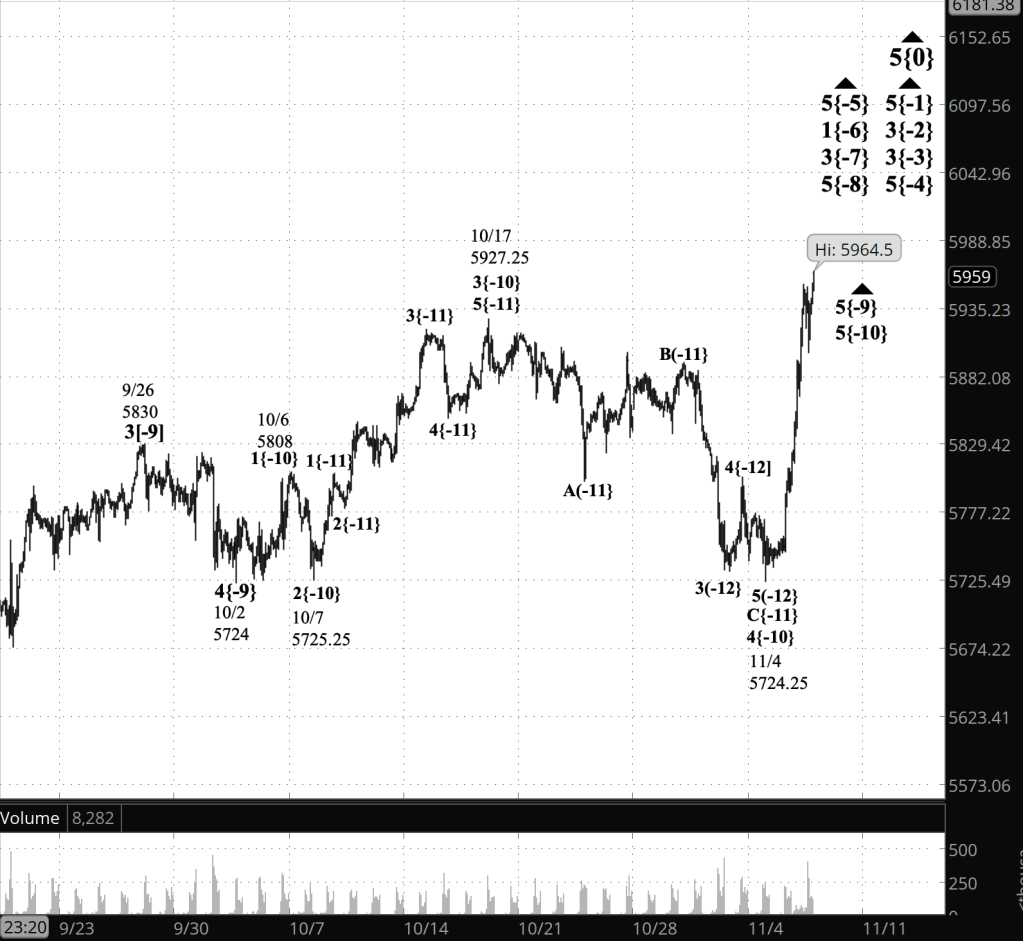
Half an hour before the closing bell. The S&P 500 futures fluctuated between the 5730s and the 5760s during the session.

This morning’s analysis is unchanged. The 4th-wave upward correction that began on September 6 continues to work through its Elliott Wave Theory end game.

9:35 a.m. New York time

What’s happening now? The S&P 500 E-mini futures continued to fall overnight, to the 5750s from the previous day’s session high, 5797.50.

What does it mean? The Elliott Wave Theory analysis remains unchanged from what it has been the past few days.

  • The 4th-wave upward correction that began on September 6 its final subwave, rising wave C, which is in its final subwave, rising wave 5.
  • The end of the smallest of the three waves — wave 5 — will also be the end of wave C and most likely the end of wave 4, unless the 4th wave forms a compound correction, containing two or three A-B-C waves corrective patterns.
  • At this point any higher high within wave 4 is potentially the end of the upward correction and the beginning of a 5th-wave downtrend that likely will carry the price down to the 5390s and perhaps much lower.

[S&P 500 E-mini futures at 3:30 p.m., 55-minute bars, with volume]

What are the alternatives? There are three.

Alternative #1:

The 4th-wave upward correction that began on September 6 ended on September 19. A 5th-wave downtrend has begun.

Alternative #2:

This alternative is a future possibility, after wave C is complete. Typically, a 4th-wave correction will have three subwaves — A, B and C — and then will be complete. Occasionally a subwave will take a compound form, containing two or three corrective patterns, each composed of three subwaves and connected to the prior pattern by a wave called an X wave. This would delay the start of the following 5th wave uptrend.

Alternative #3:

This alternative has to do with how best to interpret the chart’s position within wave C. It plays off of the fact that the 2nd subwave within C under the Principal Analysis is quite small. It is possible that the decline we’ve seen since September 2 is a degree smaller within the fractal structure of the chart than the principal analysis would have. Under this scenario, wave 1 within wave C is underway. This would delay the end of the 4th-wave downward correction and the start of the ensuing 5th wave uptrend.

What does Elliott wave theory say? Here are the waves that underly the analyses.

Principal Analysis:

  • Rising wave 5{0} is underway. It is a wave of Intermediate degree that began in December 2018.
  • It is in its final subwave, wave 5{-1}.
  • Within wave 5{-1}, rising waves 5{-2}, 5{-3} and 5{-4} are underway, as is wave 5{-5}.
  • Wave 5{-5} is in its initial subwave, wave 1{-6}, which in turn is in its middle subwave, wave 3{-7}.
  • Wave 3{-7} is in its next-to-the-last subwave, wave 4{-8}, a downward correction.
  • Wave 4{-8} is in its final subwave, wave C{-9}, which is within wave 5{-10}.
  • Wave 5{-10} is in its final subwave, rising wave 5{-11}.

Alternative Analysis #1, upward correction ended

  • Wave 4{-8} has ended and falling wave 5{-8} has begun.

Alternative Analysis #2, compound correction scenario:

  • Wave 4{-8} is in its final subwave, wave C{-9}, which is in its middle subwave, wave 3{-10}.
  • Wave 5{-10}, still in the future, will be the end of wave C{-9} but not of the wave 4{-8} downward correction, which under this scenario will take a compound form containing two or three corrective patterns.
  • The present wave C{-9} will be followed by a rising connector wave X{-9} and then a declining wave A{-9}, the first wave of the second corrective pattern.

Alternative Analysis #3, wave 1 scenario:

  • Wave 4{-8} is in its final subwave, wave C{-9}, which is in its initial subwave wave 1{-10}, which in turn is in its final subwave, wave 3{-11}. And wave 3{-11} is in its final subwave, wave 5{-12}.

Reading the chart. Price movements — waves – – in Elliott wave analysis are labeled with numbers within trending waves and letters with corrective waves. The subscripts — numbers in curly brackets — designate the wave’s degree, which, in Elliott wave analysis, means the relative position of a wave within the larger and smaller structures that make up the chart. R.N. Elliott, who in the 1930s developed the form of analysis that bears his name, viewed the chart as a complex structure of smaller waves nested within larger waves, which in turn are nested within still larger waves. In mathematics it’s called a fractal structure, where at every scale the pattern is similar to the others.

Learning and other resources. Elliott wave analysis provides context, not prophecy. As the 20th century semanticist Alfred Korzybski put it in his book Science and Sanity (1933), “The map is not the territory … The only usefulness of a map depends on similarity of structure between the empirical world and the map.” And I would add, in the ever-changing markets, we can judge that similarity of structure only after the fact.

See the menu page Analytical Methods for a rundown on where to go for information on Elliott wave analysis.

By Tim Bovee, Portland, Oregon, September 20, 2024

Disclaimer

Tim Bovee, Private Trader tracks the analysis and trades of a private trader for his own accounts. Nothing in this blog constitutes a recommendation to buy or sell stocks, options or any other financial instrument. The only purpose of this blog is to provide education and entertainment.

No trader is ever 100 percent successful in his or her trades. Trading in the stock and option markets is risky and uncertain. Each trader must make trading decisions for his or her own account, and take responsibility for the consequences.

License
Creative Commons License

All content on Tim Bovee, Private Trader by Timothy K. Bovee is licensed under a Creative Commons Attribution-ShareAlike 4.0 International License.

Based on a work at www.timbovee.com.
Trader’s Notebook

3:30 p.m. New York time

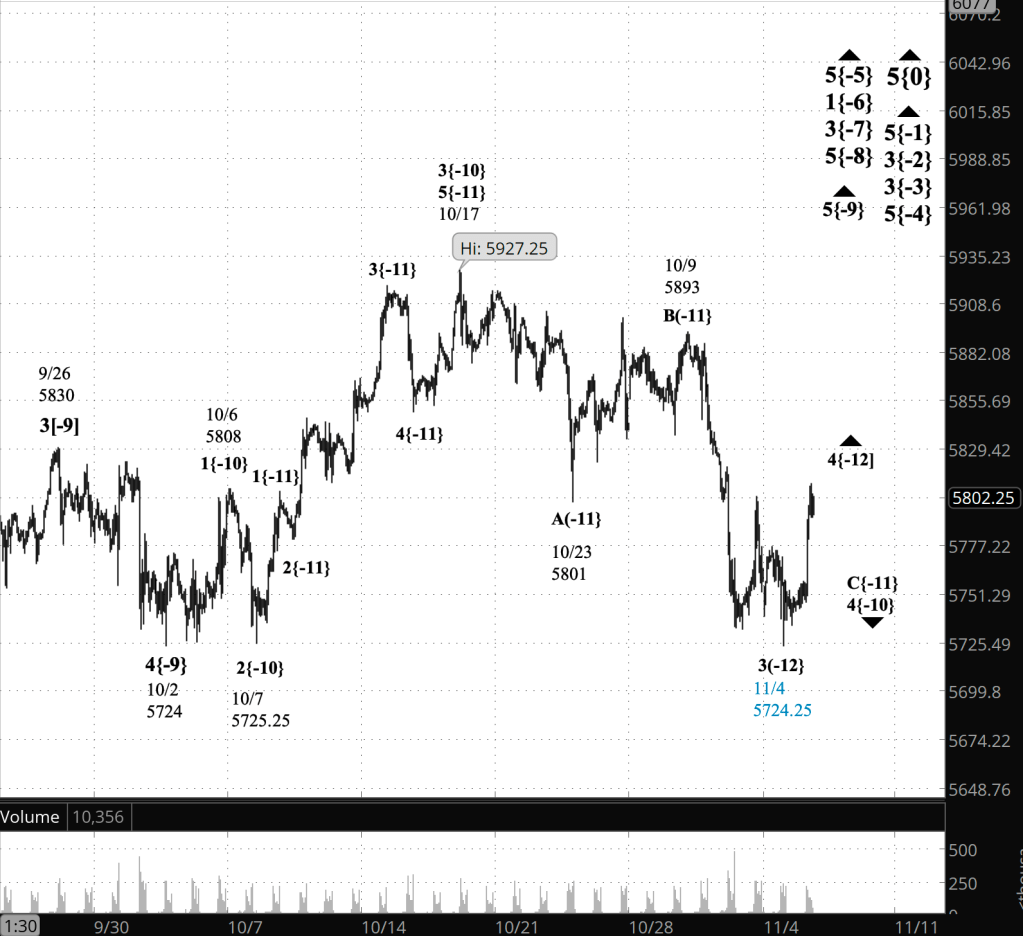
Half an hour before the closing bell. The S&P 500 futures continued to rise during the session, reaching into the 5790s.

Elliott Wave Theory: Wave C, the final subwave within wave 4, an upward correction, continues. At this point, any higher high in the rising 5th wave within wave C could possibly be the end point with that correction.

9:35 a.m. New York time

What’s happening now? The S&P 500 E-mini futures rose overnight, coming within a point of 5780.

What does it mean? The rise that began on September 11 is in its 5th subwave, according to Elliott Wave Theory analysis. That rise is a C wave, the final subwave within a 4th-wave upward correction that negan on September 6.

Some observations.

  • The C wave is quite a bit longer than the preceding waves A and B.
  • The A and B waves took a far shorter time to reach completion than has the still ongoing C wave. Wave A: Four days, Wave B: One day, Wave C: Eighteem days so far.

The C wave seems disproportionally larger compare to the two earlier waves. On the other hand, in working with charts, I’ve often seen larger C waves. A waves tend to be tentative — is the trend really changing? B waves as well — OMG! I don’t think the new trend is real! Notably, of the firm rules of Elliott Wave Theory corrections, the B wave — the wave of doubt — is the only one that has restrictions.

And 5th waves have a tendency to show greater variation. Normally they move beyond the end of the preceding 3rd wave, in a proportional manner. Sometimes, they come up short, a condition known as truncation. Sometimes they move a disproportional distance beyond the end of wave 3, a condition known as extension.

In brief, 5th waves are quirky.

In any case, the rise from September 6 is working through its end game. The end of wave 5 will be the end of wave C, which in turn will be the end of the wave 4 correction. A 5th-wave downtrend will follow and if typical, can be expected to move beyond the end of the preceding 3rd wave, at 5394, unless it is truncated, or far below 5394, if it is extended.

At this point in the endgame, each new high within the rise could be the end of the correction. Or not. It’s ambiguous.

[S&P 500 E-mini futures at 3:30 p.m., 50-minute bars, with volume]

What are the alternatives? There are three

Alternative #1:

The 4th-wave upward correction that began on September 6 ended on September 19. A 5th-wave downtrend has begun.

Alternative #2:

This alternative is a future possibility, after wave C is complete. Typically, a 4th-wave correction will have three subwaves — A, B and C — and then will be complete. Occasionally a subwave will take a compound form, containing two or three corrective patterns, each composed of three subwaves and connected to the prior pattern by a wave called an X wave. This would delay the start of the following 5th wave uptrend.

Alternative #3:

This alternative has to do with how best to interpret the chart’s position within wave C. It plays off of the fact that the 2nd subwave within C under the Principal Analysis is quite small. It is possible that the decline we’ve seen since September 2 is a degree smaller within the fractal structure of the chart than the principal analysis would have. Under this scenario, wave 1 within wave C is underway. This would delay the end of the 4th-wave downward correction and the start of the ensuing 5th wave uptrend.

What does Elliott wave theory say? Here are the waves that underly the analyses.

Principal Analysis:

  • Rising wave 5{0} is underway. It is a wave of Intermediate degree that began in December 2018.
  • It is in its final subwave, wave 5{-1}.
  • Within wave 5{-1}, rising waves 5{-2}, 5{-3} and 5{-4} are underway, as is wave 5{-5}.
  • Wave 5{-5} is in its initial subwave, wave 1{-6}, which in turn is in its middle subwave, wave 3{-7}.
  • Wave 3{-7} is in its next-to-the-last subwave, wave 4{-8}, a downward correction.
  • Wave 4{-8} is in its final subwave, wave C{-9}, which is within wave 5{-10}.
  • Wave 5{-10} is in its final subwave, rising wave 5{-11}.

Alternative Analysis #1, upward correction ended

  • Wave 4{-8} has ended and falling wave 5{-8} has begun.

Alternative Analysis #2, compound correction scenario:

  • Wave 4{-8} is in its final subwave, wave C{-9}, which is in its middle subwave, wave 3{-10}.
  • Wave 5{-10}, still in the future, will be the end of wave C{-9} but not of the wave 4{-8} downward correction, which under this scenario will take a compound form containing two or three corrective patterns.
  • The present wave C{-9} will be followed by a rising connector wave X{-9} and then a declining wave A{-9}, the first wave of the second corrective pattern.

Alternative Analysis #3, wave 1 scenario:

  • Wave 4{-8} is in its final subwave, wave C{-9}, which is in its initial subwave wave 1{-10}, which in turn is in its final subwave, wave 3{-11}. And wave 3{-11} is in its final subwave, wave 5{-12}.

Reading the chart. Price movements — waves – – in Elliott wave analysis are labeled with numbers within trending waves and letters with corrective waves. The subscripts — numbers in curly brackets — designate the wave’s degree, which, in Elliott wave analysis, means the relative position of a wave within the larger and smaller structures that make up the chart. R.N. Elliott, who in the 1930s developed the form of analysis that bears his name, viewed the chart as a complex structure of smaller waves nested within larger waves, which in turn are nested within still larger waves. In mathematics it’s called a fractal structure, where at every scale the pattern is similar to the others.

Learning and other resources. Elliott wave analysis provides context, not prophecy. As the 20th century semanticist Alfred Korzybski put it in his book Science and Sanity (1933), “The map is not the territory … The only usefulness of a map depends on similarity of structure between the empirical world and the map.” And I would add, in the ever-changing markets, we can judge that similarity of structure only after the fact.

See the menu page Analytical Methods for a rundown on where to go for information on Elliott wave analysis.

By Tim Bovee, Portland, Oregon, September 19, 2024

Disclaimer

Tim Bovee, Private Trader tracks the analysis and trades of a private trader for his own accounts. Nothing in this blog constitutes a recommendation to buy or sell stocks, options or any other financial instrument. The only purpose of this blog is to provide education and entertainment.

No trader is ever 100 percent successful in his or her trades. Trading in the stock and option markets is risky and uncertain. Each trader must make trading decisions for his or her own account, and take responsibility for the consequences.

License
Creative Commons License

All content on Tim Bovee, Private Trader by Timothy K. Bovee is licensed under a Creative Commons Attribution-ShareAlike 4.0 International License.

Based on a work at www.timbovee.com.

Trader’s Notebook

3:30 p.m. New York time

Half an hour before the closing bell. The S&P 500 futures rose from 5691 to 5755.75 in the span of a minute and then worked its way lower, so far reaching into the 5680s.

The movement, a typical whipsaw on important economic announcements, came as the Federal Open Market Committee announced it was lowering the Federal Funds Rate by 0.50 basis points, to between 4.75% and 5.00%.

Elliott Wave Theory: The whipsaw peak, 5755.75, reached above yesterday’s session high, 5737, confirmed this morning’s principal analyss: The 4th-wave upward correction that began on September 6 is still underway. The alternative analysis, that yesterday’s session peak was the end of the correction and the beginning of a 5th-wave down, transfers over to today’s session peak.

9:35 a.m. New York time

What’s happening now? The S&P 500 E-mini futures traded narrowly overnight, fluctuating between the 5690s and the 5710s.

The Federal Open Market Committee will announce its devision on interest rates at 2 p.m. New York time

What does it mean? The narrow range is clearly a holding pattern as traders await the Fed’s decision. Examined through the lens of Elliott Wave Theory, the movement is a part of the final subwave, wave C, within the 4th-wave upward correction that began on September 6.

Overnight, the price remained below yesterday’s session high, 5737. In that days afternoon analysis I raised the possibility that the high was the end of the 4th-wav upward correction. If that proves to be the case, then yesterday’s decline and the overnight pause are the first steps of a 5th-wave downtrend. Perhaps the response to the Fed’s decision will provide some clarity.

[S&P 500 E-mini futures at 3:30 p.m., 50-minute bars, with volume]

What are the alternatives? There are three

Alternative #1:

The 4th-wave downward correction that began on September 6 ended on September 18. A 5th-wave downtrend has begun.

Alternative #2:

This alternative is a future possibility, after wave C is complete. Typically, a 4th-wave correction will have three subwaves — A, B and C — and then will be complete. Occasionally a subwave will take a compound form, containing two or three corrective patterns, each composed of three subwaves and connected to the prior pattern by a wave called an X wave. This would delay the start of the following 5th wave uptrend.

Alternative #3:

This alternative has to do with how best to interpret the chart’s position within wave C. It plays off of the fact that the 2nd subwave within C under the Principal Analysis is quite small. It is possible that the decline we’ve seen since September 2 is a degree smaller within the fractal structure of the chart than the principal analysis would have. Under this scenario, wave 1 within wave C is underway. This would delay the end of the 4th-wave downward correction and the start of the ensuing 5th wave uptrend.

What does Elliott wave theory say? Here are the waves that underly the analyses.

Principal Analysis:

  • Rising wave 5{0} is underway. It is a wave of Intermediate degree that began in December 2018.
  • It is in its final subwave, wave 5{-1}.
  • Within wave 5{-1}, rising waves 5{-2}, 5{-3} and 5{-4} are underway, as is wave 5{-5}.
  • Wave 5{-5} is in its initial subwave, wave 1{-6}, which in turn is in its middle subwave, wave 3{-7}.
  • Wave 3{-7} is in its next-to-the-last subwave, wave 4{-8}, a downward correction.
  • Wave 4{-8} is in its final subwave, wave C{-9}, which is within wave 5{-10}.
  • Wave 5{-10} is in its final subwave, rising wave 5{-11}.

Alternative Analysis #1, upward correction ended

  • Wave 4{-8} has ended and falling wave 5{-8} has begun.

Alternative Analysis #2, compound correction scenario:

  • Wave 4{-8} is in its final subwave, wave C{-9}, which is in its middle subwave, wave 3{-10}.
  • Wave 5{-10}, still in the future, will be the end of wave C{-9} but not of the wave 4{-8} downward correction, which under this scenario will take a compound form containing two or three corrective patterns.
  • The present wave C{-9} will be followed by a rising connector wave X{-9} and then a declining wave A{-9}, the first wave of the second corrective pattern.

Alternative Analysis #3, wave 1 scenario:

  • Wave 4{-8} is in its final subwave, wave C{-9}, which is in its initial subwave wave 1{-10}, which in turn is in its final subwave, wave 3{-11}. And wave 3{-11} is in its final subwave, wave 5{-12}.

Reading the chart. Price movements — waves – – in Elliott wave analysis are labeled with numbers within trending waves and letters with corrective waves. The subscripts — numbers in curly brackets — designate the wave’s degree, which, in Elliott wave analysis, means the relative position of a wave within the larger and smaller structures that make up the chart. R.N. Elliott, who in the 1930s developed the form of analysis that bears his name, viewed the chart as a complex structure of smaller waves nested within larger waves, which in turn are nested within still larger waves. In mathematics it’s called a fractal structure, where at every scale the pattern is similar to the others.

Learning and other resources. Elliott wave analysis provides context, not prophecy. As the 20th century semanticist Alfred Korzybski put it in his book Science and Sanity (1933), “The map is not the territory … The only usefulness of a map depends on similarity of structure between the empirical world and the map.” And I would add, in the ever-changing markets, we can judge that similarity of structure only after the fact.

See the menu page Analytical Methods for a rundown on where to go for information on Elliott wave analysis.

By Tim Bovee, Portland, Oregon, September 18, 2024

Disclaimer

Tim Bovee, Private Trader tracks the analysis and trades of a private trader for his own accounts. Nothing in this blog constitutes a recommendation to buy or sell stocks, options or any other financial instrument. The only purpose of this blog is to provide education and entertainment.

No trader is ever 100 percent successful in his or her trades. Trading in the stock and option markets is risky and uncertain. Each trader must make trading decisions for his or her own account, and take responsibility for the consequences.

License
Creative Commons License

All content on Tim Bovee, Private Trader by Timothy K. Bovee is licensed under a Creative Commons Attribution-ShareAlike 4.0 International License.

Based on a work at www.timbovee.com.

Trader’s Notebook

3:30 p.m. New York time

Half an hour before the closing bell. The S&P 500 futures fell during the session, from a peak of 5737 down to the 5670s.

Elliott Wave Theory: The rise that began on September 11 is the final subwave, wave C, of a 4th-wave upward correction that began on September 6. The C wave when complete will have five subwaves, and internally the chart matches that pattern already. The 5737 peak could be the end of wave C, which would be the end of the upward correction if wave 4 is taking the typical form. However, it’s also possible the session’s decline is a subwave within an ongoing rising wave 5.

The pattern will clarify as the wave progresses.

9:35 a.m. New York time

What’s happening now? The S&P 500 E-mini futures rose overnight, reaching into the 5720s, a level last seen in mid-July.

What does it mean? The rise in Elliott Wave Theory fits the pattern of a 4th-wave upward correction that began on September 6. The correction is in its final subwave — wave C — which is in also its final subwave — wave 5.

When the upward correction is finished, the next step will be a downtrending 5th wave, that likely will carry the price into the 5300s and perhaps lower.

[S&P 500 E-mini futures at 3:30 p.m., 50-minute bars, with volume]

What are the alternatives? There are two.

Alternative #1:

This alternative is a future possibility, after wave C is complete. Typically, a 4th-wave correction will have three subwaves — A, B and C — and then will be complete. Occasionally a subwave will take a compound form, containing two or three corrective patterns, each composed of three subwaves and connected to the prior pattern by a wave called an X wave. This would delay the start of the following 5th wave uptrend.

Alternative #2:

This alternative has to do with how best to interpret the chart’s position within wave C. It plays off of the fact that the 2nd subwave within C under the Principal Analysis is quite small. It is possible that the decline we’ve seen since September 2 is a degree smaller within the fractal structure of the chart than the principal analysis would have. Under this scenario, wave 1 within wave C is underway. This would delay the end of the 4th-wave downward correction and the start of the ensuing 5th wave uptrend.

What does Elliott wave theory say? Here are the waves that underly the analyses.

Principal Analysis:

  • Rising wave 5{0} is underway. It is a wave of Intermediate degree that began in December 2018.
  • It is in its final subwave, wave 5{-1}.
  • Within wave 5{-1}, rising waves 5{-2}, 5{-3} and 5{-4} are underway, as is wave 5{-5}.
  • Wave 5{-5} is in its initial subwave, wave 1{-6}, which in turn is in its middle subwave, wave 3{-7}.
  • Wave 3{-7} is in its next-to-the-last subwave, wave 4{-8}, a downward correction.
  • Wave 4{-8} is in its final subwave, wave C{-9}, which is within wave 3{-10}.
  • Wave 3{-10} is in its final subwave, rising wave 5{-11}.

Alternative Analysis #1, compound correction scenario:

  • Wave 4{-8} is in its final subwave, wave C{-9}, which is in its middle subwave, wave 3{-10}.
  • Wave 5{-10}, still in the future, will be the end of wave C{-9} but not of the wave 4{-8} downward correction, which under this scenario will take a compound form containing two or three corrective patterns.
  • The present wave C{-9} will be followed by a rising connector wave X{-9} and then a declining wave A{-9}, the first wave of the second corrective pattern.

Alternative Analysis #2, wave 1 scenario:

  • Wave 4{-8} is in its final subwave, wave C{-9}, which is in its initial subwave wave 1{-10}, which in turn is in its final subwave, wave 3{-11}. And wave 3{-11} is in its final subwave, wave 5{-12}.

Reading the chart. Price movements — waves – – in Elliott wave analysis are labeled with numbers within trending waves and letters with corrective waves. The subscripts — numbers in curly brackets — designate the wave’s degree, which, in Elliott wave analysis, means the relative position of a wave within the larger and smaller structures that make up the chart. R.N. Elliott, who in the 1930s developed the form of analysis that bears his name, viewed the chart as a complex structure of smaller waves nested within larger waves, which in turn are nested within still larger waves. In mathematics it’s called a fractal structure, where at every scale the pattern is similar to the others.

Learning and other resources. Elliott wave analysis provides context, not prophecy. As the 20th century semanticist Alfred Korzybski put it in his book Science and Sanity (1933), “The map is not the territory … The only usefulness of a map depends on similarity of structure between the empirical world and the map.” And I would add, in the ever-changing markets, we can judge that similarity of structure only after the fact.

See the menu page Analytical Methods for a rundown on where to go for information on Elliott wave analysis.

By Tim Bovee, Portland, Oregon, September 17, 2024

Disclaimer

Tim Bovee, Private Trader tracks the analysis and trades of a private trader for his own accounts. Nothing in this blog constitutes a recommendation to buy or sell stocks, options or any other financial instrument. The only purpose of this blog is to provide education and entertainment.

No trader is ever 100 percent successful in his or her trades. Trading in the stock and option markets is risky and uncertain. Each trader must make trading decisions for his or her own account, and take responsibility for the consequences.

License
Creative Commons License

All content on Tim Bovee, Private Trader by Timothy K. Bovee is licensed under a Creative Commons Attribution-ShareAlike 4.0 International License.

Based on a work at www.timbovee.com.

Trader’s Notebook

3:30 p.m. New York time

Half an hour before the closing bell. The S&P 500 futures traded in a narrow range during the session, between just above 5700 and just below 5670.

This morning’s Elliott Wave Theory analysis is unchanged. The 4th-wave upward correction that began on September 6 continues.

9:35 a.m. New York time

What’s happening now? The S&P 500 E-mini futures gapped up when trading resumed after the weekend. Friday’s trading ended at 5626.75. Today’s trading began at 5684 and continued to rise into the 5690s.

What does it mean? Elliott Wave Theory: The rise that began on September 11, from 5412, is the final subwave of a low-degree 4th-wave upward correction that began on September 6 from 5394, which is a subwave of a 5th-wave downtrend that began on September 4 from 5565.

When the low-degree 4th-wave upward correction is complete, it will be followed by a 5th-wave downtrend.

[S&P 500 E-mini futures at 3:30 p.m., 40-minute bars, with volume]

What are the alternatives? There are two.

Alternative #1:

This alternative is a future possibility, after wave C is complete. Typically, a 4th-wave correction will have three subwaves — A, B and C — and then will be complete. Occasionally a subwave will take a compound form, containing two or three corrective patterns, each composed of three subwaves and connected to the prior pattern by a wave called an X wave. This would delay the start of the following 5th wave uptrend.

Alternative #2:

This alternative has to do with how best to interpret the chart’s position within wave C. It plays off of the fact that the 2nd subwave within C under the Principal Analysis is quite small. It is possible that the decline we’ve seen since September 2 is a degree smaller within the fractal structure of the chart than the principal analysis would have. Under this scenario, wave 1 within wave C is underway. This would delay the end of the 4th-wave downward correction and the start of the ensuing 5th wave uptrend.

What does Elliott wave theory say? Here are the waves that underly the analyses.

Principal Analysis:

  • Rising wave 5{0} is underway. It is a wave of Intermediate degree that began in December 2018.
  • It is in its final subwave, wave 5{-1}.
  • Within wave 5{-1}, rising waves 5{-2}, 5{-3} and 5{-4} are underway, as is wave 5{-5}.
  • Wave 5{-5} is in its initial subwave, wave 1{-6}, which in turn is in its middle subwave, wave 3{-7}.
  • Wave 3{-7} is in its next-to-the-last subwave, wave 4{-8}, a downward correction.
  • Wave 4{-8} is in its final subwave, wave C{-9}, which is within wave 3{-10}.
  • Wave 3{-10} is in its final subwave, rising wave 5{-11}.

Alternative Analysis #1, compound correction scenario:

  • Wave 4{-8} is in its final subwave, wave C{-9}, which is in its middle subwave, wave 3{-10}.
  • Wave 5{-10}, still in the future, will be the end of wave C{-9} but not of the wave 4{-8} downward correction, which under this scenario will take a compound form containing two or three corrective patterns.
  • The present wave C{-9} will be followed by a rising connector wave X{-9} and then a declining wave A{-9}, the first wave of the second corrective pattern.

Alternative Analysis #2, wave 1 scenario:

  • Wave 4{-8} is in its final subwave, wave C{-9}, which is in its initial subwave wave 1{-10}, which in turn is in its final subwave, wave 3{-11}. And wave 3{-11} is in its final subwave, wave 5{-12}.

Reading the chart. Price movements — waves – – in Elliott wave analysis are labeled with numbers within trending waves and letters with corrective waves. The subscripts — numbers in curly brackets — designate the wave’s degree, which, in Elliott wave analysis, means the relative position of a wave within the larger and smaller structures that make up the chart. R.N. Elliott, who in the 1930s developed the form of analysis that bears his name, viewed the chart as a complex structure of smaller waves nested within larger waves, which in turn are nested within still larger waves. In mathematics it’s called a fractal structure, where at every scale the pattern is similar to the others.

Learning and other resources. Elliott wave analysis provides context, not prophecy. As the 20th century semanticist Alfred Korzybski put it in his book Science and Sanity (1933), “The map is not the territory … The only usefulness of a map depends on similarity of structure between the empirical world and the map.” And I would add, in the ever-changing markets, we can judge that similarity of structure only after the fact.

See the menu page Analytical Methods for a rundown on where to go for information on Elliott wave analysis.

By Tim Bovee, Portland, Oregon, September 16, 2024

Disclaimer

Tim Bovee, Private Trader tracks the analysis and trades of a private trader for his own accounts. Nothing in this blog constitutes a recommendation to buy or sell stocks, options or any other financial instrument. The only purpose of this blog is to provide education and entertainment.

No trader is ever 100 percent successful in his or her trades. Trading in the stock and option markets is risky and uncertain. Each trader must make trading decisions for his or her own account, and take responsibility for the consequences.

License
Creative Commons License

All content on Tim Bovee, Private Trader by Timothy K. Bovee is licensed under a Creative Commons Attribution-ShareAlike 4.0 International License.

Based on a work at www.timbovee.com.
Trader’s Notebook

3:30 p.m. New York time

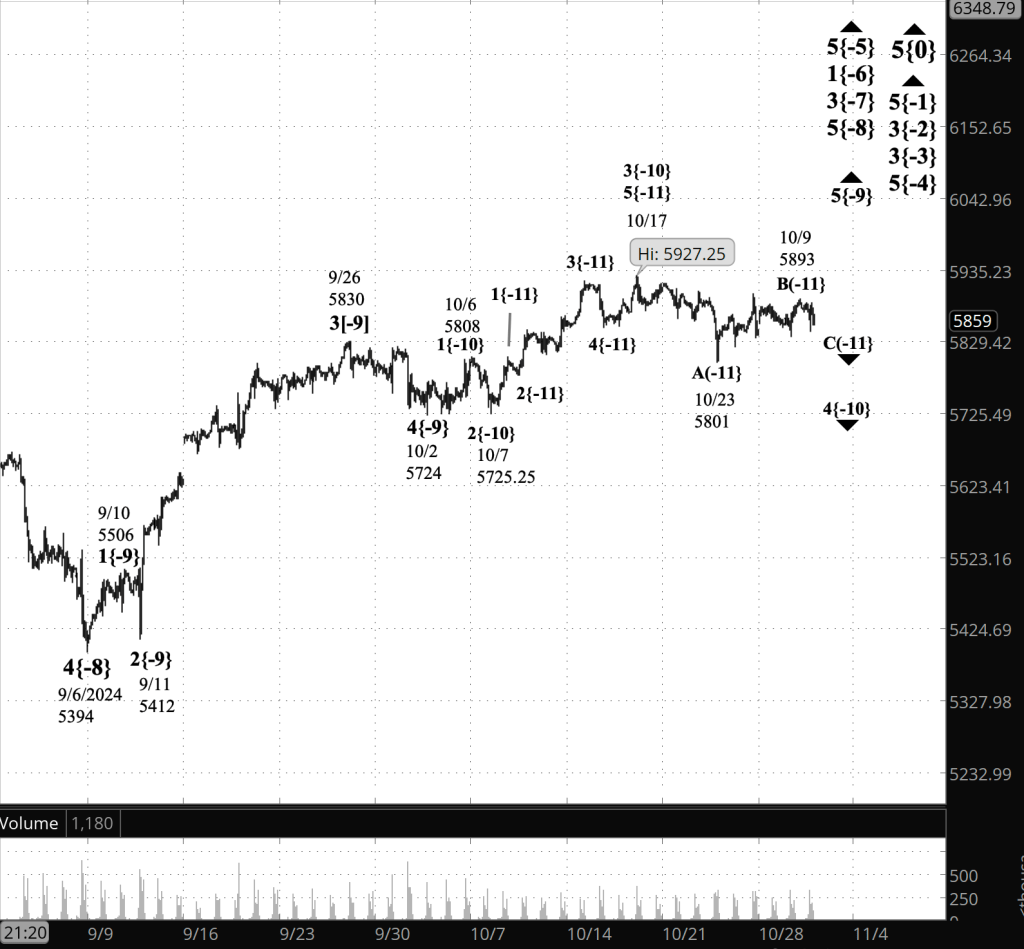
Half an hour before the closing bell. The S&P 500 futures continued to rise during the session, reaching into the 5640s.

Elliott Wave Theory: The 4th-wave upward correction that began on August 28 continues as it nears its end.

9:35 a.m. New York time

What’s happening now? The S&P 500 E-mini futures rose overnight, reaching into the 5610s.

What does it mean? Elliott Wave Theory: The 4th-wave upward correction that began on August 28 continues and is in its final subwave, wave C, which in turn is in its final subwave, wave 5. Long story sort: The upward correction is almost complete.

What comes next? The 4th-wave upward correction will be followed by a downtrending 5th wave that will complete the parent wave, uptrending 3rd wave}, which began on August 7. It will be followed by a 4th-wave downward correction

[S&P 500 E-mini futures at 3:30 p.m., 40-minute bars, with volume]

What are the alternatives? There are two.

Alternative #1:

This alternative is a future possibility, after wave C is complete. Typically, a 4th-wave correction will have three subwaves — A, B and C — and then will be complete. Occasionally a subwave will take a compound form, containing two or three corrective patterns, each composed of three subwaves and connected to the prior pattern by a wave called an X wave. This would delay the start of the following 5th wave uptrend.

Alternative #2:

This alternative has to do with how best to interpret the chart’s position within wave C. It plays off of the fact that the 2nd subwave within C under the Principal Analysis is quite small. It is possible that the decline we’ve seen since September 2 is a degree smaller within the fractal structure of the chart than the principal analysis would have. Under this scenario, wave 1 within wave C is underway. This would delay the end of the 4th-wave downward correction and the start of the ensuing 5th wave uptrend.

What does Elliott wave theory say? Here are the waves that underly the analyses.

Principal Analysis:

  • Rising wave 5{0} is underway. It is a wave of Intermediate degree that began in December 2018.
  • It is in its final subwave, wave 5{-1}.
  • Within wave 5{-1}, rising waves 5{-2}, 5{-3} and 5{-4} are underway, as is wave 5{-5}.
  • Wave 5{-5} is in its initial subwave, wave 1{-6}, which in turn is in its middle subwave, wave 3{-7}.
  • Wave 3{-7} is in its next-to-the-last subwave, wave 4{-8}, a downward correction.
  • Wave 4{-8} is in its final subwave, wave C{-9}, which is within wave 3{-10}.
  • Wave 3{-10} is in its final subwave, rising wave 5{-11}.

Alternative Analysis #1, compound correction scenario:

  • Wave 4{-8} is in its final subwave, wave C{-9}, which is in its middle subwave, wave 3{-10}.
  • Wave 5{-10}, still in the future, will be the end of wave C{-9} but not of the wave 4{-8} downward correction, which under this scenario will take a compound form containing two or three corrective patterns.
  • The present wave C{-9} will be followed by a rising connector wave X{-9} and then a declining wave A{-9}, the first wave of the second corrective pattern.

Alternative Analysis #2, wave 1 scenario:

  • Wave 4{-8} is in its final subwave, wave C{-9}, which is in its initial subwave wave 1{-10}, which in turn is in its final subwave, wave 3{-11}. And wave 3{-11} is in its final subwave, wave 5{-12}.

Reading the chart. Price movements — waves – – in Elliott wave analysis are labeled with numbers within trending waves and letters with corrective waves. The subscripts — numbers in curly brackets — designate the wave’s degree, which, in Elliott wave analysis, means the relative position of a wave within the larger and smaller structures that make up the chart. R.N. Elliott, who in the 1930s developed the form of analysis that bears his name, viewed the chart as a complex structure of smaller waves nested within larger waves, which in turn are nested within still larger waves. In mathematics it’s called a fractal structure, where at every scale the pattern is similar to the others.

Learning and other resources. Elliott wave analysis provides context, not prophecy. As the 20th century semanticist Alfred Korzybski put it in his book Science and Sanity (1933), “The map is not the territory … The only usefulness of a map depends on similarity of structure between the empirical world and the map.” And I would add, in the ever-changing markets, we can judge that similarity of structure only after the fact.

See the menu page Analytical Methods for a rundown on where to go for information on Elliott wave analysis.

By Tim Bovee, Portland, Oregon, September 13, 2024

Disclaimer

Tim Bovee, Private Trader tracks the analysis and trades of a private trader for his own accounts. Nothing in this blog constitutes a recommendation to buy or sell stocks, options or any other financial instrument. The only purpose of this blog is to provide education and entertainment.

No trader is ever 100 percent successful in his or her trades. Trading in the stock and option markets is risky and uncertain. Each trader must make trading decisions for his or her own account, and take responsibility for the consequences.

License
Creative Commons License

All content on Tim Bovee, Private Trader by Timothy K. Bovee is licensed under a Creative Commons Attribution-ShareAlike 4.0 International License.

Based on a work at www.timbovee.com.
Trader’s Notebook

3:30 p.m. New York time

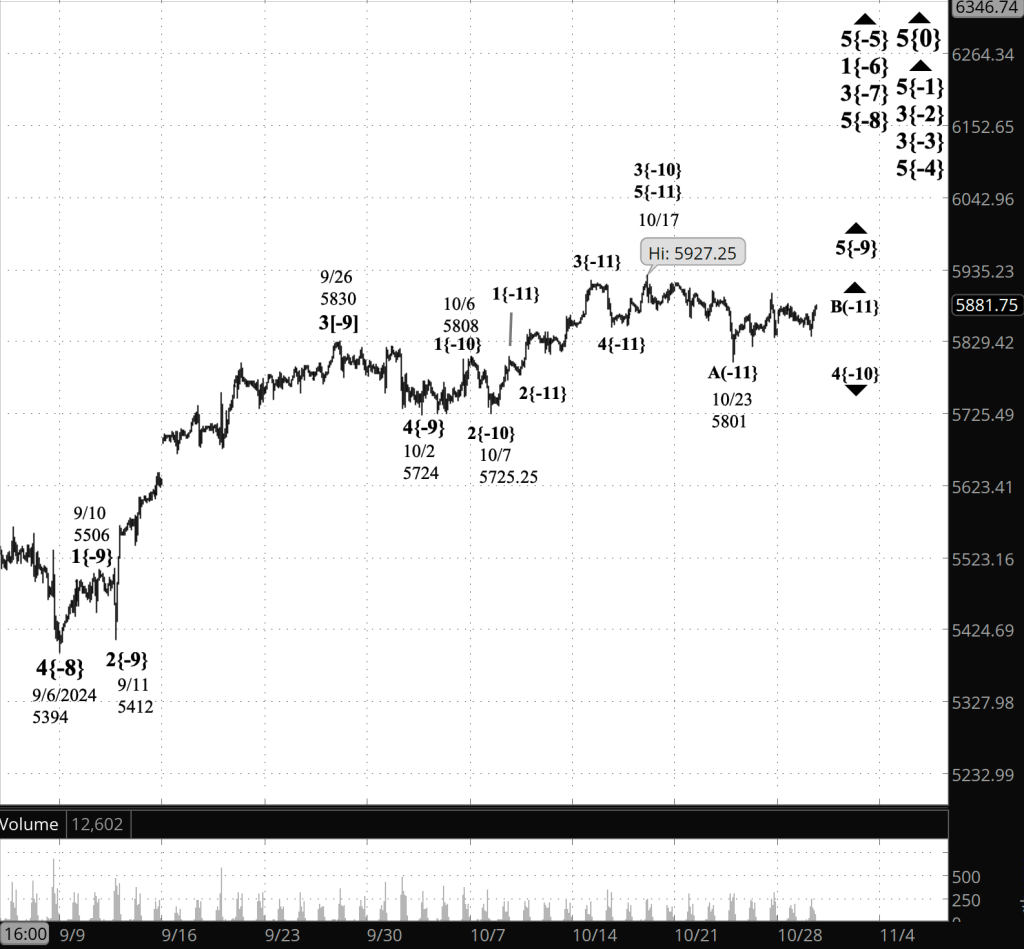
Half an hour before the closing bell. The S&P 500 futures worked their way higher during the session, reaching slightly above 5600 and then falling back slightly

Elliott Wave Theory: The final subwave, wave C, of the 4th-wave upward correction that began on August 28 continues.

9:35 a.m. New York time

What’s happening now? The S&P 500 E-mini futures rose overnight, from the 5550s, peaking in the 5580s and then retreating upon the release of the weekly jobless claims statistics.

What does it mean? In Elliott Wave Theory terminology, the rise is part of the final subwave — wave C — within a 4th-wave upward correction that began on September 6.

That small correction is in turn a subwave of downtrending wave 5, which began on September 4, the final subwave within the final subwave of a 4th-wave downward correction that began on August 28.

What comes next? The 4th-wave downward correction that began on August 28 will be followed by a 5th-wave downtrend that will in turn be followed by a rising 5th wave, the final subwave of an uptrending 3rd wave that began on August 7.

There are a lot of final and next-to-the-last subwaves in the mix at this point, and that is always a harbinger of change.

The 4th wave that began on August 28, under the rules of Elliott Wave Theory, cannot move below the endpoint of the preceding 1st wave, which was at 5362.75. I’ve marked that level on the chart with a red horizontal line.

[S&P 500 E-mini futures at 3:30 p.m., 40-minute bars, with volume]

What are the alternatives? There are two.

Alternative #1:

This alternative is a future possibility, after wave C is complete. Typically, a 4th-wave correction will have three subwaves — A, B and C — and then will be complete. Occasionally a subwave will take a compound form, containing two or three corrective patterns, each composed of three subwaves and connected to the prior pattern by a wave called an X wave. This would delay the start of the following 5th wave uptrend.

Alternative #2:

This alternative has to do with how best to interpret the chart’s position within wave C. It plays off of the fact that the 2nd subwave within C under the Principal Analysis is quite small. It is possible that the decline we’ve seen since September 2 is a degree smaller within the fractal structure of the chart than the principal analysis would have. Under this scenario, wave 1 within wave C is underway. This would delay the end of the 4th-wave downward correction and the start of the ensuing 5th wave uptrend.

What does Elliott wave theory say? Here are the waves that underly the analyses.

Principal Analysis:

  • Rising wave 5{0} is underway. It is a wave of Intermediate degree that began in December 2018.
  • It is in its final subwave, wave 5{-1}.
  • Within wave 5{-1}, rising waves 5{-2}, 5{-3} and 5{-4} are underway, as is wave 5{-5}.
  • Wave 5{-5} is in its initial subwave, wave 1{-6}, which in turn is in its middle subwave, wave 3{-7}.
  • Wave 3{-7} is in its next-to-the-last subwave, wave 4{-8}, a downward correction.
  • Wave 4{-8} is in its final subwave, wave C{-9}, which is within wave 3{-10}.
  • Wave 3{-10} is in its next-to-the-last subwave, wave 4{-11}.

Alternative Analysis #1, compound correction scenario:

  • Wave 4{-8} is in its final subwave, wave C{-9}, which is in its middle subwave, wave 3{-10}.
  • Wave 5{-10}, still in the future, will be the end of wave C{-9} but not of the wave 4{-8} downward correction, which under this scenario will take a compound form containing two or three corrective patterns.
  • The present wave C{-9} will be followed by a rising connector wave X{-9} and then a declining wave A{-9}, the first wave of the second corrective pattern.

Alternative Analysis #2, wave 1 scenario:

  • Wave 4{-8} is in its final subwave, wave C{-9}, which is in its initial subwave wave 1{-10}, which in turn is in its final subwave, wave 3{-11}. And wave 3{-11} is in its final subwave, wave 5{-12}.

Reading the chart. Price movements — waves – – in Elliott wave analysis are labeled with numbers within trending waves and letters with corrective waves. The subscripts — numbers in curly brackets — designate the wave’s degree, which, in Elliott wave analysis, means the relative position of a wave within the larger and smaller structures that make up the chart. R.N. Elliott, who in the 1930s developed the form of analysis that bears his name, viewed the chart as a complex structure of smaller waves nested within larger waves, which in turn are nested within still larger waves. In mathematics it’s called a fractal structure, where at every scale the pattern is similar to the others.

Learning and other resources. Elliott wave analysis provides context, not prophecy. As the 20th century semanticist Alfred Korzybski put it in his book Science and Sanity (1933), “The map is not the territory … The only usefulness of a map depends on similarity of structure between the empirical world and the map.” And I would add, in the ever-changing markets, we can judge that similarity of structure only after the fact.

See the menu page Analytical Methods for a rundown on where to go for information on Elliott wave analysis.

By Tim Bovee, Portland, Oregon, September 12, 2024

Disclaimer

Tim Bovee, Private Trader tracks the analysis and trades of a private trader for his own accounts. Nothing in this blog constitutes a recommendation to buy or sell stocks, options or any other financial instrument. The only purpose of this blog is to provide education and entertainment.

No trader is ever 100 percent successful in his or her trades. Trading in the stock and option markets is risky and uncertain. Each trader must make trading decisions for his or her own account, and take responsibility for the consequences.

License
Creative Commons License

All content on Tim Bovee, Private Trader by Timothy K. Bovee is licensed under a Creative Commons Attribution-ShareAlike 4.0 International License.

Based on a work at www.timbovee.com.