Trader’s Notebook

3:30 p.m. New York time

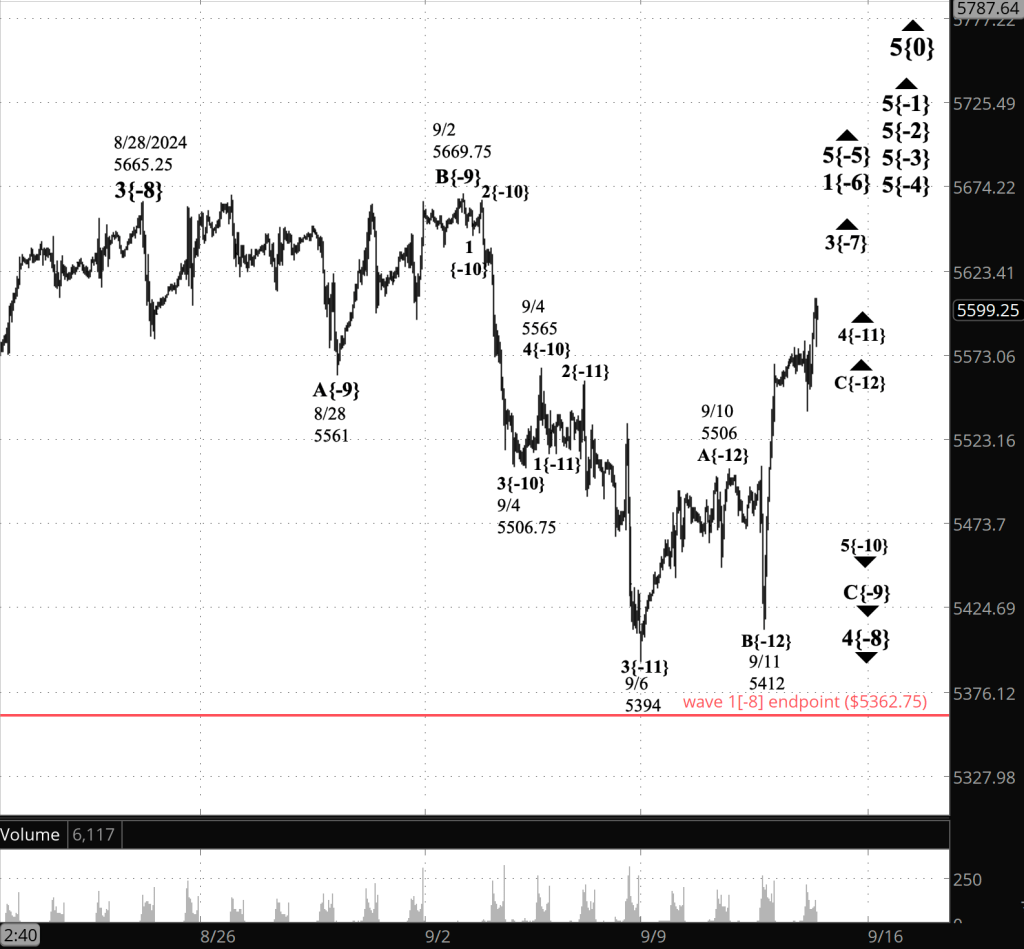
Half an hour before the closing bell. The S&P 500 futures have risen into the 5450s during the session. Elliott Wave Theory analysis suggests that today’s rise is the final subwave — wave 5 — within the larger final subwave — wave C — within the 4th-wave upward correction that began on August 5, although there is a bit of ambiguity in the pattern traced by the smaller subwaves. The rise has taken the price above the 61.8% Fibonacci retracement level without a pause.

9:35 a.m. New York time

What’s happening now? The S&P 500 E-mini futures zig-zagged overnight, rising to nearly 5410 with the release of new Producer Price Index statistics as the opening bell approached.

What does it mean? Elliott Wave Theory analysis shows that the 4th-wave upward correction that began on August 5 continues and is in its final subwave, wave C.

I’ve placed a Fibonacci ladder on the chart, in red, to measure how much of the preceding 3rd the current 4th wave has retraced. Wave 4 turns out to be something of an over-performer. A 4th wave tends to retrace a Fibonacci 38.2% of the 3rd wave. The present retracement is approaching 61.8%.

In Elliott Wave Theory, Fibonacci retracement levels are tendencies, not firm rules. Nonetheless, the present retracement level suggests that wave 4 is very near its end. When the 4th-wave is complete, a 5th-wave downtrend will follow.

See the August 12 Trader’s Notebook for a discussion of what happens after that.

[S&P 500 E-mini futures at 3:30 p.m., hourly bars, with volume]

What are the alternatives? Unchanged from yesterday. We’re at a point where the present low-degree C wave — wave C{-12} — is routinely reaching new highs, and in high carries the possibility that it is the end of wave C and of its parent 4th wave. Only the price movements that follow each high can tell us whether wave C has in fact ended.

What does Elliott wave theory say? Here are the waves that underly the analyses.

Principal Analysis:

  • Rising wave 5{0} is underway. It is a wave of Intermediate degree that began in December 2018.
  • It is in its final subwave, wave 5{-1}.
  • Within wave 5{-1}, rising waves 3{-2}, 3{-3} and 3{-4} are underway, as is wave 5{-5}.
  • Wave 5{-6} is underway and is in its final subwave, uptrending wave 5{-7}, which in turn is in its final subwave, uptrending wave 5{-8}.
  • Within wave 5{-8}, wave 4{-9}, a downward correction, is in progress.
  • Wave 4{-9} is in its final subwave, wave C{-10}.
  • Wave C{-10} is in its next-to-the-last subwave, wave 4{-11}, which in turn is in its final subwave, wave C{-12}.

Reading the chart. Price movements — waves – – in Elliott wave analysis are labeled with numbers within trending waves and letters with corrective waves. The subscripts — numbers in curly brackets — designate the wave’s degree, which, in Elliott wave analysis, means the relative position of a wave within the larger and smaller structures that make up the chart. R.N. Elliott, who in the 1930s developed the form of analysis that bears his name, viewed the chart as a complex structure of smaller waves nested within larger waves, which in turn are nested within still larger waves. In mathematics it’s called a fractal structure, where at every scale the pattern is similar to the others.

Learning and other resources. Elliott wave analysis provides context, not prophecy. As the 20th century semanticist Alfred Korzybski put it in his book Science and Sanity (1933), “The map is not the territory … The only usefulness of a map depends on similarity of structure between the empirical world and the map.” And I would add, in the ever-changing markets, we can judge that similarity of structure only after the fact.

See the menu page Analytical Methods for a rundown on where to go for information on Elliott wave analysis.

By Tim Bovee, Portland, Oregon, August 13, 2024

Disclaimer

Tim Bovee, Private Trader tracks the analysis and trades of a private trader for his own accounts. Nothing in this blog constitutes a recommendation to buy or sell stocks, options or any other financial instrument. The only purpose of this blog is to provide education and entertainment.

No trader is ever 100 percent successful in his or her trades. Trading in the stock and option markets is risky and uncertain. Each trader must make trading decisions for his or her own account, and take responsibility for the consequences.

License
Creative Commons License

All content on Tim Bovee, Private Trader by Timothy K. Bovee is licensed under a Creative Commons Attribution-ShareAlike 4.0 International License.

Based on a work at www.timbovee.com.
Trader’s Notebook

3:30 p.m. New York time

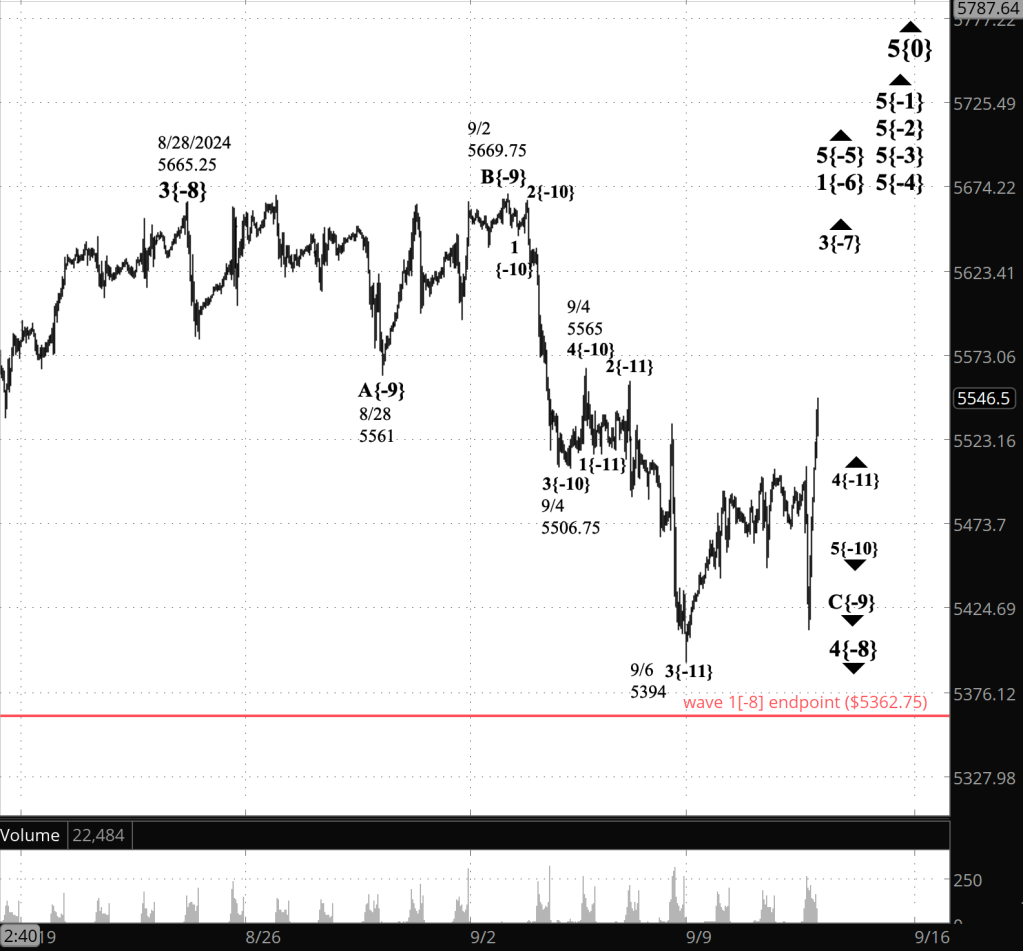
Half an hour before the closing bell. The S&P 500 futures reached a high in the 5390s during the session and then withdrew, so far reaching the 5350s. This morning’s Elliott Wave Theory analysis stands unchanged. The final subwave, wave C, of the 4th wave upward correction that began on August 5 continues to work through its endgame.

9:35 a.m. New York time

What’s happening now? The S&P 500 E-mini futures crept higher after trading resumed overnight, from the 5350s to the 5380s.

What does it mean? Elliott Wave Theory analysis sees the movement as follows: The final subwave of a low-degree 4th-wave upward correction continues. The 4th wave began on August 5 and the final subwave, wave C, on August 7.

When wave C is complete, it will be the end of the parent 4th wave and the beginning of a 5th-wave downtrend that will most likely carry the pride below 5120 — the end of the preceding 3rd wave — and perhaps significantly below that level. Occasionally, 5th waves are truncated, and if that’s the case with this wave, then it will end somewhere above 5120.

The waves are labeled on the chart with the wave number and a subscript in curly brackets showing the degree’s distance from Intermediate degree. The present Intermediate degree wave, labeled 5{0}, began in December 2018.

The 4th-wave downward correction is labeled 4{-11} and its final subwave, wave C{-12}. The future 5th wave is wave 5{-12}.

After the 5th. Those waves are all part of the final subwave, wave C, of a larger 4th-wave downward correction that began on July 11 — wave C{-10} within wave 4{-9} on the chart.

The end of that larger 4th wave will be followed by a rising 5th wave that will carry the price above 5707.75, and perhaps significantly above that level. Unless, of course, the 5th wave truncates — comes up short — as some 5th waves do. The rising 5th wave is labeled wave 5{-9} on the chart.

The end of that 5th wave will be like a bowling ball hitting the pins. The event will be the end of a series of four 5th waves, each “pin” falling against a 5th-wave one-degree higher, in a series of endings. The four 5th waves, on the chart, are labeled waves 5{-8}, 5{-7}, 5{-6} and 5{-5}.

Above them all is a rising 3rd wave — wave 3{-4} on the chart — which began on February 21 from 4959. The 4th-wave downward correction that follows — wave 4{-4} — will be of significant size and duration.

[S&P 500 E-mini futures at 3:30 p.m., hourly bars, with volume]

What are the alternatives? We’re at a point where the present low-degree C wave — wave C{-12} — is routinely reaching new highs, and in high carries the possibility that it is the end of wave C and of its parent 4th wave. Only the price movements that follow each high can tell us whether wave C has in fact ended. It’s an example of the ambiguity that is part of Elliott Wave Theory.

What does Elliott wave theory say? Here are the waves that underly the analyses.

Principal Analysis:

  • Rising wave 5{0} is underway. It is a wave of Intermediate degree that began in December 2018.
  • It is in its final subwave, wave 5{-1}.
  • Within wave 5{-1}, rising waves 3{-2}, 3{-3} and 3{-4} are underway, as is wave 5{-5}.
  • Wave 5{-6} is underway and is in its final subwave, uptrending wave 5{-7}, which in turn is in its final subwave, uptrending wave 5{-8}.
  • Within wave 5{-8}, wave 4{-9}, a downward correction, is in progress.
  • Wave 4{-9} is in its final subwave, wave C{-10}.
  • Wave C{-10} is in its next-to-the-last subwave, wave 4{-11}, which in turn is in its final subwave, wave C{-12}.

Reading the chart. Price movements — waves – – in Elliott wave analysis are labeled with numbers within trending waves and letters with corrective waves. The subscripts — numbers in curly brackets — designate the wave’s degree, which, in Elliott wave analysis, means the relative position of a wave within the larger and smaller structures that make up the chart. R.N. Elliott, who in the 1930s developed the form of analysis that bears his name, viewed the chart as a complex structure of smaller waves nested within larger waves, which in turn are nested within still larger waves. In mathematics it’s called a fractal structure, where at every scale the pattern is similar to the others.

Learning and other resources. Elliott wave analysis provides context, not prophecy. As the 20th century semanticist Alfred Korzybski put it in his book Science and Sanity (1933), “The map is not the territory … The only usefulness of a map depends on similarity of structure between the empirical world and the map.” And I would add, in the ever-changing markets, we can judge that similarity of structure only after the fact.

See the menu page Analytical Methods for a rundown on where to go for information on Elliott wave analysis.

By Tim Bovee, Portland, Oregon, August 12, 2024

Disclaimer

Tim Bovee, Private Trader tracks the analysis and trades of a private trader for his own accounts. Nothing in this blog constitutes a recommendation to buy or sell stocks, options or any other financial instrument. The only purpose of this blog is to provide education and entertainment.

No trader is ever 100 percent successful in his or her trades. Trading in the stock and option markets is risky and uncertain. Each trader must make trading decisions for his or her own account, and take responsibility for the consequences.

License
Creative Commons License

All content on Tim Bovee, Private Trader by Timothy K. Bovee is licensed under a Creative Commons Attribution-ShareAlike 4.0 International License.

Based on a work at www.timbovee.com.

Trader’s Notebook

3:30 p.m. New York time

Half an hour before the closing bell. The S&P 500 futures rose higher during the session, reaching 5385.25 and then reversing a little.

The day session brought no change to the Elliott Wave Theory analysis. Wave C of the 4th-wave upward correction that began on July 11 continues.

A calming end to a dramatic week.

9:35 a.m. New York time

What’s happening now? The S&P 500 E-mini futures reached a turning point at 5372 overnight, thereafter falling to slightly below 5320.

What does it mean? Using Elliott Wave Theory, I’ve reworked the subwave labeling within the 4th-wave decline that began on July 11. The prior numbering had a 3rd subwave that was the shortest of the set, something disallowed by the rule sof Elliott Wave Theory.

The end result is unchanged from yesterday’s analysis: The 4th-wave upward correction that began on August 5 continues and is in its final subwave, rising wave C. The degree labeling of some of the waves have been raised by one degree from yesterday’s analysis.

See Thursday’s Trader’s Notebook to compare this altered analysis with the prior analysis.

[S&P 500 E-mini futures at 3:30 p.m., 55-minute bars, with volume]

What are the alternatives? It is possible that the rising C wave ended at the overnight high, 5372, ending the rising upward correction and beginning the final subwave within the final subwave within larger 4th-wave downward correction that began on July 16.

What does Elliott wave theory say? Here are the waves that underly the analyses.

Principal Analysis:

  • Rising wave 5{0} is underway. It is a wave of Intermediate degree that began in December 2018.
  • It is in its final subwave, wave 5{-1}.
  • Within wave 5{-1}, rising waves 3{-2}, 3{-3} and 3{-4} are underway, as is wave 5{-5}.
  • Wave 5{-6} is underway and is in its final subwave, uptrending wave 5{-7}, which in turn is in its final subwave, uptrending wave 5{-8}.
  • Within wave 5{-8}, wave 4{-9}, a downward correction, is in progress.
  • Wave 4{-9} is in its final subwave, wave C{-10}.
  • Wave C{-10} is in its next-to-the-last subwave, wave 4{-11}, which in turn is in its final subwave, wave C{-12}.

Reading the chart. Price movements — waves – – in Elliott wave analysis are labeled with numbers within trending waves and letters with corrective waves. The subscripts — numbers in curly brackets — designate the wave’s degree, which, in Elliott wave analysis, means the relative position of a wave within the larger and smaller structures that make up the chart. R.N. Elliott, who in the 1930s developed the form of analysis that bears his name, viewed the chart as a complex structure of smaller waves nested within larger waves, which in turn are nested within still larger waves. In mathematics it’s called a fractal structure, where at every scale the pattern is similar to the others.

Learning and other resources. Elliott wave analysis provides context, not prophecy. As the 20th century semanticist Alfred Korzybski put it in his book Science and Sanity (1933), “The map is not the territory … The only usefulness of a map depends on similarity of structure between the empirical world and the map.” And I would add, in the ever-changing markets, we can judge that similarity of structure only after the fact.

See the menu page Analytical Methods for a rundown on where to go for information on Elliott wave analysis.

By Tim Bovee, Portland, Oregon, August 9, 2024

Disclaimer

Tim Bovee, Private Trader tracks the analysis and trades of a private trader for his own accounts. Nothing in this blog constitutes a recommendation to buy or sell stocks, options or any other financial instrument. The only purpose of this blog is to provide education and entertainment.

No trader is ever 100 percent successful in his or her trades. Trading in the stock and option markets is risky and uncertain. Each trader must make trading decisions for his or her own account, and take responsibility for the consequences.

License
Creative Commons License

All content on Tim Bovee, Private Trader by Timothy K. Bovee is licensed under a Creative Commons Attribution-ShareAlike 4.0 International License.

Based on a work at www.timbovee.com.
Trader’s Notebook

3:30 p.m. New York time

Half an hour before the closing bell. The S&P 500 futures rose during the session, reaching into the 5350s.

Elliott Wave Theory. The rise carried the price above the starting point of wave A, a subwave of the low-degree 4th-wave upward correction that began on August 5.

That’s persuasive enough to trigger this morning’s alternative analysis: Declining wave B within the upward correction ended on August 7 at 5182, and rising wave C is now underway. The C-wave will have five subwaves.

9:35 a.m. New York time

What’s happening now? The S&P 500 E-mini traded in a narrow range overnight, spiking up into the 5270s when the Initial Jobless Claims weekly statistics were published an hour before the opening bell.

What does it mean? The take-away from all the Elliott Wave Theory detail that follows is that the S&P 500 and its related products have been declining in a correction since mid-July. The complex structure of waves it contains show us that the correction, wave 4, is working through its end game and will soon reach its end.

A complex strucuture. The rise took back a portion of what Elliott Wave Theory sees as the second subwave, wave B, within the 4th-wave upward correction that began on August 5. That upward correction is a subwave of the final subwave of a declining 5th wave, which in turn is the final subwave of wave C, the final subwave of a 4th-wave downward correction that began on July 11.

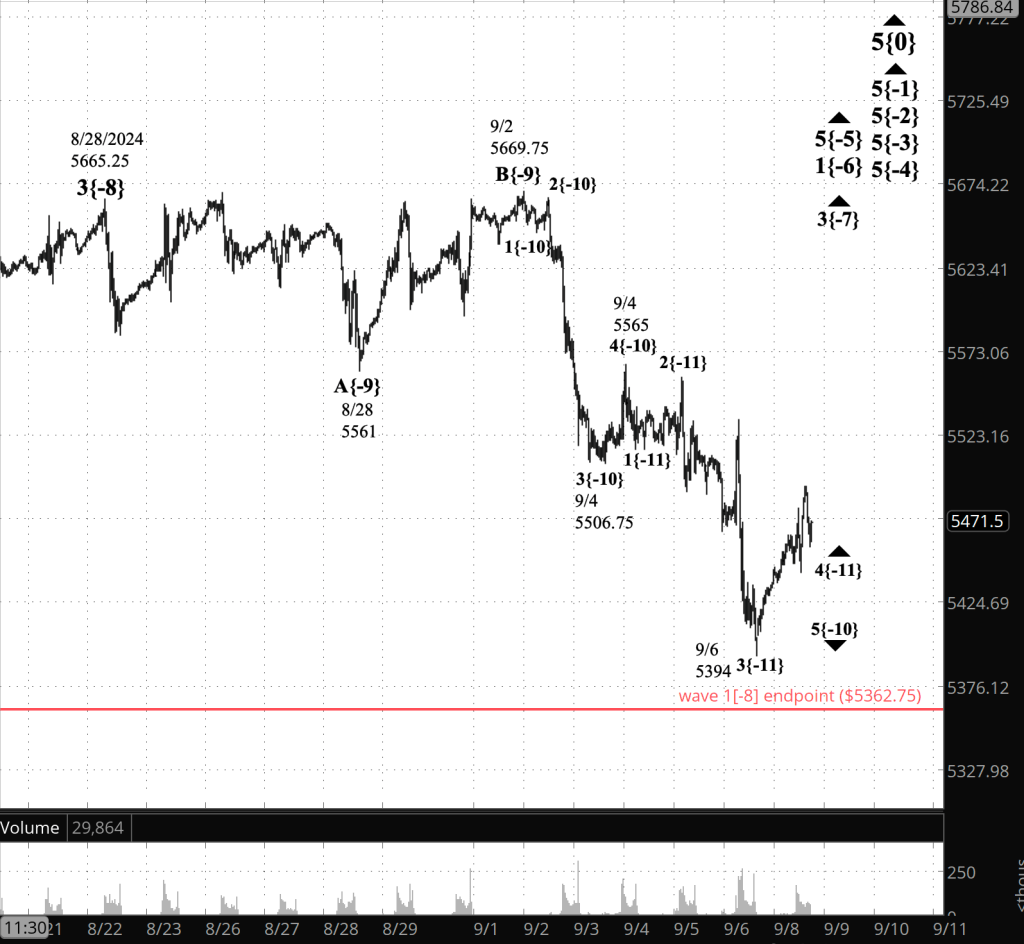
Using the wave labels that appear on the chart, the line up, smaller to larger, is wave B{-13} within wave 4{-12} within wave 5{-11} within wave C{-10}, the final wave of the downward correction, wave 4{-9}

The chart’s waves and labeled by a wave number followed by a subscript in curly brackets showing the distance from the current Intermediate wave, wave 5{0}, which began in December 2018.

And after the correction. The larger 4th-wave downward correction that has defined the markets since mid-July will be followed by an uptrendng wave 5, that if typical will retrace all of decline of wave 4 and will then rise some more. Fifth waves are fickle beasts. This one could truncate, coming up short of the prior wave-4 peak. Or it could extend, moving far higher than expected.

In any case, the end of the uptrending wave 5 will also be the end of a series of nested 5th waves covering four degrees within the fractal structure of the chart. They are waves 5{-8} to wave 5{-5} in the chart’s labeling system.

Enclosing them all is rising wave 3{-4}, which began on February 21 from 4959 and which will also end simultaneously with the smaller waves it contains. A very large 4th-wave downward correction, wave 4{-4}, will follow, taking back a portion of a rise of the last six months.

[S&P 500 E-mini futures at 3:30 p.m., 50-minute bars, with volume]

What are the alternatives? It’s possible that the August 6 session high, labeled wave A{-13} on the chart, is the end of the low 4th-wave upward correction. If so, then the 5th-wave uptrend that follows will likely carry the price back into the 5600s, although it could fall short or it could go much higher.

I’ve rejected this because the rise to August 6 appears to have five subwaves, which is more typical of an A-wave in a Zigzag structure than it is an entire correction. None the less, there are ways to analyze it as a full correction.

Another possibility: Wave B ended on the August 7 session low, and rising wave C is underway, an interpretation that seems out of proprotion to me.

What does Elliott wave theory say? Here are the waves that underly the analyses.

Principal Analysis:

  • Rising wave 5{0} is underway. It is a wave of Intermediate degree that began in December 2018.
  • It is in its final subwave, wave 5{-1}.
  • Within wave 5{-1}, rising waves 3{-2}, 3{-3} and 3{-4} are underway, as is wave 5{-5}.
  • Wave 5{-6} is underway and is in its final subwave, uptrending wave 5{-7}, which in turn is in its final subwave, uptrending wave 5{-8}.
  • Within wave 5{-8}, wave 4{-9}, a downward correction, is in progress.
  • Wave 4{-9} is in its final subwave, wave C{-10}.
  • Wave C{-10} is in its final subwave, wave 5{-11}.
  • Wave 5{-11} is in its next-to-the-last subwave, a rising correction, wave 4{-12}.
  • At the lowest level analyzed, decliinng wave B{-13} is underway.

Alternative Analysis:

  • Wave 5{-11} is in its final subwave, a rising correction, wave 4{-12}.
  • At the lowest level analyzed, rising wave C{-13} is underway.

Reading the chart. Price movements — waves – – in Elliott wave analysis are labeled with numbers within trending waves and letters with corrective waves. The subscripts — numbers in curly brackets — designate the wave’s degree, which, in Elliott wave analysis, means the relative position of a wave within the larger and smaller structures that make up the chart. R.N. Elliott, who in the 1930s developed the form of analysis that bears his name, viewed the chart as a complex structure of smaller waves nested within larger waves, which in turn are nested within still larger waves. In mathematics it’s called a fractal structure, where at every scale the pattern is similar to the others.

Learning and other resources. Elliott wave analysis provides context, not prophecy. As the 20th century semanticist Alfred Korzybski put it in his book Science and Sanity (1933), “The map is not the territory … The only usefulness of a map depends on similarity of structure between the empirical world and the map.” And I would add, in the ever-changing markets, we can judge that similarity of structure only after the fact.

See the menu page Analytical Methods for a rundown on where to go for information on Elliott wave analysis.

By Tim Bovee, Portland, Oregon, August 8, 2024

Disclaimer

Tim Bovee, Private Trader tracks the analysis and trades of a private trader for his own accounts. Nothing in this blog constitutes a recommendation to buy or sell stocks, options or any other financial instrument. The only purpose of this blog is to provide education and entertainment.

No trader is ever 100 percent successful in his or her trades. Trading in the stock and option markets is risky and uncertain. Each trader must make trading decisions for his or her own account, and take responsibility for the consequences.

License
Creative Commons License

All content on Tim Bovee, Private Trader by Timothy K. Bovee is licensed under a Creative Commons Attribution-ShareAlike 4.0 International License.

Based on a work at www.timbovee.com.
Trader’s Notebook

3:30 p.m. New York time

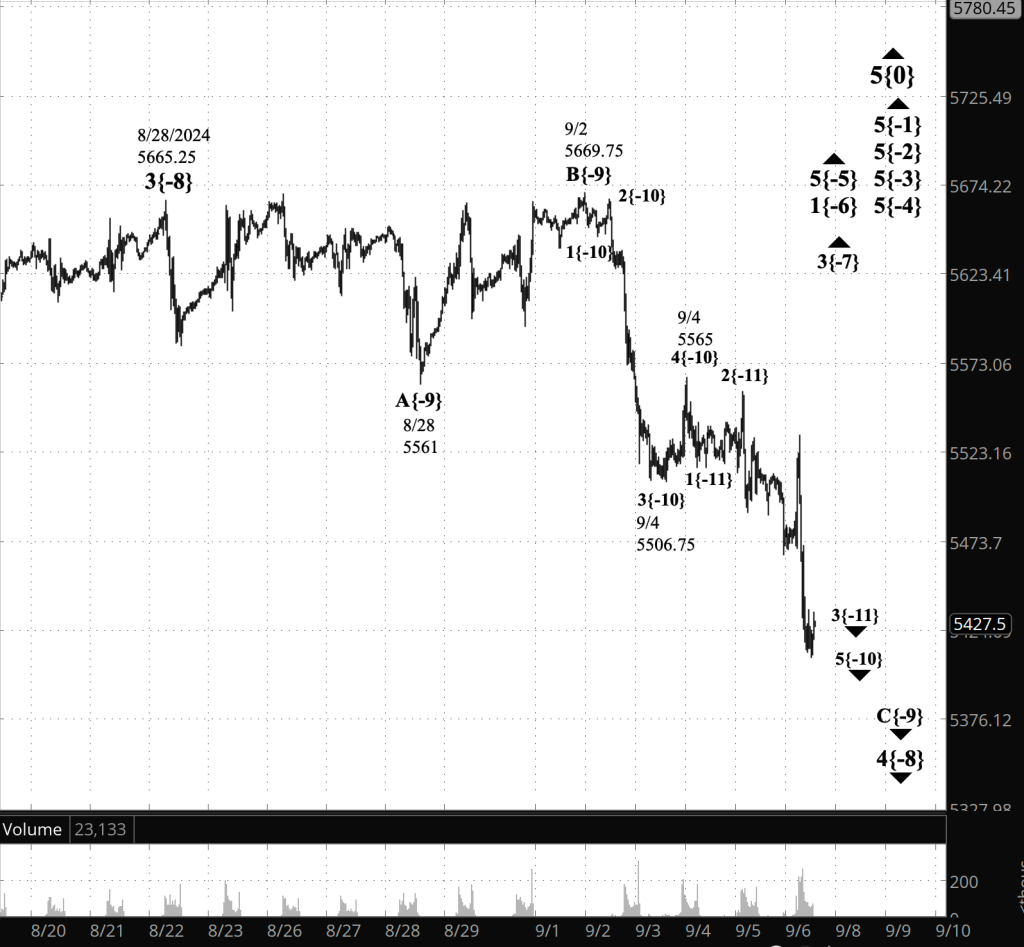
Half an hour before the closing bell.The S&P 500 futures declined during the session, returning to the 5230s. The lower the decline, the greater the support it lends to the alternative analysis, which says that that the low-grade 4th-wave upward correction that began on August 5 ended at the overnight high, 5342, and a downtrending 5th wave has begun.

However, I’m not yet persuaded, and for now I’m leaving the chart as it was, reflecting this morning’s principal analysis, which says that the 4th-wave upward correction continues.

9:35 a.m. New York time

What’s happening now? The S&P 500 E-mini futures rose overnight, reaching into the 5330s. The price approached but remained below the August 6 session high, 5342.

What does it mean? After applying Elliott Wave Theory to the chart, I’ve concluded that the low-degree 4th-wave upward correction that began on August 5 is still underway.

Any move of the price above the August 6 session high creates the possibility that the 4th-wave has ended and an uptrending 5th wave of the same degree has begun. See “What are the alternatives”, below, for more.e

Waves within waves. The correction is part of of the end game of a larger downtrending 5th wave that began on August 1, the final wave of a declining C-wave, which is the final wave of a larger 4th-wave downward correction that began on July 11.

That C wave has carried the price, so far, from the July 16 all time high, 5721.25, down to the August 5 low, 5120.

On a larger scale. The end of the 4th-wave downward correction from July 11 will be followed by a 5th-wave uptrend of roughly similar scale. When that 5th-wave is complete, it will also be the end of a series of four nested 5th waves, each larger than the one before it, and of the still larger 3rd wave that encompasses them, which began on February 21 from 4959

A similarly larger 4th-wave downward correction will then begin and will be on a sale similar to the preceding 3rd wave. Switching to wise-guy talk: If you think Friday’s steep decline was big, you ain’t seen nothing yet. Just wait for this future 4th wave.

[S&P 500 E-mini futures at 3:30 p.m., 50-minute bars, with volume]

What are the alternatives? It’s possible that the August 6 session high is the end of the low 4th-wave correction. If so, then the 5th-wave uptrend that follows will likely carry the price back into the 5600s, although it could fall short or it could go much higher.

What does Elliott wave theory say? Here are the waves that underly the analyses.

Principal Analysis:

  • Rising wave 5{0} is underway. It is a wave of Intermediate degree that began in December 2018.
  • It is in its final subwave, wave 5{-1}.
  • Within wave 5{-1}, rising waves 3{-2}, 3{-3} and 3{-4} are underway, as is wave 5{-5}.
  • Wave 5{-6} is underway and is in its final subwave, uptrending wave 5{-7}, which in turn is in its final subwave, uptrending wave 5{-8}.
  • Within wave 5{-8}, wave 4{-9}, a downward correction, is in progress.
  • Wave 4{-9} is in its final subwave, wave C{-10}.
  • Wave C{-10} is in its final subwave, wave 5{-11}.
  • At the lowest level analyzed, rising wave 4{-12} is underway.

Reading the chart. Price movements — waves – – in Elliott wave analysis are labeled with numbers within trending waves and letters with corrective waves. The subscripts — numbers in curly brackets — designate the wave’s degree, which, in Elliott wave analysis, means the relative position of a wave within the larger and smaller structures that make up the chart. R.N. Elliott, who in the 1930s developed the form of analysis that bears his name, viewed the chart as a complex structure of smaller waves nested within larger waves, which in turn are nested within still larger waves. In mathematics it’s called a fractal structure, where at every scale the pattern is similar to the others.

Learning and other resources. Elliott wave analysis provides context, not prophecy. As the 20th century semanticist Alfred Korzybski put it in his book Science and Sanity (1933), “The map is not the territory … The only usefulness of a map depends on similarity of structure between the empirical world and the map.” And I would add, in the ever-changing markets, we can judge that similarity of structure only after the fact.

See the menu page Analytical Methods for a rundown on where to go for information on Elliott wave analysis.

By Tim Bovee, Portland, Oregon, August 7, 2024

Disclaimer

Tim Bovee, Private Trader tracks the analysis and trades of a private trader for his own accounts. Nothing in this blog constitutes a recommendation to buy or sell stocks, options or any other financial instrument. The only purpose of this blog is to provide education and entertainment.

No trader is ever 100 percent successful in his or her trades. Trading in the stock and option markets is risky and uncertain. Each trader must make trading decisions for his or her own account, and take responsibility for the consequences.

License
Creative Commons License

All content on Tim Bovee, Private Trader by Timothy K. Bovee is licensed under a Creative Commons Attribution-ShareAlike 4.0 International License.

Based on a work at www.timbovee.com.

Trader’s Notebook

3:30 p.m. New York time

Half an hour before the closing bell. The S&P 500 futures rose above the overnight high, reaching into the 5340s. Under Elliott Wave Theory, the rise demotes this morning’s principal analysis, that a low-degree declining 5th wave had begun, and promotes the alternative analysis: The 4th wave upward correction continues.

The 4th wave when complete will have three subwaves. At the opening bell the overnight rise had three subwaves, leading to the now demoted morning analysis. The afternoon chart also shows three subwaves within wave 4, so it’s possible that the correction has ended during the session. Or not.

I’ve reworked the chart to show wave 4 as being underway and shall leave it there until there’s greater evidence to the contrary.

9:35 a.m. New York time

What’s happening now? The S&P 500 E-mini futures reached 5305.50 early in overnight trading and then worked its way lower into the 5220s.

What does it mean? Analysis based on Elliott Wave Theory sees the movement as the early stage of the 5th and final wave within a larger 5th wave that is the last leg of the declining wave C that began on July 15. The C wave is the final wave within the 4th-wave downward correction that began on July 11.

Chart labeling. Each wave on a chart is labeled with its wave number (such as 5 or C) followed a subscript in curly brackets showing its degree within the fractal hierarchy of the chart (such as {-9}. The subscript shows how many degrees the wave is from Intermediate degree. The present intermediate degree, wave 5{0}, began in December 2018.

What comes next? The end of the small downtrending 5th wave now beginning — wave 5{-12} — will also be the end of the downtrending larger 5th wave — wave 5{-11} — within the still larger declining C wave — wave C{-10} — which is the final subwave of the 4th-wave downward correction that began on July 11 — wave 4{-9}.

Above wave 4{-9} are a nested series of rising 5th waves — wave 5{-8} through wave 5{-5}, and they, too, will end simultaneously with wave 5{-12}. Encompassing all of that is uptrending wave 3{-4}, which began on February 21 from 4959.

So wave 5{-12} is small in degree — just a scribble on the chart — it is large in its impact. When it ends, it will be the beginning of a 4th-wave downward correction eight degrees larger in the fractal hierarchy., wave 4{-4}.

The financial media’s response to the Friday’s downward movement — wave 3{-13}, a subwave within wave 3{-12} — caused a great deal of pessimistic, maybe even panicky, assessments of the market. Multiply that pessimism and panic by nine degrees to have a sense of what lies ahead.

“After the darkness comes the dawn” ought to be the slogan of Elliott Wave Theory. Wave 4{-4}, when when complete will be followed by uptrending wave 5{-4}, which will be a bull market lasting for months

[S&P 500 E-mini futures at 9:35 a.m., 45-minute bars, with volume]

What are the alternatives? I’ve marked the small 4th-wave upward correction as having ended overnight. But perhaps it hasn’t. Stock prices tend to produce head-fakes as one wave transitions into the next. If the 4th subwave — wave 4{-12} — is still underway, the the futures developments described will be delayed briefly until wave 4{-12} reaches its end.

What does Elliott wave theory say? Here are the waves that underly the analyses.

Principal Analysis:

Principal Analysis:

  • Rising wave 5{0} is underway. It is a wave of Intermediate degree that began in December 2018.
  • It is in its final subwave, wave 5{-1}.
  • Within wave 5{-1}, rising waves 3{-2}, 3{-3} and 3{-4} are underway, as is wave 5{-5}.
  • Wave 5{-6} is underway and is in its final subwave, uptrending wave 5{-7}, which in turn is in its final subwave, uptrending wave 5{-8}.
  • Within wave 5{-8}, wave 4{-9}, a downward correction, is in progress.
  • Wave 4{-9} is in its final subwave, wave C{-10}.
  • Wave C{-10} is in its final subwave, wave 5{-11}.
  • At the lowest level analyzed, declining wave 5{-12} is underway.

Alternative Analysis

  • At the lowest level analyzed, rising wave 4{-12} is underway.

Reading the chart. Price movements — waves – – in Elliott wave analysis are labeled with numbers within trending waves and letters with corrective waves. The subscripts — numbers in curly brackets — designate the wave’s degree, which, in Elliott wave analysis, means the relative position of a wave within the larger and smaller structures that make up the chart. R.N. Elliott, who in the 1930s developed the form of analysis that bears his name, viewed the chart as a complex structure of smaller waves nested within larger waves, which in turn are nested within still larger waves. In mathematics it’s called a fractal structure, where at every scale the pattern is similar to the others.

Learning and other resources. Elliott wave analysis provides context, not prophecy. As the 20th century semanticist Alfred Korzybski put it in his book Science and Sanity (1933), “The map is not the territory … The only usefulness of a map depends on similarity of structure between the empirical world and the map.” And I would add, in the ever-changing markets, we can judge that similarity of structure only after the fact.

See the menu page Analytical Methods for a rundown on where to go for information on Elliott wave analysis.

By Tim Bovee, Portland, Oregon, August 6, 2024

Disclaimer

Tim Bovee, Private Trader tracks the analysis and trades of a private trader for his own accounts. Nothing in this blog constitutes a recommendation to buy or sell stocks, options or any other financial instrument. The only purpose of this blog is to provide education and entertainment.

No trader is ever 100 percent successful in his or her trades. Trading in the stock and option markets is risky and uncertain. Each trader must make trading decisions for his or her own account, and take responsibility for the consequences.

License
Creative Commons License

All content on Tim Bovee, Private Trader by Timothy K. Bovee is licensed under a Creative Commons Attribution-ShareAlike 4.0 International License.

Based on a work at www.timbovee.com.
Trader’s Notebook

3:30 p.m. New York time

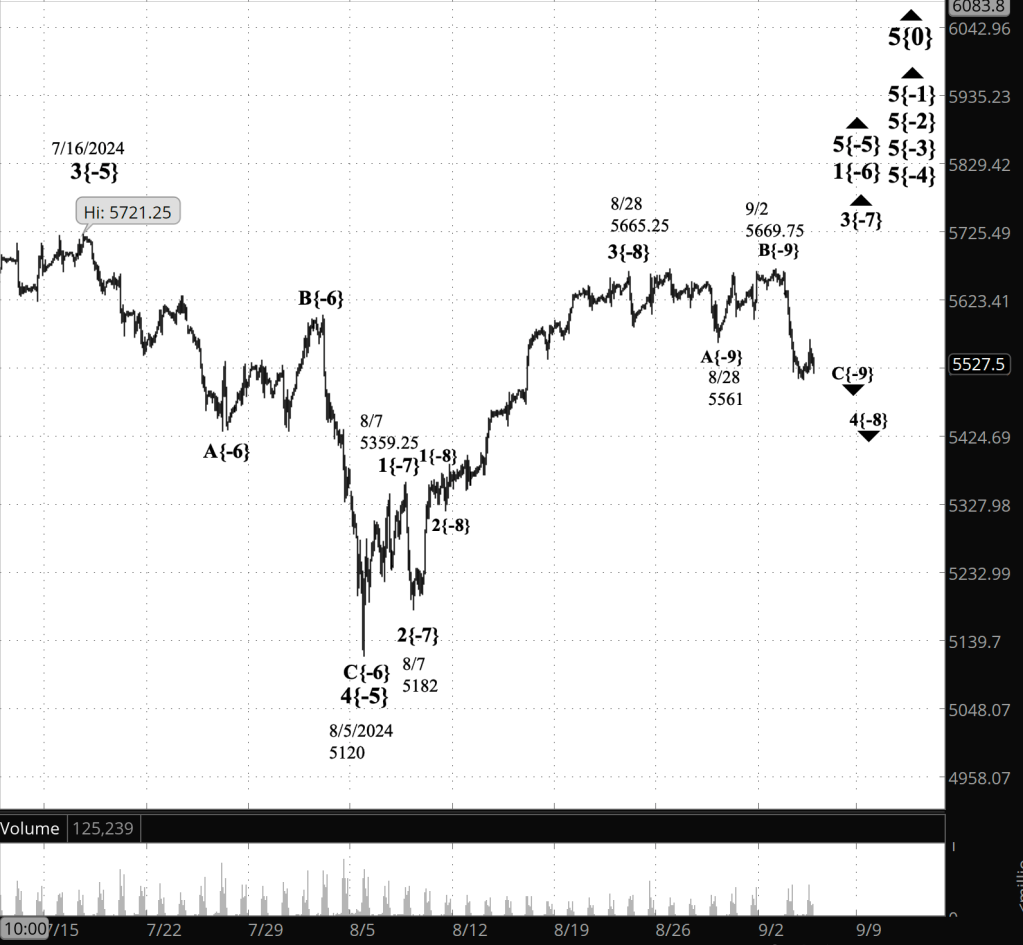
Half an hour before the closing bell. The S&P 500 futures reached its low so far today, 5120, two minutes into the session, and then rose, coming close to 5280.

Elliott Wave Theory: The decline that began on August 1 continues. It is now working through the downtrending 5th wave, the final wave of the correction’s final subwave, wave C, within the 4th-wave correction that began on July 11.

9:35 a.m. New York time

What’s happening now? The S&P 500 E-mini futures continued to fall overnight, reaching 5120 as the opening bell approached.

What does it mean? Although the focus in the news stories has been on Friday’s rapid decline — on August 4 — Elliott Wave Theory analysis the sees the present declining wave as having begun on August 1. That wave is the 5th and final wave of wave C, the final wave of a 4th-wave downward correction that began on July 11.

So although much of the market commentary has gone into full panic mode in the last day, the 4th-wave correction has been with us for a bit more than three weeks.

The end of the world as we know it? Hardly. The S&P 500 futures’ all-time high occurred on July 16 at 5721.75, a B-wave overshoot within the correction from July 11. The total decline so far has covered a bit more than 600 points, peak to low, about 10.5%. It has covered 20 days, the decline-per-day on average has been 30 points, or 0.6% of the overnight low.

That sort of fluctuation happens every day, throughout the day.

What’s next? When the present 5th-wave decline is complete, it will also be the end of the parent wave C within the 4th-wave downward correction that began on July 11. A 5th-wave uptrend will following, carrying the price higher, most likely above the all-time high set on July 16. Fifth-waves can be flaky, so there’s no guarantee that it won’t fall short.

The Chart. I’ve moved the chart in for a close-up of the 4th-wave downward correction from July 11. For a broader view see Friday’s “Trader’s Notebook”.

[S&P 500 E-mini futures at 3:30 p.m., 45-minute bars, with volume]

What are the alternatives? To be determined.

What does Elliott wave theory say? Here are the waves that underly the analyses.

Principal Analysis:

  • Rising wave 5{0} is underway. It is a wave of Intermediate degree that began in December 2018.
  • It is in its final subwave, wave 5{-1}.
  • Within wave 5{-1}, rising waves 3{-2}, 3{-3} and 3{-4} are underway, as is wave 5{-5}.
  • Wave 5{-6} is underway and is in its final subwave, uptrending wave 5{-7}, which in turn is in its final subwave, uptrending wave 5{-8}.
  • Within wave 5{-8}, wave 4{-9}, a downward correction, is in progress.
  • Wave 4{-9} is in its final subwave, wave C{-10}.
  • Wave C{-10} is in its final subwave, wave 5{-11}.
  • At the lowest level analyzed, declining wave 3{-12} is underway — maybe. There’s a lack of clairity in some parts of the decline, as is often the case with fast movements.

Reading the chart. Price movements — waves – – in Elliott wave analysis are labeled with numbers within trending waves and letters with corrective waves. The subscripts — numbers in curly brackets — designate the wave’s degree, which, in Elliott wave analysis, means the relative position of a wave within the larger and smaller structures that make up the chart. R.N. Elliott, who in the 1930s developed the form of analysis that bears his name, viewed the chart as a complex structure of smaller waves nested within larger waves, which in turn are nested within still larger waves. In mathematics it’s called a fractal structure, where at every scale the pattern is similar to the others.

Learning and other resources. Elliott wave analysis provides context, not prophecy. As the 20th century semanticist Alfred Korzybski put it in his book Science and Sanity (1933), “The map is not the territory … The only usefulness of a map depends on similarity of structure between the empirical world and the map.” And I would add, in the ever-changing markets, we can judge that similarity of structure only after the fact.

See the menu page Analytical Methods for a rundown on where to go for information on Elliott wave analysis.

By Tim Bovee, Portland, Oregon, August 5, 2024

Disclaimer

Tim Bovee, Private Trader tracks the analysis and trades of a private trader for his own accounts. Nothing in this blog constitutes a recommendation to buy or sell stocks, options or any other financial instrument. The only purpose of this blog is to provide education and entertainment.

No trader is ever 100 percent successful in his or her trades. Trading in the stock and option markets is risky and uncertain. Each trader must make trading decisions for his or her own account, and take responsibility for the consequences.

License
Creative Commons License

All content on Tim Bovee, Private Trader by Timothy K. Bovee is licensed under a Creative Commons Attribution-ShareAlike 4.0 International License.

Based on a work at www.timbovee.com.
Trader’s Notebook

3:30 p.m. New York time

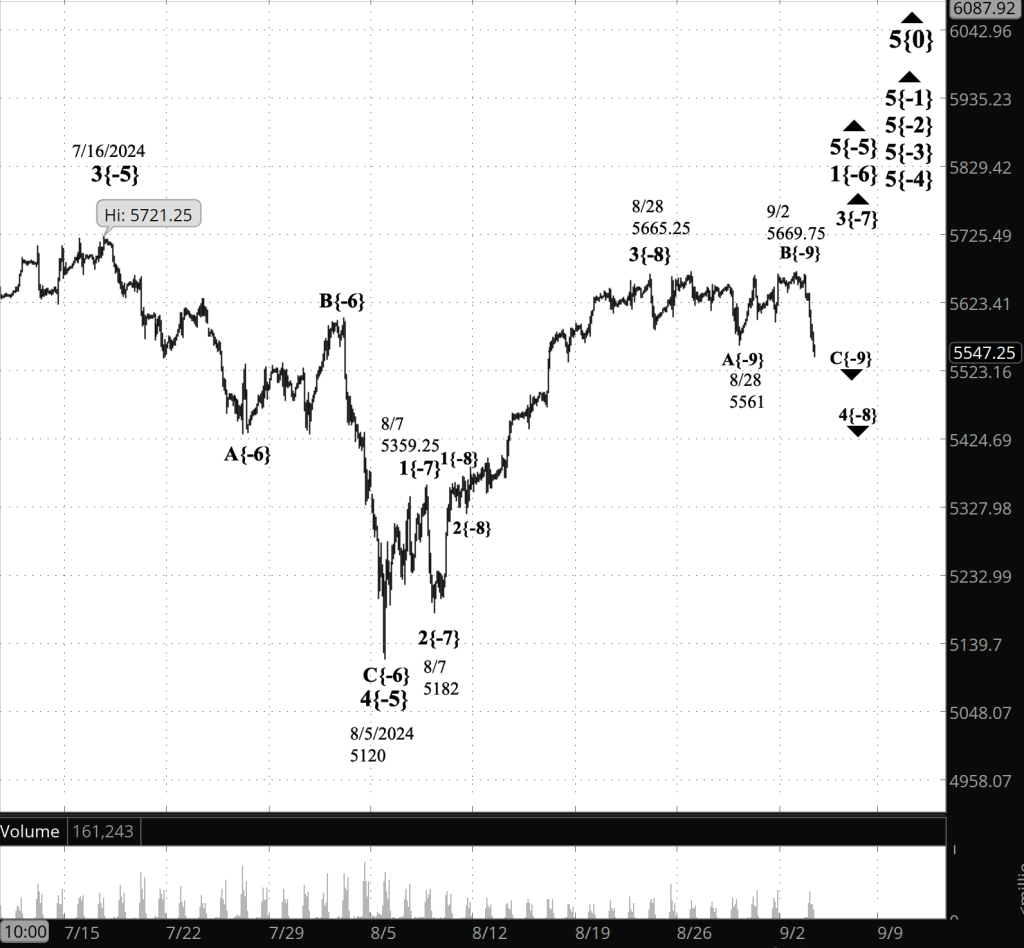
Half an hour before the closing bell. The S&P 500 futures fell during the session, reaching into the 5330s. The Elliott Wave Theory analysis is unchanged from this morning. The 4th-wave downward correction that began on July 11 continues to work through its endgame. It is in its final subwave, declining wave C, which in turn is in its final subwave, declining wave 5.

9:35 a.m. New York time

What’s happening now? The S&P 500 E-mini futures fell gently overnight an hour before the opening bell, when the Employment Situation Report was published, showing that the unemployment rate had risen from 4.1% to 4.3%. The futures spiked up to 5434.75 and then fell sharply to 5376.50 in the span of six minutes.

The unemployment rate also triggered the Sahm Rule, an unemployment-based metric developed by Federal Reserve economist Claudia Sahm. The rule isn’t a forecast. When triggered, at 0.50 or above, it means that a recession has already begun. The latest reading, based on today’s unemployment release, is 0.53.

Federal Reserve Chair Jerome Powell earlier in the week cautioned that the Sahm rule is a pattern that matches past events, not a causal indicator. “I would call it a statistical thing that has happened through history,” he said.

Sahm, in an essay posted on July 26, wrote: “The Sahm rule is likely overstating the labor market’s weakening due to unusual shifts in labor supply caused by the pandemic and immigration.”

A Sahm-rule breakout has accurately signaled each recession since 1970. Perhaps this triggering will end that winning streak. Or perhaps not…

What does it mean? Elliott Wave Theory analysis sees the decline as a continuation of the final subwave, wave 5, within the final subwave, wave C, of the 4th-wave downward correction that began on July 11.

When that small wave 5 is complete, it will also the end of the larger wave C and of the 4th-wave correction that encompasses both. A 5th-wave uptrend will follow. It is likely to carry the price back into the 5770s and perhaps much higher, although with 5th waves, there is never any guarantee.

Big picture. That rising 5th wave is the key to the S&P 500’s future. When that 5th wave comes to an end, it will also be the end of four 5th waves of increasing size, and of a still larger 3rd, which began on February 21 and which will be followed by a 4th-wave downward correction of proportional size and duration.

[S&P 500 E-mini futures at 3:30.m., 135-minute bars, with volume]

What are the alternatives? On the chart the 3rd wave that preceded the present rather small correction ended on July 11. There’s a case to be made that it actually ended on July 16, and if that’s the case, then the present correction is in its 1st subwave, wave A, with two more subwaves to follow.

What does Elliott wave theory say? Here are the waves that underly the analyses.

Principal Analysis:

  • Rising wave 5{0} is underway. It is a wave of Intermediate degree that began in December 2018.
  • It is in its final subwave, wave 5{-1}.
  • Within wave 5{-1}, rising waves 3{-2}, 3{-3} and 3{-4} are underway, as is wave 5{-5}.
  • Wave 5{-6} is underway and is in its final subwave, uptrending wave 5{-7}, which in turn is in its final subwave, uptrending wave 5{-8}.
  • Within wave 5{-8}, wave 4{-9}, a downward correction, is in progress.
  • Wave 4{-9} is in its final subwave, wave C{-10}.
  • Wave C{-10} is in its final subwave, wave 5{-11}.

Reading the chart. Price movements — waves – – in Elliott wave analysis are labeled with numbers within trending waves and letters with corrective waves. The subscripts — numbers in curly brackets — designate the wave’s degree, which, in Elliott wave analysis, means the relative position of a wave within the larger and smaller structures that make up the chart. R.N. Elliott, who in the 1930s developed the form of analysis that bears his name, viewed the chart as a complex structure of smaller waves nested within larger waves, which in turn are nested within still larger waves. In mathematics it’s called a fractal structure, where at every scale the pattern is similar to the others.

Learning and other resources. Elliott wave analysis provides context, not prophecy. As the 20th century semanticist Alfred Korzybski put it in his book Science and Sanity (1933), “The map is not the territory … The only usefulness of a map depends on similarity of structure between the empirical world and the map.” And I would add, in the ever-changing markets, we can judge that similarity of structure only after the fact.

See the menu page Analytical Methods for a rundown on where to go for information on Elliott wave analysis.

By Tim Bovee, Portland, Oregon, August 2, 2024

Disclaimer

Tim Bovee, Private Trader tracks the analysis and trades of a private trader for his own accounts. Nothing in this blog constitutes a recommendation to buy or sell stocks, options or any other financial instrument. The only purpose of this blog is to provide education and entertainment.

No trader is ever 100 percent successful in his or her trades. Trading in the stock and option markets is risky and uncertain. Each trader must make trading decisions for his or her own account, and take responsibility for the consequences.

License
Creative Commons License

All content on Tim Bovee, Private Trader by Timothy K. Bovee is licensed under a Creative Commons Attribution-ShareAlike 4.0 International License.

Based on a work at www.timbovee.com.

Trader’s Notebook

3:30 p.m. New York time

Half an hour before the closing bell. The S&P 500 futures reached a new high, 5600.75, during the session and then fell sharply, reaching into the 5440s as the closing bell approach.

Elliott Wave Theory analysis: The small decline from the overnight high was the end of the small 4th wave correction within wave C, the final subwave of a 4th wave upward correction that began on July 25. The rise during the session to a new high was wave 5, and its completion also was the end of wave C and of the 4th-wave upward correction.

The rapid decline that followed is a downtrending 5th wave. When it is complete, it will also be the end of its parent wave, the final subwave, wave C, within a 4th-wave downward correction that began on July 11.

On the chart I mark the degree of a wave within the fractal structure of the chart with a subscript in curly brackets, denoting the wave’s distance from Intermediate degree. The present Intermediate wave is wave 5{0}, which began in December 2018.

Using that system, here is what has occurred. Wave C{-12} within wave 4{-11}, a upward correction that began on July 25, ended on August 1 during the session. At that point, downtrending wave 5{-11} began and is underway. When wave 5{-11} is complete, it will also be the end of wave C{-10}, which began on July 16, within a downward correction, wave 4{-9}, which began on July 11. At completion, look for uptrending wave 5{-9} to begin.

Brevity. It’s complicated. The brief version: Down for a few days, then up for maybe several weeks. After that, a big decline that could take months. Unless, some ambiguity in the analysis results in a gotcha and a major revision, which is always a possibility in Elliott Wave Theory analysis.

9:35 a.m. New York time

What’s happening now? The S&P 500 E-mini futures peaked overnight in the 5590s and then pulled back.

What does it mean? The Elliott Wave Theory question is whether that peak is the end of wave C, the final subwave within the small 4th-wave upward correction that began on July 25. A study of the smaller waves says that wave C is still in progress.

A close-up view. The C wave will have five subwaves. I count the overnight peak as being the end of the 3rd subwave and the beginning of a smaller 4th-wave downward correction within wave C. That smaller 4th wave will have three subwaves and will be followed by a rising 5th wave that will complete the larger 4th-wave upward correction that began on July 11.

This close-up chart, captured 15 minutes before the opening bell, shows the subwaves.

[S&P 500 E-mini futures at 9:08 a.m., 5-minute bars, with volume]

Big picture. The larger 4th-wave correction will be followed by an uptrending 5th wave which, will complete, will also be the end of a series of 5th waves of increasing size, covering four degrees, and a still larger 3rd wave, that began on February 21. The 3rd wave will be following by a very large 4th-wave downward correction.

[S&P 500 E-mini futures at 3:30 p.m., 125-minute bars, with volume]

What are the alternatives? On the chart the 3rd wave that preceded the present rather small correction ended on July 11. There’s a case to be made that it actually ended on July 16, and if that’s the case, then the present correction is in its 1st subwave, wave A, with two more subwaves to follow.

What does Elliott wave theory say? Here are the waves that underly the analyses.

Principal Analysis:

  • Rising wave 5{0} is underway. It is a wave of Intermediate degree that began in December 2018.
  • It is in its final subwave, wave 5{-1}.
  • Within wave 5{-1}, rising waves 3{-2}, 3{-3} and 3{-4} are underway, as is wave 5{-5}.
  • Wave 5{-6} is underway and is in its final subwave, uptrending wave 5{-7}, which in turn is in its final subwave, uptrending wave 5{-8}.
  • Within wave 5{-8}, wave 4{-9}, a downward correction, is in progress.
  • Wave 4{-9} is in its final subwave, wave C{-10}.
  • From the Morning analysis:
  • Wave C{-10} is in its next-to-the-last subwave, wave 4{-11}, which turn is in its final subwave, wave C{-12}.
  • Within wave C{-12}, the final subwave, wave 5{-13}, is underway.
  • The new afternoon analysis:
  • Wave C{-10} is in its final subwave, wave 5{-11}.

Reading the chart. Price movements — waves – – in Elliott wave analysis are labeled with numbers within trending waves and letters with corrective waves. The subscripts — numbers in curly brackets — designate the wave’s degree, which, in Elliott wave analysis, means the relative position of a wave within the larger and smaller structures that make up the chart. R.N. Elliott, who in the 1930s developed the form of analysis that bears his name, viewed the chart as a complex structure of smaller waves nested within larger waves, which in turn are nested within still larger waves. In mathematics it’s called a fractal structure, where at every scale the pattern is similar to the others.

Learning and other resources. Elliott wave analysis provides context, not prophecy. As the 20th century semanticist Alfred Korzybski put it in his book Science and Sanity (1933), “The map is not the territory … The only usefulness of a map depends on similarity of structure between the empirical world and the map.” And I would add, in the ever-changing markets, we can judge that similarity of structure only after the fact.

See the menu page Analytical Methods for a rundown on where to go for information on Elliott wave analysis.

By Tim Bovee, Portland, Oregon, August 1, 2024

Disclaimer

Tim Bovee, Private Trader tracks the analysis and trades of a private trader for his own accounts. Nothing in this blog constitutes a recommendation to buy or sell stocks, options or any other financial instrument. The only purpose of this blog is to provide education and entertainment.

No trader is ever 100 percent successful in his or her trades. Trading in the stock and option markets is risky and uncertain. Each trader must make trading decisions for his or her own account, and take responsibility for the consequences.

License
Creative Commons License

All content on Tim Bovee, Private Trader by Timothy K. Bovee is licensed under a Creative Commons Attribution-ShareAlike 4.0 International License.

Based on a work at www.timbovee.com.
Trader’s Notebook

3:30 p.m. New York time

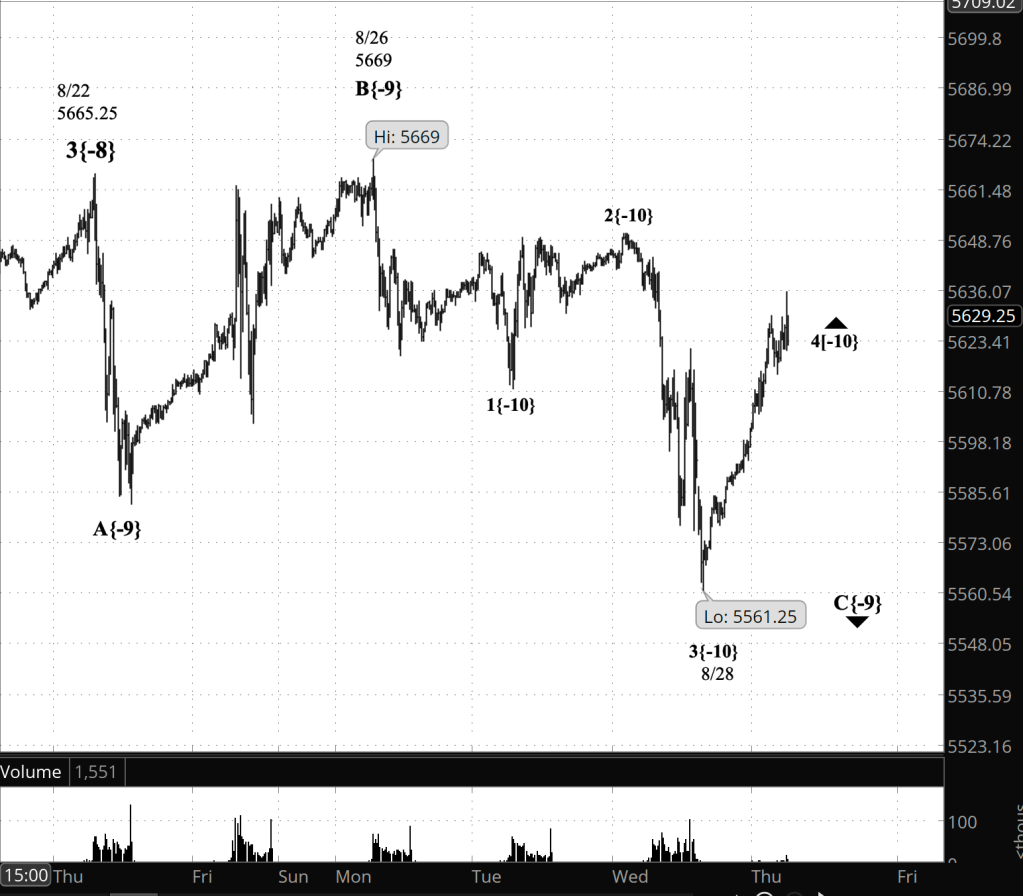
Half an hour before the closing bell. The S&P 500 futures rose throughout the session, reaching into the 5580s after the Federal Open Market Committee left the Federal Funds Rate unchanged.

The final subwave of the low-degree upward correction that began on February 25 continues.

9:35 a.m. New York time

What’s happening now? The S&P 500 E-mini futures rose overnight into the 5540s.

What does it mean? Elliott Wave Theory analysis concludes that the 4th-wave upward correction that began on July 25 has progressed to its final subwave, rising wave C. The rise has carried the price beyond the endpoint of the preceding A wave, which lends weight to the conclusion that wave C is underway.

All of this is happening within the 4th-wave upward correction that began on July 25 from 5433, which is a subwave of a larger C wave within a larger 4th-wave downward correction.

On the chart I mark the degree of a wave within the fractal structure of the chart with a subscript in curly brackets, denoting the wave’s distance from Intermediate degree. The present Intermediate wave is wave 5{0}, which began in December 2018.

The present wave is rising C{-12} within rising wave 4{-11} within falling wave C{-10) within falling wave 4{-9}.

Long story short, under the principal analysis, the 4th-wave upward correction that began on July 25 is close to its end.

What’s next? The end of the smaller C wave will also be the end of the small 4th-wave upward correction, as well as of the larger C wave within a 4th-wave downward correction that began on July 11.

That larger wave 4 will be followed by an uptrending 5th-wave, the final subwave within a still larger 5th wave that began on July 2, nested within three additional subwaves, each a larger degree than the one before it. The end of those 5th waves will also be the end of a still larger 3rd wave that encompasses them all, wave 3{-4} on the chart, which began on February 21 from 4959.

That large 3rd wave will be followed by an appropriately large 4th-wave downward correction that will take months to retrace a portion of the 3rd-wave’s rise.

[S&P 500 E-mini futures at 3:30 p.m., 2-hour bars, with volume]

What are the alternatives? On the chart the 3rd wave that preceded the present rather small correction ended on July 11. There’s a case to be made that it actually ended on July 16, and if that’s the case, then the present correction is in its 1st subwave, wave A, with two more subwaves to follow.

What does Elliott wave theory say? Here are the waves that underly the analyses.

Principal Analysis:

.Rising wave 5{0} is underway. It is a wave of Intermediate degree that began in December 2018.

It is in its final subwave, wave 5{-1}.

Within wave 5{-1}, rising waves 3{-2}, 3{-3} and 3{-4} are underway, as is wave 5{-5}.

Wave 5{-6} is underway and is in its final subwave, uptrending wave 5{-7}, which in turn is in its final subwave, uptrending wave 5{-8}.

Within wave 5{-8}, wave 4{-9}, a downward correction, is in progress.

Wave 4{-9} is in its final subwave, wave C{-10}.

Within wave C{-10}, wave 4{-11} is underway and is in its final subwave, wave 5{-12}

Reading the chart. Price movements — waves – – in Elliott wave analysis are labeled with numbers within trending waves and letters with corrective waves. The subscripts — numbers in curly brackets — designate the wave’s degree, which, in Elliott wave analysis, means the relative position of a wave within the larger and smaller structures that make up the chart. R.N. Elliott, who in the 1930s developed the form of analysis that bears his name, viewed the chart as a complex structure of smaller waves nested within larger waves, which in turn are nested within still larger waves. In mathematics it’s called a fractal structure, where at every scale the pattern is similar to the others.

Learning and other resources. Elliott wave analysis provides context, not prophecy. As the 20th century semanticist Alfred Korzybski put it in his book Science and Sanity (1933), “The map is not the territory … The only usefulness of a map depends on similarity of structure between the empirical world and the map.” And I would add, in the ever-changing markets, we can judge that similarity of structure only after the fact.

See the menu page Analytical Methods for a rundown on where to go for information on Elliott wave analysis.

By Tim Bovee, Portland, Oregon, July 31, 2024

Disclaimer

Tim Bovee, Private Trader tracks the analysis and trades of a private trader for his own accounts. Nothing in this blog constitutes a recommendation to buy or sell stocks, options or any other financial instrument. The only purpose of this blog is to provide education and entertainment.

No trader is ever 100 percent successful in his or her trades. Trading in the stock and option markets is risky and uncertain. Each trader must make trading decisions for his or her own account, and take responsibility for the consequences.

License
Creative Commons License

All content on Tim Bovee, Private Trader by Timothy K. Bovee is licensed under a Creative Commons Attribution-ShareAlike 4.0 International License.

Based on a work at www.timbovee.com.