Trader’s Notebook

3:30 p.m. New York time

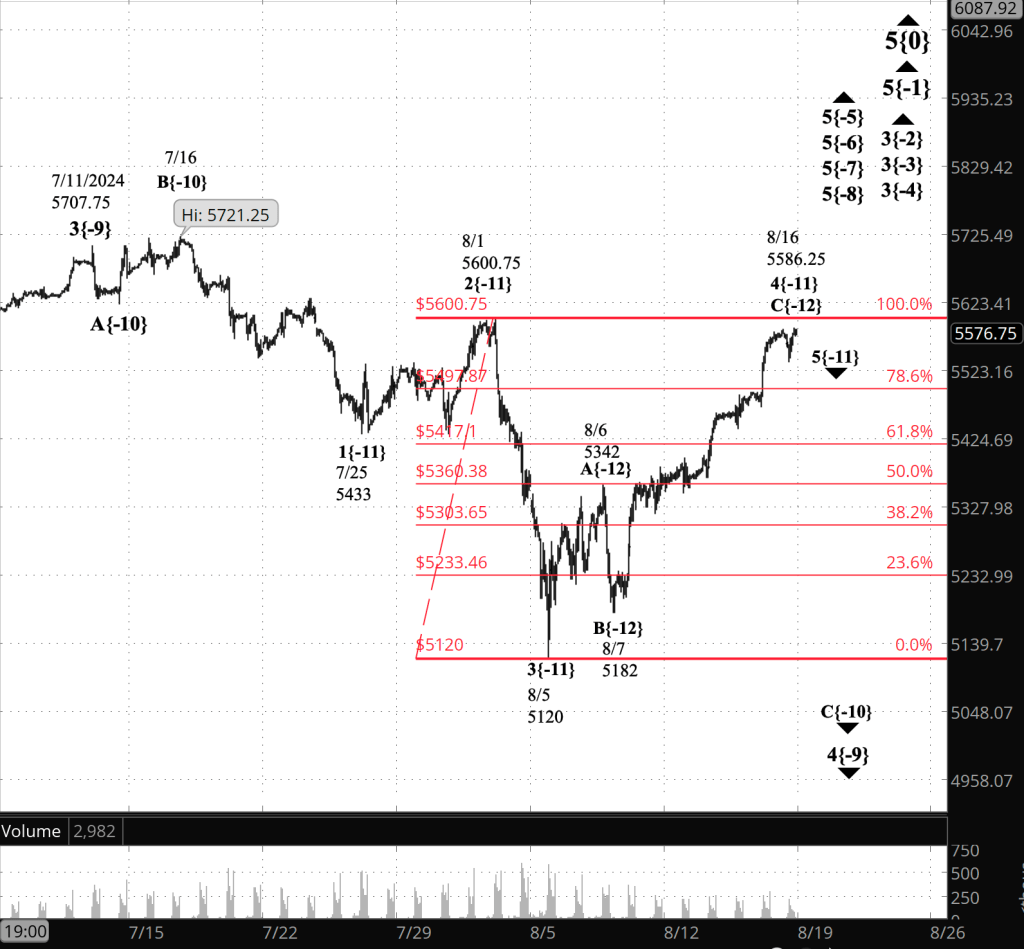
Half an hour before the closing bell. The S&P 500 futures fell further during the session, into the 5630s.

The decline reinforces this morning’s Elliott Wave Theory analysis the sees the the 4th-wave downward correction that began on July 11 as being in its final subwave, wave C. The decline has carried the price below the upper boundary, 5634.75, of the price target. See this morning’s analysis below.

I’ve updated the chart.

9:35 a.m. New York time

What’s happening now? The S&P 500 E-mini futures reached a new peak, 5721.25, minutes before the closing bell on Tuesday, and then began to decline, reaching into the 5650s as today’s opening bell sounded.

What does it mean? The 4th-wave downward correction that began on July 11 continues. My Elliott Wave Theory analyses over the last few days have repeatedly moved the end of the middle subwave — wave B — as each new peak developed. The move to the Tuesday’s peak, late in the session, has been followed by a an energetic decline, suggesting that this time the final subwave — wave C — really has begun.

Price target. As noted in yesterday’s analysis, the 4th-wave correction is taking the Flat form, and the C-wave within a Flat typically retraces from the length of the preceding A wave to 165% of that length. It’s a tendency not a firm rule.

Under that tendency, wave C will be somewhere between 86.50 points and 142.75 points in length. The target range, based on wave C’s higher starting point, will typically range from 5634.75 and 5578.50. The range boundaries have been rounded to conform the the futures’ 25-cent increment in price changes.

Looking forward. The C wave, when complete, will be the end of the 4th-wave correction and the start of a 5th-wave uptrend. Fifth waves tend to have a lot of variety, sometimes fallling short of the peak of the preceding 3rd wave — 5707.75 in this case — and sometimes extending well beyond that level.

The end of the 5th-wave uptrend will cascade up the fractal structure of the chart, also marking the end of a series of 5th wave of increasing size overing four degrees, and also the end of a still larger 3rd-wave uptrend that began on February 21. A large 4th-wave downward correction will follow.

[S&P 500 E-mini futures at 3:30 p.m., 100-minute bars, with volume]

What are the alternatives? There may be a 1st wave on the chart, between wave 5{-6} and 5{-5}. If that’s the proper count, then it would delay the onset or the 4th-wave downward correction, wave 4{-4}. See the June 18 Trader’s Notebook for a more detailed discussion. As the uptrend progresses, this alternative is appearing to be less likely.

What does Elliott wave theory say? Here are the waves that underly the analyses.

Principal Analysis:

  • Rising wave 5{0} is underway. It is a wave of Intermediate degree that began in December 2018.
  • It is in its final subwave, wave 5{-1}.
  • Within wave 5{-1}, rising waves 3{-2}, 3{-3} and 3{-4} are underway, as is wave 5{-5}.
  • Wave 5{-6} is underway and is in its final subwave, uptrending wave 5{-7}, which in turn is in its final subwave, uptrending wave 5{-8}.
  • Within wave 5{-8}, a downward correction, wave 4{-9}, is in progress.
  • Wave 4{-9} is in its final subwave, wave C{-10}

Reading the chart. Price movements — waves – – in Elliott wave analysis are labeled with numbers within trending waves and letters with corrective waves. The subscripts — numbers in curly brackets — designate the wave’s degree, which, in Elliott wave analysis, means the relative position of a wave within the larger and smaller structures that make up the chart. R.N. Elliott, who in the 1930s developed the form of analysis that bears his name, viewed the chart as a complex structure of smaller waves nested within larger waves, which in turn are nested within still larger waves. In mathematics it’s called a fractal structure, where at every scale the pattern is similar to the others.

Learning and other resources. Elliott wave analysis provides context, not prophecy. As the 20th century semanticist Alfred Korzybski put it in his book Science and Sanity (1933), “The map is not the territory … The only usefulness of a map depends on similarity of structure between the empirical world and the map.” And I would add, in the ever-changing markets, we can judge that similarity of structure only after the fact.

See the menu page Analytical Methods for a rundown on where to go for information on Elliott wave analysis.

By Tim Bovee, Portland, Oregon, July 17, 2024

Disclaimer

Tim Bovee, Private Trader tracks the analysis and trades of a private trader for his own accounts. Nothing in this blog constitutes a recommendation to buy or sell stocks, options or any other financial instrument. The only purpose of this blog is to provide education and entertainment.

No trader is ever 100 percent successful in his or her trades. Trading in the stock and option markets is risky and uncertain. Each trader must make trading decisions for his or her own account, and take responsibility for the consequences.

License
Creative Commons License

All content on Tim Bovee, Private Trader by Timothy K. Bovee is licensed under a Creative Commons Attribution-ShareAlike 4.0 International License.

Based on a work at www.timbovee.com.

Trader’s Notebook

3:30 p.m. New York time

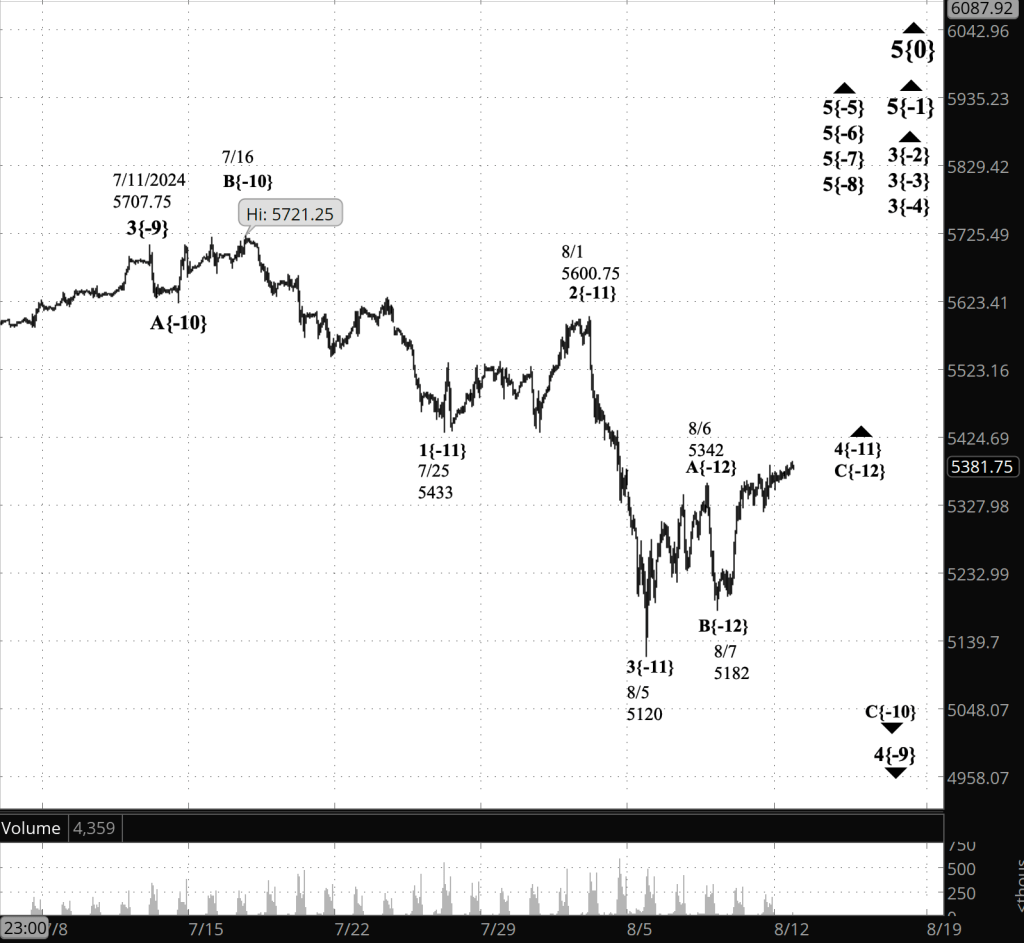
Half an hour before the closing bell. The S&P 500 futures climbed back into the 5710s during the session, so far remaining below the overnight high by a few points.

This morning’s Elliott Wave Theory analysis is unchanged: Wave C within the 4th-wave upward correction that began on July 11 continues.

I’ve updated the chart.

9:35 a.m. New York time

What’s happening now? The S&P 500 E-mini futures traded in a narrow range overnight, remaining in the 5690s except for a decline into the 5670s and then back.

What does it mean? Elliott Wave Theory sees the pause as part of the third subwave — wave C — within the 4th-wave downward correction that began on July 11. The correction is taking the form of a Flat, with waves A and B having three subwaves and wave C, five subwaves.

A C wave within a Flat typically is equal to the length of wave A or up to 65% longer. The A wave in this correction covered 86.5 points. Multiplying by 1.65 gives a length of 142.73.

Wave C began from 5718.75. That gives a range for wave C of between 5632.25 and 5576 (rounding the results to the 25-cent increments used by the S&P 500 futures), which at its longest would bring the price down to where it was in early July.

As I’ve noted in earlier posts, this is a small correction. However, there is a much larger correction in view.

The present 4th-wave corection will be followed by a small 5th-wave uptrend, whose end will also be the end of four 5th waves of increasing size, and of a still larger 3rd wave. that began on February 21. A 4th-wave downward correction of the larger 3rd wave will begin. That 4th-wave correction will be five degrees (or levels) larger than the present 4th-wave correction within the fractal structure of the chart.

[S&P 500 E-mini futures at 3:30 p.m., 100-minute bars, with volume]

What are the alternatives? Unchanged for the past few weeks. There may be a 1st wave on the chart, between wave 5{-6} and 5{-5}. If that’s the proper count, then it would delay the onset or the 4th-wave downward correction, wave 4{-4}. See the June 18 Trader’s Notebook for a more detailed discussion. As the uptrend progresses, this alternative is appearing to be less likely.

What does Elliott wave theory say? Here are the waves that underly the analyses.

Principal Analysis:

  • Rising wave 5{0} is underway. It is a wave of Intermediate degree that began in December 2018.
  • It is in its final subwave, wave 5{-1}.
  • Within wave 5{-1}, rising waves 3{-2}, 3{-3} and 3{-4} are underway, as is wave 5{-5}.
  • Wave 5{-6} is underway and is in its final subwave, uptrending wave 5{-7}, which in turn is in its final subwave, uptrending wave 5{-8}.
  • Within wave 5{-8}, a downward correction, wave 4{-9}, is in progress.
  • Wave 4{-9} is in its final subwave, wave C{-10}

Reading the chart. Price movements — waves – – in Elliott wave analysis are labeled with numbers within trending waves and letters with corrective waves. The subscripts — numbers in curly brackets — designate the wave’s degree, which, in Elliott wave analysis, means the relative position of a wave within the larger and smaller structures that make up the chart. R.N. Elliott, who in the 1930s developed the form of analysis that bears his name, viewed the chart as a complex structure of smaller waves nested within larger waves, which in turn are nested within still larger waves. In mathematics it’s called a fractal structure, where at every scale the pattern is similar to the others.

Learning and other resources. Elliott wave analysis provides context, not prophecy. As the 20th century semanticist Alfred Korzybski put it in his book Science and Sanity (1933), “The map is not the territory … The only usefulness of a map depends on similarity of structure between the empirical world and the map.” And I would add, in the ever-changing markets, we can judge that similarity of structure only after the fact.

See the menu page Analytical Methods for a rundown on where to go for information on Elliott wave analysis.

By Tim Bovee, Portland, Oregon, July 16, 2024

Disclaimer

Tim Bovee, Private Trader tracks the analysis and trades of a private trader for his own accounts. Nothing in this blog constitutes a recommendation to buy or sell stocks, options or any other financial instrument. The only purpose of this blog is to provide education and entertainment.

No trader is ever 100 percent successful in his or her trades. Trading in the stock and option markets is risky and uncertain. Each trader must make trading decisions for his or her own account, and take responsibility for the consequences.

License
Creative Commons License

All content on Tim Bovee, Private Trader by Timothy K. Bovee is licensed under a Creative Commons Attribution-ShareAlike 4.0 International License.

Based on a work at www.timbovee.com.

Trader’s Notebook

3:30 p.m. New York time

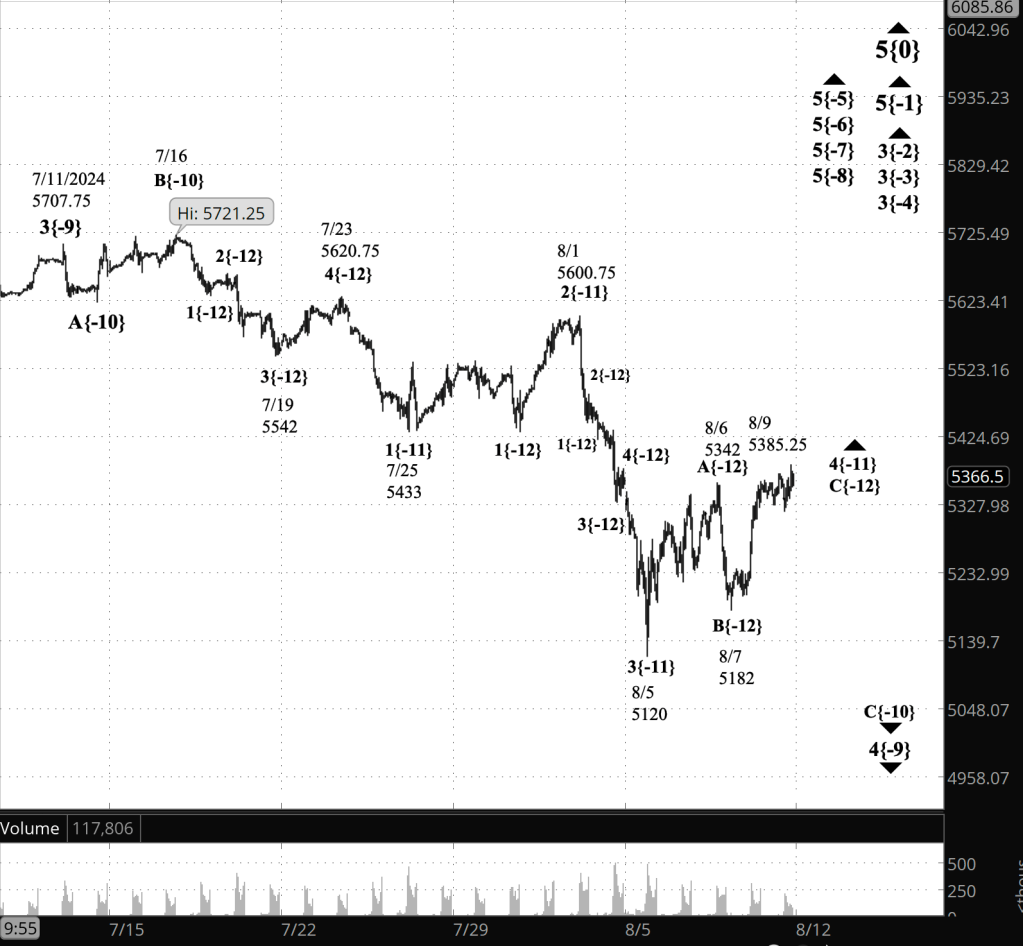
Half an hour before the closing bell. The S&P 500 futures has risen above the overnight high during the session, into the 5710s. Elliott Wave Theory: Within the 4th-wave downward correction that began on July 11, I’ve moved the end point of the rising B wave — the middle subwave — to the session high, and consider the falling C wave — the final subwave — to have begun from that point. Otherwise, the morning analysis is unchanged.

I’ve updated the chart.

9:35 a.m. New York time

What’s happening now? The S&P 500 E-mini futures rose overnight into the 5690s and then pulled back slightly.

What does it mean? The small downward correction that began on July 11 is now in its final subwave, according to Elliott Wave Theory analysis. The correction will be followed by a small 5th-wave uptrend that, if typical, will take a week or so to reach completion.

At that point, things get interesting. When the small 5th-wave uptrend reaches its endpoint, it will also be the end of a series of 5th waves of increasing degree within the fractal structure of the chart, up to a 5th wave four degrees higher. Up one more degree, and a 3rd wave that began in February will also reach its end, and a declining 4th-wave correction, far larger than the one now underway, will begin.

[S&P 500 E-mini futures at 3:30 p.m., 90-minute bars, with volume]

What are the alternatives? Unchanged for the past few weeks. There may be a 1st wave on the chart, between wave 5{-6} and 5{-5}. If that’s the proper count, then it would delay the onset or the 4th-wave downward correction, wave 4{-4}. See the June 18 Trader’s Notebook for a more detailed discussion. As the uptrend progresses, this alternative is appearing to be less likely.

What does Elliott wave theory say? Here are the waves that underly the analyses.

Principal Analysis:

  • Rising wave 5{0} is underway. It is a wave of Intermediate degree that began in December 2018.
  • It is in its final subwave, wave 5{-1}.
  • Within wave 5{-1}, rising waves 3{-2}, 3{-3} and 3{-4} are underway, as is wave 5{-5}.
  • Wave 5{-6} is underway and is in its final subwave, uptrending wave 5{-7}, which in turn is in its final subwave, uptrending wave 5{-8}.
  • Within wave 5{-8}, a downward correction, wave 4{-9}, is in progress.
  • Wave 4{-9} is in its final subwave, wave C{-10}

Reading the chart. Price movements — waves – – in Elliott wave analysis are labeled with numbers within trending waves and letters with corrective waves. The subscripts — numbers in curly brackets — designate the wave’s degree, which, in Elliott wave analysis, means the relative position of a wave within the larger and smaller structures that make up the chart. R.N. Elliott, who in the 1930s developed the form of analysis that bears his name, viewed the chart as a complex structure of smaller waves nested within larger waves, which in turn are nested within still larger waves. In mathematics it’s called a fractal structure, where at every scale the pattern is similar to the others.

Learning and other resources. Elliott wave analysis provides context, not prophecy. As the 20th century semanticist Alfred Korzybski put it in his book Science and Sanity (1933), “The map is not the territory … The only usefulness of a map depends on similarity of structure between the empirical world and the map.” And I would add, in the ever-changing markets, we can judge that similarity of structure only after the fact.

See the menu page Analytical Methods for a rundown on where to go for information on Elliott wave analysis.

By Tim Bovee, Portland, Oregon, July 15, 2024

Disclaimer

Tim Bovee, Private Trader tracks the analysis and trades of a private trader for his own accounts. Nothing in this blog constitutes a recommendation to buy or sell stocks, options or any other financial instrument. The only purpose of this blog is to provide education and entertainment.

No trader is ever 100 percent successful in his or her trades. Trading in the stock and option markets is risky and uncertain. Each trader must make trading decisions for his or her own account, and take responsibility for the consequences.

License
Creative Commons License

All content on Tim Bovee, Private Trader by Timothy K. Bovee is licensed under a Creative Commons Attribution-ShareAlike 4.0 International License.

Based on a work at www.timbovee.com.

Trader’s Notebook

3:30 p.m. New York time

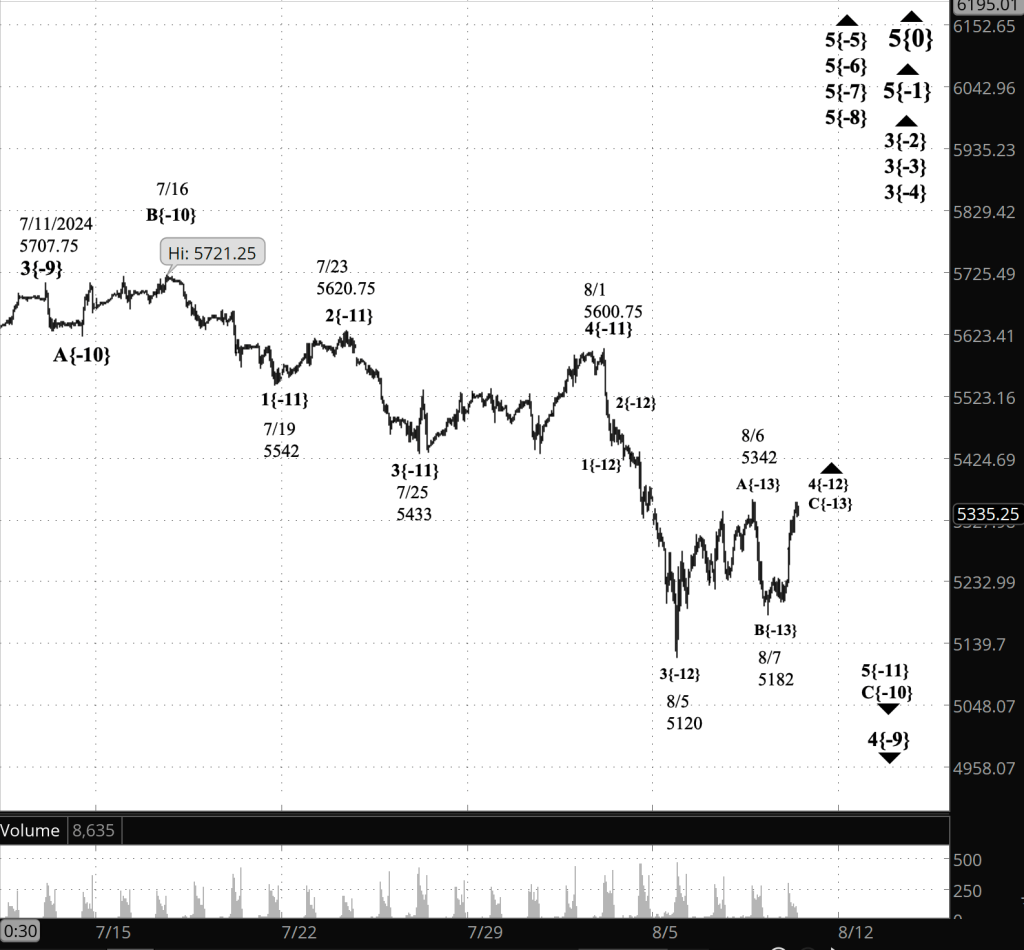
Half an hour before the closing bell. The S&P 500 futures continued to rise during the session, reaching above 5700. The chart has the look-and-feel, to me, at least, of another head-fake in the making, a repeat of yesterday’s need to correct the morning analysis.

For this afternoon’s Elliott Wave Theory analysis, I’ve retained labeling that has a 4th-wave downward correction that began on July 11 in progress. It’s a subwave of a larger 5th-wave uptrend that began on July 2.

Fourth waves have three subwaves within the initial wave, and I’ve labeled that subwave, wave A, as having ended at the overnight low. With that labeling, wave A has three subwaves, meaning that the correction is taking the form of a Flat.

The rise that followed is the B wave, the second subwave within the correction. In the Flat form, a B wave can move above the start of the preceding A wave, and that is what has happened. The B wave will have three subwaves. If this count turns out to match the future course of the chart, then the rising B wave will followed by a declining C wave with five subwaves that will complete the 4th-wave correction.

Now to the potential head-fake: It’s possible to count the wave A decline, as discussed above, as being the entire 4th-wave correction, with three subwaves and a lack of clarity within those subwaves. That lack of clarity has led me to demote this second analysis to an Alternative status. Under this scenario, today’s rise during the session is a 5th-wave uptrend, the final subwave of the larger 5th wave that began on July 2.

And now we wait for the unfolding reality of the chart to grade our work.

I’ve updated the chart.

9:35 a.m. New York time

What’s happening now? The S&P 500 E-mini futures traded sideways overnight, dropping by 18 points when new Producer Price Index data was released. The price returned to its prior level in the next minute.

What does it mean? Analysis based on Elliott Wave Theory concludes that a low-degree 4th-wave downward correction that began on July 11 continues. when it is complete, a 5th-wave uptrend will following, bringing the parent wave — also a 5th-wave uptrend — to a conclusion.

A series of three nested 5th wave, each a degree higher than the one before, will simultaneously com to an end. The entire structure is within a 3rd wave uptrend that began on February 21. When those 5th waves end, the larger 3rd wave will also end and a large 4th-wave downtrend will begin.

[S&P 500 E-mini futures at 3:30 p.m., 90-minute bars, with volume]

What are the alternatives? There may be a 1st wave on the chart, between wave 5{-6} and 5{-5}. If that’s the proper count, then it would delay the onset or the 4th-wave downward correction, wave 4{-4}. See the June 18 Trader’s Notebook for a more detailed discussion. As the uptrend progresses, this alternative is appearing to be less likely.

What does Elliott wave theory say? Here are the waves that underly the analyses.

Principal Analysis:

  • Rising wave 5{0} is underway. It is a wave of Intermediate degree that began in December 2018.
  • It is in its final subwave, wave 5{-1}.
  • Within wave 5{-1}, rising waves 3{-2}, 3{-3} and 3{-4} are underway, as is wave 5{-5}.
  • Wave 5{-6} is underway and is in its final subwave, uptrending wave 5{-7}, which in turn is in its final subwave, uptrending wave 5{-8}.
  • Within wave 5{-8}, a downward correction, wave 4{-9}, is in progress.

Reading the chart. Price movements — waves – – in Elliott wave analysis are labeled with numbers within trending waves and letters with corrective waves. The subscripts — numbers in curly brackets — designate the wave’s degree, which, in Elliott wave analysis, means the relative position of a wave within the larger and smaller structures that make up the chart. R.N. Elliott, who in the 1930s developed the form of analysis that bears his name, viewed the chart as a complex structure of smaller waves nested within larger waves, which in turn are nested within still larger waves. In mathematics it’s called a fractal structure, where at every scale the pattern is similar to the others.

Learning and other resources. Elliott wave analysis provides context, not prophecy. As the 20th century semanticist Alfred Korzybski put it in his book Science and Sanity (1933), “The map is not the territory … The only usefulness of a map depends on similarity of structure between the empirical world and the map.” And I would add, in the ever-changing markets, we can judge that similarity of structure only after the fact.

See the menu page Analytical Methods for a rundown on where to go for information on Elliott wave analysis.

By Tim Bovee, Portland, Oregon, July 12, 2024

Disclaimer

Tim Bovee, Private Trader tracks the analysis and trades of a private trader for his own accounts. Nothing in this blog constitutes a recommendation to buy or sell stocks, options or any other financial instrument. The only purpose of this blog is to provide education and entertainment.

No trader is ever 100 percent successful in his or her trades. Trading in the stock and option markets is risky and uncertain. Each trader must make trading decisions for his or her own account, and take responsibility for the consequences.

License
Creative Commons License

All content on Tim Bovee, Private Trader by Timothy K. Bovee is licensed under a Creative Commons Attribution-ShareAlike 4.0 International License.

Based on a work at www.timbovee.com.
Trader’s Notebook

3:30 p.m. New York time

Half an hour before the closing bell. The S&P 500 futures fell during the session, reaching 5630. The decline adds sufficient doubt of the accuracy of this morning’s analysis that I’ve made some revisions to the subwaves within the 5th-wave uptrend that began on July 2, as follows:

  • The end of the 3rd subwave, and uptrend, moves to the overnight peak, 5707.75.
  • The decline that followed is the 4th subwave, a downward correction.

Under this scenario, the small 4th-wave correction will be followed by a 5th wave uptrend. The 4th-wave correction is labelled wave 4{-9} on the chart, and the wave that follows will be wave 5{-9}. At this low level within the fractal structure of the chart we’re tracking wave movements that last days, maybe a week, so it shouldn’t take long.

I’ve updated the chart.

9:35 a.m. New York time

What’s happening now? The S&P 500 E-mini futures rose sharply an hour before the opening bell after the release of the Consumer Price Index, the most extensive measure of inflation in the United States. The price leapt within a minute from 5681.27 to 5707.25 and then fell back, almost returning to the starting point.

What does it mean? [The following analysis has been superseded by the afternoon analysis, above.] In Elliott Wave Theory analysis, the rapid rise marks the beginning of the final subwave within an uptrending 5th wave that began on July 2.

The 5th wave that began overnight is labeled wave 5{-9} on the chart, the subscript in curly brackets referrng to the wave’s distance from the Intermediate degree within the fractal structure of the chart. The present wave of Intermediate degree is wave 5{0}, which began in December 2018. Wave 5{-9} is nine degrees lower in the fractal structure.

The larger 5th wave, which began on July 2, is labeled wave 5{-8}. When it is complete, it will also mark the end of three 5th waves of increasingly larger size, waves 5{-7}, 5{-6} and 5{-5}. All of these waves are subwaves of a larger 3rd wave, wave 3{-4}, which began on February 21. The simultaneous completion of 5th waves covering five degrees will also be the end of wave 3{-4}, and the beginning of a downward correction, wave 4{-4}, which will be far more impressive than any correction we’ve seen since winter.

[S&P 500 E-mini futures at 3:30 p.m., 90-minute bars, with volume]

What are the alternatives? There are two, one concerning the near-term chart and a second concerning the larger movements.

Alternative #1 [Superseded by the afternoon analysis, above.-

Wave 5{-8} is in its initial subwave, and the decline from the peak is a 2nd-wave correction. One firm rule of Elliott Wave Theory is that a 2nd wave can’t move beyond the start of the preceding 1st wave; in this case, the price before the one-minute rise overnight to a new high. If the price falls below 4677.25, then my analysis above is incorrect — the middle subwave, wave 3{-9} within wave 5{-8} is still underway.

Alternative #2

Another alternative: There may be a 1st wave on the chart, between wave 5{-6} and 5{-5}. If that’s the proper count, then it would delay the onset or the 4th-wave downward correction, wave 4{-4}. See the June 18 Trader’s Notebook for a more detailed discussion. As the uptrend progresses, this alternative is appearing to be less likely.

What does Elliott wave theory say? Here are the waves that underly the analyses.

Principal Analysis:

  • Rising wave 5{0} is underway. It is a wave of Intermediate degree that began in December 2018.
  • It is in its final subwave, wave 5{-1}.
  • Within wave 5{-1}, rising waves 3{-2}, 3{-3} and 3{-4} are underway, as is wave 5{-5}.
  • Wave 5{-6} is underway and is in its final subwave, uptrending wave 5{-7}, which in turn is in its final subwave, uptrending wave 5{-8}.
  • Within wave 5{-8}, an uptrending subwave, wave 5{-9}, is in progress.

Alternative #1 Analysis [Superseded by the afternoon analysis, above]

  • Within wave 5{-8}, an uptrending subwave, wave 3{-9}, is in progress.

Reading the chart. Price movements — waves – – in Elliott wave analysis are labeled with numbers within trending waves and letters with corrective waves. The subscripts — numbers in curly brackets — designate the wave’s degree, which, in Elliott wave analysis, means the relative position of a wave within the larger and smaller structures that make up the chart. R.N. Elliott, who in the 1930s developed the form of analysis that bears his name, viewed the chart as a complex structure of smaller waves nested within larger waves, which in turn are nested within still larger waves. In mathematics it’s called a fractal structure, where at every scale the pattern is similar to the others.

Learning and other resources. Elliott wave analysis provides context, not prophecy. As the 20th century semanticist Alfred Korzybski put it in his book Science and Sanity (1933), “The map is not the territory … The only usefulness of a map depends on similarity of structure between the empirical world and the map.” And I would add, in the ever-changing markets, we can judge that similarity of structure only after the fact.

See the menu page Analytical Methods for a rundown on where to go for information on Elliott wave analysis.

By Tim Bovee, Portland, Oregon, July 11, 2024

Disclaimer

Tim Bovee, Private Trader tracks the analysis and trades of a private trader for his own accounts. Nothing in this blog constitutes a recommendation to buy or sell stocks, options or any other financial instrument. The only purpose of this blog is to provide education and entertainment.

No trader is ever 100 percent successful in his or her trades. Trading in the stock and option markets is risky and uncertain. Each trader must make trading decisions for his or her own account, and take responsibility for the consequences.

License
Creative Commons License

All content on Tim Bovee, Private Trader by Timothy K. Bovee is licensed under a Creative Commons Attribution-ShareAlike 4.0 International License.

Based on a work at www.timbovee.com.
Trader’s Notebook

3:30 p.m. New York time

Half an hour before the closing bell. The S&P 500 futures rose during the session, reaching into the 5670s. The middle subwave within the 5th wave uptrend that began on July 2 continues. This morning’s analysis stands unchanged.

I’ve updated the chart.

9:35 a.m. New York time

What’s happening now? The S&P 500 E-mini futures returned to the 5640s overnight, reachng a slightly higher peak.

What does it mean? The 5th wave uptrend that began on July 2, identified through Elliott Wave Theory analysis, continues to work its way higher. It is presently in its 3rd subwave of five.

Wave 5’s completion will also be the end of three larger 5th waves, each degree high than its predecessor in the fractal pattern formed by market prices over time. A 3rd degree, one degree higher, will also end at that point, to be followed by a 4th-wave downtrend of greater magnitude than we’ve seen since February.

[S&P 500 E-mini futures at 3:30 p.m., 90-minute bars, with volume]

What are the alternatives?

There may be a 1st wave on the chart, between wave 5{-6} and 5{-5}. If that’s the proper count, then it would delay the onset or the 4th-wave downward correction, wave 4{-4}. See the June 18 Trader’s Notebook for a more detailed discussion. As the uptrend progresses, this alternative is appearing to be less likely.

What does Elliott wave theory say? Here are the waves that underly the analyses.

Principal Analysis:

  • Rising wave 5{0} is underway. It is a wave of Intermediate degree that began in December 2018.
  • It is in its final subwave, wave 5{-1}.
  • Within wave 5{-1}, rising waves 3{-2}, 3{-3} and 3{-4} are underway, as is wave 5{-5}.
  • Wave 5{-6} is underway and is in its final subwave, uptrending wave 5{-7}, which in turn is in its final subwave, uptrending wave 5{-8}.
  • Within wave 5{-8}, an uptrending subwave, wave 3{-9}, is in progress.

We Are Here.

These are the waves currently in progress under my principal analysis. Each line on the list shows the wave number, with the subscript in curly brackets, the traditional degree name, the starting date, the starting price of the S&P 500 E-mini futures, and the direction of the wave.

Reading the chart. Price movements — waves – – in Elliott wave analysis are labeled with numbers within trending waves and letters with corrective waves. The subscripts — numbers in curly brackets — designate the wave’s degree, which, in Elliott wave analysis, means the relative position of a wave within the larger and smaller structures that make up the chart. R.N. Elliott, who in the 1930s developed the form of analysis that bears his name, viewed the chart as a complex structure of smaller waves nested within larger waves, which in turn are nested within still larger waves. In mathematics it’s called a fractal structure, where at every scale the pattern is similar to the others.

Learning and other resources. Elliott wave analysis provides context, not prophecy. As the 20th century semanticist Alfred Korzybski put it in his book Science and Sanity (1933), “The map is not the territory … The only usefulness of a map depends on similarity of structure between the empirical world and the map.” And I would add, in the ever-changing markets, we can judge that similarity of structure only after the fact.

See the menu page Analytical Methods for a rundown on where to go for information on Elliott wave analysis.

By Tim Bovee, Portland, Oregon, July 10, 2024

Disclaimer

Tim Bovee, Private Trader tracks the analysis and trades of a private trader for his own accounts. Nothing in this blog constitutes a recommendation to buy or sell stocks, options or any other financial instrument. The only purpose of this blog is to provide education and entertainment.

No trader is ever 100 percent successful in his or her trades. Trading in the stock and option markets is risky and uncertain. Each trader must make trading decisions for his or her own account, and take responsibility for the consequences.

License
Creative Commons License

All content on Tim Bovee, Private Trader by Timothy K. Bovee is licensed under a Creative Commons Attribution-ShareAlike 4.0 International License.

Based on a work at www.timbovee.com.
Trader’s Notebook

3:30 p.m. New York time

Half an hour before the closing bell. The S&P 500 futures rose during the session, peaking at 5645.75 and then withdrawing into the 5630s. The session high was slightly beyond the overnight peak of 5640.

This morning’s Elliott Wave Analysis is unchanged. Uptrending wave 5, which began on July 2, continues and is in its middle subwave, wave 3.

I’ve updated the lower chart, which mid-May to the present. The upper chart, which begin in late June, has not been updated from this morning’s version showing wave 5’s internal count.

9:35 a.m. New York time

What’s happening now? The S&P 500 E-mini futures rose overnight, reaching into the 5640s.

What does it mean? The Elliott Wave Theory analysis remans unchanged the the day before: A 5th-wave uptrend that began on June 2 continues.

So far wave 5 has covered about 140 points in a week. The preceding 3rd wave within the the enclosing structure — a larger 5th wave that began on June 11 — covered about 190 points in six days.

Subwaves. In counting the subwaves of a trend, it sometimes comes down to avoiding overly short 3rd waves.. A trend has five subwaves — three trending in the direction of the larger trend and two corrections — and a firm rule of Elliott Wave Theory forbids a 3rd wave from being the shortest of the trending waves. In practice, I’ve found the 3rd wave to almost always be the longest of the trending waves.

So applying that rule of thumb, heres the very tentative subwave count that I come up with.

The waves on the chart have a subscript in brackets showing the wave’s distance in the fractal structure of the chart from Intermediate Degree. The current wave of that degree is wave 5{0}, which began in December 2018.

[S&P 500 E-mini futures at 9:17 a.m., 15-minute bars, with volume]

[S&P 500 E-mini futures at 3:30 p.m., 90-minute bars, with volume]

What are the alternatives? There may be a 1st wave on the chart, between wave 5{-6} and 5{-5}. If that’s the proper count, then it would delay the onset or the 4th-wave downward correction, wave 4{-4}. See the June 18 Trader’s Notebook for a more detailed discussion. As the uptrend progresses, this alternative is appearing to be less likely.

What does Elliott wave theory say? Here are the waves that underly the analyses.

Principal Analysis:

  • Rising wave 5{0} is underway. It is a wave of Intermediate degree that began in December 2018.
  • It is in its final subwave, wave 5{-1}.
  • Within wave 5{-1}, rising waves 3{-2}, 3{-3} and 3{-4} are underway, as is wave 5{-5}.
  • Wave 5{-6} is underway and is in its final subwave, uptrending wave 5{-7}, which in turn is in its final subwave, uptrending wave 5{-8}.
  • Within wave 5{-8}, an uptrending subwave, wave 3{-9}, is in progress.

Reading the chart. Price movements — waves – – in Elliott wave analysis are labeled with numbers within trending waves and letters with corrective waves. The subscripts — numbers in curly brackets — designate the wave’s degree, which, in Elliott wave analysis, means the relative position of a wave within the larger and smaller structures that make up the chart. R.N. Elliott, who in the 1930s developed the form of analysis that bears his name, viewed the chart as a complex structure of smaller waves nested within larger waves, which in turn are nested within still larger waves. In mathematics it’s called a fractal structure, where at every scale the pattern is similar to the others.

Learning and other resources. Elliott wave analysis provides context, not prophecy. As the 20th century semanticist Alfred Korzybski put it in his book Science and Sanity (1933), “The map is not the territory … The only usefulness of a map depends on similarity of structure between the empirical world and the map.” And I would add, in the ever-changing markets, we can judge that similarity of structure only after the fact.

See the menu page Analytical Methods for a rundown on where to go for information on Elliott wave analysis.

By Tim Bovee, Portland, Oregon, July 9, 2024

Disclaimer

Tim Bovee, Private Trader tracks the analysis and trades of a private trader for his own accounts. Nothing in this blog constitutes a recommendation to buy or sell stocks, options or any other financial instrument. The only purpose of this blog is to provide education and entertainment.

No trader is ever 100 percent successful in his or her trades. Trading in the stock and option markets is risky and uncertain. Each trader must make trading decisions for his or her own account, and take responsibility for the consequences.

License
Creative Commons License

All content on Tim Bovee, Private Trader by Timothy K. Bovee is licensed under a Creative Commons Attribution-ShareAlike 4.0 International License.

Based on a work at www.timbovee.com.
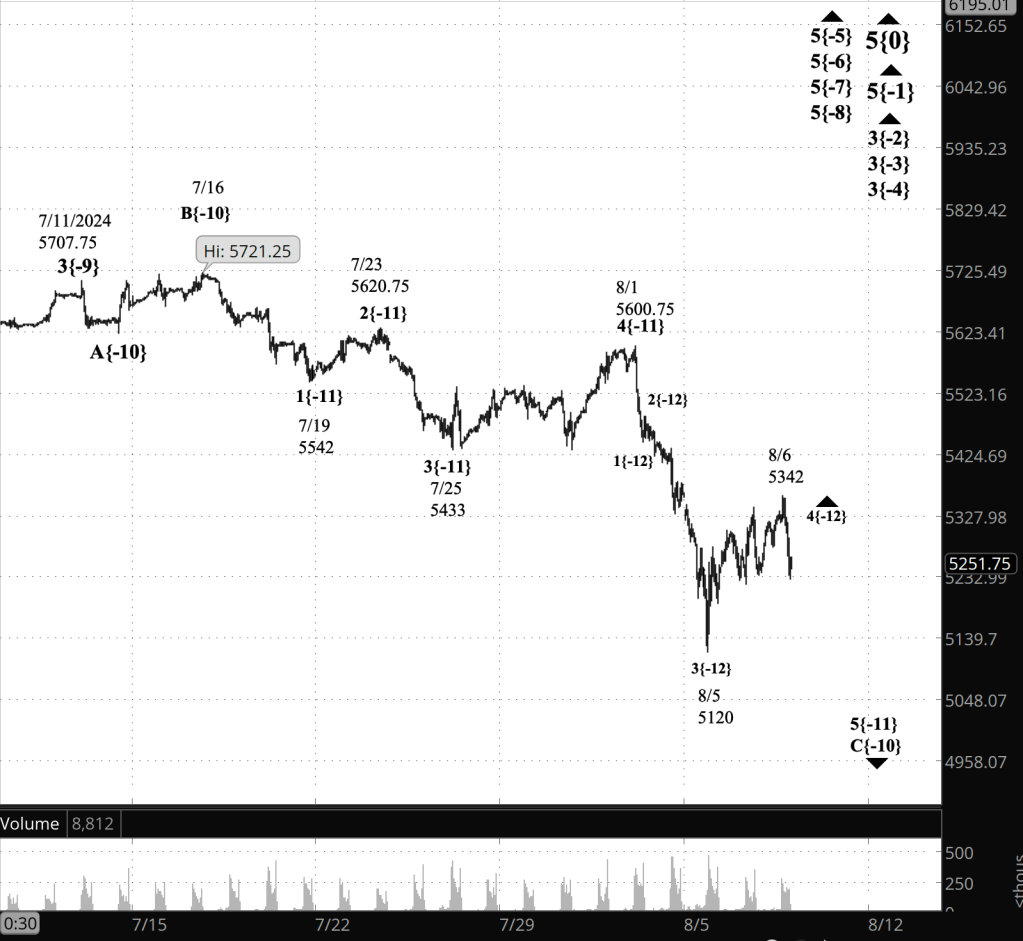
Trader’s Notebook

3:30 p.m. New York time

Half an hour before the closing bell. The S&P 500 futures peaked at 3637.50 during the session and then dropped back into the 3650s. Elliott Wave Theory: Wave 5, an uptrend that began on July 2, continues.

Internally, it’s difficult to analyze. The downward subwaves are quite shallow, and every conceivable upward movement that might count as a 3rd subwave is extraordinarily short. Usually, I’ve found, a third wave jumps out of the pattern with its easy-spot-length compared to the surrounding waves. Not so much within this 5th wave.

So I’m deferring judgment on the internal structure for now, waiting for some clarity.

I’ve updated the chart.

9:35 a.m. New York time

What’s happening now? The S&P 500 E-mini futures rose overnight reaching a new high in the 5630s shortly after the opening bell sounded.

What does it mean? Elliott Wave Theory (EWT) analysis sees the 5th-wave uptrend that began on July 2 continuing. EWT has no guidance on the length or duration of 5th waves, So far this 5th wave has covered around 120 points in seven calendar days. The preceding 3rd wave covered a bit less than 200 points in its entirely over six calendar days

A 5th wave’s personality can be quirky, with a far greater or far shorter length and duration than expected. In EWT terminology, it can either be extended or truncated. Or it can be a normie, an ordinary 5th wave that fits in with the other trending waves in the structure its part of. And there’s no way to tell ahead of time what sort of the 5th wave it will be.

When the 5th wave is complete, it will also be the end of three larger 5th waves within the fractal structure of the chart, and also the end of a still larger 3rd wave that began on February 21 and has so far covered nearly 670 points.

A 4th-wave downward correction of a similar magnitude will follow.

What are the alternatives? There may be a 1st wave on the chart, between wave 5{-6} and 5{-5}. If that’s the proper count, then it would delay the onset or the 4th-wave downward correction, wave 4{-4}. See the June 18 Trader’s Notebook for a more detailed discussion.

[S&P 500 E-mini futures at 3:30 p.m., 90-minute bars, with volume]

What does Elliott wave theory say? Here are the waves that underly the analyses.

Principal Analysis:

  • Rising wave 5{0} is underway. It is a wave of Intermediate degree that began in December 2018.
  • It is in its final subwave, wave 5{-1}.
  • Within wave 5{-1}, rising waves 3{-2}, 3{-3} and 3{-4} are underway, as is wave 5{-5}.
  • Wave 5{-6} is underway and is in its final subwave, uptrending wave 5{-7}, which in turn is in its final subwave, uptrending wave 5{-8}.

Reading the chart. Price movements — waves – – in Elliott wave analysis are labeled with numbers within trending waves and letters with corrective waves. The subscripts — numbers in curly brackets — designate the wave’s degree, which, in Elliott wave analysis, means the relative position of a wave within the larger and smaller structures that make up the chart. R.N. Elliott, who in the 1930s developed the form of analysis that bears his name, viewed the chart as a complex structure of smaller waves nested within larger waves, which in turn are nested within still larger waves. In mathematics it’s called a fractal structure, where at every scale the pattern is similar to the others.

Learning and other resources. Elliott wave analysis provides context, not prophecy. As the 20th century semanticist Alfred Korzybski put it in his book Science and Sanity (1933), “The map is not the territory … The only usefulness of a map depends on similarity of structure between the empirical world and the map.” And I would add, in the ever-changing markets, we can judge that similarity of structure only after the fact.

See the menu page Analytical Methods for a rundown on where to go for information on Elliott wave analysis.

By Tim Bovee, Portland, Oregon, July 8, 2024

Disclaimer

Tim Bovee, Private Trader tracks the analysis and trades of a private trader for his own accounts. Nothing in this blog constitutes a recommendation to buy or sell stocks, options or any other financial instrument. The only purpose of this blog is to provide education and entertainment.

No trader is ever 100 percent successful in his or her trades. Trading in the stock and option markets is risky and uncertain. Each trader must make trading decisions for his or her own account, and take responsibility for the consequences.

License
Creative Commons License

All content on Tim Bovee, Private Trader by Timothy K. Bovee is licensed under a Creative Commons Attribution-ShareAlike 4.0 International License.

Based on a work at www.timbovee.com.

Trader’s Notebook

3:30 p.m. New York time

Half an hour before the closing bell. The S&P 500 futures rose during the session, reaching above the overnight high to 5621.25. Elliott Wave Analysis: The rise is a 5th-wave uptrend that began on July 2. the wave has traveled to the upside with sufficient clarity that I’m removing the alternative analysis that saw a possibility that the rise was a subwave of the preceding 4th-wave downward correction.

I’ve updated the chart.

9:35 a.m. New York time

What’s happening now? The S&P 500 E-mini futures fluctuated gently around 5590 after trading resumed overnight, until the release of the Employment Situation Report for June, when the price zigzagged in the span of a minute, down into the 5580s and up to a new high above 5600. Thereafter it swiftly returned to the 5590s, where it stayed as the opening bell approached.

What does it mean? Elliott Wave Theory sees the new high, 5605, as further evidence that a 5th-wave uptrend began on July 2. The subwaves within the early stages of a trend can be frustratingly ambiguous. I see the wave 5 uptrend as being in its 1st subwave, but would be unsurprised if the count turned out differently.

The 5th wave is relatively small, but it will have an outsized impact, as 5th waves tend to do. A 5th wave is about endings, and new beginnings. In the fractal structure of the chart, each wave is nested within a series of ongoing waves, each larger than the one before it, and in turn ecnompasses a series of nested series of smaller waves, each smaller than the one before it.

A small 5th wave gains power when it is nested within a series of larger 5th waves. The 5th wave that began on July 2 from 5502.75 is a subwave of three larger 5th waves, up to the wave that began on April 18 from 4963.50. That largest 5th wave in the series is a subwave of a still larger 3rd wave that began on February 21 from 4959.

The end of the present small subwave, the one that began three days ago, will also be the end of the three larger subwaves and of the third wave that began in the winter winds of February.

What comes next? A 4th-wave downward correction, four levels higher in the fractal structure than the small 4th-wave downward correction that ended three days ago.

What are the alternatives? It’s still possible, although it’s less likely by the day, that the new 5th wave is a head-fake and the 4th-wave downward correction is continuing. [Note: I’ve eliminated this alternative.]

There may be a 1st wave on the chart, between wave 5{-6} and 5{-5}. If that’s the proper count, then it would delay the onset or the 4th-wave downward correction, wave 4{-4}. See the June 18 Trader’s Notebook for a more detailed discussion.

[S&P 500 E-mini futures at 3:30 p.m., 80-minute bars, with volume]

What does Elliott wave theory say? Here are the waves that underly the analyses.

Principal Analysis:

  • Rising wave 5{0} is underway. It is a wave of Intermediate degree that began in December 2018.
  • It is in its final subwave, wave 5{-1}.
  • Within wave 5{-1}, rising waves 3{-2}, 3{-3} and 3{-4} are underway, as is wave 5{-5}.
  • Wave 5{-6} is underway and is in its final subwave, uptrending wave 5{-7}, which in turn is in its final subwave, uptrending wave 5{-8}.
  • Wave 5{-8} is in its initial subwave, wave 1{-9}. [Update for afternoon analysis.]

Reading the chart. Price movements — waves – – in Elliott wave analysis are labeled with numbers within trending waves and letters with corrective waves. The subscripts — numbers in curly brackets — designate the wave’s degree, which, in Elliott wave analysis, means the relative position of a wave within the larger and smaller structures that make up the chart. R.N. Elliott, who in the 1930s developed the form of analysis that bears his name, viewed the chart as a complex structure of smaller waves nested within larger waves, which in turn are nested within still larger waves. In mathematics it’s called a fractal structure, where at every scale the pattern is similar to the others.

Learning and other resources. Elliott wave analysis provides context, not prophecy. As the 20th century semanticist Alfred Korzybski put it in his book Science and Sanity (1933), “The map is not the territory … The only usefulness of a map depends on similarity of structure between the empirical world and the map.” And I would add, in the ever-changing markets, we can judge that similarity of structure only after the fact.

See the menu page Analytical Methods for a rundown on where to go for information on Elliott wave analysis.

By Tim Bovee, Portland, Oregon, July 5, 2024

Disclaimer

Tim Bovee, Private Trader tracks the analysis and trades of a private trader for his own accounts. Nothing in this blog constitutes a recommendation to buy or sell stocks, options or any other financial instrument. The only purpose of this blog is to provide education and entertainment.

No trader is ever 100 percent successful in his or her trades. Trading in the stock and option markets is risky and uncertain. Each trader must make trading decisions for his or her own account, and take responsibility for the consequences.

License
Creative Commons License

All content on Tim Bovee, Private Trader by Timothy K. Bovee is licensed under a Creative Commons Attribution-ShareAlike 4.0 International License.

Based on a work at www.timbovee.com.
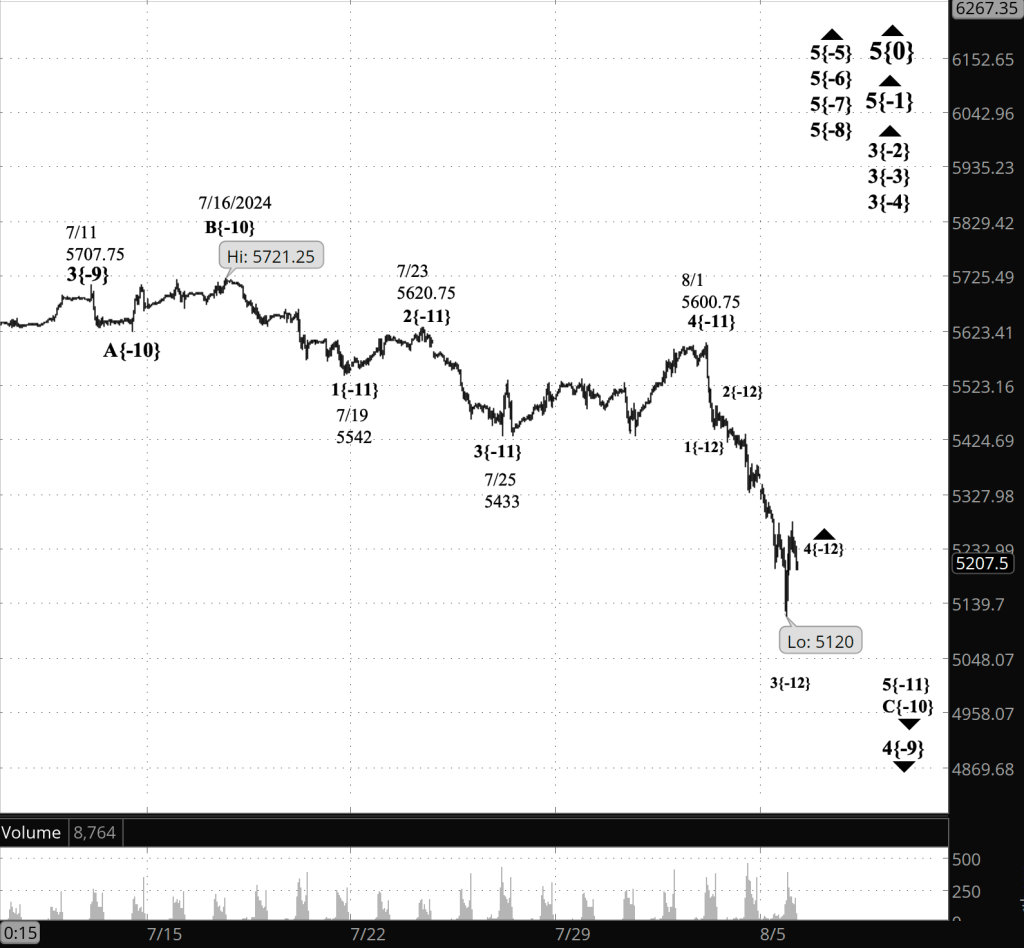
Trader’s Notebook

12:30 p.m. New York time

Half an hour before the closing bell. The S&P 500 futures rose during the session. In the terminology of Elliott Wave Theory, according to this morning’s analysis, a subwave of wave C broke past the C wave’s starting point, 5585.

This morning I said that a break above that level would increase the likelihood that wave C ended on on July 2 at 5502.5, completing the 4th-wave downward correction and beginning a 5th-wave uptrend. That has now occurred.

The next significant level is the starting point of the 4th-wave downward correction, 5588, on June 20. The price continued to rise after the first breakout and has broken above the starting point of the correction, so far reaching 5589.

There’s no rule that says a break past the wave 4 starting point means wave 4 has ended. But it’s a strong enough indicator for me to update the analysis.

An uptrend has begun. The 4th-wave downward correction that began on June 20 from 5588 ended on July 3 at 3502.75, and a 5th-wave uptrend has begun. A 5th wave can be quirky. Sometimes it ends quickly, and sometimes it extends for extraordinary gains. There’s no of telling which sort of 5th wave this is.

When the 5th wave is complete, it will also be the end of 5th waves three levels higher in the fractal structure of the chart, and a 3rd wave another level higher. A downward correction will follow.

9:35 a.m. New York time

Markets close early. U.S markets will close at 1 p.m. New York time today, three hours early, in anticipation of July 4th’s Independence Day celebration. Markets will be closed on Thursday and will return to the regular schedule on Friday.

I’ll post the closing Trader’s Notebook update today at 12:30 p.m. I’ll post no Trader’s Notebook on Thursday and will return to the regular schedule on Friday: A post five minutes after the opening bell, at 9:35 a.m. and an update half an hour before the closing bell, at 1 p.m. All times are New York time.

What’s happening now? The S&P 500 E-mini futures rose overnight from the 5550s to the 5570s and then fell, declining further with the release of the ADP Employment Report by the ADP Research Institute, a private-sector company that provides data about labor market and employee data research. The report serves as a sneak preview on the jobs portion of the government’s Employment Situation Report, which will be released on Friday before the opening bell. The ADP report has data on jobs but not on unemployment, the latter being the headline number of the government’s employment report.

The price rose back into the 5570s after the opening bell.

What does it mean? The rise and decline stayed within the range of the June 28 high and the July 2 low.

In applying Elliott Wave Theory to the analysis of charts, I prefer to have a positive reason to declare that one wave has ended and another one has begun. Absent a breakout in any direction, this analysis will be unchanged from yesterday’s: Wave C, which began on June 28, continues. It is the final subwave within a 4th-wave downward correction that began on June 20.

If the price breaks above the June 28 high, 5585, that will strengthen the case that wave C has ended and the following 5th-wave uptrend has begun. A break below the July 2 low, 5502.75, will strengthen the case that wave C is still underway.

What are the alternatives? It’s possible that the new 5th wave is a head-fake and the 4th-wave correction is continuing.

There may be a 1st wave on the chart, between wave 5{-6} and 5{-5}. If that’s the proper count, then it would delay the onset or the 4th-wave downward correction, wave 4{-4}. See the June 18 Trader’s Notebook for a more detailed discussion.

[S&P 500 E-mini futures at 12:30 a.m., 80-minute bars, with volume]

What does Elliott wave theory say? Here are the waves that underly the analyses.

Principal Analysis:

Updated with the afternoon analysis]

  • Rising wave 5{0} is underway. It is a wave of Intermediate degree that began in December 2018.
  • It is in its final subwave, wave 5{-1}.
  • Within wave 5{-1}, rising waves 3{-2}, 3{-3} and 3{-4} are underway, as is wave 5{-5}.
  • Wave 5{-6} is underway and is in its final subwave, uptrending wave 5{-7}, which in turn is in its final subwave, uptrending wave 5{-8}.

Reading the chart. Price movements — waves – – in Elliott wave analysis are labeled with numbers within trending waves and letters with corrective waves. The subscripts — numbers in curly brackets — designate the wave’s degree, which, in Elliott wave analysis, means the relative position of a wave within the larger and smaller structures that make up the chart. R.N. Elliott, who in the 1930s developed the form of analysis that bears his name, viewed the chart as a complex structure of smaller waves nested within larger waves, which in turn are nested within still larger waves. In mathematics it’s called a fractal structure, where at every scale the pattern is similar to the others.

Learning and other resources. Elliott wave analysis provides context, not prophecy. As the 20th century semanticist Alfred Korzybski put it in his book Science and Sanity (1933), “The map is not the territory … The only usefulness of a map depends on similarity of structure between the empirical world and the map.” And I would add, in the ever-changing markets, we can judge that similarity of structure only after the fact.

See the menu page Analytical Methods for a rundown on where to go for information on Elliott wave analysis.

By Tim Bovee, Portland, Oregon, July 3, 2024

Disclaimer

Tim Bovee, Private Trader tracks the analysis and trades of a private trader for his own accounts. Nothing in this blog constitutes a recommendation to buy or sell stocks, options or any other financial instrument. The only purpose of this blog is to provide education and entertainment.

No trader is ever 100 percent successful in his or her trades. Trading in the stock and option markets is risky and uncertain. Each trader must make trading decisions for his or her own account, and take responsibility for the consequences.

License
Creative Commons License

All content on Tim Bovee, Private Trader by Timothy K. Bovee is licensed under a Creative Commons Attribution-ShareAlike 4.0 International License.

Based on a work at www.timbovee.com.