Trader’s Notebook: S&P 500

3:30 p.m. New York time

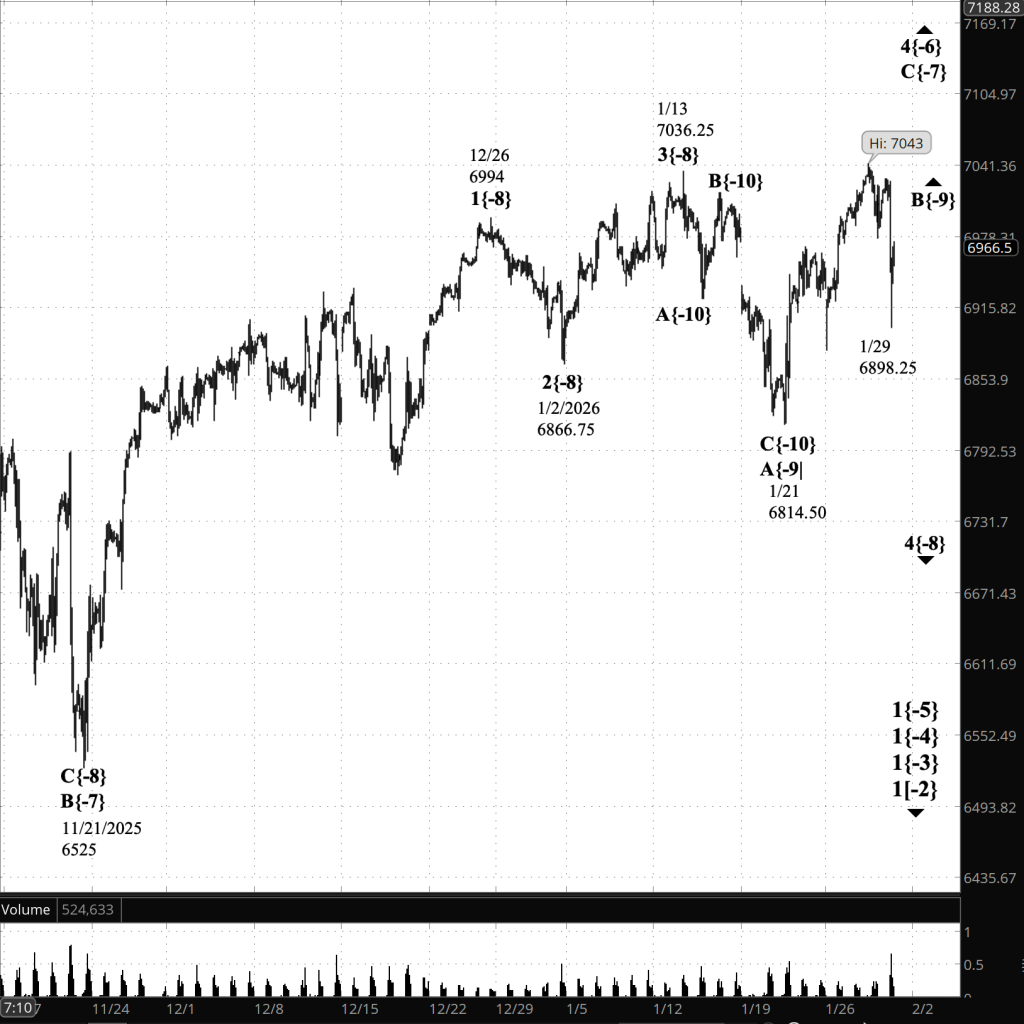
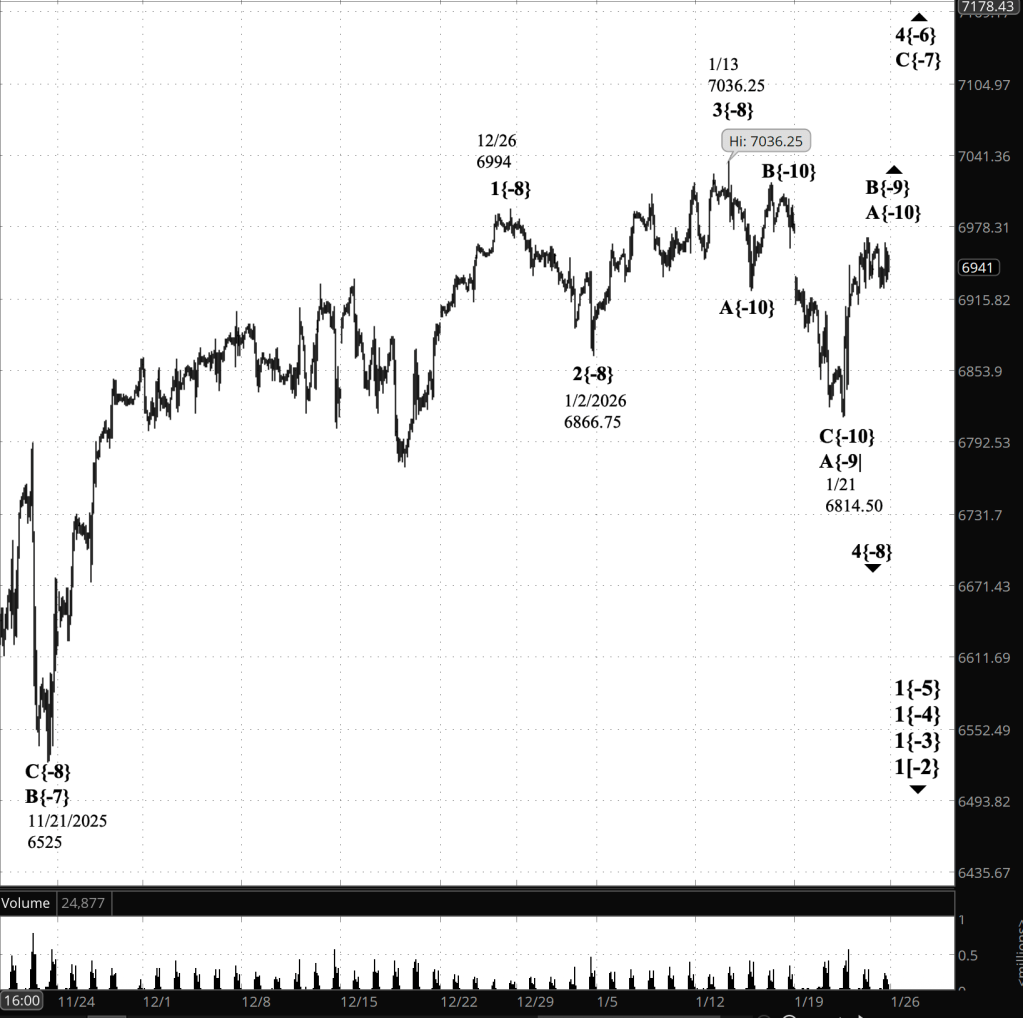
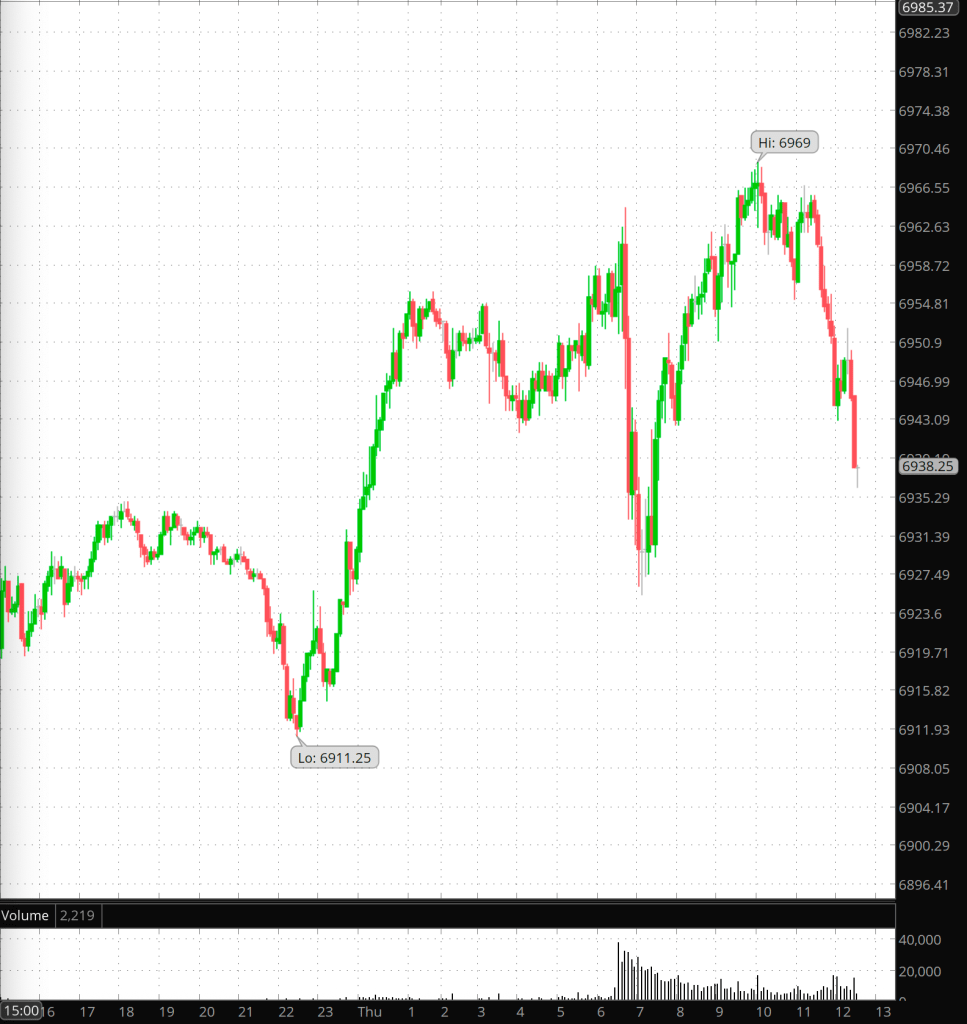
Half an hour before the closing bell. The S&P 500 futures peaked in the 6840s as the session opened and began to fall, retracing nearly all of the overnight gain.

Elliott Wave Theory: The retracement remains above the starting point of the 4th-wave upward correction, at 6786.25, so I’ve continued to view that 4th wave as being underway. An alternative view sees the peak as the end of the correction and the beginning of a downtrending 5th wave. There’s no way to know for sure which conclusion is correct.

9:35 a.m. New York time.

What’s happening now. The S&P 500 E-mini futures continued to fall overnight, reaching into the 6780s.

What does it mean? Elliott Wave Theory analysis sees the start of the decline, the November 3 peak of 6909.30, as being the end of the 2nd-wave upward correction that began on October 31, and the beginning of a downtrending 3rd wave.

All of this is happening within the first subwave of a downtrending 5th wave that began on October 30.

[S&P 500 E-mini futures at 3:30 p.m., 20-minute bars, with volume] 

Waves Now Underway

These are the waves currently in progress under my principal analysis. Each line on the list shows the wave number, with the subscript in curly brackets, the traditional degree name, the starting date, the starting price of the S&P 500 E-mini futures, and the direction of the wave.

  • 1{+4} Supermillennium, (unknown start date or start price) {down}
    • A hypothetical wave one degree higher than Supercyle, needed to make the wave analysis complete.
  • S&P 500 Index:
    • 1{+3} Supercycle, 10/8/2025, 6812.25 (down}
    • 1{+2} Cycle, 10/8/2025, 6812.25 (down}
    • 1{+1} Primary, 10/8/2025, 6812.25 (down}
    • 1{0} Intermediate, 10/8/2025, 6812.25 (down}
    • 1{-1} Minor, 10/8/2025, 6812.25 (down}
    • 1{-2} Minute, 10/8/2025, 6812.25 (down}
  • S&P 500 Futures
    • 1{-3} Minuette 10/8/2025, 6812.25 (down}
    • 1{-4} Subminutte 10/8/2025, 6812.25 (down}
    • 2{-5} Micro, 10/17/2025, 6571.25 (up}
    • 5{-6} Submicro, 10/30/2025, 6853.75 (down)
    • 1{-7} Minscule, 10/30/2025, 6853.75 (down)
    • 3{-8} (no name), 11/3/2025, 6909.50 (down)
    • 4{-9} (no name), 11/4/2025, 6786.25 (up)

Reading the chart. Price movements — waves – – in Elliott Wave Theory analysis are labeled with numbers within trending waves and letters with corrective waves. The subscripts — numbers in curly brackets — designate the wave’s degree, which, in Elliott Wave analysis, means the relative position of a wave within the larger and smaller structures that make up the chart. R.N. Elliott, who in the 1930s developed the form of analysis that bears his name, viewed the chart as a complex structure of smaller waves nested within larger waves, which in turn are nested within still larger waves. In mathematics it’s called a fractal structure, where at every scale the pattern is similar to the others.

Learning and other resources. Elliott Wave analysis provides context, not prophecy. As the 20th century semanticist Alfred Korzybski put it in his book Science and Sanity (1933), “The map is not the territory … The only usefulness of a map depends on similarity of structure between the empirical world and the map.” And I would add, in the ever-changing markets, we can judge that similarity of structure only after the fact.

See the menu page Analytical Methods for a rundown on where to go for information on Elliott Wave analysis.

By Tim Bovee, Portland, Oregon, November 4, 2025

Disclaimer

Tim Bovee, Private Trader tracks the analysis and trades of a private trader for his own accounts. Nothing in this blog constitutes a recommendation to buy or sell stocks, options or any other financial instrument. The only purpose of this blog is to provide education and entertainment.

No trader is ever 100 percent successful in his or her trades. Trading in the stock and option markets is risky and uncertain. Each trader must make trading decisions for his or her own account, and take responsibility for the consequences.

All content on Tim Bovee, Private Trader by Timothy K. Bovee is licensed under a Creative Commons Attribution-ShareAlike 4.0 International License.

License

Based on work at www.timbovee.com
Trader’s Notebook: S&P 500

3:30 p.m. New York time

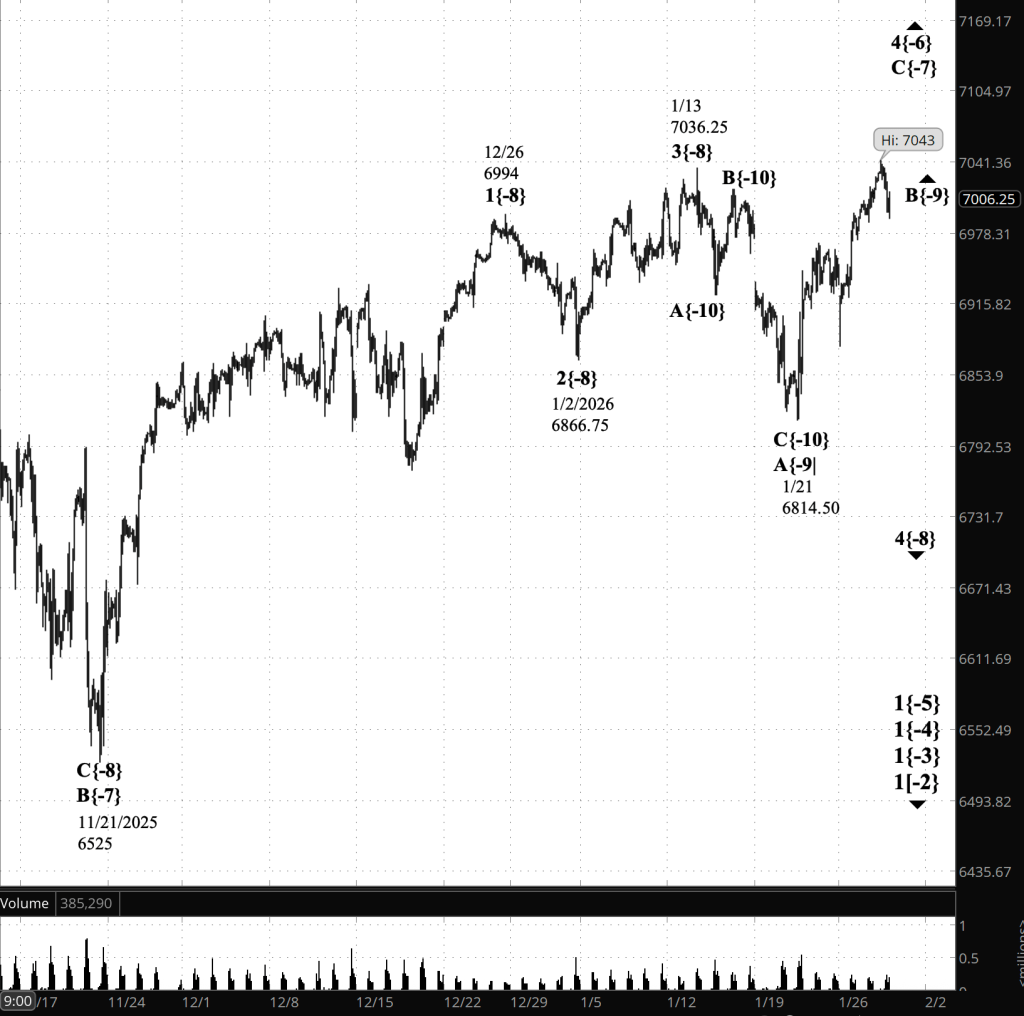
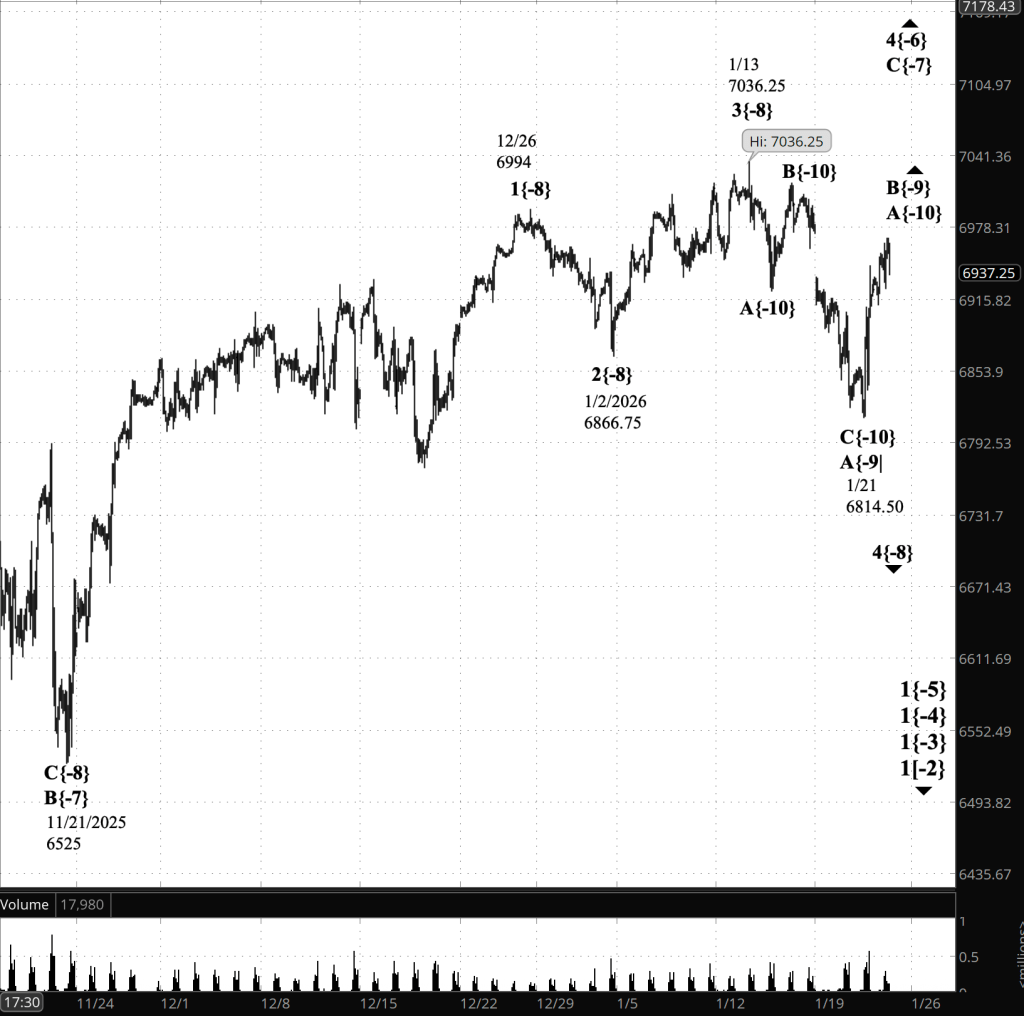
Half an hour before the closing bell. The S&P 500 futures fell from the session peak, 6909.50, down to 6849.50, afterward retracing to the 6890s.

All in all, seen through the lens of Elliott Wave Theory the changes were portions of the 2nd-wave upward correction that began on October 31 within the declining 1st wave downtrend, part the a major downtrending movement, a 5th wave that began on October 30.

9:35 a.m. New York time.

What’s happening now. When trading resumed overnight, the S&P 500 E-mini futures opened in the 6970s, zigzagged higher to 6903, and then fell back a little.

What does it mean? When Elliott Wave Theory analysis is applied, the movement is labeled an 2nd-wave upward correction, wave 2{-8} using the chart nomenclature, where the wave’s degree is stated in curly brackets as number of degrees distant from Intermediate degree. Wave 2{-8} is a subwave of wave 1{-8}, which in turn is a subwave of a downtrending wave 5 that began on October 30.

It’s possible that the wave 1{-7} ended on October 31 and that a rising 2nd wave correction is now underway. However, the principal analysis described above seems more likely to me.

Typically, a 2nd wave will retrace a Fibonacci 61.8% of the preceding 1st wave. If this 2nd wave follows that pattern, then it will end around 6911.60. So the end is near, and wave 2{-8} will be followed by declining wave 3{-8}, which may well carry the price into the 5500s.

[S&P 500 E-mini futures at 3:30 p.m., 50-minute bars, with volume] 

Waves Now Underway

These are the waves currently in progress under my principal analysis. Each line on the list shows the wave number, with the subscript in curly brackets, the traditional degree name, the starting date, the starting price of the S&P 500 E-mini futures, and the direction of the wave.

  • 1{+4} Supermillennium, (unknown start date or start price) {down}
    • A hypothetical wave one degree higher than Supercyle, needed to make the wave analysis complete.
  • S&P 500 Index:
    • 1{+3} Supercycle, 10/8/2025, 6812.25 (down}
    • 1{+2} Cycle, 10/8/2025, 6812.25 (down}
    • 1{+1} Primary, 10/8/2025, 6812.25 (down}
    • 1{0} Intermediate, 10/8/2025, 6812.25 (down}
    • 1{-1} Minor, 10/8/2025, 6812.25 (down}
    • 1{-2} Minute, 10/8/2025, 6812.25 (down}
  • S&P 500 Futures
    • 1{-3} Minuette 10/8/2025, 6812.25 (down}
    • 1{-4} Subminutte 10/8/2025, 6812.25 (down}
    • 2{-5} Micro, 10/17/2025, 6571.25 (up}
    • 5{-6} Submicro, 10/30/2025, 6853.75 (down)
    • 1{-7} Minscule, 10/30/2025, 6853.75 (down)
    • 2{-8} (no name), 10/31/2025, 6843.50 (up)

Reading the chart. Price movements — waves – – in Elliott Wave Theory analysis are labeled with numbers within trending waves and letters with corrective waves. The subscripts — numbers in curly brackets — designate the wave’s degree, which, in Elliott Wave analysis, means the relative position of a wave within the larger and smaller structures that make up the chart. R.N. Elliott, who in the 1930s developed the form of analysis that bears his name, viewed the chart as a complex structure of smaller waves nested within larger waves, which in turn are nested within still larger waves. In mathematics it’s called a fractal structure, where at every scale the pattern is similar to the others.

Learning and other resources. Elliott Wave analysis provides context, not prophecy. As the 20th century semanticist Alfred Korzybski put it in his book Science and Sanity (1933), “The map is not the territory … The only usefulness of a map depends on similarity of structure between the empirical world and the map.” And I would add, in the ever-changing markets, we can judge that similarity of structure only after the fact.

See the menu page Analytical Methods for a rundown on where to go for information on Elliott Wave analysis.

By Tim Bovee, Portland, Oregon, November 3, 2025

Disclaimer

Tim Bovee, Private Trader tracks the analysis and trades of a private trader for his own accounts. Nothing in this blog constitutes a recommendation to buy or sell stocks, options or any other financial instrument. The only purpose of this blog is to provide education and entertainment.

No trader is ever 100 percent successful in his or her trades. Trading in the stock and option markets is risky and uncertain. Each trader must make trading decisions for his or her own account, and take responsibility for the consequences.

All content on Tim Bovee, Private Trader by Timothy K. Bovee is licensed under a Creative Commons Attribution-ShareAlike 4.0 International License.

License

Based on work at www.timbovee.com
Trader’s Notebook: S&P 500

3:30 p.m. New York time.

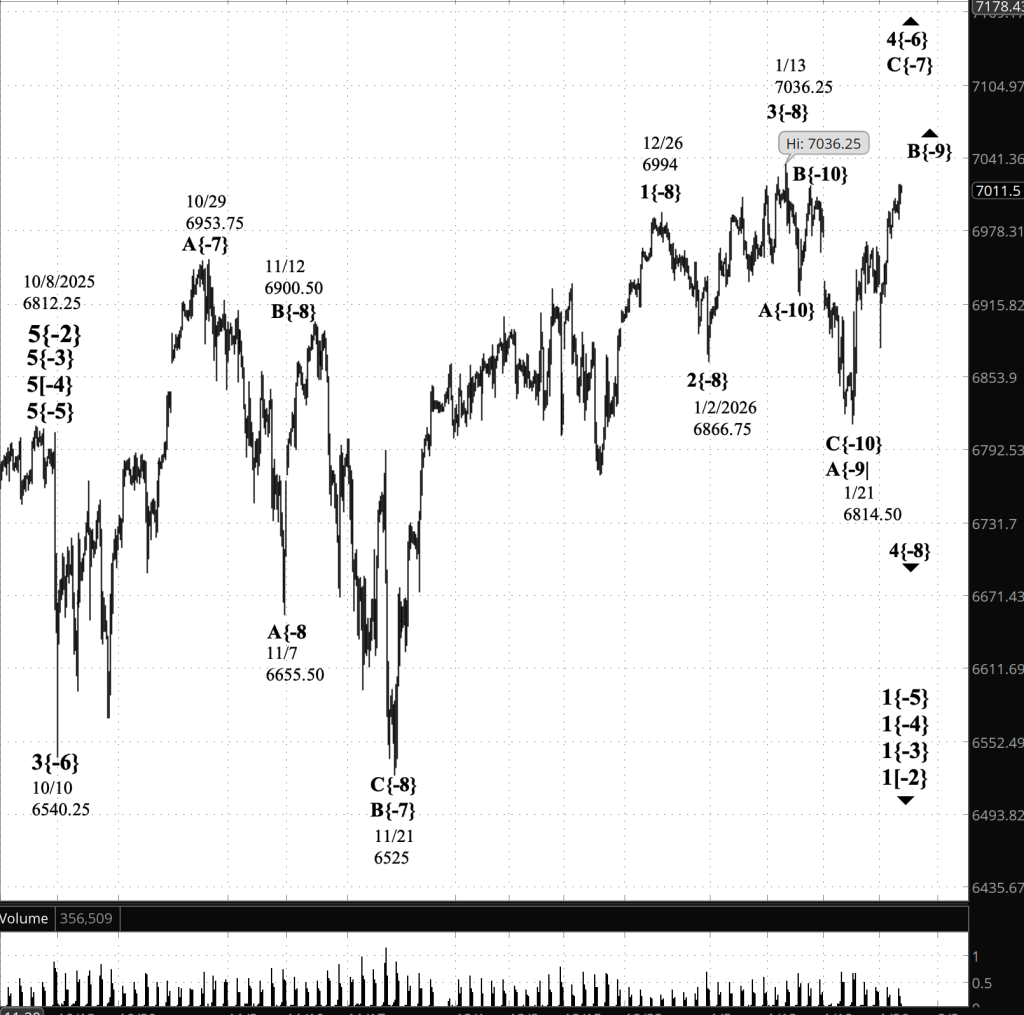
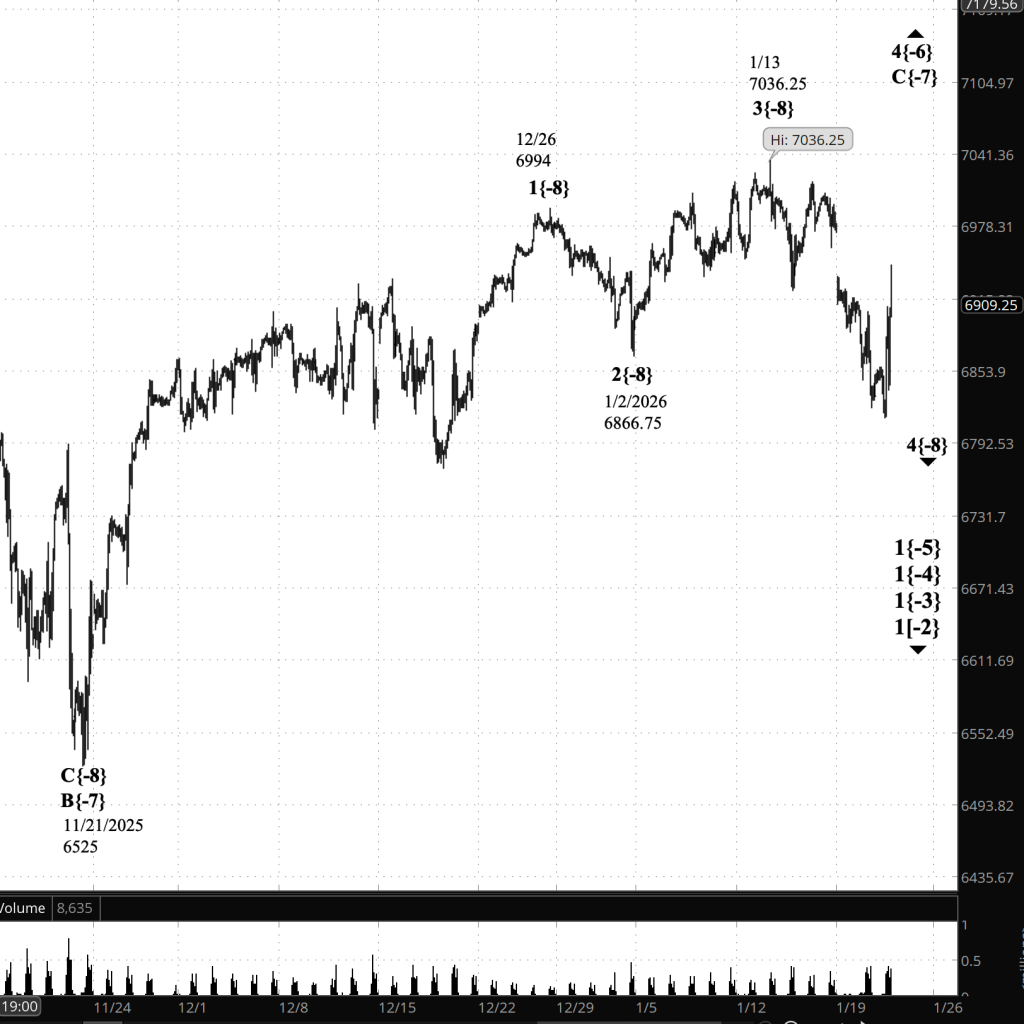
Half an hour before the closing bell. The S&P 500 futures fell during the session, from the 6910s reaching into the 6940s, and then rose a bit.

Elliott Wave Theory: Wave 1 within the downtrending 5th wave that began on October 30 continues. It appears to be in its final subwave. When it is complete, the parent 5th wave will reverse in a 2nd subwave upward correction.

Using the labeling system on the chart — see ‘Reading the Chart” below — The parent wave is wave 5{-6}. It is in its initial subwave, wave 1{-7} and willl be followed by rising wave 2{-7}, or so I’ve marked it on the chart. Or are those waves really wave 1{-8} verging on wave 2{-8} within the larger wave 1{-7}?

One frustration of Elliott Wave Theory is that early in a movement, there is little guidance as to what the degree should be. I tend to label one degree down from the parent wave, and I have been wrong before.

9:35 a.m. New York time.

What’s happening now. The S&P 500 E-mini futures rose overnight to 6818.50 and then reversed, taking back most of the gain.

What does it mean? Elliott Wave Theory sees the rise as a subwave correction within a larger downtrending 5th wave that began on October 30. The 5th wave is in its 1st subwave.

[S&P 500 E-mini futures at 3:30 p.m., 50-minute bars, with volume] 

Waves Now Underway

These are the waves currently in progress under my principal analysis. Each line on the list shows the wave number, with the subscript in curly brackets, the traditional degree name, the starting date, the starting price of the S&P 500 E-mini futures, and the direction of the wave.

  • 1{+4} Supermillennium, (unknown start date or start price) {down}
    • A hypothetical wave one degree higher than Supercyle, needed to make the wave analysis complete.
  • S&P 500 Index:
    • 1{+3} Supercycle, 10/8/2025, 6812.25 (down}
    • 1{+2} Cycle, 10/8/2025, 6812.25 (down}
    • 1{+1} Primary, 10/8/2025, 6812.25 (down}
    • 1{0} Intermediate, 10/8/2025, 6812.25 (down}
    • 1{-1} Minor, 10/8/2025, 6812.25 (down}
    • 1{-2} Minute, 10/8/2025, 6812.25 (down}
  • S&P 500 Futures
    • 1{-3} Minuette 10/8/2025, 6812.25 (down}
    • 1{-4} Subminutte 10/8/2025, 6812.25 (down}
    • 2{-5} Micro, 10/17/2025, 6571.25 (up}
    • 5{-6} Submicro, 10/30/2025, 6853.75 (down)
    • 1{-7} Minscule, 10/30/2025, 6853.75 (down)

Reading the chart. Price movements — waves – – in Elliott Wave Theory analysis are labeled with numbers within trending waves and letters with corrective waves. The subscripts — numbers in curly brackets — designate the wave’s degree, which, in Elliott Wave analysis, means the relative position of a wave within the larger and smaller structures that make up the chart. R.N. Elliott, who in the 1930s developed the form of analysis that bears his name, viewed the chart as a complex structure of smaller waves nested within larger waves, which in turn are nested within still larger waves. In mathematics it’s called a fractal structure, where at every scale the pattern is similar to the others.

Learning and other resources. Elliott Wave analysis provides context, not prophecy. As the 20th century semanticist Alfred Korzybski put it in his book Science and Sanity (1933), “The map is not the territory … The only usefulness of a map depends on similarity of structure between the empirical world and the map.” And I would add, in the ever-changing markets, we can judge that similarity of structure only after the fact.

See the menu page Analytical Methods for a rundown on where to go for information on Elliott Wave analysis.

By Tim Bovee, Portland, Oregon, October 31, 2025

Disclaimer

Tim Bovee, Private Trader tracks the analysis and trades of a private trader for his own accounts. Nothing in this blog constitutes a recommendation to buy or sell stocks, options or any other financial instrument. The only purpose of this blog is to provide education and entertainment.

No trader is ever 100 percent successful in his or her trades. Trading in the stock and option markets is risky and uncertain. Each trader must make trading decisions for his or her own account, and take responsibility for the consequences.

All content on Tim Bovee, Private Trader by Timothy K. Bovee is licensed under a Creative Commons Attribution-ShareAlike 4.0 International License.

License

Based on work at www.timbovee.com
Trader’s Notebook: S&P 500

3:30 p.m. New York time

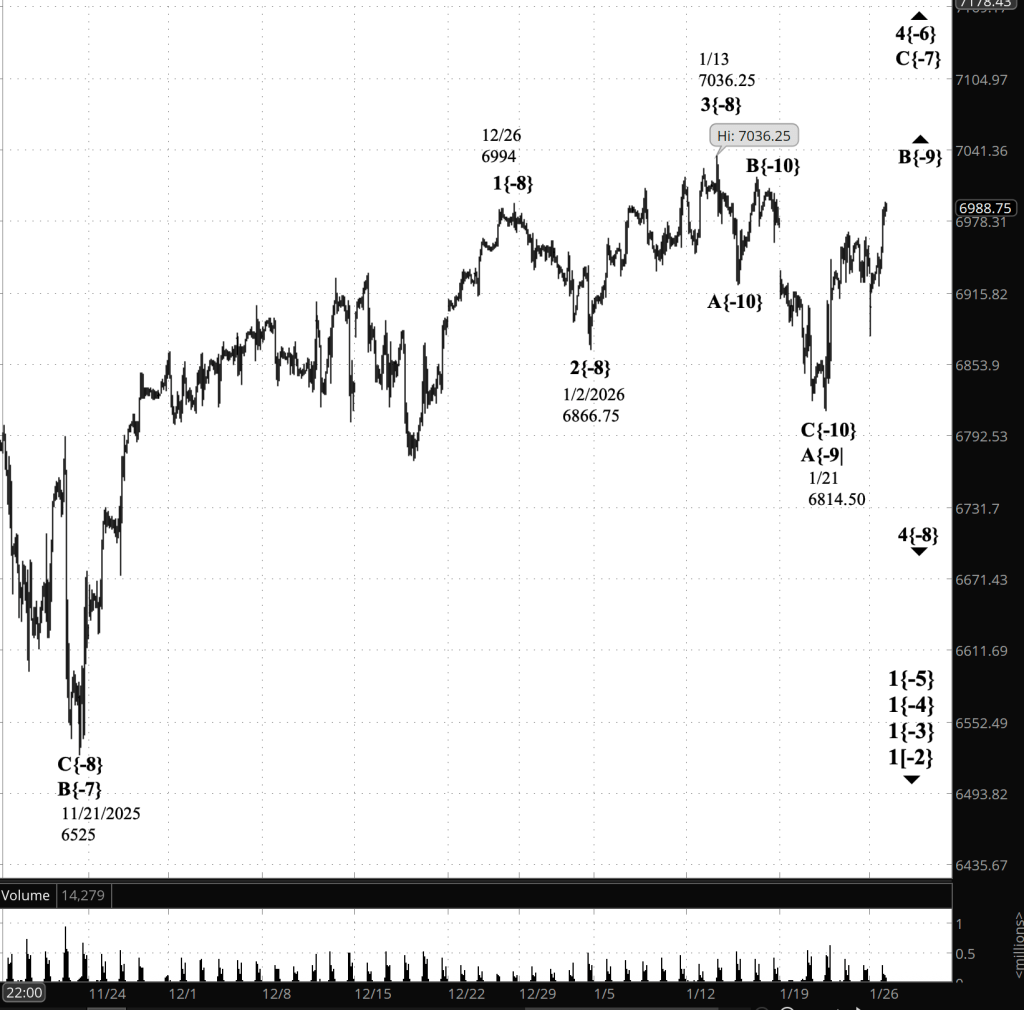
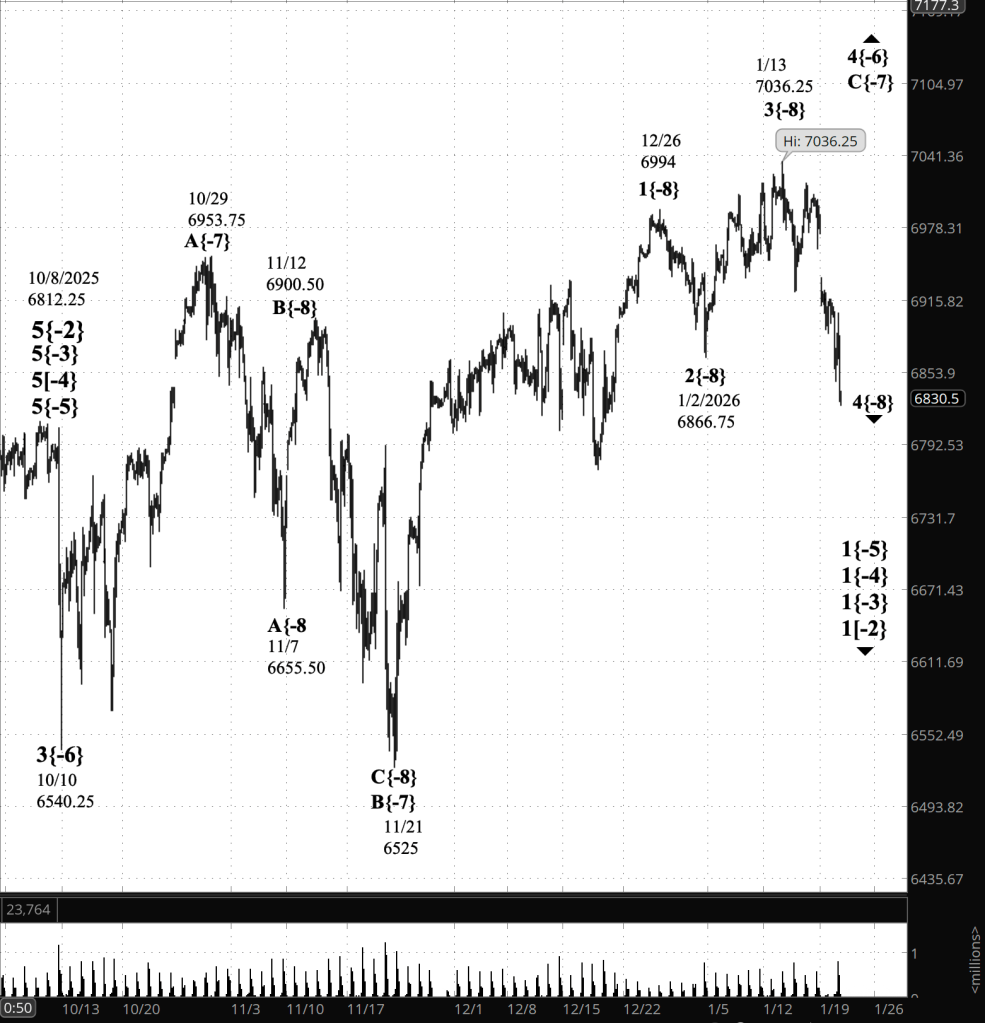
Half an hour before the closing bell. The S&P 500 futures fell further during the session, reaching 6867.75, retracing a portion of the loss, and then reversing to the downside.

Elliott Wave Theory. The decline has reached a point where, to my eye, the 4th-wave upward correction that began on October 2 peaked at today’s high, bringing wave 4 and its final subwave, wave E, to an end.

Downtrending wave 5 began at that point. It will have five subwaves, and the first subwave is now underway.

How far is wave 5 likely to fall? A 5th wave tends to be a quirky beast. If this 5th is run-of-the-mill typical, it will tend to reach somewhere in the 6600s or further, into the 6540s, based on the lengths of subwaves within the parent wave, which is a 1st wav. Sometimes they fall rediculously short, and in this wave that could mean an end somewhere below the 6990 level. And sometimes they move far beyond a length that most traders would consider reasonable, in this case perhaps deep into the 6400s.

But there is still a caveat. The present decline could still reverse and rise above high point. And if that happens, it means that falling wave 5 has not yet begun and rising wave 4 is still underway.

9:35 a.m. New York time.

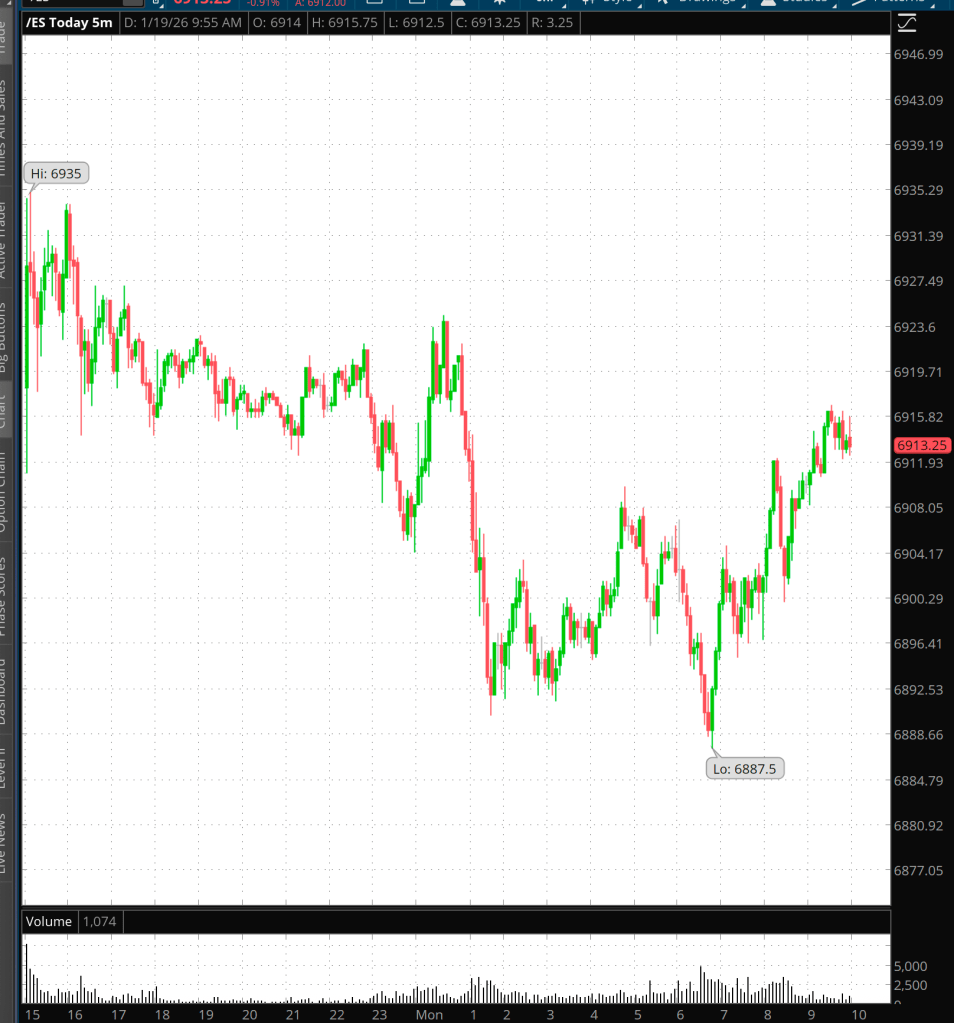
What’s happening now. The S&P 500 E-mini futures peaked overnight at 6953.75 and then fell, reaching into the 6880s.

What does it mean? Once again the Elliott Wave Theory question is this: Has the upward 4th-wave correction ended and the downtrending 5th wave begun? And the cautious answer is “Maybe”, but also “Perhaps maybe not.”

The decline is a bit larger than prior pullbacks. The last one ended at 6882 on October 29, and I consider falling beyond that point the first step toward verification.

[S&P 500 E-mini futures at 3:30 p.m., 50-minute bars, with volume] 

Waves Now Underway

These are the waves currently in progress under my principal analysis. Each line on the list shows the wave number, with the subscript in curly brackets, the traditional degree name, the starting date, the starting price of the S&P 500 E-mini futures, and the direction of the wave.

  • 1{+4} Supermillennium, (unknown start date or start price) {down}
    • A hypothetical wave one degree higher than Supercyle, needed to make the wave analysis complete.
  • S&P 500 Index:
    • 1{+3} Supercycle, 10/8/2025, 6812.25 (down}
    • 1{+2} Cycle, 10/8/2025, 6812.25 (down}
    • 1{+1} Primary, 10/8/2025, 6812.25 (down}
    • 1{0} Intermediate, 10/8/2025, 6812.25 (down}
    • 1{-1} Minor, 10/8/2025, 6812.25 (down}
    • 1{-2} Minute, 10/8/2025, 6812.25 (down}
  • S&P 500 Futures
    • 1{-3} Minuette 10/8/2025, 6812.25 (down}
    • 1{-4} Subminutte 10/8/2025, 6812.25 (down}
    • 2{-5} Micro, 10/17/2025, 6571.25 (up}
    • 5{-6} Submicro, 10/30/2025, 6853.75 (down)
    • 1{-7} Minscule, 10/30/2025, 6853.75 (down)

Reading the chart. Price movements — waves – – in Elliott Wave Theory analysis are labeled with numbers within trending waves and letters with corrective waves. The subscripts — numbers in curly brackets — designate the wave’s degree, which, in Elliott Wave analysis, means the relative position of a wave within the larger and smaller structures that make up the chart. R.N. Elliott, who in the 1930s developed the form of analysis that bears his name, viewed the chart as a complex structure of smaller waves nested within larger waves, which in turn are nested within still larger waves. In mathematics it’s called a fractal structure, where at every scale the pattern is similar to the others.

Learning and other resources. Elliott Wave analysis provides context, not prophecy. As the 20th century semanticist Alfred Korzybski put it in his book Science and Sanity (1933), “The map is not the territory … The only usefulness of a map depends on similarity of structure between the empirical world and the map.” And I would add, in the ever-changing markets, we can judge that similarity of structure only after the fact.

See the menu page Analytical Methods for a rundown on where to go for information on Elliott Wave analysis.

By Tim Bovee, Portland, Oregon, October 30, 2025

Disclaimer

Tim Bovee, Private Trader tracks the analysis and trades of a private trader for his own accounts. Nothing in this blog constitutes a recommendation to buy or sell stocks, options or any other financial instrument. The only purpose of this blog is to provide education and entertainment.

No trader is ever 100 percent successful in his or her trades. Trading in the stock and option markets is risky and uncertain. Each trader must make trading decisions for his or her own account, and take responsibility for the consequences.

All content on Tim Bovee, Private Trader by Timothy K. Bovee is licensed under a Creative Commons Attribution-ShareAlike 4.0 International License.

License

Based on work at www.timbovee.com
Trader’s Notebook: S&P 500

3:30 p.m. New York time

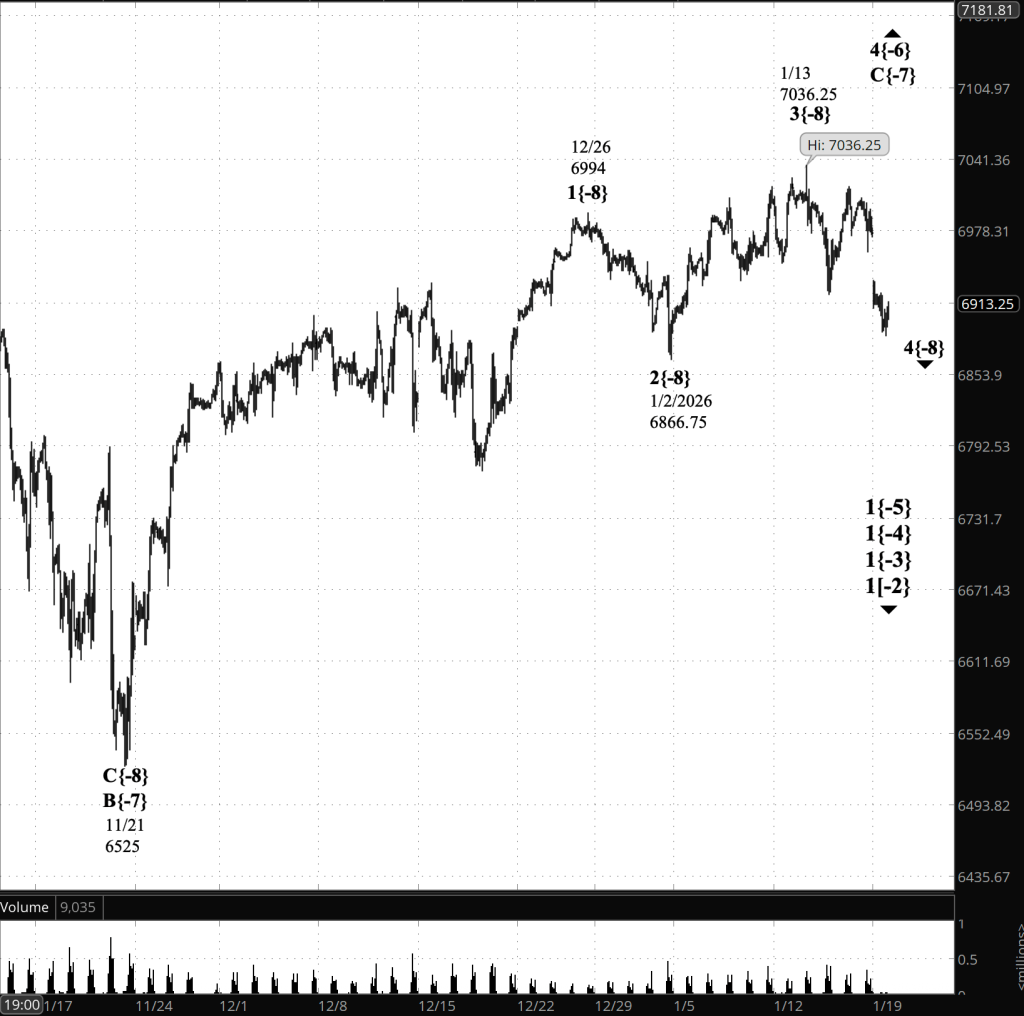
Half an hour before the opening bell. The S&P 500 futures, barely budged when the Federal Open Market Committee announced a 0.25% interest rate cut, and then a more dramatic move — sharply down and then an upward bounce, when Federal Reserve Chair Jerome Powell began his news conference. With the speedy drop and partial recovery, the net result is that the price declined.

Elliott Wave Theory. The net decline leaves open the possibility that the early session high — 6952 –may be the end of the rising 4th wave correction that began on October 10. Or perhaps not. And the ambiguity continues.

9:35 a.m. New York time.

What’s happening now. The S&P 500 E-mini futures rose to a higher peak overnight, 6949.25, and then once again entered a sideways zig-zag pattern.

What does it mean? Elliott Wave Theory analysis sees a continuation of the rise that began on October 22 — wave E, the final subwave within a 4th-wave upward correction that began on October 10.

[S&P 500 E-mini futures at 9:35 a.m., 35-minute bars, with volume] 

Waves Now Underway

These are the waves currently in progress under my principal analysis. Each line on the list shows the wave number, with the subscript in curly brackets, the traditional degree name, the starting date, the starting price of the S&P 500 E-mini futures, and the direction of the wave.

  • 1{+4} Supermillennium, (unknown start date or start price) {down}
    • A hypothetical wave one degree higher than Supercyle, needed to make the wave analysis complete.
  • S&P 500 Index:
    • 1{+3} Supercycle, 10/8/2025, 6812.25 (down}
    • 1{+2} Cycle, 10/8/2025, 6812.25 (down}
    • 1{+1} Primary, 10/8/2025, 6812.25 (down}
    • 1{0} Intermediate, 10/8/2025, 6812.25 (down}
    • 1{-1} Minor, 10/8/2025, 6812.25 (down}
    • 1{-2} Minute, 10/8/2025, 6812.25 (down}
  • S&P 500 Futures
    • 1{-3} Minuette 10/8/2025, 6812.25 (down}
    • 1{-4} Subminutte 10/8/2025, 6812.25 (down}
    • 2{-5} Micro, 10/17/2025, 6571.25 (up}
    • 4{-6} Submicro, 10/10/2025, 6540.25 (up)
    • E{-7} Minscule, 10/22/2025, 6690.75 (up)

Reading the chart. Price movements — waves – – in Elliott Wave Theory analysis are labeled with numbers within trending waves and letters with corrective waves. The subscripts — numbers in curly brackets — designate the wave’s degree, which, in Elliott Wave analysis, means the relative position of a wave within the larger and smaller structures that make up the chart. R.N. Elliott, who in the 1930s developed the form of analysis that bears his name, viewed the chart as a complex structure of smaller waves nested within larger waves, which in turn are nested within still larger waves. In mathematics it’s called a fractal structure, where at every scale the pattern is similar to the others.

Learning and other resources. Elliott Wave analysis provides context, not prophecy. As the 20th century semanticist Alfred Korzybski put it in his book Science and Sanity (1933), “The map is not the territory … The only usefulness of a map depends on similarity of structure between the empirical world and the map.” And I would add, in the ever-changing markets, we can judge that similarity of structure only after the fact.

See the menu page Analytical Methods for a rundown on where to go for information on Elliott Wave analysis.

By Tim Bovee, Portland, Oregon, October 29, 2025

Disclaimer

Tim Bovee, Private Trader tracks the analysis and trades of a private trader for his own accounts. Nothing in this blog constitutes a recommendation to buy or sell stocks, options or any other financial instrument. The only purpose of this blog is to provide education and entertainment.

No trader is ever 100 percent successful in his or her trades. Trading in the stock and option markets is risky and uncertain. Each trader must make trading decisions for his or her own account, and take responsibility for the consequences.

All content on Tim Bovee, Private Trader by Timothy K. Bovee is licensed under a Creative Commons Attribution-ShareAlike 4.0 International License.

License

Based on work at www.timbovee.com
Trader’s Notebook: S&P 500

3:30 p.m. New York time

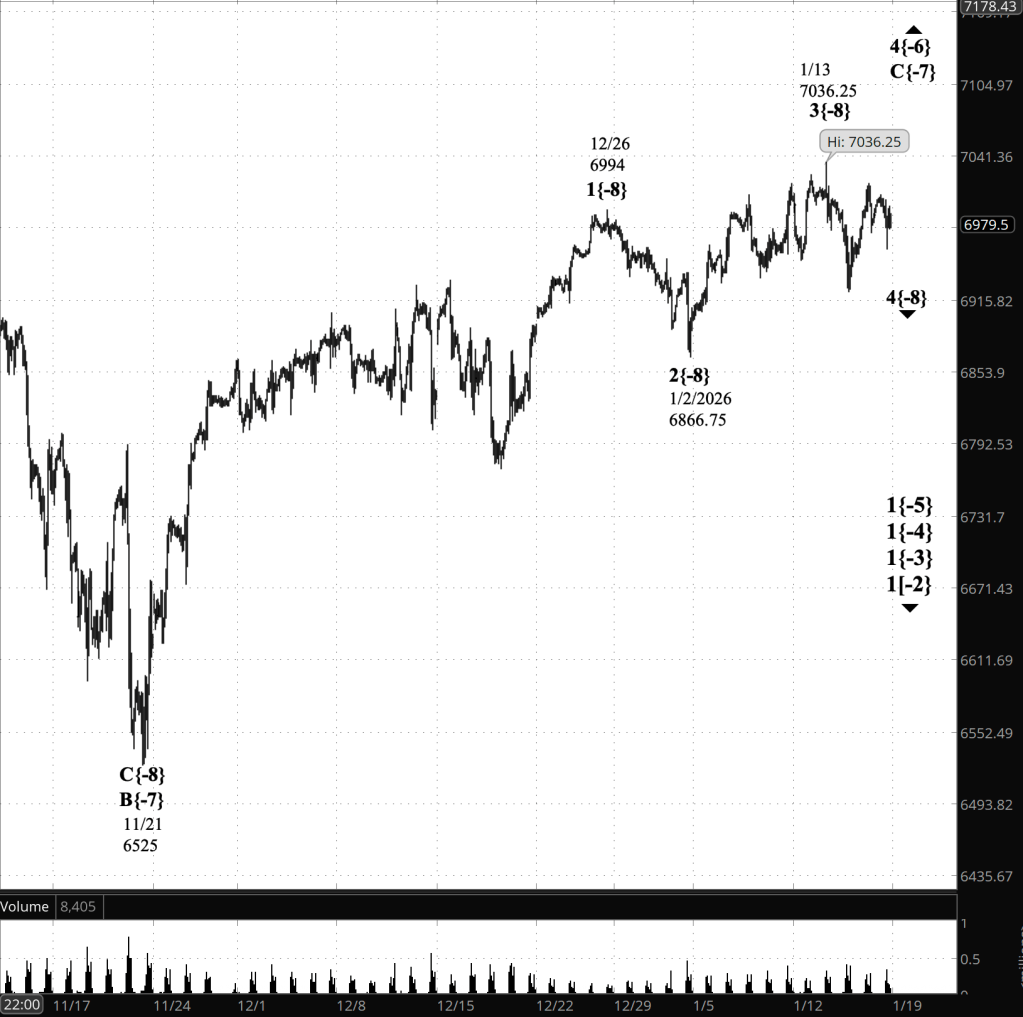
Half an hour before the closing bell. The S&P 500 futures peaked at 6939.75 during the session and then pulled back slightly, so far remaining in the 6930s. As is always the case when we’re fishing for the end of a trend, the question to be solved is whether the trend has truly reversed, or if the pullback is just a pause as the trend continues.

Elliott Wave Theory. The rise is wave E, the final subwave within a 4th-wave upward correction that began on October 10. An earlier, lower peak during the session dropped by 24 points, looking very much like a reversal, but then reversed and rose higher.

The current pause is smaller, so far, and yet, so far, looks like it could be a reversal. Unless it’s not.

And so, where do we stand? Either wave E within wave 4 is on the rise, or wave E ended during the session, as has its parent wave 4, and downtrending wave 5 has begun.

I’ve known people who say, with indignation, “I don’t gamble. I invest!”. I reply with a skeptical smile.

9:35 a.m. New York time.

What’s happening now. The S&P 500 E-mini futures rose sharply as the opening bell approached, reaching into the 6920s. The rise coincided with the release of the Case-Shiller Home Price Index.

What does it mean? Elliott Wave Theory analysis sees the rise as the end game for rising wave E, the final subwave within the 4th-wave upward correction that began on October 10. The correction will be followed by a downtrending 5th wave, which will carry the price back to the 6500s and perhaps lower.

[S&P 500 E-mini futures at 3:30 p.m., 35-minute bars, with volume] 

Waves Now Underway

These are the waves currently in progress under my principal analysis. Each line on the list shows the wave number, with the subscript in curly brackets, the traditional degree name, the starting date, the starting price of the S&P 500 E-mini futures, and the direction of the wave.

  • 1{+4} Supermillennium, (unknown start date or start price) {down}
    • A hypothetical wave one degree higher than Supercyle, needed to make the wave analysis complete.
  • S&P 500 Index:
    • 1{+3} Supercycle, 10/8/2025, 6812.25 (down}
    • 1{+2} Cycle, 10/8/2025, 6812.25 (down}
    • 1{+1} Primary, 10/8/2025, 6812.25 (down}
    • 1{0} Intermediate, 10/8/2025, 6812.25 (down}
    • 1{-1} Minor, 10/8/2025, 6812.25 (down}
    • 1{-2} Minute, 10/8/2025, 6812.25 (down}
  • S&P 500 Futures
    • 1{-3} Minuette 10/8/2025, 6812.25 (down}
    • 1{-4} Subminutte 10/8/2025, 6812.25 (down}
    • 2{-5} Micro, 10/17/2025, 6571.25 (up}
    • 4{-6} Submicro, 10/10/2025, 6540.25 (up)
    • E{-7} Minscule, 10/22/2025, 6690.75 (up)

Reading the chart. Price movements — waves – – in Elliott Wave Theory analysis are labeled with numbers within trending waves and letters with corrective waves. The subscripts — numbers in curly brackets — designate the wave’s degree, which, in Elliott Wave analysis, means the relative position of a wave within the larger and smaller structures that make up the chart. R.N. Elliott, who in the 1930s developed the form of analysis that bears his name, viewed the chart as a complex structure of smaller waves nested within larger waves, which in turn are nested within still larger waves. In mathematics it’s called a fractal structure, where at every scale the pattern is similar to the others.

Learning and other resources. Elliott Wave analysis provides context, not prophecy. As the 20th century semanticist Alfred Korzybski put it in his book Science and Sanity (1933), “The map is not the territory … The only usefulness of a map depends on similarity of structure between the empirical world and the map.” And I would add, in the ever-changing markets, we can judge that similarity of structure only after the fact.

See the menu page Analytical Methods for a rundown on where to go for information on Elliott Wave analysis.

By Tim Bovee, Portland, Oregon, October 28, 2025

Disclaimer

Tim Bovee, Private Trader tracks the analysis and trades of a private trader for his own accounts. Nothing in this blog constitutes a recommendation to buy or sell stocks, options or any other financial instrument. The only purpose of this blog is to provide education and entertainment.

No trader is ever 100 percent successful in his or her trades. Trading in the stock and option markets is risky and uncertain. Each trader must make trading decisions for his or her own account, and take responsibility for the consequences.

All content on Tim Bovee, Private Trader by Timothy K. Bovee is licensed under a Creative Commons Attribution-ShareAlike 4.0 International License.

License

Based on work at www.timbovee.com
Trader’s Notebook: S&P 500

3:30 p.m. New York time

Half an hour before the closing bell. The S&P 500 futures rose during the session, so far coming within close proximity of 6900.

Elliott Wave Theory: The final subwave within the 4th-wave upward correction that began on October 10 draws closer to its end.

9:35 a.m. New York time.

What’s happening now. The S&P 500 E-mini futures gapped higher by 56 points when trading resumed overnight worked its way sideways, fluctuating within 6870s and 6880s.

What does it mean? Elliott Wave Theory analysis sees the gap as verification that the 4th-wave upward correction entered its final subwave, rising wave E, on October 22, bringing an end to a declining correction, wave D.

Wave E, which has so far covered about 200 points, and wave 4 will be the beginning of a declining 5th wave, which likely will carry the price down the the 6500s or lower.

[S&P 500 E-mini futures at 3:30 p.m., 40-minute bars, with volume] 

Waves Now Underway

These are the waves currently in progress under my principal analysis. Each line on the list shows the wave number, with the subscript in curly brackets, the traditional degree name, the starting date, the starting price of the S&P 500 E-mini futures, and the direction of the wave.

  • 1{+4} Supermillennium, (unknown start date or start price) {down}
    • A hypothetical wave one degree higher than Supercyle, needed to make the wave analysis complete.
  • S&P 500 Index:
    • 1{+3} Supercycle, 10/8/2025, 6812.25 (down}
    • 1{+2} Cycle, 10/8/2025, 6812.25 (down}
    • 1{+1} Primary, 10/8/2025, 6812.25 (down}
    • 1{0} Intermediate, 10/8/2025, 6812.25 (down}
    • 1{-1} Minor, 10/8/2025, 6812.25 (down}
    • 1{-2} Minute, 10/8/2025, 6812.25 (down}
  • S&P 500 Futures
    • 1{-3} Minuette 10/8/2025, 6812.25 (down}
    • 1{-4} Subminutte 10/8/2025, 6812.25 (down}
    • 2{-5} Micro, 10/17/2025, 6571.25 (up}
    • 4{-6} Submicro, 10/10/2025, 6540.25 (up)
    • E{-7} Minscule, 10/22/2025, 6690.75 (up)

Reading the chart. Price movements — waves – – in Elliott Wave Theory analysis are labeled with numbers within trending waves and letters with corrective waves. The subscripts — numbers in curly brackets — designate the wave’s degree, which, in Elliott Wave analysis, means the relative position of a wave within the larger and smaller structures that make up the chart. R.N. Elliott, who in the 1930s developed the form of analysis that bears his name, viewed the chart as a complex structure of smaller waves nested within larger waves, which in turn are nested within still larger waves. In mathematics it’s called a fractal structure, where at every scale the pattern is similar to the others.

Learning and other resources. Elliott Wave analysis provides context, not prophecy. As the 20th century semanticist Alfred Korzybski put it in his book Science and Sanity (1933), “The map is not the territory … The only usefulness of a map depends on similarity of structure between the empirical world and the map.” And I would add, in the ever-changing markets, we can judge that similarity of structure only after the fact.

See the menu page Analytical Methods for a rundown on where to go for information on Elliott Wave analysis.

By Tim Bovee, Portland, Oregon, October 27, 2025

Disclaimer

Tim Bovee, Private Trader tracks the analysis and trades of a private trader for his own accounts. Nothing in this blog constitutes a recommendation to buy or sell stocks, options or any other financial instrument. The only purpose of this blog is to provide education and entertainment.

No trader is ever 100 percent successful in his or her trades. Trading in the stock and option markets is risky and uncertain. Each trader must make trading decisions for his or her own account, and take responsibility for the consequences.

All content on Tim Bovee, Private Trader by Timothy K. Bovee is licensed under a Creative Commons Attribution-ShareAlike 4.0 International License.

License

Based on work at www.timbovee.com

Trader’s Notebook: S&P 500

3:30 p.m. New York time

Half an hour before the closing bell. The S&P 500 futures inched their way slightly higher during the session, reaching into the 680s.

Elliott Wave Theory. Nothing in the day’s movement brought clarity to the ambiguities of the morning’s trading. Is it fallng wave D{-7} making an upward correction, or rising wave E{-7} pushing toward highter highs?

With the Federal Open Market Committee potentially making a decision on interest rates on Wednesday of next week, we can hope for an impetus that will help us better grasp the chart’s structure.

9:35 a.m. New York time.

What’s happening now. The S&P 500 E-mini futures whipsawed up to 6837.25 and then down to 6810.25 in the minuts following the release of the Consumer Price Index.

What does it mean? Elliott Wave Theory analysis is ambiguous. Wave 4, an upward correction is underway. It’s next-to-the-last subwave, downward wave D, is in a large rising corrective subwave.

What seems likely is that the rising subwave within wave D ended at today’s peak, and wave D has resumed its declline.

But it’s also possible that October 22 low point, 6690.75, was the end of a truncated wave D, and the subsequent rise was wave E, the final subwave within wave 4.

I’ve chosen, without a great deal of conviction, to consider declining wave D as being underway. But if it is the alternative that’s underway, that wave D completed its decline two days ago and wave E ended at the overnight peak, then the subsequent movement also be a decline. I don’t see the question being resolved quickly.

[S&P 500 E-mini futures at 3:30 p.m., 40-minute bars, with volume] 

Waves Now Underway

These are the waves currently in progress under my principal analysis. Each line on the list shows the wave number, with the subscript in curly brackets, the traditional degree name, the starting date, the starting price of the S&P 500 E-mini futures, and the direction of the wave.

  • 1{+4} Supermillennium, (unknown start date or start price) {down}
    • A hypothetical wave one degree higher than Supercyle, needed to make the wave analysis complete.
  • S&P 500 Index:
    • 1{+3} Supercycle, 10/8/2025, 6812.25 (down}
    • 1{+2} Cycle, 10/8/2025, 6812.25 (down}
    • 1{+1} Primary, 10/8/2025, 6812.25 (down}
    • 1{0} Intermediate, 10/8/2025, 6812.25 (down}
    • 1{-1} Minor, 10/8/2025, 6812.25 (down}
    • 1{-2} Minute, 10/8/2025, 6812.25 (down}
  • S&P 500 Futures
    • 1{-3} Minuette 10/8/2025, 6812.25 (down}
    • 1{-4} Subminutte 10/8/2025, 6812.25 (down}
    • 2{-5} Micro, 10/17/2025, 6571.25 (up}
    • 4{-6} Submicro, 10/10/2025, 6540.25 (up)
    • D{-7} Minscule, 10/21/2025, 6789.75 (down)

Reading the chart. Price movements — waves – – in Elliott Wave Theory analysis are labeled with numbers within trending waves and letters with corrective waves. The subscripts — numbers in curly brackets — designate the wave’s degree, which, in Elliott Wave analysis, means the relative position of a wave within the larger and smaller structures that make up the chart. R.N. Elliott, who in the 1930s developed the form of analysis that bears his name, viewed the chart as a complex structure of smaller waves nested within larger waves, which in turn are nested within still larger waves. In mathematics it’s called a fractal structure, where at every scale the pattern is similar to the others.

Learning and other resources. Elliott Wave analysis provides context, not prophecy. As the 20th century semanticist Alfred Korzybski put it in his book Science and Sanity (1933), “The map is not the territory … The only usefulness of a map depends on similarity of structure between the empirical world and the map.” And I would add, in the ever-changing markets, we can judge that similarity of structure only after the fact.

See the menu page Analytical Methods for a rundown on where to go for information on Elliott Wave analysis.

By Tim Bovee, Portland, Oregon, October 24, 2025

Disclaimer

Tim Bovee, Private Trader tracks the analysis and trades of a private trader for his own accounts. Nothing in this blog constitutes a recommendation to buy or sell stocks, options or any other financial instrument. The only purpose of this blog is to provide education and entertainment.

No trader is ever 100 percent successful in his or her trades. Trading in the stock and option markets is risky and uncertain. Each trader must make trading decisions for his or her own account, and take responsibility for the consequences.

All content on Tim Bovee, Private Trader by Timothy K. Bovee is licensed under a Creative Commons Attribution-ShareAlike 4.0 International License.

License

Based on work at www.timbovee.com

Trader’s Notebook: S&P 500

3:30 p.m. New York time

Half an hour before the closing bell. The S&P 500 futures worked their way higher during the session, reaching into the 6780s so far.

Elliott Wave Theory: The rise is a the middle subwave within declining wave D, the next-to-the-last subwave, within a rising upward correction, wave 4.

9:35 a.m. New York time.

What’s happening now. The S&P 500 E-mini futures reached a low overnight of 6717.50, rose to 6751, and then fell back into the 6710s.

What does it mean? Elliott Wave Theory analysis sees declining wave D within a 4th-wave upward correction continuing. Wave 4 is taking the form of an expanding triangle.

[S&P 500 E-mini futures at 3:30 p.m., 40-minute bars, with volume] 

Waves Now Underway

These are the waves currently in progress under my principal analysis. Each line on the list shows the wave number, with the subscript in curly brackets, the traditional degree name, the starting date, the starting price of the S&P 500 E-mini futures, and the direction of the wave.

  • 1{+4} Supermillennium, (unknown start date or start price) {down}
    • A hypothetical wave one degree higher than Supercyle, needed to make the wave analysis complete.
  • S&P 500 Index:
    • 1{+3} Supercycle, 10/8/2025, 6812.25 (down}
    • 1{+2} Cycle, 10/8/2025, 6812.25 (down}
    • 1{+1} Primary, 10/8/2025, 6812.25 (down}
    • 1{0} Intermediate, 10/8/2025, 6812.25 (down}
    • 1{-1} Minor, 10/8/2025, 6812.25 (down}
    • 1{-2} Minute, 10/8/2025, 6812.25 (down}
  • S&P 500 Futures
    • 1{-3} Minuette 10/8/2025, 6812.25 (down}
    • 1{-4} Subminutte 10/8/2025, 6812.25 (down}
    • 2{-5} Micro, 10/17/2025, 6571.25 (up}
    • 4{-6} Submicro, 10/10/2025, 6540.25 (up)
    • D{-7} Minscule, 10/21/2025, 6789.75 (down)

Reading the chart. Price movements — waves – – in Elliott Wave Theory analysis are labeled with numbers within trending waves and letters with corrective waves. The subscripts — numbers in curly brackets — designate the wave’s degree, which, in Elliott Wave analysis, means the relative position of a wave within the larger and smaller structures that make up the chart. R.N. Elliott, who in the 1930s developed the form of analysis that bears his name, viewed the chart as a complex structure of smaller waves nested within larger waves, which in turn are nested within still larger waves. In mathematics it’s called a fractal structure, where at every scale the pattern is similar to the others.

Learning and other resources. Elliott Wave analysis provides context, not prophecy. As the 20th century semanticist Alfred Korzybski put it in his book Science and Sanity (1933), “The map is not the territory … The only usefulness of a map depends on similarity of structure between the empirical world and the map.” And I would add, in the ever-changing markets, we can judge that similarity of structure only after the fact.

See the menu page Analytical Methods for a rundown on where to go for information on Elliott Wave analysis.

By Tim Bovee, Portland, Oregon, October 23, 2025

Disclaimer

Tim Bovee, Private Trader tracks the analysis and trades of a private trader for his own accounts. Nothing in this blog constitutes a recommendation to buy or sell stocks, options or any other financial instrument. The only purpose of this blog is to provide education and entertainment.

No trader is ever 100 percent successful in his or her trades. Trading in the stock and option markets is risky and uncertain. Each trader must make trading decisions for his or her own account, and take responsibility for the consequences.

All content on Tim Bovee, Private Trader by Timothy K. Bovee is licensed under a Creative Commons Attribution-ShareAlike 4.0 International License.

License

Based on work at www.timbovee.com

Trader’s Notebook: S&P 500

3:30 p.m. New York time

Half an hour before the closing bell. The S&P 500 futures began to fall rapidly during the session, reaching down to 6690.75 so far.

Elliott Wave Theory. The decline is the next-to-the-last subwave — wave D — within a 4th-wave upward correction that began on October 6.

The correction is taking the form of an expanding diagonal triangle, and expect wave D to fall below the starting point of the risng C wave, which was 6571.25 on October 17.

After wave D, a final, rising wave, wace E, will complete the wave 4 upward correction, travelling higher than the starting point of wave D, 6789.75.

A downtrending 5th wave will follow the correction and most likely will carry the price below the end of the declining 3rd wave, 6540.25.

9:35 a.m. New York time.

What’s happening now. The S&P 500 E-mini futures continued to fluctuate overnight, covering 24 points while going nowhere.

What does it mean? The Elliott Wave Theory analysis remains unchanged from yesterday: Wave C{-7} continues, the middle subwave with the upward expanding-triangle correction, wave 4{-6}, that began on October 10.

[S&P 500 E-mini futures at 3:30 p.m., 40-minute bars, with volume] 

Waves Now Underway

These are the waves currently in progress under my principal analysis. Each line on the list shows the wave number, with the subscript in curly brackets, the traditional degree name, the starting date, the starting price of the S&P 500 E-mini futures, and the direction of the wave.

  • 1{+4} Supermillennium, (unknown start date or start price) {down}
    • A hypothetical wave one degree higher than Supercyle, needed to make the wave analysis complete.
  • S&P 500 Index:
    • 1{+3} Supercycle, 10/8/2025, 6812.25 (down}
    • 1{+2} Cycle, 10/8/2025, 6812.25 (down}
    • 1{+1} Primary, 10/8/2025, 6812.25 (down}
    • 1{0} Intermediate, 10/8/2025, 6812.25 (down}
    • 1{-1} Minor, 10/8/2025, 6812.25 (down}
    • 1{-2} Minute, 10/8/2025, 6812.25 (down}
  • S&P 500 Futures
    • 1{-3} Minuette 10/8/2025, 6812.25 (down}
    • 1{-4} Subminutte 10/8/2025, 6812.25 (down}
    • 2{-5} Micro, 10/17/2025, 6571.25 (up}
    • 4{-6} Submicro, 10/10/2025, 6540.25 (up)
    • D{-7} Minscule, 10/21/2025, 6789.75 (down)

Reading the chart. Price movements — waves – – in Elliott Wave Theory analysis are labeled with numbers within trending waves and letters with corrective waves. The subscripts — numbers in curly brackets — designate the wave’s degree, which, in Elliott Wave analysis, means the relative position of a wave within the larger and smaller structures that make up the chart. R.N. Elliott, who in the 1930s developed the form of analysis that bears his name, viewed the chart as a complex structure of smaller waves nested within larger waves, which in turn are nested within still larger waves. In mathematics it’s called a fractal structure, where at every scale the pattern is similar to the others.

Learning and other resources. Elliott Wave analysis provides context, not prophecy. As the 20th century semanticist Alfred Korzybski put it in his book Science and Sanity (1933), “The map is not the territory … The only usefulness of a map depends on similarity of structure between the empirical world and the map.” And I would add, in the ever-changing markets, we can judge that similarity of structure only after the fact.

See the menu page Analytical Methods for a rundown on where to go for information on Elliott Wave analysis.

By Tim Bovee, Portland, Oregon, October 22, 2025

Disclaimer

Tim Bovee, Private Trader tracks the analysis and trades of a private trader for his own accounts. Nothing in this blog constitutes a recommendation to buy or sell stocks, options or any other financial instrument. The only purpose of this blog is to provide education and entertainment.

No trader is ever 100 percent successful in his or her trades. Trading in the stock and option markets is risky and uncertain. Each trader must make trading decisions for his or her own account, and take responsibility for the consequences.

All content on Tim Bovee, Private Trader by Timothy K. Bovee is licensed under a Creative Commons Attribution-ShareAlike 4.0 International License.

License

Based on work at www.timbovee.com