Trader’s Notebook: S&P 500

3:30 p.m. New York timw

Half an hour before the closing bell. The S&P 500 futures continued to rise during the session, reaching into the 7390s.

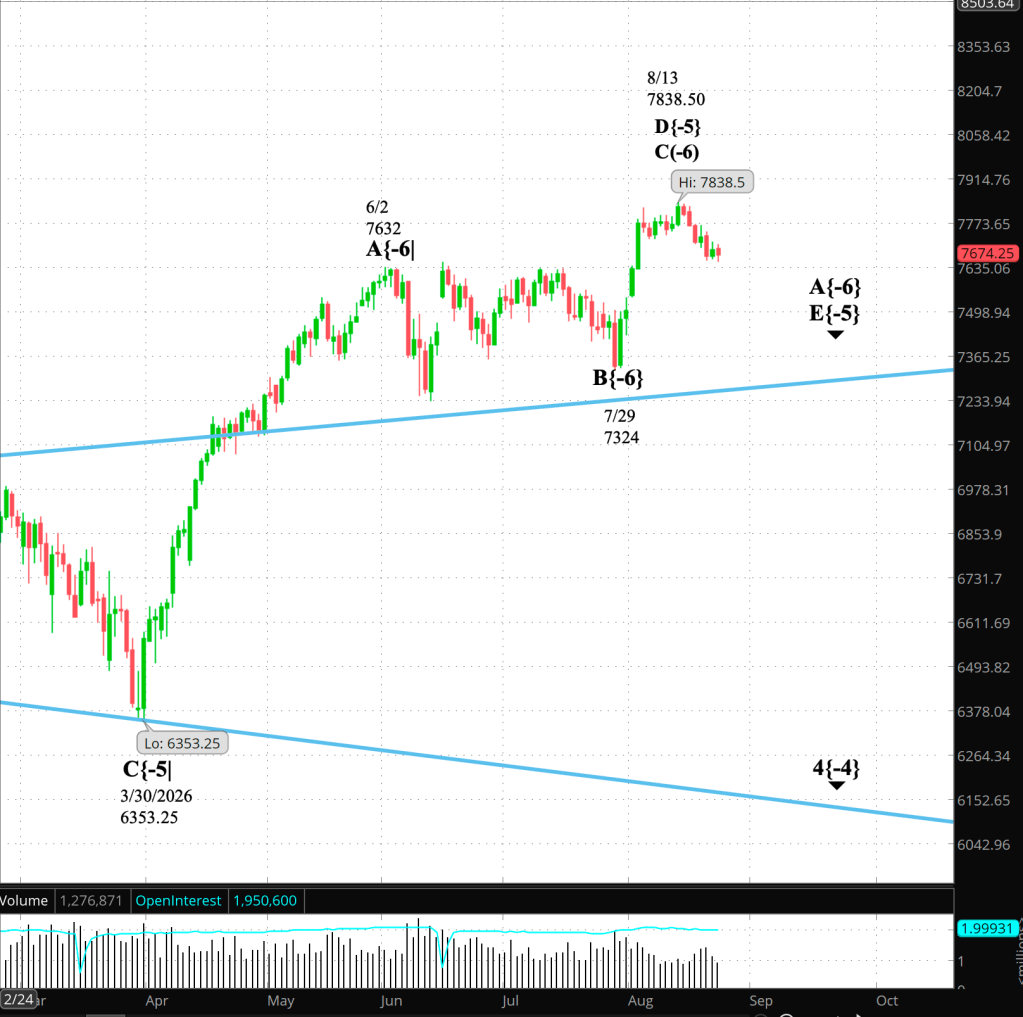
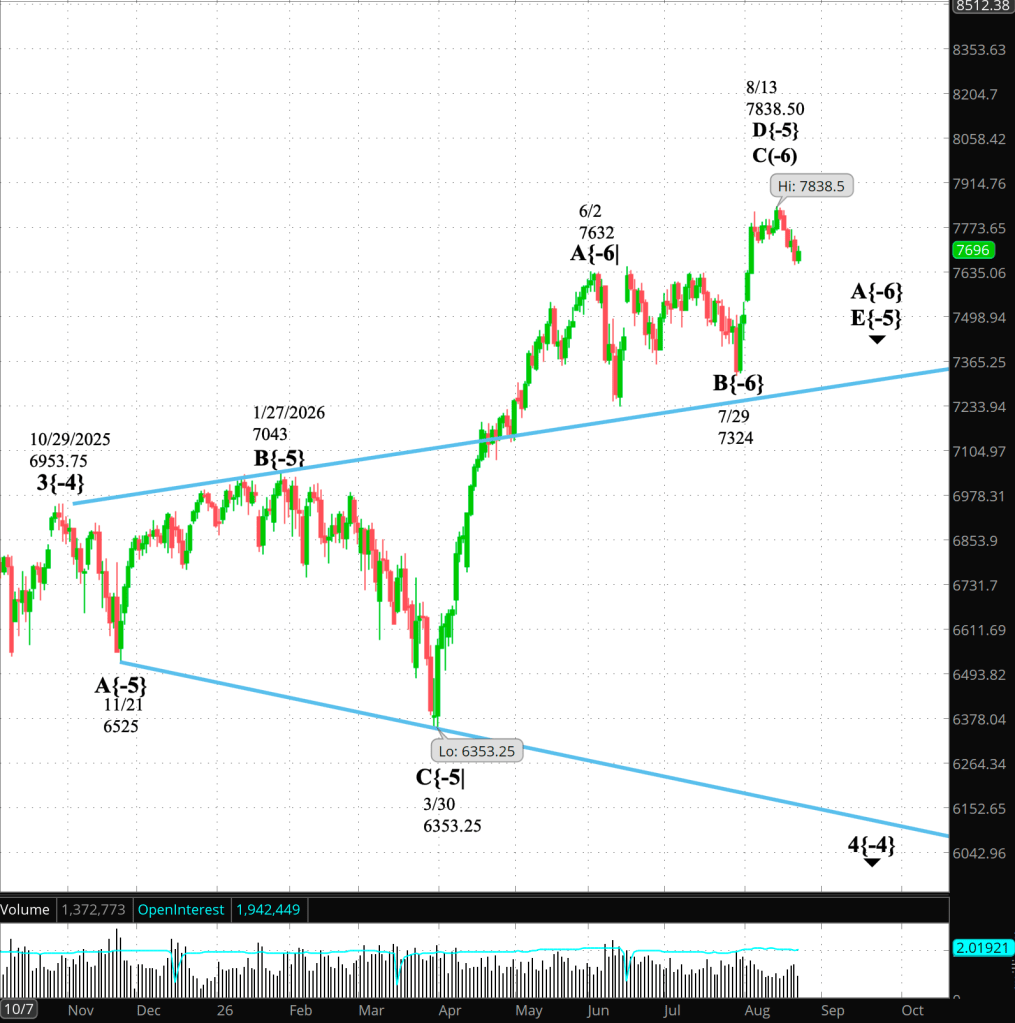
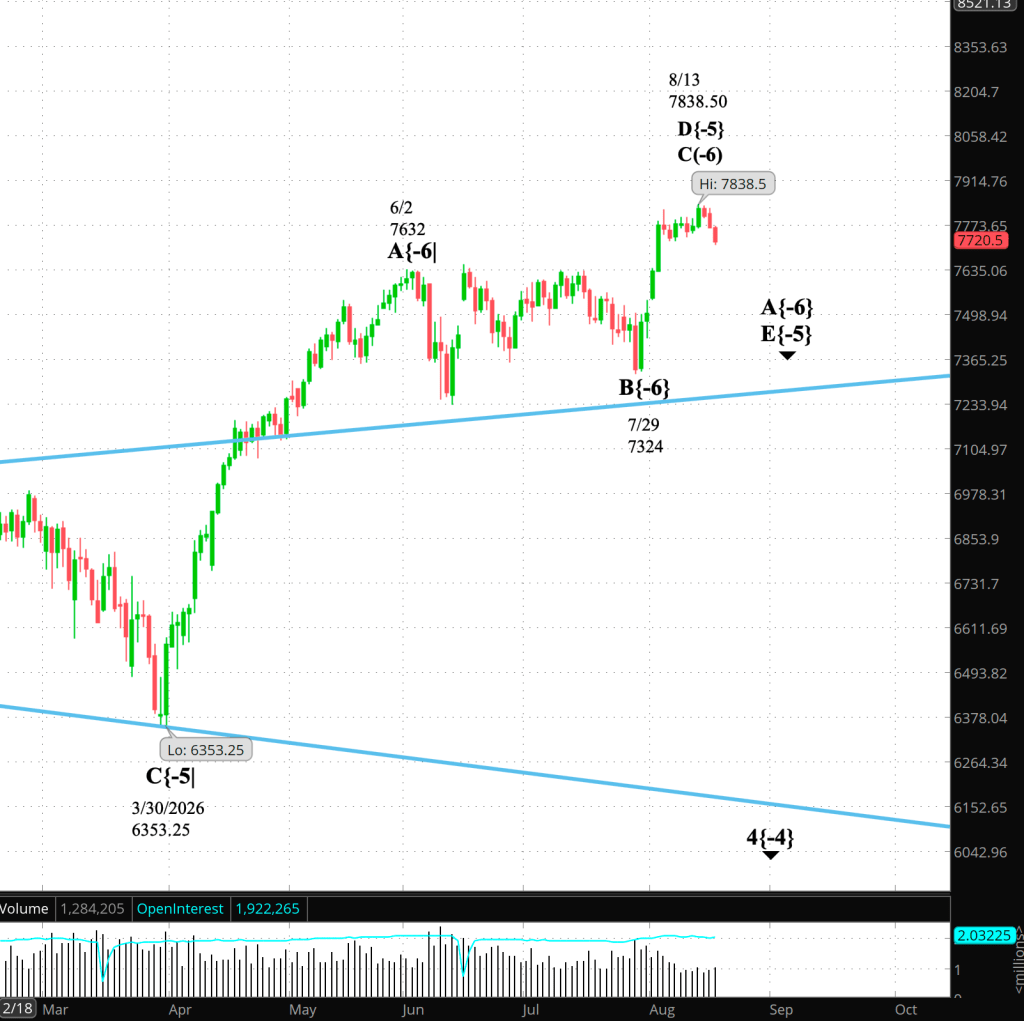
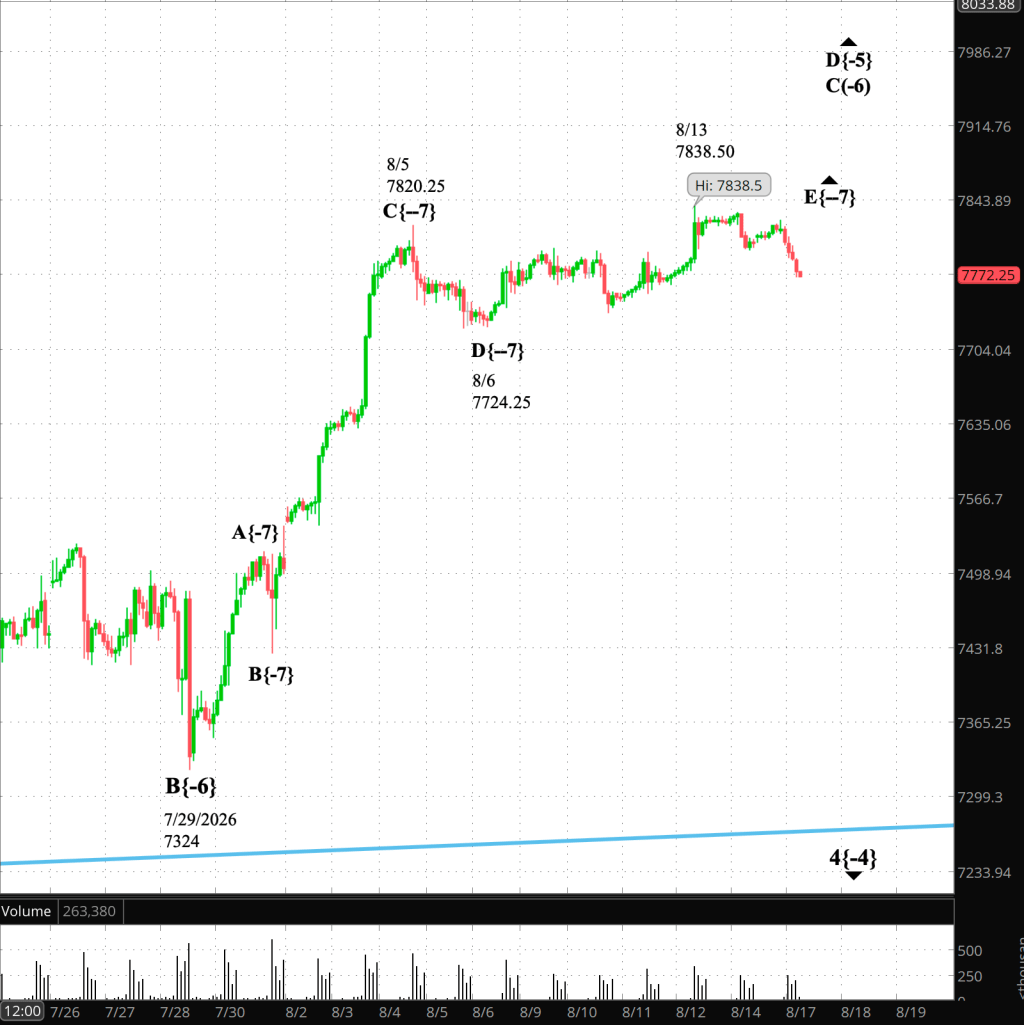
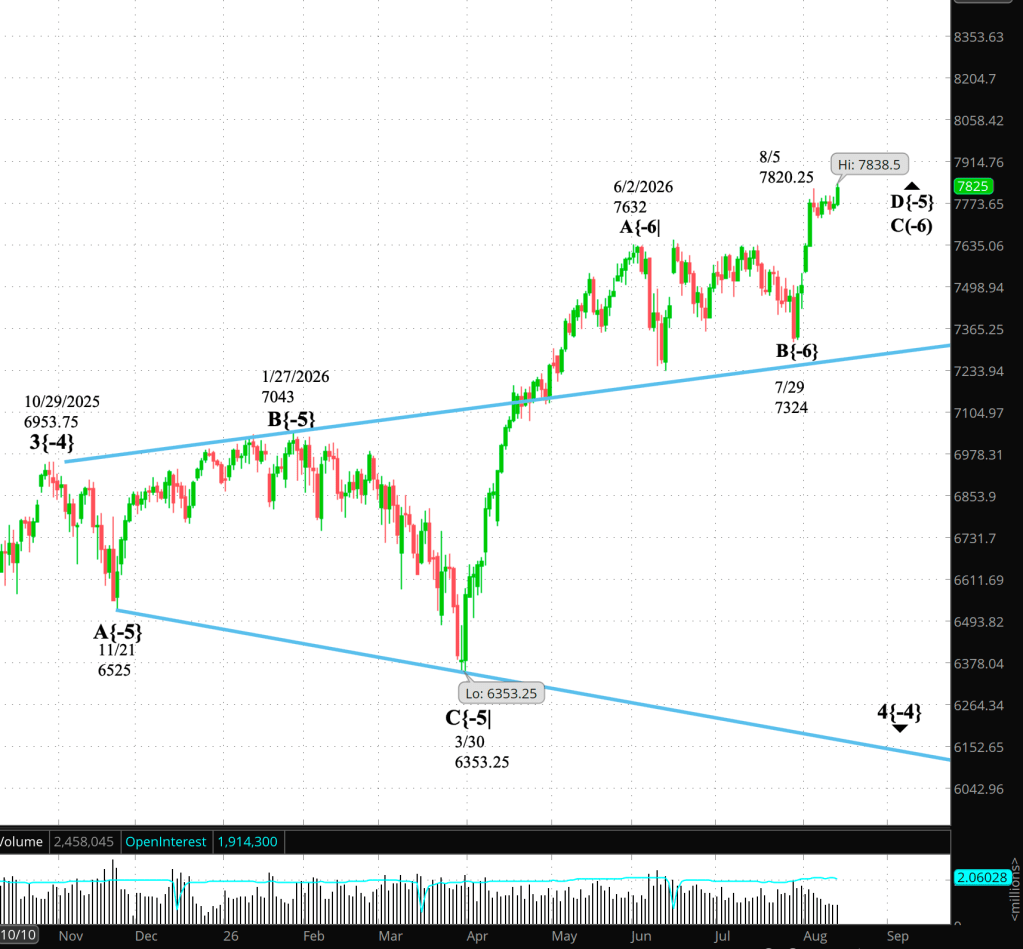
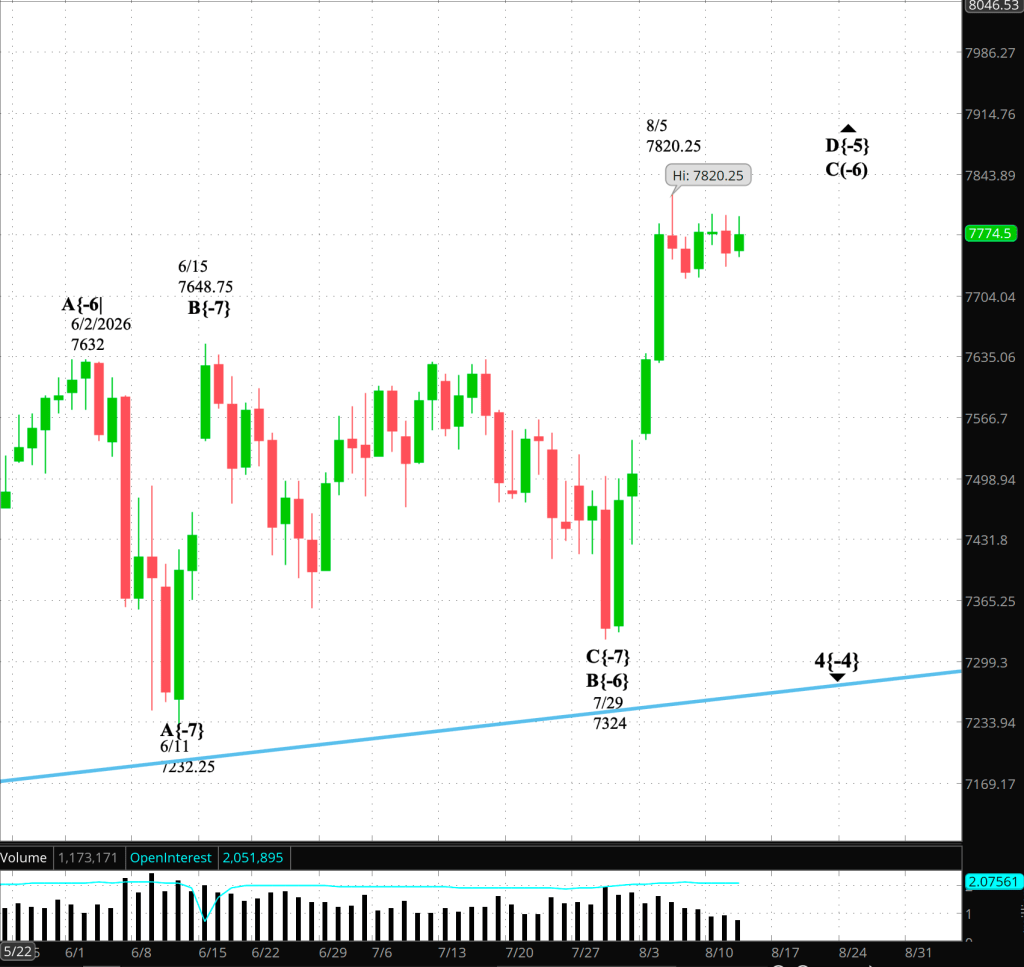
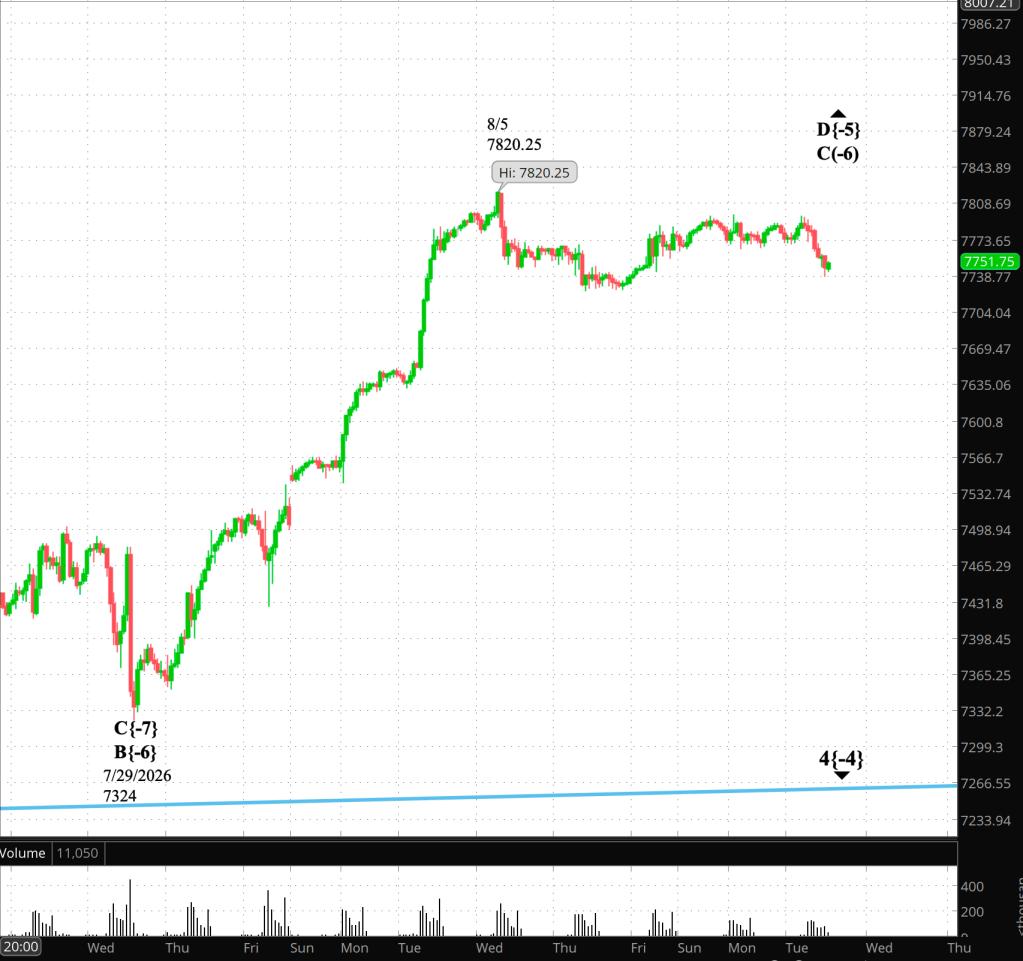
Elliott Wave Theory: Wave C{-6} continues within rising wave D{-5}, which is the next-to-last subwave of wave 4{-4}, a downward correction that has taken the form of an expanding triangle.

Decision Points. A move above 7384.50 would keep wave C{-6} extending and leave rising wave D{-5} intact. The first warning of a turn would be a decline below the most recent intraday pullback area, roughly the 7350s. A stronger warning would come if the futures fall back below 7326.50, the overnight pullback low. Until then, the chart still favors wave D{-5} as underway, although late in its structure.

9:35 a.m. New York tim

What’s happening now. The S&P 500 E-mini futures reached a peak of 7366.25 overnight and then fell back into the 7330s, after setting an overnight pullback low at 7326.50.

What does it mean? An analysis using Elliott Wave Theory concludes that rising wave D{-5} within wave 4{-4} continues and is in its final subwave, wave C{-6}. The overnight reversal is notable but, by itself, is not yet enough to conclude that wave D{-5} has ended and downward wave E{-5} has begun.

Decision Points. A move above 7366.25 would keep wave C{-6} extending and leave the immediate upward structure intact. A decline below 7326.50 would be the first stronger warning that the overnight high may stand as the end of wave C{-6} and therefore of wave D{-5}. The larger confirmation would come only if the futures begin forming a sustained series of lower highs and lower lows, especially if price moves back toward the upper boundary of the expanding triangle. Until then, the map still favors wave D{-5} as underway, although late in its structure.

[S&P 500 E-mini futures 3:30 p,m., 5-hour bars with volume]

Waves Now Underway

These are the waves currently in progress under my principal analysis. Each line on the list shows the wave number, with the subscript in curly brackets, the traditional degree name, the starting date, the starting price of the S&P 500 E-mini futures, and the direction of the wave.

  • S&P 500 Index:
  • 5{+3} Supercycle, 7/8/1932, 4.40 (up)
  • 5{+2} Cycle, 12/9/1974, 60.96 (up)
  • 5{+1} Primary, 3/6/2009, 666.79 (up)
  • 5{0} Intermediate, 2/11/2016, 1810.10 (up)
  • 3{-1} Minor, 3/23/2020, 2191.36 (up)
  • 1{-2} Minute, 7/31/2025, 6468.50 (down)
  • S&P 500 E-mini futures
  • 5{-3} Minuette 8/1/2025, 6239.50 (up}
  • 4{-4} Subminutte 10/29/2025, 6953.75 (down}
  • D{-5} Micro, 3/30/2026, 6353.25 (up}

Reading the chart. Price movements — waves – – in Elliott Wave Theory analysis are labeled with numbers within trending waves and letters with corrective waves. The subscripts — numbers in curly brackets — designate the wave’s degree, which, in Elliott Wave analysis, means the relative position of a wave within the larger and smaller structures that make up the chart. R.N. Elliott, who in the 1930s developed the form of analysis that bears his name, viewed the chart as a complex structure of smaller waves nested within larger waves, which in turn are nested within still larger waves. In mathematics it’s called a fractal structure, where at every scale the pattern is similar to the others.

Learning and other resources. Elliott Wave analysis provides context, not prophecy. As the 20th century semanticist Alfred Korzybski put it in his book Science and Sanity (1933), “The map is not the territory … The only usefulness of a map depends on similarity of structure between the empirical world and the map.” And I would add, in the ever-changing markets, we can judge that similarity of structure only after the fact.

See the menu page Analytical Methods for a rundown on where to go for information on Elliott Wave analysis.

By Tim Bovee, Portland, Oregon, May 6, 2026

Disclaimer

Tim Bovee, Private Trader tracks the analysis and trades of a private trader managing his own accounts. The content reflects my interpretation of market structure, including Elliott Wave Theory and related tools.

Nothing in this blog constitutes a recommendation to buy or sell stocks, options, or any other financial instrument, or to pursue any particular strategy. The purpose of this blog is education and entertainment.

No trader is ever 100 percent successful. Trading in stock and options markets involves risk and uncertainty. Each trader must make decisions for his or her own account and accept full responsibility for the outcomes.

Charts and tools are used to support my personal analysis. Any data displayed is illustrative of that analytical process and is not presented as a source of market data for redistribution.

All content on Tim Bovee, Private Trader by Timothy K. Bovee is licensed under a Creative Commons Attribution-ShareAlike 4.0 International License.

License

Based on work at www.timbovee.com

Trader’s Notebook: S&P 500

3:30 p.m. New York time

Half an hour before the closing bell. The S&P 500 futures rose overnight and throughout the session, reaching into the 7290s.

Elliott Wave Theory. I’ve moved the chart closer in to better see the structure of rising wave D{-5}, which has been underway since March 30. Wave D{-5} is a subwave of downward corrective wave 4{-4}, which is taking the form of an Expanding Triangle.

The subwaves of corrective triangles each have three subwaves. I’ve marked one interpretation of the D{-5} subwaves, treating the first pullback of notable size as the end of wave A{-6}, the reversal of the decline as the end of wave B{-6}, and the strong rise that has followed as wave C{-6}, still underway.

It would be just as reasonable to treat the entire rise as wave A{-6}, still underway, and change the waves I marked by moving them one degree smaller: A{-7}, B{-7}, and C{-7}, also still underway.

I realize that it’s starting to sound boring, but: Time will tell.

Decision Points. The futures are now pressing close to the recent high at 7300.75. A move above that level would show that wave D{-5} is still extending and that the upward leg of the Expanding Triangle has not yet finished.

A reversal from this area would not by itself prove that wave E{-5} has begun. The first useful warning would be a decline back below the 7270s, followed by a failure to recover the 7290s. A stronger warning would come from a return below the 7220s, which would erase today’s intraday rise and suggest that the upward pressure inside D{-5} is weakening.

Until that happens, the count remains the same: wave D{-5} is still best treated as underway, but its internal degree remains ambiguous. The map is useful, but the terrain has not yet forced a final choice between the two labels.

9:35 a.m. New York tim

What’s happening now. The S&P 500 E-mini futures continued to climb after yesterday’s session ended, so far reaching into the 7260s.

What does it mean? The overnight high remains below yesterday’s session high, which in turn was below the high point of the Expanding Triangle that began on October 29, 2025. That triangle is declining corrective wave 4{-4}, which has encompassed all that has happened in the S&P 500 in the past seven-plus months.

Elliott Wave Theory analysis tells us that wave 4{-4} is in its next-to-the-last subwave, D{-5}, a rising wave within the falling parent wave 4{-4}. The next wave, declining wave E{-5}, will carry wave 4{-4} to a close.

Expanding Triangles tend to be dramatic. The “Expanding” part means that each rising subwave moves higher than the prior rising subwave, and each falling subwave moves lower than the previous falling subwave.

The chart below tracks wave 4{-4} in its entirety, illustrating that wave D{-5} has already risen higher than wave B{-5}. Wave E{-5} will move below the end of wave C{-5}, at 6353.25.

Decision Points. As long as the futures remain above the upper boundary of the Expanding Triangle, the best working count is that wave D{-5} remains underway. A rise above the recent high at 7300.75 would strengthen that interpretation and show that wave D{-5} is still extending.

A decline into the 7220s would weaken the rise but would not, by itself, prove that wave E{-5} has begun. The first stronger warning would come if the futures returned below the upper boundary of the triangle and the decline began to take the form of a five-wave move. That would suggest the map may be shifting from late-stage D{-5} to the early stages of E{-5}.

Between those levels, ambiguity remains the dominant fact. Price is still high enough to keep wave D{-5} alive, but not strong enough to prove that it has much farther to run.

[S&P 500 E-mini futures 3:30 p,m., 5-hour bars with volume]

Waves Now Underway

These are the waves currently in progress under my principal analysis. Each line on the list shows the wave number, with the subscript in curly brackets, the traditional degree name, the starting date, the starting price of the S&P 500 E-mini futures, and the direction of the wave.

  • S&P 500 Index:
  • 5{+3} Supercycle, 7/8/1932, 4.40 (up)
  • 5{+2} Cycle, 12/9/1974, 60.96 (up)
  • 5{+1} Primary, 3/6/2009, 666.79 (up)
  • 5{0} Intermediate, 2/11/2016, 1810.10 (up)
  • 3{-1} Minor, 3/23/2020, 2191.36 (up)
  • 1{-2} Minute, 7/31/2025, 6468.50 (down)
  • S&P 500 E-mini futures
  • 5{-3} Minuette 8/1/2025, 6239.50 (up}
  • 4{-4} Subminutte 10/29/2025, 6953.75 (down}
  • D{-5} Micro, 3/30/2026, 6353.25 (up}

Reading the chart. Price movements — waves – – in Elliott Wave Theory analysis are labeled with numbers within trending waves and letters with corrective waves. The subscripts — numbers in curly brackets — designate the wave’s degree, which, in Elliott Wave analysis, means the relative position of a wave within the larger and smaller structures that make up the chart. R.N. Elliott, who in the 1930s developed the form of analysis that bears his name, viewed the chart as a complex structure of smaller waves nested within larger waves, which in turn are nested within still larger waves. In mathematics it’s called a fractal structure, where at every scale the pattern is similar to the others.

Learning and other resources. Elliott Wave analysis provides context, not prophecy. As the 20th century semanticist Alfred Korzybski put it in his book Science and Sanity (1933), “The map is not the territory … The only usefulness of a map depends on similarity of structure between the empirical world and the map.” And I would add, in the ever-changing markets, we can judge that similarity of structure only after the fact.

See the menu page Analytical Methods for a rundown on where to go for information on Elliott Wave analysis.

By Tim Bovee, Portland, Oregon, May 5, 2026

Disclaimer

Tim Bovee, Private Trader tracks the analysis and trades of a private trader managing his own accounts. The content reflects my interpretation of market structure, including Elliott Wave Theory and related tools.

Nothing in this blog constitutes a recommendation to buy or sell stocks, options, or any other financial instrument, or to pursue any particular strategy. The purpose of this blog is education and entertainment.

No trader is ever 100 percent successful. Trading in stock and options markets involves risk and uncertainty. Each trader must make decisions for his or her own account and accept full responsibility for the outcomes.

Charts and tools are used to support my personal analysis. Any data displayed is illustrative of that analytical process and is not presented as a source of market data for redistribution.

All content on Tim Bovee, Private Trader by Timothy K. Bovee is licensed under a Creative Commons Attribution-ShareAlike 4.0 International License.

License

Based on work at www.timbovee.com

Trader’s Notebook: S&P 500

3:30 p.m. New York time

Half an hour before the closing bell. The S&P 500 futures stair-stepped downward during the session, reaching a low so far of 7199.50, then bounced back to 7239.50.

Elliott Wave Theory: This morning’s Decision Points said that a rise above 7300.75 would strengthen the case for wave D{-5} still being underway, and that a sustained move below 7213.75 would strengthen the case that wave E{-5} is now underway.

The price today has stayed below the upper level and has also failed to remain below the lower level. It poked below 7213.75 a couple of times, and in each case quickly rebounded.

The futures have spent nearly all of the session in the foggy gray area of uncertainty, confirming neither the continuation of wave D{-5} nor the beginning of wave E{-5}.

Decision Points. A rise above 7239.50 would weaken the immediate bearish case but would not by itself confirm that wave D{-5} is still underway. A rise above 7300.75 would do more to strengthen the D-wave interpretation. A sustained fall below 7199.50 would strengthen the case that wave E{-5} has begun. A further decline back beneath the upper boundary of the Expanding Triangle would add weight to the E-wave interpretation.

9:35 a.m. New York time

What’s happening now. The S&P 500 E-mini futures gapped above Friday’s close when trading resumed on Sunday, reached a high of 7300.75, and then fell sharply to 7213.75 after President Trump said the United States military would escort ships through the Strait of Hormuz, a key sea route disrupted by the Iran War.

What does it mean? The price remains above the upper boundary of the Expanding Triangle that has been underway since the end of October 2025. The Triangle is the form taken by wave 4{-4}, a downward correction. When Elliott Wave Theory is applied, the downward movement weakens the case for rising wave D{-5} being underway, but not enough to verify the end of wave D and the beginning of falling wave E{-5}.

Waves D and E are each subwaves within wave 4{-4}. Wave E{-5} will be the final wave within wave 4{-4}. The end of the E wave will also be the beginning of uptrending wave 5{-4}.

Decision Points. A rise above 7300.75 would strengthen the case that wave D{-5} is still underway. A sustained move below 7213.75 would strengthen the case that wave D{-5} has ended and that falling wave E{-5} has begun. A fall back beneath the upper boundary of the Expanding Triangle would further support the E-wave interpretation.

[S&P 500 E-mini futures 3:30 p,m., 5-hour bars with volume]

Waves Now Underway

These are the waves currently in progress under my principal analysis. Each line on the list shows the wave number, with the subscript in curly brackets, the traditional degree name, the starting date, the starting price of the S&P 500 E-mini futures, and the direction of the wave.

  • S&P 500 Index:
  • 5{+3} Supercycle, 7/8/1932, 4.40 (up)
  • 5{+2} Cycle, 12/9/1974, 60.96 (up)
  • 5{+1} Primary, 3/6/2009, 666.79 (up)
  • 5{0} Intermediate, 2/11/2016, 1810.10 (up)
  • 3{-1} Minor, 3/23/2020, 2191.36 (up)
  • 1{-2} Minute, 7/31/2025, 6468.50 (down)
  • S&P 500 E-mini futures
  • 5{-3} Minuette 8/1/2025, 6239.50 (up}
  • 4{-4} Subminutte 10/29/2025, 6953.75 (down}
  • D{-5} Micro, 3/30/2026, 6353.25 (up}

Reading the chart. Price movements — waves – – in Elliott Wave Theory analysis are labeled with numbers within trending waves and letters with corrective waves. The subscripts — numbers in curly brackets — designate the wave’s degree, which, in Elliott Wave analysis, means the relative position of a wave within the larger and smaller structures that make up the chart. R.N. Elliott, who in the 1930s developed the form of analysis that bears his name, viewed the chart as a complex structure of smaller waves nested within larger waves, which in turn are nested within still larger waves. In mathematics it’s called a fractal structure, where at every scale the pattern is similar to the others.

Learning and other resources. Elliott Wave analysis provides context, not prophecy. As the 20th century semanticist Alfred Korzybski put it in his book Science and Sanity (1933), “The map is not the territory … The only usefulness of a map depends on similarity of structure between the empirical world and the map.” And I would add, in the ever-changing markets, we can judge that similarity of structure only after the fact.

See the menu page Analytical Methods for a rundown on where to go for information on Elliott Wave analysis.

By Tim Bovee, Portland, Oregon, May 4, 2026

Disclaimer

Tim Bovee, Private Trader tracks the analysis and trades of a private trader managing his own accounts. The content reflects my interpretation of market structure, including Elliott Wave Theory and related tools.

Nothing in this blog constitutes a recommendation to buy or sell stocks, options, or any other financial instrument, or to pursue any particular strategy. The purpose of this blog is education and entertainment.

No trader is ever 100 percent successful. Trading in stock and options markets involves risk and uncertainty. Each trader must make decisions for his or her own account and accept full responsibility for the outcomes.

Charts and tools are used to support my personal analysis. Any data displayed is illustrative of that analytical process and is not presented as a source of market data for redistribution.

All content on Tim Bovee, Private Trader by Timothy K. Bovee is licensed under a Creative Commons Attribution-ShareAlike 4.0 International License.

License

Based on work at www.timbovee.com

Trader’s Notebook: S&P 500

3:30 p.m. New York time

Half an hour before the closing bell. The S&P 500 futures peaked at 7300.75 early in the session and then began to fall, so far reaching slightly below 7260.

Elliott Wave Theory. The decline can be counted as five waves. It could be a pullback within wave D{-5}, which has been rising since the end of March, or it could mean that wave D reached its end at today’s peak, and what has followed are the first steps of declining wave E{-5}.

Implications can be read into the movement, but not certainties — not yet.

However, even if wave E{-5} has not yet begun, its time is rushing toward us. Here is an outline of how it will form.

Both waves D{-5} and E{-5} are subwaves of wave 4{-4}, a downward correction that has taken the form of an Expanding Triangle. The “Expanding” part means that each rising wave ends higher than the one before, and declining waves do the same on the low side.

The last declining subwave, wave C{-5}, ended at 6353.25. That is a minimum wave E{-5} endpoint of sorts. Another target is the lower boundary, which is formed by connecting the endpoints of waves A{-5} and C{-5}, and extending the declining line into the future. That boundary line is another, lower level that, a week from now, will be a few points above 6300. The more time it takes to reach that boundary, the lower the boundary will have fallen.

Will the price get there in a week? No one can say, but it seems unlikely to me. Time, as always, will tell.

Decision Points. A rise above 7300.75 would keep wave D{-5} alive and extending. Failure to regain the 7280s-to-7290s, followed by another move below 7260, would strengthen the case that today’s peak ended wave D{-5}. A move below 7246.25 would give stronger evidence that declining wave E{-5} is underway. Until then, the chart remains balanced between late D{-5} and early E{-5}.

9:35 a.m. New York time

What’s happening now. The S&P 500 E-mini futures hit an overnight peak of 7271.50 as the opening bell approached, then fell rapidly to the 7257 area.

What does it mean? Elliott Wave Theory sees the higher high as increasing the odds that wave D{-5} is continuing within wave 4{-4}, a downward correction taking the form of an Expanding Triangle. The price remains above the upper boundary of the triangle for a third day.

Each peak verifies the scenario that wave D{-5} continues. Each pullback implies that D{-5} may have ended at that peak, and that wave E{-5} has begun its fall.

The chart at this point lives in the Land of Maybe.

Decision Points. A move above 7271.50 would strengthen the case that wave D{-5} is still rising. A drop below the 7257 area would be an early warning that the latest thrust has failed, but not yet decisive. A move below 7246.25 would give stronger evidence that wave D{-5} may have ended and that falling wave E{-5} may be underway.

[S&P 500 E-mini futures 3:30 p.m., 5-hour bars with volume]

Waves Now Underway

These are the waves currently in progress under my principal analysis. Each line on the list shows the wave number, with the subscript in curly brackets, the traditional degree name, the starting date, the starting price of the S&P 500 E-mini futures, and the direction of the wave.

  • S&P 500 Index:
  • 5{+3} Supercycle, 7/8/1932, 4.40 (up)
  • 5{+2} Cycle, 12/9/1974, 60.96 (up)
  • 5{+1} Primary, 3/6/2009, 666.79 (up)
  • 5{0} Intermediate, 2/11/2016, 1810.10 (up)
  • 3{-1} Minor, 3/23/2020, 2191.36 (up)
  • 1{-2} Minute, 7/31/2025, 6468.50 (down)
  • S&P 500 E-mini futures
  • 5{-3} Minuette 8/1/2025, 6239.50 (up}
  • 4{-4} Subminutte 10/29/2025, 6953.75 (down}
  • D{-5} Micro, 3/30/2026, 6353.25 (up}

Reading the chart. Price movements — waves – – in Elliott Wave Theory analysis are labeled with numbers within trending waves and letters with corrective waves. The subscripts — numbers in curly brackets — designate the wave’s degree, which, in Elliott Wave analysis, means the relative position of a wave within the larger and smaller structures that make up the chart. R.N. Elliott, who in the 1930s developed the form of analysis that bears his name, viewed the chart as a complex structure of smaller waves nested within larger waves, which in turn are nested within still larger waves. In mathematics it’s called a fractal structure, where at every scale the pattern is similar to the others.

Learning and other resources. Elliott Wave analysis provides context, not prophecy. As the 20th century semanticist Alfred Korzybski put it in his book Science and Sanity (1933), “The map is not the territory … The only usefulness of a map depends on similarity of structure between the empirical world and the map.” And I would add, in the ever-changing markets, we can judge that similarity of structure only after the fact.

See the menu page Analytical Methods for a rundown on where to go for information on Elliott Wave analysis.

By Tim Bovee, Portland, Oregon, May 1, 2026

Disclaimer

Tim Bovee, Private Trader tracks the analysis and trades of a private trader managing his own accounts. The content reflects my interpretation of market structure, including Elliott Wave Theory and related tools.

Nothing in this blog constitutes a recommendation to buy or sell stocks, options, or any other financial instrument, or to pursue any particular strategy. The purpose of this blog is education and entertainment.

No trader is ever 100 percent successful. Trading in stock and options markets involves risk and uncertainty. Each trader must make decisions for his or her own account and accept full responsibility for the outcomes.

Charts and tools are used to support my personal analysis. Any data displayed is illustrative of that analytical process and is not presented as a source of market data for redistribution.

All content on Tim Bovee, Private Trader by Timothy K. Bovee is licensed under a Creative Commons Attribution-ShareAlike 4.0 International License.

License

Based on work at www.timbovee.com

Trader’s Notebook: S&P 500

3:30 p.m. New York time

Half an hour before the closing bell. The S&P 500 futures continued to rise during the session, reaching the 7240s.

Elliott Wave Theory. The session rise has remained above the upper boundary of the Expanding Triangle, which is the form taken by wave 4{-4}, a downward correction that began last October. The session’s rise from the 7133.75 low now appears to be in its third wave.

The present longer-term rise, wave D{-5}, began on March 30 from 6353.25, so the present session rise within it is quite small compared with the whole. It illustrates that wave D{-5} is still underway, but says nothing about how far that continuing uptrend will continue.

The final subwave within wave 4{-4} still lies in the future.

Decision Points. The morning decision point at 7223.25 has been exceeded, strengthening the case that wave D{-5} is continuing. A sustained move above today’s high would extend that case. A decline back below 7223.25 would weaken the immediate bullish push but would not, by itself, end the D-wave interpretation. The more important warning would be a return to the upper boundary area near 7137. A decisive break below that area would suggest that wave D{-5} may have ended and declining wave E{-5} may have begun.

9:35 a.m. New York time

What’s happening now. The S&P 500 E-mini futures, after dropping to a low of 7131.25 as yesterday’s session neared its end, bounced as overnight trading began, rose slightly above 7200, retreated almost to the prior low, and then bounced again into the 7210s.

What does it mean? The first of the two lows fell slightly below the upper boundary of a large Elliott Wave Theory structure, wave 4{-4}, an Expanding Triangle that began on Oct. 29, 2025. The second low retested that same boundary area. The present smaller wave in progress is the next-to-the-last subwave of that triangle, wave D{-5}.

The upper boundary is formed by a line connecting two peaks in the triangle and then extending that line into the future. The lower boundary connects two lows and extends them. Typically, each peak that follows will encounter resistance when it reaches a boundary.

The dramatic rises and falls overnight look very much like an attempt to break free of the upper boundary. If the attempt succeeds, wave D{-5} continues its rise. If it fails, wave D{-5} ends, and the final subwave within the triangle, declining wave E{-5}, will have begun.

Decision Points. A sustained move above 7223.25, yesterday’s high, would strengthen the case that wave D{-5} is still rising. A decline below 7131.25 would weaken that case and suggest that wave E{-5} may already be underway. Between those levels, the map remains unchanged: wave D{-5} is still the working count, but the futures are testing whether the upper boundary has become support or remains resistance.

[S&P 500 E-mini futures 3:30 p.m., 5-hour bars with volume]

Waves Now Underway

These are the waves currently in progress under my principal analysis. Each line on the list shows the wave number, with the subscript in curly brackets, the traditional degree name, the starting date, the starting price of the S&P 500 E-mini futures, and the direction of the wave.

  • S&P 500 Index:
  • 5{+3} Supercycle, 7/8/1932, 4.40 (up)
  • 5{+2} Cycle, 12/9/1974, 60.96 (up)
  • 5{+1} Primary, 3/6/2009, 666.79 (up)
  • 5{0} Intermediate, 2/11/2016, 1810.10 (up)
  • 3{-1} Minor, 3/23/2020, 2191.36 (up)
  • 1{-2} Minute, 7/31/2025, 6468.50 (down)
  • S&P 500 E-mini futures
  • 5{-3} Minuette 8/1/2025, 6239.50 (up}
  • 4{-4} Subminutte 10/29/2025, 6953.75 (down}
  • D{-5} Micro, 3/30/2026, 6353.25 (up}

Reading the chart. Price movements — waves – – in Elliott Wave Theory analysis are labeled with numbers within trending waves and letters with corrective waves. The subscripts — numbers in curly brackets — designate the wave’s degree, which, in Elliott Wave analysis, means the relative position of a wave within the larger and smaller structures that make up the chart. R.N. Elliott, who in the 1930s developed the form of analysis that bears his name, viewed the chart as a complex structure of smaller waves nested within larger waves, which in turn are nested within still larger waves. In mathematics it’s called a fractal structure, where at every scale the pattern is similar to the others.

Learning and other resources. Elliott Wave analysis provides context, not prophecy. As the 20th century semanticist Alfred Korzybski put it in his book Science and Sanity (1933), “The map is not the territory … The only usefulness of a map depends on similarity of structure between the empirical world and the map.” And I would add, in the ever-changing markets, we can judge that similarity of structure only after the fact.

See the menu page Analytical Methods for a rundown on where to go for information on Elliott Wave analysis.

By Tim Bovee, Portland, Oregon, April 30, 2026

Disclaimer

Tim Bovee, Private Trader tracks the analysis and trades of a private trader managing his own accounts. The content reflects my interpretation of market structure, including Elliott Wave Theory and related tools.

Nothing in this blog constitutes a recommendation to buy or sell stocks, options, or any other financial instrument, or to pursue any particular strategy. The purpose of this blog is education and entertainment.

No trader is ever 100 percent successful. Trading in stock and options markets involves risk and uncertainty. Each trader must make decisions for his or her own account and accept full responsibility for the outcomes.

Charts and tools are used to support my personal analysis. Any data displayed is illustrative of that analytical process and is not presented as a source of market data for redistribution.

All content on Tim Bovee, Private Trader by Timothy K. Bovee is licensed under a Creative Commons Attribution-ShareAlike 4.0 International License.

License

Based on work at www.timbovee.com

Trader’s Notebook: S&P 500

3:30 p.m. New York time

Half an hour before the closing bell. After the Federal Open Market Committee announced that it was leaving interest rates unchanged, the S&P 500 futures rapidly fell from the 7160s to 7137.50, and then fluctuated mainly in the 7140s.

Elliott Wave Theory. Notably, the price remained above the upper boundary line of the long-running fourth-wave downward correction that began last autumn and has taken the form of an Expanding Triangle. The present wave within wave 4{-4} is its next-to-the-last subwave, rising wave D{-5}. Given that reality, I shall continue to lean toward seeing the D wave as still underway.

Decision Points. The upper boundary of the Expanding Triangle remains the key line. As long as the price stays above that boundary, rising wave D{-5} can still be counted as incomplete, although today’s post-FOMC decline weakened the case for immediate strength.

A sustained move back above the 7160s would suggest that the decline after the announcement was only a temporary reaction. A move above the overnight high of 7188.50 would strengthen the case that wave D{-5} is still pressing higher. A move above the prior D{-5} high at 7223.25 would be stronger confirmation.

A sustained break below the upper boundary would suggest that wave D{-5} may be ending and that declining wave E{-5} may be preparing to begin. That would not be final proof, but it would mean the map is beginning to change.

9:35 a.m. New York time

What’s happening now. The S&P 500 e-mini futures reached a higher high, 7188.50. early in overnight trading and then worked its way lower in the 7188.50 for much of overnight and then fell to the 7150s as the opening bell sounded. The Federal Open Market Committee’s interest rate announcement will be at 2 p.m., with departing Fed Chair Jerome Powell holding a news conference at 2:30 p.m.

What does it mean? In Elliott Wave Theory, the wave underway is rising wave D{-5}, a subwave of a downward correction, wave 4{-4}, which began on October 30, 2025.

Wave 4 is taking the form of an Expanding Triangle. Such triangles have five subwaves, each composed of three subwaves. An idea of the turning points can be gained by drawing a line connecting the earlier turning points and extending it into the future as upper and lower boundaries of the triangle.

In this case, wave D{-5} has moved above the upper boundary, slightly, and remains there. I interpret that to mean that the D wave might not be complete yet

Decision Points. The first line to watch is the triangle’s upper boundary, presently near the 7160s. As long as the price remains above or very near that line, rising wave D{-5} can still be counted as incomplete, even if the movement is slow and hesitant.

A sustained move above the overnight high of 7188.50 would strengthen the case that wave D{-5} is still pushing higher. A move above the prior D{-5} high at 7223.25 would be stronger confirmation that the wave has not yet completed.

A sustained drop back below the upper boundary would not by itself prove that wave D{-5} is over, but it would weaken the immediate bullish interpretation. Follow-through below the 7140s would raise the possibility that the market is turning away from the boundary and beginning the transition toward declining wave E{-5}.

Because the FOMC announcement comes at 2 p.m. ET, with Jerome Powell’s news conference at 2:30 p.m., the pre-announcement movement should be treated cautiously. The clearest signal may come not from the first reaction, but from whether the price holds above or below the triangle boundary after the announcement and news conference.

[S&P 500 E-mini futures 3:30 p.m., 5-hour bars with volume]

Waves Now Underway

These are the waves currently in progress under my principal analysis. Each line on the list shows the wave number, with the subscript in curly brackets, the traditional degree name, the starting date, the starting price of the S&P 500 E-mini futures, and the direction of the wave.

  • S&P 500 Index:
  • 5{+3} Supercycle, 7/8/1932, 4.40 (up)
  • 5{+2} Cycle, 12/9/1974, 60.96 (up)
  • 5{+1} Primary, 3/6/2009, 666.79 (up)
  • 5{0} Intermediate, 2/11/2016, 1810.10 (up)
  • 3{-1} Minor, 3/23/2020, 2191.36 (up)
  • 1{-2} Minute, 7/31/2025, 6468.50 (down)
  • S&P 500 E-mini futures
  • 5{-3} Minuette 8/1/2025, 6239.50 (up}
  • 4{-4} Subminutte 10/29/2025, 6953.75 (down}
  • D{-5} Micro, 3/30/2026, 6353.25 (up}

Reading the chart. Price movements — waves – – in Elliott Wave Theory analysis are labeled with numbers within trending waves and letters with corrective waves. The subscripts — numbers in curly brackets — designate the wave’s degree, which, in Elliott Wave analysis, means the relative position of a wave within the larger and smaller structures that make up the chart. R.N. Elliott, who in the 1930s developed the form of analysis that bears his name, viewed the chart as a complex structure of smaller waves nested within larger waves, which in turn are nested within still larger waves. In mathematics it’s called a fractal structure, where at every scale the pattern is similar to the others.

Learning and other resources. Elliott Wave analysis provides context, not prophecy. As the 20th century semanticist Alfred Korzybski put it in his book Science and Sanity (1933), “The map is not the territory … The only usefulness of a map depends on similarity of structure between the empirical world and the map.” And I would add, in the ever-changing markets, we can judge that similarity of structure only after the fact.

See the menu page Analytical Methods for a rundown on where to go for information on Elliott Wave analysis.

By Tim Bovee, Portland, Oregon, April 29, 2026

Disclaimer

Tim Bovee, Private Trader tracks the analysis and trades of a private trader managing his own accounts. The content reflects my interpretation of market structure, including Elliott Wave Theory and related tools.

Nothing in this blog constitutes a recommendation to buy or sell stocks, options, or any other financial instrument, or to pursue any particular strategy. The purpose of this blog is education and entertainment.

No trader is ever 100 percent successful. Trading in stock and options markets involves risk and uncertainty. Each trader must make decisions for his or her own account and accept full responsibility for the outcomes.

Charts and tools are used to support my personal analysis. Any data displayed is illustrative of that analytical process and is not presented as a source of market data for redistribution.

All content on Tim Bovee, Private Trader by Timothy K. Bovee is licensed under a Creative Commons Attribution-ShareAlike 4.0 International License.

License

Based on work at www.timbovee.com

Trader’s Notebook: S&P 500

3:30 p.m. New York time

Half an hour before the closing bell. The S&P 500 futures continued to decline during the session, reaching a low of 7146.25, and then rising into the 7160s.

Elliott Wave Theory. The price remains above the upper boundary of the Expanding Triangle, the form taken by wave 4{-4}, a downward correction that began last autumn. The corrective wave is in its next-to-the-last subwave, rising wave D{-5}.

Decision Points. No change in the map. The upper boundary of the Expanding Triangle remains the line that matters. So long as the price remains above that boundary, rising wave D{-5} remains technically alive, although today’s decline has kept the question open.

A sustained move below the boundary would increase the likelihood that wave D{-5} ended at 7223.25 and that falling wave E{-5} has begun. A move back above 7185 would weaken that case, and a move above 7223.25 would show that wave D{-5} is still extending.

With the FOMC interest-rate decision due Wednesday, the practical trading conclusion remains unchanged: No new entry until after the release.

9:35 a.m. New York time

What’s happening now. The S&P 500 e-mini futures after yesterday’s closing bell rose to 7223.25 and then began to fall, reaching 7147.50 as today’s opening bell drew near.

What does it mean? The price at the low point remained above the upper boundary of the Expanding Triangle, the form taken by wave 4{-4} when Elliott Wave Theory is applied. The boundary at the low point stood at about 7134.

Wave 4{-4}, a downward correction, began on October 29, 2025, and at this point is well advanced as it works through its fourth subwave, rising wave D{-5}. An Expanding Triangle has five subwaves, and wave D is the fourth.

The triangle boundaries are defined by the highs and lows of prior waves. The boundaries are often the turning points when one subwave ends and the next one begins. Often, but not always. As is often the case in Elliott Wave Theory analysis, the usual pattern taken by a wave is often a suggestion rather than a rule.

If the price remains above the top boundary, I’ll consider wave D{-5} to still be underway. If it falls below the boundary and continues to fall, the likelihood that wave D has ended and falling wave E{-5} is now underway will increase.

Decision Points. The upper boundary of the Expanding Triangle is the key line this morning, standing near 7134 and rising slowly. A decline to the boundary followed by a reversal upward would keep wave D{-5} alive and would suggest that the overnight drop was only another test of support.

A sustained move below the boundary would be the first warning that wave D{-5} may have ended at 7223.25. A continued decline after that break would increase the likelihood that falling wave E{-5} has begun.

On the upside, a move back above 7185 would weaken the bearish case, and a rise above 7223.25 would show that wave D{-5} is still extending. Until one of those tests is resolved, the market remains in the same ambiguity that has defined the structure since mid-April: wave D{-5} may still be pushing higher, but it is doing so at the point where the triangle pattern normally begins to look for a turn.

[S&P 500 E-mini futures 3;30 p.m., 5-hour bars with volume]

Waves Now Underway

These are the waves currently in progress under my principal analysis. Each line on the list shows the wave number, with the subscript in curly brackets, the traditional degree name, the starting date, the starting price of the S&P 500 E-mini futures, and the direction of the wave.

  • S&P 500 Index:
  • 5{+3} Supercycle, 7/8/1932, 4.40 (up)
  • 5{+2} Cycle, 12/9/1974, 60.96 (up)
  • 5{+1} Primary, 3/6/2009, 666.79 (up)
  • 5{0} Intermediate, 2/11/2016, 1810.10 (up)
  • 3{-1} Minor, 3/23/2020, 2191.36 (up)
  • 1{-2} Minute, 7/31/2025, 6468.50 (down)
  • S&P 500 E-mini futures
  • 5{-3} Minuette 8/1/2025, 6239.50 (up}
  • 4{-4} Subminutte 10/29/2025, 6953.75 (down}
  • D{-5} Micro, 3/30/2026, 6353.25 (up}

Reading the chart. Price movements — waves – – in Elliott Wave Theory analysis are labeled with numbers within trending waves and letters with corrective waves. The subscripts — numbers in curly brackets — designate the wave’s degree, which, in Elliott Wave analysis, means the relative position of a wave within the larger and smaller structures that make up the chart. R.N. Elliott, who in the 1930s developed the form of analysis that bears his name, viewed the chart as a complex structure of smaller waves nested within larger waves, which in turn are nested within still larger waves. In mathematics it’s called a fractal structure, where at every scale the pattern is similar to the others.

Learning and other resources. Elliott Wave analysis provides context, not prophecy. As the 20th century semanticist Alfred Korzybski put it in his book Science and Sanity (1933), “The map is not the territory … The only usefulness of a map depends on similarity of structure between the empirical world and the map.” And I would add, in the ever-changing markets, we can judge that similarity of structure only after the fact.

See the menu page Analytical Methods for a rundown on where to go for information on Elliott Wave analysis.

By Tim Bovee, Portland, Oregon, April 28, 2026

Disclaimer

Tim Bovee, Private Trader tracks the analysis and trades of a private trader managing his own accounts. The content reflects my interpretation of market structure, including Elliott Wave Theory and related tools.

Nothing in this blog constitutes a recommendation to buy or sell stocks, options, or any other financial instrument, or to pursue any particular strategy. The purpose of this blog is education and entertainment.

No trader is ever 100 percent successful. Trading in stock and options markets involves risk and uncertainty. Each trader must make decisions for his or her own account and accept full responsibility for the outcomes.

Charts and tools are used to support my personal analysis. Any data displayed is illustrative of that analytical process and is not presented as a source of market data for redistribution.

All content on Tim Bovee, Private Trader by Timothy K. Bovee is licensed under a Creative Commons Attribution-ShareAlike 4.0 International License.

License

Based on work at www.timbovee.com

Trader’s Notebook: S&P 500

3:30 p.m. New York time.

Half an hour before the closing bell. The S&P 500 futures rose during the session to within a dollar of the overnight high, then reversed back into the range that has defined today’s movement.

Elliott Wave Theory. Rising wave D{-5} continues, although it has been stuck in ambiguity since April 16. Is there really more upside remaining to the wave? Or has it played out, stuck in a range until the mass opinion reaches an agreement in favor of decline? If it is decline, then wave D{-5} will have ended at the peak, and declining wave E{-5} will begin. In an expanding triangle, wave E{-5} has a high probability of pushing beyond the endpoint of wave C{-5}, which was also wave D{-5}’s starting point, 6353.25.

The lackadaisical drama is playing out within an uncommon Elliott Wave structure, an expanding triangle, wave 4{-4}, a downward correction that began on October 29, 2025. In expanding triangles, by definition, each subwave moves farther than the previous wave moving in that same direction. The line linking the start of subwave A within wave 4{-4} and the end of wave B{-5}, when extended into future time, marks the likeliest upper boundary of the next rising wave, which is the presently underway wave D{-5}. The future falling wave E{-5} has a similar boundary that is the target for its endpoint — a line connecting the end of wave A{-5} and the end of wave C{-5}.

But what does boundary mean? I think of it as a fence. Not a tall one. A farm fence. The kind of fence you might see while driving down a rural highway, intended to keep the cattle from wandering off. But sometimes an animal makes it over the fence, a bull perhaps, and sometimes a few lazy cows don’t even approach the fence. They’re too busy napping.

And so it is with the boundaries on the chart. The price may move beyond one, as is now happening with wave D{-5}, or it may pull up short, ending before it reaches the boundary.

Decision Points. The decision points from this morning’s analysis remain unchanged. A move above 7208.50 would extend wave D{-5}. Continued trade below that level but above the triangle boundary would keep the market in the present waiting pattern. A decline back below the upper boundary, now roughly in the upper 7160s to low 7170s, would be the first sign that D{-5} may have ended and that declining wave E{-5} may be beginning.

9:35 a.m. New York time

What’s happening now. The S&P 500 futures reached a new high at 7208.50 during the first few hours of overnight trading, then pulled back into the 7180s. Since then, the futures have fluctuated mainly in the 7180s and 7190s.

That keeps the price above the upper boundary of the expanding triangle that began on October 29, 2025.

What does it mean? In Elliott Wave Theory terms, wave D{-5} within the larger wave 4{-4} expanding triangle remains underway. The overnight high extended the D{-5} rise, but the subsequent pullback has so far been shallow enough to leave the count unchanged.

The main question remains whether this is a temporary push beyond the triangle boundary before wave E{-5} begins, or whether the market is separating far enough above the boundary that the present triangle map will need to be reconsidered.

For now, the map still works. The price is above the boundary, but it has not yet moved far enough away from it to make the expanding-triangle interpretation untenable.

Decision Points. A move above 7208.50 would extend wave D{-5} and keep upward pressure in place. Continued trade in the 7180s and 7190s would leave the market in a waiting pattern, still above the triangle boundary but not yet breaking decisively free. A decline back below the upper boundary, now roughly in the upper 7160s to low 7170s, would be the first sign that D{-5} may have ended and that declining wave E{-5} may be beginning.

[S&P 500 E-mini futures 3:30 p.m., 5-hour bars with volume]

Waves Now Underway

These are the waves currently in progress under my principal analysis. Each line on the list shows the wave number, with the subscript in curly brackets, the traditional degree name, the starting date, the starting price of the S&P 500 E-mini futures, and the direction of the wave.

  • S&P 500 Index:
  • 5{+3} Supercycle, 7/8/1932, 4.40 (up)
  • 5{+2} Cycle, 12/9/1974, 60.96 (up)
  • 5{+1} Primary, 3/6/2009, 666.79 (up)
  • 5{0} Intermediate, 2/11/2016, 1810.10 (up)
  • 3{-1} Minor, 3/23/2020, 2191.36 (up)
  • 1{-2} Minute, 7/31/2025, 6468.50 (down)
  • S&P 500 E-mini futures
  • 5{-3} Minuette 8/1/2025, 6239.50 (up}
  • 4{-4} Subminutte 10/29/2025, 6953.75 (down}
  • D{-5} Micro, 3/30/2026, 6353.25 (up}

Reading the chart. Price movements — waves – – in Elliott Wave Theory analysis are labeled with numbers within trending waves and letters with corrective waves. The subscripts — numbers in curly brackets — designate the wave’s degree, which, in Elliott Wave analysis, means the relative position of a wave within the larger and smaller structures that make up the chart. R.N. Elliott, who in the 1930s developed the form of analysis that bears his name, viewed the chart as a complex structure of smaller waves nested within larger waves, which in turn are nested within still larger waves. In mathematics it’s called a fractal structure, where at every scale the pattern is similar to the others.

Learning and other resources. Elliott Wave analysis provides context, not prophecy. As the 20th century semanticist Alfred Korzybski put it in his book Science and Sanity (1933), “The map is not the territory … The only usefulness of a map depends on similarity of structure between the empirical world and the map.” And I would add, in the ever-changing markets, we can judge that similarity of structure only after the fact.

See the menu page Analytical Methods for a rundown on where to go for information on Elliott Wave analysis.

By Tim Bovee, Portland, Oregon, April 27, 2026

Disclaimer

Tim Bovee, Private Trader tracks the analysis and trades of a private trader managing his own accounts. The content reflects my interpretation of market structure, including Elliott Wave Theory and related tools.

Nothing in this blog constitutes a recommendation to buy or sell stocks, options, or any other financial instrument, or to pursue any particular strategy. The purpose of this blog is education and entertainment.

No trader is ever 100 percent successful. Trading in stock and options markets involves risk and uncertainty. Each trader must make decisions for his or her own account and accept full responsibility for the outcomes.

Charts and tools are used to support my personal analysis. Any data displayed is illustrative of that analytical process and is not presented as a source of market data for redistribution.

All content on Tim Bovee, Private Trader by Timothy K. Bovee is licensed under a Creative Commons Attribution-ShareAlike 4.0 International License.

License

Based on work at www.timbovee.com

Trader’s Notebook: S&P 500

3:30 p.m. New York time

Half an hour before the closing bell. The S&P 500 futures reached a slightly higher high at 7200.50, then settled into a narrow sideways movement near the high. The price has not retreated to the Expanding Triangle’s upper boundary, which is presently near 7133.

Elliott Wave Theory. Wave D{-5} remains underway within the larger expanding triangle, wave 4{-4}, that began on October 29, 2025. The rise continues to press the upper boundary area rather than clearly breaking free of the triangle structure.

Decision Points. The first question is whether price can sustain trade above 7200.50 and extend the rise, or whether this is another marginal high followed by sideways movement or reversal. A turn down from this area would keep the triangle-boundary interpretation intact and raise the odds that wave E{-5} is approaching. A stronger, sustained rise above the current high would keep wave D{-5} alive and force the upper boundary question back onto the table.

9:35 a.m. New York time

What’s happening now. The S&P 500 E-mini futures continued to fluctuate sideways, neither rising nor falling to a meaningful degree. It touched a peak, 7190.50, and then withdrew.

What does it mean? In terms of Elliott Wave Theory, the futures are stuck on a line connecting the two completed peaks of an Expanding Diagonal Triangle that began on October 29, 2025 and is now nearing the end of its 4th subwave, rising wave D{-5}. The triangle itself is wave 4{-4}, a downward correction one degree larger than the D wave.

Decision Points. The upper boundary of the triangle, now near 7165–7175, remains the key line. A sustained move above it, especially with follow-through beyond 7189.50, the recent high, would signal that wave D{-5} is still pushing higher and may be nearing its final extreme. Failure to hold above the boundary, followed by a decline back into the body of the triangle and below 7125, would favor the alternative: that wave D{-5} has ended and declining wave E{-5} is underway. A further break below 7075 would strengthen that interpretation and confirm that the next leg of the correction is in progress.

[S&P 500 E-mini futures 3:30 p.m., 5-hour bars with volume]

Waves Now Underway

These are the waves currently in progress under my principal analysis. Each line on the list shows the wave number, with the subscript in curly brackets, the traditional degree name, the starting date, the starting price of the S&P 500 E-mini futures, and the direction of the wave.

  • S&P 500 Index:
  • 5{+3} Supercycle, 7/8/1932, 4.40 (up)
  • 5{+2} Cycle, 12/9/1974, 60.96 (up)
  • 5{+1} Primary, 3/6/2009, 666.79 (up)
  • 5{0} Intermediate, 2/11/2016, 1810.10 (up)
  • 3{-1} Minor, 3/23/2020, 2191.36 (up)
  • 1{-2} Minute, 7/31/2025, 6468.50 (down)
  • S&P 500 E-mini futures
  • 5{-3} Minuette 8/1/2025, 6239.50 (up}
  • 4{-4} Subminutte 10/29/2025, 6953.75 (down}
  • D{-5} Micro, 3/30/2026, 6353.25 (up}

Reading the chart. Price movements — waves – – in Elliott Wave Theory analysis are labeled with numbers within trending waves and letters with corrective waves. The subscripts — numbers in curly brackets — designate the wave’s degree, which, in Elliott Wave analysis, means the relative position of a wave within the larger and smaller structures that make up the chart. R.N. Elliott, who in the 1930s developed the form of analysis that bears his name, viewed the chart as a complex structure of smaller waves nested within larger waves, which in turn are nested within still larger waves. In mathematics it’s called a fractal structure, where at every scale the pattern is similar to the others.

Learning and other resources. Elliott Wave analysis provides context, not prophecy. As the 20th century semanticist Alfred Korzybski put it in his book Science and Sanity (1933), “The map is not the territory … The only usefulness of a map depends on similarity of structure between the empirical world and the map.” And I would add, in the ever-changing markets, we can judge that similarity of structure only after the fact.

See the menu page Analytical Methods for a rundown on where to go for information on Elliott Wave analysis.

By Tim Bovee, Portland, Oregon, April 24, 2026

Disclaimer

Tim Bovee, Private Trader tracks the analysis and trades of a private trader managing his own accounts. The content reflects my interpretation of market structure, including Elliott Wave Theory and related tools.

Nothing in this blog constitutes a recommendation to buy or sell stocks, options, or any other financial instrument, or to pursue any particular strategy. The purpose of this blog is education and entertainment.

No trader is ever 100 percent successful. Trading in stock and options markets involves risk and uncertainty. Each trader must make decisions for his or her own account and accept full responsibility for the outcomes.

Charts and tools are used to support my personal analysis. Any data displayed is illustrative of that analytical process and is not presented as a source of market data for redistribution.

All content on Tim Bovee, Private Trader by Timothy K. Bovee is licensed under a Creative Commons Attribution-ShareAlike 4.0 International License.

License

Based on work at www.timbovee.com

Trader’s Notebook: S&P 500

3:30 p.m. New York time

Half an hour before the closing bell. In Elliott Wave Theory terms, the S&P 500 futures remain within rising wave D{-5}, pressing once again against the upper boundary of the expanding triangle that began last October.

Over the current session and the four preceding sessions, the price has broken above that boundary several times, only to retreat. The pattern has been one of repeated tests without follow-through, and the market may now be attempting another such breakout.

The question remains unresolved. Will wave D{-5} finally break free of the triangle’s boundary and continue higher? Or, as is more typical of triangles, will it respect that boundary, turn, and begin the next phase, declining wave E{-5}?

Decision Points. The recent highs in the 7180–7186 range mark the key area of resistance at the upper boundary. A sustained move above that zone would argue that wave D{-5} is extending beyond the usual limits of the triangle and that the current count needs to be reconsidered. Failure in that area, followed by a move back below 7120, would support the view that wave D{-5} has ended and that declining wave E{-5} is underway.

9:35 a.m. New York time

What’s happening now. The S&P 500 E-mini futures dithered mainly above the 7120s overnight.

What does it mean? The price is paused at a line connecting the peaks of the uptrending subwave within a falling correction, wave 4{-4}. Elliott Wave Theory finds that such lines connecting the subwave ending and beginning prices offer a rough boundary as the parent wave plays out.

In this case, wave 4{-4} began on October 29, 2025. The upper line connects the starting points of subwaves A{-5} and C{-5}. The lower line connects the ending points of waves A{-5} and C{-5}. At the least, the lines connecting those endpoints tend to be where waves pause in their journeys. Quite often, in my experience, the lines define reversals, where one directional trend changes to another.

So at this point wave D{-5} is paused at the upper line as public mood tries to figure out what all of the public drama of our time really means. If the mood lands on the bullish side, then wave D{-5} continues its rise. If bearish, then it ends, possibly near the upper line, and declining wave E{-5} begins.

When I first began to do daily analyses of the S&P 500 futures, during the Covid-19 Pandemic, an expanding triangle was underway, and I found connecting the prior turning points was a useful way of understanding the future turning points.

And as always, there’s a caveat. Sometimes a price rise or fall breaks free of its seeming restraints, rising well beyond a presumed boundary line. Not often, but it happens.

Decision Points. The upper boundary line, now in the 7165–7190 range depending on the exact touchpoint, is the key level. A sustained move above it would argue that wave D{-5} is extending beyond the usual limits of the triangle and that the current count needs to be reconsidered. Failure at or just below that line, followed by a break back beneath 7125, would favor the view that wave D{-5} has ended and that declining wave E{-5} is underway.

[S&P 500 E-mini futures at 3:30 p.m., 5-hour bars with volume]

Waves Now Underway

These are the waves currently in progress under my principal analysis. Each line on the list shows the wave number, with the subscript in curly brackets, the traditional degree name, the starting date, the starting price of the S&P 500 E-mini futures, and the direction of the wave.

  • S&P 500 Index:
  • 5{+3} Supercycle, 7/8/1932, 4.40 (up)
  • 5{+2} Cycle, 12/9/1974, 60.96 (up)
  • 5{+1} Primary, 3/6/2009, 666.79 (up)
  • 5{0} Intermediate, 2/11/2016, 1810.10 (up)
  • 3{-1} Minor, 3/23/2020, 2191.36 (up)
  • 1{-2} Minute, 7/31/2025, 6468.50 (down)
  • S&P 500 E-mini futures
  • 5{-3} Minuette 8/1/2025, 6239.50 (up}
  • 4{-4} Subminutte 10/29/2025, 6953.75 (down}
  • D{-5} Micro, 3/30/2026, 6353.25 (up}

Reading the chart. Price movements — waves – – in Elliott Wave Theory analysis are labeled with numbers within trending waves and letters with corrective waves. The subscripts — numbers in curly brackets — designate the wave’s degree, which, in Elliott Wave analysis, means the relative position of a wave within the larger and smaller structures that make up the chart. R.N. Elliott, who in the 1930s developed the form of analysis that bears his name, viewed the chart as a complex structure of smaller waves nested within larger waves, which in turn are nested within still larger waves. In mathematics it’s called a fractal structure, where at every scale the pattern is similar to the others.

Learning and other resources. Elliott Wave analysis provides context, not prophecy. As the 20th century semanticist Alfred Korzybski put it in his book Science and Sanity (1933), “The map is not the territory … The only usefulness of a map depends on similarity of structure between the empirical world and the map.” And I would add, in the ever-changing markets, we can judge that similarity of structure only after the fact.

See the menu page Analytical Methods for a rundown on where to go for information on Elliott Wave analysis.

By Tim Bovee, Portland, Oregon, April 23, 2026

Disclaimer

Tim Bovee, Private Trader tracks the analysis and trades of a private trader for his own accounts. Nothing in this blog constitutes a recommendation to buy or sell stocks, options or any other financial instrument. The only purpose of this blog is to provide education and entertainment.

No trader is ever 100 percent successful in his or her trades. Trading in the stock and option markets is risky and uncertain. Each trader must make trading decisions for his or her own account, and take responsibility for the consequences.

All content on Tim Bovee, Private Trader by Timothy K. Bovee is licensed under a Creative Commons Attribution-ShareAlike 4.0 International License.

License

Based on work at www.timbovee.com