Trader’s Notebook

3:30 p.m. New York time

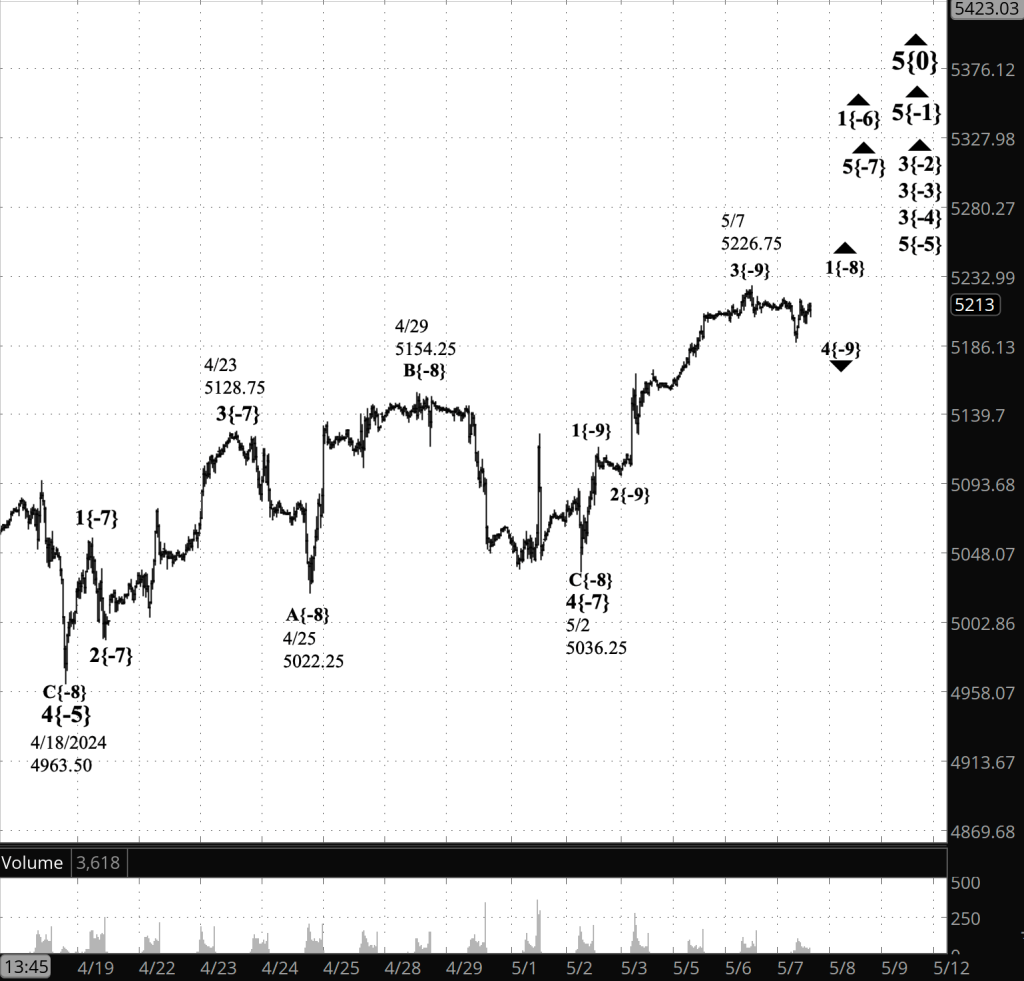
Half an hour before the closing bell. The S&P 500 futures have risen during the session, to 5308.50 so far.

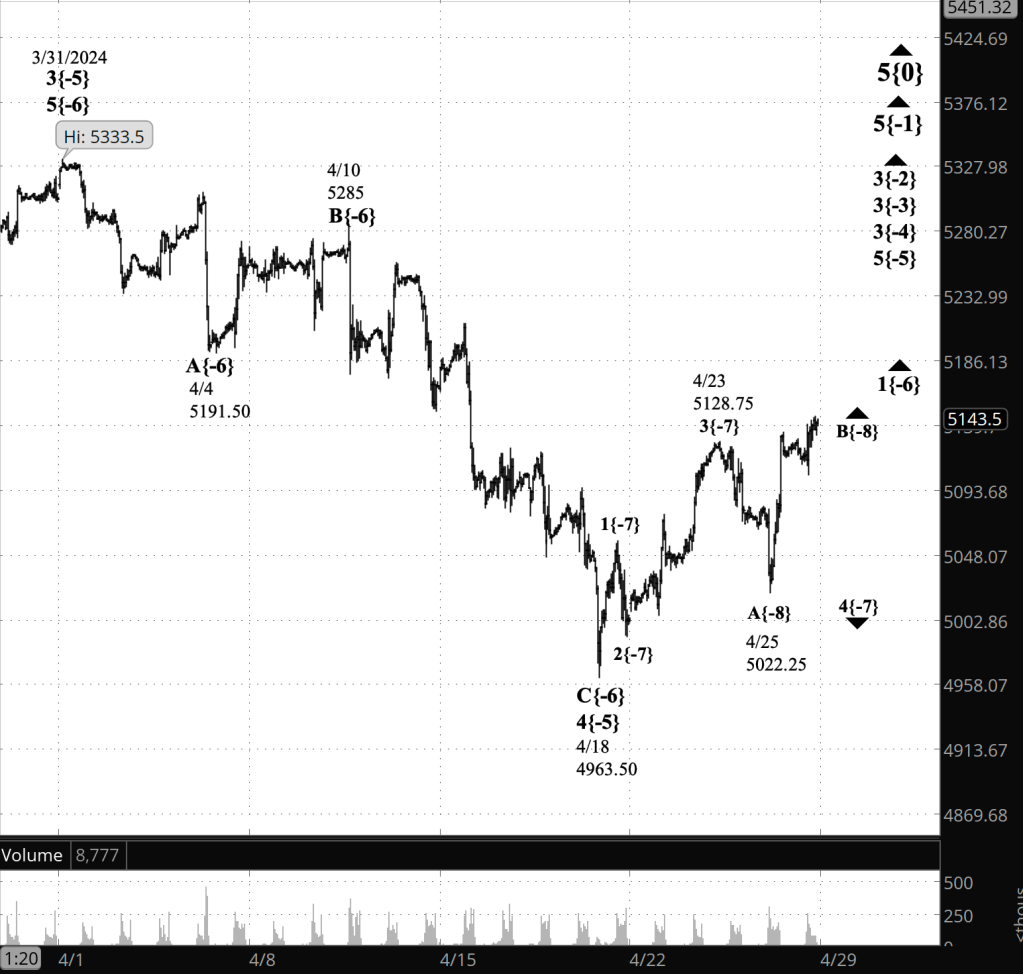
Application of Elliott Wave Theory suggests that the rise is a low-degree B wave that began on April 4 from 5191.50. That was the endpoint of the preceding declining A wave that began on March 31 from 5333.50. Both waves are subwaves of a 4th wave downward correction that began concurrently with the A wave.

On the chart, the wave’s under discussion are waves A{-6} and B{-6} within wave 4{-5}.

The A wave had five subwaves, identifying the correction as following the Zigzag pattern. A ZigZag B wave typically retraces 38% to 79% of the preceding A wave. Those tendencies would give a target price range for wave B of 5245 to 5303. Note that that range is a tendency, not rule, and the reality on the chart may well differ

I’ve updated the chart.

9:35 a.m. New York time

What’s happening now? The S&P 500 E-mini futures rose gradually overnight, to a high of almost 5220 until the Employment Situation Report was published an hour before the opening bell. The price then whipsawed dramatically, from the 5210s down to the 5190s in the span of a minute, returning within five minutes to the level from which it had begun.

What does it mean? In Elliott Wave Theory, the decline that began on April 4 from 5308.50 is in its 4th subwave and will end with its final subwave, declining wave 5.

The end of the 5th subwave will also be the end of its parent, a larger wave 5, and its grandparent, the first subwave, an A wave, within the 4th wave downward correction that began on March 31 from 5333.50.

In the nomenclature used on the chart, each wave number is followed by a subscript curly brackets showing the wave’s relationship to the much larger Intermediate-degree wave that contains everything that has happened over the past few years. The present Intermediate degree wave is wave 5{0}, and it began in December 2018.

On the chart, the S&P 500 futures are in wave 4{-8} within wave 5{-7} within wave 4{-5} within wave A{-6} within the downward correction, wave 4{-5}.

What are the alternatives?

It’s possible that the small 4th wave within the the decline will turn out to be a 2nd wave. The 1st wave of the decline had such power that the internal reversals aren’t entirely clear.

Also, I’ve numbered the correction as though the A wave is a subwave one degree lower than the parent 4th-wave correction. But is it really? Could it be two degrees lower, making it a subwave of the A wave? Only time will resolve the ambiguity.

[S&P 500 E-mini futures at 3:30 p.m., 80-minute bars, with volume]

What does Elliott wave theory say? Here are the waves that underly the analyses.

Principal Analysis:

  • Rising wave 5{0} is underway.
  • It is in its final subwave, wave 5{-1}
  • Within wave 5{-1}, rising waves 3{-2}, 3{-3} and 3{-4} are underway, as is the smallest wave labeled on the chart, wave 3{-5}.
  • Downtrending wave 4{-5} is in its 1st subwave, wave A{-6}, which in turn is in its last subwave, wave 5{-7}, which is in its next-to-the-last subwave, wave 4{-8}.

Reading the chart. Price movements — waves – – in Elliott wave analysis are labeled with numbers within trending waves and letters with corrective waves. The subscripts — numbers in curly brackets — designate the wave’s degree, which, in Elliott wave analysis, means the relative position of a wave within the larger and smaller structures that make up the chart. R.N. Elliott, who in the 1930s developed the form of analysis that bears his name, viewed the chart as a complex structure of smaller waves nested within larger waves, which in turn are nested within still larger waves. In mathematics it’s called a fractal structure, where at every scale the pattern is similar to the others.

Learning and other resources. Elliott wave analysis provides context, not prophecy. As the 20th century semanticist Alfred Korzybski put it in his book Science and Sanity (1933), “The map is not the territory … The only usefulness of a map depends on similarity of structure between the empirical world and the map.” And I would add, in the ever-changing markets, we can judge that similarity of structure only after the fact.

See the menu page Analytical Methods for a rundown on where to go for information on Elliott wave analysis.

By Tim Bovee, Portland, Oregon, April 5, 2024

Disclaimer

Tim Bovee, Private Trader tracks the analysis and trades of a private trader for his own accounts. Nothing in this blog constitutes a recommendation to buy or sell stocks, options or any other financial instrument. The only purpose of this blog is to provide education and entertainment.

No trader is ever 100 percent successful in his or her trades. Trading in the stock and option markets is risky and uncertain. Each trader must make trading decisions for his or her own account, and take responsibility for the consequences.

License
Creative Commons License

All content on Tim Bovee, Private Trader by Timothy K. Bovee is licensed under a Creative Commons Attribution-ShareAlike 4.0 International License.

Based on a work at www.timbovee.com.
Trader’s Notebook

5:30 p.m. New York time

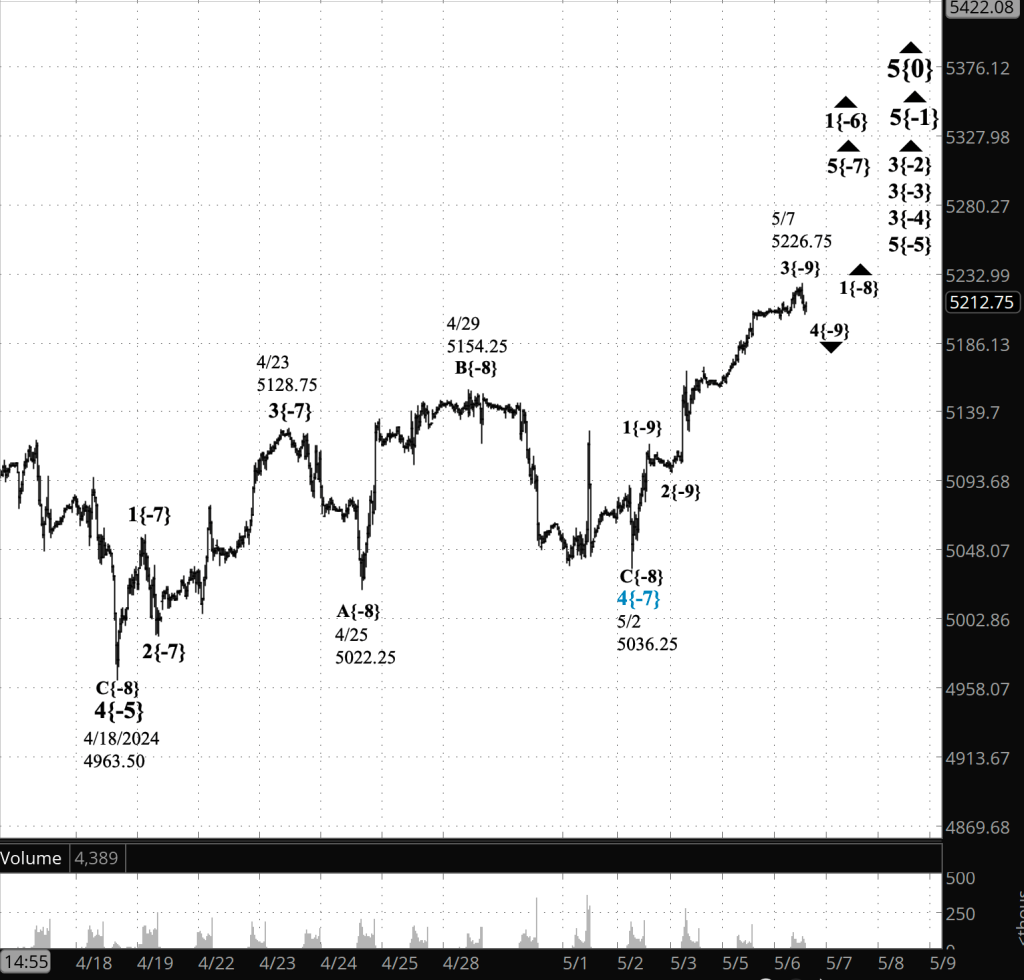
After the closing bell. The S&P 500 futures began to fall after it’s overnight high, 5308.50, and continued to fall during the session, gradually picking up speed at first and then plummeting mid-session to a low of 5192.50.

The overnight high proved to be the end of the 5th subwave within the low-degree 4th-wave upward correction that began on April 2, and that means that the 4th wave has ended and the downtrending 5th wave has begun.

The end of the present decline will also be the end of the A wave within a larger 4th-wave downward correction that began on March 31.

The decline has brought the price deep within the likely price target range of the larger 4th wave. Any 4th wave tends to end within the 4th subwave of the preceding 3rd wave. In this case, that gives a price target of 5353.50 down to 5167.75. That’s a tendency, not a firm rule. Some 4th waves are outliers, either ending short of the target or move beyond its boundaries.

The present decline on the chart is labeled wave 5{-7} within wave A{-6}, which is a subwave of wave 4{-5}.

It’s tempting to label the decline from March 31 to April 2 as the three-subwave A{-6}, the subsequent rise as B{-6}, and the session decline as C{-6}, completing wave 4{-5}.

I chose not to label it that way because of a rule in Elliott Wave Theory. Wave 4{-5} is a Flat, with three subwaves in the A wave. The rule says that if a B wave in a Flat fails to retrace last least 90% of wave A, then it’s not really a B wave. In this case, the hypothetical wave B{-7} retraced a fraction less than 74% of hypothetical wave A{-7}. So it’s not a B wave, and in reality,wave A{-6} continues on its downward course.

I’ve updated the chart.

9:40 a.m. New York time

Afternoon wrap. I have a scheduling conflict that will make it impossible for me to post the afternoon analysis, “Half an hour before the closing bell”, on its usual schedule, 3:30 p.m. New York time. I’ll post an analysis when I’m able, sometime after the market close.

9:35 a.m. New York time

What’s happening now? The S&P 500 E-mini futures continued to rise overnight, reaching above 5300.

What does it mean? The rise that began on April 2 has entered its 5th subwave. In Elliott Wave Theory, that means that the low-degree rising 4th-wave correction that began on that day is in its 1st subwave, wave A. A declining B wave, with three subwaves, will follow, and then a rising C wave with five subwaves.

This is all happening within the first subwave of a downward 4th-wave upward correction that began on March 31.

At this point, we’re juggling a lot of nested waves with the fractal structure market, and I’ll bring in the nomenclatre used on the chart: A wave number followed by a subscript curly brackets showing the wave’s relationship to the much larger Intermediate-degree wave that contains everything that has happened over the past few years. The present Intermediate degree wave is wave 5{0}, and it began in December 2018.

A list of the waves referred to earlier in the discussion shows how deeply buried they all are within wave 5{0}. From smaller to larger: Wave A{8} is underway within rising wave 4{-7}, an upward correction within wave A{-6}, the first subwave of a downward correction, wave 4{-5}, that began on March 31.

Wave 4{-5} is part of an uptrending 3rd wave — wave 3{-4} — that began on February 21. When wave 4{-5} is complete, it will be followed by uptrending wave 5[-5}, which will be the final subwave within wave 3{-4}.

That will trigger a larger 4th-wave downward correction than the one’s in progress today. Wave 3[-4} began from 4959. A 4th wave tends to end within the 4th subwave of the preceding 3rd wave of the same degree. That 4th subwave, wave 4{-5}, is still underway. It began March 31 from 5333.50, and that is the upper boundary of the wave 4{-4} target range.

What are the alternatives? Unchanged from the prior post. I’ve numbered the correction as though the A wave is a subwave one degree lower than the parent 4th-wave correction. But is it really? Could it be two degrees lower, making it a subwave of the A wave? Only time will resolve the ambiguity.

[S&P 500 E-mini futures at 5:35 p.m., 80-minute bars, with volume]

What does Elliott wave theory say? Here are the waves that underly the analyses.

Principal Analysis:

  • Rising wave 5{0} is underway.
  • It is in its final subwave, wave 5{-1}
  • Within wave 5{-1}, rising waves 3{-2}, 3{-3} and 3{-4} are underway, as is the smallest wave labeled on the chart, wave 3{-5}.
  • Downtrending wave 4{-5} is in its 1st subwave, wave A{-6}, which in turn is in its next-to-the-last subwave, wave 4{-7}.
  • The first subwave of wave 4{-7} — wave A{-8} — is underway.

Reading the chart. Price movements — waves – – in Elliott wave analysis are labeled with numbers within trending waves and letters with corrective waves. The subscripts — numbers in curly brackets — designate the wave’s degree, which, in Elliott wave analysis, means the relative position of a wave within the larger and smaller structures that make up the chart. R.N. Elliott, who in the 1930s developed the form of analysis that bears his name, viewed the chart as a complex structure of smaller waves nested within larger waves, which in turn are nested within still larger waves. In mathematics it’s called a fractal structure, where at every scale the pattern is similar to the others.

Learning and other resources. Elliott wave analysis provides context, not prophecy. As the 20th century semanticist Alfred Korzybski put it in his book Science and Sanity (1933), “The map is not the territory … The only usefulness of a map depends on similarity of structure between the empirical world and the map.” And I would add, in the ever-changing markets, we can judge that similarity of structure only after the fact.

See the menu page Analytical Methods for a rundown on where to go for information on Elliott wave analysis.

By Tim Bovee, Portland, Oregon, April 4, 2024

Disclaimer

Tim Bovee, Private Trader tracks the analysis and trades of a private trader for his own accounts. Nothing in this blog constitutes a recommendation to buy or sell stocks, options or any other financial instrument. The only purpose of this blog is to provide education and entertainment.

No trader is ever 100 percent successful in his or her trades. Trading in the stock and option markets is risky and uncertain. Each trader must make trading decisions for his or her own account, and take responsibility for the consequences.

License
Creative Commons License

All content on Tim Bovee, Private Trader by Timothy K. Bovee is licensed under a Creative Commons Attribution-ShareAlike 4.0 International License.

Based on a work at www.timbovee.com.

Trader’s Notebook

3:30 p.m. New York time

Half an hour before the closing bell. The S&P 500 futures rose during the session, reaching into the 5280s. Applying Elliott Wave Theory: The rise has so far traced three clear waves from the low of April 2, the beginning of the 4th subwave within the A wave of the downtrending 4th wave correction that began on March 31. The price reversed late in the session, suggesting that the final wave, wave 5{-7}, has begun.

On the chart, with wave numbers and subscripts in curly brackets designating the wave’s distance from the Intermediate degree, the lineup is rising wave 5{-7} within falling wave A{-6} within falling wave 4{-5}.

I’ve updated the chart.

9:35 a.m. New York time

What’s happening now? The S&P 500 E-mini futures traded sideways overnight, mainly fluctuating in the 5240s and 5250s.

What does it mean? The trading range was centered on the upper boundary of the price target for the 4th-wave downward correction that began on March 31. I’ve marked the price target range boundaries on the chart with dashed red lines.

Elliott Wave Theory counts this sideways movement as the 4th subwave within the larger A wave that is the first leg of a three-way correction. (This labeling is a change from yesterday’s analysis, where I considered the decline to be the final wave of the analysis. It didn’t play out that way.)

Wave A will have five subwaves, wave B will have three and wave C will have five, a Zigzag pattern. Wave 4, the downward correction, will be followed by a 5th-wave uptrend that likely will carry the price beyond the endpoint of the preceding wave 3, which was 5333.50.

When the 4th-wave correction is complete, it will also be the end of its parent, a larger 3rd wave, and the beginning of a another 4th wave correction, this one larger than the one now underway.

What are the alternatives? I’ve numbered the correction as though the A wave is a subwave one degree lower than the parent 4th-wave correction. But is it really? Could it be two degrees lower, making it a subwave of the A wave? Only time will resolve the ambiguity.

[S&P 500 E-mini futures at 3:30 p.m., 80-minute bars, with volume]

What does Elliott wave theory say? Here are the waves that underly the analyses.

Principal Analysis:

  • Rising wave 5{0} is underway.
  • It is in its final subwave, wave 5{-1}
  • Within wave 5{-1}, rising waves 3{-2}, 3{-3} and 3{-4} are underway, as is the smallest wave labeled on the chart, wave 3{-5}.
  • Downtrending wave 4{-5} is in its 1st subwave, wave A{-6}, which in turn is in its next-to-the-last subwave, wave 4{-7}.

Reading the chart. Price movements — waves – – in Elliott wave analysis are labeled with numbers within trending waves and letters with corrective waves. The subscripts — numbers in curly brackets — designate the wave’s degree, which, in Elliott wave analysis, means the relative position of a wave within the larger and smaller structures that make up the chart. R.N. Elliott, who in the 1930s developed the form of analysis that bears his name, viewed the chart as a complex structure of smaller waves nested within larger waves, which in turn are nested within still larger waves. In mathematics it’s called a fractal structure, where at every scale the pattern is similar to the others.

Learning and other resources. Elliott wave analysis provides context, not prophecy. As the 20th century semanticist Alfred Korzybski put it in his book Science and Sanity (1933), “The map is not the territory … The only usefulness of a map depends on similarity of structure between the empirical world and the map.” And I would add, in the ever-changing markets, we can judge that similarity of structure only after the fact.

See the menu page Analytical Methods for a rundown on where to go for information on Elliott wave analysis.

By Tim Bovee, Portland, Oregon, April 3, 2024

Disclaimer

Tim Bovee, Private Trader tracks the analysis and trades of a private trader for his own accounts. Nothing in this blog constitutes a recommendation to buy or sell stocks, options or any other financial instrument. The only purpose of this blog is to provide education and entertainment.

No trader is ever 100 percent successful in his or her trades. Trading in the stock and option markets is risky and uncertain. Each trader must make trading decisions for his or her own account, and take responsibility for the consequences.

License
Creative Commons License

All content on Tim Bovee, Private Trader by Timothy K. Bovee is licensed under a Creative Commons Attribution-ShareAlike 4.0 International License.

Based on a work at www.timbovee.com.

Trader’s Notebook

3:30 p.m. New York time

Half an hour before the closing bell. The S&P 500 futures continued to decline early in the session, reaching into the 5230s. The price then began a sideways pattern.

Applying Elliott Wave Theory, Wave A, the first wave of a 4th-wave downward correction, is underway. Internally, it is in its 3rd subwave, which is either the final wave within the A wave, meaning the correction is taking the form of a Flat, or the middle wave of five total, meaning the correction is taking the form of a Zigzag.

If it’s a Flat, the pause in the decline could be the first steps of a rising B wave, the 2nd subwave of the correction. If it’s a Zigzag, then the pause is a correction within declining wave A, the 1st subwave of the correction.

I’ve updated the chart.

9:35 a.m. New York time

What’s happening now? The S&P 500 E-mini futures continued to fall overnight, reaching into the 5250s.

What does it mean? The fall brought the price into the price target range for the 4th-wave downward correction that began on March 31. The target range runs from 5253.50 to 5167 and is marked by red dashed lines on the chart.

The correction is in its first subwave — wave A. The overnight decline is the 5th and final subwave of the A wave. When the A wave is complete, it will be followed by a rising wave B, which under a rule of Elliott Wave Theory never moves above the starting point of the preceding A wave. So 5333.50 is a firm cap on how far the B wave can travel. A final wave C will complete the correction. C waves almost always are longer than the preceding A wave.

All of this is happening on a relative small scale within the fractal structure of the chart. The 4th wave correction is a subwave of a larger 3rd-wave uptrend, which in turn is nested within three more layers of subwaves, all of 3rd waves. The way the chart will play out for awhile will be a series of 3rd waves ending, triggering a 4th wave correction.

The wave numbers in the upper right-hand corner of the chart have subscripts in curly brackets showing the relative position of the wave within the fractal structure.

What are the alternatives? I’ve number the correction as though the decline is an A wave, a subwave one degree lower than the 4th-wave correction. But is it really? Could it be two degrees lower, making it a subwave of the A wave? Only time will resolve the ambiguity.

[S&P 500 E-mini futures at 3:30 p.m., 70-minute bars, with volume]

What does Elliott wave theory say? Here are the waves that underly the analyses.

Principal Analysis:

  • Rising wave 5{0} is underway.
  • It is in its final subwave, wave 5{-1}
  • Within wave 5{-1}, rising waves 3{-2}, 3{-3} and 3{-4} are underway, as is the smallest wave labeled on the chart, wave 3{-5}.
  • Downtrending wave 4{-5} is in its 1st subwave, wave A{-6}, which in turn is in its 5th and final subwave, wave 5{-7}.

Reading the chart. Price movements — waves – – in Elliott wave analysis are labeled with numbers within trending waves and letters with corrective waves. The subscripts — numbers in curly brackets — designate the wave’s degree, which, in Elliott wave analysis, means the relative position of a wave within the larger and smaller structures that make up the chart. R.N. Elliott, who in the 1930s developed the form of analysis that bears his name, viewed the chart as a complex structure of smaller waves nested within larger waves, which in turn are nested within still larger waves. In mathematics it’s called a fractal structure, where at every scale the pattern is similar to the others.

Learning and other resources. Elliott wave analysis provides context, not prophecy. As the 20th century semanticist Alfred Korzybski put it in his book Science and Sanity (1933), “The map is not the territory … The only usefulness of a map depends on similarity of structure between the empirical world and the map.” And I would add, in the ever-changing markets, we can judge that similarity of structure only after the fact.

See the menu page Analytical Methods for a rundown on where to go for information on Elliott wave analysis.

By Tim Bovee, Portland, Oregon, April 2, 2024

Disclaimer

Tim Bovee, Private Trader tracks the analysis and trades of a private trader for his own accounts. Nothing in this blog constitutes a recommendation to buy or sell stocks, options or any other financial instrument. The only purpose of this blog is to provide education and entertainment.

No trader is ever 100 percent successful in his or her trades. Trading in the stock and option markets is risky and uncertain. Each trader must make trading decisions for his or her own account, and take responsibility for the consequences.

License
Creative Commons License

All content on Tim Bovee, Private Trader by Timothy K. Bovee is licensed under a Creative Commons Attribution-ShareAlike 4.0 International License.

Based on a work at www.timbovee.com.

Trader’s Notebook

3:30 p.m. New York time

Half an hour before the closing bell. The S&P 500 futures continued to fall during the session, reaching into the 5280s. The further the decline, the greater the likelihood that the the principal analysis is the better match for the reality of the chart: A 4th wave decline has begun.

In Elliott Wave Theory, 4th waves tend to end within the 4th subwave of the preceding 3rd wave of the same degree. On the chart, that would be in the range of wave 4{-6} within wave 3{-5}, from 5253.50 down to 5167.75. I’ve marked the range boundaries with dashed red lines.

That target range represents a tendency, not a firm rule. The correction could turn out to be shallower or deeper than the target range would suggest.

The subwaves of wave the preceding 3rd wave uptrend took one or two weeks to reach completion. Under the Elliott Wave proportionality tendency, the subwaves of the present declining 4th wave can be expected to take about the same amount of time. A 4th wave has three subwaves. If wave A is the shortest of the lot (one week) and the other two each lasts for two weeks, then we can expect correction to last seven weeks or so, carrying the chart into May. Plus or minus who knows what. It’s a tendency, not a rule.

Rather than updating the morning’s close-up chart, I’ve added a new chart for the afternoon analysis, showing the preceding 3rd wave in its entirely followed the early steps of the 4th wave.

[S&P 500 E-mini futures at 3:30 p.m., 70-minute bars, with volume]

9:35 a.m. New York time

What’s happening now? The S&P 500 E-mini futures peaked at 5333.50 shortly after trading resumed overnight, and then dropped almost to 5310.

What does it mean? The 3rd wave uptrend that began on February 28 has ended, and a 4th-wave downward correction has begun.

Applying Elliott Wave Theory: The peak came as the 5th-wave uptrend that began on March 29 was in the 5th subwave of its rise. The the decline that followed can be counted as being in its 3rd subwave, although the structure of the 11 hours of sideways trading after the peak lacks clarity. The subsequent sharper decline is in its 3rd subwave.

What to make of all of this? The fact that the 5th wave uptrend is in its 5th subwave means that any new high could be its end. The 5th wave is itself the final subwave of a larger 5th wave uptrend that began on March 15. Up one more degree, the end of the two smaller 5th waves also means the end of a larger 5th wave, whose end is the end of a still larger 3rd wave that began on February 28 from 5088.

What follows the 3rd wave is a 4th-wave correction, which is in its 1st subwave, an A wave.

The waves appear on the chart appear with subscript’s in curly brackets showing the relative distance of each wave’s degree from Intermediate degree, which has a degree designation of {0}.

In the above discussion, the ending waves, small to large, are wave 5{-8} within wave 5{-7} within wave A{-6}, all three within wave 3{-5}. The beginning waves are wave 1{-8} within wave 1{-7} within wave 1{-6}, all of them subwaves of wave 4{-5}.

Wave 4{-5} is a downward correction.

What are the alternatives? As always, assigning degree designators to the first tentative steps of a larger wave is an uncertain proposition. Also, is this decline actually the start of a 4th wave correction, as the principal anaysis has it, or is it a subwave of the ongoing 5th-wave uptrend, as an alternative analysis? It looks very much like a correction to my eyes, but it hasn’t proceeded far enough to be absolutely certain.

[S&P 500 E-mini futures at 9:35 a.m., 30-minute bars, with volume]

What does Elliott wave theory say? Here are the waves that underly the analyses.

Principal Analysis:

  • Rising wave 5{0} is underway.
  • It is in its final subwave, wave 5{-1}
  • Within wave 5{-1}, rising waves 3{-2}, 3{-3} and 3{-4} are underway, as is the smallest wave labeled on the chart, wave 3{-5}.
  • Downtrending wave 4{-5} is in its 1st subwave, wave A{-6}.

Reading the chart. Price movements — waves – – in Elliott wave analysis are labeled with numbers within trending waves and letters with corrective waves. The subscripts — numbers in curly brackets — designate the wave’s degree, which, in Elliott wave analysis, means the relative position of a wave within the larger and smaller structures that make up the chart. R.N. Elliott, who in the 1930s developed the form of analysis that bears his name, viewed the chart as a complex structure of smaller waves nested within larger waves, which in turn are nested within still larger waves. In mathematics it’s called a fractal structure, where at every scale the pattern is similar to the others.

Learning and other resources. Elliott wave analysis provides context, not prophecy. As the 20th century semanticist Alfred Korzybski put it in his book Science and Sanity (1933), “The map is not the territory … The only usefulness of a map depends on similarity of structure between the empirical world and the map.” And I would add, in the ever-changing markets, we can judge that similarity of structure only after the fact.

See the menu page Analytical Methods for a rundown on where to go for information on Elliott wave analysis.

By Tim Bovee, Portland, Oregon, April 1, 2024

Disclaimer

Tim Bovee, Private Trader tracks the analysis and trades of a private trader for his own accounts. Nothing in this blog constitutes a recommendation to buy or sell stocks, options or any other financial instrument. The only purpose of this blog is to provide education and entertainment.

No trader is ever 100 percent successful in his or her trades. Trading in the stock and option markets is risky and uncertain. Each trader must make trading decisions for his or her own account, and take responsibility for the consequences.

License
Creative Commons License

All content on Tim Bovee, Private Trader by Timothy K. Bovee is licensed under a Creative Commons Attribution-ShareAlike 4.0 International License.

Based on a work at www.timbovee.com.

Trader’s Notebook

Market holiday. U.S. markets will be closed on Friday, March 29, to mark the Christian Good Friday holiday. The next Trader’s Notebook will be posted on Monday, April 1.

3:30 p.m. New York time

Half an hour before the closing bell. The S&P 500 futures rose during the session, breaking past 5320. Applying Elliott Wave Theory: The move past the end of the preceding 3rd wave suggests the possibility that the low-degree 4th wave ended today, at the overnight low, 5301, and that the uptrending 5th wave has begun. Although it’s not yet a certainty. The rise is small enough so far to count as a subwave within the 4th wave. This is all happening within a larger uptrending 5th wave.

The waves in question, as labeled on the chart, are waves 4{-8} (correction) and 5{-8} (uptrend) within wave 5{-7} (larger uptrend). I’ve updated the chart, retaining this morning’s analysis until there is greater certainty that the uptrend truly has begun.

9:35 a.m. New York time

What’s happening now? The S&P 500 E-mini futures shot up to 5312.50 in a minute after the 2nd GDP revision was released, and in the next minute retreated to their overnight price range, just above 5300.

What does it mean? Elliott Wave Theory looks at chart patterns, not economic releases. The rapid rise and fall came in below the peak that had ended the rise during the March 27 session, to 5313.75.

Taken together, the pattern confirms yesterday’s alternative analysis: The 4th wave downward correction that began on March 21 ended on March 27 at 5263. From that point an uptrending 5th wave began and has quickly worked its way through three subwaves and is now in wave 4, the next-to-the-last subwave.

When the 5th subwave is complete, it will also mark the end of its parent, also a 5th wave, and of its grandparent, a larger 3rd wave. A 4th-wave downward correction will follow, two degrees larger than the one that ended on March 27.

What are the alternatives? (The following discussion uses degree designations as subscripts in curly brackets. See the “Reading the chart” section below for an explanation.)

But what degree is the 5th wave that began on March 27, wave 5{-7} on the chart? The waves at degree {-7} have tended to last several sessions. Wave 3{-7} went for three sessions. If the subwaves I’ve labeled as degree {-8} are truly only one degree smaller than their parent wave, then wave 5{-7} will be finished in less than two sessions. It’s possible that the {-8} waves 1 through 4 that I’ve numbered on the chart are one degree lower, the {-9} degree, and are subwaves of wave 1{-8}.

Time will tell which degree-labeling best matches the chart.

[S&P 500 E-mini futures at 3:30 p.m., 30-minute bars, with volume]

What does Elliott wave theory say? Here are the waves that underly the analyses.

Principal Analysis:

  • Rising wave 5{0} is underway.
  • It is in its final subwave, wave 5{-1}
  • Within wave 5{-1}, rising waves 3{-2}, 3{-3} and 3{-4} are underway, as is the smallest wave labeled on the chart, wave 3{-5}.
  • Wave 3{-5} is in its 5th subwave, wave 5{-6}
  • Within wave 5{-6}, uptrending wave 5{-7} is underway.

Reading the chart. Price movements — waves – – in Elliott wave analysis are labeled with numbers within trending waves and letters with corrective waves. The subscripts — numbers in curly brackets — designate the wave’s degree, which, in Elliott wave analysis, means the relative position of a wave within the larger and smaller structures that make up the chart. R.N. Elliott, who in the 1930s developed the form of analysis that bears his name, viewed the chart as a complex structure of smaller waves nested within larger waves, which in turn are nested within still larger waves. In mathematics it’s called a fractal structure, where at every scale the pattern is similar to the others.

Learning and other resources. Elliott wave analysis provides context, not prophecy. As the 20th century semanticist Alfred Korzybski put it in his book Science and Sanity (1933), “The map is not the territory … The only usefulness of a map depends on similarity of structure between the empirical world and the map.” And I would add, in the ever-changing markets, we can judge that similarity of structure only after the fact.

See the menu page Analytical Methods for a rundown on where to go for information on Elliott wave analysis.

By Tim Bovee, Portland, Oregon, March 28, 2024

Disclaimer

Tim Bovee, Private Trader tracks the analysis and trades of a private trader for his own accounts. Nothing in this blog constitutes a recommendation to buy or sell stocks, options or any other financial instrument. The only purpose of this blog is to provide education and entertainment.

No trader is ever 100 percent successful in his or her trades. Trading in the stock and option markets is risky and uncertain. Each trader must make trading decisions for his or her own account, and take responsibility for the consequences.

License
Creative Commons License

All content on Tim Bovee, Private Trader by Timothy K. Bovee is licensed under a Creative Commons Attribution-ShareAlike 4.0 International License.

Based on a work at www.timbovee.com.
Trader’s Notebook

3:30 p.m. New York time

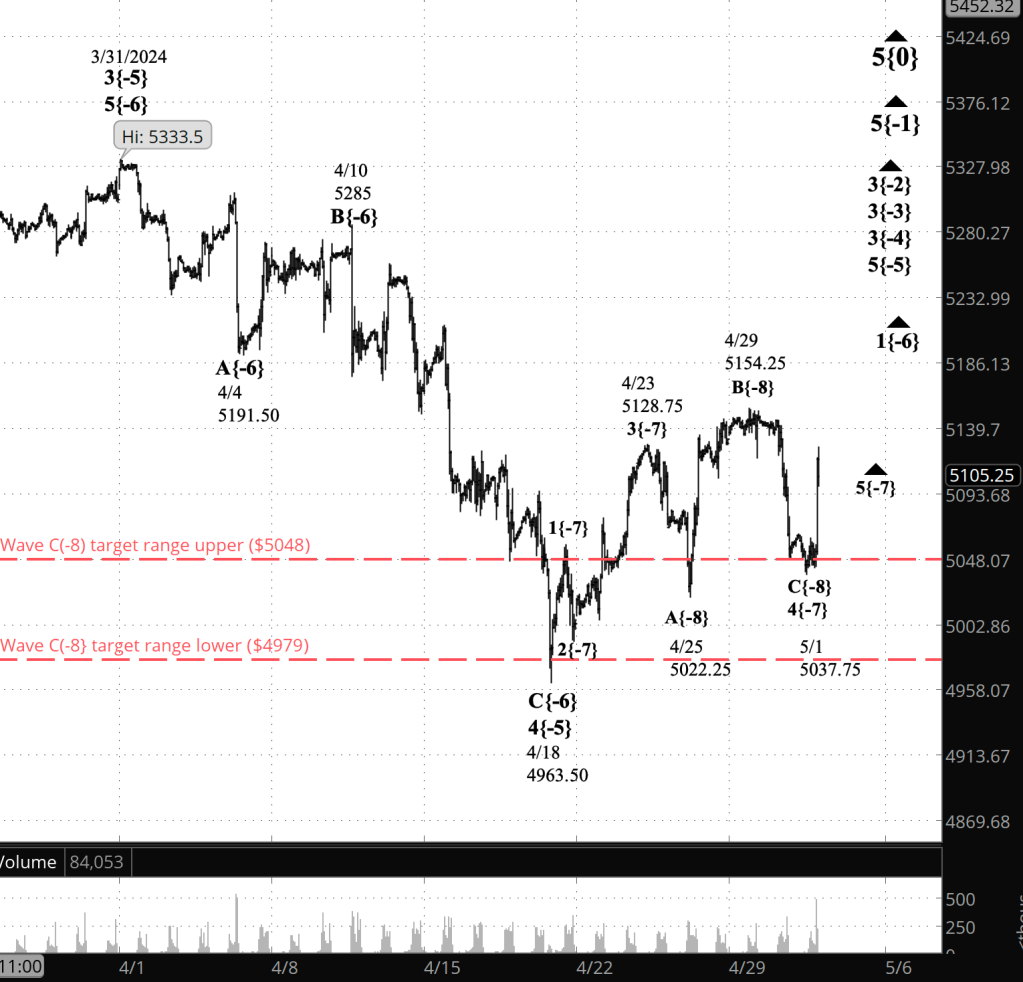
Half an hour before the closing bell. The S&P 500 futures rose during the session and then retreated, remaining below the March 26 high. This morning’s analysis remains unchanged. The 3rd and final subwave, wave C, within the 4th-wave downward correction that began on March 21 continues. I’ve updated the chart.

9:35 a.m. New York time

What’s happening now? The S&P 500 E-mini futures rose overnight, from the 5270s to the 5290s.

What does it mean? Under Elliott Wave Theory, the rise can be interpreted in two ways: Either it is the middle subwave (wave B) of larger C-wave decline, or the larger C wave ended at the March 26 low, 5263, completing the still larger 4th-wave correction, and a 5th-wave uptrend has begun.

For the moment I’m sticking with yesterday’s principal analysis — the B-wave-decline scenario. The decline lacks a clear five-wave pattern, as is normal for the C wave within a Zigzag pattern. The overnight rise fits nicely as a B wave within the C wave.

One caveat: A 4th-wave correction never moves the end of the preceding 1st wave — 5240.25 on March 18 in this case. If it does, then the analysis must be revised to eliminate the error. The C subwave low so far is 5263, so there’s not much downside left for an ongoing C-wave decline.

What are the alternatives? None beyond what was discussed above. Other ambiguities, without a doubt, will appear.

[S&P 500 E-mini futures at 3:30 p.m., 30-minute bars, with volume]

What does Elliott wave theory say? Here are the waves that underly the analyses.

Principal Analysis:

  • Rising wave 5{0} is underway.
  • It is in its final subwave, wave 5{-1}
  • Within wave 5{-1}, rising waves 3{-2}, 3{-3} and 3{-4} are underway, as is the smallest wave labeled on the chart, wave 3{-5}.
  • Wave 3{-5} is in its 5th subwave, wave 5{-6}
  • Within wave 5{-6}, the next-to-the-last subwave, wave 4{-7}, is underway.
  • Wave C{-8}, the last of three subwaves within wave 4{-7}, began on March 26 and is in its second subwave (wave B{-9}.
  • Or, wave C{-8} may have ended at the March 26 low, ending wave 4{-7} and marking the start of an uptrend, wave 5{-7}.

Reading the chart. Price movements — waves – – in Elliott wave analysis are labeled with numbers within trending waves and letters with corrective waves. The subscripts — numbers in curly brackets — designate the wave’s degree, which, in Elliott wave analysis, means the relative position of a wave within the larger and smaller structures that make up the chart. R.N. Elliott, who in the 1930s developed the form of analysis that bears his name, viewed the chart as a complex structure of smaller waves nested within larger waves, which in turn are nested within still larger waves. In mathematics it’s called a fractal structure, where at every scale the pattern is similar to the others.

Learning and other resources. Elliott wave analysis provides context, not prophecy. As the 20th century semanticist Alfred Korzybski put it in his book Science and Sanity (1933), “The map is not the territory … The only usefulness of a map depends on similarity of structure between the empirical world and the map.” And I would add, in the ever-changing markets, we can judge that similarity of structure only after the fact.

See the menu page Analytical Methods for a rundown on where to go for information on Elliott wave analysis.

By Tim Bovee, Portland, Oregon, March 27, 2024

Disclaimer

Tim Bovee, Private Trader tracks the analysis and trades of a private trader for his own accounts. Nothing in this blog constitutes a recommendation to buy or sell stocks, options or any other financial instrument. The only purpose of this blog is to provide education and entertainment.

No trader is ever 100 percent successful in his or her trades. Trading in the stock and option markets is risky and uncertain. Each trader must make trading decisions for his or her own account, and take responsibility for the consequences.

License
Creative Commons License

All content on Tim Bovee, Private Trader by Timothy K. Bovee is licensed under a Creative Commons Attribution-ShareAlike 4.0 International License.

Based on a work at www.timbovee.com.
Trader’s Notebook

3:30 p.m. New York time

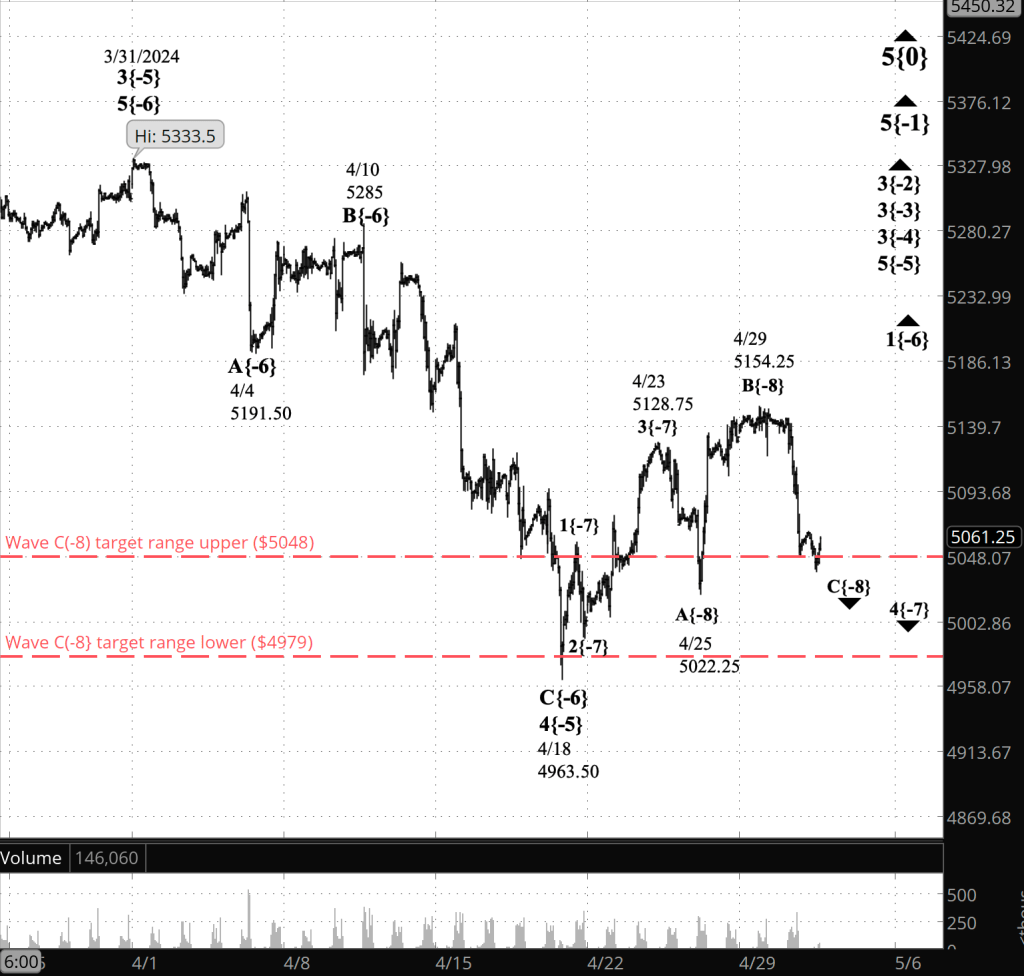
Half an hour before the closing bell. The S&P 500 futures continued to gradually work their way lower during the session. Elliott Wave Theory sees the decline as forming a clear five-subwave pattern, indicating that the 4th-wave downward correction that began on March 21 has entered a C wave, the final subwave of three. This morning’s 4th-wave-continues analysis stands, although the subwave labeling has been updated, as has the chart.

9:35 a.m. New York time

What’s happening now? The S&P 500 E-mini futures rose overnight to 5300 and then pulled back slightly.

What does it mean? Viewed through the lens of Elliott Wave Theory, the pattern is ambiguous. Either the rise is a B-wave with three subwaves within its parent, a low-degree 4th-wave downward correction that began on March 21. Or the 4th wave ended on March 25 and the next wave, a 5th-wave uptrend, has begun.

I’m leaning toward the 4th-wave-continues analysis. The decline from March 21 to March 25 is best seen as having five subwaves, as is proper for the A wave of a Zigzag correction. I see no clear three subwave pattern, a requirement for the 5th-wave-begins analysis.

What are the alternatives? None beyond what was discussed above. Other ambiguities, without a doubt, will appear.

The Chart. I’ve moved the chart closer in so as to see greater detail in the 4th-wave downward correction — wave 4{-7} on the chart. See reading the “Reading the chart” section below for an explanation of the subscripts in curly brackets, which give each wave’s relationship to a much larger degree, the Intermediate degree, which is presently wave 5{0}, which began in December 2018.

Wave A{-8} on the chart lacks clarity in its subwaves. I’ve numbered them, waves 1{-9} through 5{-9}, but with little confidence. There are other readings possible.

[S&P 500 E-mini futures at 3:30 p.m., 20-minute bars, with volume]

What does Elliott wave theory say? Here are the waves that underly the analyses.

Principal Analysis:

  • Rising wave 5{0} is underway.
  • It is in its final subwave, wave 5{-1}
  • Within wave 5{-1}, rising waves 3{-2}, 3{-3} and 3{-4} are underway, as is the smallest wave labeled on the chart, wave 3{-5}.
  • Wave 3{-5} is in its 5th subwave, wave 5{-6}
  • Within wave 5{-6}, the next-to-the-last subwave, wave 4{-7}, is underway.
  • Wave B{-8}, the middle of three subwaves within wave 4{-7}, began on March 25 and may have ended on March 26 at the overnight high, 5300.50, the end of wave C{-9}. Or perhaps not. The high could instead be the end of rising wave A{-9}, and the subsequent decline the beginning of falling wave B{-9}.

Reading the chart. Price movements — waves – – in Elliott wave analysis are labeled with numbers within trending waves and letters with corrective waves. The subscripts — numbers in curly brackets — designate the wave’s degree, which, in Elliott wave analysis, means the relative position of a wave within the larger and smaller structures that make up the chart. R.N. Elliott, who in the 1930s developed the form of analysis that bears his name, viewed the chart as a complex structure of smaller waves nested within larger waves, which in turn are nested within still larger waves. In mathematics it’s called a fractal structure, where at every scale the pattern is similar to the others.

Learning and other resources. Elliott wave analysis provides context, not prophecy. As the 20th century semanticist Alfred Korzybski put it in his book Science and Sanity (1933), “The map is not the territory … The only usefulness of a map depends on similarity of structure between the empirical world and the map.” And I would add, in the ever-changing markets, we can judge that similarity of structure only after the fact.

See the menu page Analytical Methods for a rundown on where to go for information on Elliott wave analysis.

By Tim Bovee, Portland, Oregon, March 26, 2024

Disclaimer

Tim Bovee, Private Trader tracks the analysis and trades of a private trader for his own accounts. Nothing in this blog constitutes a recommendation to buy or sell stocks, options or any other financial instrument. The only purpose of this blog is to provide education and entertainment.

No trader is ever 100 percent successful in his or her trades. Trading in the stock and option markets is risky and uncertain. Each trader must make trading decisions for his or her own account, and take responsibility for the consequences.

License
Creative Commons License

All content on Tim Bovee, Private Trader by Timothy K. Bovee is licensed under a Creative Commons Attribution-ShareAlike 4.0 International License.

Based on a work at www.timbovee.com.

Trader’s Notebook

3:30 p.m. New York time

Half an hour before the closing bell. The S&P 500 futures rose into the 5280s and for the most part stayed in that area, trading sideway for most of the session. This morning’s Elliott Wave Theory analysis is unchanged. The low-degree 4th-wave correction within a 5th-wave uptrend one degree larger continues. I’ve updated the chart.

9:35 a.m. New York time

What’s happening now? The S&P 500 E-mini futures continued their decline after trading resumed overnight, reaching into the 5270s.

What does it mean? Elliott Wave Theory sees the decline as 4th-wave downward correction of low degree that began on March 21, part of a 5th-wave uptrend, one degree larger, that began on March 15.

Bigger picture: The 5th wave is a subwave of four levels of 3rd waves, each larger by a degree than the one that came before, all within a 5th-wave uptrend that began on October 13, 2022, from 3502.

The series of rising 3rd subwaves means that the larger 5th-wave uptrend still has a lot of life left in it before reaching its end, since each 3rd subwave, when it reaches completion, must go through a 4th-wave downward correction and then a 5th wave rise before reaching its end.

What are the alternatives? None at present. They will surely develop.

[S&P 500 E-mini futures at 3:30 p.m., hourly bars, with volume]

What does Elliott wave theory say? Here are the waves that underly the analyses.

Principal Analysis:

  • Rising wave 5{0} is underway.
  • It is in its final subwave, wave 5{-1}
  • Within wave 5{-1}, rising waves 3{-2}, 3{-3} and 3{-4} are underway, as is the smallest wave labeled on the chart, wave 3{-5}.
  • Wave 3{-5} is in its 5th subwave, wave 5{-6}
  • Within wave 5{-6}, the next-to-the-last subwave, wave 4{-7}, is underway.

Reading the chart. Price movements — waves – – in Elliott wave analysis are labeled with numbers within trending waves and letters with corrective waves. The subscripts — numbers in curly brackets — designate the wave’s degree, which, in Elliott wave analysis, means the relative position of a wave within the larger and smaller structures that make up the chart. R.N. Elliott, who in the 1930s developed the form of analysis that bears his name, viewed the chart as a complex structure of smaller waves nested within larger waves, which in turn are nested within still larger waves. In mathematics it’s called a fractal structure, where at every scale the pattern is similar to the others.

Learning and other resources. Elliott wave analysis provides context, not prophecy. As the 20th century semanticist Alfred Korzybski put it in his book Science and Sanity (1933), “The map is not the territory … The only usefulness of a map depends on similarity of structure between the empirical world and the map.” And I would add, in the ever-changing markets, we can judge that similarity of structure only after the fact.

See the menu page Analytical Methods for a rundown on where to go for information on Elliott wave analysis.

By Tim Bovee, Portland, Oregon, March 25, 2024

Disclaimer

Tim Bovee, Private Trader tracks the analysis and trades of a private trader for his own accounts. Nothing in this blog constitutes a recommendation to buy or sell stocks, options or any other financial instrument. The only purpose of this blog is to provide education and entertainment.

No trader is ever 100 percent successful in his or her trades. Trading in the stock and option markets is risky and uncertain. Each trader must make trading decisions for his or her own account, and take responsibility for the consequences.

License
Creative Commons License

All content on Tim Bovee, Private Trader by Timothy K. Bovee is licensed under a Creative Commons Attribution-ShareAlike 4.0 International License.

Based on a work at www.timbovee.com.
Trader’s Notebook

3:30 p.m. New York time

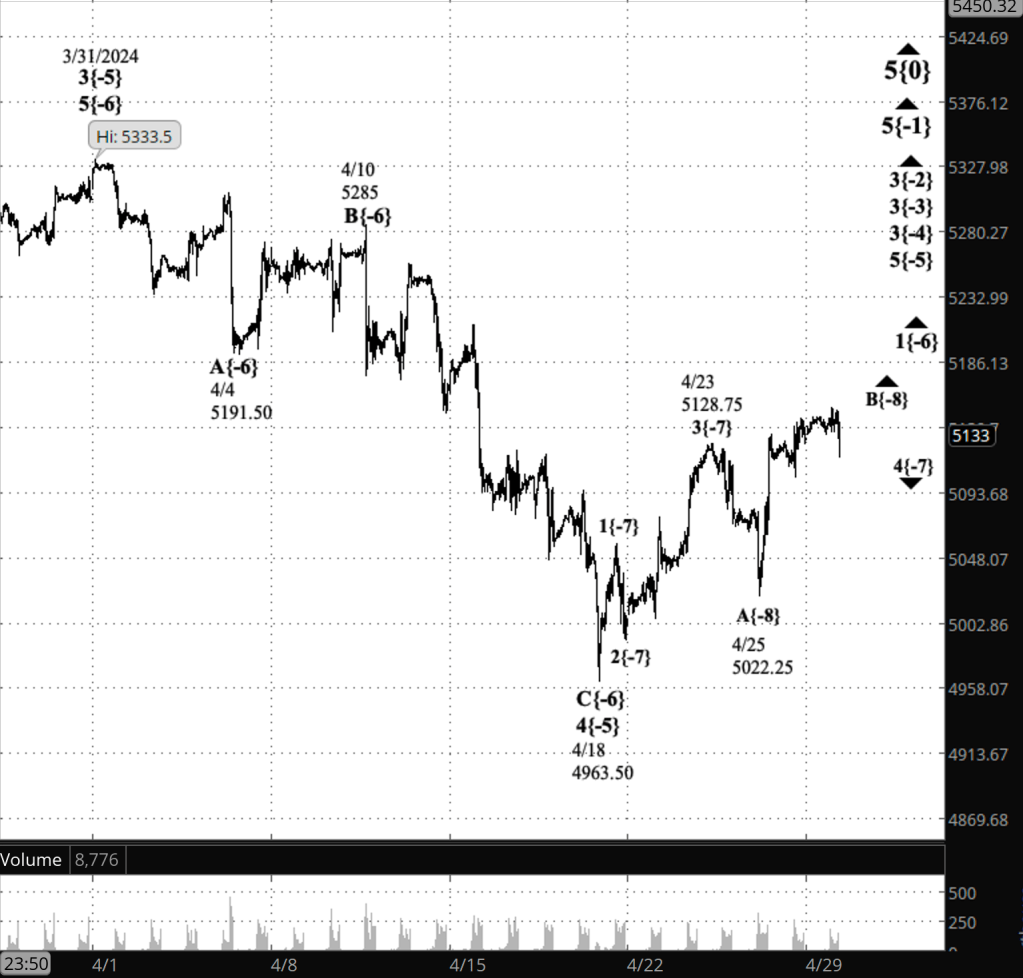
Half an hour before the closing bell. The S&P 500 futures traded narrowly during the session, bouncing around the 5300 level but going nowhere. Elliott Wave Theory: The 4th-wave correction within a low-degree 5th-wave uptrend continues. I’ve updated the chart.

9:35 a.m. New York time

What’s happening now? The S&P 500 E-mini futures fell rapidly as the opening bell approached, from 5311.75 into the 5290s in 45 minutes.

What does it mean? In Elliott Wave Theory, the decline is a small 4th-wave correction within the 5th wave of an uptrend that began on March 15. The uptrend is a subwave of a nested series of 3rd waves of increasing size. All of this is happening within a rising 5th wave that began in October 2023.

The 4th-wave correction will be followed by a rising 5th wave that will complete the uptrend from March 15 and willl also complete the parent 5th wave. A larger 4th-wave downward correction will follow.

What are the alternatives? None at present. They will surely develop.

[S&P 500 E-mini futures at 3:30 p.m., hourly bars, with volume]

What does Elliott wave theory say? Here are the waves that underly the analyses.

Principal Analysis:

.

  • Rising wave 5{0} is underway.
  • It is in its final subwave, wave 5{-1}
  • Within wave 5{-1}, rising waves 3{-2}, 3{-3} and 3{-4} are underway, as is the smallest wave labeled on the chart, wave 3{-5}.
  • Wave 3{-5} is in its 5th subwave, wave 5{-6}
  • Within wave 5{-6}, the next-to-the-last subwave, wave 4{-7}, is underway.

We Are Here.

These are the waves currently in progress under my principal analysis. Each line on the list shows the wave number, with the subscript in curly brackets, the traditional degree name, the starting date, the starting price of the S&P 500 E-mini futures, and the direction of the wave.

  • S&P 500 Index:
  • 5{+3} Supercycle, 7/8/1932, 4.40 (up)
  • 5{+2} Cycle, 12/9/1974, 60.96 (up)
  • 5{+1} Primary, 3/6/2009, 666.79 (up)
  • 5{0} Intermediate, 12/26/2018, 2346.58 (up)
  • S&P 500 Futures and index:
  • 5{-1} Minor, 10/13/2022, 3502 (up) (futures), 3491.58 (up) (index)
  • S&P 500 Futures:

Reading the chart. Price movements — waves – – in Elliott wave analysis are labeled with numbers within trending waves and letters with corrective waves. The subscripts — numbers in curly brackets — designate the wave’s degree, which, in Elliott wave analysis, means the relative position of a wave within the larger and smaller structures that make up the chart. R.N. Elliott, who in the 1930s developed the form of analysis that bears his name, viewed the chart as a complex structure of smaller waves nested within larger waves, which in turn are nested within still larger waves. In mathematics it’s called a fractal structure, where at every scale the pattern is similar to the others.

Learning and other resources. Elliott wave analysis provides context, not prophecy. As the 20th century semanticist Alfred Korzybski put it in his book Science and Sanity (1933), “The map is not the territory … The only usefulness of a map depends on similarity of structure between the empirical world and the map.” And I would add, in the ever-changing markets, we can judge that similarity of structure only after the fact.

See the menu page Analytical Methods for a rundown on where to go for information on Elliott wave analysis.

By Tim Bovee, Portland, Oregon, March 22, 2024

Disclaimer

Tim Bovee, Private Trader tracks the analysis and trades of a private trader for his own accounts. Nothing in this blog constitutes a recommendation to buy or sell stocks, options or any other financial instrument. The only purpose of this blog is to provide education and entertainment.

No trader is ever 100 percent successful in his or her trades. Trading in the stock and option markets is risky and uncertain. Each trader must make trading decisions for his or her own account, and take responsibility for the consequences.

License
Creative Commons License

All content on Tim Bovee, Private Trader by Timothy K. Bovee is licensed under a Creative Commons Attribution-ShareAlike 4.0 International License.

Based on a work at www.timbovee.com.