Options Trades 12/20/2023: IWM

Symbols traded today: IWM (37DTE)

I entered a longer term short iron condor position on IWM 37 days before expiration and exited with 22 days to go, for an 11.6% loss. The expectation for the position was that volatility would decline, boosting the return. Volatility rose instead. My method is to manage or exit a position 21 days before expiration. I exited a day early to avoid holding the position through the next release of employment numbers, on January 5 befor ethe opening bell.

IWM short Iron Condor

The position expires in 37 days, on January 26, 2024. My intent is to exit the position at 50% profit or at 21 days before expiration, on January 5, whatever the profit or loss. Also, I’ve penciled in two prices that may trigger an exit if they should be crossed, near the expected move based on options pricing. The trigger points are 209.97 to the upside and 192.71 to the downside.

One change that I’ve made to my prior practice for such trades is to tighten the long options, which limit my potential losses. This reduces the risk/reward ratio.

LOT:8ENTRY DATE:12/20/2023
EXIT DATE:1/4/2024
DAYS HELD:15

Entry and Exit

METRICCREDITDEBITCHANGECHANGE %ANNUALIZED CHANGE %
Options premium$ 0.76$ 0.86$ (0.10)-11.6%-281%
METRICENTRYEXITCHANGECHANGE %ANNUALIZED CHANGE %
Stock price$ 201.34$ 194.58$ 6.76-3.36%-82%
Impllied Volatility Rate31.846.514.7
Days to expiration3722

The structure of the position

STRUCTURESTRIKEODDS EXPIRE OTMDELTAIN PRICEOUT PRICENET PRICE
Calls
Long213.0080.0%20$ (1.61)$ 0.26$ (1.35)
Break-even211.7678.0%22
Short211.0076.0%24$ 2.01$ (0.38)$ 1.63
Puts
Short193.0080.0%20$ 1.69$ (3.22)$ (1.53)
Break-even191.7682.0%18
Long191.0084.0%16$ (1.33)$ 2.48$ 1.15
======
`NET TOTAL:$ (0.10)

Risk and Reward

Per contract:
Reward76.00
Risk124.00
R/R Ratio (n:1)1.6

By Tim Bovee, Portland, Oregon, December 20, 2023 / January 5, 2024

Disclaimer

Tim Bovee, Private Trader tracks the analysis and trades of a private trader for his own accounts. Nothing in this blog constitutes a recommendation to buy or sell stocks, options or any other financial instrument. The only purpose of this blog is to provide education and entertainment.

No trader is ever 100 percent successful in his or her trades. Trading in the stock and option markets is risky and uncertain. Each trader must make trading decisions for his or her own account, and take responsibility for the consequences.

License
Creative Commons License

All content on Tim Bovee, Private Trader by Timothy K. Bovee is licensed under a Creative Commons Attribution-ShareAlike 4.0 International License.

Based on a work at www.timbovee.com.
Trader’s Notebook

3:30 p.m. New York time

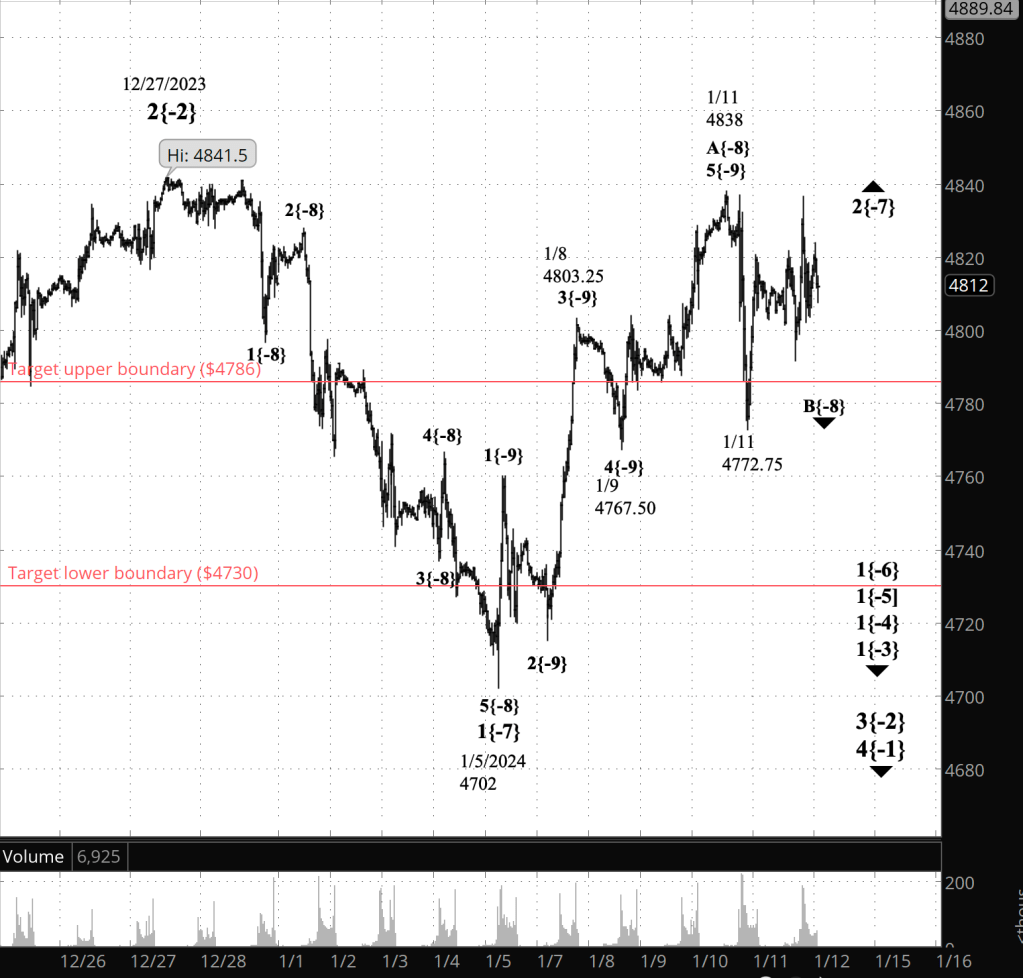
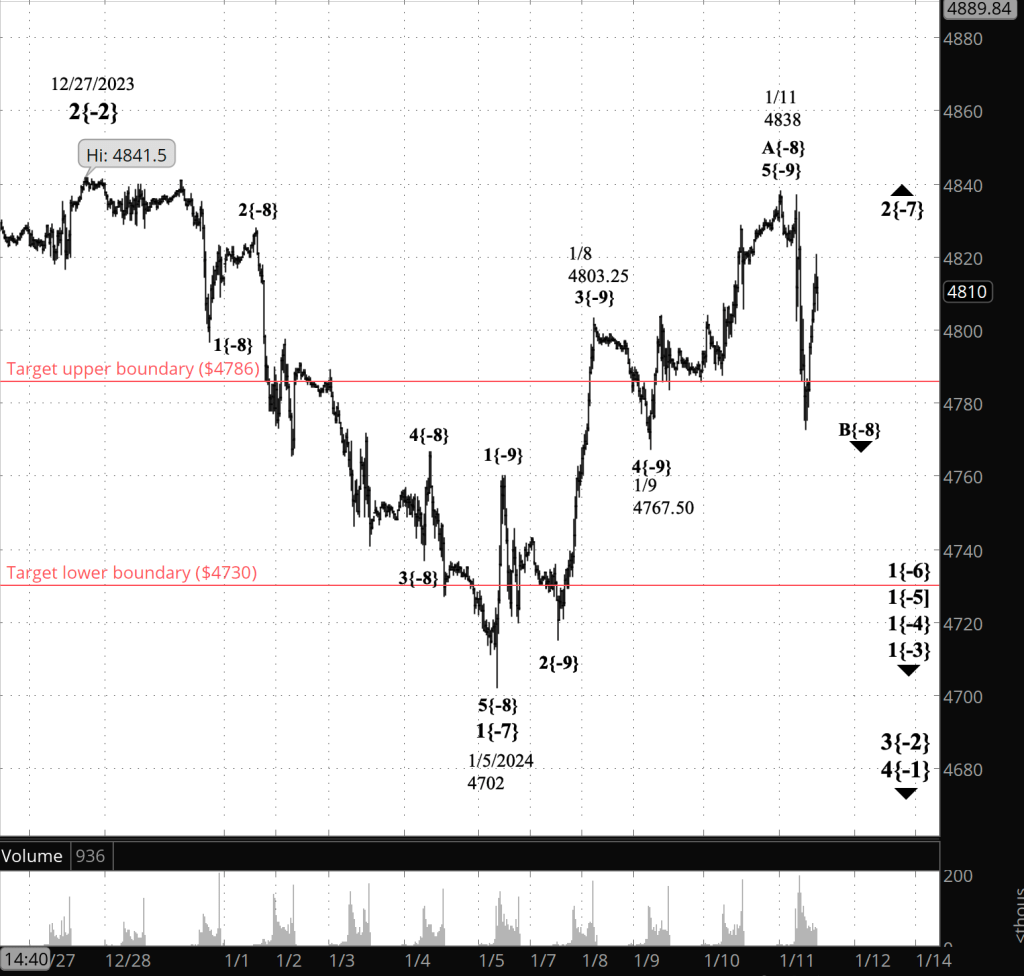
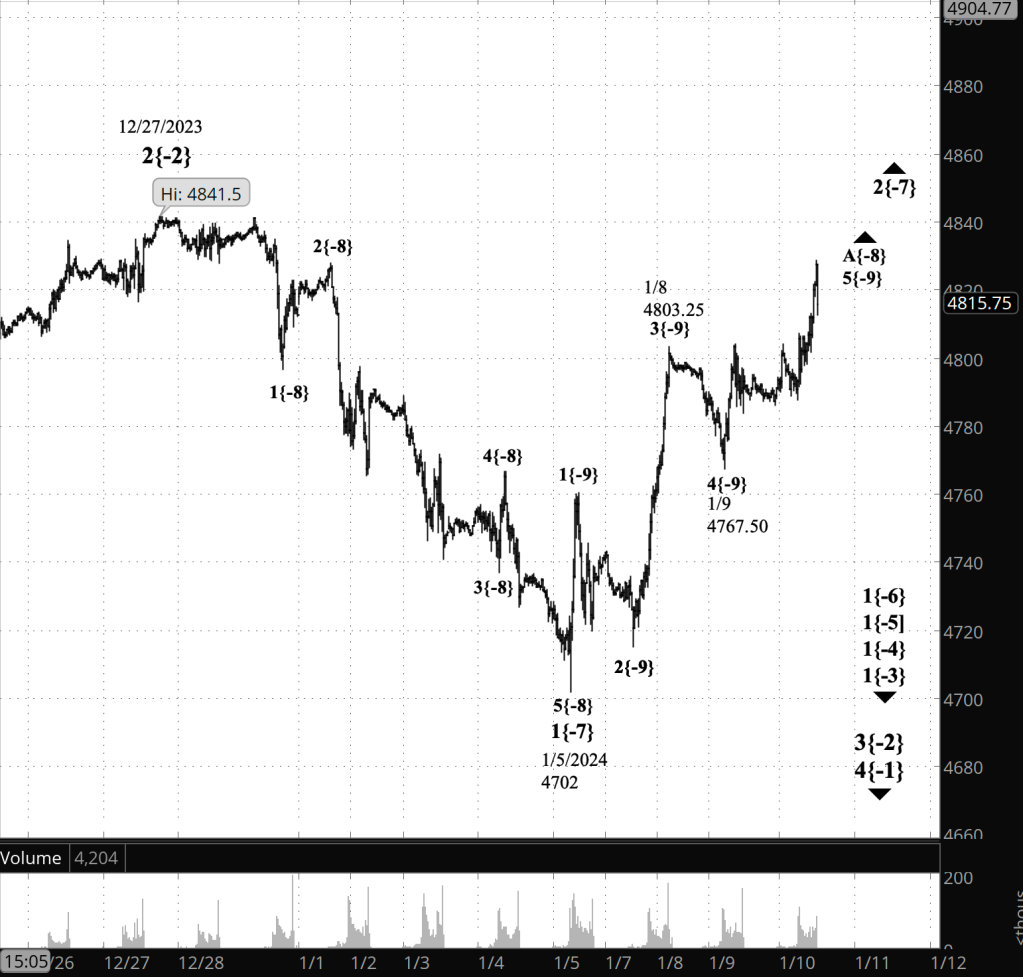
Half an hour before the closing bell. The S&P 500 futures fell sharply during the session, from the 4830s to the 4760s. As a result, I’ve changed this morning’s analysis: The low-degree 3rd wave within the final subwave, wave C, in the upward correction that began on October 13, 2022 ended at the overnight high, 4830.75, on December 19. The declining 4th wave has begun.

On the chart, the 3rd wave just ended is labeled wave 3{-8}, the {-8} being the size of the degree, and the declining wave that has begun is wave 4{-8}. All of this is happening with wave C{-3}, the final wave of the corrective pattern formed by the upward correction, wave {-2}.

The 4th wave will be followed by a rising 5th wave, whose completion will cascade up the fractal chain of larger 5th waves, completing them along with wave C and, possibly, the 2nd wave upward correction. The caveat is that the correction could take a compound form, containing two or three corrective patterns, which would delay its completion.

2:35 p.m. New York time

Trades. I exited short Iron Fly positions on QQQ and SPY, both entered the day before and exited on expiration day, and have updated the trade analyses with details.

I won’t be entering new 1DTE positions today because a GDP update will be released before the opening bell tomorrow, and that can on occasion cause significant price moves that a short-lived position doesn’t handle well.

I entered a longer term position, a short Iron Condor play on IWM that expires in 37 days, on January 26, 2024. My intent is to exit the position at 50% profit or at 21 days before expiration, on January 5. Also, I’ve penciled in two prices that may trigger an exit if they should be crossed. I’ve posted an analysis of the trade.

9:35 a.m. New York time

What’s happening now? Another night, another new high in the S&P 500 E-mini futures’ upward correction that began on October 13, 2022. The peak, 4824.25, brings the price to within 129 points of the correction’s upper limit under the rules of Elliott Wave Theory. The price then retreated from the peak by nearly 20 points.

What does it mean? The correction is a rising 2nd wave. The preceding 1st wave began from 4953.25. Under the rules discovered by R.N. Elliott, a 2nd wave never moves beyond the start of the preceding 1st wave of the same degree. If it is does, then it’s not a 2nd wave, something else is going on, and the analysis will be redone.

The 2nd wave’s corrective pattern is in its 3rd and final subwave, wave C, which in turn is in its 5th and final wave. It’s 5th waves for four degrees down the fractal chain, and the fifth degree down is either a 3rd wave or a 5th wave, either of which may have ended at the overnight high. Or not.

It’s an equal likelihood either way.

What are the alternatives? I’m keeping the analysis that I’ve had since last week — the 3rd wave of small degree is underway — until I have clear evidence that I should change it. That’s the principal analysis. The other likelihoods described above are the alternative analysis.

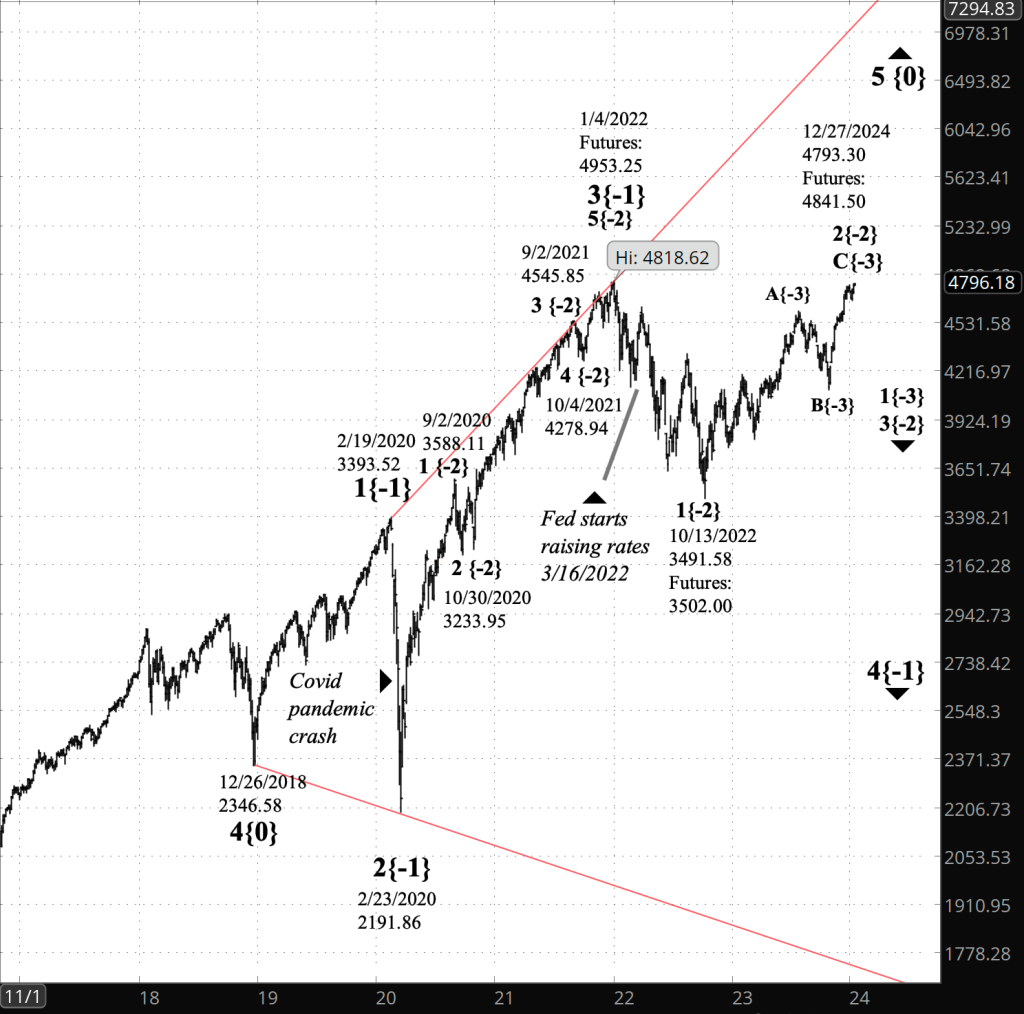
The chart. I’ve placed the Fibonacci retracement ladder on the chart, in red, to show how close to a 100% retracement the correction has traveled.

[S&P 500 E-mini futures at 3:30 p.m., 105-minute bars, with volume]

What does Elliott wave theory say? Here are the waves that underly the analyses.

Principal Analysis:

  • A downtrend, wave 4{-1}, began on January 4, 2022 and is underway.
  • Within wave 4{-1}, an upward correction, wave 2{-2}, began on October 13, 2022.
  • The third wave of the correction, wave C{-3}, is underway.
  • Wave C{-3} has reached its 5th and final subwave, wave 5{-4} and a series of smaller 5th waves, down to wave 5{-7}.
  • Wave 5{-7} internally contains two possiblilities of nearly equal likelihood. Either…
    • … the middle subwave, rising wave 3{-8}, is underway, or…
    • … the next-to-the-last subwave, a 4{-8}, a downward correction, began with the December 19 high.
    • In the afternoon analysis today I switched the 4th wave scenario to the principal analysis slot, and relegated the 3rd wave scenario to alternative status.

We Are Here.

These are the waves currently in progress under my principal analysis. Each line on the list shows the wave number, with the subscript in curly brackets, the traditional degree name, the starting date, the starting price of the S&P 500 E-mini futures, and the direction of the wave.

  • S&P 500 Index:
  • 5{+3} Supercycle, 7/8/1932, 4.40 (up)
  • 5{+2} Cycle, 12/9/1974, 60.96 (up)
  • 5{+1} Primary, 3/6/2009, 666.79 (up)
  • 5{0} Intermediate, 12/26/2018, 2346.58 (up)
  • S&P 500 Futures and index:
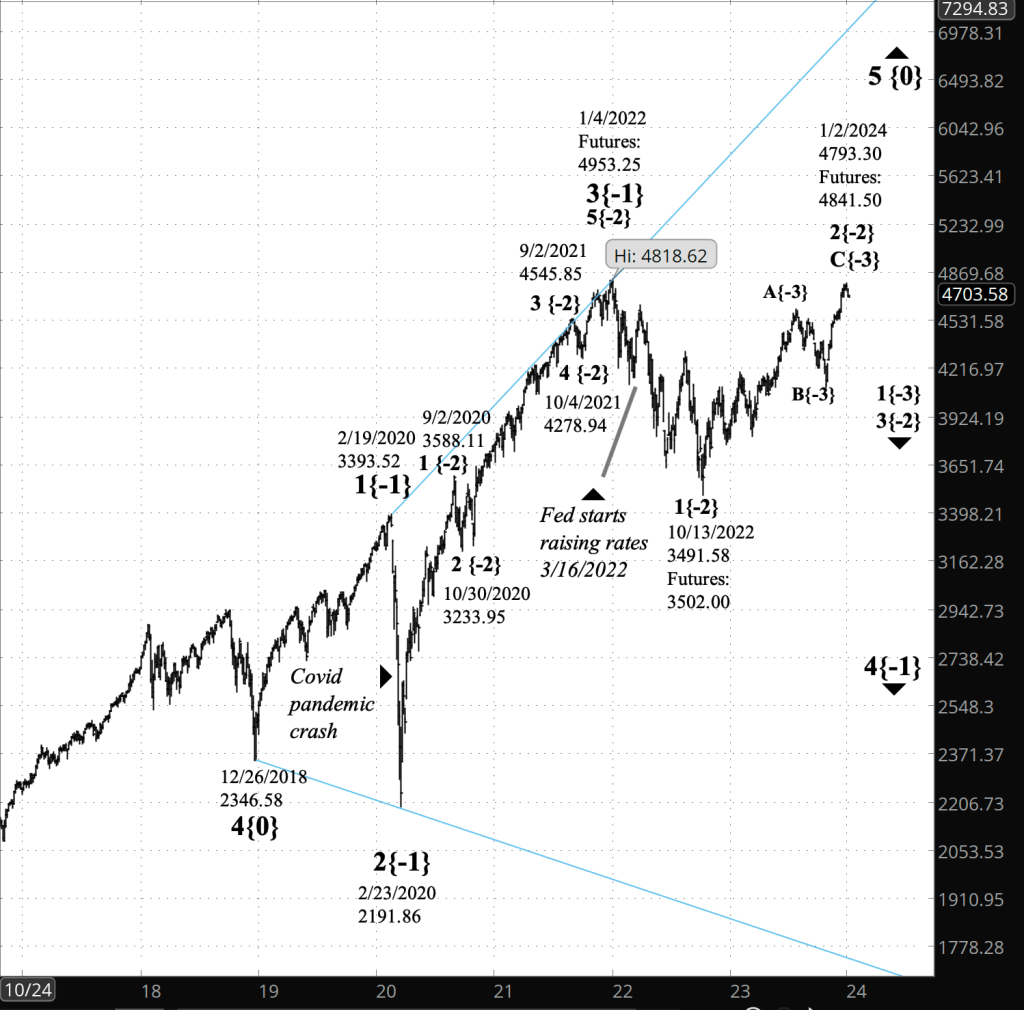
  • 4{-1} Minor, 1/4/2022, 4953.25 (down) (futures), 4818.62 (down) (index)
  • S&P 500 Futures:
  • 2{-2} Minute, 10/13/2022, 3491.58 (up)
  • C{-3} Minuette, 10/27/2023, 4122.25 (up)

Reading the chart. Price movements — waves – – in Elliott wave analysis are labeled with numbers within trending waves and letters with corrective waves. The subscripts — numbers in curly brackets — designate the wave’s degree, which, in Elliott wave analysis, means the relative position of a wave within the larger and smaller structures that make up the chart. R.N. Elliott, who in the 1930s developed the form of analysis that bears his name, viewed the chart as a complex structure of smaller waves nested within larger waves, which in turn are nested within still larger waves. In mathematics it’s called a fractal structure, where at every scale the pattern is similar to the others.

Learning and other resources. Elliott wave analysis provides context, not prophecy. As the 20th century semanticist Alfred Korzybski put it in his book Science and Sanity (1933), “The map is not the territory … The only usefulness of a map depends on similarity of structure between the empirical world and the map.” And I would add, in the ever-changing markets, we can judge that similarity of structure only after the fact.

See the menu page Analytical Methods for a rundown on where to go for information on Elliott wave analysis.

By Tim Bovee, Portland, Oregon, December 20, 2023

Disclaimer

Tim Bovee, Private Trader tracks the analysis and trades of a private trader for his own accounts. Nothing in this blog constitutes a recommendation to buy or sell stocks, options or any other financial instrument. The only purpose of this blog is to provide education and entertainment.

No trader is ever 100 percent successful in his or her trades. Trading in the stock and option markets is risky and uncertain. Each trader must make trading decisions for his or her own account, and take responsibility for the consequences.

License
Creative Commons License

All content on Tim Bovee, Private Trader by Timothy K. Bovee is licensed under a Creative Commons Attribution-ShareAlike 4.0 International License.

Based on a work at www.timbovee.com.
Options Trades 12/19/2023: QQQ SPY

Symbols traded today: short Iron Flies on QQQ SPY (1DTE)

I entered short Iron Fly positions on QQQ and SPY, one day before expiration and exited both the next day for a profit.

QQQ short short Iron Fly

LOT:11ENTRY DATE:12/19/2023
EXIT DATE:12/20/2023
DAYS HELD:1

Entry and Exit

METRICCREDITDEBITCHANGECHANGE %ANNUALIZED CHANGE %
Options premium$ 1.85$ 1.66$ 0.1911.4%4155%
METRICENTRYEXITCHANGECHANGE %ANNUALIZED CHANGE %
Stock price$ 408.43$ 408.33$ 0.10-0.02%-9%
Impllied Volatility Rate3.44.71.3
Days to expiration10

The structure of the position

STRUCTURESTRIKEODDS EXPIRE OTMDELTA
Calls
Long411.0083.0%17
Break-even409.8565.5%36
Short408.0048.0%55
Puts
Short408.0049.0%52
Break-even406.8566.0%34.5
Long405.0083.0%17

Risk and Reward

Per contract:
Reward185.00
Risk115.00
R/R Ratio (n:1)0.6

SPY short Iron Fly

LOT:21ENTRY DATE:12/19/2023
EXIT DATE:12/20/2023
DAYS HELD:1

Entry and Exit

METRICCREDITDEBITCHANGECHANGE %ANNUALIZED CHANGE %
Options premium$ 1.41$ 1.25$ 0.1612.8%4646%
METRICENTRYEXITCHANGECHANGE %ANNUALIZED CHANGE %
Stock price$ 473.72$ 474.10$ (0.38)0.08%29%
Impllied Volatility Rate5.65.80.2
Days to expiration10

The structure of the position

STRUCTURESTRIKEODDS EXPIRE OTMDELTA
Calls
Long476.0075.0%24
Break-even475.4161.0%38.5
Short474.0047.0%53
Puts
Short474.0047.0%54
Break-even473.4164.0%37
Long472.0081.0%20

Risk and Reward

Per contract:
Reward141.00
Risk59.00
R/R Ratio (n:1)0.4

By Tim Bovee, Portland, Oregon, December 19-20, 2023

Disclaimer

Tim Bovee, Private Trader tracks the analysis and trades of a private trader for his own accounts. Nothing in this blog constitutes a recommendation to buy or sell stocks, options or any other financial instrument. The only purpose of this blog is to provide education and entertainment.

No trader is ever 100 percent successful in his or her trades. Trading in the stock and option markets is risky and uncertain. Each trader must make trading decisions for his or her own account, and take responsibility for the consequences.

License
Creative Commons License

All content on Tim Bovee, Private Trader by Timothy K. Bovee is licensed under a Creative Commons Attribution-ShareAlike 4.0 International License.

Based on a work at www.timbovee.com.
Trader’s Notebook

3:30 p.m. New York time

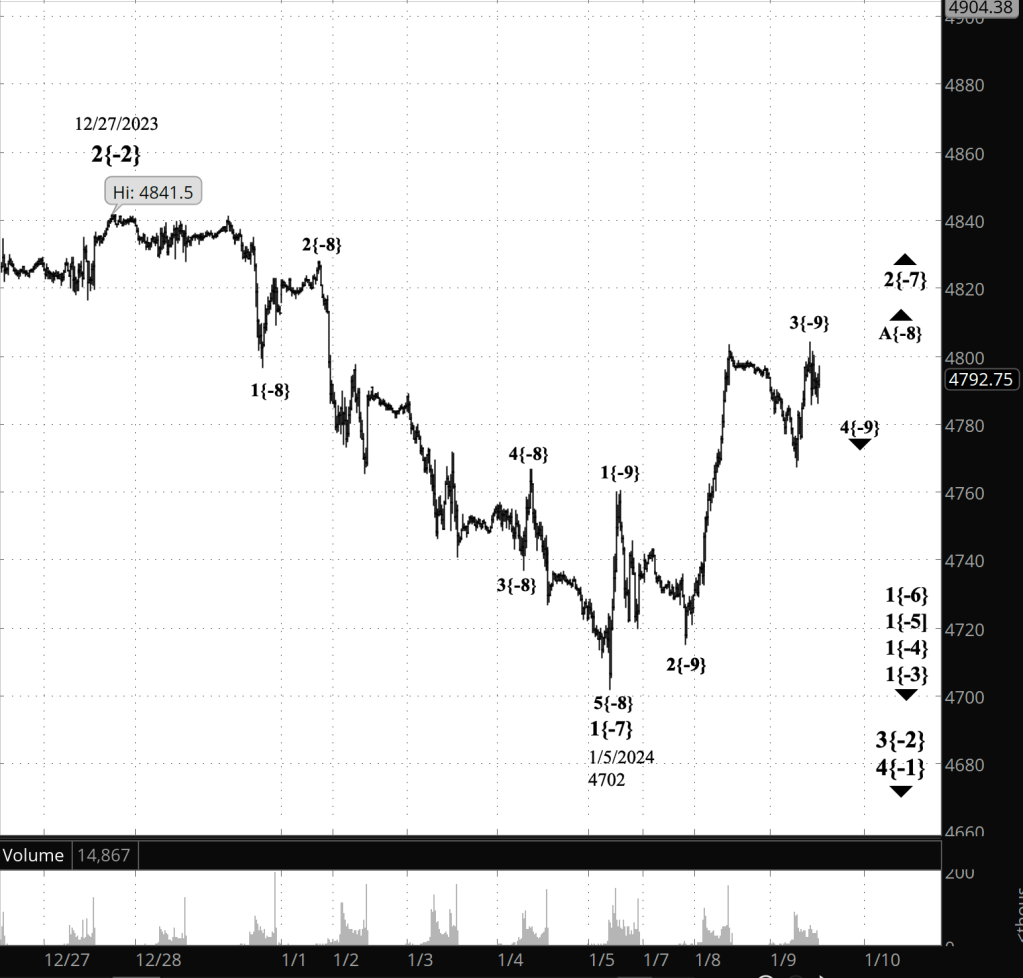
Half an hour before the closing bell. The S&P 500 futures rose gently during the session, reaching a new high, 4817, for the upward correction now underway.

This morning’s analysis is unchanged. I’ve updated the chart.

2:45 p.m. New York time

Trades. I exited an expiring short Iron Fly position on XSP for a 13.1% profit, entered one day earlier, and have updated the trade analysis with details.

I also entered short Iron Fly positions on QQQ and SPY that expire the next day, and have a posted trade analysis of each.

9:35 a.m. New York time

What’s happening now? The S&P 500 E-mini futures rose overnight to a new high, 4804.25, within the 2nd-wave upward correction that began on October 13, 2022.

What does it mean? The correction is in its 3rd and likely final subwave, wave C, which for four degrees down the fractal structure is in 5th subwaves, and at the fifth subwave down, is in its middle subwave, wave 3.

Wave 3 at that low level will be followed by declining wave 4 and a final subwave, rising wave 5. Once that small 5th wave is complete, it will cascade up the fractal structure, completing wave C and the corrective pattern that is wave 2.

Second waves tend to have a single corrective pattern, and so the present pattern, when it ends, will be the end of the correction and the start of a 3rd wave downtrend. Occasionally a 2nd wave will take a compound form, with two or three corrective patterns, extending the time it takes for the correction to reach an end.

What are the alternatives? As is often the case, a new high may mean that the rise is over and downward movement has began. The principal analysis has wave 3 still underway. It is of equal likelihood that wave 3 ended overnight and wave 4 has begun.

The chart. The chart shows wave C, and I’ve placed a Fibonacci ladder over the chart, in red, showing wave 2’s retracement of the preceding 1st wave, which began on January 4, 2022. The wave C price has exceeded a major Fibonacci pause-or-reversal point, a 78.6% retracement. Under the rules of Elliott Wave Theory, the 2nd wave price cannot exceed a 100% retracement of wave 1 — at 4953.25. If it does, then the analysis is invalidated and must be redone. On this chart, if wave 2 exceeds the start of wave 1, then the decline that began on January 4 of last year is a subwave of the 3rd-wave rise that began on February 23, 2020.

[S&P 500 E-mini futures at 3:30 p.m., 105-minute bars, with volume]

What does Elliott wave theory say? Here are the waves that underly the analyses.

Principal Analysis:

  • A downtrend, wave 4{-1}, began on January 4, 2022 and is underway.
  • Within wave 4{-1}, an upward correction, wave 2{-2}, began on October 13, 2022.
  • The third wave of the correction, wave C{-3}, is underway.
  • Wave C{-3} has reached its 5th and final subwave, wave 5{-4} and a series of smaller 5th waves, down to wave 5{-7}.
  • Wave 5{-7} internally contains two possiblilities of nearly equal likelihood. Either…
    • … the middle subwave, rising wave 3{-8}, is underway, or…
    • … the next-to-the-last subwave, a 4{-8}, a downward correction, began with the December 14 high.

We Are Here.

These are the waves currently in progress under my principal analysis. Each line on the list shows the wave number, with the subscript in curly brackets, the traditional degree name, the starting date, the starting price of the S&P 500 E-mini futures, and the direction of the wave.

  • S&P 500 Index:
  • 5{+3} Supercycle, 7/8/1932, 4.40 (up)
  • 5{+2} Cycle, 12/9/1974, 60.96 (up)
  • 5{+1} Primary, 3/6/2009, 666.79 (up)
  • 5{0} Intermediate, 12/26/2018, 2346.58 (up)
  • S&P 500 Futures and index:
  • 4{-1} Minor, 1/4/2022, 4953.25 (down) (futures), 4818.62 (down) (index)
  • S&P 500 Futures:
  • 2{-2} Minute, 10/13/2022, 3491.58 (up)
  • C{-3} Minuette, 10/27/2023, 4122.25 (up)

Reading the chart. Price movements — waves – – in Elliott wave analysis are labeled with numbers within trending waves and letters with corrective waves. The subscripts — numbers in curly brackets — designate the wave’s degree, which, in Elliott wave analysis, means the relative position of a wave within the larger and smaller structures that make up the chart. R.N. Elliott, who in the 1930s developed the form of analysis that bears his name, viewed the chart as a complex structure of smaller waves nested within larger waves, which in turn are nested within still larger waves. In mathematics it’s called a fractal structure, where at every scale the pattern is similar to the others.

Learning and other resources. Elliott wave analysis provides context, not prophecy. As the 20th century semanticist Alfred Korzybski put it in his book Science and Sanity (1933), “The map is not the territory … The only usefulness of a map depends on similarity of structure between the empirical world and the map.” And I would add, in the ever-changing markets, we can judge that similarity of structure only after the fact.

See the menu page Analytical Methods for a rundown on where to go for information on Elliott wave analysis.

By Tim Bovee, Portland, Oregon, December 19, 2023

Disclaimer

Tim Bovee, Private Trader tracks the analysis and trades of a private trader for his own accounts. Nothing in this blog constitutes a recommendation to buy or sell stocks, options or any other financial instrument. The only purpose of this blog is to provide education and entertainment.

No trader is ever 100 percent successful in his or her trades. Trading in the stock and option markets is risky and uncertain. Each trader must make trading decisions for his or her own account, and take responsibility for the consequences.

License
Creative Commons License

All content on Tim Bovee, Private Trader by Timothy K. Bovee is licensed under a Creative Commons Attribution-ShareAlike 4.0 International License.

Based on a work at www.timbovee.com.
Options Trades 12/18/2023: XSP

Symbols traded today: XSP (1DTE)

I’ve entered a short Iron Fly position on XSP and exited for a profit the next day shortly after the opening bell.

XSP short Iron Fly

LOT:2ENTRY DATE:12/18/2023
EXIT DATE:12/19/2023
DAYS HELD:1

Entry and Exit

METRICCREDITDEBITCHANGECHANGE %ANNUALIZED CHANGE %
Options premium$ 1.38$ 1.22$ 0.1613.1%4761%
METRICENTRYEXITCHANGECHANGE %ANNUALIZED CHANGE %
Stock price$ 474.55$ 474.46$ 0.09-0.02%-7%
Impllied Volatility Rate5.77.51.8
Days to expiration10

The structure of the position

STRUCTURESTRIKEODDS EXPIRE OTMDELTA
Calls
Long477.0082.0%18
Break-even476.3862.5%37
Short475.0043.0%56
Puts
Short475.0044.0%56
Break-even474.3858.5%42
Long473.0073.0%28

Risk and Reward

Per contract:
Reward138.00
Risk62.00
R/R Ratio (n:1)0.4

By Tim Bovee, Portland, Oregon, December 18, 2023

Disclaimer

Tim Bovee, Private Trader tracks the analysis and trades of a private trader for his own accounts. Nothing in this blog constitutes a recommendation to buy or sell stocks, options or any other financial instrument. The only purpose of this blog is to provide education and entertainment.

No trader is ever 100 percent successful in his or her trades. Trading in the stock and option markets is risky and uncertain. Each trader must make trading decisions for his or her own account, and take responsibility for the consequences.

License
Creative Commons License

All content on Tim Bovee, Private Trader by Timothy K. Bovee is licensed under a Creative Commons Attribution-ShareAlike 4.0 International License.

Based on a work at www.timbovee.com.

Trader’s Notebook

3:30 p.m. New York time

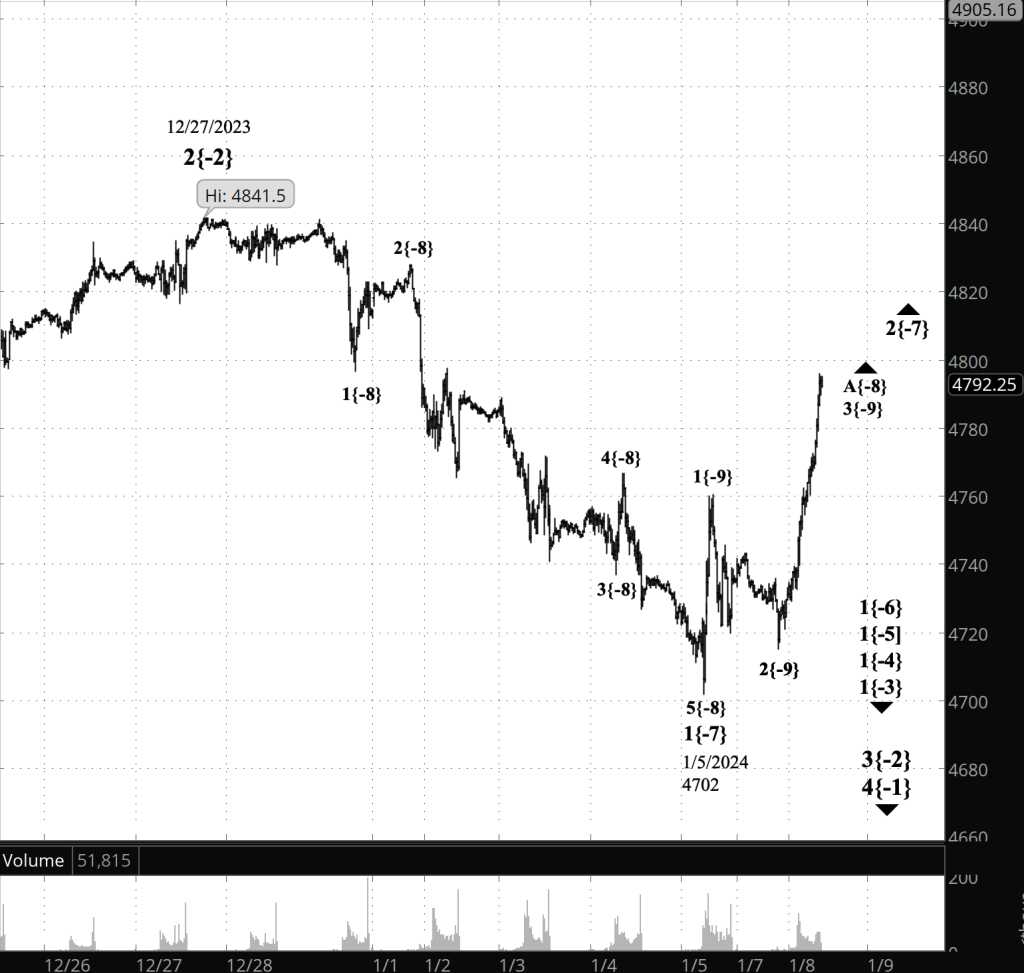
Half an hour before the opening bell. The S&P 500 futures traded sideways during the session, moving up at one point to set a new high for the upward correction, of 4802.25.

This morning’s analysis stands unchanged, along with all of the ambiguities. I’ve updated the upper chart, showing wave C within the correction, and left unchanged the lower chart, showing the entire Diagonal Triangle discussed this morning.

2:05 p.m. New York time

Trades. Two trades today: One out, one in, both short Iron Fly positions.

My position on SPY expired after the close on December 15 for an 8.3% loss. I had intended to hold the position over the weekend and exit at the opening bell on December 18, but I erred in setting up the trade.

I entered a position on XSP, which expires on December 19 (1DTE).

I’ve updated the trade analysis on SPY with full results and posted a trade analysis on XSP.

9:35 a.m. New York time

What’s happening now? The S&P 500 E-mini futures stayed within a narrow range after trading resumed overnight, remaining below the December 14 reversal point, 4791.45.

What does it mean? The 2nd-wave upward correction that began on October 13, 2022, is in the wave C subwave, likely the final wave in the correction. I’ve placed a Fibonacci retracement ladder on the chart, in red, to better judge how far the correction has traveled in relation to the 1st wave that preceded it.

Wave and wave 1 are both subwaves of a larger wave 4, the declining next-to-the-last subwave of an expanding triangle that began in December 2018.

The Fibonacci ladder shows that wave C is approaching the starting point of the preceding 1st wave that began the ongoing downtrend on January 4, 2022 from 4953.25. If the price exceeds that level, then it will break a firm rule of Elliott Wave Theory: No 2nd wave can move beyond the starting point of the preceding 1st wave of the same degree.

On this chart, if the rule is broken, then there will be major change in the analysis,. One level higher than the present upward correction and its preceding 1st wave is the 4th wave of an expanding Diagonal Triangle that began on December 26, 2018. Should the correction exceed it’s upper limit, then the new analysis would mean that the 3rd wave of the Diagonal Triangle, which began on February 23, 2020 at the end of the pandemic crash. That implies much more upside than the present analysis allows.

Note that under the present analysis I hedged whether wave C will be the end of the wave 2 correction. Most corrections contain one corrective pattern, but some form a complex structure, containing two or three corrective patterns. There’s no way to say at this point whether or not wave 2 will go complex.

What are the alternatives? At smaller degrees, wave C is in its final waves of the corrective pattern. The subwaves in my principal analysis are five degrees lower than the C wave (degree {-2}. It’s possible that the precent smallest wave I’m tracking, a 3rd wave at degree {-8}, is instead wave 5{-8}, with the 3rd wave having ended at the December 14 high.

Charts. There are two. The upper chart, of the futures, focuses on wave C, which began on October 27 this year. The lower chart, of the S&P 500 index, shows the expanding Diagonal Triangle that began on December 26, 2018, of which the present 2nd-wave correction is a subwave two degrees lower.

[S&P 500 E-mini futures at 3:30 p.m., 105-minute bars, with volume]

[S&P 500 index at 9:30 a.m., 3-day bars]

What does Elliott wave theory say? Here are the waves that underly the analyses.

Principal Analysis:

  • A downtrend, wave 4{-1}, began on January 4, 2022 and is underway.
  • Within wave 4{-1}, an upward correction, wave 2{-2}, began on October 13, 2022.
  • The third wave of the correction, wave C{-3}, is underway.
  • Wave C{-3} has reached its 5th and final subwave, wave 5{-4} and a series of smaller 5th waves, down to wave 5{-7}.
  • Wave 5{-7} internally contains two possiblilities of nearly equal likelihood. Either…
    • … the middle subwave, rising wave 3{-8}, is underway, or…
    • … the next-to-the-last subwave, a 4{-8}, a downward correction, began with the December 14 high.

We Are Here.

These are the waves currently in progress under my principal analysis. Each line on the list shows the wave number, with the subscript in curly brackets, the traditional degree name, the starting date, the starting price of the S&P 500 E-mini futures, and the direction of the wave.

  • S&P 500 Index:
  • 5{+3} Supercycle, 7/8/1932, 4.40 (up)
  • 5{+2} Cycle, 12/9/1974, 60.96 (up)
  • 5{+1} Primary, 3/6/2009, 666.79 (up)
  • 5{0} Intermediate, 12/26/2018, 2346.58 (up)
  • S&P 500 Futures and index:
  • 4{-1} Minor, 1/4/2022, 4953.25 (down) (futures), 4818.62 (down) (index)
  • S&P 500 Futures:
  • 2{-2} Minute, 10/13/2022, 3491.58 (up)
  • C{-3} Minuette, 10/27/2023, 4122.25 (up)

Reading the chart. Price movements — waves – – in Elliott wave analysis are labeled with numbers within trending waves and letters with corrective waves. The subscripts — numbers in curly brackets — designate the wave’s degree, which, in Elliott wave analysis, means the relative position of a wave within the larger and smaller structures that make up the chart. R.N. Elliott, who in the 1930s developed the form of analysis that bears his name, viewed the chart as a complex structure of smaller waves nested within larger waves, which in turn are nested within still larger waves. In mathematics it’s called a fractal structure, where at every scale the pattern is similar to the others.

Learning and other resources. Elliott wave analysis provides context, not prophecy. As the 20th century semanticist Alfred Korzybski put it in his book Science and Sanity (1933), “The map is not the territory … The only usefulness of a map depends on similarity of structure between the empirical world and the map.” And I would add, in the ever-changing markets, we can judge that similarity of structure only after the fact.

See the menu page Analytical Methods for a rundown on where to go for information on Elliott wave analysis.

By Tim Bovee, Portland, Oregon, December 18, 2023

Disclaimer

Tim Bovee, Private Trader tracks the analysis and trades of a private trader for his own accounts. Nothing in this blog constitutes a recommendation to buy or sell stocks, options or any other financial instrument. The only purpose of this blog is to provide education and entertainment.

No trader is ever 100 percent successful in his or her trades. Trading in the stock and option markets is risky and uncertain. Each trader must make trading decisions for his or her own account, and take responsibility for the consequences.

License
Creative Commons License

All content on Tim Bovee, Private Trader by Timothy K. Bovee is licensed under a Creative Commons Attribution-ShareAlike 4.0 International License.

Based on a work at www.timbovee.com.
Options Trades 12/15/2023: SPY

Symbols traded today: SPY (0DTE)

I’ve entered a short Iron Fly position on SPY. I had intended that it expire on Monday, December 18, but I erred and it turned out to be a 0DTE trade that expired after the close on the date of entry, for a loss.

SPY short Iron Fly

LOT:20ENTRY DATE:12/15/2023
EXIT DATE:12/15/2023
DAYS HELD:1

Entry and Exit

METRICCREDITDEBITCHANGECHANGE %ANNUALIZED CHANGE %
Options premium$ 1.10$ 1.20$ (0.10)-8.3%-3025%
METRICENTRYEXITCHANGECHANGE %ANNUALIZED CHANGE %
Stock price$ 468.48$ 468.89$ (0.41)0.09%32%
Impllied Volatility Rate4.05.91.9
Days to expiration00

The structure of the position

STRUCTURESTRIKEODDS EXPIRE OTMDELTA
Calls
Long471.0097.0%4
Break-even470.1075.5%25
Short469.0054.0%46
Puts
Short469.0046.0%55
Break-even468.1070.0%31
Long467.0094.0%7

Risk and Reward

Per contract:
Reward110.00
Risk90.00
R/R Ratio (n:1)0.8

By Tim Bovee, Portland, Oregon, December 15-16, 2023

Disclaimer

Tim Bovee, Private Trader tracks the analysis and trades of a private trader for his own accounts. Nothing in this blog constitutes a recommendation to buy or sell stocks, options or any other financial instrument. The only purpose of this blog is to provide education and entertainment.

No trader is ever 100 percent successful in his or her trades. Trading in the stock and option markets is risky and uncertain. Each trader must make trading decisions for his or her own account, and take responsibility for the consequences.

License
Creative Commons License

All content on Tim Bovee, Private Trader by Timothy K. Bovee is licensed under a Creative Commons Attribution-ShareAlike 4.0 International License.

Based on a work at www.timbovee.com.
Trader’s Notebook

3:30 p.m. New York time

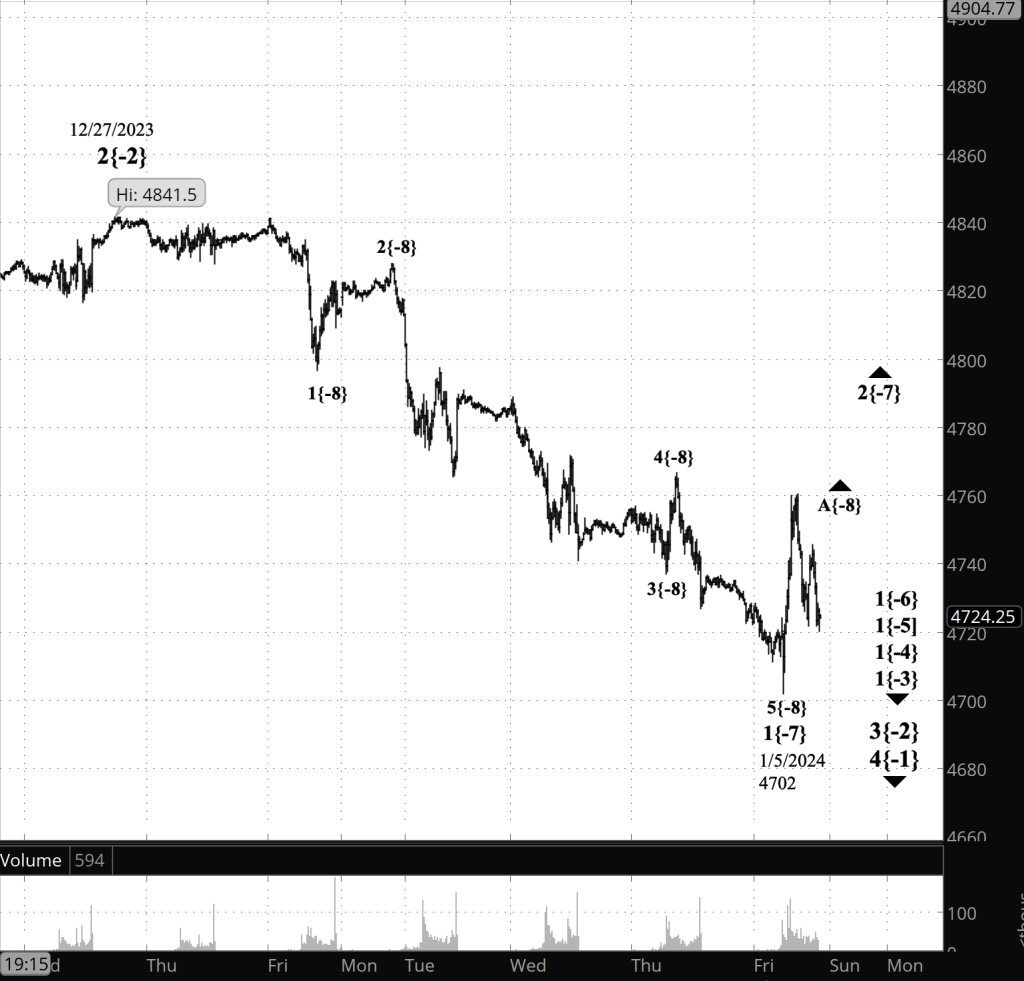
Half an hour before the closing bell. The S&P 500 futures continued their decline during the session, reaching the 4750s. The low since the December 14 peak was 4746.25, and if the price drops below that level then I’ll most likely change the chart labelling to show the low-degree 3rd wave I’ve been tracking to have ended at the peak, and to show that the 4th wave is underway. All of this happening with the final subwave, wave C, within the 2nd wave upward correction that began in October 2022.

I’ve updated the chart.

2:10 p.m. New York time

Trades. I’ve exited a 1DTE Iron Fly position on XSP for a 9.9% profit and entered a 3DTE Iron Fly position on SPY, which expires on Monday, with a 0.8:1 risk/reward ratio.

I’ve updated the XSP trade analysis with full results of the exit, and have posted a trade analysis of the SPY entry.

9:35 a.m. New York time

What’s happening now? The S&P 500 E-mini futures climbed from the 4760s to the 4780s overnight and the returned to the 4760s, falling rapidly after New York Federal Reserve Chair John Williams, in an interview with CNBC, said, “We aren’t really talking about rate cuts right now”, continuing that the focus is on the question, “have we gotten monetary policy to sufficiently restrictive stance in order to ensure the inflation comes back down to 2%?”

The comment coincided with the release of a survey showing business declining in New York state. The price remained below the December 14 peak of the upward correction, 4791.25.

What does it mean? The 2nd-wave upward correction that began in October 2022 continues and is working through its end game.

The smallest wave I’m tracking, six degrees below the wave 2 correction, is either a 3rd wave or a 4th wave. The failure of the price to break through the December 14 peak increases the likelihood that the 4th of five waves has begun. Wave 4 is a downward correction and will be followed by a 5th-wave rise that will cascade up the fractal structure and end the third subwave of the correction, wave C, and possibly the correction itself.

I say “possibly” because the correction will end with the present rise only if wave takes a simple form, containing one corrective pattern. Most wave 2s take that form, but a few will take a complex form, containing two or three corrective patterns. Which form will this correction take? We’ll have to wait and see.

Despite the uncertainty — wave 3 or wave 4? — I’ve chosen to retain the 3rd-wave labelling on the chart. The two possibilities are of nearly equal likelihood, and my habit it is keep the labeling as it is unless I have clear evidence to back up a change.

So far, the present low-degree structure lacks clarity.

What are the alternatives? t’s possible that the subwaves within wave C should be lower down in the fractal structure than I’ve labeled them. If that proves to be the case, then wave C is further from completion than the principal analysis would have it.

[S&P 500 E-mini futures at 3:30 pss.m., 105-minute bars, with volume]

What does Elliott wave theory say? Here are the waves that underly the analyses.

Principal Analysis:

  • Principal Analysis:
  • A downtrend, wave 4{-1}, began on January 4, 2022 and is underway.
  • Within wave 4{-1}, an upward correction, wave 2{-2}, began on October 13, 2022.
  • The third wave of the correction, wave C{-3}, is underway.
  • Wave C{-3} has reached its 5th and final subwave, wave 5{-4} and a series of smaller 5th waves, down to wave 5{-7}.
  • Wave 5{-7} internally contains two possiblilities of nearly equal likelihood. Either…
    • … the middle subwave, rising wave 3{-8}, is underway, or…
    • … the next-to-the-last subwave, a 4{-8}, a downward correction, began with the December 14 high.

We Are Here.

These are the waves currently in progress under my principal analysis. Each line on the list shows the wave number, with the subscript in curly brackets, the traditional degree name, the starting date, the starting price of the S&P 500 E-mini futures, and the direction of the wave.

  • S&P 500 Index:
  • 5{+3} Supercycle, 7/8/1932, 4.40 (up)
  • 5{+2} Cycle, 12/9/1974, 60.96 (up)
  • 5{+1} Primary, 3/6/2009, 666.79 (up)
  • 5{0} Intermediate, 12/26/2018, 2346.58 (up)
  • S&P 500 Futures and index:
  • 4{-1} Minor, 1/4/2022, 4953.25 (down) (futures), 4818.62 (down) (index)
  • S&P 500 Futures:
  • 2{-2} Minute, 10/13/2022, 3491.58 (up)
  • C{-3} Minuette, 10/27/2023, 4122.25 (up)

Reading the chart. Price movements — waves – – in Elliott wave analysis are labeled with numbers within trending waves and letters with corrective waves. The subscripts — numbers in curly brackets — designate the wave’s degree, which, in Elliott wave analysis, means the relative position of a wave within the larger and smaller structures that make up the chart. R.N. Elliott, who in the 1930s developed the form of analysis that bears his name, viewed the chart as a complex structure of smaller waves nested within larger waves, which in turn are nested within still larger waves. In mathematics it’s called a fractal structure, where at every scale the pattern is similar to the others.

Learning and other resources. Elliott wave analysis provides context, not prophecy. As the 20th century semanticist Alfred Korzybski put it in his book Science and Sanity (1933), “The map is not the territory … The only usefulness of a map depends on similarity of structure between the empirical world and the map.” And I would add, in the ever-changing markets, we can judge that similarity of structure only after the fact.

See the menu page Analytical Methods for a rundown on where to go for information on Elliott wave analysis.

By Tim Bovee, Portland, Oregon, December 15, 2023

Disclaimer

Tim Bovee, Private Trader tracks the analysis and trades of a private trader for his own accounts. Nothing in this blog constitutes a recommendation to buy or sell stocks, options or any other financial instrument. The only purpose of this blog is to provide education and entertainment.

No trader is ever 100 percent successful in his or her trades. Trading in the stock and option markets is risky and uncertain. Each trader must make trading decisions for his or her own account, and take responsibility for the consequences.

License
Creative Commons License

All content on Tim Bovee, Private Trader by Timothy K. Bovee is licensed under a Creative Commons Attribution-ShareAlike 4.0 International License.

Based on a work at www.timbovee.com.
Options Trades 12/14/2023: XSP

Symbols traded: XSP

I’ve entered a short Iron Fly position on XSP, one day prior to expiration (1DTE), and exitred on expiration day for a 9.9% profit.

XSP short Iron Fly

LOT:1ENTRY DATE:12/14/2023
EXIT DATE:12/15/2023
DAYS HELD:1

Entry and Exit

METRICCREDITDEBITCHANGECHANGE %ANNUALIZED CHANGE %
Options premium$ 2.00$ 1.82$ 0.189.9%3590%
METRICENTRYEXITCHANGECHANGE %ANNUALIZED CHANGE %
Stock price$ 471.30$ 470.75$ 0.55-0.12%-43%
Impllied Volatility Rate3.13.10.0
Days to expiration10

The structure of the position

STRUCTURESTRIKEODDS EXPIRE OTMDELTA
Calls
Long474.0077.0%23
Break-even473.0063.5%37
Short471.0050.0%51
Puts
Short471.0050.0%49
Break-even470.0064.5%35
Long468.0079.0%21

Risk and Reward

Per contract:
Reward200.00
Risk100.00
R/R Ratio (n:1)0.5

By Tim Bovee, Portland, Oregon, December 14, 2023

Disclaimer

Tim Bovee, Private Trader tracks the analysis and trades of a private trader for his own accounts. Nothing in this blog constitutes a recommendation to buy or sell stocks, options or any other financial instrument. The only purpose of this blog is to provide education and entertainment.

No trader is ever 100 percent successful in his or her trades. Trading in the stock and option markets is risky and uncertain. Each trader must make trading decisions for his or her own account, and take responsibility for the consequences.

License
Creative Commons License

All content on Tim Bovee, Private Trader by Timothy K. Bovee is licensed under a Creative Commons Attribution-ShareAlike 4.0 International License.

Based on a work at www.timbovee.com.

Trader’s Notebook

3:30 p.m. New York time

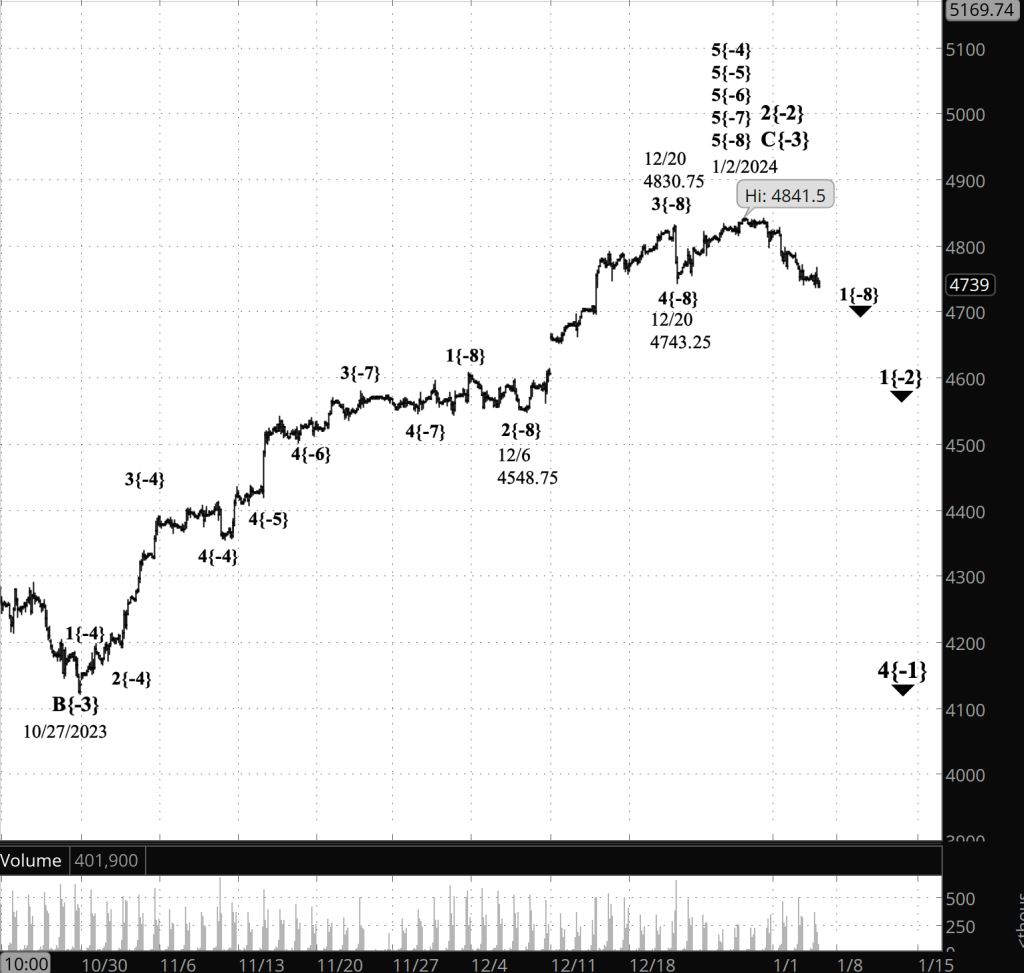
Half an hour before the closing bell. The S&P 500 futures reached a session peak of 4791.75 and fell to a session low of 4746.25.

The decline so far is in its 4th wave and is a classic trend structure, with the 3rd wave being the longest wave so far. For the moment I’m staying with this morning’s announcement, that the parent of the session decline, a rising 3rd wave, is not yet complete. I’d like to see more of how that 4th wave shapes up before changing the principal analysis.

I’ve updated the chart.

1:35 p.m. New York time

Trades. I’ve exited a short Iron Fly position on SPY, on expiration day for a 24.1% loss and have updated the trade analysis with details.

I’ve entered a short Iron Fly position on XSP — a lower-priced version of SPX, the S&P 500 Index — with the intent of exiting the next day, when it expires. I’ve posted an analysis of the trade.

9:35 a.m. New York time

What’s happening now? The S&P 500 E-mini futures remained within a narrow range during much of overnight trading, pushing higher as the opening bell approached.

What does it mean? The 2nd-wave upward correction that began on October 13, 2022 continues to work through its final subwave, wave C.

At the smallest degree in the chart’s Elliott Wave structure, five levels small than the C wave, a wave 3 uptrend is in progress. It will be followed by a 4th wave downward correction and a 5th wave push to the upside that will complete the small-degree rise, the series of increasingly larger 5th waves up to the C wave, the C wave itself, and the 2nd wave upward correction, if it takes a simple form containing a single corrective pattern. If it takes a comple form, with two or three correvtive patterns, then it will be awhile longer before the correction reaches its end.

What are the alternatives? It’s possible that the subwaves within wave C should be lower down in the fractal structure than I’ve labeled them. If that proves to be the case, then wave C is further from completion than the principal analysis would have it.

[S&P 500 E-mini futures at 3:30 p.m., 105-minute bars, with volume]

What does Elliott wave theory say? Here are the waves that underly the analyses.

Principal Analysis:

  • A downtrend, wave 4{-1}, began on January 4, 2022 and is underway.
  • Within wave 4{-1}, an upward correction, wave 2{-2}, began on October 13, 2022.
  • The third wave of the correction, wave C{-3}, is underway.
  • Wave C{-3} has reached its 5th and final subwave, wave 5{-4} and a series of smaller 5th waves, down to wave 5{-7}.
  • Wave 5{-7} is in its middle subwave, rising wave 3{-8}.

We Are Here.

These are the waves currently in progress under my principal analysis. Each line on the list shows the wave number, with the subscript in curly brackets, the traditional degree name, the starting date, the starting price of the S&P 500 E-mini futures, and the direction of the wave.

  • S&P 500 Index:
  • 5{+3} Supercycle, 7/8/1932, 4.40 (up)
  • 5{+2} Cycle, 12/9/1974, 60.96 (up)
  • 5{+1} Primary, 3/6/2009, 666.79 (up)
  • 5{0} Intermediate, 12/26/2018, 2346.58 (up)
  • S&P 500 Futures and index:
  • 4{-1} Minor, 1/4/2022, 4953.25 (down) (futures), 4818.62 (down) (index)
  • S&P 500 Futures:
  • 2{-2} Minute, 10/13/2022, 3491.58 (up)
  • C{-3} Minuette, 10/27/2023, 4122.25 (up)

Reading the chart. Price movements — waves – – in Elliott wave analysis are labeled with numbers within trending waves and letters with corrective waves. The subscripts — numbers in curly brackets — designate the wave’s degree, which, in Elliott wave analysis, means the relative position of a wave within the larger and smaller structures that make up the chart. R.N. Elliott, who in the 1930s developed the form of analysis that bears his name, viewed the chart as a complex structure of smaller waves nested within larger waves, which in turn are nested within still larger waves. In mathematics it’s called a fractal structure, where at every scale the pattern is similar to the others.

Learning and other resources. Elliott wave analysis provides context, not prophecy. As the 20th century semanticist Alfred Korzybski put it in his book Science and Sanity (1933), “The map is not the territory … The only usefulness of a map depends on similarity of structure between the empirical world and the map.” And I would add, in the ever-changing markets, we can judge that similarity of structure only after the fact.

See the menu page Analytical Methods for a rundown on where to go for information on Elliott wave analysis.

By Tim Bovee, Portland, Oregon, December 14, 2023

Disclaimer

Tim Bovee, Private Trader tracks the analysis and trades of a private trader for his own accounts. Nothing in this blog constitutes a recommendation to buy or sell stocks, options or any other financial instrument. The only purpose of this blog is to provide education and entertainment.

No trader is ever 100 percent successful in his or her trades. Trading in the stock and option markets is risky and uncertain. Each trader must make trading decisions for his or her own account, and take responsibility for the consequences.

License
Creative Commons License

All content on Tim Bovee, Private Trader by Timothy K. Bovee is licensed under a Creative Commons Attribution-ShareAlike 4.0 International License.

Based on a work at www.timbovee.com.