Trader’s Notebook

3:30 p.m. New York time

Half an hour before the closing bell. The S&P 500 futures rose into the 4610s during session, remaining below the July 27 high, 4634.50. This morning’s inventory of the ambiguities on the chart is unchanged. I’ve updated the chart.

9:37 a.m. New York time

What’s happening now? The S&P 500 E-mini futures rose back into the 4590s after falling sharply in yesterday’s session, from a high of 4634.50 down to 4553.75.

What does it mean? The fall and partial recovery open up a number of mutually exclusive interpretations regarding the upward correction that began on October 13, 2022. The correction took a compound form and contains two corrective patterns.

I’ve moved the chart in to show the final leg of the second corrective pattern.

This is no “What are the alternatives?” section to this analysis. They’re all alternatives.

The possible waves are marked on the chart with question marks.

Here’s the list:

  • The second corrective pattern with an upward correction, wave 2{-2}, ended at the July 27 peak, 4734.50.
  • That sets up the following scenarios:
    • Wave 2{-2} will only contain two corrective patterns. Therefore, wave 2{-2} has ended and the first steps of a major downtrend, wave 3{-2}, are underway.
    • Or, wave 2{-2} will move on to a 3rd corrective pattern and a connector, downward wave X{-3}, is underway.

Another set of possibilities:

  • The second corrective pattern within wave 2{-2}, a compound correction, is still underway and is nearing its end.
  • That sets up the following scenarios:
    • Within the last leg of the second corrective pattern, wave C{-3}’s final subwave is underway, wave E{-4}, and within it, a final subwave one degree lower, wave E{-5}, is underway.
    • Or, the middle subwave, wave C{-5}, is still continuing its rise.

Complex enough? I expect the whole ambiguous mess to resolve itself fairly quickly, if not today then next week.

Reading the chart. Price movements — waves – – in Elliott wave analysis are labeled with numbers within trending waves and letters with corrective waves. The subscripts — numbers in curly brackets — designate the wave’s degree, which, in Elliott wave analysis, means the relative position of a wave within the larger and smaller structures that make up the chart. R.N. Elliott, who in the 1930s developed the form of analysis that bears his name, viewed the chart as a complex structure of smaller waves nested within larger waves, which in turn are nested within still larger waves. In mathematics it’s called a fractal structure, where at every scale the pattern is similar to the others.
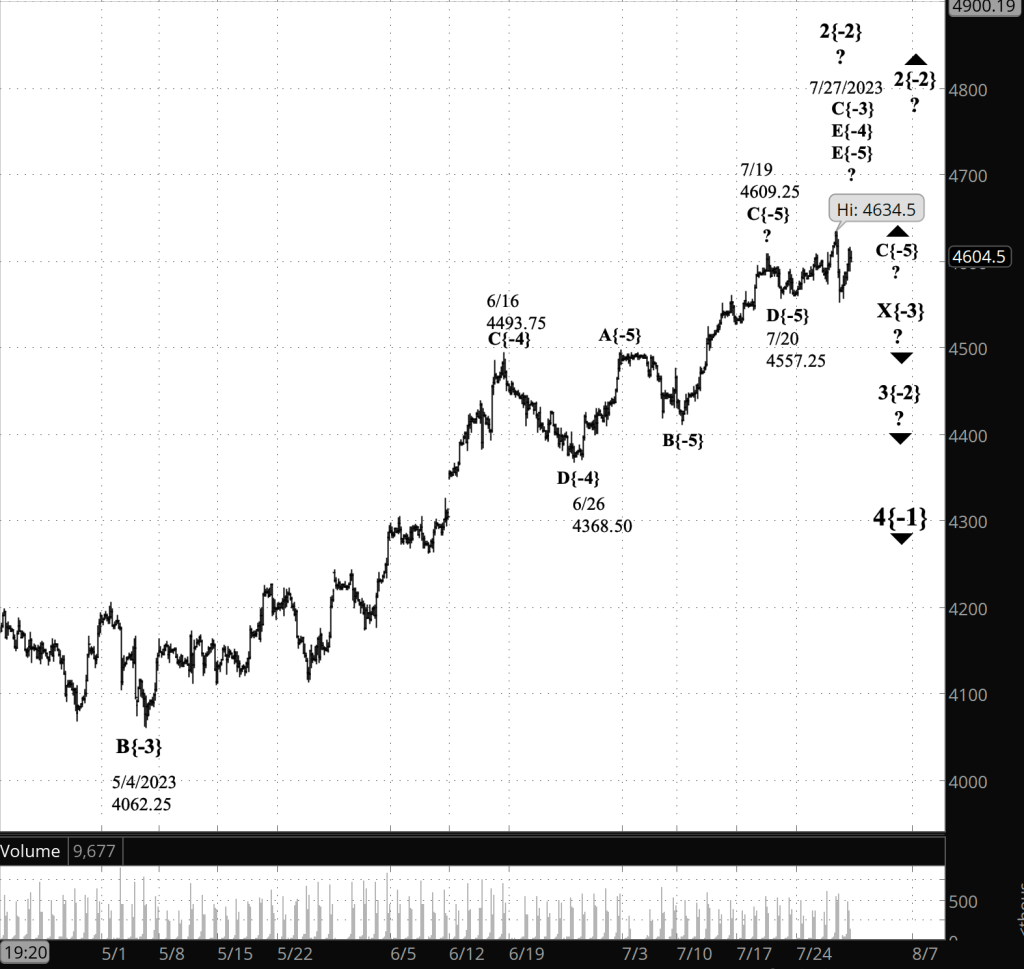
[S&P 500 E-mini futures at 3:30 p.m., 160-minute bars, with volume]

What does Elliott wave theory say? This is a repeat of yesterday’s post, for comparison with the ambiguities listed above.

Here are the waves that underlie the analysis, as of the morning of July 27.

Principal analysis:

  • An upward correction, a Zigzag, wave 2{-2}, began on October 13, 2022 and is underway.
  • The upward correction, wave 2{-2}, is taking a compound form, which can contain up to three corrective patterns.
  • The correction is in its second corrective pattern, which is in wave C{-3}, its final wave.
  • The end of the present wave C{-3} could also be the end of the wave 2{-2} correction if the compound structure contains two subwaves.
  • Or the present corrective pattern could be followed by a declining connector, wave X{-3}, and then a third corrective pattern.
  • Wave C{-3} will have five subwaves and is at wave E{-4}, the final subwave.
  • Wave E{-4} is in its final of five subwaves, wave E{-5}.
  • Wave 2{-2}, when complete, will be followed by a powerful downtrend, wave 3{-2}.
  • Under the rules of Elliott wave analysis, wave 2{-2} cannot move beyond the beginning of wave 1{-2}, which was the January 4, 2022 peak at 4953.25

Alternative analysis:

  • Wave E{-4} is in its third of five subwaves, wave C{-5}, a rising wave that will be followed by an downward movement and then a final rise to completion.

We Are Here.

These are the waves currently in progress under my analysis. Each line on the list shows the wave number, with the subscript in curly brackets, the traditional degree name, the starting date, the starting price of the S&P 500 E-mini futures, and the direction of the wave.

  • S&P 500 Index:
  • 5{+3} Supercycle, 7/8/1932, 4.40 (up)
  • 5{+2} Cycle, 12/9/1974, 60.96 (up)
  • 5{+1} Primary, 3/6/2009, 666.79 (up)
  • 5{0} Intermediate, 12/26/2018, 2346.58 (up)
  • S&P 500 Futures and index:
  • 4{-1} Minor, 1/4/2022, 4953.25 (down) (futures), 4818.62 (down) (index)
  • S&P 500 Futures:
  • 2{-2} Minute, 10/13/2022, 3502 (up) — Maybe.
  • Or possibly, 3{-2} Minute, 7/27/2023 (down)

Learning and other resources. Elliott wave analysis provides context, not prophecy. As the 20th century semanticist Alfred Korzybski put it in his book Science and Sanity (1933), “The map is not the territory … The only usefulness of a map depends on similarity of structure between the empirical world and the map.” And I would add, in the ever-changing markets, we can judge that similarity of structure only after the fact.

See the menu page Analytical Methods for a rundown on where to go for information on Elliott wave analysis.

By Tim Bovee, Portland, Oregon, July 28, 2023

Disclaimer

Tim Bovee, Private Trader tracks the analysis and trades of a private trader for his own accounts. Nothing in this blog constitutes a recommendation to buy or sell stocks, options or any other financial instrument. The only purpose of this blog is to provide education and entertainment.

No trader is ever 100 percent successful in his or her trades. Trading in the stock and option markets is risky and uncertain. Each trader must make trading decisions for his or her own account, and take responsibility for the consequences.

License
Creative Commons License

All content on Tim Bovee, Private Trader by Timothy K. Bovee is licensed under a Creative Commons Attribution-ShareAlike 4.0 International License.

Based on a work at www.timbovee.com.
Trader’s Notebook

3:30 p.m. New York time

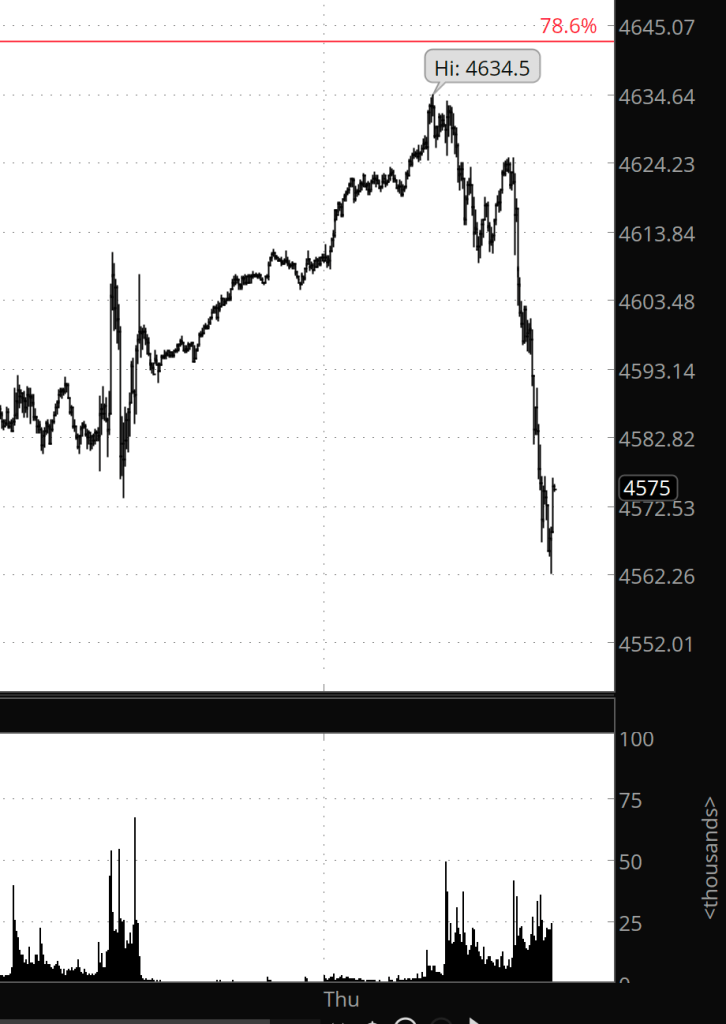
[S&P 500 E-mini futures at 3:15 p.m., 5-minute bars, with volume]

Half an hour before the closing bell. The S&P 500 futures have declined throughout the session so far, reaching back into the 4560s. The price never exceeded the overnight high, 4634.50.

Two interpretations:

  • Either the second corrective pattern within the long-running upward compound correction ended at the overnight peak, perhaps ending the correction …
  • … Or the alternative scenario is playing out; wave C{-5} ended at the overnight peak, and the subsequent decline is wave D{-5} as the second corrective pattern continues.

At this point, there’s insufficient evidence to choose between those interpretations.

I’ve updated this morning’s chart.

9:35 a.m. New York time

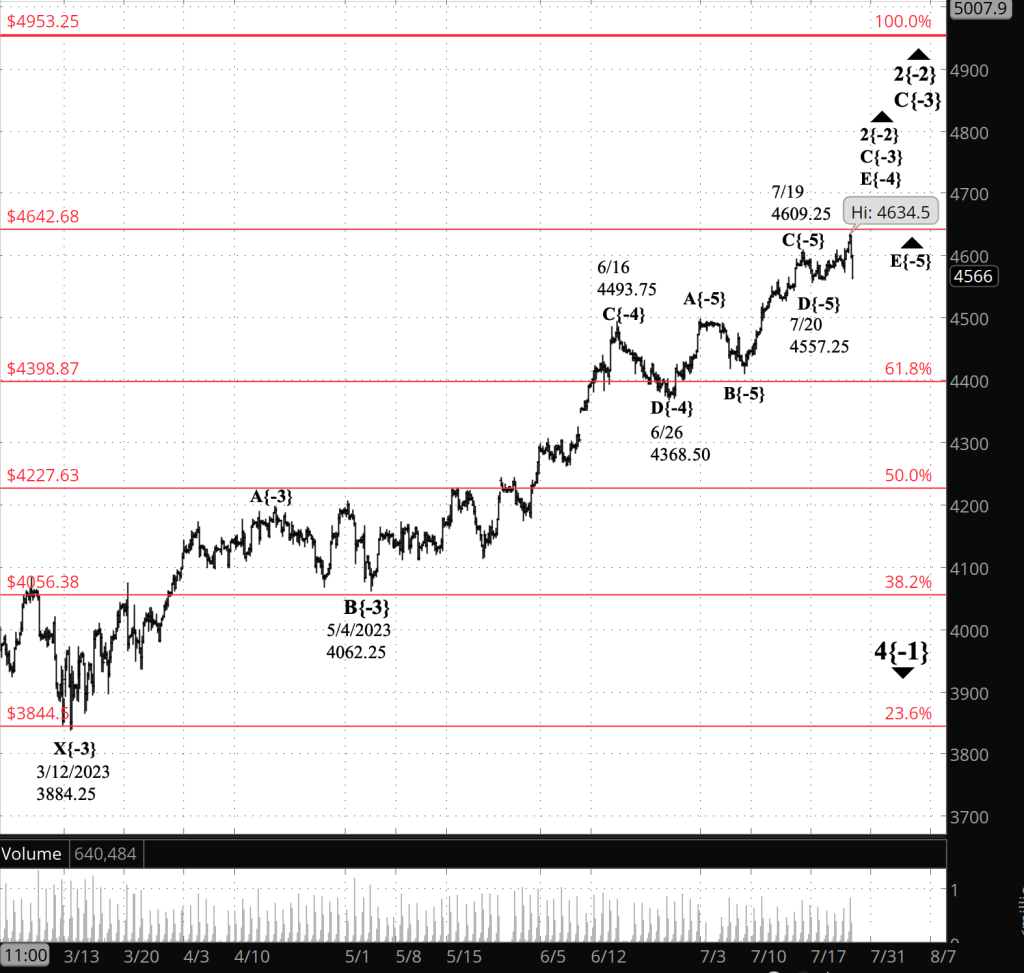
What’s happening now? The S&P 500 E-mini futures rose overnight, reaching beyond the the July 19 high, 4009.25, into the 4630s. The new upward correction high is only 7 points below the 78.6% Fibonacci retracement level, a common reversal point. The Fibonacci ladder is shown on the chart in red.

What does it mean? The upward corrective pattern that began on March 12 has moved one step closer to completion. The corrective pattern is the second within an upward correction that began last October.

The complexity of the fractal structure require reference to the wave labels on the chart. See the “Reading the Chart” section just before the chart for an explanation of the labeling system.

The subwave driving the correction is two degrees smaller than the correction degree. That subwave, labeled E{-4} on the chart, is now in its fifth and final subwave, labeled E{-5}.

When wave E{-5} is complete, it will cascade up the fractal structure, marking the end of waves E{-4} and C{-3}.

Will it also mean the end of the correction itself? Well, that depends. The correction has taken a compound form and is in its second corrective patterns. Compound corrections can contain two or three corrective patterns.

If the present correction, wave 2{-2}, continues into a third such pattern, then it will likely continue for some time. The second corrective pattern has already lasted 4-1/2 months, and it would be reasonable to expect a similar length from a third corrective pattern, a lengthy delay before the future downtrend, wave 3{-2}, begins.

If wave 2{-2} ends with the second corrective pattern, then the powerful downtrend, wave 3{-2}, will begin immediately. In either case, I expect wave 3{-2} to move below the start of the upward correction, 3502, and almost certainly significantly below that level.

What are the alternatives? The falling fourth wave within wave C{-4}, labeled wave D{-5}, was quite shallow. It’s possible to interpret it as a subwave of wave C{-5}, the third subwave within wave C{-4}, with two more subwaves, D{-5} and E{-5}, to come before the second corrective pattern is complete.

Reading the chart. Price movements — waves – – in Elliott wave analysis are labeled with numbers within trending waves and letters with corrective waves. The subscripts — numbers in curly brackets — designate the wave’s degree, which, in Elliott wave analysis, means the relative position of a wave within the larger and smaller structures that make up the chart. R.N. Elliott, who in the 1930s developed the form of analysis that bears his name, viewed the chart as a complex structure of smaller waves nested within larger waves, which in turn are nested within still larger waves. In mathematics it’s called a fractal structure, where at every scale the pattern is similar to the others.

[S&P 500 E-mini futures at 3:30 p.m., 260-minute bars, with volume]

What does Elliott wave theory say? Here are the waves that underlie the analysis.

Principal analysis:

  • An upward correction, a Zigzag, wave 2{-2}, began on October 13, 2022 and is underway.
  • The upward correction, wave 2{-2}, is taking a compound form, which can contain up to three corrective patterns.
  • The correction is in its second corrective pattern, which is in wave C{-3}, its final wave.
  • The end of the present wave C{-3} could also be the end of the wave 2{-2} correction if the compound structure contains two subwaves.
  • Or the present corrective pattern could be followed by a declining connector, wave X{-3}, and then a third corrective pattern.
  • Wave C{-3} will have five subwaves and is at wave E{-4}, the final subwave.
  • Wave E{-4} is in its final of five subwaves, wave E{-5}.
  • Wave 2{-2}, when complete, will be followed by a powerful downtrend, wave 3{-2}.
  • Under the rules of Elliott wave analysis, wave 2{-2} cannot move beyond the beginning of wave 1{-2}, which was the January 4, 2022 peak at 4953.25

Alternative analysis:

  • Wave E{-4} is in its third of five subwaves, wave C{-5}, a rising wave that will be followed by an downward movement and then a final rise to completion.

We Are Here.

These are the waves currently in progress under my principal analysis. Each line on the list shows the wave number, with the subscript in curly brackets, the traditional degree name, the starting date, the starting price of the S&P 500 E-mini futures, and the direction of the wave.

  • S&P 500 Index:
  • 5{+3} Supercycle, 7/8/1932, 4.40 (up)
  • 5{+2} Cycle, 12/9/1974, 60.96 (up)
  • 5{+1} Primary, 3/6/2009, 666.79 (up)
  • 5{0} Intermediate, 12/26/2018, 2346.58 (up)
  • S&P 500 Futures and index:
  • 4{-1} Minor, 1/4/2022, 4953.25 (down) (futures), 4818.62 (down) (index)
  • S&P 500 Futures:
  • 2{-2} Minute, 10/13/2022, 3502 (up)

Learning and other resources. Elliott wave analysis provides context, not prophecy. As the 20th century semanticist Alfred Korzybski put it in his book Science and Sanity (1933), “The map is not the territory … The only usefulness of a map depends on similarity of structure between the empirical world and the map.” And I would add, in the ever-changing markets, we can judge that similarity of structure only after the fact.

See the menu page Analytical Methods for a rundown on where to go for information on Elliott wave analysis.

By Tim Bovee, Portland, Oregon, July 27, 2023

Disclaimer

Tim Bovee, Private Trader tracks the analysis and trades of a private trader for his own accounts. Nothing in this blog constitutes a recommendation to buy or sell stocks, options or any other financial instrument. The only purpose of this blog is to provide education and entertainment.

No trader is ever 100 percent successful in his or her trades. Trading in the stock and option markets is risky and uncertain. Each trader must make trading decisions for his or her own account, and take responsibility for the consequences.

License
Creative Commons License

All content on Tim Bovee, Private Trader by Timothy K. Bovee is licensed under a Creative Commons Attribution-ShareAlike 4.0 International License.

Based on a work at www.timbovee.com.
Trader’s Notebook

3:30 p.m. New York time

Half an hour before the closing bell. The S&P 500 futures slipped slightly into the 4570s when the Federal Open Market raised interest rates and within a minute returned to the 4580s, where it has spent nearly all of the session. This morning’s analysis remains unchanged. I’ve updated the chart.

9:35 a.m. New York time

What’s happening now? The S&P 500 E-mini futures fell overnight, back into the 4580s.

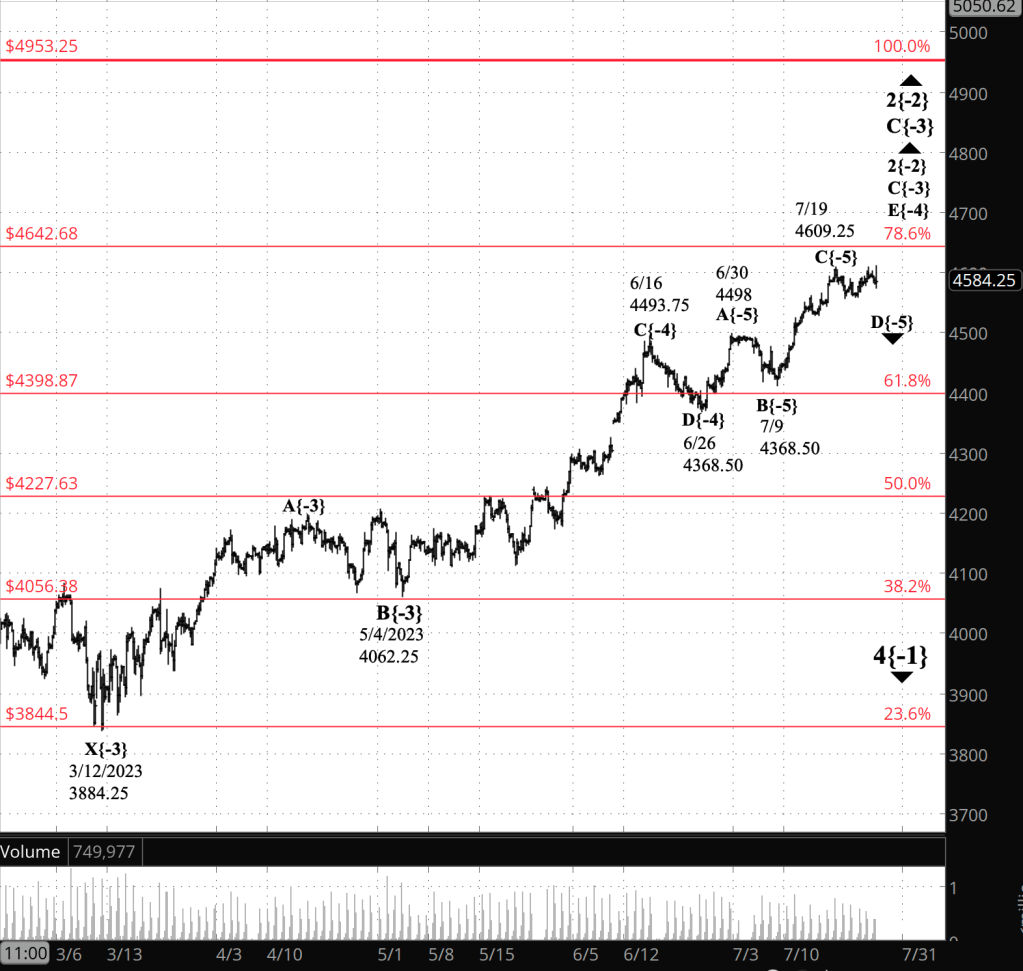
What does it mean? The decline strengthens the scenario that within the long-running upward compound correction, the wave signaling the progress of the second corrective pattern is in its fourth wave, only one wave away from completion.

On the chart, the signaling wave is wave E{-4}, a subwave of the third and final wave, C{-3}, within the upward correction, wave 2{-2}, which began on October 13, 2022.

The overnight decline strengthens the case that the chart is in wave D{-5} within wave E{-4}.

The future final wave within the corrective pattern will be rising wave E{-5}, and when it is complete, it will be the end of the second corrective pattern and perhaps of the correction itself. .It is possible that the correction will move on to a third and final corrective pattern.

In any case, the end of wave E{-5} will also be the end of waves E{-4} and C{-3}, and of the correction, wave 2{-2}.

A powerful downtrend, wave 3{-2}, will follow, carrying the price below the start of the correction, from 3502, and likely significantly below that level.

The Fibonacci retracement levels for the correction are shown on the chart in red.

What are the alternatives? The strengthened case described above doesn’t entirely eliminate the alternative: That the wave signaling progress is still in its third wave, two waves away from completion. However, the case for the alternative is weaker than it was a day ago. The third wave in the pattern would be labeled wave C{-5}.

A move above the July 19 high, 4609.256, strengthens the case for the alternative analysis.

[S&P 500 E-mini futures at 3:30 p.m., 260-minute bars, with volume]

What does Elliott wave theory say? Here are the waves that underlie the analysis.

Principal analysis:

  • An upward correction, a Zigzag, wave 2{-2}, began on October 13, 2022 and is underway.
  • The upward correction, wave 2{-2}, is taking a compound form, which can contain up to three corrective patterns.
  • The correction is in its second corrective pattern, which is in wave C{-3}, its final wave.
  • The end of the present wave C{-3} could also be the end of the wave 2{-2} correction if the compound structure contains two subwaves.
  • Or the present corrective pattern could be followed by a declining connector, wave X{-3}, and then a third corrective pattern.
  • Wave C{-3} will have five subwaves and is at wave E{-4}, the final subwave.
  • Wave E{-4} is in its fourth of five subwaves, wave D{-5}.
  • Wave 2{-2}, when complete, will be followed by a powerful downtrend, wave 3{-2}.
  • Under the rules of Elliott wave analysis, wave 2{-2} cannot move beyond the beginning of wave 1{-2}, which was the January 4, 2022 peak at 4953.25

Alternative analysis:

  • Wave E{-4} is in its third of five subwaves, wave C{-5}, a rising wave that will be followed by an downward movement and then a final rise to completion.

Reading the chart. Price movements — waves – – in Elliott wave analysis are labeled with numbers within trending waves and letters with corrective waves. The subscripts — numbers in curly brackets — designate the wave’s degree, which, in Elliott wave analysis, means the relative position of a wave within the larger and smaller structures that make up the chart. R.N. Elliott, who in the 1930s developed the form of analysis that bears his name, viewed the chart as a complex structure of smaller waves nested within larger waves, which in turn are nested within still larger waves. In mathematics it’s called a fractal structure, where at every scale the pattern is similar to the others.

We Are Here.

These are the waves currently in progress under my principal analysis. Each line on the list shows the wave number, with the subscript in curly brackets, the traditional degree name, the starting date, the starting price of the S&P 500 E-mini futures, and the direction of the wave.

  • S&P 500 Index:
  • 5{+3} Supercycle, 7/8/1932, 4.40 (up)
  • 5{+2} Cycle, 12/9/1974, 60.96 (up)
  • 5{+1} Primary, 3/6/2009, 666.79 (up)
  • 5{0} Intermediate, 12/26/2018, 2346.58 (up)
  • S&P 500 Futures and index:
  • 4{-1} Minor, 1/4/2022, 4953.25 (down) (futures), 4818.62 (down) (index)
  • S&P 500 Futures:
  • 2{-2} Minute, 10/13/2022, 3502 (up)

Learning and other resources. Elliott wave analysis provides context, not prophecy. As the 20th century semanticist Alfred Korzybski put it in his book Science and Sanity (1933), “The map is not the territory … The only usefulness of a map depends on similarity of structure between the empirical world and the map.” And I would add, in the ever-changing markets, we can judge that similarity of structure only after the fact.

See the menu page Analytical Methods for a rundown on where to go for information on Elliott wave analysis.

By Tim Bovee, Portland, Oregon, July 26, 2023

Disclaimer

Tim Bovee, Private Trader tracks the analysis and trades of a private trader for his own accounts. Nothing in this blog constitutes a recommendation to buy or sell stocks, options or any other financial instrument. The only purpose of this blog is to provide education and entertainment.

No trader is ever 100 percent successful in his or her trades. Trading in the stock and option markets is risky and uncertain. Each trader must make trading decisions for his or her own account, and take responsibility for the consequences.

License
Creative Commons License

All content on Tim Bovee, Private Trader by Timothy K. Bovee is licensed under a Creative Commons Attribution-ShareAlike 4.0 International License.

Based on a work at www.timbovee.com.
Trader’s Notebook

3:30 p.m. New York time

Half an hour before the closing bell.

[S&P 500 E-mini futures at 3:15 p.m., 5-minute bars]

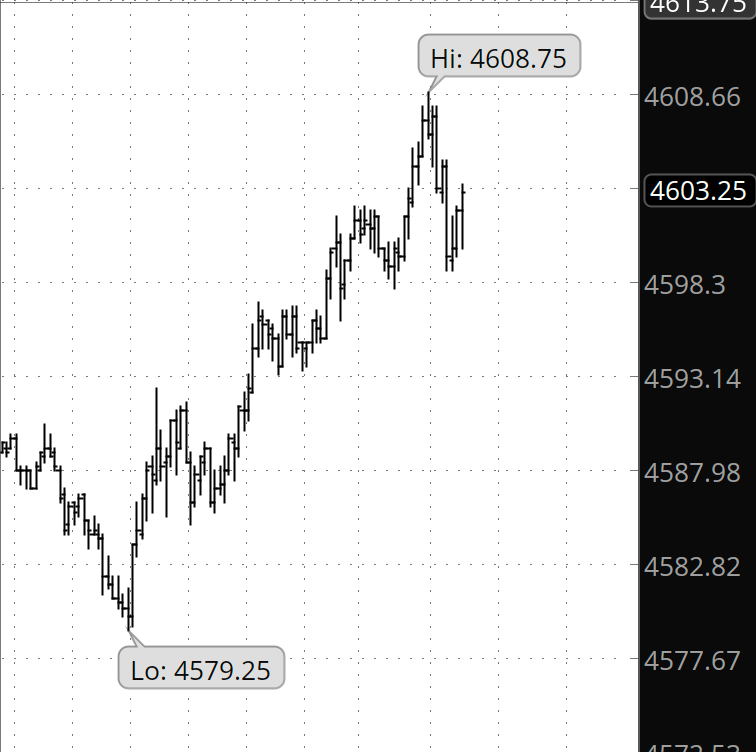
The S&P 500 futures have risen during the session, so far reaching a daily high of 4608.75. That’s $1 below the July 19 peak of the upward correction, 4609.75. If the price moves above 4609.75, then it can be interpreted in couple of ways.

  • Either the decline since July 19 was a subwave of rising wave C{-5}, which is still ongoing.
  • Or declining wave D{-5} proved to be unusually shallow and wave E{-5} is underway.

As noted in this morning’s analysis, waves of the {-5} degree are the ones that will signal the future course of the upward compound correction that began on October 13, 2022.

Wave C{-5} is the third of five waves within the final subwave, E{-4}, of the last leg, wave C{-3}, of the second corrective pattern within the rising compound correction, wave 2{-2}. Wave E{-4} will have five subwaves at completion

The price as of this writing has remained below the July 19 peak and so this morning’s analysis still stands: Declining wave D{-5} is underway.

I’ve updated this morning’s chart.

9:35 a.m. New York time

What’s happening now? The S&P 500 E-mini futures fluctuated between the 4570s and the 4590s overnight, going nowhere. The price remained below the July 19 high, 4609.25, which is slightly below the 78.6% Fibonacci retracement level, which is 4642.68. The Fibonacci ladder is shown on the chart in red.

What does it mean? Spoiler alert: There will be nothing new in this analysis.The second corrective pattern within upward compound correction that began in October continues. The correction is of the {-2} degree. The wave in play, the one that will determine the end of the corrective, is of the smaller {-5} degree and is in its fourth of five waves.

A compound correction can have two or three corrective patterns, so the present pattern, when complete, will either be the end of the correction, or will be followed by another corrective pattern. There’s no way to tell in advance how the correction will play out.

The correction will be followed by a powerful downtrend.

What are the alternatives? It is possible that the {-5} degree is in its rising third wave rather than its declining fourth. There have been several false signals.

[S&P 500 E-mini futures at 3:30 p.m., 260-minute bars, with volume]

What does Elliott wave theory say? Here are the waves that underly the analysis.

Principal analysis:

  • An upward correction, a Zigzag, wave 2{-2}, began on October 13, 2022 and is underway.
  • The upward correction, wave 2{-2}, is taking a compound form, which can contain up to three corrective patterns.
  • The correction is in its second corrective pattern, which is in wave C{-3}, its final wave.
  • The end of the present wave C{-3} could also be the end of the wave 2{-2} correction if the compound structure contains two subwaves.
  • Or the present corrective pattern could be followed by a declining connector, wave X{-3}, and then a third corrective pattern.
  • Wave C{-3} will have five subwaves and is at wave E{-4}, the final subwave.
  • Wave E{-4} is in its fourth of five subwaves, wave D{-5}.
  • Wave 2{-2}, when complete, will be followed by a powerful downtrend, wave 3{-2}.
  • Under the rules of Elliott wave analysis, wave 2{-2} cannot move beyond the beginning of wave 1{-2}, which was the January 4, 2022 peak at 4953.25

Alternative analysis:

  • Wave E{-4} is in its third of five subwaves, wave C{-5}, a rising wave that will be followed by an downward movement and then a final rise to completion.

Reading the chart. Price movements — waves – – in Elliott wave analysis are labeled with numbers within trending waves and letters with corrective waves. The subscripts — numbers in curly brackets — designate the wave’s degree, which, in Elliott wave analysis, means the relative position of a wave within the larger and smaller structures that make up the chart. R.N. Elliott, who in the 1930s developed the form of analysis that bears his name, viewed the chart as a complex structure of smaller waves nested within larger waves, which in turn are nested within still larger waves. In mathematics it’s called a fractal structure, where at every scale the pattern is similar to the others.

We Are Here.

These are the waves currently in progress under my principal analysis. Each line on the list shows the wave number, with the subscript in curly brackets, the traditional degree name, the starting date, the starting price of the S&P 500 E-mini futures, and the direction of the wave.

  • S&P 500 Index:
  • 5{+3} Supercycle, 7/8/1932, 4.40 (up)
  • 5{+2} Cycle, 12/9/1974, 60.96 (up)
  • 5{+1} Primary, 3/6/2009, 666.79 (up)
  • 5{0} Intermediate, 12/26/2018, 2346.58 (up)
  • S&P 500 Futures and index:
  • 4{-1} Minor, 1/4/2022, 4953.25 (down) (futures), 4818.62 (down) (index)
  • S&P 500 Futures:
  • 2{-2} Minute, 10/13/2022, 3577.75 (up)

Learning and other resources. Elliott wave analysis provides context, not prophecy. As the 20th century semanticist Alfred Korzybski put it in his book Science and Sanity (1933), “The map is not the territory … The only usefulness of a map depends on similarity of structure between the empirical world and the map.” And I would add, in the ever-changing markets, we can judge that similarity of structure only after the fact.

See the menu page Analytical Methods for a rundown on where to go for information on Elliott wave analysis.

By Tim Bovee, Portland, Oregon, July 25, 2023

Disclaimer

Tim Bovee, Private Trader tracks the analysis and trades of a private trader for his own accounts. Nothing in this blog constitutes a recommendation to buy or sell stocks, options or any other financial instrument. The only purpose of this blog is to provide education and entertainment.

No trader is ever 100 percent successful in his or her trades. Trading in the stock and option markets is risky and uncertain. Each trader must make trading decisions for his or her own account, and take responsibility for the consequences.

License
Creative Commons License

All content on Tim Bovee, Private Trader by Timothy K. Bovee is licensed under a Creative Commons Attribution-ShareAlike 4.0 International License.

Based on a work at www.timbovee.com.
Trader’s Notebook

3:30 p.m. New York time

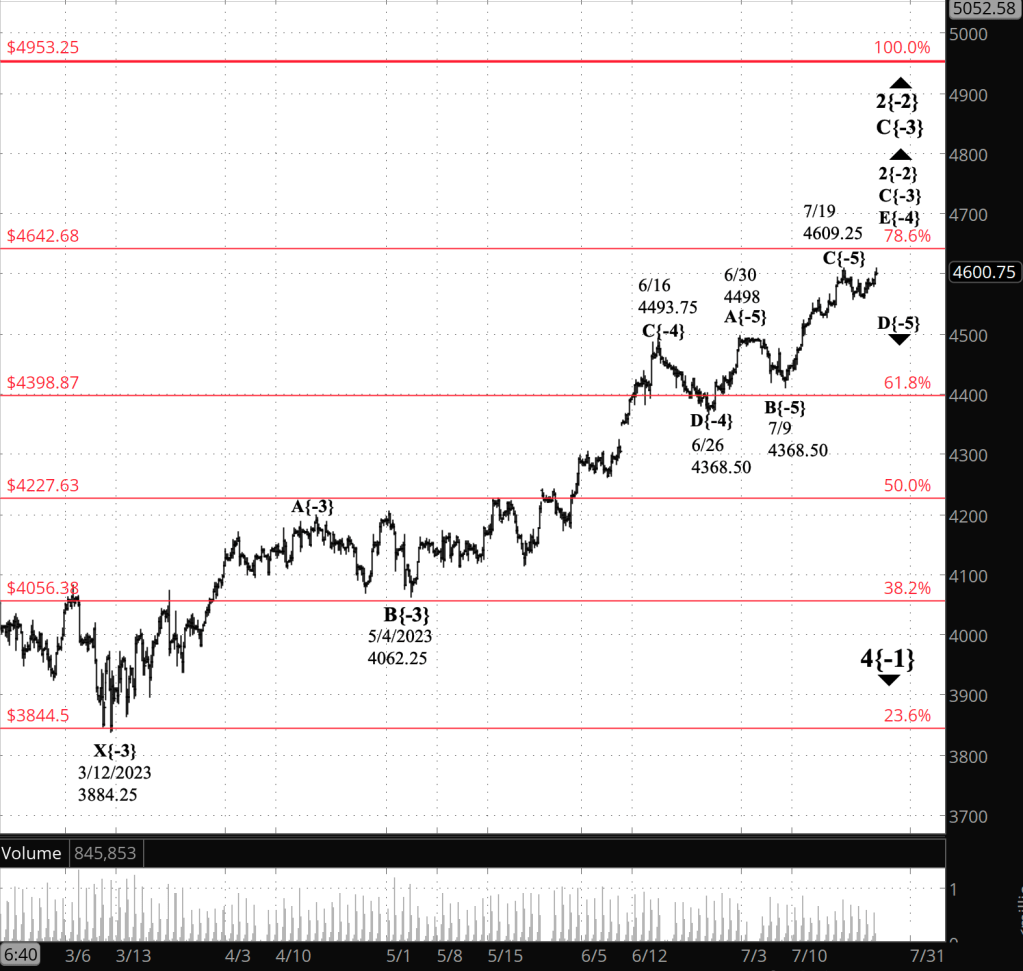
Half an hour before the closing bell. The S&P 500 futures worked their way up into the 4590s during the session, remaining below the high point, 4609.25, reached by the upward correction that has been underway for more than nine months.

No change in the analysis. I’ve updated the chart.

9:35 a.m. New York time

What’s happening now? The S&P 500 E-mini futures rose from the 4560s into the 4570s after trading resumed overnight, reaching still higher, in the 4580s, after the opening bell. The price remains below a 78.6% Fibonacci retracement, noted on the chart’s Fibonacci ladder, in red. That retracement level is a common turning point.

What does it mean? The upward correction that began last October has formed a compound structure. It is in its second corrective pattern. There may be a third corrective pattern, or the correction may stock at two patterns.

Like all stock-chart patterns, the corrective pattern is composed of a series of increasingly smaller patterns, nested like Russian matryoshka dolls. The corrective pattern, at degree {-2}, is in its final stage, as are the smaller patterns down to degree {-4}.

At this point, it is the pattern one degree smaller, at {-5}, that is driving the analysis. I did an analysis of still smaller patterns on Friday that suggested that the {-5} pattern is in its declining next-to-the-last-wave, the fourth of five waves.

That declining wave, labelled wave D{-5} on the chart, will be followed by a final push upward, which will complete the second corrective pattern.

A compound correction can have up to three corrective patterns. Most that I’ve seen have two, but that’s just anecdotal evidence and means little.

If this compound produces a third pattern, then the second pattern’s peak will be followed by a declining connector wave and then by the final pattern.

If the second pattern ends the correction, then a powerful downtrending wave of the {-2} degree will follow, carrying the price to the start of the correction, at 3502, and below, most likely significantly lower.

The market’s movements are an effective of the ever-changing public mood. Most financial events do little to switch the mood for more than a short time. A few events can have greater impact, and this week has such an event.

The Federal Open Market Committee meets Tuesday and Wednesday. The impact, if any, will come on Wednesday at 2 p.m. New York Time, when the FOMC releases a statement describing the committee’s consensus view of the economy and any decisions taken, usually involving interest rates. Fed Chair Jerome Powell will hold a news conference at 2:30 p.m., which can also contribute to the mood reflected by the markets.

What are the alternatives? It is still possible that the {-5} degree is in its rising third wave rather than its declining fourth. There have been several false signals as the price fishes for a top.

Reading the chart. Price movements — waves – – in Elliott wave analysis are labeled with numbers within trending waves and letters with corrective waves. The subscripts — numbers in curly brackets — designate the wave’s degree, which, in Elliott wave analysis, means the relative position of a wave within the larger and smaller structures that make up the chart. R.N. Elliott, who in the 1930s developed the form of analysis that bears his name, viewed the chart as a complex structure of smaller waves nested within larger waves, which in turn are nested within still larger waves. In mathematics it’s called a fractal structure, where at every scale the pattern is similar to the others.

[S&P 500 E-mini futures at 3:30 p.m., 260-minute bars, with volume]

What does Elliott wave theory say? Here are the waves that underly the nearer-term analysis.

Principal analysis:

  • An upward correction, a Zigzag, wave 2{-2}, began on October 13, 2022 and is underway.
  • The upward correction, wave 2{-2}, is taking a compound form, which can contain up to three corrective patterns.
  • The correction is in its second corrective pattern, which is in wave C{-3}, its final wave.
  • The end of the present wave C{-3} could also be the end of the wave 2{-2} correction if the compound structure contains two subwaves.
  • Or the present corrective pattern could be followed by a declining connector, wave X{-3}, and then a third corrective pattern.
  • Wave C{-3} will have five subwaves and is at wave E{-4}, the final subwave.
  • Wave E{-4} is in its fourth of five subwaves, wave D{-5}.
  • Wave 2{-2}, when complete, will be followed by a powerful downtrend, wave 3{-2}.
  • Under the rules of Elliott wave analysis, wave 2{-2} cannot move beyond the beginning of wave 1{-2}, which was the January 4, 2022 peak at 4953.25

Alternative analysis:

  • Wave E{-4} is in its third of five subwaves, wave C{-5}, a rising wave that will be followed by an downward movement and then a final rise to completion

We Are Here.

These are the waves currently in progress under my principal analysis. Each line on the list shows the wave number, with the subscript in curly brackets, the traditional degree name, the starting date, the starting price of the S&P 500 E-mini futures, and the direction of the wave.

  • S&P 500 Index:
  • 5{+3} Supercycle, 7/8/1932, 4.40 (up)
  • 5{+2} Cycle, 12/9/1974, 60.96 (up)
  • 5{+1} Primary, 3/6/2009, 666.79 (up)
  • 5{0} Intermediate, 12/26/2018, 2346.58 (up)
  • S&P 500 Futures and index:
  • 4{-1} Minor, 1/4/2022, 4953.25 (down) (futures), 4818.62 (down) (index)
  • S&P 500 Futures:
  • 2{-2} Minute, 10/13/2022, 3577.75 (up)

Learning and other resources. Elliott wave analysis provides context, not prophecy. As the 20th century semanticist Alfred Korzybski put it in his book Science and Sanity (1933), “The map is not the territory … The only usefulness of a map depends on similarity of structure between the empirical world and the map.” And I would add, in the ever-changing markets, we can judge that similarity of structure only after the fact.

See the menu page Analytical Methods for a rundown on where to go for information on Elliott wave analysis.

By Tim Bovee, Portland, Oregon, July 24, 2023

Disclaimer

Tim Bovee, Private Trader tracks the analysis and trades of a private trader for his own accounts. Nothing in this blog constitutes a recommendation to buy or sell stocks, options or any other financial instrument. The only purpose of this blog is to provide education and entertainment.

No trader is ever 100 percent successful in his or her trades. Trading in the stock and option markets is risky and uncertain. Each trader must make trading decisions for his or her own account, and take responsibility for the consequences.

License
Creative Commons License

All content on Tim Bovee, Private Trader by Timothy K. Bovee is licensed under a Creative Commons Attribution-ShareAlike 4.0 International License.

Based on a work at www.timbovee.com.
Trader’s Notebook

3:30 p.m. New York time

Half an hour before the closing bell. The S&P 500 futures have traded sideways during the session, remaining below the July 19 peak that marks the highest point of the upward correction that began on October 13, 2022.

Since July 19 the price has engaged in a five-wave pattern, indicative of a trending move (as opposed to a counter-trend correction). That suggests that the July 19 peak was the end of the middle leg of wave E{-4}, the wave that is in play as the corrective pattern nears its end.

On this very near-term chart, I’ve marked the peak as the end of wave C{-5} and falling wave D{-5} as being underway. In the smaller wave count, I have no idea what degree those waves are. I’ve marked the larger degree with a place-holder {n} as the degree number, and the subwave of that degree as {n-1}. An expedient, but it works.

Wave D{-5} as a counter-trend move ought to have three subwaves. It is certainly possible for those waves to take a Zigzag pattern, which would mean five subwaves for the first of the three waves, suggesting that the {n} degree could be degree {-6} and {n-1}, {-7}.

If this analysis proves correct, then wave D{-5} with its three subwaves will be followed by rising wave E{-5}, with five subwaves, which will be the final subwave of wave E{-4} whose completion will also be the end of wave C{-3} in the second corrective pattern within rising correction wave 2{-2}.

The chart in Thursday’s post gives context to the waves that led up to the July 19 peak and the small price movements that have followed it.

I’ve left this morning’s chart without an update, since the price movements are too small to show meaningfully on a chart of that scale.

[S&P 500 E-mini futures at 3:30 p.m., 10-minute bars, with volume]

9:35 a.m. New York time

What’s happening now? The S&P 500 E-mini futures traded in the 4560s and 4570s overnight, rising sharply into the 4590s as the opening bell approached.

What does it mean? The upward correction that began on October 13 continues. It has taken a compound form and is in its second corrective pattern. When that pattern is complete, it may be the end of the correction, or it may be followed by a third corrective pattern that will end the correction.

In any case, when upward correction is complete, it will be followed by a powerful downtrend. Trends in Elliott wave theory are composed of five waves: 1st, 3rd and 5th in the direction of the trend, and 2nd and 4th as countertrend corrections.

In the near-term view of the market, little has changed over the past few sessions, and I’d like end the week by pulling out for the long view. All of the ups and downs of the upward correction, a 2nd wave, have been part of a 4th wave downtrend, the next to the last wave within a massive expanding Diagonal Triangle, a 5th wave that began in December 2018.

For the nearer-term analysis, I refer the reader to yesterday’s Trader’s Notebook and to editions posted earlier in the week. There’s a rather mind-numbing sameness to them all as the present corrective pattern keeps reaching new heights, each of which could be the end the pattern, but so none has been.

In the discussion below I refer to waves by number, with their degree — their place in the fractal structure — indicated by a subscript in curly brackets. See the “Reading the Chart” section further down in this posting.

The expanding part of “expanding Diagonal Triangle” means that each reversal point is beyond the one that came before. The price channel I’ve marked on the chart, in blue, shows how the pattern got its name.

The Triangle is wave 5{0}, which began on December 26, 2018. It is the final wave of a rising wave 5{+1}. which which began on March 6, 2009. That wave, in turn is nested in two still larger rising trends, wave 5{+2}, which began on December 9, 1974, and wave 5{+3}, which began on July 8, 1932.

That all means that there are multiple end games underway. The present upward correction, wave 2{-2}, is a subwave of wave 4{-1}, which began on January 4, 2022. The future downtrend, wave 3{-2}, will be followed by another upward correction, wave 4{-2}, and then a final downward push, wave 5{-2}, which may well turn out to be more powerful than the 3rd wave that preceded it.

The end of wave 5{-2} will also be the end of the next-to-the-last wave of the Triangle, wave 4{-1}. And that’s when things get interesting. Wave 5{-1} will follow, a powerful rise that will carry the price up into the neighborhood of the upper price channel, which is presently in the 6400s and rising higher every day. It will be a bull market for the history books.

As all experienced traders know, just as the dark of night follows a bright and sunny day, so any bull market is followed by a bear market. And what a bear market it will be!

The end of wave 5{-1} will also be the end of wave 5{0} — the expanding Diagonal Triangle — and also of the larger enclosing waves, all the way up to wave 5{+3}, the uptrend that began in 1932, from the low of the Great Depression.

The downward movement that follows will eclipse any downtrend in the memories of people now living. I expect that it will feel like the end of the world as we know it.

What are the alternatives? Some analysts see the structure that began in December 2018 as a regular five-wave trend rather than as an expanding Diagonal Triangle. The scale of the wave 4{-1} decline and wave 5{-1} rise may vary depending upon which analysis proves correct. The wave numberings and relative scales that lie ahead are the same for both analyses.

[S&P 500 index at 9:35 a.m., 3-day bars]

What does Elliott wave theory say? Here are the waves that underly the nearer-term analysis. For longer-term waves, see the “We Are Here” section below.

Principal analysis:

  • An upward correction, a Zigzag, wave 2{-2}, began on October 13, 2022 and is underway.
  • The upward correction, wave 2{-2}, is taking a compound form, which can contain up to three corrective patterns.
  • The correction is in its second corrective pattern, which is in wave C{-3}, its final wave.
  • The end of the present wave C{-3} could also be the end of the wave 2{-2} correction if the compound structure contains two subwaves.
  • Or the present corrective pattern could be followed by a declining connector, wave X{-3}, and then a third corrective pattern.
  • Wave C{-3} will have five subwaves and is at wave E{-4}, the final subwave.
  • Wave E{-4} is in its third of five subwaves, wave C{-5}.
  • Wave 2{-2}, when complete, will be followed by a powerful downtrend, wave 3{-2}.
  • Under the rules of Elliott wave analysis, wave 2{-2} cannot move beyond the beginning of wave 1{-2}, which was the January 4, 2022 peak at 4953.25

Alternative analysis:

  • Wave E{-4} is in its fourth of five subwaves, wave D{-5}, a declining wave that will be followed by an upward push to completion

We Are Here.

These are the waves currently in progress under my principal analysis. Each line on the list shows the wave number, with the subscript in curly brackets, the traditional degree name, the starting date, the starting price of the S&P 500 E-mini futures, and the direction of the wave.

  • S&P 500 Index:
  • 5{+3} Supercycle, 7/8/1932, 4.40 (up)
  • 5{+2} Cycle, 12/9/1974, 60.96 (up)
  • 5{+1} Primary, 3/6/2009, 666.79 (up)
  • 5{0} Intermediate, 12/26/2018, 2346.58 (up)
  • S&P 500 Futures and index:
  • 4{-1} Minor, 1/4/2022, 4953.25 (down) (futures), 4818.62 (down) (index)
  • S&P 500 Futures:
  • 2{-2} Minute, 10/13/2022, 3577.75 (up)

Reading the chart. Price movements — waves – – in Elliott wave analysis are labeled with numbers within trending waves and letters with corrective waves. The subscripts — numbers in curly brackets — designate the wave’s degree, which, in Elliott wave analysis, means the relative position of a wave within the larger and smaller structures that make up the chart. R.N. Elliott, who in the 1930s developed the form of analysis that bears his name, viewed the chart as a complex structure of smaller waves nested within larger waves, which in turn are nested within still larger waves. In mathematics it’s called a fractal structure, where at every scale the pattern is similar to the others.

Learning and other resources. Elliott wave analysis provides context, not prophecy. As the 20th century semanticist Alfred Korzybski put it in his book Science and Sanity (1933), “The map is not the territory … The only usefulness of a map depends on similarity of structure between the empirical world and the map.” And I would add, in the ever-changing markets, we can judge that similarity of structure only after the fact.

See the menu page Analytical Methods for a rundown on where to go for information on Elliott wave analysis.

By Tim Bovee, Portland, Oregon, July 21, 2023

Disclaimer

Tim Bovee, Private Trader tracks the analysis and trades of a private trader for his own accounts. Nothing in this blog constitutes a recommendation to buy or sell stocks, options or any other financial instrument. The only purpose of this blog is to provide education and entertainment.

No trader is ever 100 percent successful in his or her trades. Trading in the stock and option markets is risky and uncertain. Each trader must make trading decisions for his or her own account, and take responsibility for the consequences.

License
Creative Commons License

All content on Tim Bovee, Private Trader by Timothy K. Bovee is licensed under a Creative Commons Attribution-ShareAlike 4.0 International License.

Based on a work at www.timbovee.com.
Trader’s Notebook

3:30 p.m. New York time

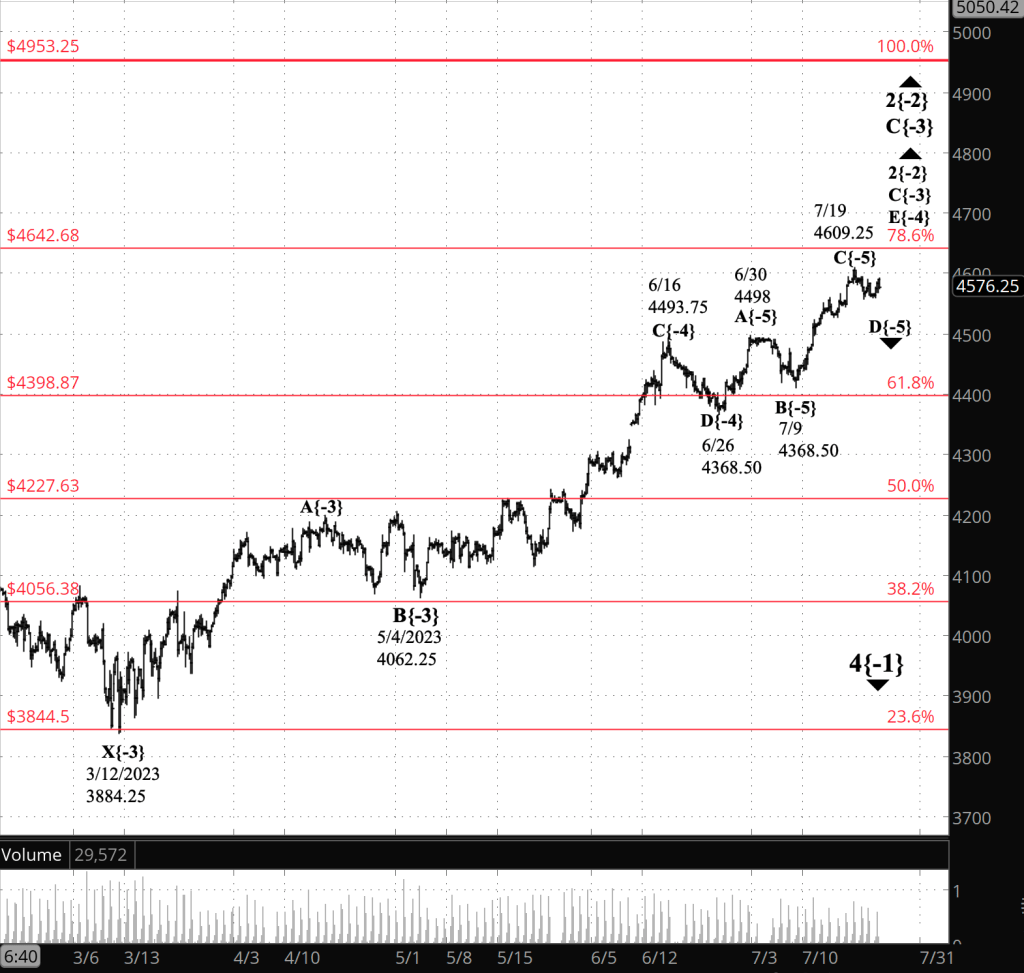
Half an hour before the closing bell. The S&P 500 futures fell during the session from the 4590s into the 4550s. This morning’s analysis remains unchanged. I’ve updated the chart.

9:35 a.m. New York time

What’s happening now? The S&P 500 E-mini futures meandered sideways overnight, remaining in the 4590s and 4580s until shortly before the opening bell, when the price dropped into the 4570s.

What does it mean? The pause is either a small subwave within the last leg of the corrective pattern that began on March 12, …

What are the alternatives? … or the tentative start of a wave connecting that corrective pattern, which ended at yesterday’s high, with another corrective pattern, …

… or the first steps of a powerful downtrend following the completion yesterday of the upward compound correction that began on October 13, 2022.

Which analysis reflects the path of the price will become clear eventually. At this point, it’s ambiguous.

Within the principal analysis, there’s room to question whether the last leg of the corrective pattern is in its middle or next-to-the-last subwave. I’ve chose the middle wave for the chart, wave C{-5}, although without a great deal of confidence.

Reading the chart. The chart shows the second corrective pattern in its entirety, overlaid by the Fibonacci ladder, in red, for the retracement of wave C{-3}, the last leg of the upward correction.

Price movements — waves – – in Elliott wave analysis are labeled with numbers within trending waves and letters with corrective waves. The subscripts — numbers in curly brackets — designate the wave’s degree, which, in Elliott wave analysis, means the relative position of a wave within the larger and smaller structures that make up the chart. R.N. Elliott, who in the 1930s developed the form of analysis that bears his name, viewed the chart as a complex structure of smaller waves nested within larger waves, which in turn are nested within still larger waves. In mathematics it’s called a fractal structure, where at every scale the pattern is similar to the others.

[S&P 500 E-mini futures at 3:30 p.m., 260-minute bars, with volume]

What does Elliott wave theory say? Here are the waves that underly the analysis.

Principal analysis:

  • An upward correction, a Zigzag, wave 2{-2}, began on October 13, 2022 and is underway.
  • The upward correction, wave 2{-2}, is taking a compound form, which can contain up to three corrective patterns.
  • The correction is in its second corrective pattern, which is in wave C{-3}, its final wave.
  • The end of the present wave C{-3} could also be the end of the wave 2{-2} correction if the compound structure contains two subwaves.
  • Or the present corrective pattern could be followed by a declining connector, wave X{-3}, and then a third corrective pattern.
  • Wave C{-3} will have five subwaves and is at wave E{-4}, the final subwave.
  • Wave E{-4} is in its third of five subwaves, wave C{-5}.
  • Wave 2{-2}, when complete, will be followed by a powerful downtrend, wave 3{-2}.
  • Under the rules of Elliott wave analysis, wave 2{-2} cannot move beyond the beginning of wave 1{-2}, which was the January 4, 2022 peak at 4953.25

Alternative analysis:

  • Wave E{-4} is in its fourth of five subwaves, wave D{-5}, a declining wave that will be followed by an upward push to completion

We Are Here.

These are the waves currently in progress under my principal analysis. Each line on the list shows the wave number, with the subscript in curly brackets, the traditional degree name, the starting date, the starting price of the S&P 500 E-mini futures, and the direction of the wave.

  • S&P 500 Index:
  • 5{+3} Supercycle, 7/8/1932, 4.40 (up)
  • 5{+2} Cycle, 12/9/1974, 60.96 (up)
  • 5{+1} Primary, 3/6/2009, 666.79 (up)
  • 5{0} Intermediate, 12/26/2018, 2346.58 (up)
  • S&P 500 Futures and index:
  • 4{-1} Minor, 1/4/2022, 4953.25 (down) (futures), 4818.62 (down) (index)
  • S&P 500 Futures:
  • 2{-2} Minute, 10/13/2022, 3577.75 (up)

Learning and other resources. Elliott wave analysis provides context, not prophecy. As the 20th century semanticist Alfred Korzybski put it in his book Science and Sanity (1933), “The map is not the territory … The only usefulness of a map depends on similarity of structure between the empirical world and the map.” And I would add, in the ever-changing markets, we can judge that similarity of structure only after the fact.

See the menu page Analytical Methods for a rundown on where to go for information on Elliott wave analysis.

By Tim Bovee, Portland, Oregon, July 20, 2023

Disclaimer

Tim Bovee, Private Trader tracks the analysis and trades of a private trader for his own accounts. Nothing in this blog constitutes a recommendation to buy or sell stocks, options or any other financial instrument. The only purpose of this blog is to provide education and entertainment.

No trader is ever 100 percent successful in his or her trades. Trading in the stock and option markets is risky and uncertain. Each trader must make trading decisions for his or her own account, and take responsibility for the consequences.

License
Creative Commons License

All content on Tim Bovee, Private Trader by Timothy K. Bovee is licensed under a Creative Commons Attribution-ShareAlike 4.0 International License.

Based on a work at www.timbovee.com.

Trader’s Notebook

3:30 p.m. New York time

Half an hour before the closing bell. The S&P 500 futures have hit a session high, so far, of 4609.25, which is also a high for the upward correction that began on October 13, 2022. No change in the analysis. I’ve updated the chart.

9:35 a.m. New York time

What’s happening now? The S&P 500 E-mini futures tracked sideways overnight, remaining within the 4580s and 4590s.

What does it mean? The trip to nowhere was a low-degree pause in the rise that began on July 9, part of the final portion of the second corrective pattern within a long-running upward compound correction that has defined the market for nine months.

As the opening bell approached, the price broke past yesterday’s peak, 4594.50 and in the first few minutes of the session reached higher, to 4603. Any higher high continues the last leg of the corrective pattern. Alternatively, any high is potentially the end of the corrective pattern.

Could a high also be the end of the correction itself? Maybe. A compound correction can have up to three corrective patterns, so it’s possible that the present second pattern will be followed by a shallow decline that will connect that pattern to the future third pattern. And it’s also possible that the second pattern will the end of the correction, setting off a powerful decline that will care the price below 3502, where the correction began, and typically far below that level.

What are the alternatives? All of the above. There is no way to know at this point how many corrective patterns the compound correction will produce. And there’s no way to pinpoint the final high with any degree of certainty. As the stand-up comedian Emo Phillips once defined it, “Ambiguity — the Devil’s volleyball.” Analyzing this market, it certainly seems that way.

[S&P 500 E-mini futures at 3:30 p.m., 2-hour bars, with volume]

What does Elliott wave theory say? Here are the waves that underly the analysis.

Principal analysis:

  • An upward correction, a Zigzag, wave 2{-2}, began on October 13, 2022 and is underway.
  • The upward correction, wave 2{-2}, is taking a compound form, which can contain up to three corrective patterns.
  • The correction is in its second corrective pattern, which is in wave C{-3}, its final wave.
  • The end of the present wave C{-3} could also be the end of the wave 2{-2} correction if the compound structure contains two subwaves.
  • Or the present corrective pattern could be followed by a declining connector, wave X{-3}, and then a third corrective pattern.
  • Wave C{-3} will have five subwaves and is at wave E{-4}, the final subwave.
  • Wave E{-4} is in its third of five subwaves, wave C{-5}.
  • Wave 2{-2}, when complete, will be followed by a powerful downtrend, wave 3{-2}.
  • Under the rules of Elliott wave analysis, wave 2{-2} cannot move beyond the beginning of wave 1{-2}, which was the January 4, 2022 peak at 4953.25

Alternative analysis:

  • Wave E{-4} is in its fourth of five subwaves, wave D{-5}, a declining wave that will be followed by an upward push to completion

Reading the chart. The chart contains, in red, the Fibonacci ladder for the retracement of wave C{-3}, the last leg of the upward correction.

Price movements — waves – – in Elliott wave analysis are labeled with numbers within trending waves and letters with corrective waves. The subscripts — numbers in curly brackets — designate the wave’s degree, which, in Elliott wave analysis, means the relative position of a wave within the larger and smaller structures that make up the chart. R.N. Elliott, who in the 1930s developed the form of analysis that bears his name, viewed the chart as a complex structure of smaller waves nested within larger waves, which in turn are nested within still larger waves. In mathematics it’s called a fractal structure, where at every scale the pattern is similar to the others.

We Are Here. These are the waves currently in progress under my principal analysis. Each line on the list shows the wave number, with the subscript in curly brackets, the traditional degree name, the starting date, the starting price of the S&P 500 E-mini futures, and the direction of the wave.

  • S&P 500 Index:
  • 5{+3} Supercycle, 7/8/1932, 4.40 (up)
  • 5{+2} Cycle, 12/9/1974, 60.96 (up)
  • 5{+1} Primary, 3/6/2009, 666.79 (up)
  • 5{0} Intermediate, 12/26/2018, 2346.58 (up)
  • S&P 500 Futures and index:
  • 4{-1} Minor, 1/4/2022, 4953.25 (down) (futures), 4818.62 (down) (index)
  • S&P 500 Futures:
  • 2{-2} Minute, 10/13/2022, 3577.75 (up)

Learning and other resources. Elliott wave analysis provides context, not prophecy. As the 20th century semanticist Alfred Korzybski put it in his book Science and Sanity (1933), “The map is not the territory … The only usefulness of a map depends on similarity of structure between the empirical world and the map.” And I would add, in the ever-changing markets, we can judge that similarity of structure only after the fact.

See the menu page Analytical Methods for a rundown on where to go for information on Elliott wave analysis.

By Tim Bovee, Portland, Oregon, July 19, 2023

Disclaimer

Tim Bovee, Private Trader tracks the analysis and trades of a private trader for his own accounts. Nothing in this blog constitutes a recommendation to buy or sell stocks, options or any other financial instrument. The only purpose of this blog is to provide education and entertainment.

No trader is ever 100 percent successful in his or her trades. Trading in the stock and option markets is risky and uncertain. Each trader must make trading decisions for his or her own account, and take responsibility for the consequences.

License
Creative Commons License

All content on Tim Bovee, Private Trader by Timothy K. Bovee is licensed under a Creative Commons Attribution-ShareAlike 4.0 International License.

Based on a work at www.timbovee.com.

Trader’s Notebook

3:30 p.m. New York time

Half an hour before the closing bell. The S&P 500 futures rose during the session, reaching into the 4590s. No change from this morning’s analysis. The second corrective pattern within a rising upward correction that began last October continues. I’ve updated the chart.

9:35 a.m. New York time

What’s happening now? The S&P 500 E-mini futures fell back into the 4530s overnight and then rose again into the 4550s as the opening bell approached.

What does it mean? At this point any peak and withdrawal could either be a stopping point on the middle wave of the rise that began on June 26, the final stage of the corrective pattern that began March 12. It is the second corrective pattern within a rising compound correction that began on October 13, 2022.

What is the alternative? Or the high could be the end of the middle wave of the June 26 rise and the beginning of a declining next-to-the-last wave that will be followed by the final wave of the corrective pattern.

Under both scenarios. A compound correction can contain two or three corrective patterns.

If this correction ends with two patterns, then the next step will be an energetic downtrend that will carry the price down to the correction’s starting point, 3502, and below, perhaps significantly lower.

If the correction turns out to contain three patterns, then the next step will be a shallow decline connecting the pattern just ended with the future pattern.

[S&P 500 E-mini futures at 3:30 p.m., 2-hour bars, with volume]

What does Elliott wave theory say? Here are the waves that underly the analysis.

Principal analysis:

  • An upward correction, a Zigzag, wave 2{-2}, began on October 13, 2022 and is underway.
  • The upward correction, wave 2{-2}, is taking a compound form, which can contain up to three corrective patterns.
  • The correction is in its second corrective pattern, which is in wave C{-3}, its final wave.
  • The end of the present wave C{-3} could also be the end of the wave 2{-2} correction if the compound structure contains two subwaves.
  • Or the present corrective pattern could be followed by a declining connector, wave X{-3}, and then a third corrective pattern.
  • Wave C{-3} will have five subwaves and is at wave E{-4}, the final subwave.
  • Wave E{-4} is in its third of five subwaves, wave C{-5}.
  • Wave 2{-2}, when complete, will be followed by a powerful downtrend, wave 3{-2}.
  • Under the rules of Elliott wave analysis, wave 2{-2} cannot move beyond the beginning of wave 1{-2}, which was the January 4, 2022 peak at 4953.25

Alternative analysis:

  • Wave E{-4} is in its fourth of five subwaves, wave D{-5}, a declining wave that will be followed by an upward push to completion

Reading the chart. The chart contains, in red, the Fibonacci ladder for the retradement of wave C{-3}, the last leg of the upward correction.

Price movements — waves – – in Elliott wave analysis are labeled with numbers within trending waves and letters with corrective waves. The subscripts — numbers in curly brackets — designate the wave’s degree, which, in Elliott wave analysis, means the relative position of a wave within the larger and smaller structures that make up the chart. R.N. Elliott, who in the 1930s developed the form of analysis that bears his name, viewed the chart as a complex structure of smaller waves nested within larger waves, which in turn are nested within still larger waves. In mathematics it’s called a fractal structure, where at every scale the pattern is similar to the others.

We Are Here.

These are the waves currently in progress under my principal analysis. Each line on the list shows the wave number, with the subscript in curly brackets, the traditional degree name, the starting date, the starting price of the S&P 500 E-mini futures, and the direction of the wave.

  • S&P 500 Index:
  • 5{+3} Supercycle, 7/8/1932, 4.40 (up)
  • 5{+2} Cycle, 12/9/1974, 60.96 (up)
  • 5{+1} Primary, 3/6/2009, 666.79 (up)
  • 5{0} Intermediate, 12/26/2018, 2346.58 (up)
  • S&P 500 Futures and index:
  • 4{-1} Minor, 1/4/2022, 4953.25 (down) (futures), 4818.62 (down) (index)
  • S&P 500 Futures:
  • 2{-2} Minute, 10/13/2022, 3577.75 (up)

Learning and other resources. Elliott wave analysis provides context, not prophecy. As the 20th century semanticist Alfred Korzybski put it in his book Science and Sanity (1933), “The map is not the territory … The only usefulness of a map depends on similarity of structure between the empirical world and the map.” And I would add, in the ever-changing markets, we can judge that similarity of structure only after the fact.

See the menu page Analytical Methods for a rundown on where to go for information on Elliott wave analysis.

By Tim Bovee, Portland, Oregon, July 18, 2023

Disclaimer

Tim Bovee, Private Trader tracks the analysis and trades of a private trader for his own accounts. Nothing in this blog constitutes a recommendation to buy or sell stocks, options or any other financial instrument. The only purpose of this blog is to provide education and entertainment.

No trader is ever 100 percent successful in his or her trades. Trading in the stock and option markets is risky and uncertain. Each trader must make trading decisions for his or her own account, and take responsibility for the consequences.

License
Creative Commons License

All content on Tim Bovee, Private Trader by Timothy K. Bovee is licensed under a Creative Commons Attribution-ShareAlike 4.0 International License.

Based on a work at www.timbovee.com.

Trader’s Notebook

Trading rule update. Over the weekend I updated my rule set for trading long options and posted a discussion of the changes.

3:30 p.m. New York time

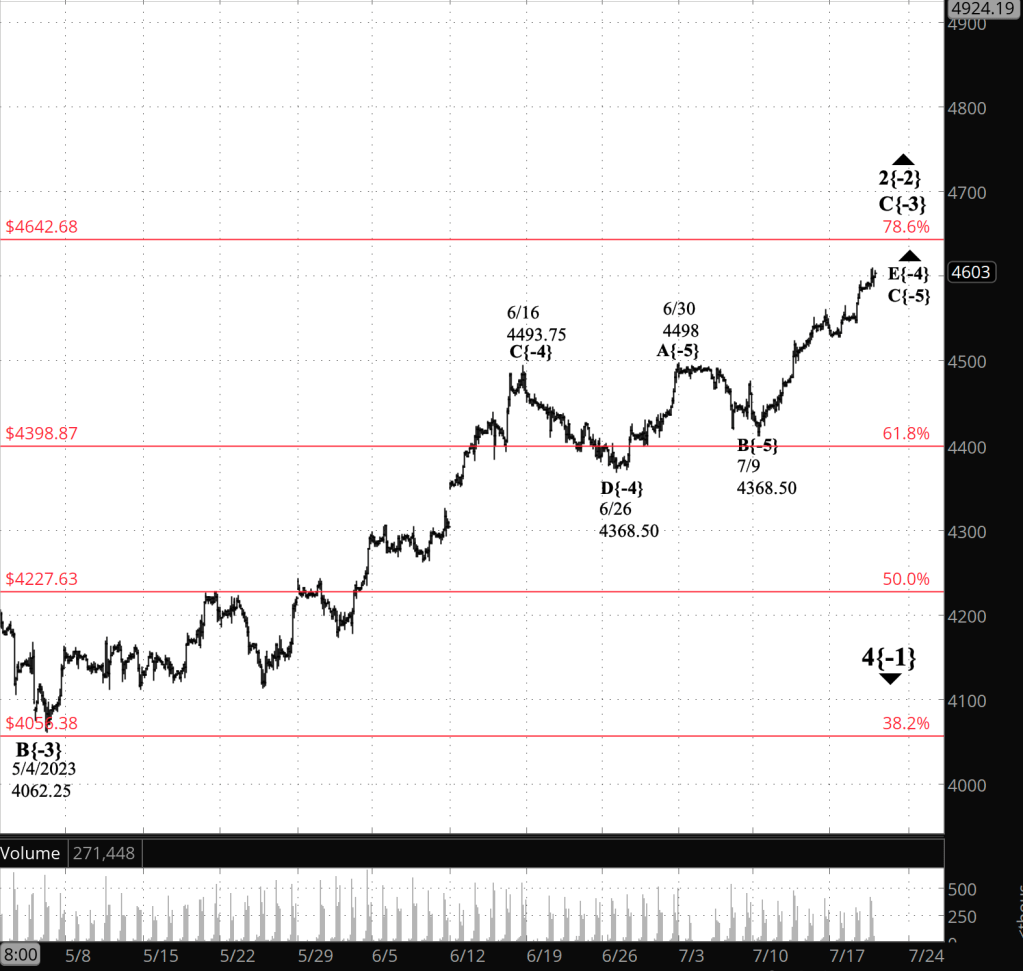
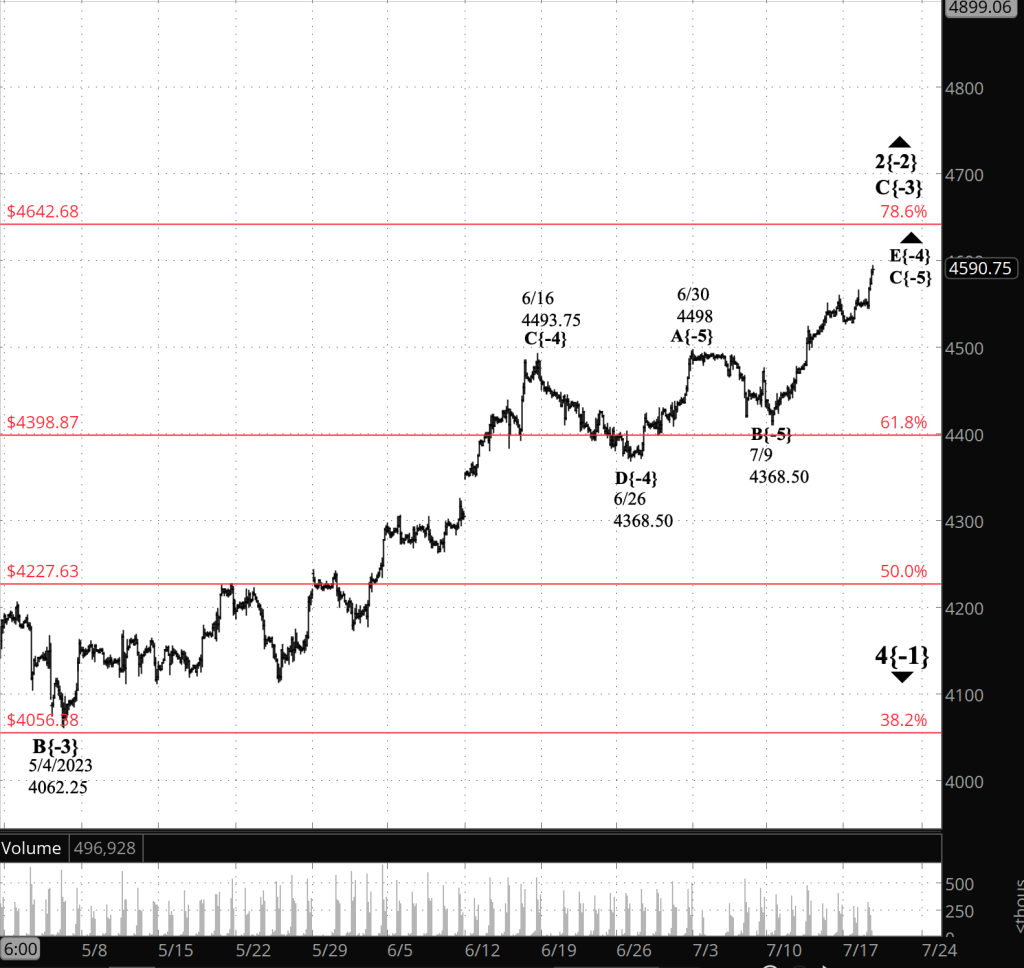
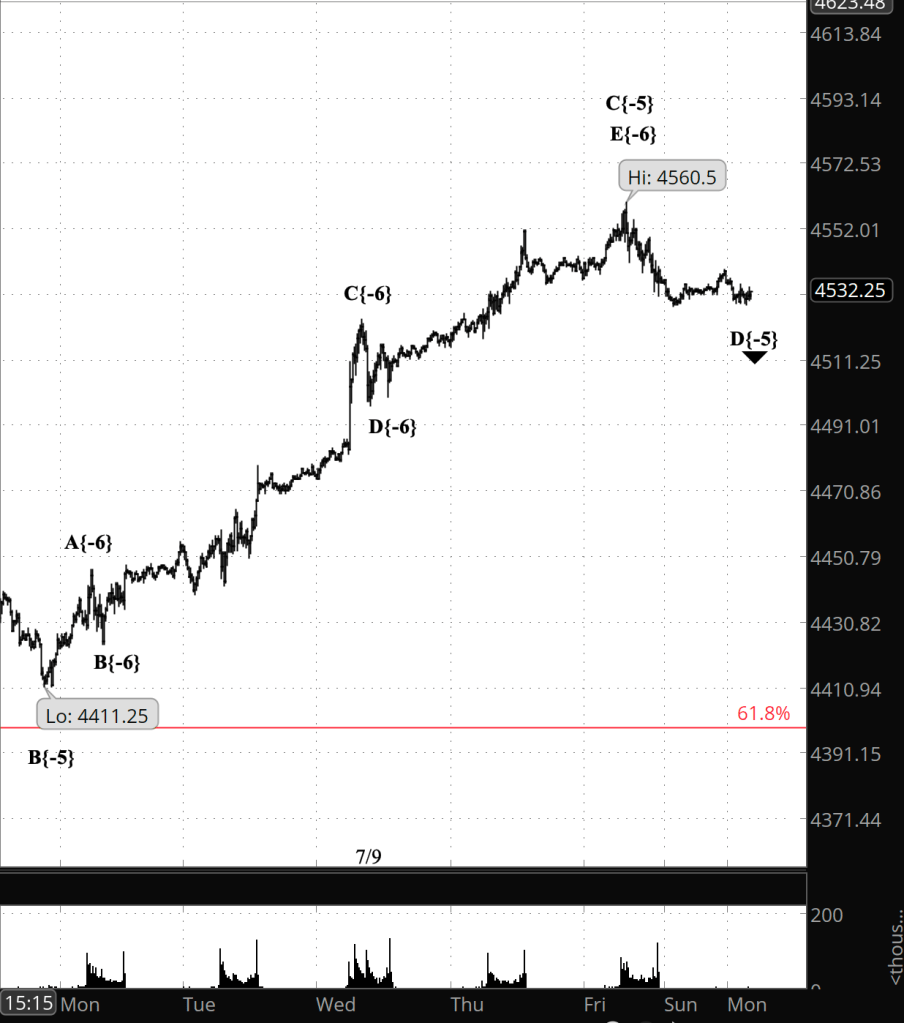
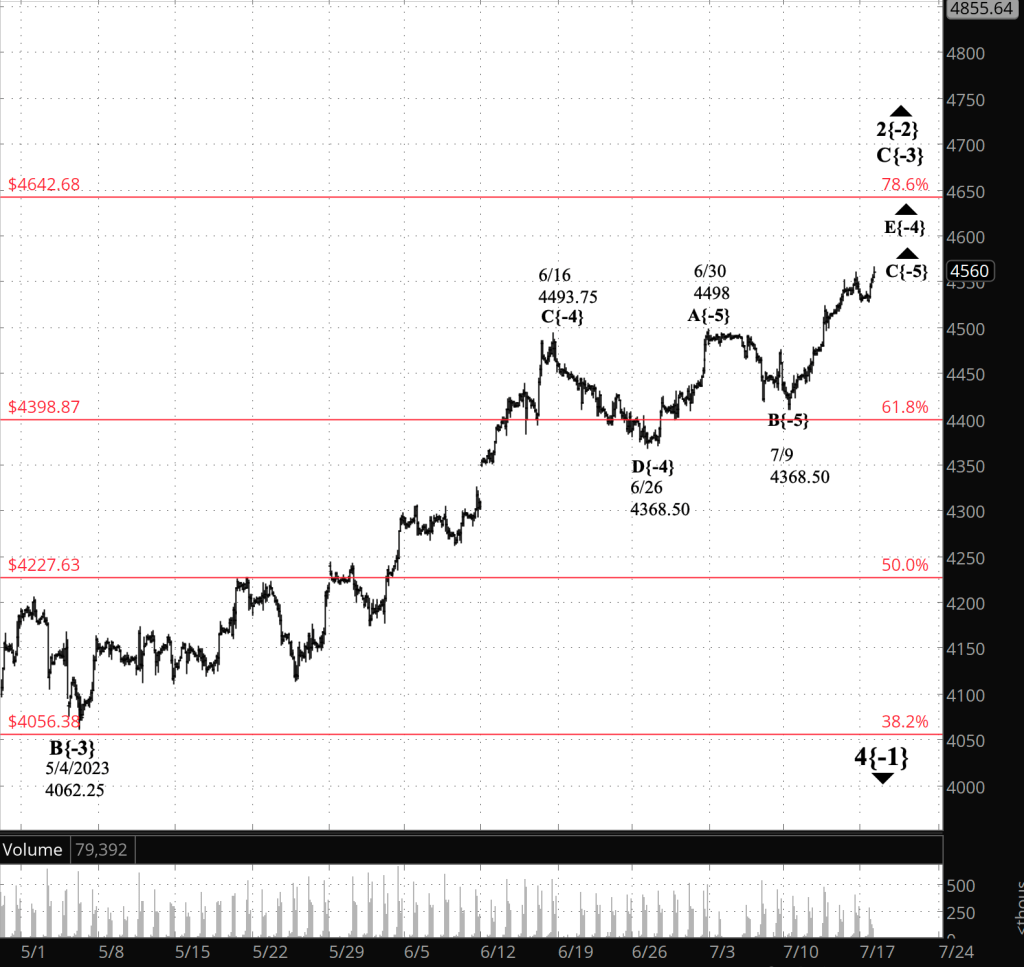
Half an hour before the closing bell. The S&P 500 futures rose above 4560.50, invalidating this morning’s principle analysis and validating the alternative: Wave E{-4}, is still in its middle wave, rising wave C{-5}.

I’ve updated the lower chart, which gives a view of the whole final wave of the present corrective pattern, wave C{-3}.

9:35 a.m. New York time

What’s happening now? The S&P 500 E-mini futures rose after trading resumed overnight, reaching 4539.25 and then falling into the 4520s.

What does it mean? The upward compound correction that began in October is nearing the end of its second corrective pattern, which will be followed either by a connecting wave and a third corrective pattern, or by a powerful downtrend following the end of the correction.

In the terminology used to mark the chart, the upward correction is wave 2{-2}. It is in its final leg, wave C{-3}, which is in its final subwave, E{-4}.

Wave E{-4} will have five subwaves and is in its fourth, wave D{-5}., which will be followed by a final push upward that will end the pattern.

Following is a close-up chart showing the subwaves of wave C{-5}

[S&P 500 E-mini futures at 8:59 a.m., 15-minute bars, with volume]

The neighborhood of the 78.6% Fibonacci retracement level — the topmost red line Fibonacci ladder — would be a typical ending point for the final subwave, E{-5}. No guarantees — Fibonacci reversals are tendencies, not certainties

Reading the chart. Price movements — waves – – in Elliott wave analysis are labeled with numbers within trending waves and letters with corrective waves. The subscripts — numbers in curly brackets — designate the wave’s degree, which, in Elliott wave analysis, means the relative position of a wave within the larger and smaller structures that make up the chart. R.N. Elliott, who in the 1930s developed the form of analysis that bears his name, viewed the chart as a complex structure of smaller waves nested within larger waves, which in turn are nested within still larger waves. In mathematics it’s called a fractal structure, where at every scale the pattern is similar to the others.

What are the alternatives? It’s possible that the decline from Friday’s peak is a subwave within an ongoing wave C{-5}. I consider it to be the less likely interpretation.

[S&P 500 E-mini futures at 3:31 p.m., 2-hour bars, with volume]

What does Elliott wave theory say? Here are the waves that underly the analysis.

Principal analysis:

  • An upward correction, a Zigzag, wave 2{-2}, began on October 13, 2022 and is underway.
  • The upward correction, wave 2{-2}, is taking a compound form, which can contain up to three corrective patterns.
  • The correction is in its second corrective pattern, which is in wave C{-3}, its final wave.
  • The end of the present wave C{-3} could also be the end of the wave 2{-2} correction if the compound structure contains two subwaves.
  • Or the present corrective pattern could be followed by a declining connector, wave X{-3}, and then a third corrective pattern.
  • Wave C{-3} will have five subwaves and is at wave E{-4}, the final subwave.
  • Wave E{-4} is in its fourth of five subwaves, wave D{-5}.
  • Wave 2{-2}, when complete, will be followed by a powerful downtrend, wave 3{-2}.
  • Under the rules of Elliott wave analysis, wave 2{-2} cannot move beyond the beginning of wave 1{-2}, which was the January 4, 2022 peak at 4953.25

Alternative analysis:

  • Wave E{-4} is in its third of five subwaves, wave C{-5}, which will be followed by a declining wave D{-5} and then an upward push to completion

We Are Here.

These are the waves currently in progress under my principal analysis. Each line on the list shows the wave number, with the subscript in curly brackets, the traditional degree name, the starting date, the starting price of the S&P 500 E-mini futures, and the direction of the wave.

  • S&P 500 Index:
  • 5{+3} Supercycle, 7/8/1932, 4.40 (up)
  • 5{+2} Cycle, 12/9/1974, 60.96 (up)
  • 5{+1} Primary, 3/6/2009, 666.79 (up)
  • 5{0} Intermediate, 12/26/2018, 2346.58 (up)
  • S&P 500 Futures and index:
  • 4{-1} Minor, 1/4/2022, 4953.25 (down) (futures), 4818.62 (down) (index)
  • S&P 500 Futures:
  • 2{-2} Minute, 10/13/2022, 3577.75 (up)

Learning and other resources. Elliott wave analysis provides context, not prophecy. As the 20th century semanticist Alfred Korzybski put it in his book Science and Sanity (1933), “The map is not the territory … The only usefulness of a map depends on similarity of structure between the empirical world and the map.” And I would add, in the ever-changing markets, we can judge that similarity of structure only after the fact.

See the menu page Analytical Methods for a rundown on where to go for information on Elliott wave analysis.

By Tim Bovee, Portland, Oregon, July 17, 2023

Disclaimer

Tim Bovee, Private Trader tracks the analysis and trades of a private trader for his own accounts. Nothing in this blog constitutes a recommendation to buy or sell stocks, options or any other financial instrument. The only purpose of this blog is to provide education and entertainment.

No trader is ever 100 percent successful in his or her trades. Trading in the stock and option markets is risky and uncertain. Each trader must make trading decisions for his or her own account, and take responsibility for the consequences.

License
Creative Commons License

All content on Tim Bovee, Private Trader by Timothy K. Bovee is licensed under a Creative Commons Attribution-ShareAlike 4.0 International License.

Based on a work at www.timbovee.com.