Trader’s Notebook

9:35 a.m. New York time

What’s happening now? The S&P 500 E-mini futures continued to trade in the 4490s and 4480s during a week that began with U.S. markets having a shortened session on Monday and staying closed today, Tuesday, for .the Independence Day holiday. Other global exchanges, such as London and Tokyo, were open for their regular sessions.

What does it mean? The only analysis possible is more of the same. An upward compounding correction, wave 2{-6} is in its second corrective pattern, and internally is in the final wave, rising wave E{-8}, within the last leg of the correction, rising wave C{-7}.

The end of wave E{-8} will also be the end of wave C{-7} and second corrective pattern.

Compound corrections can have as many as three waves, although many stop at two. There’s no way to know what this correction will do.

If the second corrective pattern marks the end of wave 2{-6}, then it will be followed by a powerful downtrending wave 3{-6}, which will carry the price below the start of the upward correction, 3502 on October 13, 2022, and, if it’s a typical 3rd wave, significantly lower.

If the correction will have a third corrective pattern, then there will be a downward separator wave, X{-7}, which will likely remain above the starting point of the correction.,

What are the alternatives? There is some ambiguity as to the relative degree of the correction — a not unusual situation. I’ve marked it as {-6} — Minuscule Degree in traditional Elliott wave terminology — but it could be larger.

Reading the chart. Price movements — waves – – in Elliott wave analysis are labeled with numbers within trending waves and letters with corrective waves. The subscripts — numbers in curly brackets — designate the wave’s degree, which, in Elliott wave analysis, means the relative position of a wave within the larger and smaller structures that make up the chart. R.N. Elliott, who in the 1930s developed the form of analysis that bears his name, viewed the chart as a complex structure of smaller waves nested within larger waves, which in turn are nested within still larger waves. In mathematics it’s called a fractal structure, where at every scale the pattern is similar to the others.
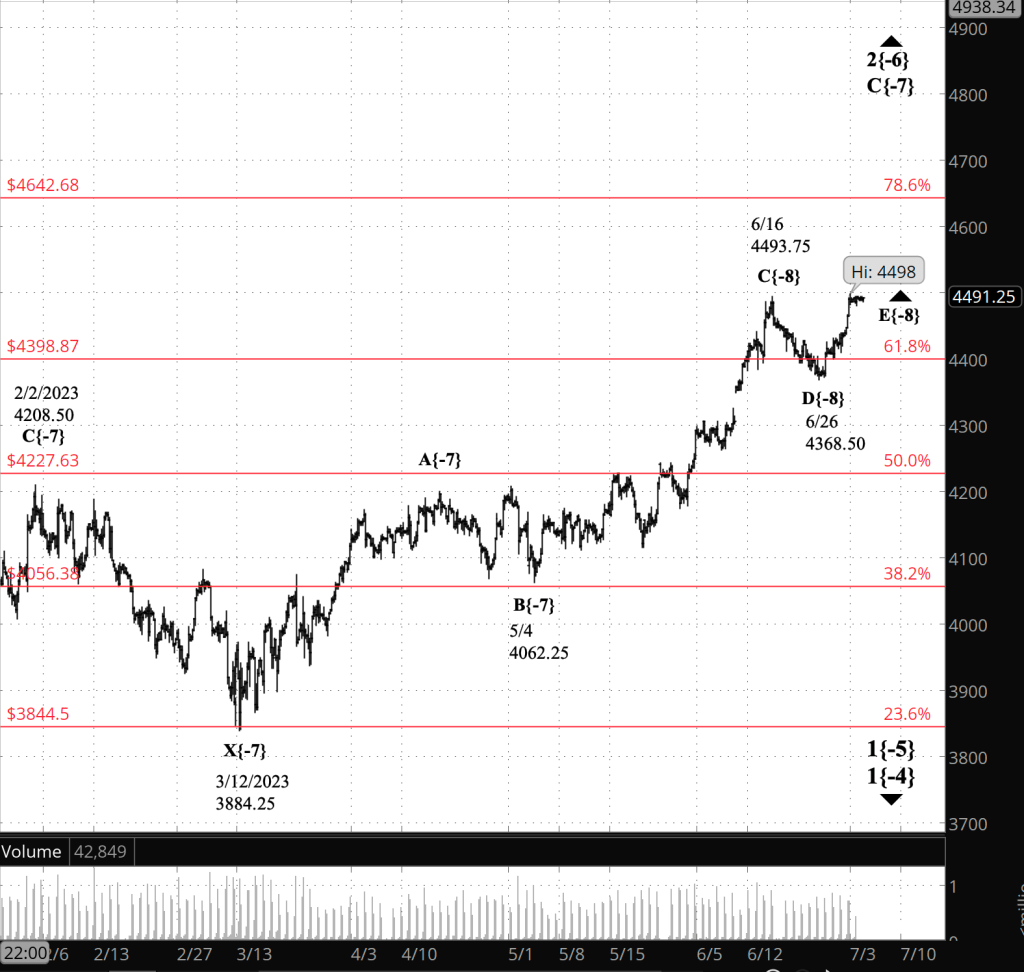
[S&P 500 E-mini futures at 9:35 a.m., 4-hour bars, with volume]

What does Elliott wave theory say? Here are the waves that underly the analysis.

  • An upward correction, a Zigzag, wave 2{-6}, began on October 13, 2022 and is underway.
  • The upward correction, wave 2{-6}, is taking a compound form, which can contain up to three corrective patterns.
  • The correction is in its second corrective pattern, which is in wave C{-7}, its final wave.
  • The end of the present wave C{-7} could also be the end of the wave 2{-6} correction if the compound structure contains two subwaves.
  • Or the present corrective pattern could be followed by a declining connector, wave X{-7}, and then a third corrective pattern.
  • Wave 2{-6}, when complete, will be followed by a powerful downtrend, wave 3{-6}.
  • Under the rules of Elliott wave analysis, wave 2{-6} cannot move beyond the beginning of wave 1{-6}, which was the January 4, 2022 peak at 4953.25. (I’ve adjusted the January 4 peak.)

We Are Here.

These are the waves currently in progress under my principal analysis. Each line on the list shows the wave number, with the subscript in curly brackets, the traditional degree name, the starting date, the starting price of the S&P 500 E-mini futures, and the direction of the wave.

  • S&P 500 Index:
  • 5{+3} Supercycle, 7/8/1932, 4.40 (up)
  • 5{+2} Cycle, 12/9/1974, 60.96 (up)
  • 5{+1} Primary, 3/6/2009, 666.79 (up)
  • 5{0} Intermediate, 12/26/2018, 2346.58 (up)
  • S&P 500 Futures and index:
  • 4{-1} Minor, 1/4/2022, 4953.25 (down) (futures), 4818.62 (down) (index)
  • S&P 500 Futures:
  • 1{-2} Minute, 1/4/2022, 4953.25 (down)
  • 1{-3} Minuette, 1/4/2022, 4953.25 (down)
  • 1{-4} Subminuette, 1/4/2022, 4953.25 (down)
  • 1{-5} Micro, 1/4/2022, 4953.25 (down)
  • 2{-6} Minuscule, 10/13/2022, 3577.75 (up)

Learning and other resources. Elliott wave analysis provides context, not prophecy. As the 20th century semanticist Alfred Korzybski put it in his book Science and Sanity (1933), “The map is not the territory … The only usefulness of a map depends on similarity of structure between the empirical world and the map.” And I would add, in the ever-changing markets, we can judge that similarity of structure only after the fact.

See the menu page Analytical Methods for a rundown on where to go for information on Elliott wave analysis.

By Tim Bovee, Portland, Oregon, July 4, 2023

Disclaimer

Tim Bovee, Private Trader tracks the analysis and trades of a private trader for his own accounts. Nothing in this blog constitutes a recommendation to buy or sell stocks, options or any other financial instrument. The only purpose of this blog is to provide education and entertainment.

No trader is ever 100 percent successful in his or her trades. Trading in the stock and option markets is risky and uncertain. Each trader must make trading decisions for his or her own account, and take responsibility for the consequences.

License
Creative Commons License

All content on Tim Bovee, Private Trader by Timothy K. Bovee is licensed under a Creative Commons Attribution-ShareAlike 4.0 International License.

Based on a work at www.timbovee.com.
Trader’s Notebook

U.S. markets schedule. Tomorrow, July 4, is a major holiday in the United States, celebrating its declaration of independence from the British Empire. U.S. markets will close early today, at 1 p.m. New York time, and will be closed tomorrow. The London and Tokyo markets traded today and will trade tomorrow. Today’s final update of Trader’s Notebook will be posted half an hour before the close, at 12:30 p.m. New York time.

12:30 p.m. New York time

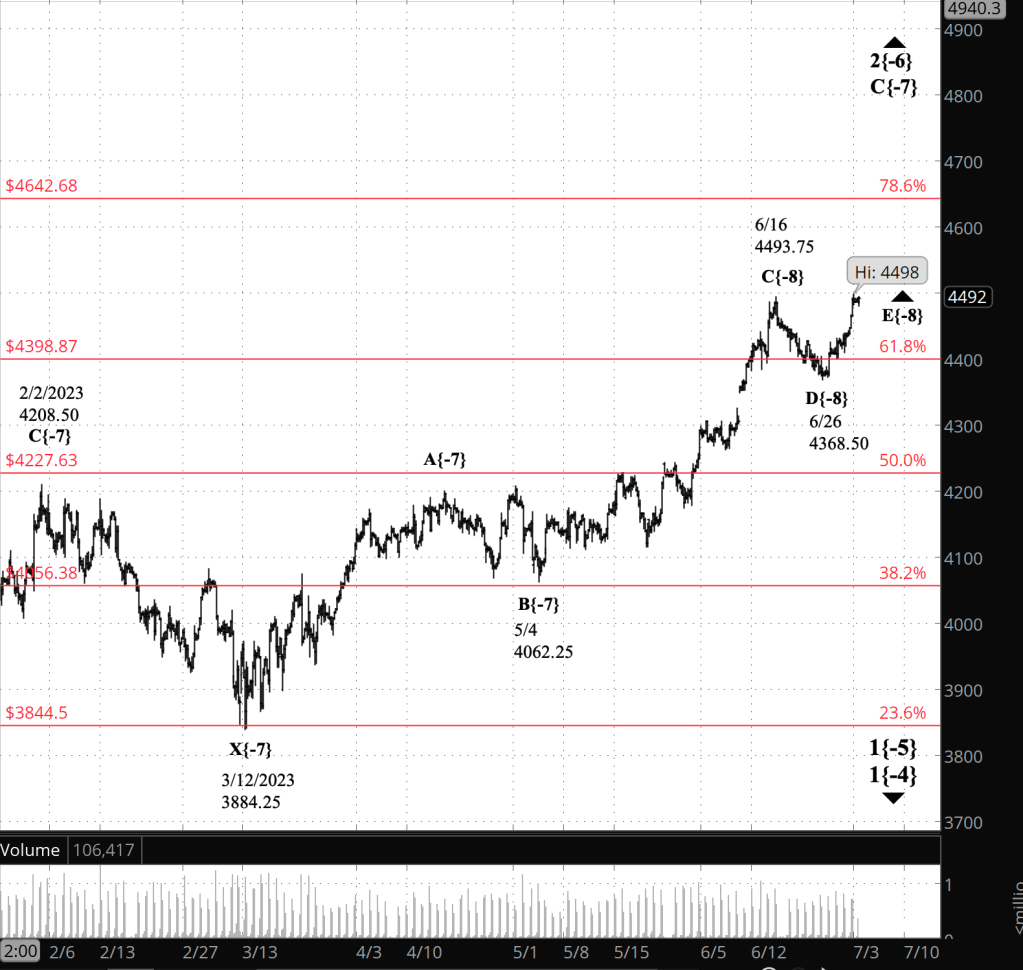
Half an hour before the closing bell. The S&P 500 futures has so far remained within the overnight range during the abbreviated session, rising from the 4470s back into the 4490s. No change in the analysis. I’ve updated the chart.

9:35 a.m. New York time

What’s happening now? The S&P 500 E-mini futures traded sideways overnight, peaked after 12 hours at 4493.25 and then quickly dropped, reaching into the 4470s as the opening bell sounded.

What does it mean? The question with which I closed the week on Friday remains unanswered: Is the rise that began on June 6 is the final subwave within the rising final wave of a corrective pattern, or is it an upward movement within the falling next-to-the-last subwave.

I’ve chosen to mark the chart with the scenario that the final subwave is underway as being the slightly more likely choice

In either case, the upward compound correction that began on October 13, 2022 continues and is in the last leg of its second corrective pattern. When the second pattern is complete, the price will either fall deeply in a downtrend, or will fall less dramatically in a linking wave that will be followed by a third corrective pattern, which when complete will be the end of the upward correction.

What are the alternatives? As is common, there is some ambiguity as to the relative degree of the correction. I’ve marked it as {-6} — Minuscule Degree in traditional Elliott wave terminology — but it could be larger.

[S&P 500 E-mini futures at 12:30 p.m., 4-hour bars, with volume]

What does Elliott wave theory say? Here are the waves that underly the analysis.

  • An upward correction, a Zigzag, wave 2{-6}, began on October 13, 2022 and is underway.
  • The upward correction, wave 2{-6}, is taking a compound form, which can contain up to three corrective patterns.
  • The correction is in its second corrective pattern, which is in wave C{-7}, its final wave.
  • The end of the present wave C{-7} could also be the end of the wave 2{-6} correction if the compound structure contains two subwaves.
  • Or the present corrective pattern could be followed by a declining connector, wave X{-7}, and then a third corrective pattern.
  • Wave 2{-6}, when complete, will be followed by a powerful downtrend, wave 3{-6}.
  • Under the rules of Elliott wave analysis, wave 2{-6} cannot move beyond the beginning of wave 1{-6}, which was the January 4, 2022 peak at 4953.25. (I’ve adjusted the January 4 peak.)

We Are Here.

These are the waves currently in progress under my principal analysis. Each line on the list shows the wave number, with the subscript in curly brackets, the traditional degree name, the starting date, the starting price of the S&P 500 E-mini futures, and the direction of the wave.

  • S&P 500 Index:
  • 5{+3} Supercycle, 7/8/1932, 4.40 (up)
  • 5{+2} Cycle, 12/9/1974, 60.96 (up)
  • 5{+1} Primary, 3/6/2009, 666.79 (up)
  • 5{0} Intermediate, 12/26/2018, 2346.58 (up)
  • S&P 500 Futures and index:
  • 4{-1} Minor, 1/4/2022, 4953.25 (down) (futures), 4818.62 (down) (index)
  • S&P 500 Futures:
  • 1{-2} Minute, 1/4/2022, 4953.25 (down)
  • 1{-3} Minuette, 1/4/2022, 4953.25 (down)
  • 1{-4} Subminuette, 1/4/2022, 4953.25 (down)
  • 1{-5} Micro, 1/4/2022, 4953.25 (down)
  • 2{-6} Minuscule, 10/13/2022, 3577.75 (up)

Learning and other resources. Elliott wave analysis provides context, not prophecy. As the 20th century semanticist Alfred Korzybski put it in his book Science and Sanity (1933), “The map is not the territory … The only usefulness of a map depends on similarity of structure between the empirical world and the map.” And I would add, in the ever-changing markets, we can judge that similarity of structure only after the fact.

See the menu page Analytical Methods for a rundown on where to go for information on Elliott wave analysis.

By Tim Bovee, Portland, Oregon, July 3, 2023

Disclaimer

Tim Bovee, Private Trader tracks the analysis and trades of a private trader for his own accounts. Nothing in this blog constitutes a recommendation to buy or sell stocks, options or any other financial instrument. The only purpose of this blog is to provide education and entertainment.

No trader is ever 100 percent successful in his or her trades. Trading in the stock and option markets is risky and uncertain. Each trader must make trading decisions for his or her own account, and take responsibility for the consequences.

License
Creative Commons License

All content on Tim Bovee, Private Trader by Timothy K. Bovee is licensed under a Creative Commons Attribution-ShareAlike 4.0 International License.

Based on a work at www.timbovee.com.
Trader’s Notebook

3:30 p.m. New York time

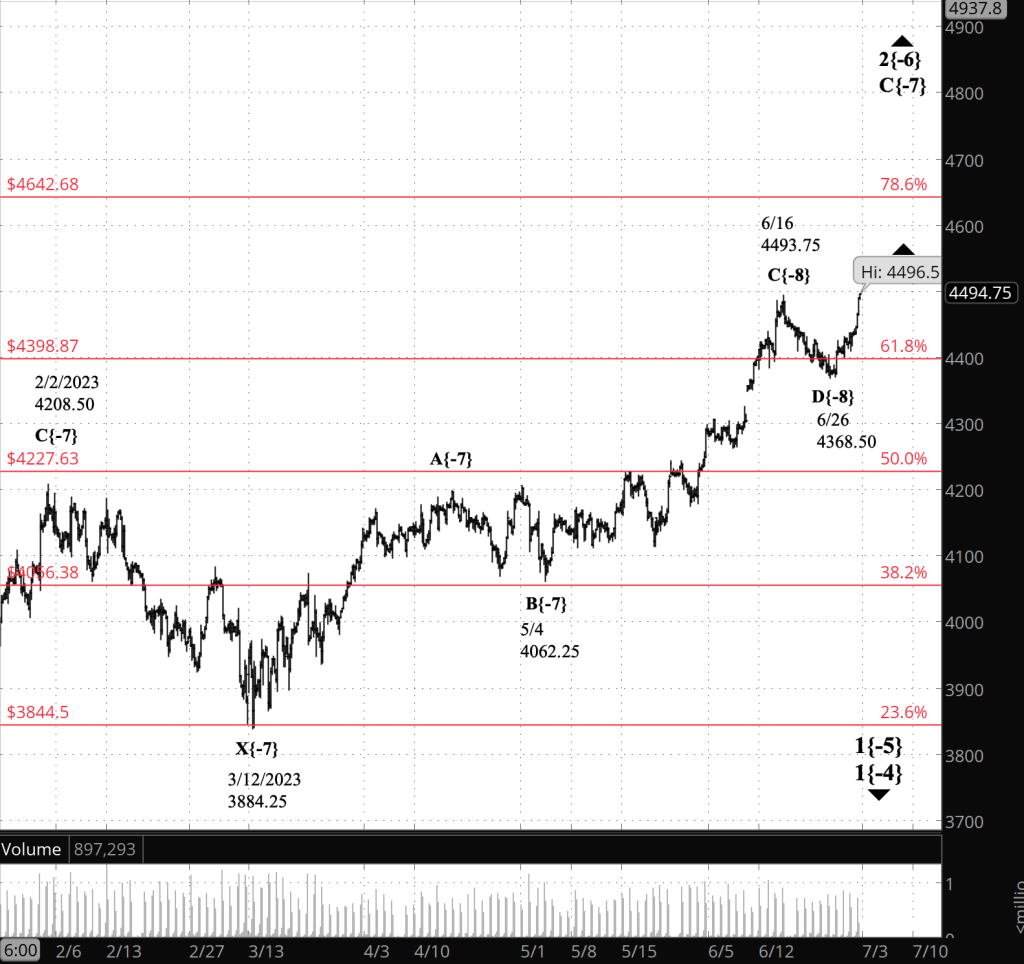
Half an hour before the closing bell. The S&P 500 continued to rise during the session, as the final subwave within the last leg of the compound correction’s second corrective pattern continued.

The final subwave is wave E{-8}. I expect it to contain five waves one degree smaller. When that fifth smaller wave is complete, the last leg, wave C{-7}, of the second corrective pattern will be complete.

The correction containing the patterns is wave 2{-6}. Under the rules of Elliott Wave Theory, a second wave cannot move beyond the starting point of the preceding 1st wave. Wave 1{-6} began on January 4, 2022 from 4808.25. That price is an absolute upper limit for wave 2{-6}. Any move higher will mean that the analysis doesn’t match the chart — the map doesn’t match the territory — and I’ll reanalyze the chart.

What happens next? Well, as is so often the case with market charts, it depends.

A compound correction can have two or three corrective patterns within it.

If this one has two, then the end of wave C{-7} will also be the end of the upward correction, wave 2{-6}. Downtrending wave 3{-6} will follow, and like all third waves, it will be powerful, will carry the price below the starting point of the wave 2{-6} correction, from 3508, and almost certainly well below that level. For optimistic traders whose positions are long, it will feel like the roller coaster has reached the fast downslope, whose end point can’t seen.

If the correction will contain three corrective patterns, then the present wave C{-7} will be followed a relatively shallow connector, wave X{-7}, which will remain above the correction’s starting point, 3508, and perhaps well above that level. When wave X{-7} is complete, a third corrective pattern will begin with yet another upward wave A{-7}.

There has been a lot written recently about the collapse of everything, most notably End Times by Peter Turchin. In its small way, this chart feels like the End Times for our long-running upward correction.

I’ve updated the upper chart, retaining this morning’s lower chart for comparison with the revised analysis.

2:15 p.m. New York time

The final subwave begins. I noted this a move above the upward correction’s prior peak, 44903.75, would mean that the final subwave within the last leg of the compound correction’s second corrective pattern has begun. The price this afternoon has moved to 4494.25 (so far), meaning that the final subwave is underway. In Elliott wave terminology, wave E{-8} within wave C{-7} within the correction, wave 2{-6}, has begun.

[S&P 500 E-mini futures at 3:30 p.m., 4-hour bars, with volume]

9:35 a.m. New York time

What’s happening now? The S&P 500 E-mini futures spiked up into the 4470s when the PCE inflation numbers were released, remaining below the high set so far by the present upward correction, 4493.75

What does it mean? In question as the week comes to a close is whether the rise that began on June 6 is the final subwave within the rising final wave of a corrective pattern, or is an upward movement within the falling next-to-the-last subwave. A move above the prior peak within the correction, 4493.75, would confirm the final-subwave scenario. A reversal and fall below 4368.50 would confirm the next-to-the-last subwave scenario.

In any case, when the final subwave is complete, it will also mark the end of the second corrective pattern within a compound correction that began on October 13, 2022. At that point, one of two possibilities will play out: Either the compound correction adds a third and final corrective pattern, or the upward correction ends and an energetic downtrend begins.

What are the alternatives? As is common, there is some ambiguity as to the relative degree of the correction. I’ve marked it as {-6} — Minuscule Degree in traditional Elliott wave terminology — but it could be larger.

The week ahead. Next Tuesday, July 4, is the Independence Day holiday in the United States. U.S. markets will be closed on the holiday and on Monday, July 3, they will close early, at 1 p.m. New York time. The London and Tokyo markets will trade on both days, and I’ll report on S&P 500 futures trading that occurs on those days.

[S&P 500 E-mini futures at 9:35 a.m., 4-hour bars, with volume]

[Chart outdated by this afternoon’s new price peak]

What does Elliott wave theory say? Here are the waves that underly the analysis.

  • An upward correction, a Zigzag, wave 2{-6}, began on October 13, 2022 and is underway.
  • The upward correction, wave 2{-6}, is taking a compound form, which can contain up to three corrective patterns.
  • The correction is in its second corrective pattern, which is in wave C{-7}, its final wave.
  • The end of the present wave C{-7} could also be the end of the wave 2{-6} correction if the compound structure contains two subwaves.
  • Or the present corrective pattern could be followed by a declining connector, wave X{-7}, and then a third corrective pattern.
  • Wave 2{-6}, when complete, will be followed by a powerful downtrend, wave 3{-6}.
  • Under the rules of Elliott wave analysis, wave 2{-6} cannot move beyond the beginning of wave 1{-6}, which was the January 4, 2022 peak at 4953.25. (I’ve adjusted the January 4 peak.)

Reading the chart. Price movements — waves – – in Elliott wave analysis are labeled with numbers within trending waves and letters with corrective waves. The subscripts — numbers in curly brackets — designate the wave’s degree, which, in Elliott wave analysis, means the relative position of a wave within the larger and smaller structures that make up the chart. R.N. Elliott, who in the 1930s developed the form of analysis that bears his name, viewed the chart as a complex structure of smaller waves nested within larger waves, which in turn are nested within still larger waves. In mathematics it’s called a fractal structure, where at every scale the pattern is similar to the others.

We Are Here.

These are the waves currently in progress under my principal analysis. Each line on the list shows the wave number, with the subscript in curly brackets, the traditional degree name, the starting date, the starting price of the S&P 500 E-mini futures, and the direction of the wave.

  • S&P 500 Index:
  • 5{+3} Supercycle, 7/8/1932, 4.40 (up)
  • 5{+2} Cycle, 12/9/1974, 60.96 (up)
  • 5{+1} Primary, 3/6/2009, 666.79 (up)
  • 5{0} Intermediate, 12/26/2018, 2346.58 (up)
  • S&P 500 Futures and index:
  • 4{-1} Minor, 1/4/2022, 4953.25 (down) (futures), 4818.62 (down) (index)
  • S&P 500 Futures:
  • 1{-2} Minute, 1/4/2022, 4953.25 (down)
  • 1{-3} Minuette, 1/4/2022, 4953.25 (down)
  • 1{-4} Subminuette, 1/4/2022, 4953.25 (down)
  • 1{-5} Micro, 1/4/2022, 4953.25 (down)
  • 2{-6} Minuscule, 10/13/2022, 3577.75 (up)

Learning and other resources. Elliott wave analysis provides context, not prophecy. As the 20th century semanticist Alfred Korzybski put it in his book Science and Sanity (1933), “The map is not the territory … The only usefulness of a map depends on similarity of structure between the empirical world and the map.” And I would add, in the ever-changing markets, we can judge that similarity of structure only after the fact.

See the menu page Analytical Methods for a rundown on where to go for information on Elliott wave analysis.

By Tim Bovee, Portland, Oregon, June 30, 2023

Disclaimer

Tim Bovee, Private Trader tracks the analysis and trades of a private trader for his own accounts. Nothing in this blog constitutes a recommendation to buy or sell stocks, options or any other financial instrument. The only purpose of this blog is to provide education and entertainment.

No trader is ever 100 percent successful in his or her trades. Trading in the stock and option markets is risky and uncertain. Each trader must make trading decisions for his or her own account, and take responsibility for the consequences.

License
Creative Commons License

All content on Tim Bovee, Private Trader by Timothy K. Bovee is licensed under a Creative Commons Attribution-ShareAlike 4.0 International License.

Based on a work at www.timbovee.com.

Trader’s Notebook

3:30 p.m. New York time

Half an hour before the closing bell. The S&P 500 futures kept to a narrow range during the session, going nowhere. No change in the analysis. I’ve updated the chart.

9:35 a.m. New York time

What’s happening now? The S&P 500 E-mini futures rose in overnight trading, reaching into the 4430s and then falling back below 4410 as the opening bell approached.

What does it mean? Given the complexity the structure at this point, I’m again using Elliott wave designations in this section to keep things clear.

The rise could be the beginning of the final subwave, wave E{-8}, within the final leg, wave C{-7}, of the second corrective pattern within a compound correction, wave 2{-6}, that began in October. From the form of the chart, it seems somewhat more likely to me that the rise is a subwave within declining wave D{-8}, the next-to-the-last subwave within the final leg of the upward correction. But, wave patterns don’t always present themselves with a great deal of clarity, so if the upward movement starts to show more energy, then I’ll be more likely to switch to the wave E{-8} scenario.

What are the alternatives? The ambiguity as to the relative degree of the correction continues. I’ve marked it as {-6} — Minuscule Degree in traditional Elliott wave terminology — but it could be larger.

Reading the chart. Price movements — waves – – in Elliott wave analysis are labeled with numbers within trending waves and letters with corrective waves. The subscripts — numbers in curly brackets — designate the wave’s degree, which, in Elliott wave analysis, means the relative position of a wave within the larger and smaller structures that make up the chart. R.N. Elliott, who in the 1930s developed the form of analysis that bears his name, viewed the chart as a complex structure of smaller waves nested within larger waves, which in turn are nested within still larger waves. In mathematics it’s called a fractal structure, where at every scale the pattern is similar to the others.

[S&P 500 E-mini futures at 3:30 p.m., 4-hour bars, with volume]

What does Elliott wave theory say? Here are the waves that underly the analysis.

  • An upward correction, a Zigzag, wave 2{-6}, began on October 13, 2022 and is underway.
  • The upward correction, wave 2{-6}, is taking a compound form, which can contain up to three corrective patterns.
  • The correction is in its second corrective pattern, which is in wave C{-7}, its final wave.
  • The end of the present wave C{-7} could also be the end of the wave 2{-6} correction if the compound structure contains two subwaves.
  • Or the present corrective pattern could be followed by a declining connector, wave X{-7}, and then a third corrective pattern.
  • Wave 2{-6}, when complete, will be followed by a powerful downtrend, wave 3{-6}.
  • Under the rules of Elliott wave analysis, wave 2{-6} cannot move beyond the beginning of wave 1{-6}, which was the January 4, 2022 peak at 4953.25. (I’ve adjusted the January 4 peak.)

We Are Here.

These are the waves currently in progress under my principal analysis. Each line on the list shows the wave number, with the subscript in curly brackets, the traditional degree name, the starting date, the starting price of the S&P 500 E-mini futures, and the direction of the wave.

  • S&P 500 Index:
  • 5{+3} Supercycle, 7/8/1932, 4.40 (up)
  • 5{+2} Cycle, 12/9/1974, 60.96 (up)
  • 5{+1} Primary, 3/6/2009, 666.79 (up)
  • 5{0} Intermediate, 12/26/2018, 2346.58 (up)
  • S&P 500 Futures and index:
  • 4{-1} Minor, 1/4/2022, 4953.25 (down) (futures), 4818.62 (down) (index)
  • S&P 500 Futures:
  • 1{-2} Minute, 1/4/2022, 4953.25 (down)
  • 1{-3} Minuette, 1/4/2022, 4953.25 (down)
  • 1{-4} Subminuette, 1/4/2022, 4953.25 (down)
  • 1{-5} Micro, 1/4/2022, 4953.25 (down)
  • 2{-6} Minuscule, 10/13/2022, 3577.75 (up)

Learning and other resources. Elliott wave analysis provides context, not prophecy. As the 20th century semanticist Alfred Korzybski put it in his book Science and Sanity (1933), “The map is not the territory … The only usefulness of a map depends on similarity of structure between the empirical world and the map.” And I would add, in the ever-changing markets, we can judge that similarity of structure only after the fact.

See the menu page Analytical Methods for a rundown on where to go for information on Elliott wave analysis.

By Tim Bovee, Portland, Oregon, June 29, 2023

Disclaimer

Tim Bovee, Private Trader tracks the analysis and trades of a private trader for his own accounts. Nothing in this blog constitutes a recommendation to buy or sell stocks, options or any other financial instrument. The only purpose of this blog is to provide education and entertainment.

No trader is ever 100 percent successful in his or her trades. Trading in the stock and option markets is risky and uncertain. Each trader must make trading decisions for his or her own account, and take responsibility for the consequences.

License
Creative Commons License

All content on Tim Bovee, Private Trader by Timothy K. Bovee is licensed under a Creative Commons Attribution-ShareAlike 4.0 International License.

Based on a work at www.timbovee.com.

Trader’s Notebook

3:30 p.m. New York time

Half an hour before the closing bell. The S&P 500 futures hit a high in the 4430s during the session and then dropped back. No change in this morning’s analysis. I’ve updated the chart.

9:35 a.m. New York time

What’s happening now? The S&P 500 E-mini futures rose to the 4016.75 in overnight trading and then fell to 4401.25 at the opening bell, slightly above the 61.8% Fibonacci retracement level.

What does it mean? The analysis by necessity must deal with three levels of waves, and I’ve used the Elliott wave numbers for greater clarity.

The upward compound correction, wave 2{-6} that began last October is in the final leg, wave C{-7}, of its second corrective pattern, which internally is … ambiguous. In yesterday’s analysis I described two possibilities: Either Monday’s low, 4385.75, was the end of wave D{-8}, the next-to-the-last subwave within the final leg second corrective pattern and the final wave, E{-8}, has begun. Or that low was just a small drop within wave D{-8}.

The overnight go-nowhere chart does nothing to remove the ambiguity. Generally, I like to have some evidence before declaring one wave to be complete and the next to have begun. Lacking such evidence, I’m sticking with the scenario that began June 16: Wave D{-8} is underway.

What are the alternatives? Also unchanged. The ambiguity as to the relative degree of the correction continues. I’ve marked it as {-6} — Minuscule Degree in traditional Elliott wave terminology — but it could be larger.

[S&P 500 E-mini futures at 3:30 p.m., 4-hour bars, with volume]

What does Elliott wave theory say? Here are the waves that underly the analysis.

  • An upward correction, a Zigzag, wave 2{-6}, began on October 13, 2022 and is underway.
  • The upward correction, wave 2{-6}, is taking a compound form, which can contain up to three corrective patterns.
  • The correction is in its second corrective pattern, which is in wave C{-7}, its final wave.
  • The end of the present wave C{-7} could also be the end of the wave 2{-6} correction if the compound structure contains two subwaves.
  • Or the present corrective pattern could be followed by a declining connector, wave X{-7}, and then a third corrective pattern.
  • Wave 2{-6}, when complete, will be followed by a powerful downtrend, wave 3{-6}.
  • Under the rules of Elliott wave analysis, wave 2{-6} cannot move beyond the beginning of wave 1{-6}, which was the January 4, 2022 peak at 4953.25. (I’ve adjusted the January 4 peak.)

Reading the chart. Price movements — waves – – in Elliott wave analysis are labeled with numbers within trending waves and letters with corrective waves. The subscripts — numbers in curly brackets — designate the wave’s degree, which, in Elliott wave analysis, means the relative position of a wave within the larger and smaller structures that make up the chart. R.N. Elliott, who in the 1930s developed the form of analysis that bears his name, viewed the chart as a complex structure of smaller waves nested within larger waves, which in turn are nested within still larger waves. In mathematics it’s called a fractal structure, where at every scale the pattern is similar to the others.

We Are Here.

These are the waves currently in progress under my principal analysis. Each line on the list shows the wave number, with the subscript in curly brackets, the traditional degree name, the starting date, the starting price of the S&P 500 E-mini futures, and the direction of the wave.

  • S&P 500 Index:
  • 5{+3} Supercycle, 7/8/1932, 4.40 (up)
  • 5{+2} Cycle, 12/9/1974, 60.96 (up)
  • 5{+1} Primary, 3/6/2009, 666.79 (up)
  • 5{0} Intermediate, 12/26/2018, 2346.58 (up)
  • S&P 500 Futures and index:
  • 4{-1} Minor, 1/4/2022, 4953.25 (down) (futures), 4818.62 (down) (index)
  • S&P 500 Futures:
  • 1{-2} Minute, 1/4/2022, 4953.25 (down)
  • 1{-3} Minuette, 1/4/2022, 4953.25 (down)
  • 1{-4} Subminuette, 1/4/2022, 4953.25 (down)
  • 1{-5} Micro, 1/4/2022, 4953.25 (down)
  • 2{-6} Minuscule, 10/13/2022, 3577.75 (up)

Learning and other resources. Elliott wave analysis provides context, not prophecy. As the 20th century semanticist Alfred Korzybski put it in his book Science and Sanity (1933), “The map is not the territory … The only usefulness of a map depends on similarity of structure between the empirical world and the map.” And I would add, in the ever-changing markets, we can judge that similarity of structure only after the fact.

See the menu page Analytical Methods for a rundown on where to go for information on Elliott wave analysis.

By Tim Bovee, Portland, Oregon, June 28, 2023

Disclaimer

Tim Bovee, Private Trader tracks the analysis and trades of a private trader for his own accounts. Nothing in this blog constitutes a recommendation to buy or sell stocks, options or any other financial instrument. The only purpose of this blog is to provide education and entertainment.

No trader is ever 100 percent successful in his or her trades. Trading in the stock and option markets is risky and uncertain. Each trader must make trading decisions for his or her own account, and take responsibility for the consequences.

License
Creative Commons License

All content on Tim Bovee, Private Trader by Timothy K. Bovee is licensed under a Creative Commons Attribution-ShareAlike 4.0 International License.

Based on a work at www.timbovee.com.
Trader’s Notebook

3:30 p.m. New York time

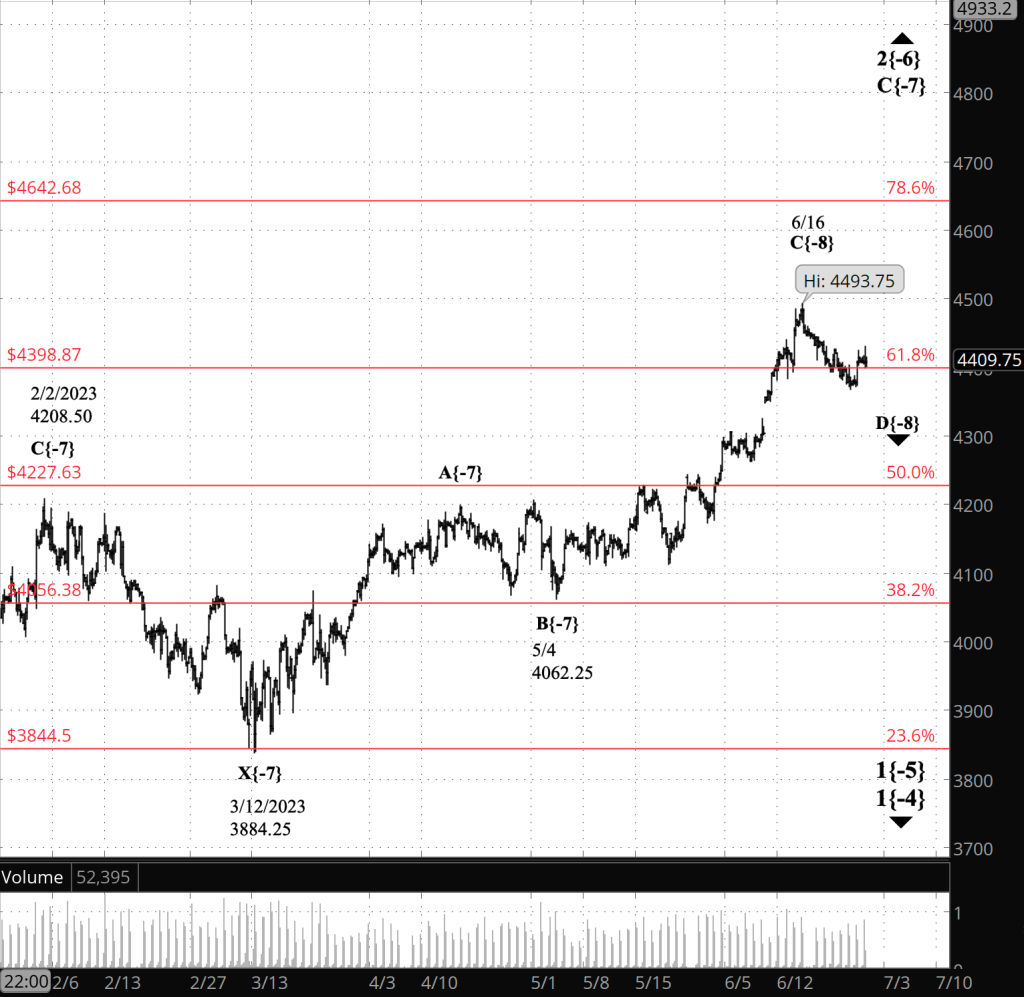
Half an hour before the closing bell. The S&P 500 futures rose into the 4420s during the session, once again breaking above the 61.8% Fibonacci retracement level. It’s possible that the reversal marks the end of the 4th subwave, wave D{-8}, within the final leg, wave C{-7}, of the corrective pattern that began on March 12, the second such pattern within an upward correction, wave 2{-6}, that began in mid-October. Or it could be a subwave within that 4th subwave.

I’m staying with this morning’s analysis which sees that 4th subwave as still being underway. A sufficient continuation of the rise, into the 4490s and higher, would be a sign that the 5th and final subwave has begun. I’ve updated the chart.

9:35 a.m. New York time

What’s happening now? The S&P 500 E-mini futures continued to fall overnight, reaching into the low 4370s and then pulling up sllightly

What does it mean? The final subwave within the second corrective pattern of a compound correction that began on October 13, 2022 continues and is now in the fourth of five subwaves. When corrective pattern is complete, it will be followed either by a declining connector wave and a third corrective pattern, or by a powerful downtrend, a sign that the upward correction has ended at the second corrective pattern.

What are the alternatives? As is common, there is some ambiguity as to the relative degree of the correction. I’ve marked it as {-6} — Minuscule Degree in traditional Elliott wave terminology — but it could be larger.

Reading the chart. I’ve focused the chart on the second corrective pattern within the upward correction, which is a 2nd wave. The Fibonacci retracement ladder, in red, shows the correction’s retracement of the preceding downtrending wave, a 1st wave.

Price movements — waves – – in Elliott wave analysis are labeled with numbers within trending waves and letters with corrective waves. The subscripts — numbers in curly brackets — designate the wave’s degree, which, in Elliott wave analysis, means the relative position of a wave within the larger and smaller structures that make up the chart. R.N. Elliott, who in the 1930s developed the form of analysis that bears his name, viewed the chart as a complex structure of smaller waves nested within larger waves, which in turn are nested within still larger waves. In mathematics it’s called a fractal structure, where at every scale the pattern is similar to the others.

[S&P 500 E-mini futures at 3:30 p.m., 4-hour bars, with volume]

What does Elliott wave theory say? Here are the waves that underly the analysis.

  • An upward correction, a Zigzag, wave 2{-6}, began on October 13, 2022 and is underway.
  • The upward correction, wave 2{-6}, is taking a compound form, which can contain up to three corrective patterns.
  • The correction is in its second corrective pattern, which is in wave C{-7}, its final wave.
  • The end of the present wave C{-7} could also be the end of the wave 2{-6} correction if the compound structure contains two subwaves.
  • Or the present corrective pattern could be followed by a declining connector, wave X{-7}, and then a third corrective pattern.
  • Wave 2{-6}, when complete, will be followed by a powerful downtrend, wave 3{-6}.
  • Under the rules of Elliott wave analysis, wave 2{-6} cannot move beyond the beginning of wave 1{-6}, which was the January 4, 2022 peak at 4953.25. (I’ve adjusted the January 4 peak.)

We Are Here.

These are the waves currently in progress under my principal analysis. Each line on the list shows the wave number, with the subscript in curly brackets, the traditional degree name, the starting date, the starting price of the S&P 500 E-mini futures, and the direction of the wave.

  • S&P 500 Index:
  • 5{+3} Supercycle, 7/8/1932, 4.40 (up)
  • 5{+2} Cycle, 12/9/1974, 60.96 (up)
  • 5{+1} Primary, 3/6/2009, 666.79 (up)
  • 5{0} Intermediate, 12/26/2018, 2346.58 (up)
  • S&P 500 Futures and index:
  • 4{-1} Minor, 1/4/2022, 4953.25 (down) (futures), 4818.62 (down) (index)
  • S&P 500 Futures:
  • 1{-2} Minute, 1/4/2022, 4953.25 (down)
  • 1{-3} Minuette, 1/4/2022, 4953.25 (down)
  • 1{-4} Subminuette, 1/4/2022, 4953.25 (down)
  • 1{-5} Micro, 1/4/2022, 4953.25 (down)
  • 2{-6} Minuscule, 10/13/2022, 3577.75 (up)

Learning and other resources. Elliott wave analysis provides context, not prophecy. As the 20th century semanticist Alfred Korzybski put it in his book Science and Sanity (1933), “The map is not the territory … The only usefulness of a map depends on similarity of structure between the empirical world and the map.” And I would add, in the ever-changing markets, we can judge that similarity of structure only after the fact.

See the menu page Analytical Methods for a rundown on where to go for information on Elliott wave analysis.

By Tim Bovee, Portland, Oregon, June 27, 2023

Disclaimer

Tim Bovee, Private Trader tracks the analysis and trades of a private trader for his own accounts. Nothing in this blog constitutes a recommendation to buy or sell stocks, options or any other financial instrument. The only purpose of this blog is to provide education and entertainment.

No trader is ever 100 percent successful in his or her trades. Trading in the stock and option markets is risky and uncertain. Each trader must make trading decisions for his or her own account, and take responsibility for the consequences.

License
Creative Commons License

All content on Tim Bovee, Private Trader by Timothy K. Bovee is licensed under a Creative Commons Attribution-ShareAlike 4.0 International License.

Based on a work at www.timbovee.com.

Trader’s Notebook

3:30 p.m. New York time

Half an hour before the closing bell. The S&P 500 futures rose to 4403 in the early hours of the session and then retreated back to the 4370s, trading in a narrow range thereafter, so far. No change in this morning’s analysis. I’ve updated the chart.

9:35 a.m. New York time

What’s happening now? The S&P 500 E-mini futures worked its way lower into the 4370s after trading resumed overnight,

What does it mean? The upward correction that began in mid-October continues and has taken a compound form. It is presently in the final wave of the second corrective pattern, which may be the final pattern. Or, possibly, there could be one more corrective pattern.

That final wave within the second pattern is in the fourth of five subwaves. When complete, that fourth subwave will be followed by a fifth and final wave that will most likely rise above the correction’s previous high, 4493.75, attained on June 16.

What happens after the second corrective pattern is complete? There will be a decline, that will fill one or the other of two very different roles in the Elliott wave structure.

If the compound correction will have two corrective patterns, then the end of the present pattern will also be the end do the correction, and the decline will be a powerful downtrend that will carry the price well below the correction’s starting point, 3502.

If the compound correction will have three corrective patterns, then the downward movement will be a connecting wave that will be followed by the third and final corrective pattern. The connecting wave will be relatively shallow — the first connecting wave within this correction covered only 324 points. The third corrective pattern, when complete, will also be the end of the compound correction, and the powerful downtrend will begin.

Timing: The first corrective pattern took about 3-1/2 months to complete. The second pattern has been underway for almost 3-1/2 months and still has further to go. The prior corrective pattern’s connector wave took a month and a half to complete. So a third corrective pattern, along with the connector wave, could possibly add five months to the lifespan of the correction, bringing it to the end of the year. If the present second corrective pattern completes the correction, then it could be over before autumn begins in the Northern Hemisphere.

However, some waves move fast, others move slow, and past time spans aren’t necessarily accurate indicators of future timespans.

What are the alternatives? I’ve labeled the correction as being of the {-6} degree. Degree labelling is notoriously prone to re-interpretation. It could turn out to be of a larger degree.

[S&P 500 E-mini futures at 3:30 p.m., 8-hour bars, with volume]

Reading the chart. Price movements — waves – – in Elliott wave analysis are labeled with numbers within trending waves and letters with corrective waves. The subscripts — numbers in curly brackets — designate the wave’s degree, which, in Elliott wave analysis, means the relative position of a wave within the larger and smaller structures that make up the chart. R.N. Elliott, who in the 1930s developed the form of analysis that bears his name, viewed the chart as a complex structure of smaller waves nested within larger waves, which in turn are nested within still larger waves. In mathematics it’s called a fractal structure, where at every scale the pattern is similar to the others.

What does Elliott wave theory say? Here are the waves that underly the analysis.

  • An upward correction, a Zigzag, wave 2{-6}, began on October 13, 2022 and is underway.
  • The upward correction, wave 2{-6}, is taking a compound form, which can contain up to three corrective patterns.
  • The correction is in its second corrective pattern, which is in wave C{-7}, its final wave.
  • The end of the present wave C{-7} could also be the end of the wave 2{-6} correction if the compound structure contains two subwaves.
  • Or the present corrective pattern could be followed by a declining connector, wave X{-7}, and then a third corrective pattern.
  • Wave 2{-6}, when complete, will be followed by a powerful downtrend, wave 3{-6}.
  • Under the rules of Elliott wave analysis, wave 2{-6} cannot move beyond the beginning of wave 1{-6}, which was the January 4, 2022 peak at 4953.25. (I’ve adjusted the January 4 peak.)

We Are Here.

These are the waves currently in progress under my principal analysis. Each line on the list shows the wave number, with the subscript in curly brackets, the traditional degree name, the starting date, the starting price of the S&P 500 E-mini futures, and the direction of the wave.

  • S&P 500 Index:
  • 5{+3} Supercycle, 7/8/1932, 4.40 (up)
  • 5{+2} Cycle, 12/9/1974, 60.96 (up)
  • 5{+1} Primary, 3/6/2009, 666.79 (up)
  • 5{0} Intermediate, 12/26/2018, 2346.58 (up)
  • S&P 500 Futures and index:
  • 4{-1} Minor, 1/4/2022, 4953.25 (down) (futures), 4818.62 (down) (index)
  • S&P 500 Futures:
  • 1{-2} Minute, 1/4/2022, 4953.25 (down)
  • 1{-3} Minuette, 1/4/2022, 4953.25 (down)
  • 1{-4} Subminuette, 1/4/2022, 4953.25 (down)
  • 1{-5} Micro, 1/4/2022, 4953.25 (down)
  • 2{-6} Minuscule, 10/13/2022, 3577.75 (up)

Learning and other resources. Elliott wave analysis provides context, not prophecy. As the 20th century semanticist Alfred Korzybski put it in his book Science and Sanity (1933), “The map is not the territory … The only usefulness of a map depends on similarity of structure between the empirical world and the map.” And I would add, in the ever-changing markets, we can judge that similarity of structure only after the fact.

See the menu page Analytical Methods for a rundown on where to go for information on Elliott wave analysis.

By Tim Bovee, Portland, Oregon, June 26, 2023

Disclaimer

Tim Bovee, Private Trader tracks the analysis and trades of a private trader for his own accounts. Nothing in this blog constitutes a recommendation to buy or sell stocks, options or any other financial instrument. The only purpose of this blog is to provide education and entertainment.

No trader is ever 100 percent successful in his or her trades. Trading in the stock and option markets is risky and uncertain. Each trader must make trading decisions for his or her own account, and take responsibility for the consequences.

License
Creative Commons License

All content on Tim Bovee, Private Trader by Timothy K. Bovee is licensed under a Creative Commons Attribution-ShareAlike 4.0 International License.

Based on a work at www.timbovee.com.
Trader’s Notebook

3:30 p.m. New York time

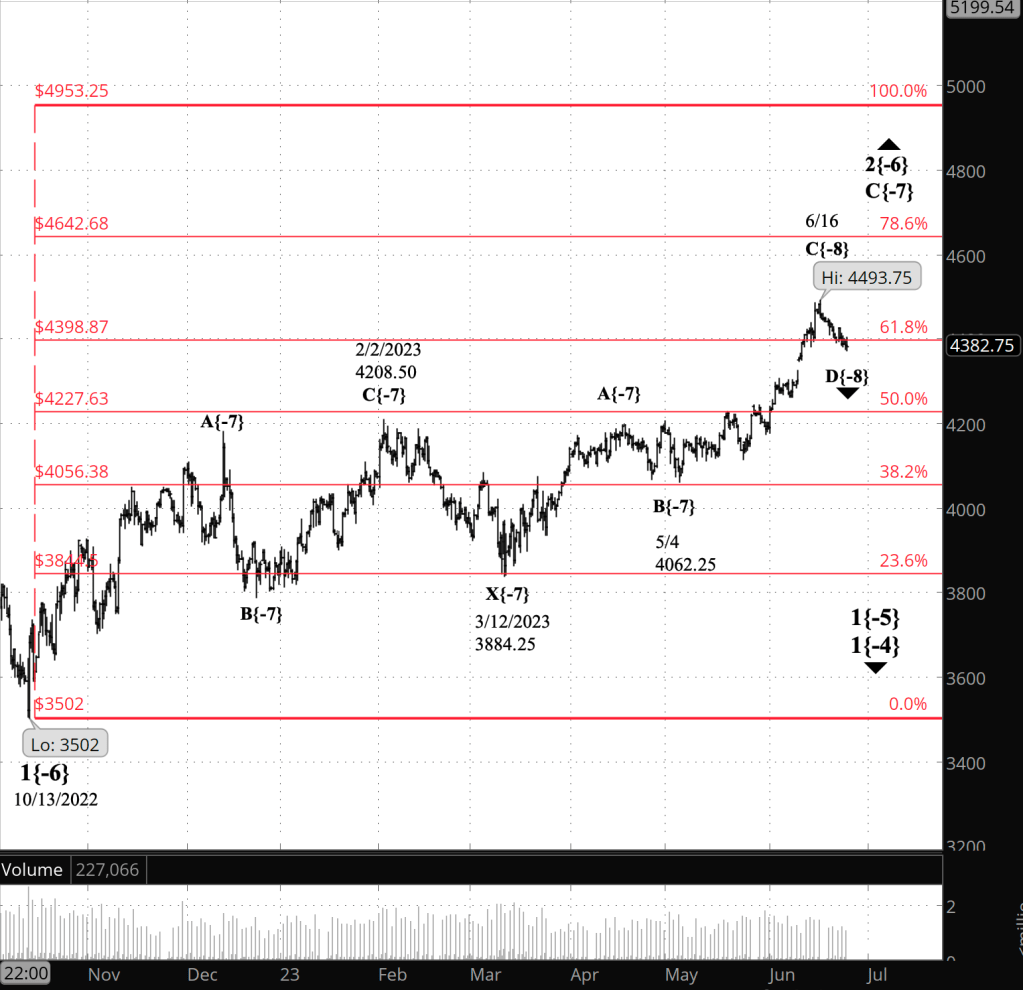
Half an hour before the closing bell. The S&P 500 fell in latter half of the session, reaching the low 4380s. This morning’s analysis is unchanged. I’ve updated the chart.

9:35 a.m. New York time

What’s happening now? The S&P 500 E-mini futures drifted back below the 61.8% Fibonacci retracement level in overnight trading, reaching into the 4380s.

What does it mean? The upward correction that began on October 13, 2022 continues and may be nearing its end. It is in the next-to-the-last subwave within the corrective pattern’s third and final wave.

The correction has formed a compound pattern and is nearing the end of its second corrective pattern, which will be followed by either the beginning of a powerful downtrend or a much shorter downward wave that will connect the second pattern with a third.

What are the alternatives? I’ve labeled the correction as being of the {-6} degree. It could be of a larger degree.

[S&P 500 E-mini futures at 3:30 p.m., 8-hour bars, with volume]

Reading the chart. Price movements — waves – – in Elliott wave analysis are labeled with numbers within trending waves and letters with corrective waves. The subscripts — numbers in curly brackets — designate the wave’s degree, which, in Elliott wave analysis, means the relative position of a wave within the larger and smaller structures that make up the chart. R.N. Elliott, who in the 1930s developed the form of analysis that bears his name, viewed the chart as a complex structure of smaller waves nested within larger waves, which in turn are nested within still larger waves. In mathematics it’s called a fractal structure, where at every scale the pattern is similar to the others.

What does Elliott wave theory say? Here are the waves that underly the analysis.

  • An upward correction, a Zigzag, wave 2{-6}, began on October 13, 2022 and is underway.
  • The upward correction, wave 2{-6}, is taking a compound form, which can contain up to three corrective patterns.
  • The correction is in its second corrective pattern, which is in wave C{-7}, its final wave.
  • The end of the present wave C{-7} could also be the end of the wave 2{-6} correction if the compound structure contains two subwaves.
  • Or the present corrective pattern could be followed by a declining connector, wave X{-7}, and then a third corrective pattern.
  • Wave 2{-6}, when complete, will be followed by a powerful downtrend, wave 3{-6}.
  • Under the rules of Elliott wave analysis, wave 2{-6} cannot move beyond the beginning of wave 1{-6}, which was the January 4, 2022 peak at 4953.25. (I’ve adjusted the January 4 peak.)

We Are Here.

These are the waves currently in progress under my principal analysis. Each line on the list shows the wave number, with the subscript in curly brackets, the traditional degree name, the starting date, the starting price of the S&P 500 E-mini futures, and the direction of the wave.

  • S&P 500 Index:
  • 5{+3} Supercycle, 7/8/1932, 4.40 (up)
  • 5{+2} Cycle, 12/9/1974, 60.96 (up)
  • 5{+1} Primary, 3/6/2009, 666.79 (up)
  • 5{0} Intermediate, 12/26/2018, 2346.58 (up)
  • S&P 500 Futures and index:
  • 4{-1} Minor, 1/4/2022, 4953.25 (down) (futures), 4818.62 (down) (index)
  • S&P 500 Futures:
  • 1{-2} Minute, 1/4/2022, 4953.25 (down)
  • 1{-3} Minuette, 1/4/2022, 4953.25 (down)
  • 1{-4} Subminuette, 1/4/2022, 4953.25 (down)
  • 1{-5} Micro, 1/4/2022, 4953.25 (down)
  • 2{-6} Minuscule, 10/13/2022, 3577.75 (up)

Learning and other resources. Elliott wave analysis provides context, not prophecy. As the 20th century semanticist Alfred Korzybski put it in his book Science and Sanity (1933), “The map is not the territory … The only usefulness of a map depends on similarity of structure between the empirical world and the map.” And I would add, in the ever-changing markets, we can judge that similarity of structure only after the fact.

See the menu page Analytical Methods for a rundown on where to go for information on Elliott wave analysis.

By Tim Bovee, Portland, Oregon, June 23, 2023

Disclaimer

Tim Bovee, Private Trader tracks the analysis and trades of a private trader for his own accounts. Nothing in this blog constitutes a recommendation to buy or sell stocks, options or any other financial instrument. The only purpose of this blog is to provide education and entertainment.

No trader is ever 100 percent successful in his or her trades. Trading in the stock and option markets is risky and uncertain. Each trader must make trading decisions for his or her own account, and take responsibility for the consequences.

License
Creative Commons License

All content on Tim Bovee, Private Trader by Timothy K. Bovee is licensed under a Creative Commons Attribution-ShareAlike 4.0 International License.

Based on a work at www.timbovee.com.
Trader’s Notebook

3:30 p.m. New York time

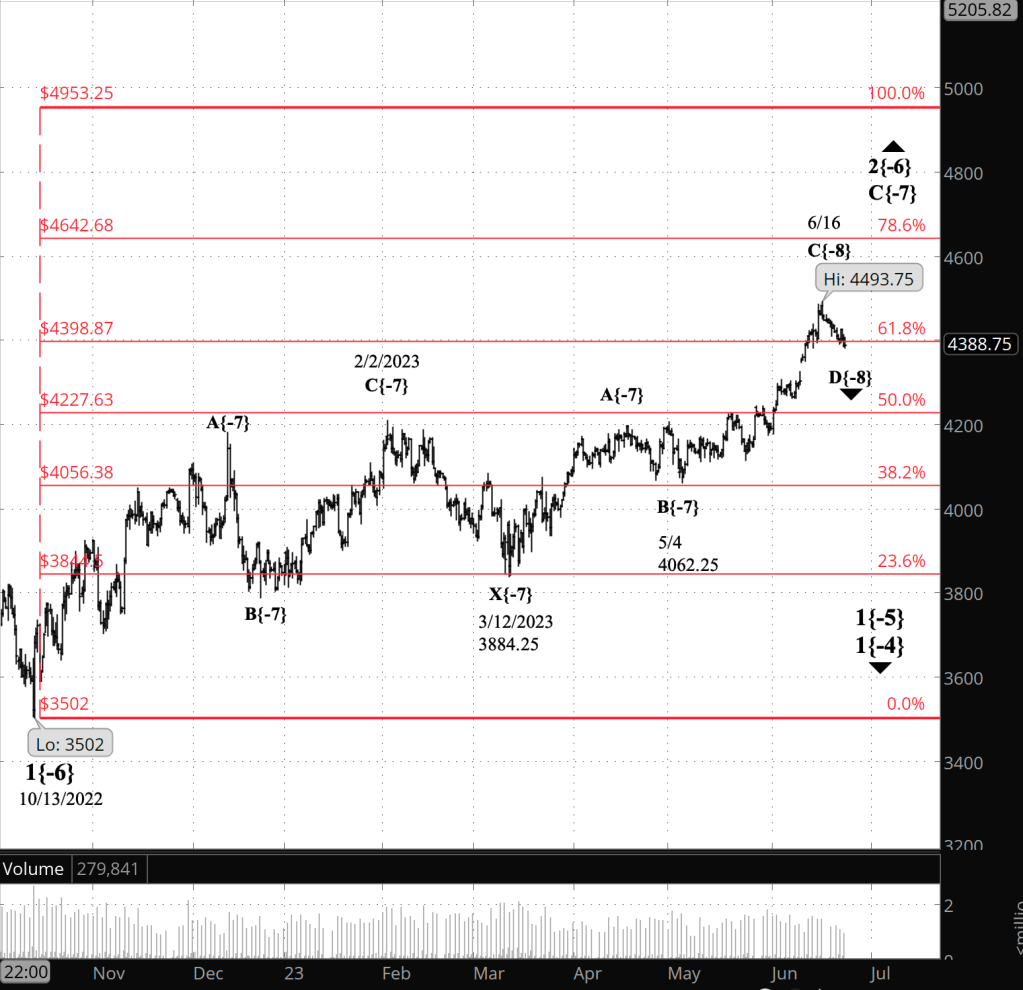
Half an hour before the closing bell. The S&P 500 futures, having fallen overnight, bounced during the session, reaching into the 4420s. The bounce wasn’t large enough to warrant changing this morning’s analysis, which sees the a small downward correction underway within the larger upward correction. I’ve updated the chart.

9:35 a.m. New York time

What’s happening now? The S&P 500 E-mini futures declined overnight to the 4390s, moving below the 61.8% Fibonacci retracement level for the first time since June 14. The high point in the rise that began in October was 4493.75, set on June 16.

What does it mean? The rise that began on October 13, 2022 is an upward correction. The 61.8% Fibonacci level is a common reversal point, or bounce point. If the price doesn’t bounce, then it’s an indicator that the trend may have changed.

If the price continues downward, then the likelihood increases that the June 16 peak ended a subwave in what may be the final wave of the correction, which is a 2nd wave. I’ve marked the chart to reflect this scenario.

I’ve also resolved the ambiguity in the correction analysis that has complicated the chart for a week. There were two alternatives, of equal likelihood: A simple correction in its first subwave (the A-wave scenario), and a compound correction in the final subwave of its second corrective pattern (the C-wave scenario).

After checking the time consumed by prior 2nd waves, I’ve settled on the compound correction C-wave scenario, and have marked the chart accordingly.

What are the alternatives? It’s possible that the peak so far isn’t the end of the final wave within the second corrective pattern. A rapid reversal to the upside will lend credence to this scenario.

A second alternative is that the degree assigned to the 2nd wave, wave 2{-6}, is too low. I’ll be looking at that issue over the weekend.

What happens next? A compound correction can contain three corrective patterns. The present second corrective pattern, when complete, could be the end of the correction and the beginning of a powerful 3rd wave downtrend. Or it could be that the correction will add a third corrective pattern, connected to the second pattern by a declining X wave that likely will remain above the start of the second pattern, 3884.25.

[S&P 500 E-mini futures at 3:30 p.m., 8-hour bars, with volume]

Reading the chart. Price movements — waves – – in Elliott wave analysis are labeled with numbers within trending waves and letters with corrective waves. The subscripts — numbers in curly brackets — designate the wave’s degree, which, in Elliott wave analysis, means the relative position of a wave within the larger and smaller structures that make up the chart. R.N. Elliott, who in the 1930s developed the form of analysis that bears his name, viewed the chart as a complex structure of smaller waves nested within larger waves, which in turn are nested within still larger waves. In mathematics it’s called a fractal structure, where at every scale the pattern is similar to the others.

What does Elliott wave theory say? Here are the waves that underly the analysis.

  • An upward correction, a Zigzag, wave 2{-6}, began on October 13, 2022 and is underway.
  • The upward correction, wave 2{-6}, is taking a compound form, which can contain up to three corrective patterns.
  • The correction is in its second corrective pattern, which is in wave C{-7}, its final wave.
  • The end of the present wave C{-7} could also be the end of the wave 2{-6} correction if the compound structure contains two subwaves.
  • Or the present corrective pattern could be followed by a declining connector, wave X{-7}, and then a third corrective pattern.
  • Wave 2{-6}, when complete, will be followed by a powerful downtrend, wave 3{-6}.
  • Under the rules of Elliott wave analysis, wave 2{-6} cannot move beyond the beginning of wave 1{-6}, which was the January 4, 2022 peak at 4953.25. (I’ve adjusted the January 4 peak.)

We Are Here.

These are the waves currently in progress under my principal analysis. Each line on the list shows the wave number, with the subscript in curly brackets, the traditional degree name, the starting date, the starting price of the S&P 500 E-mini futures, and the direction of the wave.

  • S&P 500 Index:
  • 5{+3} Supercycle, 7/8/1932, 4.40 (up)
  • 5{+2} Cycle, 12/9/1974, 60.96 (up)
  • 5{+1} Primary, 3/6/2009, 666.79 (up)
  • 5{0} Intermediate, 12/26/2018, 2346.58 (up)
  • S&P 500 Futures and index:
  • 4{-1} Minor, 1/4/2022, 4953.25 (down) (futures), 4818.62 (down) (index)
  • S&P 500 Futures:
  • 1{-2} Minute, 1/4/2022, 4953.25 (down)
  • 1{-3} Minuette, 1/4/2022, 4953.25 (down)
  • 1{-4} Subminuette, 1/4/2022, 4953.25 (down)
  • 1{-5} Micro, 1/4/2022, 4953.25 (down)
  • 2{-6} Minuscule, 10/13/2022, 3577.75 (up)

Learning and other resources. Elliott wave analysis provides context, not prophecy. As the 20th century semanticist Alfred Korzybski put it in his book Science and Sanity (1933), “The map is not the territory … The only usefulness of a map depends on similarity of structure between the empirical world and the map.” And I would add, in the ever-changing markets, we can judge that similarity of structure only after the fact.

See the menu page Analytical Methods for a rundown on where to go for information on Elliott wave analysis.

By Tim Bovee, Portland, Oregon, June 22, 2023

Disclaimer

Tim Bovee, Private Trader tracks the analysis and trades of a private trader for his own accounts. Nothing in this blog constitutes a recommendation to buy or sell stocks, options or any other financial instrument. The only purpose of this blog is to provide education and entertainment.

No trader is ever 100 percent successful in his or her trades. Trading in the stock and option markets is risky and uncertain. Each trader must make trading decisions for his or her own account, and take responsibility for the consequences.

License
Creative Commons License

All content on Tim Bovee, Private Trader by Timothy K. Bovee is licensed under a Creative Commons Attribution-ShareAlike 4.0 International License.

Based on a work at www.timbovee.com.

Trader’s Notebook

3:30 p.m. New York time

Half an hour before the closing bell. The S&P 500 futures has reached a low during the session of 4403.50, just a few dollars above the 61.8% Fibonacci retracement level, and then rose back into the 4430s. The indicator continues to go nowhere. This morning’s analysis stands unchanged. I’ve updated the chart.

9:35 a.m. New York time

What’s happening now? The S&P 500 E-mini futures fell overnight into the 4110s as an upward correction that began on October 13, 2022 continues.

What does it mean? The present rise began on May 4 from 4062.25. The S&P 500 has been limited to small movements since the recent correction peak, 4493.75, on June 16. The correction is a 2nd wave, and under the rules of Elliott wave analysis, the highest the correction’s price can rise is the starting point of the preceding 1st wave, 4953.25.

What are the choices? I’ve found two principal analyses of chart, both equally likely. One analysis is labeled on the chart in black and referred to as the Black Analysis. The other is labeled in blue and referred to as the Blue Analysis.

Black Analysis, A-wave scenario: The wave labels on the chart in black show a simple correction, with the first subwave, wave A{-7}, within the upward correction, wave 2{-6}, still underway and nearing its end.

Blue Analysis, C-wave scenario: The blue wave labels show the correction having taken a compound form. Compound corrections can contain up to three corrective patterns. The first pattern ended on February 2. The second pattern is now nearing completion. The end of the second pattern could be the end of the upward correction and the beginning of a powerful downtrend, or it could be followed by a relatively shallow declining connection wave, called an X-wave, and then a third corrective pattern.

[S&P 500 E-mini futures at 3:30 p.m., 8-hour bars, with volume]

Reading the chart. Price movements — waves – – in Elliott wave analysis are labeled with numbers within trending waves and letters with corrective waves. The subscripts — numbers in curly brackets — designate the wave’s degree, which, in Elliott wave analysis, means the relative position of a wave within the larger and smaller structures that make up the chart. R.N. Elliott, who in the 1930s developed the form of analysis that bears his name, viewed the chart as a complex structure of smaller waves nested within larger waves, which in turn are nested within still larger waves. In mathematics it’s called a fractal structure, where at every scale the pattern is similar to the others.

What does Elliott wave theory say? Here are the waves that underly the analyses.

Black Analysis, simple correction (black labeling on the chart):

  • An upward correction, a Zigzag, wave 2{-6}, began on October 13, 2022 and is underway.
  • The correction’s first subwave, wave A{-7}, is underway and will have five subwaves.
  • Wave A{-7} at present is in its 3rd subwave, wave C{-8}.
  • Wave C{-8} is in its 3rd subwave, wave C{-9}.
  • Wave 2{-6}, when complete, will be followed by a powerful downtrend, wave 3{-6}.
  • Under the rules of Elliott wave analysis, wave 2{-6} cannot move beyond the beginning of wave 1{-6}, which was the January 4, 2022 peak at 4953.25. (I’ve adjusted the January 4 peak.)

Blue Analysis, compound correction (blue labeling on the chart):

  • The upward correction, wave 2{-6}, is taking a compound form, which can contain up to three corrective patterns.
  • The correction is in its second corrective pattern, which is in wave C{-7}, its final wave.

Future Alternatives, an additional corrective pattern or the end of the correction?

  • In either scenario, wave C{-7}, when complete, will either be followed by a separator wave, X{-7}, and then an additional corrective pattern, or will be the end of the wave 2{-6} correction and will be followed by a powerful downtrend, wave 3{-6}.
  • Compound corrections can contain no more than three corrective patterns.

We Are Here.

These are the waves currently in progress under my principal analysis. Each line on the list shows the wave number, with the subscript in curly brackets, the traditional degree name, the starting date, the starting price of the S&P 500 E-mini futures, and the direction of the wave.

  • S&P 500 Index:
  • 5{+3} Supercycle, 7/8/1932, 4.40 (up)
  • 5{+2} Cycle, 12/9/1974, 60.96 (up)
  • 5{+1} Primary, 3/6/2009, 666.79 (up)
  • 5{0} Intermediate, 12/26/2018, 2346.58 (up)
  • S&P 500 Futures and index:
  • 4{-1} Minor, 1/4/2022, 4953.25 (down) (futures), 4818.62 (down) (index)
  • S&P 500 Futures:
  • 1{-2} Minute, 1/4/2022, 4953.25 (down)
  • 1{-3} Minuette, 1/4/2022, 4953.25 (down)
  • 1{-4} Subminuette, 1/4/2022, 4953.25 (down)
  • 1{-5} Micro, 1/4/2022, 4953.25 (down)
  • 2{-6} Minuscule, 10/13/2022, 3577.75 (up)

Learning and other resources. Elliott wave analysis provides context, not prophecy. As the 20th century semanticist Alfred Korzybski put it in his book Science and Sanity (1933), “The map is not the territory … The only usefulness of a map depends on similarity of structure between the empirical world and the map.” And I would add, in the ever-changing markets, we can judge that similarity of structure only after the fact.

See the menu page Analytical Methods for a rundown on where to go for information on Elliott wave analysis.

By Tim Bovee, Portland, Oregon, June 21, 2023

Disclaimer

Tim Bovee, Private Trader tracks the analysis and trades of a private trader for his own accounts. Nothing in this blog constitutes a recommendation to buy or sell stocks, options or any other financial instrument. The only purpose of this blog is to provide education and entertainment.

No trader is ever 100 percent successful in his or her trades. Trading in the stock and option markets is risky and uncertain. Each trader must make trading decisions for his or her own account, and take responsibility for the consequences.

License
Creative Commons License

All content on Tim Bovee, Private Trader by Timothy K. Bovee is licensed under a Creative Commons Attribution-ShareAlike 4.0 International License.

Based on a work at www.timbovee.com.