Trader’s Notebook: S&P 500

3:30 p.m. New York time

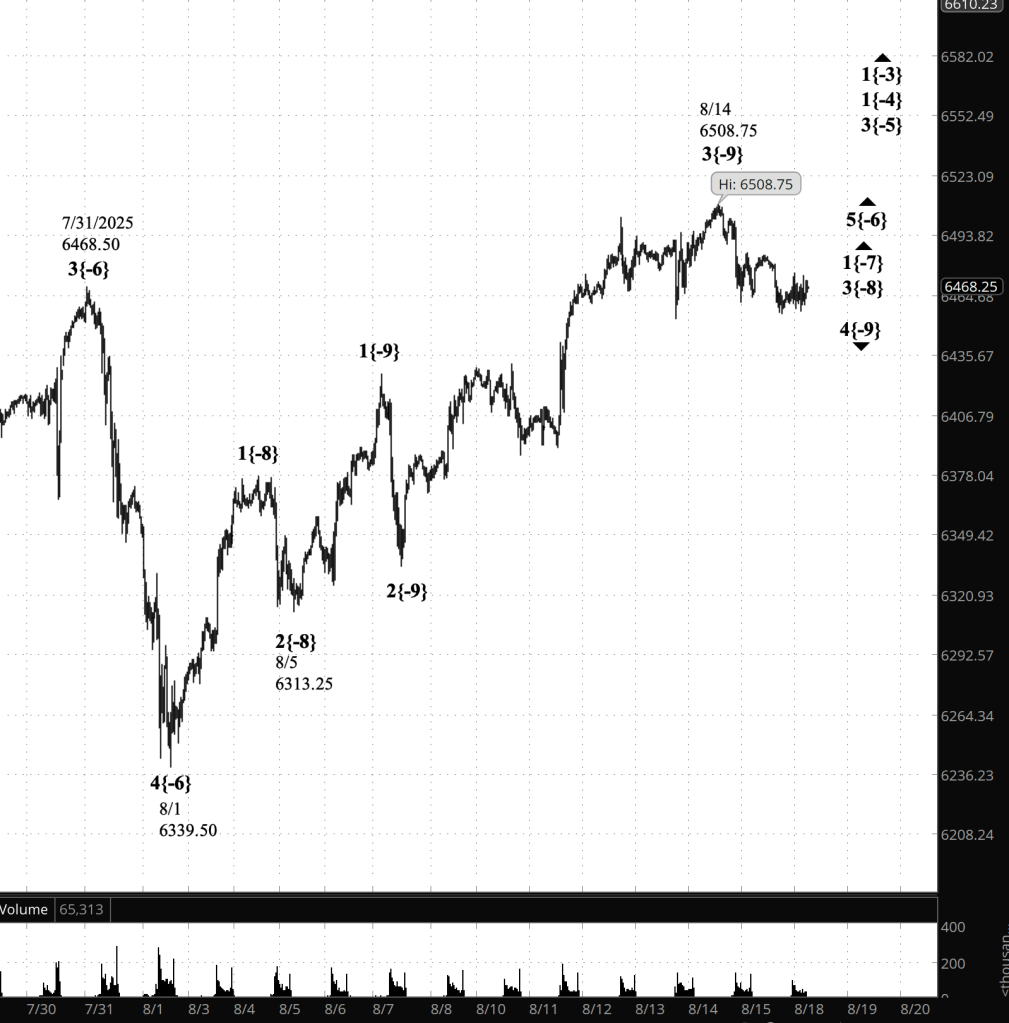
Half an hour before the closing bell. The S&P 500 futures have risen continually during the session.

Elliott Wave Theory: The distance covered is great enough to declare that declining wave A, which began on July 10, reached its end on July 11, and rising wave B has begun. Wave B is the middle subwave of wave 4, a downward correction.

9:35 a.m. New York time.

What’s happening now. The S&P 500 E-mini futures fell overnight, from the 6330s down into the 6270s.

What does it mean?  The July 10 higher high, 6335.50, ended the uptrending 3rd wave that began on July 7, Elliott Wave Theory analysis concludes. The 4th-wave downward correction that followed is nearing the end of its declining initial subwave, wave A. When that ends, it will be followed by rising wave B and then falling wave C.

All of this is happening within a larger uptrending 3rd wave that began on June 30.

[S&P 500 E-mini futures at 3:30 p.m., 35-minute bars, with volume] 

Waves Now Underway

[Revised for afternoon analysis.]

These are the waves currently in progress under my principal analysis. Each line on the list shows the wave number, with the subscript in curly brackets, the traditional degree name, the starting date, the starting price of the S&P 500 E-mini futures, and the direction of the wave.

  • S&P 500 Index:
  • 5{+3} Supercycle, 7/8/1932, 4.40 (up)
  • 5{+2} Cycle, 12/9/1974, 60.96 (up)
  • 5{+1} Primary, 3/6/2009, 666.79 (up)
  • 5{0} Intermediate, 2/11/2016, 1810.10 (up)
  • 3{-1} Minor, 3/23/2020, 2191.36 (up)
  • 5{-2} Minute, 4/7/2025, 4832 (up)
  • S&P 500 Futures
  • 1{-3} Minuette, 4/7/2025, 4832 (up)
  • 1{-4} Subminuette, 4/7/2025, 4832 (up)
  • 1{-5} Micro, 4/7/2025, 4832 (up)
  • 3{-6} Submicro, 4/24/2025, 5260 (up)
  • 5{-7} Minuscule, 4/25/2025, 5550 (up)
  • 5{-8} (unnamed), 5/7/2025, 5596 (up)
  • 5{-9} (unnamed), 5/23/2025, 5756.50 (up)
  • 5{-10} (unnamed), 6/22/2025, 5959 (up)
  • 5{-11} (unnamed), 6/27/2025, 6183.25 (up)
  • 3{-12} (unnamed), 6/30/2025, 6224 (up)
  • 4{-13} (unnamed), 7/10/2025, 6335.50 (down)
  • B{-14} (unnamed), 7/11/2025, 6276.75 (up)

Reading the chart. Price movements — waves – – in Elliott Wave Theory analysis are labeled with numbers within trending waves and letters with corrective waves. The subscripts — numbers in curly brackets — designate the wave’s degree, which, in Elliott Wave analysis, means the relative position of a wave within the larger and smaller structures that make up the chart. R.N. Elliott, who in the 1930s developed the form of analysis that bears his name, viewed the chart as a complex structure of smaller waves nested within larger waves, which in turn are nested within still larger waves. In mathematics it’s called a fractal structure, where at every scale the pattern is similar to the others.

Learning and other resources. Elliott Wave analysis provides context, not prophecy. As the 20th century semanticist Alfred Korzybski put it in his book Science and Sanity (1933), “The map is not the territory … The only usefulness of a map depends on similarity of structure between the empirical world and the map.” And I would add, in the ever-changing markets, we can judge that similarity of structure only after the fact.

See the menu page Analytical Methods for a rundown on where to go for information on Elliott Wave analysis.

By Tim Bovee, Portland, Oregon, July 11, 2025

Disclaimer

Tim Bovee, Private Trader tracks the analysis and trades of a private trader for his own accounts. Nothing in this blog constitutes a recommendation to buy or sell stocks, options or any other financial instrument. The only purpose of this blog is to provide education and entertainment.

No trader is ever 100 percent successful in his or her trades. Trading in the stock and option markets is risky and uncertain. Each trader must make trading decisions for his or her own account, and take responsibility for the consequences.

All content on Tim Bovee, Private Trader by Timothy K. Bovee is licensed under a Creative Commons Attribution-ShareAlike 4.0 International License.

License

Based on a work at www.timbovee.com.

Trader’s Notebook: S&P 500

3:30 p.m. New York time.

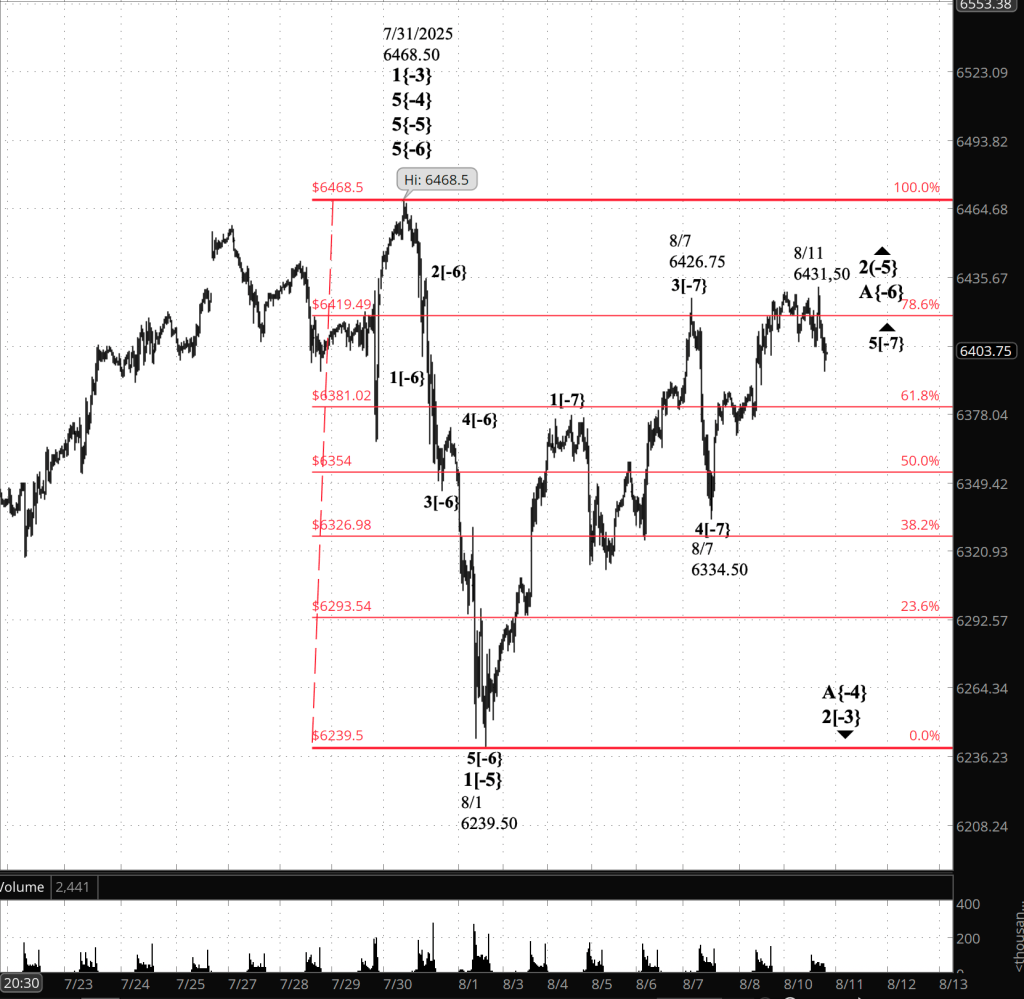
Half an hour before the closing bell. The S&P 500 futures verified that it has completed the correction and is trending upward.

Elliott Wave Theory: The verification of Wave 2’s end came early in the session as the price for what had appeared to be wave C, the third subwave of the correction, rose higher than wave B and continued to move higher.

That resolved the ambiguities we’ve been seeing over the last few days. For this discussion I’ll use the labeling system on the chart: A wave number followed by a subscript in curly brackets with the wave’s distance in the fractal structure from the Intermediate degree.

The new principal analysis: Wave C{-14} ended on July 7 and in doing so also brought wave 2{-13} to an end, at 6246.25. From that point wave 3{-13} began and is in its middle subwave, wave 3{-14}. All of tis is contained with the parent wave 3{-12} and grandparent wave 5{-11}, which began June 27.

Bottom line: The collection of 3rd waves provide ample ground for a period of upward lean, with the usually downward corrections long the way.

9:35 a.m. New York time.

What’s happening now. The S&P 500 E-mini futures fell from 6312.25 to 6287.50 and then bounced almost all the way back.

What does it mean? Elliott Wave Theory analysis sees the pattern as a failed attempt to break above the end of the preceding B wave, a subwave of the 2nd wave downward correction that began July 3. ES keeps failling to move above the peak of wave B. Is the wave testing that upper limit wave C or did wave C end on July 7, making the wave doing the testing a subwave of uptrending wave 3? Increasingly, it appears to be an early subwave within wave 3. But wthout a breakout there is no verification. So I’m keeping the wave C within wave 2 scenario as my principal analysis.

[S&P 500 E-mini futures at 3:30 p.m., 35-minute bars, with volume] 

Waves Now Underway

These are the waves currently in progress under my principal analysis. Each line on the list shows the wave number, with the subscript in curly brackets, the traditional degree name, the starting date, the starting price of the S&P 500 E-mini futures, and the direction of the wave.

  • S&P 500 Index:
  • 5{+3} Supercycle, 7/8/1932, 4.40 (up)
  • 5{+2} Cycle, 12/9/1974, 60.96 (up)
  • 5{+1} Primary, 3/6/2009, 666.79 (up)
  • 5{0} Intermediate, 2/11/2016, 1810.10 (up)
  • 3{-1} Minor, 3/23/2020, 2191.36 (up)
  • 5{-2} Minute, 4/7/2025, 4832 (up)
  • S&P 500 Futures
  • 1{-3} Minuette, 4/7/2025, 4832 (up)
  • 1{-4} Subminuette, 4/7/2025, 4832 (up)
  • 1{-5} Micro, 4/7/2025, 4832 (up)
  • 3{-6} Submicro, 4/24/2025, 5260 (up)
  • 5{-7} Minuscule, 4/25/2025, 5550 (up)
  • 5{-8} (unnamed), 5/7/2025, 5596 (up)
  • 5{-9} (unnamed), 5/23/2025, 5756.50 (up)
  • 5{-10} (unnamed), 6/22/2025, 5959 (up)
  • 5{-11} (unnamed), 6/27/2025, 6183.25 (up)
  • 3{-12} (unnamed), 6/30/2025, 6224 (up)
  • 3{-13} (unnamed), 7/7/2025, 6246.25 (up)
  • 3{-14} (unnamed), 7/4/2025, 6260 (up)

Reading the chart. Price movements — waves – – in Elliott Wave Theory analysis are labeled with numbers within trending waves and letters with corrective waves. The subscripts — numbers in curly brackets — designate the wave’s degree, which, in Elliott Wave analysis, means the relative position of a wave within the larger and smaller structures that make up the chart. R.N. Elliott, who in the 1930s developed the form of analysis that bears his name, viewed the chart as a complex structure of smaller waves nested within larger waves, which in turn are nested within still larger waves. In mathematics it’s called a fractal structure, where at every scale the pattern is similar to the others.

Learning and other resources. Elliott Wave analysis provides context, not prophecy. As the 20th century semanticist Alfred Korzybski put it in his book Science and Sanity (1933), “The map is not the territory … The only usefulness of a map depends on similarity of structure between the empirical world and the map.” And I would add, in the ever-changing markets, we can judge that similarity of structure only after the fact.

See the menu page Analytical Methods for a rundown on where to go for information on Elliott Wave analysis.

By Tim Bovee, Portland, Oregon, July 10, 2025

Disclaimer

Tim Bovee, Private Trader tracks the analysis and trades of a private trader for his own accounts. Nothing in this blog constitutes a recommendation to buy or sell stocks, options or any other financial instrument. The only purpose of this blog is to provide education and entertainment.

No trader is ever 100 percent successful in his or her trades. Trading in the stock and option markets is risky and uncertain. Each trader must make trading decisions for his or her own account, and take responsibility for the consequences.

All content on Tim Bovee, Private Trader by Timothy K. Bovee is licensed under a Creative Commons Attribution-ShareAlike 4.0 International License.

License

Based on a work at www.timbovee.com.

Trader’s Notebook: S&P 500

3:30 p.m. New York time

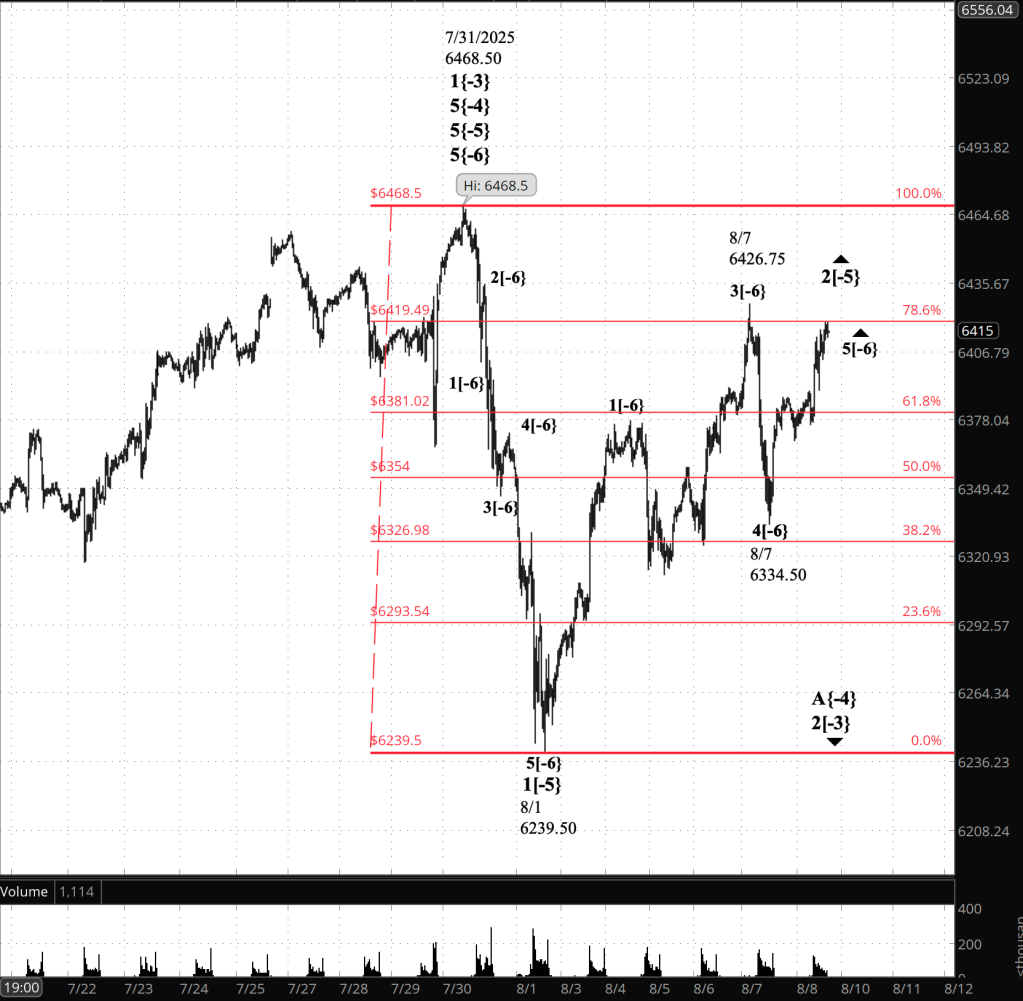
Half an hour before the opening bell. The S&P 500 futures continued their during the session, reaching the price, 6333.25. It was as though it had hit a wall. The price reversed, fell back into the 6270s, and then began to rise again.

Elliott Wave Theory: So what makes 6333.25 special? That price is the precise ending point for wave B within the 2nd-wave downward correction that began on July 3.

Elliott Wave Theory is based on the idea that the price movements represent the opinions and feelings of traders. There are a sufficiently large number of traders in S&P 500-related products that in my opinion it would be close to accurate to the feelings and opinions of Americans.

Traders figuratively said “No more” on July 7 when wave B ended, and did it again today, showing that that traders were still uneasy, That upper limit still has power.

For the analysis, it means there is not yet confirmation regarding the end of wave C. It could have ended on July 7, as the alternate analysis says. If so, the session rise was part of the wave 1 within uptrending wave 5. A 1st wave often tends to pause or bounce back when it reaches the wave of the preceding correction’s wave B. Or it could be wave C correcting its continuing decline.

The chart immediately below tracks five days of the S&P 500 futures with 5-minute bars.

[S&P 500 E-mini futures at 3:30 p.m., 30-minute bars, with volume] 

9:35 a.m. New York time.

What’s happening now. The S&P 500 E-mini futures rose overnight in what appears to be another leg in a net sideways pattern that began on July 7.

What does it mean? Elliott Wave Theory analysis gives us two possible wave structures that are underway since the beginning of the 2nd-wave downward correction that began on July 3.

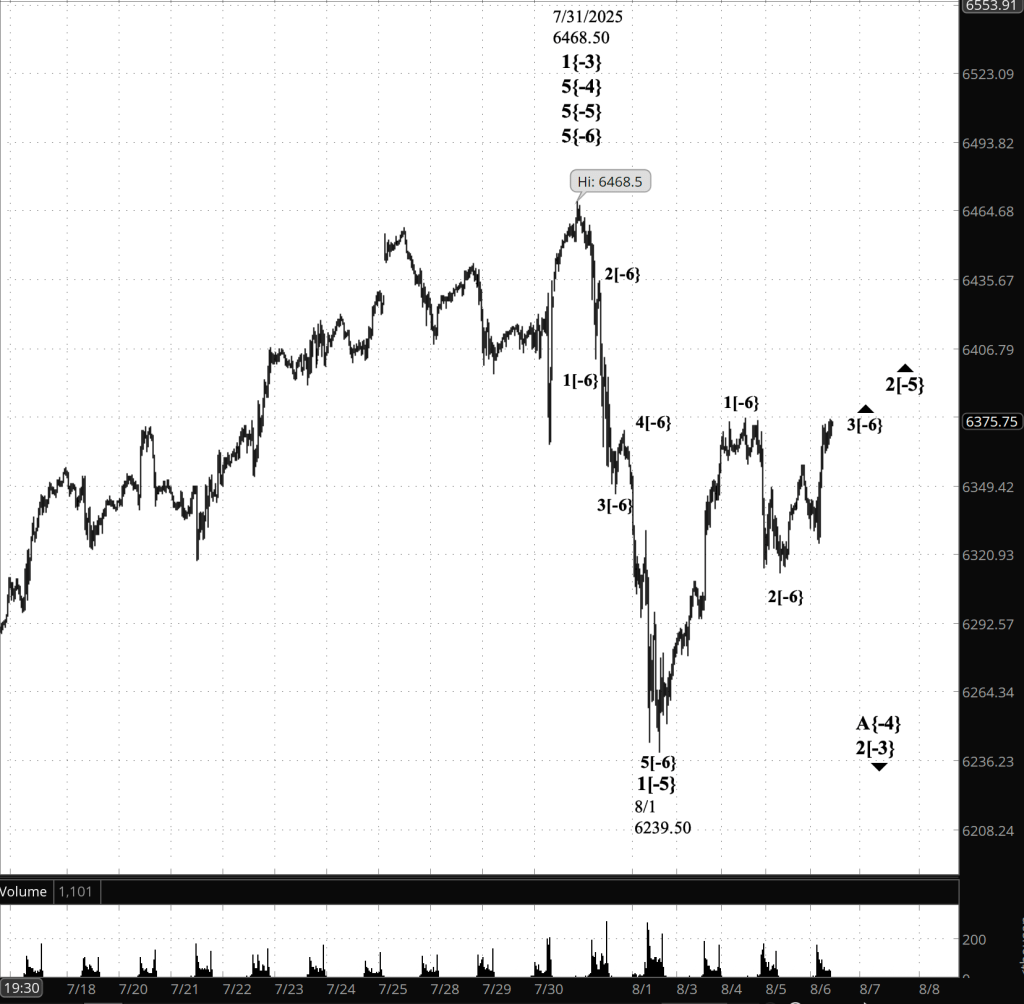
The current principal analysis is that the first two subwaves within the correction — waves A and B — are complete, and declining wave C is underway

The alternative analysis sees wave C as having ended at the July 7 low, 6246.25. Under this scenario, the 2nd wave also ended ended at that, and wave 3 began.

My strategy in choosing between the two is to wait for a breakout. I will retain the C{-14} scenario unless the price closes convincingly above 6315–6317 — above the end of wave B — at which point I will recognize that C has ended and a new upward sequence, wave 1 within uptrending wave 3, has begun.

[S&P 500 E-mini futures at 3:30 p.m., 30-minute bars, with volume] 

Waves Now Underway

These are the waves currently in progress under my principal analysis. Each line on the list shows the wave number, with the subscript in curly brackets, the traditional degree name, the starting date, the starting price of the S&P 500 E-mini futures, and the direction of the wave.

  • S&P 500 Index:
  • 5{+3} Supercycle, 7/8/1932, 4.40 (up)
  • 5{+2} Cycle, 12/9/1974, 60.96 (up)
  • 5{+1} Primary, 3/6/2009, 666.79 (up)
  • 5{0} Intermediate, 2/11/2016, 1810.10 (up)
  • 3{-1} Minor, 3/23/2020, 2191.36 (up)
  • 5{-2} Minute, 4/7/2025, 4832 (up)
  • S&P 500 Futures
  • 1{-3} Minuette, 4/7/2025, 4832 (up)
  • 1{-4} Subminuette, 4/7/2025, 4832 (up)
  • 1{-5} Micro, 4/7/2025, 4832 (up)
  • 3{-6} Submicro, 4/24/2025, 5260 (up)
  • 5{-7} Minuscule, 4/25/2025, 5550 (up)
  • 5{-8} (unnamed), 5/7/2025, 5596 (up)
  • 5{-9} (unnamed), 5/23/2025, 5756.50 (up)
  • 5{-10} (unnamed), 6/22/2025, 5959 (up)
  • 5{-11} (unnamed), 6/27/2025, 6183.25 (up)
  • 3{-12} (unnamed), 6/30/2025, 6224 (up)
  • 2{-13} (unnamed), 7/3/2025, 6335.25 (down)
  • C{-14} (unnamed), 7/4/2025, 6276.50 (down)

Reading the chart. Price movements — waves – – in Elliott Wave Theory analysis are labeled with numbers within trending waves and letters with corrective waves. The subscripts — numbers in curly brackets — designate the wave’s degree, which, in Elliott Wave analysis, means the relative position of a wave within the larger and smaller structures that make up the chart. R.N. Elliott, who in the 1930s developed the form of analysis that bears his name, viewed the chart as a complex structure of smaller waves nested within larger waves, which in turn are nested within still larger waves. In mathematics it’s called a fractal structure, where at every scale the pattern is similar to the others.

Learning and other resources. Elliott Wave analysis provides context, not prophecy. As the 20th century semanticist Alfred Korzybski put it in his book Science and Sanity (1933), “The map is not the territory … The only usefulness of a map depends on similarity of structure between the empirical world and the map.” And I would add, in the ever-changing markets, we can judge that similarity of structure only after the fact.

See the menu page Analytical Methods for a rundown on where to go for information on Elliott Wave analysis.

By Tim Bovee, Portland, Oregon, July 9, 2025

Disclaimer

Tim Bovee, Private Trader tracks the analysis and trades of a private trader for his own accounts. Nothing in this blog constitutes a recommendation to buy or sell stocks, options or any other financial instrument. The only purpose of this blog is to provide education and entertainment.

No trader is ever 100 percent successful in his or her trades. Trading in the stock and option markets is risky and uncertain. Each trader must make trading decisions for his or her own account, and take responsibility for the consequences.

All content on Tim Bovee, Private Trader by Timothy K. Bovee is licensed under a Creative Commons Attribution-ShareAlike 4.0 International License.

License

Based on a work at www.timbovee.com.

Trader’s Notebook: S&P 500

3:30 p.m. New York time

Half an hour before the closing bell. The S&P 500 futures traded in a widening whipsaw pattern during the session, swinging between the 6280s and the 6260s.

Elliott Wave Theory: The movement did nothing to clarify the ambiguities of the chart, described below in this morning’s analysis.

9:35 a.m. New York time.

What’s happening now. The S&P 500 E-mini futures worked their way higher overnight, from 6254.50 to 6289 and then leveled out in a sideways pattern.

What does it mean? The Elliott Wave Theory analysis depends upon how we interpret the July 7 low, 6246.25. We know that a 2nd-wave downward correction has been uderway since July 3. We know that subwaves falling wave A and rising wave B are complete. We know that the July 7 low has been followed by a fairly lackluster rise.

Here’s the question: Is that rise a continuation of falling wave C, or did wave C end at yesterday’s low, and therefore is the rise that followed the early steps in rising wave 3?

Or, yet another alternative, are the waves labeled A, B and C on the chart the subwaves within wave A, which under this scenario ended on July 7, and therefore is wave B in its beginning stages?

The beauty of Elliiott Wave Theory is that ambiguities are eventually resolved. Eventually, not always immediately.

Meanwhile, consistent with my “show me” approach, I’ve kept the first scenario — wave C underway — as my principal analysis, and am keeping close watch to see whether on of the alternative analyses should in fact be labeled as primary.

[S&P 500 E-mini futures at 3:30 p.m., 30-minute bars, with volume] 

Waves Now Underway

These are the waves currently in progress under my principal analysis. Each line on the list shows the wave number, with the subscript in curly brackets, the traditional degree name, the starting date, the starting price of the S&P 500 E-mini futures, and the direction of the wave.

  • S&P 500 Index:
  • 5{+3} Supercycle, 7/8/1932, 4.40 (up)
  • 5{+2} Cycle, 12/9/1974, 60.96 (up)
  • 5{+1} Primary, 3/6/2009, 666.79 (up)
  • 5{0} Intermediate, 2/11/2016, 1810.10 (up)
  • 3{-1} Minor, 3/23/2020, 2191.36 (up)
  • 5{-2} Minute, 4/7/2025, 4832 (up)
  • S&P 500 Futures
  • 1{-3} Minuette, 4/7/2025, 4832 (up)
  • 1{-4} Subminuette, 4/7/2025, 4832 (up)
  • 1{-5} Micro, 4/7/2025, 4832 (up)
  • 3{-6} Submicro, 4/24/2025, 5260 (up)
  • 5{-7} Minuscule, 4/25/2025, 5550 (up)
  • 5{-8} (unnamed), 5/7/2025, 5596 (up)
  • 5{-9} (unnamed), 5/23/2025, 5756.50 (up)
  • 5{-10} (unnamed), 6/22/2025, 5959 (up)
  • 5{-11} (unnamed), 6/27/2025, 6183.25 (up)
  • 3{-12} (unnamed), 6/30/2025, 6224 (up)
  • 2{-13} (unnamed), 7/3/2025, 6335.25 (down)
  • C{-14} (unnamed), 7/4/2025, 6276.50 (down)

Reading the chart. Price movements — waves – – in Elliott Wave Theory analysis are labeled with numbers within trending waves and letters with corrective waves. The subscripts — numbers in curly brackets — designate the wave’s degree, which, in Elliott Wave analysis, means the relative position of a wave within the larger and smaller structures that make up the chart. R.N. Elliott, who in the 1930s developed the form of analysis that bears his name, viewed the chart as a complex structure of smaller waves nested within larger waves, which in turn are nested within still larger waves. In mathematics it’s called a fractal structure, where at every scale the pattern is similar to the others.

Learning and other resources. Elliott Wave analysis provides context, not prophecy. As the 20th century semanticist Alfred Korzybski put it in his book Science and Sanity (1933), “The map is not the territory … The only usefulness of a map depends on similarity of structure between the empirical world and the map.” And I would add, in the ever-changing markets, we can judge that similarity of structure only after the fact.

See the menu page Analytical Methods for a rundown on where to go for information on Elliott Wave analysis.

By Tim Bovee, Portland, Oregon, July 8, 2025

Disclaimer

Tim Bovee, Private Trader tracks the analysis and trades of a private trader for his own accounts. Nothing in this blog constitutes a recommendation to buy or sell stocks, options or any other financial instrument. The only purpose of this blog is to provide education and entertainment.

No trader is ever 100 percent successful in his or her trades. Trading in the stock and option markets is risky and uncertain. Each trader must make trading decisions for his or her own account, and take responsibility for the consequences.

All content on Tim Bovee, Private Trader by Timothy K. Bovee is licensed under a Creative Commons Attribution-ShareAlike 4.0 International License.

License

Based on a work at www.timbovee.com.

Trader’s Notebook: S&P 500

3:30 p.m. New York time

Half an hour before the closing bell. The S&P 500 futures continued to decline during the session. In doing so, the price broke a rule of Elliott Wave theory. I shall use the chart labeling system — wave number plus a subscript showing the wave’s position relative to Intermediate degree — to avoid confusion.

The problem: Wave 4{-14} moved below the endpoint of the preceding wave 1{-14}. Not allowed.

The re-analysis: All that has happened since June 30 are subwaves of rising wave 3{-12}. Wave {-13} ended on July 3, and the subsequent decline is wave 2{-13}, a corrective, which is in its 3rd and final subwave, wave C{-13}. It may have ended already, but there’s no way to say for sure.

9:35 a.m. New York time.

What’s happening now. The S&P 500 E-mini futures fell when trading resumed overnight, reaching a low of 6290.75. It then reversed, rising to 6315. At that point it reversed again, falling to 6300 so far.

What does it mean? Elliott Wave Theory analysis sees the overnight movements as subwaves of rising wave B, the middle subwave of the 4th-wave downward correction that began on July 3. The correction is happening within a rising wave 3 that began on July 1, encompassed by a rising 3rd wave that began on June 30.

The whole structure is part of wave 5 that began on June 22 from 5959. That 5th wave provides an uptrending direction to to chart, with the usual smaller uptrends and corrections.

[S&P 500 E-mini futures at 9:35 a.m., 25-minute bars, with volume] 

Waves Now Underway

These are the waves currently in progress under my principal analysis. Each line on the list shows the wave number, with the subscript in curly brackets, the traditional degree name, the starting date, the starting price of the S&P 500 E-mini futures, and the direction of the wave.

  • S&P 500 Index:
  • 5{+3} Supercycle, 7/8/1932, 4.40 (up)
  • 5{+2} Cycle, 12/9/1974, 60.96 (up)
  • 5{+1} Primary, 3/6/2009, 666.79 (up)
  • 5{0} Intermediate, 2/11/2016, 1810.10 (up)
  • 3{-1} Minor, 3/23/2020, 2191.36 (up)
  • 5{-2} Minute, 4/7/2025, 4832 (up)
  • S&P 500 Futures
  • 1{-3} Minuette, 4/7/2025, 4832 (up)
  • 1{-4} Subminuette, 4/7/2025, 4832 (up)
  • 1{-5} Micro, 4/7/2025, 4832 (up)
  • 3{-6} Submicro, 4/24/2025, 5260 (up)
  • 5{-7} Minuscule, 4/25/2025, 5550 (up)
  • 5{-8} (unnamed), 5/7/2025, 5596 (up)
  • 5{-9} (unnamed), 5/23/2025, 5756.50 (up)
  • 5{-10} (unnamed), 6/22/2025, 5959 (up)
  • 5{-11} (unnamed), 6/27/2025, 6183.25 (up)
  • 3{-12} (unnamed), 6/30/2025, 6224 (up)
  • 2{-13} (unnamed), 7/3/2025, 6335.25 (down)
  • C{-14} (unnamed), 7/4/2025, 6276.50 (down)

Reading the chart. Price movements — waves – – in Elliott Wave Theory analysis are labeled with numbers within trending waves and letters with corrective waves. The subscripts — numbers in curly brackets — designate the wave’s degree, which, in Elliott Wave analysis, means the relative position of a wave within the larger and smaller structures that make up the chart. R.N. Elliott, who in the 1930s developed the form of analysis that bears his name, viewed the chart as a complex structure of smaller waves nested within larger waves, which in turn are nested within still larger waves. In mathematics it’s called a fractal structure, where at every scale the pattern is similar to the others.

Learning and other resources. Elliott Wave analysis provides context, not prophecy. As the 20th century semanticist Alfred Korzybski put it in his book Science and Sanity (1933), “The map is not the territory … The only usefulness of a map depends on similarity of structure between the empirical world and the map.” And I would add, in the ever-changing markets, we can judge that similarity of structure only after the fact.

See the menu page Analytical Methods for a rundown on where to go for information on Elliott Wave analysis.

By Tim Bovee, Portland, Oregon, July 7, 2025

Disclaimer

Tim Bovee, Private Trader tracks the analysis and trades of a private trader for his own accounts. Nothing in this blog constitutes a recommendation to buy or sell stocks, options or any other financial instrument. The only purpose of this blog is to provide education and entertainment.

No trader is ever 100 percent successful in his or her trades. Trading in the stock and option markets is risky and uncertain. Each trader must make trading decisions for his or her own account, and take responsibility for the consequences.

License

All content on Tim Bovee, Private Trader by Timothy K. Bovee is licensed under a Creative Commons Attribution-ShareAlike 4.0 International License.

Based on a work at www.timbovee.com.

Trader’s Notebook: S&P 500

2:55 p.m. New York time.

Happy 4th of July! Some Americans still call the day on which we declared our independence “The Glorious 4th”. Despite the difficulties that we have faced from time to time over the centuries, and some would say in the present, I’m one of those Americans who still call July 4 by that old fashioned name.

But holiday though it may be, nothing stops the markets from moving forward. And it was a significant day.

What happened on July 4. The S&P 500 E-mini futures traded overnight and into the 4th of July holiday, closing at 1 p.m. New York time. The price fell from its opening, 6322.25, down to 6276.50, and then stayed within a sideways range until until trading ended.

What does it mean? Elliott Wave Theory analysis sees the peak during the July 3 session, 6331.75, as the end of the 3rd subwave within the 5th-wave uptrend correction that began on June 27.

The subsequent decline is wave 4, a downward correction, that when the holiday session ended had reached a low of 6285.50. There is no notable pattern of subwaves within the decline. The simplest interpretation is that the July 4 low marks the end of wave A within the correction, and the slight bounce upward is the start of wave B, the middle wave within the most common 3-wave form of a correction.

Looking forward: when wave 4 is complete, a 5th wave will begin. Fifth waves are tricky beasts. Most often they leap forward, moving above the endpoint of the preceding 3rd wave (6333.25). Sometimes, they fall short and never reach that level. An sometimes, they will take an extended form, that will carry the price far beyond levels that seem reasonable.

Which kind is this 5th wave? Time will tell.

[S&P 500 E-mini futures at 1 p.m., 25-minute bars, with volume] 

Waves Now Underway

These are the waves currently in progress under my principal analysis. Each line on the list shows the wave number, with the subscript in curly brackets, the traditional degree name, the starting date, the starting price of the S&P 500 E-mini futures, and the direction of the wave.

  • S&P 500 Index:
  • 5{+3} Supercycle, 7/8/1932, 4.40 (up)
  • 5{+2} Cycle, 12/9/1974, 60.96 (up)
  • 5{+1} Primary, 3/6/2009, 666.79 (up)
  • 5{0} Intermediate, 2/11/2016, 1810.10 (up)
  • 3{-1} Minor, 3/23/2020, 2191.36 (up)
  • 5{-2} Minute, 4/7/2025, 4832 (up)
  • S&P 500 Futures
  • 1{-3} Minuette, 4/7/2025, 4832 (up)
  • 1{-4} Subminuette, 4/7/2025, 4832 (up)
  • 1{-5} Micro, 4/7/2025, 4832 (up)
  • 3{-6} Submicro, 4/24/2025, 5260 (up)
  • 5{-7} Minuscule, 4/25/2025, 5550 (up)
  • 5{-8} (unnamed), 5/7/2025, 5596 (up)
  • 5{-9} (unnamed), 5/23/2025, 5756.50 (up)
  • 5{-10} (unnamed), 6/22/2025, 5959 (up)
  • 5{-11} (unnamed), 6/27/2025, 6183.25 (up)
  • 3{-12} (unnamed), 6/30/2025, 6224 (up)
  • 3{-13} (unnamed), 7/1/2025, 6227.50 (up)
  • 4{-14} {unnamed), 7/3/2025, 6335.25 (down)

Reading the chart. Price movements — waves – – in Elliott Wave Theory analysis are labeled with numbers within trending waves and letters with corrective waves. The subscripts — numbers in curly brackets — designate the wave’s degree, which, in Elliott Wave analysis, means the relative position of a wave within the larger and smaller structures that make up the chart. R.N. Elliott, who in the 1930s developed the form of analysis that bears his name, viewed the chart as a complex structure of smaller waves nested within larger waves, which in turn are nested within still larger waves. In mathematics it’s called a fractal structure, where at every scale the pattern is similar to the others.

Learning and other resources. Elliott Wave analysis provides context, not prophecy. As the 20th century semanticist Alfred Korzybski put it in his book Science and Sanity (1933), “The map is not the territory … The only usefulness of a map depends on similarity of structure between the empirical world and the map.” And I would add, in the ever-changing markets, we can judge that similarity of structure only after the fact.

See the menu page Analytical Methods for a rundown on where to go for information on Elliott Wave analysis.

By Tim Bovee, Portland, Oregon, July 4, 2025

Disclaimer

Tim Bovee, Private Trader tracks the analysis and trades of a private trader for his own accounts. Nothing in this blog constitutes a recommendation to buy or sell stocks, options or any other financial instrument. The only purpose of this blog is to provide education and entertainment.

No trader is ever 100 percent successful in his or her trades. Trading in the stock and option markets is risky and uncertain. Each trader must make trading decisions for his or her own account, and take responsibility for the consequences.

License

All content on Tim Bovee, Private Trader by Timothy K. Bovee is licensed under a Creative Commons Attribution-ShareAlike 4.0 International License.

Based on a work at www.timbovee.com.

Trader’s Notebook: S&P 500

Short session today, holiday tomorrow. The markets will close early today, at 1 p.m. New York time, in anticipation of the 4th of July holiday on Friday. The markets will be closed on Friday, except for an abbreviated futures session, which I shall monitor and file an analysis if anything interesting happens. I shall post today’s afternoon analysis at 12:30 p.m. New York time.

Half an hour before the closing bell. Having reached a low of 6270.50 overnight, the S&P 500 futures rose throughout the session, reaching into the 6330s as the end drew near.

Elliott Wave Theory: I’ll use the labeling method that appears on the chart: A wave number followed by a subscript, in curly brackets, that tells the position of the degree within the fractal structure relative to Intermediate degree.

The present rise is wave 3{-14}, a subwave within wave 3{-13}. Both are encapsulated within wave 3{-12}, which began on June 30, a subwave of wave 5{-11}, which in turn is a subwave of wave 5{-10}, which began on June 22 from 5959.

9:35 a.m. New York time.

What’s happening now. The S&P 500 E-mini futures fluctuated sideways for much of the overnight trading, and then shot upward in the span of 6 minutes, from the 6270s to the 6290s, when the Employment Situation Report was released, a day early because of the pending holiday.

The price reached a new higher high, 6296, and then immediately retreated, returning to the range within which it had traded overnight. It then rose again, reaching a new higher high.

What does it mean? My Elliott Wave Theory analysis sees the rise and retreat as subwaves with an ongoing 3rd wave that began its rise on June 30. Wave is in turn a subwave within a rising 5th wave one degree higher.

[S&P 500 E-mini futures at 12:30 p.m., 20-minute bars, with volume] 

Waves Now Underway

These are the waves currently in progress under my principal analysis. Each line on the list shows the wave number, with the subscript in curly brackets, the traditional degree name, the starting date, the starting price of the S&P 500 E-mini futures, and the direction of the wave.

  • S&P 500 Index:
  • 5{+3} Supercycle, 7/8/1932, 4.40 (up)
  • 5{+2} Cycle, 12/9/1974, 60.96 (up)
  • 5{+1} Primary, 3/6/2009, 666.79 (up)
  • 5{0} Intermediate, 2/11/2016, 1810.10 (up)
  • 3{-1} Minor, 3/23/2020, 2191.36 (up)
  • 5{-2} Minute, 4/7/2025, 4832 (up)
  • S&P 500 Futures
  • 1{-3} Minuette, 4/7/2025, 4832 (up)
  • 1{-4} Subminuette, 4/7/2025, 4832 (up)
  • 1{-5} Micro, 4/7/2025, 4832 (up)
  • 3{-6} Submicro, 4/24/2025, 5260 (up)
  • 5{-7} Minuscule, 4/25/2025, 5550 (up)
  • 5{-8} (unnamed), 5/7/2025, 5596 (up)
  • 5{-9} (unnamed), 5/23/2025, 5756.50 (up)
  • 5{-10} (unnamed), 6/22/2025, 5959 (up)
  • 5{-11} (unnamed), 6/27/2025, 6183.25 (up)
  • 3{-12} (unnamed), 6/30/2025, 6224 (up)

Reading the chart. Price movements — waves – – in Elliott Wave Theory analysis are labeled with numbers within trending waves and letters with corrective waves. The subscripts — numbers in curly brackets — designate the wave’s degree, which, in Elliott Wave analysis, means the relative position of a wave within the larger and smaller structures that make up the chart. R.N. Elliott, who in the 1930s developed the form of analysis that bears his name, viewed the chart as a complex structure of smaller waves nested within larger waves, which in turn are nested within still larger waves. In mathematics it’s called a fractal structure, where at every scale the pattern is similar to the others.

Learning and other resources. Elliott Wave analysis provides context, not prophecy. As the 20th century semanticist Alfred Korzybski put it in his book Science and Sanity (1933), “The map is not the territory … The only usefulness of a map depends on similarity of structure between the empirical world and the map.” And I would add, in the ever-changing markets, we can judge that similarity of structure only after the fact.

See the menu page Analytical Methods for a rundown on where to go for information on Elliott Wave analysis.

By Tim Bovee, Portland, Oregon, July 3, 2025

Disclaimer

Tim Bovee, Private Trader tracks the analysis and trades of a private trader for his own accounts. Nothing in this blog constitutes a recommendation to buy or sell stocks, options or any other financial instrument. The only purpose of this blog is to provide education and entertainment.

No trader is ever 100 percent successful in his or her trades. Trading in the stock and option markets is risky and uncertain. Each trader must make trading decisions for his or her own account, and take responsibility for the consequences.

License

All content on Tim Bovee, Private Trader by Timothy K. Bovee is licensed under a Creative Commons Attribution-ShareAlike 4.0 International License.

Based on a work at www.timbovee.com.

Trader’s Notebook: S&P 500

3:30 p.m. New York time

Half an hour before the closing bell. The S&P 500 futures continued to rise during the session, reaching a higher high by a few a dollars.

I’ve moved the chart closer in to better understand the internal structure of the 5th wave that began on June 22 from 5959. For greater clarity, I’ll use the wave labels on the chart: A wave number, followed by a degree position relative to Intermediate degree.

The wave that began on June 22 is wave 5{-10}. Internally, it is in its final leg, wave 5{-11}. which began on June 22.

The closeup shows the subwaves of wave wave 5{-11}. which is presently in wave 3{-12}.

The patterns are a bit unclear within wave 5{-11}. My principal analysis is that wave 3{-12} is still underway, with the decline that preceded the current rise being a subwave with the 3rd wave.

The alternative analysis is that wave 3{-12} ended at the peak from which the brief decline began and wave 4{-12} began. Adding another choice: Wave 4 may have ended at the end of the decline, or that decline may have been wave A{-13] within wave 4{-23}.

Ambiguities abound.

9:35 a.m. New York time.

What’s happening now. The S&P 500 E-mini futures rose to a higher high overnight, 6270.75, and then fell, picking up the pace of decline after the ADP employment report showed a loss of private sector jobs, the first since 2023.

The ADP report is a preview of the government’s Employment Situation Report, which will be released on Thursday rather than the usual Friday because the markets will be closed on Friday for the 4th of July holiday.

What does it mean? Elliott Wave Theory analysis views the higher high as the end of a small downward correction and the beginning of the uptrend within a 5th wave that began June 27. The low point of the overnight decline remans above yesterday’s low, 6227.25, suggesting the uptrend has resumed.

If the price were to fall below that level, it would call this analysis into question, and I’d move to an alternative: The downward correction within wave 5 continues.

[S&P 500 E-mini futures at 3:30 p.m., 20-minute bars, with volume] 

Waves Now Underway

These are the waves currently in progress under my principal analysis. Each line on the list shows the wave number, with the subscript in curly brackets, the traditional degree name, the starting date, the starting price of the S&P 500 E-mini futures, and the direction of the wave.

  • S&P 500 Index:
  • 5{+3} Supercycle, 7/8/1932, 4.40 (up)
  • 5{+2} Cycle, 12/9/1974, 60.96 (up)
  • 5{+1} Primary, 3/6/2009, 666.79 (up)
  • 5{0} Intermediate, 2/11/2016, 1810.10 (up)
  • 3{-1} Minor, 3/23/2020, 2191.36 (up)
  • 5{-2} Minute, 4/7/2025, 4832 (up)
  • S&P 500 Futures
  • 1{-3} Minuette, 4/7/2025, 4832 (up)
  • 1{-4} Subminuette, 4/7/2025, 4832 (up)
  • 1{-5} Micro, 4/7/2025, 4832 (up)
  • 3{-6} Submicro, 4/24/2025, 5260 (up)
  • 5{-7} Minuscule, 4/25/2025, 5550 (up)
  • 5{-8} (unnamed), 5/7/2025, 5596 (up)
  • 5{-9} (unnamed), 5/23/2025, 5756.50 (up)
  • 5{-10} (unnamed), 6/22/2025, 5959 (up)
  • 5{-11} (unnamed), 6/27/2025, 6183.25 (up)
  • 3{-12} (unnamed), 6/30/2025, 6224 (up)

Reading the chart. Price movements — waves – – in Elliott Wave Theory analysis are labeled with numbers within trending waves and letters with corrective waves. The subscripts — numbers in curly brackets — designate the wave’s degree, which, in Elliott Wave analysis, means the relative position of a wave within the larger and smaller structures that make up the chart. R.N. Elliott, who in the 1930s developed the form of analysis that bears his name, viewed the chart as a complex structure of smaller waves nested within larger waves, which in turn are nested within still larger waves. In mathematics it’s called a fractal structure, where at every scale the pattern is similar to the others.

Learning and other resources. Elliott Wave analysis provides context, not prophecy. As the 20th century semanticist Alfred Korzybski put it in his book Science and Sanity (1933), “The map is not the territory … The only usefulness of a map depends on similarity of structure between the empirical world and the map.” And I would add, in the ever-changing markets, we can judge that similarity of structure only after the fact.

See the menu page Analytical Methods for a rundown on where to go for information on Elliott Wave analysis.

By Tim Bovee, Portland, Oregon, July 2, 2025

Disclaimer

Tim Bovee, Private Trader tracks the analysis and trades of a private trader for his own accounts. Nothing in this blog constitutes a recommendation to buy or sell stocks, options or any other financial instrument. The only purpose of this blog is to provide education and entertainment.

No trader is ever 100 percent successful in his or her trades. Trading in the stock and option markets is risky and uncertain. Each trader must make trading decisions for his or her own account, and take responsibility for the consequences.

License

All content on Tim Bovee, Private Trader by Timothy K. Bovee is licensed under a Creative Commons Attribution-ShareAlike 4.0 International License.

Based on a work at www.timbovee.com.

Trader’s Notebook: S&P 500

3:30 p.m. New York time

Half an hour before the closing bell. The S&P 500 futures, after hitting a low for the day of 6227.25 a few minutes before the opening bell, rose during the session, reaching a high of 6261.50 and then falling sharply.

Elliott Wave Theory: The downward correction of the past day is within a 5th-wave uptrend that began on June 27.

9:35 a.m. New York time.

What’s happening now. The S&P 500 E-mini futures declined overnight from yesterday’s high, 6265.50, so far reaching a low of 6227.25.

What does it mean? Elliott Wave Theory analysis is ambiguous. My principal analysis says the decline as a downward corrective wave within a rising 5th-wave that began on June 27. That wave is labelled 5{-11} on the chart an is stil underway.

In the wave references below, I refer to the chart labels in this format: Wave number, and wave degree as a subscript in curly brackets, with the degree being given relative to Intermediate degree.

My alternative analysis says the yesterday’s peak was the end of wave 5{-11} and its parent wave, 5{-10, and a series of three larger 5th waves — 5{-9}, 5{-8} and 5{-7}. One degree higher, it is also the end of wave 3{-6} and the beginning of wave A{-7} within wave 4{-6}.

Which is most likely to be correct? I can’t say for sure. Perhaps today’s session will clarify the analysis.

[S&P 500 E-mini futures at 3:30 p.m., 65-minute bars, with volume] 

Waves Now Underway

These are the waves currently in progress under my principal analysis. Each line on the list shows the wave number, with the subscript in curly brackets, the traditional degree name, the starting date, the starting price of the S&P 500 E-mini futures, and the direction of the wave.

  • S&P 500 Index:
  • 5{+3} Supercycle, 7/8/1932, 4.40 (up)
  • 5{+2} Cycle, 12/9/1974, 60.96 (up)
  • 5{+1} Primary, 3/6/2009, 666.79 (up)
  • 5{0} Intermediate, 2/11/2016, 1810.10 (up)
  • 3{-1} Minor, 3/23/2020, 2191.36 (up)
  • 5{-2} Minute, 4/7/2025, 4832 (up)
  • S&P 500 Futures
  • 1{-3} Minuette, 4/7/2025, 4832 (up)
  • 1{-4} Subminuette, 4/7/2025, 4832 (up)
  • 1{-5} Micro, 4/7/2025, 4832 (up)
  • 3{-6} Submicro, 4/24/2025, 5260 (up)
  • 5{-7} Minuscule, 4/25/2025, 5550 (up)
  • 5{-8} (unnamed), 5/7/2025, 5596 (up)
  • 5{-9} (unnamed), 5/23/2025, 5756.50 (up)
  • 5{-10} (unnamed), 6/22/2025, 5959 (up)
  • 5{-11} (unnamed), 6/27/2025, 6183.25 {up}

Reading the chart. Price movements — waves – – in Elliott Wave Theory analysis are labeled with numbers within trending waves and letters with corrective waves. The subscripts — numbers in curly brackets — designate the wave’s degree, which, in Elliott Wave analysis, means the relative position of a wave within the larger and smaller structures that make up the chart. R.N. Elliott, who in the 1930s developed the form of analysis that bears his name, viewed the chart as a complex structure of smaller waves nested within larger waves, which in turn are nested within still larger waves. In mathematics it’s called a fractal structure, where at every scale the pattern is similar to the others.

Learning and other resources. Elliott Wave analysis provides context, not prophecy. As the 20th century semanticist Alfred Korzybski put it in his book Science and Sanity (1933), “The map is not the territory … The only usefulness of a map depends on similarity of structure between the empirical world and the map.” And I would add, in the ever-changing markets, we can judge that similarity of structure only after the fact.

See the menu page Analytical Methods for a rundown on where to go for information on Elliott Wave analysis.

By Tim Bovee, Portland, Oregon, July 1, 2025

Disclaimer

Tim Bovee, Private Trader tracks the analysis and trades of a private trader for his own accounts. Nothing in this blog constitutes a recommendation to buy or sell stocks, options or any other financial instrument. The only purpose of this blog is to provide education and entertainment.

No trader is ever 100 percent successful in his or her trades. Trading in the stock and option markets is risky and uncertain. Each trader must make trading decisions for his or her own account, and take responsibility for the consequences.

License

All content on Tim Bovee, Private Trader by Timothy K. Bovee is licensed under a Creative Commons Attribution-ShareAlike 4.0 International License.

Based on a work at www.timbovee.com.

Trader’s Notebook: S&P 500

3:30 p.m. New York Time

Half an hour before the Closing Bell. The S&P 500 futures fell slightly during the session, reaching a low so far of 6114.25.

Elliott Wave Theory: The decline is a subwave wave of the 5th-wave rise that began on June 27.

How long will wave 5 turn out to be? Length and duration in Elliott Whave Theory is far from precise. One metric is to calculate the 5th-wave’s Fibonacci retracements of the preceding 1st wave. A 100% retracement to 6313.25, a 61.8% to around 6263.59, and a 38.2% retracement to about 6232.91. The price is already into the 6250s, so the 38.2% wave has already been exceeded.

Bottom line: The end of wave 5 isn’t too far away.

9:35 a.m. New York time.

What’s happening now. The S&P 500 E-mini futures rose overnight, putting an end to last week’s decline.

What does it mean? Elliott Wave Theory analysis suggests that the decline matches the pattern of a typical 4th wave and the rise that follow, the first steps of the following 5th wave.

The 5th-wave, in turn, is a subwave of a larger 5th wave that began on June 22. When the smaller wave 5 is complete, it will also be the end of the larger 5th wave and series of even larger 5th waves stretching up three degrees. Above them stands an even larger 3rd wave, which began on April 24 and also reach its end simultaneously with all of the smaller waves.

After wave 3 is done, a 4th-wave downward correction will begin and will be noticeably larger than the smaller corrections we have seen of late.

[S&P 500 E-mini futures at 3:30 p.m., 65-minute bars, with volume] 

Waves Now Underway

These are the waves currently in progress under my principal analysis. Each line on the list shows the wave number, with the subscript in curly brackets, the traditional degree name, the starting date, the starting price of the S&P 500 E-mini futures, and the direction of the wave.

  • S&P 500 Index:
  • 5{+3} Supercycle, 7/8/1932, 4.40 (up)
  • 5{+2} Cycle, 12/9/1974, 60.96 (up)
  • 5{+1} Primary, 3/6/2009, 666.79 (up)
  • 5{0} Intermediate, 2/11/2016, 1810.10 (up)
  • 3{-1} Minor, 3/23/2020, 2191.36 (up)
  • 5{-2} Minute, 4/7/2025, 4832 (up)
  • S&P 500 Futures
  • 1{-3} Minuette, 4/7/2025, 4832 (up)
  • 1{-4} Subminuette, 4/7/2025, 4832 (up)
  • 1{-5} Micro, 4/7/2025, 4832 (up)
  • 3{-6} Submicro, 4/24/2025, 5260 (up)
  • 5{-7} Minuscule, 4/25/2025, 5550 (up)
  • 5{-8} (unnamed), 5/7/2025, 5596 (up)
  • 5{-9} (unnamed), 5/23/2025, 5756.50 (up)
  • 5{-10} (unnamed), 6/22/2025, 5959 (up)
  • 5{-11} (unnamed), 6/27/2025, 6183.25 {up}

Reading the chart. Price movements — waves – – in Elliott Wave Theory analysis are labeled with numbers within trending waves and letters with corrective waves. The subscripts — numbers in curly brackets — designate the wave’s degree, which, in Elliott Wave analysis, means the relative position of a wave within the larger and smaller structures that make up the chart. R.N. Elliott, who in the 1930s developed the form of analysis that bears his name, viewed the chart as a complex structure of smaller waves nested within larger waves, which in turn are nested within still larger waves. In mathematics it’s called a fractal structure, where at every scale the pattern is similar to the others.

Learning and other resources. Elliott Wave analysis provides context, not prophecy. As the 20th century semanticist Alfred Korzybski put it in his book Science and Sanity (1933), “The map is not the territory … The only usefulness of a map depends on similarity of structure between the empirical world and the map.” And I would add, in the ever-changing markets, we can judge that similarity of structure only after the fact.

See the menu page Analytical Methods for a rundown on where to go for information on Elliott Wave analysis.

By Tim Bovee, Portland, Oregon, June 30, 2025

Disclaimer

Tim Bovee, Private Trader tracks the analysis and trades of a private trader for his own accounts. Nothing in this blog constitutes a recommendation to buy or sell stocks, options or any other financial instrument. The only purpose of this blog is to provide education and entertainment.

No trader is ever 100 percent successful in his or her trades. Trading in the stock and option markets is risky and uncertain. Each trader must make trading decisions for his or her own account, and take responsibility for the consequences.

License

All content on Tim Bovee, Private Trader by Timothy K. Bovee is licensed under a Creative Commons Attribution-ShareAlike 4.0 International License.

Based on a work at www.timbovee.com.