Trader’s Notebook: S&P 500

3:30 p.m. New York Time

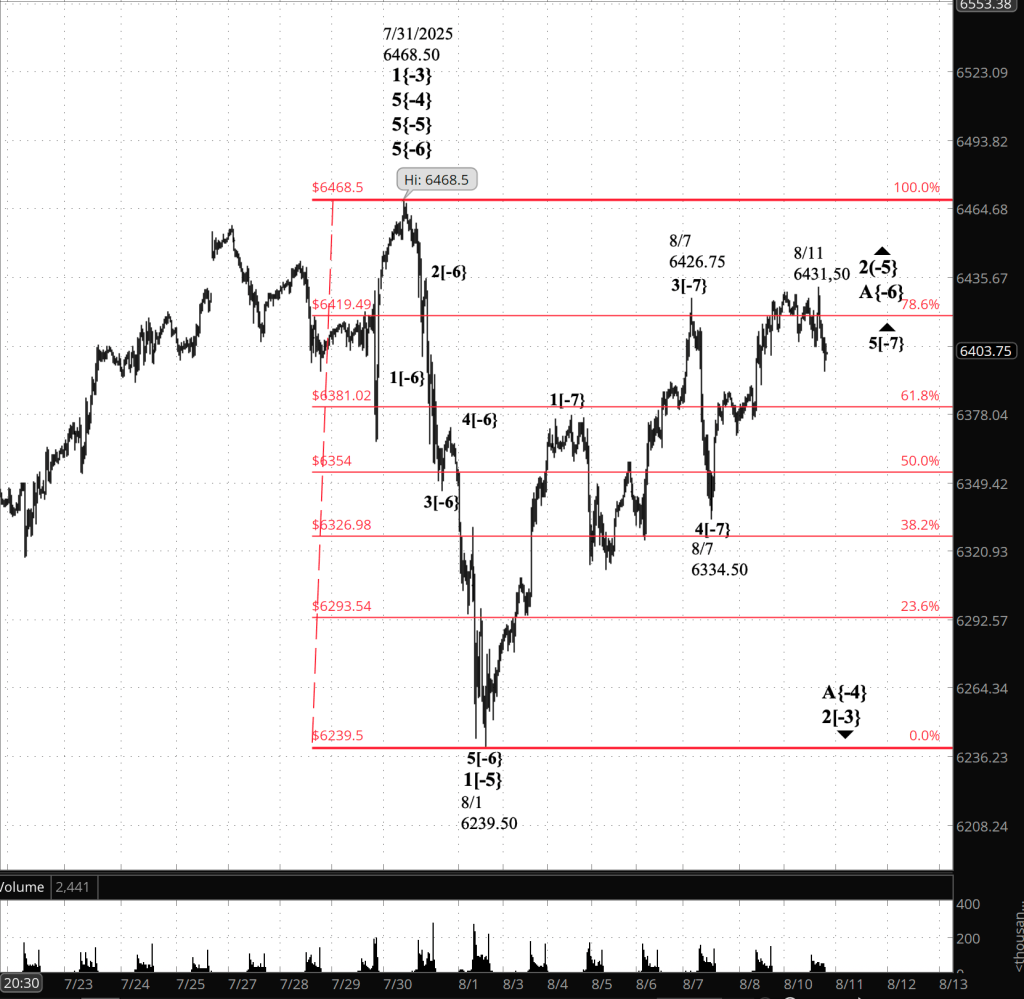
Half an hour before the closing bell. The S&P 500 futures peaked at 6239 right at the opening bell, and then reversed sharply.

Elliott Wave Theory: It appears likely that today’s peak is the end of the rising 3rd wave that began on June 23 and that a 4th-wave downward correction has begun. As is often the case in Elliott wave reversals, there’s some ambiguity. In this case, the 4th wave must remain above the end of the previous 1st wave, at 6123.25 on July 23, in order to confirm that the 4th wave has indeed begun.

Based on Fibonacci retracement theory, wave 4 is likely to decline into the mid-6100s, although that’s not a certainty. If it drops below 6123.25, then the Elliott Wave Theory rule is broken and the analysis will be redone. If it ends above the 6160s, no harm, no foul — wave 5 begins, an uptrend with five subwaves.

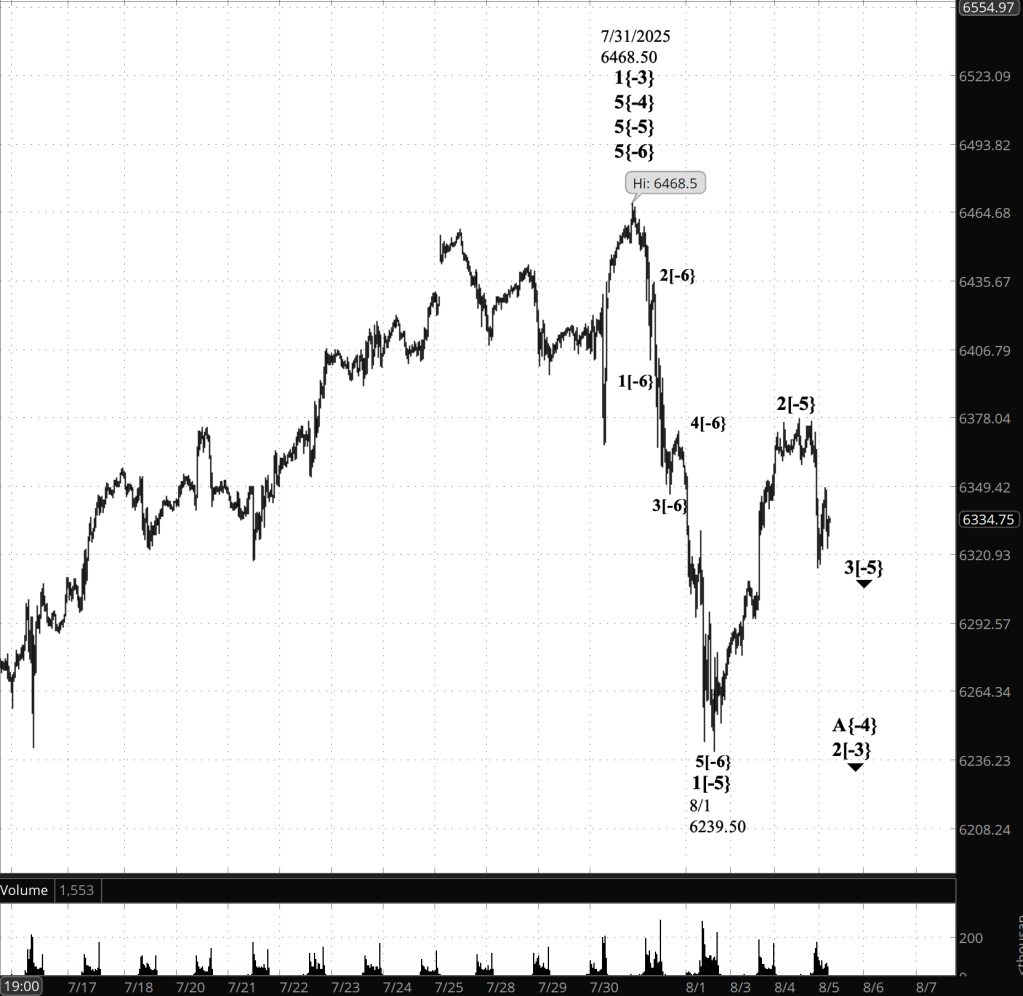
[S&P 500 E-mini futures at 3:30 p.m., 65-minute bars, with volume] 

9:35 a.m. New York time.

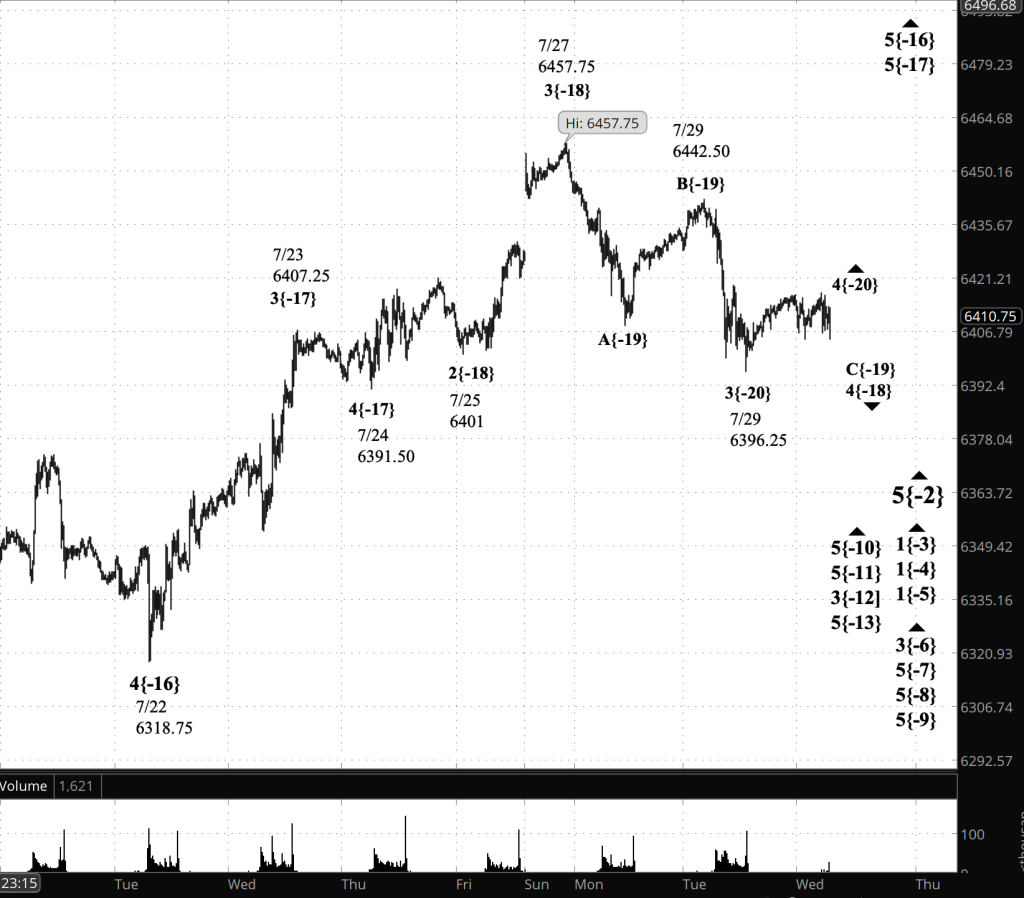
What’s happening now. The S&P 500 E-mini futures rose overnight, from the 6190s to a peak of 6220.75.

What does it mean? The Elliott Wave Theory wave structure has remained unchanged since the present uptrending 3rd wave began on June 23. The 3rd wave is the middle subwave of a 5th wave that began the day before, June 22. The 5th wave is the final subwave in a larger 5th wave that began its rise on May 23 from 5756.50. That’s the principal analysis.

It’s also possible, if we squint our eyes and use our imagination, to a 4th-wave downward correction within the 5th wave that began on June 22. In my view, it lacks clarity and looks more like a random scribble than a countertrend move large enough to be a 4th wave correction. None the less, clarify is far from unknown an Elliiott Wave Theory analysis, and so it’s possible that wave 3 ended on June 24, wave 4 ended on June 25, and wave 5 began on that date.

Using the labeling system on the chart, under the principal analysis we have wave 3{-11} within wave 5{-10}, and under the alternative analysis we have wave 5{-11} withi wave 5{-10}.

When wave 5{-11} is complete, it will also be the end of waves 5{-10}, 5{-9}, 5{-8}, 5{-7} and 3{-6}. The largest wave, 3{-6}, began on April 21 from 5127.25.

[Outdated by events: S&P 500 E-mini futures at 9:35 a.m., 65-minute bars, with volume] 

Waves Now Underway

These are the waves currently in progress under my principal analysis. Each line on the list shows the wave number, with the subscript in curly brackets, the traditional degree name, the starting date, the starting price of the S&P 500 E-mini futures, and the direction of the wave.

  • S&P 500 Index:
  • 5{+3} Supercycle, 7/8/1932, 4.40 (up)
  • 5{+2} Cycle, 12/9/1974, 60.96 (up)
  • 5{+1} Primary, 3/6/2009, 666.79 (up)
  • 5{0} Intermediate, 2/11/2016, 1810.10 (up)
  • 3{-1} Minor, 3/23/2020, 2191.36 (up)
  • 5{-2} Minute, 4/7/2025, 4832 (up)
  • S&P 500 Futures
  • 1{-3} Minuette, 4/7/2025, 4832 (up)
  • 1{-4} Subminuette, 4/7/2025, 4832 (up)
  • 1{-5} Micro, 4/7/2025, 4832 (up)
  • 3{-6} Submicro, 4/24/2025, 5260 (up)
  • 5{-7} Minuscule, 4/25/2025, 5550 (up)
  • 5{-8} (unnamed), 5/7/2025, 5596 (up)
  • 5{-9} (unnamed), 5/23/2025, 5756.50 (up)
  • 5{-10} (unnamed), 6/22/2025, 5959 (up)
  • 4{-11} (unnamed), 6/272025, 6239 {down}
  • A{-12} (unnamed), 6/272025, 6239 {down}

Reading the chart. Price movements — waves – – in Elliott Wave Theory analysis are labeled with numbers within trending waves and letters with corrective waves. The subscripts — numbers in curly brackets — designate the wave’s degree, which, in Elliott Wave analysis, means the relative position of a wave within the larger and smaller structures that make up the chart. R.N. Elliott, who in the 1930s developed the form of analysis that bears his name, viewed the chart as a complex structure of smaller waves nested within larger waves, which in turn are nested within still larger waves. In mathematics it’s called a fractal structure, where at every scale the pattern is similar to the others.

Learning and other resources. Elliott Wave analysis provides context, not prophecy. As the 20th century semanticist Alfred Korzybski put it in his book Science and Sanity (1933), “The map is not the territory … The only usefulness of a map depends on similarity of structure between the empirical world and the map.” And I would add, in the ever-changing markets, we can judge that similarity of structure only after the fact.

See the menu page Analytical Methods for a rundown on where to go for information on Elliott Wave analysis.

By Tim Bovee, Portland, Oregon, June 27, 2025

Disclaimer

Tim Bovee, Private Trader tracks the analysis and trades of a private trader for his own accounts. Nothing in this blog constitutes a recommendation to buy or sell stocks, options or any other financial instrument. The only purpose of this blog is to provide education and entertainment.

No trader is ever 100 percent successful in his or her trades. Trading in the stock and option markets is risky and uncertain. Each trader must make trading decisions for his or her own account, and take responsibility for the consequences.

License

All content on Tim Bovee, Private Trader by Timothy K. Bovee is licensed under a Creative Commons Attribution-ShareAlike 4.0 International License.

Based on a work at www.timbovee.com.
Trader’s Notebook: S&P 500

3:30 p.m. New York time

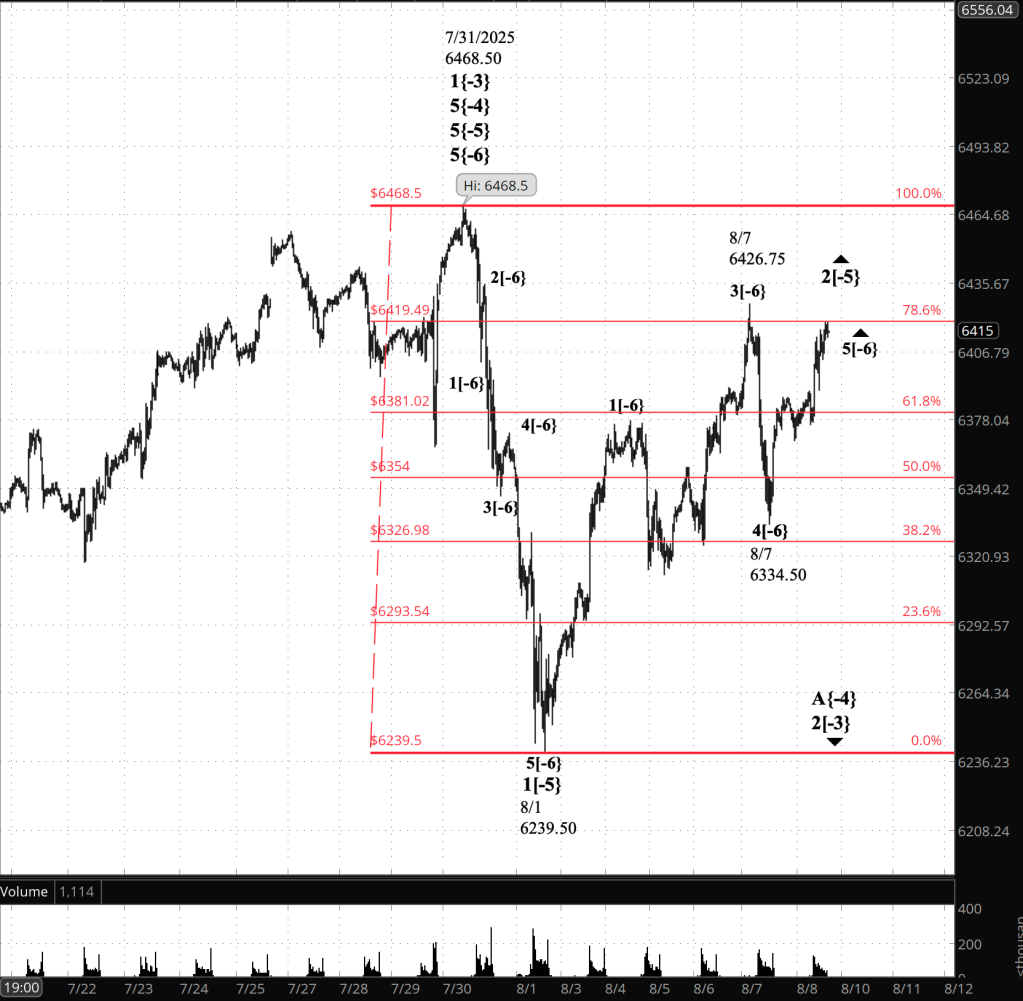
Half an hour before the closing bell. The S&P 500 futures continued to rise during the session, reaching a peak of 6198 and then pulling back slightly.

Elliott Wave theory: The rising 3rd wave within a larger 5th wave continues.

9:35 a.m. New York time.

What’s happening now. The S&P 500 E-mini futures rose overnight from the 6140s to a higher high, 6171, and then dropped sharply but briefly when the Gross Domestic Product revision was released.

What does it mean? An Elliott Wave Theory analysis of the chart shows that the rising 3rd wave that began on June 23 continues, the middle subwave with a rising 5th wave that began on June 22.

Both are subwaves of a larger risng 5th wave that began on May 23 from 5756.50.

The ambiguity in yesterday’s analysis has been resolved. The small 3rd wave that began this week is still underway.

[S&P 500 E-mini futures at 3:30 p.m., 65-minute bars, with volume] 

Waves Now Underway

These are the waves currently in progress under my principal analysis. Each line on the list shows the wave number, with the subscript in curly brackets, the traditional degree name, the starting date, the starting price of the S&P 500 E-mini futures, and the direction of the wave.

  • S&P 500 Index:
  • 5{+3} Supercycle, 7/8/1932, 4.40 (up)
  • 5{+2} Cycle, 12/9/1974, 60.96 (up)
  • 5{+1} Primary, 3/6/2009, 666.79 (up)
  • 5{0} Intermediate, 2/11/2016, 1810.10 (up)
  • 3{-1} Minor, 3/23/2020, 2191.36 (up)
  • 5{-2} Minute, 4/7/2025, 4832 (up)
  • S&P 500 Futures
  • 1{-3} Minuette, 4/7/2025, 4832 (up)
  • 1{-4} Subminuette, 4/7/2025, 4832 (up)
  • 1{-5} Micro, 4/7/2025, 4832 (up)
  • 3{-6} Submicro, 4/24/2025, 5260 (up)
  • 5{-7} Minuscule, 4/25/2025, 5550 (up)
  • 5{-8} (unnamed), 5/7/2025, 5596 (up)
  • 5{-9} (unnamed), 5/23/2025, 5756.50 (up)
  • 5{-10} (unnamed), 6/22/2025, 5959 (up)
  • 3{-11} (unnamed), 6/24/2025, 6155.25 {up}
  • 5{-12} (unnamed), 6/24/2025, 6109 (up)

Reading the chart. Price movements — waves – – in Elliott Wave Theory analysis are labeled with numbers within trending waves and letters with corrective waves. The subscripts — numbers in curly brackets — designate the wave’s degree, which, in Elliott Wave analysis, means the relative position of a wave within the larger and smaller structures that make up the chart. R.N. Elliott, who in the 1930s developed the form of analysis that bears his name, viewed the chart as a complex structure of smaller waves nested within larger waves, which in turn are nested within still larger waves. In mathematics it’s called a fractal structure, where at every scale the pattern is similar to the others.

Learning and other resources. Elliott Wave analysis provides context, not prophecy. As the 20th century semanticist Alfred Korzybski put it in his book Science and Sanity (1933), “The map is not the territory … The only usefulness of a map depends on similarity of structure between the empirical world and the map.” And I would add, in the ever-changing markets, we can judge that similarity of structure only after the fact.

See the menu page Analytical Methods for a rundown on where to go for information on Elliott Wave analysis.

By Tim Bovee, Portland, Oregon, June 26, 2025

Disclaimer

Tim Bovee, Private Trader tracks the analysis and trades of a private trader for his own accounts. Nothing in this blog constitutes a recommendation to buy or sell stocks, options or any other financial instrument. The only purpose of this blog is to provide education and entertainment.

No trader is ever 100 percent successful in his or her trades. Trading in the stock and option markets is risky and uncertain. Each trader must make trading decisions for his or her own account, and take responsibility for the consequences.

License

All content on Tim Bovee, Private Trader by Timothy K. Bovee is licensed under a Creative Commons Attribution-ShareAlike 4.0 International License.

Based on a work at www.timbovee.com.

Trader’s Notebook: S&P 500

3:30 p.m. New York time

Half an hour before the closing bell. The S&P 500 futures fell during the session, reaching into the 6130s so far.

Elliott Wave Theory: A rising 3rd wave continues within a larger 5th wave.

9:35 a.m. New York time.

What’s happening now. The S&P 500 E-mini futures rose overnight from the 6130s to the 6150s.

What does it mean? Elliott Wave Theory analysis labels the rise that began on June 22 as a 5th-wave uptrend that, internally, is in its middle subwave, wave 3.

There is some ambiguity in the analysis. An extremely shallow decline on June 25, from 6155.25, could be a 4th-wave downward correction. If so, it would mean that the final subwave, wave 5, has begun. To me, the 4th-wave decline seems too shallow to be of the same degree as the preceding 3rd wave.

So, I see two possible interpretations, using the labels that appear on the chart, a wave number followed by a subscript in brackets showing the number of degrees distance from Intermediate degree.

  • Principal analysis: Wave 3{-11} continues, with wave 4{-12}, a subwave, having ended on June 24 and wave 5{-12} having begun.
  • Alternative analysis: Wave 5{-11} has begun, within wave 4{-10} having ended on June 24.eceding 3rd wave.

While a shallow decline from 6155.25 could technically be counted as wave 4{-11}, it lacks both depth and duration typical of that degree. I favor the interpretation that wave 3{-11} is still in progress, and we are now in its final subwave, wave 5{-12}. A strong upward move above 6160–6170 with volume could confirm this and start the countdown to 4{-11}.

[S&P 500 E-mini futures at 3:30 p.m., 60-minute bars, with volume] 

Waves Now Underway

These are the waves currently in progress under my principal analysis. Each line on the list shows the wave number, with the subscript in curly brackets, the traditional degree name, the starting date, the starting price of the S&P 500 E-mini futures, and the direction of the wave.

  • S&P 500 Index:
  • 5{+3} Supercycle, 7/8/1932, 4.40 (up)
  • 5{+2} Cycle, 12/9/1974, 60.96 (up)
  • 5{+1} Primary, 3/6/2009, 666.79 (up)
  • 5{0} Intermediate, 2/11/2016, 1810.10 (up)
  • 3{-1} Minor, 3/23/2020, 2191.36 (up)
  • 5{-2} Minute, 4/7/2025, 4832 (up)
  • S&P 500 Futures
  • 1{-3} Minuette, 4/7/2025, 4832 (up)
  • 1{-4} Subminuette, 4/7/2025, 4832 (up)
  • 1{-5} Micro, 4/7/2025, 4832 (up)
  • 3{-6} Submicro, 4/24/2025, 5260 (up)
  • 5{-7} Minuscule, 4/25/2025, 5550 (up)
  • 5{-8} (unnamed), 5/7/2025, 5596 (up)
  • 5{-9} (unnamed), 5/23/2025, 5756.50 (up)
  • 5{-10} (unnamed), 6/22/2025, 5959 (up)
  • 3{-11} (unnamed), 6/24/2025, 6155.25 {up}
  • 5{-12} (unnamed), 6/24/2025, 6109 (up)

Reading the chart. Price movements — waves – – in Elliott Wave Theory analysis are labeled with numbers within trending waves and letters with corrective waves. The subscripts — numbers in curly brackets — designate the wave’s degree, which, in Elliott Wave analysis, means the relative position of a wave within the larger and smaller structures that make up the chart. R.N. Elliott, who in the 1930s developed the form of analysis that bears his name, viewed the chart as a complex structure of smaller waves nested within larger waves, which in turn are nested within still larger waves. In mathematics it’s called a fractal structure, where at every scale the pattern is similar to the others.

Learning and other resources. Elliott Wave analysis provides context, not prophecy. As the 20th century semanticist Alfred Korzybski put it in his book Science and Sanity (1933), “The map is not the territory … The only usefulness of a map depends on similarity of structure between the empirical world and the map.” And I would add, in the ever-changing markets, we can judge that similarity of structure only after the fact.

See the menu page Analytical Methods for a rundown on where to go for information on Elliott Wave analysis.

By Tim Bovee, Portland, Oregon, June 25, 2025

Disclaimer

Tim Bovee, Private Trader tracks the analysis and trades of a private trader for his own accounts. Nothing in this blog constitutes a recommendation to buy or sell stocks, options or any other financial instrument. The only purpose of this blog is to provide education and entertainment.

No trader is ever 100 percent successful in his or her trades. Trading in the stock and option markets is risky and uncertain. Each trader must make trading decisions for his or her own account, and take responsibility for the consequences.

License

All content on Tim Bovee, Private Trader by Timothy K. Bovee is licensed under a Creative Commons Attribution-ShareAlike 4.0 International License.

Based on a work at www.timbovee.com.
Trader’s Notebook: S&P 500

3:30 p.m. New York time

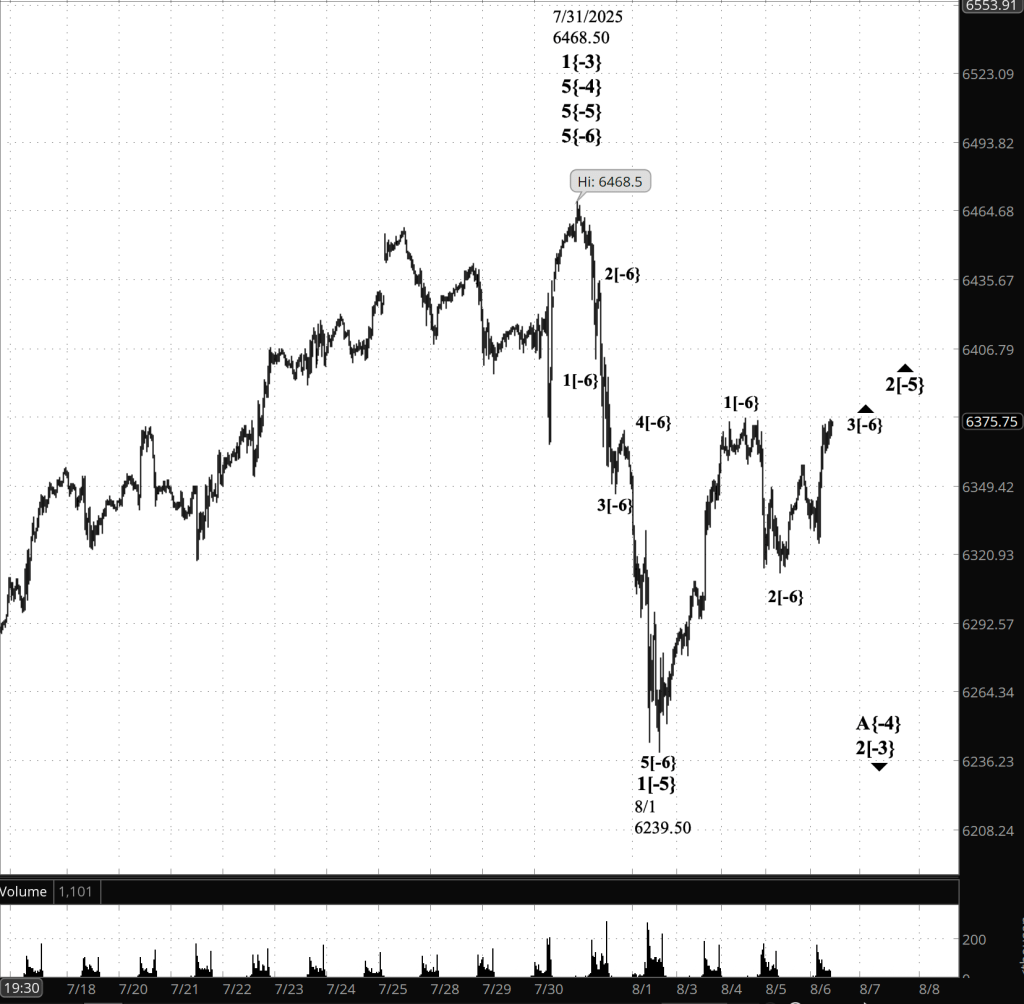
Half an hour before the closing bell. The S&P 500 futures continued to rise during the session, reaching into the 6150s as the end approached.

Elliott Wave Theory: An uptrending 5th wave that began on June 22 is underway and is in its middle subwave, wave 3.

9:35 a.m. New York time.

What’s happening now. The S&P 500 E-mini futures rose overnight, reaching into the 6170s, well above the prior high of 6109.

What does it mean? The new high requires a revision of the Elliott Wave Theory analysis.

The prior high, on 6/16, had been labeled wave 5 and has been relabeled wave 3. The low at 5959, on 6/22, which had been a subwave within a downtrendiing 4th wave, has been relabeled as the end of wave 4. And the rise from that point, also a subwave in previous labeling, has been relabelled as a 5th wave.

In other words, we’ve moved from a major peak followed by the first stages of what would become a major downtrend to a significant uptrend that is typical will carry the price significantly above the 6/22 starting point..

[S&P 500 E-mini futures at 3:30 p.m., 55-minute bars, with volume] 

Waves Now Underway

These are the waves currently in progress under my principal analysis. Each line on the list shows the wave number, with the subscript in curly brackets, the traditional degree name, the starting date, the starting price of the S&P 500 E-mini futures, and the direction of the wave.

  • S&P 500 Index:
  • 5{+3} Supercycle, 7/8/1932, 4.40 (up)
  • 5{+2} Cycle, 12/9/1974, 60.96 (up)
  • 5{+1} Primary, 3/6/2009, 666.79 (up)
  • 5{0} Intermediate, 2/11/2016, 1810.10 (up)
  • 3{-1} Minor, 3/23/2020, 2191.36 (up)
  • 5{-2} Minute, 4/7/2025, 4832 (up)
  • S&P 500 Futures
  • 1{-3} Minuette, 4/7/2025, 4832 (up)
  • 1{-4} Subminuette, 4/7/2025, 4832 (up)
  • 1{-5} Micro, 4/7/2025, 4832 (up)
  • 3{-6} Submicro, 4/24/2025, 5260 (up)
  • 5{-7} Minuscule, 4/25/2025, 5550 (up)
  • 5{-8} (unnamed), 5/7/2025, 5596 (up)
  • 5{-9} (unnamed), 5/23/2025, 5756.50 (up)
  • 5{-10} (unnamed), 6/22/2025, 5959 (up

Reading the chart. Price movements — waves – – in Elliott Wave Theory analysis are labeled with numbers within trending waves and letters with corrective waves. The subscripts — numbers in curly brackets — designate the wave’s degree, which, in Elliott Wave analysis, means the relative position of a wave within the larger and smaller structures that make up the chart. R.N. Elliott, who in the 1930s developed the form of analysis that bears his name, viewed the chart as a complex structure of smaller waves nested within larger waves, which in turn are nested within still larger waves. In mathematics it’s called a fractal structure, where at every scale the pattern is similar to the others.

Learning and other resources. Elliott Wave analysis provides context, not prophecy. As the 20th century semanticist Alfred Korzybski put it in his book Science and Sanity (1933), “The map is not the territory … The only usefulness of a map depends on similarity of structure between the empirical world and the map.” And I would add, in the ever-changing markets, we can judge that similarity of structure only after the fact.

See the menu page Analytical Methods for a rundown on where to go for information on Elliott Wave analysis.

By Tim Bovee, Portland, Oregon, June 24, 2025

Disclaimer

Tim Bovee, Private Trader tracks the analysis and trades of a private trader for his own accounts. Nothing in this blog constitutes a recommendation to buy or sell stocks, options or any other financial instrument. The only purpose of this blog is to provide education and entertainment.

No trader is ever 100 percent successful in his or her trades. Trading in the stock and option markets is risky and uncertain. Each trader must make trading decisions for his or her own account, and take responsibility for the consequences.

License

All content on Tim Bovee, Private Trader by Timothy K. Bovee is licensed under a Creative Commons Attribution-ShareAlike 4.0 International License.

Based on a work at www.timbovee.com.
Trader’s Notebook: S&P 500

3:30 p.m. New York time

Half an hour before the closing bell. The S&P 500 futures continued rising during the session, reaching to within 25 cents of the 6070 mark.

Elliott Wave Theory: Declining wave A, the first subwave within the declining 4th wave that began on June 16, continues.

9:35 a.m. New York time.

What’s happening now. The United States launched an air attack on nuclear facilities in Iran over the weekend. The S&P 500 E-mini futures ended last week at 6025, before the attack. It resumed trading from 5959 and immediately began to rise, so far reaching into the 6030s. In other words, a minute of drama followed by trading as usual.

What does it mean? Elliott Wave Theory analysis has the S&P 500 futures reaching a major turning point on June 16, triggering the end of four degrees of 5th waves and ushering in a batch of initial subwaves within a 4th-wave downward correction, wave 4{-6} on the chart, within the early stages of a downtrend. The preceding 3rd wave began on April 21, two months ago, and since 4th waves tend to be shorter than 3rd waves, It will be a long decline that we’ve grown used to but not hugely so.

One quirk of Elliott Wave Theory is the difficulty of precisely locating degrees. There’s insufficient data. So the wave 4{-6} label and wave A{-7} labels are precise, but the degrees of the waves within wave A{-7} so far lack clarity

[S&P 500 E-mini futures at 3:30 p.m., 55-minute bars, with volume] 

Waves Now Underway

These are the waves currently in progress under my principal analysis. Each line on the list shows the wave number, with the subscript in curly brackets, the traditional degree name, the starting date, the starting price of the S&P 500 E-mini futures, and the direction of the wave.

  • S&P 500 Index:
  • 5{+3} Supercycle, 7/8/1932, 4.40 (up)
  • 5{+2} Cycle, 12/9/1974, 60.96 (up)
  • 5{+1} Primary, 3/6/2009, 666.79 (up)
  • 5{0} Intermediate, 2/11/2016, 1810.10 (up)
  • 3{-1} Minor, 3/23/2020, 2191.36 (up)
  • 5{-2} Minute, 4/7/2025, 4832 (up)
  • S&P 500 Futures
  • 1{-3} Minuette, 4/7/2025, 4832 (up)
  • 1{-4} Subminuette, 4/7/2025, 4832 (up)
  • 1{-5} Micro, 4/7/2025, 4832 (up)
  • 4{-6} Submicro, 6/16/2025, 6109 (down)
  • A{-7} Minuscule, 6/16/2025, 6109 (down)

Reading the chart. Price movements — waves – – in Elliott Wave Theory analysis are labeled with numbers within trending waves and letters with corrective waves. The subscripts — numbers in curly brackets — designate the wave’s degree, which, in Elliott Wave analysis, means the relative position of a wave within the larger and smaller structures that make up the chart. R.N. Elliott, who in the 1930s developed the form of analysis that bears his name, viewed the chart as a complex structure of smaller waves nested within larger waves, which in turn are nested within still larger waves. In mathematics it’s called a fractal structure, where at every scale the pattern is similar to the others.

Learning and other resources. Elliott Wave analysis provides context, not prophecy. As the 20th century semanticist Alfred Korzybski put it in his book Science and Sanity (1933), “The map is not the territory … The only usefulness of a map depends on similarity of structure between the empirical world and the map.” And I would add, in the ever-changing markets, we can judge that similarity of structure only after the fact.

See the menu page Analytical Methods for a rundown on where to go for information on Elliott Wave analysis.

By Tim Bovee, Portland, Oregon, June 23, 2025

Disclaimer

Tim Bovee, Private Trader tracks the analysis and trades of a private trader for his own accounts. Nothing in this blog constitutes a recommendation to buy or sell stocks, options or any other financial instrument. The only purpose of this blog is to provide education and entertainment.

No trader is ever 100 percent successful in his or her trades. Trading in the stock and option markets is risky and uncertain. Each trader must make trading decisions for his or her own account, and take responsibility for the consequences.

License

All content on Tim Bovee, Private Trader by Timothy K. Bovee is licensed under a Creative Commons Attribution-ShareAlike 4.0 International License.

Based on a work at www.timbovee.com.

Trader’s Notebook: S&P 500

3:30 p.m. New York time

Half an hour before the closing bell. The S&P 500 futures peaked early in the session at 6071 and the retreated, so far reaching slightly above 6000.

Elliott Wave Theory: Wave A within the 4th-wave downward correction that began on June 16 continues, under the principal analysis. Under the alternative analysis, the June 16 high becomes the end of wave 3{-10}, with the subwaves now labeled {-10} are demoted one degree to {-11}. Were the alternative count prove to be the best analysis, then there will be a significant increase in the rise that lies ahead.

9:35 a.m. New York time.

What’s happening now. When trading resumed overnight, the S&P 500 E-mini futures began at 5991.50 and began to rise, so far reaching into the 6050s.

What does it mean? I’ve modified the Elliott Wave Theory analysis to imrprove the balance among the waves. As part of the change, the June 16 peak, 6109, became a major turning point in the market.

If the price rises above 6109, then the revision is incorrect and somethng else is going on. However, the revision solved a major problem and appears compelling enough that a fair analysis will at the least show what it looks like.

[S&P 500 E-mini futures at 3:30 p.m., 50-minute bars, with volume] 

Waves Now Underway

These are the waves currently in progress under my principal analysis. Each line on the list shows the wave number, with the subscript in curly brackets, the traditional degree name, the starting date, the starting price of the S&P 500 E-mini futures, and the direction of the wave.

  • S&P 500 Index:
  • 5{+3} Supercycle, 7/8/1932, 4.40 (up)
  • 5{+2} Cycle, 12/9/1974, 60.96 (up)
  • 5{+1} Primary, 3/6/2009, 666.79 (up)
  • 5{0} Intermediate, 2/11/2016, 1810.10 (up)
  • 3{-1} Minor, 3/23/2020, 2191.36 (up)
  • 5{-2} Minute, 4/7/2025, 4832 (up)
  • S&P 500 Futures
  • 1{-3} Minuette, 4/7/2025, 4832 (up)
  • 1{-4} Subminuette, 4/7/2025, 4832 (up)
  • 1{-5} Micro, 4/7/2025, 4832 (up)
  • 3{-6} Submicro, 4/21/2025, 4832 (up)

Reading the chart. Price movements — waves – – in Elliott Wave Theory analysis are labeled with numbers within trending waves and letters with corrective waves. The subscripts — numbers in curly brackets — designate the wave’s degree, which, in Elliott Wave analysis, means the relative position of a wave within the larger and smaller structures that make up the chart. R.N. Elliott, who in the 1930s developed the form of analysis that bears his name, viewed the chart as a complex structure of smaller waves nested within larger waves, which in turn are nested within still larger waves. In mathematics it’s called a fractal structure, where at every scale the pattern is similar to the others.

Learning and other resources. Elliott Wave analysis provides context, not prophecy. As the 20th century semanticist Alfred Korzybski put it in his book Science and Sanity (1933), “The map is not the territory … The only usefulness of a map depends on similarity of structure between the empirical world and the map.” And I would add, in the ever-changing markets, we can judge that similarity of structure only after the fact.

See the menu page Analytical Methods for a rundown on where to go for information on Elliott Wave analysis.

By Tim Bovee, Portland, Oregon, June 20, 2025

Disclaimer

Tim Bovee, Private Trader tracks the analysis and trades of a private trader for his own accounts. Nothing in this blog constitutes a recommendation to buy or sell stocks, options or any other financial instrument. The only purpose of this blog is to provide education and entertainment.

No trader is ever 100 percent successful in his or her trades. Trading in the stock and option markets is risky and uncertain. Each trader must make trading decisions for his or her own account, and take responsibility for the consequences.

License

All content on Tim Bovee, Private Trader by Timothy K. Bovee is licensed under a Creative Commons Attribution-ShareAlike 4.0 International License.

Based on a work at www.timbovee.com.

Trader’s Notebook: S&P 500

Market holiday. Thursday, June 19, is Juneteenth, a market holiday in the United States. Markets will be closed, and I won’t be uploading analyses until markets resume trading on Friday.

3:30 p.m. New York time

Half an hour before the closing bell. The S&P 500 futures rose rapidly when the Federal Open Market Committee said it would hold interest rates steady. The price fell back, and then rose again as Fed Chair Powell held his news conference.

Elliott Wave Theory:The 4th wave downward correction that began on June 6 continues.

9:35 a.m. New York time.

What’s happening now. The S&P 500 E-mini futures rose from 6017.75 to 6072 overnight and then drew back to the 6030s as the opening bell approached.

What does it mean? Seen through the lens of Elliott Wave Theory analysis, the 4th-wave decline that began on June 16 continues. This smaller 4th wave is a subwave of a larger rising 4th wave that began on June 12, and both are part of the final subwave, declining wave C, that began on June 11..

Encompassing the whole structure is a still larger 4th wave, which began its decline on June 5.

And that’s what June has been in the S&P 500 — a tangle of 4th waves within a rising 5th wave that began on May 23 and, several degrees larger, within a rising 5th wave that began on April 7 from 4837.

The all-time high for the S&P 500 was the end of a rising 3rd wave — wave 3{-2} on the charts — on February 19, at 6166.50.

And that’s what 2025 has been like so far. Despite all of the Sturm un Drang of our society and our politics, it has been a very hopeful, bullish year on the markets.

And turning back to the small 4th wave decline now underway? (Wave 4{-14} on the chart.) It will be followed by a rising 5th wave that, as is the nature of things, will eclipse February’s all-time high with an even higher all-time high. And so it goes.

Robert Prechter, who brought about a rebirth of Elliott Wave Theory in the 20th century, sees the dance of the waves as a reflection of the public mood. Looking at the waves this year, I’d have to say that the public mood is good.

[S&P 500 E-mini futures at 3:30 p.m., 45-minute bars, with volume] 

Elliott Wave Theory wave labels. Each wave listed on the charts has two components: A wave number, and a subscript in curly brackets that place the wave’s position in the fractal strucutre in relationship to Intermediate degree. The present Intermediate degree, wave 5{0}, began its rise on February 11, 2016 from 1810.10 and is still underway.

The waves referred to on the chart are as follows.

Principal analysis: Upward correction wave 5{-2} is underway and within it is working through a nested series of initial subwaves, wave 1{-3} down to wave 1{-5}. One degree lower, rising wave 3{-6} is underway and is in its final subwave, wave 5{-7},

Within wave 5{-7}, uptrending wave 5{-8} is in its final stage, uptrending wave 5{-9}.

Within wave 5{-9}, its middle subwave, wave 3{-10}, is underway. Internally, wave 3{-10} is in its next to the last subwave, wave 4{-11}, a downward correction that began from 6016.50.

Falling wave 4{-11} is in its final subwave, declining wave C{-12}, which is in its next-to-the-last subwave, rising wave 4{-13}.and which is in its final subwave

Waves Now Underway

These are the waves currently in progress under my principal analysis. Each line on the list shows the wave number, with the subscript in curly brackets, the traditional degree name, the starting date, the starting price of the S&P 500 E-mini futures, and the direction of the wave.

  • S&P 500 Index:
  • 5{+3} Supercycle, 7/8/1932, 4.40 (up)
  • 5{+2} Cycle, 12/9/1974, 60.96 (up)
  • 5{+1} Primary, 3/6/2009, 666.79 (up)
  • 5{0} Intermediate, 2/11/2016, 1810.10 (up)
  • 3{-1} Minor, 3/23/2020, 2191.36 (up)
  • 5{-2} Minute, 4/7/2025, 4832 (up)
  • S&P 500 Futures
  • 1{-3} Minuette, 4/7/2025, 4832 (up)
  • 1{-4} Subminuette, 4/7/2025, 4832 (up)
  • 1{-5} Micro, 4/7/2025, 4832 (up)
  • 3{-6} Submicro, 4/21/2025, 4832 (up)

Reading the chart. Price movements — waves – – in Elliott Wave Theory analysis are labeled with numbers within trending waves and letters with corrective waves. The subscripts — numbers in curly brackets — designate the wave’s degree, which, in Elliott Wave analysis, means the relative position of a wave within the larger and smaller structures that make up the chart. R.N. Elliott, who in the 1930s developed the form of analysis that bears his name, viewed the chart as a complex structure of smaller waves nested within larger waves, which in turn are nested within still larger waves. In mathematics it’s called a fractal structure, where at every scale the pattern is similar to the others.

Learning and other resources. Elliott Wave analysis provides context, not prophecy. As the 20th century semanticist Alfred Korzybski put it in his book Science and Sanity (1933), “The map is not the territory … The only usefulness of a map depends on similarity of structure between the empirical world and the map.” And I would add, in the ever-changing markets, we can judge that similarity of structure only after the fact.

See the menu page Analytical Methods for a rundown on where to go for information on Elliott Wave analysis.

By Tim Bovee, Portland, Oregon, June 18, 2025

Disclaimer

Tim Bovee, Private Trader tracks the analysis and trades of a private trader for his own accounts. Nothing in this blog constitutes a recommendation to buy or sell stocks, options or any other financial instrument. The only purpose of this blog is to provide education and entertainment.

No trader is ever 100 percent successful in his or her trades. Trading in the stock and option markets is risky and uncertain. Each trader must make trading decisions for his or her own account, and take responsibility for the consequences.

License

All content on Tim Bovee, Private Trader by Timothy K. Bovee is licensed under a Creative Commons Attribution-ShareAlike 4.0 International License.

Based on a work at www.timbovee.com.

Trader’s Notebook: S&P 500

3:30 p.m. New York Time

Half an hour before the closing bell. The S&P 500 futures rose early in the session and then resumed the decline, reaching into the 6030s as a session close approached.

Elliott Wave Theory: The 4th-wave downtrend correction that began on June 16 continues. When it is complete, wave 5 within the parent rising 4th wave that began on June 12 will begin, carrying the price higher.

The present line-up of the degrees within the present fractal structure is more than a little confusing. Most friends of mine tend to hang on to their holdings for awhile. I would suggest that traders with longer-term goals will do better to keep an eye on wave 5{-9}, which began on May 23 and which has been in its 3rd subwave, rising wave 3{-10}, since May 30.

Of course, for the super long-term investor, the wave to track is wave 5{+1}, which began on March 6, 2009, during the Great Recession and which is and which is in its final subwave, wave 5{0}, which began on February 11, 2016.

9:35 a.m. New York time.

What’s happening now. The S&P 500 E-mini futures fell overnight, from the 6090s to the 6050s

What does it mean? Elliott Wave Theory analysis sees the 4th-wave downward correction that began on correction that began on June 5 continuing to work through its final subwave, wave C. (On the chart: 4{-11, C{-12}.

C waves generally have five subwaves, and this subwave is in its next-to-the-last subwave, rising wave 4, which began on June 12. (On the chart: 4{-13}.)

[S&P 500 E-mini futures at 3:30 p.m., 45-minute bars, with volume] 

Elliott Wave Theory wave labels. Each wave listed on the charts has two components: A wave number, and a subscript in curly brackets that place the wave’s position in the fractal strucutre in relationship to Intermediate degree. The present Intermediate degree, wave 5{0}, began its rise on February 11, 2016 from 1810.10 and is still underway.

The waves referred to on the chart are as follows.

Principal analysis: Upward correction wave 5{-2} is underway and within it is working through a nested series of initial subwaves, wave 1{-3} down to wave 1{-5}. One degree lower, rising wave 3{-6} is underway and is in its final subwave, wave 5{-7},

Within wave 5{-7}, uptrending wave 5{-8} is in its final stage, uptrending wave 5{-9}.

Within wave 5{-9}, its middle subwave, wave 3{-10}, is underway. Internally, wave 3{-10} is in its next to the last subwave, wave 4{-11}, a downward correction that began from 6016.50.

Falling wave 4{-11} is in its final subwave, declining wave C{-12}, which is in its next-to-the-last subwave, rising wave 4{-13}.and which is in its final subwave

Waves Now Underway

These are the waves currently in progress under my principal analysis. Each line on the list shows the wave number, with the subscript in curly brackets, the traditional degree name, the starting date, the starting price of the S&P 500 E-mini futures, and the direction of the wave.

  • S&P 500 Index:
  • 5{+3} Supercycle, 7/8/1932, 4.40 (up)
  • 5{+2} Cycle, 12/9/1974, 60.96 (up)
  • 5{+1} Primary, 3/6/2009, 666.79 (up)
  • 5{0} Intermediate, 2/11/2016, 1810.10 (up)
  • 3{-1} Minor, 3/23/2020, 2191.36 (up)
  • 5{-2} Minute, 4/7/2025, 4832 (up)
  • S&P 500 Futures
  • 1{-3} Minuette, 4/7/2025, 4832 (up)
  • 1{-4} Subminuette, 4/7/2025, 4832 (up)
  • 1{-5} Micro, 4/7/2025, 4832 (up)
  • 3{-6} Submicro, 4/21/2025, 4832 (up)

Reading the chart. Price movements — waves – – in Elliott Wave Theory analysis are labeled with numbers within trending waves and letters with corrective waves. The subscripts — numbers in curly brackets — designate the wave’s degree, which, in Elliott Wave analysis, means the relative position of a wave within the larger and smaller structures that make up the chart. R.N. Elliott, who in the 1930s developed the form of analysis that bears his name, viewed the chart as a complex structure of smaller waves nested within larger waves, which in turn are nested within still larger waves. In mathematics it’s called a fractal structure, where at every scale the pattern is similar to the others.

Learning and other resources. Elliott Wave analysis provides context, not prophecy. As the 20th century semanticist Alfred Korzybski put it in his book Science and Sanity (1933), “The map is not the territory … The only usefulness of a map depends on similarity of structure between the empirical world and the map.” And I would add, in the ever-changing markets, we can judge that similarity of structure only after the fact.

See the menu page Analytical Methods for a rundown on where to go for information on Elliott Wave analysis.

By Tim Bovee, Portland, Oregon, June 17, 2025

Disclaimer

Tim Bovee, Private Trader tracks the analysis and trades of a private trader for his own accounts. Nothing in this blog constitutes a recommendation to buy or sell stocks, options or any other financial instrument. The only purpose of this blog is to provide education and entertainment.

No trader is ever 100 percent successful in his or her trades. Trading in the stock and option markets is risky and uncertain. Each trader must make trading decisions for his or her own account, and take responsibility for the consequences.

License

All content on Tim Bovee, Private Trader by Timothy K. Bovee is licensed under a Creative Commons Attribution-ShareAlike 4.0 International License.

Based on a work at www.timbovee.com.

Trader’s Notebook: S&P 500

3:30 p.m. New York time.

Half an hour before the closing bell. The S&P 500 futures dropped slightly after the session high, 6109, reaching into the 6080s.

Elliott Wave Theory: The rising upward correction that began on June 12, wave 4, continues, as does its parent, declining wave C.

9:35 a.m. New York time.

What’s happening now. The S&P 500 E-mini futures resumed trqding overnight from 6000 and so far has risen into the 6070s;

What does it mean? Elliott Wave Theory analysis late last week yet again appeared to have found the end of rising wave 4, only to have what appeared to be a signifiant decline, the start of falling wave 5, prove to be but another subwave within wave 4’s exuberant rise.

At this point, for clarity, I’m switching to the numbering system used on the chart, where the wave number is followed by a subscript in curly brackets show how many degrees the wave stands from Intermediate degree. All of the degrees in this analysis are of signifiantly smaller degrees than Intermediate and so are negative numbrers.

Ongoing wave 4{-13], the next-to-the-last subwave within declining wave C{-12} continues. The C wave is the final subwave within a downward correction, wave 4{-11}.

In the decades I’ve worked with Elliott Wave Theory, I’ve found that the end game of a trend is filled with ambiguity, “bottom fishing” as its called when a downward movement is nearing its end, and I suppose the present end game of an upward movement could be called “top fishing”. Or whatever the direction, we can call it a ‘head fake”.

Whatever the nomenclature, wave 4{-13}, having begun on June 12, is tracing out its 3rd and likely final subwave, wave C{-14}.

[S&P 500 E-mini futures at 3:30 p.m., 40-minute bars, with volume] 

Elliott Wave Theory wave labels. Each wave listed on the charts has two components: A wave number, and a subscript in curly brackets that place the wave’s position in the fractal strucutre in relationship to Intermediate degree. The present Intermediate degree, wave 5{0}, began its rise on February 11, 2016 from 1810.10 and is still underway.

The waves referred to on the chart are as follows.

Principal analysis: Upward correction wave 5{-2} is underway and within it is working through a nested series of initial subwaves, wave 1{-3} down to wave 1{-5}. One degree lower, rising wave 3{-6} is underway and is in its final subwave, wave 5{-7},

Within wave 5{-7}, uptrending wave 5{-8} is in its final stage, uptrending wave 5{-9}.

Within wave 5{-9}, its middle subwave, wave 3{-10}, is underway. Internally, wave 3{-10} is in its next to the last subwave, wave 4{-11}, a downward correction that began from 6016.50.

Falling wave 4{-11} is in its final subwave, declining wave C{-12}, which is in its next-to-the-last subwave, rising wave 4{-13}.

Waves Now Underway

These are the waves currently in progress under my principal analysis. Each line on the list shows the wave number, with the subscript in curly brackets, the traditional degree name, the starting date, the starting price of the S&P 500 E-mini futures, and the direction of the wave.

  • S&P 500 Index:
  • 5{+3} Supercycle, 7/8/1932, 4.40 (up)
  • 5{+2} Cycle, 12/9/1974, 60.96 (up)
  • 5{+1} Primary, 3/6/2009, 666.79 (up)
  • 5{0} Intermediate, 2/11/2016, 1810.10 (up)
  • 3{-1} Minor, 3/23/2020, 2191.36 (up)
  • 5{-2} Minute, 4/7/2025, 4832 (up)
  • S&P 500 Futures
  • 1{-3} Minuette, 4/7/2025, 4832 (up)
  • 1{-4} Subminuette, 4/7/2025, 4832 (up)
  • 1{-5} Micro, 4/7/2025, 4832 (up)
  • 3{-6} Submicro, 4/21/2025, 4832 (up)

Reading the chart. Price movements — waves – – in Elliott Wave Theory analysis are labeled with numbers within trending waves and letters with corrective waves. The subscripts — numbers in curly brackets — designate the wave’s degree, which, in Elliott Wave analysis, means the relative position of a wave within the larger and smaller structures that make up the chart. R.N. Elliott, who in the 1930s developed the form of analysis that bears his name, viewed the chart as a complex structure of smaller waves nested within larger waves, which in turn are nested within still larger waves. In mathematics it’s called a fractal structure, where at every scale the pattern is similar to the others.

Learning and other resources. Elliott Wave analysis provides context, not prophecy. As the 20th century semanticist Alfred Korzybski put it in his book Science and Sanity (1933), “The map is not the territory … The only usefulness of a map depends on similarity of structure between the empirical world and the map.” And I would add, in the ever-changing markets, we can judge that similarity of structure only after the fact.

See the menu page Analytical Methods for a rundown on where to go for information on Elliott Wave analysis.

By Tim Bovee, Portland, Oregon, June 16, 2025

Disclaimer

Tim Bovee, Private Trader tracks the analysis and trades of a private trader for his own accounts. Nothing in this blog constitutes a recommendation to buy or sell stocks, options or any other financial instrument. The only purpose of this blog is to provide education and entertainment.

No trader is ever 100 percent successful in his or her trades. Trading in the stock and option markets is risky and uncertain. Each trader must make trading decisions for his or her own account, and take responsibility for the consequences.

License

All content on Tim Bovee, Private Trader by Timothy K. Bovee is licensed under a Creative Commons Attribution-ShareAlike 4.0 International License.

Based on a work at www.timbovee.com.

Trader’s Notebook: S&P 500

3:30 p.m. New York time

Half an hour before the closing bell. The S&P 500 futures continued falling during the session, reaching into the 5980s.

Elliott Wave Theory: The reversal has traveled far enough to add credence to this wave line-up: Declining wave 5, the final subwave within declining wave C, which in turn is the final subwave within declining wave 4 are all underway.

I’ve changed the mark-up of the chart to confirm and will post a new chart, leaving intact the old chart and this morning’s mark-up intact.

[S&P 500 E-mini futures at 3:30 p.m., 40-minute bars, with volume] 

9:35 a.m. New York time.

What’s happening now. The S&P 500 E-mini futures hit a low yesterday evening, several hours after the closing bell. The price reversed at 5927.50 and has kept rising, so far reaching slightly above 6,000.

What does it mean? The fall and rise are all happening within wave C, the final subwave within the 4th-wave downward correction that began on June 5, Elliott Wave Theory analysis shows. Wave C will have five subwaves when complete. Yesterday’s fall was wave 3, the middle subwave within wave C. The reversal and rise overnight is rising wave 4 within wave C.

When wave 4 is complete, it will be followed by wave 5, the final subwave within wave C. The 5th wave will likely carry the price beyond last night’s low, perhaps significantly so. Or not. Fifth waves are quirky and sometimes fall short of the end of wave 3.

Long or short, wave 5 will be the end of its parent C wave and its grandparent 4th wave, and will be the beginning wave a rising 5th wave that will carry the price well into the 6000s.

[Note: The analysis on this morning’s chart, below, has changed considerably during the session. See the new analysis in the afternoon chart, above.]

[S&P 500 E-mini futures at 9:35 a.m., 40-minute bars, with volume] 

Elliott Wave Theory wave labels. Each wave listed on the charts has two components: A wave number, and a subscript in curly brackets that place the wave’s position in the fractal strucutre in relationship to Intermediate degree. The present Intermediate degree, wave 5{0}, began its rise on February 11, 2016 from 1810.10 and is still underway.

The waves referred to on the chart are as follows.

Principal analysis: Upward correction wave 5{-2} is underway and within it is working through a nested series of initial subwaves, wave 1{-3} down to wave 1{-5}. One degree lower, rising wave 3{-6} is underway and is in its final subwave, wave 5{-7},

Within wave 5{-7}, uptrending wave 5{-8} is in its final stage, uptrending wave 5{-9}.

Within wave 5{-9}, its middle subwave, wave 3{-10}, is underway. Internally, wave 3{-10} is in its next to the last subwave, wave 4{-11}, a downward correction that began from 6016.50.

Wave 4{-11} is in its final subwave, declining wave C{-12}, which is in its next-to-the-last subwave, wave 4{-13}.d

Waves Now Underway

These are the waves currently in progress under my principal analysis. Each line on the list shows the wave number, with the subscript in curly brackets, the traditional degree name, the starting date, the starting price of the S&P 500 E-mini futures, and the direction of the wave.

  • S&P 500 Index:
  • 5{+3} Supercycle, 7/8/1932, 4.40 (up)
  • 5{+2} Cycle, 12/9/1974, 60.96 (up)
  • 5{+1} Primary, 3/6/2009, 666.79 (up)
  • 5{0} Intermediate, 2/11/2016, 1810.10 (up)
  • 3{-1} Minor, 3/23/2020, 2191.36 (up)
  • 5{-2} Minute, 4/7/2025, 4832 (up)
  • S&P 500 Futures
  • 1{-3} Minuette, 4/7/2025, 4832 (up)
  • 1{-4} Subminuette, 4/7/2025, 4832 (up)
  • 1{-5} Micro, 4/7/2025, 4832 (up)
  • 3{-6} Submicro, 4/21/2025, 4832 (up)

Reading the chart. Price movements — waves – – in Elliott Wave Theory analysis are labeled with numbers within trending waves and letters with corrective waves. The subscripts — numbers in curly brackets — designate the wave’s degree, which, in Elliott Wave analysis, means the relative position of a wave within the larger and smaller structures that make up the chart. R.N. Elliott, who in the 1930s developed the form of analysis that bears his name, viewed the chart as a complex structure of smaller waves nested within larger waves, which in turn are nested within still larger waves. In mathematics it’s called a fractal structure, where at every scale the pattern is similar to the others.

Learning and other resources. Elliott Wave analysis provides context, not prophecy. As the 20th century semanticist Alfred Korzybski put it in his book Science and Sanity (1933), “The map is not the territory … The only usefulness of a map depends on similarity of structure between the empirical world and the map.” And I would add, in the ever-changing markets, we can judge that similarity of structure only after the fact.

See the menu page Analytical Methods for a rundown on where to go for information on Elliott Wave analysis.

By Tim Bovee, Portland, Oregon, June 13, 2025

Disclaimer

Tim Bovee, Private Trader tracks the analysis and trades of a private trader for his own accounts. Nothing in this blog constitutes a recommendation to buy or sell stocks, options or any other financial instrument. The only purpose of this blog is to provide education and entertainment.

No trader is ever 100 percent successful in his or her trades. Trading in the stock and option markets is risky and uncertain. Each trader must make trading decisions for his or her own account, and take responsibility for the consequences.

License

All content on Tim Bovee, Private Trader by Timothy K. Bovee is licensed under a Creative Commons Attribution-ShareAlike 4.0 International License.

Based on a work at www.timbovee.com.