SPY is trading within yesterday’s range so far this morning and requires no action.
ARKG has set a lower low for two days in a a row for the first time since June 4, and the daily chart Fisher Transform has switched to downtrending. It has been uptrending since June 13. The weekly chart Fisher remains uptrending, as it has been since mid-May. The weekly is my chosen signal to consider exiting to avoid a downtrend.
Neither symbol demands a change in my Elliott wave count, so I see no reason to take action on either today.
On Saturday, look for The Week Ahead — my discussion of what to expect in economic reporting.
My Elliott wave analysis of SPY and ARKG still stand, and there has been no change in the Fisher Transform directional signals on either. I anticipate no trades today.
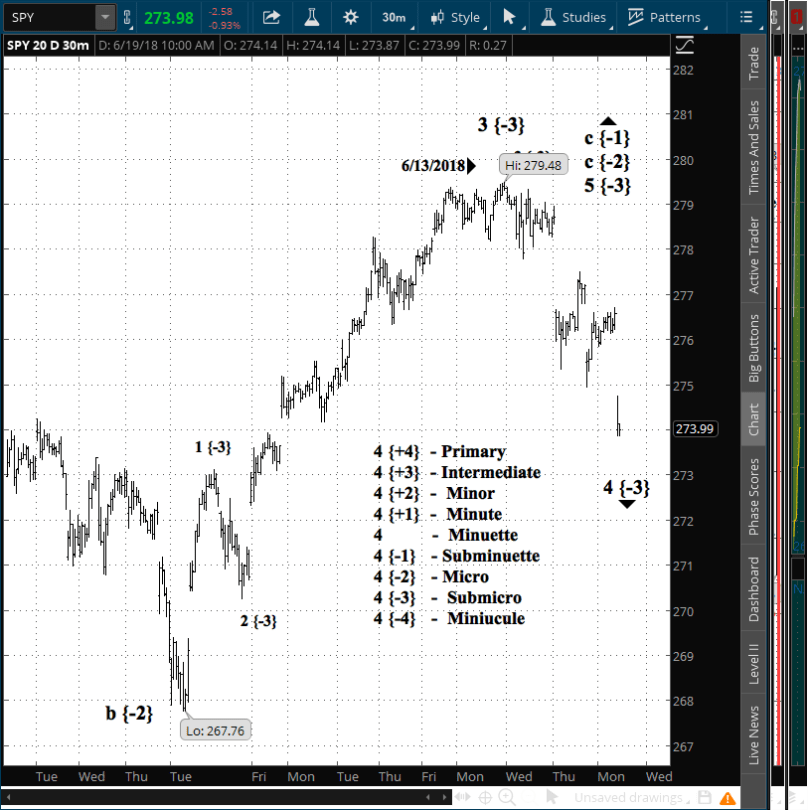
SPY has opened with a downward gap as the 4th wave down of the Submicro degree continues, Elliott wave analysis shows. The 3rd wave peaked on June 13 at 279.48. As of this writing SPY is trading at $274.40, which is 1.8% below that peak.
The market talk-talk is blaming the accelerating U.S.-China trade war for the decline. In the broader context of the chart, it’s a very small response, and one consistent with the pre-existing trend. So, “Balderdash!”, I say.
The low significance of the fall is buttressed by the Fisher Transform, which is unchanged: Downtrending on the daily chart and uptrending on the weekly chart.
The chart covers 20 days with 30-minute bars.
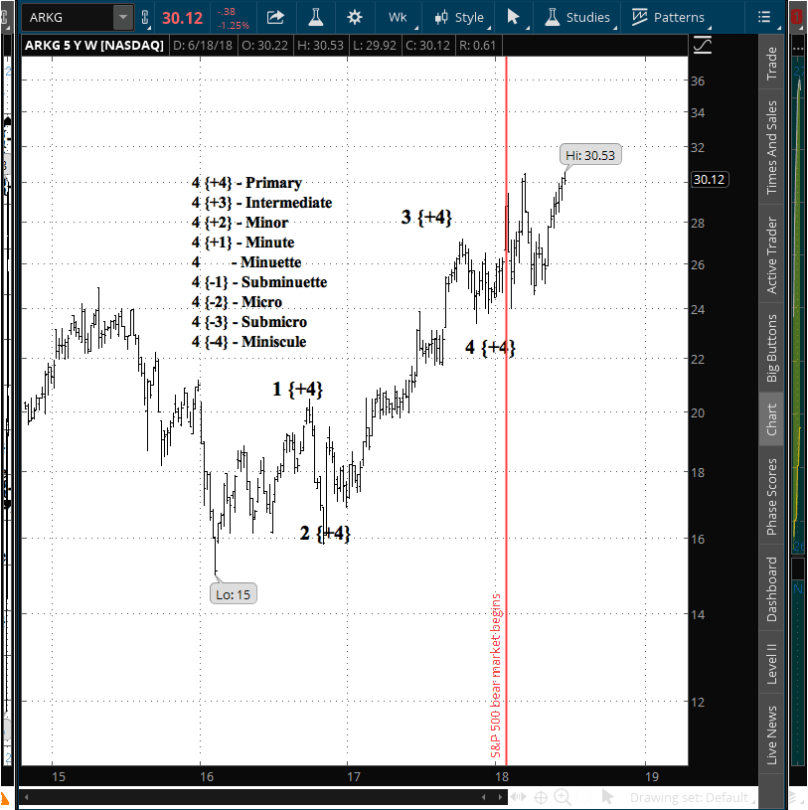
My shares position on ARKG continues to tick-tock along a rising 5th wave of the Primary degree. It has fulfilled all of the requirements for that wave and so could reverse into a correction without doing damage to the analysis. It could also continue to rise for some time. The daily and weekly Fishers remain uptrending.
The chart covers a 5-year span with one-week bars. The beginning of the bear market, on Jan. 26, is marked with a red line.
In either case, at this point I see no need for a trade today
The Fisher Transform on the SPY daily chart has switched to a downtrend signal. The weekly-bar chart continues to signal uptrending.
Elliott wave analysis of the chart shows SPY in a 4th wave down at the Submicro degree, to be followed by a 5th wave up that in a normal formation would complete the 2nd wave upward correction in the Subminuette degree, to be followed by the start of the 3rds wave down in the Minuette degree, which is the wave I plan to ride.
So, no trades today, most likely. But I’m keeping a close eye on the chart.
In this market stocks and their derivatives tend to be closely correlated, with very few stocks and funds bucking the trend. In an effort to find alternatives to trade, I did some chart work on GLD — gold bullion — and FXE — the Euro/Dollar fund.
I found the GLD chart to lack clarity at this stage and I have set it aside. FXE has been in a B wave to the downside within a higher-degree 4th have since May 14 and might be worth playing on the C-wave reversal upward. I’m keeping watch.
Having entered ARKG on Friday as my first story play in years, I spent the weekend looking into the fund’s parent company, ARK Invest, and found its approach to be be fascinating. I’ve updated my ARKG analysis with a half-hour interview with the company’s CEO, Catherine Woods.
Two real-estate reports will be published during the week: Housing starts, a forward looking study, on Tuesday at 8:30 a.m. New York time, and existing home sales, on Wednesday at 10 a.m.
Also out during the week, the Purchasing Managers index composite flash report, on Friday at 9:45 a.m.
In Fedworld, Chairman Jerome Powell will take part in a panel discussion at the European Central Bank Forum on Central Banking in Linhó Sintra, Portugal, on Wednesday at 9:30 a.m. New York time (2:30 p.m. local). The event will be streamed live here.
Update 7/10/2018: I have exited ARKG for a small profit. My fundamental reason for buying ARKG — growth of the genetics sector — remains valid. However, we have been in a bear market since Jan. 26, and ARKG has moved into a down wave. I took my chips off the table — temporarily — in order to let that wave do its work without impacting me, and I shall jump back in once that wave is complete.
Shares produced a net rise of 3.1% over my 25-day holding period, for a +46% annual rate.
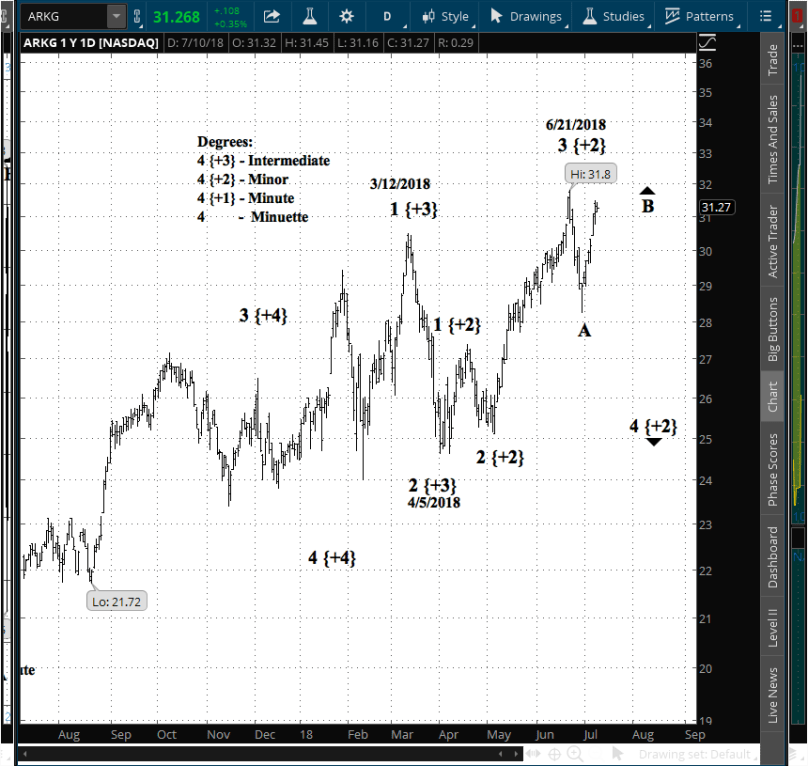
The ARKG chart below, covering one year with daily bars, shows that at the Minor degree the stock is in an uptrend and has begun a counter-trend correction at the Minute and Minuette degrees.
The 4th wave is generally a sideways movement, and often a complex one. That means a shallow correction but one that will take some time to complete. It will be followed by a 5th wave rise to new highs.
My plan is follow the Minute wave and trade the reversal to the upside of the Minor wave.
Update 6/17/2018: After buying into ARKG I have spent the weekend learning more about the fund’s creator and manager, ARK Investment Management LLC. Among my finds was this half-hour interview with ARK’s CEO, Catherine D. Woods, in which she discusses the company’s disruptive technologies themes. Interesting ideas.
I have entered a long shares position on ARKG, one of the few exchange-traded funds with an uptrending Fisher Transform and a visual trend on the annual chart to match.
I have structured it as a longer-term trade, a traditional buy-and-hold. The chart doesn’t follow the normal movements of the broad market, and in this bear market, I judge that outliers give the best prospects.
I screened for it in the simplest possible way: Listing all of the available exchange-traded funds, the huge majority of which are downtrending, and looking at those few with an uptrending Fisher. After that, it was just a matter of skimming through the charts.
The fund has no Zacks rank but is considered to be high risk. It pays no dividend and has no options. Morningstar gives it a 3-star rating.
The entry price was $30.22.
Atypically for me, ARKG is a story trade. I’m fascinated by genomics and all the useful information that can be harvested from a genetic test. Like millions of others, I’ve been tested by 23andMe (Wikipedia article), and have learned more about myself, my limits and gifts, my likely health challenges and I age, than my parents could have ever hoped to know.
Running my testing results through Promethease, I linked my results to the broad scientific literature tracked by SNPedia (Wikipedia article) for an even deeper knowledge of myself.
After much reading, I’m convinced that this tech is the Next Big Thing, and I want to go along for the ride. Plus, ARKG is classified as a Health Care ETF. I judge that we are in the last stage of the expansion that began in October 2009, a stage in which Health is a sector that does well.
ARKG is newly uptrending on the monthly Fisher Transform, and I shall use a switch to downtrending on that indicator as a signal to pull out temporarily.
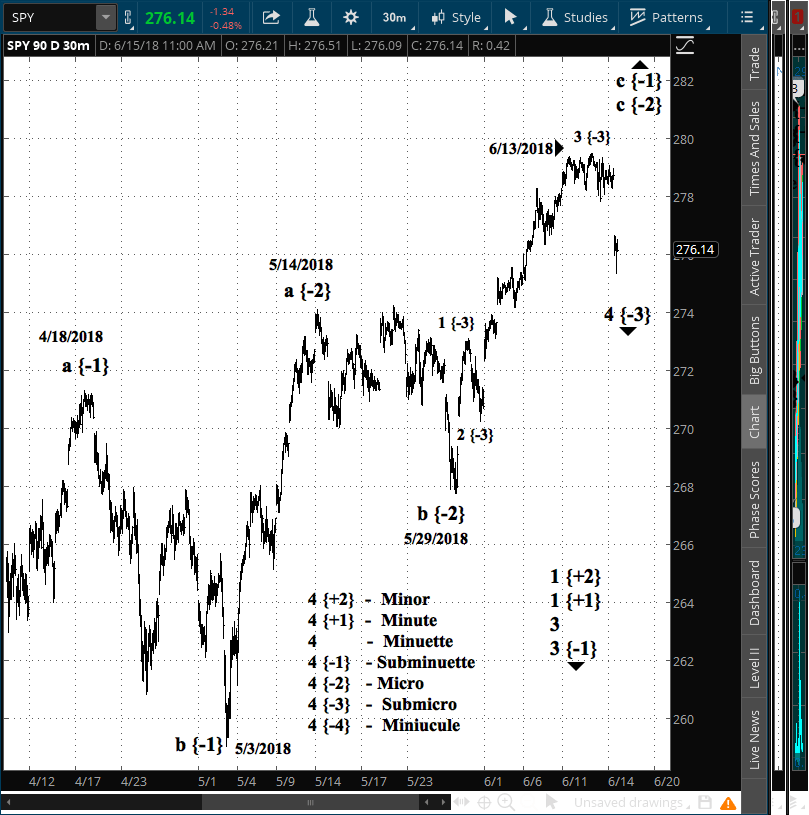
The rising 3rd wave of the Submicro degree (3 {-3}) on the SPY chart has ended, peaking on June 13 at $279.48. The reversal happened with an opening gap, and such gaps generally are a shout-out that a significant reversal has begun.
Further underlining the significance of the reversal, the Fisher Transform
The Elliotchart covers 90 days with 30-minute bars.
Elliott wave analysis shows that the next step will be a 4th wave to the downside, and then a final push upward that will complete the C wave of the 4th wave upward correction up to the Subminuette degree (4 {-1+}), and indeed will mark the end of the 4th wave correction at the Minuette degree (4) that began on April 2.
Once that Subminuette 5th wave (5 {-3}) is complete, then I shall re-establish my bear options positions on SPY.


You must be logged in to post a comment.