Thursday, December 3, 2020

3:35 p.m. New York time

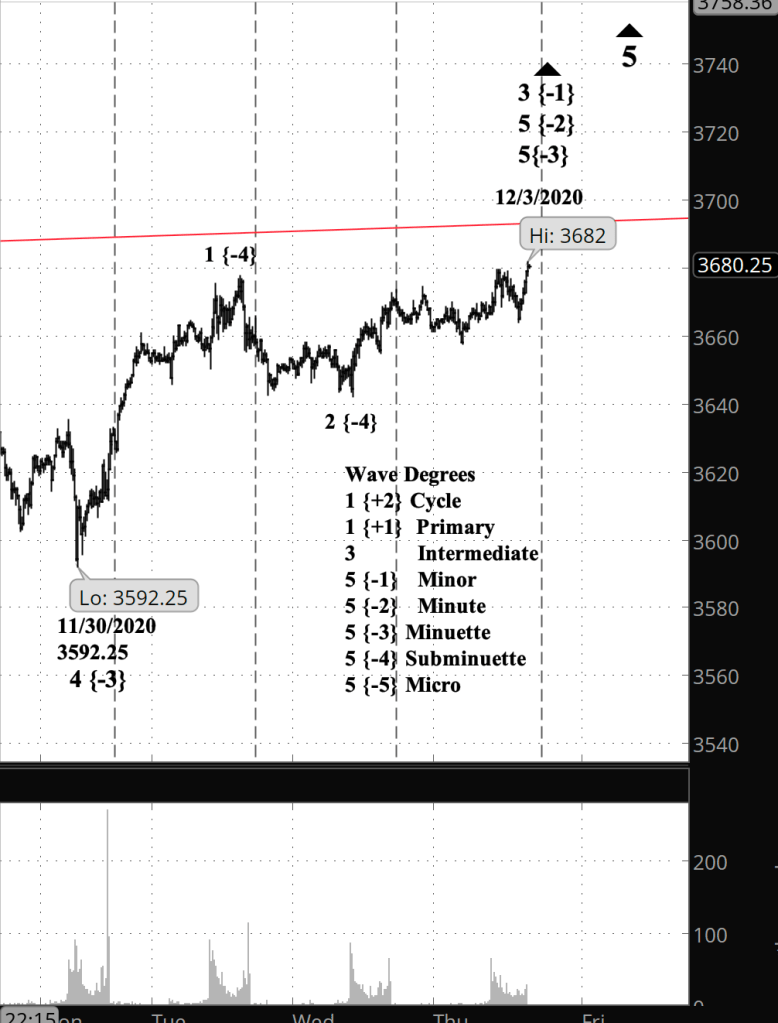
The S&P 500 index and futures moved above their high of December 1, extending the rise of Minor wave 3 and its subwaves. I’ve updated the chart, below, at half an hour before the closing bell.

10 a.m. New York time

What’s happening now? The S&P 500 index and its derivatives has completed one down-wave of five subwaves and one up-wave of three subwaves since the peak of December 1.

What does it mean? The pattern is typical of a downward correction.
[S&P 500 E-mini futures, 15-minute bars, with volume]

What does Elliott wave theory say? The parent wave is a 4th of Minor degree, and the subwaves are A and B of Minute degree (or possibly one degree down, of Minuette degree). Wave B took back most of wave A, which as is typical of B behavior.

My trading strategy. Down is eventually profitable for my short bear call spread options positions, and the pattern shows a downtrend, so I’m in hold mode. Same with my shares of SDS, an inverse exchange-traded fund based on the S&P 500, with a long time horizon.

Read More »
Wednesday, December 2, 2020

3:30 p.m. New York time

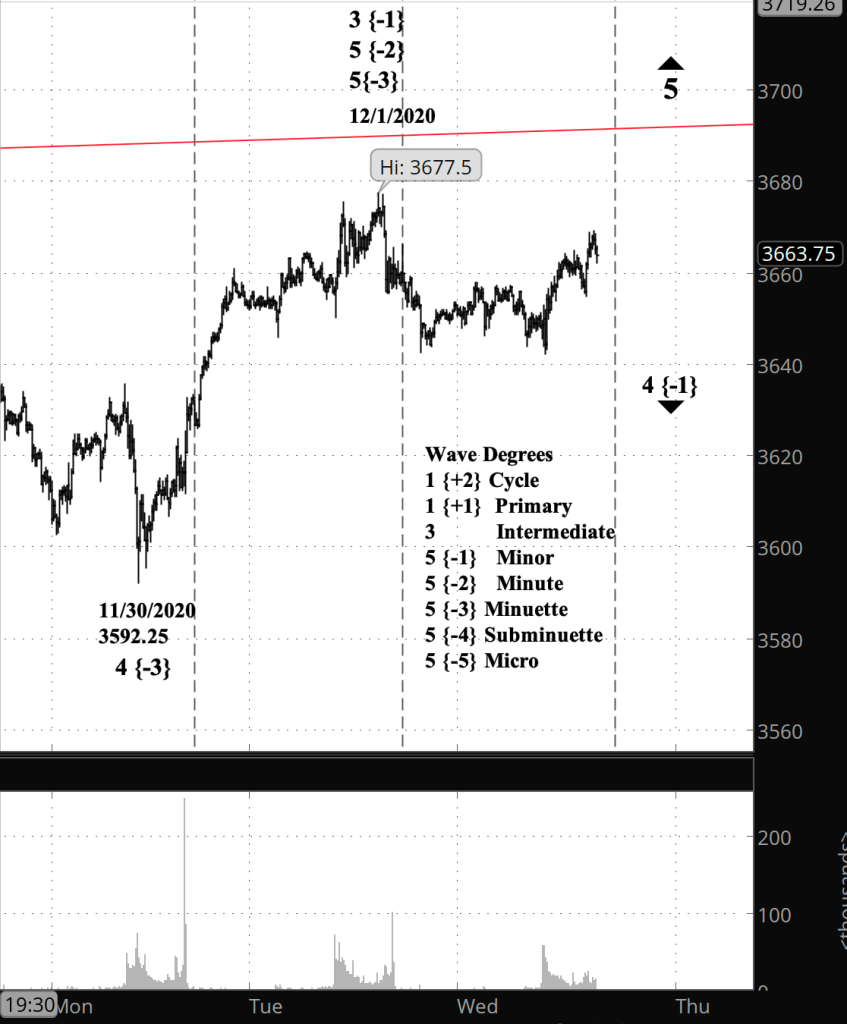
Half an hour before the closing bell the S&P 500 continues through the early stages of a downward correction, having completed five waves down and three waves up today as steps in the decline. I’ve updated the chart below.

10:35 a.m. New York time

What’s happening now? The S&P 500 index and its derivatives continue to pull back slightly from Tuesday’s high, 3678.45 around the upper boundary of a Diagonal Triangle form that began in December 2018.

What does it mean? The peak ended an upward push that began February 23, 2020 from 2191.86. The next move will be a downward correction and then a final wave to the upside.

What is the alternative? The price remains near the high and it is possible that rather than withdrawing immediately, the price might bounce up to a slightly higher level before beginning its downward movement.

[S&P 500 E-mini futures, 10-minute bars, with volume]

What does Elliott wave theory say? Tuesday’s high marks the end of wave 3 of Minor degree, after two days short of 10 months to the day. What follows is Minor wave 4 to the downside. Fourth wave corrections often tend to trend sideways, suggesting the downward move will be shallow. All of this is happening within Intermediate wave 5, which is one degree higher.

My trading strategy. My short bear call options spreads on IWM, with 44 days until expiration on January 15, continue to hold near the level of their entry credit. Decision day on exiting will come 21 days prior to expiration, on December 25 by the calendar. Since the market will be closed that day, the decision, at the latest, will made on December 23. I continue to hold my shares in the inverse S&P 500 fund SDS.

Read More »

Tuesday, December 1, 2020

3:30 p.m. New York time

Half an hour before the closing bell the S&P 500 remains about 16 points below its overnight high. Barely changed.

10:45 a.m. New York time

What’s happening now? The S&P 500 index and its derivatives rose rapidly after Monday’s closing bell. The index moved above the upper boundary of the Diagonal Triangle that began in December 2018, a condition known as a throw-over, taking the alternative course described in Monday morning’s analysis. The E-mini futures approached but remained below the boundary.

What does it mean? A throw-over is generally a short-lived condition, suggesting a reversal will soon be at hand.

What is the alternative? The degrees I have on the chart need revisiting — I’ve written before about the ambiguity inherent in labelling degrees, especially early in a trend.

What does Elliott wave theory say? On the chart I’ve moved the end of wave 3 of Minor degree from the previous high, on November 9, to the December 1 high of 3676.22 (so far). Uptrending Minor 3 will be followed by downtrending Minor 4, both being subwaves of uptrending wave 5 of Intermediate degree.

My trading strategy. My short bear call options spread positions remain within what will become the profit zone. As the entry analysis shows, the short call is at $192, which is $7 above the symbol’s high so far of $185.44, set on November 24. If the price exceeds $192, then I will need to make a hold or sell decision. I continue to hold my contrarian shares in SDS; as the S&P 500 rises, they fall. The Elliott wave analysis shows that a decline will happen soon.

Read More »