Trader’s Notebook

3:30 p.m. New York time

Half an hour before the closing bell. The S&P 500 fell during the session, to 3704.25, and then reversed, rising into the 3750s. In Elliott wave terminology, descending wave B{-8} is underway. It is the middle subwave of an upward correction that began on October 13, wave 2{-7}.

Just based on the short time that has passed since wave B{-8} began, it appears to be in its initial subwave, A{-9}. But there is always much ambiguity over degree labeling early in a price movement, so the subwave may be further along than that..

I’ve updated the chart, adding blue dashed lines showing the upper and lower boundaries of the wave B{-8} target range. So far this session, the price has remained below the upper boundary and within the target range.

9:35 a.m. New York time

What’s happening now? The S&P 500 E-mini futures fell sharply overnight, reaching the 3720s, about 200 points below the October 28 high.

What does it mean? The downward middle wave of an upward correction that began on October 13 is now underway. It is part of a downtrend that began on August 16.

What are the alternatives? The correction will have three subwaves, unless it forms a compound structure linking two or three corrective patterns together. This correction is the first of two upward corrections within the present downtrend, and it is the second correction that is more likely to be compounded.

Chart note. I’ve superimposed a Fibonacci ladder on the chart, in red, to better track the retracement by the correction of the decline since August 16.
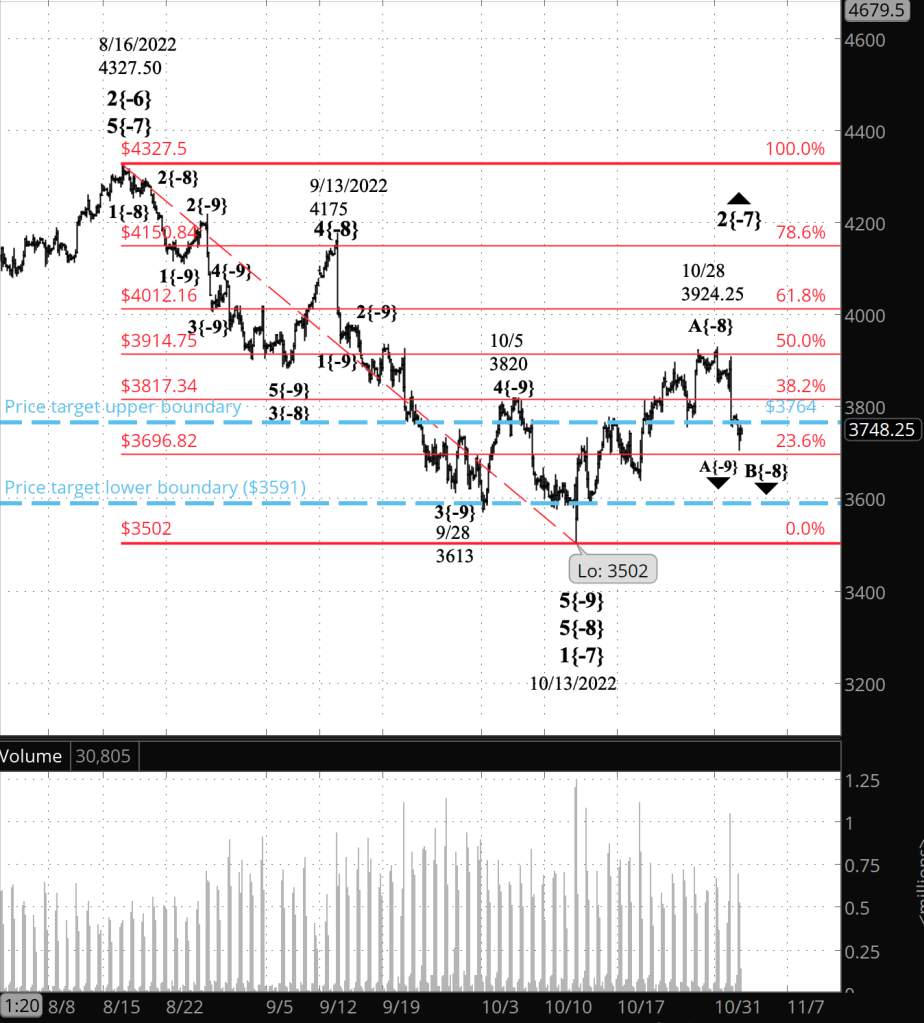
[S&P 500 E-mini futures at 3:30 p.m., 200-minute bars, with volume]

What does Elliott wave theory say? Downtrending Wave B{-8} within an upward correction, wave 2{-7}, began on October 28 from 3924.25. The 2nd wave is taking the form of a Zigzag, with five waves within with A.

In Zigzags, the B wave tends to retrace between 38% and 79% of the distance covered by wave A. Wave A{-8} covered 422.25 points, ending at 3924.25. Therefore, the price target ranges from 3764 to 3591. The price at the opening bell is already within the target range. That’s a tendency, not a rule, so wave B could break below 3591.

Wave B{-8} will have three internal waves. Internally, wave A{-9} ended yesterday at 3907, and wave B{-9} began from that point. So by that count, wave B{-9} is not yet complete.

Wave B{-8} will be followed by uptrending wave C{-8}, the final wave in the Zigzag corrective pattern, with five subwaves. Wave C{-8} will most likely be the final subwave within wave 2{-7}, unless the upward correction forms a compound structure. If it does, wave C{-8} will be followed by a downward connective wave, X{-8}, and then a second corrective pattern.

In any case, wave 2{-7}, including wave B{-8}, will remain above 3502, the correction’s starting point.

This is all happening with wave 3{-6}, a downtrend that began on August 16, that in turn is enclosed in a series of nested 1st waves, from 1{-5} up to 1{-2}. They are all subwaves of wave 4{-1}, the next-to-the-last wave within a very large expanding Diagonal Triangle, wave 5{0}, which began on December 26, 2018.

We Are Here.

These are the waves currently in progress under my principal analysis. Each line on the list shows the wave number, with the subscript in curly brackets, the traditional degree name, the starting date, the starting price of the S&P 500 E-mini futures, and the direction of the wave.

  • S&P 500 Index:
  • 5{+3} Supercycle, 7/8/1932, 4.40 (up)
  • 5{+2} Cycle, 12/9/1974, 60.96 (up)
  • 5{+1} Primary, 3/6/2009, 666.79 (up)
  • 5{0} Intermediate, 12/26/2018, 2346.58 (up)
  • 4{-1} Minor, 1/4/2022 4818.62 (down)
  • 1{-2} Minute, 1/4/2022 4818.62 (down)
  • S&P 500 Futures and index:
  • 1{-3} Minuette, 1/4/2022, 4808.25 (down) (futures), 4818.62 (down) (index)
  • S&P 500 Futures:
  • 1{-4} Subminuette, 1/4/2022, 4808.25 (down)
  • 1{-5} Micro, 1/4/2022, 4808.25 (down)
  • 3{-6} Submicro, 8/16/2022, 4327.50 (down)
  • 2{-7} Minuscule, 10/13/2022, 3502 (up)
  • B{-8} Subminuscule, 10/28/2022, 3924.25 (down)

Learning and other resources. Elliott wave analysis provides context, not prophecy. As the 20th century semanticist Alfred Korzybski put it in his book Science and Sanity (1933), “The map is not the territory … The only usefulness of a map depends on similarity of structure between the empirical world and the map.” And I would add, in the ever-changing markets, we can judge that similarity of structure only after the fact.

See the menu page Analytical Methods for a rundown on where to go for information on Elliott wave analysis.

By Tim Bovee, Portland, Oregon, November 3, 2022

Disclaimer

Tim Bovee, Private Trader tracks the analysis and trades of a private trader for his own accounts. Nothing in this blog constitutes a recommendation to buy or sell stocks, options or any other financial instrument. The only purpose of this blog is to provide education and entertainment.

No trader is ever 100 percent successful in his or her trades. Trading in the stock and option markets is risky and uncertain. Each trader must make trading decisions for his or her own account, and take responsibility for the consequences.

License
Creative Commons License

All content on Tim Bovee, Private Trader by Timothy K. Bovee is licensed under a Creative Commons Attribution-ShareAlike 4.0 International License.

Based on a work at www.timbovee.com.

Trader’s Notebook

3:57 p.m. New York time

IBM earnings play exit. I’ve exited my short bear call options spread on IBM, two days before expiry. The earnings came in better than expected, and I spent two weeks of waiting for the price to come down to my expected maximum loss. It never did, and to avoid extra work and fees, I bought back the contracts, closing the position for a 50%+ loss. I’ve updated the trade analysis with full results.

3:30 p.m. New York time

Half an hour before the closing bell. The S&P 500 made like a yo-yo after the Federal Open Market Committee announced another 75-basis-point increase in the Federal Funds Rate, falling 26 points and the rising by 46.5 points, to 3899.25, within three minutes before settling down slightly below that high. It eventually worked its way a bit higher, to 3907, and then, six minutes into Fed Chair Jerome Powell’s news conference, it rapidly fell back, to 3841.

As Macbeth, Thane of Glamis, mused in Shakespeare’s play, the market’s response to the Fed was “full of sound and fury, signifying nothing”.

[S&P 500 E-mini futures at 2:41 p.m., 1-minute bars]

The movement was consistent with all three scenarios discussed this morning. Notably, the price remained below the 50% Fibonacci retracement level and also below the upward correction high so far of 3828, attained today before the opening bell. In Elliott wave terminology, the key outcome is that rising wave 2{-7}, the upward correction, is still underway, but whether that wave internally is in rising wave A{-8} or falling wave B{-8} remains an open question. I’ve updated the chart below.

9:35 a.m. New York time

What’s happening now? The S&P 500 E-mini futures fell in overnight trading, reaching the 3740s, more than 70 points below the high of the rise that began on October 13.

What does it mean? That rise, an upward correction is nearing the end of its first internal wave…

What are the alternatives? … and indeed, that initial wave of the correction may well have ended at yesterday’s peak.

If that sounds familiar, that’s because it is the same analysis as yesterday: Three possible scenarios with no way to choose from among them.

In addition to the principal analysis — first internal wave still rising — and the first alternative — first internal wave ended yesterday — there is a second alternative — the first leg of the correction is in its middle internal wave rather than the first. Details in the Elliott wave theory section below.

Chart note. I’ve placed the Fibonacci retracement ladder, in red, on the decline that began on August 16, which the rise from October 13 is correcting. So far the correction has taken back half of the preceding decline at yesterday’s peak, 3928.

[S&P 500 E-mini futures at 3:30 p.m., 3-hour bars, with volume]

What does Elliott wave theory say? All three scenarios are occurring within wave 2{-7}, an upward correction that began on October 13, which is part of an energetic downtrend, wave 3{-6}, that began on August 16.

The principal analysis sees wave A{-8} — the first subwave within wave 2{-7} — as being in its 5th and final internal wave, E{-9}.

The first alternative analysis sees wave A{-8} as having ended at yesterday’s high. Wave B{-8} under this scenario is now underway.

The second alternative sees wave A{-8} as being in its middle subwave, which is wave C{-9}.

See yesterday’s “Trader’s Notebook” for a more detailed explanation of the three scenarios.

We Are Here.

These are the waves currently in progress under my principal analysis. Each line on the list shows the wave number, with the subscript in curly brackets, the traditional degree name, the starting date, the starting price of the S&P 500 E-mini futures, and the direction of the wave.

  • S&P 500 Index:
  • 5{+3} Supercycle, 7/8/1932, 4.40 (up)
  • 5{+2} Cycle, 12/9/1974, 60.96 (up)
  • 5{+1} Primary, 3/6/2009, 666.79 (up)
  • 5{0} Intermediate, 12/26/2018, 2346.58 (up)
  • 4{-1} Minor, 1/4/2022 4818.62 (down)
  • 1{-2} Minute, 1/4/2022 4818.62 (down)
  • S&P 500 Futures and index:
  • 1{-3} Minuette, 1/4/2022, 4808.25 (down) (futures), 4818.62 (down) (index)
  • S&P 500 Futures:
  • 1{-4} Subminuette, 1/4/2022, 4808.25 (down)
  • 1{-5} Micro, 1/4/2022, 4808.25 (down)
  • 3{-6} Submicro, 8/16/2022, 4327.50 (down)
  • 2{-7} Minuscule, 10/13/2022, 3502 (up)
  • B{-8} Subminuscule, 10/16/2022, 3897.50 (down)

Learning and other resources. Elliott wave analysis provides context, not prophecy. As the 20th century semanticist Alfred Korzybski put it in his book Science and Sanity (1933), “The map is not the territory … The only usefulness of a map depends on similarity of structure between the empirical world and the map.” And I would add, in the ever-changing markets, we can judge that similarity of structure only after the fact.

See the menu page Analytical Methods for a rundown on where to go for information on Elliott wave analysis.

By Tim Bovee, Portland, Oregon, November 2, 2022

Disclaimer

Tim Bovee, Private Trader tracks the analysis and trades of a private trader for his own accounts. Nothing in this blog constitutes a recommendation to buy or sell stocks, options or any other financial instrument. The only purpose of this blog is to provide education and entertainment.

No trader is ever 100 percent successful in his or her trades. Trading in the stock and option markets is risky and uncertain. Each trader must make trading decisions for his or her own account, and take responsibility for the consequences.

License
Creative Commons License

All content on Tim Bovee, Private Trader by Timothy K. Bovee is licensed under a Creative Commons Attribution-ShareAlike 4.0 International License.

Based on a work at www.timbovee.com.
Trader’s Notebook

3:30 p.m. New York time

Half an hour before the closing bell. The S&P 500 fell slightly during the session, from the overnight high, 3928 on the futures, into the 3850s. The decline is insufficient to support a choice from among the three scenarios I presented in this morning’s analysis, so I’ve kept the principal analysis in place while repeating the caveat: Any one of the three scenarios has a good chance of describing how the market will play out.

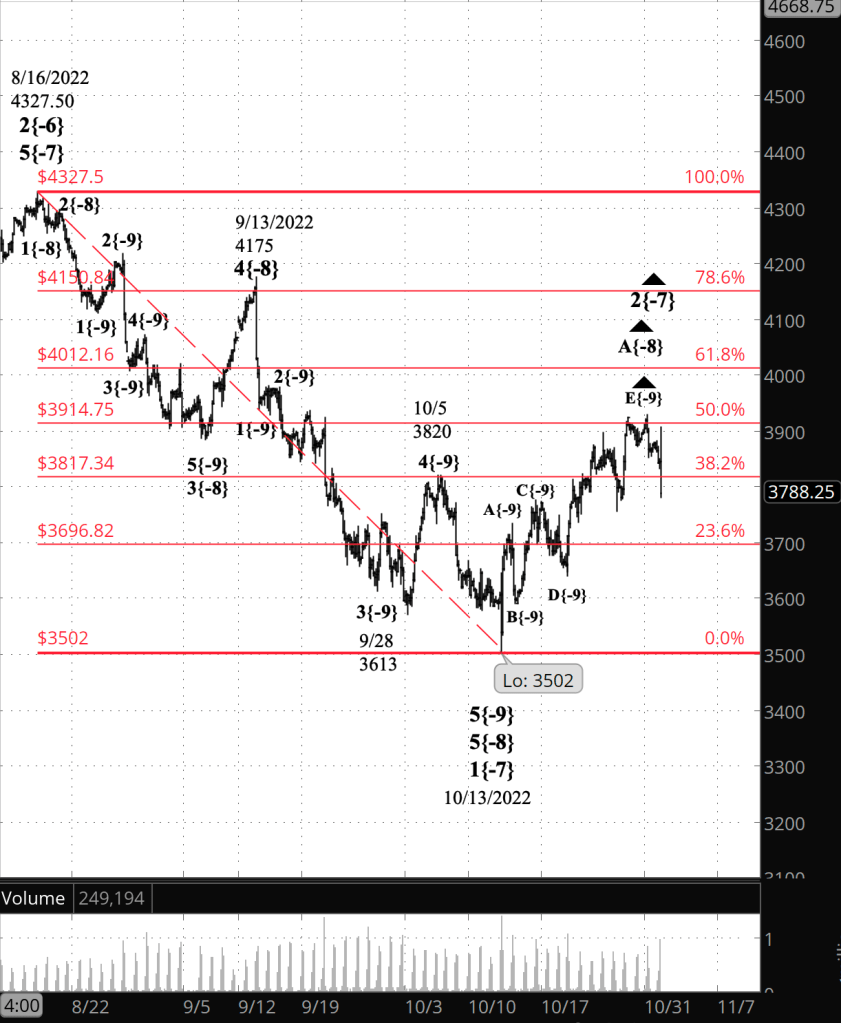
If the price reverses and climbs to a new high, then two scenarios are still in the running within the upward correction, wave 2{-7}. Either wave A{-8} is still underway and is in its final wave, E{-9}. Or instead of the final wave with A{8}, wave C{-9}, the middle wave, is underway and is in its final subwave, E{-10}.

And if that isn’t enough to satisfy our hunger for ambiguity, it could also be that wave A{-8} ended overnight at 3928 and wave B{-8} has begun.

Is Elliott wave analysis fun or what!?! I’ve updated the chart.

9:35 a.m. New York time

What’s happening now? The S&P 500 E-mini futures continued to hover around the 50% Fibonacci retracement level as the rise that began on October 13 continues.

What does it mean? The rise is an upward correction, and the first wave within that correction is in its 5th internal wave and therefore is nearing its end. It will be followed by a declining middle wave, and then by a final, rising wave that will end the corrective pattern.

What are the alternatives? At this point each new high could be the end of the first wave within the correction. Or not. I’ve marked the chart to show the first wave continuing, but the odds of either scenario playing are are pretty much equal.

Also, the chart can be counted in such way that the present rise is the middle wave within the first subwave of the correction. That increases the amount of upside that lies ahead.

Chart note. The Fibonacci ladder appears on the chart in red.

[S&P 500 E-mini futures at 3:30 p.m., 3-hour bars, with volume]

What does Elliott wave theory say? Wave A{-8}, the first wave within an upward correction, wave 2{-7}, is nearing its end. The corrective pattern has three waves internally. Declining wave B{-8} will follow, and then rising wave C{-8} will complete the corrective pattern, and most likely the correction as a whole, unless it turns out to be a compound structure, linking two or three corrective patterns together.

That’s the principal analysis. Under the alternative analysis, wave A{-8} ended at the overnight high, 3928, and downward wave B{-8} has begun.

And then there’s the pesky problem of assigning a degree to waves. Under the principal analysis, wave A{-8} internally is in its final subwave, E{-9}. An alternative count would see the wave C{-9} rise following the end of wave B{-9} as being a subwave rather than being C{-9} in its entirely.

So under that scenario,

  • the place marked C{-9} becomes A{-10}, D{-9} becomes B{-10},
  • and the longer rise above the 38.2% Fibonacci level becomes C{-10},
  • then a small decline for D{-10}
  • and a so-far small rise for E{-10}, the present wave which, when complete, will mark the end of wave C{-9}.

Under this scenario, we have a wave D{-9} decline ahead, and then a rising wave E{-9} that will complete wave A{-8} within the wave 2{-7} correction.

And enclosing these alternatives is downtrending wave 3{-6}, which began on August 16. It is a subwave of a series of nested 1st waves, each bigger than the last, reaching up to wave 1{-2}. The parent wave of that nested series is wave 4{-1}, the declining next-to-the-last wave within an expanding Diagonal Triangle that began on December 26, 2018.

We Are Here.

These are the waves currently in progress under my principal analysis. Each line on the list shows the wave number, with the subscript in curly brackets, the traditional degree name, the starting date, the starting price of the S&P 500 E-mini futures, and the direction of the wave.

  • S&P 500 Index:
  • 5{+3} Supercycle, 7/8/1932, 4.40 (up)
  • 5{+2} Cycle, 12/9/1974, 60.96 (up)
  • 5{+1} Primary, 3/6/2009, 666.79 (up)
  • 5{0} Intermediate, 12/26/2018, 2346.58 (up)
  • 4{-1} Minor, 1/4/2022 4818.62 (down)
  • 1{-2} Minute, 1/4/2022 4818.62 (down)
  • S&P 500 Futures and index:
  • 1{-3} Minuette, 1/4/2022, 4808.25 (down) (futures), 4818.62 (down) (index)
  • S&P 500 Futures:
  • 1{-4} Subminuette, 1/4/2022, 4808.25 (down)
  • 1{-5} Micro, 1/4/2022, 4808.25 (down)
  • 3{-6} Submicro, 8/16/2022, 4327.50 (down)
  • 2{-7} Minuscule, 10/13/2022, 3502 (up)
  • B{-8} Subminuscule, 10/16/2022, 3897.50 (down)

Learning and other resources. Elliott wave analysis provides context, not prophecy. As the 20th century semanticist Alfred Korzybski put it in his book Science and Sanity (1933), “The map is not the territory … The only usefulness of a map depends on similarity of structure between the empirical world and the map.” And I would add, in the ever-changing markets, we can judge that similarity of structure only after the fact.

See the menu page Analytical Methods for a rundown on where to go for information on Elliott wave analysis.

By Tim Bovee, Portland, Oregon, November 1, 2022

Disclaimer

Tim Bovee, Private Trader tracks the analysis and trades of a private trader for his own accounts. Nothing in this blog constitutes a recommendation to buy or sell stocks, options or any other financial instrument. The only purpose of this blog is to provide education and entertainment.

No trader is ever 100 percent successful in his or her trades. Trading in the stock and option markets is risky and uncertain. Each trader must make trading decisions for his or her own account, and take responsibility for the consequences.

License
Creative Commons License

All content on Tim Bovee, Private Trader by Timothy K. Bovee is licensed under a Creative Commons Attribution-ShareAlike 4.0 International License.

Based on a work at www.timbovee.com.