Trader’s Notebook

3:30 p.m. New York time

Half an hour before the closing bell. The S&P 500 E-mini futures, 4 minutes before the opening bell, reached a low for the day of 3912.50, thereafter rising during the session into the low 3960s and then resuming the decline.

No change from this morning’s analysis. The rising final wave within an upward correction that began on October 13 is still underway, and internally, it is in a declining next-to-the-last wave. In Elliott wave analytical terminology, declining wave B{-9} within rising wave C{-8} within the upward correction, wave 2{-7} is underway.

I’ve updated the chart.

9:35 a.m. New York time

What’s happening now? The S&P 500 E-mini futures continued to fall in overnight trading, reaching into the 2910s.

What does it mean? The next-to-the-last wave within the final wave of an upward correction that began on October 13 has begun its decline from Monday’s high, 4050.75.

What are the alternatives? None at present. I’m sure some will develop. They always do.
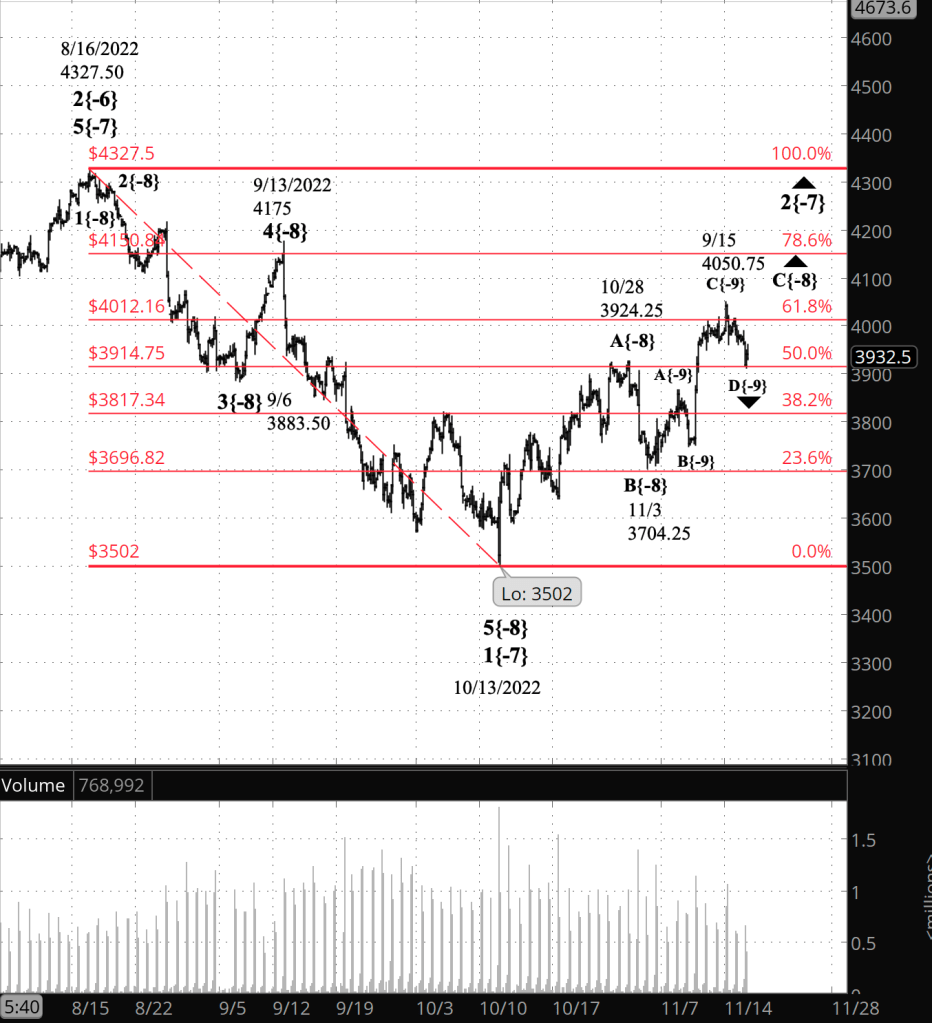
[S&P 500 E-mini futures at 3:30 p.m., 230-minute bars, with volume]

What does Elliott wave theory say? Declining wave D{-9} within rising wave C{-8}, both within the rising correction, wave 2{-7}, are underway. Wave D{-9} has so far reached returned to the 50% Fibonacci retracement level, 3914.75, falling from just beyond the 61.8% retracement level.

Wave 2{-7} has taken the form of a Zigzag, with five subwaves within the first of the three waves. In a Zigzag (and also a Flat), the third wave in a correction also has five subwaves. Presently, the 4th of those five subwaves is underway, wave D{-9}.

Wave D{-9} will be followed by the final subwave, wave E{-9}, which will mark the completion of wave C{-8} and of the upward correction, wave 2{-7}.

The C wave with within a Zigzag is often about the same length as the A wave. The length of wave A{-8} was 422.25. Wave C{-8} began at 3704.25. So the Wave C{-8} endpoint typically would be around 4126.50, about 127 points above Monday’s high, 4050.75, almost reaching the 78.6% Fibonacci retracement level.

So what comes next? Wave 2{-7} will be followed by wave 3{-7}, a powerful decline that will almost certainly carry the price into the 3400s and perhaps significantly lower, completing the parent wave 3{-6}, which began on August 16 from 4327.50.

As a trader, I’m looking at it this way: I’ve got a bit of a down, a bit of an up, and then a big, big down.

Wave 4{-6}, an upward correction, will follow the energetic 3rd wave decline.

We Are Here.

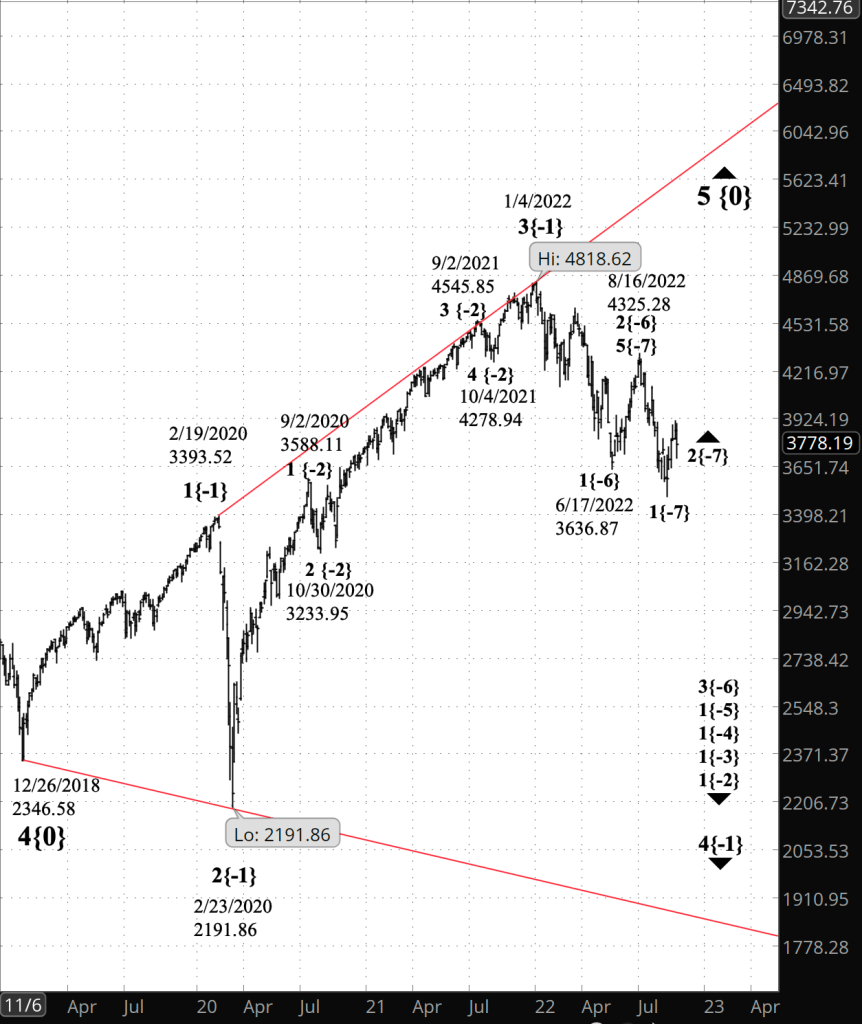
These are the waves currently in progress under my principal analysis. Each line on the list shows the wave number, with the subscript in curly brackets, the traditional degree name, the starting date, the starting price of the S&P 500 E-mini futures, and the direction of the wave.

  • S&P 500 Index:
  • 5{+3} Supercycle, 7/8/1932, 4.40 (up)
  • 5{+2} Cycle, 12/9/1974, 60.96 (up)
  • 5{+1} Primary, 3/6/2009, 666.79 (up)
  • 5{0} Intermediate, 12/26/2018, 2346.58 (up)
  • 4{-1} Minor, 1/4/2022 4818.62 (down)
  • 1{-2} Minute, 1/4/2022 4818.62 (down)
  • S&P 500 Futures and index:
  • 1{-3} Minuette, 1/4/2022, 4808.25 (down) (futures), 4818.62 (down) (index)
  • S&P 500 Futures:
  • 1{-4} Subminuette, 1/4/2022, 4808.25 (down)
  • 1{-5} Micro, 1/4/2022, 4808.25 (down)
  • 3{-6} Submicro, 8/16/2022, 4327.50 (down)
  • 2{-7} Minuscule, 10/13/2022, 3502 (up)
  • C{-8} Subminuscule, 11/3/2022, 3704.25 (up)

Learning and other resources. Elliott wave analysis provides context, not prophecy. As the 20th century semanticist Alfred Korzybski put it in his book Science and Sanity (1933), “The map is not the territory … The only usefulness of a map depends on similarity of structure between the empirical world and the map.” And I would add, in the ever-changing markets, we can judge that similarity of structure only after the fact.

See the menu page Analytical Methods for a rundown on where to go for information on Elliott wave analysis.

By Tim Bovee, Portland, Oregon, November 17, 2022

Disclaimer

Tim Bovee, Private Trader tracks the analysis and trades of a private trader for his own accounts. Nothing in this blog constitutes a recommendation to buy or sell stocks, options or any other financial instrument. The only purpose of this blog is to provide education and entertainment.

No trader is ever 100 percent successful in his or her trades. Trading in the stock and option markets is risky and uncertain. Each trader must make trading decisions for his or her own account, and take responsibility for the consequences.

License
Creative Commons License

All content on Tim Bovee, Private Trader by Timothy K. Bovee is licensed under a Creative Commons Attribution-ShareAlike 4.0 International License.

Based on a work at www.timbovee.com.

Trader’s Notebook

3:30 p.m. New York time

Half an hour before the closing bell. The S&P 500 traded narrowly during the session, dropping back into the 3960s on the futures. No change in the analysis. The final wave within an upward correction that began on October 13 continues. That’s wave C{-8} within wave 2{-7}.

9:35 a.m. New York time

What’s happening now? The S&P 500 E-mini futures continued to fall in yesterday’s trading, reaching into the 3970s. Yesterday’s high and low — 4050.75 and 3960 — define the range within which the price has remained since then.

What does it mean? The analysis remains unchanged for another day, as it seeks to answer the question, “Where’s does the correction end?” It’s an important question, since the high will most likely mark the end of an upward correction that began on October 13 from 3502. And the answer to the question is, a shrug. Nobody knows.

If the price reaches above yesterday’s high, then the rise that began on November 3 from 3704.25 is still underway, as is the upward correction. I’ve chosen that as principal analysis, but that’s an arbitrary decision, driven by the absence of clear evidence that a strong decline has begun.

What are the alternatives?

If the price turns and falls below the 3960, the lower level of the range, then that increases the likelihood that yesterday’s high marked the end of the rise from November 3, and the end of the upward correction. The price since the high has traced three waves — down, up, down — in a pattern that is consistent with the early steps in a downtrend.

[S&P 500 E-mini futures at 3:30 p.m., 230-minute bars, with volume]

What does Elliott wave theory say? The upward correction that began on October 13 is wave 2{-7}. Internally, it is in its final wave, C{-8}, which began on November 3.

Under the principal analysis, wave C{-8} is in its third subwave, C{-9}. It will be followed by a downward wave D{-9} and then a push to a new high, wave E{-9}, which will complete wave C{-8} and most likely wave 2{-7} as well. It is possible, although not likely, that wave 2{-7} will form a compound correction pattern, stringing together two or three corrective patterns before reaching its end.

Under the alternative analysis, wave C{-8} yesterday completed its 5th internal wave, E{-9}. If wave 2{-7} is forming a simple structure, with a single corrective pattern, then the 2nd wave is over and a strong downtrend, wave 3{-7}, has begun. It will almost certainly carry the price below 3500, perhaps significantly below. If the structure is that of a compound correction, then wave C{-8} will be followed by a declining connector wave, X{-8}, and then a second corrective pattern.

This is all happening within downtrending wave 3{-6}, which began on August 16, from 4127.50. And wave 3{-6} is itself a subwave in a fractal pattern of nested downward waves of increasing size, stretching back to the Great Depression in the 1930s. There will be large ups and downs within the fractal pattern, and as a trader, I plan to keep in mind that the downs will be trends and therefore have more power than will the ups, which will be corrections, running contrary to the trend.

As my mentors in trading often said, “The trend is your friend”, and those will be words to trade by in the coming years.

We Are Here.

These are the waves currently in progress under my principal analysis. Each line on the list shows the wave number, with the subscript in curly brackets, the traditional degree name, the starting date, the starting price of the S&P 500 E-mini futures, and the direction of the wave.

  • S&P 500 Index:
  • 5{+3} Supercycle, 7/8/1932, 4.40 (up)
  • 5{+2} Cycle, 12/9/1974, 60.96 (up)
  • 5{+1} Primary, 3/6/2009, 666.79 (up)
  • 5{0} Intermediate, 12/26/2018, 2346.58 (up)
  • 4{-1} Minor, 1/4/2022 4818.62 (down)
  • 1{-2} Minute, 1/4/2022 4818.62 (down)
  • S&P 500 Futures and index:
  • 1{-3} Minuette, 1/4/2022, 4808.25 (down) (futures), 4818.62 (down) (index)
  • S&P 500 Futures:
  • 1{-4} Subminuette, 1/4/2022, 4808.25 (down)
  • 1{-5} Micro, 1/4/2022, 4808.25 (down)
  • 3{-6} Submicro, 8/16/2022, 4327.50 (down)
  • 2{-7} Minuscule, 10/13/2022, 3502 (up)
  • C{-8} Subminuscule, 11/3/2022, 3704.25 (up)

Learning and other resources. Elliott wave analysis provides context, not prophecy. As the 20th century semanticist Alfred Korzybski put it in his book Science and Sanity (1933), “The map is not the territory … The only usefulness of a map depends on similarity of structure between the empirical world and the map.” And I would add, in the ever-changing markets, we can judge that similarity of structure only after the fact.

See the menu page Analytical Methods for a rundown on where to go for information on Elliott wave analysis.

By Tim Bovee, Portland, Oregon, November 6, 2022

Disclaimer

Tim Bovee, Private Trader tracks the analysis and trades of a private trader for his own accounts. Nothing in this blog constitutes a recommendation to buy or sell stocks, options or any other financial instrument. The only purpose of this blog is to provide education and entertainment.

No trader is ever 100 percent successful in his or her trades. Trading in the stock and option markets is risky and uncertain. Each trader must make trading decisions for his or her own account, and take responsibility for the consequences.

License
Creative Commons License

All content on Tim Bovee, Private Trader by Timothy K. Bovee is licensed under a Creative Commons Attribution-ShareAlike 4.0 International License.

Based on a work at www.timbovee.com.
Trader’s Notebook

3:30 p.m. New York time

Half an hour before the closing bell. During the session the S&P 500 futures declined from the overnight high, 4050.75, to 3960, and then rose slightly. The decline isn’t sufficient to conclude that the rise from November 3 has ended, so this morning’s analysis stands: The upward correction that began on October 13 is still underway. I’ve updated the chart.

9:35 a.m. New York time

What’s happening now? The S&P 500 E-mini futures reached 4050.75 in overnight trading, a new high in the rise that began on November 3 from 3704.25.

What does it mean? The rise is the final wave within the final wave of that rise that began on October 13 from 3502, an upward correction following the decline that began on August 16 from 4327.50. The correction has completed all of its requirements of form, as laid out in Elliott wave theory, and so any new high could mark the end of the correction and the beginning of a powerful downtrend that will carry the price below 3502, almost without a doubt significantly below that level.

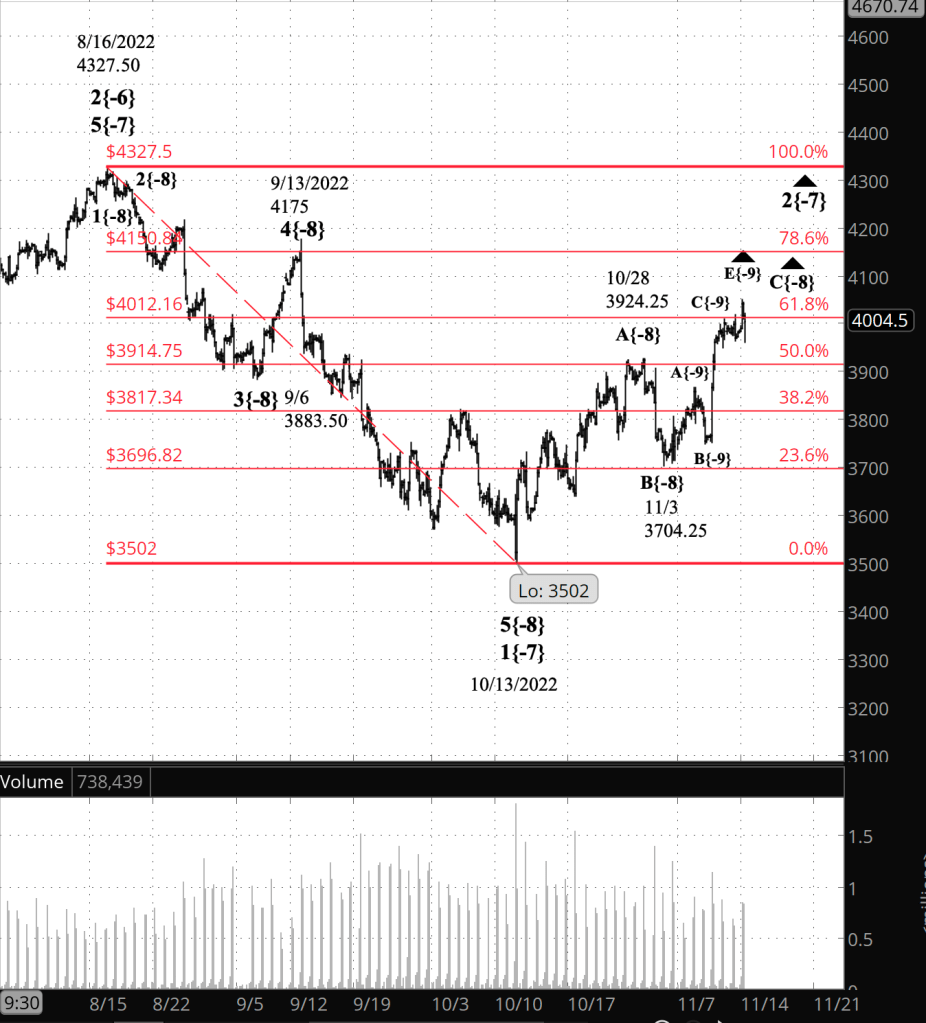
I’ve marked the chart as though the correction were still underway. Such structures tend to end at Fibonacci retracement levels (although not always). The next higher Fib level is the 78.6% retracement, at 4150.84. (The Fibonacci levels are shown on the chart in red.)

What are the alternatives? However, the chances are about equal that the correction ended at the overnight high and that the subsequent small decline is the tentative beginning of what will turn out to be a powerful downtrend.

If the price rises above 4050.75, then the principal scenario matches the chart: The correction continues. The further the price continues to fall, the greater the likelihood that the alternative scenario matches the chart: The correction has ended.

[S&P 500 E-mini futures at 3:30 p.m., 230-minute bars, with volume]

What does Elliott wave theory say? The upward correction is wave 2{-7}, which began on October 13. It is in its third segment, wave C{-8}, which in turn is in its final segment, wave E{-9}.

Under the alternative scenario, waves E{-9}, C{-8} and 2{-7} all ended at the overnight high, 4050.75.

The correction is a subwave of wave 3{-6}, a downtrend that began on August 16.

In either case, wave 2{-7} will be followed by wave 3{-7}, a powerful downtrend that will carry the precise below the start of wave 2{-7} — 3502 — and almost certainly significantly lower, into the 3400s or even the 3300s. Wave 3{-7} will be followed by another upward correction, wave 4{-7}, and then a final decline to new lows that will complete wave 3{-6}.

A larger upward correction, wave 4{-6}, will follow, and will be followed in turn by wave 5{-6}, a downtrend that will complete the parent, downtrending wave 1{-5}, which began on January 4 from 4808.25.

That starting point of wave 1{-5} is also the starting point of a nested series of increasingly larger 1st waves, stretching up to wave 1{-2}. It’s parent, wave 4{-1}, is the downtrending next-to-the-last wave within a large expanding Diagonal Triangle that began on December 26, 2018 from 2346.48 on the index.

There’s a lot of downside in that fractal stew, which will dominant the markets well into next year and possibly into 2024, seasoned by the occasional upward correction.

We Are Here.

These are the waves currently in progress under my principal analysis. Each line on the list shows the wave number, with the subscript in curly brackets, the traditional degree name, the starting date, the starting price of the S&P 500 E-mini futures, and the direction of the wave.

  • S&P 500 Index:
  • 5{+3} Supercycle, 7/8/1932, 4.40 (up)
  • 5{+2} Cycle, 12/9/1974, 60.96 (up)
  • 5{+1} Primary, 3/6/2009, 666.79 (up)
  • 5{0} Intermediate, 12/26/2018, 2346.58 (up)
  • 4{-1} Minor, 1/4/2022 4818.62 (down)
  • 1{-2} Minute, 1/4/2022 4818.62 (down)
  • S&P 500 Futures and index:
  • 1{-3} Minuette, 1/4/2022, 4808.25 (down) (futures), 4818.62 (down) (index)
  • S&P 500 Futures:
  • 1{-4} Subminuette, 1/4/2022, 4808.25 (down)
  • 1{-5} Micro, 1/4/2022, 4808.25 (down)
  • 3{-6} Submicro, 8/16/2022, 4327.50 (down)
  • 2{-7} Minuscule, 10/13/2022, 3502 (up)
  • C{-8} Subminuscule, 11/3/2022, 3704.25 (up)

Learning and other resources. Elliott wave analysis provides context, not prophecy. As the 20th century semanticist Alfred Korzybski put it in his book Science and Sanity (1933), “The map is not the territory … The only usefulness of a map depends on similarity of structure between the empirical world and the map.” And I would add, in the ever-changing markets, we can judge that similarity of structure only after the fact.

See the menu page Analytical Methods for a rundown on where to go for information on Elliott wave analysis.

By Tim Bovee, Portland, Oregon, November 15, 2022

Disclaimer

Tim Bovee, Private Trader tracks the analysis and trades of a private trader for his own accounts. Nothing in this blog constitutes a recommendation to buy or sell stocks, options or any other financial instrument. The only purpose of this blog is to provide education and entertainment.

No trader is ever 100 percent successful in his or her trades. Trading in the stock and option markets is risky and uncertain. Each trader must make trading decisions for his or her own account, and take responsibility for the consequences.

License
Creative Commons License

All content on Tim Bovee, Private Trader by Timothy K. Bovee is licensed under a Creative Commons Attribution-ShareAlike 4.0 International License.

Based on a work at www.timbovee.com.
Trader’s Notebook

3:30 p.m. New York time

Half an hour before the closing bell. The S&P 500 moved higher during the session, to 4017.50 on the futures. The move higher confirms this morning’s alternative analysis: Rising wave C{-9} within rising wave C{-8} is underway, within an upward correction, wave 2{-7}.

9:35 a.m. New York time

What’s happening now? The S&P 500 E-mini futures fell off slightly from Friday’s high, 4009.75, and remained within 30 points of that level.

What does it mean? The peak may have been the third of five waves within the rise that began on November 3 from 3704.25, and the pullback, the tentative first steps of the fourth wave. The fifth and final wave will most likely carry the price above Friday’s high and will complete the upward correction that began on October 13 from 3502. An energetic downtrend will follow.

What are the alternatives? The third wave within the rise that began on November 3 may still be underway, and the pullback is a small correction within that rising wave.

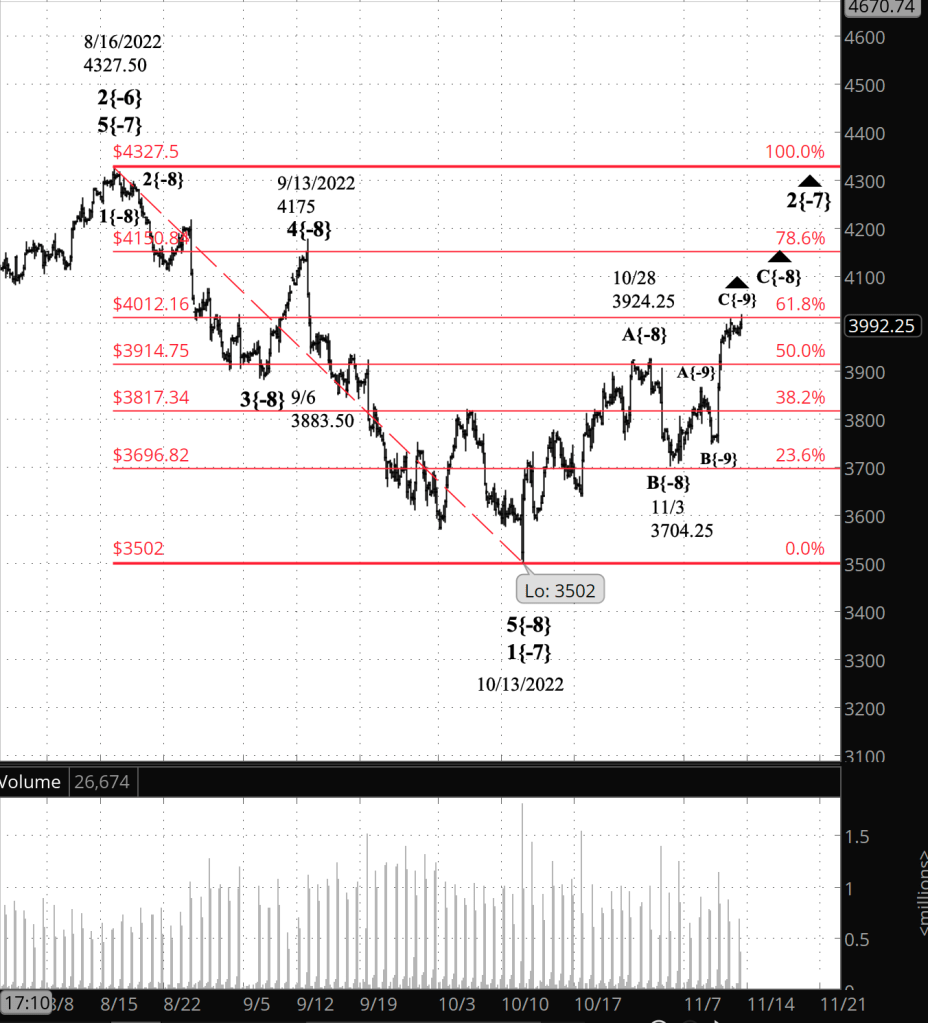
[S&P 500 E-mini futures at 3:30 p.m., 230-minute bars, with volume]

What does Elliott wave theory say? The rise that began on November 3 is wave C{-8}, the third wave within an upward correction, wave 2{-7}, that began on October 13.

Under the principal analysis, wave C{-9} — the middle wave within wave C{-8} — ended at Friday’s high, 4009.75, and declining wave D{-9} has begun. Under the alternative analysis, wave C{-9} is still underway.

At this point the two are of equal probability. Friday’s peak was at the 61.8% Fibonacci retracement level, which is often the endpoint of a corrective wave, and so I gave slightly more wait to the scenario that sees wave C{-9} as having ended at that level. If the price continues to fall, then the principal analysis matches the chart. If the price quickly rises back above 4009.75, then the alternative analysis matches the chart.

(The Fibonacci retracement levels are shown on the chart in red.)

In either case, wave C{-9} will be followed by a downward wave D{-9}, and then what will be the final wave of the corrective pattern, rising wave E{-9}, which will complete wave C{-8} and is also likely be the end of wave 2{-7}.

That last sentence has a hedge in it, regarding whether C{-8} will be the final wave within wave 2{-7}. Itr allows for the possibility that the upward correction, wave 2{-7}, will form a compound structure, linking two or three corrective patterns together. Compounding is not often seen in 2nd wave corrections, so I expect wave C{-8} to be the final wave within wave 2{-7}.

Wave 2{-7} will be followed by wave 3{-7}, a powerful downtrend that will carry the price below 3502 — the beginning of wave 2{-7} and perhaps significantly below that level.

Wave 3{-7} is a subwave of wave 1{-6}, a downtrend that began on August 16, and is the smallest of a series of downtrends of increasing size up to wave 4{-1}, which began on January 4 from 4818.62 on the index.

We Are Here.

These are the waves currently in progress under my principal analysis. Each line on the list shows the wave number, with the subscript in curly brackets, the traditional degree name, the starting date, the starting price of the S&P 500 E-mini futures, and the direction of the wave.

  • S&P 500 Index:
  • 5{+3} Supercycle, 7/8/1932, 4.40 (up)
  • 5{+2} Cycle, 12/9/1974, 60.96 (up)
  • 5{+1} Primary, 3/6/2009, 666.79 (up)
  • 5{0} Intermediate, 12/26/2018, 2346.58 (up)
  • 4{-1} Minor, 1/4/2022 4818.62 (down)
  • 1{-2} Minute, 1/4/2022 4818.62 (down)
  • S&P 500 Futures and index:
  • 1{-3} Minuette, 1/4/2022, 4808.25 (down) (futures), 4818.62 (down) (index)
  • S&P 500 Futures:
  • 1{-4} Subminuette, 1/4/2022, 4808.25 (down)
  • 1{-5} Micro, 1/4/2022, 4808.25 (down)
  • 3{-6} Submicro, 8/16/2022, 4327.50 (down)
  • 2{-7} Minuscule, 10/13/2022, 3502 (up)
  • C{-8} Subminuscule, 11/3/2022, 3704.25 (up)

Learning and other resources. Elliott wave analysis provides context, not prophecy. As the 20th century semanticist Alfred Korzybski put it in his book Science and Sanity (1933), “The map is not the territory … The only usefulness of a map depends on similarity of structure between the empirical world and the map.” And I would add, in the ever-changing markets, we can judge that similarity of structure only after the fact.

See the menu page Analytical Methods for a rundown on where to go for information on Elliott wave analysis.

By Tim Bovee, Portland, Oregon, November 14, 2022

Disclaimer

Tim Bovee, Private Trader tracks the analysis and trades of a private trader for his own accounts. Nothing in this blog constitutes a recommendation to buy or sell stocks, options or any other financial instrument. The only purpose of this blog is to provide education and entertainment.

No trader is ever 100 percent successful in his or her trades. Trading in the stock and option markets is risky and uncertain. Each trader must make trading decisions for his or her own account, and take responsibility for the consequences.

License
Creative Commons License

All content on Tim Bovee, Private Trader by Timothy K. Bovee is licensed under a Creative Commons Attribution-ShareAlike 4.0 International License.

Based on a work at www.timbovee.com.
Trader’s Notebook

3:30 p.m. New York time

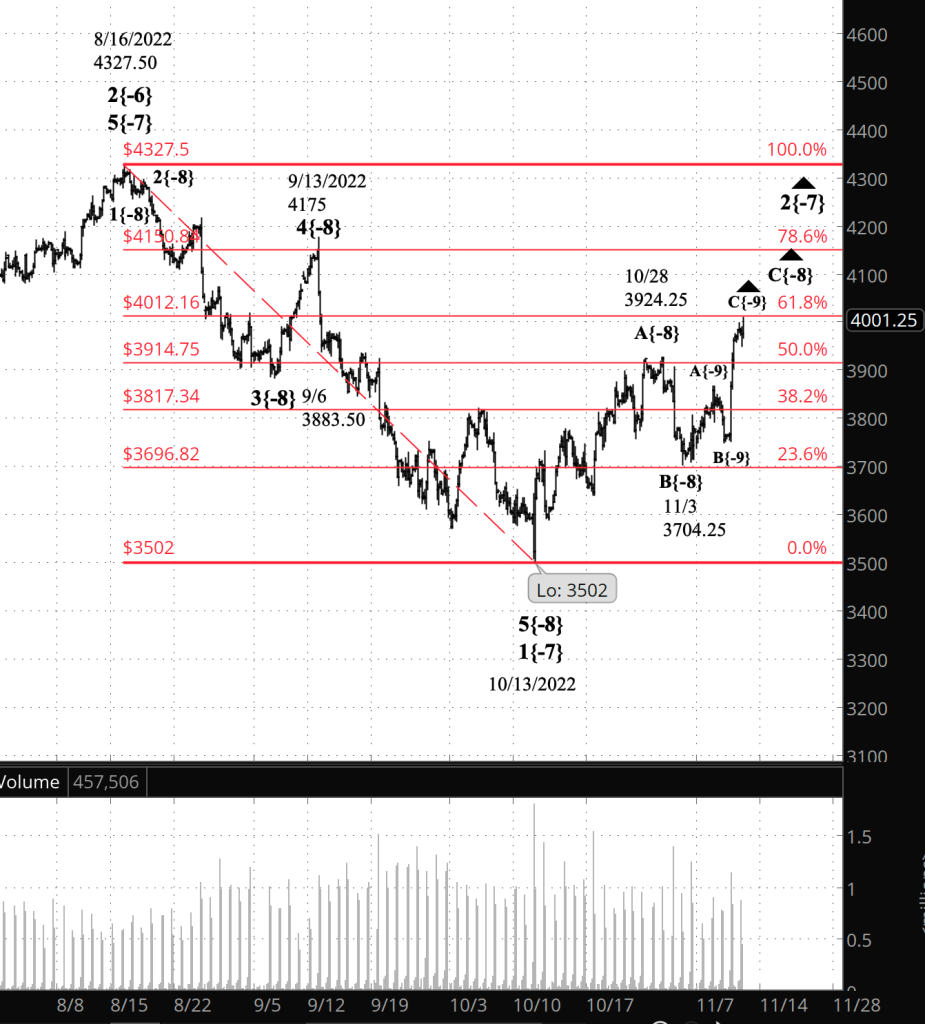
Half an hour before the closing bell. The S&P 500 E-mini futures broke above 4000 for the first time since mid-September, as the last wave within an upward correction continues. That last wave is in its final subwave. In Elliott wave terminology, wave C{-9} within wave C{-8} within wave 2{-8} is underway. I’ve updated the chart.

9:35 a.m. New York time

What’s happening now? The S&P 500 E-mini futures rose sharply overnight, reaching into the 3990s.

What does it mean? The rise that began on October 3 from 3704.25 is the final leg of an upward correction that began on October 13. I’ve reanalyzed the subwaves of the correction, relabeling the decline from October 28 as the second wave in the correction and the present rise as the third wave, raising them by one degree larger than prior analyses had it.

I made that decision based on the power of the present rise, which has carried the price to the area of the 61.8% Fibonacci retracement level. The present rise is in its third wave internally and will have five subwaves when complete. The rise will be followed by a pullback and then an additional upward movement, most likely reaching above the endpoint of the third wave.

The Fibonacci retracement levels are shown on the chart in red.

What are the alternatives? The upward correction is taking the form of a Zigzag. We know this because its first wave had five subwaves. In a Zigzag, the third wave also must have five subwaves. If the present rise ends with only three subwaves, then yesterday’s analysis was correct: The present rise is one degree smaller than today’s analysis would have it.

[S&P 500 E-mini futures at 3:30 p.m., 230-minute bars, with volume]

What does Elliott wave theory say? The upward correction is wave 2{-7}, the second of five waves within downtrending wave 3{-6}, which began on August 16 from 4327.50. Wave 2{-7} is taking the form of a Zigzag, with a rising A wave composed of five subwaves, a declining B wave with three subwaves and a rising C wave with five subwaves.

Internally, wave C{-8} within wave 2{-7} is now underway and is in its rising third wave, C{-9}.

When wave C{-9} is complete, it most likely will also be the end of the upward correction, unless wave 2{-7} forms a compound structure, linking two or three corrective patterns together. A simple structure is more likely for a 2nd wave.

In any event, wave 2{-7} will be followed by a powerful downward movement, wave 3{-7}, which will carry the price below the starting point of the preceding 2nd wave, 3502, and almost certainly significantly below that level.

The Elliott wave analysis suggests that traders would do best to take the happy talk accompanying the present rise with a great deal scepticism.

Today’s new analysis took what had been waves at the {-9} level within wave B{-8}, which began on October 28, and promoted them to the {-8} level. The former analysis had wave B{-8} as still underway, putting it in its rising middle wave, B{-9}, internally.

If wave C{-9} turns out to be the final wave within wave C{-8}, then something else is happening, most likely the scenario outlined in yesterday’s principal analysis. The alternative to today’s principal analysis consider the present rise to be rising wave B{-9} within declining wave B{-8}.

A chart of the former analysis can be found in yesterday’s Trader’s Notebook.

We Are Here.

These are the waves currently in progress under my principal analysis. Each line on the list shows the wave number, with the subscript in curly brackets, the traditional degree name, the starting date, the starting price of the S&P 500 E-mini futures, and the direction of the wave.

  • S&P 500 Index:
  • 5{+3} Supercycle, 7/8/1932, 4.40 (up)
  • 5{+2} Cycle, 12/9/1974, 60.96 (up)
  • 5{+1} Primary, 3/6/2009, 666.79 (up)
  • 5{0} Intermediate, 12/26/2018, 2346.58 (up)
  • 4{-1} Minor, 1/4/2022 4818.62 (down)
  • 1{-2} Minute, 1/4/2022 4818.62 (down)
  • S&P 500 Futures and index:
  • 1{-3} Minuette, 1/4/2022, 4808.25 (down) (futures), 4818.62 (down) (index)
  • S&P 500 Futures:
  • 1{-4} Subminuette, 1/4/2022, 4808.25 (down)
  • 1{-5} Micro, 1/4/2022, 4808.25 (down)
  • 3{-6} Submicro, 8/16/2022, 4327.50 (down)
  • 2{-7} Minuscule, 10/13/2022, 3502 (up)
  • C{-8} Subminuscule, 11/3/2022, 3704.25 (up)

Learning and other resources. Elliott wave analysis provides context, not prophecy. As the 20th century semanticist Alfred Korzybski put it in his book Science and Sanity (1933), “The map is not the territory … The only usefulness of a map depends on similarity of structure between the empirical world and the map.” And I would add, in the ever-changing markets, we can judge that similarity of structure only after the fact.

See the menu page Analytical Methods for a rundown on where to go for information on Elliott wave analysis.

By Tim Bovee, Portland, Oregon, November 11, 2022

Disclaimer

Tim Bovee, Private Trader tracks the analysis and trades of a private trader for his own accounts. Nothing in this blog constitutes a recommendation to buy or sell stocks, options or any other financial instrument. The only purpose of this blog is to provide education and entertainment.

No trader is ever 100 percent successful in his or her trades. Trading in the stock and option markets is risky and uncertain. Each trader must make trading decisions for his or her own account, and take responsibility for the consequences.

License
Creative Commons License

All content on Tim Bovee, Private Trader by Timothy K. Bovee is licensed under a Creative Commons Attribution-ShareAlike 4.0 International License.

Based on a work at www.timbovee.com.

Trader’s Notebook

3:30 p.m. New York time

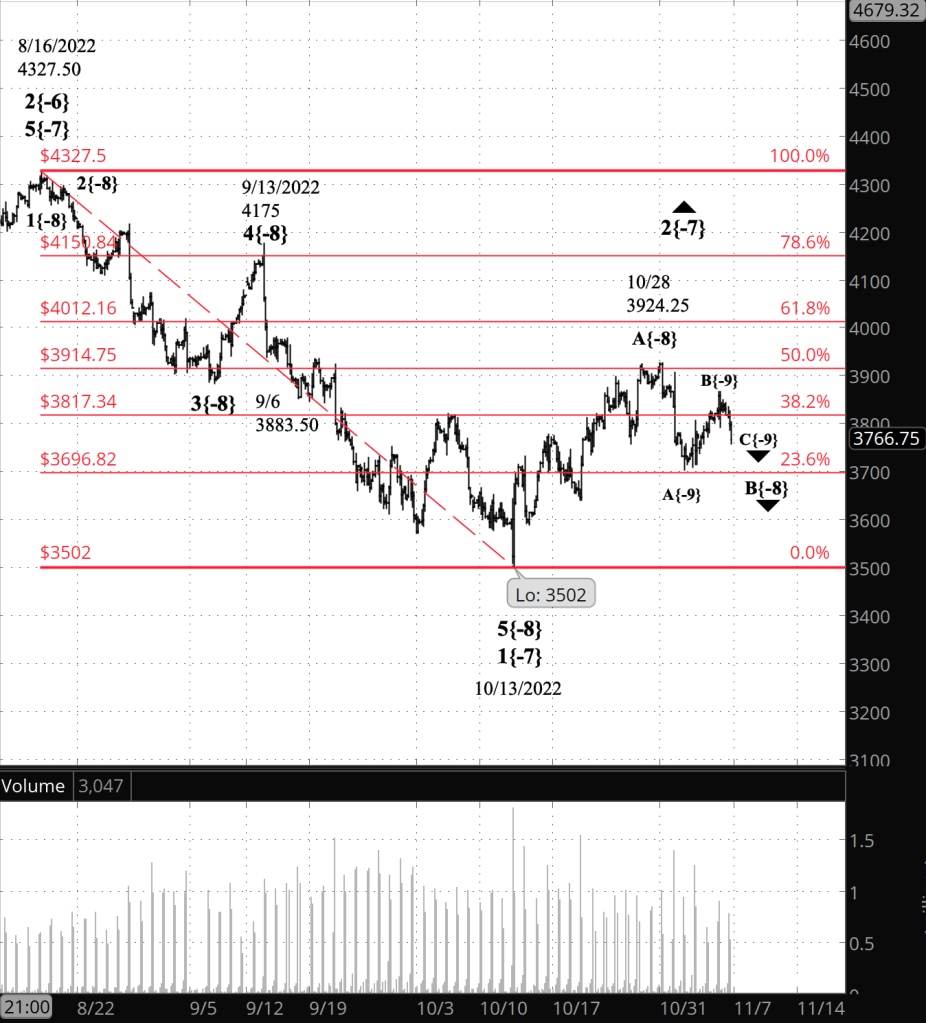
Half an hour before the closing bell. The S&P 500 has continued to rise during the session, so far reaching 3950 on the futures. In Elliott wave terminology, rising wave B{-9} is underway, a subwave of declining wave B{-8} within an upward correction, wave 2{-7}. I’ve updated the chart.

9:35 a.m. New York time

What’s happening now? After the latest inflation numbers were released, an hour before the opening bell, the S&P 500 E-mini futures shot up by nearly 100 points in a single minute, to 3861, and then continued to rise, coming close to the 50% Fibonacci retracement level in the low 3900s.

What does it mean? The rise suggests that the middle wave within an upward correction that began on October 13 is still in its middle subwave. A final decline will follow, and when it is complete, a larger final wave to the upside will complete the correction.

What is the alternative? This morning’s rapid rise invalidates my late analysis in yesterday’s Trader’s Notebook, which saw decline as ending the middle subwave within the correction’s middle wave. That middle subwave has met all of the requirements for completion, so any higher high in the rise that began this morning could be the end of that subwave. Or not.

[S&P 500 E-mini futures at 3:30 p.m., 230-minute bars, with volume]

What does Elliott wave theory say? The middle subwave is rising wave B{-9}, part of the larger rising middle wave, B{-8}, within wave 2{-7}, the upward correction that began on October. 13. My late analysis yesterday, posted half an hour before the closing bell, saw wave B{-9} as having ended at yesterday’s high, and declining wave C{-9} as having begun. Today’s new high tosses that analysis in the trash. Wave B{-9} is underway, and wave C{-9}, which will complete wave B{-8}, lies in the future.

The flaw in my late analysis yesterday was the lack of a clear three-wave pattern within wave B{-9}. There was a middle subwave of sorts, but it really wasn’t proportional to the parent wave. The overnight decline and subsequent rise provides that clear three-subwave pattern.

Wave 2{-7} is a subwave of downtrendng wave 3{-6}, which began on August 16 and is encompassed by a series of increasingly larger downtrending 1st waves that began on January 4, all part of downward wave 4{-1}, the fourth of five waves within an expanding Diagonal Triangle that began on December 26, 2018.

We Are Here.

These are the waves currently in progress under my principal analysis. Each line on the list shows the wave number, with the subscript in curly brackets, the traditional degree name, the starting date, the starting price of the S&P 500 E-mini futures, and the direction of the wave.

  • S&P 500 Index:
  • 5{+3} Supercycle, 7/8/1932, 4.40 (up)
  • 5{+2} Cycle, 12/9/1974, 60.96 (up)
  • 5{+1} Primary, 3/6/2009, 666.79 (up)
  • 5{0} Intermediate, 12/26/2018, 2346.58 (up)
  • 4{-1} Minor, 1/4/2022 4818.62 (down)
  • 1{-2} Minute, 1/4/2022 4818.62 (down)
  • S&P 500 Futures and index:
  • 1{-3} Minuette, 1/4/2022, 4808.25 (down) (futures), 4818.62 (down) (index)
  • S&P 500 Futures:
  • 1{-4} Subminuette, 1/4/2022, 4808.25 (down)
  • 1{-5} Micro, 1/4/2022, 4808.25 (down)
  • 3{-6} Submicro, 8/16/2022, 4327.50 (down)
  • 2{-7} Minuscule, 10/13/2022, 3502 (up)
  • B{-8} Subminuscule, 10/28/2022, 3924.25 (down)

Learning and other resources. Elliott wave analysis provides context, not prophecy. As the 20th century semanticist Alfred Korzybski put it in his book Science and Sanity (1933), “The map is not the territory … The only usefulness of a map depends on similarity of structure between the empirical world and the map.” And I would add, in the ever-changing markets, we can judge that similarity of structure only after the fact.

See the menu page Analytical Methods for a rundown on where to go for information on Elliott wave analysis.

By Tim Bovee, Portland, Oregon, November 10, 2022

Disclaimer

Tim Bovee, Private Trader tracks the analysis and trades of a private trader for his own accounts. Nothing in this blog constitutes a recommendation to buy or sell stocks, options or any other financial instrument. The only purpose of this blog is to provide education and entertainment.

No trader is ever 100 percent successful in his or her trades. Trading in the stock and option markets is risky and uncertain. Each trader must make trading decisions for his or her own account, and take responsibility for the consequences.

License
Creative Commons License

All content on Tim Bovee, Private Trader by Timothy K. Bovee is licensed under a Creative Commons Attribution-ShareAlike 4.0 International License.

Based on a work at www.timbovee.com.
Trader’s Notebook

3:30 p.m. New York time

Half an hour before the closing bell. The S&P 500 continued to decline during the session, with the futures reaching into the 3750s. The greater the decline, the greater the likelihood that the final subwave has begun, within the middle wave the upward correction that began on October 13. I’ve marked it that way on the chart: Wave C{-9} within wave B{-8} within the correction, Wave 2{-7}.

If the wave C{-9} decline moves below 3502, the correction’s starting point, then the October 28 peak was the end of the correction, which is the alternative scenario. Under the principal scenario, that peak was the end of the first subwave within the correction.

I’ve updated the chart.

9:35 a.m. New York time

What’s happening now? The S&P 500 E-mini futures traded sideways overnight, slightly above a 38% retracement of the downtrend that lasted from August 16 to October 13, and then declined at the opening bell. The price remained below yesterday’s high, 3847, throughout the night.

What does it mean? The upward correction that began on October 13 continues, It is in the middle of three waves forming a Zigzag corrective structure, and that middle wave is in its middle subwave of three.

What is the alternative? The same as it has been for the past few days: The entire upward correction ended at the October 28 peak, which in the principal analysis is the end of the first subwave within the correction. I find this to be an entirely unlikely scenario, but I can’t rule it out entirely, either.

[S&P 500 E-mini futures at 3:30 p.m., 230-minute bars, with volume]

What does Elliott wave theory say? Unchanged from yesterday.. The S&P 500 is in wave B{-9} within wave B{-8} within wave 2{-7}, where in wave 2{-7} is the upward correction that began on October 13, wave B{-8} is the middle subwave within a three-wave Zigzag corrective pattern, and wave 2{-7} is an upward correction.

The structure is part of wave 3{-6}, a downtrend that began on August 16 from 4327.50 on the futures. When the correction is over, wave 3{-7{ will carry the parent wave significantly lower.

Wave 3{-6} is enclosed by a series of nested 1st waves of increasing size, up to wave 1{-2}, a subwave of wave 4{-1}, the fourth of five waves within an expanding Diagonal Triangle, wave 5{0}, that began on December 26, 2018. When wave 4{-1} is complete, it will be followed by uptrending wave 5{-1}, which will most likely carry the price above the January 4 starting point of wave 4{-1}, 4818.62 on the index.

We Are Here.

These are the waves currently in progress under my principal analysis. Each line on the list shows the wave number, with the subscript in curly brackets, the traditional degree name, the starting date, the starting price of the S&P 500 E-mini futures, and the direction of the wave.

  • S&P 500 Index:
  • 5{+3} Supercycle, 7/8/1932, 4.40 (up)
  • 5{+2} Cycle, 12/9/1974, 60.96 (up)
  • 5{+1} Primary, 3/6/2009, 666.79 (up)
  • 5{0} Intermediate, 12/26/2018, 2346.58 (up)
  • 4{-1} Minor, 1/4/2022 4818.62 (down)
  • 1{-2} Minute, 1/4/2022 4818.62 (down)
  • S&P 500 Futures and index:
  • 1{-3} Minuette, 1/4/2022, 4808.25 (down) (futures), 4818.62 (down) (index)
  • S&P 500 Futures:
  • 1{-4} Subminuette, 1/4/2022, 4808.25 (down)
  • 1{-5} Micro, 1/4/2022, 4808.25 (down)
  • 3{-6} Submicro, 8/16/2022, 4327.50 (down)
  • 2{-7} Minuscule, 10/13/2022, 3502 (up)
  • B{-8} Subminuscule, 10/28/2022, 3924.25 (down)

Learning and other resources. Elliott wave analysis provides context, not prophecy. As the 20th century semanticist Alfred Korzybski put it in his book Science and Sanity (1933), “The map is not the territory … The only usefulness of a map depends on similarity of structure between the empirical world and the map.” And I would add, in the ever-changing markets, we can judge that similarity of structure only after the fact.

See the menu page Analytical Methods for a rundown on where to go for information on Elliott wave analysis.

By Tim Bovee, Portland, Oregon, November 9, 2022

Disclaimer

Tim Bovee, Private Trader tracks the analysis and trades of a private trader for his own accounts. Nothing in this blog constitutes a recommendation to buy or sell stocks, options or any other financial instrument. The only purpose of this blog is to provide education and entertainment.

No trader is ever 100 percent successful in his or her trades. Trading in the stock and option markets is risky and uncertain. Each trader must make trading decisions for his or her own account, and take responsibility for the consequences.

License
Creative Commons License

All content on Tim Bovee, Private Trader by Timothy K. Bovee is licensed under a Creative Commons Attribution-ShareAlike 4.0 International License.

Based on a work at www.timbovee.com.
Trader’s Notebook

3:30 p.m. New York time

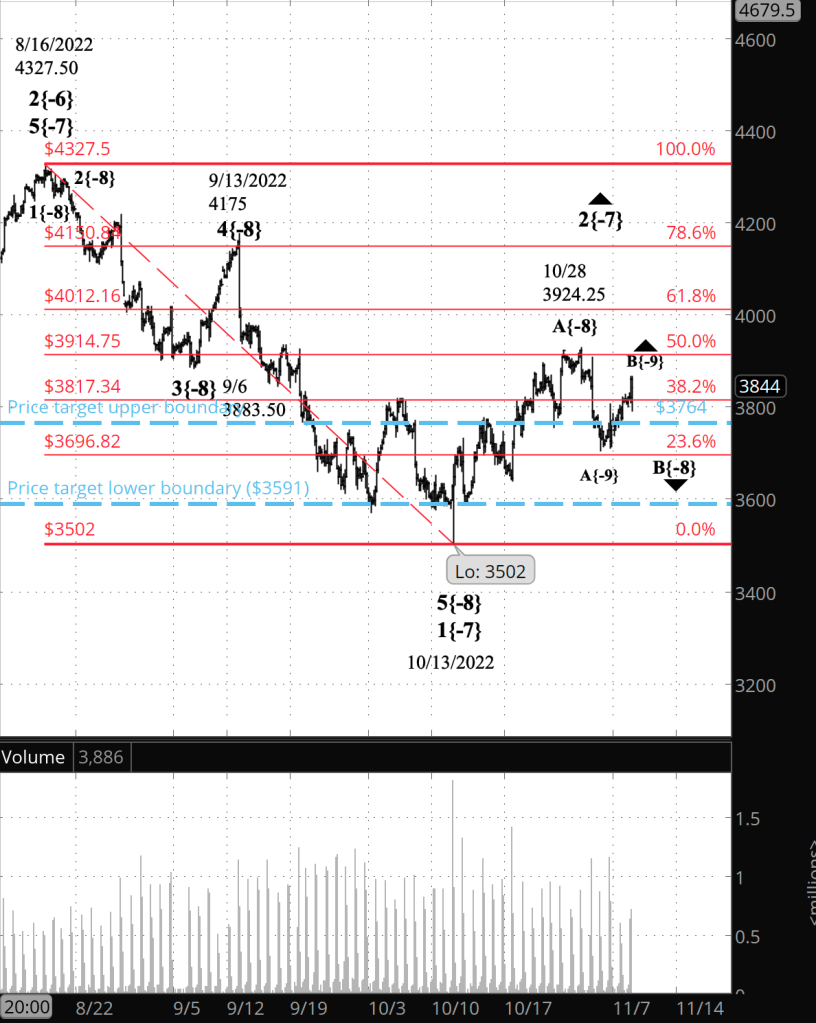
Half an hour before the closing bell. The S&P 500 rose early in the session, to 3867 on the futures, and then dropped back to the 38.2% Fibonacci retracement level, at 3817. Upward wave B{-9} within downward wave B{-8} within an upward correction, wave 2{-7} are all underway. No change in the analysis. I’ve updated the chart.

9:35 a.m. New York time

What’s happening now? The S&P 500 E-mini futures traded narrowly overnight, staying within the 3800s close to the 38.2% Fibonacci retracement level.

What does it mean? An upward correction that began on October 13 is in its second wave, which is a downward movement. A third internal wave will rise above the end of the first wave reached on October 28 at 3924, completing the corrective pattern.

What are the alternatives? The October 28 high could have been the end of the upward correction. I don’t take this alternative seriously because the subwaves seem disproportionately small. Nonetheless, it’s possible.

Why is the market stalling? My best guess: The Bureau of Labor Statistics releases new inflation data on Thursday, an hour before the opening bell, and I think a lot of trade decisions are showing caution as that new information release approaches.

Chart note. The chart is a bit complicated by overlays at this point. The Fibonacci ladder, showing the retracement of the decline that began on August 16, is in red. The two blue horizontal lines are the upper and lower boundaries of the price target range of the second wave of the upward correction.

[S&P 500 E-mini futures at 3:30 p.m., 220-minute bars, with volume]

What does Elliott wave theory say? The upward correction is wave 2{-7}, the second wave within downtrending wave 3{-6}, which began on August 16.

Internally, according to the principal analysis, wave B{-8}, the middle wave of a Zigzag pattern, is underway. Wave B{-8} is in its middle subwave, B{-9}, which is rising. It will be followed by wave C{-8}, the final wave in the Zigzag, which will rise above 3924, the endpoint of wave A{-8}.

Most likely wave C{-8} will be the end of the correction. However, sometimes corrections take a compound structure, linking two or three corrective patterns together.

Downtrending wave 3{-6}, the parent wave of the correction, is in turn enclosed by a series increasingly larger downtrending 1st waves, up to wave 1{-2}, four degrees larger. Above the entire structure of nested waves is wave 4{-1}, a downtrending wave that is the next-to-the-last wave within an expanding Diagonal Triangle that began on December 26, 2018.

Wave 4{-1} will be followed by the triangle’s final segment, wave 5{-1}, which probably will rise above 4818.62 on the index, the beginning of wave 4{-1} on January 4. Fifth waves are like donkeys,.We know what they’re supposed to do — move above the prior high — but sometimes they get stubborn and come up short.

In any case, the end of the triangle will be the start of a downtrend of massive proportion that will take decades to complete, although there will be many chances to profit from very large upward corrections within the downtrend.

We Are Here.

These are the waves currently in progress under my principal analysis. Each line on the list shows the wave number, with the subscript in curly brackets, the traditional degree name, the starting date, the starting price of the S&P 500 E-mini futures, and the direction of the wave.

  • S&P 500 Index:
  • 5{+3} Supercycle, 7/8/1932, 4.40 (up)
  • 5{+2} Cycle, 12/9/1974, 60.96 (up)
  • 5{+1} Primary, 3/6/2009, 666.79 (up)
  • 5{0} Intermediate, 12/26/2018, 2346.58 (up)
  • 4{-1} Minor, 1/4/2022 4818.62 (down)
  • 1{-2} Minute, 1/4/2022 4818.62 (down)
  • S&P 500 Futures and index:
  • 1{-3} Minuette, 1/4/2022, 4808.25 (down) (futures), 4818.62 (down) (index)
  • S&P 500 Futures:
  • 1{-4} Subminuette, 1/4/2022, 4808.25 (down)
  • 1{-5} Micro, 1/4/2022, 4808.25 (down)
  • 3{-6} Submicro, 8/16/2022, 4327.50 (down)
  • 2{-7} Minuscule, 10/13/2022, 3502 (up)
  • B{-8} Subminuscule, 10/28/2022, 3924.25 (down)

Learning and other resources. Elliott wave analysis provides context, not prophecy. As the 20th century semanticist Alfred Korzybski put it in his book Science and Sanity (1933), “The map is not the territory … The only usefulness of a map depends on similarity of structure between the empirical world and the map.” And I would add, in the ever-changing markets, we can judge that similarity of structure only after the fact.

See the menu page Analytical Methods for a rundown on where to go for information on Elliott wave analysis.

By Tim Bovee, Portland, Oregon, November 8, 2022

Disclaimer

Tim Bovee, Private Trader tracks the analysis and trades of a private trader for his own accounts. Nothing in this blog constitutes a recommendation to buy or sell stocks, options or any other financial instrument. The only purpose of this blog is to provide education and entertainment.

No trader is ever 100 percent successful in his or her trades. Trading in the stock and option markets is risky and uncertain. Each trader must make trading decisions for his or her own account, and take responsibility for the consequences.

License
Creative Commons License

All content on Tim Bovee, Private Trader by Timothy K. Bovee is licensed under a Creative Commons Attribution-ShareAlike 4.0 International License.

Based on a work at www.timbovee.com.

Trader’s Notebook

3:30 p.m. New York time

Half an hour before the closing bell. The S&P 500 has traded sideways during most of the session, in the 3770s on the futures, and as the closing bell approach the price rose to the 38.2% Fibonacci retracement level, in the low 3800s. No change in the analysis. I’ve updated the chart.

9:35 a.m. New York time

What’s happening now? The S&P 500 E-mini futures broke above the narrow range within which it ended the week, returning to the low 3800s.

What does it mean? The downward middle wave within an upward correction that began on October 13 is underway. That middle wave, when complete, will have three subwaves. The first subwave appears to be complete and the second subwave is in progress.

What are the alternatives? If I squint my eyes and use my imagination, I can sort of make a case for the middle wave of the upward correction having ended at the November 3 low, 3704.25, at the wave A{-9} endpoint on the chart. It seems far fetched, so I’m ranking it as a distant alternative.

[S&P 500 E-mini futures at 3:30 p.m., 220-minute bars, with volume]

What does Elliott wave theory say? Under the principal analysis, wave B{-8}, the second wave within an upward correction, wave 2{-7}, is continuing. The B wave resumed trading overnight near the 23.6% Fibonacci retracement level, which is slightly below the upper boundary of the B wave’s price target range, 3764. The lower boundary of the range is at 3591. The price is approaching the 38.2% Fibonacci retracement level. The preceding wave A{-8} ended near the 50% retracement level.

The Fibonacci levels are marked in red on the chart. The price target boundaries are in blue.

Within wave B{-8}, the middle subwave, rising wave B{-9}, is underway. It will be followed by declining wave C{-9}, which will complete wave B{-8}.

Under the alternative analysis, wave B{-8} ended at 3704.25 on November 3. The subwaves within B{-8} so far seem extraordinarily shallow, and so this isn’t an analysis that I take seriously. Nonetheless, it’s not beyond the realm of possibility.

Under either scenario, the next movement is an upward wave.

The principal analysis labels the rise as wave B{-9}, and it will have three subwaves. The alternative analysis labels the rise as wave C{-8}, and it will have five subwaves. The subwave count will eventually determine which analysis is correct.

Wave 2{-7} is a subwave of downtrending wave 3{-6}, which began on August 16 from 4327.50. The 2nd wave upward correction will be followed by a powerful downtrending wave, 3{-7}, that will carry a price below the October 13 low, 3502, and most likely significantly below that level. After a 4th wave upward correction, wave 5{-7} will carry the price still lower and will complete wave 3{-6}.

Wave 3{-6} will be followed by a 4th wave upward correction and then by downtrending wave 5{-6}, which will likely carry the price lower still.

This is all happening within a nested series of 1st waves, ranging from wave 1{-5} to wave 1{-2}, all of which began on January 4. Their parent wave, which also began on January 4, is wave 4{-1}, the next-to-the-last wave within wave 5{0}, the final wave of an expanding Diagonal Triangle. Wave 5{0} began on December 26, 2018.

The “expanding” part of this Diagonal Triangle means that the highs keep getting higher and the lows lower, creating a sideways pattern that gets broader over time. After wave 4{-1} is complete, the final wave within the triangle, wave 5{-1}, will carry the price to new heights.

We Are Here.

These are the waves currently in progress under my principal analysis. Each line on the list shows the wave number, with the subscript in curly brackets, the traditional degree name, the starting date, the starting price of the S&P 500 E-mini futures, and the direction of the wave.

  • S&P 500 Index:
  • 5{+3} Supercycle, 7/8/1932, 4.40 (up)
  • 5{+2} Cycle, 12/9/1974, 60.96 (up)
  • 5{+1} Primary, 3/6/2009, 666.79 (up)
  • 5{0} Intermediate, 12/26/2018, 2346.58 (up)
  • 4{-1} Minor, 1/4/2022 4818.62 (down)
  • 1{-2} Minute, 1/4/2022 4818.62 (down)
  • S&P 500 Futures and index:
  • 1{-3} Minuette, 1/4/2022, 4808.25 (down) (futures), 4818.62 (down) (index)
  • S&P 500 Futures:
  • 1{-4} Subminuette, 1/4/2022, 4808.25 (down)
  • 1{-5} Micro, 1/4/2022, 4808.25 (down)
  • 3{-6} Submicro, 8/16/2022, 4327.50 (down)
  • 2{-7} Minuscule, 10/13/2022, 3502 (up)
  • B{-8} Subminuscule, 10/28/2022, 3924.25 (down)

Learning and other resources. Elliott wave analysis provides context, not prophecy. As the 20th century semanticist Alfred Korzybski put it in his book Science and Sanity (1933), “The map is not the territory … The only usefulness of a map depends on similarity of structure between the empirical world and the map.” And I would add, in the ever-changing markets, we can judge that similarity of structure only after the fact.

See the menu page Analytical Methods for a rundown on where to go for information on Elliott wave analysis.

By Tim Bovee, Portland, Oregon, November 7, 2022

Disclaimer

Tim Bovee, Private Trader tracks the analysis and trades of a private trader for his own accounts. Nothing in this blog constitutes a recommendation to buy or sell stocks, options or any other financial instrument. The only purpose of this blog is to provide education and entertainment.

No trader is ever 100 percent successful in his or her trades. Trading in the stock and option markets is risky and uncertain. Each trader must make trading decisions for his or her own account, and take responsibility for the consequences.

License
Creative Commons License

All content on Tim Bovee, Private Trader by Timothy K. Bovee is licensed under a Creative Commons Attribution-ShareAlike 4.0 International License.

Based on a work at www.timbovee.com.
Trader’s Notebook

3:30 p.m. New York time

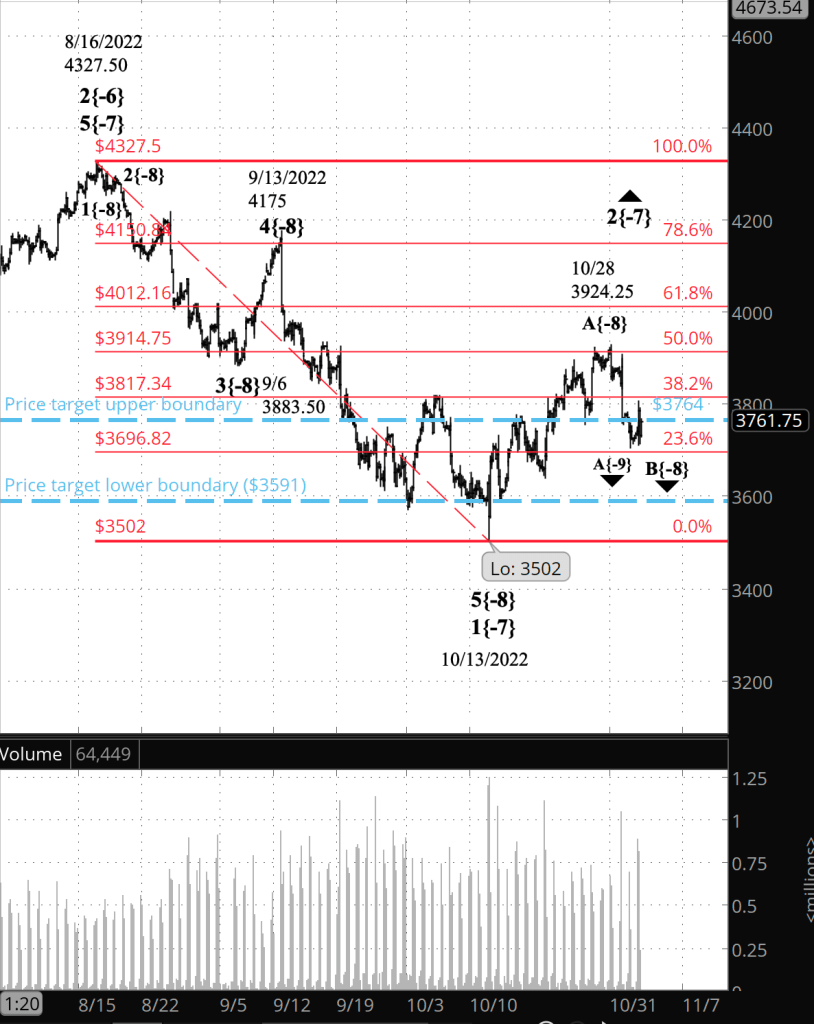
Half an hour before the closing bell. The S&P 500 set a session high, 3805.50 on the futures, reached in the second hour of trading. The price then declined, trading narrowly between the 3710s and the 3750s. In Elliott wave terminology, wave B{-8}, the downward second wave within an upward correction, wave 2{-7}, is still underway. The price target range for the B wave endpoint is 3591 to 3764. The morning high was above the upper boundary and the price immediately withdrew into the target range, trading just below that upper boundary. I’ve updated the upper (near-term) chart.

9:35 a.m. New York time

What’s happening now? The S&P 500 E-mini futures fluctuated sideways in the mid-3700s overnight, breaking that pattern only once, with a dramatic 58-point swing lasting 5 minutes after the U.S. employment numbers were released. The price then settled back in the mid-3700s;

What does it mean? The fluctuation means little, just small bump in a larger decline that began on October 28 from 4924.25. The decline is the middle wave within an upward correction that began on October 13. That middle wave has carried the price from a 50% Fibonacci retracement (3915) of the downtrend that lasted from August 16 to October 13 down to a 23.6% retracement (3697).

The middle wave of the correction will be followed by a third and possibly final wave that is almost certain to carry the price above the 50% retracement level, and perhaps significantly so, up to the 61.8% (4012) Fibonacci retracement or the 78.6% retracement (4151).

This upward correction cannot exceed the starting point of the preceding downtrend, 4327.50. That’s the upper limit of its rise.

What are the alternatives? The middle leg of the upward correction has three waves internally and is in its third wave. It may have ended at Thursday’s low, 3704.25.

The upward correction will end with its third internal wave unless it forms a compound structure, linking two or three corrective patterns together.

Chart note. The Fibonacci ladder, an aid to tracking retracements, is shown on the chart in red. The likely price target range of the second wave of the corrective pattern is shown in with dashed lines.

[S&P 500 E-mini futures at 3:30 p.m., 200-minute bars, with volume]

What does Elliott wave theory say? An upward correction, wave 2{-7}, that began on October 13 from 3502 is underway, and the middle wave of the corrective pattern, wave B{-8}, is nearing its end. Wave B{-8} has remained within the likely range of its terminus, 3591 to 3764, since October 3. The B wave will be followed by rising wave C{-8}, the final wave of the corrective pattern, which will likely rise into the 4000s.

The end of wave B{-8} will be signaled by a dramatic move to the upside. That hasn’t happened yet, but it’s not unusual for an end point to be followed by some hesitation before the reversal kicks off.

Wave C{-8}, which will follow wave B{-8}, will rise beyond B{-8}’s starting point, perhaps significantly so.

The upward correction, wave 2{-7}, will end with wave C{-8}, unless it forms a compound corrective pattern. If that’s the case, then wave C{-8} will be followed by a declining connective wave, X{-8}, and then by a second corrective patterns.

Second waves, such as the present wave 2{-7}, are less likely to go compound than are the other corrective waves in a trend, the 4th waves.

Wave 3{-7}, a powerful downtrend, will follow wave 2{-7}, carrying the price significantly lower.

Encompassing all of this is wave 3{-6}, a downtrend that began on August 16 from 4327.50. It, in turn, is encompassed by a series of downtrending 1st waves that began on January 4 from 4818.62 on the index. In degree the nested series of 1st waves ranges from wave 1{-5}, the smallest, to wave 1{-2}, the largest, which in turn in encompassed by declining wave 4{-1}, the next-to-the-last wave within wave 5{0}, the final wave within an expanding Diagonal Triangle that began on December 26, 2018.

Those 1st waves are important to traders, because they show no matter how much optimism is generated by the upward corrections along the way, the direction of the S&P 500 is down, down, down. The upward corrections can be played by traders — I’ve bought and sold stocks all week that benefit from the wave 2{-7} rise of the S&P 500 — but I’ll be cautious and suspicious of upward moves until wave 5{-1} begins, the final wave of the expanding Diagonal Triangle that will carry the price back up 4818, most likely significantly above that level.

S&P 500 index at 9:30 a.m., 3-day bars]

We Are Here.

These are the waves currently in progress under my principal analysis. Each line on the list shows the wave number, with the subscript in curly brackets, the traditional degree name, the starting date, the starting price of the S&P 500 E-mini futures, and the direction of the wave.

  • S&P 500 Index:
  • 5{+3} Supercycle, 7/8/1932, 4.40 (up)
  • 5{+2} Cycle, 12/9/1974, 60.96 (up)
  • 5{+1} Primary, 3/6/2009, 666.79 (up)
  • 5{0} Intermediate, 12/26/2018, 2346.58 (up)
  • 4{-1} Minor, 1/4/2022 4818.62 (down)
  • 1{-2} Minute, 1/4/2022 4818.62 (down)
  • S&P 500 Futures and index:
  • 1{-3} Minuette, 1/4/2022, 4808.25 (down) (futures), 4818.62 (down) (index)
  • S&P 500 Futures:
  • 1{-4} Subminuette, 1/4/2022, 4808.25 (down)
  • 1{-5} Micro, 1/4/2022, 4808.25 (down)
  • 3{-6} Submicro, 8/16/2022, 4327.50 (down)
  • 2{-7} Minuscule, 10/13/2022, 3502 (up)
  • B{-8} Subminuscule, 10/28/2022, 3924.25 (down)

Learning and other resources. Elliott wave analysis provides context, not prophecy. As the 20th century semanticist Alfred Korzybski put it in his book Science and Sanity (1933), “The map is not the territory … The only usefulness of a map depends on similarity of structure between the empirical world and the map.” And I would add, in the ever-changing markets, we can judge that similarity of structure only after the fact.

See the menu page Analytical Methods for a rundown on where to go for information on Elliott wave analysis.

By Tim Bovee, Portland, Oregon, November 4, 2022

Disclaimer

Tim Bovee, Private Trader tracks the analysis and trades of a private trader for his own accounts. Nothing in this blog constitutes a recommendation to buy or sell stocks, options or any other financial instrument. The only purpose of this blog is to provide education and entertainment.

No trader is ever 100 percent successful in his or her trades. Trading in the stock and option markets is risky and uncertain. Each trader must make trading decisions for his or her own account, and take responsibility for the consequences.

License
Creative Commons License

All content on Tim Bovee, Private Trader by Timothy K. Bovee is licensed under a Creative Commons Attribution-ShareAlike 4.0 International License.

Based on a work at www.timbovee.com.