Trader’s Notebook

3:30 p.m. New York time

Half an hour before the closing bell. The S&P 500 futures rose sharply at 1:30 p.m. when Federal Reserve President Jerome Powell said interest rate increases would continue but the pace would slow, perhaps as early as the December 13-14 Federal Open Market Committee meeting.

  • As inflation took hold, the FOMC began raising rates, first in March, by 25 basis, then again in May, 50 basis points, and then by 75 basis points the next four times the committee met.
  • Powell’s remark suggests a 50 basis point increase in December, perhaps, or perhaps early next year.

The S&P 500 futures responded by rising 87 basis points, to 4043, in an hour.

The price pushed past the 61.8% retracement of the downtrend Fibonacci retracement that began on August 16. The price has stalled twice at that level in November. Today the price broke through the November 15 high, 4050.75, reaching into the 4060s as the closing bell approached.

The final upward drive. The break beyond the 61.8% retracement, at 4013, suggests that the end of the correction has come one step nearer.

  • The final wave within the final wave of the correction is now underway.
  • On the chart, the wave labels are wave E{-9} within wave C{-8} within wave 2{-7}.
  • The alternative analysis presented this morning is no longer a contender.

9:35 a.m. New York time

What’s happening now? The S&P 500 E-mini futures rose into the 3960s and 3970s and continued to fluctuate around that level overnight. At 8:30 a.m., as the opening bell approached, the price took a sudden quick dip into the 3950s, coinciding with release of a sneak preview of Friday’s jobs numbers.

What does it mean? The upward correction that began on October 13 is nearing its end. It will be followed by a powerful decline into the 3400s or lower.

  • The retreat from the recent peak is the fourth part of a five part movement that on balance has brought the price higher. The fifth part will carry the price still higher.
  • The five parts of the rise are the building blocks of the third leg of the upward correction. When the third leg is complete, it will also mean that the correction is complete.
  • After the correction is done, the downtrend that began on August 16 will resume.

What are the alternatives? It’s possible that the recent peak was the end of the upward correction, and the movement that followed is the early stage of the resumed downtrend.

Elliott wave theory. The analysis is based on Elliott wave theory, a way of reading charts developed in the 1930s by R.N. Elliott, an accountant. Elliott called each movement on the chart, up or down, a “wave”. Although his Wave Principle has many observations, it is based on three key discoveries.

  • All market trends contain five waves, three in the direction of the trend and two corrections in the opposite direction.
  • Most market corrections contain three waves, although there are exceptions.
  • Most importantly, each wave in a trend or correction contains smaller waves and is itself part of a larger wave. And those waves, big or small, all trace the same patterns and can be analyzed in the same way.

Elliott’s theory gives every market movement a context. If we know the placement of a wave, we will know how far along a trend or correction has gone, how much remains, and how it will play out.

Chart notes. On the chart I follow Elliott by giving each wave a number, for waves within trends, or a letter, for waves within corrections. I use subscripts, in curly brackets, to denote the relative size — what Elliott called the “degree” — of each wave within the complex structure of the chart.

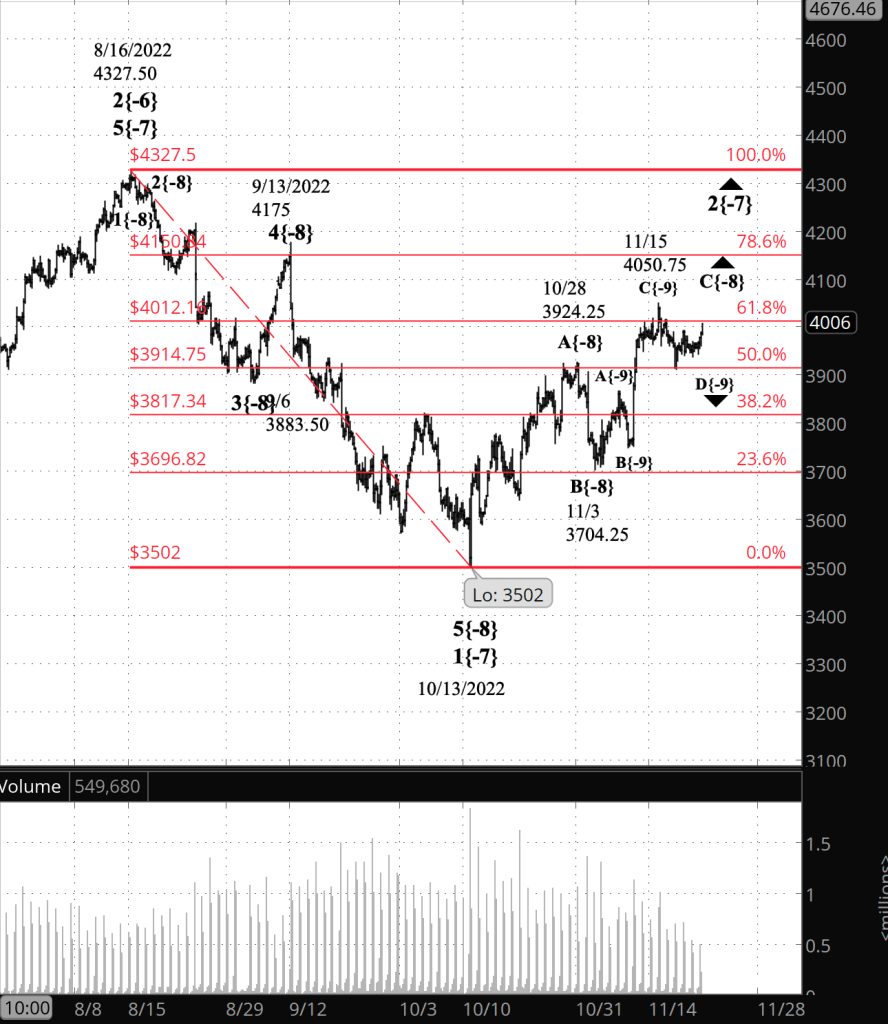
For this chart I have added red lines showing likely turning points, called Fibonacci retracement levels. They show how much of a trend that a correction has retraced.

  • On this chart, the price is between the 50% an 61.8% retracement levels. The present wave, labeled D{-9}, is likely to end around the 50% level — a price of3915 — and the next wave, E{-9}, may well carry the price up to the next Fibonacci turning point, the 78.6% retracement level — a price of 4151.
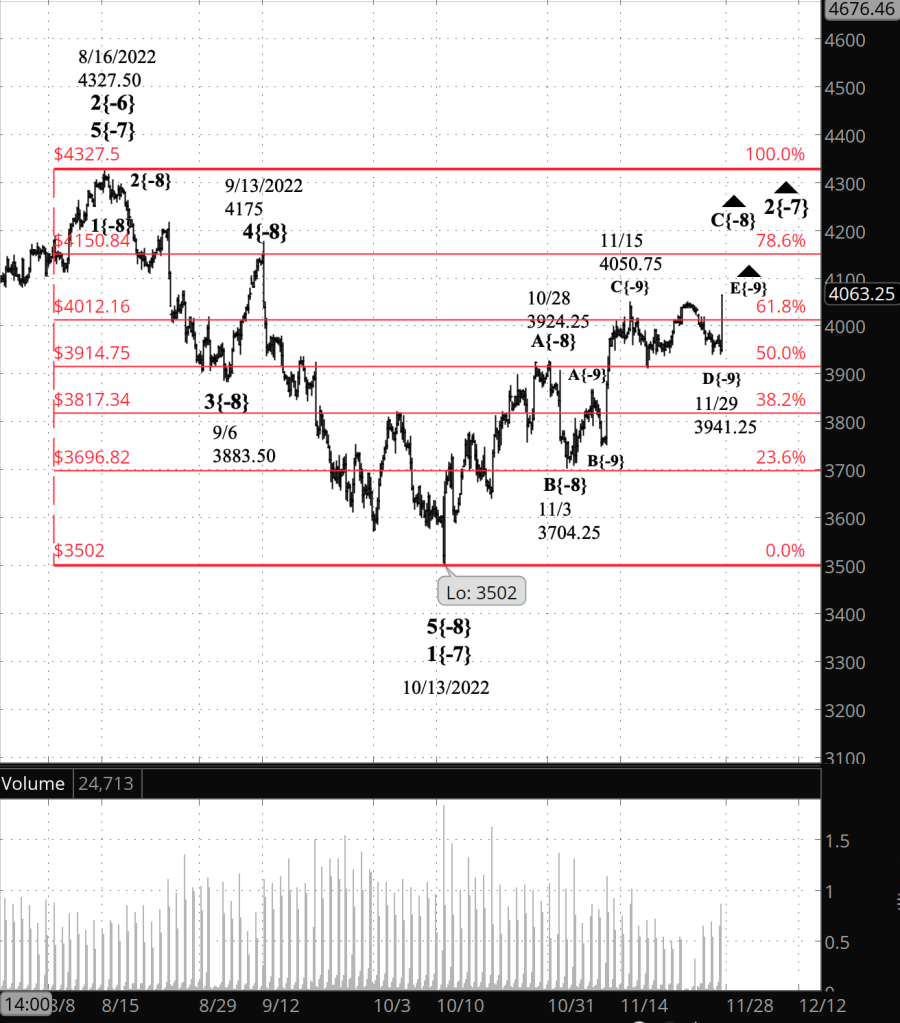
[S&P 500 E-mini futures at 3:30 p.m., 4-hour bars, with volume]

What does Elliott wave theory say? The three waves powering the action illustrate Elliott’s waves-within-waves idea.

  • The largest wave is the upward correction as a whole, wave 2{-7}.
  • Within it is the third and final leg of the three-wave correction, wave C{-8}.
  • And that third leg has a five wave structure and is presently in wave D{-9}, with the final wave, E{-9}, still to ome.

The alternative shows wave 2{-7} as having ended at the recent high, 4050.75.

Under both the principal scenario and its alternative, wave 2{-7} will be a followed by wave 3{-7}, a resumption of the downtrend.

  • Third waves are usually the most powerful of them all. Expect wave 3{-7} to produce an energetic decline.
  • All of the waves mentioned so far are parts of wave 3{-6}. a downtrend that began on August 16 from 4327.50.

It’s mainly down from here. Within the larger downtrend, wave 3{-6}, the next wave to come, wave 3{-7}, will be a downtrend within a downtrend. It will be followed by wave 4{-7}, a second upward correction, and then by wave 5{-7}, another resumption of the downtrend.

  • And at a larger level, we’ve been in a downtrend all year, within wave 1{-2}. which began on January 4, from slightly above 4800.

The message of Elliott wave analysis is clear: Expect prices to decline more than they rise well into next year and perhaps beyond. We won’t see that January 4 peak for awhile.

We Are Here.

These are the waves currently in progress under my principal analysis. Each line on the list shows the wave number, with the subscript in curly brackets, the traditional degree name, the starting date, the starting price of the S&P 500 E-mini futures, and the direction of the wave.

  • S&P 500 Index:
  • 5{+3} Supercycle, 7/8/1932, 4.40 (up)
  • 5{+2} Cycle, 12/9/1974, 60.96 (up)
  • 5{+1} Primary, 3/6/2009, 666.79 (up)
  • 5{0} Intermediate, 12/26/2018, 2346.58 (up)
  • 4{-1} Minor, 1/4/2022 4818.62 (down)
  • 1{-2} Minute, 1/4/2022 4818.62 (down)
  • S&P 500 Futures and index:
  • 1{-3} Minuette, 1/4/2022, 4808.25 (down) (futures), 4818.62 (down) (index)
  • S&P 500 Futures:
  • 1{-4} Subminuette, 1/4/2022, 4808.25 (down)
  • 1{-5} Micro, 1/4/2022, 4808.25 (down)
  • 3{-6} Submicro, 8/16/2022, 4327.50 (down)
  • 2{-7} Minuscule, 10/13/2022, 3502 (up)
  • C{-8} Subminuscule, 11/3/2022, 3704.25 (up)

Learning and other resources. Elliott wave analysis provides context, not prophecy. As the 20th century semanticist Alfred Korzybski put it in his book Science and Sanity (1933), “The map is not the territory … The only usefulness of a map depends on similarity of structure between the empirical world and the map.” And I would add, in the ever-changing markets, we can judge that similarity of structure only after the fact.

See the menu page Analytical Methods for a rundown on where to go for information on Elliott wave analysis.

By Tim Bovee, Portland, Oregon, November 30, 2022

Disclaimer

Tim Bovee, Private Trader tracks the analysis and trades of a private trader for his own accounts. Nothing in this blog constitutes a recommendation to buy or sell stocks, options or any other financial instrument. The only purpose of this blog is to provide education and entertainment.

No trader is ever 100 percent successful in his or her trades. Trading in the stock and option markets is risky and uncertain. Each trader must make trading decisions for his or her own account, and take responsibility for the consequences.

License
Creative Commons License

All content on Tim Bovee, Private Trader by Timothy K. Bovee is licensed under a Creative Commons Attribution-ShareAlike 4.0 International License.

Based on a work at www.timbovee.com.

Trader’s Notebook

3:30 p.m. New York time

Half an hour before the closing bell. The S&P 500 futures hit a low of 3941.25 during the session and then rose back into the 3960s before reversing back to the downside. No change in the analysis. I’ve updated the chart.

9:35 a.m. New York time

What’s happening now? The S&P 500 E-mini futures rose overnight into the 3990s and then retreated to the 3960s.

  • The high point of the rise that began last month remains an elusive goal.

What does it mean? That rise is an upward correction that began on October 13. It is in the last leg of a corrective pattern, and that last leg is in its next-to-the-last segment.

  • The rise is playing its endgame and a powerful decline is approaching.

What are the alternatives? Just possibly, that decline has already begun, on November 15 from the high point of the correction, 4050.75.

Chart notes. The 4050.75 level matters because it was a brief piercing of the 61.8% Fibonacci retracement level, a point where corrections reach their end. The Fibonacci retracement levels are shown on the chart in red.

  • A rise above the 61.8% retracement — 4012 — means that the last leg of the correction is in its final subwave.
  • A decline below the 50% retracement — 3915 — means that the correction has ended and the downtrend has begun.

[S&P 500 E-mini futures at 3:30 p.m., 4-hour bars, with volume]

What does Elliott wave theory say? Three waves are driving the action.

  • The upward correction is wave 2{-7}. It began on October 13 from 3502. It is the first of two corrections within wave 3{-6}, which began its downtrend on August 16 from 4327.50
  • The last leg of the correction is wave C{-8}. The chart shows it as still being on its upward journey, but it could have ended on November 15 at 4050.75.
  • Wave C{-8} will have five subwaves, and it now on the fourth subwave. Wave D{-9} is dropping, setting the stage for a an upward drive that will almost certainly break through the 4050.75 level.

What could change that scenario?

  • Compounding. Sometimes a correction adds additional corrective patterns. If that happens, then wave C{-8} will be followed by a connecting wave X{-8}, and then by the start of a second corrective pattern, wave A{-8}.
  • A compound correction can contain up to three corrective patterns.
  • But compounding is rare in a wave 2, the first correction inside of a trend. It’s more common in a wave 4, the second correction running against the trend.

Is compounding really that important? Ultimately, no. It will delay the end of the correction and so put off the start of more decline.

  • But compounded or not, as sure as night follows day, the wave 2 correction will be followed by wave 3, a powerful decline that will carry the price below 3502, almost certainly a great distance below that level.

More downside to come.

The downtrend that began on August 16 — wave 3{-6} — isn’t the end of the bear market. A wave is always a part of a larger wave, a child who has ancestors. And wave 3{-6} has a parent wave, a grandparent wave, and a bunch of greats. They’re all a crotchety bunch, looking to the downside.

  • The ancestors are all first waves, meaning each will end up with three downtrending waves and two upward corrections.
  • The downtrending ancestors go up to great-great-grandparent, wave 1{-2}, which began on January 4 from 4818.62 on the index.

After darkness comes the dawn.

No downtrend lasts forever. Will the downtrend that began on January 4 end this year? Never. Next year? Maybe. 2024? Seems likely.

  • Everything we see on the chart is part of wave 4{-1}, a declining next-to-the-last subwave of a five-wave expanding Diagonal Triangle that began on December 26, 2018.
  • When that 4th subwave is complete, a 5th and final subwave will kick off, a large uptrend that will eventually carry the price above the January 4 high, and almost certainly quite a bit higher than that level.
  • The triangle is wave 5{0}, the final wave within a large uptrend that began in 2009, during the Great Recession.

We Are Here.

These are the waves currently in progress under my principal analysis. Each line on the list shows the wave number, with the subscript in curly brackets, the traditional degree name, the starting date, the starting price of the S&P 500 E-mini futures, and the direction of the wave.

  • S&P 500 Index:
  • 5{+3} Supercycle, 7/8/1932, 4.40 (up)
  • 5{+2} Cycle, 12/9/1974, 60.96 (up)
  • 5{+1} Primary, 3/6/2009, 666.79 (up)
  • 5{0} Intermediate, 12/26/2018, 2346.58 (up)
  • 4{-1} Minor, 1/4/2022 4818.62 (down)
  • 1{-2} Minute, 1/4/2022 4818.62 (down)
  • S&P 500 Futures and index:
  • 1{-3} Minuette, 1/4/2022, 4808.25 (down) (futures), 4818.62 (down) (index)
  • S&P 500 Futures:
  • 1{-4} Subminuette, 1/4/2022, 4808.25 (down)
  • 1{-5} Micro, 1/4/2022, 4808.25 (down)
  • 3{-6} Submicro, 8/16/2022, 4327.50 (down)
  • 2{-7} Minuscule, 10/13/2022, 3502 (up)
  • C{-8} Subminuscule, 11/3/2022, 3704.25 (up)

Learning and other resources. Elliott wave analysis provides context, not prophecy. As the 20th century semanticist Alfred Korzybski put it in his book Science and Sanity (1933), “The map is not the territory … The only usefulness of a map depends on similarity of structure between the empirical world and the map.” And I would add, in the ever-changing markets, we can judge that similarity of structure only after the fact.

See the menu page Analytical Methods for a rundown on where to go for information on Elliott wave analysis.

By Tim Bovee, Portland, Oregon, November 29, 2022

Disclaimer

Tim Bovee, Private Trader tracks the analysis and trades of a private trader for his own accounts. Nothing in this blog constitutes a recommendation to buy or sell stocks, options or any other financial instrument. The only purpose of this blog is to provide education and entertainment.

No trader is ever 100 percent successful in his or her trades. Trading in the stock and option markets is risky and uncertain. Each trader must make trading decisions for his or her own account, and take responsibility for the consequences.

License
Creative Commons License

All content on Tim Bovee, Private Trader by Timothy K. Bovee is licensed under a Creative Commons Attribution-ShareAlike 4.0 International License.

Based on a work at www.timbovee.com.

Trader’s Notebook

3:30 p.m. New York time

Half an hour before the closing bell. The S&P 500 continued to fall during the session, reaching the 3960s on the futures. For the moment I’m staying with this morning’s principal analysis: The upward correction continues.

If the price drops below the 50% Fibonacci retracement level — at 3914.75 — and continues to fall, then I’ll switch to the alternative analysis: The upward correction ended at 4050.75 on October 15 and a downtrend has begun.

I’ve updated the chart.

9:35 a.m. New York time

What’s happening now? The S&P 500 E-mini futures gapped downward by 11 points, to 4020.25, when trading resumed Sunday evening. The price reached a low of 3392.25, moving below the 61.8% Fibonacci retracement level, before rising slightly.

What does it mean? The 61.8% retracement level — 4012.16 — is important, since corrections often end near there. The next higher Fibonacci retracement level is 78.6%, at 4150.84. The lack so far of a fall to the 50% retracement level suggests that the final leg of a two-week-old upward correction is still underway. The upward correction is the 2nd wave within a larger 3rd wave that began on August 16.

What is the alternative? The upward correction may have ended on November 15. The most recent high in the correction was 4050.75, on that date. That price is slightly above the 61.8% retracement. Under this scenario, the decline since the high point is the beginning of a significant downtrend. The internal count suggests that 4050.75 isn’t the end, but wave analysis always has ambiguities, and it’s possible — just barely — to see this alternative in the chart.

What happens next? A powerful downtrend, the 3rd wave within the larger 3rd wave, will follow the downward correction, most likely carrying the price into the 3400s and even below. The downtrend will be followed by another upward correction, a 4th wave, and then a further push to the downside, a 5th wave.

Batten down the hatches! In my personal trading I’m taking this downtrend quite seriously. I’ve put stop/losses on my stock holdings, and will lean to the bear side in my options trades. I’m putting the cash freed by my holdings into 13-week Treasury bills as a temporary home. The bills were yielding 4.41% annually as of Friday. My strategy is to stay out during the 3rd, 4th and 5th waves, and then re-enter one the parent 3rd wave is complete and a large upward correction has begun.

Chart notes. I’ve returned the Fibonacci ladder to the chart, in red, to better see the retracement levels that are important to analyzing this chart.

[S&P 500 E-mini futures at 3:30 p.m., 4-hour bars, with volume]

What does Elliott wave theory say? The upward correction that began on October 13 is wave 2{-7}. Within it, rising wave C{-8} is underway. A subwave of C{-8}, falling wave D{-9}, is underway. It will be followed by rising wave E{-8}, which will complete the larger wave C{-8} and most likely the correction as a whole. If wave 2{-7} forms a compound structure, then the end wave C{-8} will be followed by a connector, wave X{-8}, and then a second corrective pattern. Compound corrections can have up to three corrective patterns within them. Compounding is uncommon in 2nd waves.

Under the principal analysis, the correction is incomplete. Under the alternative analysis, wave 2{-7} ended on November 15.

When wave 2{-7} is completed, it will be followed by wave 3{-7}, a powerful downtrend. The principal analysis says that wave 3{-8} lies ahead. The alternative analysis says that it has already begun. An upward correction, wave 4{-7}, will follow, and then a final downtrend, wave 5{-7}, that is likely to push the price to still lower levels.

The end of wave 5{-7} will also be the end of the parent, downtrending wave 3{-6}, which encompasses all of the waves described above. An upward correction, wave 4{-6}, will follow, and then another large push to the downside, wave 5{-6}. Wave 3{-6} is already three months old, so I expect wave 5{-6} to carry us well into 2023, and 2024 is not an impossibility.

My personal trading strategy is to stay out of during the rest of wave 3{-6}, wave 4{-6} and wave 5{-6}, and to re-enter during the upward correction that will follow, wave 2{-5}.

We Are Here.

These are the waves currently in progress under my principal analysis. Each line on the list shows the wave number, with the subscript in curly brackets, the traditional degree name, the starting date, the starting price of the S&P 500 E-mini futures, and the direction of the wave.

  • S&P 500 Index:
  • 5{+3} Supercycle, 7/8/1932, 4.40 (up)
  • 5{+2} Cycle, 12/9/1974, 60.96 (up)
  • 5{+1} Primary, 3/6/2009, 666.79 (up)
  • 5{0} Intermediate, 12/26/2018, 2346.58 (up)
  • 4{-1} Minor, 1/4/2022 4818.62 (down)
  • 1{-2} Minute, 1/4/2022 4818.62 (down)
  • S&P 500 Futures and index:
  • 1{-3} Minuette, 1/4/2022, 4808.25 (down) (futures), 4818.62 (down) (index)
  • S&P 500 Futures:
  • 1{-4} Subminuette, 1/4/2022, 4808.25 (down)
  • 1{-5} Micro, 1/4/2022, 4808.25 (down)
  • 3{-6} Submicro, 8/16/2022, 4327.50 (down)
  • 2{-7} Minuscule, 10/13/2022, 3502 (up)
  • C{-8} Subminuscule, 11/3/2022, 3704.25 (up)

Learning and other resources. Elliott wave analysis provides context, not prophecy. As the 20th century semanticist Alfred Korzybski put it in his book Science and Sanity (1933), “The map is not the territory … The only usefulness of a map depends on similarity of structure between the empirical world and the map.” And I would add, in the ever-changing markets, we can judge that similarity of structure only after the fact.

See the menu page Analytical Methods for a rundown on where to go for information on Elliott wave analysis.

By Tim Bovee, Portland, Oregon, November 28, 2022

Disclaimer

Tim Bovee, Private Trader tracks the analysis and trades of a private trader for his own accounts. Nothing in this blog constitutes a recommendation to buy or sell stocks, options or any other financial instrument. The only purpose of this blog is to provide education and entertainment.

No trader is ever 100 percent successful in his or her trades. Trading in the stock and option markets is risky and uncertain. Each trader must make trading decisions for his or her own account, and take responsibility for the consequences.

License
Creative Commons License

All content on Tim Bovee, Private Trader by Timothy K. Bovee is licensed under a Creative Commons Attribution-ShareAlike 4.0 International License.

Based on a work at www.timbovee.com.
Trader’s Notebook

12:30 p.m. New York time

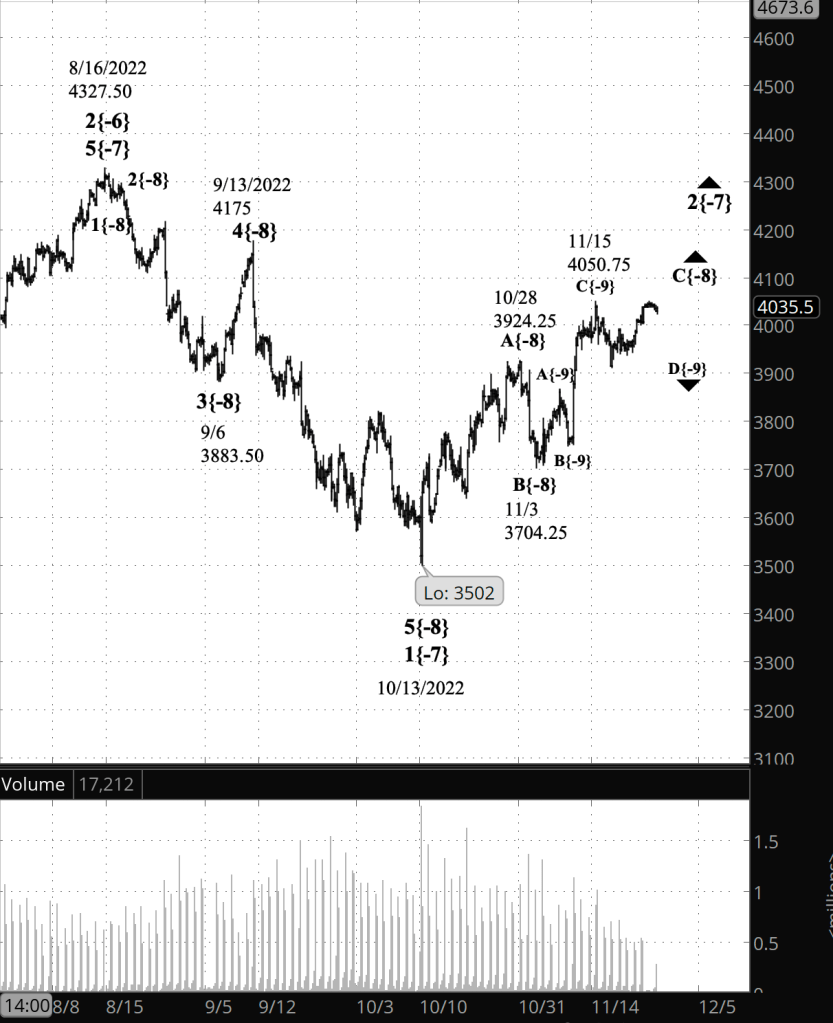
Half an hour before the closing bell. The S&P 500 continued to work its way lower during the session, to 4024.75 on the futures at the lowest point so far today. No change in the analysis. I’ve updated the upper chart.

9:35 a.m. New York time

An early closing bell. The U.S. markets will close early today, at 1 p.m., as is customary on the day following the Thanksgiving Day holiday. Regular session hours, 9:30 a.m. to 3:30 p.m., will resume on Monday. The S&P 500 futures trade both during the session and outside of regular hours.

What’s happening now? The S&P 500 E-mini futures declined in overnight trading, reaching into the 4030s as the opening bell approached. The price remained below the high so far, 4049.25, reached on November 15 by the upward correction that began on October 13.

What does it mean? The correction is in its final phase — the rising third wave — and within that structure, is in a declining wave, the fourth wave in a series of five. I expect the rising fifth wave, which will likely complete the correction, to rise above the 4049.25 high. The correction, when complete, will be followed by a powerful downtrend.

What are the alternative? The 4049.25 peak was the end of the fifth wave, of the final phase of the upward correction, and possibly of the correction as a whole.

Corollary #1: The decline after the peak is the first tentative step in a powerful downtrend that will cary the price below 3502, the starting point of the upward correction, and most likely significantly below that level.

Corollary #2: The upward correction is taking a compound form, containing two or three corrective patterns. In that case, the decline following the peak connects the first corrective pattern, with a second corrective pattern that still lies in future. When the compound correction is over, the powerful downtrend will begin.

The charts. The upper chart shows the S&P 500 futures from July of this year to the present. The lower chart shows the S&P 500 index from November 2017 to the present.

[S&P 500 E-mini futures at 9:35 a.m., 4-hour bars, with volume]

What does Elliott wave theory say? The upward correction that began on October 13 is wave 2{-7}.

Under the principal analysis, the correction is in wave 3{-8}, its final phase, and within wave 3{-8}, is in wave D{-9}, a declining wave that will be followed by rising wave E{-9}, the final wave of the corrective pattern and most likely of the wave 2{-7} correction itself. I expect wave E{-9} to exceed the 4049.25 peak, which is the end of rising wave C{-9}, the middle subwave of wave C{-8}.

The powerful downtrend that follows the correction will be wave 3{-7}, the middle wave of a larger downtrend, wave 3{-6}, which began on August 16.

Under the alternative analysis, the 4049.25 peak was the end of wave E{-9} and therefore of wave C{-8}. This see this as being less likely. Wave C{-8} must have five waves internally, since the correction has taken the form of a Zigzag. Although there is a shallow decline that could count as a fourth internal wave, it doesn’t seem deep enough to fulfill that roll. So as the principal analysis I am counting the 4049.25 peak as the wave C{-9} endpoint and placing the wave E{-9} endpoint as an alternative.

The two corollaries have to do with the nature of the decline that follows the 4049.25 peak. Corollary #1 sees it as the beginning of wave 3{-7}, a powerful downtrend. Corollary #2 sees it as a wave connecting two corrective patterns within the ongoing wave 2{-7} upward correction. The present decline is wave X{-8}, and it will be followed by a second corrective pattern, beginning with rising wave A{-8}.

In 2nd waves, simple corrections are far more common than compound corrections, which are mainly found in 4th wave corrections.

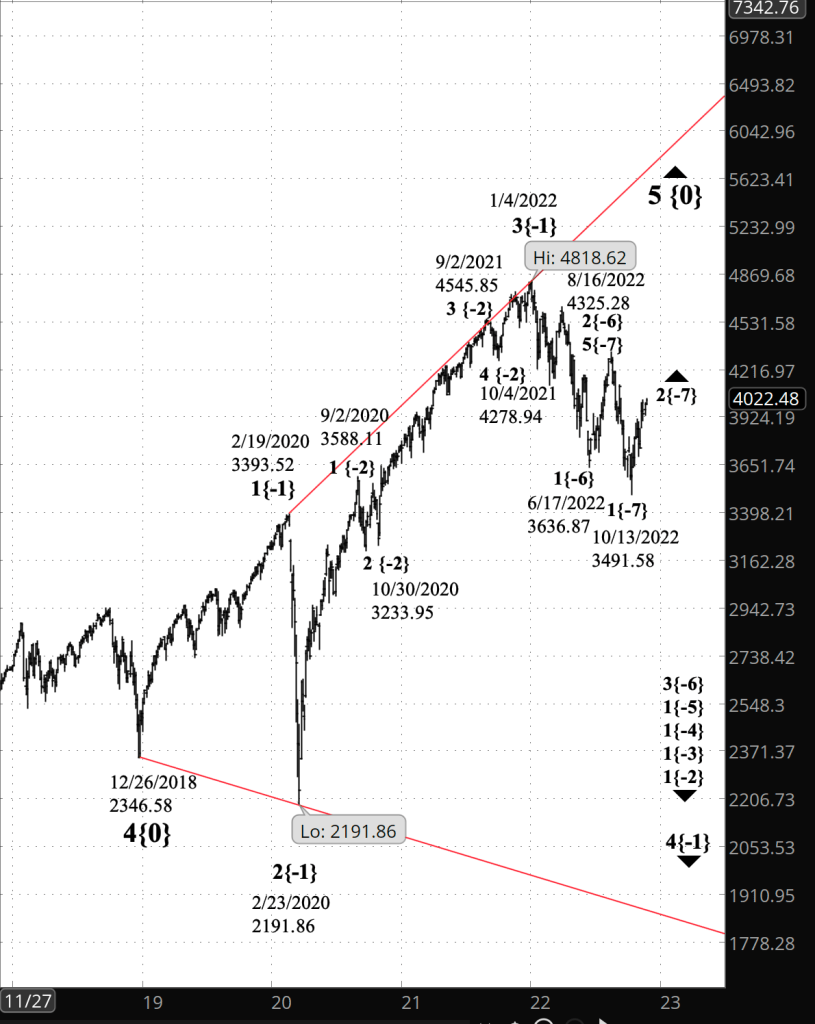
The parent wave of all of this, wave 3{-6}, lies within a series of increasingly larger 1st-wave downtrends, stretching from wave 1{-5} to wave 1{-2}. They all began on January 4 from 4818.62 on the index. They are all part of wave 4{-1}, the next-to-the-last wave within wave 5{0}, an expanding Diagonal Triangle that began on December 26, 2018.

Wave 4{-1} is a major decline that could carry the price into the 2500s and perhaps even below 2000. It will be followed by the final wave of the Triangle, wave 5{0}, an uptrending wave that will carry the price above the January 4 peak, 4818.62 on the index, into the mid-5600s and perhaps even higher.

[S&P 500 index at 9:35 a.m., 3-day bars]

We Are Here.

These are the waves currently in progress under my principal analysis. Each line on the list shows the wave number, with the subscript in curly brackets, the traditional degree name, the starting date, the starting price of the S&P 500 E-mini futures, and the direction of the wave.

  • S&P 500 Index:
  • 5{+3} Supercycle, 7/8/1932, 4.40 (up)
  • 5{+2} Cycle, 12/9/1974, 60.96 (up)
  • 5{+1} Primary, 3/6/2009, 666.79 (up)
  • 5{0} Intermediate, 12/26/2018, 2346.58 (up)
  • 4{-1} Minor, 1/4/2022 4818.62 (down)
  • 1{-2} Minute, 1/4/2022 4818.62 (down)
  • S&P 500 Futures and index:
  • 1{-3} Minuette, 1/4/2022, 4808.25 (down) (futures), 4818.62 (down) (index)
  • S&P 500 Futures:
  • 1{-4} Subminuette, 1/4/2022, 4808.25 (down)
  • 1{-5} Micro, 1/4/2022, 4808.25 (down)
  • 3{-6} Submicro, 8/16/2022, 4327.50 (down)
  • 2{-7} Minuscule, 10/13/2022, 3502 (up)
  • C{-8} Subminuscule, 11/3/2022, 3704.25 (up)

Learning and other resources. Elliott wave analysis provides context, not prophecy. As the 20th century semanticist Alfred Korzybski put it in his book Science and Sanity (1933), “The map is not the territory … The only usefulness of a map depends on similarity of structure between the empirical world and the map.” And I would add, in the ever-changing markets, we can judge that similarity of structure only after the fact.

See the menu page Analytical Methods for a rundown on where to go for information on Elliott wave analysis.

By Tim Bovee, Portland, Oregon, November 25, 2022

Disclaimer

Tim Bovee, Private Trader tracks the analysis and trades of a private trader for his own accounts. Nothing in this blog constitutes a recommendation to buy or sell stocks, options or any other financial instrument. The only purpose of this blog is to provide education and entertainment.

No trader is ever 100 percent successful in his or her trades. Trading in the stock and option markets is risky and uncertain. Each trader must make trading decisions for his or her own account, and take responsibility for the consequences.

License
Creative Commons License

All content on Tim Bovee, Private Trader by Timothy K. Bovee is licensed under a Creative Commons Attribution-ShareAlike 4.0 International License.

Based on a work at www.timbovee.com.
Trader’s Notebook

9:35 a.m. New York time

What’s happening now? The S&P 500 E-mini futures continued to rise overnight, reaching 4049.25 and then declining back into the 4030s. U.S. markets are closed today for a holiday, Thanksgiving Day, and so there will be no opening bell.

What does it mean? The correction that began on October 13 is still underway. The overnight high reversed 1-1/2 points below the correction peak so far, 4050.75, attained on November 15. Internally, the correction is in its rising third and last leg, and that rise is in the declining fourth subwave in a five-wave series.

What is the alternative? The November 17 low, 4039.50, was the end the fourth subwave and the rising fifth subwave is underway. When it is complete, it will mark the end of the third leg of the correction and most likely the end of the correction itself.

If the price moves above 4050.75, the prior correction peak, then I shall reanalyze the chart to see if the alternative scenario should be promoted to the principal scenario.

[S&P 500 E-mini futures at 9:35 a.m., 4-hour bars, with volume]

What does Elliott wave theory say? The correction is wave 2{-7}. It is in its 3rd leg, wave C{-8}.

Under the principal analysis, wave C{-8} is in its fourth subwave, wave D{-9}. The alternative analysis sees wave D{-9} as having ended and labels the rise since November 17 as wave E{-9}.

We Are Here.

These are the waves currently in progress under my principal analysis. Each line on the list shows the wave number, with the subscript in curly brackets, the traditional degree name, the starting date, the starting price of the S&P 500 E-mini futures, and the direction of the wave.

  • S&P 500 Index:
  • 5{+3} Supercycle, 7/8/1932, 4.40 (up)
  • 5{+2} Cycle, 12/9/1974, 60.96 (up)
  • 5{+1} Primary, 3/6/2009, 666.79 (up)
  • 5{0} Intermediate, 12/26/2018, 2346.58 (up)
  • 4{-1} Minor, 1/4/2022 4818.62 (down)
  • 1{-2} Minute, 1/4/2022 4818.62 (down)
  • S&P 500 Futures and index:
  • 1{-3} Minuette, 1/4/2022, 4808.25 (down) (futures), 4818.62 (down) (index)
  • S&P 500 Futures:
  • 1{-4} Subminuette, 1/4/2022, 4808.25 (down)
  • 1{-5} Micro, 1/4/2022, 4808.25 (down)
  • 3{-6} Submicro, 8/16/2022, 4327.50 (down)
  • 2{-7} Minuscule, 10/13/2022, 3502 (up)
  • C{-8} Subminuscule, 11/3/2022, 3704.25 (up)

Learning and other resources. Elliott wave analysis provides context, not prophecy. As the 20th century semanticist Alfred Korzybski put it in his book Science and Sanity (1933), “The map is not the territory … The only usefulness of a map depends on similarity of structure between the empirical world and the map.” And I would add, in the ever-changing markets, we can judge that similarity of structure only after the fact.

See the menu page Analytical Methods for a rundown on where to go for information on Elliott wave analysis.

By Tim Bovee, Portland, Oregon, November 24, 2022

Disclaimer

Tim Bovee, Private Trader tracks the analysis and trades of a private trader for his own accounts. Nothing in this blog constitutes a recommendation to buy or sell stocks, options or any other financial instrument. The only purpose of this blog is to provide education and entertainment.

No trader is ever 100 percent successful in his or her trades. Trading in the stock and option markets is risky and uncertain. Each trader must make trading decisions for his or her own account, and take responsibility for the consequences.

License
Creative Commons License

All content on Tim Bovee, Private Trader by Timothy K. Bovee is licensed under a Creative Commons Attribution-ShareAlike 4.0 International License.

Based on a work at www.timbovee.com.
Trader’s Notebook

3:30 p.m. New York time

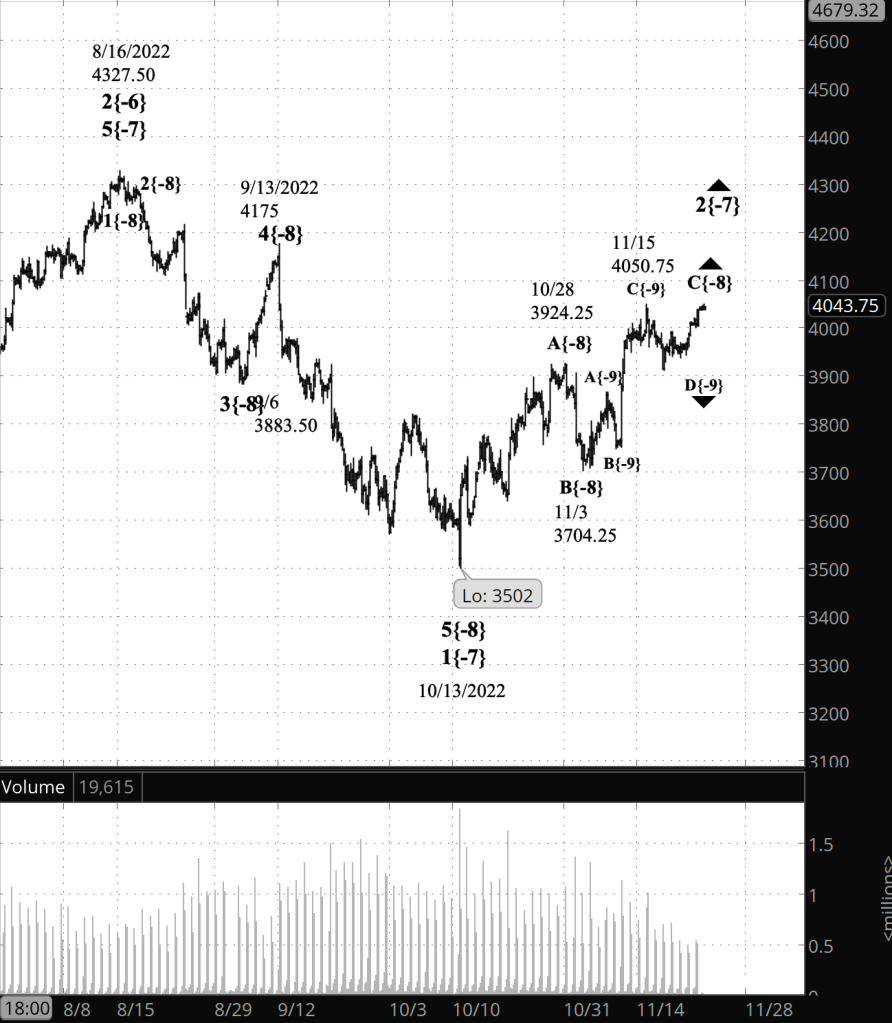
Half an hour before the closing bell. The S&P 500 rose rapidly after the Federal Open Market Committee minutes from early November were released, moving from 4020 to 4039.25 on the futures in 27 minutes. The price then fell back a bit while remaining above the 61.8% Fibonacci retracement level.

The price remained below the November 15 high, 4050.75 — the high point so far of the upward correction that began on October 13.

My analysis from this morning remains unchanged. Declining wave D{-9} within rising wave C{-8} within the upward correction, wave 2{-7} is underway. If the price moves above 4050.75, then I’ll reconsider the analysis.

I’ve updated the chart.

9:35 a.m. New York time

Market holiday. Tomorrow, Thursday, is the Thanksgiving Day holiday in the United States, and U.S. markets will be closed. They will re-open on Friday at the usual time for an abbreviated session ending at 1 p.m. I shall post analyses at 9:35 a.m. and 12:30 p.m. during Friday’s short session.

What’s happening now? The S&P 500 E-mini futures pushed almost 10 points above the 61.8% Fibonacci retracement level, to 4021.75, and then retreated, falling 10 points below that level. The Fibonacci levels are shown on the chart in red. After the opening bell the price rose back to the 61.8% retracement level.

What does it mean? The 61.8% retracement level is a common stopping point. The question on this chart is, What was it that was stopped? Or at least disrupted.

For my principal analysis, I’m staying with the scenario that I’ve had since last week: The upward correction that began on October 13 is still underway and is in its next-to-the-last subwave within its third and final wave. The fifth and final subwave will follow, likely taking the price above the November 15 high, 4050.75.

What is the alternative? The alternative scenario is also unchanged. The fifth and final subwave within the third wave of the upward correction began from the November 17 low, 3912.50. I consider this scenario to be less likely because the price has not exceeded the November 15 high, which was the end point of the middle wave of the five-subwave series. If the price moves above 4050.75, then the alternative will become the principal analysis.

[S&P 500 E-mini futures at 3:30 p.m., 4-hour bars, with volume]

What does Elliott wave theory say? The upward correct that began on October 13 is wave 2{-7}, a correction within a downtrend, wave 3{-6}, that began on August 16 from 4327.50. The correction’s starting point was 3502.

Under the principal analysis, rising wave C{-8}, the final wave of the three-wave corrective pattern that has been the form of wave 2{-7} so far, is in the fourth of five subwaves, descending wave D{-9}, and will be followed by the rising final wave in the series, wave E{-9}.

Under the alternative analysis, wave D{-9} ended on November 15 at 4050.75 and wave E{-9} is underway.

Wave 2{-7} will be followed by wave 3{-7}, a powerful downtrend that will carry the price down 500 points and lower, perhaps much lower. Big picture, the state of the chart at present is downtrends, from wave 3{-6} up to wave 4{-1}, which began on January 4 from 4808.25. See the “We Are Here” section below for an inventory of waves now in progress.

We Are Here.

These are the waves currently in progress under my principal analysis. Each line on the list shows the wave number, with the subscript in curly brackets, the traditional degree name, the starting date, the starting price of the S&P 500 E-mini futures, and the direction of the wave.

  • S&P 500 Index:
  • 5{+3} Supercycle, 7/8/1932, 4.40 (up)
  • 5{+2} Cycle, 12/9/1974, 60.96 (up)
  • 5{+1} Primary, 3/6/2009, 666.79 (up)
  • 5{0} Intermediate, 12/26/2018, 2346.58 (up)
  • 4{-1} Minor, 1/4/2022 4818.62 (down)
  • 1{-2} Minute, 1/4/2022 4818.62 (down)
  • S&P 500 Futures and index:
  • 1{-3} Minuette, 1/4/2022, 4808.25 (down) (futures), 4818.62 (down) (index)
  • S&P 500 Futures:
  • 1{-4} Subminuette, 1/4/2022, 4808.25 (down)
  • 1{-5} Micro, 1/4/2022, 4808.25 (down)
  • 3{-6} Submicro, 8/16/2022, 4327.50 (down)
  • 2{-7} Minuscule, 10/13/2022, 3502 (up)
  • C{-8} Subminuscule, 11/3/2022, 3704.25 (up)

Learning and other resources. Elliott wave analysis provides context, not prophecy. As the 20th century semanticist Alfred Korzybski put it in his book Science and Sanity (1933), “The map is not the territory … The only usefulness of a map depends on similarity of structure between the empirical world and the map.” And I would add, in the ever-changing markets, we can judge that similarity of structure only after the fact.

See the menu page Analytical Methods for a rundown on where to go for information on Elliott wave analysis.

By Tim Bovee, Portland, Oregon, November 23, 2022

Disclaimer

Tim Bovee, Private Trader tracks the analysis and trades of a private trader for his own accounts. Nothing in this blog constitutes a recommendation to buy or sell stocks, options or any other financial instrument. The only purpose of this blog is to provide education and entertainment.

No trader is ever 100 percent successful in his or her trades. Trading in the stock and option markets is risky and uncertain. Each trader must make trading decisions for his or her own account, and take responsibility for the consequences.

License
Creative Commons License

All content on Tim Bovee, Private Trader by Timothy K. Bovee is licensed under a Creative Commons Attribution-ShareAlike 4.0 International License.

Based on a work at www.timbovee.com.

Trader’s Notebook

3:30 p.m. New York time

Half an hour before the closing bell. The S&P 500 continued to rise during the session and as the closing bell approached, was nearing the 61.8% Fibonacci retracement level, at 4012. The Fibonacci levels are shown in red on the chart.

The last leg of an upward correction that began on October 13 continues. The present wave inventory is either downward wave D{-9} or alternatively, upward wave E{-9}, within upward wave C{-8} within upward correction 2{-7}.

I’ve updated the chart.

10:30 a.m. New York time

DELL earnings play exit. I’ve exited my short bear call earnings spread on DELL for 49.2% of maximum potential loss and have updated the trade analysis with full results. The company did better than analysts had expected.

9:35 a.m. New York time

What’s happening now? The S&P 500 E-mini futures rose slightly in overnight trading, from the 3940s to the 3980s.

What does it mean? The upward correction that began on October 13 continues and is now in its final leg. When the correction is complete, it will be followed by a powerful decline that will reach below 3502 — the beginning of the correction — and almost certainly significantly below that level.

What are the alternatives? The correction may have ended on November 15 at 4050.75. This seems less likely to me because the correction has taken the form of a Zigzag, meaning that the final leg will have five waves internally. I see three completed legs on the chart and a fourth wave in progress, but no fifth wave of comparable magnitude.

[S&P 500 E-mini futures at 3:30 p.m., 4-hour bars, with volume]

What does Elliott wave theory say? Wave 2{-7}, the upward correction, is still underway and is in wave C{-8}, the last leg of a three-wave Zigzag. Within C{-8}, declining wave D{-9} is underway. It will be followed by rising wave E{-9}, which will complete wave C{-8} and most likely wave 2{-7}.

It sometimes happens that a correction will form a compound structure, linking together two or three corrective patterns. If that’s the case, then wave C{-8} will be followed by a downward correction wave, X{-8}, and then buy a second corrective pattern, delaying the end of the parent wave 2{-7}.

Whenever wave 2{-7} ends, it will be followed by wave 3{-7}. Third waves are usually the longest of the three waves in the direction of a trend — a downtrend in this case — and tend to show a dramatic amount of energy in their falls.

Looking further ahead, wave 3{-7} will be followed by a 4th wave correction and then a downtrending 5th wave, which will complete the parent wave of all of this action: Wave 3{-6}, which began August 16 from 4327.50. A 4th wave correction and a downtrending 5th wave will follow, completing wave 3{6} and beginning a larger 4th wave upward correction, followed by a larger 5th wave decline.

Wave 3{-6} and waves of the same degree that follow are subwaves of downtrending wave 1{-5}, which began on January 4. It is the smallest of a series of nested 1st waves of increasing size, up to wave 4{-1}, a downtrending wave within an expanding Diagonal Triangle, wave 5{0}, that began on December 26, 2018.

Wave 4{-1} will be followed by uptrending wave 5[-1}, the final leg in the Triangle, which will carry the price above the January 4 high, 4818.62 on the index.

When the Triangle is complete, the price will work its way down to levels not seen for many generations.

We Are Here.

These are the waves currently in progress under my principal analysis. Each line on the list shows the wave number, with the subscript in curly brackets, the traditional degree name, the starting date, the starting price of the S&P 500 E-mini futures, and the direction of the wave.

  • S&P 500 Index:
  • 5{+3} Supercycle, 7/8/1932, 4.40 (up)
  • 5{+2} Cycle, 12/9/1974, 60.96 (up)
  • 5{+1} Primary, 3/6/2009, 666.79 (up)
  • 5{0} Intermediate, 12/26/2018, 2346.58 (up)
  • 4{-1} Minor, 1/4/2022 4818.62 (down)
  • 1{-2} Minute, 1/4/2022 4818.62 (down)
  • S&P 500 Futures and index:
  • 1{-3} Minuette, 1/4/2022, 4808.25 (down) (futures), 4818.62 (down) (index)
  • S&P 500 Futures:
  • 1{-4} Subminuette, 1/4/2022, 4808.25 (down)
  • 1{-5} Micro, 1/4/2022, 4808.25 (down)
  • 3{-6} Submicro, 8/16/2022, 4327.50 (down)
  • 2{-7} Minuscule, 10/13/2022, 3502 (up)
  • C{-8} Subminuscule, 11/3/2022, 3704.25 (up)

Learning and other resources. Elliott wave analysis provides context, not prophecy. As the 20th century semanticist Alfred Korzybski put it in his book Science and Sanity (1933), “The map is not the territory … The only usefulness of a map depends on similarity of structure between the empirical world and the map.” And I would add, in the ever-changing markets, we can judge that similarity of structure only after the fact.

See the menu page Analytical Methods for a rundown on where to go for information on Elliott wave analysis.

By Tim Bovee, Portland, Oregon, November 22, 2022

Disclaimer

Tim Bovee, Private Trader tracks the analysis and trades of a private trader for his own accounts. Nothing in this blog constitutes a recommendation to buy or sell stocks, options or any other financial instrument. The only purpose of this blog is to provide education and entertainment.

No trader is ever 100 percent successful in his or her trades. Trading in the stock and option markets is risky and uncertain. Each trader must make trading decisions for his or her own account, and take responsibility for the consequences.

License
Creative Commons License

All content on Tim Bovee, Private Trader by Timothy K. Bovee is licensed under a Creative Commons Attribution-ShareAlike 4.0 International License.

Based on a work at www.timbovee.com.
DELL Trade

Dell Technologies Inc. (DELL)

Update 11/22/2022: I exited my short bear call vertical spread on DELL, 24 days before expiration, for a $0.90 debit per contract/share, a loss before fees of $23 per contract. Shares were trading at $41.70, up $1.42 from the entry level.

The Implied Volatility Rank at exit was 75.9%, down 1.1 points from the entry level.

I exited on the day after entry because that is my usual practice with earnings plays. Earnings beat analysts’ forecast, and shares rose in response. I exited the position for 49.2% of maximum potential loss.

Shares rose by 3.5% over one day for a +1,287% annual rate. The options position produced a 25.6% loss for a -9,328% annual rate.


I have entered a short bear call vertical spread on DELL, using options that trade for the last time 25 days hence, on December 16. The premium is a $0.67 credit per contract share and the stock at the time of entry was priced at $40.28.

The Implied Volatility Ratio stood at 77%.

Premium:$0.67Expire OTM
DELL-bear call spreadStrikeOddsDelta
Calls
Long45.0091.0%12
Break-even43.1777.0%27
Short42.5063.0%42

The premium is 53.6% of the width of the position’s short/long spread. The profit zone covers a 7.2% move to the upside and an unlimited move to the downside.

The risk/reward ratio is 2.7:1, with maximum risk of $183 and maximum reward of $67 per contract.

How I chose the trade. The trade was placed to coincide with DELL’s earnings announcement, after the closing bell on the day of entry. The short strikes were set to coincide with the expected move of $3.38 either way, based on options pricing, which gives a price range of $37.41 to $43.15. The Zacks Investment Research earnings surprise predictor gave DELL a score of -1.35%, with a rank of 4 (sell). The analysts’ consensus is that DELL will announce earnings of $1.59 per share.

By Tim Bovee, Portland, Oregon, November 21, 2022

Disclaimer

Tim Bovee, Private Trader tracks the analysis and trades of a private trader for his own accounts. Nothing in this blog constitutes a recommendation to buy or sell stocks, options or any other financial instrument. The only purpose of this blog is to provide education and entertainment.

No trader is ever 100 percent successful in his or her trades. Trading in the stock and option markets is risky and uncertain. Each trader must make trading decisions for his or her own account, and take responsibility for the consequences.

License
Creative Commons License

All content on Tim Bovee, Private Trader by Timothy K. Bovee is licensed under a Creative Commons Attribution-ShareAlike 4.0 International License.

Based on a work at www.timbovee.com.

Trader’s Notebook

3:30 p.m. New York time

Half an hour before the closing bell. The S&P 500 declined during the day, with a gentleness appropriate for a major holiday week in the United States. This morning’s analysis is unchanged. Wave 2{-7} continues to work through its last internal wave, C{-8}. I’ve updated the upper chart.

1:20 p.m. New York time

DELL earnings play entry. I have entered a bear call spread on DELL, using options that expire on December 16, and have posted an analysis of the trade.

9:35 a.m. New York time

What’s happening now? The S&P 500 E-mini futures declined slightly after trading resumed overnight, remaining between last week’s high and low: 4050.75 and 3912.50.

What does it mean? An upward correction that began on October 13 from 3502 is in its last stages. The present decline is the next-to-the-last movement within the final wave of the correction. It will be followed by an upward movement that will complete the corrective pattern and most likely will mark the end of the correction as well, unless the correction takes a compound form, containing two or three corrective patterns.

So far the upward correction has peeked above the 61.8% Fibonacci retracement level and since then has traded between the 61.8% and 50% Fibonacci levels. The Fibonacci levels are marked on the upper chart in red.

What are the alternatives? Most corrections contain only one corrective pattern. However, a few form a compound structure, with additional corrective patterns.

In either case. When the upward correction is complete, it will be followed by a powerful downtrend that will carry the price below 3502, almost certainly into the 3400s, and perhaps even lower.

Charts. The upper chart shows the S&P 500 E-mini futures from mid-August to the present. The lower chart shows the S&P 500 index from November 2007 to the present, including an expanding Diagonal Triangle discussed in the Elliott wave analysis section, below.

[S&P 500 E-mini futures at 3:30 p.m., 230-minute bars, with volume]

What does Elliott wave theory say? The upward correction is wave 2{-7}, a Zigzag pattern with three waves. The third wave, rising wave C{-8}, is now underway. The last wave in a Zigzag has five subwaves, and the present wave is now in its 4th wave, declining wave D{-9}, which will be followed by a final, rising wave E{-9}, which will most likely exceed the correction’s most recent high, 4050.75 attained on November 15.

The end of wave E{9} will also be the end of waves C{-8} and 2{-7}, the correction in its entirety. The decline that follows will be wave 3{-7}, and from it we can expect all of the energy and power that are characteristic of 3rd waves in a trend.

Looking further ahead, wave 3{-7} will be followed by another upward correction, wave 4{-7}, and then by downtrending wave 5{-7}, which will complete the parent wave 3{-6}, which began on August 16. A 5th wave generally moves beyond the end of the preceding 3rd wave in the series, but sometimes comes up short, an action known as a truncation. And sometimes it can extend, creating an unnaturally long 5th wave. So 5th waves can do the unexpected. They are much like the porridge in “Goldilocks and the Three Bears”: Too hot, too cold, or just right.

The parent wave 3{-6} is contained within a series of downtrending 1st waves, each larger than the one it contains. The size stretches up four levels, to downtrending wave 1{-2}, which is contained within downtrending wave 4{-1}, which began on January 4, 2022.

Wave 4{-1} is the next-to-the-last wave within wave 5{-0}, an expanding Diagonal Triangle that began on December 26, 2018 and will be followed by uptrending wave 5{1}, which will most likely carry the price above the January 4 peak — 4818.62 on the index — unless it is truncated. And like all 5th waves it can be extended, rising far more than expected. All of this will almost certainly carry us through 2023 and perhaps further.

The end of wave 5{-0} will kick off a market decline of world-historical importance. For wave 5{-0} is nested within a series of 5th waves, each larger than the wave it contains, stretching up, at the least, to wave 5{+3}, an uptrending wave that began on July 8, 1932, the date the marks the end of the 1929 crash, which triggered the Great Depression.

The end of wave 5{0} will simultaneously trigger the end of all of those larger 5th waves. The downtrend that follows will probably take decades to complete, although it’s possible that the new crash could be far swifter. As in any downtrend, there will be upward corrections that will provide trading opportunities, but the overall direction of the markets will be down.

[S&P 500 index at 9:35 a.m., 3-day bars, with volume]

We Are Here.

These are the waves currently in progress under my principal analysis. Each line on the list shows the wave number, with the subscript in curly brackets, the traditional degree name, the starting date, the starting price of the S&P 500 E-mini futures, and the direction of the wave.

  • S&P 500 Index:
  • 5{+3} Supercycle, 7/8/1932, 4.40 (up)
  • 5{+2} Cycle, 12/9/1974, 60.96 (up)
  • 5{+1} Primary, 3/6/2009, 666.79 (up)
  • 5{0} Intermediate, 12/26/2018, 2346.58 (up)
  • 4{-1} Minor, 1/4/2022 4818.62 (down)
  • 1{-2} Minute, 1/4/2022 4818.62 (down)
  • S&P 500 Futures and index:
  • 1{-3} Minuette, 1/4/2022, 4808.25 (down) (futures), 4818.62 (down) (index)
  • S&P 500 Futures:
  • 1{-4} Subminuette, 1/4/2022, 4808.25 (down)
  • 1{-5} Micro, 1/4/2022, 4808.25 (down)
  • 3{-6} Submicro, 8/16/2022, 4327.50 (down)
  • 2{-7} Minuscule, 10/13/2022, 3502 (up)
  • C{-8} Subminuscule, 11/3/2022, 3704.25 (up)

Learning and other resources. Elliott wave analysis provides context, not prophecy. As the 20th century semanticist Alfred Korzybski put it in his book Science and Sanity (1933), “The map is not the territory … The only usefulness of a map depends on similarity of structure between the empirical world and the map.” And I would add, in the ever-changing markets, we can judge that similarity of structure only after the fact.

See the menu page Analytical Methods for a rundown on where to go for information on Elliott wave analysis.

By Tim Bovee, Portland, Oregon, November 21, 2022

Disclaimer

Tim Bovee, Private Trader tracks the analysis and trades of a private trader for his own accounts. Nothing in this blog constitutes a recommendation to buy or sell stocks, options or any other financial instrument. The only purpose of this blog is to provide education and entertainment.

No trader is ever 100 percent successful in his or her trades. Trading in the stock and option markets is risky and uncertain. Each trader must make trading decisions for his or her own account, and take responsibility for the consequences.

License
Creative Commons License

All content on Tim Bovee, Private Trader by Timothy K. Bovee is licensed under a Creative Commons Attribution-ShareAlike 4.0 International License.

Based on a work at www.timbovee.com.

Trader’s Notebook

3:30 p.m. New York time

Half an hour before the closing bell. The S&P 500 futures peaked at 3994 before the opening bell, fell to to the 3940s, and then rose slightly. The movements were subwaves of the next-to-the-last wave within the larger final wave of an upward correction that began on October 13.

In Elliott wave terminology: The movements were subwaves of downward wave D{-9} within rising wave C{-8}, the final wave within wave 2{-7}, the upward correction that began on October 13.

No change in the analysis. I’ve updated the chart.

9:35 a.m. New York time

What’s happening now? The S&P 500 E-mini futures rose in overnight trading, returning from the session low, 3912.50, to the 3990s, while remaining below the November 15 high, 4050.75.

What does it mean? Two alternatives of nearly equal likelihood. As principal analysis for the chart, I’ve chosen to treat the rise as an upward correction within the downward wave that began on November 15. That downward wave is the next-to-the-last wave within an upward correction that began on October 13.

What is the alternative? The alternative is to consider Thursday’s session low to be the end of the decline from November 15 and the beginning of the final subwave within the third and probably final wave of the upward correction.

If the price remains below the November 15 high, 4050.75, and reverses to the downside, then the principal scenario gains credence. If the price moves above 4050.75 and keeps rising, then the alternative scenario is more likely.

[S&P 500 E-mini futures at 3:30 p.m., 230-minute bars, with volume]

What does Elliott wave theory say? The upward correction that began on October 13 is wave 2{-7}.

Under the principal scenario, downward wave D{-8} within the correction is underway, havng begun on November 15 from 4050.75. Under the alternative, wave D{-8} ended at Thursday’s session low, 3912.50, and rising wave E{-8} began.

Wave 2{-7} is a subwave of downtrending wave 3{-6}, which began on August 16 from 4327.50 and which is nested within a series of downward waves of increasing size, stretching up wave 4{-1}, which began on January 4 from 4818.62 on the index.

Enclosing them all is wave 5{0}, an expanding Diagonal Triangle that began on December 26, 2018, from 2346.58 on the index. Wave 4{-1} is the next-to-the-last wave within the Triangle. It will be followed by a powerful push to the upside, wave 5{-1}, which will complete the Triangle and mark the start of a major decline.

We Are Here.

These are the waves currently in progress under my principal analysis. Each line on the list shows the wave number, with the subscript in curly brackets, the traditional degree name, the starting date, the starting price of the S&P 500 E-mini futures, and the direction of the wave.

  • S&P 500 Index:
  • 5{+3} Supercycle, 7/8/1932, 4.40 (up)
  • 5{+2} Cycle, 12/9/1974, 60.96 (up)
  • 5{+1} Primary, 3/6/2009, 666.79 (up)
  • 5{0} Intermediate, 12/26/2018, 2346.58 (up)
  • 4{-1} Minor, 1/4/2022 4818.62 (down)
  • 1{-2} Minute, 1/4/2022 4818.62 (down)
  • S&P 500 Futures and index:
  • 1{-3} Minuette, 1/4/2022, 4808.25 (down) (futures), 4818.62 (down) (index)
  • S&P 500 Futures:
  • 1{-4} Subminuette, 1/4/2022, 4808.25 (down)
  • 1{-5} Micro, 1/4/2022, 4808.25 (down)
  • 3{-6} Submicro, 8/16/2022, 4327.50 (down)
  • 2{-7} Minuscule, 10/13/2022, 3502 (up)
  • C{-8} Subminuscule, 11/3/2022, 3704.25 (up)

Learning and other resources. Elliott wave analysis provides context, not prophecy. As the 20th century semanticist Alfred Korzybski put it in his book Science and Sanity (1933), “The map is not the territory … The only usefulness of a map depends on similarity of structure between the empirical world and the map.” And I would add, in the ever-changing markets, we can judge that similarity of structure only after the fact.

See the menu page Analytical Methods for a rundown on where to go for information on Elliott wave analysis.

By Tim Bovee, Portland, Oregon, November 18, 2022

Disclaimer

Tim Bovee, Private Trader tracks the analysis and trades of a private trader for his own accounts. Nothing in this blog constitutes a recommendation to buy or sell stocks, options or any other financial instrument. The only purpose of this blog is to provide education and entertainment.

No trader is ever 100 percent successful in his or her trades. Trading in the stock and option markets is risky and uncertain. Each trader must make trading decisions for his or her own account, and take responsibility for the consequences.

License
Creative Commons License

All content on Tim Bovee, Private Trader by Timothy K. Bovee is licensed under a Creative Commons Attribution-ShareAlike 4.0 International License.

Based on a work at www.timbovee.com.