Trader’s Notebook

3:30 p.m. New York time

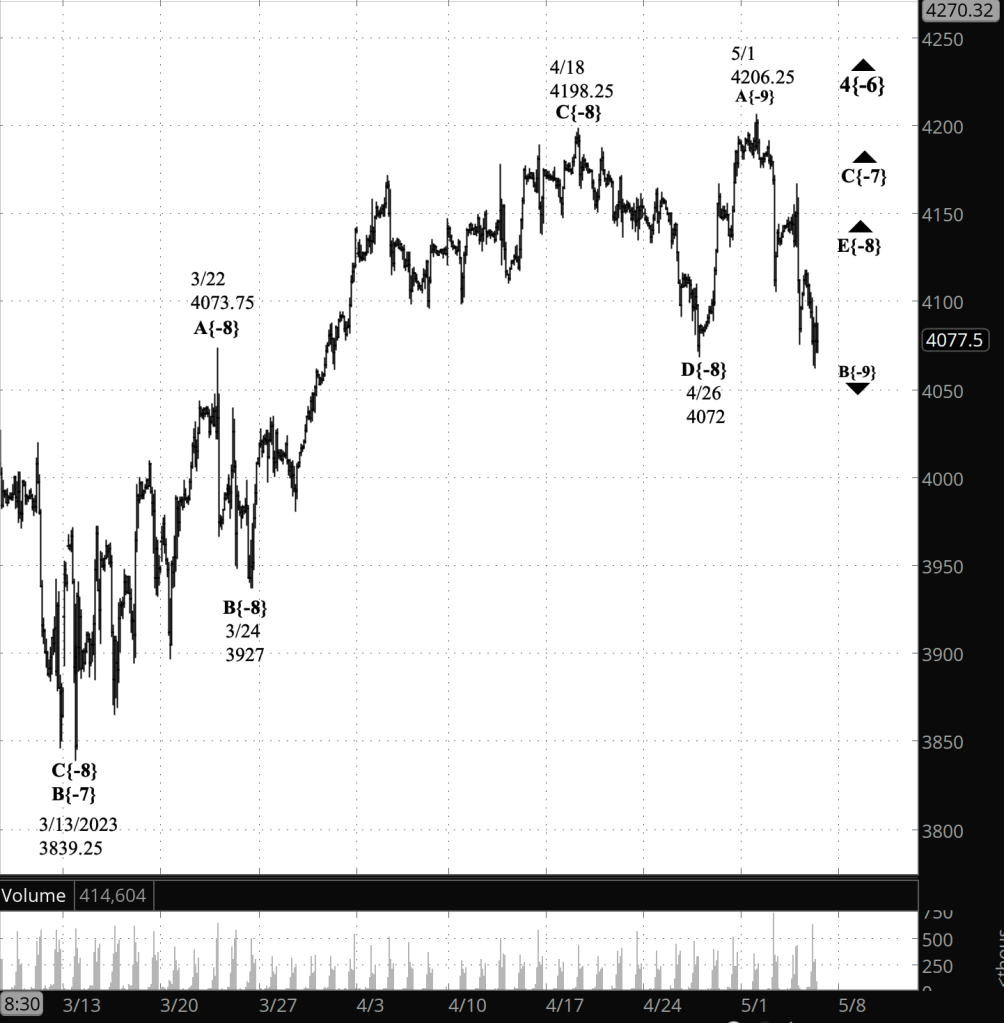
Half an hour before the closing bell. The S&P 500 futures rose rapidly during the session, rising more than 50 points, from 4122 to 4179 and then pulling back slightly.

The rise broke beyond the upper boundary of the triangle, and with that new information, I’ve changed the endpoint of wave D{-9} from May 10 to the May 16 low, 4120. The breakout carried the price above the preceding C-wave peak, 4161, but remains below the preceding A-wave peak, 4206.25, (I’ve corrected the price labeling both of those peaks on the chart.)

Wave E{-9} is the final wave of wave E{-8}, which in turn is the final wave within wave C{-7}, which is the last wave of the upward correction that has been underway since October 13, 2022.

Typically wave E{-9} will move

Bottom line: The end is near.

I’ve updated the chart and the Elliott wave section, both below.

9:35 a.m. New York time

What’s happening now? The S&P 500 E-mini futures continued to progress through its final phase within the narrow bounds of a triangle structure.

What does it mean? The triangle, which began on May 10, is part of the final segment of an upward correction three levels larger that began on October 13, 2022. The end of the triangle will also be the end of the larger correction and will be followed by a downtrend that will carry the price below the correction’s starting point, 3502, and likely well below that price.

On the chart, I’ve marked the triangle structure now underway with red lines. See the Reading the Chart section below for an explanation of the wave labeling.

What are the alternatives? Unchanged from yesterday. If the correction forms a compound structure, then the present corrective pattern won’t complete the correction. Instead, it will be followed by a declining wave and then a second corrective pattern. Compound corrections can be formed from as many as three patterns.
[S&P 500 E-mini futures at 3:30 p.m., 120-minute bars, with volume]

What does Elliott wave theory say? Here are the waves that underly the analyses, updated with the afternoon analysis.

Principal analysis:

  • An upward correction, wave 4{-6}, began on October 13, 2022 and is underway.
  • The correction’s first subwave, wave A{-7}, had five subwaves, meaning the correction is taking the form of a Zigzag
  • Wave 4{-6} is in its final subwave wave, C{-7}, which began on March 13, 2023.
  • Wave C{-7} is taking the form of a Zigzag and as expected, has already exceeded the peak of the first subwave of the correction, wave A{-7}, which ended on December 13, 2022 at 4180.
  • Wave C{-7} is in its final subwave, wave E{-8}.
  • Wave E{-8} is in its final subwave, rising wave E{-9}.
  • The end of wave E{-9} will cascade up the wave degrees, marking the end of waves E{-8}, C{-7} and of the correction, wave 4{-6}
  • Wave 4{-6} will be followed by downtrending wave 5{-6}, which, like all 5th waves, might match one of a number of different patterns, all based on the downtrend’s relation with the end of the preceding 3rd wave, at 3502.
  • Almost always a 5th wave will move past the preceding 3rd wave’s end point.
  • Some 5th waves are truncated, and on this chart that means wave 5{-6} would end before reaching 3502.
  • Some 5th waves are extended, that would mean wave 5{-6} would have nine waves internally rather than the usual five, and would cover a greater than expected distance over a greater than expected period of time.

Alternative analysis, compound correction:

  • The end of wave C{-7} may won’t be the end of the wave 4{-6} correction.
  • Wave 4{-6} will form a compound structure and wave C{-7} ends the first corrective pattern.
  • Wave C{-7} will be followed by a declining connector, wave X{-7}, and then by a second corrective pattern.

Reading the chart. Price movements — waves – – in Elliott wave analysis are labeled with numbers within trending waves and letters with corrective waves. The subscripts — numbers in curly brackets — designate the wave’s degree, which, in Elliott wave analysis, means the relative position of a wave within the larger and smaller structures that make up the chart. R.N. Elliott, who in the 1930s developed the form of analysis that bears his name, viewed the chart as a complex structure of smaller waves nested within larger waves, which in turn are nested within still larger waves. In mathematics it’s called a fractal structure, where at every scale the pattern is similar to the others.

We Are Here.

These are the waves currently in progress under my principal analysis. Each line on the list shows the wave number, with the subscript in curly brackets, the traditional degree name, the starting date, the starting price of the S&P 500 E-mini futures, and the direction of the wave.

  • S&P 500 Index:
  • 5{+3} Supercycle, 7/8/1932, 4.40 (up)
  • 5{+2} Cycle, 12/9/1974, 60.96 (up)
  • 5{+1} Primary, 3/6/2009, 666.79 (up)
  • 5{0} Intermediate, 12/26/2018, 2346.58 (up)
  • S&P 500 Futures and index:
  • 4{-1} Minor, 1/4/2022, 4808.25 (down) (futures), 4818.62 (down) (index)
  • S&P 500 Futures:
  • 1{-2} Minute, 1/4/2022, 4808.25 (down)
  • 1{-3} Minuette, 1/4/2022, 4808.25 (down)
  • 1{-4} Subminuette, 1/4/2022, 4808.25 (down)
  • 1{-5} Micro, 1/4/2022, 4808.25 (down)
  • 4{-6} Submicro, 10/13/2022, 3502 (up)
  • C{-7} Minuscule, 3/13/2023, 3830.25 (up)

Learning and other resources. Elliott wave analysis provides context, not prophecy. As the 20th century semanticist Alfred Korzybski put it in his book Science and Sanity (1933), “The map is not the territory … The only usefulness of a map depends on similarity of structure between the empirical world and the map.” And I would add, in the ever-changing markets, we can judge that similarity of structure only after the fact.

See the menu page Analytical Methods for a rundown on where to go for information on Elliott wave analysis.

By Tim Bovee, Portland, Oregon, May 17, 2023

Disclaimer

Tim Bovee, Private Trader tracks the analysis and trades of a private trader for his own accounts. Nothing in this blog constitutes a recommendation to buy or sell stocks, options or any other financial instrument. The only purpose of this blog is to provide education and entertainment.

No trader is ever 100 percent successful in his or her trades. Trading in the stock and option markets is risky and uncertain. Each trader must make trading decisions for his or her own account, and take responsibility for the consequences.

License
Creative Commons License

All content on Tim Bovee, Private Trader by Timothy K. Bovee is licensed under a Creative Commons Attribution-ShareAlike 4.0 International License.

Based on a work at www.timbovee.com.
Trader’s Notebook

3:30 p.m. New York time

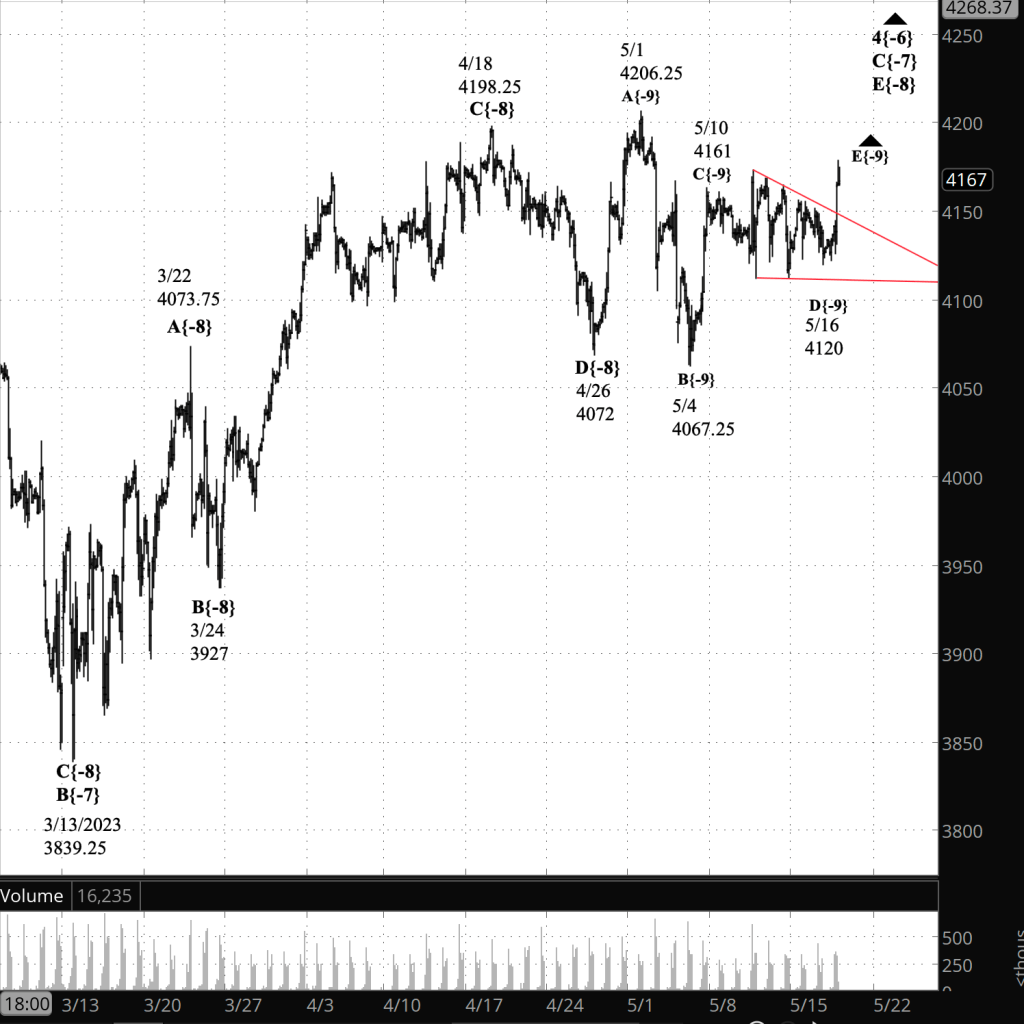
Half an hour before the closing bell. The S&P 500 futures continued to fluctuate narrowly as it works its way through a triangle, the wave that, when complete, will also be the end of the much larger upward correction that began last October. No change from this morning’s analysis. I’ve updated the chart.

9:35 a.m. New York time

What’s happening now? The S&P 500 E-mini futures continued zigzagging overnight, reaching a low of 4135.25 and then rising to a peak of 4151.50 before pulling back.

What does it mean? In last Friday’s analysis I mentioned the possibility that a triangle was developing. It’s clear now that such is the case. The triangle form can be characteristic of the final wave of a larger movement. If the triangle analysis proves to be correct, then the upward correction that began on October 13, 2022 is in its last leg down three levels of subwaves. The triangle is nearing the 4th of five subwaves.

What are the alternatives? If the correction forms a compound structure, then the present corrective pattern won’t complete the correction. Instead, it will be followed by a declining wave and then a second corrective pattern. Compound corrections can be formed from as many as three patterns.

Reading the chart. On the chart, I’ve marked the triangle structure now underway with red lines.

Price movements — waves – – in Elliott wave analysis are labeled with numbers within trending waves and letters with corrective waves. The subscripts — numbers in curly brackets — designate the wave’s degree, which, in Elliott wave analysis, means the relative position of a wave within the larger and smaller structures that make up the chart. R.N. Elliott, who in the 1930s developed the form of analysis that bears his name, viewed the chart as a complex structure of smaller waves nested within larger waves, which in turn are nested within still larger waves. In mathematics it’s called a fractal structure, where at every scale the pattern is similar to the others.

[S&P 500 E-mini futures at 3:30 p.m., 120-minute bars, with volume]

What does Elliott wave theory say? Here are the waves that underly the analyses.

Principal analysis:

  • An upward correction, wave 4{-6}, began on October 13, 2022 and is underway.
  • The correction’s first subwave, wave A{-7}, had five subwaves, meaning the correction is taking the form of a Zigzag
  • Wave 4{-6} is in its final subwave wave, C{-7}, which began on March 13, 2023.
  • Wave C{-7} is in its final subwave, wave E{-8}.
  • Wave E{-8} is in its final subwave, wave D{-9}, which is taking the form of a triangle.
  • Wave 4{-6} will be followed by downtrending wave 5{-6}, which, like all 5th waves, might match one of a number of different patterns, all based on the downtrend’s relation with the end of the preceding 3rd wave, at 3502.
  • Almost always a 5th wave will move past the preceding 3rd wave’s end point.
  • Some 5th waves are truncated, and on this chart that means wave 5{-6} would end before reaching 3502.
  • Some 5th waves are extended, that would mean wave 5{-6} would have nine waves internally rather than the usual five, and would cover a greater than expected distance over a greater than expected period of time.

Alternative analysis, compound correction:

  • The end of wave C{-7} may won’t be the end of the wave 4{-6} correction.
  • Wave 4{-6} will form a compound structure and wave C{-7} ends the first corrective pattern.
  • Wave C{-7} will be followed by a declining connector, wave X{-7}, and then by a second corrective pattern.

We Are Here.

These are the waves currently in progress under my principal analysis. Each line on the list shows the wave number, with the subscript in curly brackets, the traditional degree name, the starting date, the starting price of the S&P 500 E-mini futures, and the direction of the wave.

  • S&P 500 Index:
  • 5{+3} Supercycle, 7/8/1932, 4.40 (up)
  • 5{+2} Cycle, 12/9/1974, 60.96 (up)
  • 5{+1} Primary, 3/6/2009, 666.79 (up)
  • 5{0} Intermediate, 12/26/2018, 2346.58 (up)
  • S&P 500 Futures and index:
  • 4{-1} Minor, 1/4/2022, 4808.25 (down) (futures), 4818.62 (down) (index)
  • S&P 500 Futures:
  • 1{-2} Minute, 1/4/2022, 4808.25 (down)
  • 1{-3} Minuette, 1/4/2022, 4808.25 (down)
  • 1{-4} Subminuette, 1/4/2022, 4808.25 (down)
  • 1{-5} Micro, 1/4/2022, 4808.25 (down)
  • 4{-6} Submicro, 10/13/2022, 3502 (up)
  • C{-7} Minuscule, 3/13/2023, 3830.25 (up)

Learning and other resources. Elliott wave analysis provides context, not prophecy. As the 20th century semanticist Alfred Korzybski put it in his book Science and Sanity (1933), “The map is not the territory … The only usefulness of a map depends on similarity of structure between the empirical world and the map.” And I would add, in the ever-changing markets, we can judge that similarity of structure only after the fact.

See the menu page Analytical Methods for a rundown on where to go for information on Elliott wave analysis.

By Tim Bovee, Portland, Oregon, May 16, 2023

Disclaimer

Tim Bovee, Private Trader tracks the analysis and trades of a private trader for his own accounts. Nothing in this blog constitutes a recommendation to buy or sell stocks, options or any other financial instrument. The only purpose of this blog is to provide education and entertainment.

No trader is ever 100 percent successful in his or her trades. Trading in the stock and option markets is risky and uncertain. Each trader must make trading decisions for his or her own account, and take responsibility for the consequences.

License
Creative Commons License

All content on Tim Bovee, Private Trader by Timothy K. Bovee is licensed under a Creative Commons Attribution-ShareAlike 4.0 International License.

Based on a work at www.timbovee.com.

Trader’s Notebook

3:30 p.m. New York time

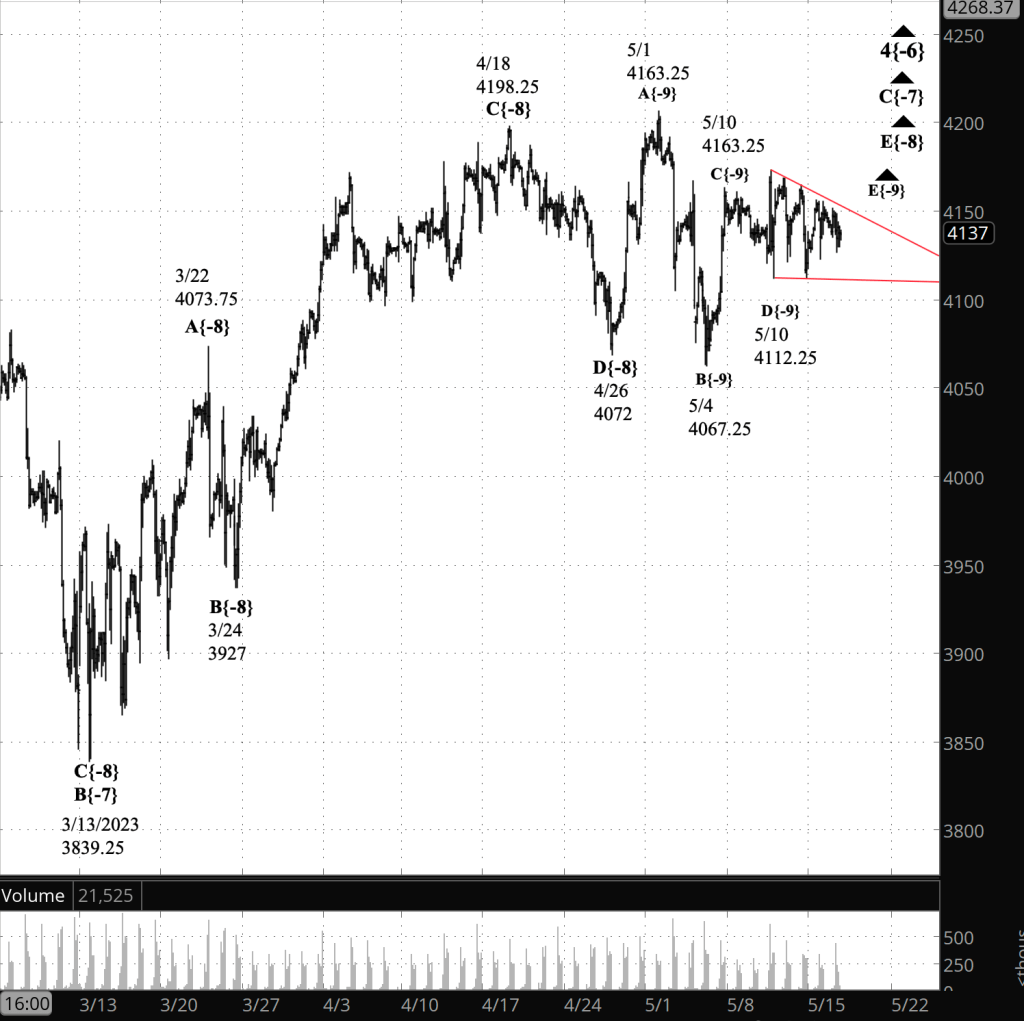
Half an hour before the closing bell. The S&P 500 futures continued to fluctuate narrowly during the session, between an early low in the 4120s and the session high in the 4150s. This morning’s analysis stands unchanged. I’ve updated the chart.

9:35 a.m. New York time

What’s happening now? The S&P 500 E-mini futures rose into the 4150s after trading resumed overnight, and then fell, reaching into the 4130s so far.

What does it mean? The upward correction that began on October 13 continues to work through its final movements. The correction is in its last leg. Internally, that final upward movement is in the final subwaves two degrees down, and at the lowest level I track, is in its next-to-the-last subwave, a downward movement that began on May 10.

The end of that smallest wave will also be the end the correction, which will be followed by a downtrend that will fall below the correction’s starting point, 3502, and most likely quite a distance below that level.

What are the alternatives? There are two, unchanged from week. The first is likely to remain with us as a possibility until after the final wave of the correction is complete; the second until the smallest wave in my analysis, the one that began on May 10, reaches its end.

Alternative #1

If the correction forms a compound structure, then the present corrective pattern won’t complete the correction. Instead, it will be followed by a declining wave and then a second corrective pattern. Compound corrections can be formed from as many as three patterns.

Alternative #2

For the second alternative, I’ll need to se the jargon of Elliott wave analysis that is used on the chart. See the “Reading the Chart” section below for an explainer.

In the nearer-term, we’re wading through the ambiguities of which low point marks the end of the downtrending low-degree wave, D{-9}, and the final uptrending wave, E{-9}, that will bring the correction to an end. Identifying turning points means navigating the ambiguity inherent in Elliott wave analysis. So, rule of thumb: Each low since the May 10 peak could be the end of the D{-9}. Or not. Each high could mean the final wave, E{-9}, has begun. Or not.

Reading the chart. Price movements — waves – – in Elliott wave analysis are labeled with numbers within trending waves and letters with corrective waves. The subscripts — numbers in curly brackets — designate the wave’s degree, which, in Elliott wave analysis, means the relative position of a wave within the larger and smaller structures that make up the chart. R.N. Elliott, who in the 1930s developed the form of analysis that bears his name, viewed the chart as a complex structure of smaller waves nested within larger waves, which in turn are nested within still larger waves. In mathematics it’s called a fractal structure, where at every scale the pattern is similar to the others.

[S&P 500 E-mini futures at 3:30 p.m., 120-minute bars, with volume]

What does Elliott wave theory say? Here are the waves that underly the analyses.

Principal analysis:

  • An upward correction, wave 4{-6}, began on October 13, 2022 and is underway.
  • The correction’s first subwave, wave A{-7}, had five subwaves, meaning the correction is taking the form of a Zigzag
  • Wave 4{-6} is in its final subwave wave, C{-7}, which began on March 13, 2023.
  • Wave C{-7} is in its final subwave, wave E{-8}.
  • Wave E{-8} is in its next-to-the-last subwave, falling wave D{-9}.
  • Wave 4{-6} will be followed by downtrending wave 5{-6}, which, like all 5th waves, might match one of a number of different patterns, all based on the downtrend’s relation with the end of the preceding 3rd wave, at 3502.
  • Almost always a 5th wave will move past the preceding 3rd wave’s end point.
  • Some 5th waves are truncated, and on this chart that means wave 5{-6} would end before reaching 3502.
  • Some 5th waves are extended, that would mean wave 5{-6} would have nine waves internally rather than the usual five, and would cover a greater than expected distance over a greater than expected period of time.

Alternative analysis #1, compound correction:

  • The end of wave C{-7} may won’t be the end of the wave 4{-6} correction.
  • Wave 4{-6} will form a compound structure and wave C{-7} ends the first corrective pattern.
  • Wave C{-7} will be followed by a declining connector, wave X{-7}, and then by a second corrective pattern.

Alternative analysis #2, turning points

  • At some point, wave D{-9} will end and wave E{-9}, the final wave that will end the upward correction, will begin.
  • It won’t be obvious when that happens.
  • A move below the prior low point of wave D{-9} will confirm that the wave has been underway, and it may or may not end at that new low.
  • A move above the wave C{-9} peak will confirm that wave D{-9} has ended and wave E{-9} has begun.

Bigger structures:

  • This is all happening within downtrending wave 1{-5}, which began on January 4, 2022 from 4808.25.
  • Wave 1{-5} is a subwave of a nested series of larger subwaves, from wave 1{-4} to wave 1{-2}. which also began on January 4, 2022.
  • Wave 1{-2} is a subwave of wave 4{-1}, the next-to-the-last wave within a large expanding Diagonal Triangle, wave 5{0}, that began on December 26, 2018.
  • When wave 4{-1} is complete, wave 5{-1} will begin and will carry the wave above the January 4 high.25, and back to the upper boundary of the triangle, which gets higher continually and is in the 6140s.

We Are Here.

These are the waves currently in progress under my principal analysis. Each line on the list shows the wave number, with the subscript in curly brackets, the traditional degree name, the starting date, the starting price of the S&P 500 E-mini futures, and the direction of the wave.

  • S&P 500 Index:
  • 5{+3} Supercycle, 7/8/1932, 4.40 (up)
  • 5{+2} Cycle, 12/9/1974, 60.96 (up)
  • 5{+1} Primary, 3/6/2009, 666.79 (up)
  • 5{0} Intermediate, 12/26/2018, 2346.58 (up)
  • S&P 500 Futures and index:
  • 4{-1} Minor, 1/4/2022, 4808.25 (down) (futures), 4818.62 (down) (index)
  • S&P 500 Futures:
  • 1{-2} Minute, 1/4/2022, 4808.25 (down)
  • 1{-3} Minuette, 1/4/2022, 4808.25 (down)
  • 1{-4} Subminuette, 1/4/2022, 4808.25 (down)
  • 1{-5} Micro, 1/4/2022, 4808.25 (down)
  • 4{-6} Submicro, 10/13/2022, 3502 (up)
  • C{-7} Minuscule, 3/13/2023, 3830.25 (up)

Learning and other resources. Elliott wave analysis provides context, not prophecy. As the 20th century semanticist Alfred Korzybski put it in his book Science and Sanity (1933), “The map is not the territory … The only usefulness of a map depends on similarity of structure between the empirical world and the map.” And I would add, in the ever-changing markets, we can judge that similarity of structure only after the fact.

See the menu page Analytical Methods for a rundown on where to go for information on Elliott wave analysis.

By Tim Bovee, Portland, Oregon, May 15, 2023

Disclaimer

Tim Bovee, Private Trader tracks the analysis and trades of a private trader for his own accounts. Nothing in this blog constitutes a recommendation to buy or sell stocks, options or any other financial instrument. The only purpose of this blog is to provide education and entertainment.

No trader is ever 100 percent successful in his or her trades. Trading in the stock and option markets is risky and uncertain. Each trader must make trading decisions for his or her own account, and take responsibility for the consequences.

License
Creative Commons License

All content on Tim Bovee, Private Trader by Timothy K. Bovee is licensed under a Creative Commons Attribution-ShareAlike 4.0 International License.

Based on a work at www.timbovee.com.

Trader’s Notebook

3:30 p.m. New York time

Half an hour before the closing bell. The S&P 500 futures dropped rapidly during the session, reaching a low so far of 4111.75. The fall broke the triangle pattern discussed this morning. I count the decline as the 3rd internal wave within the lowest degree that I’m tracking, wave D{-9}. It’s a subwave within rising wave E{-8} within rising wave C{-7} within the upward correction, wave 4{-6}. Wave E{-9} will follow and when complete, will be the end of the correction. A downtrend, wave 5{-6}, will follow. I’ve updated the chart below.

9:35 a.m. New York time

What’s happening now? The S&P 500 E-mini futures rose back into the 4160s overnight, remaining below yesterday’s session high, and then began to decline again. The pattern since May 10 has begun to resemble a contracting triangle, with higher lows and lower highs. Both high turning points are positioned lower than the one before, and the low turning point between them being higher than the one before. I think of such narrowing price swings as an equally batched battle between Bulls and Bears that often suggests that a change in direction lies ahead.

What does it mean? There’s no guarantee that the pattern will in fact form a triangle, and so for now I’m staying with yesterday’s analysis. The upward correction is nearing its end, is in its final wave both one degree and two degrees down, and is in its next-to-the-last wave three degrees down.

What are the alternatives? There are two, unchanged from yesterday.

If the correction forms a compound structure, then the present corrective pattern won’t complete the correction. Instead, it will be followed by a declining wave and then a second corrective pattern. Compound corrections can be formed from as many as three patterns.

It’s not really an alternative, but in the nearer-term, we’re wading through the ambiguities of which low point marks the end of the downtrending low-degree wave, D{-9}, and the final uptrending wave, E{-9}, that will bring the correction to an end. Identifying turning points means navigating the ambiguity inherent in Elliott wave analysis. So, rule of thumb: Each low since the May 10 peak could be the end of the D{-9}. Or not. Each high could mean the final wave, E{-9}, has begun. Or not.

Reading the chart. I mentioned “degrees” above, which, in Elliott wave analysis, means the relative position of a wave within the larger and smaller structures that make up the chart. R.N. Elliott, who in the 1930s developed the form of analysis that bears his name, viewed the chart as a complex structure of smaller waves nested within larger waves, which in turn are nested within still larger waves. In mathematicfs it’s called a fractal structure, where at every scale the pattern is similar to the others.

My labeling system assigns numbers to the subwaves of trending waves, and letters to the subwaves of corrections. Each number or letter is followed by a subscript, in curly brackets, showing the wave’s degreeThe smaller the number, the lower the degree. On this chart we’re dealing with relatively small waves, so the degree numbers are negative.

[S&P 500 E-mini futures at 3:30 p.m., 2-hour bars, with volume]

What does Elliott wave theory say? Here are the waves that underly the analyses, unchanged from yesterday.

Principal analysis:

  • An upward correction, wave 4{-6}, began on October 13, 2022 and is underway.
  • The correction’s first subwave, wave A{-7}, had five subwaves, meaning the correction is taking the form of a Zigzag
  • Wave 4{-6} is in its final subwave wave, C{-7}, which began on March 13, 2023.
  • Wave C{-7} is in its final subwave, wave E{-8}.
  • Wave E{-8} is in its next-to-the-last subwave, falling wave D{-9}.
  • Wave 4{-6} will be followed by downtrending wave 5{-6}, which, like all 5th waves, might match one of a number of different patterns, all based on the downtrend’s relation with the end of the preceding 3rd wave, at 3502.
  • Almost always a 5th wave will move past the preceding 3rd wave’s end point.
  • Some 5th waves are truncated, and on this chart that means wave 5{-6} would end before reaching 3502.
  • Some 5th waves are extended, that would mean wave 5{-6} would have nine waves internally rather than the usual five, and would cover a greater than expected distance over a greater than expected period of time.

Alternative analysis, compound correction:

  • The end of wave C{-7} may won’t be the end of the wave 4{-6} correction.
  • Wave 4{-6} will form a compound structure and wave C{-7} ends the first corrective pattern.
  • Wave C{-7} will be followed by a declining connector, wave X{-7}, and then by a second corrective pattern.

Alternative analysis, turning points

  • At some point, wave D{-9} will end and wave E{-9}, the final wave that will end the upward correction, will begin.
  • It won’t be obvious when that happens.
  • A move below the prior low point of wave D{-9} will confirm that the wave has been underway, and it may or may not end at that new low.
  • A move above the wave C{-9} peak will confirm that wave D{-9} has ended and wave E{-9} has begun.

Bigger structures:

  • This is all happening within downtrending wave 1{-5}, which began on January 4, 2022 from 4808.25.
  • Wave 1{-5} is a subwave of a nested series of larger subwaves, from wave 1{-4} to wave 1{-2}. which also began on January 4, 2022.
  • Wave 1{-2} is a subwave of wave 4{-1}, the next-to-the-last wave within a large expanding Diagonal Triangle, wave 5{0}, that began on December 26, 2018.
  • When wave 4{-1} is complete, wave 5{-1} will begin and will carry the wave above the January 4 high.25, and back to the upper boundary of the triangle, which gets higher continually and is in the 6140s.

We Are Here.

These are the waves currently in progress under my principal analysis. Each line on the list shows the wave number, with the subscript in curly brackets, the traditional degree name, the starting date, the starting price of the S&P 500 E-mini futures, and the direction of the wave.

  • S&P 500 Index:
  • 5{+3} Supercycle, 7/8/1932, 4.40 (up)
  • 5{+2} Cycle, 12/9/1974, 60.96 (up)
  • 5{+1} Primary, 3/6/2009, 666.79 (up)
  • 5{0} Intermediate, 12/26/2018, 2346.58 (up)
  • S&P 500 Futures and index:
  • 4{-1} Minor, 1/4/2022, 4808.25 (down) (futures), 4818.62 (down) (index)
  • S&P 500 Futures:
  • 1{-2} Minute, 1/4/2022, 4808.25 (down)
  • 1{-3} Minuette, 1/4/2022, 4808.25 (down)
  • 1{-4} Subminuette, 1/4/2022, 4808.25 (down)
  • 1{-5} Micro, 1/4/2022, 4808.25 (down)
  • 4{-6} Submicro, 10/13/2022, 3502 (up)
  • C{-7} Minuscule, 3/13/2023, 3830.25 (up)

Learning and other resources. Elliott wave analysis provides context, not prophecy. As the 20th century semanticist Alfred Korzybski put it in his book Science and Sanity (1933), “The map is not the territory … The only usefulness of a map depends on similarity of structure between the empirical world and the map.” And I would add, in the ever-changing markets, we can judge that similarity of structure only after the fact.

See the menu page Analytical Methods for a rundown on where to go for information on Elliott wave analysis.

By Tim Bovee, Portland, Oregon, May 12, 2023

Disclaimer

Tim Bovee, Private Trader tracks the analysis and trades of a private trader for his own accounts. Nothing in this blog constitutes a recommendation to buy or sell stocks, options or any other financial instrument. The only purpose of this blog is to provide education and entertainment.

No trader is ever 100 percent successful in his or her trades. Trading in the stock and option markets is risky and uncertain. Each trader must make trading decisions for his or her own account, and take responsibility for the consequences.

License
Creative Commons License

All content on Tim Bovee, Private Trader by Timothy K. Bovee is licensed under a Creative Commons Attribution-ShareAlike 4.0 International License.

Based on a work at www.timbovee.com.
Trader’s Notebook

3:30 p.m. New York time

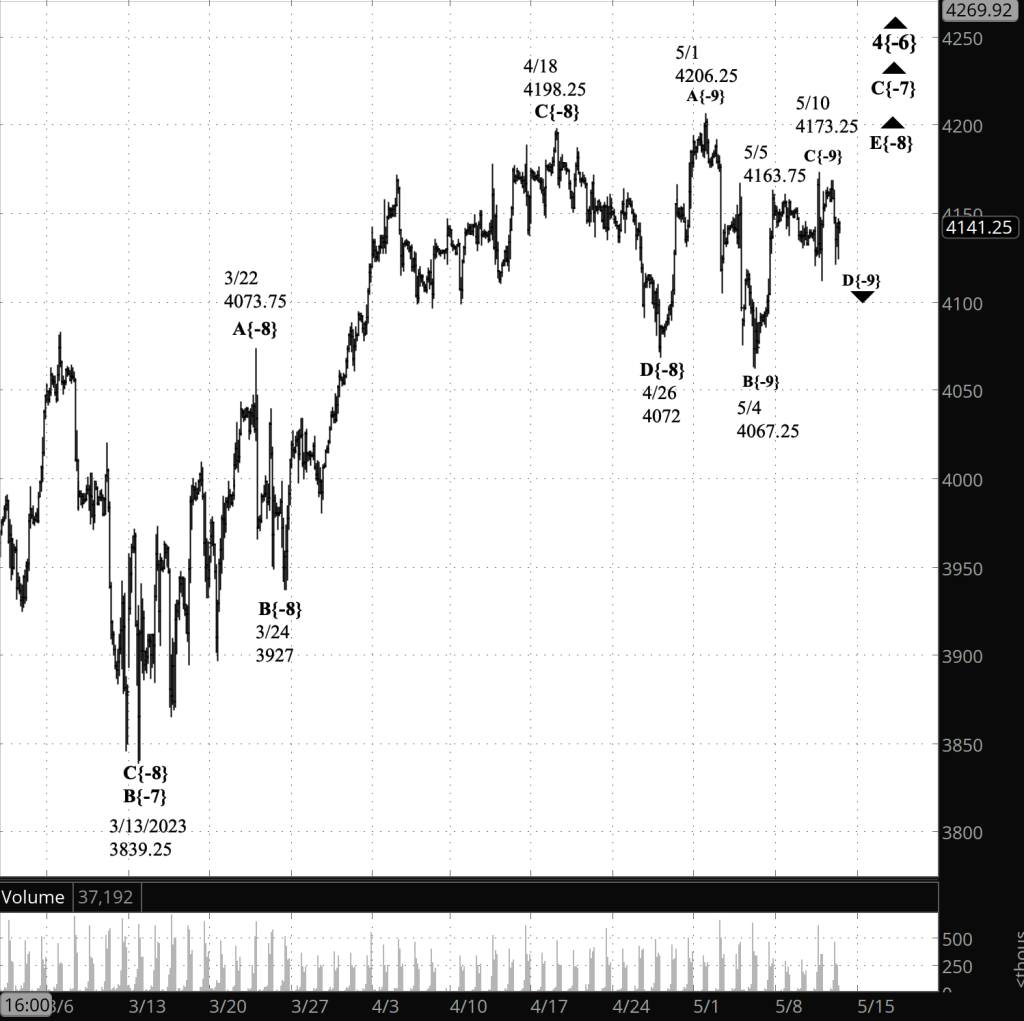
Half an hour before the closing bell. The S&P 500 fluctuated narrowly during the day, ranging from the 4120s to the 4140s. There’s no change in the analysis from this morning. The upward correction continues to work through it’s final patterns before reaching an end. I’ve updated the chart.

9:35 a.m. New York time

What’s happening now? The S&P 500 E-mini futures fell to the 4120s in overnight trading, remaining within Wednesday’s range, from the 4170s to the 4110s.

What does it mean? The upward correction that began on October 13, 2022 is nearing its end, and is working through its final subwaves two degrees smaller. Drop down one degree — the lowest level I’m tracking — and the price is in its declining next-to-the-last subwave.

When that smallest wave, D{-9} on the chart, reaches its end, that finality will cascade up the fractal structure, bringing the correction itself — wave 4{-6} on the chart — to a close.

A downtrend will follow, carrying the price below the correction’s starting point — 3502 — and most likely noticeably lower.

What are the alternatives? If the correction forms a compound structure, then the present corrective pattern won’t complete the correction. Instead, it will be followed by a declining wave and then a second corrective pattern. Compound corrections can be formed from as many as three patterns.

It’s not really an alternative, but in the nearer-term, we’re wading through the ambiguities of which low point marks the end of the downtrending low-degree wave, D{-9}, and the final uptrending wave, E{-9}, that will bring the correction to an end. Identifying turning points means navigating the ambiguity inherent in Elliott wave analysis. So, rule of thumb: Each low since the May 10 peak could be the end of the D{-9}. Or not. Each high could mean the final wave, E{-9}, has begun. Or not.

[S&P 500 E-mini futures at 3:30 p.m., 2-hour bars, with volume]

What does Elliott wave theory say? Here are the waves that underly the analyses.

Principal analysis:

  • An upward correction, wave 4{-6}, began on October 13, 2022 and is underway.
  • The correction’s first subwave, wave A{-7}, had five subwaves, meaning the correction is taking the form of a Zigzag
  • Wave 4{-6} is in its final subwave wave, C{-7}, which began on March 13, 2023.
  • Wave C{-7} is in its final subwave, wave E{-8}.
  • Wave E{-8} is in its next-to-the-last subwave, falling wave D{-9}.
  • Wave 4{-6} will be followed by downtrending wave 5{-6}, which, like all 5th waves, might match one of a number of different patterns, all based on the downtrend’s relation with the end of the preceding 3rd wave, at 3502.
  • Almost always a 5th wave will move past the preceding 3rd wave’s end point.
  • Some 5th waves are truncated, and on this chart that means wave 5{-6} would end before reaching 3502.
  • Some 5th waves are extended, that would mean wave 5{-6} would have nine waves internally rather than the usual five, and would cover a greater than expected distance over a greater than expected period of time.

Alternative analysis, compound correction:

  • The end of wave C{-7} may won’t be the end of the wave 4{-6} correction.
  • Wave 4{-6} will form a compound structure and wave C{-7} ends the first corrective pattern.
  • Wave C{-7} will be followed by a declining connector, wave X{-7}, and then by a second corrective pattern.

Alternative analysis, turning points

  • At some point, wave D{-9} will end and wave E{-9}, the final wave that will end the upward correction, will begin.
  • It won’t be obvious when that happens.
  • A move below the prior low point of wave D{-9} will confirm that the wave has been underway, and it may or may not end at that new low.
  • A move above the wave C{-9} peak will confirm that wave D{-9} has ended and wave E{-9} has begun.

Bigger structures:

  • This is all happening within downtrending wave 1{-5}, which began on January 4, 2022 from 4808.25.
  • Wave 1{-5} is a subwave of a nested series of larger subwaves, from wave 1{-4} to wave 1{-2}. which also began on January 4, 2022.
  • Wave 1{-2} is a subwave of wave 4{-1}, the next-to-the-last wave within a large expanding Diagonal Triangle, wave 5{0}, that began on December 26, 2018.
  • When wave 4{-1} is complete, wave 5{-1} will begin and will carry the wave above the January 4 high.25, and back to the upper boundary of the triangle, which gets higher continually and is in the 6140s.

Reading the chart. Elliott wave analysis views the chart as a complex structure of smaller waves nested within larger waves, which in turn are nested within still larger waves. My labeling system assigns numbers to the subwaves of trending waves, and letters to the subwaves of corrections. Each number or letter is followed by a subscript, in curly brackets, showing the waves position within the complex structure, called its “degree” in Elliott wave parlance. The smaller the number, the lower the degree. On this chart we’re dealing with relatively small waves, so the degree numbers are negative.

We Are Here.

These are the waves currently in progress under my principal analysis. Each line on the list shows the wave number, with the subscript in curly brackets, the traditional degree name, the starting date, the starting price of the S&P 500 E-mini futures, and the direction of the wave.

  • S&P 500 Index:
  • 5{+3} Supercycle, 7/8/1932, 4.40 (up)
  • 5{+2} Cycle, 12/9/1974, 60.96 (up)
  • 5{+1} Primary, 3/6/2009, 666.79 (up)
  • 5{0} Intermediate, 12/26/2018, 2346.58 (up)
  • S&P 500 Futures and index:
  • 4{-1} Minor, 1/4/2022, 4808.25 (down) (futures), 4818.62 (down) (index)
  • S&P 500 Futures:
  • 1{-2} Minute, 1/4/2022, 4808.25 (down)
  • 1{-3} Minuette, 1/4/2022, 4808.25 (down)
  • 1{-4} Subminuette, 1/4/2022, 4808.25 (down)
  • 1{-5} Micro, 1/4/2022, 4808.25 (down)
  • 4{-6} Submicro, 10/13/2022, 3502 (up)
  • C{-7} Minuscule, 3/13/2023, 3830.25 (up)

Learning and other resources. Elliott wave analysis provides context, not prophecy. As the 20th century semanticist Alfred Korzybski put it in his book Science and Sanity (1933), “The map is not the territory … The only usefulness of a map depends on similarity of structure between the empirical world and the map.” And I would add, in the ever-changing markets, we can judge that similarity of structure only after the fact.

See the menu page Analytical Methods for a rundown on where to go for information on Elliott wave analysis.

By Tim Bovee, Portland, Oregon, May 11, 2023

Disclaimer

Tim Bovee, Private Trader tracks the analysis and trades of a private trader for his own accounts. Nothing in this blog constitutes a recommendation to buy or sell stocks, options or any other financial instrument. The only purpose of this blog is to provide education and entertainment.

No trader is ever 100 percent successful in his or her trades. Trading in the stock and option markets is risky and uncertain. Each trader must make trading decisions for his or her own account, and take responsibility for the consequences.

License
Creative Commons License

All content on Tim Bovee, Private Trader by Timothy K. Bovee is licensed under a Creative Commons Attribution-ShareAlike 4.0 International License.

Based on a work at www.timbovee.com.
Trader’s Notebook

3:30 p.m. New York time

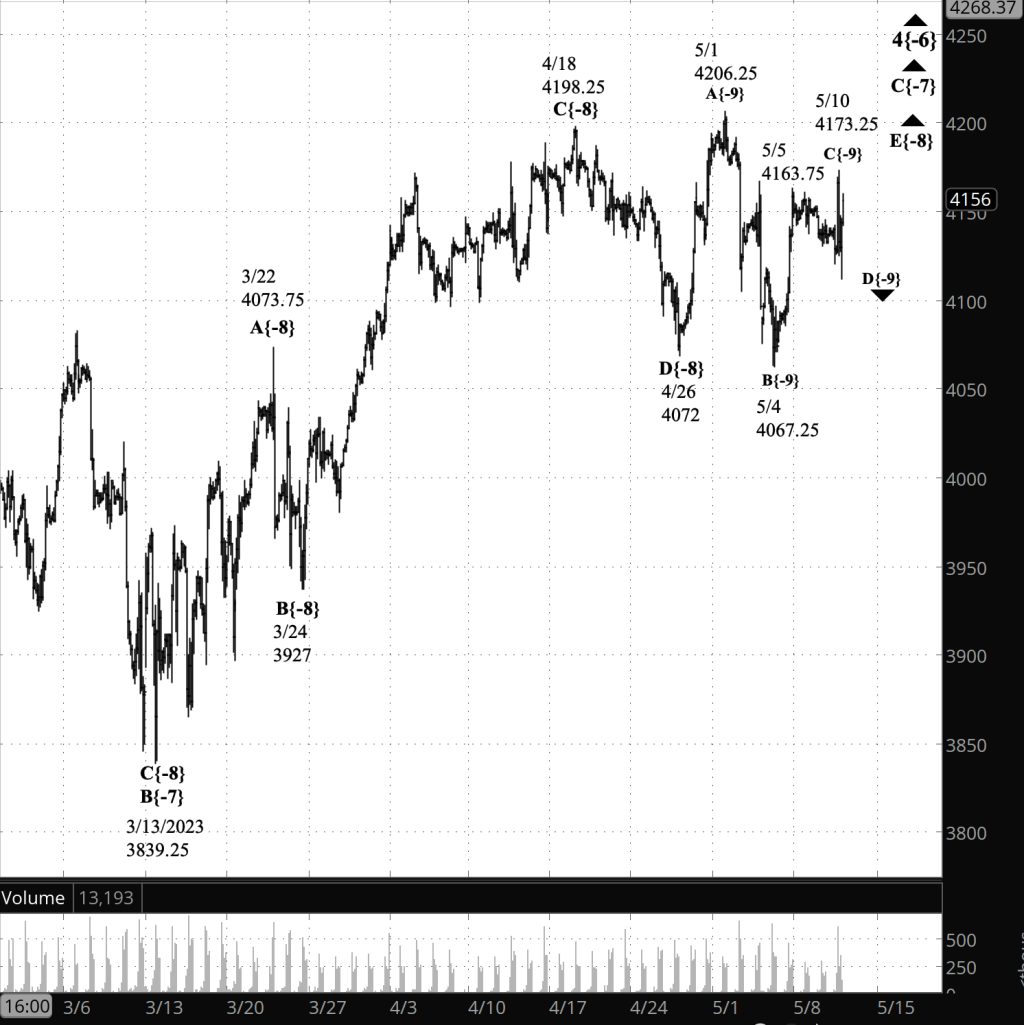
Half an hour before the closing bell. The S&P 500 futures delivered a whipsaw today, quickly rising to 4173.25 before the opening bell and declining during the session to 4112.25. It then started to rise again.

The whipsaw poses some problems for this morning’s analysis, since it carried the price above the May 5 high and then below yesterday’s low. It doesn’t break any strict rules of Elliott wave analysis, but it runs contrary to the subjective concept within the Elliott wave methodology, that a wave ought to have the right look and feel consistent with its position in the sequential progress of and the hierarchy of waves.

Whipsaws often produce terrible looks and feels. So here’s how I’ve dealt with it in my revised analysis of the low-degree waves.

Wave C{-9}, rather than ending on May 5, ended at today’s session high, 4173.25. The subsequent decline is wave D{-9}, which is still underway.

Contrary to this morning’s analysis, wave E{-9} has not yet begun.

If the price quickly rises above 4173.25, then I’ll change the analysis to show wave C{-9} as being underway.

Everything else remains as it was in this morning’s analysis: The upward correction, wave 4{-6}, is still underway and is in the final waves for two degrees down, waves C{-7} and E{-8}.

I’ve kept this morning’s chart with the old analysis for comparison. Here’s the new chart, with the revised analysis.

[New analysis: S&P 500 E-mini futures at 3:30 p.m., 120-minute bars, with volume]

9:35 a.m. New York time

What’s happening now? The S&P 500 E-mini futures fell to a low overnight of 4120.50 but rose immediately 4152.75 when fresh inflation stats confirmed analysts’ forecasts. The price continued to work its way higher, reaching into the 4170s

What does it mean? The upward correction continues and is in the last subwave of the last leg of its journey. This morning’s peak exceeded the May 5 high, 4163.75, which I analyzed yesterday as being the end of the middle segment of that last subwave. The higher high has several possible interpretations. My principal analysis has the decline to the overnight low as being the 4th segment within the last subwave, and the last segment as being underway.

The end of that last segment, wave E{-9} on the chart, will also be the end of the last segment, E{-8}, within the last leg, C{-7}, of the upward correction, wave 4{-6}. When the correction is complete, a downtrend will follow, carrying the price below the correction’s starting point, 3502, and possibly well below that level.

What are the alternatives? If the correction forms a compound structure, then the present corrective pattern won’t complete the correction. Instead, it will be followed by a declining wave and then a second corrective pattern. Compound corrections can be formed from as many as three patterns.

[Now outdated: S&P 500 E-mini futures at 9:35 a.m., 120-minute bars, with volume]

What does Elliott wave theory say? Here are the waves that underly this afternoon’s revised analyses (see upper chart).

Principal analysis:

  • An upward correction, wave 4{-6}, began on October 13, 2022 and is underway.
  • The correction’s first subwave, wave A{-7}, had five subwaves, meaning the correction is taking the form of a Zigzag
  • Wave 4{-6} is in its final subwave wave, C{-7}, which began on March 13, 2023.
  • Wave C{-7} is in its final subwave, wave E{-8}.
  • Wave E{-8} is in its next-to-the-last subwave, falling wave D{-9}.
  • Wave 4{-6} will be followed by downtrending wave 5{-6}, which, like all 5th waves, might match one of a number of different patterns, all based on the downtrend’s relation with the end of the preceding 3rd wave, at 3502.
  • Almost always a 5th wave will move past the preceding 3rd wave’s end point.
  • Some 5th waves are truncated, and on this chart that means wave 5{-6} would end before reaching 3502.
  • Some 5th waves are extended, that would mean wave 5{-6} would have nine waves internally rather than the usual five, and would cover a greater than expected distance over a greater than expected period of time.

Alternative analysis:

  • The end of wave C{-7} may won’t be the end of the wave 4{-6} correction.
  • Wave 4{-6} will form a compound structure and wave C{-7} ends the first corrective pattern.
  • Wave C{-7} will be followed by a declining connector, wave X{-7}, and then by a second corrective pattern.

Bigger structures:

  • This is all happening within downtrending wave 1{-5}, which began on January 4, 2022 from 4808.25.
  • Wave 1{-5} is a subwave of a nested series of larger subwaves, from wave 1{-4} to wave 1{-2}. which also began on January 4, 2022.
  • Wave 1{-2} is a subwave of wave 4{-1}, the next-to-the-last wave within a large expanding Diagonal Triangle, wave 5{0}, that began on December 26, 2018.
  • When wave 4{-1} is complete, wave 5{-1} will begin and will carry the wave above the January 4 high.25, and back to the upper boundary of the triangle, which gets higher continually and is in the 6140s.

Reading the chart. Elliott wave analysis views the chart as a complex structure of smaller waves nested within larger waves, which in turn are nested within still larger waves. My labeling system assigns numbers to the subwaves of trending waves, and letters to the subwaves of corrections. Each number or letter is followed by a subscript, in curly brackets, showing the waves position within the complex structure, called its “degree” in Elliott wave parlance. The smaller the number, the lower the degree. On this chart we’re dealing with relatively small waves, so the degree numbers are negative.

We Are Here.

These are the waves currently in progress under my principal analysis. Each line on the list shows the wave number, with the subscript in curly brackets, the traditional degree name, the starting date, the starting price of the S&P 500 E-mini futures, and the direction of the wave.

  • S&P 500 Index:
  • 5{+3} Supercycle, 7/8/1932, 4.40 (up)
  • 5{+2} Cycle, 12/9/1974, 60.96 (up)
  • 5{+1} Primary, 3/6/2009, 666.79 (up)
  • 5{0} Intermediate, 12/26/2018, 2346.58 (up)
  • S&P 500 Futures and index:
  • 4{-1} Minor, 1/4/2022, 4808.25 (down) (futures), 4818.62 (down) (index)
  • S&P 500 Futures:
  • 1{-2} Minute, 1/4/2022, 4808.25 (down)
  • 1{-3} Minuette, 1/4/2022, 4808.25 (down)
  • 1{-4} Subminuette, 1/4/2022, 4808.25 (down)
  • 1{-5} Micro, 1/4/2022, 4808.25 (down)
  • 4{-6} Submicro, 10/13/2022, 3502 (up)
  • C{-7} Minuscule, 3/13/2023, 3830.25 (up)

Learning and other resources. Elliott wave analysis provides context, not prophecy. As the 20th century semanticist Alfred Korzybski put it in his book Science and Sanity (1933), “The map is not the territory … The only usefulness of a map depends on similarity of structure between the empirical world and the map.” And I would add, in the ever-changing markets, we can judge that similarity of structure only after the fact.

See the menu page Analytical Methods for a rundown on where to go for information on Elliott wave analysis.

By Tim Bovee, Portland, Oregon, May 10, 2023

Disclaimer

Tim Bovee, Private Trader tracks the analysis and trades of a private trader for his own accounts. Nothing in this blog constitutes a recommendation to buy or sell stocks, options or any other financial instrument. The only purpose of this blog is to provide education and entertainment.

No trader is ever 100 percent successful in his or her trades. Trading in the stock and option markets is risky and uncertain. Each trader must make trading decisions for his or her own account, and take responsibility for the consequences.

License
Creative Commons License

All content on Tim Bovee, Private Trader by Timothy K. Bovee is licensed under a Creative Commons Attribution-ShareAlike 4.0 International License.

Based on a work at www.timbovee.com.
Trader’s Notebook

3:30 p.m. New York time

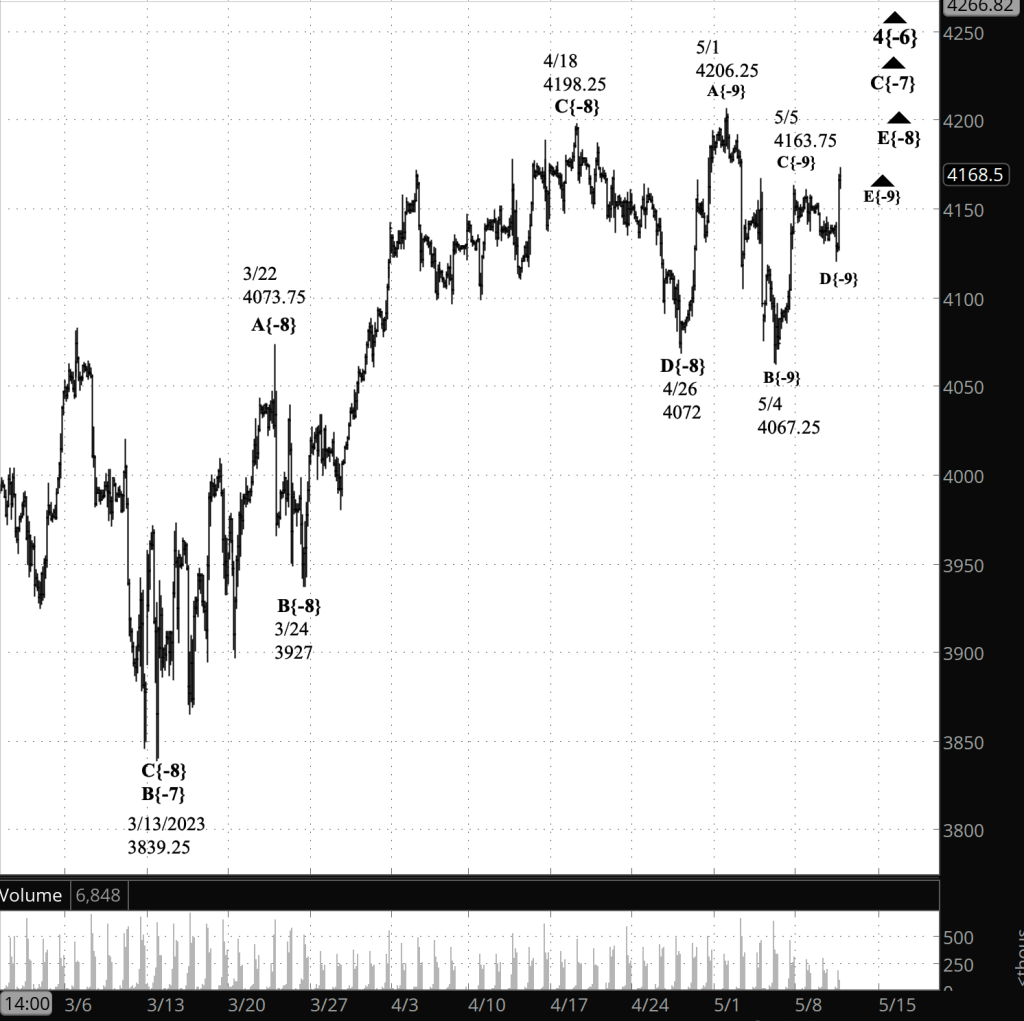
Half an hour before the closing bell. The S&P 500 futures traded narrowly during the session, as the upward correction, wave 4[-6}, continues. Wave 4{-6} is in its third and final wave, C{-7}, which is in its final subwave, wave E{-8}, which is in its next-to-the-last subwave, downward wave D{-9}.

The beginning of wave D{-9} is new development since this morning’s analysis. All else is unchanged. I’ve updated the chart and the Elliott wave theory section.

9:35 a.m. New York time

What’s happening now? The S&P 500 E-mini futures fell overnight from the 4150s to the 4130s, continuing a sideways movement that has been underway since last week.

What does it mean? The upward correction that began 17 months ago continues and is nearing its end. It will be followed by a downtrend that will carry the price significantly lower.

What are the alternatives? Or at least, probably is nearing its end. If the correction forms a compound structure, then the present corrective pattern will be followed by a declining wave and then a second corrective pattern. Compound corrections can be formed from as many as three patterns.

[S&P 500 E-mini futures at 3:30 p.m., 2-hour bars, with volume]

What does Elliott wave theory say? Here are the waves that underly the analyses.

Principal analysis:

  • An upward correction, wave 4{-6}, began on October 13, 2022 and is underway.
  • The correction’s first subwave, wave A{-7}, had five subwaves, meaning the correction is taking the form of a Zigzag
  • Wave 4{-6} is in its final subwave wave, C{-7}, which began on March 13, 2023.
  • Wave C{-7} is in its final subwave, wave E{-8}.
  • Wave E{-8} is in its fourth subwave, falling wave D{-9}.
  • Wave E{-8} will have five subwaves altogether once it is complete.
  • Wave 4{-6} will be followed by downtrending wave 5{-6}, which, like all 5th waves, might match one of a number of different patterns, all based on the downtrend’s relation with the end of the preceding 3rd wave, at 3502.
  • Almost always a 5th wave will move past the preceding 3rd wave’s end point.
  • Some 5th waves are truncated, and on this chart that means wave 5{-6} would end before reaching 3502.
  • Some 5th waves are extended, that would mean wave 5{-6} would have nine waves internally rather than the usual five, and would cover a greater than expected distance over a greater than expected period of time.

Alternative analysis:

  • Wave C{-7} may have ended on May 1 but that is not the end of the wave 4{-6} correction.
  • Wave 4{-6} is forming a compound structure and wave C{-7} ends the first corrective pattern.
  • Wave C{-7} will be followed by a declining connector, wave X{-7}, and then by a second corrective pattern.

Bigger structures:

  • This is all happening within downtrending wave 1{-5}, which began on January 4, 2022 from 4808.25.
  • Wave 1{-5} is a subwave of a nested series of larger subwaves, from wave 1{-4} to wave 1{-2}. which also began on January 4, 2022.
  • Wave 1{-2} is a subwave of wave 4{-1}, the next-to-the-last wave within a large expanding Diagonal Triangle, wave 5{0}, that began on December 26, 2018.
  • When wave 4{-1} is complete, wave 5{-1} will begin and will carry the wave above the January 4 high.25, and back to the upper boundary of the triangle, which gets higher continually and is in the 6140s.

Reading the chart. Elliott wave analysis views the chart as a complex structure of smaller waves nested within larger waves, which in turn are nested within still larger waves. My labeling system assigns numbers to the subwaves of trending waves, and letters to the subwaves of corrections. Each number or letter is followed by a subscript, in curly brackets, showing the waves position within the complex structure, called its “degree” in Elliott wave parlance. The smaller the number, the lower the degree. On this chart we’re dealing with relatively small waves, so the degree numbers are negative.

We Are Here.

These are the waves currently in progress under my principal analysis. Each line on the list shows the wave number, with the subscript in curly brackets, the traditional degree name, the starting date, the starting price of the S&P 500 E-mini futures, and the direction of the wave.

  • S&P 500 Index:
  • 5{+3} Supercycle, 7/8/1932, 4.40 (up)
  • 5{+2} Cycle, 12/9/1974, 60.96 (up)
  • 5{+1} Primary, 3/6/2009, 666.79 (up)
  • 5{0} Intermediate, 12/26/2018, 2346.58 (up)
  • S&P 500 Futures and index:
  • 4{-1} Minor, 1/4/2022, 4808.25 (down) (futures), 4818.62 (down) (index)
  • S&P 500 Futures:
  • 1{-2} Minute, 1/4/2022, 4808.25 (down)
  • 1{-3} Minuette, 1/4/2022, 4808.25 (down)
  • 1{-4} Subminuette, 1/4/2022, 4808.25 (down)
  • 1{-5} Micro, 1/4/2022, 4808.25 (down)
  • 4{-6} Submicro, 10/13/2022, 3502 (up)
  • C{-7} Minuscule, 3/13/2023, 3830.25 (up)

Learning and other resources. Elliott wave analysis provides context, not prophecy. As the 20th century semanticist Alfred Korzybski put it in his book Science and Sanity (1933), “The map is not the territory … The only usefulness of a map depends on similarity of structure between the empirical world and the map.” And I would add, in the ever-changing markets, we can judge that similarity of structure only after the fact.

See the menu page Analytical Methods for a rundown on where to go for information on Elliott wave analysis.

By Tim Bovee, Portland, Oregon, May 9, 2023

Disclaimer

Tim Bovee, Private Trader tracks the analysis and trades of a private trader for his own accounts. Nothing in this blog constitutes a recommendation to buy or sell stocks, options or any other financial instrument. The only purpose of this blog is to provide education and entertainment.

No trader is ever 100 percent successful in his or her trades. Trading in the stock and option markets is risky and uncertain. Each trader must make trading decisions for his or her own account, and take responsibility for the consequences.

License
Creative Commons License

All content on Tim Bovee, Private Trader by Timothy K. Bovee is licensed under a Creative Commons Attribution-ShareAlike 4.0 International License.

Based on a work at www.timbovee.com.

Trader’s Notebook

3:30 p.m. New York time

Half an hour before the closing bell. The S&P 500 futures fell to 4137.50 and then rose past the decline’s starting point, into the 4150s. The upward correction continues. No change from this morning’s analysis. I’ve updated the chart.

9:35 a.m. New York time

What’s happening now? The S&P 500 E-mini futures initially fell when trading resumed overnight, then rose, covering a range of slightly less than 20 points, and the fell back slightly.

What does it mean? The upward correction that began last year on October 13, a 4th wave, continues and is working through its final subwave. When the correction is complete, it will be followed by a 5th-wave downtrend that will carry the price well below the start of the correction from 3839.25. When the five subwaves within that downtrend are complete, it will also be the completion of the parent wave, a downtrending 1st wave that began on January 4, 2022 from 4808.25, the starting point of the bear market that has dominated investing and trading for the past 17 months.

What are the alternatives? There is one. The upward correction is forming a compound structure, linking two or three corrective patterns together. The present “last leg” of the correction, under the principal analysis, won’t be the end of the analysis under this alternative but only the end of the first corrective pattern. The first pattern will be followed by a declining connector wave and then a second corrective pattern.

[S&P 500 E-mini futures at 3:30 p.m., 2-hour bars, with volume]

What does Elliott wave theory say? Here are the waves that underly the analyses.

Principal analysis:

  • An upward correction, wave 4{-6}, began on October 13, 2022 and is underway.
  • The correction’s first subwave, wave A{-7}, had five subwaves, meaning the correction is taking the form of a Zigzag
  • Wave 4{-6} is in its final subwave wave, C{-7}, which began on March 13, 2023.
  • Wave C{-7} is in its final subwave, wave E{-8}.
  • Wave E{-8} is in its third subwave, rising wave C{-9}.
  • Wave E{-8} will have five subwaves altogether once it is complete.
  • As a 4th wave, wave 4{-6} has no upper limits under Elliott wave theory.
  • Wave 4{-6} will be followed by downtrending wave 5{-6}, which, like all 5th waves, might match one of a number of different patterns, all based on the downtrend’s relation with the end of the preceding 3rd wave, at 3502.
  • Almost always a 5th wave will move past the preceding 3rd wave’s end point.
  • Some 5th waves are truncated, and on this chart that means wave 5{-6} would end before reaching 3502.
  • Some 5th waves are extended, that would mean wave 5{-6} would have nine waves internally rather than the usual five, and would cover a greater than expected distance over a greater than expected period of time.

Alternative analysis:

  • Wave C{-7} may have ended on May 1 but that is not the end of the wave 4{-6} correction.
  • Wave 4{-6} is forming a compound structure and wave C{-7} ends the first corrective pattern.
  • Wave C{-7} will be followed by a declining connector, wave X{-7}, and then by a second corrective pattern.

Bigger structures:

  • This is all happening within downtrending wave 1{-5}, which began on January 4, 2022 from 4808.25.
  • Wave 1{-5} is a subwave of a nested series of larger subwaves, from wave 1{-4} to wave 1{-2}. which also began on January 4, 2022.
  • Wave 1{-2} is a subwave of wave 4{-1}, the next-to-the-last wave within a large expanding Diagonal Triangle, wave 5{0}, that began on December 26, 2018.
  • When wave 4{-1} is complete, wave 5{-1} will begin and will carry the wave above the January 4 high.25, and back to the upper boundary of the triangle, which gets higher continually and is in the 6140s.

Reading the chart. Elliott wave analysis views the chart as a complex structure of smaller waves nested within larger waves, which in turn are nested within still larger waves. My labeling system assigns numbers to the subwaves of trending waves, and letters to the subwaves of corrections. Each number or letter is followed by a subscript, in curly brackets, showing the waves position within the complex structure, called its “degree” in Elliott wave parlance. The smaller the number, the lower the degree. On this chart we’re dealing with relatively small waves, so the degree numbers are negative.

We Are Here.

These are the waves currently in progress under my principal analysis. Each line on the list shows the wave number, with the subscript in curly brackets, the traditional degree name, the starting date, the starting price of the S&P 500 E-mini futures, and the direction of the wave.

  • S&P 500 Index:
  • 5{+3} Supercycle, 7/8/1932, 4.40 (up)
  • 5{+2} Cycle, 12/9/1974, 60.96 (up)
  • 5{+1} Primary, 3/6/2009, 666.79 (up)
  • 5{0} Intermediate, 12/26/2018, 2346.58 (up)
  • S&P 500 Futures and index:
  • 4{-1} Minor, 1/4/2022, 4808.25 (down) (futures), 4818.62 (down) (index)
  • S&P 500 Futures:
  • 1{-2} Minute, 1/4/2022, 4808.25 (down)
  • 1{-3} Minuette, 1/4/2022, 4808.25 (down)
  • 1{-4} Subminuette, 1/4/2022, 4808.25 (down)
  • 1{-5} Micro, 1/4/2022, 4808.25 (down)
  • 4{-6} Submicro, 10/13/2022, 3502 (up)
  • C{-7} Minuscule, 3/13/2023, 3830.25 (up)

Learning and other resources. Elliott wave analysis provides context, not prophecy. As the 20th century semanticist Alfred Korzybski put it in his book Science and Sanity (1933), “The map is not the territory … The only usefulness of a map depends on similarity of structure between the empirical world and the map.” And I would add, in the ever-changing markets, we can judge that similarity of structure only after the fact.

See the menu page Analytical Methods for a rundown on where to go for information on Elliott wave analysis.

By Tim Bovee, Portland, Oregon, May 8, 2023

Disclaimer

Tim Bovee, Private Trader tracks the analysis and trades of a private trader for his own accounts. Nothing in this blog constitutes a recommendation to buy or sell stocks, options or any other financial instrument. The only purpose of this blog is to provide education and entertainment.

No trader is ever 100 percent successful in his or her trades. Trading in the stock and option markets is risky and uncertain. Each trader must make trading decisions for his or her own account, and take responsibility for the consequences.

License
Creative Commons License

All content on Tim Bovee, Private Trader by Timothy K. Bovee is licensed under a Creative Commons Attribution-ShareAlike 4.0 International License.

Based on a work at www.timbovee.com.
Trader’s Notebook

3:30 p.m. New York time

Half an hour before the closing bell. The S&P 500 futures have moved a step closer to the end of the upward correction that has dominated the markets since last October.

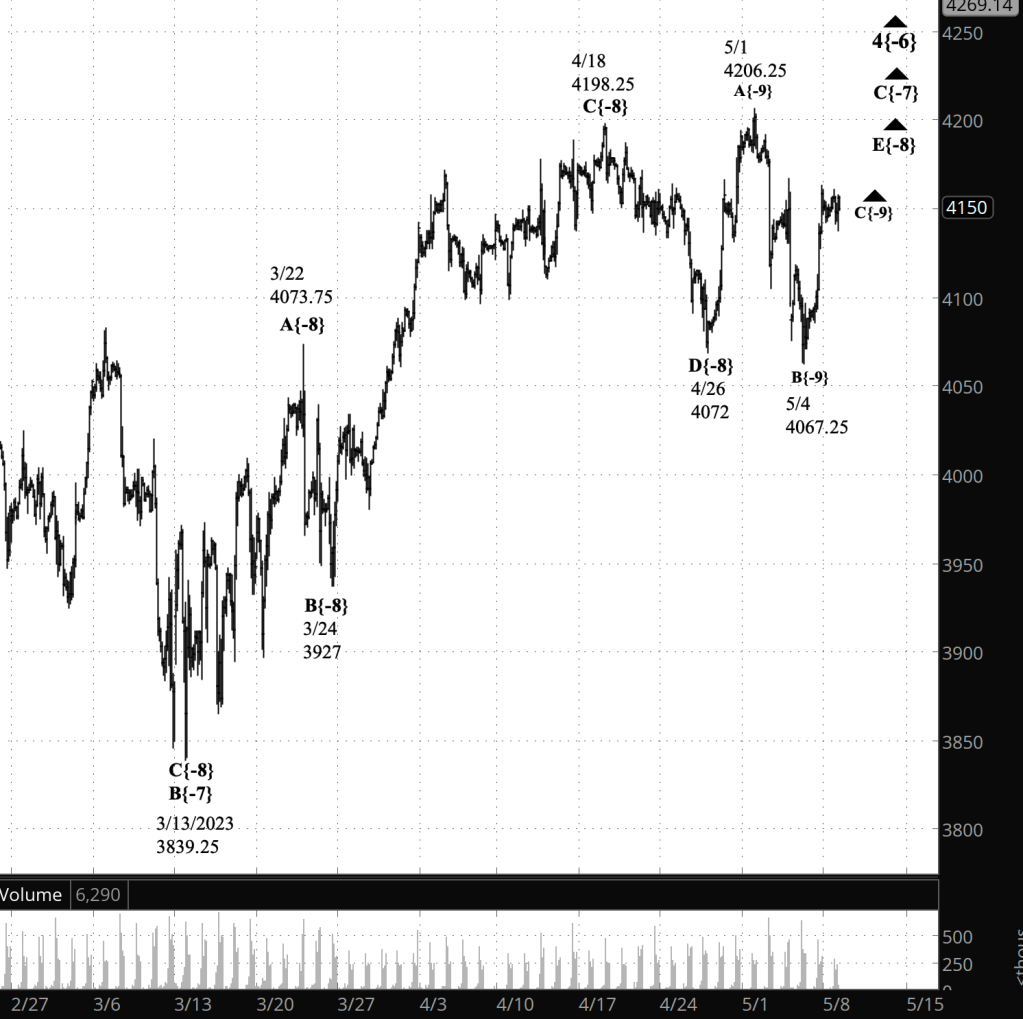
To locate the We-Are-Here marker, we must drill down three levels from the correction wave, 4{-6}. Wave 4{-6} is a Zigzag with three waves internally, and it is in wave C{-7}, the 3rd wave. Wave C{-7}, in turn, will have five waves internally and is in the 5th wave, E{-8}. That 5th wave will also have five internal waves. It became clear today, as the price rose into the 4160s, that the 3rd of those waves, C{-9}, began yesterday from 4067.25.

Wave C{-9} typically would rise higher than wave A{-9}, which ended on May 1 at 4206.25. Looking forward, decling wave D{-9} will follow, and will in turn be followed by the final upward push: wave E{-9} within E{-8} within wave C{-7} within the upward correction, wave 4{-6}. The end of wave E{-9} will be the end of the correction.

The downtrend, wave 5{-6}, will follow and, if typical, will carry the price below the start of the correction, from 3502. Fifth waves are quirky beasts, and the price could move significantly below 3502, or it could come up short. After wave 5{-6} is complete, an even larger upward correction, wave 2{-5}, will begin.

I’ve updated the chart.

9:35 a.m. New York time

What’s happening now? The S&P 500 E-mini futures whipsawed between the 4090s and the 4110s after the employment report was released, an hour before the opening bell. The price stayed well above yesterday’s session low, 4067.25

What does it mean? The upward correction continues. It began on October 13, 2022 and is now nearing its end. It will be followed by a final downtrend that will wrap up the larger downtrend that began on January 4, 2022, one of a series of nested downtrending waves of increasing size.

What are the alternatives? There is one.

  • The upward correction is forming a compound structure, linking two or three corrective patterns together.
  • The present “last leg” of the correction, under the principal analysis, won’t be the end of the analysis under this alternative but only the end of the first corrective pattern.
  • The first pattern will be followed by a declining connector wave and then a second corrective pattern.

[S&P 500 E-mini futures at 3:30 p.m., 105-minute bars, with volume]

What does Elliott wave theory say? Here are the waves that underly the principal analysis.

Principal analysis:

  • An upward correction, wave 4{-6}, began on October 13, 2022 and is underway.
  • The correction’s first subwave, wave A{-7}, had five subwaves, meaning the correction is taking the form of a Zigzag
  • Wave 4{-6} is in its final subwave wave, C{-7}, which began on March 13, 2023.
  • Wave C{-7} is in its final subwave, wave E{-8}.
  • Wave E{-8} is in its second subwave, declining wave B{-9}.
  • Wave E{-8} will have five subwaves altogether once it is complete.
  • As a 4th wave, wave 4{-6} has no upper limits under Elliott wave theory.
  • Wave 4{-6} will be followed by downtrending wave 5{-6}, which, like all 5th waves, might match one of a number of different patterns, all based on the downtrend’s relation with the end of the preceding 3rd wave, at 3502.
  • Usually, a 5th wave will move past the preceding 3rd wave’s end point.
  • Some 5th waves are truncated, and on this chart that means wave 5{-6} would end before reaching 3502.
  • Some 5th waves are extended, that would mean wave 5{-6} would have nine waves internally rather than the usual five, and would cover a greater than expected distance over a greater than expected period of time.

Alternative analysis:

  • Wave C{-7} may have ended on May 1 but that is not the end of the wave 4{-6} correction.
  • Wave 4{-6} is forming a compound structure and wave C{-7} ends the first corrective pattern.
  • Wave C{-7} will be followed by a declining connector, wave X{-7}, and then by a second corrective pattern.

Bigger structures:

  • This is all happening within downtrending wave 1{-5}, which began on January 4, 2022 from 4808.25.
  • Wave 1{-5} is a subwave of a nested series of larger subwaves, from wave 1{-4} to wave 1{-2}. which also began on January 4, 2022.
  • Wave 1{-2} is a subwave of wave 4{-1}, the next-to-the-last wave within a large expanding Diagonal Triangle, wave 5{0}, that began on December 26, 2018.
  • When wave 4{-1} is complete, wave 5{-1} will begin and will carry the wave above the January 4 high.25, and back to the upper boundary of the triangle, which gets higher continually and is in the 6140s.

We Are Here.

These are the waves currently in progress under my principal analysis. Each line on the list shows the wave number, with the subscript in curly brackets, the traditional degree name, the starting date, the starting price of the S&P 500 E-mini futures, and the direction of the wave.

  • S&P 500 Index:
  • 5{+3} Supercycle, 7/8/1932, 4.40 (up)
  • 5{+2} Cycle, 12/9/1974, 60.96 (up)
  • 5{+1} Primary, 3/6/2009, 666.79 (up)
  • 5{0} Intermediate, 12/26/2018, 2346.58 (up)
  • S&P 500 Futures and index:
  • 4{-1} Minor, 1/4/2022, 4808.25 (down) (futures), 4818.62 (down) (index)
  • S&P 500 Futures:
  • 1{-2} Minute, 1/4/2022, 4808.25 (down)
  • 1{-3} Minuette, 1/4/2022, 4808.25 (down)
  • 1{-4} Subminuette, 1/4/2022, 4808.25 (down)
  • 1{-5} Micro, 1/4/2022, 4808.25 (down)
  • 4{-6} Submicro, 10/13/2022, 3502 (up)
  • C{-7} Minuscule, 3/13/2023, 3830.25 (up)

Reading the chart. Elliott wave analysis views the chart as a complex structure of smaller waves nested within larger waves, which in turn are nested within still larger waves. My labeling system assigns numbers to the subwaves of trending waves, and letters to the subwaves of corrections. Each number or letter is followed by a subscript, in curly brackets, showing the waves position within the complex structure, called its “degree” in Elliott wave parlance. The smaller the number, the lower the degree. On this chart we’re dealing with relatively small waves, so the degree numbers are negative.

Learning and other resources. Elliott wave analysis provides context, not prophecy. As the 20th century semanticist Alfred Korzybski put it in his book Science and Sanity (1933), “The map is not the territory … The only usefulness of a map depends on similarity of structure between the empirical world and the map.” And I would add, in the ever-changing markets, we can judge that similarity of structure only after the fact.

See the menu page Analytical Methods for a rundown on where to go for information on Elliott wave analysis.

By Tim Bovee, Portland, Oregon, May 5, 2023

Disclaimer

Tim Bovee, Private Trader tracks the analysis and trades of a private trader for his own accounts. Nothing in this blog constitutes a recommendation to buy or sell stocks, options or any other financial instrument. The only purpose of this blog is to provide education and entertainment.

No trader is ever 100 percent successful in his or her trades. Trading in the stock and option markets is risky and uncertain. Each trader must make trading decisions for his or her own account, and take responsibility for the consequences.

License
Creative Commons License

All content on Tim Bovee, Private Trader by Timothy K. Bovee is licensed under a Creative Commons Attribution-ShareAlike 4.0 International License.

Based on a work at www.timbovee.com.
Trader’s Notebook

3:30 p.m. New York time

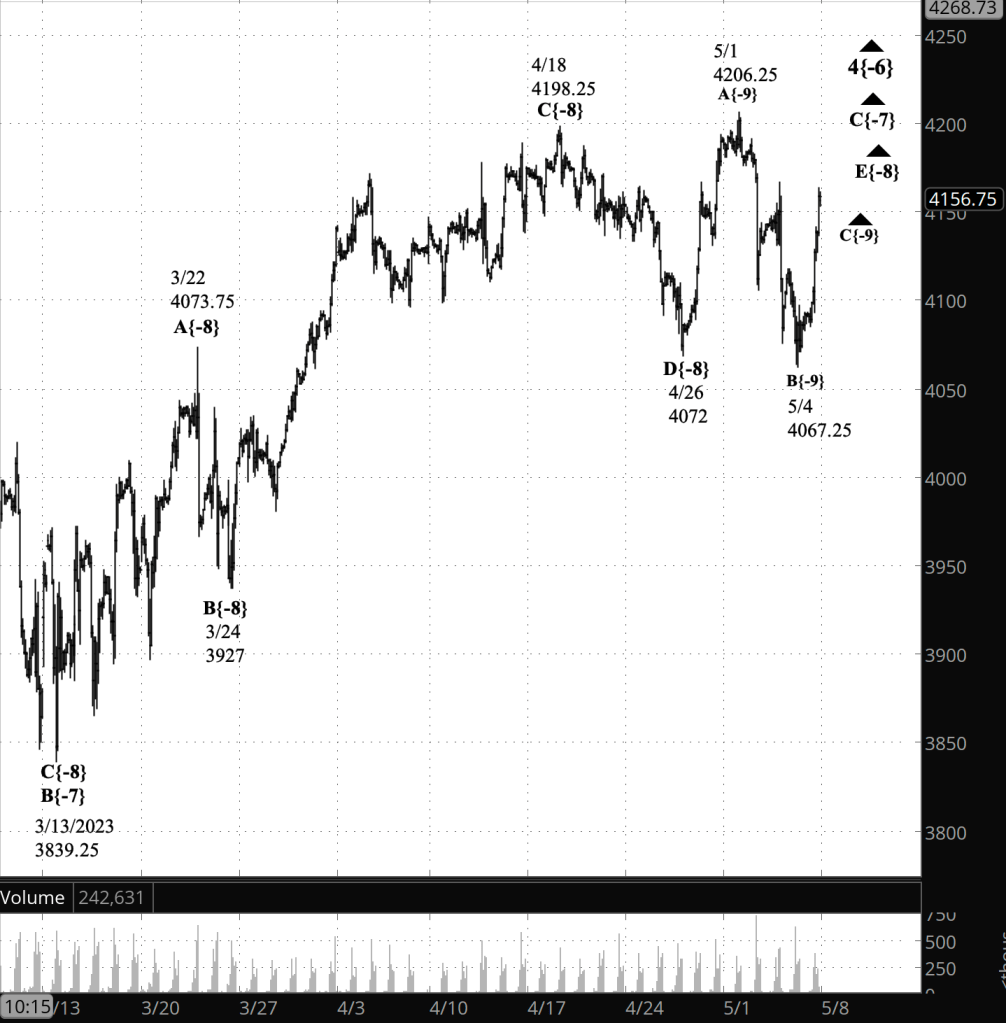
Half an hour before the closing bell. The S&P 500 futures have fallen during the session, to a low, so far, of 4062.25. The upward correction that began on October 13, 2022, wave 2{-6}, continues, is in its final leg, wave C{-7}, which is in its final leg, wave E{-8}, which is in its second wave, B{-9}, out of what will be a total of five subwaves.

No change from this morning’s analysis. I’ve updated the chart.

9:35 a.m. New York time

What’s happening now? The S&P 500 E-mini futures fell overnight, reaching into the 4080s so far.

What does it mean? The upward correction that began on October 13, 2023 is still underway. It is in its last leg, which in turn in its final subwave. And that rising final subwave is declining in the 2nd of five waves.

What are the alternatives? I’ve removed yesterday’s 1st alternative, which was based on the idea that the upward correction had ended at the May 1 high, 4206.25. A close-up look shows clearly that the final leg of the correction has completed one subwave and is in its 2nd subwave. The correction is forming a Zigzag pattern, with five subwaves in its 1st leg, three in its 2nd, and five in present final leg. So after that 2nd subwave is complete, there will be three more waves to go: Up, down, up.

That leaves …

Alternative #1:

  • The upward correction is forming a compound structure, linking two or three corrective patterns together.
  • The present “last leg” of the correction, under the principal analysis, won’t be the end of the analysis under this alternative but only the end of the first corrective pattern.
  • The first pattern will be followed by a declining connector wave and then a second corrective pattern.

Reading the chart. I’ve moved the chart closer in to better understand the subwaves within the final leg of the upward correction. Elliott wave analysis views the chart as a complex structure of smaller waves nested within larger waves, which in turn are nested within still larger waves, and this close-up view certainly shows that, focusing on three degrees of waves within a larger 4th degree.

My labeling system assigns numbers to the subwaves of trending waves, and letters to the subwaves of corrections. Each number or letter is followed by a subscript, in curly brackets, showing the waves position within the complex structure, called its “degree” in Elliott wave parlance. The smaller the number, the lower the degree. On this chart we’re dealing with relatively small waves, so the degree numbers are negative.

[S&P 500 E-mini futures at 3:30 p.m., 105-minute bars, with volume]

What does Elliott wave theory say? Here are the waves that underly the revised analysis.

Principal analysis:

  • An upward correction, wave 4{-6}, began on October 13, 2022 and is underway.
  • The correction’s first subwave, wave A{-7}, had five subwaves, meaning the correction is taking the form of a Zigzag
  • Wave 4{-6} is in its final subwave wave, C{-7}, which began on March 13, 2023.
  • Wave C{-7} is in its final subwave, wave E{-8}.
  • Wave E{-8} is in its second subwave, declining wave B{-9}.
  • Wave E{-8} will have five subwaves altogether once it is complete.
  • As a 4th wave, wave 4{-6} has no upper limits under Elliott wave theory.
  • Wave 4{-6} will be followed by downtrending wave 5{-6}, which, like all 5th waves, might match one of a number of different patterns, all based on the downtrend’s relation with the end of the preceding 3rd wave, at 3502.
  • Usually, a 5th wave will move past the preceding 3rd wave’s end point.
  • Some 5th waves are truncated, and on this chart that means wave 5{-6} would end before reaching 3502.
  • Some 5th waves are extended, that would mean wave 5{-6} would have nine waves internally rather than the usual five, and would cover a greater than expected distance over a greater than expected period of time.

Alternative #1:

  • Wave C{-7} may have ended on May 1 but that is not the end of the wave 4{-6} correction.
  • Wave 4{-6} is forming a compound structure and wave C{-7} ends the first corrective pattern.
  • Wave C{-7} will be followed by a declining connector, wave X{-7}, and then by a second corrective pattern.

Bigger structures:

  • This is all happening within downtrending wave 1{-5}, which began on January 4, 2022 from 4808.25.
  • Wave 1{-5} is a subwave of a nested series of larger subwaves, from wave 1{-4} to wave 1{-2}. which also began on January 4, 2022.
  • Wave 1{-2} is a subwave of wave 4{-1}, the next-to-the-last wave within a large expanding Diagonal Triangle, wave 5{0}, that began on December 26, 2018.
  • When wave 4{-1} is complete, wave 5{-1} will begin and will carry the wave above the January 4 high.25, and back to the upper boundary of the triangle, which gets higher continually and is in the 6140s.

We Are Here.

These are the waves currently in progress under my principal analysis. Each line on the list shows the wave number, with the subscript in curly brackets, the traditional degree name, the starting date, the starting price of the S&P 500 E-mini futures, and the direction of the wave.

  • S&P 500 Index:
  • 5{+3} Supercycle, 7/8/1932, 4.40 (up)
  • 5{+2} Cycle, 12/9/1974, 60.96 (up)
  • 5{+1} Primary, 3/6/2009, 666.79 (up)
  • 5{0} Intermediate, 12/26/2018, 2346.58 (up)
  • S&P 500 Futures and index:
  • 4{-1} Minor, 1/4/2022, 4808.25 (down) (futures), 4818.62 (down) (index)
  • S&P 500 Futures:
  • 1{-2} Minute, 1/4/2022, 4808.25 (down)
  • 1{-3} Minuette, 1/4/2022, 4808.25 (down)
  • 1{-4} Subminuette, 1/4/2022, 4808.25 (down)
  • 1{-5} Micro, 1/4/2022, 4808.25 (down)
  • 4{-6} Submicro, 10/13/2022, 3502 (up)
  • C{-7} Minuscule, 3/13/2023, 3830.25 (up)

Learning and other resources. Elliott wave analysis provides context, not prophecy. As the 20th century semanticist Alfred Korzybski put it in his book Science and Sanity (1933), “The map is not the territory … The only usefulness of a map depends on similarity of structure between the empirical world and the map.” And I would add, in the ever-changing markets, we can judge that similarity of structure only after the fact.

See the menu page Analytical Methods for a rundown on where to go for information on Elliott wave analysis.

By Tim Bovee, Portland, Oregon, May 4, 2023

Disclaimer

Tim Bovee, Private Trader tracks the analysis and trades of a private trader for his own accounts. Nothing in this blog constitutes a recommendation to buy or sell stocks, options or any other financial instrument. The only purpose of this blog is to provide education and entertainment.

No trader is ever 100 percent successful in his or her trades. Trading in the stock and option markets is risky and uncertain. Each trader must make trading decisions for his or her own account, and take responsibility for the consequences.

License
Creative Commons License

All content on Tim Bovee, Private Trader by Timothy K. Bovee is licensed under a Creative Commons Attribution-ShareAlike 4.0 International License.

Based on a work at www.timbovee.com.