SPY Analysis (lot 3)

SPRD S&P 500 ETF Trust (SPY)

Update 3/4/2020: I have exited my short bear call spread position on SPY, which was due to expire on March 20, just 16 days away. The debit was $0.46, which is 42.5% of maximum potential profit. Shares declined by $2.49, or 0.8%, to $306.53, during the one-day holding period.

The options positions produced a 72.5% return for the day, or a 26,978% annual rate.


I have entered a short bear call spread on SPY, using options that trade for the last time 17 days hence, on March 20. The premium is a $0.80 credit and the stock at the time of entry was priced at $308.25.

The implied volatility rank (IVR) stands at 58.1%.

This is lot 3 of SPY options traded on March 3.

Mea culpa: I had intended this trade be built from options expiring April 17. I made an error in setting it up. The difference between the mistaken March expiry and the intended April is that March has a lower premium that covers less of the position’s wing, provides narrower upside protection and exposes me to a higher risk/reward ratio. Even so, the metrics are still well within my standards, and having made the trade, I shall treat it according to the rules I use for other options trades. It may yet prove to be serendipitous.

Premium: $0.80 Expire OTM
SPY-bear call spread Strike Odds Delta
Calls
Long 330.00 94.0% 7
Break-even 323.20 90.0% 12
Short 324.00 86.0% 16

The premium is 26.7% of the width of the position’s wing.

The profit zone covers a 4.8% move to the upside.

The risk/reward ratio is 6.5:1, with maximum risk of $520 and maximum reward of $80 per contract.

By Tim Bovee, Portland, Oregon, March 3, 2020

Read More »

SPY Analysis (lot 2)

SPRD S&P 500 ETF Trust (SPY)

Update 3/6/2020: SPY rose slightly after I entered this position and then resumed its downtrend, hitting the exit point dictated by my rules. I closed the position for a $0.57 debit, down $0.59 from the entry credit, with shares trading for $293.15, down $16.60 from the price at entry. The exit came at 50.9% of maximum potential profit.

SPY had done a correction after a large decline beginning February 19 and resumed its downward movement after I entered the position, quickly hitting its exit point 42 days before expiration. The implied volatility rank stood at 104.6, up 46.5 points from the entry level.

Shares declined by 5.3% over three days, or a –644% annual rate. The options position produced a 1.03.5% return for a +12,594% annual rate.


I have entered a short bear call spread on SPY, using options that trade for the last time 45 days hence, on April 17. The premium is a $1.16 credit and the stock at the time of entry was priced at $309.71.

The implied volatility rank (IVR) stands at 58.1%.

This is lot 2 of two similar spreads on SPY expiring in April.

Premium: $1.16 Expire OTM
SPY-bear call spread Strike Odds Delta
Calls
Long 334.00 81.0% 19
Break-even 326.84 85.5% 15
Short 328.00 90.0% 10

The premium is 38.7% of the width of the position’s wing.

The profit zone covers a 5.5% move to the upside.

The risk/reward ratio is 4.2:1, with maximum risk of $484 and maximum reward of $116 per contract.

By Tim Bovee, Portland, Oregon, March 3, 2020

Read More »

SPY Analysis (lot 1)

SPRD S&P 500 ETF Trust (SPY)

Update 3/6/2020: SPY rose slightly after I entered this position and then resumed its downtrend, hitting the exit point dictated by my rules. I closed the position for a $0.59 debit, down $0.59 from the entry credit, with shares trading for $293.15, down $17 from the price at entry. The exit came at 50% of maximum potential profit.

SPY had done a correction after a large decline beginning February 19 and resumed its downward movement after I entered the position, quickly hitting its exit point 42 days before expiration. The implied volatility rank stood at 104.6, up 46.5 points from the entry level.

Shares declined by 5.5% over three days, or a –669% annual rate. The options position produced a 100.0% return for a +12,167% annual rate.


I have entered a short bear call spread on SPY, using options that trade for the last time 45 days hence, on April 17. The premium is a $1.18 credit and the stock at the time of entry was priced at $310.18.

The implied volatility rank (IVR) stands at 58.1%.

This is lot 1 of two similar spreads on SPY expiring in April.

Premium: $1.18 Expire OTM
SPY-bear call spread Strike Odds Delta
Calls
Long 334.00 81.0% 19
Break-even 326.82 85.5% 15
Short 328.00 90.0% 10

The premium is 39.3% of the width of the position’s wing.

The profit zone covers a 5.4% move to the upside.

The risk/reward ratio is 4.1:1, with maximum risk of $482 and maximum reward of $118 per contract.

By Tim Bovee, Portland, Oregon, March 3, 2020

Read More »

Live: Tuesday, March 3, 2020

2:10 p.m. New York time

I have posted entry analyses of three short bear call spreads on SPY. Lots 1 and 2 expire April 17. Lot 3 is for a similar position expiring March 20, the early expiry being the result of a trading error on my part.

Here are the three analysis:

Before entering the new positions, the Federal Open Market Committee announced an unscheduled meeting and reduced the target Fed funds rate by half a percent, which is double their normal reduction size. The new target range is 1% to 1.25% and amounts to a one-third reduction in the interest rate.

Putting on my Math hat here (thanks, Andrew Wang!) … wait a minute, that’s huge! That’s a recession level reduction. And that doesn’t leave a lot of room for further reduction if the market crash is indeed a harbinger of the next recession.

Stocks briefly swooned upward after the announcement, and then just as quickly fell back, and then kept on falling. During the upward spike three of my long-unprofitable March short iron condor positions — SMH, XBI and XLP — briefly became profitable. I acted quickly, got no fills, chased the price, still no fills, and the positions became unprofitable again as stocks pulled back. High hopes, dashed again. Like February, March, has been an unkind month for my trades.

11:45 a.m. New York time

Today is entry day for my options positions expiring April 17, which 45 days from now.

A major change: Before the Coronavirus Crash, I was trading short iron condors, which are based on the premise that stock prices will trade within a range. This time, I’ll be trading short bear call spreads, which are based on the premise that stock prices will go down.

A second major change: Before the crash I saw value in diversifying into options based on a number of exchange-traded funds. But Over the past week plus change, I’ve seen nearly all of the ETFs I follow dancing to same tune. Since my expectations for the markets are based on the S&P 500 chart, I’ve decided to forego fund diversity and use SPY options for all of my April positions. SPY, of course, like its parent index, tracks 505 stocks, so there’s a great deal of diversity already built in.

And a complication. Since my March options are still alive and losing, soaking up free cash, I had to spread my short bear call spreads in two lots across several accounts. So, different trades with slightly different metrics means that I’ll be posting a separate analysis for each. Coming soon.

By Tim Bovee, Portland, Oregon, March 3, 2020

Read More »

Live: Monday, March 2, 2020

7:40 p.m. New York time

I set a short stop over the weekend on my TLT shares positions. The stop/loss was triggered today shortly before the market close, as the 20-year U.S. Treasury bond interest rates rose, sending their capital value — their price — into a fall. So the funds removed from shares last week and now back in cash.

The results: I exited TLT for  a $153.95 credit per share, up $1.21 from the entry price, producing a 0.8% return over four days for a +72% annual rate.

Also, I do believe that I made the ex-dividend date, so a dividend payment will be coming in soon.

3:50 p.m. New York time

TLT declined and triggered my rather tight stop/losses, and my positions were sold. Details and results tonight.

10:50 a.m. New York time

I wrote a rule for resuming my long stocks trades and have posted it and an explanation of the metric I’m using in an essay, “After the Coronavirus Crash — What’s next?

The metric is Elliott Wave theory, which I’ve used and posted about in the past. The essay gives a review of how the theory works, so I’ll jump into the discussion here without further explanation.

I’m looking for five waves to the downside, at the Intemediate level, which I generally think of as a months-long movement. It was last October that the Intermediate level set of five waves that culminated with the high of February 19 on the S&P 500, from which point the present decline began.

What has happened to the markets since February 19 is a lower level than Intermediate. Until the patterns have played out more, there’s no way to know just what level we’re watching. My guess is that it’s a Minor wave — two levels below Intermediate. The patterns of this level will eventually provide a definition, and one thing it an do for us today is help us confirm that Intermediate pattern ending February 19 actually did end. It’s possible — although unlikely in my opinion — that this the prior rise isn’t complete and that this is a correction within that wave. We’ll find out soon.

The wave down from February 19 has subdivided into lower level five waves, and today’s rise, if it continues, appears to be the start of wave 2, an upside correction. Second waves tend to be a zig-zag, meaning they move directionally rather than sideways.

They often end a Fibonacci points. With a low of 285.54 for SPY, the most likely Fibonacci points are 61.8% above the low, at 418.63; 50% above, at 312.31, or if the movement is directionally weak, 38.2% above, at 305.99.

Second waves subdivide into three lower level waves. Wave A contains five waves within it, B has three waves and C again has five waves.

Wave 2 will, under the Elliott rules, be followed by an energetic 3rd wave to the downside. Typically, the 3rd wave is longer than the 1st wave, so we likely have quite a dizzying ride ahead.

Options. Oh my poor options!

My short iron condor positions in the March series– all nine of them — remain beyond their profit levels. The XBI position is closest to its profit zone, about a tenth of the fund’s average daily range. XLB and XLI are furthest away from profitability, each more than five days out.

Tomorrow — March 3 — is when I enter the April options positions. However, the March options still have a tight grip on cash, so my April trades are likely to be sparse.

By Tim Bovee, Portland, Oregon, March 2, 2020

Read More »

After the Coronavirus Crash — What’s next?


“Wait a bit, Tyek,” Farad’n said. “There are wheels within wheels here.”
Children of Dune by Frank Herbert (1976)

Truth: Every downtrend is followed by an uptrend.

Truth: Every trend has smaller trends with it.

Those truths are evident at even a cursory glance of a stock chart.

Now that I’ve sold nearly all of my stock positions, I need to know when to start buying back in again. That means a rule. That’s the hard lesson I’ve during nearly 40 years of trading. I can’t rely on instinct, or hope, or fear. In the past those have led me to misjudge the markets, and sometimes those misjudgments have cost me dearly.

If the present downtrend was mainly caused by the coronavirus, then there’s not much of a rule needed. The CDC and World Health Organization will declare a tentative victory over the pandemic, we’ll all dance in the streets, the markets will start to rise, and the world will move on.

If the crash was caused by far more than the coronavirus outbreak, then the road back to trading stocks again is somewhat more complex.

Among the other contributors to the downturn are, I think,

  • weak markets in Europe that pre-date the breakout of the disease,
  • calendar angst as people worry that 10 years without a recession is very unusual — since 1900 there has been a recession every four years, on average,
  • concern over the central banks’ lowering interest rates to the point that there is no more down, hindering efforts to stimulate the economy,
  • and perhaps a feeling that our society has become unmoored due large numbers of people who aren’t benefiting from the healthy economy. (That last item is not a partisan; President Trump, a Republican, campaigned on that premise in 2016, as did Senator Bernie Sanders, who continues on the theme in the 2020 Democratic primaries, where he at present leads the pack.)

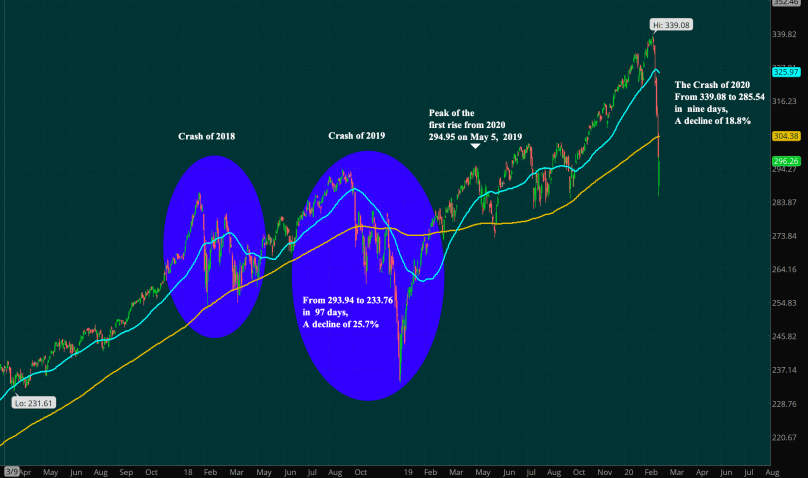
The following chart shows SPY — the exchange-traded fund that tracks the S&P 500 — for the past three years, with each bar representing one day’s trading. (To increase the size, use Alt-plus on Windows machines or Command-plus on Apple machines, or open the image in a new tab, where it will quite readable.)
Screen Shot 2020-02-29 at 12.31.50 PM

The crash this year is the third  in a series. We had a downturn in 2018, another in 2019 that lasted 97 days and went deeper, and now a crash in 2020 that in nine days has almost equalled the Crash of 2019. What has happened over the past nine days has been no small thing. And my job as a trader is to identify the markers that might show when the initial drop is finished, and whether that reversal means a reversal of the entire decline.

I have several traditional tools at hand. One is the 50-day moving average, which was pierced on the third trading day of the decline. I have the 200-day moving average, which was pierced on the fourth day. I have the 50-day/20-day crossover, when the 20-day moving average falls below the 200-day average. That hasn’t occurred yet.

A close back above the 200-day moving average would suggest that the initial decline was over, and that the price was in a retracement. A close above the 50-day moving average would reinforce the notion of a retracement.

On the other hand, if the 50-day moving average crosses below the 200-day moving average, then I would conclude that we’re in for an extended decline, as happened in the 2019 crash.

But those tools address only the initial decline, and a glance at the 2018 and 2019 crashes suggests that it’s never as simple as an unrelenting decline followed by happy days.

At this point, Elliott wave theory comes into play. Long-time readers will remember that I’ve used Elliott waves before to gain an understanding of likely paths the market might trace. I find it to be extraordinary useful. I also find that it has ambiguities, so I treat its conclusions as tentative and am always ready to revise my opinion on the basis of new information. Fans of statistics will recognize this as an non-mathematical application of the Bayesian method.

In Elliott wave theory, a market movement consists of five waves — three in the direction of the trend, separated by two counter-trend movements. The peak before the present crash clearly marks the end of a five wave uptrend from the low point of the crash of 2019, suggesting more decline lies ahead. If stocks rise, then I would interpret them — using Elliott — as being counter-trend movements within a larger downtrend.

But as the very long term chart I posted Friday shows, the markets have been in an uptrend since 1932, the low point of the Crash of 1929. So if the final wave of February 19, 2020 could well be the final uptrending wave of a larger final uptrend of a still larger final uptrend, eventually reaching 88 years back to Great Depression.

For market trends are fractal. The movements of a five-minute chart are components of the larger movements seen in the daily chart, and all the way up fractal the ladder to the very, very large movements of a quarterly chart, such as I used in yesterday’s post.

The current decline is clearly a first of the five waves in a downtrend. What happens next is a zig-zag correction back toward the February 19 high, but it will fall short of that level. It could well take the shape of a sideways movement, which means less of a rise.

The upward correction would be followed by a middle wave decline, almost always the most energetic of the bunch, that would carry us down further, followed by another upward correction, and then a final drop to the downside, from which a new first wave would begin an uptrend.

In Elliott, the trending waves are numbered 1, 3 and 5, and the corrective waves are numbered 2 and 4. Starting from the February 19 peak, we are clearly in a wave 1 of a downtrend.

That wave, as with all trending waves, must be subdivided into five waves. As I read the chart, wave 1 down shows a subdivision into five lesser waves, with the 5th ending with Friday’s 285.54 close. Perhaps. That interpretation will be scrapped if the downward move continues on Monday. This is where the ambiguity comes in.

When the 5th wave within the 1st wave of the decline is complete, then wave 2 will begin. One firm rule in Elliott wave theory is that a 2nd wave of a trend cannot exceed the trend’s starting point, the beginning of wave 1. In this case, that means SPY can’t exceed 339.08. If it does, then all bets are off. Something else is happening, scrap the analysis and start anew.

And of course, it’s not yet clear where on the ladder of trends this initial decline resides. In Elliott, the rise up from the low point of the 2019 crash is called an Intermediate wave, and it lasted for months. The wave a step higher is called the Primary wave, and it tracks the rise from the low set by the Great Recession Crash of 2008/09. In past trading I’ve done best with the Intermediate wave when it comes to market trend analysis. I’ve used lesser waves in the past for individual trades.

And that’s Elliott in brief. I won’t be using the traditional moving average tools to dictate my re-entry into the stock markets. They simply aren’t nuanced enough to provide adequate guidance. So my re-entry will be dictated by Elliott.

And so, to the rule:

  1. Stay out of stocks until
    1. The Intermediate Elliott wave decline has completed a five-wave movement downward on the SPY chart
    2. Or, the price of SPY reverses and closes above 339.08, the pre-decline high.

That’s it. All that talk and such a simple ruleset.

I shall continue to trade options, generally bear call spreads, and for options strategy shall rely on Elliott wave analysis for guidance.

Elliott Wave Theory resources

    • Best book: Elliott Wave Principleby A.J. Frost and Robert Prechter. Chapters 1 and 2 are essential, and I suggest a permanent bookmark be placed at the “Summary of Rules and Guidelines for Waves” section of Chapter 2.
    • Best online: Elliott Wave International, managed by Prechter. There’s much free information available for free via the site’s Club EWI. Registration is the only requirement.

By Tim Bovee, Portland, Oregon, February 29, 2020

Read More »

Just to put things in perspective…

It has been an interesting ride, the past few days, as the trees begin to blossom, the hay fever pollen begins its disruptive whirl, and the stock market trips on a rock and falls off a cliff.

The Coronavirus Crash of 2020, young though it is, promises to have a large impact on the economy, our politics — on how we feel about our lives.

But a look at the long-term chart shows that, so far at least, it’s no big deal.

Screen Shot 2020-02-28 at 7.42.22 AM

The chart above shows the Dow Jones Industrial Average from 1906 to a few minutes ago today. The chart is logarithmic, meaning that it accurately shows percentage change. Compared to the Crash of 1929 or the Crash of 1987, or even the Crash of 2008 that kicked off the Great Recession, which broke our world and stunted the prospects of a generation, our Coronavirus Crash of 2020 so far is barely visible.

Yet, there’s a less hopeful lesson to be drawn from the chart. The markets have been on the rise since the Crash of 1929 hit its low point in 1932.

One reality of the markets is that what goes up will eventually go down. No trend lasts forever. So the possibility exists that the decline from the market high of a few days ago is not just a correction of the last market rise, but rather is a multi-year, perhaps multi-decade correction of the rise from 1932.

Of course, any decline of that magnitude would have long uptrends within the dominant downtrend. So we would still have bull seasons and bear seasons. Life, and trading, would go on., although perhaps with less optimism than we’ve seen in the past 88-year-long bull market that began in the Great Depression.

Note: I don’t attribute the downturn solely to the COVID-19 (coronavirus) pandemic that appears to have begun. I think there are a lot of factors at work, including a full decade of economic growth, without a recession. Business downturns tend to happen more often than that. The consensus has been developing for months that it’s time for the economy to shed some of its optimism. If I’m correct, then we could be in for a significant decline. If I’m not correct, then, let the good times roll.

By Tim Bovee, Portland, Oregon, February 28, 2020

Read More »

Live: Friday, February 28, 2020

11:20 a.m. New York time

I’ve posted a brief discussion of the long-term chart. I mean, really long term: The Dow Jones Industrial Average from 1906 until today. It’s titled, “Just to put things in perspective…

10:10 a.m. New York time

In stocks, one of my AAPL lots, the one with the highest entry price, triggered its stop/loss and was sold. AAPL is in the  Genetics, Robotics and S&P 500 portfolios. Two lots remain.

The AAPL sale provided a $258.78 credit per share, down $59.22 from the entry price, an 18.6% loss over 10 days for a -680% annual rate.

Also triggered, the stop/loss on another S&P 500 stock, QRVO, for a $92.52 credit per share, down $17.74 from entry, producing a 16.1% loss over 15 days for a -391% annual rate.

Remaining stock positions:  AAPL and TSM.

9:55 a.m. New York time

Today is management day for my short iron condor options positions expiring after the closing bell on March 20. It’s the day that I exit my profitable positions, only retaining the losing positions in the hope that they’ll return to profitability in the 21 days until expiration.

Actually, it’s going to be a very easy management day, for none of my nine short iron condor positions is profitable at present. Indeed, all contain options that are trading in the money. For a short options position, in the money means the position will be unprofitable when it expires, and indeed almost always will be exchanged for short shares of stock, a minor pain in the neck when it happens.

Here’s table showing how far in the money my positions are this morning. As an analytical tool, I’ve taken the 14-day average true range (ATR) — a measure of how far a stock can be expected to fluctuate in a day — and divided it by the distance the price is in the money, showing how many days of normal trading it would take to return to profitability.

SYM
LAST
SHORT PUT
DIFF%
DIFF$
ITM?
ATR
ATR DAYS
QQQ 202.04 215 -6.0% (12.96) x 4.15 -3.1
SMH 126.83 137 -7.4% (10.18) x 3.71 -2.7
XBI 88.45 89 -0.6% (0.55) x 2.29 -0.2
XLB 52.36 58 -9.7% (5.64) x 1.01 -5.6
XLE 44.56 51.21 -13.0% (6.65) x 1.26 -5.3
XLI 73.16 80 -8.6% (6.84) x 1.36 -5.0
XLK 85.94 95 -9.5% (9.06) x 2.08 -4.4
XLP 57.73 62 -6.9% (4.27) x 0.76 -5.6
XLV 92.44 99 -6.6% (6.56) x 1.53 -4.3

By that measure, XBI is in the best shape, only 0.2 of its ATR day way from the profit point. The worst is XLB, which is 5.6 ATR days away from profitability.

There’s no way to salvage these positions by selling off losing options. A short spread strategy limits the potential loss, and implicitly when I set up the position, I knew what I could afford to lose. So I’ll hang on to the positions and take my profits if any do indeed return to profitability, or take my losses if they don’t.

By Tim Bovee, Portland, Oregon, February 28, 2020

Read More »

Live: Thursday, February 27, 2020

7:45 p.m. New York time

And now the exciting part of the day. The S&P500 closed below the average price of the past 200 days — a moving average. This is only the sixth time that has happened after January 2009, when a below average close kicked off the crash of the Great Recession. Since, a move below the 200 day moving average has happened in June 2010, August 2011, August 2015, October 2018, May 2019, and now, today.

Some were short-term sojourns below the moving average. The 2019, 2015 and 2011 declines were significant. The 2009 drop below the moving average accompanied the Great Recession, which had and is still has an impact on our lives.

Screen Shot 2020-02-27 at 4.40.54 PM

7:20 p.m. New York time

Three additional stock positions triggered their stops shortly before the closing bell. Here are the results:

  • AEL in the Growth Portfolio, sold for a $27.19 credit per share, down $5.91 from the entry price, a 17.9% loss over seven days for a -931% annual rate.
  • KBH in Value, for a $343.83 credit, down $5.10 from the entry price, a 12.8% loss over seven days for a -666% annual rate.
  • RL in the S&P 500, for a $102.37 credit, down $19.60 from the entry price, down 16.1% over 13 days for a -451% annual rate.

I have three stock positions left, not counting my new grown income positions in TLT, the long-term Treasury bonds exchange-funded fund. Those left are AAPL in the Genetics, Robotics and S&P 500 portfolios, QRVO in the S&P 500, and TSM in Robotics.

4:10 p.m. New York time

AEL, KBH and RL hit their stops. Results to come.

1:35 p.m. New York time

INVA in the Momentum Portfolio has triggered its stop/loss, for a $14.03 credit per share, down $1.22 from the entry price. The position sustained an 8.0% loss over six days for a -487% annual rate.

1:10 p.m. New York time

BRY in the Value Portfolio has triggered its stop loss, for a $6.40 credit, down 59 cents per share from the entry price. The return was an 8.4% loss over 29 days for a -105% annual rate.

11:20 a.m. New York time

Every exit strategy requires a re-entry strategy. Here’s mine.

First, a chart of the index showing the decline, including the price piercing the 200-day moving average before recoiling back above.

Screen Shot 2020-02-27 at 8.14.23 AM

If the S&P 500 closes below it’s 200-day moving average and then continues to drop in subsequent days, I shall consider the market to be in a longer-term downtrend and shall rework my trading strategies, using more short options spreads, a great vehicle for trading a declining market.

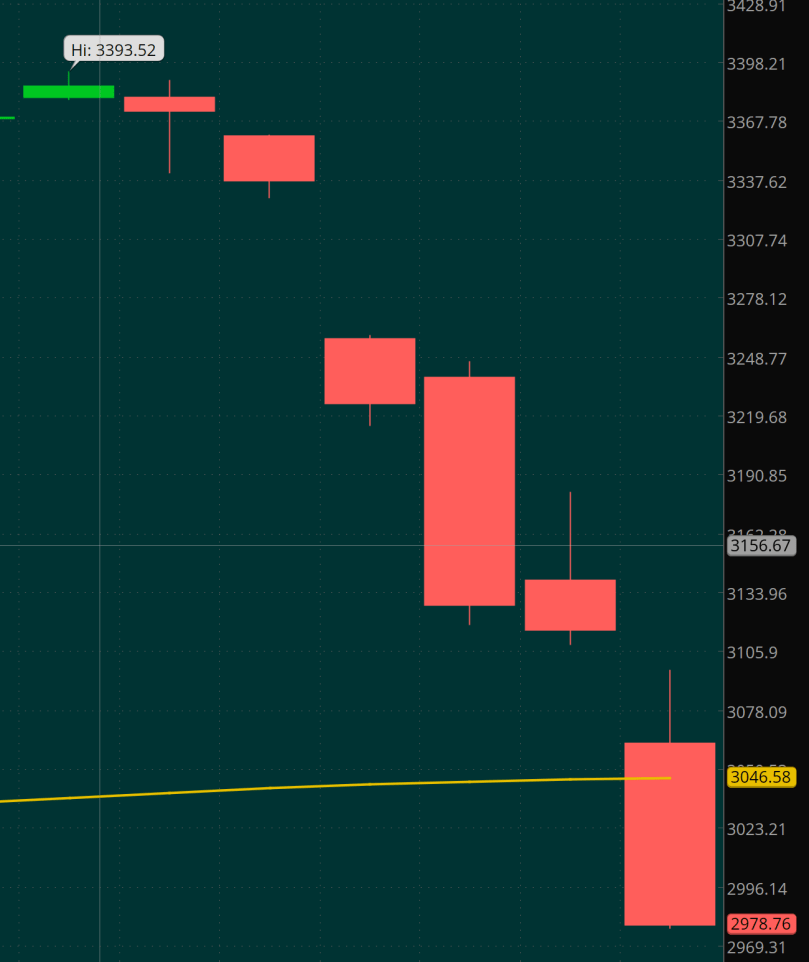
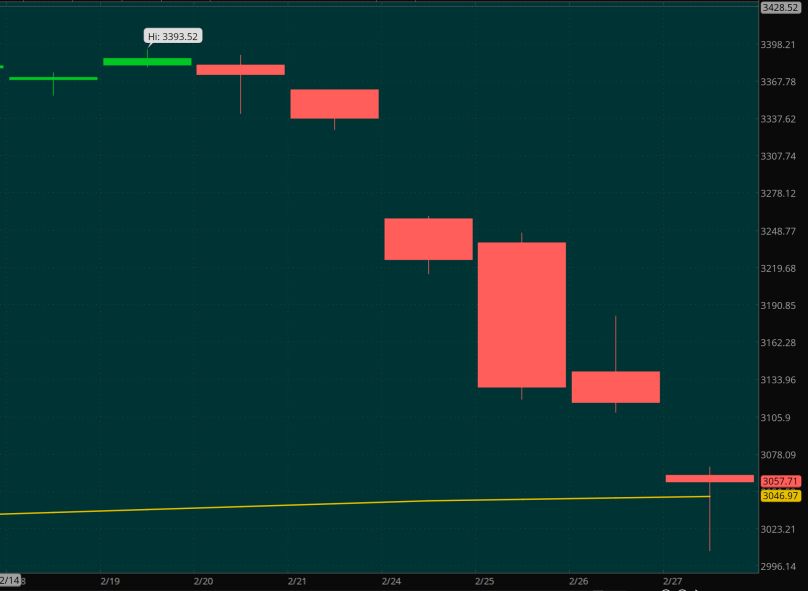
If the S&P 500 moves above its peak prior to the present decline, 3393.52, then I shall consider the downtrend to have ended and shall return to my normal strategy in bullish times, using the Zacks analysis.

In all cases my decision will also be informed by the Elliott Wave count, which I’ve used in the past. A change of the Elliott Wave analysis to uptrending at a reasonably high level would prompt a re-entry, even if below the 200-day moving average. A continuation of the Elliott count as downtrending would keep me out of stocks even if the S&P500 is above its recent peak.

10:40 a.m. New York time

I have placed the funds freed from the exits into TLT, an exchange-traded fund tracking the 30-year Treasury bonds. It is rising, as it tends to do when there’s an expectation of the Federal Reserve lowering rates. And it pays a dividend yielding about 2% annually. Liquidity, capital gains, a reasonable dividend — not a bad parking spot in stormy weather.

10:10 a.m.  New York time

Eleven positions triggered their tightened stop/losses in the first 15 minutes of trading, and then the sell-storm calmed. One of the positions, REGN, showed a profit. I exited my other profitable positions on Wednesday.

Below are the results of today’s exits so far, in spreadsheet form. (Two spreadsheets, to fit the page width.)

First, information about the positions traded and their portfolios, and the credit received from the trade:

sym portfolio bench credit
APAM momentum x 30.08
DAL sp500 x 46.14
DVA momentum sp500 x 78.77
GIII value 22.07
IBP growth x 64.11
LITE growth 74.10
PHM growth sp500 41.23
REGN genetics 461.67
SNX growth 129.16
STM growth 27.10
TER robotics 59.53

And the results of the trades, in dollars and percentages.

sym return/share$ return% days annualized%
APAM -6.25 -17.2% 20 -314%
DAL -12.67 -21.5% 14 -562%
DVA -9.27 -10.5% 15 -256%
GIII -5.84 -20.9% 17 -449%
IBP -11.17 -14.8% 13 -417%
LITE -18.20 -19.7% 16 -450%
PHM -4.29 -9.4% 27 -127%
REGN 62.83 15.8% 7 +821%
SNX -13.27 -9.3% 22 -155%
STM -3.78 -12.3% 16 -280%
TER -11.62 -16.3% 21 -284%

9:40 a.m. New York time

Before the opening bell I tightened my stop/losses on everything to a trailing percentage reflecting one day’s average movement, using the ATRWilder (average true range) as a basis. The range of stops was from 2% to 4%. And a number have been triggered in the first 10 minutes of trading. I’lll wait until the sell-storm calms and then post results.

By Tim Bovee, Portland, Oregon, February 27, 2020

Read More »

Live: Wednesday, February 26, 2020

11:40 a.m. New York time

In stocks, I exited three profitable positions. Normally I cut my losers and keep my winners, but this is a circumstance where the markets, after their dramatic declines, may well bounce back. So, prudence dictates that I preserve what what I earned and optimism dictates that I wait and see what happens to the rest.

The exits:

  • CDNA, from the Genetics Portfolio, for a $25.47 credit, up $1.50 from the entry debt, producing a 6.3% return over 40 days for a +57% annual rate.
  • MOD, Value Portfolio, for an $8.30 credit, up 43 cents from entry, for a 5.5% return over 22 days, a +91% annual rate.
  • TCEHY, Robotics Portfolio, for a $51.54 credit, up $3.35 from the entry debit, a 7.0% return over 27 days for a +94% annual rate.

I’m hanging on to REGN, my biggest earner, which contrary to all the other stocks in my portfolios continues to rise. I’m keeping a close watch on it, and shall exit if it drops below the low of the current day. REGN is presently showing a 12% return.

I plan no entries today, and the Zacks algorithm didn’t remove any stocks from their portfolios.

In my nine short iron condor options, five continue to be priced in the money, below the strike price on their short puts. For a short position, in the money is when a trader loses money. The three ITM short iron condors are XLB, XLE, XLI, XLK and XLV.

A bounce back up in the broad markets will bring the five positions back into potentially profitable territory. When I manage winners (if any) on Friday, I shall also decide about the losers, either exiting the put legs, during them into bear call spreads, or hanging on to them in the hope that their prices will return to profitable ranges.

By Tim Bovee, Portland, Oregon, February 26, 2020

Read More »