Trader’s Notebook

3:30 p.m. New York time

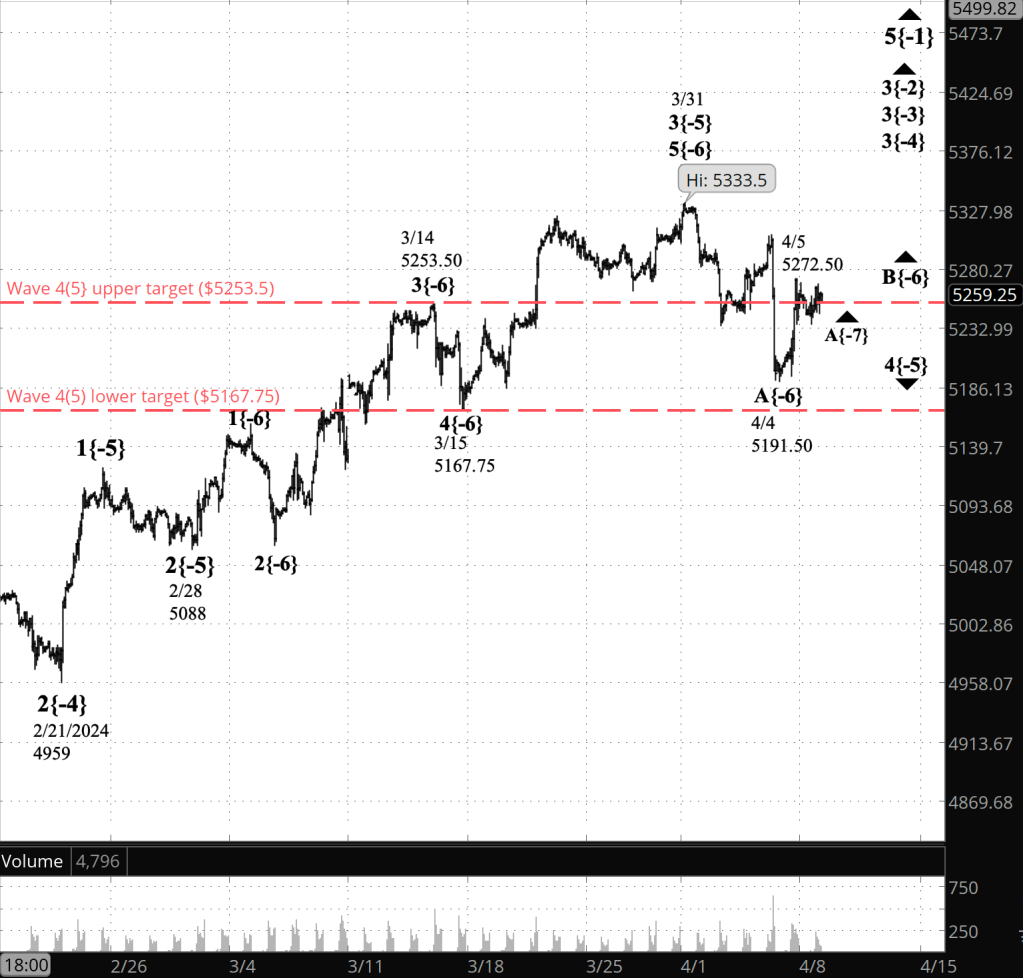
Half an hour before the closing bell. The S&P 500 futures drifted lower during the session while remaining above the overnight low, 4963.50. No change in this morning’s conclusions based on Elliott Wave Theory. I’ve updated the chart.

9:35 a.m. New York time

What’s happening now? The S&P 500 E-mini futures rose overnight from the 4960s into the 5050s.

What does it mean? Applying Elliott Wave Theory, I’ve concluded that the decline that began on April 15 is in its next-to-the-last subwave, and one last decline will bring it to an end.

What are the alternatives? The chart can also be interpreted as the mid-April decline having reached its endpoint with the overnight low, 4963.50, and the rise that followed is the beginning of an uptrend. The principal analysis — correction within a downtrend — matches the chart better, in my opinion. Nonetheless, the alternative is a viable possibility.
[S&P 500 E-mini futures at 3:30 p.m., 40-minute bars, with volume]

What does Elliott wave theory say? Here are the waves that underly the analyses, as they appear on the chart. Each wave number is followed by a subscript in curly brackets denoting the wave’s distance from Intermediate degree. The present Intermediate degree wave is 5{0}, and it began in December 2018.

Principal Analysis:

  • Rising wave 5{0} is underway. It is a wave of Intermediate Degree that began in December 2018.
  • It is in its final subwave, wave 5{-1}
  • Within wave 5{-1}, rising waves 3{-2}, 3{-3} and 3{-4} are underway, as is the smallest wave labeled on the chart, wave 4{-5}.
  • Downtrending wave 4{-5} is in its final subwave, falling wave C{-6}, which is in its last subwave, falling wave 5{-7}.
  • Within wave 5{-7}, wave 5{-8} is underway and is in its next-to-the-last subwave, wave 4{-9}.

Alternative analysis:

  • Wave 4{-5}, a downward correction, ended overnight on April 18, along with its subwaves, waves C{-6}, 5{-7}, 5{-8} and 5{-9}.
  • Uptrending wave 5{-5} is underway and is in its early stages.

.

We Are Here.

These are the larger waves currently in progress under my principal analysis. Each line on the list shows the wave number, with the subscript in curly brackets, the traditional degree name, the starting date, the starting price of the S&P 500 E-mini futures, and the direction of the wave.

  • S&P 500 Index:
  • 5{+3} Supercycle, 7/8/1932, 4.40 (up)
  • 5{+2} Cycle, 12/9/1974, 60.96 (up)
  • 5{+1} Primary, 3/6/2009, 666.79 (up)
  • 5{0} Intermediate, 12/26/2018, 2346.58 (up)

Reading the chart. Price movements — waves – – in Elliott wave analysis are labeled with numbers within trending waves and letters with corrective waves. The subscripts — numbers in curly brackets — designate the wave’s degree, which, in Elliott wave analysis, means the relative position of a wave within the larger and smaller structures that make up the chart. R.N. Elliott, who in the 1930s developed the form of analysis that bears his name, viewed the chart as a complex structure of smaller waves nested within larger waves, which in turn are nested within still larger waves. In mathematics it’s called a fractal structure, where at every scale the pattern is similar to the others.

Learning and other resources. Elliott wave analysis provides context, not prophecy. As the 20th century semanticist Alfred Korzybski put it in his book Science and Sanity (1933), “The map is not the territory … The only usefulness of a map depends on similarity of structure between the empirical world and the map.” And I would add, in the ever-changing markets, we can judge that similarity of structure only after the fact.

See the menu page Analytical Methods for a rundown on where to go for information on Elliott wave analysis.

By Tim Bovee, Portland, Oregon, April 19, 2024

Disclaimer

Tim Bovee, Private Trader tracks the analysis and trades of a private trader for his own accounts. Nothing in this blog constitutes a recommendation to buy or sell stocks, options or any other financial instrument. The only purpose of this blog is to provide education and entertainment.

No trader is ever 100 percent successful in his or her trades. Trading in the stock and option markets is risky and uncertain. Each trader must make trading decisions for his or her own account, and take responsibility for the consequences.

License
Creative Commons License

All content on Tim Bovee, Private Trader by Timothy K. Bovee is licensed under a Creative Commons Attribution-ShareAlike 4.0 International License.

Based on a work at www.timbovee.com.
Trader’s Notebook

3:30 p.m. New York time

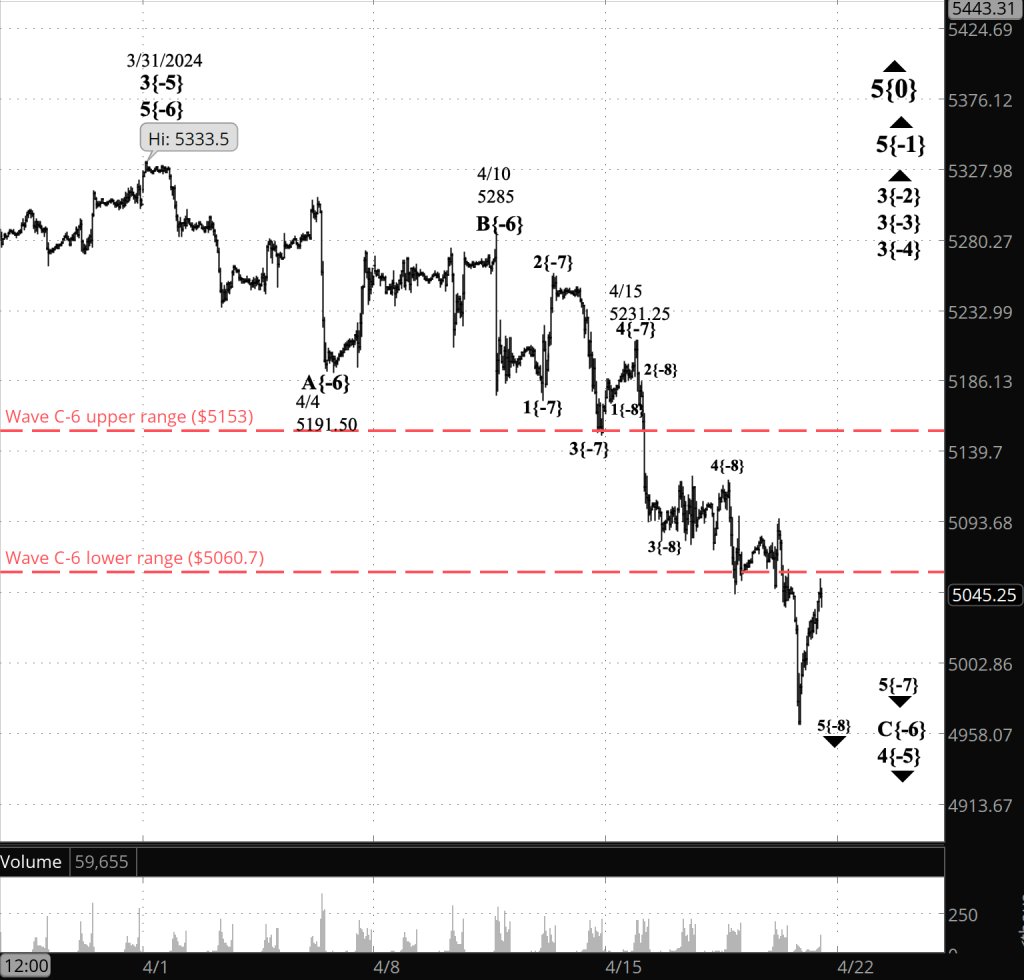
Half an hour before the closing bell. The S&P 500 futures fell slightly during the session, reaching into the 5030s. The lower low, in Elliott Wave Theory, confirms that the declining 5th wave that began on April 15 is still underway. The wave is labled wave 5{-7} on the chart, which I’ve updated.

9:35 a.m. New York time

What’s happening now? The S&P 500 E-mini futures meandered sideways overnight, between the 5060s and the 5080s.

What does it mean? Elliott Wave Theory: The final subwave of a 4th-wave downward correction that began on March 31 is close to its end. Wave 4 will be followed by a 5th-wave uptrend that is likely to last for a few weeks, although it could be much swifter or take much longer than that.

Here are the waves now underway, as they are labeled on the chart, with the wave number followed by a subscript in curly brackets that denotes the wave’s distance from the Intermediate degree within the fractal structure of the chart.

Smaller to larger: Declining wave 5{-8}, the final subwave within falling wave 5{-7}, the final subwave within falling wave C{-6}, the final subwave within the downward correction, wave 4{-5}. There’s quite a bit of finality at this moment in the chart.

Of course, the waves underway continue higher. The above waves are all encompassed by a series of rising waves, wave 3{-4}, the middle subwave of wave 3{-3}, which in turn is the middle subwave of wave 3{-2}, the middle subwave of wave 5{-1}, which in turn is the final subwave within wave 5{0}, the Intermediate wave that began in December 2018.

So yes, there’s finality in the smaller corners of the fractal structure, but at the larger end of things, there is quite a bit of upside that will carry us forward beyond the end of 2024 and perhaps much further.

But back to the details. The correction — wave 4{-5} — has taken the from of a Flat, with three subwaves within the A wave. Within that pattern, the C wave tends to retrace somewhere between 100% and 169% of the preceding A wave of the same degree. I’ve marked that range on the chart, keeping in mind that those retracement boundaries represent a tendency, not a firm rule. The price is presently close to the lower boundary of that range.

What are the alternatives? The S&P 500 futures are bottom fishing, which means that any low can be interpreted as being the end of the decline. My principal analysis, described above, concludes that wave 5[-8} is still underway and is in its final subwave, wave 5{-9}. An alternative interpretation sees wave 4{-9} as underway, the next-to-the-last subwave within wave 5{-8}. As always with Elliott Wave Theory, there are ambiguities. At that small degree, they have little significance.

[S&P 500 E-mini futures at 3:30 p.m., 35-minute bars, with volume]

Reading the chart. Price movements — waves – – in Elliott wave analysis are labeled with numbers within trending waves and letters with corrective waves. The subscripts — numbers in curly brackets — designate the wave’s degree, which, in Elliott wave analysis, means the relative position of a wave within the larger and smaller structures that make up the chart. R.N. Elliott, who in the 1930s developed the form of analysis that bears his name, viewed the chart as a complex structure of smaller waves nested within larger waves, which in turn are nested within still larger waves. In mathematics it’s called a fractal structure, where at every scale the pattern is similar to the others.

Learning and other resources. Elliott wave analysis provides context, not prophecy. As the 20th century semanticist Alfred Korzybski put it in his book Science and Sanity (1933), “The map is not the territory … The only usefulness of a map depends on similarity of structure between the empirical world and the map.” And I would add, in the ever-changing markets, we can judge that similarity of structure only after the fact.

See the menu page Analytical Methods for a rundown on where to go for information on Elliott wave analysis.

By Tim Bovee, Portland, Oregon, April 18, 2024

Disclaimer

Tim Bovee, Private Trader tracks the analysis and trades of a private trader for his own accounts. Nothing in this blog constitutes a recommendation to buy or sell stocks, options or any other financial instrument. The only purpose of this blog is to provide education and entertainment.

No trader is ever 100 percent successful in his or her trades. Trading in the stock and option markets is risky and uncertain. Each trader must make trading decisions for his or her own account, and take responsibility for the consequences.

License
Creative Commons License

All content on Tim Bovee, Private Trader by Timothy K. Bovee is licensed under a Creative Commons Attribution-ShareAlike 4.0 International License.

Based on a work at www.timbovee.com.

Trader’s Notebook

3:30 p.m. New York time

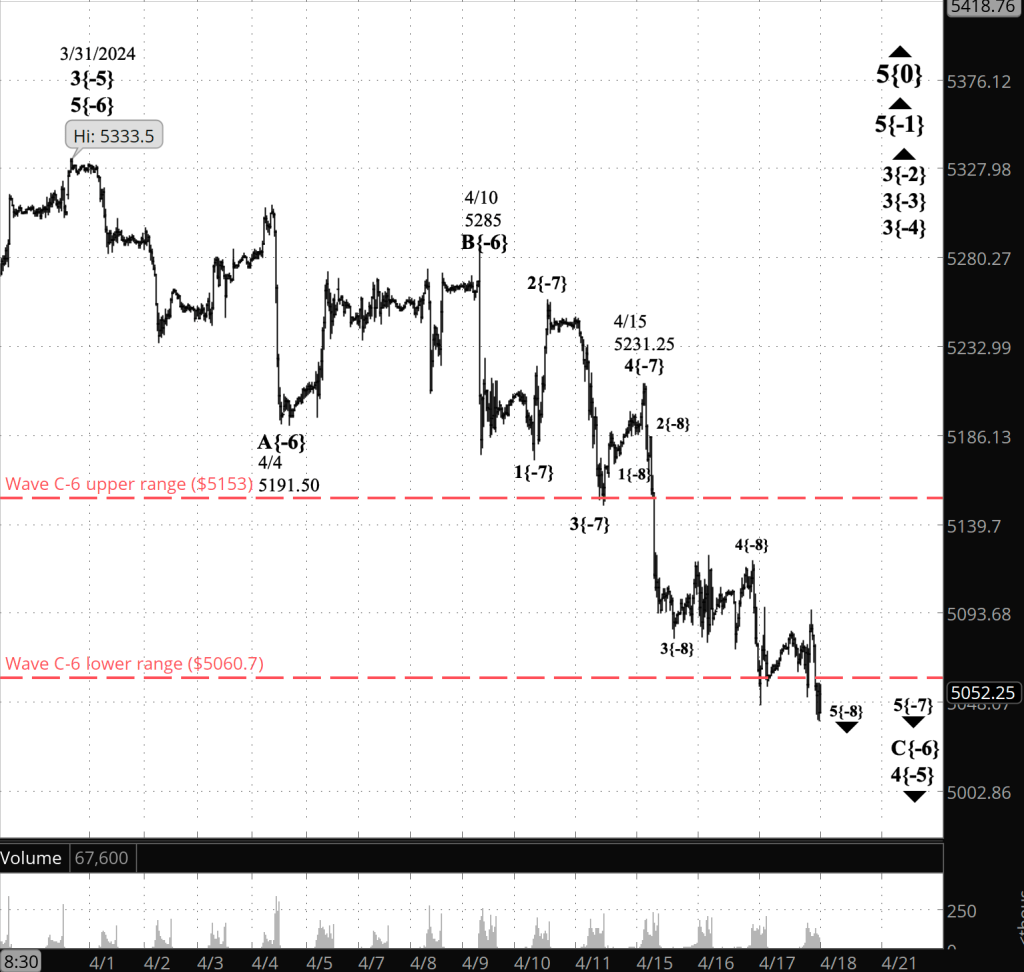
Half an hour before the closing bell. The price movement overnight and during the session has clarified the count within the final subwave, wave C, of the 4th-wave downward correction that began on March 31. In the discussion that follows I’ll use the labeling system that appears on the chart, with the wave number followed by a subscript in curly brackets that indicate how many degrees removed from Elliott Wave Theory’s Intermediate degree.

Elliott Wave Theory, when applied to a closer view of the chart shows that wave C{-6} is in its 5th and final subwave — wave 5{-7} on the chart — which in turn is in its final subwave — wave 5{-8}. It’s not marked on the chart, but wave 5{-8} has completed its second subwave — wave 2{-9} — and has begun the middle subwave — wave 3{-9}.

Waves of the {-9} degree can begin and end within a day, so at that level things are happening fast. The final wave of the 4th wave downward correction is likely within days of reaching its end.

I’ve updated the chart.

9:35 a.m. New York time

What’s happening now? The S&P 500 E-mini futures continued its bottom fishing overnight, dropping into the 5070s, with each lower low potentially being the end of the decline that began on March 31 and the beginning of an equally significant rise.

What does it mean? According to Elliott Wave Theory, the decline is a 4th-wave downward correction, and it is in the final stage of its 3rd and final subwave, wave C. When wave C is complete, it will also be the end of the 4th-wave correction and the beginning of a 5th-wave uptrend.

The correction is taking the form of a Flat, and typically wave C of that sort of correction will travel somewhere between the length of the preceding wave A and 1.65 times that length. The A-wave had a length of 142. Wave C began from 5285. So typically, wave C will end somewhere between 5153 and 5060.70.

The overnight low is well below the upper boundary of the price target range and is only 10 points above the lower boundary. I’ve marked the boundaries of the target price range on the chart with red dashed lines.

What are the alternatives? The 20th-century New York Yankees baseball team catcher Yogi Berra famously said, “It ain’t over till it’s over.” The principal analysis today says, “It ain’t over.” The alternative analysis says, “It’s over.” It’s a typical ambiguity when a wave reaches its bottom-fishing stage.

[S&P 500 E-mini futures at 3:30 p.m., 100-minute bars, with volume]

What does Elliott wave theory say? Here are the waves that underly the analyses.

Principal Analysis:

  • Rising wave 5{0} is underway. It is a wave of Intermediate Degree that began in December 2018.
  • It is in its final subwave, wave 5{-1}
  • Within wave 5{-1}, rising waves 3{-2}, 3{-3} and 3{-4} are underway, as is the smallest wave labeled on the chart, wave 3{-5}.
  • Downtrending wave 4{-5} is in its final subwave, falling wave C{-6}, which is in its last subwave, falling wave 5{-7}

Reading the chart. Price movements — waves – – in Elliott wave analysis are labeled with numbers within trending waves and letters with corrective waves. The subscripts — numbers in curly brackets — designate the wave’s degree, which, in Elliott wave analysis, means the relative position of a wave within the larger and smaller structures that make up the chart. R.N. Elliott, who in the 1930s developed the form of analysis that bears his name, viewed the chart as a complex structure of smaller waves nested within larger waves, which in turn are nested within still larger waves. In mathematics it’s called a fractal structure, where at every scale the pattern is similar to the others.

Learning and other resources. Elliott wave analysis provides context, not prophecy. As the 20th century semanticist Alfred Korzybski put it in his book Science and Sanity (1933), “The map is not the territory … The only usefulness of a map depends on similarity of structure between the empirical world and the map.” And I would add, in the ever-changing markets, we can judge that similarity of structure only after the fact.

See the menu page Analytical Methods for a rundown on where to go for information on Elliott wave analysis.

By Tim Bovee, Portland, Oregon, April 17, 2024

Disclaimer

Tim Bovee, Private Trader tracks the analysis and trades of a private trader for his own accounts. Nothing in this blog constitutes a recommendation to buy or sell stocks, options or any other financial instrument. The only purpose of this blog is to provide education and entertainment.

No trader is ever 100 percent successful in his or her trades. Trading in the stock and option markets is risky and uncertain. Each trader must make trading decisions for his or her own account, and take responsibility for the consequences.

License
Creative Commons License

All content on Tim Bovee, Private Trader by Timothy K. Bovee is licensed under a Creative Commons Attribution-ShareAlike 4.0 International License.

Based on a work at www.timbovee.com.

Trader’s Notebook

3:30 p.m. New York time

Half an hour before the closing bell. This morning’s analysis interpreted the chart as showing that the 4th-wave downward correction that began on March 31 had ended, and a 5th-wave uptrend had begun.

In the alternative analysis, I asked what could possibly go wrong with the principal analysis. My answer was, the price could reverse during session, moving lower. A few hours later, the price did just that.

I’ve promoted the alternative analysis — the 4th wave correction is still underway — back to principal analysis. I think the 4th-wave correction is nearing its end, but not quite yet. Unless, the new low is the actual end.

As a leading AI, Anthropic’s Claude 3 Opus, which is capable of doing Elliott Wave Analysis, said after analyzing GLD the other day, “Confidence in the accuracy of this analysis is moderate, as Elliott Wave Theory is a subjective tool and open to interpretation. The wave count should be continually reassessed as new price data becomes available. It’s crucial to use other technical analysis tools and fundamental analysis in conjunction with Elliott Wave Theory to make more informed trading decisions.”

I meditated for awhile on those wise words before launching into this afternoon’s analysis.

Based on the subwaves of the C-wave within the 4th-wave, I think the correction is nearing its end, but it’s not there quite yet. Unless, the new low is the actual end. For what it’s worth, Ehlers Stochastic, a technical analysis metric that I find to be reliable, is oversold and so has the S&P 500 futures poised for a rise.

I’ve retained this morning’s chart and added a new one with the revised analysis.

[S&P 500 E-mini futures at 3:30 p.m., 100-minute bars, with volume]

9:35 a.m. New York time

What’s happening now? The S&P 500 E-mini futures fell overnight and then reversed to the upside.

What does it mean? Applying Elliott Wave Theory: The 5th-wave decline on April 15, from 5213.25 to 5081.25, has five subwaves, suggesting that the overnight low is the end of that 5th wave, its parent C wave and, up one more degree, the 4th-wave downward correction that began on March 31.

If that count continues to match the reality of the chart, then a 5th-wave uptrend has begun.

The 5th wave uptrend will have five subwaves. There are few guidelines or rules for 5th waves. They can extend and rise a long distance beyond the end of the preceding 3rd wave — 5333.50 in this case. Or they can be truncated, ending before reaching that point.

Like many Elliott Waves, 5th waves tend to adhere to the Fibonacci retracement levels. For example a truncated 5th wave may end at a 61.8% retracement of the preceding 3rd wave, 5229.02 on this chart. Or it may expand and reach a 161.8% retracement, 5503.53 on the chart. These are tendencies, not rules, and often 5th waves will end at non-Fibonacci levels.

I’ve placed a Fibonacci retracement ladder, for the preceding 3rd wave on the chart, in red.

What are the alternatives? What could possibly go wrong? The price could reverse during the session, moving lower than 5081.25. If that happens, then the 4th-wave downward correction is not yet complete and the 5th-wave uptrend has not yet begun.

On the chart: Here are the waves under discussion as they are labeled on the chart, smaller to larger, with subscripts in curly brackets denoting the wave’s distance from Intermediate degree. The present Intermediate wave is 5{0}. It began in December 2018. The waves: Wave 5{-7} within wave C{-6} within the downward correction, wave 4{-5}. If the alternative analysis is correct, that’s where things stand now. But if the principal analysis is correct, the ongoing waves are wave 1{-6} within uptrending wave 5{-5}.

[Outdated analysis: S&P 500 E-mini futures at 9:35 a.m., 100-minute bars, with volume]

What does Elliott wave theory say? Here are the waves that underly the analyses. [Note: Outdated analysis. The Alternative Analysis has been promoted to Principal Analysis.]

Principal Analysis:

  • Rising wave 5{0} is underway. It is a wave of Intermediate Degree that began in December 2018.
  • It is in its final subwave, wave 5{-1}
  • Within wave 5{-1}, rising waves 3{-2}, 3{-3} and 3{-4} are underway, as is the smallest wave labeled on the chart, wave 3{-5}.
  • Uptrending wave 5{-5} is in its initial subwave, rising wave 1{-6}.

Alternative Analysis:

  • Downtrending wave 4{-5} is in its final subwave, falling wave C{-6}, which is in its next-to-the-last subwave, rising wave 4{-7}.

Reading the chart. Price movements — waves – – in Elliott wave analysis are labeled with numbers within trending waves and letters with corrective waves. The subscripts — numbers in curly brackets — designate the wave’s degree, which, in Elliott wave analysis, means the relative position of a wave within the larger and smaller structures that make up the chart. R.N. Elliott, who in the 1930s developed the form of analysis that bears his name, viewed the chart as a complex structure of smaller waves nested within larger waves, which in turn are nested within still larger waves. In mathematics it’s called a fractal structure, where at every scale the pattern is similar to the others.

Learning and other resources. Elliott wave analysis provides context, not prophecy. As the 20th century semanticist Alfred Korzybski put it in his book Science and Sanity (1933), “The map is not the territory … The only usefulness of a map depends on similarity of structure between the empirical world and the map.” And I would add, in the ever-changing markets, we can judge that similarity of structure only after the fact.

See the menu page Analytical Methods for a rundown on where to go for information on Elliott wave analysis.

By Tim Bovee, Portland, Oregon, April 16, 2024

Disclaimer

Tim Bovee, Private Trader tracks the analysis and trades of a private trader for his own accounts. Nothing in this blog constitutes a recommendation to buy or sell stocks, options or any other financial instrument. The only purpose of this blog is to provide education and entertainment.

No trader is ever 100 percent successful in his or her trades. Trading in the stock and option markets is risky and uncertain. Each trader must make trading decisions for his or her own account, and take responsibility for the consequences.

License
Creative Commons License

All content on Tim Bovee, Private Trader by Timothy K. Bovee is licensed under a Creative Commons Attribution-ShareAlike 4.0 International License.

Based on a work at www.timbovee.com.

Trader’s Notebook

3:30 p.m. New York time

Half an hour before the closing bell. The S&P 500 futures continued to fall during the session, reaching into the 5090s. Applying Elliott Wave Theory, the velocity of the decline suggests that the final subwave, wave C, within the 4th-wave downward correction has begun. An alternative analysis is that the session’s decline is a wave one degree smaller, a subwave within wave 3, which in turn is a subwave of the larger 5th-wave decline.

Here are the waves as labeled on the chart, with wave numbers followed by subscripts in curly brackets showing each wave’s distance from the Intermediate wave that began in December 2018 and contains everything that has happened since.

Now underway, smaller to larger:

  • Principal Analysis
    • Wave 5{-7} within wave C{-6} within the down correction, wave 4{-5}.
  • Alternative Analysis
    • Wave 3{-8} within wave 3{-7} within wave C{-6} within wave 4{-5}.

I’ve updated the chart.

9:35 a.m. New York time

What’s happening now? The S&P 500 E-mini futures rose after trading resumed overnight, from the 5160s to the 5210s.

What does it mean? Elliott Wave Theory considers the rise to be the next-to-the last subwave — wave 4 — within a larger declining final subwave — wave C — within a 4th-wave downward correction that began on March 31. When that final subwave is complete, it will also be the end of the wave 4 correction and a 5th-wave uptrend will begin.

On the chart, the waves under discussion, from small to large, are labeled rising wave 4{-7} within falling wave C{-6} within the downward correction, wave 4{-5}. The waves are designated by their number and with a subscript, in curly brackets, showing the distance of the wave from the Intermediate degree. For example, within the fractal structure of the chart, wave 4{-5} is five degrees smaller than the current wave of Intermediate degree, wave 5{0}, which began in December 2018.

Fourth wave corrections tend to end within the range of the 4th subwave within the preceding 3rd wave of the same degree. Wave 4{-5] has so far moved in line with that tendency, with its low point so far only slightly below the lower boundary of that trend. The trend boundaries are shown on the chart as dashed lines in red.

What are the alternatives? It’s possible that what I’ve labeled as wave 4{-7} is actually a subwave of an ongoing wave 3{-7}, although given wave 3{-7}’s internal structure, it seems unlikely to me.

[S&P 500 E-mini futures at 3:30 p.m., 90-minute bars, with volume]

What does Elliott wave theory say? Here are the waves that underly the analyses.

Principal Analysis:

  • Rising wave 5{0} is underway. It is a wave of Intermediate Degree that began in December 2018.
  • It is in its final subwave, wave 5{-1}
  • Within wave 5{-1}, rising waves 3{-2}, 3{-3} and 3{-4} are underway, as is the smallest wave labeled on the chart, wave 3{-5}.
  • Downtrending wave 4{-5} is in its final subwave, falling wave C{-6}, which is in its next-to-the-last subwave, rising wave 4{-7}

Reading the chart. Price movements — waves – – in Elliott wave analysis are labeled with numbers within trending waves and letters with corrective waves. The subscripts — numbers in curly brackets — designate the wave’s degree, which, in Elliott wave analysis, means the relative position of a wave within the larger and smaller structures that make up the chart. R.N. Elliott, who in the 1930s developed the form of analysis that bears his name, viewed the chart as a complex structure of smaller waves nested within larger waves, which in turn are nested within still larger waves. In mathematics it’s called a fractal structure, where at every scale the pattern is similar to the others.

Learning and other resources. Elliott wave analysis provides context, not prophecy. As the 20th century semanticist Alfred Korzybski put it in his book Science and Sanity (1933), “The map is not the territory … The only usefulness of a map depends on similarity of structure between the empirical world and the map.” And I would add, in the ever-changing markets, we can judge that similarity of structure only after the fact.

See the menu page Analytical Methods for a rundown on where to go for information on Elliott wave analysis.

By Tim Bovee, Portland, Oregon, April 15, 2024

Disclaimer

Tim Bovee, Private Trader tracks the analysis and trades of a private trader for his own accounts. Nothing in this blog constitutes a recommendation to buy or sell stocks, options or any other financial instrument. The only purpose of this blog is to provide education and entertainment.

No trader is ever 100 percent successful in his or her trades. Trading in the stock and option markets is risky and uncertain. Each trader must make trading decisions for his or her own account, and take responsibility for the consequences.

License
Creative Commons License

All content on Tim Bovee, Private Trader by Timothy K. Bovee is licensed under a Creative Commons Attribution-ShareAlike 4.0 International License.

Based on a work at www.timbovee.com.

Trader’s Notebook

3:40 p.m. New York time

Half an hour before the closing bell. The S&P 500 futures continued to fall during the session, so far reaching into the 5150s.

As the decline progressed, what I had marked as a low-degree declining B wave moved beyond the starting price of the preceding rising A wave.

And that’s not OK. Here’s why.

Under this morning’s analysis, wave A had five subwaves, which means that the larger 4th-wave downward correction that began on March 31 is taking the form of a ZigZag. The rule applying to Zigzags is that the B wave can never move beyond the starting point of the preceding wave.

Yet it did. My reanalysis has the initial subwave, wave A, of the 4th-wave downward correction ending on April 4, and wave B ending on April 10. The downward movement since then has been the C waver.

On the chart, the 4th-wave correction is 4{-5}, and the subwaves are waves A{-6}. B{-67} and C{-6}.

I’ve updated the chart with the new line-up.

9:35 a.m. New York time

What’s happening now? The S&P 500 E-mini futures fell overnight, from the 5240s to the 5190s

What does it mean? Elliott Wave Theory: The decline is the second subwave, wave B, within the first subwave, a rising wave B, of the 4th-wave downward correction that began on March 31. On the chart, the waves are labeled declining wave B{-7} within rising wave B{-6}, a subwave of wave 4{-5}, a downward correction. The subscripts, in curly brackets, tell each wave’s position within the fractal structure of the chart in terms of degrees distance from the Intermediate degree, represented since December 2018 by wave 5{0}.

On the chart, I’ve marked the wave B{-6} price target boundaries with blue dashed lines, and the wave 4{-5} price target boundaries with red dashed lines.

What are the alternatives? Wave A{-6} may still be underway. I marked it as having ended because of its proximity to the lower boundary of the 4th-wave price target range.

[S&P 500 E-mini futures at 9:40 a.m., 90-minute bars, with volume]

What does Elliott wave theory say? Here are the waves that underly the analyses.

Principal Analysis:

  • Rising wave 5{0} is underway. It is a wave of Intermediate Degree that began in December 2018.
  • It is in its final subwave, wave 5{-1}
  • Within wave 5{-1}, rising waves 3{-2}, 3{-3} and 3{-4} are underway, as is the smallest wave labeled on the chart, wave 3{-5}.
  • Downtrending wave 4{-5} is in its 2nd subwave, rising wave B{-6}.

Reading the chart. Price movements — waves – – in Elliott wave analysis are labeled with numbers within trending waves and letters with corrective waves. The subscripts — numbers in curly brackets — designate the wave’s degree, which, in Elliott wave analysis, means the relative position of a wave within the larger and smaller structures that make up the chart. R.N. Elliott, who in the 1930s developed the form of analysis that bears his name, viewed the chart as a complex structure of smaller waves nested within larger waves, which in turn are nested within still larger waves. In mathematics it’s called a fractal structure, where at every scale the pattern is similar to the others.

Learning and other resources. Elliott wave analysis provides context, not prophecy. As the 20th century semanticist Alfred Korzybski put it in his book Science and Sanity (1933), “The map is not the territory … The only usefulness of a map depends on similarity of structure between the empirical world and the map.” And I would add, in the ever-changing markets, we can judge that similarity of structure only after the fact.

See the menu page Analytical Methods for a rundown on where to go for information on Elliott wave analysis.

By Tim Bovee, Portland, Oregon, April 12, 2024

Disclaimer

Tim Bovee, Private Trader tracks the analysis and trades of a private trader for his own accounts. Nothing in this blog constitutes a recommendation to buy or sell stocks, options or any other financial instrument. The only purpose of this blog is to provide education and entertainment.

No trader is ever 100 percent successful in his or her trades. Trading in the stock and option markets is risky and uncertain. Each trader must make trading decisions for his or her own account, and take responsibility for the consequences.

License
Creative Commons License

All content on Tim Bovee, Private Trader by Timothy K. Bovee is licensed under a Creative Commons Attribution-ShareAlike 4.0 International License.

Based on a work at www.timbovee.com.
Trader’s Notebook

3:30 p.m. New York time

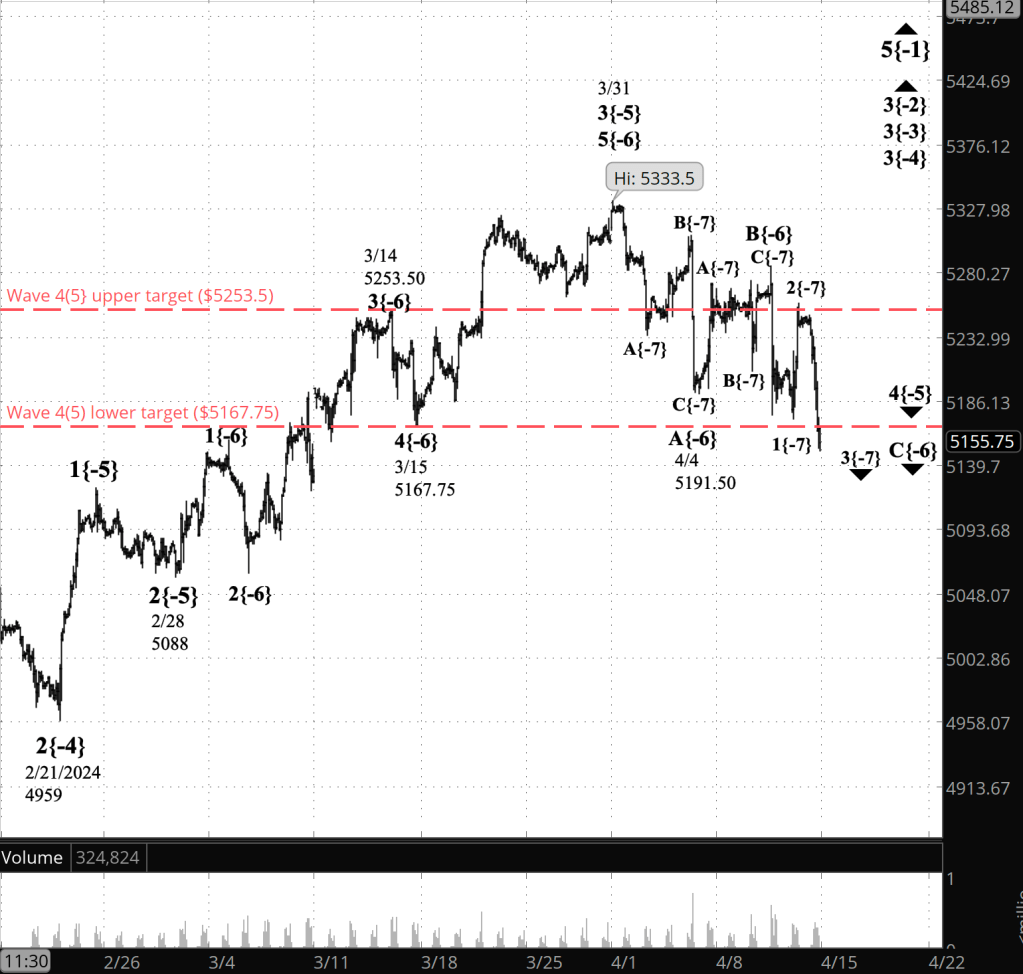
Half an hour before the closing bell. The S&P 500 futures rose during the session, into the 5250s. The rise is wave B, the second subwave of the 4th-wave downward correction that began on March 31.

As noted this morning, the price target range for this B wave is 5234 to 5299. I’ve marked the upper and lower boundaries of the range with blue dotted lines. The session rise has brought the B wave to within that range.

The chart also shows the price target range for the 4th-wave correction, parent of the B wave, marking the upper and lower boundaries — 5253.50 and 5167.75 with red dotted lines.

Here is the labeling of the waves under discussion, with the wave numbers followed by a subscript in curly brackets show how many degrees removed from the Intermediate range the wave is.

Now underway: Rising wave B{-6}, retracing the now complete declining wave A{-6}, both subwaves of the downward correction, wave 4{-5}.12

9:35 a.m. New York time

What’s happening now? The S&P 500 E-mini futures fell overnight but rose sharply following the release of wholesale inflation data — the Producer Price Index. The PPI-inspired move carried the price from the 5170s to the 5220s.

What does it mean? Applying Elliott Wave Theory: The session low, 5173.50, remained above the lower boundary of the target price range of the 4th-wave downward correction that began on March 31. The price came close to the lower boundary, 5167.50.

The overnight decline carried the price below what had been labeled the end of the A-wave within the correction, the first of three waves, forcing a rapid reanalysis.

Here are the changes:

  • The wave 4 correction is taking the form of a Zizag (not a Flat)
  • Falling wave A within the correction may have ended with the overnight low, although not necessarily not on April 4).
  • Rising Wave B began on April 4.

Since the correction is now clearly a Zigzag, wave B is likely to retrace between 38% and 79% of of the preceding A wave. That’s a tendency, not a firm rule. That retracement range would end wave B somewhere between 5234 and 5299.

What are the alternatives? As noted above, wave A may still be underway. I marked it as having ended because of its proximity to the lower boundary of the 4th-wave price target range.

[S&P 500 E-mini futures at 3:30 p.m., 90-minute bars, with volume]

What does Elliott wave theory say? Here are the waves that underly the analyses.

Principal Analysis:

  • Rising wave 5{0} is underway. It is a wave of Intermediate Degree that began in December 2018.
  • It is in its final subwave, wave 5{-1}
  • Within wave 5{-1}, rising waves 3{-2}, 3{-3} and 3{-4} are underway, as is the smallest wave labeled on the chart, wave 3{-5}.
  • Downtrending wave 4{-5} is in its 2nd subwave, rising wave B{-6}, which just began with the overnight low that ended falling wave A[-6}, the first subwave. Wave B{-6} will have three subwaves.

Reading the chart. Price movements — waves – – in Elliott wave analysis are labeled with numbers within trending waves and letters with corrective waves. The subscripts — numbers in curly brackets — designate the wave’s degree, which, in Elliott wave analysis, means the relative position of a wave within the larger and smaller structures that make up the chart. R.N. Elliott, who in the 1930s developed the form of analysis that bears his name, viewed the chart as a complex structure of smaller waves nested within larger waves, which in turn are nested within still larger waves. In mathematics it’s called a fractal structure, where at every scale the pattern is similar to the others.

Learning and other resources. Elliott wave analysis provides context, not prophecy. As the 20th century semanticist Alfred Korzybski put it in his book Science and Sanity (1933), “The map is not the territory … The only usefulness of a map depends on similarity of structure between the empirical world and the map.” And I would add, in the ever-changing markets, we can judge that similarity of structure only after the fact.

See the menu page Analytical Methods for a rundown on where to go for information on Elliott wave analysis.

By Tim Bovee, Portland, Oregon, April 11, 2024

Disclaimer

Tim Bovee, Private Trader tracks the analysis and trades of a private trader for his own accounts. Nothing in this blog constitutes a recommendation to buy or sell stocks, options or any other financial instrument. The only purpose of this blog is to provide education and entertainment.

No trader is ever 100 percent successful in his or her trades. Trading in the stock and option markets is risky and uncertain. Each trader must make trading decisions for his or her own account, and take responsibility for the consequences.

License
Creative Commons License

All content on Tim Bovee, Private Trader by Timothy K. Bovee is licensed under a Creative Commons Attribution-ShareAlike 4.0 International License.

Based on a work at www.timbovee.com.
Trader’s Notebook

3:30 p.m. New York time

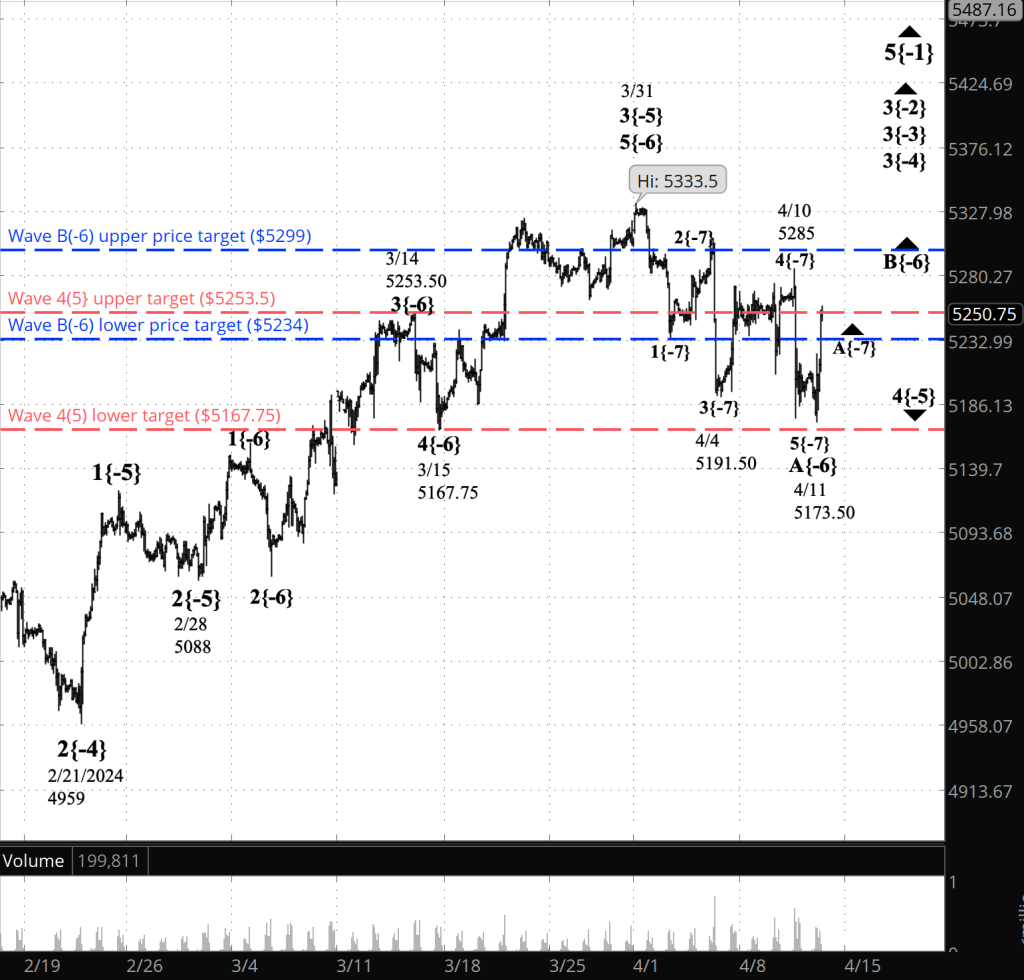
Half an hour before the closing bell. The S&P 500 futures stayed low during the session while so far remaining above the overnight low. Elliott Wave Theory: The middle subwave, wave B, of the 4th-wave downward correction continues.

I’ve updated the chart.

9:35 a.m. New York time

What’s happening now? The S&P 500 E-mini futures fell sharply after consumer price data for March was released, from the overnight peak, 5283, down to the 5170s as the opening bell approached.

What does it mean? Applying Elliott Wave Theory: The decline carried the price to within 10 points of the lower boundary of the price target range of the 4th-wave downward correction that began on March 31. The correction’s rising middle wave — wave B — began on April 4 and is now in its second subwave, a falling wave B.

That smaller falling wave B began coincident with the price data release. It will have three subwaves and will be followed by a rising C wave that will complete the larger middle wave — wave B — of the 4th-wave correction.

On the chart below I label a wave by its wave number or letter, and with a subscript, in curly brackets, that shows the wave’s degree as its distance from the much larger Intermediate wave, presently wave 5{0}, which began in December 2018. See the “Reading the chart” section below for more on degree labelling.

The wave’s discussed above, as they are labeled on the chart, are falling wave B{-7} within rising wave B{-6}, both subwaves of the falling correction, wave 4{-5}. Wave B{-7} will be followed by rising wave C{-7}, whose end will also be the end of rising wave B{-6}.

Under a rule of Elliott Wave Theory, the B wave of a correction that has taken the Flat pattern must retrace at least 90% of the preceding A wave. I’ve marked that 90% retracement level, 5319.25, with a dashed blue line.

The price range of the 4th wave correction is marked with red dashed lines. A 4th wave tends to end within the range of the 3rd, for the upper and lower boundaries of the range of the 4th subwave within the preceding 3rd wave, and red lines show those price levels, 5223.50 down to 5167.75.

What are the alternatives? None at present. Without a data future ambiguities will show up.

[S&P 500 E-mini futures at 3:30 p.m., 90-minute bars, with volume]

What does Elliott wave theory say? Here are the waves that underly the analyses.

Principal Analysis:.

  • Rising wave 5{0} is underway. It is a wave of Intermediate Degree that began in December 2018.
  • It is in its final subwave, wave 5{-1}
  • Within wave 5{-1}, rising waves 3{-2}, 3{-3} and 3{-4} are underway, as is the smallest wave labeled on the chart, wave 3{-5}.
  • Downtrending wave 4{-5} is in its 2nd subwave, rising wave B{-6}, which in turn is in its middle subwave, falling wave B{-7}.

Reading the chart. Price movements — waves – – in Elliott wave analysis are labeled with numbers within trending waves and letters with corrective waves. The subscripts — numbers in curly brackets — designate the wave’s degree, which, in Elliott wave analysis, means the relative position of a wave within the larger and smaller structures that make up the chart. R.N. Elliott, who in the 1930s developed the form of analysis that bears his name, viewed the chart as a complex structure of smaller waves nested within larger waves, which in turn are nested within still larger waves. In mathematics it’s called a fractal structure, where at every scale the pattern is similar to the others.

Learning and other resources. Elliott wave analysis provides context, not prophecy. As the 20th century semanticist Alfred Korzybski put it in his book Science and Sanity (1933), “The map is not the territory … The only usefulness of a map depends on similarity of structure between the empirical world and the map.” And I would add, in the ever-changing markets, we can judge that similarity of structure only after the fact.

See the menu page Analytical Methods for a rundown on where to go for information on Elliott wave analysis.

By Tim Bovee, Portland, Oregon, April 10, 2024

Disclaimer

Tim Bovee, Private Trader tracks the analysis and trades of a private trader for his own accounts. Nothing in this blog constitutes a recommendation to buy or sell stocks, options or any other financial instrument. The only purpose of this blog is to provide education and entertainment.

No trader is ever 100 percent successful in his or her trades. Trading in the stock and option markets is risky and uncertain. Each trader must make trading decisions for his or her own account, and take responsibility for the consequences.

License
Creative Commons License

All content on Tim Bovee, Private Trader by Timothy K. Bovee is licensed under a Creative Commons Attribution-ShareAlike 4.0 International License.

Based on a work at www.timbovee.com.

Trader’s Notebook

3:30 p.m. New York times

Half an hour before the closing bell. The S&P 500 futures fell during the session, back below 5210. In the discussion that follows, I’ll be using the wave numbers and degree designators that appear on the chart. See the “Reading the chart” section, below.

Applying Elliott Wave Theory, I reanalyzed the internal structure of rising wave B{-6}, the middle subwave of the falling 4th-wave correction that began on March 31 with its first subwave, falling wave A{-6}.

This morning’s analysis had wave B{-7}, a subwave of wave B{-6}, as having ended having ended at the opening-bell high. This afternoon’s analysis labels that high as the end of wave rising A{-7} and the beginning of falling wave B{-7}, which will have three subwaves.

Wave B{-7} will be followed by rising wave C{-7}, which under the Elliott Wave Theory rule discussed this morning, must carry the price at minimum up to a 90% retracement of wave A{-6}, to 5319.25 or greater.

I’ve updated the chart.

9:35 a.m. New York time

What’s happening now? The S&P 500 E-mini futures fell into the 5240s overnight and then rose to the 5260s as the opening bell approafhed.

What does it mean? Rising wave B — the middle subwave of the 4th-wave downward correction that began on March 31 — continues. Since the 4th wave is tracing a Flat pattern, it is required by a review of Elliott Wave Theory to retrace 90% of the preceding A wave. The blue dashed line on the chart shows the 90% retracement level, which wave B has not yet attained.

The waves under discussion, as labeled on the chart, are waves A{-6} and B{-6} within the upward correction, wave 4{-5}, and waves B{-7} and C{-7} within wave B{-6}. The subscript numbers in the curly brackets is the wave’s degree within the chart’s fractal structure, relative to what Elliott called the Intermediate Degree.

What are the alternatives? None at present. Without a data future ambiguities will ahow up.

[S&P 500 E-mini futures at 3:30 p.m., 90-minute bars, with volume]

What does Elliott wave theory say? Here are the waves that underly the analyses.

Principal Analysis:

  • Rising wave 5{0} is underway. It is a wave of Intermediate Degree that began in December 2018.
  • It is in its final subwave, wave 5{-1}
  • Within wave 5{-1}, rising waves 3{-2}, 3{-3} and 3{-4} are underway, as is the smallest wave labeled on the chart, wave 3{-5}.
  • Downtrending wave 4{-5} is in its 2nd subwave, rising wave B{-6}.

We Are Here.

These are the waves currently in progress under my principal analysis. Each line on the list shows the wave number, with the subscript in curly brackets, the traditional degree name, the starting date, the starting price of the S&P 500 E-mini futures, and the direction of the wave.

  • S&P 500 Index:
  • 5{+3} Supercycle, 7/8/1932, 4.40 (up)
  • 5{+2} Cycle, 12/9/1974, 60.96 (up)
  • 5{+1} Primary, 3/6/2009, 666.79 (up)
  • 5{0} Intermediate, 12/26/2018, 2346.58 (up)
  • S&P 500 Futures and index:
  • 5{-1} Minor, 10/13/2022, 3502 (up) (futures), 3491.58 (up) (index)
  • S&P 500 Futures:

Reading the chart. Price movements — waves – – in Elliott wave analysis are labeled with numbers within trending waves and letters with corrective waves. The subscripts — numbers in curly brackets — designate the wave’s degree, which, in Elliott wave analysis, means the relative position of a wave within the larger and smaller structures that make up the chart. R.N. Elliott, who in the 1930s developed the form of analysis that bears his name, viewed the chart as a complex structure of smaller waves nested within larger waves, which in turn are nested within still larger waves. In mathematics it’s called a fractal structure, where at every scale the pattern is similar to the others.

Learning and other resources. Elliott wave analysis provides context, not prophecy. As the 20th century semanticist Alfred Korzybski put it in his book Science and Sanity (1933), “The map is not the territory … The only usefulness of a map depends on similarity of structure between the empirical world and the map.” And I would add, in the ever-changing markets, we can judge that similarity of structure only after the fact.

See the menu page Analytical Methods for a rundown on where to go for information on Elliott wave analysis.

By Tim Bovee, Portland, Oregon, April 9, 2024

Disclaimer

Tim Bovee, Private Trader tracks the analysis and trades of a private trader for his own accounts. Nothing in this blog constitutes a recommendation to buy or sell stocks, options or any other financial instrument. The only purpose of this blog is to provide education and entertainment.

No trader is ever 100 percent successful in his or her trades. Trading in the stock and option markets is risky and uncertain. Each trader must make trading decisions for his or her own account, and take responsibility for the consequences.

License
Creative Commons License

All content on Tim Bovee, Private Trader by Timothy K. Bovee is licensed under a Creative Commons Attribution-ShareAlike 4.0 International License.

Based on a work at www.timbovee.com.
Trader’s Notebook

3:30 p.m. New York time

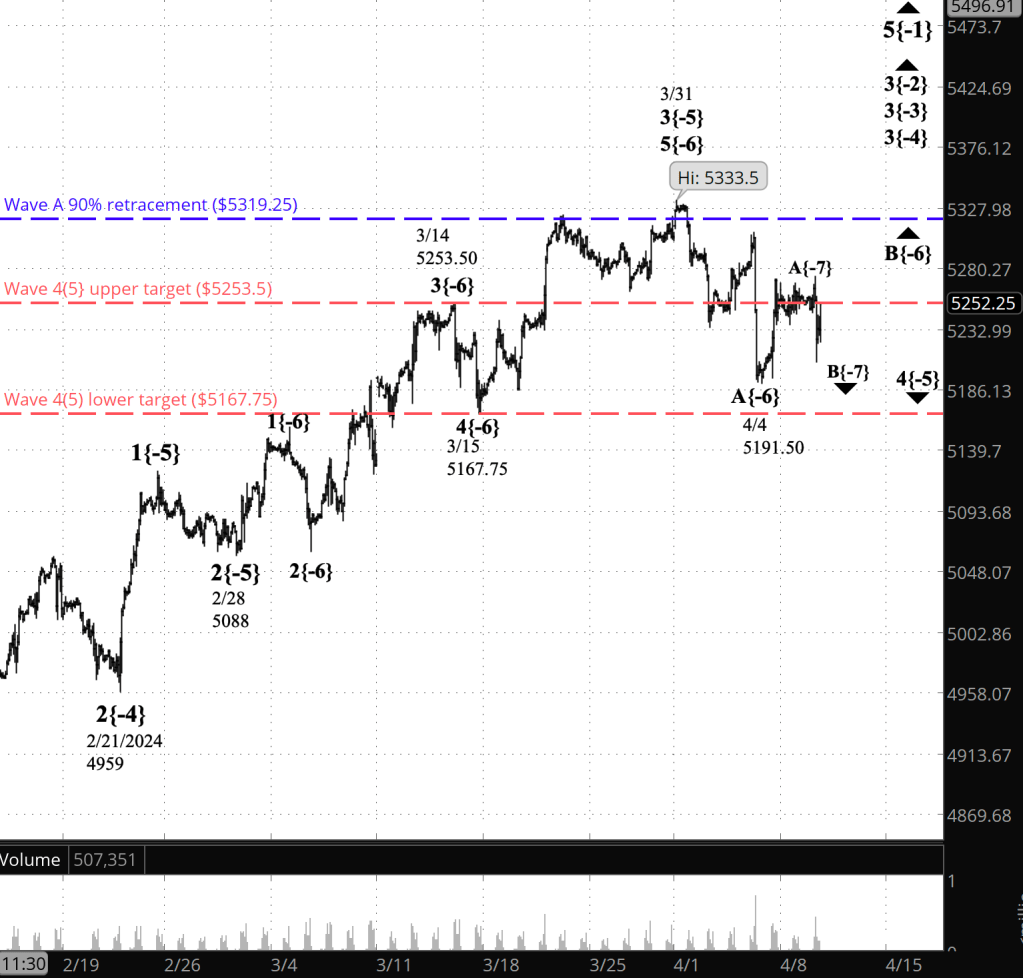
Half an hour before the closing bell. The S&P 500 futures rose during the session and then declined a bit, as the the rising middle subwave of downward 4th-wave correction that began March 31 continues.

Elliott Wave Theory: The middle subwave, wave B, appears to in the first of three subwaves, wave A. In a Flat-pattern correction, the B-wave always retraces 90% or more of the preceding wave A. That means wave B will have an end point of 5319.25 or greater. The B-wave’s high point so far is 5272.50. For that reason, I’m not yet calling wave B as being complete. It’s maximum end point is 5333.50, no higher under a rule of EWT.

The waves under discussion as labelled on the chart: Rising wave B{-6} retracing falling wave A{-6} within the larger downward correction, wave 4{-5}.

I’ve updated the chart.

9:35 a.m. New York time

What’s happening now? The S&P 500 E-mini futures traded sideways after trading resumed overnight.

What does it mean? The price remained close to the upper boundary of the target price range of the 4th-wave downward correction that began March 31. I show the price range boundaries on the chart with red dashed lines.

Applying Elliott Wave Theory, the correction began its rising B wave — the middle of three subwaves — on April 4. Wave B will be followed by a declining C wave that will end the correction, unless the 4th wave takes a complex form, linking two or three corrective patterns, each with three subwaves, separated by an X wave. Such expanded corrections aren’t exactly rare, but they aren’t everyday occurrences. Their impact is to lengthen the time it takes for the parent correction to reach its end.

When wave 4 is complete, it will be followed by a rising wave 5 that will complete the larger 3rd-wave uptrend that began on February 21. The of the larger 3rd wave will be followed by a 4th-degree downward correction, one degree higher than the 4th-wave correction presently underway. The B wave will wave three subwaves.

The waves discussed above are labeled on the chart with a wave number and a subscript indicating how far removed the wave’s degree is within the fractal structure of the chart from the Intermediate degree.

Here are the waves under discussion, smaller degree to larger degree: Wave B{-6} within wave 4{-5} within wave 3{-4}. The Intermediate degree wave that contains them all is wave 5{0}, which began in December 2018.

What are the alternatives? The ambiguities discussed in Friday’s Trader’s Notebook seem less likely as wave 4 plays out, and I’ve dropped the alternatives from this report. However, the reality of Elliott Wave Theory is that there are always ambiguities, some less likely than others.

[S&P 500 E-mini futures at 3:30 p.m., 80-minute bars, with volume]

What does Elliott wave theory say? Here are the waves that underly the analyses.

Principal Analysis:

  • Rising wave 5{0} is underway.
  • It is in its final subwave, wave 5{-1}
  • Within wave 5{-1}, rising waves 3{-2}, 3{-3} and 3{-4} are underway, as is the smallest wave labeled on the chart, wave 3{-5}.
  • Downtrending wave 4{-5} is in its 2nd subwave, rising wave B{-6}.

Reading the chart. Price movements — waves – – in Elliott wave analysis are labeled with numbers within trending waves and letters with corrective waves. The subscripts — numbers in curly brackets — designate the wave’s degree, which, in Elliott wave analysis, means the relative position of a wave within the larger and smaller structures that make up the chart. R.N. Elliott, who in the 1930s developed the form of analysis that bears his name, viewed the chart as a complex structure of smaller waves nested within larger waves, which in turn are nested within still larger waves. In mathematics it’s called a fractal structure, where at every scale the pattern is similar to the others.

Learning and other resources. Elliott wave analysis provides context, not prophecy. As the 20th century semanticist Alfred Korzybski put it in his book Science and Sanity (1933), “The map is not the territory … The only usefulness of a map depends on similarity of structure between the empirical world and the map.” And I would add, in the ever-changing markets, we can judge that similarity of structure only after the fact.

See the menu page Analytical Methods for a rundown on where to go for information on Elliott wave analysis.

By Tim Bovee, Portland, Oregon, April 8, 2024

Disclaimer

Tim Bovee, Private Trader tracks the analysis and trades of a private trader for his own accounts. Nothing in this blog constitutes a recommendation to buy or sell stocks, options or any other financial instrument. The only purpose of this blog is to provide education and entertainment.

No trader is ever 100 percent successful in his or her trades. Trading in the stock and option markets is risky and uncertain. Each trader must make trading decisions for his or her own account, and take responsibility for the consequences.

License
Creative Commons License

All content on Tim Bovee, Private Trader by Timothy K. Bovee is licensed under a Creative Commons Attribution-ShareAlike 4.0 International License.

Based on a work at www.timbovee.com.