Options Trades 1/8/2024: SPY USO

Symbols traded today: SPY (1DTE), USO (39DTE)

I entered a short Iron Fly position on SPY and exited the next day athte market open for a 12.2% profit/.

I also entered a longer-term short Iron Condor position on USO with a 50% profit target. The position expires on February 16, and I’ll manage as needed 21 days before expiration, on January 26.

2/1/2024: The USO position was unprofitable when management day arrived. I continued to hold the position hoping to, at the least, break even, and that’s in fact where the price stood when I exited on February 1 for a cost equal to what I had earned at entry.

SPY short Iron Fly

LOT:1ENTRY DATE:1/8/2024
EXIT DATE:1/9/2024
DAYS HELD:1

Entry and Exit

METRICCREDITDEBITCHANGECHANGE %ANNUALIZED CHANGE %
Options premium$ 1.93$ 1.72$ 0.2112.2%4432%
METRICENTRYEXITCHANGECHANGE %ANNUALIZED CHANGE %
Stock price$ 471.54$ 471.97$ (0.43)0.09%33%
Impllied Volatility Rate10.010.70.7
Days to expiration10

The structure of the position

STRUCTURESTRIKEODDS EXPIRE OTMDELTAIN PRICEOUT PRICENET PRICE
Calls
Long474.0080.0%20$ (0.35)$ 0.24$ (0.11)
Break-even472.9362.0%37.5
Short471.0044.0%55$ 1.56$ (1.46)$ 0.10
Puts
Short471.0056.0%44$ 0.98$ (0.58)$ 0.40
Break-even469.9370.5%29.5
Long468.0085.0%15$ (0.26)$ 0.08$ (0.18)
======
`NET TOTAL:$ 0.21

Risk and Reward

Per contract:
Reward193.00
Risk107.00
R/R Ratio (n:1)0.6

USO short Iron Condor

LOT:1ENTRY DATE:1/8/2024
EXIT DATE:2/1/2024
DAYS HELD:24

Entry and Exit

METRICCREDITDEBITCHANGECHANGE %ANNUALIZED CHANGE %
Options premium$ 0.68$ 0.68$ –0.0%0%
METRICENTRYEXITCHANGECHANGE %ANNUALIZED CHANGE %
Stock price$ 65.91$ 69.42$ (3.51)5.33%81%
Impllied Volatility Rate47.741.0-6.7
Days to expiration3915

The structure of the position

STRUCTURESTRIKEODDS EXPIRE OTMDELTAIN PRICEOUT PRICENET PRICE
Calls
Long73.0082.0%20$ (0.78)$ 0.68$ (0.10)
Break-even71.6878.5%23.5
Short71.0075.0%27$ 1.17$ (1.29)$ (0.12)
Puts
Short60.0078.0%20$ 0.91$ (0.17)$ 0.74
Break-even58.6881.0%17
Long58.0084.0%14$ (0.62)$ 0.10$ (0.52)
======
`NET TOTAL:$ (0.00)

Risk and Reward

Per contract:
Reward68.00
Risk132.00
R/R Ratio (n:1)1.9

By Tim Bovee, Portland, Oregon, January 8-9, February 1, 2024

Disclaimer

Tim Bovee, Private Trader tracks the analysis and trades of a private trader for his own accounts. Nothing in this blog constitutes a recommendation to buy or sell stocks, options or any other financial instrument. The only purpose of this blog is to provide education and entertainment.

No trader is ever 100 percent successful in his or her trades. Trading in the stock and option markets is risky and uncertain. Each trader must make trading decisions for his or her own account, and take responsibility for the consequences.

License
Creative Commons License

All content on Tim Bovee, Private Trader by Timothy K. Bovee is licensed under a Creative Commons Attribution-ShareAlike 4.0 International License.

Based on a work at www.timbovee.com.
Trader’s Notebook

3:30 p.m. New York time

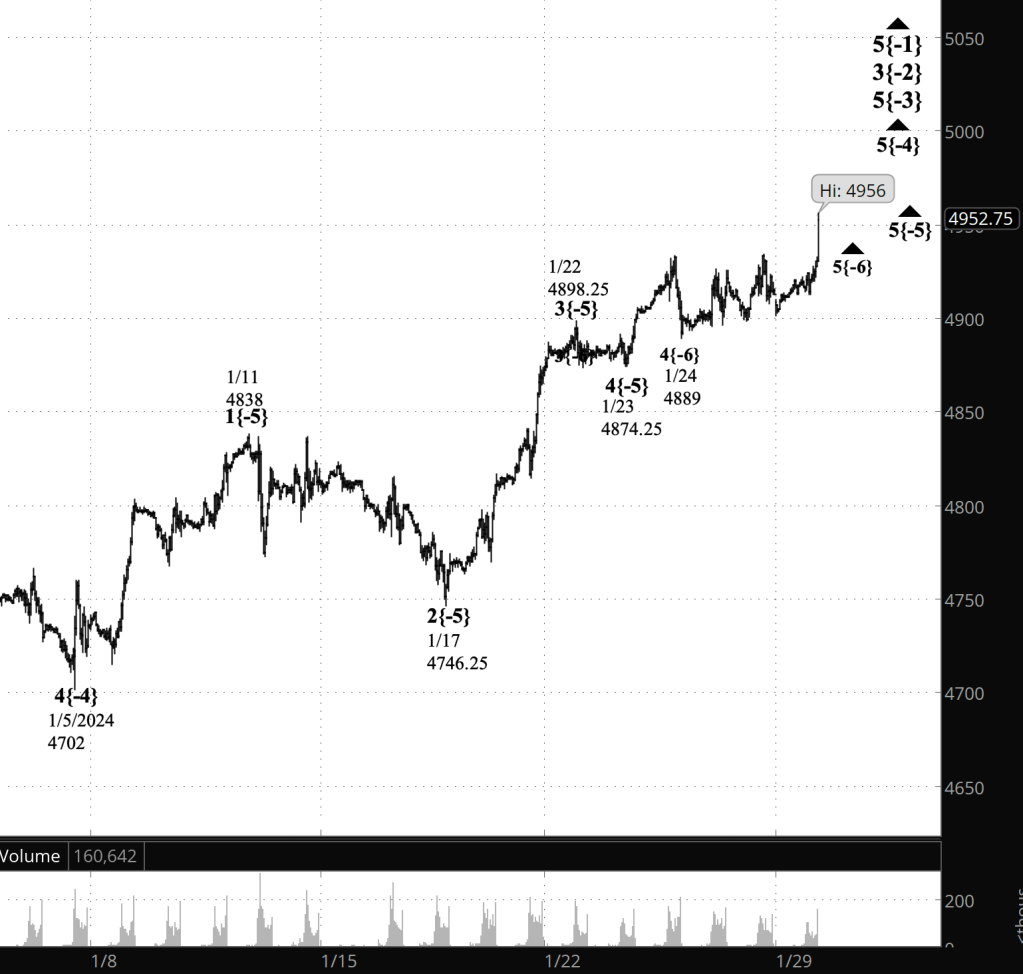
Half an hour before the closing bell. The S&P 500 futures continued rising during the session, with the first subwave — wave A — of the ongoing 2nd-wave downward correction reaching into the 4790s.

It is most common in 2nd waves for the A wave to take the Zigzag form, with five subwaves. I count wave A as being in its middle subwave, wave 3.

I’ve updated the chart.

2:10 a.m. New York time

Trades. I exited my short Iron Fly options position on XSP, which I entered on Friday and held over the weekend, for a 41.8% profit and updated the trade analysis with results.

I entered two options positions today.

My short Iron Fly on SPY is an overnighter. I’ll exit Tuesday morning right after the opening bell.

My short Iron Condor on USO is a longer-term position with a 50% profit target. It expires 39 days after entry, on February 16, and if needed I’ll manage the position 21 days before expiration, on January 26.

I’ve posted trade analyses for both the SPY and USO positions.

I worked on entering a short Iron Condor position on ACI, timed to coincide with Tuesday’s earnings announcement before the opening bell. But it’s a lower priced underlying stock — less than $30 — and I couldn’t work out a structure that would meet my requirements and still produce sufficient return to be worthwhile. The next earnings-trade opportunity is DAL: Entry on January 11 and announcement on January 12 before the session begins.

9:35 a.m. New York time

What’s happening now? The S&P 500 E-mini futures declined after trading resumed overnight, reaching into the 4710s and then reversing as the opening bell approached, returning to the 4740s.

What does it mean? A 2nd-wave upward correction deep within a much larger 3rd-wave downtrend is now underway. Elliott Wave Theory has a rule that applies to each 2nd wave: It never moves above the starting point of the preceding 1st wave. In this case, the 1st wave began on December 27, coincident with the start of a downtrending 3rd wave five degree larger in the fractal structure the price movements.

That starting point, 4841.50, is a non-negotiable barrier to the 2nd wave’s rise. Bottom line: The correction has a long distance to travel.

There’s no formal guidance on how much of the 1st wave will be retraced by the 2nd wave. My experience is that wave 2 usually retraces most of wave 1 and results in much happy talk concluding that the market’s uptrend has resumed, expectations that are eventually dashed.

The much larger parent wave of the 2nd-wave correction — wave 3 — will ultimately reach below the endpoint of the preceding 1st wave of the same degree — 3491.38. Typically a 3rd wave will move significantly below that endpoint.

What are the alternatives? There are two:

Alternative #1: The 2nd wave rise that preceded the 3rd wave is still underway and is taking a compound form. The present decline is an X wave, which will link the first corrective pattern within wave 2 to a second corrective pattern. A compound correction contains up to three corrective patterns.

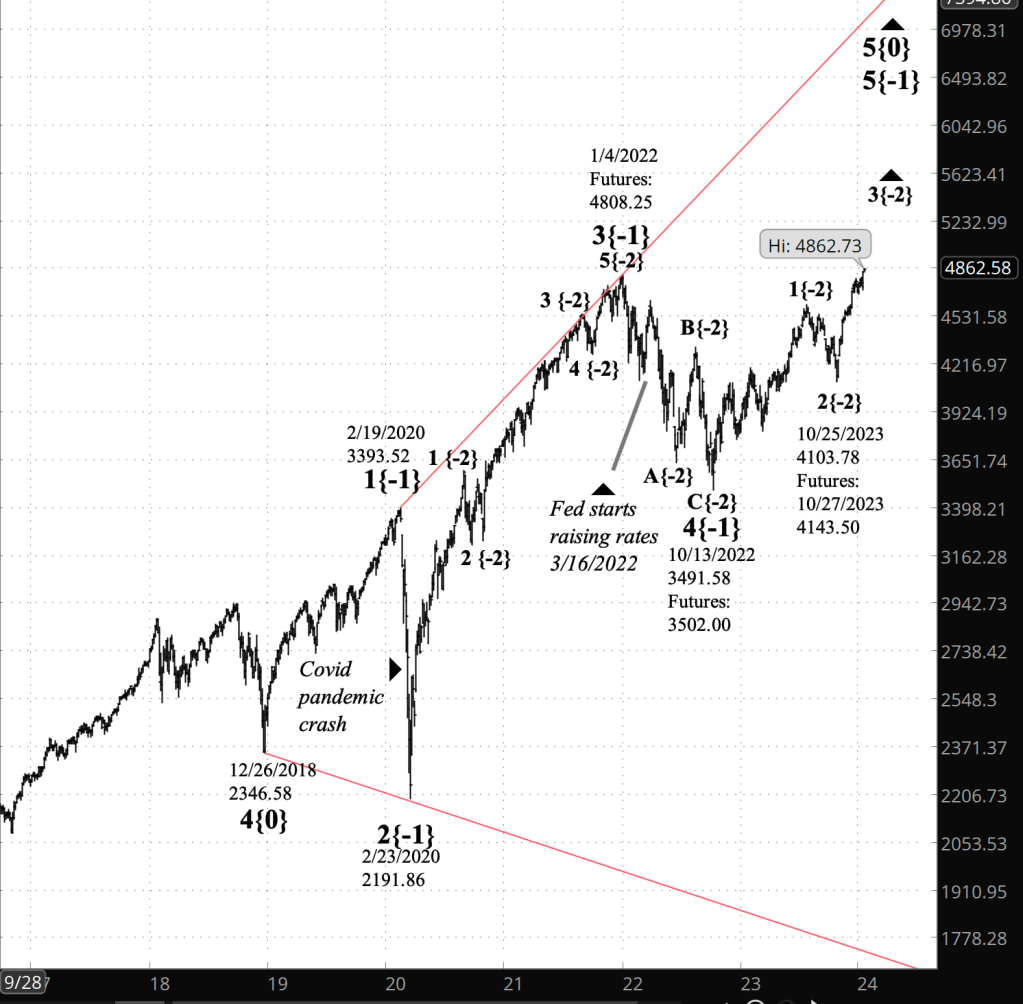
Alternative #2: This is more of a general observation. Assigning a degree to subwaves early in a correction is, frankly, little more than an educated guess. The only guidance is that the time and distance characteristics of a subwave be similar to those attributes in waves of the same degree that came before. Not exactly a precise metric. So the degrees I’ve assigned may change over time as the downtrend progresses. The degrees on the chart labels are subscripts within curly brackets that follow the wave number. The degree number shows the wave’s position relative to wave 5{0}, an expanding Diagonal Triangle still underway that began on December 26, 2018. Wave 2{-7}, the present upward correction, is seven degrees lower than wave 5{0}.

[S&P 500 E-mini futures at 3:30 p.m., 20-minute bars, with volume]

What does Elliott wave theory say? Here are the waves that underly the analyses.

Principal Analysis:

  • Wave 5{0}, an expanding Diagonal Triangle, began on December 26, 2018.
  • Within it, a downtrend, wave 4{-1}, began on January 4, 2022 and is underway.
  • Wave 4{-1} is the parent wave of a downtrend, wave 3{-2}, that began on January 2, 2024 and is in wave 1{-3}, the first of five subwaves.
  • Deep within that downtrend’s 1st wave, downtrending wave 5{-8} and its parent, wave 1{-7}, ended at the overnight low, 4702. Wave 2{-7} is now underway, an upward correction of low degree, and within it, wave A{-8} is underway.

Alternative #1:

  • Wave 2{-2}, an upward correction that began on October 13, 2022, continues and is taking a compound form.
  • Wave X{-3} is underway, connecting the now complete first corrective pattern and the not-yet-begun second corrective pattern.

Alternative #2:

  • The upward correction that began on January 5, labeled on the chart was wave 2{-7}, is actually wave 2{-6}, or perhaps wave 2{-5}, or maybe even larger.

We Are Here.

These are the waves currently in progress under my principal analysis. Each line on the list shows the wave number, with the subscript in curly brackets, the traditional degree name, the starting date, the starting price of the S&P 500 E-mini futures, and the direction of the wave.

  • S&P 500 Index:
  • 5{+3} Supercycle, 7/8/1932, 4.40 (up)
  • 5{+2} Cycle, 12/9/1974, 60.96 (up)
  • 5{+1} Primary, 3/6/2009, 666.79 (up)
  • 5{0} Intermediate, 12/26/2018, 2346.58 (up)
  • S&P 500 Futures and index:
  • 4{-1} Minor, 1/4/2022, 4953.25 (down) (futures), 4818.62 (down) (index)
  • S&P 500 Futures:
  • 2{-2} Minute, 10/13/2022, 3491.58 (up)
  • C{-3} Minuette, 10/27/2023, 4122.25 (up)

Reading the chart. Price movements — waves – – in Elliott wave analysis are labeled with numbers within trending waves and letters with corrective waves. The subscripts — numbers in curly brackets — designate the wave’s degree, which, in Elliott wave analysis, means the relative position of a wave within the larger and smaller structures that make up the chart. R.N. Elliott, who in the 1930s developed the form of analysis that bears his name, viewed the chart as a complex structure of smaller waves nested within larger waves, which in turn are nested within still larger waves. In mathematics it’s called a fractal structure, where at every scale the pattern is similar to the others.

Learning and other resources. Elliott wave analysis provides context, not prophecy. As the 20th century semanticist Alfred Korzybski put it in his book Science and Sanity (1933), “The map is not the territory … The only usefulness of a map depends on similarity of structure between the empirical world and the map.” And I would add, in the ever-changing markets, we can judge that similarity of structure only after the fact.

See the menu page Analytical Methods for a rundown on where to go for information on Elliott wave analysis.

By Tim Bovee, Portland, Oregon, January 8, 2024

Disclaimer

Tim Bovee, Private Trader tracks the analysis and trades of a private trader for his own accounts. Nothing in this blog constitutes a recommendation to buy or sell stocks, options or any other financial instrument. The only purpose of this blog is to provide education and entertainment.

No trader is ever 100 percent successful in his or her trades. Trading in the stock and option markets is risky and uncertain. Each trader must make trading decisions for his or her own account, and take responsibility for the consequences.

License
Creative Commons License

All content on Tim Bovee, Private Trader by Timothy K. Bovee is licensed under a Creative Commons Attribution-ShareAlike 4.0 International License.

Based on a work at www.timbovee.com.

Options Trades 1/5/2024: XSP

Symbols traded today: XSP short Iron Fly (3DTE)

On Friday, January 5, I entered a short Iron Fly position on XSP, held it over the weekend, and exited shortly after the opening bell the next Monday, January 8, for a 41.8% profit.

XSP short Iron Fly

LOT:2ENTRY DATE:1/5/2024
EXIT DATE:1/8/2024
DAYS HELD:3

Entry and Exit

METRICCREDITDEBITCHANGECHANGE %ANNUALIZED CHANGE %
Options premium$ 2.24$ 1.58$ 0.6641.8%5054%
METRICENTRYEXITCHANGECHANGE %ANNUALIZED CHANGE %
Stock price$ 469.14$ 470.26$ (1.12)0.24%29%
Impllied Volatility Rate11.713.11.4
Days to expiration30

The structure of the position

STRUCTURESTRIKEODDS EXPIRE OTMDELTAIN PRICEOUT PRICECHANGE
Calls
Long473.0084%16$ (0.25)$ 0.12$ (0.13)
Break-even472.2469%30.5
Short470.0054%45$ 1.08$ (1.06)$ 0.02
Puts
Short470.0046%55$ 1.75$ (0.68)$ 1.07
Break-even468.2465%36
Long466.0084%17$ (0.34)$ 0.04$ (0.30)
======
NET TOTAL:$ 0.66

Risk and Reward

Per contract:
Reward224.00
Risk126.00
R/R Ratio (n:1)0.6

By Tim Bovee, Portland, Oregon, January 5-8, 2024

Disclaimer

Tim Bovee, Private Trader tracks the analysis and trades of a private trader for his own accounts. Nothing in this blog constitutes a recommendation to buy or sell stocks, options or any other financial instrument. The only purpose of this blog is to provide education and entertainment.

No trader is ever 100 percent successful in his or her trades. Trading in the stock and option markets is risky and uncertain. Each trader must make trading decisions for his or her own account, and take responsibility for the consequences.

License
Creative Commons License

All content on Tim Bovee, Private Trader by Timothy K. Bovee is licensed under a Creative Commons Attribution-ShareAlike 4.0 International License.

Based on a work at www.timbovee.com.
Trader’s Notebook

3:30 p.m. New York time

Half an hour before the closing bell. The S&P 500 futures swung into a small upward correction during the session as the wave 3 downtrend that began on December 27, 2023 continued to work through its early stages.

Elliott Wave Theory defines two sorts of correction that are most common, each with three subwaves, A, B, and C: A Zigzag has five subwaves in the A wave, three in the B and five in the C. A Flat has three subwaves in A and also in B, and five subwaves in C. My experience has been that 2nd waves are more likely to take the Zigzag pattern, and 4th waves, the Flat. An alternation rule of Elliott Wave Theory is that if the wave 2 correction is of one pattern, wave 4 will be the other pattern.

All of this is happening within wave 3{-2} on the chart, a subwave of a larger declining wave 4{-1}, the next to the last wave of the expanding Diagonal Triangle that began in late 2018.

The first subwave, downtrending wave 1{-2}, took 282 days to reach completions, and the second subwave, upward correction 2{-2}, took 440 days. A 3rd wave is almost always longer than waves 1 and 2 by a large margin, so we can rest assured that the downtrending 3rd wave, with all of its internal ups and downs, will be with us for quite a long time.

I made two adjustments to the charts. I the upper chart, I’ve moved the end point label of wave 1{-8}. On the lower chart, I corrected the date of the wave 2{-2} end point.

1:45 p.m. New York time

Trades. I’ve entered a short Iron Fly position on XSP that expires on Monday, with the intent of selling shortly after the opening bell, and have posted an analysis of the trade.

Trades will be blocked on two days next week because of economic reports: On Wednesday by the Consumer Price Index before the opening bell on Thursday, and on Thursday by the Producer Price Index on Friday.

I’ll consider entering short-term Iron Condor options positions covering earnings announcements next week: ACI on Monday for a pre-opening Tuesday announcement, and DAL on Thursday in anticipation of a Friday announcement before the opening. Whether actually take the trade or not depends upon whether the options maintain their high implied volatility and whether their pricing will provide sufficient return.

9:35 a.m. New York time

What’s happening now? The S&P 500 E-mini futures declined overnight, reaching a low of 4702 as the December employment statistics were released and then rising back into the 4720s.

What does it mean? The 3rd-wave downtrend that began on December 27, 2023 continues and is in its early stages. In Elliott Wave Theory, when a wave has first begun, determining the degree of the subwaves — where they reside in the fractal structure of the movement — is little better than a guess. I’ve chosen to label the waves as being six degrees lower than the 3rd wave that encompasses them.

That degree — {-8} on the chart — seems similar in size and duration to {-8} waves within the preceding 2nd wave upward correction, so I’ll go with that labeling for now. That degree could be modified as the the 1st subwave — wave 1{-3} — within the downtrend — wave 3{-2} — progresses.

Under the Elliott Wave Theory’s analytical rules, a 3rd wave trend always moves beyond the starting point of the preceding 2nd wave. That means the present 3rd wave, at a minimum, will move below 3502, where wave 2{-2} began on October 13, 2022.

A 3rd wave almost always moves far below the starting point of wave 2.

The parent of wave 3{-2} is wave 4{-1}, the declining next-to-the-last wave of a very large expanding Diagonal Triangle that began on December 26, 2018. A characteristic of expanding triangles is, at the extremes, the highs keep moving higher and the lows, lower. Wave 4{-1} will eventually come close to or meet the lower boundary of the triangle’s price channel, which is presently in the 1750s and declining further every session.

What are the alternatives? None at present. Without a doubt, they will develop.

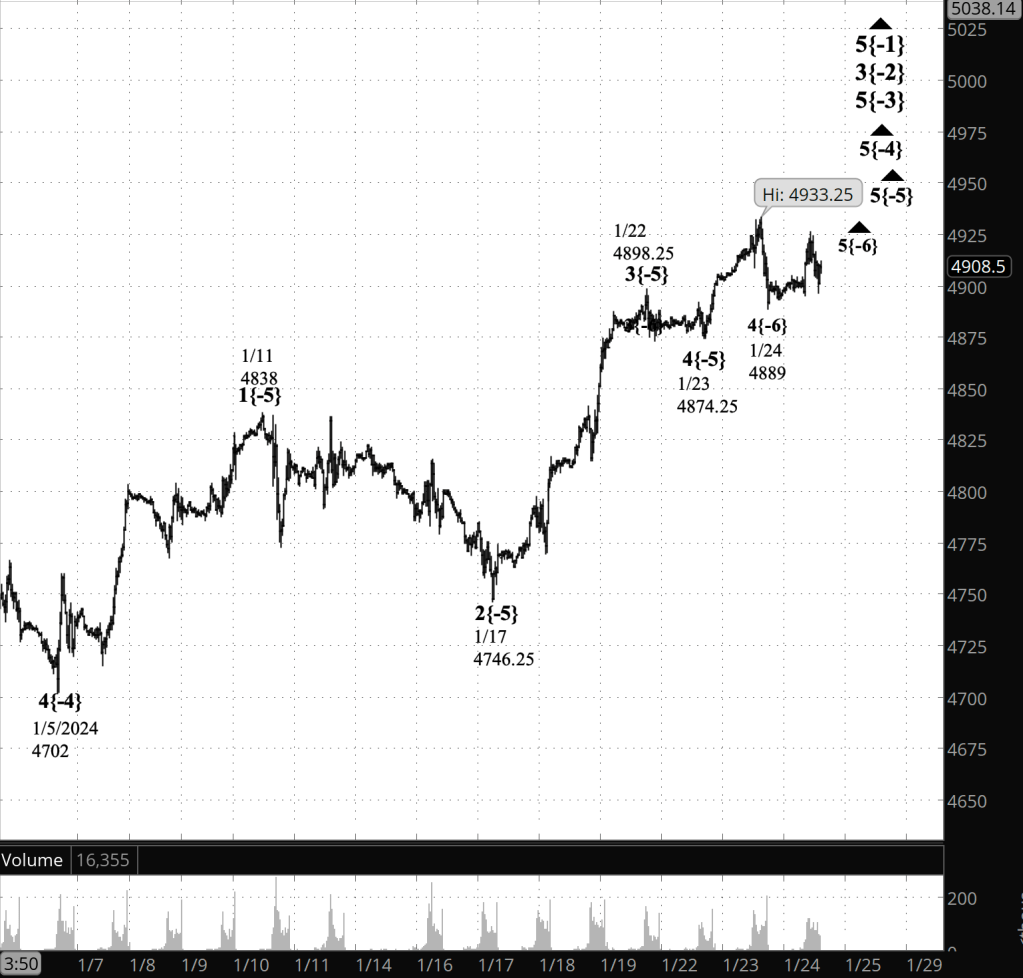
Charts. The upper chart, tracking the futures, shows a close-up of the downtrending 3rd wave that began on December 27. The lower chart, tracking the index, shows the expanding Diagonal Triangle, with the upper and lower price channels drawn in red.

[S&P 500 E-mini futures at 3:30 p.m., 15-minute bars, with volume]

[S&P 500 index at 3:29 p.m., 13-day bars]

What does Elliott wave theory say? Here are the waves that underly the analyses.

Principal Analysis:

  • A downtrend, wave 4{-1}, began on January 4, 2022 and is underway.
  • Within wave 4{-1}, a downtrend, wave 3{-2}, began on January 2, 2024 and is in wave 1{-3}, the first of five subwaves.
  • Deep within that downtrend’s 1st wave, downtrending wave 5{-8} and its parent, wave 1{-7}, ended at the overnight low, 4702. Wave 2{-7} is now underway, an upward correction of low degree, and within it, wave A{-8} is underway.

We Are Here.

These are the waves currently in progress under my principal analysis. Each line on the list shows the wave number, with the subscript in curly brackets, the traditional degree name, the starting date, the starting price of the S&P 500 E-mini futures, and the direction of the wave.

  • S&P 500 Index:
  • 5{+3} Supercycle, 7/8/1932, 4.40 (up)
  • 5{+2} Cycle, 12/9/1974, 60.96 (up)
  • 5{+1} Primary, 3/6/2009, 666.79 (up)
  • 5{0} Intermediate, 12/26/2018, 2346.58 (up)
  • S&P 500 Futures and index:
  • 4{-1} Minor, 1/4/2022, 4953.25 (down) (futures), 4818.62 (down) (index)
  • S&P 500 Futures:
  • 3{-2} Minute, 12/27/2022, 3491.58 (down)
  • 1{-3} Minuette, 12/27/2022, 3491.58 (down)

Reading the chart. Price movements — waves – – in Elliott wave analysis are labeled with numbers within trending waves and letters with corrective waves. The subscripts — numbers in curly brackets — designate the wave’s degree, which, in Elliott wave analysis, means the relative position of a wave within the larger and smaller structures that make up the chart. R.N. Elliott, who in the 1930s developed the form of analysis that bears his name, viewed the chart as a complex structure of smaller waves nested within larger waves, which in turn are nested within still larger waves. In mathematics it’s called a fractal structure, where at every scale the pattern is similar to the others.

Learning and other resources. Elliott wave analysis provides context, not prophecy. As the 20th century semanticist Alfred Korzybski put it in his book Science and Sanity (1933), “The map is not the territory … The only usefulness of a map depends on similarity of structure between the empirical world and the map.” And I would add, in the ever-changing markets, we can judge that similarity of structure only after the fact.

See the menu page Analytical Methods for a rundown on where to go for information on Elliott wave analysis.

By Tim Bovee, Portland, Oregon, January 5, 2024

Disclaimer

Tim Bovee, Private Trader tracks the analysis and trades of a private trader for his own accounts. Nothing in this blog constitutes a recommendation to buy or sell stocks, options or any other financial instrument. The only purpose of this blog is to provide education and entertainment.

No trader is ever 100 percent successful in his or her trades. Trading in the stock and option markets is risky and uncertain. Each trader must make trading decisions for his or her own account, and take responsibility for the consequences.

License
Creative Commons License

All content on Tim Bovee, Private Trader by Timothy K. Bovee is licensed under a Creative Commons Attribution-ShareAlike 4.0 International License.

Based on a work at www.timbovee.com.

Trader’s Notebook

3:30 p.m. New York time

Half an hour before the closing bell. The S&P 500 futures fluctuated between the 4730s and the 4760s during the session, in a small upward correction deep within a much larger 3rd wave downtrend that began on January 2.

This morning’s analysis stands unchanged. I’ve updated the upper chart, a close-up of the futures, and have left the lower chart, a long-term view of the index back to 2018, as it was this morning.

1:30 p.m. New York time

Trades. I exited my short Iron Condor position on IWM, 15 days after entry and 22 before expiration, for an 11.6% loss admid a geeneral market decline since trading resumed for the new year. I’ve updated the trade analysis with results.

9:35 a.m. New York time

What’s happening now? The S&P 500 E-mini futures moved largely sideways in overnight trading, drifting lower as the clock ticked toward the opening bell.

What does it mean? The decline brought the price below the target range of the downward 4th wave of small degree within the upward correction that began on October 13, 2022. The 4th wave is five levels deep within wave 2. All of the waves in between are in their final stages, so what that deeply buried small wave does will determine whether the correction is over or not.

I said yesterday that a decline below the target range would trigger a reassessment of the analysis. The time spent below the range was brief — only a few minutes — and I was tempted to delay the relabeling of the chart until the decline has greater staying power. Nonetheless, the decline has formed five waves to the downside, suggesting a trend rather than a correction.

The new principal analysis: Wave 2 is complete and downtrending wave 3 has begun and is in its early stages. It will eventually carry the price below the start of the preceding 1st wave, 3502 on the futures, and almost certainly significantly below that level.

Could this declaration be premature? It certainly could, and if that proves to be the case, then I’ll return the chart to its January 3 version.

What are the alternatives? It’s possible that wave 2{-2} will take a compound form, containing two or three corrective patterns. if that proves to be the case, then the present declining is an X wave, separating the first corrective pattern, which ended overnight, from the second corrective pattern.

The Charts. The upper chart shows the final subwave of the wave 2 correction and the start of the wave 3 downtrend on the S&P 500 futures. The lower chart shows the entirety of the expanding Diagonal Triangle that began in December 2018 and contains the wave 2 upward correction.

[S&P 500 E-mini futures at 3:30 p.m. , 2-hour bars, with volume]

[S&P 500 index at 9:34 a.m., 3-day bars]

What does Elliott wave theory say? Here are the waves that underly the analyses.

Principal Analysis:

  • A downtrend, wave 4{-1}, began on January 4, 2022 and is underway.
  • Within wave 4{-1}, an upward correction, wave 3{-2}, began on January 2, 2024 and is in wave 1{-3}, the first of five subwaves.

Alternative Analysis:

  • Wave 2{-2} is still underway and is taking a compound form.
  • The first corrective pattern ended on January 2, the end of wave C{-3}.
  • A declining connector wave is underway, wave X{-3}.

We Are Here.

These are the waves currently in progress under my principal analysis. Each line on the list shows the wave number, with the subscript in curly brackets, the traditional degree name, the starting date, the starting price of the S&P 500 E-mini futures, and the direction of the wave.

  • S&P 500 Index:
  • 5{+3} Supercycle, 7/8/1932, 4.40 (up)
  • 5{+2} Cycle, 12/9/1974, 60.96 (up)
  • 5{+1} Primary, 3/6/2009, 666.79 (up)
  • 5{0} Intermediate, 12/26/2018, 2346.58 (up)
  • S&P 500 Futures and index:
  • 4{-1} Minor, 1/4/2022, 4953.25 (down) (futures), 4818.62 (down) (index)
  • S&P 500 Futures:
  • 3{-2} Minute, 1/2/2024, 4841.50 (down)
  • 1{-3} Minuette, 1/2/2024, 4841.50 (down)

Reading the chart. Price movements — waves – – in Elliott wave analysis are labeled with numbers within trending waves and letters with corrective waves. The subscripts — numbers in curly brackets — designate the wave’s degree, which, in Elliott wave analysis, means the relative position of a wave within the larger and smaller structures that make up the chart. R.N. Elliott, who in the 1930s developed the form of analysis that bears his name, viewed the chart as a complex structure of smaller waves nested within larger waves, which in turn are nested within still larger waves. In mathematics it’s called a fractal structure, where at every scale the pattern is similar to the others.

Learning and other resources. Elliott wave analysis provides context, not prophecy. As the 20th century semanticist Alfred Korzybski put it in his book Science and Sanity (1933), “The map is not the territory … The only usefulness of a map depends on similarity of structure between the empirical world and the map.” And I would add, in the ever-changing markets, we can judge that similarity of structure only after the fact.

See the menu page Analytical Methods for a rundown on where to go for information on Elliott wave analysis.

By Tim Bovee, Portland, Oregon, January 4, 2024

Disclaimer

Tim Bovee, Private Trader tracks the analysis and trades of a private trader for his own accounts. Nothing in this blog constitutes a recommendation to buy or sell stocks, options or any other financial instrument. The only purpose of this blog is to provide education and entertainment.

No trader is ever 100 percent successful in his or her trades. Trading in the stock and option markets is risky and uncertain. Each trader must make trading decisions for his or her own account, and take responsibility for the consequences.

License
Creative Commons License

All content on Tim Bovee, Private Trader by Timothy K. Bovee is licensed under a Creative Commons Attribution-ShareAlike 4.0 International License.

Based on a work at www.timbovee.com.
Trader’s Notebook

3:30 p.m. New York time

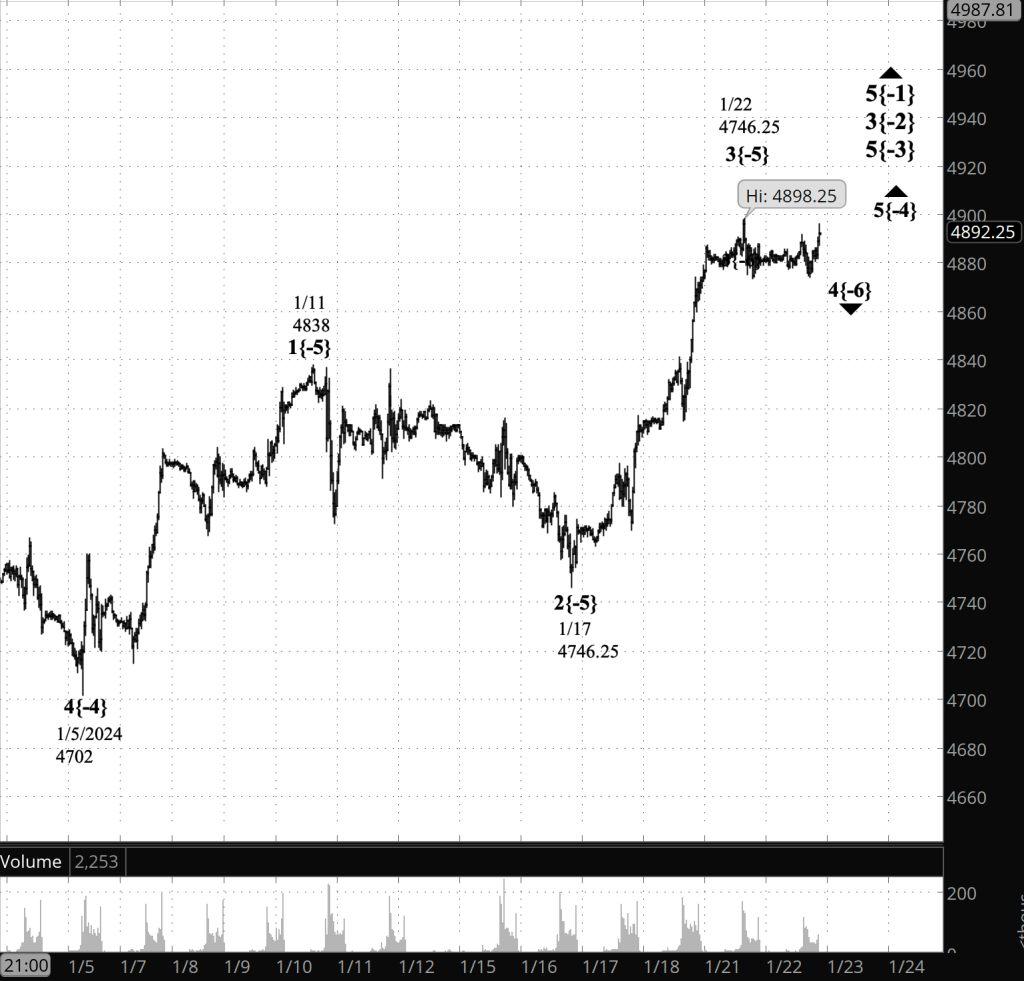
Half an hour before the closing bell. The S&P 500 futures hit a low of 4746.50 early in the session, and then rose slightly, into the 4770s. The reversal price was within the typical range of a 4th wave correction. If the price remains above the lower boundary of the range, 4743.25, then I’ll retain my present analysis: A 4th wave of low degree is underway as its much larger parent, a wave 2 upward correction, continues to work through its end game.

I’ve updated the chart.

2:50 p.m. New York time

Trades. I exited my short Iron Fly options position, the day after entry, on XSP for a 3.6% loss. It was a significant down day on the S&P 500, and XSP, which tracks the index, moved far enough so as to be unprofitable. I’ve updated the trade analysis with results.

No other trades today. I passed on entering another 1DTE trade because the ADP sneak preview to the employment numbers will be released before the opening bell. It often causes unanticipated moves in the price.

I also analyzed three possible earnings plays, on CAG, LW and WBA, and passed on all three. None produced sufficient return for a position that covered the expected moves sufficiently.

9:35 a.m. New York time

What’s happening now? The S&P 500 E-mini futures continued to decline overnight, reaching deep into the 4760s.

What does it mean? The greater the decline, the more likely the first alternative analysis becomes: The 2nd-wave upward correction ended on January 2, and a 3rd-wave downtrend has begun.

I’ve chose to retain yesterday’s principal analysis for the moment: A low degree wave 3 within the final subwave of the correction, rising wave C, ended on January 2. A low-degree 4th wave within with the much larger correction is underway and will be followed by a rising 5th wave that will end the correction.

The low-degree 4th wave remains within its typical range: The 4th subwave within the preceding 3rd wave of the same degree. That range stretches from 4830.75 to 4743.25.

If the price moves below that lower number, I will switch the chart to Alternative #1: The correction ended on January 2 and wave 3 began, retaining this morning’s principal analysis as a new 1st alternative.

What are the alternatives? There are two, the same as yesterday.

Alternative #1: It’s possible that the January 2 peak was the end of wave 5{-8}. If that proves to be the case, then the large 2nd wave — wave 2{-2} on the chart — ended at that peak, and wave 3{-2} has begun its energetic decline that will carry the price below the start of the preceding 1st wave — 3491.58 — and perhaps significantly below.

Alternative #2: It’s also possible that wave 2{-2} will take a compound form, containing two or three corrective patterns. if that proves to be the case, then the present declining is an X wave, separating the first corrective pattern, which ended overnight, from the second corrective pattern.

[S&P 500 E-mini futures at 9:35 a.m., 2-hour bars, with volume]

What does Elliott wave theory say? Here are the waves that underly the analyses.

Principal Analysis:

  • A downtrend, wave 4{-1}, began on January 4, 2022 and is underway.
  • Within wave 4{-1}, an upward correction, wave 2{-2}, began on October 13, 2022.
  • The third wave of the correction, wave C{-3}, is underway.
  • Wave C{-3} has reached its 5th and final subwave, wave 5{-4} and a series of smaller 5th waves, down to wave 5{-7}.
  • Within wave 5{-7}, the next-to-the-last subwave is underway, wave 4{-8}, a decline that began on January 2, 2024.

Alternative #1:

  • Wave 5{-8}, the final wave of the upward correction, ended on January 2, also ending wave C{-3} and the upward correction, wave 2{-2}.
  • Wave 3{-2} is underay.

Alternative #2:

  • Wave 2{-2} is taking a compound form.
  • The first corrective pattern ended on January 2, the end of wave C{-3}.
  • A declining connector wave is underway, wave X{-3}.

We Are Here.

These are the waves currently in progress under my principal analysis. Each line on the list shows the wave number, with the subscript in curly brackets, the traditional degree name, the starting date, the starting price of the S&P 500 E-mini futures, and the direction of the wave.

  • S&P 500 Index:
  • 5{+3} Supercycle, 7/8/1932, 4.40 (up)
  • 5{+2} Cycle, 12/9/1974, 60.96 (up)
  • 5{+1} Primary, 3/6/2009, 666.79 (up)
  • 5{0} Intermediate, 12/26/2018, 2346.58 (up)
  • S&P 500 Futures and index:
  • 4{-1} Minor, 1/4/2022, 4953.25 (down) (futures), 4818.62 (down) (index)
  • S&P 500 Futures:
  • 2{-2} Minute, 10/13/2022, 3491.58 (up)
  • C{-3} Minuette, 10/27/2023, 4122.25 (up)

Reading the chart. Price movements — waves – – in Elliott wave analysis are labeled with numbers within trending waves and letters with corrective waves. The subscripts — numbers in curly brackets — designate the wave’s degree, which, in Elliott wave analysis, means the relative position of a wave within the larger and smaller structures that make up the chart. R.N. Elliott, who in the 1930s developed the form of analysis that bears his name, viewed the chart as a complex structure of smaller waves nested within larger waves, which in turn are nested within still larger waves. In mathematics it’s called a fractal structure, where at every scale the pattern is similar to the others.

Learning and other resources. Elliott wave analysis provides context, not prophecy. As the 20th century semanticist Alfred Korzybski put it in his book Science and Sanity (1933), “The map is not the territory … The only usefulness of a map depends on similarity of structure between the empirical world and the map.” And I would add, in the ever-changing markets, we can judge that similarity of structure only after the fact.

See the menu page Analytical Methods for a rundown on where to go for information on Elliott wave analysis.

By Tim Bovee, Portland, Oregon, January 3, 2024

Disclaimer

Tim Bovee, Private Trader tracks the analysis and trades of a private trader for his own accounts. Nothing in this blog constitutes a recommendation to buy or sell stocks, options or any other financial instrument. The only purpose of this blog is to provide education and entertainment.

No trader is ever 100 percent successful in his or her trades. Trading in the stock and option markets is risky and uncertain. Each trader must make trading decisions for his or her own account, and take responsibility for the consequences.

License
Creative Commons License

All content on Tim Bovee, Private Trader by Timothy K. Bovee is licensed under a Creative Commons Attribution-ShareAlike 4.0 International License.

Based on a work at www.timbovee.com.
Options Trades 1/2/2024: XSP

Symbols traded today: XSP (1DTE)

I entered a short Iron Fly position on XSP that expires the next day, a 1DTE position, and exited it for a 3.6% loss.

XSP short Iron Fly

LOT:1ENTRY DATE:1/2/2024
EXIT DATE:1/3/2024
DAYS HELD:1

Entry and Exit

METRICCREDITDEBITCHANGECHANGE %ANNUALIZED CHANGE %
Options premium$ 2.16$ 2.24$ (0.08)-3.6%-1296%
METRICENTRYEXITCHANGECHANGE %ANNUALIZED CHANGE %
Stock price$ 474.54$ 472.17$ 2.37-0.50%-182%
Impllied Volatility Rate10.514.03.5
Days to expiration10

The structure of the position

STRUCTURESTRIKEODDS EXPIRE OTMDELTAIN PRICEOUT PRICECHANGE
Calls
Long478.0090%12$ (0.18)$ 0.02$ (0.16)
Break-even476.1667%34$ 1.00
Short474.0044%56$ 1.54$ (0.35)$ 1.19
Puts
Short474.0056%44$ 0.92$ (2.23)$ (1.31)
Break-even472.1674%26.5
Long470.0091%9$ (0.12)$ 0.32$ 0.20
======
NET TOTAL:$ (0.08)

Risk and Reward

Per contract:
Reward216.00
Risk184.00
R/R Ratio (n:1)0.9

By Tim Bovee, Portland, Oregon, January 2-3, 2024

Disclaimer

Tim Bovee, Private Trader tracks the analysis and trades of a private trader for his own accounts. Nothing in this blog constitutes a recommendation to buy or sell stocks, options or any other financial instrument. The only purpose of this blog is to provide education and entertainment.

No trader is ever 100 percent successful in his or her trades. Trading in the stock and option markets is risky and uncertain. Each trader must make trading decisions for his or her own account, and take responsibility for the consequences.

License
Creative Commons License

All content on Tim Bovee, Private Trader by Timothy K. Bovee is licensed under a Creative Commons Attribution-ShareAlike 4.0 International License.

Based on a work at www.timbovee.com.
Trader’s Notebook

3:30 p.m. New York time

Half an hour before the closing bell. The S&P 500 futures worked their way lower during the session, reaching the 4760s as the closing bell approached. This morning’s analysis stands unchanged. The 2nd wave upward correction continues to play its end game within its final subwave, wave C. I’ve updated the chart.

2:30 p.m. New York time

Trade. I’ve entered a short Iron Fly options position on XSP. The options expire the day after entry, and I intend to exit the position shortly after the opening bell tomorrow. I’ve posted an analysis of the trade.

9:35 a.m. New York time

What’s happening now? The S&P 500 E-mini futures traded sideways until shortly before the London and EU exchanges, and then began to fall, from 4828, by more than 50 points as the opening bell in New York approached.

What does it mean? The 2nd-wave upward correction that began on October 13, 2022 is continuing. Moving deeper into the fractal structure of the chart, all of the correction’s subwaves are in their final waves, until the 6th level down, when a rising 3rd wave that began on December 6, 2023 peaked overnight. Declining wave 4 has begun: Wave 4{-8} on the chart.

The 4th wave will retrace a portion of the preceding, typically ending in the 4th subwave of the preceding 3rd wave. That small subwave, wave 4{-9} on the chart, began from 4830.75 and ended at 4743.25. That’s the target range for wave 4{-8}.

What are the alternatives? There are two:

Alternative #1: It’s possible that the January 2 peak was the end of wave 5{-8}. If that proves to be the case, then the large 2nd wave — wave 2{-2} on the chart — ended at that peak, and wave 3{-2} has begun its energetic decline that will carry the price below the start of the preceding 1st wave — 3491.58 — and perhaps significantly below.

Alternative #2: It’s also possible that wave 2{-2} will take a compound form, containing two or three corrective patterns. if that proves to be the case, then the present declining is an X wave, separating the first corrective pattern, which ended overnight, from the second corrective pattern.

[S&P 500 E-mini futures at 3:30 p.m., 2-hour bars, with volume]

What does Elliott wave theory say? Here are the waves that underly the analyses.

Principal Analysis:

  • A downtrend, wave 4{-1}, began on January 4, 2022 and is underway.
  • Within wave 4{-1}, an upward correction, wave 2{-2}, began on October 13, 2022.
  • The third wave of the correction, wave C{-3}, is underway.
  • Wave C{-3} has reached its 5th and final subwave, wave 5{-4} and a series of smaller 5th waves, down to wave 5{-7}.
  • Within wave 5{-7}, the next-to-the-last subwave is underway, wave 4{-8}, a decline that began on January 2, 2024.

Alternative #1:

  • Wave 5{-8}, the final wave of the upward correction, ended on January 2, also ending wave C{-3} and the upward correction, wave 2{-2}.
  • Wave 3{-2} is underay.

Alternative #2:

  • Wave 2{-2} is taking a compound form.
  • The first corrective pattern ended on January 2, the end of wave C{-3}.
  • A declining connector wave is underway, wave X{-3}.

We Are Here.

These are the waves currently in progress under my principal analysis. Each line on the list shows the wave number, with the subscript in curly brackets, the traditional degree name, the starting date, the starting price of the S&P 500 E-mini futures, and the direction of the wave.

  • S&P 500 Index:
  • 5{+3} Supercycle, 7/8/1932, 4.40 (up)
  • 5{+2} Cycle, 12/9/1974, 60.96 (up)
  • 5{+1} Primary, 3/6/2009, 666.79 (up)
  • 5{0} Intermediate, 12/26/2018, 2346.58 (up)
  • S&P 500 Futures and index:
  • 4{-1} Minor, 1/4/2022, 4953.25 (down) (futures), 4818.62 (down) (index)
  • S&P 500 Futures:
  • 2{-2} Minute, 10/13/2022, 3491.58 (up)
  • C{-3} Minuette, 10/27/2023, 4122.25 (up)

Reading the chart. Price movements — waves – – in Elliott wave analysis are labeled with numbers within trending waves and letters with corrective waves. The subscripts — numbers in curly brackets — designate the wave’s degree, which, in Elliott wave analysis, means the relative position of a wave within the larger and smaller structures that make up the chart. R.N. Elliott, who in the 1930s developed the form of analysis that bears his name, viewed the chart as a complex structure of smaller waves nested within larger waves, which in turn are nested within still larger waves. In mathematics it’s called a fractal structure, where at every scale the pattern is similar to the others.

Learning and other resources. Elliott wave analysis provides context, not prophecy. As the 20th century semanticist Alfred Korzybski put it in his book Science and Sanity (1933), “The map is not the territory … The only usefulness of a map depends on similarity of structure between the empirical world and the map.” And I would add, in the ever-changing markets, we can judge that similarity of structure only after the fact.

See the menu page Analytical Methods for a rundown on where to go for information on Elliott wave analysis.

By Tim Bovee, Portland, Oregon, January 2, 2024

Disclaimer

Tim Bovee, Private Trader tracks the analysis and trades of a private trader for his own accounts. Nothing in this blog constitutes a recommendation to buy or sell stocks, options or any other financial instrument. The only purpose of this blog is to provide education and entertainment.

No trader is ever 100 percent successful in his or her trades. Trading in the stock and option markets is risky and uncertain. Each trader must make trading decisions for his or her own account, and take responsibility for the consequences.

License
Creative Commons License

All content on Tim Bovee, Private Trader by Timothy K. Bovee is licensed under a Creative Commons Attribution-ShareAlike 4.0 International License.

Based on a work at www.timbovee.com.

Trader’s Notebook

3:30 p.m. New York time

Half an hour before the closing bell. The S&P 500 futures fell into the 4790s during the session and then rose slightly. The further the price falls, the more likely it is that the 3rd-wave rise that began on December 6 ended at the December 27 high and the declining 4th wave has begun.

Of course, under the pattern I discussed this morning, it’s certainly possible that the price will rise and reach a higher high — above 4841.50 — demonstrating that the rising 3rd wave is still underway.

This is all happening and a lower degree with the third and possibly final subwave, wave C, within the 2nd-wave upward correction that began on October 27.

Wave 3 or wave 4? Time will tell, as the old cliche puts it. Meanwhile, this morning’s analysis is unchanged. I’ve updated the upper chart, showing the C wave.

1:40 p.m. New York time

Trade. I’ve exited my short Iron Fly position on SPY, one day after entry, on expiration day, for an 8.7% profit and have updated the trade analysis with results.

I’ve decided against entering any short-term trades today that expire on Tuesday, after the New Year’s holiday. A study suggests that the first trading day of the year tends to be more volatile than the average. Since the Iron Fly strategy relies on a low-volatility underlying, prudence suggests that I stay away.

9:35 a.m. New York time

Holiday note. Markets will be closed on Monday, New Year’s Day, with no regular sessions. The S&P 500 E-mini futures will resume trading at 6 p.m. New York time on Monday, and the first Trader’s Notebook of 2024 will be posted Tuesday morning at 9:35 a.m. New York time.

What’s happening now? The S&P 500 E-mini futures bounced from the 4840s to the 4820s overnight, remaining within the range established after the December 27 high retreated slightly.

What does it mean? The chart has been stuck in a pattern for more than a week: Reach a new high within the 2nd-wave upward correction that began on October 13, 2022, navigate sideways for a spell, rise a bit more to a new high, repeat. Each new high is possibly the end of the third and final subwave of the long-running corrective pattern, wave C. And the sideways pattern that has followed each high does nothing to answer the question: Is wave C over or not? So the chart remains in a state of constant ambiguity.

However the ambiguity on the chart is resolved, wave C will be the end of the 2nd-wave upward correction if it takes a simple form, containing one corrective pattern. If it takes a complex form, wave C will be followed by a second corrective pattern, and possibly a third, extending the wave 2 correction.

When wave 2 is complete, it will be followed by a powerful 3rd-wave downtrend that will carry the price down the 3490s, and most likely significantly lower.

Meanwhile, wave 2 and its subwaves will break a rule of Elliott Wave Theory if they move above 4953.25, the starting point of the 1st wave that preceded the present 2nd wave. If such a breakout should happen, then the present analysis will be scrapped and a new analysis put in its place, most likely making the decline that began on January 4, 2022 a subwave of a rising 3rd wave that began in December 2022. The 3rd wave is a subwave of an expanding Diagonal Triangle that began in December 2018.

What are the alternatives? When a price movement is close to its end, each new high is potentially the end of the 3rd subwave of low degree and the beginning of 4th subwave. I’ve chosen to mark wave the 3rd subwave as being underway. There’s an equal likelihood that the 4th subwave has begun its decline. In any case, wave 4 will be followed by rising wave 5, which will complete the much larger corrective pattern.

The chart. Two charts today.

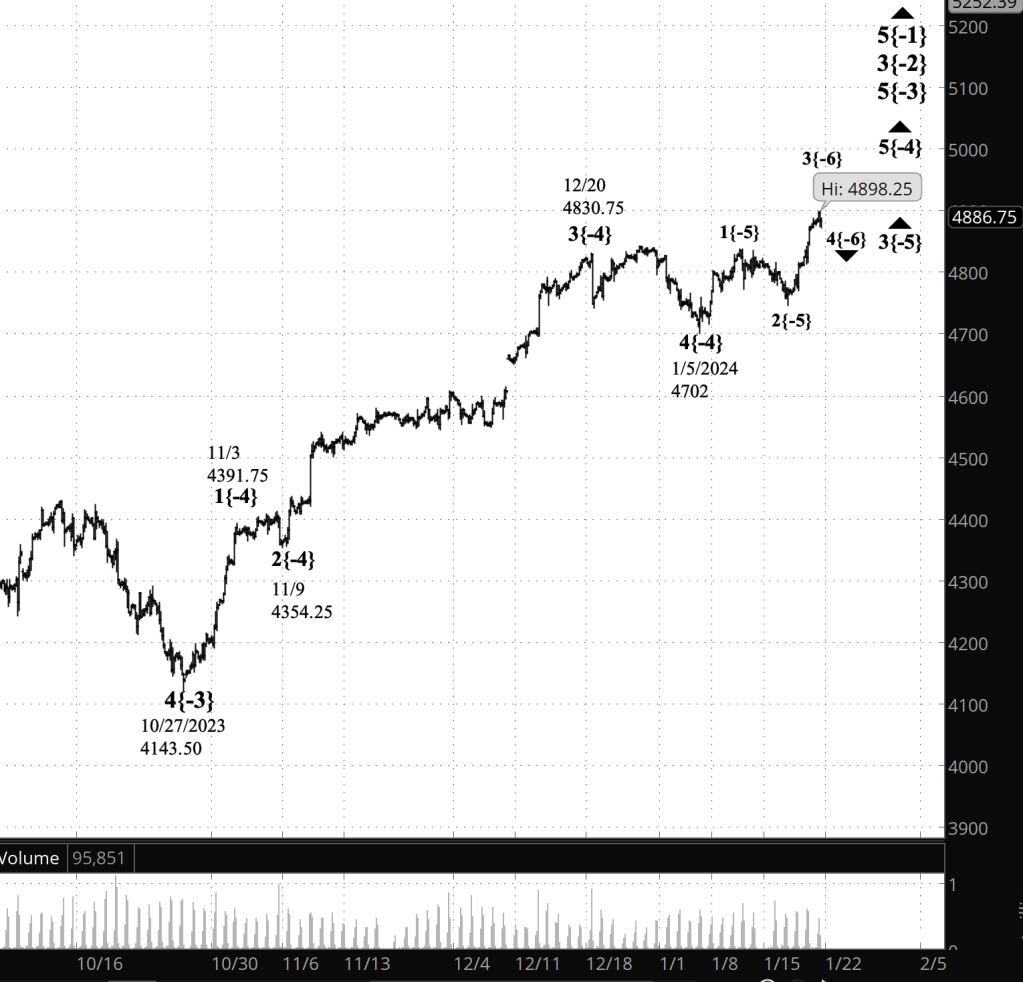
The upper chart — the futures — focuses on wave C within the 2nd-wave upward correction, covering October 22 to the present. I’ve superimposed a Fibonacci retracement ladder over the upper chart, in red, showing how close the price has come to the 100% retracement level, which is also the starting point of preceding wave 1, the ceiling on wave 2’s upward movement under the present analysis.

The lower chart — the index — shows the expanding Diagonal Triangle that began in December 2018 in its entirety so far, providing context for the relatively small-scale dramas playing out on the upper chart.

[S&P 500 E-mini futures at 3:30 p.m., 2-hour bars, with volume]

[S&P 500 index at 9:30 a.m., 3-day bars]

What does Elliott wave theory say? Here are the waves that underly the analyses.

Principal Analysis:

  • A downtrend, wave 4{-1}, began on January 4, 2022 and is underway.
  • Within wave 4{-1}, an upward correction, wave 2{-2}, began on October 13, 2022.
  • The third wave of the correction, wave C{-3}, is underway.
  • Wave C{-3} has reached its 5th and final subwave, wave 5{-4} and a series of smaller 5th waves, down to wave 5{-7}.
  • Within wave 5{-7}, the middle subwave is underway, wave 3{-8}, an uptrend, began with the December 6 low.

Alternative Analysis:

  • Within wave 5{-7}, the next-to-the-last subwave is underway, wave 4{-8}, a downward correction, began with the December 27 high.

We Are Here.

These are the waves currently in progress under my principal analysis. Each line on the list shows the wave number, with the subscript in curly brackets, the traditional degree name, the starting date, the starting price of the S&P 500 E-mini futures, and the direction of the wave.

  • S&P 500 Index:
  • 5{+3} Supercycle, 7/8/1932, 4.40 (up)
  • 5{+2} Cycle, 12/9/1974, 60.96 (up)
  • 5{+1} Primary, 3/6/2009, 666.79 (up)
  • 5{0} Intermediate, 12/26/2018, 2346.58 (up)
  • S&P 500 Futures and index:
  • 4{-1} Minor, 1/4/2022, 4953.25 (down) (futures), 4818.62 (down) (index)
  • S&P 500 Futures:
  • 2{-2} Minute, 10/13/2022, 3491.58 (up)
  • C{-3} Minuette, 10/27/2023, 4122.25 (up)

Reading the chart. Price movements — waves – – in Elliott wave analysis are labeled with numbers within trending waves and letters with corrective waves. The subscripts — numbers in curly brackets — designate the wave’s degree, which, in Elliott wave analysis, means the relative position of a wave within the larger and smaller structures that make up the chart. R.N. Elliott, who in the 1930s developed the form of analysis that bears his name, viewed the chart as a complex structure of smaller waves nested within larger waves, which in turn are nested within still larger waves. In mathematics it’s called a fractal structure, where at every scale the pattern is similar to the others.

Learning and other resources. Elliott wave analysis provides context, not prophecy. As the 20th century semanticist Alfred Korzybski put it in his book Science and Sanity (1933), “The map is not the territory … The only usefulness of a map depends on similarity of structure between the empirical world and the map.” And I would add, in the ever-changing markets, we can judge that similarity of structure only after the fact.

See the menu page Analytical Methods for a rundown on where to go for information on Elliott wave analysis.

By Tim Bovee, Portland, Oregon, December 29, 2023

Disclaimer

Tim Bovee, Private Trader tracks the analysis and trades of a private trader for his own accounts. Nothing in this blog constitutes a recommendation to buy or sell stocks, options or any other financial instrument. The only purpose of this blog is to provide education and entertainment.

No trader is ever 100 percent successful in his or her trades. Trading in the stock and option markets is risky and uncertain. Each trader must make trading decisions for his or her own account, and take responsibility for the consequences.

License
Creative Commons License

All content on Tim Bovee, Private Trader by Timothy K. Bovee is licensed under a Creative Commons Attribution-ShareAlike 4.0 International License.

Based on a work at www.timbovee.com.

Options Trades 12/28/2023: SPY

Symbol traded today: SPY (1DTE)

I entered a short Iron Fly position on SPY, one day before expiration, and exited for an 8.7% profit.

SPY short Iron Fly

LOT:23ENTRY DATE:12/28/2023
EXIT DATE:12/29/2023
DAYS HELD:1

Entry and Exit

METRICCREDITDEBITCHANGECHANGE %ANNUALIZED CHANGE %
Options premium$ 1.88$ 1.73$ 0.158.7%3147%
METRICENTRYEXITCHANGECHANGE %ANNUALIZED CHANGE %
Stock price$ 477.26$ 476.49$ 0.77-0.16%-59%
Impllied Volatility Rate4.35.41.1
Days to expiration10

The structure of the position

STRUCTURESTRIKEODDS EXPIRE OTMDELTAIN PRICEOUT PRICENET PRICE
Calls
Long480.0080.0%20$ (0.34)$ 0.08$ (0.26)
Break-even478.8863.5%37
Short477.0047.0%54$ 1.44$ (0.74)$ 0.70
Puts
Short477.0054.0%46$ 1.08$ (1.32)$ (0.24)
Break-even475.8869.0%31.5
Long474.0084.0%17$ (0.31)$ 0.26$ (0.05)
======
`NET TOTAL:$ 0.15

Risk and Reward

Per contract:
Reward188.00
Risk112.00
R/R Ratio (n:1)0.6

By Tim Bovee, Portland, Oregon, December 28-29, 2023

Disclaimer

Tim Bovee, Private Trader tracks the analysis and trades of a private trader for his own accounts. Nothing in this blog constitutes a recommendation to buy or sell stocks, options or any other financial instrument. The only purpose of this blog is to provide education and entertainment.

No trader is ever 100 percent successful in his or her trades. Trading in the stock and option markets is risky and uncertain. Each trader must make trading decisions for his or her own account, and take responsibility for the consequences.

License
Creative Commons License

All content on Tim Bovee, Private Trader by Timothy K. Bovee is licensed under a Creative Commons Attribution-ShareAlike 4.0 International License.

Based on a work at www.timbovee.com.