Trader’s Notebook

3:30 p.m. New York time

Half an hour before the closing bell. As the closing bell approached, the S&P 500 futures had fallen into the 4070s as the downtrend that began April 18, wave 3{-8}, continued. The downtrend is expected to carry the price into the 3830s and below, with the usual ups and downs that mark any trend. No change from this morning’s analysis. I’ve updated the chart.

9:35 a.m. New York time

What’s happening now? The S&P 500 E-mini futures held steady in the 4110s after yesterday’s close and then in the early morning hours fell to 4089.25, ending a low-degree downtrend within a series of larger downtrends. That smaller downtrend has now begun an upward correction.

What does it mean? The downtrend that began on April 18 continues and is nearing the end of its first segment, which is a smaller downtrend. The end of the smaller downtrend will also be the end of the larger downtrend and will be followed by a larger upward correction.

What are the alternatives? It’s possible that the waves within the April 18 downtrend are larger, or smaller than I’ve labeled them.

I’ve discontinued the two alternatives that were noted in Trader’s Notebook through yesterday’s analysis. They have had a shrinking probability since April 18, and I no longer think there’s a serious chance that they’ll be the occur. The odds are still greater than zero, but by much.

Those two alternatives were that the last segment of the March 13 upward correction had not yet ended, or that the compound correction as forming a compound structure, containing two or three corrective patterns.

Both are off the table, in my opinion.

[S&P 500 E-mini futures at 3:30 p.m., 17-minute bars, with volume]

What does Elliott wave theory say?

Here’s a description of the waves that underly the analysis.

Principal analysis:

  • The downtrend that began on April 18 is wave 3{-8}.
  • Within it, wave 1{-9}, the first of five waves, is underway.
  • Wave 1{-9} internally is in its final wave, 5{-10}.
  • Wave 5{-10} in turn is in its next-to-the-last wave, upward wave 4{-11}.
  • Wave 4{-11} will be followed by a push to the end as wave 5{-11}
  • The end of wave 5{-11} will also be the end of waves 5{-10} and 1{-9}
  • The most energetic part of the downtrend, wave 3{-9}, lies ahead.
  • Wave 3{-8} will carry the price below the starting point, 3830.25, of wave 2{-8}, the upward correction that began on March 13 and ended on April 18. Most likely the price will decline significantly below that level.

Bigger structures:

  • This is all happening within downtrending wave 3{-7}, which began on February 2.
  • Wave 3{-7} is a subwave of downtrending wave 3{-6}, which began on August 16, 2022.
  • Wave 3{-6} is encompassed by a series of larger declining waves, the smaller within the larger, stretching up five degrees to wave 4{-1}, which began on January 4, 2022.
  • Wave 4{-1} is the next-to-the-last wave within a large expanding Diagonal Triangle, wave 5{0}, that began on December 26, 2018
  • When wave 4{-1} is complete, wave 5{-1} will begin and will carry the wave above the January 4 high, 4808.25, and back to the upper boundary of the triangle, which gets higher continually and is in the 6090s.

Reading the chart. Elliott wave analysis views the chart as a complex structure of smaller waves nested within larger waves, which in turn are nested within still larger waves. My labeling system assigns numbers to the subwaves of trending waves, and letters to the subwaves of corrections. Each number or letter is followed by a subscript, in curly brackets, showing the waves position within the complex structure, called its “degree” in Elliott wave parlance. The smaller the number, the lower the degree. On this chart we’re dealing with relatively small waves, so the degree numbers are negative.

We Are Here.

These are the waves currently in progress under my principal analysis. Each line on the list shows the wave number, with the subscript in curly brackets, the traditional degree name, the starting date, the starting price of the S&P 500 E-mini futures, and the direction of the wave.

  • S&P 500 Index:
  • 5{+3} Supercycle, 7/8/1932, 4.40 (up)
  • 5{+2} Cycle, 12/9/1974, 60.96 (up)
  • 5{+1} Primary, 3/6/2009, 666.79 (up)
  • 5{0} Intermediate, 12/26/2018, 2346.58 (up)
  • S&P 500 Futures and index:
  • 4{-1} Minor, 1/4/2022, 4808.25 (down) (futures), 4818.62 (down) (index)
  • S&P 500 Futures:
  • 1{-2} Minute, 1/4/2022, 4808.25 (down)
  • 1{-3} Minuette, 1/4/2022, 4808.25 (down)
  • 1{-4} Subminuette, 1/4/2022, 4808.25 (down)
  • 1{-5} Micro, 1/4/2022, 4808.25 (down)
  • 3{-6} Submicro, 8/16/2022, 4327.50 (down)
  • 3{-7} Minuscule, 2/2/2023, 4208.50 (down)

Learning and other resources. Elliott wave analysis provides context, not prophecy. As the 20th century semanticist Alfred Korzybski put it in his book Science and Sanity (1933), “The map is not the territory … The only usefulness of a map depends on similarity of structure between the empirical world and the map.” And I would add, in the ever-changing markets, we can judge that similarity of structure only after the fact.

See the menu page Analytical Methods for a rundown on where to go for information on Elliott wave analysis.

By Tim Bovee, Portland, Oregon, April 26, 2023

Disclaimer

Tim Bovee, Private Trader tracks the analysis and trades of a private trader for his own accounts. Nothing in this blog constitutes a recommendation to buy or sell stocks, options or any other financial instrument. The only purpose of this blog is to provide education and entertainment.

No trader is ever 100 percent successful in his or her trades. Trading in the stock and option markets is risky and uncertain. Each trader must make trading decisions for his or her own account, and take responsibility for the consequences.

License
Creative Commons License

All content on Tim Bovee, Private Trader by Timothy K. Bovee is licensed under a Creative Commons Attribution-ShareAlike 4.0 International License.

Based on a work at www.timbovee.com.

Trader’s Notebook

3:30 p.m. New York time

Half an hour before the closing bell. The S&P 500 futures fell sharply during the session, reaching the 4090s so far as the downtrend that began on April 18 began to show its energy. Today’s decline is a 3rd wave within a larger 3rd wave within the 1st wave of the downtrend. A 3rd wave is usually the most dramatic of the five waves that make up a trend, and a 3rd within a 3rd doubly so. The present decline is just a preview, since the 3rd waves are happening within a still larger 1st wave within the downtrend. The still larger 3rd wave that lies ahead will make the decline in today’s session look small in comparison.

The waves: The present decline is wave 3{-11} within wave 3{-10} within wave 1{-9} within the downtrend, which is wave 3{-8}. The larger 3rd wave that lies ahead will be wave 3{-9}. Ultimately, the downtrend, wave 3{-8}, will fall below 3839.25, the end of the preceding 1st wave.

All of which is a long way of saying that there is no change from this morning’s analysis. I’ve updated the chart.

9:35 a.m. New York time

What’s happening now? The S&P 500 E-mini futures declined overnight to 4130 and then rose slightly.

What does it mean? The downtrend that began on April 18 continues and internally is nearing the end of its first leg, which will be followed by an upward correction and then a smaller downtrend that will pick up the pace of the decline. The larger downtrend will eventually carry the price below the end of the preceding 1st wave, which is also the start of the upward correction that ended on April 18.

What are the alternatives? There are the same two that have been with us for a week.

Alternative #1: The upward correction is still underway. The downward movement from the April 18 peak is still in its early stages, and it remains possible that the decline is part of the final waves of the correction. The further the decline, the less likely this scenario becomes.

Alternative #2: The correction is forming a compound pattern, linking several corrective patterns together. Under this scenario, the correction is nearing the end of its first corrective pattern but not of the correction itself. The first corrective pattern will be followed by a declining connector wave, and then a second corrective pattern. This scenario will be eliminated entirely only by a fall below 3839.25, the end of the preceding 1st wave.

Reading the chart. I’ve moved the chart to a closer view in order to see the details of the 3rd wave decline from April 18. There is a degree of ambiguity. The downtrend is in its early phases, and it is impossible to know for sure what degree the internal waves are. I’ve labeled the degrees based on the number of days it has taken similar earlier waves to complete their work, but there may be a need to adjust the degrees before the downtrend is complete. Or perhaps not. The patterns on the chart will be our guide.

As usual, there is also a degree of complexity within the price movement. Elliott wave analysis views the chart as a complex structure of smaller waves nested within larger waves, which in turn are nested within still larger waves. My labeling system assigns numbers to the subwaves of trending waves, and letters to the subwaves of corrections. Each number or letter is followed by a subscript, in curly brackets, showing the waves position within the complex structure, called its “degree” in Elliott wave parlance. The smaller the number, the lower the degree. On this chart we’re dealing with relatively small waves, so the degree numbers are negative.

For a broader view, showing the upward correction that preceded the present downtrend, and also a chart showing the entire expanding Diagonal Triangle that began in 2018 and that encompasses everything that has happened sense, I refer the reader to the Trader’s Notebook for April 21.

[S&P 500 E-mini futures at 3:30 p.m., 15-minute bars, with volume]

What does Elliott wave theory say? Here’s a description of the waves that underly the analysis.

Principal analysis:

  • The downtrend that began on April 18 is wave 3{-8}.
  • Within it, wave 1{-9}, the first of five waves, is underway.
  • Wave 1{-9} internally is in its final wave, 5{-10}.
  • Wave 5{-10} in turn is in its middle wave, 3{-11}.
  • Wave 3{-11} will be followed by a small upward correction wave 4{-11}, and then a push to the end as wave 5{-11}
  • The end of wave 5{-11} will also be the end of waves 5{-10} and 1{-9}
  • The most energetic part of the downtrend, wave 3{-9}, lies ahead.
  • Wave 3{-8} will carry the price below the starting point, 3830.25, of wave 2{-8}, the upward correction that began on March 13 and ended on April 18. Most likely the price will decline significantly below that level.

Alternative Analysis #1:

  • Wave 2{-8}, an upward correction that began on March 13, is underway.
  • Within it, wave C{-9}, the correction’s final wave of that degree, is in its final wave, rising wave E{-10}.
  • Under a rule of Elliott wave analysis, wave E{-10} cannot move above the starting point of the preceding wave 1{-8}, 4208.50.
  • Wave E{-10} is in its final subwave, E{-11}.
  • If wave 2{-8} and its subwaves, C{-9} and E{-10}, move above 4208.50, the starting point of wave 1{-8}, then then analysis will have broken a rule of Elliott wave analysis and a new analysis will be done.

Alternative analysis #2:

  • Wave 2{-8}, the upward correction, is forming a compound structure, linking together two or three corrective patterns.
  • Under that alternative, if it should occur, the present rising wave C{-9} will be followed by a declining connector wave, X{-9}, and then the first wave of a second corrective pattern.
  • The correction is a 2nd wave, and compounding is seen less often in 2nds. However, they do happen on occasion.

Bigger structures:

  • This is all happening within downtrending wave 3{-7}, which began on February 2.
  • Wave 3{-7} is a subwave of downtrending wave 3{-6}, which began on August 16, 2022.
  • Wave 3{-6} is encompassed by a series of larger declining waves, the smaller within the larger, stretching up five degrees to wave 4{-1}, which began on January 4, 2022.
  • Wave 4{-1} is the next-to-the-last wave within a large expanding Diagonal Triangle, wave 5{0}, that began on December 26, 2018
  • When wave 4{-1} is complete, wave 5{-1} will begin and will carry the wave above the January 4 high, 4808.25, and back to the upper boundary of the triangle, which gets higher continually and is in the 6090s.

We Are Here.

These are the waves currently in progress under my principal analysis. Each line on the list shows the wave number, with the subscript in curly brackets, the traditional degree name, the starting date, the starting price of the S&P 500 E-mini futures, and the direction of the wave.

  • S&P 500 Index:
  • 5{+3} Supercycle, 7/8/1932, 4.40 (up)
  • 5{+2} Cycle, 12/9/1974, 60.96 (up)
  • 5{+1} Primary, 3/6/2009, 666.79 (up)
  • 5{0} Intermediate, 12/26/2018, 2346.58 (up)
  • S&P 500 Futures and index:
  • 4{-1} Minor, 1/4/2022, 4808.25 (down) (futures), 4818.62 (down) (index)
  • S&P 500 Futures:
  • 1{-2} Minute, 1/4/2022, 4808.25 (down)
  • 1{-3} Minuette, 1/4/2022, 4808.25 (down)
  • 1{-4} Subminuette, 1/4/2022, 4808.25 (down)
  • 1{-5} Micro, 1/4/2022, 4808.25 (down)
  • 3{-6} Submicro, 8/16/2022, 4327.50 (down)
  • 3{-7} Minuscule, 2/2/2023, 4208.50 (down)

Learning and other resources. Elliott wave analysis provides context, not prophecy. As the 20th century semanticist Alfred Korzybski put it in his book Science and Sanity (1933), “The map is not the territory … The only usefulness of a map depends on similarity of structure between the empirical world and the map.” And I would add, in the ever-changing markets, we can judge that similarity of structure only after the fact.

See the menu page Analytical Methods for a rundown on where to go for information on Elliott wave analysis.

By Tim Bovee, Portland, Oregon, April 25, 2023

Disclaimer

Tim Bovee, Private Trader tracks the analysis and trades of a private trader for his own accounts. Nothing in this blog constitutes a recommendation to buy or sell stocks, options or any other financial instrument. The only purpose of this blog is to provide education and entertainment.

No trader is ever 100 percent successful in his or her trades. Trading in the stock and option markets is risky and uncertain. Each trader must make trading decisions for his or her own account, and take responsibility for the consequences.

License
Creative Commons License

All content on Tim Bovee, Private Trader by Timothy K. Bovee is licensed under a Creative Commons Attribution-ShareAlike 4.0 International License.

Based on a work at www.timbovee.com.
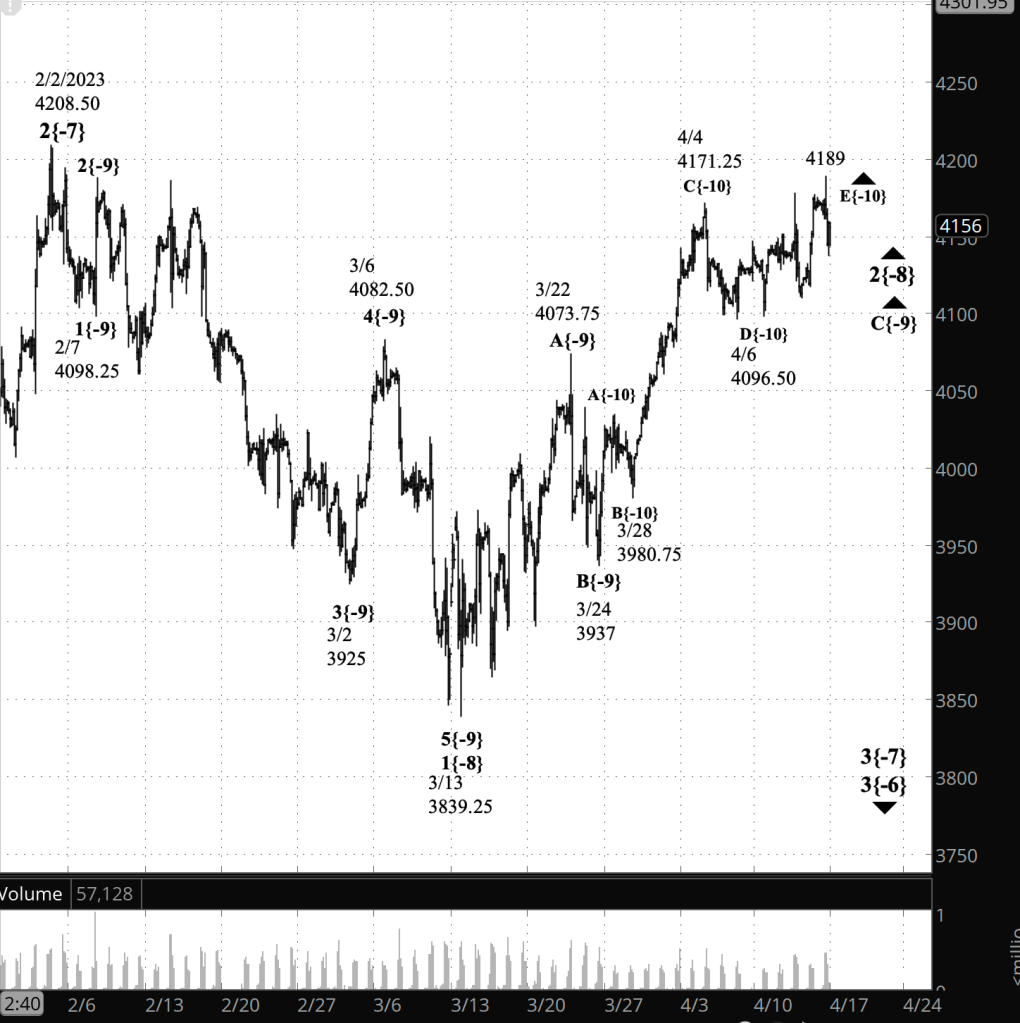
Trader’s Notebook

3:30 p.m. New York time

Half an hour before the closing bell. After peaking at 4164.25 during the session, the S&P 500 futures declined to the 4130s and then worked its way back up to the 4150s. This morning’s analysis is unchanged. The downtrend, wave 3{-8}, continues and is its initial subwave, wave 1{-9}. I’ve updated the chart.

9:35 a.m. New York time

What’s happening now? The S&P 500 E-mini futures declined to 4133.50 after trading resumed overnight, and then rose, reaching back into the 4160s.

What does it mean? The downtrend that began on April 18 continues and is in its early stages. The wave is the 3rd within a larger five-wave trend and is itself in its 1st subwave. The energy will come when the downtrend enters its 3rd wave — a 3rd of 3rd. The downtrend will carry the price below 3839.25 — the start of the preceding upward correction — and likely significantly below that level.

What are the alternatives? There are two, unchanged from Friday.

Alternative #1: The upward correction is still underway. The downward movement from the April 18 peak is still in its early stages, and it remains possible that the decline is part of the final waves of the correction.

Alternative #2: The correction is forming a compound pattern, linking several corrective patterns together. Under this scenario, the correction is nearing the end of its first corrective pattern but not of the correction itself. The first corrective pattern will be followed by a declining connector wave, and then a second corrective pattern.

[S&P 500 E-mini futures at 3:30 p.m., 90-minute bars, with volume]

What does Elliott wave theory say? Here’s a description of the waves that underly the analysis.

Principal analysis:

  • The downtrend that began on April 18 is wave 3{-8}.
  • Within it, wave 1{-9}, the first of five waves, is underway.
  • The most energetic part of the downtrend, wave 3{-9}, lies ahead.
  • Wave 3{-8} will carry the price below the starting point, 3830.25, of wave 2{-8}, the upward correction that began on March 13 and ended on April 18. Most likely the price will decline significantly below that level.

Alternative Analysis #1:

  • Wave 2{-8}, an upward correction that began on March 13, is underway.
  • Within it, wave C{-9}, the correction’s final wave of that degree, is in its final wave, rising wave E{-10}.
  • Under a rule of Elliott wave analysis, wave E{-10} cannot move above the starting point of the preceding wave 1{-8}, 4208.50.
  • Wave E{-10} is in its final subwave, E{-11}.
  • If wave 2{-8} and its subwaves, C{-9} and E{-10}, move above 4208.50, the starting point of wave 1{-8}, then then analysis will have broken a rule of Elliott wave analysis and a new analysis will be done.

Alternative analysis #2:

  • Wave 2{-8}, the upward correction, is forming a compound structure, linking together two or three corrective patterns.
  • Under that alternative, if it should occur, the present rising wave C{-9} will be followed by a declining connector wave, X{-9}, and then the first wave of a second corrective pattern.
  • The correction is a 2nd wave, and compounding is seen less often in 2nds. However, they do happen on occasion.

Bigger structures:

  • This is all happening within downtrending wave 3{-7}, which began on February 2.
  • Wave 3{-7} is a subwave of downtrending wave 3{-6}, which began on August 16, 2022.
  • Wave 3{-6} is encompassed by a series of larger declining waves, the smaller within the larger, stretching up five degrees to wave 4{-1}, which began on January 4, 2022.
  • Wave 4{-1} is the next-to-the-last wave within a large expanding Diagonal Triangle, wave 5{0}, that began on December 26, 2018
  • When wave 4{-1} is complete, wave 5{-1} will begin and will carry the wave above the January 4 high, 4808.25, and back to the upper boundary of the triangle, which gets higher continually and is in the 6090s.

Reading the chart. Elliott wave analysis views the chart as a complex structure of smaller waves nested within larger waves, which in turn are nested within still larger waves. My labeling system assigns numbers to the subwaves of trending waves, and letters to the subwaves of corrections. Each number or letter is followed by a subscript, in curly brackets, showing the waves position within the complex structure, called its “degree” in Elliott wave parlance. The smaller the number, the lower the degree. On this chart we’re dealing with relatively small waves, so the degree numbers are negative.

We Are Here.

These are the waves currently in progress under my principal analysis. Each line on the list shows the wave number, with the subscript in curly brackets, the traditional degree name, the starting date, the starting price of the S&P 500 E-mini futures, and the direction of the wave.

  • S&P 500 Index:
  • 5{+3} Supercycle, 7/8/1932, 4.40 (up)
  • 5{+2} Cycle, 12/9/1974, 60.96 (up)
  • 5{+1} Primary, 3/6/2009, 666.79 (up)
  • 5{0} Intermediate, 12/26/2018, 2346.58 (up)
  • S&P 500 Futures and index:
  • 4{-1} Minor, 1/4/2022, 4808.25 (down) (futures), 4818.62 (down) (index)
  • S&P 500 Futures:
  • 1{-2} Minute, 1/4/2022, 4808.25 (down)
  • 1{-3} Minuette, 1/4/2022, 4808.25 (down)
  • 1{-4} Subminuette, 1/4/2022, 4808.25 (down)
  • 1{-5} Micro, 1/4/2022, 4808.25 (down)
  • 3{-6} Submicro, 8/16/2022, 4327.50 (down)
  • 3{-7} Minuscule, 2/2/2023, 4208.50 (down)

Learning and other resources. Elliott wave analysis provides context, not prophecy. As the 20th century semanticist Alfred Korzybski put it in his book Science and Sanity (1933), “The map is not the territory … The only usefulness of a map depends on similarity of structure between the empirical world and the map.” And I would add, in the ever-changing markets, we can judge that similarity of structure only after the fact.

See the menu page Analytical Methods for a rundown on where to go for information on Elliott wave analysis.

By Tim Bovee, Portland, Oregon, April 24, 2023

Disclaimer

Tim Bovee, Private Trader tracks the analysis and trades of a private trader for his own accounts. Nothing in this blog constitutes a recommendation to buy or sell stocks, options or any other financial instrument. The only purpose of this blog is to provide education and entertainment.

No trader is ever 100 percent successful in his or her trades. Trading in the stock and option markets is risky and uncertain. Each trader must make trading decisions for his or her own account, and take responsibility for the consequences.

License
Creative Commons License

All content on Tim Bovee, Private Trader by Timothy K. Bovee is licensed under a Creative Commons Attribution-ShareAlike 4.0 International License.

Based on a work at www.timbovee.com.

Trader’s Notebook

3:30 p.m. New York time

Half an hour before the closing bell. The S&P 500 futures moved narrowly during the session, between the 4160s and the 4130s. No change in this morning’s analysis. I’ve updated the upper chart, which shows the futures.

9:35 a.m. New York time

What’s happening now? The S&P 500 E-mini futures fell to 4040 overnight, remaining above the prior day’s low, 4137, and then rose back into the 4150s.

What does it mean? A downtrend that began on April 18 from 4198.25 is now in its early stages. It will carry the price below 3839.25, the start of the upward correction that preceded it, and likely significantly below that level.

What are the alternatives? There are two.

Alternative #1: The upward correction is still underway. The downward movement from the April 18 peak is still in its early stages, and it remains possible that the decline is part of the final waves of the correction.

Alternative #2: The correction is forming a compound pattern, linking several corrective patterns together. Under this scenario, the correction is nearing the end of its first corrective pattern but not of the correction itself. The first corrective pattern will be followed by a declining connector wave, and then a second corrective pattern.

[S&P 500 E-mini futures at 3:30 p.m., 90-minute bars, with volume]

The Big Picture. Since December 26, 2018 the S&P 500 index and its derivatives have been in the final segment of an uptrend that began on March 6, 2009. The final segment is taking the form of an expanding Diagonal Triangle composed of five subwaves.

The early pandemic crash that ended on February 23, 2020 is the 2nd subwave within the triangle. The long rise that followed and ended on January 4, 2022 is the 3rd wave, and a declining 4th wave is presently underway.

When the 4th wave is complete — it has years to go — the 5th and final wave will carry the price above 4818,62 the peak attained on January 4, 2022, and most likely a considerable distance above the level.

In short, a few years of gloomy decline and then a years-long massive rise. After the storm comes the sun, and a rainbow.

[S&P 500 index at 9:35 a.m., 4-day bars, with volume]

What does Elliott wave theory say? Here’s a description of the waves that underly the analysis.

Principal analysis:

  • The downtrend that began on April 18 is wave 3{-8}.
  • Within it, wave 1{-9}, the first of five waves, is underway.
  • Wave 3{-8} will carry the price below the starting point, 3830.25, of wave 2{-8}, the upward correction that began on March 13 and ended on April 18. Most likely the price will decline significantly below that level.

Alternative Analysis #1:

  • Wave 2{-8}, an upward correction that began on March 13, is underway.
  • Within it, wave C{-9}, the correction’s final wave of that degree, is in its final wave, rising wave E{-10}.
  • Under a rule of Elliott wave analysis, wave E{-10} cannot move above the starting point of the preceding wave 1{-8}, 4208.50.
  • Wave E{-10} is in its final subwave, E{-11}.
  • If wave 2{-8} and its subwaves, C{-9} and E{-10}, move above 4208.50, the starting point of wave 1{-8}, then then analysis will have broken a rule of Elliott wave analysis and a new analysis will be done.

Alternative analysis #2:

  • Wave 2{-8}, the upward correction, is forming a compound structure, linking together two or three corrective patterns.
  • Under that alternative, if it should occur, the present rising wave C{-9} will be followed by a declining connector wave, X{-9}, and then the first wave of a second corrective pattern.
  • The correction is a 2nd wave, and compounding is seen less often in 2nds. However, they do happen on occasion.

Bigger structures:

  • This is all happening within downtrending wave 3{-7}, which began on February 2.
  • Wave 3{-7} is a subwave of downtrending wave 3{-6}, which began on August 16, 2022.
  • Wave 3{-6} is encompassed by a series of larger declining waves, the smaller within the larger, stretching up five degrees to wave 4{-1}, which began on January 4, 2022.
  • Wave 4{-1} is the next-to-the-last wave within a large expanding Diagonal Triangle, wave 5{0}, that began on December 26, 2018
  • When wave 4{-1} is complete, wave 5{-1} will begin and will carry the wave above the January 4 high, 4808.25, and back to the upper boundary of the triangle, which gets higher continually and is in the 6090s.

We Are Here.

These are the waves currently in progress under my principal analysis. Each line on the list shows the wave number, with the subscript in curly brackets, the traditional degree name, the starting date, the starting price of the S&P 500 E-mini futures, and the direction of the wave.

  • S&P 500 Index:
  • 5{+3} Supercycle, 7/8/1932, 4.40 (up)
  • 5{+2} Cycle, 12/9/1974, 60.96 (up)
  • 5{+1} Primary, 3/6/2009, 666.79 (up)
  • 5{0} Intermediate, 12/26/2018, 2346.58 (up)
  • S&P 500 Futures and index:
  • 4{-1} Minor, 1/4/2022, 4808.25 (down) (futures), 4818.62 (down) (index)
  • S&P 500 Futures:
  • 1{-2} Minute, 1/4/2022, 4808.25 (down)
  • 1{-3} Minuette, 1/4/2022, 4808.25 (down)
  • 1{-4} Subminuette, 1/4/2022, 4808.25 (down)
  • 1{-5} Micro, 1/4/2022, 4808.25 (down)
  • 3{-6} Submicro, 8/16/2022, 4327.50 (down)
  • 3{-7} Minuscule, 2/2/2023, 4208.50 (down)

Learning and other resources. Elliott wave analysis provides context, not prophecy. As the 20th century semanticist Alfred Korzybski put it in his book Science and Sanity (1933), “The map is not the territory … The only usefulness of a map depends on similarity of structure between the empirical world and the map.” And I would add, in the ever-changing markets, we can judge that similarity of structure only after the fact.

See the menu page Analytical Methods for a rundown on where to go for information on Elliott wave analysis.

By Tim Bovee, Portland, Oregon, April 21, 2023

Disclaimer

Tim Bovee, Private Trader tracks the analysis and trades of a private trader for his own accounts. Nothing in this blog constitutes a recommendation to buy or sell stocks, options or any other financial instrument. The only purpose of this blog is to provide education and entertainment.

No trader is ever 100 percent successful in his or her trades. Trading in the stock and option markets is risky and uncertain. Each trader must make trading decisions for his or her own account, and take responsibility for the consequences.

License
Creative Commons License

All content on Tim Bovee, Private Trader by Timothy K. Bovee is licensed under a Creative Commons Attribution-ShareAlike 4.0 International License.

Based on a work at www.timbovee.com.

Trader’s Notebook

3:30 p.m. New York time

Half an hour before the closing bell. The S&P 500 futures worked their way up to the 4170s during the session, and then swiftly dropped back to the 4130s, below the April 14 low, 4138. That’s sufficient to promote this morning’s Alternative #1 scenario to Principal Analysis: The upward correction that began on March 13 ended on April l8. An energetic downtrend, wave 3{-8}, has begun. Alternative #2 from this morning — a compound correction — is still a possibility.

More in Friday morning’s analysis. This switched kicked in five minutes before I post, so it’s rushed. I’ve updated the chart.

2:55 p.m. New York time

FDX options exit. I’ve exited my short bear call options spread on FDX, a day plus change before expiration, for a loss, and have updated the trade analysis with details.

9:35 a.m. New York time

What’s happening now? The S&P 500 E-mini futures fell very slightly overnight, to 4143.

What does it mean? The upward correction that began on March 13 continues. Drill down through three degrees of subwaves, and they’re all in their final movements. I expect the correction to end soon and a downtrend to begin that will carry the price into the 3800s and perhaps lower.

What are the alternatives? There are two, and to regular readers, they will look familiar.

Alternative #1: The upward correction ended at 4198.25, the high attained on April l8. Under this scenario, the downtrend has begun, although very tentatively.

Alternative #2: The correction is forming a compound pattern, linking several corrective patterns together. Under this scenario, the correction is nearing the end of its first corrective pattern but not of the correction itself. The first corrective pattern will be followed by a declining connector wave, and then a second corrective pattern.

[S&P 500 E-mini futures at 3:30 p.m., 90-minute bars, with volume]

What does Elliott wave theory say? Here’s a technical description of the waves that underly the analysis.

Principal analysis:

  • The upward correction that began on March 13 is wave 2{-8}.
  • Within it, wave C{-9}, the correction’s final wave of that degree, is in its final wave, rising wave E{-10}.
  • Under a rule of Elliott wave analysis, wave E{-10} cannot move above the starting point of the preceding wave 1{-8}, 4208.50.
  • Wave E{-10} is in its final subwave, E{-11}.
  • If wave 2{-8} and its subwaves, C{-9} and E{-10}, move above 4208.50, the starting point of wave 1{-8}, then then analysis will have broken a rule of Elliott wave analysis and a new analysis will be done.
  • Wave 2{-8} will be followed by a downtrend, wave 3{-8}, that will carry the price below the correction’s starting point, 3839.25, and most likely significantly below that level.

Alternative Analysis #1:

  • Wave E{-10}, its child, wave E{-11}, and its parent, wave C{-9}, ended at the April 18 peak, bringing the upward correction, wave 2{-8} to an end.
  • Downtrending wave 3{-8} is underway.

Alternative analysis #2:

  • Wave 2{-8}, the upward correction, is forming a compound structure, linking together two or three corrective patterns.
  • Under that alternative, if it should occur, the present rising wave C{-9} will be followed by a declining connector wave, X{-9}, and then the first wave of a second corrective pattern.
  • The correction is a 2nd wave, and compounding is seen less often in 2nds. However, they do happen on occasion.

Bigger structures:

  • This is all happening within downtrending wave 3{-7}, which began on February 2.
  • Wave 3{-7} is a subwave of downtrending wave 3{-6}, which began on August 16, 2022.
  • Wave 3{-6} is encompassed by a series of larger declining waves, the smaller within the larger, stretching up five degrees to wave 4{-1}, which began on January 4, 2022.
  • Wave 4{-1} is the next-to-the-last wave within a large expanding Diagonal Triangle, wave 5{0}, that began on December 26, 2018
  • When wave 4{-1} is complete, wave 5{-1} will begin and will carry the wave above the January 4 high, 4808.25, and back to the upper boundary of the triangle, which gets higher continually and is in the 6090s.

Reading the chart. Elliott wave analysis views the chart as a complex structure of smaller waves nested within larger waves, which in turn are nested within still larger waves. My labeling system assigns numbers to the subwaves of trending waves, and letters to the subwaves of corrections. Each number or letter is followed by a subscript, in curly brackets, showing the waves position within the complex structure, called its “degree” in Elliott wave parlance. The smaller the number, the lower the degree. On this chart we’re dealing with relatively small waves, so the degree numbers are negative.

We Are Here.

These are the waves currently in progress under my principal analysis. Each line on the list shows the wave number, with the subscript in curly brackets, the traditional degree name, the starting date, the starting price of the S&P 500 E-mini futures, and the direction of the wave.

  • S&P 500 Index:
  • 5{+3} Supercycle, 7/8/1932, 4.40 (up)
  • 5{+2} Cycle, 12/9/1974, 60.96 (up)
  • 5{+1} Primary, 3/6/2009, 666.79 (up)
  • 5{0} Intermediate, 12/26/2018, 2346.58 (up)
  • S&P 500 Futures and index:
  • 4{-1} Minor, 1/4/2022, 4808.25 (down) (futures), 4818.62 (down) (index)
  • S&P 500 Futures:
  • 1{-2} Minute, 1/4/2022, 4808.25 (down)
  • 1{-3} Minuette, 1/4/2022, 4808.25 (down)
  • 1{-4} Subminuette, 1/4/2022, 4808.25 (down)
  • 1{-5} Micro, 1/4/2022, 4808.25 (down)
  • 3{-6} Submicro, 8/16/2022, 4327.50 (down)
  • 3{-7} Minuscule, 2/2/2023, 4208.50 (down)

Learning and other resources. Elliott wave analysis provides context, not prophecy. As the 20th century semanticist Alfred Korzybski put it in his book Science and Sanity (1933), “The map is not the territory … The only usefulness of a map depends on similarity of structure between the empirical world and the map.” And I would add, in the ever-changing markets, we can judge that similarity of structure only after the fact.

See the menu page Analytical Methods for a rundown on where to go for information on Elliott wave analysis.

By Tim Bovee, Portland, Oregon, April 20, 2023

Disclaimer

Tim Bovee, Private Trader tracks the analysis and trades of a private trader for his own accounts. Nothing in this blog constitutes a recommendation to buy or sell stocks, options or any other financial instrument. The only purpose of this blog is to provide education and entertainment.

No trader is ever 100 percent successful in his or her trades. Trading in the stock and option markets is risky and uncertain. Each trader must make trading decisions for his or her own account, and take responsibility for the consequences.

License
Creative Commons License

All content on Tim Bovee, Private Trader by Timothy K. Bovee is licensed under a Creative Commons Attribution-ShareAlike 4.0 International License.

Based on a work at www.timbovee.com.

Trader’s Notebook

3:30 p.m. New York time

Half an hour before the closing bell. The S&P 500 futures rose during the session, lending credence to the upward correction still being underway.

The correction, wave 2{-8}, is near it’s end. It is in its final segment, C{-9}, which is in its final subwave, E{-10} and, one degree down, E{-11}. Within wave E{-11}, subwave E{-12} began from the overnight low, 4150.50. When wave E{-12} is complete, the correction will also be complete and the downtrend, wave 3{-8}, will begin.

Unless, that is, the correction forms a compound structure, linking two or three corrective patterns together. If that alternative proves to be the case, then then the futures and the S&P 500 index will be hanging out near present levels for awhile, perhaps for another month or two.

I’ve updated the chart.

9:35 a.m. New York time

What’s happening now? The S&P 500 E-mini futures fell overnight, to 4150.50.

What does it mean? Did the upward correction that began 36 days ago reach its end on April 18, at 4198.25, giving way to the downtrend that Elliott wave analysis told us would follow? Or is there still a final push to the upside ahead before the upward correction is complete?

Supporting the idea that the correction, the 2nd wave in a larger downtrend, complete is the nearness of the April 18 high to beginning of the previous 1st ave in the downtrend, from 4208.50. Under the Elliott rules, a 2nd wave can’t rise above the start of the 1st wave, so there isn’t much room for further rise. Also, the decline since April 18 has retraced almost 50% of the rise that began on April 6. There might be a bit more to go if the correction is still underway — the 61.8% Fibonacci retracement level is at 4096.50 — so if the price doesn’t reverse soon, if it goes more than a small distance below 4096.50, then the downtrend scenario becomes far more likely.

Supporting the idea that the correction is still underway is the internal count of what the chart shows as wave E{-11}. I count four waves within E{-11}, including the present downtrend, and under the Elliott Wave Principle, it should have five.

I’m leaving the chart mark-up as it has been for a couple of weeks: The upward correction is still underway, is in its final segment, which is in its final subwave. An alternative, that the correction ended on April 18 and that the downtrend has begun, is equally likely. My methodology is, when in doubt, stick with the status quo. I put the burden of proof on the side of change.

What are the alternatives? Complicating things, there is another possible analysis, that the overnight high marked the end of the corrective pattern but not of the correction, which is forming a compound structure, linking two or three corrective patterns together. If that’s the case, then the decline is a downward linking wave, which will be followed by a second corrective pattern.

Reading the chart. I’ve moved the wave closer in to focus on the correction and its end game. See yesterday’s Trader’s Notebook for a broader view that shows the 1st subwave of the downtrend that began on February 2nd as well as the present (or complete) 2nd wave correction that began on March 13. It uses a red arrow to mark the maximum upward movement of the correction under the Elliott rules and a second arrow to mark the correction’s highest point.

Elliott wave analysis views the chart as a complex structure of smaller waves nested within larger waves, which in turn are nested within still larger waves. My labeling system assigns numbers to the subwaves of trending waves, and letters to the subwaves of corrections. Each number or letter is followed by a subscript, in curly brackets, showing the waves position within the complex structure, called its “degree” in Elliott wave parlance. The smaller the number, the lower the degree. On this chart we’re dealing with relatively small waves, so the degree numbers are negative.

[S&P 500 E-mini futures at 3:30 p.m., 90-minute bars, with volume]

What does Elliott wave theory say? As mentioned above, it’s impossible to choose between two possibilities, so we have two principal analyses.

Principal analysis:

  • The upward correction that began on March 13 is wave 2{-8}.
  • Within it, wave C{-9}, the correction’s final wave of that degree, is in its final wave, rising wave E{-10}.
  • Under a rule of Elliott wave analysis, wave E{-10} cannot move above the starting point of the preceding wave 1{-8}, 4208.50.

Under the principal analysis shown on the chart, concluding that the correction is not complete

  • Wave E{-10} is in its final subwave, E{-11}.
  • If wave 2{-8} and its subwaves, C{-9} and E{-10}, move above 4208.50, the starting point of wave 1{-8}, then then analysis will have broken a rule of Elliott wave analysis and a new analysis will be done.
  • Wave 2{-8} will be followed by a downtrend, wave 3{-8}, that will carry the price below the correction’s starting point, 3839.25, and most likely significantly below that level.

Under the equally likely principal analysis that concludes that the correction has ended and the downtrend has begun

  • Wave E{-10}, its child, wave E{-11}, and its parent, wave C{-9}, ended at the April 18 peak, bringing the upward correction, wave 2{-8} to an end.
  • Downtrending wave 3{-8} is underway.

Alternative analysis #1:

  • Wave 2{-8}, the upward correction, is forming a compound structure, linking together two or three corrective patterns.
  • Under that alternative, if it should occur, the present rising wave C{-9} will be followed by a declining connector wave, X{-9}, and then the first wave of a second corrective pattern.
  • The correction is a 2nd wave, and compounding is seen less often in 2nds. However, they do happen on occasion.

Bigger structures:

  • This is all happening within downtrending wave 3{-7}, which began on February 2.
  • Wave 3{-7} is a subwave of downtrending wave 3{-6}, which began on August 16, 2022.
  • Wave 3{-6} is encompassed by a series of larger declining waves, the smaller within the larger, stretching up five degrees to wave 4{-1}, which began on January 4, 2022.
  • Wave 4{-1} is the next-to-the-last wave within a large expanding Diagonal Triangle, wave 5{0}, that began on December 26, 2018
  • When wave 4{-1} is complete, wave 5{-1} will begin and will carry the wave above the January 4 high, 4808.25, and back to the upper boundary of the triangle, which gets higher continually and is in the 6090s.

We Are Here.

These are the waves currently in progress under my principal analysis. Each line on the list shows the wave number, with the subscript in curly brackets, the traditional degree name, the starting date, the starting price of the S&P 500 E-mini futures, and the direction of the wave.

  • S&P 500 Index:
  • 5{+3} Supercycle, 7/8/1932, 4.40 (up)
  • 5{+2} Cycle, 12/9/1974, 60.96 (up)
  • 5{+1} Primary, 3/6/2009, 666.79 (up)
  • 5{0} Intermediate, 12/26/2018, 2346.58 (up)
  • S&P 500 Futures and index:
  • 4{-1} Minor, 1/4/2022, 4808.25 (down) (futures), 4818.62 (down) (index)
  • S&P 500 Futures:
  • 1{-2} Minute, 1/4/2022, 4808.25 (down)
  • 1{-3} Minuette, 1/4/2022, 4808.25 (down)
  • 1{-4} Subminuette, 1/4/2022, 4808.25 (down)
  • 1{-5} Micro, 1/4/2022, 4808.25 (down)
  • 3{-6} Submicro, 8/16/2022, 4327.50 (down)
  • 3{-7} Minuscule, 2/2/2023, 4208.50 (down)

Learning and other resources. Elliott wave analysis provides context, not prophecy. As the 20th century semanticist Alfred Korzybski put it in his book Science and Sanity (1933), “The map is not the territory … The only usefulness of a map depends on similarity of structure between the empirical world and the map.” And I would add, in the ever-changing markets, we can judge that similarity of structure only after the fact.

See the menu page Analytical Methods for a rundown on where to go for information on Elliott wave analysis.

By Tim Bovee, Portland, Oregon, April 19, 2023

Disclaimer

Tim Bovee, Private Trader tracks the analysis and trades of a private trader for his own accounts. Nothing in this blog constitutes a recommendation to buy or sell stocks, options or any other financial instrument. The only purpose of this blog is to provide education and entertainment.

No trader is ever 100 percent successful in his or her trades. Trading in the stock and option markets is risky and uncertain. Each trader must make trading decisions for his or her own account, and take responsibility for the consequences.

License
Creative Commons License

All content on Tim Bovee, Private Trader by Timothy K. Bovee is licensed under a Creative Commons Attribution-ShareAlike 4.0 International License.

Based on a work at www.timbovee.com.
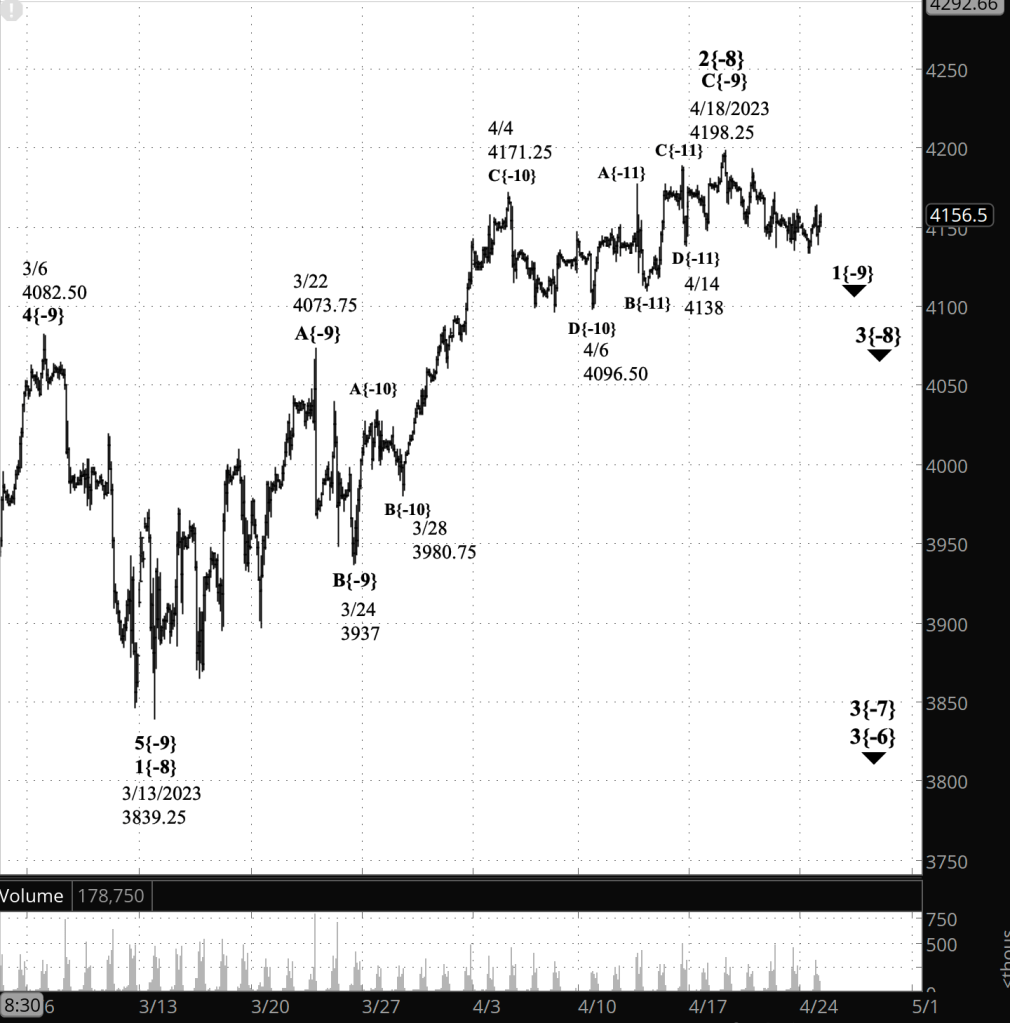
Trader’s Notebook

3:30 p.m. New York time

Half an hour before the closing bell. The S&P 500 futures continued to fall during the session, reaching 4164.50 and then bouncing a slightly. The further the price drops, the more likely it is that Alternative #1 is correct: The upward correction ended at the overnight high, 4198.25, and the long-anticipated downtrend has begun. Or not. If the price reverses to the upside and moves above the overnight high, then this morning’s principal analysis is correct.

I give the two possibilities equal odds at this point. I’ve updated this morning’s chart, leaving the principal analysis intact. And I’ve added a very short-term chart showing the futures since yesterday’s market close. And we shall see if tomorrow will allow a choice between the two possibilities. (Alternative #2, a compound correction, is also still in the mix.)

[S&P 500 E-mini futures, 5-minute bars, with volume]

9:35 a.m. New York time

What’s happening now? The S&P 500 E-mini futures rose overnight to 4198.25 as the opening bell approached.

What does it mean? There is very little upside left for the correction that began on March 13. This correction is a 2nd wave correction within a five-wave downtrend. Under the rules of Elliott wave analysis, a 2nd wave correction cannot move beyond the start of the 1st wave of the trend, which is 4208.50. If the price moves above that level, then the chart will be reanalyzed to eliminate the discrepancy. Ultimately, the chart is always right.

Internally, the correction is in its 3rd and final segment, which in turn in within its final subwave. So the end is very near.

The correction will be followed by an energetic downtrend that will carry the price below 3839.25 — the correction’s starting point — and most likely significantly lower.

What are the alternatives? There are two.

Alternative #1. For awhile now we’ve been in a situation where any high within the correction might be its end. The overnight high on today’s chart is no exception.

Alternative #2: Under this scenario, the overnight high marked the end of the corrective pattern but not of the correction, which is forming a compound structure, linking two or three corrective patterns together. If that’s the case, then the decline since Friday’s peak is a downward linking wave, which will be followed by a second corrective pattern.

Reading the chart. I’ve placed two red arrows on the chart, one showing the 4208.50 starting point of the 1st wave of the downtrend that began on February 2 and the other showing the overnight peak within the 2nd wave correction within the downtrend. Those two points define the possibilities of the S&P 500 futures.

Under the principal analysis, the 2nd wave correction cannot rise above that point. If it does, I’ll reanalyze the chart. When such surprises occur, it’s usually because the degrees used in the analysis don’t match the reality of the chart. The degrees of waves are difficult to assess until after a structure is complete. Before that, it’s an educated guess.

Elliott wave analysis views the chart as a complex structure of smaller waves nested within larger waves, which in turn are nested within still larger waves. My labeling system assigns numbers to the subwaves of trending waves, and letters to the subwaves of corrections. Each number or letter is followed by a subscript, in curly brackets, showing the waves position within the complex structure, called its “degree” in Elliott wave parlance. The smaller the number, the lower the degree. On this chart we’re dealing with relatively small waves, so the degree numbers are negative.

[S&P 500 E-mini futures at 9:35 a.m., 150-minute bars, with volume]

What does Elliott wave theory say? The analyses described above rely on these waves.

Principal analysis:

  • The upward correction that began on March 13 is wave 2{-8}.
  • Within it, wave C{-9}, the correction’s final wave of that degree, is in its final wave, rising wave E{-10}.
  • Under a rule of Elliott wave analysis, wave E{-10} cannot move above the starting point of the preceding wave 1{-8}, 4208.50.
  • Wave E{-10} is in its final subwave, E{-11}.
  • If wave 2{-8} and its subwaves, C{-9} and E{-10}, move above 4208.50, the starting point of wave 1{-8}, then then analysis will have broken a rule of Elliott wave analysis and a new analysis will be done.
  • Wave 2{-8} will be followed by a downtrend, wave 3{-8}, that will carry the price below the correction’s starting point, 3839.25, and most likely significantly below that level.

Alternative analysis #1:

  • Wave E{-10}, its child, wave E{-11}, and its parent, wave C{-9}, ended at the April 18 peak, bringing the upward correction, wave 2{-8} to an end.
  • Downtrending wave 3{-8} is underway.

Alternative analysis #2:

  • Wave 2{-8}, the upward correction, is forming a compound structure, linking together two or three corrective patterns.
  • Under that alternative, if it should occur, the present rising wave C{-9} will be followed by a declining connector wave, X{-9}, and then the first wave of a second corrective pattern.
  • The correction is a 2nd wave, and compounding is seen less often in 2nds. However, they do happen on occasion.

Bigger structures:

  • This is all happening within downtrending wave 3{-7}, which began on February 2.
  • Wave 3{-7} is a subwave of downtrending wave 3{-6}, which began on August 16, 2022.
  • Wave 3{-6} is encompassed by a series of larger declining waves, the smaller within the larger, stretching up five degrees to wave 4{-1}, which began on January 4, 2022.
  • Wave 4{-1} is the next-to-the-last wave within a large expanding Diagonal Triangle, wave 5{0}, that began on December 26, 2018
  • When wave 4{-1} is complete, wave 5{-1} will begin and will carry the wave above the January 4 high, 4808.25, and back to the upper boundary of the triangle, which gets higher continually and is in the 6090s.

We Are Here.

These are the waves currently in progress under my principal analysis. Each line on the list shows the wave number, with the subscript in curly brackets, the traditional degree name, the starting date, the starting price of the S&P 500 E-mini futures, and the direction of the wave.

  • S&P 500 Index:
  • 5{+3} Supercycle, 7/8/1932, 4.40 (up)
  • 5{+2} Cycle, 12/9/1974, 60.96 (up)
  • 5{+1} Primary, 3/6/2009, 666.79 (up)
  • 5{0} Intermediate, 12/26/2018, 2346.58 (up)
  • S&P 500 Futures and index:
  • 4{-1} Minor, 1/4/2022, 4808.25 (down) (futures), 4818.62 (down) (index)
  • S&P 500 Futures:
  • 1{-2} Minute, 1/4/2022, 4808.25 (down)
  • 1{-3} Minuette, 1/4/2022, 4808.25 (down)
  • 1{-4} Subminuette, 1/4/2022, 4808.25 (down)
  • 1{-5} Micro, 1/4/2022, 4808.25 (down)
  • 3{-6} Submicro, 8/16/2022, 4327.50 (down)
  • 3{-7} Minuscule, 2/2/2023, 4208.50 (down)

Learning and other resources. Elliott wave analysis provides context, not prophecy. As the 20th century semanticist Alfred Korzybski put it in his book Science and Sanity (1933), “The map is not the territory … The only usefulness of a map depends on similarity of structure between the empirical world and the map.” And I would add, in the ever-changing markets, we can judge that similarity of structure only after the fact.

See the menu page Analytical Methods for a rundown on where to go for information on Elliott wave analysis.

By Tim Bovee, Portland, Oregon, April 18, 2023

Disclaimer

Tim Bovee, Private Trader tracks the analysis and trades of a private trader for his own accounts. Nothing in this blog constitutes a recommendation to buy or sell stocks, options or any other financial instrument. The only purpose of this blog is to provide education and entertainment.

No trader is ever 100 percent successful in his or her trades. Trading in the stock and option markets is risky and uncertain. Each trader must make trading decisions for his or her own account, and take responsibility for the consequences.

License
Creative Commons License

All content on Tim Bovee, Private Trader by Timothy K. Bovee is licensed under a Creative Commons Attribution-ShareAlike 4.0 International License.

Based on a work at www.timbovee.com.

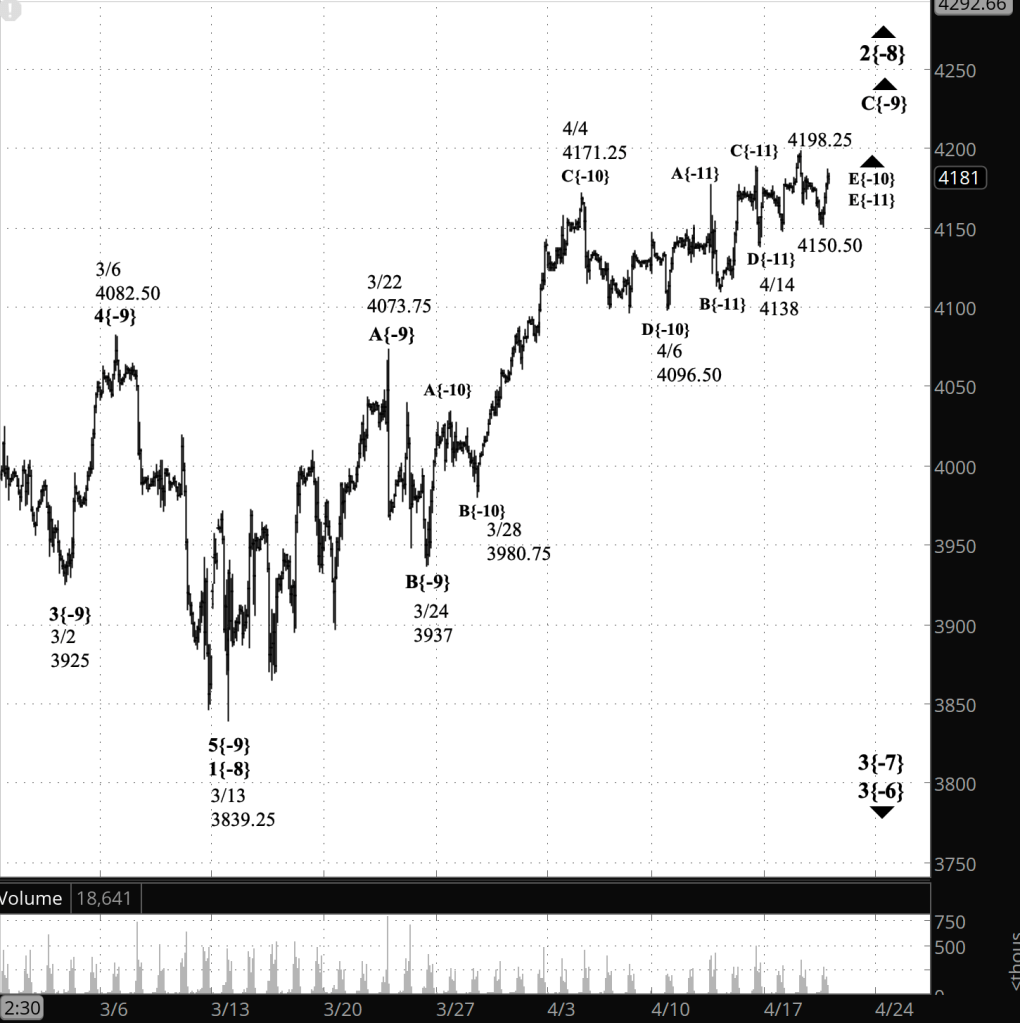
Trader’s Notebook

3:30 p.m. New York time

Half an hour before the closing bell. The S&P 500 futures fell during most of the session, down to 4148, and then rose sharply, reaching back into the 4170s, so far. This morning’s analysis remains unchanged. The upward correction, wave 2{-8}, that began on March 13 is still underway and is in its final segment, rising wave C{-9}. Drilling down one degree lower, wave rising E{-10} is in progress and internally is in its next to the last wave, declining wave D{-11}.

Alternatively, it’s possible that 4148 marked the end of wave D{-11} and the final wave, E{-11}, is underway. When E{-11} is complete, the correction will be complete, unless it takes a compound form, as discussed this morning.

I’ve updated the chart

9:35 a.m. New York time

What’s happening now? The S&P 500 E-mini futures traded sideways overnight, with a slight downward lean that carried it from the 4170s into the 4150s.

What does it mean? The upward correction that began on March 13 continues to work through its last leg within the correction’s 3rd and final wave . When complete, it will be followed by an energetic downtrend that will carry the price into the 3800s and likely lower.

What are the alternatives? There are two alternatives.

Alternative #1: The April 15 high, 4189, might be the end of the correction, and the decline that followed, the early steps of the downtrend. Choosing between this alternative and principal analysis depends upon how we analyze that last leg. Under the rules of Elliott wave analysis, it will have five subwaves. I count that peak as being the end of the 3rd wave. By that principal analysis, the present decline will be followed by a final push upward, likely above 4189. However, wave counts are sometimes a bit ambiguous, and I can’t rule out the alternative analysis.

Alternative #2: Under this scenario, Friday’s high marked the end of the corrective pattern but not of the correction, which is forming a compound structure, linking two or three corrective patterns together. If that’s the case, then the decline since Friday’s peak is a downward linking wave, which will be followed by a second corrective pattern.

[S&P 500 E-mini futures at 3:30 p.m., 140-minute bars, with volume]

What does Elliott wave theory say? Here’s how the waves line up, small to large.

Principal analysis:

  • The upward correction that began on March 13 is wave 2{-8}.
  • Within it, wave C{-9}, the correction’s final wave of that degree, is in its final wave, rising wave E{-10}.
  • Under a rule of Elliott wave analysis, wave E{-10} cannot move above the starting point of the preceding wave 1{-8}, 4208.50.
  • Wave E{-10} when complete will have five subwaves. It completed the 3rd wave, wave C{-11}, at the April 15 peak and is now in the next-to-the-last wave, D{-11}.
  • If wave 2{-8} and its subwaves, C{-9} and E{-10}, move above the starting point of wave 1{-8}, which was 4208.50, then then analysis will have broken a rule of Elliott wave analysis and a new analysis will be done.
  • Wave 2{-8} will be followed by a downtrend, wave 3{-8}, that will carry the price below the correction’s starting point, 3839.25, and most likely significantly below that level.

Alternative analysis #1:

  • Wave E{-10}, its child, wave E{-11}, and its parent, wave C{-9}, ended at the April 15 peak, 4189, bringing the upward correction, wave 2{-8} to an end.
  • Downtrending wave 3{-8} is underway.

Alternative analysis #2:

  • Wave 2{-8}, the upward correction, is forming a compound structure, linking together two or three corrective patterns.
  • Under that alternative, if it should occur, the present rising wave C{-9} will be followed by a declining connector wave, X{-9}, and then the first wave of a second corrective pattern.
  • The correction is a 2nd wave, and compounding is seen less often in 2nds. However, they do happen on occasion.

Bigger structures:

  • This is all happening within downtrending wave 3{-7}, which began on February 2.
  • Wave 3{-7} is a subwave of downtrending wave 3{-6}, which began on August 16, 2022.
  • Wave 3{-6} is encompassed by a series of larger declining waves, the smaller within the larger, stretching up five degrees to wave 4{-1}, which began on January 4, 2022.
  • Wave 4{-1} is the next-to-the-last wave within a large expanding Diagonal Triangle, wave 5{0}, that began on December 26, 2018
  • When wave 4{-1} is complete, wave 5{-1} will begin and will carry the wave above the January 4 high, 4808.25, and back to the upper boundary of the triangle, which gets higher continually and is in the 6090s.

Reading the chart. Elliott wave analysis views the chart as a complex structure of smaller waves nested within larger waves, which in turn are nested within still larger waves. My labeling system assigns numbers to the subwaves of trending waves, and letters to the subwaves of corrections. Each number or letter is followed by a subscript, in curly brackets, showing the waves position within the complex structure, called its “degree” in Elliott wave parlance. The smaller the number, the lower the degree. On this chart we’re dealing with relatively small waves, so the degree numbers are negative.

We Are Here.

These are the waves currently in progress under my principal analysis. Each line on the list shows the wave number, with the subscript in curly brackets, the traditional degree name, the starting date, the starting price of the S&P 500 E-mini futures, and the direction of the wave.

  • S&P 500 Index:
  • 5{+3} Supercycle, 7/8/1932, 4.40 (up)
  • 5{+2} Cycle, 12/9/1974, 60.96 (up)
  • 5{+1} Primary, 3/6/2009, 666.79 (up)
  • 5{0} Intermediate, 12/26/2018, 2346.58 (up)
  • S&P 500 Futures and index:
  • 4{-1} Minor, 1/4/2022, 4808.25 (down) (futures), 4818.62 (down) (index)
  • S&P 500 Futures:
  • 1{-2} Minute, 1/4/2022, 4808.25 (down)
  • 1{-3} Minuette, 1/4/2022, 4808.25 (down)
  • 1{-4} Subminuette, 1/4/2022, 4808.25 (down)
  • 1{-5} Micro, 1/4/2022, 4808.25 (down)
  • 3{-6} Submicro, 8/16/2022, 4327.50 (down)
  • 3{-7} Minuscule, 2/2/2023, 4208.50 (down)

Learning and other resources. Elliott wave analysis provides context, not prophecy. As the 20th century semanticist Alfred Korzybski put it in his book Science and Sanity (1933), “The map is not the territory … The only usefulness of a map depends on similarity of structure between the empirical world and the map.” And I would add, in the ever-changing markets, we can judge that similarity of structure only after the fact.

See the menu page Analytical Methods for a rundown on where to go for information on Elliott wave analysis.

By Tim Bovee, Portland, Oregon, April 17, 2023

Disclaimer

Tim Bovee, Private Trader tracks the analysis and trades of a private trader for his own accounts. Nothing in this blog constitutes a recommendation to buy or sell stocks, options or any other financial instrument. The only purpose of this blog is to provide education and entertainment.

No trader is ever 100 percent successful in his or her trades. Trading in the stock and option markets is risky and uncertain. Each trader must make trading decisions for his or her own account, and take responsibility for the consequences.

License
Creative Commons License

All content on Tim Bovee, Private Trader by Timothy K. Bovee is licensed under a Creative Commons Attribution-ShareAlike 4.0 International License.

Based on a work at www.timbovee.com.

Trader’s Notebook

3:30 p.m. New York time

Half an hour before the closing bell. The S&P 500 futures reached a high of 4189 early in the session and then declined back into the 4140s. Wave E{-10} within wave C{-9} within the upward correction, wave 2{-8}, is still underway. Or perhaps not. The 4189 peak may well be the end of the correction and the start of a downtrend, wave 3{-8}. Given the 4208.50 upper limit for the correction under the rules of Elliott wave analysis, 4189 is a reasonable end point. Yet wave E{-10} ought to have five internal waves, and I find the count to be a bit ambiguous. So I’m holding to this morning’s scenario for now and will await with interest what Monday brings. I’ve updated the chart.

9:35 a.m. New York time

What’s happening now? The S&P 500 E-mini futures rose back into the 4170s as the opening bell approached,

What does it mean? The same as yesterday: The upward correction that began March 13 is nearing its end. An energetic downtrend will follow. At this point any high could be the end of the correction. The correction high so far is 4177.75, attained on April 12.

What are the alternatives? It’s possible that the April 12 high was the end of the correction and the tentative first steps of the downtrend are underway

It’s also possible that the correction is forming a compound structure, linking two or three corrective patterns together. If that’s the case, then the end of the 3rd wave within the correction will be followed by a downward linking wave, and then a second corrective pattern.

[S&P 500 E-mini futures at 3:30 p.m., 140-minute bars, with volume]

What does Elliott wave theory say? Here is a discussion of waves important to the analysis.

Principal analysis:

  • The upward correction that began on March 13 is wave 2{-8}.
  • Within it, wave C{-9}, the correction’s final wave of that degree, is in its final wave, rising wave E{-10}.
  • Wave E{-10} will likely rise above the preceding wave D{-10}’s starting point, 4l71.25, but under a rule of Elliott wave analysis, cannot move above the starting point of the wave 2{-8} correction itself, 4208.50.
  • Down one degree, wave C{-9} is the final wave within that correction.
  • If wave 2{-8} and its subwaves, C{-9} and E{-10}, move above the starting point of wave 1{-8}, which was 4208.50, then then analysis will have broken a rule of Elliott wave analysis and a new analysis will be done.
  • Wave 2{-8} will be followed by a downtrend, wave 3{-8}, that will carry the price below the correction’s starting point, 3839.25, and most likely significantly below that level.

Alternative analysis #1:

  • Wave E{-10} and its parent, wave C{-9}, ended at the April 12 peak, bringing the upward correction, wave 2{-8} to an end.
  • Downtrending wave 3{-8} is underway.

Alternative analysis #2:

  • Wave 2{-8}, the upward correction, will form a compound structure, linking together two or three corrective patterns.
  • Under that alternative, if it should occur, the present rising wave C{-9} will be followed by a declining connector wave, X{-9}, and then the first wave of a second corrective pattern.
  • The correction is a 2nd wave, and compounding is seen less often in 2nds. However, they do happen on occasion.

Bigger structures:

  • This is all happening within downtrending wave 3{-7}, which began on February 2.
  • Wave 3{-7} is a subwave of downtrending wave 3{-6}, which began on August 16, 2022.
  • Wave 3{-6} is encompassed by a series of larger declining waves, the smaller within the larger, stretching up five degrees to wave 4{-1}, which began on January 4, 2022.
  • Wave 4{-1} is the next-to-the-last wave within a large expanding Diagonal Triangle, wave 5{0}, that began on December 26, 2018
  • When wave 4{-1} is complete, wave 5{-1} will begin and will carry the wave above the January 4 high, 4808.25, and back to the upper boundary of the triangle, which gets higher continually and is in the 6090s.

Reading the chart. Elliott wave analysis views the chart as a complex structure of smaller waves nested within larger waves, which in turn are nested within still larger waves. My labeling system assigns numbers to the subwaves of trending waves, and letters to the subwaves of corrections. Each number or letter is followed by a subscript, in curly brackets, showing the waves position within the complex structure, called its “degree” in Elliott wave parlance. The smaller the number, the lower the degree. On this chart we’re dealing with relatively small waves, so the degree numbers are negative.

We Are Here.

These are the waves currently in progress under my principal analysis. Each line on the list shows the wave number, with the subscript in curly brackets, the traditional degree name, the starting date, the starting price of the S&P 500 E-mini futures, and the direction of the wave.

  • S&P 500 Index:
  • 5{+3} Supercycle, 7/8/1932, 4.40 (up)
  • 5{+2} Cycle, 12/9/1974, 60.96 (up)
  • 5{+1} Primary, 3/6/2009, 666.79 (up)
  • 5{0} Intermediate, 12/26/2018, 2346.58 (up)
  • S&P 500 Futures and index:
  • 4{-1} Minor, 1/4/2022, 4808.25 (down) (futures), 4818.62 (down) (index)
  • S&P 500 Futures:
  • 1{-2} Minute, 1/4/2022, 4808.25 (down)
  • 1{-3} Minuette, 1/4/2022, 4808.25 (down)
  • 1{-4} Subminuette, 1/4/2022, 4808.25 (down)
  • 1{-5} Micro, 1/4/2022, 4808.25 (down)
  • 3{-6} Submicro, 8/16/2022, 4327.50 (down)
  • 3{-7} Minuscule, 2/2/2023, 4208.50 (down)

Learning and other resources. Elliott wave analysis provides context, not prophecy. As the 20th century semanticist Alfred Korzybski put it in his book Science and Sanity (1933), “The map is not the territory … The only usefulness of a map depends on similarity of structure between the empirical world and the map.” And I would add, in the ever-changing markets, we can judge that similarity of structure only after the fact.

See the menu page Analytical Methods for a rundown on where to go for information on Elliott wave analysis.

By Tim Bovee, Portland, Oregon, April 14, 2023

Disclaimer

Tim Bovee, Private Trader tracks the analysis and trades of a private trader for his own accounts. Nothing in this blog constitutes a recommendation to buy or sell stocks, options or any other financial instrument. The only purpose of this blog is to provide education and entertainment.

No trader is ever 100 percent successful in his or her trades. Trading in the stock and option markets is risky and uncertain. Each trader must make trading decisions for his or her own account, and take responsibility for the consequences.

License
Creative Commons License

All content on Tim Bovee, Private Trader by Timothy K. Bovee is licensed under a Creative Commons Attribution-ShareAlike 4.0 International License.

Based on a work at www.timbovee.com.
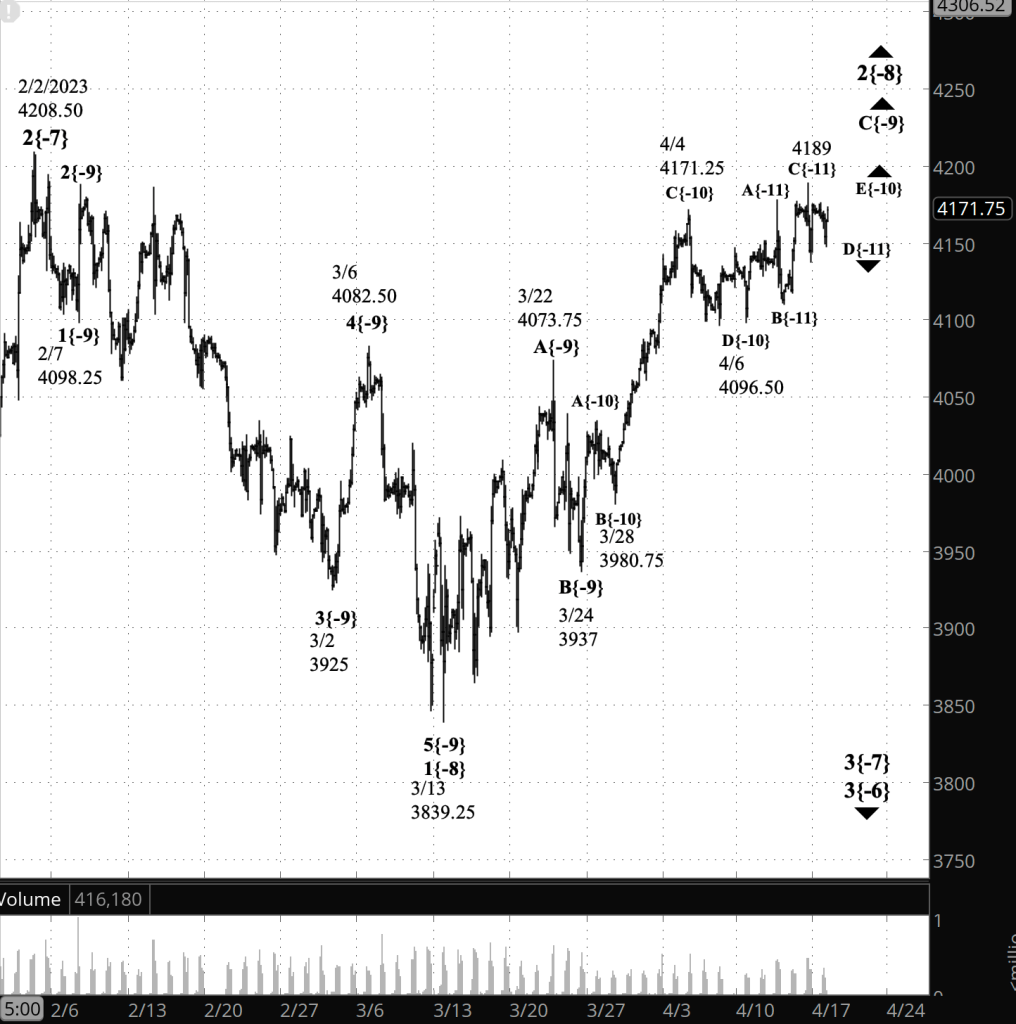
Trader’s Notebook

3:30 p.m. New York time

Half an hour before the closing bell. The S&P 500 futures rose during the session, reaching in to the 4170s. The upward correction, wave 2{-8}, has shown all of the characteristics of being complete, although it may have a bit more to go. As noted in prior posts, a rise above 4208.50, the start of wave 1{-8}, would violate a rule of Elliott wave analysis, requiring a revision of the analysis. This morning’s analysis stands unchanged. I’ve updated the chart.

9:35 a.m. New York time

What’s happening now? The S&P 500 E-mini futures reached a low overnight of 4110.25 and then rose back into the 4130s.

What does it mean? The upward correction that began on March 13 continues to work through its last stage, the last subwave within the 3rd wave and final wave of the correction. The correction ends when the 3rd wave ends, and an energetic downtrend will follow, carrying the price below 3839.25, the correction’s starting point, and likely a significant distance below that level.

What are the alternatives? It’s possible that the 3rd wave will end a corrective pattern but not the correction itself. Some corrections form a compound structure, linking two or three corrective patterns together. If that happens, then the 3rd wave will be followed by a downward wave that will connect the completed first corrective pattern with a second corrective pattern.

[S&P 500 E-mini futures at 3:30 p.m., 140-minute bars, with volume]

What does Elliott wave theory say? Here is a discussion of waves important to the analysis.

Principal analysis:

  • The upward correction that began on March 13 is wave 2{-8}.
  • Within it, wave C{-9}, the correction’s final wave of that degree, is in its final wave, rising wave E{-10}.
  • Wave E{-10} will likely rise above the preceding wave D{-10}’s starting point, 4l71.25, but under a rule of Elliott wave analysis, cannot move above the starting point of the wave 2{-8} correction itself, 4208.50.
  • Down one degree, wave C{-9} is the final wave within that correction.
  • If wave 2{-8} and its subwaves, C{-9} and E{-10}, move above the starting point of wave 1{-8}, which was 4208.50, then then analysis will have broken a rule of Elliott wave analysis and a new analysis will be done.
  • Wave 2{-8} will be followed by a downtrend, wave 3{-8}, that will carry the price below the correction’s starting point, 3839.25, and most likely significantly below that level.

Alternative analysis:

  • Wave 2{-8}, the upward correction, will form a compound structure, linking together two or three corrective patterns.
  • Under that alternative, if it should occur, the present rising wave C{-9} will be followed by a declining connector wave, X{-9}, and then the first wave of a second corrective pattern.
  • The correction is a 2nd wave, and compounding is seen less often in 2nds. However, they do happen on occasion.

Bigger structures:

  • This is all happening within downtrending wave 3{-7}, which began on February 2.
  • Wave 3{-7} is a subwave of downtrending wave 3{-6}, which began on August 16, 2022.
  • Wave 3{-6} is encompassed by a series of larger declining waves, the smaller within the larger, stretching up five degrees to wave 4{-1}, which began on January 4, 2022.
  • Wave 4{-1} is the next-to-the-last wave within a large expanding Diagonal Triangle, wave 5{0}, that began on December 26, 2018
  • When wave 4{-1} is complete, wave 5{-1} will begin and will carry the wave above the January 4 high, 4808.25, and back to the upper boundary of the triangle, which gets higher continually and is in the 6090s.

Reading the chart. Elliott wave analysis views the chart as a complex structure of smaller waves nested within larger waves, which in turn are nested within still larger waves. My labeling system assigns numbers to the subwaves of trending waves, and letters to the subwaves of corrections. Each number or letter is followed by a subscript, in curly brackets, showing the waves position within the complex structure, called its “degree” in Elliott wave parlance. The smaller the number, the lower the degree. On this chart we’re dealing with relatively small waves, so the degree numbers are negative.

We Are Here.

These are the waves currently in progress under my principal analysis. Each line on the list shows the wave number, with the subscript in curly brackets, the traditional degree name, the starting date, the starting price of the S&P 500 E-mini futures, and the direction of the wave.

  • S&P 500 Index:
  • 5{+3} Supercycle, 7/8/1932, 4.40 (up)
  • 5{+2} Cycle, 12/9/1974, 60.96 (up)
  • 5{+1} Primary, 3/6/2009, 666.79 (up)
  • 5{0} Intermediate, 12/26/2018, 2346.58 (up)
  • S&P 500 Futures and index:
  • 4{-1} Minor, 1/4/2022, 4808.25 (down) (futures), 4818.62 (down) (index)
  • S&P 500 Futures:
  • 1{-2} Minute, 1/4/2022, 4808.25 (down)
  • 1{-3} Minuette, 1/4/2022, 4808.25 (down)
  • 1{-4} Subminuette, 1/4/2022, 4808.25 (down)
  • 1{-5} Micro, 1/4/2022, 4808.25 (down)
  • 3{-6} Submicro, 8/16/2022, 4327.50 (down)
  • 3{-7} Minuscule, 2/2/2023, 4208.50 (down)

Learning and other resources. Elliott wave analysis provides context, not prophecy. As the 20th century semanticist Alfred Korzybski put it in his book Science and Sanity (1933), “The map is not the territory … The only usefulness of a map depends on similarity of structure between the empirical world and the map.” And I would add, in the ever-changing markets, we can judge that similarity of structure only after the fact.

See the menu page Analytical Methods for a rundown on where to go for information on Elliott wave analysis.

By Tim Bovee, Portland, Oregon, April 13, 2023

Disclaimer

Tim Bovee, Private Trader tracks the analysis and trades of a private trader for his own accounts. Nothing in this blog constitutes a recommendation to buy or sell stocks, options or any other financial instrument. The only purpose of this blog is to provide education and entertainment.

No trader is ever 100 percent successful in his or her trades. Trading in the stock and option markets is risky and uncertain. Each trader must make trading decisions for his or her own account, and take responsibility for the consequences.

License
Creative Commons License

All content on Tim Bovee, Private Trader by Timothy K. Bovee is licensed under a Creative Commons Attribution-ShareAlike 4.0 International License.

Based on a work at www.timbovee.com.