Trader’s Notebook

3:30 p.m. New York time

Half an hour before the closing bell. The S&P 500 futures fell during the session, reaching into the 4110s as the closing bell approached. The last leg of the upward correction that began on March 13 is nearing its end. Rising wave E{-10} within rising wave C{-9} within the correction, wave 2{-9}, are underway. The end of one will be the end of all and the beginning of an energetic downtrend, wave 3{-8}. No change from this morning’s analysis. I’ve updated the chart.

9:35 a.m. New York time

What’s happening now? The S&P 500 E-mini futures rose 39 points in six minutes, to 4177.75, after new inflation numbers showed a 0.1% rise in the consumer price index in March. The price then declined to the 4160s as the opening bell approached. The last time inflation increased so little was in December 2022. Rising prices picked up speed in January, at 0.4%, and February, 0.5%.

What does it mean? The last leg of the upward correction that began on March 13 has entered its final subwave. The end of the subwave will bring the correction to a close and will begin an energetic downtrend that will carry the price below the correction’s starting point, 3839.25, and perhaps significantly below that level.

The final subwave now underway, along with the larger correction, is limited in how far can rise. Under the rules of Elliott wave analysis, the price must not move above the starting point of the preceding downtrend, which began on February 2 from 4208.50. If the price moves above that level, then the analysis no longer matches the reality on the chart and must be redone.

What are the alternatives? The rise that began overnight is the final subwave within the 3rd wave of the upward correction. It’s possible that the 3rd wave will be the end of a corrective pattern but not of the correction itself. Some corrections form a compound structure, linking two or three corrective patterns together. The present correction is the 2nd of five waves within a downtrend. Compound corrections are far more common in 4th waves. Nonetheless, 2nd-wave compound corrections aren’t unheard of.
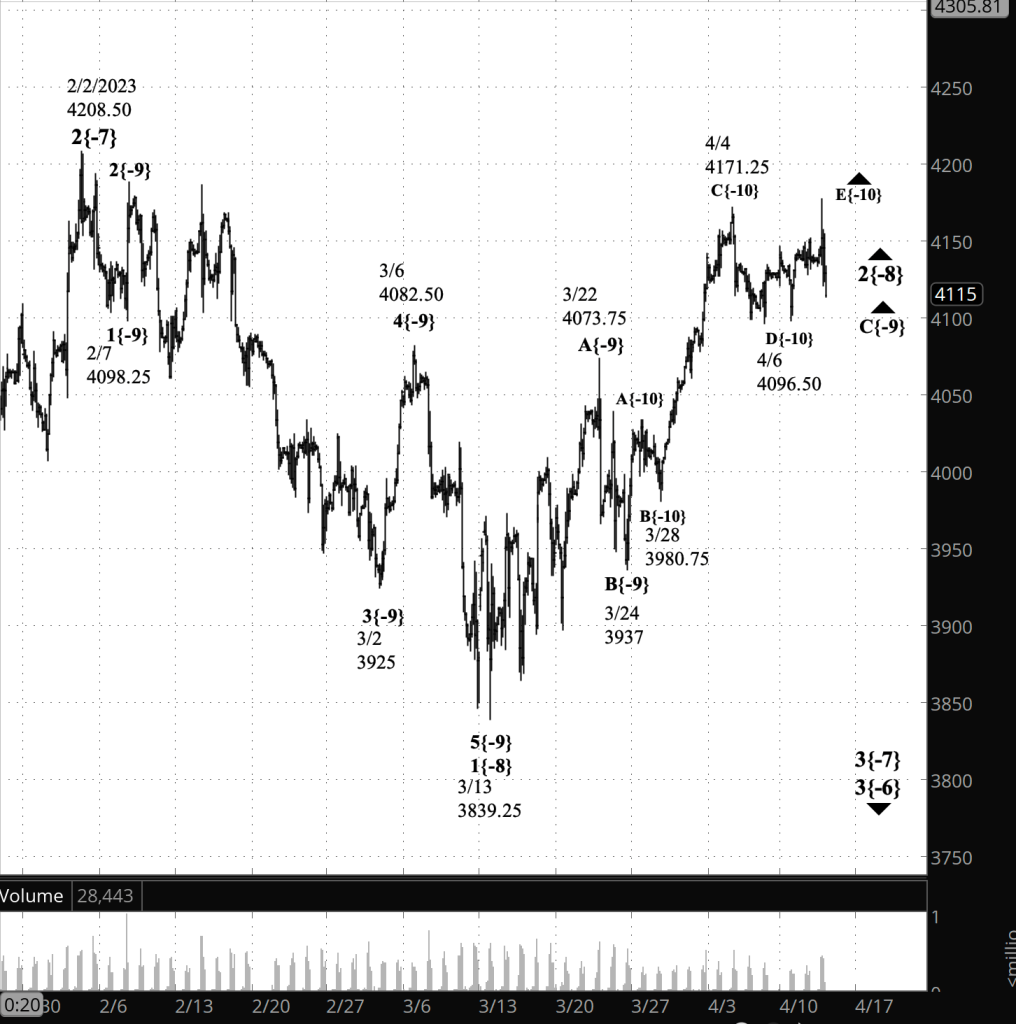
[S&P 500 E-mini futures at 3:30 p.m., 180-minute bars, with volume]

What does Elliott wave theory say? The rise that began overnight is wave E{-10} within rising wave C{-9}, the last leg of the upward correction, wave 2{-8}, that began on March 13. Wave E{-10} is the final subwave within wave C{-9}.

Here is a discussion of waves important to the analysis.

Principal analysis:

  • The upward correction that began on March 13 is wave 2{-8}.
  • Down one degree, wave C{-9} is the final wave within that correction.
  • If wave 2{-8} and its subwavs, C{-9} and E{-10}, move above the starting point of wave 1{-8}, which was 4208.50, then then analysis will have broken a rule of Elliott wave analysis and a new analysis will be done.
  • Wave 2{-8} will be followed by a downtrend, wave 3{-8}, that will carry the price below the correction’s starting point, 3839.25, and most likely significantly below that level.

Alternative analysis:

  • Wave 2{-8}, the upward correction, will form a compound structure, linking together two or three corrective patterns.
  • Under that alternative, if it should occur, the present rising wave C{-9} will be followed by a declining connector wave, X{-9}, and then the first wave of a second corrective pattern.
  • The correction is a 2nd wave, and compounding is seen less often in 2nds. However, they do happen on occasion.

Bigger structures:

  • This is all happening within downtrending wave 3{-7}, which began on February 2.
  • Wave 3{-7} is a subwave of downtrending wave 3{-6}, which began on August 16, 2022.
  • Wave 3{-6} is encompassed by a series of larger declining waves, the smaller within the larger, stretching up five degrees to wave 4{-1}, which began on January 4, 2022.
  • Wave 4{-1} is the next-to-the-last wave within a large expanding Diagonal Triangle, wave 5{0}, that began on December 26, 2018
  • When wave 4{-1} is complete, wave 5{-1} will begin and will carry the wave above the January 4 high, 4808.25, and back to the upper boundary of the triangle, which gets higher continually and is in the 6090s.

Reading the chart. Elliott wave analysis views the chart as a complex structure of smaller waves nested within larger waves, which in turn are nested within still larger waves. My labeling system assigns numbers to the subwaves of trending waves, and letters to the subwaves of corrections. Each number or letter is followed by a subscript, in curly brackets, showing the waves position within the complex structure, called its “degree” in Elliott wave parlance. The smaller the number, the lower the degree. On this chart we’re dealing with relatively small waves, so the degree numbers are negative.

We Are Here.

These are the waves currently in progress under my principal analysis. Each line on the list shows the wave number, with the subscript in curly brackets, the traditional degree name, the starting date, the starting price of the S&P 500 E-mini futures, and the direction of the wave.

  • S&P 500 Index:
  • 5{+3} Supercycle, 7/8/1932, 4.40 (up)
  • 5{+2} Cycle, 12/9/1974, 60.96 (up)
  • 5{+1} Primary, 3/6/2009, 666.79 (up)
  • 5{0} Intermediate, 12/26/2018, 2346.58 (up)
  • S&P 500 Futures and index:
  • 4{-1} Minor, 1/4/2022, 4808.25 (down) (futures), 4818.62 (down) (index)
  • S&P 500 Futures:
  • 1{-2} Minute, 1/4/2022, 4808.25 (down)
  • 1{-3} Minuette, 1/4/2022, 4808.25 (down)
  • 1{-4} Subminuette, 1/4/2022, 4808.25 (down)
  • 1{-5} Micro, 1/4/2022, 4808.25 (down)
  • 3{-6} Submicro, 8/16/2022, 4327.50 (down)
  • 3{-7} Minuscule, 2/2/2023, 4208.50 (down)

Learning and other resources. Elliott wave analysis provides context, not prophecy. As the 20th century semanticist Alfred Korzybski put it in his book Science and Sanity (1933), “The map is not the territory … The only usefulness of a map depends on similarity of structure between the empirical world and the map.” And I would add, in the ever-changing markets, we can judge that similarity of structure only after the fact.

See the menu page Analytical Methods for a rundown on where to go for information on Elliott wave analysis.

By Tim Bovee, Portland, Oregon, April 12, 2023

Disclaimer

Tim Bovee, Private Trader tracks the analysis and trades of a private trader for his own accounts. Nothing in this blog constitutes a recommendation to buy or sell stocks, options or any other financial instrument. The only purpose of this blog is to provide education and entertainment.

No trader is ever 100 percent successful in his or her trades. Trading in the stock and option markets is risky and uncertain. Each trader must make trading decisions for his or her own account, and take responsibility for the consequences.

License
Creative Commons License

All content on Tim Bovee, Private Trader by Timothy K. Bovee is licensed under a Creative Commons Attribution-ShareAlike 4.0 International License.

Based on a work at www.timbovee.com.

Trader’s Notebook

3:30 p.m. New York time

Half an hour before the closing bell. The S&P 500 rose during the session, with the futures reaching a high so far of 4151.25. No change in this morning’s analysis. The 4th subwave, declining wave D{-10}, within the final segment, rising wave C{-9}, within the upward correction that began on March 13, wave 2{-8}, continues. I’ve updated the chart.

9:35 a.m. New York time

What’s happening now? The S&P 500 E-mini futures rose overnight to 4149, remaining below the start of the downward movement that began on April 4 from 4171.25.

What does it mean? The downward movement is the 4th of five subwaves within the final wave of an upward correction that began on March 13. It’s possible that the 4th subwave ended at the April 6 low, 4096,50. That would be a 39% retracement of the preceding subwave — disproportionally small but not by a lot. For now I’m sticking with the scenario that sees the 4th subwave as being underway, but the closer the price approaches to the 4175.25 peak, the more likely I’ll be to switching to a scenario that sees the 5th subwave as having begun from the April 6 low.

With either scenario, the end of the 5th subwave will also be the end of the entire upward correction, which will be followed by a significant downtrend that will carry the price below the correction’s starting point, 3839.25, and perhaps well below that level.

What are the alternatives? It’s possible that the third wave within the correction will be the end of a corrective pattern but not of the correction itself. Some corrections form a compound structure, linking two or three corrective patterns together. The present correction is the 2nd of five waves in a downtrend. Compound corrections are far more common in 4th waves. Nonetheless, 2nd-wave compound corrections aren’t unheard of.

[S&P 500 E-mini futures at e:30 p.m., 180-minute bars, with volume]

What does Elliott wave theory say? The decline that began on April 4 is wave D{-10} within rising wave C{-9}, the last leg of the upward correction, wave 2{-8}, that began on March 13. It’s possible that wave D{-10} ended on April 6 and that wave E{-10}, the final subwave within wave C{-9}, has begun. I’m not yet ready to switch to the wave E{-10} scenario, because of the proportionality of the retracement, discussed above in the “What does it mean?” section.

Here is the line-up waves important to the analysis.

Principal analysis:

  • The upward correction that began on March 13 is wave 2{-8}.
  • Down one degree, wave C{-9} is the final wave within that correction.
  • Within that final wave, declining wave D{-10} is underway, It will be followed by wave E{-10}, which likely will carry the price above the April 4 high, 4171.25.
  • If wave 2{-8} moves above the starting point of wave 1{-8}, from 4208.50, then then analysis will have broken a rule of Elliott wave analysis and will be redone.
  • Wave 2{-8} will be followed by a downtrend, wave 3{-8}, that will carry the price below the correction’s starting point, 3839.25, and most likely significantly below that level.

Alternative analysis:

  • Wave 2{-8}, the upward correction, will form a compound structure, linking together two or three corrective patterns.
  • Under that alternative, if it should occur, the present rising wave C{-9} will be followed by a declining connector wave, X{-9}, and then the first wave of a second corrective pattern.
  • The correction is a 2nd wave, and compounding is seen less often in 2nds. However, they do happen on occasion.

Bigger structures:

  • This is all happening within downtrending wave 3{-7}, which began on February 2.
  • Wave 3{-7} is a subwave of downtrending wave 3{-6}, which began on August 16, 2022.
  • Wave 3{-6} is encompassed by a series of larger declining waves, the smaller within the larger, stretching up five degrees to wave 4{-1}, which began on January 4, 2022.
  • Wave 4{-1} is the next-to-the-last wave within a large expanding Diagonal Triangle, wave 5{0}, that began on December 26, 2018
  • When wave 4{-1} is complete, wave 5{-1} will begin and will carry the wave above the January 4 high, 4808.25, and back to the upper boundary of the triangle, which gets higher continually and is in the 6090s.

Reading the chart. Elliott wave analysis views the chart as a complex structure of smaller waves nested within larger waves, which in turn are nested within still larger waves. My labeling system assigns numbers to the subwaves of trending waves, and letters to the subwaves of corrections. Each number or letter is followed by a subscript, in curly brackets, showing the waves position within the complex structure, called its “degree” in Elliott wave parlance. The smaller the number, the lower the degree. On this chart we’re dealing with relatively small waves, so the degree numbers are negative.

We Are Here.

These are the waves currently in progress under my principal analysis. Each line on the list shows the wave number, with the subscript in curly brackets, the traditional degree name, the starting date, the starting price of the S&P 500 E-mini futures, and the direction of the wave.

  • S&P 500 Index:
  • 5{+3} Supercycle, 7/8/1932, 4.40 (up)
  • 5{+2} Cycle, 12/9/1974, 60.96 (up)
  • 5{+1} Primary, 3/6/2009, 666.79 (up)
  • 5{0} Intermediate, 12/26/2018, 2346.58 (up)
  • S&P 500 Futures and index:
  • 4{-1} Minor, 1/4/2022, 4808.25 (down) (futures), 4818.62 (down) (index)
  • S&P 500 Futures:
  • 1{-2} Minute, 1/4/2022, 4808.25 (down)
  • 1{-3} Minuette, 1/4/2022, 4808.25 (down)
  • 1{-4} Subminuette, 1/4/2022, 4808.25 (down)
  • 1{-5} Micro, 1/4/2022, 4808.25 (down)
  • 3{-6} Submicro, 8/16/2022, 4327.50 (down)
  • 3{-7} Minuscule, 2/2/2023, 4208.50 (down)

Learning and other resources. Elliott wave analysis provides context, not prophecy. As the 20th century semanticist Alfred Korzybski put it in his book Science and Sanity (1933), “The map is not the territory … The only usefulness of a map depends on similarity of structure between the empirical world and the map.” And I would add, in the ever-changing markets, we can judge that similarity of structure only after the fact.

See the menu page Analytical Methods for a rundown on where to go for information on Elliott wave analysis.

By Tim Bovee, Portland, Oregon, April 11, 2023

Disclaimer

Tim Bovee, Private Trader tracks the analysis and trades of a private trader for his own accounts. Nothing in this blog constitutes a recommendation to buy or sell stocks, options or any other financial instrument. The only purpose of this blog is to provide education and entertainment.

No trader is ever 100 percent successful in his or her trades. Trading in the stock and option markets is risky and uncertain. Each trader must make trading decisions for his or her own account, and take responsibility for the consequences.

License
Creative Commons License

All content on Tim Bovee, Private Trader by Timothy K. Bovee is licensed under a Creative Commons Attribution-ShareAlike 4.0 International License.

Based on a work at www.timbovee.com.

Trader’s Notebook

3:30 p.m. New York time

Half an hour before the closing bell. The S&P 500 futures reached a low of 4098.75 at the session opening and rose thereafter, reaching back into the 4130s so far. The next to the last subwave, D{-10} within the final wave, C{-9}, within the upward correction that began on March 13, wave 2{-8}, continues. No change from this morning’s analysis. I’ve updated the chart.

9:35 a.m. New York time

What’s happening now? The S&P 500 E-mini futures fell overnight, from the 4140s to a low so far of 4100.

What does it mean? The rising final wave of an upward correction that began on March 13 continues and is in its declining next-to-the-last subwave. The final subwave, if it is typical, will carry the price above 4171.25, the prior high point of the correction, although it’s not a certainty.

The end of that final subwave will also be the end of the correction, which will be followed by an energetic downtrend that will carry the price below 3839.25 — the correction’s starting point — and perhaps significantly below that level.

What are the alternatives? It’s possible that the third wave within the correction will be the end of a corrective pattern but not of the correction itself. Some corrections form a compound structure, linking two or three corrective patterns together. The present correction is the 2nd of five waves in a downtrend. Compound corrections are far more common in 4th waves. Nonetheless, 2nd-wave compound corrections aren’t unheard of.

[S&P 500 E-mini futures at 3:30 p.m., 180-minute bars, with volume]

What does Elliott wave theory say? The decline that began on April 4 is wave D{-10} within rising wave C{-9}, the last leg of the upward correction, wave 2{-8}, that began on March 13. .

Here are the other waves that underly the analysis.

Principal analysis:

  • The upward correction that began on March 13 is wave 2{-8}.
  • Down one degree, wave C{-9} is the final wave within that correction.
  • Within that final wave, declining wave D{-10} is underway, It will be followed by wave E{-10}, which likely will carry the price above the April 4 high, 4171.25.
  • If wave 2{-8} moves above the starting point of wave 1{-8}, from 4208.50, then then analysis will have broken a rule of Elliott wave analysis and will be redone.
  • Wave 2{-8} will be followed by a downtrend, wave 3{-8}, that will carry the price below the correction’s starting point, 3839.25, and most likely significantly below that level.

Alternative analysis:

  • Wave 2{-8}, the upward correction, will form a compound structure, linking together two or three corrective patterns.
  • Under that alternative, if it should occur, the present rising wave C{-9} will be followed by a declining connector wave, X{-9}, and then the first wave of a second corrective pattern.
  • The correction is a 2nd wave, and compounding is seen less often in 2nds. However, they do happen on occasion.

Bigger structures:

  • This is all happening within downtrending wave 3{-7}, which began on February 2.
  • Wave 3{-7} is a subwave of downtrending wave 3{-6}, which began on August 16, 2022.
  • Wave 3{-6} is encompassed by a series of larger declining waves, the smaller within the larger, stretching up five degrees to wave 4{-1}, which began on January 4, 2022.
  • Wave 4{-1} is the next-to-the-last wave within a large expanding Diagonal Triangle, wave 5{0}, that began on December 26, 2018
  • When wave 4{-1} is complete, wave 5{-1} will begin and will carry the wave above the January 4 high, 4808.25, and back to the upper boundary of the triangle, which gets higher continually and is in the 6090s.

Reading the chart. Elliott wave analysis views the chart as a complex structure of smaller waves nested within larger waves, which in turn are nested within still larger waves. My labeling system assigns numbers to the subwaves of trending waves, and letters to the subwaves of corrections. Each number or letter is followed by a subscript, in curly brackets, showing the waves position within the complex structure, called its “degree” in Elliott wave parlance. The smaller the number, the lower the degree. On this chart we’re dealing with relatively small waves, so the degree numbers are negative.

We Are Here.

These are the waves currently in progress under my principal analysis. Each line on the list shows the wave number, with the subscript in curly brackets, the traditional degree name, the starting date, the starting price of the S&P 500 E-mini futures, and the direction of the wave.

  • S&P 500 Index:
  • 5{+3} Supercycle, 7/8/1932, 4.40 (up)
  • 5{+2} Cycle, 12/9/1974, 60.96 (up)
  • 5{+1} Primary, 3/6/2009, 666.79 (up)
  • 5{0} Intermediate, 12/26/2018, 2346.58 (up)
  • S&P 500 Futures and index:
  • 4{-1} Minor, 1/4/2022, 4808.25 (down) (futures), 4818.62 (down) (index)
  • S&P 500 Futures:
  • 1{-2} Minute, 1/4/2022, 4808.25 (down)
  • 1{-3} Minuette, 1/4/2022, 4808.25 (down)
  • 1{-4} Subminuette, 1/4/2022, 4808.25 (down)
  • 1{-5} Micro, 1/4/2022, 4808.25 (down)
  • 3{-6} Submicro, 8/16/2022, 4327.50 (down)
  • 3{-7} Minuscule, 2/2/2023, 4208.50 (down)

Learning and other resources. Elliott wave analysis provides context, not prophecy. As the 20th century semanticist Alfred Korzybski put it in his book Science and Sanity (1933), “The map is not the territory … The only usefulness of a map depends on similarity of structure between the empirical world and the map.” And I would add, in the ever-changing markets, we can judge that similarity of structure only after the fact.

See the menu page Analytical Methods for a rundown on where to go for information on Elliott wave analysis.

By Tim Bovee, Portland, Oregon, April 10, 2023

Disclaimer

Tim Bovee, Private Trader tracks the analysis and trades of a private trader for his own accounts. Nothing in this blog constitutes a recommendation to buy or sell stocks, options or any other financial instrument. The only purpose of this blog is to provide education and entertainment.

No trader is ever 100 percent successful in his or her trades. Trading in the stock and option markets is risky and uncertain. Each trader must make trading decisions for his or her own account, and take responsibility for the consequences.

License
Creative Commons License

All content on Tim Bovee, Private Trader by Timothy K. Bovee is licensed under a Creative Commons Attribution-ShareAlike 4.0 International License.

Based on a work at www.timbovee.com.

Trader’s Notebook

9:35 a.m. New York time

Market holiday. Stock and option markets in the United States will be closed today in observance of the Christian Good Friday holiday. Bond markets will close early, at noon. The S&P 500 E-mini futures continued to trade overnight.

What’s happening now? The S&P 500 E-mini futures traded sideways overnight until the release the monthly employment situation report, when price rose sharply, moving in four minutes from 4121 to 4146.75. The price then pulled back slightly, settling in the 4130s.

What does it mean? The final leg of the present upward correction continues and has covered 234.25 points since beginning on March 24.

The market continues to search for the bottom of the next-to-the-last subwave within that final leg. When it comes to bottom-fishing, proportionality is key.The pullback that began from the April 4 peak, 4171.25, has so far covered 50.25 points. That’s a 17.5% retracement, which seems overly small to be the entire pull back before the final upward push that will end the correction. For that reason, I’m retaining yesterday’s analysis.

What are the alternatives? It’s possible that the third wave within the correction will be the end of a corrective pattern but not of the correction itself. Some corrections form a compound structure, linking two or three corrective patterns together. The present correction is the 2nd of five waves in a downtrend. Compound corrections are far more common in 4th waves. Nonetheless, 2nd-wave compound corrections aren’t unheard of.

[S&P 500 E-mini futures at 9:35 a.m., 180-minute bars, with volume]

What does Elliott wave theory say? The decline that began on April 4 is wave D{-10} within rising wave C{-9}, the last leg of the upward correction, wave 2{-8}, that began on March 13. In analyzing the chart, wave D{-10}’s 17.5% retracement of the preceding wave, C{-10}, seems disproportionally small. It doesn’t break any rules of Elliott wave analysis. It could indeed be the entirety of wave D{-10} and wave E{-10} might well have begun from the April 6 low. But it seems more likely to me that the upward reversal lis a subwave within wave D{-10} and that the downward movement will soon resume.

Here’s a rundown of other waves that underly the analysis.

Principal analysis:

  • The upward correction that began on March 13 is wave 2{-8}.
  • Down one degree, wave C{-9} is the final wave within that correction.
  • Within that final wave, declining wave D{-10} is underway, It will be followed by wave E{-10}, which likely will carry the price above the April 4 high, 4171.25.
  • If wave 2{-8} moves above the starting point of wave 1{-8}, from 4208.50, then then analysis will have broken a rule of Elliott wave analysis and will be redone.
  • Wave 2{-8} will be followed by a downtrend, wave 3{-8}, that will carry the price below the correction’s starting point, 3839.25, and most likely significantly below that level.

Alternative analysis:

  • Wave 2{-8}, the upward correction, will form a compound structure, linking together two or three corrective patterns.
  • Under that alternative, if it should occur, the present rising wave C{-9} will be followed by a declining connector wave, X{-9}, and then the first wave of a second corrective pattern.
  • The correction is a 2nd wave, and compounding is seen less often in 2nds. However, they do happen on occasion.

Bigger structures:

  • This is all happening within downtrending wave 3{-7}, which began on February 2.
  • Wave 3{-7} is a subwave of downtrending wave 3{-6}, which began on August 16, 2022.
  • Wave 3{-6} is encompassed by a series of larger declining waves, the smaller within the larger, stretching up five degrees to wave 4{-1}, which began on January 4, 2022.
  • Wave 4{-1} is the next-to-the-last wave within a large expanding Diagonal Triangle, wave 5{0}, that began on December 26, 2018
  • When wave 4{-1} is complete, wave 5{-1} will begin and will carry the wave above the January 4 high, 4808.25, and back to the upper boundary of the triangle, which gets higher continually and is in the 6090s.

Reading the chart. Elliott wave analysis views the chart as a complex structure of smaller waves nested within larger waves, which in turn are nested within still larger waves. My labeling system assigns numbers to the subwaves of trending waves, and letters to the subwaves of corrections. Each number or letter is followed by a subscript, in curly brackets, showing the waves position within the complex structure, called its “degree” in Elliott wave parlance. The smaller the number, the lower the degree. On this chart we’re dealing with relatively small waves, so the degree numbers are negative.

We Are Here.

These are the waves currently in progress under my principal analysis. Each line on the list shows the wave number, with the subscript in curly brackets, the traditional degree name, the starting date, the starting price of the S&P 500 E-mini futures, and the direction of the wave.

  • S&P 500 Index:
  • 5{+3} Supercycle, 7/8/1932, 4.40 (up)
  • 5{+2} Cycle, 12/9/1974, 60.96 (up)
  • 5{+1} Primary, 3/6/2009, 666.79 (up)
  • 5{0} Intermediate, 12/26/2018, 2346.58 (up)
  • S&P 500 Futures and index:
  • 4{-1} Minor, 1/4/2022, 4808.25 (down) (futures), 4818.62 (down) (index)
  • S&P 500 Futures:
  • 1{-2} Minute, 1/4/2022, 4808.25 (down)
  • 1{-3} Minuette, 1/4/2022, 4808.25 (down)
  • 1{-4} Subminuette, 1/4/2022, 4808.25 (down)
  • 1{-5} Micro, 1/4/2022, 4808.25 (down)
  • 3{-6} Submicro, 8/16/2022, 4327.50 (down)
  • 3{-7} Minuscule, 2/2/2023, 4208.50 (down)

Learning and other resources. Elliott wave analysis provides context, not prophecy. As the 20th century semanticist Alfred Korzybski put it in his book Science and Sanity (1933), “The map is not the territory … The only usefulness of a map depends on similarity of structure between the empirical world and the map.” And I would add, in the ever-changing markets, we can judge that similarity of structure only after the fact.

See the menu page Analytical Methods for a rundown on where to go for information on Elliott wave analysis.

By Tim Bovee, Portland, Oregon, April 7, 2023

Disclaimer

Tim Bovee, Private Trader tracks the analysis and trades of a private trader for his own accounts. Nothing in this blog constitutes a recommendation to buy or sell stocks, options or any other financial instrument. The only purpose of this blog is to provide education and entertainment.

No trader is ever 100 percent successful in his or her trades. Trading in the stock and option markets is risky and uncertain. Each trader must make trading decisions for his or her own account, and take responsibility for the consequences.

License
Creative Commons License

All content on Tim Bovee, Private Trader by Timothy K. Bovee is licensed under a Creative Commons Attribution-ShareAlike 4.0 International License.

Based on a work at www.timbovee.com.

Trader’s Notebook

3:30 p.m. New York time

Half an hour before the closing bell. The S&P 500 futures rose during the session, reaching into the 4130s, well below the high set so far by the upward correction that began on March 13. It’s possible that the overnight low, 4096.50, was the end of wave D{-10}, the downward next-to-the-last leg of the final wave, C{-9}, within the correction, wave 2{-8}. The low came on the third day since wave D{-10} began, which is proportional to what has come before.

If that low is indeed the end of wave D{-10}, then wave E{-10}, the final wave within wave C{-9}, has begun. I’m not at all certain that E{-10} has begun, so for now I’m sticking with this morning’s analysis: Wave D{-10} continues its journey within wave C{-9} within wave 2{-8}.

I’ve updated the chart.

10:20 a.m. New York time

MKC options play exercise and exit. I’ve exited my short bear call options spread on MKC after the short calls were exercised as the stock went ex-dividend. I’ve updated the trade analysis with details.

9:35 a.m. New York time

What’s happening now? The S&P 500 E-mini futures remained above the April 5 low, 4099, in overnight trading.

What does it mean? From smaller to larger, the next-to-the-last subwave, which is declining, within the final wave of an upward correction that began on March 13 is fishing for its end point. Once it is complete, the subwave will be followed by the rising final wave that will bring the correction to an end.

A tendency and a rule govern how high the final wave within the correction will go.

First, within that final wave, the last of five subwaves will tend to move above the prior high within the final wave, which means above 4171.25. It’s a tendency not a rule, so the final rise might come up short.

Second, the upward correction, a 2nd wave, cannot move above the start of the preceding 1st wave, which sets a maximum of 4208.50.

So under the principal analysis, the correction’s peak must be no higher than 4208.50 but might go higher than 4171.25. If the rule is violated, then I’ll redo the analysis. If the tendency is violated, no action required.

What are the alternatives? It’s possible that the third wave within the correction will be the end of a corrective pattern but not of the correction itself. Some corrections form a compound structure, linking two or three corrective patterns together. The present correction is the 2nd of five waves in a downtrend. Compound corrections are far more common in 4th waves. Nonetheless, 2nd-wave compound corrections aren’t unheard of.

[S&P 500 E-mini futures at 3:30 p.m., 180-minute bars, with volume]

What does Elliott wave theory say? Here’s the Elliott wave terminology.

Principal analysis:

  • The upward correction that began on March 13 is wave 2{-8}.
  • Down one degree, wave C{-9} is the final wave within that correction.
  • Within that final wave, declining wave D{-10} is underway, It will be followed by wave E{-10}, which likely will carry the price above the April 4 high, 4171.25.
  • If wave 2{-8} moves above the starting point of wave 1{-8}, from 4208.50, then then analysis will have broken a rule of Elliott wave analysis and will be redone.
  • Wave 2{-8} will be followed by a downtrend, wave 3{-8}, that will carry the price below the correction’s starting point, 3839.25, and most likely significantly below that level.

Alternative analysis:

  • Wave 2{-8}, the upward correction, will form a compound structure, linking together two or three corrective patterns.
  • Under that alternative, if it should occur, the present rising wave C{-9} will be followed by a declining connector wave, X{-9}, and then the first wave of a second corrective pattern.
  • The correction is a 2nd wave, and compounding is seen less often in 2nds. However, they do happen on occasion.

Bigger structures:

  • This is all happening within downtrending wave 3{-7}, which began on February 2.
  • Wave 3{-7} is a subwave of downtrending wave 3{-6}, which began on August 16, 2022.
  • Wave 3{-6} is encompassed by a series of larger declining waves, the smaller within the larger, stretching up five degrees to wave 4{-1}, which began on January 4, 2022.
  • Wave 4{-1} is the next-to-the-last wave within a large expanding Diagonal Triangle, wave 5{0}, that began on December 26, 2018
  • When wave 4{-1} is complete, wave 5{-1} will begin and will carry the wave above the January 4 high, 4808.25, and back to the upper boundary of the triangle, which gets higher continually and is in the 6090s.

Reading the chart. Elliott wave analysis views the chart as a complex structure of smaller waves nested within larger waves, which in turn are nested within still larger waves. My labeling system assigns numbers to the subwaves of trending waves, and letters to the subwaves of corrections. Each number or letter is followed by a subscript, in curly brackets, showing the waves position within the complex structure, called its “degree” in Elliott wave parlance. The smaller the number, the lower the degree. On this chart we’re dealing with relatively small waves, so the degree numbers are negative.

We Are Here.

These are the waves currently in progress under my principal analysis. Each line on the list shows the wave number, with the subscript in curly brackets, the traditional degree name, the starting date, the starting price of the S&P 500 E-mini futures, and the direction of the wave.

  • S&P 500 Index:
  • 5{+3} Supercycle, 7/8/1932, 4.40 (up)
  • 5{+2} Cycle, 12/9/1974, 60.96 (up)
  • 5{+1} Primary, 3/6/2009, 666.79 (up)
  • 5{0} Intermediate, 12/26/2018, 2346.58 (up)
  • S&P 500 Futures and index:
  • 4{-1} Minor, 1/4/2022, 4808.25 (down) (futures), 4818.62 (down) (index)
  • S&P 500 Futures:
  • 1{-2} Minute, 1/4/2022, 4808.25 (down)
  • 1{-3} Minuette, 1/4/2022, 4808.25 (down)
  • 1{-4} Subminuette, 1/4/2022, 4808.25 (down)
  • 1{-5} Micro, 1/4/2022, 4808.25 (down)
  • 3{-6} Submicro, 8/16/2022, 4327.50 (down)
  • 3{-7} Minuscule, 2/2/2023, 4208.50 (down)

Learning and other resources. Elliott wave analysis provides context, not prophecy. As the 20th century semanticist Alfred Korzybski put it in his book Science and Sanity (1933), “The map is not the territory … The only usefulness of a map depends on similarity of structure between the empirical world and the map.” And I would add, in the ever-changing markets, we can judge that similarity of structure only after the fact.

See the menu page Analytical Methods for a rundown on where to go for information on Elliott wave analysis.

By Tim Bovee, Portland, Oregon, April 6, 2023

Disclaimer

Tim Bovee, Private Trader tracks the analysis and trades of a private trader for his own accounts. Nothing in this blog constitutes a recommendation to buy or sell stocks, options or any other financial instrument. The only purpose of this blog is to provide education and entertainment.

No trader is ever 100 percent successful in his or her trades. Trading in the stock and option markets is risky and uncertain. Each trader must make trading decisions for his or her own account, and take responsibility for the consequences.

License
Creative Commons License

All content on Tim Bovee, Private Trader by Timothy K. Bovee is licensed under a Creative Commons Attribution-ShareAlike 4.0 International License.

Based on a work at www.timbovee.com.
Trader’s Notebook

3:30 p.m. New York time

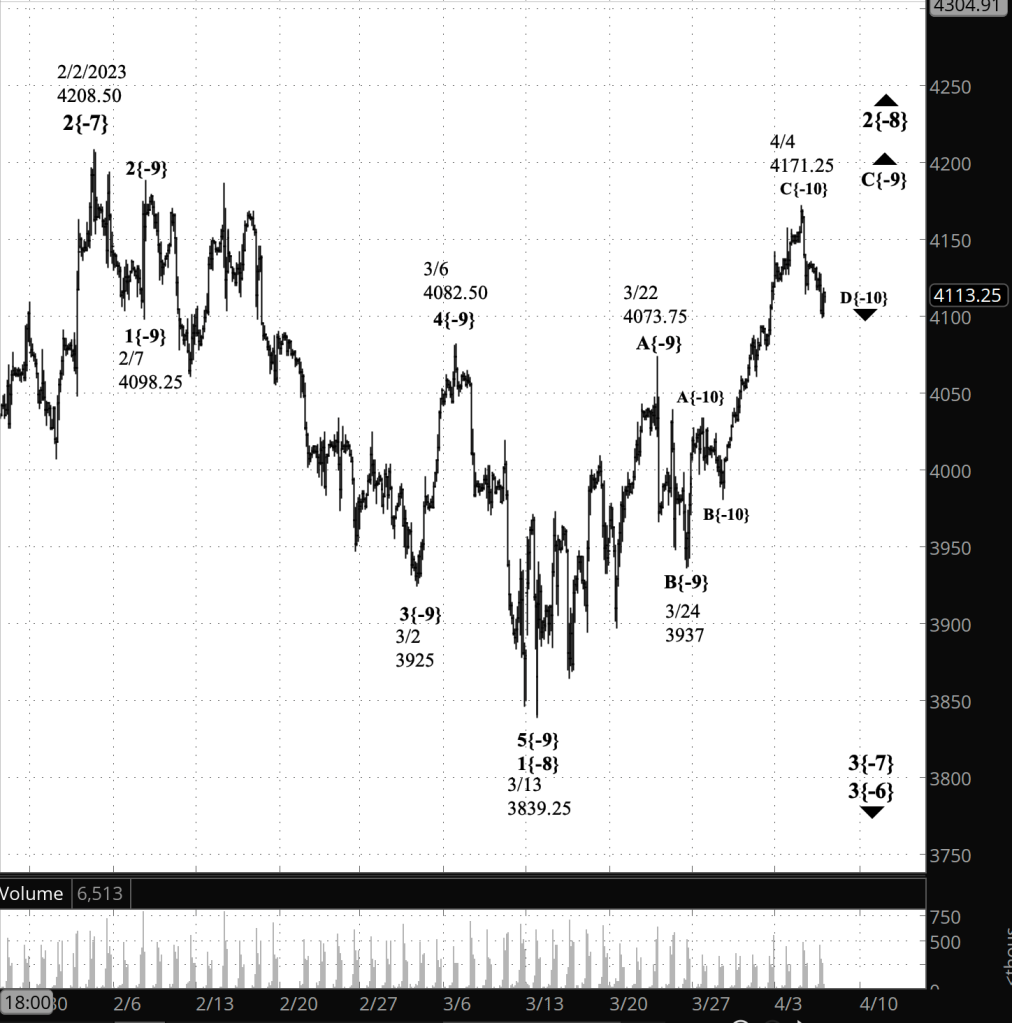
Half an hour before the closing bell. The S&P 500 worked its way lower during the session, reaching a low of 4099 on the futures as the closing bell approached. The decline is the next-to-the-last wave, D{-10}, within the final wave, C{-9}, within the upward correction that began on March 13, wave 2{-8}. No change from this morning’s analysis. I’ve updated the chart.

9:35 a.m. New York time

What’s happening now? The S&P 500 E-mini futures traded sideways overnight, remaining above the April 4 low, 4115.25.

What does it mean? The downward correction that began on March 13 in in its final wave, which in turn is in its next-to-the-last subwave. The correction is nearing its end and will be followed by a downtrend that will carry the price below the correction’s starting point, 3839.25, and likely significantly below that level.

What are the alternatives? It’s possible that the third wave within the correction will be the end of a corrective pattern but not of the correction itself. Some corrections form a compound structure, linking two or three corrective patterns together. The present correction is the 2nd of five waves in a downtrend. Compound corrections are far more common in 4th waves. Nonetheless, 2nd-wave compound corrections aren’t unheard of.

[S&P 500 E-mini futures at 3:30 p.m., 180-minute bars, with volume]

What does Elliott wave theory say? The waves behind the analysis:

Principal analysis:

  • The upward correction that began on March 13 is wave 2{-8}.
  • Down one degree, wave C{-9} is the final wave within that correction.
  • Within that final wave, declining wave D{-10} is underway, It will be followed by wave E{-10}, which likely will carry the price above the April 4 high, 4171.25.
  • If wave 2{-8} moves above the starting point of wave 1{-8}, from 4208.50, then then analysis will have broken a rule of Elliott wave analysis and will be redone.
  • Wave 2{-8} will be followed by a downtrend, wave 3{-8}, that will carry the price below the correction’s starting point, 3839.25, and most likely significantly below that level.

Alternative analysis:

  • Wave 2{-8}, the upward correction, will form a compound structure, linking together two or three corrective patterns.
  • Under that alternative, if it should occur, the present rising wave C{-9} will be followed by a declining connector wave, X{-9}, and then the first wave of a second corrective pattern.
  • The correction is a 2nd wave, and compounding is seen less often in 2nds. However, they do happen on occasion.

Bigger structures:

  • This is all happening within downtrending wave 3{-7}, which began on February 2.
  • Wave 3{-7} is a subwave of downtrending wave 3{-6}, which began on August 16, 2022.
  • Wave 3{-6} is encompassed by a series of larger declining waves, the smaller within the larger, stretching up five degrees to wave 4{-1}, which began on January 4, 2022.
  • Wave 4{-1} is the next-to-the-last wave within a large expanding Diagonal Triangle, wave 5{0}, that began on December 26, 2018
  • When wave 4{-1} is complete, wave 5{-1} will begin and will carry the wave above the January 4 high, 4808.25, and back to the upper boundary of the triangle, which gets higher continually and is in the 6090s.

Reading the chart. Elliott wave analysis views the chart as a complex structure of smaller waves nested within larger waves, which in turn are nested within still larger waves. My labeling system assigns numbers to the subwaves of trending waves, and letters to the subwaves of corrections. Each number or letter is followed by a subscript, in curly brackets, showing the waves position within the complex structure, called its “degree” in Elliott wave parlance. The smaller the number, the lower the degree. On this chart we’re dealing with relatively small waves, so the degree numbers are negative.

We Are Here.

These are the waves currently in progress under my principal analysis. Each line on the list shows the wave number, with the subscript in curly brackets, the traditional degree name, the starting date, the starting price of the S&P 500 E-mini futures, and the direction of the wave.

  • S&P 500 Index:
  • 5{+3} Supercycle, 7/8/1932, 4.40 (up)
  • 5{+2} Cycle, 12/9/1974, 60.96 (up)
  • 5{+1} Primary, 3/6/2009, 666.79 (up)
  • 5{0} Intermediate, 12/26/2018, 2346.58 (up)
  • S&P 500 Futures and index:
  • 4{-1} Minor, 1/4/2022, 4808.25 (down) (futures), 4818.62 (down) (index)
  • S&P 500 Futures:
  • 1{-2} Minute, 1/4/2022, 4808.25 (down)
  • 1{-3} Minuette, 1/4/2022, 4808.25 (down)
  • 1{-4} Subminuette, 1/4/2022, 4808.25 (down)
  • 1{-5} Micro, 1/4/2022, 4808.25 (down)
  • 3{-6} Submicro, 8/16/2022, 4327.50 (down)
  • 3{-7} Minuscule, 2/2/2023, 4208.50 (down)

Learning and other resources. Elliott wave analysis provides context, not prophecy. As the 20th century semanticist Alfred Korzybski put it in his book Science and Sanity (1933), “The map is not the territory … The only usefulness of a map depends on similarity of structure between the empirical world and the map.” And I would add, in the ever-changing markets, we can judge that similarity of structure only after the fact.

See the menu page Analytical Methods for a rundown on where to go for information on Elliott wave analysis.

By Tim Bovee, Portland, Oregon, April 5, 2023

Disclaimer

Tim Bovee, Private Trader tracks the analysis and trades of a private trader for his own accounts. Nothing in this blog constitutes a recommendation to buy or sell stocks, options or any other financial instrument. The only purpose of this blog is to provide education and entertainment.

No trader is ever 100 percent successful in his or her trades. Trading in the stock and option markets is risky and uncertain. Each trader must make trading decisions for his or her own account, and take responsibility for the consequences.

License
Creative Commons License

All content on Tim Bovee, Private Trader by Timothy K. Bovee is licensed under a Creative Commons Attribution-ShareAlike 4.0 International License.

Based on a work at www.timbovee.com.

Trader’s Notebook

3:30 p.m. New York time

Half an hour before the closing bell. The S&P 500 futures headed south during the session, dropping into the 4110s, well below the overnight high, 4171.25. The sharp decline reduces for the present the potential violation of the rules of Elliott wave analysis, discussed in this morning’s “What does it mean?” section.

I’ve revised this morning principal analysis as follows.

  • The overnight peak marks the end of the middle subwave, C{-10}, within the final wave, C{-9}, of the upward correction that began on March 13, wave 2{-8}.
  • Within wave C{-9}, the 4th subwaves of five, wave D{-10}, is now underway.
  • Wave D{-10}, which is declining, will be followed by rising wave E{-10}, which will complete the upward correction, unless it forms a compound structure, as discussed this morning in the “What are the alternatives section?”.
  • Wave E{-10} cannot carry the upward correction above the beginning of preceding 1st wave, 4208.50. If it does exceed that level, then the chart will be reanalyzed.

I’ve retained this morning’s chart and am posting a new one showing this afternoon’s changes in the principal analysis.

[S&P 500 E-mini futures at 3:30 p.m., 180-minute bars, with volume]

9:35 a.m. New York time

What’s happening now? The S&P 500 E-mini futures rose overnight, reaching a high so far of 4171.25 as the opening bell approached.

What does it mean? The upward correction that began on March 13 continues and is in its final wave. The correction is a 2nd wave within a five-wave downtrend. A strict rule of Elliott wave analysis says that a 2nd wave can’t move beyond the starting point of the preceding 1st wave. If it does, then it’s not a 2nd wave and something else is going on. In this case, the 1st wave began on February 2 from 4208.50. If the present upward correction reaches above that level, then the wave count will be revised.

The futures are derivatives of the S&P 500 index, whose comparable 1st wave began from 4195.44 and whose 2nd wave has reached a high so far of 4127.66.

The index moves in one-cent increments, and the futures in 25-cent increments. The index moves only during the session, and the futures trade every day except for Saturday. So it’s possible for the futures to go above the start of the 1st wave while the index remains below. Another way of putting it is that the futures are vulnerable to rounding error. On the other hand, the futures provide a more detailed pictures of investor sentiment, since it is traded while markets around the world are open. The index reflects only the American market sessions.

And meanwhile…

The Elliott wave rule has not been broken, yet, so the analysis remains what it was yesterday. Here is that analysis, word-for-word, along with the alternative identified yesterday:

There are three levels of nested waves in play — three “degrees”, in Elliott wave terminology. The largest is the ongoing upward correction that began on March 13. Next down is the final wave within the correction, which began on March 24. And down one more is the 3rd of five waves, which may have ended at the March 31 peak, or may not have. We’ll know when we see what happens next.

When the smallest of those three waves is complete, it will be followed by a downward movement and then by a rise above the March 31 high. That rise will be the final wave within the final wave of the upward correction. When that smallest final wave is complete, the correction will be over and a powerful downtrend will begin, carrying the price below 3839.25 — the starting point of the upward correction, and most likely significantly below that level.

What are the alternatives? The ambiguity lies in whether the end of the final wave of the correction will actually be the final wave. Most corrections have three waves internally. But not always. Some corrections form a compound structure, linking two or three corrective patterns together. The present correction is the 2nd of five waves in a downtrend. Compound corrections are far more common in 4th waves. Nonetheless, 2nd-wave compound corrections aren’t unheard of.

[Updated by the chart above]

[S&P 500 E-mini futures at 9:35 a.m., 180-minute bars, with volume]

What does Elliott wave theory say? Here are the waves in play at this point, as updated based on this afternoon’s revision of the principal analysios..

Principal analysis:

  • The upward correction that began on March 13 is wave 2{-8}.
  • Down one degree, wave C{-9} is the final wave within that correction.
  • Within that final wave, declining wave D{-10} is underway, It will be followed by wave E{-10}, which likely will carry the price above the April 4 high, 4171.25.
  • If wave 2{-8} moves above the starting point of wave 1{-8}, from 4208.50, then then analysis will have broken a rule of Elliott wave analysis and will be redone.
  • Wave 2{-8} will be followed by a downtrend, wave 3{-8}, that will carry the price below the correction’s starting point, 3839.25, and most likely significantly below that level.

Alternative analysis:

  • Wave 2{-8}, the upward correction, will form a compound structure, linking together two or three corrective patterns.
  • Under that alternative, if it should occur, the present rising wave C{-9} will be followed by a declining connector wave, X{-9}, and then the first wave of a second corrective pattern.
  • The correction is a 2nd wave, and compounding is seen less often in 2nds. However, they do happen on occasion.

Bigger structures:

  • This is all happening within downtrending wave 3{-7}, which began on February 2.
  • Wave 3{-7} is a subwave of downtrending wave 3{-6}, which began on August 16, 2022.
  • Wave 3{-6} is encompassed by a series of larger declining waves, the smaller within the larger, stretching up five degrees to wave 4{-1}, which began on January 4, 2022.
  • Wave 4{-1} is the next-to-the-last wave within a large expanding Diagonal Triangle, wave 5{0}, that began on December 26, 2018
  • When wave 4{-1} is complete, wave 5{-1} will begin and will carry the wave above the January 4 high, 4808.25, and back to the upper boundary of the triangle, which gets higher continually and is in the 6090s.

Reading the chart. Elliott wave analysis views the chart as a complex structure of smaller waves nested within larger waves, which in turn are nested within still larger waves. My labeling system assigns numbers to the subwaves of trending waves, and letters to the subwaves of corrections. Each number or letter is followed by a subscript, in curly brackets, showing the waves position within the complex structure, called its “degree” in Elliott wave parlance. The smaller the number, the lower the degree. On this chart we’re dealing with relatively small waves, so the degree numbers are negative.

We Are Here.

These are the waves currently in progress under my principal analysis. Each line on the list shows the wave number, with the subscript in curly brackets, the traditional degree name, the starting date, the starting price of the S&P 500 E-mini futures, and the direction of the wave.

  • S&P 500 Index:
  • 5{+3} Supercycle, 7/8/1932, 4.40 (up)
  • 5{+2} Cycle, 12/9/1974, 60.96 (up)
  • 5{+1} Primary, 3/6/2009, 666.79 (up)
  • 5{0} Intermediate, 12/26/2018, 2346.58 (up)
  • S&P 500 Futures and index:
  • 4{-1} Minor, 1/4/2022, 4808.25 (down) (futures), 4818.62 (down) (index)
  • S&P 500 Futures:
  • 1{-2} Minute, 1/4/2022, 4808.25 (down)
  • 1{-3} Minuette, 1/4/2022, 4808.25 (down)
  • 1{-4} Subminuette, 1/4/2022, 4808.25 (down)
  • 1{-5} Micro, 1/4/2022, 4808.25 (down)
  • 3{-6} Submicro, 8/16/2022, 4327.50 (down)
  • 3{-7} Minuscule, 2/2/2023, 4208.50 (down)

Learning and other resources. Elliott wave analysis provides context, not prophecy. As the 20th century semanticist Alfred Korzybski put it in his book Science and Sanity (1933), “The map is not the territory … The only usefulness of a map depends on similarity of structure between the empirical world and the map.” And I would add, in the ever-changing markets, we can judge that similarity of structure only after the fact.

See the menu page Analytical Methods for a rundown on where to go for information on Elliott wave analysis.

By Tim Bovee, Portland, Oregon, April 4, 2023

Disclaimer

Tim Bovee, Private Trader tracks the analysis and trades of a private trader for his own accounts. Nothing in this blog constitutes a recommendation to buy or sell stocks, options or any other financial instrument. The only purpose of this blog is to provide education and entertainment.

No trader is ever 100 percent successful in his or her trades. Trading in the stock and option markets is risky and uncertain. Each trader must make trading decisions for his or her own account, and take responsibility for the consequences.

License
Creative Commons License

All content on Tim Bovee, Private Trader by Timothy K. Bovee is licensed under a Creative Commons Attribution-ShareAlike 4.0 International License.

Based on a work at www.timbovee.com.

Trader’s Notebook

3:30 p.m. New York time

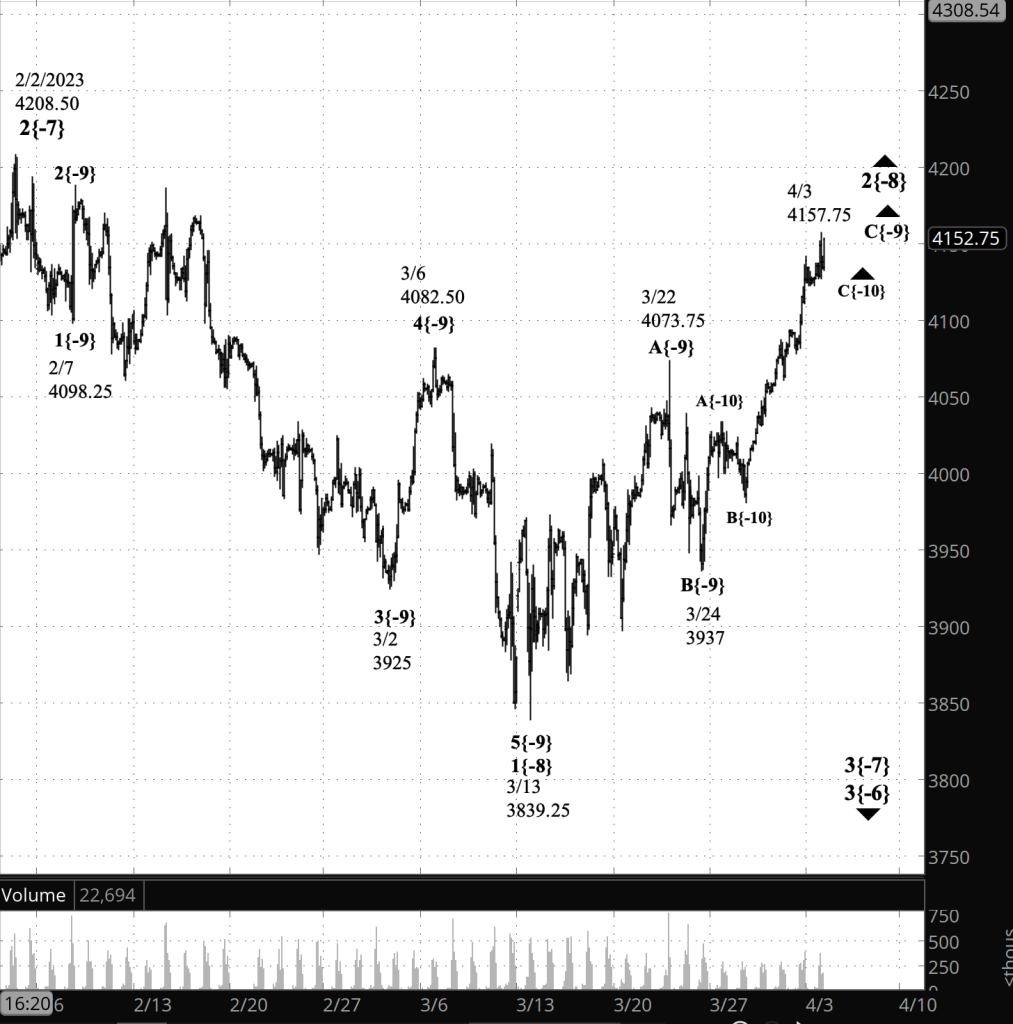
Half an hour before the closing bell. The S&P 500 futures quickly rose to a new high, 4157.75, early in the session and just as quickly fell back into the 4120s. As was the case with the March 31 high, the peak could mark the end of the middle wave, C{-10}, within the final wave, C{-9}, of the upward correction that began on March 13, or not. We’re fishing for a top, and when we’re fishing, we never know if we’ve caught anything until after the fish bites. I’ve updated the chart.

9:35 a.m. New York time

What’s happening now? The S&P 500 E-mini futures kept to a narrow range after trading resumed overnight, remaining below the March 31 peak of 4142.50 and reaching into the 4120s.

What does it mean? There are three levels of nested waves in play — three “degrees”, in Elliott wave terminology. The largest is the ongoing upward correction that began on March 13. Next down is the final wave within the correction, which began on March 24. And down one more is the 3rd of five waves, which may have ended at the March 31 peak, or may not have. We’ll know when we see what happens next.

When the smallest of those three waves is complete, it will be followed by a downward movement and then by a rise above the March 31 high. That rise will be the final wave within the final wave of the upward correction. When that smallest final wave is complete, the correction will be over and a powerful downtrend will begin, carrying the price below 3839.25 — the starting point of the upward correction, and most likely significantly below that level.

What are the alternatives? The ambiguity lies in whether the end of the final wave of the correction will actually be the final wave. Most corrections have three waves internally. But not always. Some corrections form a compound structure, linking two or three corrective patterns together. The present correction is the 2nd of five waves in a downtrend. Compound corrections are far more common in 4th waves. Nonetheless, 2nd-wave compound corrections aren’t unheard of.

[S&P 500 E-mini futures at 3:30 p.m., 110-minute bars, with volume]

What does Elliott wave theory say? I’ll begin with the Elliott wave terminology for the three nested waves described above in the “What does it mean?” section, from larger to smaller,

Principal analysis:

  • The upward correction that began on March 13 is wave 2{-8}.
  • Down one degree, wave C{-9} is the final wave within that correction.
  • Within that final wave, wave C{-10} is underway, It will be followed by a decline, wave D{-10}, and then by a wave E{-10}, which will carry the price above the March 31 high, 4142.50.

Wave 2{-8} will be followed by a downtrend, wave 3{-8}, that will carry the price below the correction’s starting point, 3839.25, and most likely significantly below that level.

Alternative analysis:

  • Wave 2{-8}, the upward correction, will form a compound structure, linking together two or three corrective patterns.
  • Under that alternative, if it should occur, the present rising wave C{-9} will be followed by a declining connector wave, X{-9}, and then the first wave of a second corrective pattern.
  • The correction is a 2nd wave, and compounding is seen less often in 2nds. However, they do happen on occasion.

Bigger structures:

  • This is all happening within downtrending wave 3{-7}, which began on February 2.
  • Wave 3{-7} is a subwave of downtrending wave 3{-6}, which began on August 16, 2022.
  • Wave 3{-6} is encompassed by a series of larger declining waves, the smaller within the larger, stretching up five degrees to wave 4{-1}, which began on January 4, 2022.
  • Wave 4{-1} is the next-to-the-last wave within a large expanding Diagonal Triangle, wave 5{0}, that began on December 26, 2018
  • When wave 4{-1} is complete, wave 5{-1} will begin and will carry the wave above the January 4 high, 4808.25, and back to the upper boundary of the triangle, which gets higher continually and is in the 6090s.

Reading the chart. Elliott wave analysis views the chart as a complex structure of smaller waves nested within larger waves, which in turn are nested within still larger waves. My labeling system assigns numbers to the subwaves of trending waves, and letters to the subwaves of corrections. Each number or letter is followed by a subscript, in curly brackets, showing the waves position within the complex structure, called its “degree” in Elliott wave parlance. The smaller the number, the lower the degree. On this chart we’re dealing with relatively small waves, so the degree numbers are negative.

We Are Here.

These are the waves currently in progress under my principal analysis. Each line on the list shows the wave number, with the subscript in curly brackets, the traditional degree name, the starting date, the starting price of the S&P 500 E-mini futures, and the direction of the wave.

  • S&P 500 Index:
  • 5{+3} Supercycle, 7/8/1932, 4.40 (up)
  • 5{+2} Cycle, 12/9/1974, 60.96 (up)
  • 5{+1} Primary, 3/6/2009, 666.79 (up)
  • 5{0} Intermediate, 12/26/2018, 2346.58 (up)
  • S&P 500 Futures and index:
  • 4{-1} Minor, 1/4/2022, 4808.25 (down) (futures), 4818.62 (down) (index)
  • S&P 500 Futures:
  • 1{-2} Minute, 1/4/2022, 4808.25 (down)
  • 1{-3} Minuette, 1/4/2022, 4808.25 (down)
  • 1{-4} Subminuette, 1/4/2022, 4808.25 (down)
  • 1{-5} Micro, 1/4/2022, 4808.25 (down)
  • 3{-6} Submicro, 8/16/2022, 4327.50 (down)
  • 3{-7} Minuscule, 2/2/2023, 4208.50 (down)

Learning and other resources. Elliott wave analysis provides context, not prophecy. As the 20th century semanticist Alfred Korzybski put it in his book Science and Sanity (1933), “The map is not the territory … The only usefulness of a map depends on similarity of structure between the empirical world and the map.” And I would add, in the ever-changing markets, we can judge that similarity of structure only after the fact.

See the menu page Analytical Methods for a rundown on where to go for information on Elliott wave analysis.

By Tim Bovee, Portland, Oregon, April 3, 2023

Disclaimer

Tim Bovee, Private Trader tracks the analysis and trades of a private trader for his own accounts. Nothing in this blog constitutes a recommendation to buy or sell stocks, options or any other financial instrument. The only purpose of this blog is to provide education and entertainment.

No trader is ever 100 percent successful in his or her trades. Trading in the stock and option markets is risky and uncertain. Each trader must make trading decisions for his or her own account, and take responsibility for the consequences.

License
Creative Commons License

All content on Tim Bovee, Private Trader by Timothy K. Bovee is licensed under a Creative Commons Attribution-ShareAlike 4.0 International License.

Based on a work at www.timbovee.com.
Trader’s Notebook

3:30 p.m. New York time

Half an hour before the closing bell. The S&P 500 futures moved to a higher high, reaching into the 4130s so far, within the present upward correction, and then pulled back, rising again but staying below the peak. The pattern is consistent with the principal analysis, below. I’ve updated the chart.

9:35 a.m. New York time

What’s happening now? The S&P 500 E-mini futures zigzagged sideways overnight, reaching a low of 4078 and then spiking to a high of 4098.50 after the Personal Income and Outlays report for February was released. After the spike, the price immediately dropped back to where it had been before the data release.

What does it mean? The sharp rise is consistent with the analysis that has been in place since the March 24 low: The third of three waves within the upward correction that began on March 13 is underway. Internally, that 3rd wave is in the 3rd of five subwaves. At this point, any peak could potentially be the end of that 3rd subwave, but we won’t know it until we see what happens next.

What are the alternatives? Unchanged from the last few days. The 3rd subwave is the final wave of a correction. But not always. Some corrections form a compound structure, linking two or three corrective patterns together. The present correction is the 2nd of five waves in a downtrend. Compound corrections are far more common in 4th waves. Nonetheless, 2nd-wave compound corrections aren’t unheard of.

[S&P 500 E-mini futures at 3:30 p.m., 110-minute bars, with volume]

What does Elliott wave theory say? Also unchanged. Wave C{-9} within the upward correction that began on March 13, wave 2{-8}, is underway. Wave C{-9} will have five subwaves one degree lower and is in the 3rd subwave, rising wave C{-10}.

Here are other waves that are important to the analysis:

Principal analysis:

  • The upward correction that began on March 13, wave 2{-8}, continues.
  • It is in the third of three subwaves, rising wave C{-9}.
  • Wave 2{-8} will be followed by a downtrend, wave 3{-8}, that will carry the price below the correction’s starting point, 3839.25, and most likely significantly below that level.

Alternative analysis:

  • Wave 2{-8}, the upward correction, will form a compound structure, linking together two or three corrective patterns.
  • Under that alternative, if it should occur, the present rising wave C{-9} will be followed by a declining connector wave, X{-9}, and then the first wave of a second corrective pattern.
  • The correction is a 2nd wave, and compounding is seen less often in 2nds. However, they do happen on occasion.

Bigger structures:

  • This is all happening within downtrending wave 3{-7}, which began on February 2.
  • Wave 3{-7} is a subwave of downtrending wave 3{-6}, which began on August 16, 2022.
  • Wave 3{-6} is encompassed by a series of larger declining waves, the smaller within the larger, stretching up five degrees to wave 4{-1}, which began on January 4, 2022.
  • Wave 4{-1} is the next-to-the-last wave within a large expanding Diagonal Triangle, wave 5{0}, that began on December 26, 2018
  • When wave 4{-1} is complete, wave 5{-1} will begin and will carry the wave above the January 4 high, 4808.25, and back to the upper boundary of the triangle, which gets higher continually and is in the 6090s.

Reading the chart. Elliott wave analysis views the chart as a complex structure of smaller waves nested within larger waves, which in turn are nested within still larger waves. My labeling system assigns numbers to the subwaves of trending waves, and letters to the subwaves of corrections. Each number or letter is followed by a subscript, in curly brackets, showing the waves position within the complex structure, called its “degree” in Elliott wave parlance. The smaller the number, the lower the degree. On this chart we’re dealing with relatively small waves, so the degree numbers are negative.

We Are Here.

These are the waves currently in progress under my principal analysis. Each line on the list shows the wave number, with the subscript in curly brackets, the traditional degree name, the starting date, the starting price of the S&P 500 E-mini futures, and the direction of the wave.

  • S&P 500 Index:
  • 5{+3} Supercycle, 7/8/1932, 4.40 (up)
  • 5{+2} Cycle, 12/9/1974, 60.96 (up)
  • 5{+1} Primary, 3/6/2009, 666.79 (up)
  • 5{0} Intermediate, 12/26/2018, 2346.58 (up)
  • S&P 500 Futures and index:
  • 4{-1} Minor, 1/4/2022, 4808.25 (down) (futures), 4818.62 (down) (index)
  • S&P 500 Futures:
  • 1{-2} Minute, 1/4/2022, 4808.25 (down)
  • 1{-3} Minuette, 1/4/2022, 4808.25 (down)
  • 1{-4} Subminuette, 1/4/2022, 4808.25 (down)
  • 1{-5} Micro, 1/4/2022, 4808.25 (down)
  • 3{-6} Submicro, 8/16/2022, 4327.50 (down)
  • 3{-7} Minuscule, 2/2/2023, 4208.50 (down)

Learning and other resources. Elliott wave analysis provides context, not prophecy. As the 20th century semanticist Alfred Korzybski put it in his book Science and Sanity (1933), “The map is not the territory … The only usefulness of a map depends on similarity of structure between the empirical world and the map.” And I would add, in the ever-changing markets, we can judge that similarity of structure only after the fact.

See the menu page Analytical Methods for a rundown on where to go for information on Elliott wave analysis.

By Tim Bovee, Portland, Oregon, March 31, 2023

Disclaimer

Tim Bovee, Private Trader tracks the analysis and trades of a private trader for his own accounts. Nothing in this blog constitutes a recommendation to buy or sell stocks, options or any other financial instrument. The only purpose of this blog is to provide education and entertainment.

No trader is ever 100 percent successful in his or her trades. Trading in the stock and option markets is risky and uncertain. Each trader must make trading decisions for his or her own account, and take responsibility for the consequences.

License
Creative Commons License

All content on Tim Bovee, Private Trader by Timothy K. Bovee is licensed under a Creative Commons Attribution-ShareAlike 4.0 International License.

Based on a work at www.timbovee.com.
Trader’s Notebook

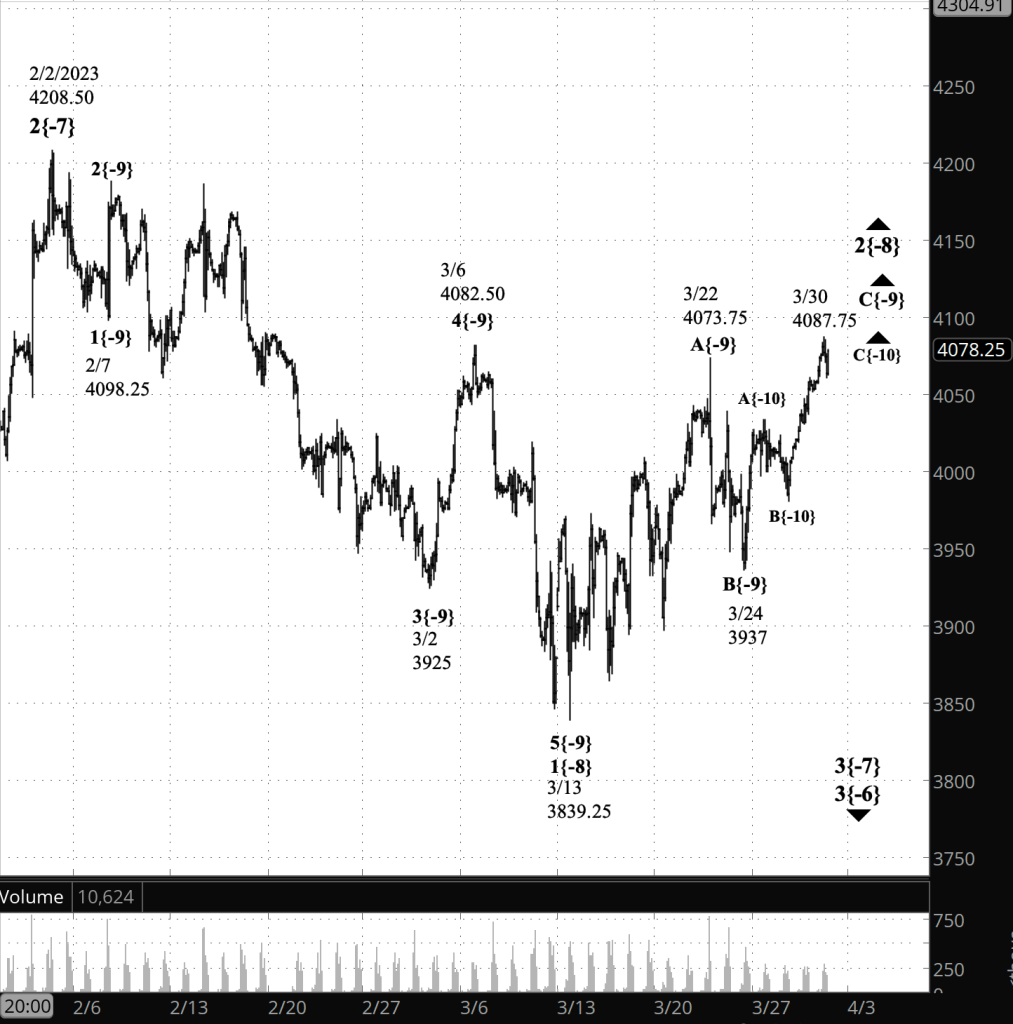
3:30 p.m. New York time

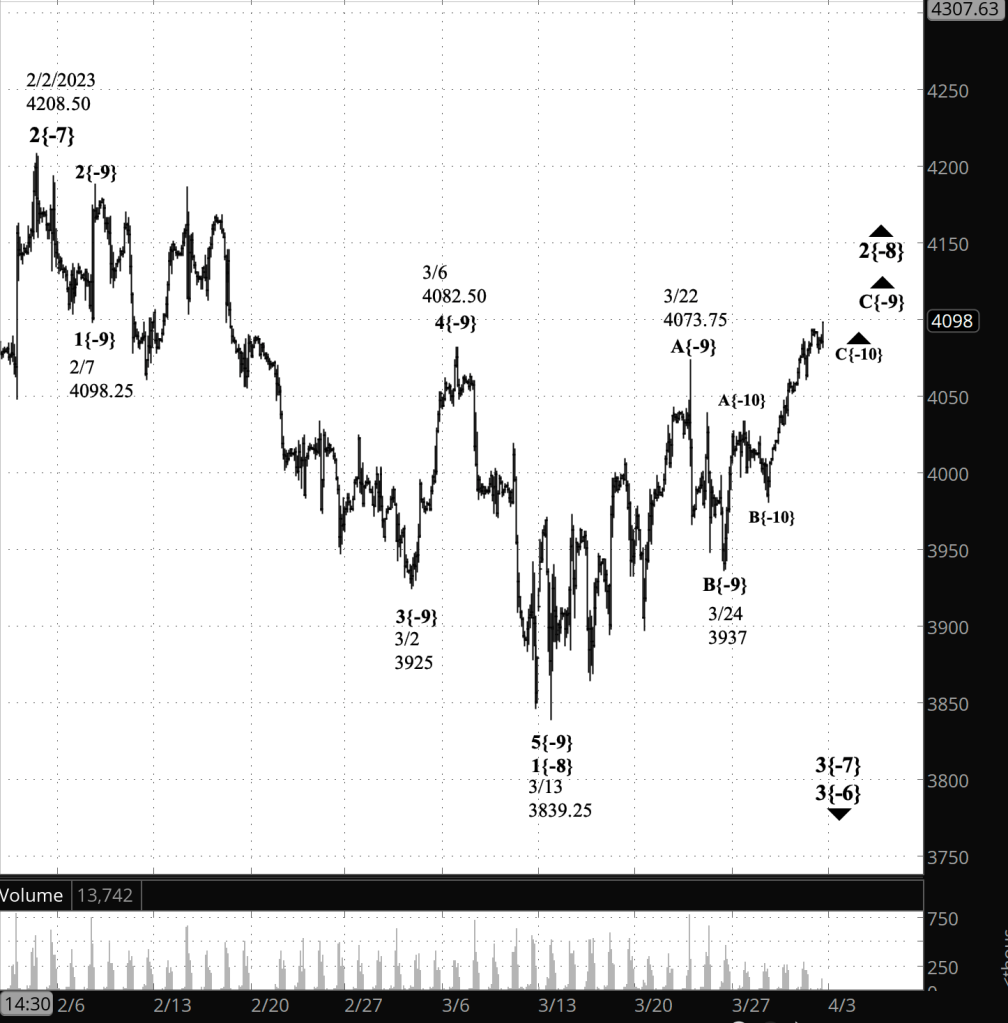
Half an hour before the closing bell. The S&P 500 futures peaked at 4087.75 early in the session and then fell back to the 4060s. It’s possible the peak marked the end of the 3rd of five waves within the final wave of the upward correction that began on March 13. Or perhaps not.

In Elliott wave terminology, the peak may have marked the end of rising wave C{-10} and the beginning of declining wave D{-10} within rising wave C{-9}. The corrective pattern will end with rising wave E{-10} within wave C{-9}. It’s also possible that the price will quickly reverse and continue pushing wave C{-10} upward.

For the moment, I shall stay with this morning’s analysis, that wave C{-10} is underway. Nonetheless, I’ll be unsurprised if Wave D{-10} began from that point.

I’ve updated the chart.

9:35 a.m. New York time

What’s happening now? The S&P 500 E-mini futures rose steadily into the 4080s overnight.

What does it mean? The upward correction that began on March 13 continues and is in the corrective pattern’s third and final leg. The correction will be followed by a downtrend that will carry the price back to the 3830s and most likely significantly below that level.

What are the alternatives? The 3rd subwave is the final wave of a correction. But not always. Some corrections form a compound structure, linking two or three corrective patterns together. The present correction is the 2nd of five waves in a downtrend. Compound corrections are far more common in 4th waves. Nonetheless, 2nd-wave compound corrections aren’t unheard of.

Reading the chart. Elliott wave analysis views the chart as a complex structure of smaller waves nested within larger waves, which in turn are nested within still larger waves. My labeling system assigns numbers to the subwaves of trending waves, and letters to the subwaves of corrections. Each number or letter is followed by a subscript, in curly brackets, showing the waves position within the complex structure, called its “degree” in Elliott wave parlance. The smaller the number, the lower the degree. On this chart we’re dealing with relatively small waves, so the degree numbers are negative.

[S&P 500 E-mini futures at 3:30 p.m., 110-minute bars, with volume]

What does Elliott wave theory say? The configuration is unchanged from yesterday. Wave C{-9} within the upward correction that began on March 13, wave 2{-8}, is underway. Wave C{-9} will have five subwaves one degree lower and is in the 3rd subwave, rising wave C{-10}.

Here are other waves that are important to the analysis:

Principal analysis:

  • The upward correction that began on March 13, wave 2{-8}, continues.
  • It is in the third of three subwaves, rising wave C{-9}.
  • Wave 2{-8} will be followed by a downtrend, wave 3{-8}, that will carry the price below the correction’s starting point, 3839.25, and most likely significantly below that level.

Alternative analysis:

  • Wave 2{-8}, the upward correction, will form a compound structure, linking together two or three corrective patterns.
  • Under that alternative, if it should occur, the present rising wave C{-9} will be followed by a declining connector wave, X{-9}, and then the first wave of a second corrective pattern.
  • The correction is a 2nd wave, and compounding is seen less often in 2nds. However, they do happen on occasion.

Bigger structures:

  • This is all happening within downtrending wave 3{-7}, which began on February 2.
  • Wave 3{-7} is a subwave of downtrending wave 3{-6}, which began on August 16, 2022.
  • Wave 3{-6} is encompassed by a series of larger declining waves, the smaller within the larger, stretching up five degrees to wave 4{-1}, which began on January 4, 2022.
  • Wave 4{-1} is the next-to-the-last wave within a large expanding Diagonal Triangle, wave 5{0}, that began on December 26, 2018
  • When wave 4{-1} is complete, wave 5{-1} will begin and will carry the wave above the January 4 high, 4808.25, and back to the upper boundary of the triangle, which gets higher continually and is in the 6090s.

We Are Here.

These are the waves currently in progress under my principal analysis. Each line on the list shows the wave number, with the subscript in curly brackets, the traditional degree name, the starting date, the starting price of the S&P 500 E-mini futures, and the direction of the wave.

  • S&P 500 Index:
  • 5{+3} Supercycle, 7/8/1932, 4.40 (up)
  • 5{+2} Cycle, 12/9/1974, 60.96 (up)
  • 5{+1} Primary, 3/6/2009, 666.79 (up)
  • 5{0} Intermediate, 12/26/2018, 2346.58 (up)
  • S&P 500 Futures and index:
  • 4{-1} Minor, 1/4/2022, 4808.25 (down) (futures), 4818.62 (down) (index)
  • S&P 500 Futures:
  • 1{-2} Minute, 1/4/2022, 4808.25 (down)
  • 1{-3} Minuette, 1/4/2022, 4808.25 (down)
  • 1{-4} Subminuette, 1/4/2022, 4808.25 (down)
  • 1{-5} Micro, 1/4/2022, 4808.25 (down)
  • 3{-6} Submicro, 8/16/2022, 4327.50 (down)
  • 3{-7} Minuscule, 2/2/2023, 4208.50 (down)

Learning and other resources. Elliott wave analysis provides context, not prophecy. As the 20th century semanticist Alfred Korzybski put it in his book Science and Sanity (1933), “The map is not the territory … The only usefulness of a map depends on similarity of structure between the empirical world and the map.” And I would add, in the ever-changing markets, we can judge that similarity of structure only after the fact.

See the menu page Analytical Methods for a rundown on where to go for information on Elliott wave analysis.

By Tim Bovee, Portland, Oregon, March 30, 2023

Disclaimer

Tim Bovee, Private Trader tracks the analysis and trades of a private trader for his own accounts. Nothing in this blog constitutes a recommendation to buy or sell stocks, options or any other financial instrument. The only purpose of this blog is to provide education and entertainment.

No trader is ever 100 percent successful in his or her trades. Trading in the stock and option markets is risky and uncertain. Each trader must make trading decisions for his or her own account, and take responsibility for the consequences.

License
Creative Commons License

All content on Tim Bovee, Private Trader by Timothy K. Bovee is licensed under a Creative Commons Attribution-ShareAlike 4.0 International License.

Based on a work at www.timbovee.com.