Trader’s Notebook

3:30 p.m. New York time

Half an hour before the closing bell. The S&P 500 futures rose sharply during session, reaching the 4050s as the closing bell approached. The upward correction that began on February 22 is almost complete.

This morning I listed three possible targets as the endpoint of the correction, wave 4{-12} marking each possibility ln the chart with a large question mark. Two of the possibilities were eliminated by today’s rise, the 38.2% Fibonacci retracement level and the peak of the 4th wave within the preceding 3rd wave, which was wave 4{-13}. In honor of their being surpassed, I’ve changed their color to sickly green.

Remaining is 4098.25, the ending the proceeding 1st wave of the downtrend, wave 1{-12}, on February 16. This possible target differs from the other two. Under the rules of Elliott wave analysis, a 4th wave cannot exceed the endpoint of the preceding 1st wave.

If the price hits 2098.25 and reverses, then the upward correction ends at that point, and the final wave of the larger downtrend, wave 5{-12}, will have begun.

If the price exceeds 2098.25, then by the book, the labeling no longer reflects the reality of the chart — the map doesn’t match the territory — and the analysis will have to be redone.

Maybe. The S&P 500 and products derived from it are a complex ecosystem. The index trades only during the sessions, in increments of one cent. The futures trade 24 hours a day, takes Saturdays off, and then resumes trading Sunday evenings (New York time). The trading increment is 25 cents.

Given the large disparity between the increments by which each product moves, it’s easy to imagine the futures going over that absolute ceiling, while the index stays below it. The end of wave 1{-12} for the index, the ceiling for the upward correction, is 4049.14, set on February 17.

If there’s a disparity between the two trading vehicles, then each case is unique and must be judged based on what happens after the ceiling is hit. I tend to give greater weight to the index, since it has the smaller increment. But we’ll see.

9:35 a.m. New York time

What’s happening now? The S&P 500 E-mini futures rose overnight, reaching 4011 so far.

What does it mean? The continued rise lends credence to the principal analysis since later February: The upward correction that began on February 22 is underway and is in its final wave. The correction is the 4th wave of a downtrend that began on February 15.

How high can it go?

  • At the most, 4098.25, the end of the preceding 1st wave of the downtrend.
  • Possibly in the vicinity of 4023.14, the 38.2% Fibonacci retracement level.
  • Typically, no higher than 4034.25, the peak of the 4th wave within the preceding 3rd wave of the downtrend that began February 15. This level would be a small overshoot of the 38.2% Fib retracement, and I think this is the strongest possibllity.

See the humongous question marks on the chart.

What are the alternatives? None at present. For much of the week there has been a possibility that the upward correction had ended on February 27 at 4024.75 and that subsequent decline was the early stages of the downtrend that will follow the upward correction. The rise from yesterday’s low, 3925, makes that alternative vanishingly unlikely.

Reading the chart. Elliott wave analysis views the chart as a complex structure of smaller waves nested within larger waves, which in turn are nested within still larger waves. My labeling system assigns numbers to the subwaves of trending waves, and letters to the subwaves of corrections. Each number or letter is followed by a subscript, in curly brackets, showing the waves position within the complex structure, called its “degree” in Elliott wave parlance. The smaller the number, the lower the degree. On this chart we’re dealing with relatively small waves, so the degree numbers are negative.
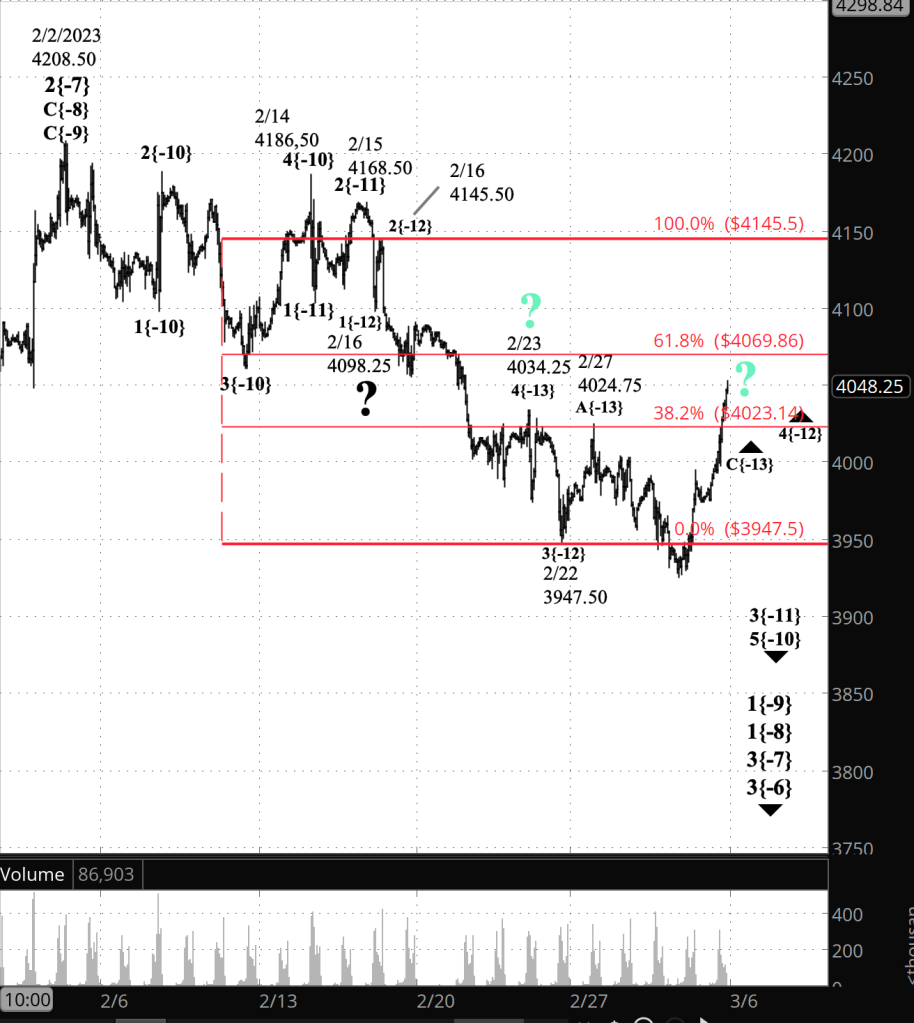
[S&P 500 E-mini futures at 3:30 p.m., hourly bars, with volume]

What does Elliott wave theory say? These are the waves that are I’m keeping a close eye on.

Principal analysis:

  • The downward correction that began on February 2, wave 3{-7}, continues.
  • It is in the first of five subwaves, wave 1{-8}.
  • Within wave 1{-8}, wave 1{-9} is underway and is in the final subwave within a five-wave structure, downtrending wave 5{-10}.
  • Wave 5{-10}, in turn, is in its middle wave, 3{-11}.
  • Wave 3{-11}’s middle wave, wave 3{-12}, ended on February 22, and the next-to-the-last wave, an upward correction, wave 4{-12}, is now underway.
  • Internally, wave 4{-12} is in its final wave of three, C{-13}.
  • The end of wave C{-13} will be the end of the correction, wave 4{-12}, which will be followed by wave 5{-12}, which will mark the end of wave 3{-11}, a subwave of downtrending wave 5{-10}.
  • The end of wave 5{-12} will also be the end of wave 3{-11}, a subwave of downtrending wave 5{-10}.
  • When wave 5{-10} is complete, it will also mark the end of wave 1{-9} and the beginning of a low-degree upward correction, wave 2{-9}.
  • Wave 3{-7} is still taking its tentative first steps and will develop into a powerful downtrend that will carry the price below 3502, the starting point of the preceding upward correction, wave 2{-7}, and most likely significantly below that level.

How high can it go: Here’s the Elliott wave nomenclature for the possible endpoints of wave 4{-12}.

  • At the most, 4098.25, the end of wave 1{-12} within wave 3{-11} within wave 5{-10}.
  • Possibly in the vicinity of 4023.14, the 38.2% Fibonacci retracement level.
  • Typically, no higher than 4034.25, the peak of the wave 4{-13} within wave 3{-12} within wave 3{-11}.

We Are Here.

These are the waves currently in progress under my principal analysis. Each line on the list shows the wave number, with the subscript in curly brackets, the traditional degree name, the starting date, the starting price of the S&P 500 E-mini futures, and the direction of the wave.

  • S&P 500 Index:
  • 5{+3} Supercycle, 7/8/1932, 4.40 (up)
  • 5{+2} Cycle, 12/9/1974, 60.96 (up)
  • 5{+1} Primary, 3/6/2009, 666.79 (up)
  • 5{0} Intermediate, 12/26/2018, 2346.58 (up)
  • S&P 500 Futures and index:
  • 4{-1} Minor, 1/4/2022, 4808.25 (down) (futures), 4818.62 (down) (index)
  • S&P 500 Futures:
  • 1{-2} Minute, 1/4/2022, 4808.25 (down)
  • 1{-3} Minuette, 1/4/2022, 4808.25 (down)
  • 1{-4} Subminuette, 1/4/2022, 4808.25 (down)
  • 1{-5} Micro, 1/4/2022, 4808.25 (down)
  • 3{-6} Submicro, 8/16/2022, 4327.50 (down)
  • 3{-7} Minuscule, 2/2/2023, 4208.50 (down)

Learning and other resources. Elliott wave analysis provides context, not prophecy. As the 20th century semanticist Alfred Korzybski put it in his book Science and Sanity (1933), “The map is not the territory … The only usefulness of a map depends on similarity of structure between the empirical world and the map.” And I would add, in the ever-changing markets, we can judge that similarity of structure only after the fact.

See the menu page Analytical Methods for a rundown on where to go for information on Elliott wave analysis.

By Tim Bovee, Portland, Oregon, March 3, 2023

Disclaimer

Tim Bovee, Private Trader tracks the analysis and trades of a private trader for his own accounts. Nothing in this blog constitutes a recommendation to buy or sell stocks, options or any other financial instrument. The only purpose of this blog is to provide education and entertainment.

No trader is ever 100 percent successful in his or her trades. Trading in the stock and option markets is risky and uncertain. Each trader must make trading decisions for his or her own account, and take responsibility for the consequences.

License
Creative Commons License

All content on Tim Bovee, Private Trader by Timothy K. Bovee is licensed under a Creative Commons Attribution-ShareAlike 4.0 International License.

Based on a work at www.timbovee.com.

DELL Trade

Dell Technologies Inc. (DELL)

Update 3/6/2023: I exited my short bull put vertical spread on DELL, 46 days before expiration, for a $1.21 debit per contract/share, a loss before fees of $24 per contract. Shares were trading at $40.15, up $0.79 from the entry level.

The Implied Volatility Rank at exit was 11.3%, down 40-.1 points from the entry level.

I exited on the day after entry because the price move opposite the direction of the trade.

Shares rose by 2.0% over four days for a +183% annual rate. The options position produced a 19.8% loss for a -1,810% annual rate.


I have entered a short bear call vertical spread on DELL, using options that trade for the last time 50 days hence, on April 27. The premium is a $0.97 credit per contract share and the stock at the time of entry was priced at $39.36.

The Implied Volatility Ratio stood at 51.4%.

Premium:$0.97Expire OTM
DELL-bear call spreadStrikeOddsDelta
Calls
Long42.5073.0%31
Break-even40.9765.5%39.5
Short40.0058.0%48

The premium is 77.6% of the width of the position’s short/long spread. The profit zone covers a 4.1% move to the upside and an unlimited move to the upside.

The risk/reward ratio is 1.6:1, with maximum risk of $153 and maximum reward of $97 per contract.

How I chose the trade. The trade was placed to coincide with DELL’s earnings announcement, after the closing bell on the day of entry. The short strikes were set to coincide with the expected move of $1.52 either way, based on options pricing, which gives a price range of $37.84 to $40.88. The Zacks Investment Research earnings surprise predictor gave DELL a score of -4.35%, with a rank of 3(hold).

By Tim Bovee, Portland, Oregon, March 2, 2023

Disclaimer

Tim Bovee, Private Trader tracks the analysis and trades of a private trader for his own accounts. Nothing in this blog constitutes a recommendation to buy or sell stocks, options or any other financial instrument. The only purpose of this blog is to provide education and entertainment.

No trader is ever 100 percent successful in his or her trades. Trading in the stock and option markets is risky and uncertain. Each trader must make trading decisions for his or her own account, and take responsibility for the consequences.

License
Creative Commons License

All content on Tim Bovee, Private Trader by Timothy K. Bovee is licensed under a Creative Commons Attribution-ShareAlike 4.0 International License.

Based on a work at www.timbovee.com.

Trader’s Notebook

3:30 p.m. New York time

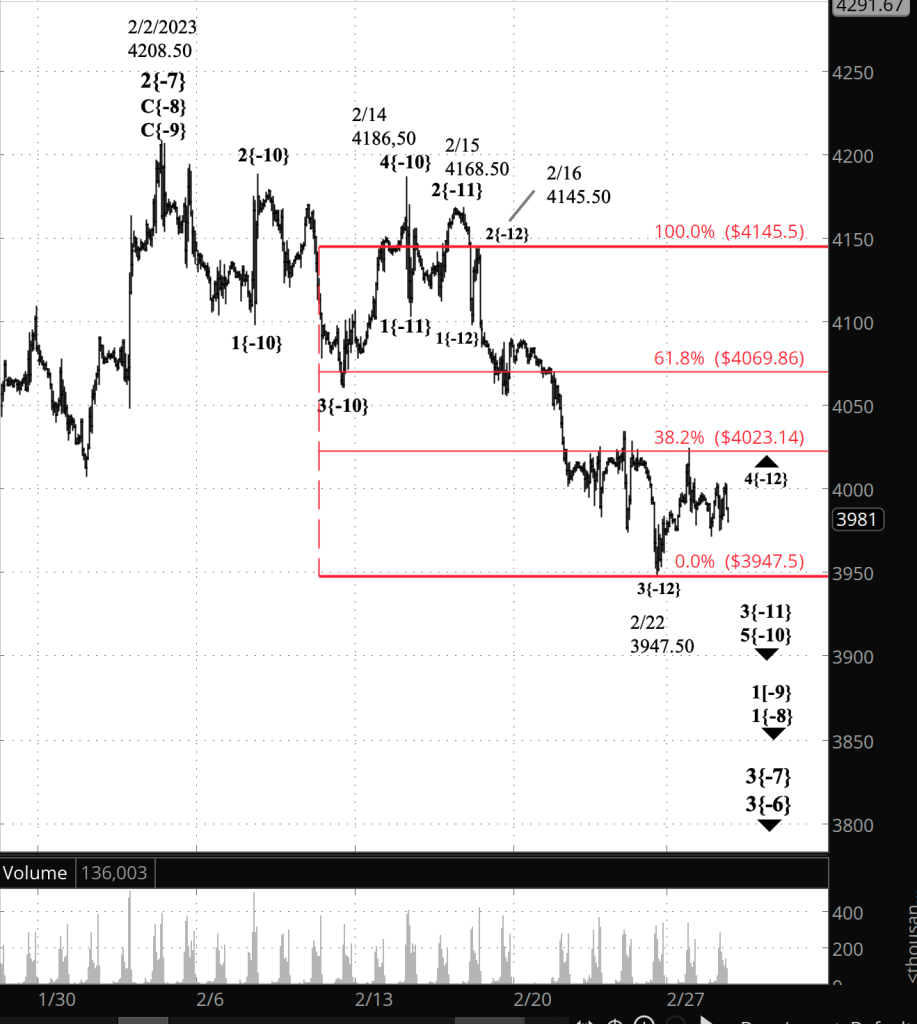
Half an hour before the closing bell. The S&P 500 futures reversed from the overnight low, 3925, and pushed higher, back into the 3980s. This means that the final segment of the upward correction that began on February 22 is now underway. Maybe. Traders have spent the last few days bottom fishing, but honestly, who really knows whether this is in fact the end of the declining middle segment and the rise of the final segment.

In Elliott wave terminology, the final segment, wave C{-13} is now underway. It is a subwave of wave 4{-12}, an upward correction within downtrending wave 3{-11}, which began on February 16.

I’ve updated the chart, changing the wave labels to show that wave C{-13} is in progress.

How how high can it go? The correction is a 4th wave, and a rule of Elliott wave analysis says that if a 4th wave moves beyond the end of the preceding 1st wave, at 4098.25 in this case, then it’s not really a 4th wave and the chart must be reanalyzed.

And conversely, if the price reverses and moves even lower than last night’s low, I’ll consider once again the alternative analysis, which sees the upward correction as having ended on February 27 and the downtrend having resumed.

9:55 a.m. New York time

DELL earnings play entry. I’ve opened a short bear call spread on DELL, using options that trade for the last time in 50 days, and have posted an analysis. of the trade.

9:35 a.m. New York time

What’s happening now? The S&P 500 E-mini futures declined further overnight but then rose enough to take almost all of it back in a classic resistance battle between bear and bull sentiments.

What does it mean? Elliott wave analysis suggests that bulls will win, although the result won’t be a true uptrend but rather will be the final leg of an upward correction that began on October 13, 2022. When the correction is complete, a true downtrend of significant size will begin.

What are the alternatives? Unchanged from the last few days. It’s possible that a downtrending subwave of the February 2 decline, one that began on February 14, ended at the February 22 low. If that proves to be the case, then the upward correction will be larger than the principal analysis expects. I think this scenario is less likely because the scale of its internal waves is small compared to the size of the parent wave. There’s a lack of proportion, which often means that there’s a more accurate analysis to be found.

Reading the chart. Elliott wave analysis views the chart as a complex structure of smaller waves nested within larger waves, which in turn are nested within still larger waves. My labeling system assigns numbers to the subwaves of trending waves, and letters to the subwaves of corrections. Each number or letter is followed by a subscript, in curly brackets, showing the waves position within the complex structure, called its “degree” in Elliott wave parlance. The smaller the number, the lower the degree. On this chart we’re dealing with relatively small waves, so the degree numbers are negative.

[S&P 500 E-mini futures at 3:30 p.m., hourly bars, with volume]

What does Elliott wave theory say? These are the waves that are guiding my analysis, unchanged from yesterday.

Principal analysis:

  • The downward correction that began on February 2, wave 3{-7}, continues.
  • It is in the first of five subwaves, wave 1{-8}.
  • Within wave 1{-8}, wave 1{-9} is underway and is in the final subwave within a five-wave structure, downtrending wave 5{-10}.
  • Wave 5{-10}, in turn, is in its middle wave, 3{-11}.
  • Wave 3{-11}’s middle wave, wave 3{-12}, ended on February 22, and the next-to-the-last wave, an upward correction, wave 4{-12}, is now underway.
  • Internally, wave 4{-12} is in its middle wave of three, B{-13}, which is at or near its end. It will be followed by rising wave C{-13} may well end that the 61.7% Fibonacci retracement level, 4069.86. However, under the rules of Elliott wave analysis, it cannot move above the end of wave 1{-12}, 4098.25. If it does, it will force a reanalysis.
  • The end of wave C{-13} will be the end of the correction, wave 4{-12}, which will be followed by wave 5{-12}, which will mark the end of wave 3{-11}, a subwave of downtrending wave 5{-10}.
  • The end of wave 5{-12} will also be the end of wave 3{-11}, a subwave of downtrending wave 5{-10}.
  • When wave 5{-10} is complete, it will also mark the end of wave 1{-9} and the beginning of a low-degree upward correction, wave 2{-9}.
  • Wave 3{-7} is still taking its tentative first steps and will develop into a powerful downtrend that will carry the price below 3502, the starting point of the preceding upward correction, wave 2{-7}, and most likely significantly below that level.

Alternative analysis:

The alternative makes these changes to the principal analysis.

  • The February 22 low is the end of wave 5{-12} and also the end of its parent wave, 3{-11}.
  • Wave 4{-11}, an upward correction, began on that date.

We Are Here.

These are the waves currently in progress under my principal analysis. Each line on the list shows the wave number, with the subscript in curly brackets, the traditional degree name, the starting date, the starting price of the S&P 500 E-mini futures, and the direction of the wave.

  • S&P 500 Index:
  • 5{+3} Supercycle, 7/8/1932, 4.40 (up)
  • 5{+2} Cycle, 12/9/1974, 60.96 (up)
  • 5{+1} Primary, 3/6/2009, 666.79 (up)
  • 5{0} Intermediate, 12/26/2018, 2346.58 (up)
  • S&P 500 Futures and index:
  • 4{-1} Minor, 1/4/2022, 4808.25 (down) (futures), 4818.62 (down) (index)
  • S&P 500 Futures:
  • 1{-2} Minute, 1/4/2022, 4808.25 (down)
  • 1{-3} Minuette, 1/4/2022, 4808.25 (down)
  • 1{-4} Subminuette, 1/4/2022, 4808.25 (down)
  • 1{-5} Micro, 1/4/2022, 4808.25 (down)
  • 3{-6} Submicro, 8/16/2022, 4327.50 (down)
  • 3{-7} Minuscule, 2/2/2023, 4208.50 (down)

Learning and other resources. Elliott wave analysis provides context, not prophecy. As the 20th century semanticist Alfred Korzybski put it in his book Science and Sanity (1933), “The map is not the territory … The only usefulness of a map depends on similarity of structure between the empirical world and the map.” And I would add, in the ever-changing markets, we can judge that similarity of structure only after the fact.

See the menu page Analytical Methods for a rundown on where to go for information on Elliott wave analysis.

By Tim Bovee, Portland, Oregon, March 2, 2023

Disclaimer

Tim Bovee, Private Trader tracks the analysis and trades of a private trader for his own accounts. Nothing in this blog constitutes a recommendation to buy or sell stocks, options or any other financial instrument. The only purpose of this blog is to provide education and entertainment.

No trader is ever 100 percent successful in his or her trades. Trading in the stock and option markets is risky and uncertain. Each trader must make trading decisions for his or her own account, and take responsibility for the consequences.

License
Creative Commons License

All content on Tim Bovee, Private Trader by Timothy K. Bovee is licensed under a Creative Commons Attribution-ShareAlike 4.0 International License.

Based on a work at www.timbovee.com.
Trader’s Notebook

3:30 p.m. New York time

Half an hour before the closing bell. The S&P 500 futures during the day edged slightly below the pre-session low, 3956, reaching a low so far of 3943. The present upward correction, wave 2{-7}, began at 3947.50 on February 22, and the session low fell below that mark.

This reversal puts the analysis in search of a low and reversal, a process called “bottom fishing” in trader jargon. It means that even though the analysis lines up perfectly for the present low to actually be the turning point, there’s always just slight of low left, enough to invalidate that earlier conclusion. I’ve changed the chart below to show the present low as being the end of the middle wave of the correction, wave B{-13}.

However, I find it important that I remember that there is possibly more bottom fishing ahead. I would expect the end of wave B{-13} to be much beyond the start of the wave 2{-7} correction.

With that one adjustment, this morning’s analysis stands unchanged.

9:55 a.m. New York time

RIVN earnings play exit. I’ve exited my short bear call verticval options spread on RIVN for 34.2% of maximum potential profit and have updated the trade analysis with full results.

9:35 a.m. New York time

What’s happening now? The S&P 500 E-mini futures reached a low of 3956 after the closing bell on Tuesday, rose during the wee hours of the morning to 3991 and then fell back, reaching into the 3960s.

What does it mean? The downtrend that began on February 15, a smaller part of a nested series of larger corrections, is in an upward correction. That correction internally is in its final leg. When the upward correction is complete, it will be followed by a decline, the final portion of the downtrend.

The key question now is how far the upward correction can go. The correction is the 4th segment of the downtrend, and a rule of Elliott wave analysis says that if a 4th wave moves beyond the end of the preceding 1st wave, 4098.25 in this case, then it’s not really a 4th wave and the chart must be reanalyzed. That sets an upper limit on the rise on this principal analysis.

There’s no guarantee that the correction will go that high. A common stopping point is a Fibonacci retracement level. The first leg of the correction touched the 38.2% Fibonacci level. The next Fib level higher, a 61.8% retracement, or 4969.86, would be a likely end point, although it’s a tendency, not a rule.

What are the alternatives? It’s possible that a downtrending subwave of the February 2 decline, one that began on February 14, ended at the February 22 low. If that proves to be the case, then the upward correction will be larger than the principal analysis expects.

Reading the chart. Under the labeling system, each wave — a directional price movement — has a designation — a number or letter — that shows its position within the larger structure that contains it. And each wave designation is followed by a subscript, in curly brackets, to indicate the wave’s place, its degree, within the complete fractal structure of the price movements. The subscript is needed because in Elliott wave analysis, waves form a fractal structure, with smaller waves serving as the building blocks of larger waves, which in turn are building blocks of still larger waves.

[S&P 500 E-mini futures at 3:30 p.m., hourly bars, with volume]

What does Elliott wave theory say? These are the waves that are guiding my analysis.

Principal analysis:

  • The downward correction that began on February 2, wave 3{-7}, continues.
  • It is in the first of five subwaves, wave 1{-8}.
  • Within wave 1{-8}, wave 1{-9} is underway and is in the final subwave within a five-wave structure, downtrending wave 5{-10}.
  • Wave 5{-10}, in turn, is in its middle wave, 3{-11}.
  • Wave 3{-11}’s middle wave, wave 3{-12}, ended on February 22, and the next-to-the-last wave, an upward correction, wave 4{-12}, is now underway.
  • Internally, wave 4{-12} is in its last wave of three, C{-13}. Wave C{-13} may well end that the 61.7% Fibonacci retracement level, 4069.86. However, under the rules of Elliott wave analysis, it cannot move above the end of wave 1{-12}, 4098.25. If it does, it will force a reanalysis.
  • The end of wave C{-13} will be the end of the correction, wave 4{-12}, which will be followed by wave 5{-12}, which will mark the end of wave 3{-11}, a subwave of downtrending wave 5{-10}.
  • The end of wave 5{-12} will also be the end of wave 3{-11}, a subwave of downtrending wave 5{-10}.
  • When wave 5{-10} is complete, it will also mark the end of wave 1{-9} and the beginning of a low-degree upward correction, wave 2{-9}.
  • Wave 3{-7} is still taking its tentative first steps and will develop into a powerful downtrend that will carry the price below 3502, the starting point of the preceding upward correction, wave 2{-7}, and most likely significantly below that level.

Alternative analysis:

The alternative makes these changes to the principal analysis.

  • The February 22 low is the end of wave 5{-12} and also the end of its parent wave, 3{-11}.
  • Wave 4{-11}, an upward correction, began on that date.

We Are Here.

These are the waves currently in progress under my principal analysis. Each line on the list shows the wave number, with the subscript in curly brackets, the traditional degree name, the starting date, the starting price of the S&P 500 E-mini futures, and the direction of the wave.

  • S&P 500 Index:
  • 5{+3} Supercycle, 7/8/1932, 4.40 (up)
  • 5{+2} Cycle, 12/9/1974, 60.96 (up)
  • 5{+1} Primary, 3/6/2009, 666.79 (up)
  • 5{0} Intermediate, 12/26/2018, 2346.58 (up)
  • S&P 500 Futures and index:
  • 4{-1} Minor, 1/4/2022, 4808.25 (down) (futures), 4818.62 (down) (index)
  • S&P 500 Futures:
  • 1{-2} Minute, 1/4/2022, 4808.25 (down)
  • 1{-3} Minuette, 1/4/2022, 4808.25 (down)
  • 1{-4} Subminuette, 1/4/2022, 4808.25 (down)
  • 1{-5} Micro, 1/4/2022, 4808.25 (down)
  • 3{-6} Submicro, 8/16/2022, 4327.50 (down)
  • 3{-7} Minuscule, 2/2/2023, 4208.50 (down)

Learning and other resources. Elliott wave analysis provides context, not prophecy. As the 20th century semanticist Alfred Korzybski put it in his book Science and Sanity (1933), “The map is not the territory … The only usefulness of a map depends on similarity of structure between the empirical world and the map.” And I would add, in the ever-changing markets, we can judge that similarity of structure only after the fact.

See the menu page Analytical Methods for a rundown on where to go for information on Elliott wave analysis.

By Tim Bovee, Portland, Oregon, March 1, 2023

Disclaimer

Tim Bovee, Private Trader tracks the analysis and trades of a private trader for his own accounts. Nothing in this blog constitutes a recommendation to buy or sell stocks, options or any other financial instrument. The only purpose of this blog is to provide education and entertainment.

No trader is ever 100 percent successful in his or her trades. Trading in the stock and option markets is risky and uncertain. Each trader must make trading decisions for his or her own account, and take responsibility for the consequences.

License
Creative Commons License

All content on Tim Bovee, Private Trader by Timothy K. Bovee is licensed under a Creative Commons Attribution-ShareAlike 4.0 International License.

Based on a work at www.timbovee.com.

RIVN Trade

Rivian Automotive Inc. (RIVN)

Update 3/1/2023: I exited my short bull put vertical spread on RIVN, 51 days before expiration, for a $0.52 debit per contract/share, a profit before fees of $27 per contract. Shares were trading at $17.80, down $1.20 from the entry level.

The Implied Volatility Rank at exit was 50.8%, up 9.6 points from the entry level.

I exited on the day after entry because the position reached 34.2% of maximum potential profit, well above my normal exit point for earnings plays of 25%

Shares fell by 6.3% over one day for a -2,305% annual rate. The options position produced a 51.9% return for a +18,952% annual rate.


I have entered a short bear call vertical spread on RIVN, using options that trade for the last time 52 days hence, on April 21. The premium is a $0.79 credit per contract share and the stock at the time of entry was priced at $19.00.

The Implied Volatility Ratio stood at 41.2%.

Premium:$0.79Expire OTM
RIVN-bear call spreadStrikeOddsDelta
Calls
Long22.5076.0%35
Break-even20.7969.5%42.5
Short20.0063.0%50

The premium is 63.2% of the width of the position’s short/long spread. The profit zone covers a 9.4% move to the upside and an unlimited move to the downside.

The risk/reward ratio is 2.2:1, with maximum risk of $171 and maximum reward of $79 per contract.

How I chose the trade. The trade was placed to coincide with RIVN’s earnings announcement after the closing bell on the day of entry. The short strikes were set with knowledge that stock’s very short term expected move is $2.18 either way, based on options pricing, which gives a price range of $16.82 to $21.18. The Zacks Investment Research earnings surprise predictor gave RIVN a score of -7.11%, with a rank of 3(hold). The analysts’ consensus is that RIVN will announce a loss of 1.89 per share.

By Tim Bovee, Portland, Oregon, February 28, 2023

Disclaimer

Tim Bovee, Private Trader tracks the analysis and trades of a private trader for his own accounts. Nothing in this blog constitutes a recommendation to buy or sell stocks, options or any other financial instrument. The only purpose of this blog is to provide education and entertainment.

No trader is ever 100 percent successful in his or her trades. Trading in the stock and option markets is risky and uncertain. Each trader must make trading decisions for his or her own account, and take responsibility for the consequences.

License
Creative Commons License

All content on Tim Bovee, Private Trader by Timothy K. Bovee is licensed under a Creative Commons Attribution-ShareAlike 4.0 International License.

Based on a work at www.timbovee.com.
Trader’s Notebook

3:30 p.m. New York time

Half an hour before the closing bell. The S&P 500 futures spent the session in a net sideways movement, fluctuating between the 3970s and a few points above 4000. The waves discussed in this morning’s analysis continue: A small upward correction, wave 4{-12}, within a much larger downtrend, wave 3{-7}. I’ve updated the chart.

1:20 p.m. New York time

RIVN earnings play entry. I’ve entered a bear call vertical spread on RIVN, using options that trade for the last time 52 days from now, and have posted an analysis of the trade.

9:35 a.m. New York time

What’s happening now? The S&P 500 E-mini futures fell overnight to 3972.25 and then reversed, reaching 4003.75 before reversing again, back to the 3970s so far.

What does it mean? The relatively small upward correction that began February 22 continues and is in the second of three internal segments. It is part of a downtrend that began on February 2. That larger downtrend will reach below 3502 and most likely significantly below that level.,

What are the alternatives? It’s possible that a downtrending subwave of the February 2 decline, one that began on February 14, ended at the February 22 low. If that proves to be the case, then the upward correction will be larger than the principal analysis expects.

Reading the chart. I’ve superimposed a Fibonacci retracement ladder on the chart, in read, making it easier to see when the price reaches the levels that are often reversal points. So far the price has reached, and reversed from, the 38.2% retracement level, the smallest of the major levels.

The labeling system on the chart that shows the Elliott wave analysis. It is complex, a necessity given the fractal nature of stock movements. Under the labeling system, each wave — a directional price movement — has a designation — a number or letter — that shows its position within the larger structure that contains it. And each wave designation is followed by a subscript, in curly brackets, to indicate the wave’s place, its degree, within the complete fractal structure of the price movements. 

[S&P 500 E-mini futures at 3:30 p.m., hourly bars, with volume]

What does Elliott wave theory say? These are the waves that are guiding my analysis.

Principal analysis:

  • The downward correction that began on February 2, wave 3{-7}, continues.
  • It is in the first of five subwaves, wave 1{-8}.
  • Within wave 1{-8}, wave 1{-9} is underway and is in the final subwave within a five-wave structure, downtrending wave 5{-10}.
  • Wave 5{-10}, in turn, is in its middle wave, 3{-11}.
  • Wave 3{-11}’s middle wave, wave 3{-12}, ended on February 22, and the next-to-the-last wave, an upward correction, wave 4{-12}, is now underway.
  • Internally, wave 4{-12} is in its middle wave of three waves, B{-13}, which reversed downward from the 38.2% Fibonacci retracement level.
  • Wave 4{-12} will be followed by wave 5{-12}, which will mark the end of wave 3{-11}, a subwave of downtrending wave 5{-10}.
  • When wave 5{-10} is complete, it will also mark the end of wave 1{-9} and the beginning of a low-degree upward correction, wave 2{-9}.
  • Wave 3{-7} is still taking its tentative first steps and will develop into a powerful downtrend that will carry the price below 3502, the starting point of the preceding upward correction, wave 2{-7}, and most likely significantly below that level.

Alternative analysis:

The alternative makes these changes to the principal analysis.

  • The February 22 low is the end of wave 5{-12} and also the end of its parent wave, 3{-11}.
  • Wave 4{-11}, an upward correction, began on that date.

We Are Here.

These are the waves currently in progress under my principal analysis. Each line on the list shows the wave number, with the subscript in curly brackets, the traditional degree name, the starting date, the starting price of the S&P 500 E-mini futures, and the direction of the wave.

  • S&P 500 Index:
  • 5{+3} Supercycle, 7/8/1932, 4.40 (up)
  • 5{+2} Cycle, 12/9/1974, 60.96 (up)
  • 5{+1} Primary, 3/6/2009, 666.79 (up)
  • 5{0} Intermediate, 12/26/2018, 2346.58 (up)
  • S&P 500 Futures and index:
  • 4{-1} Minor, 1/4/2022, 4808.25 (down) (futures), 4818.62 (down) (index)
  • S&P 500 Futures:
  • 1{-2} Minute, 1/4/2022, 4808.25 (down)
  • 1{-3} Minuette, 1/4/2022, 4808.25 (down)
  • 1{-4} Subminuette, 1/4/2022, 4808.25 (down)
  • 1{-5} Micro, 1/4/2022, 4808.25 (down)
  • 3{-6} Submicro, 8/16/2022, 4327.50 (down)
  • 3{-7} Minuscule, 2/2/2023, 4208.50 (down)

Learning and other resources. Elliott wave analysis provides context, not prophecy. As the 20th century semanticist Alfred Korzybski put it in his book Science and Sanity (1933), “The map is not the territory … The only usefulness of a map depends on similarity of structure between the empirical world and the map.” And I would add, in the ever-changing markets, we can judge that similarity of structure only after the fact.

See the menu page Analytical Methods for a rundown on where to go for information on Elliott wave analysis.

By Tim Bovee, Portland, Oregon, February 28, 2023

Disclaimer

Tim Bovee, Private Trader tracks the analysis and trades of a private trader for his own accounts. Nothing in this blog constitutes a recommendation to buy or sell stocks, options or any other financial instrument. The only purpose of this blog is to provide education and entertainment.

No trader is ever 100 percent successful in his or her trades. Trading in the stock and option markets is risky and uncertain. Each trader must make trading decisions for his or her own account, and take responsibility for the consequences.

License
Creative Commons License

All content on Tim Bovee, Private Trader by Timothy K. Bovee is licensed under a Creative Commons Attribution-ShareAlike 4.0 International License.

Based on a work at www.timbovee.com.
Trader’s Notebook

3:30 p.m. New York time

Half an hour before the closing bell. The S&P 500 futures rose during the session to 4024.75 and then pulled back into the 3980s. This morning’s analysis is unchanged. Wave 4{-12}, a low degree upward correction that began on February 22 continues. It is a subwave five degrees down from downtrending wave 2{-7}, which began on February 2. I’ve updated the chart.

9:35 a.m. New York time

What’s happening now? The S&P 500 E-mini futures rose gently in overnight trading and then sharply as the open bell approached, reaching into the 4010s, around 60 points above Friday’s low.

What does it mean? A low-level upward correction within a series of larger downtrends has begun. The downtrend that began on February 2 is still in its early phase and be expected to reach below the starting point 3502 of the rise that ended on February 2, and most likely significantly below that level.

What are the alternatives? It’s possible to count the decline that began on February 14 in a manner that has it ending on February 22. If that scenario turns out to best reflect the market, then then the upward correction that began on that date will be larger than expected under the principal analysis.

Chart notes. I’ve moved the chart back to a closer view to better understand the internal structure of the downtrend that began on February 2.

The labeling system on the chart that shows the Elliott wave analysis. It is complex, a necessity given the fractal nature of stock movements. Under the labeling system, each wave — a directional price movement — has a designation — a number or letter — that shows its position within the larger structure that contains it. And each wave designation is followed by a subscript, in curly brackets, to indicate the wave’s place, its degree, within the complete fractal structure of the price movements. 

[S&P 500 E-mini futures at 3:30 p.m., hourly bars, with volume]

What does Elliott wave theory say? These are the waves that are guiding my analysis.

Principal analysis:

  • The downward correction that began on February 2, wave 3{-7}, continues.
  • It is in the first of five subwaves, wave 1{-8}.
  • Within wave 1{-8}, wave 1{-9} is underway and is in the final subwave within a five-wave structure, downtrending wave 5{-10}.
  • Wave 5{-10}, in turn, is in its middle wave, 3{-11}.
  • Wave 3{-11}’s middle wave, wave 3{-12}, ended on February 22, and the next-to-the-last wave, an upward correction, wave 4{-12}, is now underway.
  • Wave 4{-12} will be followed by wave 5{-12}, which will mark the end of wave 3{-11}, a subwave of downtrending wave 5{-10}.
  • When wave 5{-10} is complete, it will also mark the end of wave 1{-9} and the beginning of a low-degree upward correction, wave 2{-9}.
  • Wave 3{-7} is still taking its tentative first steps and will develop into a powerful downtrend that will carry the price below 3502, the starting point of the preceding upward correction, wave 2{-7}, and most likely significantly below that level.

Alternative analysis:

The alternative makes these changes to the principal analysis.

  • The February 22 low is the end of wave 5{-12} and also the end of its parent wave, 3{-11}.
  • Wave 4{-11}, an upward correction, began on that date.

We Are Here.

These are the waves currently in progress under my principal analysis. Each line on the list shows the wave number, with the subscript in curly brackets, the traditional degree name, the starting date, the starting price of the S&P 500 E-mini futures, and the direction of the wave.

  • S&P 500 Index:
  • 5{+3} Supercycle, 7/8/1932, 4.40 (up)
  • 5{+2} Cycle, 12/9/1974, 60.96 (up)
  • 5{+1} Primary, 3/6/2009, 666.79 (up)
  • 5{0} Intermediate, 12/26/2018, 2346.58 (up)
  • S&P 500 Futures and index:
  • 4{-1} Minor, 1/4/2022, 4808.25 (down) (futures), 4818.62 (down) (index)
  • S&P 500 Futures:
  • 1{-2} Minute, 1/4/2022, 4808.25 (down)
  • 1{-3} Minuette, 1/4/2022, 4808.25 (down)
  • 1{-4} Subminuette, 1/4/2022, 4808.25 (down)
  • 1{-5} Micro, 1/4/2022, 4808.25 (down)
  • 3{-6} Submicro, 8/16/2022, 4327.50 (down)
  • 3{-7} Minuscule, 2/2/2023, 4208.50 (down)

Learning and other resources. Elliott wave analysis provides context, not prophecy. As the 20th century semanticist Alfred Korzybski put it in his book Science and Sanity (1933), “The map is not the territory … The only usefulness of a map depends on similarity of structure between the empirical world and the map.” And I would add, in the ever-changing markets, we can judge that similarity of structure only after the fact.

See the menu page Analytical Methods for a rundown on where to go for information on Elliott wave analysis.

By Tim Bovee, Portland, Oregon, February 27, 2023

Disclaimer

Tim Bovee, Private Trader tracks the analysis and trades of a private trader for his own accounts. Nothing in this blog constitutes a recommendation to buy or sell stocks, options or any other financial instrument. The only purpose of this blog is to provide education and entertainment.

No trader is ever 100 percent successful in his or her trades. Trading in the stock and option markets is risky and uncertain. Each trader must make trading decisions for his or her own account, and take responsibility for the consequences.

License
Creative Commons License

All content on Tim Bovee, Private Trader by Timothy K. Bovee is licensed under a Creative Commons Attribution-ShareAlike 4.0 International License.

Based on a work at www.timbovee.com.
Trader’s Notebook

3:30 p.m. New York time

Half an hour before the closing bell. The S&P 500 futures rose during the session back into the 3980s, taking a form that implied a low-degree upward correction within a larger downward movement (3 waves, A-C, with this subwave pattern: A:3, B:3, C:5. This morning’s analysis is unchanged. I’ve updated the upper chart.

9:35 a.m. New York time

What’s happening now? The S&P 500 E-mini futures had a downward slope in overnight trading until the inflation metric from the GDP was released. Inflation rose. The S&P 500 futures fell, by 25 points in 15 minutes, into the 3960s.

What does it mean? In a large downtrend, all news is bad news, and the present downtrend, which began on February 2, is no exception. The downtrend is still in its early stage and will eventually carry the price below 3502, most likely significantly below that level. The downtrend begun this month is a building block within a nested series of downtrends of increasing size, stretching back to the downtrend that began on January 4, 2022, from 4808.25.

What is the alternative? The downtrend so far has retraced 35% of the rising correction that preceded it. It has some distance to go before reacing the correction’s starting point at 3502 on October 13, 2022.

Nonetheless, one alternative is that the upward correction is still underway and the present downward movement is a subcomponent of that correction. The price the goes, the less likely this scenario becomes. Nonetheless, it’s a possible interpretation that doesn’t break any of the rules of Elliott wave analysis. A decline below 3502 would take this scenario off the table.

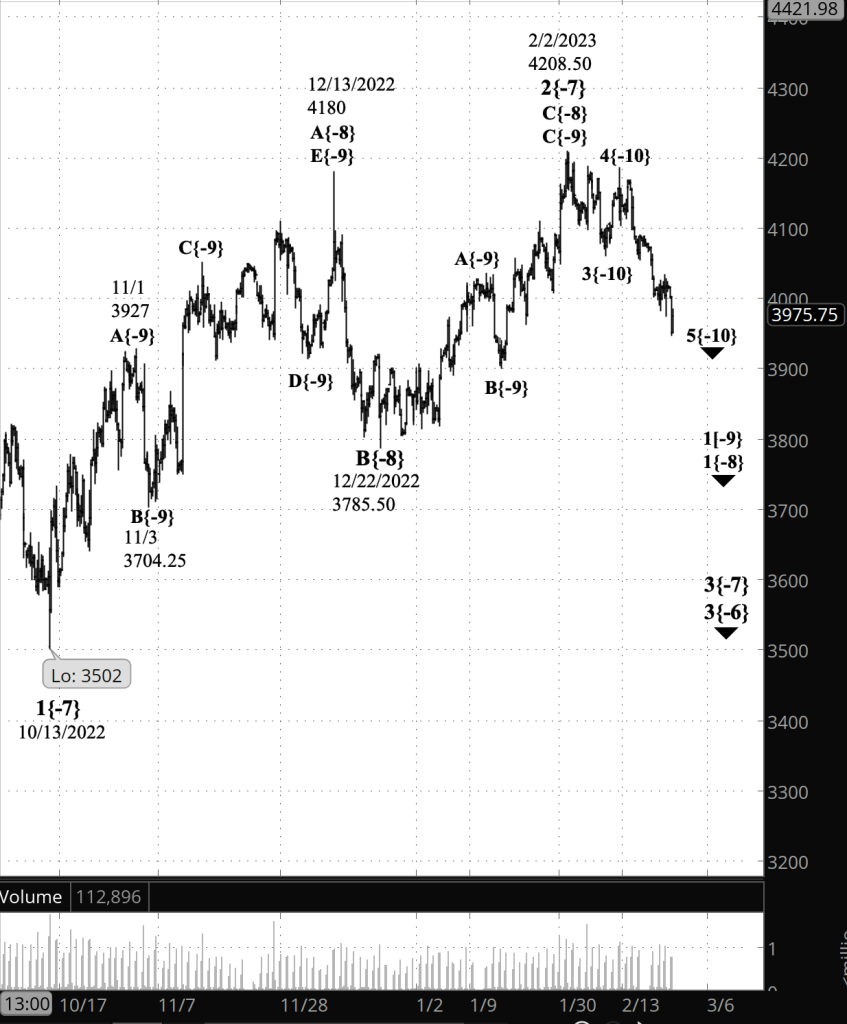
Chart note. I’ve moved the chart out for a broader view, showing the upward correction that began on October 13, 2022 and the downtrened that began last February 2. The chart vividly illustrates just how much downward potential there is. I’ve posted a second even longer-term chart in the Elliott wave theory section, below.

A note on the complex labeling system on the chart that shows the Elliott wave analysis, a necessity given the fractal nature of stock movements. Under the labeling system, each wave — a directional price movement — has a designation — a number or letter — that shows its position within the larger structure that contains it. And each wave designation is followed by a subscript, in curly brackets, to indicate the wave’s place, its degree, within the complete fractal structure of the price movements. 

[S&P 500 E-mini futures at 9:35 a.m., 5-hour bars, with volume]

What does Elliott wave theory say? Here are the key waves that inform my analyses.

Principal analysis:

  • The downward correction that began on February 2, wave 3{-7}, continues.
  • It is working through the first of five subwaves, wave 1{-8}.
  • Within wave 1{-8}, wave 1{-9} is underway and is in the final subwave within a five-wave structure, downtrending wave 5{-10}.
  • Wave 3{-7} is still taking its tentative first steps and will develop into a powerful downtrend that will carry the price below 3502, the starting point of the preceding upward correction, wave 2{-7}, and most likely significantly below that level.
  • The preceding wave, an upward correction, is wave 2{-7}, which began on October 13, 2022 and ended on February 2.

Alternative analysis;

  • The upward correction that began on October 13, 2022, wave 2{-7}, is still underway.
  • It is in the third of three parts, upward wave C{-8}.
  • C{-8} in turn is in its third and final subwave, rising wave C{-9}.
  • Wave 3{-7} will follow, a powerful downtrend that will carry the price below the starting point of the correction, 3502, and most likely significantly below that level.

Confirmation signals.

The principal analysis will be confirmed if the present decline, wave 3{-7} and its subwaves move below 3502.

Alternative analysis #1 will be confirmed if the price reverses and moves above 4208.50.

Bigger structures:

  • This is all happening within wave 3{-6}, which began on August 16, 2022.
  • Wave 3{-6} is encompassed by a series of larger waves, the smaller within the larger, stretching up five degrees to wave 4{-1}, which began on January 4, 2022.
  • Wave 4{-1} is the next-to-the-last wave within a large expanding Diagonal Triangle, wave 5{0}, that began on December 26, 2018

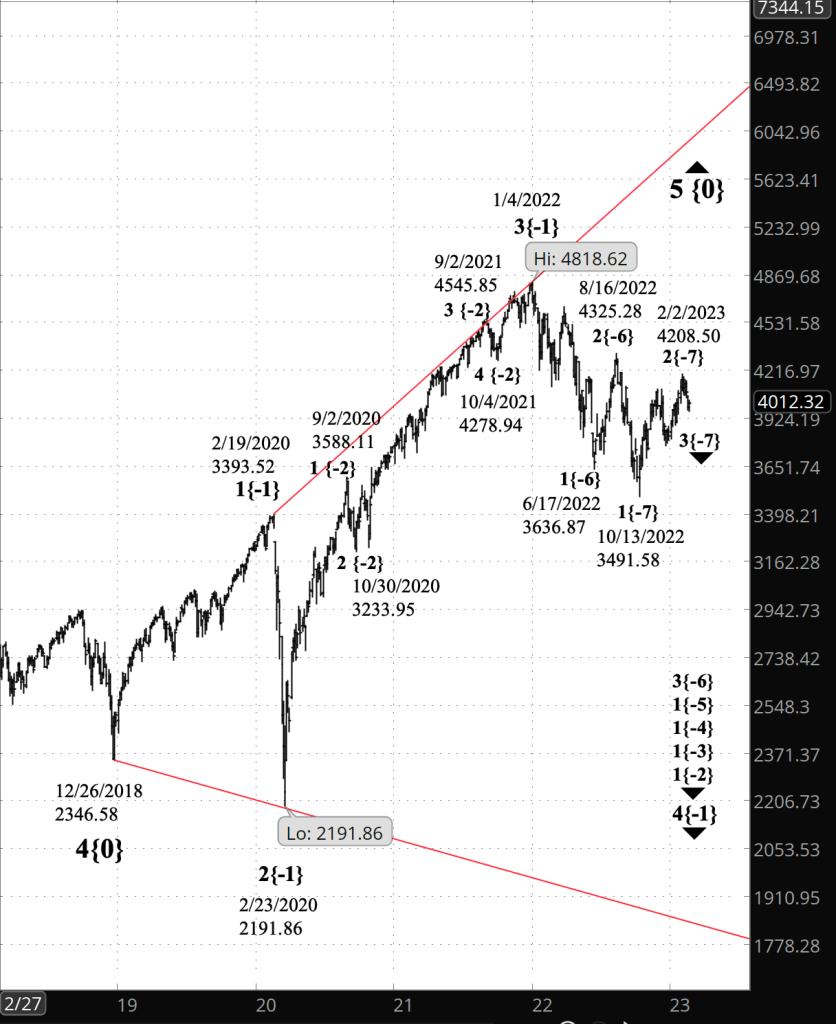
The chart below covers the S&P 500 index from late 2018, the starting point of the expanding Diagonal Triangle now underway, to the present. The red lines are price channels, showing the boundaries of the Triangle as defined by the beginning and end points of the internal waves. The crash early in the pandemic is wave 2{-1} on the chart. The rise to January 4, 2022 labeled wave 3{-1}, and the present downtrend, as wave 4[-1}. The present downtrend potentially could carry the price down to the lower boundary of the price channel, which is presently in the 1840s and falling further each day.

[S&P 500 index at 9:25 a.m., 3-day bars, with volume]

We Are Here.

These are the waves currently in progress under my principal analysis. Each line on the list shows the wave number, with the subscript in curly brackets, the traditional degree name, the starting date, the starting price of the S&P 500 E-mini futures, and the direction of the wave.

  • S&P 500 Index:
  • 5{+3} Supercycle, 7/8/1932, 4.40 (up)
  • 5{+2} Cycle, 12/9/1974, 60.96 (up)
  • 5{+1} Primary, 3/6/2009, 666.79 (up)
  • 5{0} Intermediate, 12/26/2018, 2346.58 (up)
  • S&P 500 Futures and index:
  • 4{-1} Minor, 1/4/2022, 4808.25 (down) (futures), 4818.62 (down) (index)
  • S&P 500 Futures:
  • 1{-2} Minute, 1/4/2022, 4808.25 (down)
  • 1{-3} Minuette, 1/4/2022, 4808.25 (down)
  • 1{-4} Subminuette, 1/4/2022, 4808.25 (down)
  • 1{-5} Micro, 1/4/2022, 4808.25 (down)
  • 3{-6} Submicro, 8/16/2022, 4327.50 (down)
  • 3{-7} Minuscule, 2/2/2023, 4208.50 (down)

Learning and other resources. Elliott wave analysis provides context, not prophecy. As the 20th century semanticist Alfred Korzybski put it in his book Science and Sanity (1933), “The map is not the territory … The only usefulness of a map depends on similarity of structure between the empirical world and the map.” And I would add, in the ever-changing markets, we can judge that similarity of structure only after the fact.

See the menu page Analytical Methods for a rundown on where to go for information on Elliott wave analysis.

By Tim Bovee, Portland, Oregon, February 24, 2023

Disclaimer

Tim Bovee, Private Trader tracks the analysis and trades of a private trader for his own accounts. Nothing in this blog constitutes a recommendation to buy or sell stocks, options or any other financial instrument. The only purpose of this blog is to provide education and entertainment.

No trader is ever 100 percent successful in his or her trades. Trading in the stock and option markets is risky and uncertain. Each trader must make trading decisions for his or her own account, and take responsibility for the consequences.

License
Creative Commons License

All content on Tim Bovee, Private Trader by Timothy K. Bovee is licensed under a Creative Commons Attribution-ShareAlike 4.0 International License.

Based on a work at www.timbovee.com.

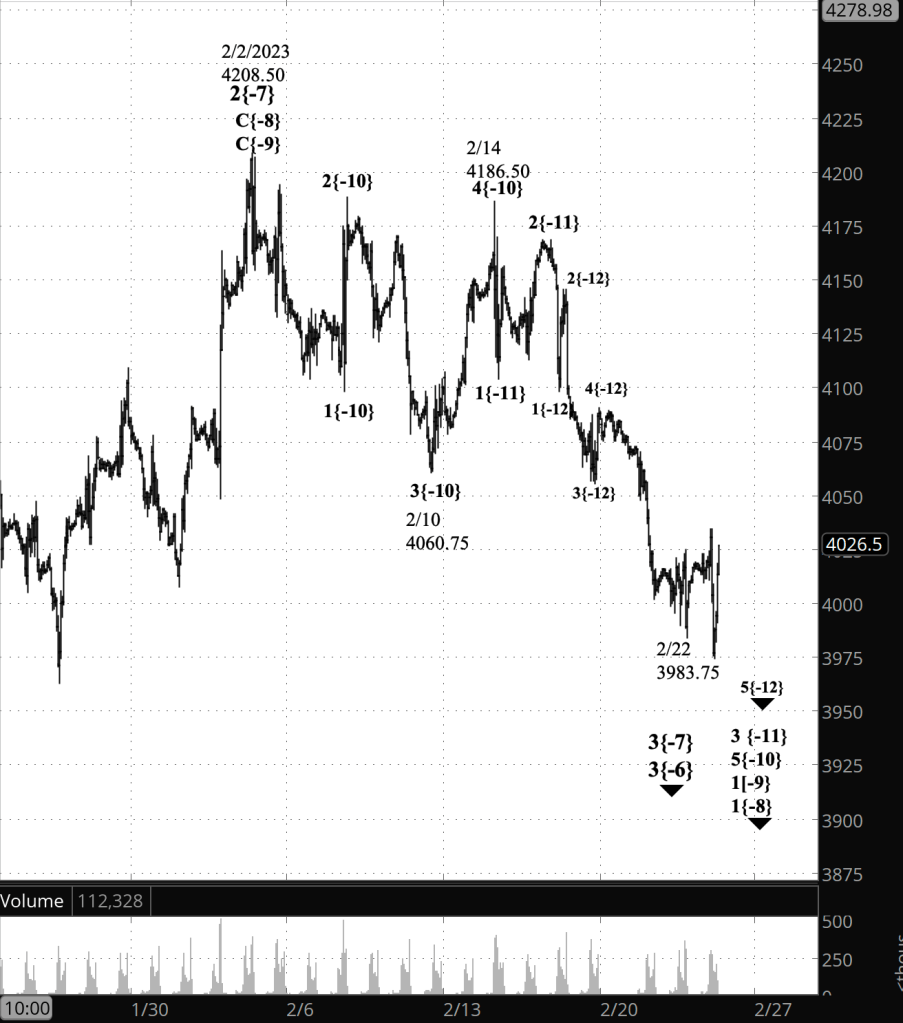
Trader’s Notebook

3:30 p.m. New York time

Half an hour before the closing bell. The S&P 500 futures fell to 3974.25 in mid-session and then rose back into the 4020s. The low point was below yesterday’s session low, 3893.55, confirming that a small subwave, {5-12}, of the 3-week-old larger downtrend, wave 5{-7}, is still underway. When 5{-12} is complete, it will also be the completion of wave 3{-11}, a downtrend that began on February 16.

This are all small-degree movements whose value lies in their indicating when a larger upward correction might begin. Waves 1{-8} and 1{-9} have been downtrending since February 2, and their termination, when wave 5{-10} comes to an end, will be the start of an upward correction that could carry the price up into the high 4100s. Aside from that early warning function, the smaller degrees are just the daily dance of the market, full of sound and fury, signifying nothing.

I’ve updated the chart.

9:35 a.m. New York time

What’s happening now? The S&P 500 E-mini futures rose overnight, reaching 4030.

What does it mean? The downtrend that began on February 2 continues and is in its initial decline, which, when complete, will be followed by an upward correction.

What are the alternatives? There are two, unchanged from yesterday:

Alternative #1: It remains possible that the present movement is a subwave of the upward correction that began on October 13, which, under this scenario, is still not complete. A reversal and rise above 4208.50 would confirm thiws analysis.

Alternative #2: Early in a directional movement, determining the place of a subwave in the fractal hierarchy of waves — smaller waves within larger waves that in turn are the subwaves of still larger waves — is at best an experienced guess, at worse a throw of the dice. All of the subwaves I’ve labeled on the chart cold be one or two degrees higher, or one degree lower. There’s no way to know for sure. This doesn’t effect the analysis; however, it can speed things up or slow them down.

Chart note. Also unchanged from yesterday.

The fractal nature of stock movements requires a complex labeling system. The chart mark-up, showing the Elliott wave analysis, works like this: Each wave has a designation — a number or letter — that shows its position within the larger structure that contains it. And each wave designation is followed by a subscript, in curly brackets, to indicate the wave’s place, its degree, within the complete fractal structure of the price movements. 

[S&P 500 E-mini futures at 3:30 p.m., hourly bars, with volume]

What does Elliott wave theory say?

Here are the waves that my analyses are based on.

Principal analysis:

  • The downward correction that began on February 2, wave 3{-7}, continues.
  • It is in the first of five subwaves, wave 1{-8}.
  • Within wave 1{-8}, wave 1{-9} is underway and is in the final subwave within a five-wave structure, downtrending wave 5{-10}.
  • Wave 5{-10}, in turn, is in its middle wave, 3{-11}, which is in its final wave, 5{-12}.
  • The nature of the low-degree rise that began on February 22 is uncertain. It is either a subwave of an ongoing downtrend, wave 5{-12}, or wave 5{-12} ended at the February 22 low, 3983.75, also ending the parent wave 3 {-11}. If wave 3{-11} has ended, then an upward correction, wave 4{-11}, is now underway.
  • When wave 5{-10} is complete, it will also mark the end of wave 1{-9} and the beginning of a low-degree upward correction, wave 2{-9}.
  • Wave 3{-7} is still taking its tentative first steps and will develop into a powerful downtrend that will carry the price below 3502, the starting point of the preceding upward correction, wave 2{-7}, and most likely significantly below that level.

Alternative analysis #1:

  • The upward correction that began on October 13, 2022, wave 2{-7}, is still underway.
  • It is in the third of three parts, upward wave C{-8}.
  • C{-8} in turn is in its third and final subwave, rising wave C{-9}.
  • Wave C{-9} has five subwaves and is in the fourth, declining wave D{-10}.
  • Wave D{10} will be followed by rising wave E{-10},
  • A wave in wave E{-10}’s position normally will exceed the endpoint of the prior upward wave, 4208.50, which is wave C{-10}. That peak was attained on February 2.
  • The end of the wave E{-10} will also be the end of waves C{-9}, C{-8} and of the upward correction, wave 2{-7}.
  • Wave 3{-7} will follow, a powerful downtrend that will carry the price below the starting point of the correction, 3502, and most likely significantly below that level.

Alternative analysis #2:

The degrees of the waves my analysis have a degree (no pun intended) of uncertainty. What I’ve labeled as wave 1{-8} could in fact be wave 1{-9}, with another wave 1{-8} inserted in between and pushing everything smaller down a degree. Or the wave 1{-9} on my chart could in fact be 1{-8}, raising everything up by a degee.

Confirmation signals.

The principal analysis will be confirmed if the present decline, wave 3{-7} and its subwaves move below 3502.

Alternative analysis #1 will be confirmed if the present decline, wave D{-10}, moves above 4208.50.

Situations such as those described in alternative analysis #2 are generally confirmed by a price movement that breaks the Elliott wave analysis rules somehow. Since the chart is always right, this means performing a new analysis that almost always results in changes in the degree of each wave.

Bigger structures:

  • This is all happening within wave 3{-6}, which began on August 16, 2022.
  • Wave 3{-6} is encompassed by a series of larger waves, the smaller within the larger, stretching up five degrees to wave 4{-1}, which began on January 4, 2022.
  • Wave 4{-1} is the next-to-the-last wave within a large expanding Diagonal Triangle, wave 5{0}, that began on December 26, 2018

We Are Here.

These are the waves currently in progress under my principal analysis. Each line on the list shows the wave number, with the subscript in curly brackets, the traditional degree name, the starting date, the starting price of the S&P 500 E-mini futures, and the direction of the wave.

  • S&P 500 Index:
  • 5{+3} Supercycle, 7/8/1932, 4.40 (up)
  • 5{+2} Cycle, 12/9/1974, 60.96 (up)
  • 5{+1} Primary, 3/6/2009, 666.79 (up)
  • 5{0} Intermediate, 12/26/2018, 2346.58 (up)
  • S&P 500 Futures and index:
  • 4{-1} Minor, 1/4/2022, 4808.25 (down) (futures), 4818.62 (down) (index)
  • S&P 500 Futures:
  • 1{-2} Minute, 1/4/2022, 4808.25 (down)
  • 1{-3} Minuette, 1/4/2022, 4808.25 (down)
  • 1{-4} Subminuette, 1/4/2022, 4808.25 (down)
  • 1{-5} Micro, 1/4/2022, 4808.25 (down)
  • 3{-6} Submicro, 8/16/2022, 4327.50 (down)
  • 3{-7} Minuscule, 2/2/2023, 4208.50 (down)

Learning and other resources. Elliott wave analysis provides context, not prophecy. As the 20th century semanticist Alfred Korzybski put it in his book Science and Sanity (1933), “The map is not the territory … The only usefulness of a map depends on similarity of structure between the empirical world and the map.” And I would add, in the ever-changing markets, we can judge that similarity of structure only after the fact.

See the menu page Analytical Methods for a rundown on where to go for information on Elliott wave analysis.

By Tim Bovee, Portland, Oregon, February 23, 2023

Disclaimer

Tim Bovee, Private Trader tracks the analysis and trades of a private trader for his own accounts. Nothing in this blog constitutes a recommendation to buy or sell stocks, options or any other financial instrument. The only purpose of this blog is to provide education and entertainment.

No trader is ever 100 percent successful in his or her trades. Trading in the stock and option markets is risky and uncertain. Each trader must make trading decisions for his or her own account, and take responsibility for the consequences.

License
Creative Commons License

All content on Tim Bovee, Private Trader by Timothy K. Bovee is licensed under a Creative Commons Attribution-ShareAlike 4.0 International License.

Based on a work at www.timbovee.com.

NVDA Trade

NVIDIA Corp. (NVDA)

Update 3/6/2023: I exited my short bull put vertical spread on March 6, 11 days before expiration, for a $4.70 debit per contract/share, a loss before fees of $240 per contract. Shares were trading at $239.97, up $30.93 from the entry level.

The Implied Volatility Rank at exit was 17.7%, down 20.2 points from the entry level.

I exited 12 days after entry because the price moved contrary to the direction of the trade. The timing of the exit was dictated by the shares scheduled to go ex-dividend the next day. Had I held the position, the short calls would almost certainly have been assigned, and I would have had to pay the dividend to the anonymous owner.

Despite the forced exit, I got out for $30 less than the maximum risk.

Shares rose by 14.8% over 12 day2 for a +450% annual rate. The options position produced a 51.1% loss for a -1,553% annual rate.


I have entered a short bear call vertical spread on NVDA, using options that trade for the last time 23 days hence, on March 17. The premium is a $2.30 credit per contract share and the stock at the time of entry was priced at $209.04.

The Implied Volatility Ratio stood at 37.9%.

Premium:$2.30Expire OTM
NVDA-bear call spreadStrikeOddsDelta
Calls
Long215.0060.0%45
Break-even212.3057.0%48.5
Short210.0054.0%52

The premium is 92% of the width of the position’s short/long spread. The profit zone covers a 1.6% move to the upsideand an unlimited move to the downside.

The risk/reward ratio is 1.2:1, with maximum risk of $270 and maximum reward of $230 per contract.

The trade was placed to coincide with NVDA’s earnings announcement after the closing bell on the day of entry.

By Tim Bovee, Portland, Oregon, February 22, 2023

Disclaimer

Tim Bovee, Private Trader tracks the analysis and trades of a private trader for his own accounts. Nothing in this blog constitutes a recommendation to buy or sell stocks, options or any other financial instrument. The only purpose of this blog is to provide education and entertainment.

No trader is ever 100 percent successful in his or her trades. Trading in the stock and option markets is risky and uncertain. Each trader must make trading decisions for his or her own account, and take responsibility for the consequences.

License
Creative Commons License

All content on Tim Bovee, Private Trader by Timothy K. Bovee is licensed under a Creative Commons Attribution-ShareAlike 4.0 International License.

Based on a work at www.timbovee.com.