Trader’s Notebook

3:30 p.m. New York time

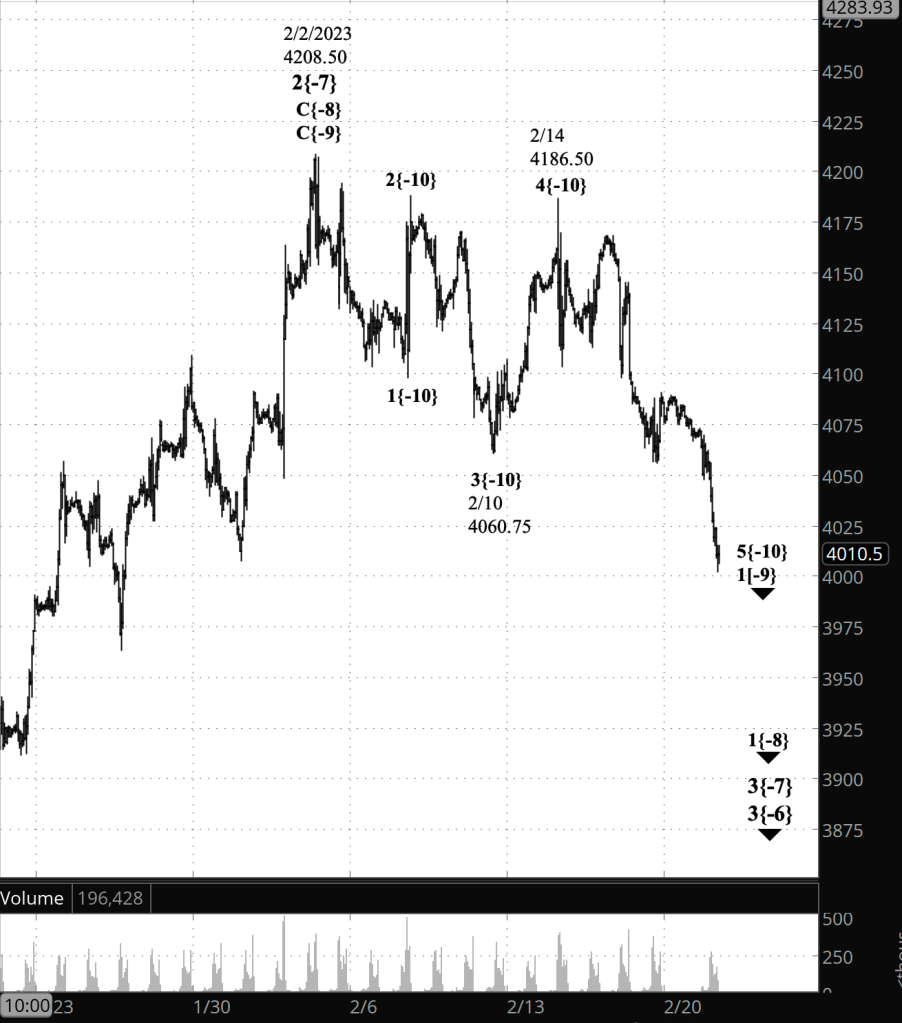
Half an hour before the closing bell. The S&P 500 futures continued to fall during the session, reaching a low so far of 3986.25. This morning’s analysis is unchanged. I’ve updated the chart.

3:15 p.m. New York time

COIN earnings play exit. I’ve exited my short bear fall vertical options spread for 24% of maximum potential profit and have updated the trade analysis with full results.

1:15 p.m. New York time

NVDA earnings play entry. I’ve entered a bear call vertical spread on NVDA, timed to coincide with the company’s earnings announcement, using options that trade for the last time on March 17, and have posted an analysis of the trade.

9:35 a.m. New York time

What’s happening now? The S&P 500 E-mini futures traded narrowly overnight, near the session close, 4007.75, before breaking free from the range in the early morning hours, falling to 3995.50, and then bouncing up into the 4020s.

What does it mean? The downtrend that began on February 2 is in its first leg and still has some distance to go before that initial wave, the first of five, is complete. Working our way down the chain of subwaves, two levels smaller are also in their initial wave, the third level down is in its final wave, the fourth level in its middle wave and the fifth level lower is in its final wave.

Moving back up to the largest wave within the downtrend: When it is complete, it will be followed by an upward correction that will take back a significant portion of the decline since February 2 while remaining below that date’s peak, 4208.50. The downtrend ultimately will move below 3502, the end point of the preceding upward correction, and almost certainly signifiantly below that level.

What are the alternatives? There are two:

Alternative #1: It remains possible that the present movement is a subwave of the upward correction that began on October 13, which, under this scenario, is still not complete. A reversal and rise above 4208.50 would confirm thiws analysis.

Alternative #2: Early in a directional movement, determining the place of a subwave in the fractal hierarchy of waves — smaller waves within larger waves that in turn are the subwaves of still larger waves — is at best an experienced guess, at worse a throw of the dice. All of the subwaves I’ve labeled on the chart cold be one or two degrees higher, or one degree lower. There’s no way to know for sure. This doesn’t effect the analysis; however, it can speed things up or slow them down.

Chart note. The fractal nature of stock movements requires a complex labeling system. The chart mark-up, showing the Elliott wave analysis, works like this: Each wave has a designation — a number or letter — that shows its position within the larger structure that contains it. And each wave designation is followed by a subscript, in curly brackets, to indicate the wave’s place, its degree, within the complete fractal structure of the price movements. 

[S&P 500 E-mini futures at 3:30 p.m., hourly bars, with volume]

What does Elliott wave theory say? Here are the waves that my analyses are based on.

Principal analysis:

  • The downward correction that began on February 2, wave 3{-7}, continues.
  • It is in the first of five subwaves, wave 1{-8}.
  • Within wave 1{-8}, wave 1{-9} is underway and is in the final subwave within a five-wave structure, downtrending wave 5{-10}.
  • Wave 5{-10}, in turn, is in its middle wave, 3{-11}, which is in its final wave, 5{-12}.
  • When wave 5{-10} is complete, it will also mark the end of wave 1{-9} and the beginning of a low-degree upward correction, wave 2{-9}.
  • Wave 3{-7} is still taking its tentative first steps and will develop into a powerful downtrend that will carry the price below 3502, the starting point of the preceding upward correction, wave 2{-7}, and most likely significantly below that level.

Alternative analysis #1:

  • The upward correction that began on October 13, 2022, wave 2{-7}, is still underway.
  • It is in the third of three parts, upward wave C{-8}.
  • C{-8} in turn is in its third and final subwave, rising wave C{-9}.
  • Wave C{-9} has five subwaves and is in the fourth, declining wave D{-10}.
  • Wave D{10} will be followed by rising wave E{-10},
  • A wave in wave E{-10}’s position normally will exceed the endpoint of the prior upward wave, 4208.50, which is wave C{-10}. That peak was attained on February 2.
  • The end of the wave E{-10} will also be the end of waves C{-9}, C{-8} and of the upward correction, wave 2{-7}.
  • Wave 3{-7} will follow, a powerful downtrend that will carry the price below the starting point of the correction, 3502, and most likely significantly below that level.

Alternative analysis #2:

The degrees of the waves my analysis have a degree (no pun intended) of uncertainty. What I’ve labeled as wave 1{-8} could in fact be wave 1{-9}, with another wave 1{-8} inserted in between and pushing everything smaller down a degree. Or the wave 1{-9} on my chart could in fact be 1{-8}, raising everything up by a degee.

Confirmation signals.

The principal analysis will be confirmed if the present decline, wave 3{-7} and its subwaves move below 3502.

Alternative analysis #1 will be confirmed if the present decline, wave D{-10}, moves above 4208.50.

Situations such as those described in alternative analysis #2 are generally confirmed by a price movement that breaks the Elliott wave analysis rules somehow. Since the chart is always right, this means performing a new analysis that almost always results in changes in the degree of each wave.

Bigger structures:

  • This is all happening within wave 3{-6}, which began on August 16, 2022.
  • Wave 3{-6} is encompassed by a series of larger waves, the smaller within the larger, stretching up five degrees to wave 4{-1}, which began on January 4, 2022.
  • Wave 4{-1} is the next-to-the-last wave within a large expanding Diagonal Triangle, wave 5{0}, that began on December 26, 2018

We Are Here.

These are the waves currently in progress under my principal analysis. Each line on the list shows the wave number, with the subscript in curly brackets, the traditional degree name, the starting date, the starting price of the S&P 500 E-mini futures, and the direction of the wave.

  • S&P 500 Index:
  • 5{+3} Supercycle, 7/8/1932, 4.40 (up)
  • 5{+2} Cycle, 12/9/1974, 60.96 (up)
  • 5{+1} Primary, 3/6/2009, 666.79 (up)
  • 5{0} Intermediate, 12/26/2018, 2346.58 (up)
  • S&P 500 Futures and index:
  • 4{-1} Minor, 1/4/2022, 4808.25 (down) (futures), 4818.62 (down) (index)
  • S&P 500 Futures:
  • 1{-2} Minute, 1/4/2022, 4808.25 (down)
  • 1{-3} Minuette, 1/4/2022, 4808.25 (down)
  • 1{-4} Subminuette, 1/4/2022, 4808.25 (down)
  • 1{-5} Micro, 1/4/2022, 4808.25 (down)
  • 3{-6} Submicro, 8/16/2022, 4327.50 (down)
  • 3{-7} Minuscule, 2/2/2023, 4208.50 (down)

Learning and other resources. Elliott wave analysis provides context, not prophecy. As the 20th century semanticist Alfred Korzybski put it in his book Science and Sanity (1933), “The map is not the territory … The only usefulness of a map depends on similarity of structure between the empirical world and the map.” And I would add, in the ever-changing markets, we can judge that similarity of structure only after the fact.

See the menu page Analytical Methods for a rundown on where to go for information on Elliott wave analysis.

By Tim Bovee, Portland, Oregon, February 22, 2023

Disclaimer

Tim Bovee, Private Trader tracks the analysis and trades of a private trader for his own accounts. Nothing in this blog constitutes a recommendation to buy or sell stocks, options or any other financial instrument. The only purpose of this blog is to provide education and entertainment.

No trader is ever 100 percent successful in his or her trades. Trading in the stock and option markets is risky and uncertain. Each trader must make trading decisions for his or her own account, and take responsibility for the consequences.

License
Creative Commons License

All content on Tim Bovee, Private Trader by Timothy K. Bovee is licensed under a Creative Commons Attribution-ShareAlike 4.0 International License.

Based on a work at www.timbovee.com.
COIN Trade

Coinbase Global Inc. (COIN)

Update 2/22/2023: I exited my short bull put vertical spread on COIN, one day before expiration, for a $0.92 debit per contract/share, a profit before fees of $29 per contract. Shares were trading at $59.07, down $3.71 from the entry level.

The Implied Volatility Rank at exit was 39.7%, down 19.2 points from the entry level.

I exited on the day after entry because the position reached 24% of maximum potential profit, just below my normal exit point for earnings plays, 25%.

Shares fell by 5.9% over one day for a -2,157% annual rate. The options position produced a 31.5% return for a +11,505% annual rate.


I have entered a short bear call vertical spread on COIN, using options that trade for the last time 24 days hence, on March 17. The premium is a $1.21 credit per contract share and the stock at the time of entry was priced at $62.78.

The Implied Volatility Ratio stood at 58.9%.

Premium:$1.21Expire OTM
COIN-bear call spreadStrikeOddsDelta
Calls
Long66.0062.0%51
Break-even64.21
Short63.0057.0%56

The premium is 80.7% of the width of the position’s short/long spread. The profit zone covers a 2.3% move to the upside and an unlimited move to the downside.

The risk/reward ratio is 1.5:1, with maximum risk of $179 and maximum reward of $121 per contract.

How I chose the trade. The trade was placed to coincide with COIN’s earnings announcement, after the closing bell on the day of entry. The short strikes were set to coincide with the expected move of $10.93 either way, based on options pricing, which gives a price range of $52.94 to $72.62.

By Tim Bovee, Portland, Oregon, February 21, 2023

Disclaimer

Tim Bovee, Private Trader tracks the analysis and trades of a private trader for his own accounts. Nothing in this blog constitutes a recommendation to buy or sell stocks, options or any other financial instrument. The only purpose of this blog is to provide education and entertainment.

No trader is ever 100 percent successful in his or her trades. Trading in the stock and option markets is risky and uncertain. Each trader must make trading decisions for his or her own account, and take responsibility for the consequences.

License
Creative Commons License

All content on Tim Bovee, Private Trader by Timothy K. Bovee is licensed under a Creative Commons Attribution-ShareAlike 4.0 International License.

Based on a work at www.timbovee.com.
Trader’s Notebook

3:30 p.m. New York time

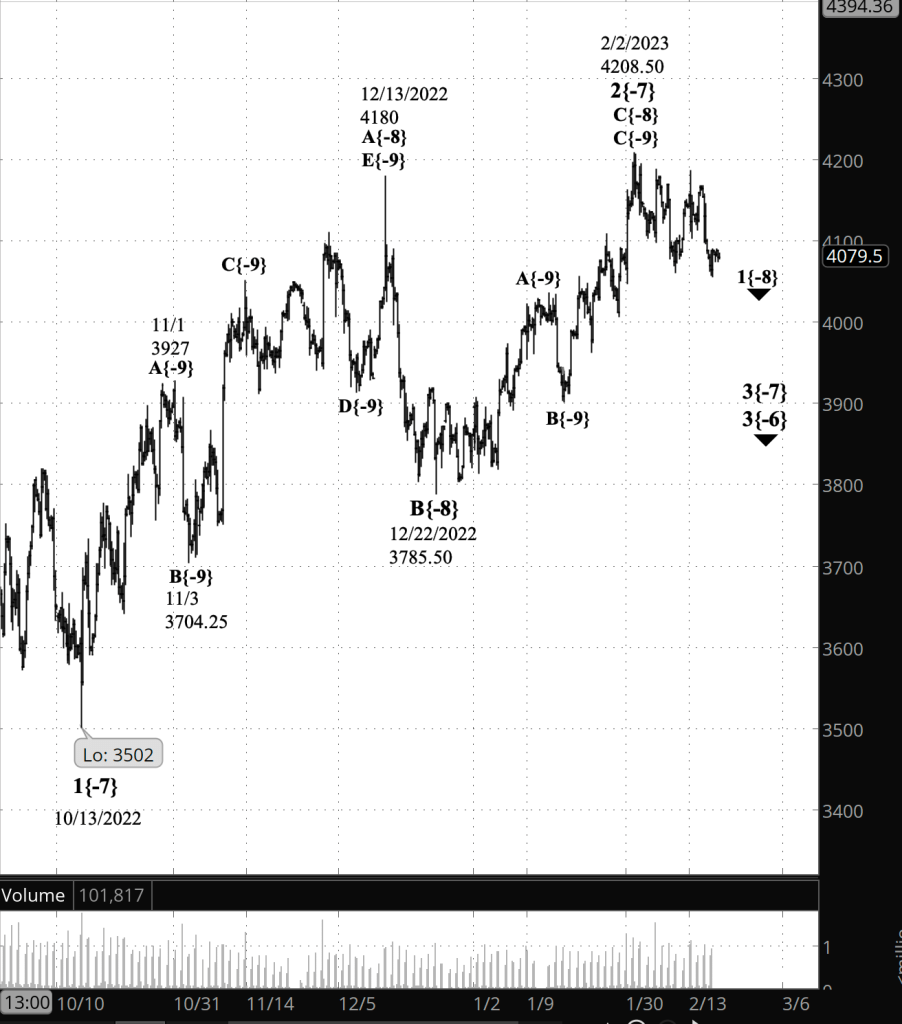
Half an hour before the closing bell. The S&P 500 futures fell during the session, beginning the day in the 4050s and as the closing bell approaches, has so far reached 4002. The movement gives credence to this morning’s principal analysis, that the downtrend that began on February 2, wave 3{-7}, continues and will fall a significant distance before reaching its end. I’ve updated the chart.

1 p.m. New York time

COIN earnings play entry. I’ve entered a bear call vertical spread on COIN, using options that expire in 24 days, and have posted an analysis of the trade.

9:35 a.m. New York time

What’s happening now? The S&P 500 E-mini futures fell overnight, reaching a low of 4044.25 as the opening bell sounded.

What does it mean? A downtrend that began on February 2 continues and is in its early stages. Eventually it will carry the price below 3502, the starting point of the preceding upward correction, and almost certainly significantly below that level.

The present decline, a relatively small subwave, began on February 14 and when complete, will be followed by a small upward correction and then a resukption of the downtrend.

The further the price declines, the more likely it is that this principal analysis is the most accurate map of the S&P 500.

What is the alternative? The upward correction that began on October 13, 2022 is still underway and is in its late stages. The decline since February 2 is a subwave within the correction, and it will be followed by a resumption of the rise that will carry the price above 4208.50, the high so far within the correction.

If the price reverses and moves above 4208.50, then that would confirm that this alternative analysis is the most accurate map of the S&P 500.

Chart note. I’ve focused the chart to take a closer look at the details of the downtrend that began on February 2.

The chart mark-up, showing the Elliott wave analysis, works like this: Each wave has a designation — a number or letter — that shows its position within the larger structure that contains it. And each wave designation is followed by a subscript, in curly brackets, to indicate the wave’s place, its degree, within the complete fractal structure of the price movements. 

[S&P 500 E-mini futures at 3:30 p.m., hourly bars, with volume]

What does Elliott wave theory say?

Here are the waves that my analyses are based on.

Principal analysis:

  • The downward correction that began on February 2, wave 3{-7}, continues.
  • It is in the first of five subwaves, wave 1{-8}.
  • Within wave 1{-8}, wave 1{-9} is underway and is in the final subwave within a five-wave structure, downtrending wave 5{-10}.
  • When wave 5{-10} is complete, it will also mark the end of wave 1{-9} and the beginning of a low-degree upward correction, wave 2{-9}.
  • Wave 3{-7} is still taking its tentative first steps and will develop into a powerful downtrend that will carry the price below 3502, the starting point of the preceding upward correction, wave 2{-7}, and most likely significantly below that level.

Alternative analysis:

  • The upward correction that began on October 13, 2022, wave 2{-7}, is still underway.
  • It is in the third of three parts, upward wave C{-8}.
  • C{-8} in turn is in its third and final subwave, rising wave C{-9}.
  • Wave C{-9} has five subwaves and is in the fourth, declining wave D{-10}.
  • Wave D{10} will be followed by rising wave E{-10},
  • A wave in wave E{-10}’s position normally will exceed the endpoint of the prior upward wave, 4208.50, which is wave C{-10}. That peak was attained on February 2.
  • The end of the wave E{-10} will also be the end of waves C{-9}, C{-8} and of the upward correction, wave 2{-7}.
  • Wave 3{-7} will follow, a powerful downtrend that will carry the price below the starting point of the correction, 3502, and most likely significantly below that level.

Confirmation signals.

The principal analysis will be confirmed if the present decline, wave 3{-7} and its subwaves move below 3502.

The alternative analysis will be confirmed if the present decline, wave D{-10}, moves above 4208.50.

Bigger structures:

  • This is all happening within wave 3{-6}, which began on August 16, 2022.
  • Wave 3{-6} is encompassed by a series of larger waves, the smaller within the larger, stretching up five degrees to wave 4{-1}, which began on January 4, 2022.
  • Wave 4{-1} is the next-to-the-last wave within a large expanding Diagonal Triangle, wave 5{0}, that began on December 26, 2018

We Are Here.

These are the waves currently in progress under my principal analysis. Each line on the list shows the wave number, with the subscript in curly brackets, the traditional degree name, the starting date, the starting price of the S&P 500 E-mini futures, and the direction of the wave.

  • S&P 500 Index:
  • 5{+3} Supercycle, 7/8/1932, 4.40 (up)
  • 5{+2} Cycle, 12/9/1974, 60.96 (up)
  • 5{+1} Primary, 3/6/2009, 666.79 (up)
  • 5{0} Intermediate, 12/26/2018, 2346.58 (up)
  • S&P 500 Futures and index:
  • 4{-1} Minor, 1/4/2022, 4808.25 (down) (futures), 4818.62 (down) (index)
  • S&P 500 Futures:
  • 1{-2} Minute, 1/4/2022, 4808.25 (down)
  • 1{-3} Minuette, 1/4/2022, 4808.25 (down)
  • 1{-4} Subminuette, 1/4/2022, 4808.25 (down)
  • 1{-5} Micro, 1/4/2022, 4808.25 (down)
  • 3{-6} Submicro, 8/16/2022, 4327.50 (down)
  • 3{-7} Minuscule, 2/2/2023, 4208.50 (down)

Learning and other resources. Elliott wave analysis provides context, not prophecy. As the 20th century semanticist Alfred Korzybski put it in his book Science and Sanity (1933), “The map is not the territory … The only usefulness of a map depends on similarity of structure between the empirical world and the map.” And I would add, in the ever-changing markets, we can judge that similarity of structure only after the fact.

See the menu page Analytical Methods for a rundown on where to go for information on Elliott wave analysis.

By Tim Bovee, Portland, Oregon, February 21, 2023

Disclaimer

Tim Bovee, Private Trader tracks the analysis and trades of a private trader for his own accounts. Nothing in this blog constitutes a recommendation to buy or sell stocks, options or any other financial instrument. The only purpose of this blog is to provide education and entertainment.

No trader is ever 100 percent successful in his or her trades. Trading in the stock and option markets is risky and uncertain. Each trader must make trading decisions for his or her own account, and take responsibility for the consequences.

License
Creative Commons License

All content on Tim Bovee, Private Trader by Timothy K. Bovee is licensed under a Creative Commons Attribution-ShareAlike 4.0 International License.

Based on a work at www.timbovee.com.
Trader’s Notebook

9:35 a.m. New York time

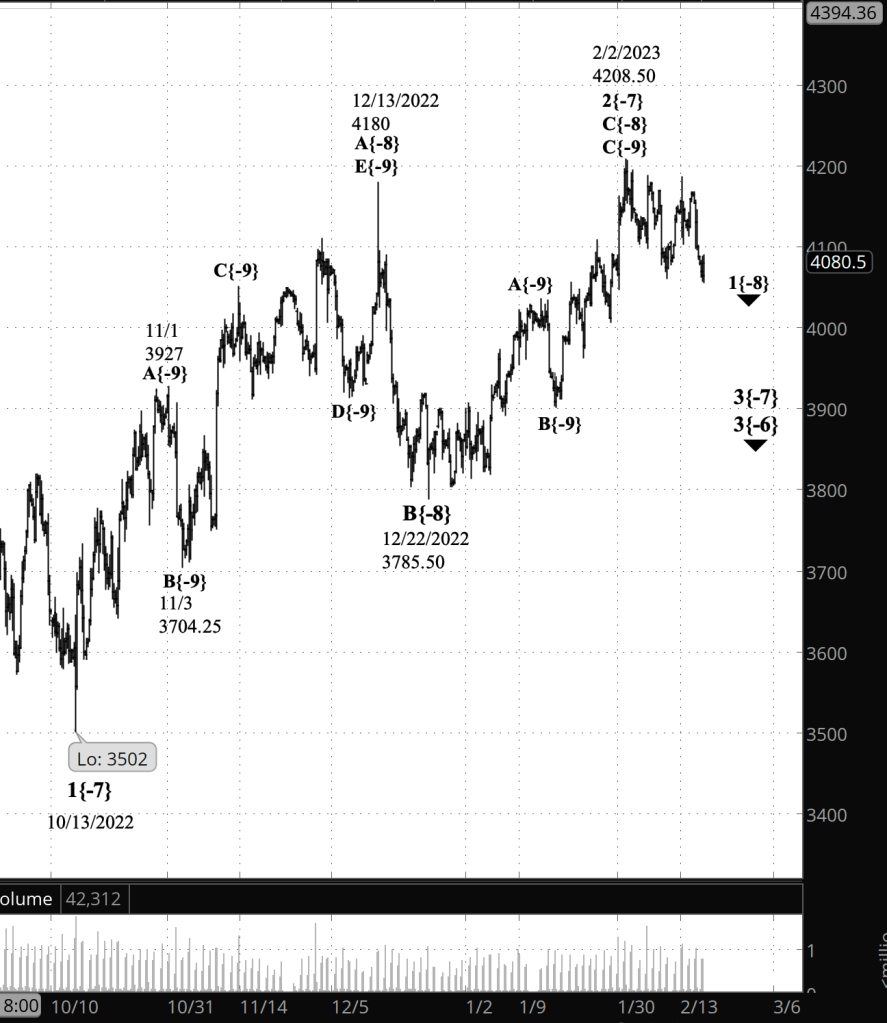
What’s happening now? The S&P 500 E-mini futures kept to a narrow range after trading resumed Sunday evening, remaining in the 4070s and 4080s. U.S. stock and options markets are closed today for the President’s Day holiday. Futures traded while overseas markets were open.

No afternoon analysis today, unless the chart changes meaningfully.

What does it mean? A downtrending wave that will carry the price significantly lower began on February 2 from 4208.50 and is in its early stage. As with all directional movements, it will contain both waves in the direction of the trend and counter-trend corrections. The downtrend will carry the price below 3502, the starting point of the preceding upward correction, which began on October 13, 2022, and most likely significantly below that level. The further the price declines, the more likely this scenario becomes. A drop below 3502 will confirm the analysis.

What is the alternative? The upward correction is still underway. The February 2 peak marked the beginning of a small downward correction within the larger upward correction. The rise will resume shortly and will carry the price above 4208.50. The higher the price rises, the more likely this scenario becomes. A rise above 4208.50 will confirm the scenario.

Chart note. Each wave’s designation — a number or letter — has a subscript, in curly brackets, to indicate the wave’s place, its degree, within the fractal structure of the price movements. 

[S&P 500 E-mini futures at 9:35 a.m., 5-hour bars, with volume]

What does Elliott wave theory say? Here are the waves that my analyses are based on.

Principal analysis:

  • The downward correction that began on February 2, wave 3{-7}, continues.
  • It is in the first of five subwaves, wave 1{-8}.
  • Wave 3{-7} will develop into a powerful downtrend that will carry the price below 3502, the starting point of the preceding upward correction, wave 2{-7}, and most likely significantly below that level.

Alternative analysis:

  • The upward correction that began on October 13, 2022, wave 2{-7}, is still underway.
  • It is in the third of three parts, upward wave C{-8}.
  • C{-8} in turn is in its third and final subwave, rising wave C{-9}.
  • Wave C{-9} has five subwaves and is in the fourth, declining wave D{-10}.
  • Wave D{10} will be followed by rising wave E{-10},
  • A wave in wave E{-10}’s position normally will exceed the endpoint of the prior upward wave, 4208.50, which is wave C{-10}. That peak was attained on February 2.
  • The end of the wave E{-10} will also be the end of waves C{-9}, C{-8} and of the upward correction, wave 2{-7}.
  • Wave 3{-7} will follow, a powerful downtrend that will carry the price below the starting point of the correction, 3502, and most likely significantly below that level.

Confirmation signals.

The principal analysis will be confirmed if the present decline, wave 3{-7} and its subwaves move below 3502.

The alternative analysis will be confirmed if the present decline, wave D{-10}, moves above 4208.50.

Bigger structures:

  • This is all happening within wave 3{-6}, which began on August 16, 2022.
  • Wave 3{-6} is encompassed by a series of larger waves, the smaller within the larger, stretching up five degrees to wave 4{-1}, which began on January 4, 2022.
  • Wave 4{-1} is the next-to-the-last wave within a large expanding Diagonal Triangle, wave 5{0}, that began on December 26, 2018

We Are Here.

These are the waves currently in progress under my principal analysis. Each line on the list shows the wave number, with the subscript in curly brackets, the traditional degree name, the starting date, the starting price of the S&P 500 E-mini futures, and the direction of the wave.

  • S&P 500 Index:
  • 5{+3} Supercycle, 7/8/1932, 4.40 (up)
  • 5{+2} Cycle, 12/9/1974, 60.96 (up)
  • 5{+1} Primary, 3/6/2009, 666.79 (up)
  • 5{0} Intermediate, 12/26/2018, 2346.58 (up)
  • S&P 500 Futures and index:
  • 4{-1} Minor, 1/4/2022, 4808.25 (down) (futures), 4818.62 (down) (index)
  • S&P 500 Futures:
  • 1{-2} Minute, 1/4/2022, 4808.25 (down)
  • 1{-3} Minuette, 1/4/2022, 4808.25 (down)
  • 1{-4} Subminuette, 1/4/2022, 4808.25 (down)
  • 1{-5} Micro, 1/4/2022, 4808.25 (down)
  • 3{-6} Submicro, 8/16/2022, 4327.50 (down)
  • 3{-7} Minuscule, 2/2/2023, 4208.50 (down)

Learning and other resources. Elliott wave analysis provides context, not prophecy. As the 20th century semanticist Alfred Korzybski put it in his book Science and Sanity (1933), “The map is not the territory … The only usefulness of a map depends on similarity of structure between the empirical world and the map.” And I would add, in the ever-changing markets, we can judge that similarity of structure only after the fact.

See the menu page Analytical Methods for a rundown on where to go for information on Elliott wave analysis.

By Tim Bovee, Portland, Oregon, February 20, 2023

Disclaimer

Tim Bovee, Private Trader tracks the analysis and trades of a private trader for his own accounts. Nothing in this blog constitutes a recommendation to buy or sell stocks, options or any other financial instrument. The only purpose of this blog is to provide education and entertainment.

No trader is ever 100 percent successful in his or her trades. Trading in the stock and option markets is risky and uncertain. Each trader must make trading decisions for his or her own account, and take responsibility for the consequences.

License
Creative Commons License

All content on Tim Bovee, Private Trader by Timothy K. Bovee is licensed under a Creative Commons Attribution-ShareAlike 4.0 International License.

Based on a work at www.timbovee.com.
Trader’s Notebook

3:30 p.m. New York time

Monday. U.S. markets will be closed on Monday for the President’s Day holiday. Normal trading hours will resume on Tuesday. The S&P 500 futures are likely to trade during the holiday, and if that in favt proves to be the case, then I shall post an analysis.

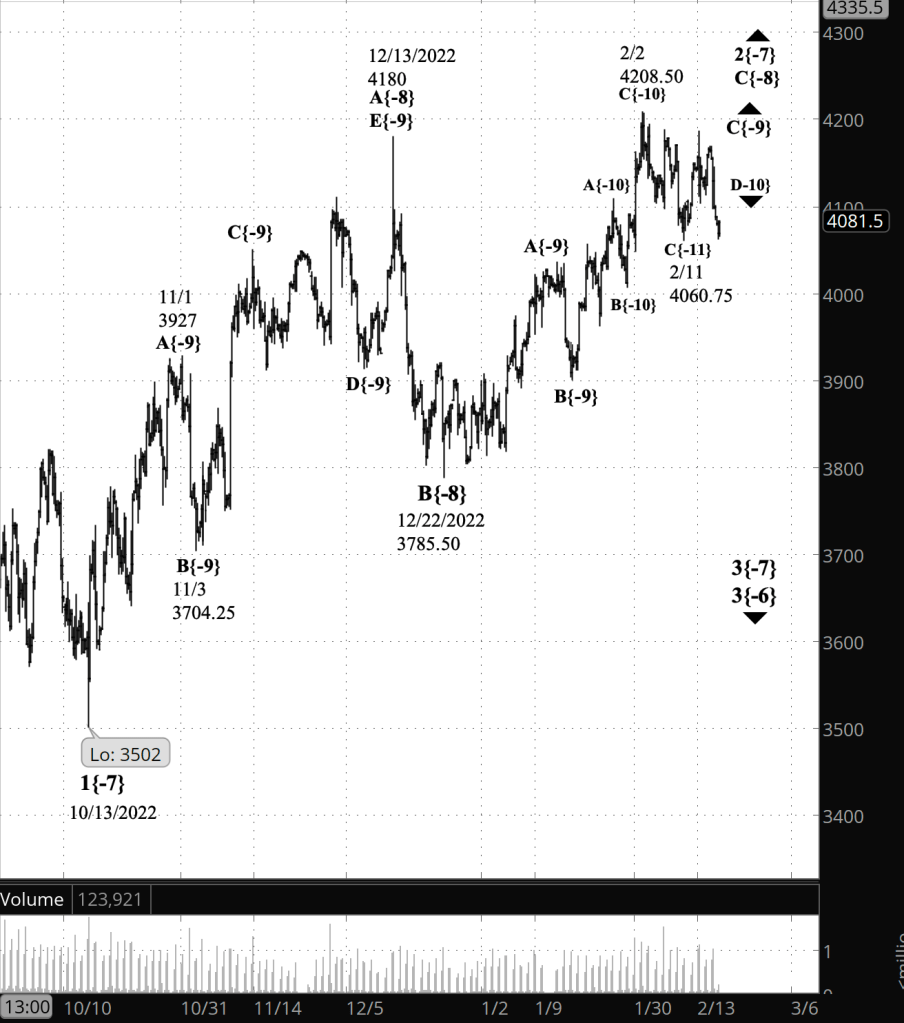
Half an hour before the closing bell. The S&P 500 futures moved below the February 11 low, 4060.75, increasing the likelihood that a new downtrend began on February 2 from 4208.50. The S&P 500 index had a corresponding break below, confirming the futures movement.

I’ve replaced this morning’s principal analysis with thge alternative analysis.

I’ve added a new chart showing the new principal analysis: A downtrend has begun and will carry the price below 3502, the starting point of the upward correction that ended on February 2.

In Elliott wave terminology, the downtrend is wave 3{-7}, and as a third wave, it an be expected to show a great deal of energy on its downward journey, which will likely take it significantly below 3502, the starting point of the preceding upward correction, wave 2{-7}.

If the price reverses and moves above 4208.50, then wave 2{-7} has not yet ended, this morning’s alternative analysis was incorrect, and this morning’s principal analysis better represents the chart.

[S&P 500 E-mini futures at 3:30 p.m., 5-hour bars, with volume]

9:35 a.m. New York time

The analysis below has been outdated by events. The alternative analysis has replaced the principal analysis. See the afternoon analysis, above.

What’s happening now? The S&P 500 E-mini futures declined overnight to 4063.25, a few points above the rise that began on February 11.

What does it mean? An upward correction that began on October 13, 2022 continues and is in near it’s end. A reversal and rise above the February 2 high so far in the correction would confirm this scenario.

What is the alternative? If the price moves below the start of the rise, 4060.75, that increases the credibility of an alternative scenario, that the upward correction ended at the February 2 peak, 4208.50, and a downtrend has begun and is in its early stages. A decline below the start of the correction, 3502, would confirm this analysis. The downtrend is likely to carry the price well below 3502.

Chart note. On the chart below, directional movements — waves — are numbered of they’re within trending waves, and designated by letters if they are within corrective waves. Waves on a stock chart form a fractal pattern, larger waves encompassing smaller waves, and those smaller waves encompassing still smaller waves, forming a hierarchy. A wave’s position within the fractal hierarchy is designated by a subscript, within curly brackets. The smaller the subscript number, the further down the hierarchy a wave stands.

[Outdated analysis: S&P 500 E-mini futures at 9:35 a.m., 5-hour bars, with volume]

What does Elliott wave theory say? Here are the waves that my analysis is based on, unchanged from the past few days.

Principal analysis:

  • The upward correction, wave 2{-7}, continues.
  • It is in the third of three parts, upward wave C{-8}.
  • C{-8} in turn is in its third and final subwave, rising wave C{-9}.
  • Wave C{-9} has five subwaves and is in the fourth, declining wave D{-10}.
  • Wave D{10} will be followed by rising wave E{-10},
  • A wave in wave E{-10}’s position normally will exceed the endpoint of the prior upward wave, 4208.50, which is wave C{-10}. That peak was attained on February 2.
  • The end of the wave E{-10} will also be the end of waves C{-9}, C{-8} and of the upward correction, wave 2{-7}.
  • Wave 3{-7} will follow, a powerful downtrend that will carry the price below the starting point of the correction, 3502, and most likely significantly below that level.

Alternative analysis:

  • The upward correction, wave 2{-7}, ended on February 2 at 4208.50 and downtrending wave 3{-7} is now underway.

Confirmation signals.

The choice between the principal and alternative analyses depends on whether wave D{-10} has ended. The chart has sufficient ambiguity to ensure that there is no obvious answer.

A breakout above 4208.50 — the end of rising wave C{-10} — would confirm that wave E{-10} is underway, A break below 4060.75 — the low point so far of wave D{-10}, 4060.75 andthe end of falling wave C{-11} — would confirm that D{-10} is still underway.

Bigger structures:

  • This is all happening within wave 3{-6}, which began on August 16, 2022.
  • Wave 3{-6} is encompassed by a series of larger waves, the smaller within the larger, stretching up five degrees to wave 4{-1}, which began on January 4, 2022.
  • Wave 4{-1} is the next-to-the-last wave within a large expanding Diagonal Triangle, wave 5{0}, that began on December 26, 2018

We Are Here.

These are the waves currently in progress under my principal analysis. Each line on the list shows the wave number, with the subscript in curly brackets, the traditional degree name, the starting date, the starting price of the S&P 500 E-mini futures, and the direction of the wave.

  • S&P 500 Index:
  • 5{+3} Supercycle, 7/8/1932, 4.40 (up)
  • 5{+2} Cycle, 12/9/1974, 60.96 (up)
  • 5{+1} Primary, 3/6/2009, 666.79 (up)
  • 5{0} Intermediate, 12/26/2018, 2346.58 (up)
  • S&P 500 Futures and index:
  • 4{-1} Minor, 1/4/2022, 4808.25 (down) (futures), 4818.62 (down) (index)
  • S&P 500 Futures:
  • 1{-2} Minute, 1/4/2022, 4808.25 (down)
  • 1{-3} Minuette, 1/4/2022, 4808.25 (down)
  • 1{-4} Subminuette, 1/4/2022, 4808.25 (down)
  • 1{-5} Micro, 1/4/2022, 4808.25 (down)
  • 3{-6} Submicro, 8/16/2022, 4327.50 (down)
  • 3{-7} Minuscule, 2/2/2023, 4208.50 (down)

Learning and other resources. Elliott wave analysis provides context, not prophecy. As the 20th century semanticist Alfred Korzybski put it in his book Science and Sanity (1933), “The map is not the territory … The only usefulness of a map depends on similarity of structure between the empirical world and the map.” And I would add, in the ever-changing markets, we can judge that similarity of structure only after the fact.

See the menu page Analytical Methods for a rundown on where to go for information on Elliott wave analysis.

By Tim Bovee, Portland, Oregon, February 17, 2023

Disclaimer

Tim Bovee, Private Trader tracks the analysis and trades of a private trader for his own accounts. Nothing in this blog constitutes a recommendation to buy or sell stocks, options or any other financial instrument. The only purpose of this blog is to provide education and entertainment.

No trader is ever 100 percent successful in his or her trades. Trading in the stock and option markets is risky and uncertain. Each trader must make trading decisions for his or her own account, and take responsibility for the consequences.

License
Creative Commons License

All content on Tim Bovee, Private Trader by Timothy K. Bovee is licensed under a Creative Commons Attribution-ShareAlike 4.0 International License.

Based on a work at www.timbovee.com.
Trader’s Notebook

3:30 p.m. New York time

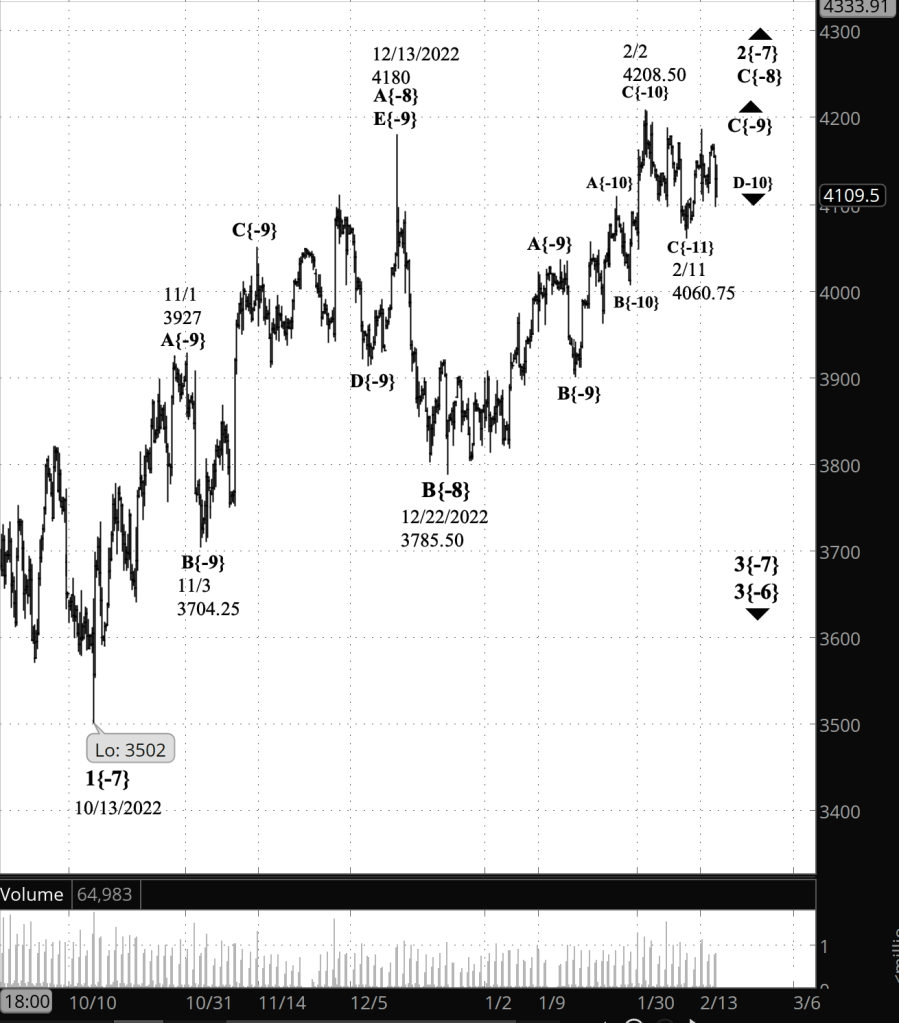
Half an hour before the closing bell. The S&P 500 futures reached a session low of 4098.25 shortly after the opening bell and then rose back to the 4140s, pulling back in the final minutes. No change in this morning’s analysis. I’ve updated the chart.

9:35 a.m. New York time

What’s happening now? The S&P 500 E-mini futures peaked overnight at 4168.50 and then fell sharply to 4101.50 as the opening bell sounded.

What does it mean? The price hasn’t broken beyond the high point of an upward correction that began last October, 4208.50, nor below the starting point of the present rise that began on February 2, from 4060.75. There are no signals to help us choose between the principal analysis and the alternative. Therefore, the principal analysis is that the upward correction is still underway and is nearing completion. A rise above 4208.50 will confirm this analysis.

What is the alternative? The upward correction has ended at the February 2 high, 4208.50, and subsequent price movements have been the early stages of a downtrend that will carry the price below the beginning of the correction, 3502, and almost certainly significantly below that level. A decline below 4060.75 will increase the credence to this scenario, and a decline below 3502 will confirm it.

Chart notes. In Elliott wave analysis, a directional price movement is called a “wave”, and each wave has two characteristics. The first is its designator, a number for trending waves and a letter for corrective waves, that shows the wave’s relative location within the encompassing wave. The second is a subscript, placed within curly brackets on charts I analyze, that shows the wave’s relative position within the fractal structure of large and small waves, called the wave’s “degree”. The smaller the subscript, the further down the wave is in that structure. The larger the subscript, the higher up the fractal hierarchy the wave stands.

[S&P 500 E-mini futures at 3:30 p.m., 5-hour bars, with volume]

What does Elliott wave theory say? Here are the waves that my analysis is based on. It is is unchanged from the past few days.

Principal analysis:

  • The upward correction, wave 2{-7}, continues.
  • It is in the third of three parts, upward wave C{-8}.
  • C{-8} in turn is in its third and final subwave, rising wave C{-9}.
  • Wave C{-9} has five subwaves and is in the fourth, declining wave D{-10}.
  • Wave D{10} will be followed by rising wave E{-10},
  • A wave in wave E{-10}’s position normally will exceed the endpoint of the prior upward wave, 4208.50, which is wave C{-10}. That peak was attained on February 2.
  • The end of the wave E{-10} will also be the end of waves C{-9}, C{-8} and of the upward correction, wave 2{-7}.
  • Wave 3{-7} will follow, a powerful downtrend that will carry the price below the starting point of the correction, 3502, and most likely significantly below that level.

Alternative analysis:

  • The upward correction, wave 2{-7}, ended on February 2 at 4208.50 and downtrending wave 3{-7} is now underway.

Confirmation signals.

The choice between the principal and alternative analyses depends on whether wave D{-10} has ended. The chart has sufficient ambiguity to ensure that there is no obvious answer.

A breakout above 4208.50 — the end of rising wave C{-10} — would confirm that wave E{-10} is underway, A break below 4060.75 — the low point so far of wave D{-10}, 4060.75 andthe end of falling wave C{-11} — would confirm that D{-10} is still underway.

Bigger structures:

  • This is all happening within wave 3{-6}, which began on August 16, 2022.
  • Wave 3{-6} is encompassed by a series of larger waves, the smaller within the larger, stretching up five degrees to wave 4{-1}, which began on January 4, 2022.
  • Wave 4{-1} is the next-to-the-last wave within a large expanding Diagonal Triangle, wave 5{0}, that began on December 26, 2018.

We Are Here.

These are the waves currently in progress under my principal analysis. Each line on the list shows the wave number, with the subscript in curly brackets, the traditional degree name, the starting date, the starting price of the S&P 500 E-mini futures, and the direction of the wave.

  • S&P 500 Index:
  • 5{+3} Supercycle, 7/8/1932, 4.40 (up)
  • 5{+2} Cycle, 12/9/1974, 60.96 (up)
  • 5{+1} Primary, 3/6/2009, 666.79 (up)
  • 5{0} Intermediate, 12/26/2018, 2346.58 (up)
  • S&P 500 Futures and index:
  • 4{-1} Minor, 1/4/2022, 4808.25 (down) (futures), 4818.62 (down) (index)
  • S&P 500 Futures:
  • 1{-2} Minute, 1/4/2022, 4808.25 (down)
  • 1{-3} Minuette, 1/4/2022, 4808.25 (down)
  • 1{-4} Subminuette, 1/4/2022, 4808.25 (down)
  • 1{-5} Micro, 1/4/2022, 4808.25 (down)
  • 3{-6} Submicro, 8/16/2022, 4327.50 (down)
  • 2{-7} Minuscule, 10/13/2022, 3502 (up)

Learning and other resources. Elliott wave analysis provides context, not prophecy. As the 20th century semanticist Alfred Korzybski put it in his book Science and Sanity (1933), “The map is not the territory … The only usefulness of a map depends on similarity of structure between the empirical world and the map.” And I would add, in the ever-changing markets, we can judge that similarity of structure only after the fact.

See the menu page Analytical Methods for a rundown on where to go for information on Elliott wave analysis.

By Tim Bovee, Portland, Oregon, February 16, 2023

Disclaimer

Tim Bovee, Private Trader tracks the analysis and trades of a private trader for his own accounts. Nothing in this blog constitutes a recommendation to buy or sell stocks, options or any other financial instrument. The only purpose of this blog is to provide education and entertainment.

No trader is ever 100 percent successful in his or her trades. Trading in the stock and option markets is risky and uncertain. Each trader must make trading decisions for his or her own account, and take responsibility for the consequences.

License
Creative Commons License

All content on Tim Bovee, Private Trader by Timothy K. Bovee is licensed under a Creative Commons Attribution-ShareAlike 4.0 International License.

Based on a work at www.timbovee.com.
Trader’s Notebook

3:30 p.m. New York time

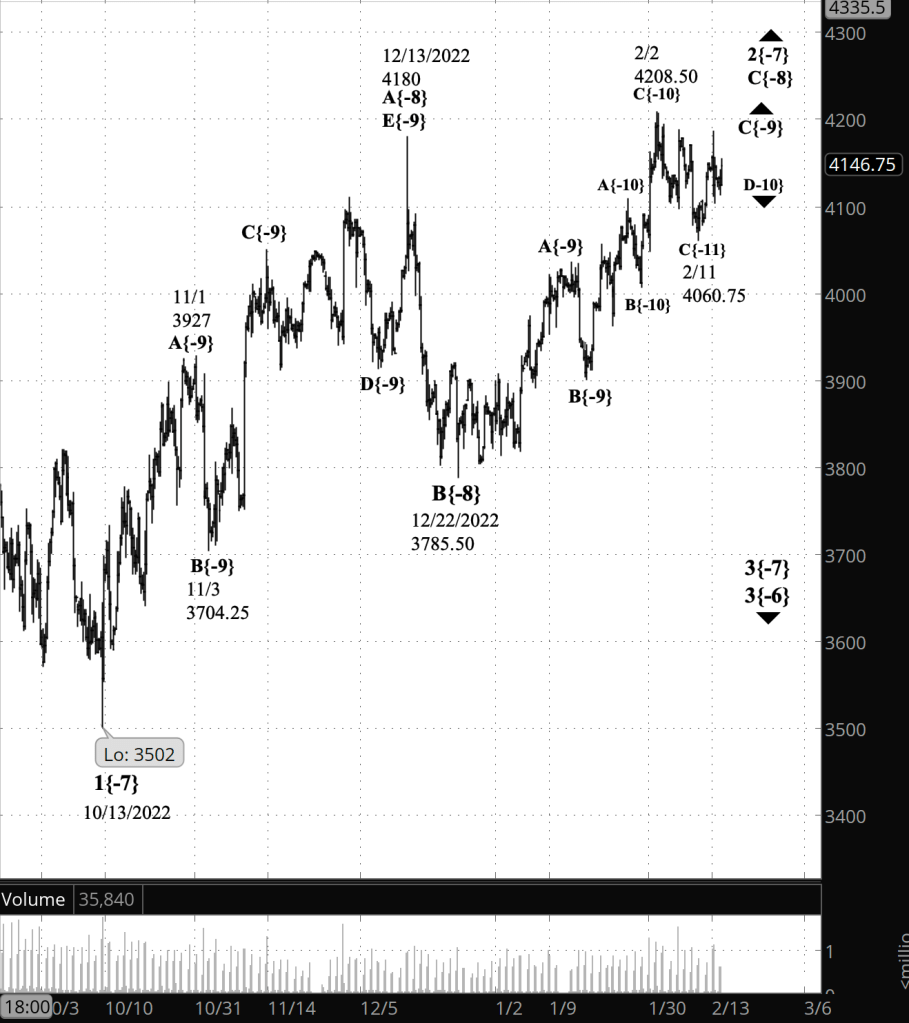
Half an hour before the closing bell. The S&P 500 futures traded in a narrowing range during the session, remaining between the highs and lows set a day earlier. No change in the analysis. I’ve updated the chart.

9:35 a.m. New York time

What’s happening now? The S&P 500 E-mini futures fell overnight, reaching a low of 4116 before bouncing back into the 4130s. The price remained above the starting point of the present rise, 4060.75, and below the peak since that rise began, 4186.50.

What does it mean? The larger upward correction that began last October is still underway. It is in its final segment, which internally is within a final segment that is nearing its end. The upward correction will be followed by a powerful downtrend that, at a minimum, will carry the price below 3502, the correction’s starting point, and almost certainly well below that level.

What are the alternatives? The upward correction may have ended at the February 2 high, 4208.50, and if so, the price movements since have been the first tentative steps the downtrend.

Chart notes. A directional movement in Elliott wave analysis is called a “wave”, and what may appear to be a squiggly line on the chart is, to Elliotticians, a complex fractal structure of smaller waves within larger waves and the larger waves within waves that are still larger.

fA wave has two characteristics that are used to make sense of that structure. The first is its designator, a number for trending waves and a letter for corrective waves, that sows its relative location within the encompassing wave. The second is a subscript, placed within curly brackets on charts I analyze, that shows the wave’s relative position within the fractal structure, called the wave’s “degree”. The smaller the subscript, the further down the wave is in that structure. The larger the subscript, the higher up the fractal hierarchy the wave stands.

[S&P 500 E-mini futures at 3:30 p.m., 5-hour bars, with volume]

What does Elliott wave theory say? Here are the waves behind the principal analysis, the alternative, and the bigger wave strutures encompassing both.

Principal analysis:

  • The upward correction, wave 2{-7}, continues.
  • It is in the third of three parts, upward wave C{-8}.
  • C{-8} in turn is in its third and final subwave, rising wave C{-9}.
  • Wave C{-9} has five subwaves and is in the fourth, declining wave D{-10}.
  • Wave D{10} will be followed by rising wave E{-10},
  • A wave in wave E{-10}’s position normally will exceed the endpoint of the prior upward wave, 4208.50, which is wave C{-10}. That peak was attained on February 2.
  • The end of the wave E{-10} will also be the end of waves C{-9}, C{-8} and of the upward correction, wave 2{-7}.
  • Wave 3{-7} will follow, a powerful downtrend that will carry the price below the starting point of the correction, 3502, and most likely significantly below that level.

Alternative analysis:

  • The upward correction, wave 2{-7}, ended on February 2 at 4208.50 and downtrending wave 3{-7} is now underway.

Confirmation signals.

The choice between the principal and alternative analyses depends on whether wave D{-10} has ended. The chart has sufficient ambiguity to ensure that there is no obvious answer.

A breakout above 4208.50 — the end of rising wave C{-10} — would confirm that wave E{-10} is underway, A break below 4060.75 — the low point so far of wave D{-10}, 4060.75 andthe end of falling wave C{-11} — would confirm that D{-10} is still underway.

Bigger structures:

  • This is all happening within wave 3{-6}, which began on August 16, 2022.
  • Wave 3{-6} is encompassed by a series of larger waves, the smaller within the larger, stretching up five degrees to wave 4{-1}, which began on January 4, 2022.
  • Wave 4{-1} is the next-to-the-last wave within a large expanding Diagonal Triangle, wave 5{0}, that began on December 26, 2018.

We Are Here.

These are the waves currently in progress under my principal analysis. Each line on the list shows the wave number, with the subscript in curly brackets, the traditional degree name, the starting date, the starting price of the S&P 500 E-mini futures, and the direction of the wave.

  • S&P 500 Index:
  • 5{+3} Supercycle, 7/8/1932, 4.40 (up)
  • 5{+2} Cycle, 12/9/1974, 60.96 (up)
  • 5{+1} Primary, 3/6/2009, 666.79 (up)
  • 5{0} Intermediate, 12/26/2018, 2346.58 (up)
  • S&P 500 Futures and index:
  • 4{-1} Minor, 1/4/2022, 4808.25 (down) (futures), 4818.62 (down) (index)
  • S&P 500 Futures:
  • 1{-2} Minute, 1/4/2022, 4808.25 (down)
  • 1{-3} Minuette, 1/4/2022, 4808.25 (down)
  • 1{-4} Subminuette, 1/4/2022, 4808.25 (down)
  • 1{-5} Micro, 1/4/2022, 4808.25 (down)
  • 3{-6} Submicro, 8/16/2022, 4327.50 (down)
  • 2{-7} Minuscule, 10/13/2022, 3502 (up)

Learning and other resources. Elliott wave analysis provides context, not prophecy. As the 20th century semanticist Alfred Korzybski put it in his book Science and Sanity (1933), “The map is not the territory … The only usefulness of a map depends on similarity of structure between the empirical world and the map.” And I would add, in the ever-changing markets, we can judge that similarity of structure only after the fact.

See the menu page Analytical Methods for a rundown on where to go for information on Elliott wave analysis.

By Tim Bovee, Portland, Oregon, February 15, 2023

Disclaimer

Tim Bovee, Private Trader tracks the analysis and trades of a private trader for his own accounts. Nothing in this blog constitutes a recommendation to buy or sell stocks, options or any other financial instrument. The only purpose of this blog is to provide education and entertainment.

No trader is ever 100 percent successful in his or her trades. Trading in the stock and option markets is risky and uncertain. Each trader must make trading decisions for his or her own account, and take responsibility for the consequences.

License
Creative Commons License

All content on Tim Bovee, Private Trader by Timothy K. Bovee is licensed under a Creative Commons Attribution-ShareAlike 4.0 International License.

Based on a work at www.timbovee.com.
Trader’s Notebook

3:30 p.m. New York time

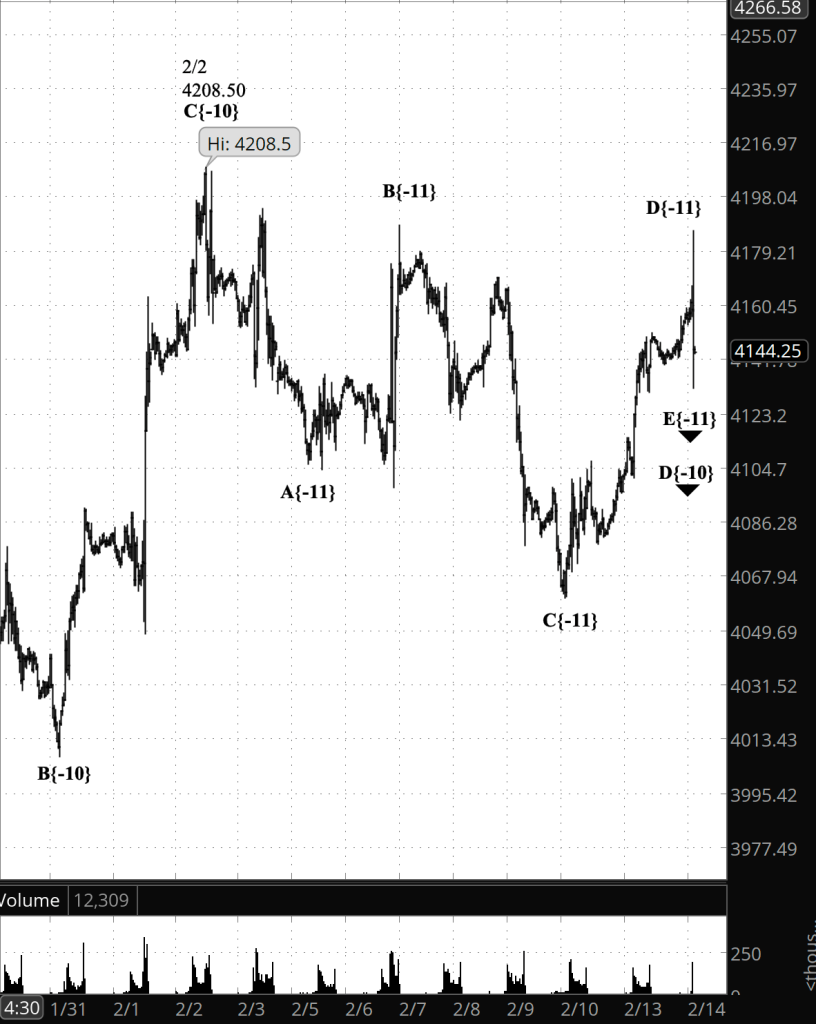
Half an hour before the closing bell. The S&P 500 futures fell to 4103.75 during the session and then rose back into the 4150s. No change in the analysis. I’ve updated the lower chart.

9:35 a.m. New York time

What’s happening now? This morning’s brief whipsaw in the S&P 500 E-mini futures when the latest inflation numbers were released carried the price down to 4132, and then up to 4186.50, before returning the price to its starting point in the 4150s, from which point it less dramatically drifted lower. The consumer price index rose 0.5% in January, far more than December’s 0.1% rise. Annualized, January was a 6% rise compared to December with a 1.2% rise.

What does it mean? The upper boundary of the swing remained below 4208.50, the high point so far in the upward correction that began on October 13, 2022. A move above that level would have confirmed that the final segment within the final leg of the correction is now underway. But that confirmation wasn’t forthcoming, and the internal structure of that final structure suggests that it is not yet complete. (See the upper chart below.)

What is the alternative? The upward correction ended at the February 2 high, 4208.50, and the largely declining price movements since have been the first tentative steps a downtrend that will reach 3502 and likely much lower.

Chart notes. The upper chart is a close-up chart showing the end game of the upward correction. The lower chart shows the correction in its entirety. On both charts, as is always the case with Elliott wave analysis, subwaves of corrective waves are labeled with letters and of trending waves, with numbers. The waves form a fractal structure — smaller waves within larger waves which in turn are within still larger waves. I show a wave’s place in the fractal hierarchy with a numerical subscript, between curly brackets. The smaller the number, the lower down the hierarchy the wave is.

[S&P 500 E-mini futures at 9 a.m., 30-minute bars, with volume]

[S&P 500 E-mini futures at 3:30 p.m., 5-hour bars, with volume]

What does Elliott wave theory say? These are the waves that are the basis of the analyses.

Principal analysis:

  • The upward correction, wave 2{-7}, continues.
  • It is in the third of three parts, upward wave C{-8}…
  • … which in turn is in its third and final subwave, rising wave C{-9}.
  • Wave C{-9} has five subwaves and is in the fourth, declining wave D{-10}.
  • Wave D{10} will be followed by rising wave E{-10}
  • A wave in wave E{-10}’s position normally will exceed the endpoint of the prior upward wave, 4208.50, which is wave C{-10}. That peak was attained on February 2.
  • The end of the wave E{-10} will also be the end of waves C{-9}, C{-8} and of the upward correction, wave 2{-7}.
  • Wave 3{-7} will follow, a powerful downtrend that will carry the price below the starting point of the correction, 3502, and most likely significantly below that level.

The big question today is, has wave D{-10} ended? The Elliott wave literature is curiously silent on what happens within a C wave. I chose to count it as having five waves internally, within the fifth wave, D{-11}, still underway. But there are alternative counts possible. For the time being, I shall leave the chart as it has stood for the past few days, until…

  • … a breakout above 4208.50 — the end of rising wave C{-10} — confirms that wave E{-10} is underway,
  • … or below the low point so far of wave D{-10}, 4060.75 — the end of falling wave C{-11} — confirming that D{-10} is still underway.

Alternative:

  • The upward correction, wave 2{-7}, ended on February 2 at 4208.50 and downtrending wave 3{-7} is now underway.

All analyses:

  • This is all happening within wave 3{-6}, which began on August 16, 2022.
  • Wave 3{-6} is encompassed by a series of larger waves, the smaller within the larger, stretching up five degrees to wave 4{-1}, which began on January 4, 2022.
  • Wave 4{-1} is the next-to-the-last wave within a large expanding Diagonal Triangle, wave 5{0}, that began on December 26, 2018.

We Are Here.

These are the waves currently in progress under my principal analysis. Each line on the list shows the wave number, with the subscript in curly brackets, the traditional degree name, the starting date, the starting price of the S&P 500 E-mini futures, and the direction of the wave.

  • S&P 500 Index:
  • 5{+3} Supercycle, 7/8/1932, 4.40 (up)
  • 5{+2} Cycle, 12/9/1974, 60.96 (up)
  • 5{+1} Primary, 3/6/2009, 666.79 (up)
  • 5{0} Intermediate, 12/26/2018, 2346.58 (up)
  • S&P 500 Futures and index:
  • 4{-1} Minor, 1/4/2022, 4808.25 (down) (futures), 4818.62 (down) (index)
  • S&P 500 Futures:
  • 1{-2} Minute, 1/4/2022, 4808.25 (down)
  • 1{-3} Minuette, 1/4/2022, 4808.25 (down)
  • 1{-4} Subminuette, 1/4/2022, 4808.25 (down)
  • 1{-5} Micro, 1/4/2022, 4808.25 (down)
  • 3{-6} Submicro, 8/16/2022, 4327.50 (down)
  • 2{-7} Minuscule, 10/13/2022, 3502 (up)

Learning and other resources. Elliott wave analysis provides context, not prophecy. As the 20th century semanticist Alfred Korzybski put it in his book Science and Sanity (1933), “The map is not the territory … The only usefulness of a map depends on similarity of structure between the empirical world and the map.” And I would add, in the ever-changing markets, we can judge that similarity of structure only after the fact.

See the menu page Analytical Methods for a rundown on where to go for information on Elliott wave analysis.

By Tim Bovee, Portland, Oregon, February 14, 2023

Disclaimer

Tim Bovee, Private Trader tracks the analysis and trades of a private trader for his own accounts. Nothing in this blog constitutes a recommendation to buy or sell stocks, options or any other financial instrument. The only purpose of this blog is to provide education and entertainment.

No trader is ever 100 percent successful in his or her trades. Trading in the stock and option markets is risky and uncertain. Each trader must make trading decisions for his or her own account, and take responsibility for the consequences.

License
Creative Commons License

All content on Tim Bovee, Private Trader by Timothy K. Bovee is licensed under a Creative Commons Attribution-ShareAlike 4.0 International License.

Based on a work at www.timbovee.com.
Trader’s Notebook

3:30 p.m. New York time

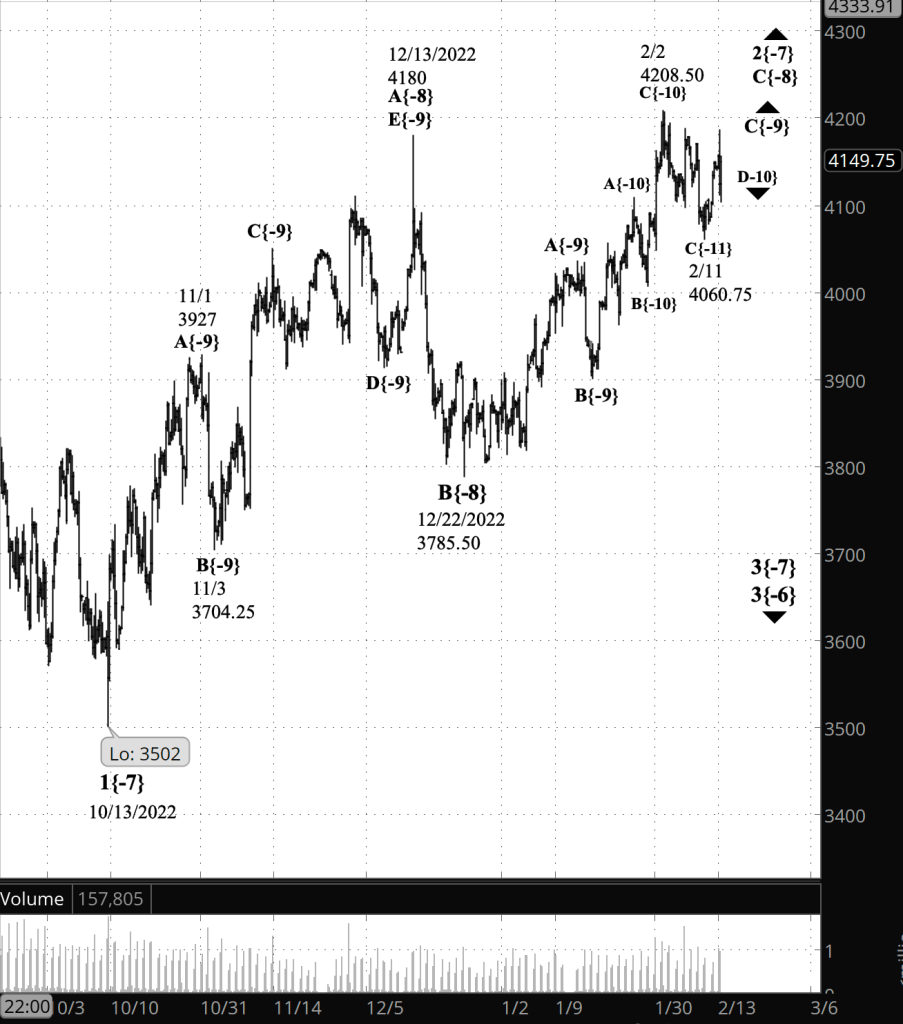
Half an hour before the closing bell. The S&P 500 futures rose during the session to 4149.50, which 59 points below beginning of the decline that began on February 2 from 4208.50. The analysis from this morning is unchanged: Downward wave D{-10} is underway. It is a subwave of rising waves C{-9} within C{-8} within the upward correction that began on October 13, 2022, wave 2{-7}.

However, the higher the price rises, the likelier it becomes that the wave D{-10} decline has ended. A price move above 4208.50 would confirm that the upward wave E{-10} has begun, and it may have begun already on February 10 at 4060.75.

When E{-10} is complete, it will also mark the end of waves C{-9}, C{-8} and the upward correction, 2{-7}. A downtrend, wave 3{-7}, will follow, bringing the pricer below the start of the correction, 3502, and almost certainly significantly below that level. Third waves almost always pack a lot of directional power, and given the uneasiness evident in the markets, wave 3{-7} seems unlikely to be an exception.

I’ve updated the chart.

9:35 a.m. New York time

What’s happening now? The S&P 500 E-mini futures rose after trading resumed overnight, from the 4070s to a high of 4115, and then pulled back a little.

What does it mean? Today’s principal analysis is unchanged from Friday’s: The upward correction that began on October 13, 2022 is still in progress and internally is in its final rise.

What is the alternative? The upward correction ended at the February 2 high, 4208.50, and the largely declining price movements since have been the first tentative steps a downtrend that will reach 3502 and likely much lower.

[S&P 500 E-mini futures at 3:30 p.m., 3-hour bars, with volume]

What does Elliott wave theory say?

These are the waves that are the basis of the analyses.

Principal analysis:

  • The upward correction, wave 2{-7}, continues.
  • It is in the third of three parts, upward wave C{-8}…
  • … which in turn is in its third and final subwave, rising wave C{-9}.
  • Wave C{-9} has five subwaves and is in the fourth, declining wave D{-10}.
  • Wave D{10} will be followed by rising wave E{-10}
  • A wave in wave E{-10}’s position normally will exceed the endpoint of the prior upward wave, 4208.50, which is wave C{-10}. That peak was attained on February 2.
  • The end of the wave E{-10} will also be the end of waves C{-9}, C{-8} and of the upward correction, wave 2{-7}.
  • Wave 3{-7} will follow, a powerful downtrend that will carry the price below the starting point of the correction, 3502, and most likely significantly below that level.

Alternativ:

  • The upward correction, wave 2{-7}, ended on February 2 at 4208.50 and downtrending wave 3{-7} is now underway.

All analyses:

  • This is all happening within wave 3{-6}, which began on August 16, 2022.
  • Wave 3{-6} is encompassed by a series of larger waves, the smaller within the larger, stretching up five degrees to wave 4{-1}, which began on January 4, 2022.
  • Wave 4{-1} is the next-to-the-last wave within a large expanding Diagonal Triangle, wave 5{0}, that began on December 26, 2018.

We Are Here.

These are the waves currently in progress under my principal analysis. Each line on the list shows the wave number, with the subscript in curly brackets, the traditional degree name, the starting date, the starting price of the S&P 500 E-mini futures, and the direction of the wave.

  • S&P 500 Index:
  • 5{+3} Supercycle, 7/8/1932, 4.40 (up)
  • 5{+2} Cycle, 12/9/1974, 60.96 (up)
  • 5{+1} Primary, 3/6/2009, 666.79 (up)
  • 5{0} Intermediate, 12/26/2018, 2346.58 (up)
  • S&P 500 Futures and index:
  • 4{-1} Minor, 1/4/2022, 4808.25 (down) (futures), 4818.62 (down) (index)
  • S&P 500 Futures:
  • 1{-2} Minute, 1/4/2022, 4808.25 (down)
  • 1{-3} Minuette, 1/4/2022, 4808.25 (down)
  • 1{-4} Subminuette, 1/4/2022, 4808.25 (down)
  • 1{-5} Micro, 1/4/2022, 4808.25 (down)
  • 3{-6} Submicro, 8/16/2022, 4327.50 (down)
  • 2{-7} Minuscule, 10/13/2022, 3502 (up)

Learning and other resources. Elliott wave analysis provides context, not prophecy. As the 20th century semanticist Alfred Korzybski put it in his book Science and Sanity (1933), “The map is not the territory … The only usefulness of a map depends on similarity of structure between the empirical world and the map.” And I would add, in the ever-changing markets, we can judge that similarity of structure only after the fact.

See the menu page Analytical Methods for a rundown on where to go for information on Elliott wave analysis.

By Tim Bovee, Portland, Oregon, February 13, 2023

Disclaimer

Tim Bovee, Private Trader tracks the analysis and trades of a private trader for his own accounts. Nothing in this blog constitutes a recommendation to buy or sell stocks, options or any other financial instrument. The only purpose of this blog is to provide education and entertainment.

No trader is ever 100 percent successful in his or her trades. Trading in the stock and option markets is risky and uncertain. Each trader must make trading decisions for his or her own account, and take responsibility for the consequences.

License
Creative Commons License

All content on Tim Bovee, Private Trader by Timothy K. Bovee is licensed under a Creative Commons Attribution-ShareAlike 4.0 International License.

Based on a work at www.timbovee.com.
Trader’s Notebook

3:30 p.m. New York time

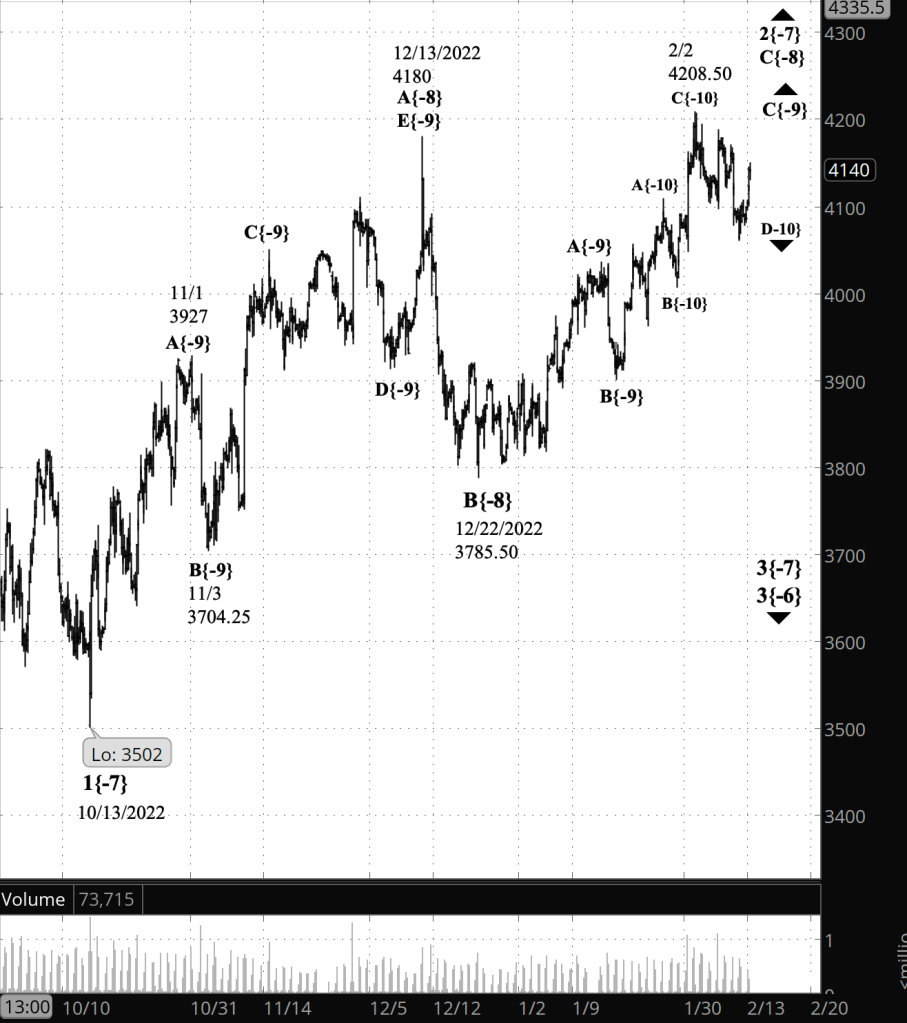
Half an hour before the closing bell. From a low of 4060.75 before the opening bell, the S&P 500 futures launched into a series of swings that appear to be a low degree upward correction within the much larger upward correction, wave 2{-7}, that began on October 13, 2022. The form of the swings, on a five-minute chart, resemble an ascending Triangle structure. No change in this morning’s analysis. I’ve updated the chart.

9:35 a.m. New York time

What’s happening now? The S&P 500 E-mini futures declined overnight, coming close to 4060 before bouncing back into the 4080s. The index has fallen nearly 150 points since the February 2 high, 4208.50, a decline of about 3.5%.

What does it mean? The upward correction that began on October 13, 2022 continues and is in its final phase. At a detailed level, the price in the declining next-to-the-last segment of a five-part movement. The final segment will likely rise above 4208.50 and when it ends, will also be the completion of the upward correction. A downtrend will follow, carrying the price below the correction’s starting point, 3502, and most likely significantly lower.

What is the alternative? The upward correction ended at the February 2 high, 4208.50, and the largely declining price movements since have been the first tentative steps a downtrend that will reach 3502 and likely much lower.

Why are there curly brackets on the chart? Each wave has a subscript. In print, subscripts are generally small numbers, which wouldn’t be easily read on a chart. So I’ve placed in curly brackets. A subscript indicates the wave’s place, its degree, within the fractal structure of the price movements. Directional price movements, called “waves’ in Elliott wave analysis, are complex on stock charts. Each wave contains smaller waves and is in turn contained by larger waves. Their sizes stretch from waves lasting a millisecond to those lasting for years and decades.

[S&P 500 E-mini futures at 3:30 p.m., 4-hour bars, with volume]

What does Elliott wave theory say?

These are the waves that are the basis of the analyses.

Principal analysis:

  • The upward correction, wave 2{-7}, continues.
  • It is in the third of three parts, upward wave C{-8}…
  • … which in turn is in its third and final subwave, rising wave C{-9}.
  • Wave C{-9} has five subwaves and is in the fourth, declining wave D{-10}.
  • Wave D{10} will be followed by rising wave E{-10}
  • A wave in wave E{-10}’s position normally will exceed the endpoint of the prior upward wave, 4208.50, which is wave C{-10}. That peak was attained on February 2.
  • The end of the wave E{-10} will also be the end of waves C{-9}, C{-8} and of the upward correction, wave 2{-7}.
  • Wave 3{-7} will follow, a powerful downtrend that will carry the price below the starting point of the correction, 3502, and most likely significantly below that level.

Alternativ:

  • The upward correction, wave 2{-7}, ended on February 2 at 4208.50 and downtrending wave 3{-7} is now underway.

All analyses:

  • This is all happening within wave 3{-6}, which began on August 16, 2022.
  • Wave 3{-6} is encompassed by a series of larger waves, the smaller within the larger, stretching up five degrees to wave 4{-1}, which began on January 4, 2022.
  • Wave 4{-1} is the next-to-the-last wave within a large expanding Diagonal Triangle, wave 5{0}, that began on December 26, 2018.

We Are Here.

These are the waves currently in progress under my principal analysis. Each line on the list shows the wave number, with the subscript in curly brackets, the traditional degree name, the starting date, the starting price of the S&P 500 E-mini futures, and the direction of the wave.

  • S&P 500 Index:
  • 5{+3} Supercycle, 7/8/1932, 4.40 (up)
  • 5{+2} Cycle, 12/9/1974, 60.96 (up)
  • 5{+1} Primary, 3/6/2009, 666.79 (up)
  • 5{0} Intermediate, 12/26/2018, 2346.58 (up)
  • S&P 500 Futures and index:
  • 4{-1} Minor, 1/4/2022, 4808.25 (down) (futures), 4818.62 (down) (index)
  • S&P 500 Futures:
  • 1{-2} Minute, 1/4/2022, 4808.25 (down)
  • 1{-3} Minuette, 1/4/2022, 4808.25 (down)
  • 1{-4} Subminuette, 1/4/2022, 4808.25 (down)
  • 1{-5} Micro, 1/4/2022, 4808.25 (down)
  • 3{-6} Submicro, 8/16/2022, 4327.50 (down)
  • 2{-7} Minuscule, 10/13/2022, 3502 (up)

Learning and other resources. Elliott wave analysis provides context, not prophecy. As the 20th century semanticist Alfred Korzybski put it in his book Science and Sanity (1933), “The map is not the territory … The only usefulness of a map depends on similarity of structure between the empirical world and the map.” And I would add, in the ever-changing markets, we can judge that similarity of structure only after the fact.

See the menu page Analytical Methods for a rundown on where to go for information on Elliott wave analysis.

By Tim Bovee, Portland, Oregon, February 10, 2023

Disclaimer

Tim Bovee, Private Trader tracks the analysis and trades of a private trader for his own accounts. Nothing in this blog constitutes a recommendation to buy or sell stocks, options or any other financial instrument. The only purpose of this blog is to provide education and entertainment.

No trader is ever 100 percent successful in his or her trades. Trading in the stock and option markets is risky and uncertain. Each trader must make trading decisions for his or her own account, and take responsibility for the consequences.

License
Creative Commons License

All content on Tim Bovee, Private Trader by Timothy K. Bovee is licensed under a Creative Commons Attribution-ShareAlike 4.0 International License.

Based on a work at www.timbovee.com.