SP500 Analysis

3:50 p.m. New York time

My trades. I’ve exited my long call position on GLD for a profit and updated the analysis with details.

3:30 p.m. New York time

Half an hour before the closing bell. The S&P 500 fell during the day, reaching within 2 points of yesterday’s low on the futures, and then rose again, so far staying below yesterday’s high, 4365, as wave 5 of Micro degree continues. No change in the analysis. I’ve updated the chart.

9:35 a.m. New York time

What’s happening now? The S&P 500 E-mini futures rose slightly in overnight trading while remaining between yesterday’s high and low.

What does it mean? The early stages of the rise from yesterday’s low continues within the larger rise that began October 1. Eventually — probably a month or more from now — the price will exceed the September 3 high of 4549.50. A move above the October 7 high, 4420.50, will strengthen the case for this principal scenario.

What’s the alternative? The downward correction that began October 7 is still underway. A move below the October 12 low of of 4317.25 will strengthen the case for this alternative scenario.

[S&P 500 E-mini futures at 3:30 p.m., 85-minute bars, with volume]

What does Elliott wave theory say? By my principal analysis, uptrending wave 5 of Minuscule degree began on October 12. So far it has been a tentative rise, with an internal rise (wave 1?), decline (wave 2?) and small rise (first step in wave 3 or another step in wave 2?). This is all happening within wave 5 of Micro degree, which began on October 1 and which will eventually work its way above the September 3 high, 4549.50

By my alternative analysis, the rise-decline-rise pattern since October 12 is a continuation of wave 4 of Minuscule degree, meaning the correction that began October 7 is still underway.

Learning and other resources. Elliott wave analysis provides context, not prophecy. As the 20th century semanticist Alfred Korzybski put it in his book Science and Sanity (1933), “The map is not the territory … The only usefulness of a map depends on similarity of structure between the empirical world and the map.” And I would add, we can judge that similarity of structure only after the fact.

See the menu page Analytical Methods for a rundown on where to go for information on Elliott wave analysis.

By Tim Bovee, Portland, Oregon, October 13, 2021

Disclaimer

Tim Bovee, Private Trader tracks the analysis and trades of a private trader for his own accounts. Nothing in this blog constitutes a recommendation to buy or sell stocks, options or any other financial instrument. The only purpose of this blog is to provide education and entertainment.

No trader is ever 100 percent successful in his or her trades. Trading in the stock and option markets is risky and uncertain. Each trader must make trading decisions for his or her own account, and take responsibility for the consequences.

License
Creative Commons License

All content on Tim Bovee, Private Trader by Timothy K. Bovee is licensed under a Creative Commons Attribution-ShareAlike 4.0 International License.

Based on a work at www.timbovee.com.

SP500 Analysis

3:30 p.m. New York time

Half an hour before the closing bell. The S&P 500 rose slightly during the session and then reversed slightly, and has continued to trade above its overnight low, as wave 5 of Minuscule degree continues to work through the early stages of its rise. No change in the analysis. I’ve updated the chart.

9:35 a.m. New York time

What’s happening now? The S&P 500 E-mini futures declined to a low of 4317.25 in overnight trading and then rose into the 4360s.

What does it mean? The three-leg pattern of the decline completes the correction that began on October 7, and the price has begun a rise that will eventually exceed the September 3 high of 4549.50. I have some uncertainty over whether the correction is indeed over, for reasons described in the alternative scenario.

What’s the alternative? It is possible to count the decline from October 7-12 as completing only the first leg of the correction, with an upward move (now underway) followed by another downward move. It is also possible that the rise that began last night is a separator wave that will be followed by a second corrective pattern in a compound structure, extending the correction and putting off the eventual rise to a new high.

[S&P 500 E-mini futures at 3:30 p.m., 85-minute bars, with volume]

What does Elliott wave theory say? Under my principle analysis, the decline from October 7-12 is wave 4 of Minuscule degree, with three waves of Subminuscule degree internally, A-B-C. Under my alternative analysis, that decline is wave A of Subminuscule degree with three waves of Bitsy degree internally. As always with Elliott, degree identity involves a lot of ambiguity that is often resolved only after the price movement is complete. It’s also possible, under the first alternative scenario, that Subminuscule waves A through C don’t complete the 4th wave correction, and instead, the rise that began last night is an X wave, which will be followed by a second corrective pattern in a compound structure.

Whichever scenario plays out, the correction will be followed by a 5th wave rise of Minuscule degree that will complete the parent, wave 1 of Submicro degree, whose parent, grandparent and great-grandparent waves, up four levels to Minute degree, are all 5th waves, within wave 3 of Minor degree, which began at the end of the pandemic crash last year, on February 23.

Learning and other resources. Elliott wave analysis provides context, not prophecy. As the 20th century semanticist Alfred Korzybski put it in his book Science and Sanity (1933), “The map is not the territory … The only usefulness of a map depends on similarity of structure between the empirical world and the map.” And I would add, we can judge that similarity of structure only after the fact.

See the menu page Analytical Methods for a rundown on where to go for information on Elliott wave analysis.

By Tim Bovee, Portland, Oregon, October 12, 2021

Disclaimer

Tim Bovee, Private Trader tracks the analysis and trades of a private trader for his own accounts. Nothing in this blog constitutes a recommendation to buy or sell stocks, options or any other financial instrument. The only purpose of this blog is to provide education and entertainment.

No trader is ever 100 percent successful in his or her trades. Trading in the stock and option markets is risky and uncertain. Each trader must make trading decisions for his or her own account, and take responsibility for the consequences.

License
Creative Commons License

All content on Tim Bovee, Private Trader by Timothy K. Bovee is licensed under a Creative Commons Attribution-ShareAlike 4.0 International License.

Based on a work at www.timbovee.com.
SP500 Analysis

3:30 p.m. New York time

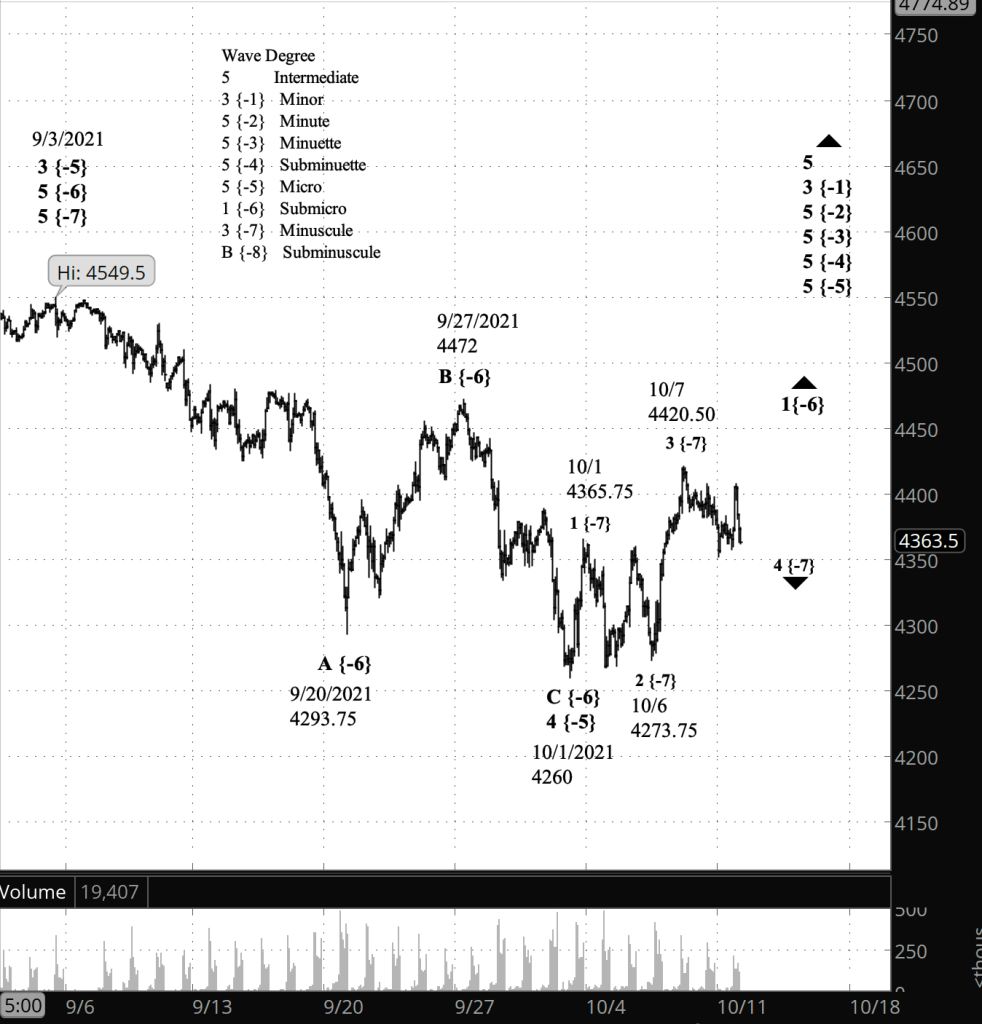
Half an hour before the closing bell. The S&P 500 fell into the afternoon from a morning high of 4407.50 on the futures, remaining above the Sunday night low. Wave 4 of Minuscule degree continues. No change in the analysis. Chart updated.

9:35 a.m. New York time

What’s happening now? The S&P 500 E-mini futures reached a low of 4352.25 when trading resumed Sunday evening and rose slightly.

What does it mean? The low and reversal were a continuation of a shallow correction within an uptrend. The low may have marked the end of the first of, most likely, three segments within the correction, although that is not a certainty.

What’s the alternative? It remains possible that the uptrend is in fact a separator within a larger ongoing downward correction. The separator will be followed by another corrective pattern in a compound structure.

[S&P 500 E-mini futures at 3:30 p.m., 80-minute bars, with volume]

What does Elliott wave theory say? Under principle scenario, the shallow correction — wave 4 of of Minuscule degree — began on October 7 and is possibly in the second segment internally, wave B of Subminuscule degree.

The pattern is happening within wave 5 of Micro degree, which began on October 1. The 5th wave will eventually move above the preceding 3rd wave, which ended on September 3 at 4549.50, and the move could carry the price significantly above that level.

Under the alternative scenario, wave 5 of Micro degree has not yet begun. Instead, wave 4 of Micro degree is forming a compound structure, and the rise from October 1 is wave X of Submicro degree, separating the now complete first corrective pattern from a second corrective pattern that has not yet begun.

Learning and other resources. Elliott wave analysis provides context, not prophecy. As the 20th century semanticist Alfred Korzybski put it in his book Science and Sanity (1933), “The map is not the territory … The only usefulness of a map depends on similarity of structure between the empirical world and the map.” And I would add, we can judge that similarity of structure only after the fact.

See the menu page Analytical Methods for a rundown on where to go for information on Elliott wave analysis.

By Tim Bovee, Portland, Oregon, October 11, 2021

Disclaimer

Tim Bovee, Private Trader tracks the analysis and trades of a private trader for his own accounts. Nothing in this blog constitutes a recommendation to buy or sell stocks, options or any other financial instrument. The only purpose of this blog is to provide education and entertainment.

No trader is ever 100 percent successful in his or her trades. Trading in the stock and option markets is risky and uncertain. Each trader must make trading decisions for his or her own account, and take responsibility for the consequences.

License
Creative Commons License

All content on Tim Bovee, Private Trader by Timothy K. Bovee is licensed under a Creative Commons Attribution-ShareAlike 4.0 International License.

Based on a work at www.timbovee.com.
SP500 Analysis

3:30 p.m. New York time

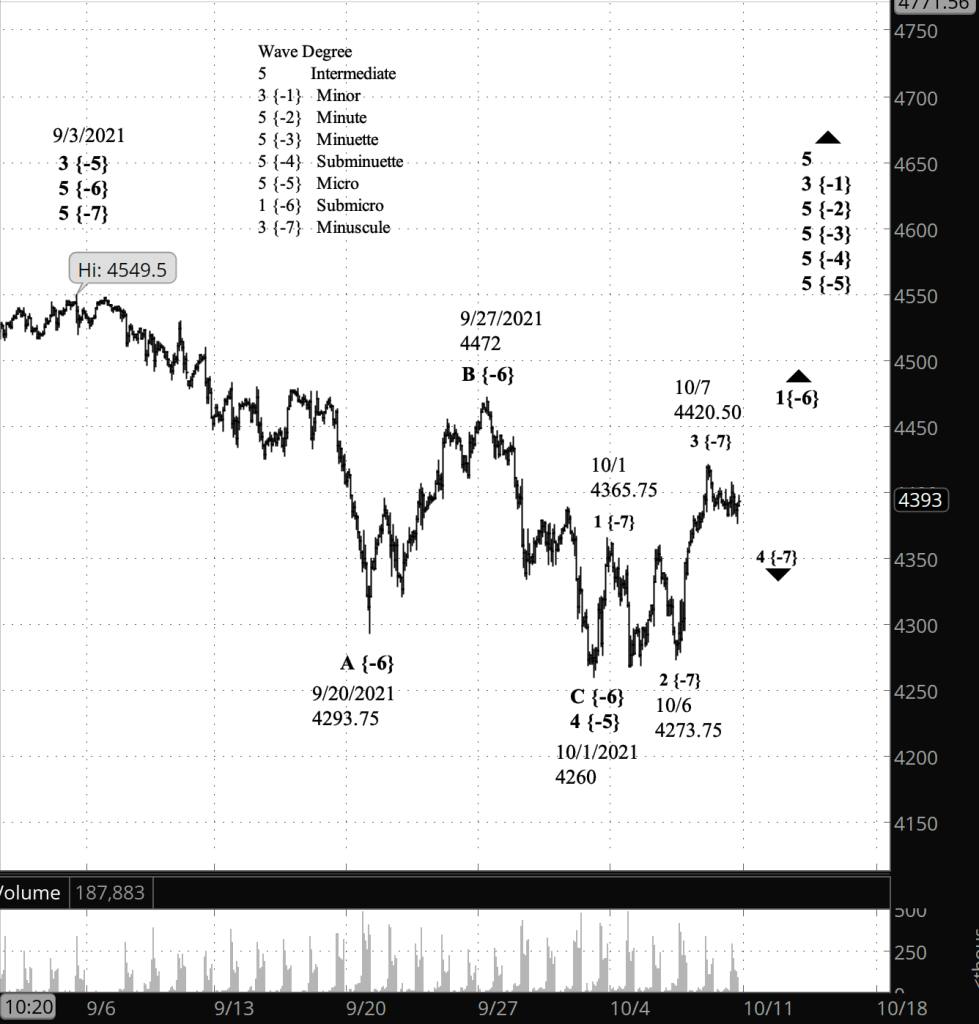
Half an hour before the closing bell. The S&P 500 spent the session trading in a narrow range as the sideways-trending wave 4 of Minuscule degree continued on its course. No change in the analysis. I’ve updated the upper chart.

2:50 p.m. New York time

My trades. I’ve exited my long call position on GM for a profit.

9:35 a.m. New York time

What’s happening now? In overnight trading, the S&P 500 E-mini futures declined by nearly 40 points from yesterday’s peak of 4420.50.

What does it mean? The decline is the second correction in the early stage of the uptrend that began October 1. Once the correction is over, the price will resume its rise, eventually exceeding 4549.50, the high set on September 3.

What’s the alternative? It remains possible that the rise from October 1 is a separator between two corrective patterns in a compound structure. Under this scenario the uptrend lies in the future, having not yet begun.

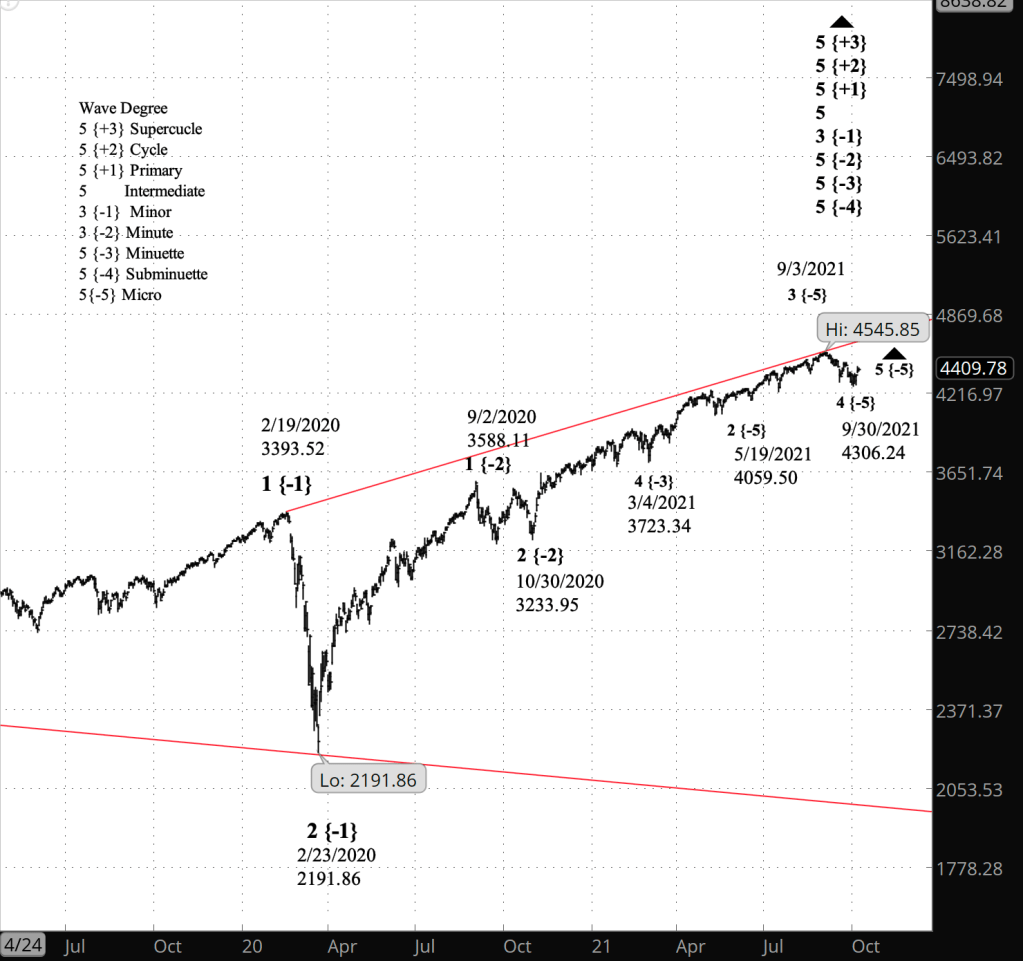
Charts. The upper chart is a near-term view of the S&P 500 E-mini futures; the lower chart shows a longer-term view, dating back to the early pandemic crash.

[S&P 500 E-mini futures at 3:30 p.m., 80-minute bars, with volume]
[S&P 500 index at 9:33 a.m., daily bars]

What does Elliott wave theory say? Upper chart: Under my principle analysis, the S&P 500 has begun a 4th wave of Minuscule degree within wave 1 of Submicro degree. Minuscule 4, which will most likely be a Flat, will be followed by a 5th wave to the upside which, when it ends, will also mark the end of Submicro 1 and the beginning of a Submicro 2 correction. Second waves often retrace much of the preceding 1st wave, and so the price could again dip below 4300, while remaining above 4260, the low of October 1. The end of Submicro 2 will mark the start of wave 3 of Submicro degree, which will carry the price beyond recent levels.

Under the alternative scenario, the rise from October 1 and the future decline is wave X of Submicro degree, marking the division among two corrective patterns in a compound structure.

The lower chart shows the boundaries of an expanding Diagonal Triangle that began in December 2018. The 3rd wave of Minor degree is presently at the upper boundary. It will eventually approach the lower boundary as a 4th wave and then rise again to the upper boundary in a 5th and final wave.

Learning and other resources. Elliott wave analysis provides context, not prophecy. As the 20th century semanticist Alfred Korzybski put it in his book Science and Sanity (1933), “The map is not the territory … The only usefulness of a map depends on similarity of structure between the empirical world and the map.” And I would add, we can judge that similarity of structure only after the fact.

See the menu page Analytical Methods for a rundown on where to go for information on Elliott wave analysis.

By Tim Bovee, Portland, Oregon, October 8, 2021

Disclaimer

Tim Bovee, Private Trader tracks the analysis and trades of a private trader for his own accounts. Nothing in this blog constitutes a recommendation to buy or sell stocks, options or any other financial instrument. The only purpose of this blog is to provide education and entertainment.

No trader is ever 100 percent successful in his or her trades. Trading in the stock and option markets is risky and uncertain. Each trader must make trading decisions for his or her own account, and take responsibility for the consequences.

License
Creative Commons License

All content on Tim Bovee, Private Trader by Timothy K. Bovee is licensed under a Creative Commons Attribution-ShareAlike 4.0 International License.

Based on a work at www.timbovee.com.
GM Trade

General Motors Co. (GM)

Update 10/8/2021: The price of my GM option rose sharply after the company announced revenue expectations from electric vehicles. Although the Fisher Transform indicator continues to give an up signal, I took my profits.

I exited my long call position 105 days before expiration, for a $4.75 credit per contract/share, a profit before fees of 120 per contract. Shares were trading at $58.53, up $2.09 from the entry level.

The Implied Volatility Rank at exit was 18.8%, down 0.1 point from the entry level.

I decided to exit despite the lack of an indicator signal based on past experiences wherein a price jump based on news is followed by a decline. I considered it better to exit now and put the money to work elsewhere.

Shares rose by 3.7% over one day for a +1,352% annual rate. The options position produced a 33.8% return for a +12,338% annual rate.


I have entered a long call on GM, using options that trade for the last time 106 days hence, on January 21, 2022. The premium is a $3.55 debit per contract share and the stock at the time of entry was priced at 56.44.

The Implied Volatility Ratio stands at 18.9%

Premium:$3.55Expire OTM
GM-long optionStrikeOddsDelta
Call
Long57.5058.0%49

The maximum risk is $355 per contract and the maximum reward is uncapped.

How I chose the trade. The Fisher Transform indicator gave a buy signal, and I confirmed that it was unlikely to be a whipsaw based on Elliott wave analysis.

By Tim Bovee, Portland, Oregon, October 7, 2021

Disclaimer

Tim Bovee, Private Trader tracks the analysis and trades of a private trader for his own accounts. Nothing in this blog constitutes a recommendation to buy or sell stocks, options or any other financial instrument. The only purpose of this blog is to provide education and entertainment.

No trader is ever 100 percent successful in his or her trades. Trading in the stock and option markets is risky and uncertain. Each trader must make trading decisions for his or her own account, and take responsibility for the consequences.

License
Creative Commons License

All content on Tim Bovee, Private Trader by Timothy K. Bovee is licensed under a Creative Commons Attribution-ShareAlike 4.0 International License.

Based on a work at www.timbovee.com.
SPY Trade

SPDR S&P 500 ETF Trust (SPY)

Lot 1

Update 10/19/2021: I exited my bull put options spread position on SPY 31 days before expiration, for a $0.54 debit per contract/share, a profit before fees of $80 per contract. Shares were trading at $450.17, up $8.92 from the entry level.

The Implied Volatility Rank at exit was 10.4%, down 10.89 points from the entry level.

My decision to exit was based on on my rule that requires exiting an options position once it has reached 50% of maximum potential profit.

Shares declined by 2% over 12 days for a +62% annual rate. The options position produced a 148.1% return for a +4,506% annual rate.


I have entered a short bull put spread on SPY, using options that trade for the last time 43 days hence, on November 19. The premium is a $1.12 credit per contract share and the stock at the time of entry was priced at $441.25.

The Implied Volatility Ratio stands at 20.1%

Premium:$1.12Expire OTM
SPY-bull spreadStrikeOddsDelta
Puts
Long428.0066.0%31
Break-even434.1263.0%34
Short433.0060.0%37

The risk/reward ratio is 3.5:1, with maximum risk of $388 and maximum reward of $112 per contract.

The premium is 44.8% of the width of the position’s short/long spread. The profit zone covers a 5% move to the downside.

How I chose the trade. I entered the traded based on Elliott wave analysis, concluding that wave 3 of Minuscule degree within wave 1 of Submicro degree began on October 6, a set-up that has upside potential.

By Tim Bovee, Portland, Oregon, October 7, 2021

Disclaimer

Tim Bovee, Private Trader tracks the analysis and trades of a private trader for his own accounts. Nothing in this blog constitutes a recommendation to buy or sell stocks, options or any other financial instrument. The only purpose of this blog is to provide education and entertainment.

No trader is ever 100 percent successful in his or her trades. Trading in the stock and option markets is risky and uncertain. Each trader must make trading decisions for his or her own account, and take responsibility for the consequences.

License
Creative Commons License

All content on Tim Bovee, Private Trader by Timothy K. Bovee is licensed under a Creative Commons Attribution-ShareAlike 4.0 International License.

Based on a work at www.timbovee.com.
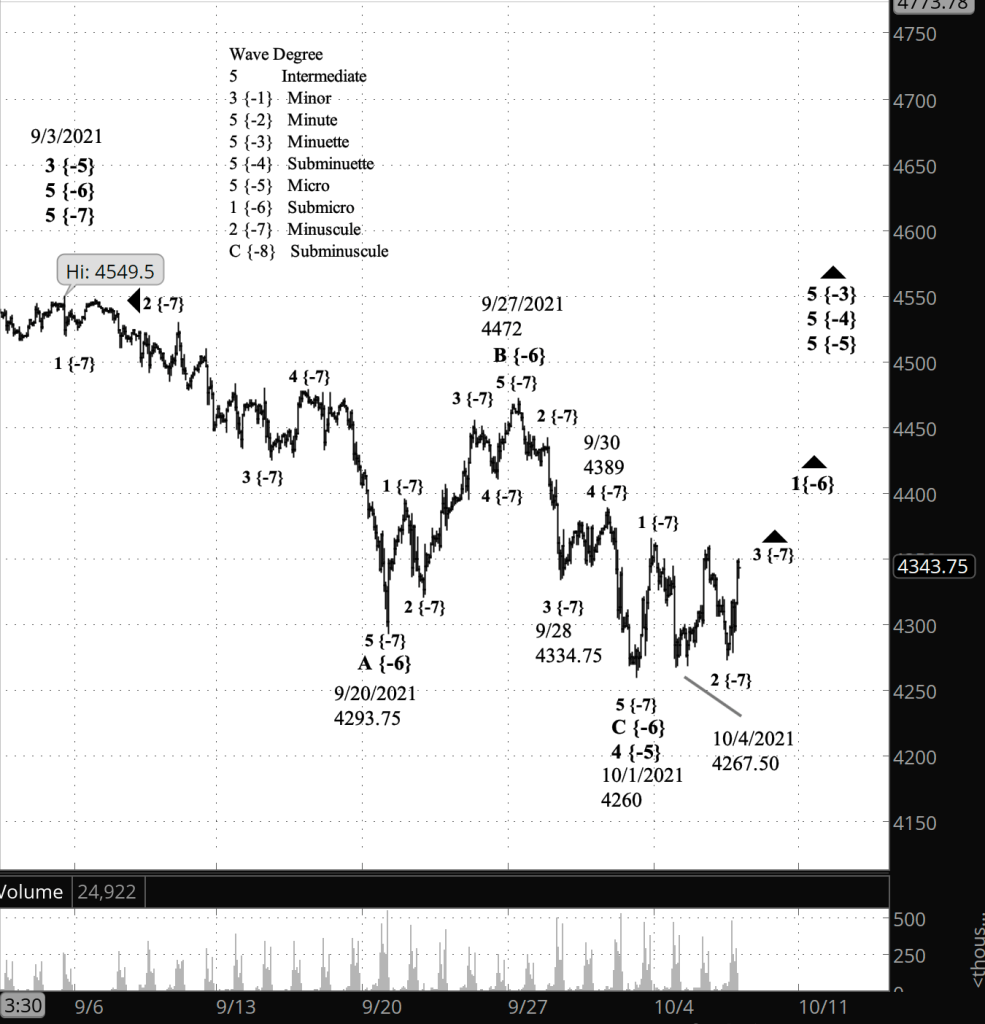
SP500 Analysis

3:30 p.m. New York time

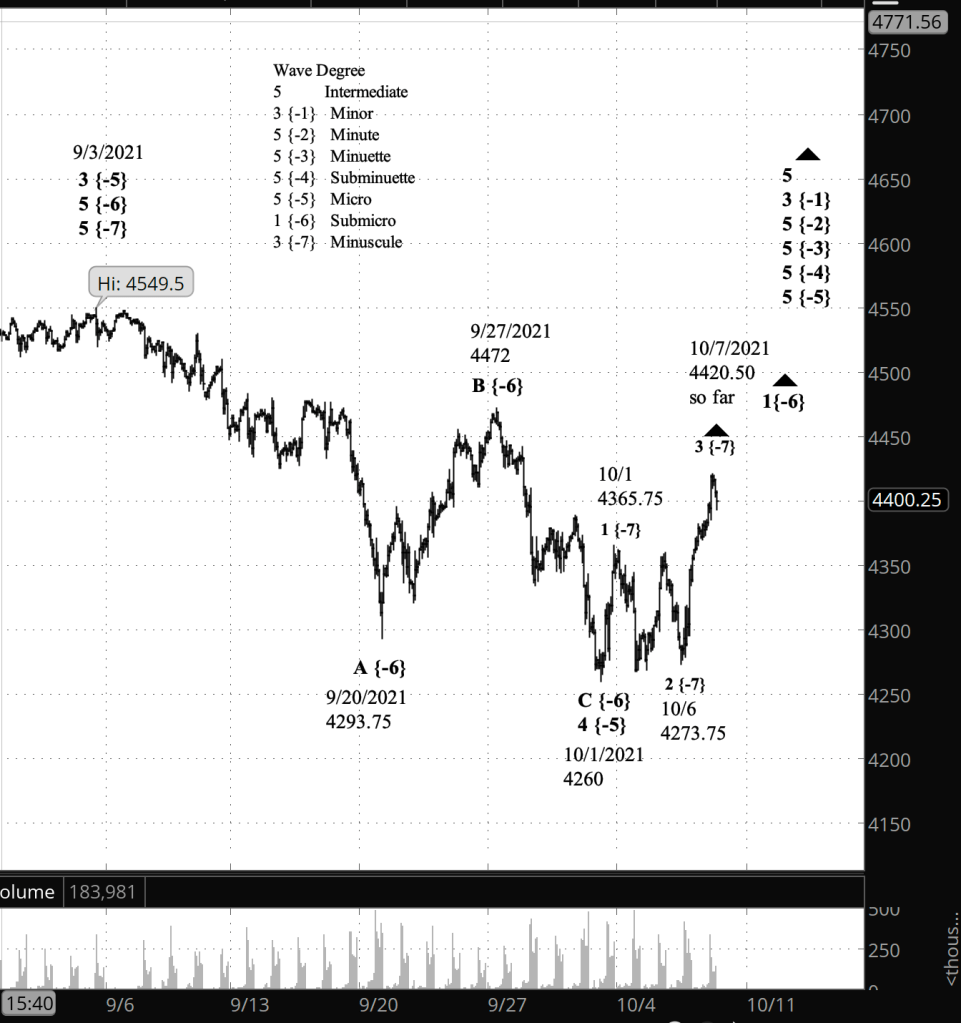
Half an hour before the closing bell. The S&P 500 rose during the day, reaching a peak of 4420.50 on the futures, 4429.97 on the index. Late in the day it reversed, falling slightly. All of this is happening within uptrending wave 3 of Minuscule degree within wave 1 of Submicro degree. That is, the late-day decline is a correction within an uptrend. No change in the analysis. I’ve updated the chart.

2:30 p.m. New York time

My trades. I’ve entered a short bull put spread position on SPY and a long call option on GM, and exited a long put on XLY.

9:35 a.m. New York time

What’s happening now? The S&P 500 E-mini futures continued climbing overnight, exceeding the high of October 1.

What does it mean? The break beyond the range of the correction than ran from October 1 to October 6 adds weight to a scenario that says the correction has ended and a rise is underway that will eventually exceed the September 3 high of 4549.50.

What’s the alternative? If the price reverses and falls back to the 4270s, then the alternative scenario comes into play: The present rise separates two corrective patterns in a compound structure.

[S&P 500 E-mini futures at 3:30 p.m., 80-minute bars, with volume]

What does Elliott wave theory say? Under my principle analysis, the rise that began yesterday is wave 3 of Minuscule degree within wave 1 of Submicro degree within 5th waves of successively higher degrees — Micro, Subminuette and Minuette — within wave 5 of Minute degree within wave 3 of Minor degree, which began on October 30, 2020.

The September 3 peak ended wave 3 of Micro degree, and wave 4 of Micro degree ended on October 1. The present wave 5 of MIcro degree will eventually reach to new heights, beyond the end of the preceding 3rd wave.

If the price reverses before reverses from its present level, plus or minus, then wave 4 of Micro degree is still underway and is forming a compound structure. Under this alternative scenario, the present wave is wave X of Submicro degree and will be followed by another corrective pattern, most likely a Zigzag or a Flat.

Learning and other resources. Elliott wave analysis provides context, not prophecy. As the 20th century semanticist Alfred Korzybski put it in his book Science and Sanity (1933), “The map is not the territory … The only usefulness of a map depends on similarity of structure between the empirical world and the map.” And I would add, we can judge that similarity of structure only after the fact.

See the menu page Analytical Methods for a rundown on where to go for information on Elliott wave analysis.

By Tim Bovee, Portland, Oregon, October 7, 2021

Disclaimer

Tim Bovee, Private Trader tracks the analysis and trades of a private trader for his own accounts. Nothing in this blog constitutes a recommendation to buy or sell stocks, options or any other financial instrument. The only purpose of this blog is to provide education and entertainment.

No trader is ever 100 percent successful in his or her trades. Trading in the stock and option markets is risky and uncertain. Each trader must make trading decisions for his or her own account, and take responsibility for the consequences.

License
Creative Commons License

All content on Tim Bovee, Private Trader by Timothy K. Bovee is licensed under a Creative Commons Attribution-ShareAlike 4.0 International License.

Based on a work at www.timbovee.com.

FXI Trade

Lot 3

iShares China Large-Cap ETF (FXI)

Update 11/11/2021: I exited my short bear call spread position on FXI eight days before expiration, for a $2.05 debit per contract/share, a loss before fees of $1.37 per contract. Shares were trading at $41.37, up $3.78 from the entry level.

The Implied Volatility Rank at exit was 39.1%, down 20.1 points from the entry level.

My decision to exit was based on a sudden reversal of the price to the upside as the expiration date approached, cutting my losses before they grew even larger.

Shares rose by 10.1% over 36 days for a +102% annual rate. The options position produced a 66.8% loss for a -678% annual rate.


I have entered a short bear call spread on FXI, using options that trade for the last time 44 days hence, on November 19. The premium is a $0.68 credit per contract share and the stock at the time of entry was priced at $37.59.

The Implied Volatility Ratio stands at 59.2%

Premium:$0.68Expire OTM
FXI-bear call spreadStrikeOddsDelta
Calls
Long42.0091.0%11
Break-even39.6879.5%23.5
Short39.0068.0%36

The premium is 45.3% of the width of the positions short/long spread. The profit zone covers a 5.6% move to the upside.

The risk/reward ratio is 3.4:1, with maximum risk of $232 and maximum reward of $68 per contract.

How I chose the trade. FXI has moved below resistance, the low of October 4, in what I count as a 5th wave in the decline that began on September 7. I set the strike price just above the peak of the most recent upward move within the descent. My read of the chart is that FXI is in a downward movement that will take a few weeks to work through.

By Tim Bovee, Portland, Oregon, October 6, 2021

Disclaimer

Tim Bovee, Private Trader tracks the analysis and trades of a private trader for his own accounts. Nothing in this blog constitutes a recommendation to buy or sell stocks, options or any other financial instrument. The only purpose of this blog is to provide education and entertainment.

No trader is ever 100 percent successful in his or her trades. Trading in the stock and option markets is risky and uncertain. Each trader must make trading decisions for his or her own account, and take responsibility for the consequences.

License
Creative Commons License

All content on Tim Bovee, Private Trader by Timothy K. Bovee is licensed under a Creative Commons Attribution-ShareAlike 4.0 International License.

Based on a work at www.timbovee.com.

SP500 Analysis

3:30 p.m. New York time

Half an hour before the closing bell. The S&P 500 reversed direction and resumed its climb while remaining below the two prior peaks since the low that ended wave 4 of Micro degree on October 1. No change in the analysis. I’ve updated the chart, labeling the overnight low as the end of wave 2 of Minuscule degree.

11:15 a.m. New York time

My trades. I’ve entered a bear call options spread on FXI. I’ve exited my position on PAAS for a loss.

9:35 a.m. New York time

What’s happening now? The S&P 500 E-mini futures declined sharply in overnight trading, remaining above 4260, the low of October 1 that ended the decline that began on September 3.

What does it mean? The decline is the third leg of a low-level correction within the rise that began on October 1.

What’s the alternative? If the price should move below 4260, then something else is going on, such as the decline that began September 3 not yet being complete.

[S&P 500 E-mini futures at 3:30 p.m., 75-minute bars, with volume]

What does Elliott wave theory say? By my principle analysis, the low of 4260 on October 1 ended wave 4 of Micro degree. The subsequent rise was wave 1 of Minuscule degree within wave 5 of Micro degree, the decline that followed is wave 2 of Minuscule degree. That 2nd wave correction has so far reached a low of 4267.50, on October 4, just 7-1/2 points above the end of wave 4 of Micro degree. A fall below the end of that 4th wave would suggest that the correction is still underway. On the chart I’ve marked wave 2 of Minuscule degree as still being underway. However, it’s possible that wave 2 ended at the October 4 low, and the second low in overnight trading wave 2 of Subminuscule degree within wave 3 of Minuscule degree. As always, the degrees are ambiguous — the market provides no “You Are Here” signs.

Learning and other resources. Elliott wave analysis provides context, not prophecy. As the 20th century semanticist Alfred Korzybski put it in his book Science and Sanity (1933), “The map is not the territory … The only usefulness of a map depends on similarity of structure between the empirical world and the map.” And I would add, we can judge that similarity of structure only after the fact.

See the menu page Analytical Methods for a rundown on where to go for information on Elliott wave analysis.

By Tim Bovee, Portland, Oregon, October 6, 2021

Disclaimer

Tim Bovee, Private Trader tracks the analysis and trades of a private trader for his own accounts. Nothing in this blog constitutes a recommendation to buy or sell stocks, options or any other financial instrument. The only purpose of this blog is to provide education and entertainment.

No trader is ever 100 percent successful in his or her trades. Trading in the stock and option markets is risky and uncertain. Each trader must make trading decisions for his or her own account, and take responsibility for the consequences.

License
Creative Commons License

All content on Tim Bovee, Private Trader by Timothy K. Bovee is licensed under a Creative Commons Attribution-ShareAlike 4.0 International License.

Based on a work at www.timbovee.com.

SPCE Trade

Virgin Galactic Ltd. (SPCE)

I have entered a put on SPCE, using options that trade for the last time 108 days hence, on January 21, 2022. The premium is a $3.25 debit per contract share and the stock at the time of entry was priced at $22.30..

The Implied Volatility Ratio stands at 11.1%, and time decay is running at 0.0154.

Premium:$3.35Expire ITM%
SPCE-long optionStrikeOddsDelta
Put
Long22.0057%41

Maximum risk is $335 per contract and maximum reward is uncapped.

How I chose the trade. I entered the trade based on a down signal from the Fisher Transform indicator, confirmed by the price falling below resistance.

By Tim Bovee, Portland, Oregon, October 5, 2021

Disclaimer

Tim Bovee, Private Trader tracks the analysis and trades of a private trader for his own accounts. Nothing in this blog constitutes a recommendation to buy or sell stocks, options or any other financial instrument. The only purpose of this blog is to provide education and entertainment.

No trader is ever 100 percent successful in his or her trades. Trading in the stock and option markets is risky and uncertain. Each trader must make trading decisions for his or her own account, and take responsibility for the consequences.

License
Creative Commons License

All content on Tim Bovee, Private Trader by Timothy K. Bovee is licensed under a Creative Commons Attribution-ShareAlike 4.0 International License.

Based on a work at www.timbovee.com.