Tuesday, September 22, 2020

9:50 a.m. New York time

What’s happening now? The S&P 500 index reversed into an uptrending correction, reaching a high so far of 3,298.18.

What does it mean? The correction, when complete, will be followed by a renewed decline that will carry the price to the the lower boundary of the price channel. Assuming that takes a couple of days, the price would reach down into the 3,170s, more or less.

[S&P 500 index, 5-minute bars]

What is the alternative? The timing of the decline is the question. Corrections sometimes trace extended patterns, and the longer the correction goes on, the further down the lower boundary drops. Target setting is quite problematic within this context.

What does Elliott wave theory say? The correction is wave 4 of the Subminuette degree, and the final push to the downside will be wave 5. Under Elliott’s Rule of Alternation, a 4th wave correction tends to trace a different pattern than the prior 2nd wave correction. Subminuette wave 2 was a simple Zigzag pattern, a single three wave climb to the upside. Under the rule, Subminuette 4 has a likelihood of being a Flat pattern — a sideways trend — or a complex pattern, stringing together several Flats or mixing Flats and Zagzags. At this point it’s impossible to understand how Subminuette wave 4 will play out.

My trading strategy. At present my short iron condor positions on SPY are at 21.5% of maximum potential profit (my target is 50%). I’m continuing to hold my shares in the inverse fund SDS.

Read More »
Monday, September 21, 2020

10 a.m. New York time

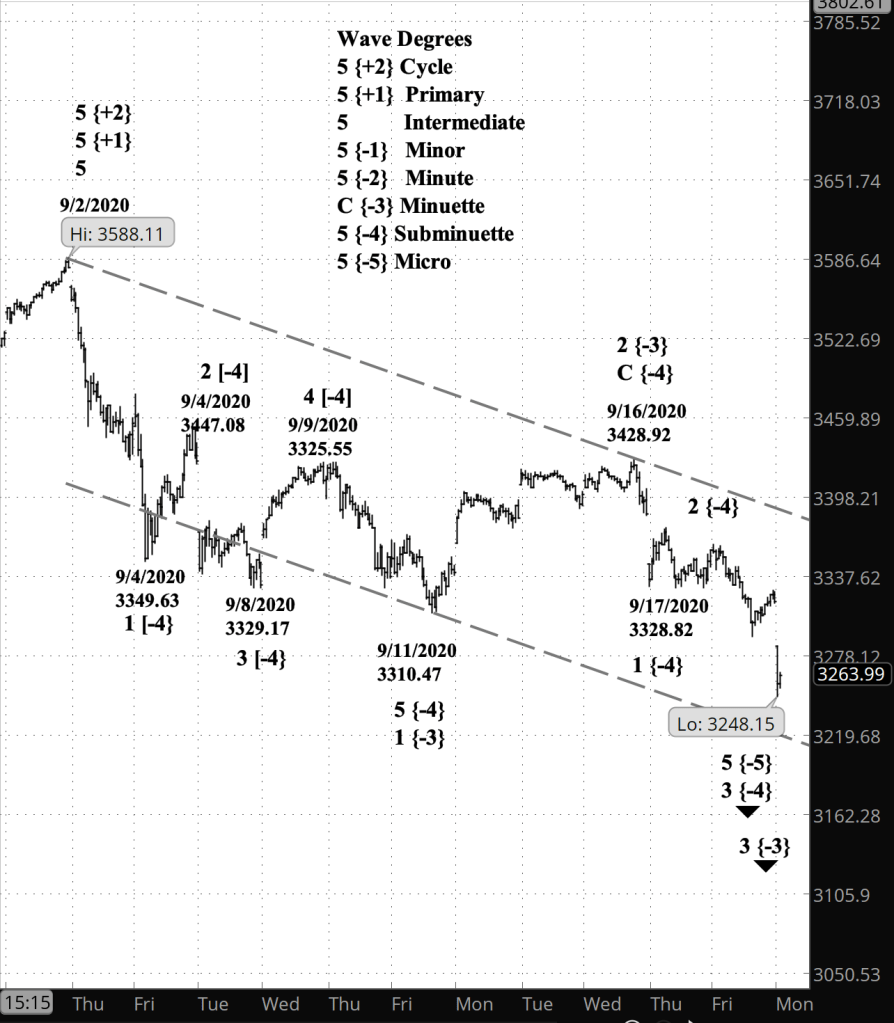
What’s happening now? The S&P 500 index is continuing the decline that began on September 16. The price so far has reached a low of 3,248.15, down 5.3% from the September 16 high.

What does it mean? By falling below the low of September 11, which was 3,310.47, the index has confirmed that the correction is over and the downtrend has resumed.

[S&P 500, 15-minute bars]

What does Elliott wave theory say? Wave 3 of Minuette degree began on September 16. The Subminuette degree, one smaller than the Minuette, is in its 3rd wave, which, based on the price channel, appears likely to end around 3,200 or below.

My trading strategy. I shall exit my short iron condor position on SPY, an exchange-traded fund that tracks the S&P 500, around the end of Subminuette wave 3. I shall continue to hold my shares in SDS, an ETF that tracks the inverse of the index, preferably into next year, when some of the lots will become eligible for the long-term tax break.

Read More »

Friday, September 18, 2020

10 a.m. New York time

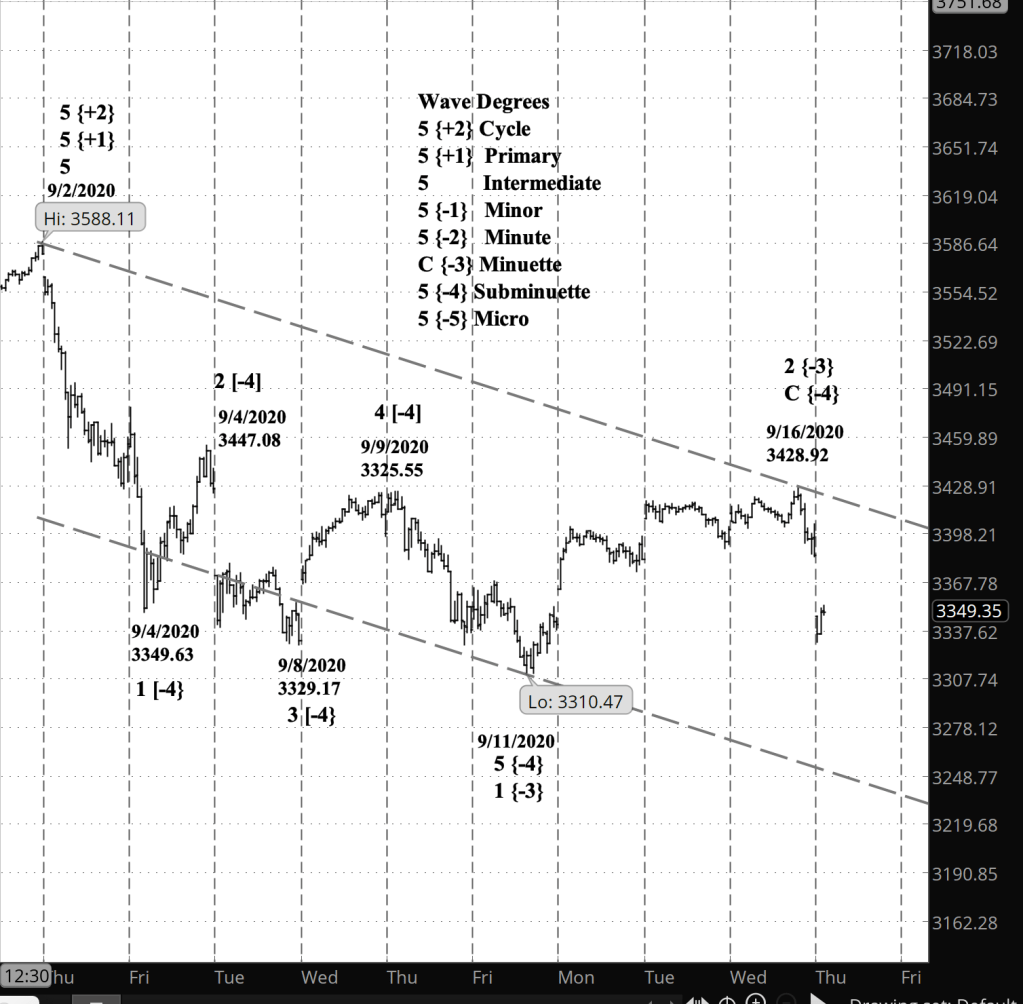
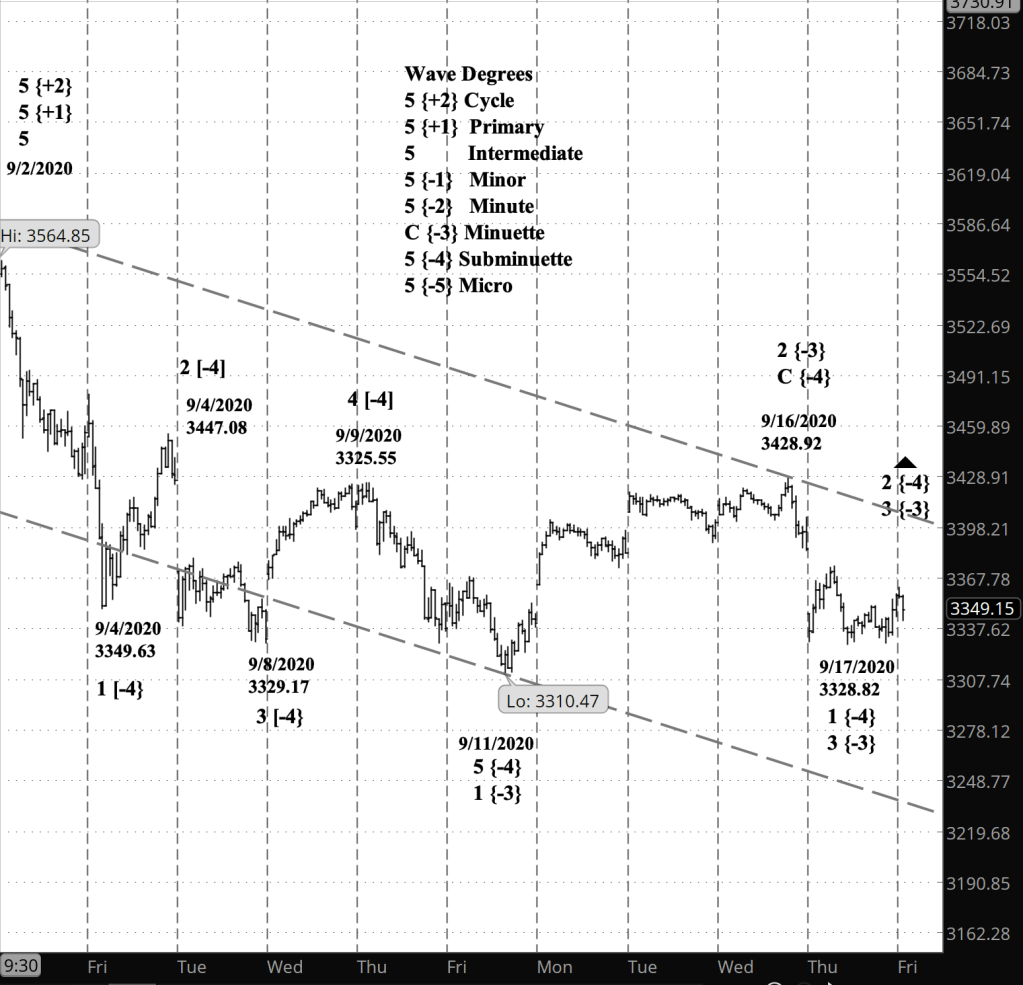
What’s happening now? The S&P 500 index moved slightly lower at mid-day Thursday, to 3,328.82, tentatively marking the end of the decline that began the day before.

What does it mean? The index has begun an upward correction within the downward move that began on Thursday. The correction will remain below 3,428.92, the starting point of the decline.

What is the alternative? It is still possible for the price to reverse and extend the correction that began September 11 from 3,310.47. I find it to be unlikely but can’t rule it out entirely.

[S&P 500 index, 15-minute bars]

What does Elliott wave theory say? Thursday’s low begins the uptrending wave 2 of Subminuette degree within downtrending wave 3 of Minuette degree. At the Subminuette 2 will end below 3,428.92, the starting point of Minuette 3 and within it, Subminuette 1. A firm rule of Elliott wave analysis posits that a 2nd wave cannot move beyond the start of the preceding 1st wave. Subminuette 2 will be followed by Subminuette 3, which will take the price down to new lows in the decline since September 16

My trading strategy. My short iron condor options position on SPY, the exchange-traded fund based on the S&P 500, is 28 days from expiration and seven days until management day, when I take profits. It is trading at 12% of maximum potential profit, and I shall exit at 50% of max.

Also, I’m holding inverse exchange-traded fund shares on the S&P 500 (SDS is the symbol).

Read More »

SPY Analysis

SPDR S&P 500 ETF Trust (SPY)

Lot 2020-16

Update 9/25/2020: I exited my short iron condor position on SPY 21 days before expiration, for a $1.27 credit per contract/share, a profit before fees of $22 per contract, or 17.3%. Shares were trading at $332.91, down $4.10 from the entry level.

My decision to exit was based on my Management Day rule that requires managing profitable trades 21 days before expiration. Also, the exit decision, like the entry, was based on Elliott wave analysis. While I held the contract, SPY traced the second half of wave 3 of Subminuete degree to the downside, all of Subminuette 4 to the upside, and at exit was, tentatively, in Micro 2 of Subminuette 5. Micro 2 was uptrending and increased my profit. Once Micro 3 began, it would cut into my profits, so I decided to exit. Had the Elliott wave count suggested a greater likelihood of profit, then I would have delayed exit past Management Day.

Shares declined by 1.2% over eight days for a -56% annual rate. The options position produced a 17.3% return for a +790% annual rate.


I have entered a short iron condor on SPY, using options that trade for the last time 29 days hence, on October 16. The premium is a $1.49 credit per contract share and the stock at the time of entry was priced at $337.56.

The implied volatility rank (IVR) stands at 19.9.

Premium: $1.49 Expire OTM
SPY-iron condor Strike Odds Delta
Long 356.00 87.0% 14
Break-even 352.49 83.5% 17
Short 351.00 80.0% 20
Puts
Short 314.00 80.0% 19
Break-even 310.49 82.0% 17
Long 309.00 84.0% 15

The premium is 29.8% of the width of the position’s wings.
The profit zone covers a 4.6% move to the upside and an 8.5% move to the downside, for a range of 13.1%.

The risk/reward ratio is 2.4:1, with maximum risk of $351 and maximum reward of $149 per contract.

Elliott Wave Analysis. I entered the 2nd wave of Subminuette degree within the 3rd wave of Minuette degree, which began September 16. This gives me the opportunity to capture the 3rd wave of a 3rd wave decline. I’ll exit either 21 days before expiration if profitable, on September 25, or at the completion of Minuette wave 3, whichever comes first.

By Tim Bovee, Portland, Oregon, September 17, 2020

Read More »

Thursday, September 17, 2020

10:55 a.m. New York time

I’ve decided to enter an iron condor on the S&P 500 exchange-traded fund SPY, with the options expiring October 16.

10 a.m. New York time

What’s happening now? The S&P 500 index moved slightly lower at mid-day Thursday, to 3,328.82, tentatively marking the end of the decline that began the day before.

What does it mean? The index has begun an upward correction within the downward move that began on Thursday. The correction will remain below 3,428.92, the starting point of the decline.

What is the alternative? It is still possible for the price to reverse and extend the correction that began September 11 from 3,310.47. I find it to be unlikely but can’t rule it out entirely.

[S&P 500 index, 15-minute bars]

What does Elliott wave theory say? Thursday’s low begins the uptrending wave 2 of Subminuette degree within downtrending wave 3 of Minuette degree. At the Subminuette 2 will end below 3,428.92, the starting point of Minuette 3 and within it, Subminuette 1. A firm rule of Elliott wave analysis posits that a 2nd wave cannot move beyond the start of the preceding 1st wave. Subminuette 2 will be followed by Subminuette 3, which will take the price down to new lows in the decline since September 16

My trading strategy. My short iron condor options position on SPY, the exchange-traded fund based on the S&P 500, is 28 days from expiration and seven days until management day, when I take profits. It is trading at 12% of maximum potential profit, and I shall exit at 50% of max.

Also, I’m holding inverse exchange-traded fund shares on the S&P 500 (SDS is the symbol).

Read More »

Wednesday, September 16, 2020

10 a.m. New York time

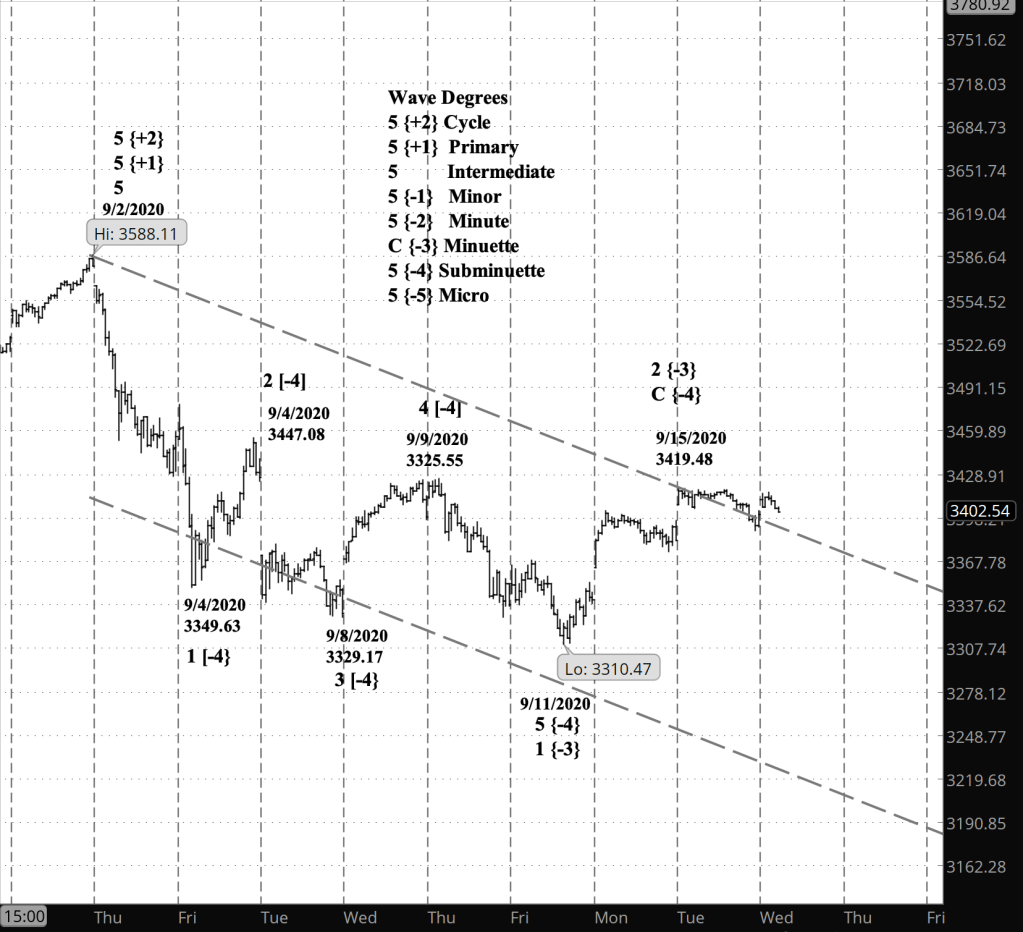
What’s happening now? The S&P 500 index moved slightly lower at mid-day Thursday, to 3,328.82, tentatively marking the end of the decline that began the day before.

What does it mean? The index has begun an upward correction within the downward move that began on Thursday. The correction will remain below 3,428.92, the starting point of the decline.

What is the alternative? It is still possible for the price to reverse and extend the correction that began September 11 from 3,310.47. I find it to be unlikely but can’t rule it out entirely.

[S&P 500 index, 15-minute bars]

What does Elliott wave theory say? Thursday’s low begins the uptrending wave 2 of Subminuette degree within downtrending wave 3 of Minuette degree. At the Subminuette 2 will end below 3,428.92, the starting point of Minuette 3 and within it, Subminuette 1. A firm rule of Elliott wave analysis posits that a 2nd wave cannot move beyond the start of the preceding 1st wave. Subminuette 2 will be followed by Subminuette 3, which will take the price down to new lows in the decline since September 16

My trading strategy. My short iron condor options position on SPY, the exchange-traded fund based on the S&P 500, is 28 days from expiration and seven days until management day, when I take profits. It is trading at 12% of maximum potential profit, and I shall exit at 50% of max.

Also, I’m holding inverse exchange-traded fund shares on the S&P 500 (SDS is the symbol).

Read More »

Tuesday, September 15, 2020

10 a.m. New York time

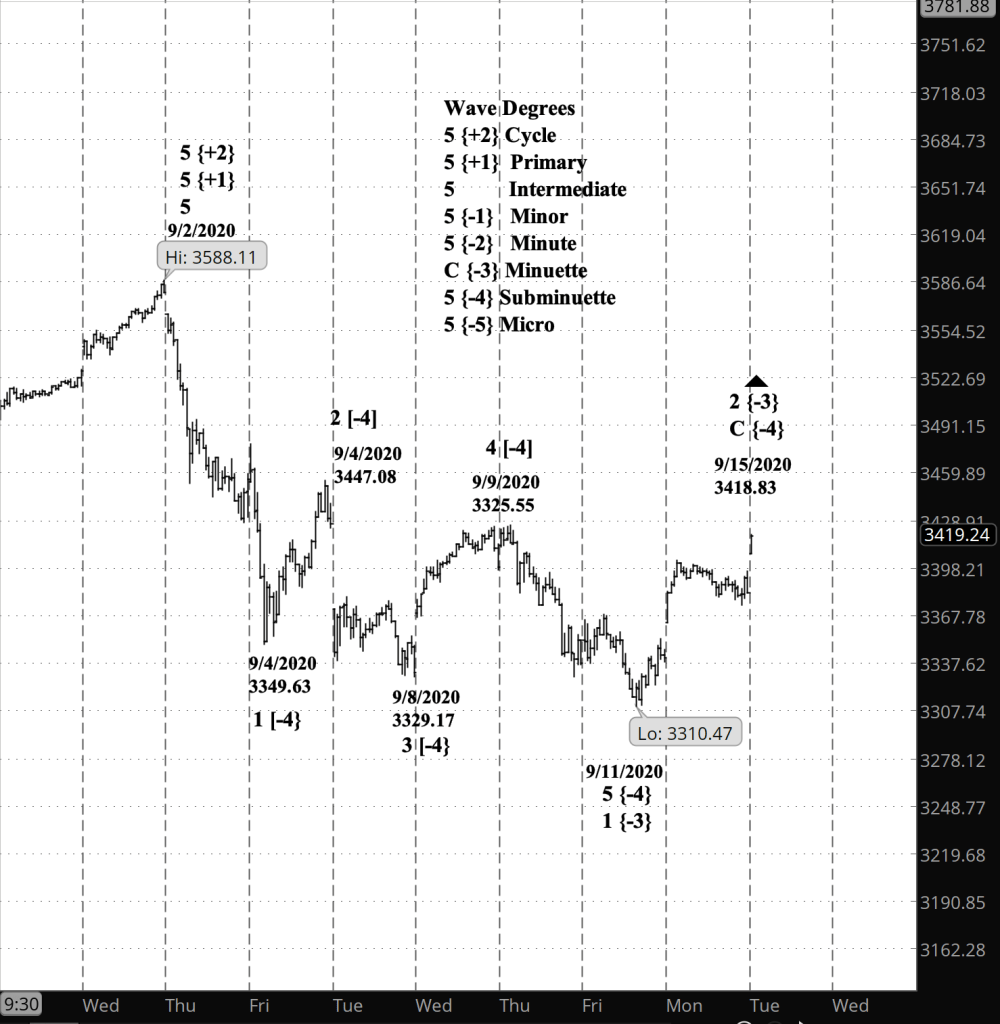
What’s happening now? The S&P 500 index moved slightly lower at mid-day Thursday, to 3,328.82, tentatively marking the end of the decline that began the day before.

What does it mean? The index has begun an upward correction within the downward move that began on Thursday. The correction will remain below 3,428.92, the starting point of the decline.

What is the alternative? It is still possible for the price to reverse and extend the correction that began September 11 from 3,310.47. I find it to be unlikely but can’t rule it out entirely.

[S&P 500 index, 15-minute bars]

What does Elliott wave theory say? Thursday’s low begins the uptrending wave 2 of Subminuette degree within downtrending wave 3 of Minuette degree. At the Subminuette 2 will end below 3,428.92, the starting point of Minuette 3 and within it, Subminuette 1. A firm rule of Elliott wave analysis posits that a 2nd wave cannot move beyond the start of the preceding 1st wave. Subminuette 2 will be followed by Subminuette 3, which will take the price down to new lows in the decline since September 16

My trading strategy. My short iron condor options position on SPY, the exchange-traded fund based on the S&P 500, is 28 days from expiration and seven days until management day, when I take profits. It is trading at 12% of maximum potential profit, and I shall exit at 50% of max.

Also, I’m holding inverse exchange-traded fund shares on the S&P 500 (SDS is the symbol).

Read More »

Monday, September 14, 2020

10 a.m. New York time

What does it mean? The index has begun an upward correction within the downward move that began on Thursday. The correction will remain below 3,428.92, the starting point of the decline.

What is the alternative? It is still possible for the price to reverse and extend the correction that began September 11 from 3,310.47. I find it to be unlikely but can’t rule it out entirely.

What’s happening now? The S&P 500 index moved slightly lower at mid-day Thursday, to 3,328.82, tentatively marking the end of the decline that began the day before.

What does it mean? The index has begun an upward correction within the downward move that began on Thursday. The correction will remain below 3,428.92, the starting point of the decline.

What is the alternative? It is still possible for the price to reverse and extend the correction that began September 11 from 3,310.47. I find it to be unlikely but can’t rule it out entirely.

[S&P 500 index, 15-minute bars]

What does Elliott wave theory say? Thursday’s low begins the uptrending wave 2 of Subminuette degree within downtrending wave 3 of Minuette degree. At the Subminuette 2 will end below 3,428.92, the starting point of Minuette 3 and within it, Subminuette 1. A firm rule of Elliott wave analysis posits that a 2nd wave cannot move beyond the start of the preceding 1st wave. Subminuette 2 will be followed by Subminuette 3, which will take the price down to new lows in the decline since September 16

My trading strategy. My short iron condor options position on SPY, the exchange-traded fund based on the S&P 500, is 28 days from expiration and seven days until management day, when I take profits. It is trading at 12% of maximum potential profit, and I shall exit at 50% of max.

Also, I’m holding inverse exchange-traded fund shares on the S&P 500 (SDS is the symbol).

Read More »

Friday, September 11, 2020

10 a.m. New York time

What’s happening now? The S&P 500 index moved slightly lower at mid-day Thursday, to 3,328.82, tentatively marking the end of the decline that began the day before.

What does it mean? The index has begun an upward correction within the downward move that began on Thursday. The correction will remain below 3,428.92, the starting point of the decline.

What is the alternative? It is still possible for the price to reverse and extend the correction that began September 11 from 3,310.47. I find it to be unlikely but can’t rule it out entirely.

[S&P 500 index, monthly bars]

What does Elliott wave theory say? Thursday’s low begins the uptrending wave 2 of Subminuette degree within downtrending wave 3 of Minuette degree. At the Subminuette 2 will end below 3,428.92, the starting point of Minuette 3 and within it, Subminuette 1. A firm rule of Elliott wave analysis posits that a 2nd wave cannot move beyond the start of the preceding 1st wave. Subminuette 2 will be followed by Subminuette 3, which will take the price down to new lows in the decline since September 16

My trading strategy. My short iron condor options position on SPY, the exchange-traded fund based on the S&P 500, is 28 days from expiration and seven days until management day, when I take profits. It is trading at 12% of maximum potential profit, and I shall exit at 50% of max.

Also, I’m holding inverse exchange-traded fund shares on the S&P 500 (SDS is the symbol).

Read More »

Thursday, September 10, 2020

10 a.m. New York time

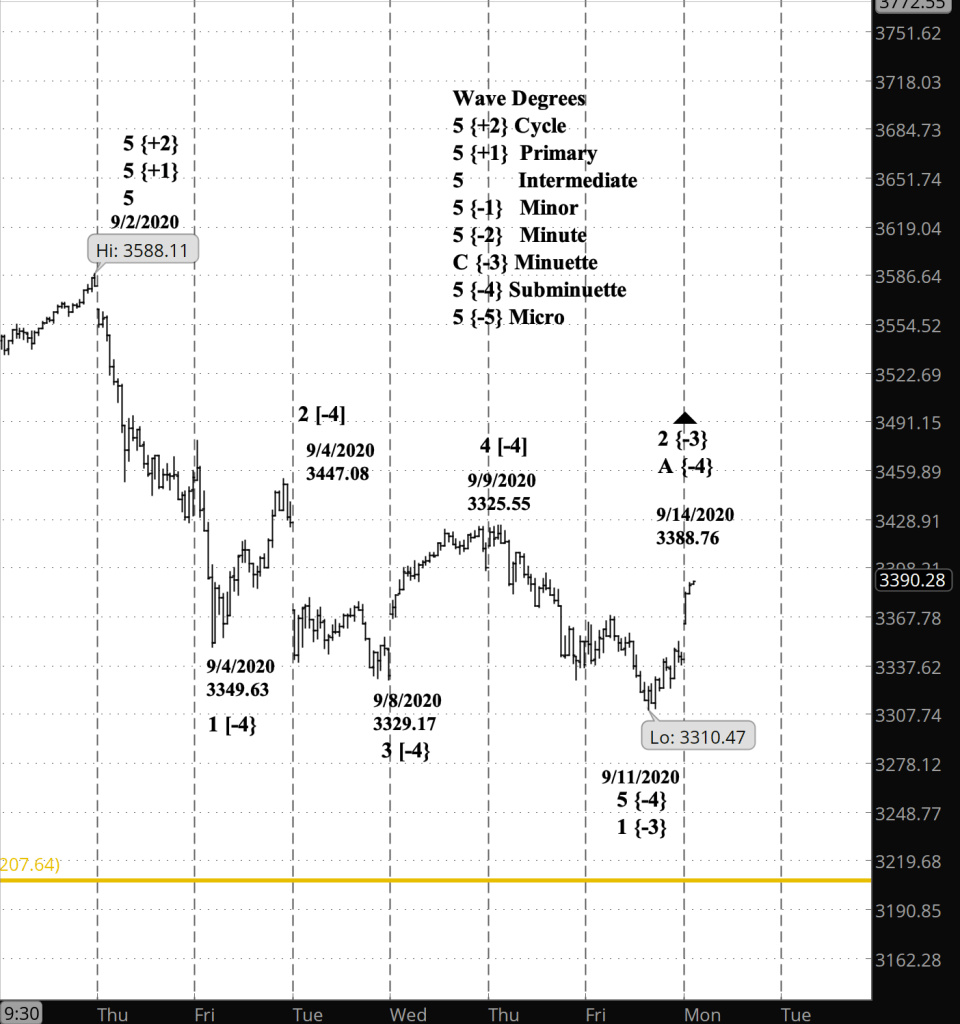
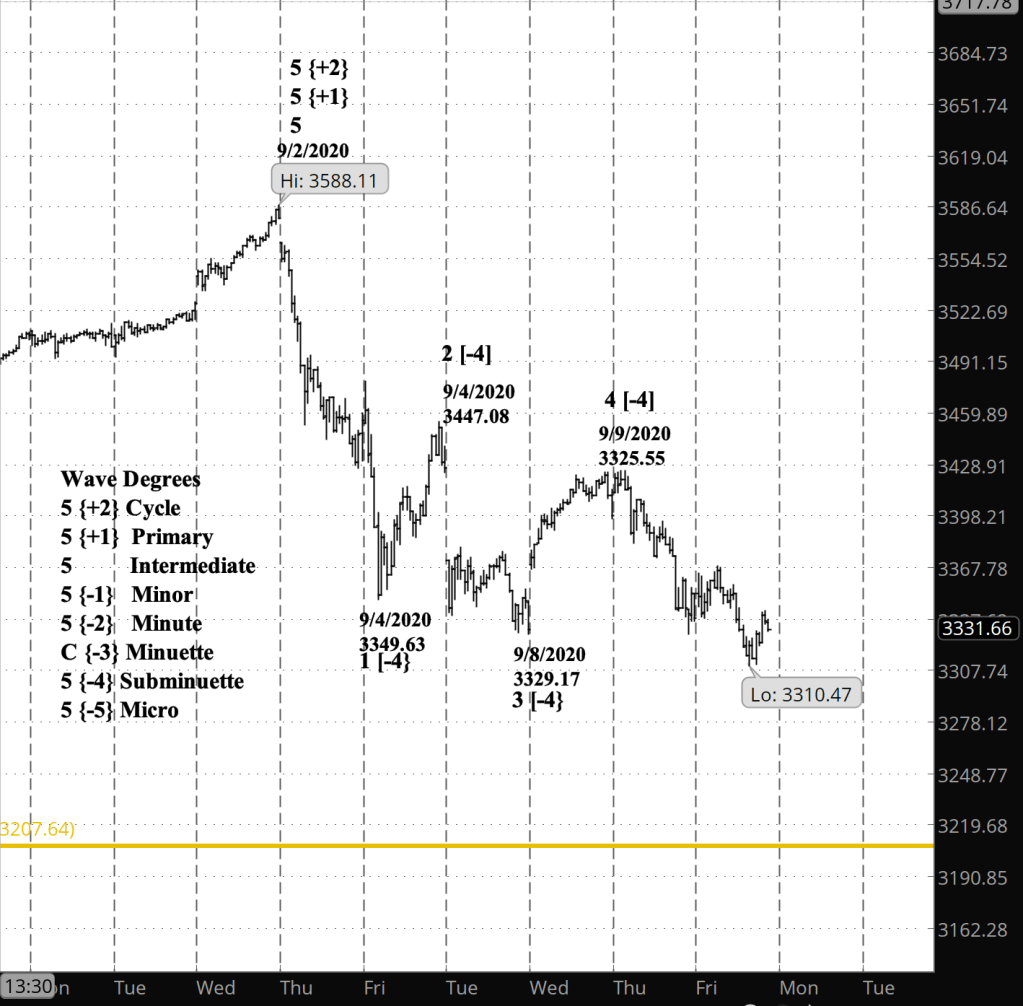
The S&P 500 index in the near term continues its decline on Friday afternoon. Under Elliott wave rules, the lowest Subminuette wave 5 of the index can go on this move and remain a valid count is 3207.64 (the gold line). See my discussion yesterday for the reasoning behind it.

[S&P 500 index, 15-minute bars]

10 a.m. New York time

What’s happening now? The S&P 500 index moved slightly lower at mid-day Thursday, to 3,328.82, tentatively marking the end of the decline that began the day before.

What does it mean? The index has begun an upward correction within the downward move that began on Thursday. The correction will remain below 3,428.92, the starting point of the decline.

What is the alternative? It is still possible for the price to reverse and extend the correction that began September 11 from 3,310.47. I find it to be unlikely but can’t rule it out entirely.

What does Elliott wave theory say? Thursday’s low begins the uptrending wave 2 of Subminuette degree within downtrending wave 3 of Minuette degree. At the Subminuette 2 will end below 3,428.92, the starting point of Minuette 3 and within it, Subminuette 1. A firm rule of Elliott wave analysis posits that a 2nd wave cannot move beyond the start of the preceding 1st wave. Subminuette 2 will be followed by Subminuette 3, which will take the price down to new lows in the decline since September 16

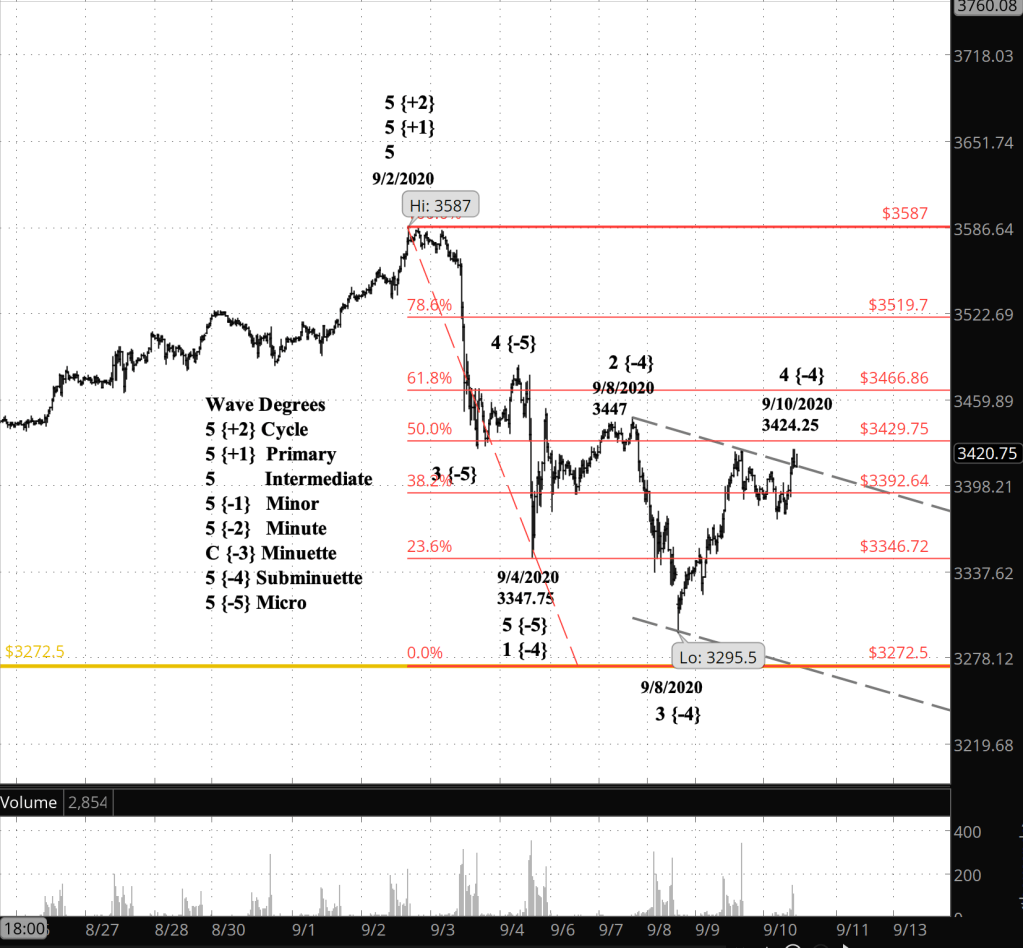
If it turns out that Subminuette wave 5 — the end of Minuette wave 1 — moves below 3424.25, the my count was invalid: Either wave 5 isn’t really a 5th wave or wave 3 is longer than I counted it. As always in Elliott wave analysis, when the ensuing movement on the chart discredits an earlier count, then the chart wins, I recount and move on. And there’s no requirement for a 5th wave to move beyond the end of the preceding 3rd wave, so Subminuette wave 5 could end well above the 3424.25 level.

After Minuette wave 1 comes to an end, the market will reverse course in an upward correction, Minuette wave 2. The Elliott rules tell us that wave 2 can’t move beyond the start of wave 1, which sets a cap on wave 2 of 3587 on the E-mini futures chart — 3588.11 on the index. There’s no requirement that the price go that high. Common stopping points are the Fibonacci levels — 61.8% at 3466.86 or 78.6% at 3519.70. (I’ve placed a Fibonacci level overly in red.)

Read More »