ORCL Analysis

Oracle Corp. (ORCL)

Update 9/18/2018: ORCL dropped sharply after earnings were published and then quickly recovered most of the temporary loss. I exited at 36.5% of maximum potential profit. Shares were at $48.65, and the debit on my options was $1.90, producing a profit of $109 per contract.

Shares declined by 1.3% over my one-day holding period, or a -489% annual rate. The options position produced a +57.4% return for a +20,939% annual rate.


I have entered a short iron fly spread on ORCL, using options that trade for the last time 32 days hence, on Oct. 19. The premium is a $2.99 credit and the stock at the time of entry was priced at $49.31.

I made the decision to enter the trade in my account based on an earnings announcement.

The profit zone for this position is between $51.99 on the upside and $45.99 on the downside.

ORCL publishes earnings on Sept. 19 after the opening bell.

Read More »

Live: Monday, Sept. 17, 2018

12:50 p.m. New York time

I have entered a short iron fly options position on ORCL.

11:05 a.m. New York time

ORCL publishes earnings after the closing bell, and I shall analyze it as a potential earnings play. Given the nature of the broader markets, I’m leaning at this point toward a non-directional iron fly strategy.

SPY and the S&P 500 are trading within the prior day’s range

Here’s the present state of my options holdings:

sym option debit share price curr % max profit options days left
AAPL 4.05 220.00 (4.1) 11
AMD 1.03 31.99 (5.1) 18
GNRC 1.10 57.61 9.1 32

… and my shares holdings:

sym share price net result %
AAPL 220.00 -1.8%
CHK 4.04 1.0%
FXI 41.66 1.1%
SPXU 32.99 -18.7%
VNQI 56.85 0.1%

By Tim Bovee, Portland, Oregon, Sept. 17, 2018

Read More »

The Week Ahead: Housing, and my favorite Fed report

log_cabin

Housing dominates a week largely devoid of other major economic reporting. Housing starts, a leading indicator, will be published Wednesday at 8:30 a.m. New York time, and existing home sales — the larger part of the market — on Thursday at 10 a.m.

A third housing report, generally thought of as being of lesser importance, is the housing market index, produced by the National Association of Home Builders. It will be released on Tuesday at 10 a.m.

My favorite Federal Reserve report, the quarterly Financial Accounts of the United States (Z.1), will be published on Thursday at noon. It has no market impact to speak of, but for a broader view it is nonpareil. The report lists the assets and liabilities of the U.S. economy — private sector and public sector. I find it be more exciting reading than my other big-picture standbys: The monthly Gross Domestic Product report from the U.S. Bureau of Economic Analysis and the Beige Book, published eight times a year by the Federal Reserve.

Read More »

Shares: AAPL, CHK, FXI

Apple Inc. (AAPL)

Chesapeake Energy Corp. (CHK)

iShares China Large-Cap ETF (FXI)

What to do with an orphaned account? In this case, it’s a Roth IRA account that got hit hard by losses last year, leaving only a small amount of cash? Especially if, like me, you’re retired and so can no longer put new funds to fill the tax-deferred account.

It’s too little money to productively trade using options. The only conceivable strategy is one that has long been anathema to me: Buy shares and hold them, praying that Fortuna will smile upon them.

I did that bit of housekeeping this afternoon, establish a small number long-share positions in AAPL, CHK and FXI.

There’s very little strategy behind these choices.

AAPL because, you know, Apple. They’ll eventually produce a roaring success, they’re smart and focused, they have a lot of cash, and they like to do stock buybacks to keep shareholders happy.

That left a few bucks remaining, so I had to fit prices to what I could afford. I chose CHK because its the oil business, which often moves independently of the broad markets (and also as an homage to my father, who got his start in business as a partner/accountant of a drilling contractor firm in Oklahoma), and FXI because China, although a wildcard at this point, seems to have a long-term strategic plan that I suspect will result in a rapid recovery, no matter how much tariff pressure it faces from the U.S.

The AAPL entry price was $223.96 per share, CHK $4.00 and FXI $41.21.

By Tim Bovee, Portland, Oregon, Sept. 14, 2018

Read More »

Live: Friday, Sept. 4, 2018

2:35 p.m. New York time

I did a bit of housekeeping to open positions on a zombie account, one that had been depleted by circumstances with no chance of replenishing it. I entered small long-shares positions in AAPL, CHK and FXI.

10 a.m. New York time

SPY and the S&P 500 are trading within the prior day’s range, and my positions are similarly calm as the market day opens.

Here’s the state of my options holdings:

sym option debit share price curr % max profit options days left
AAPL 2.88 224.92 26.0 14
AMD 0.93 31.28 5.1 21
GNRC 1.30 57.56 (7.4) 35

… and my shares holdings:

sym share price net result %
SPXU 32.61 -19.60%
VNQI 56.83 0.04%

I have no trades in sight today, as I wait for the funding of my new brokerage account with TastyWorks to clear.

I shall post my look at economic reporting and other events during the coming week, The Week Ahead, on Saturday.

By Tim Bovee, Portland, Oregon, Sept. 14, 2018

Read More »

Shares: VNQI

Global ex-U.S. Real Estate ETF (VNQI)

Update 11/1/2018: I’ve exited VNQI for a loss in order to raise funds for other purposes, and to escape the possibility of further loss, given my increasingly bearish assessment of the markets.

Exiting brought in a $54.64 credit, $2.17 less than what I paid for the shares at entry.

The shares position produced a loss of 3.8% over 49 days for a -28% annual rate.


I’ve entered a long shares position VNQI. The entry price was $56.81. VNQI invests in real estate outside of the United States. It is a counterpart to Vanguard’s mutual fund VGXRX.

I entered the position as an income play. Since VNQI is an exchange-traded fund, it is more liquid than my Treasury bills, and less risky than my option trades.

VNQI has an expense ratio of 0.14%, with its top holdings in Japan, Hong Kong and China. Of the 625 stocks in the fund’s portfolio, 21% are in emerging markets and 79% in developed countries.

The fund pays dividends quarterly, with the present rate being 5.12%. The next dividend is due in late September.

By Tim Bovee, Portland, Oregon, Sept. 13, 2018

Read More »

Live: Thursday, Sept. 13, 2018

2:40 p.m. New York time

I’ve entered a shares position on the international real-estate exchange-traded VNQI.

10:10 a.m. New York time

SPY has opened above the prior day’s range, producing an opening gap. In terms of Elliott wave analysis, it remains below the Aug. 29 peak, although barely so. A break above that peak, $291.74, would cause me to reassess my analysis.

For my volatility positions, my practice for iron condors and directional spreads is to exit at 50% of maximum potential profit.

AAPL, which expires Sept. 28, stands at 22% of max this morning in the wake of Wednesday’s product announcements. AMD, expiring Oct. 5, and GNRC, expiring Oct. 19, are in loss territory, with AMD at -14.3% of max and GNRC at -3.3%.

By Tim Bovee, Portland, Oregon, Sept. 13, 2018

Read More »

GNRC Analysis

Generac Holdings Inc. (GNRC)

Update 10/1/2018:  I exited my short iron  position on GNRC at 50% of maximum potential profit, my designated exit point for that strategy. I bought the options back for $0.59 debit, for a $0.62 profit. Shares stood at $57.77 when I exited.

The share price fell for much of the holding period but remained within the profitable range. Implied volatility was fairly steady, declining a little but then rrising a bit. IV stood at 31% when I exited, compared to 35% at entry.

Shares declined by 1.8% over 18 days, or a -36% annual rate. The options position produced a +105.1% return for a +2,131% annual rate.


I have entered a short iron condor spread on GNRC, using options that trade for the last time 37 days hence, on Oct. 19. The premium is a $1.21 credit and the stock at the time of entry was priced at $57.77.

I made the decision to enter the trade in my account based on high implied volatility.

The profit zone for this position is between $61.21 on the upside and $53.71 on the downside.

Read More »

Live: Wednesday, Sept. 12, 2018

2:35 p.m. New York time

I’m passing for now on LLY without a full analysis.

12:05 p.m. New York time

I have entered an iron condor position on GNRC. As it turns out, the funds in my new TastyWorks account have a five-day hold, a normal practice for the brokerage, and so I placed the trade using my TD Ameritrade account.

10:50 a.m. New York time

SPY is trading within yesterday’s range. I see no need to revise my Elliott wave analysis.

Volatility plays: My position on AAPL remains below the profit zone at the open. The company announces new iPhones and other products today at 1 p.m. New York time. My AMD position is in the zone..

I shall resume searching out new volatility plays today, now that my account on TastyWorks has been funded. I’m looking for stocks with high implied volatility that appear to have stalled for now. My preferred structure is the iron condor.

I’ll be looking first at GNRC and LLY.

By Tim Bovee, Portland, Oregon, Sept. 12, 2018

Read More »

Live: Tuesday, Sept. 11, 2018

10:25 a.m. New York time

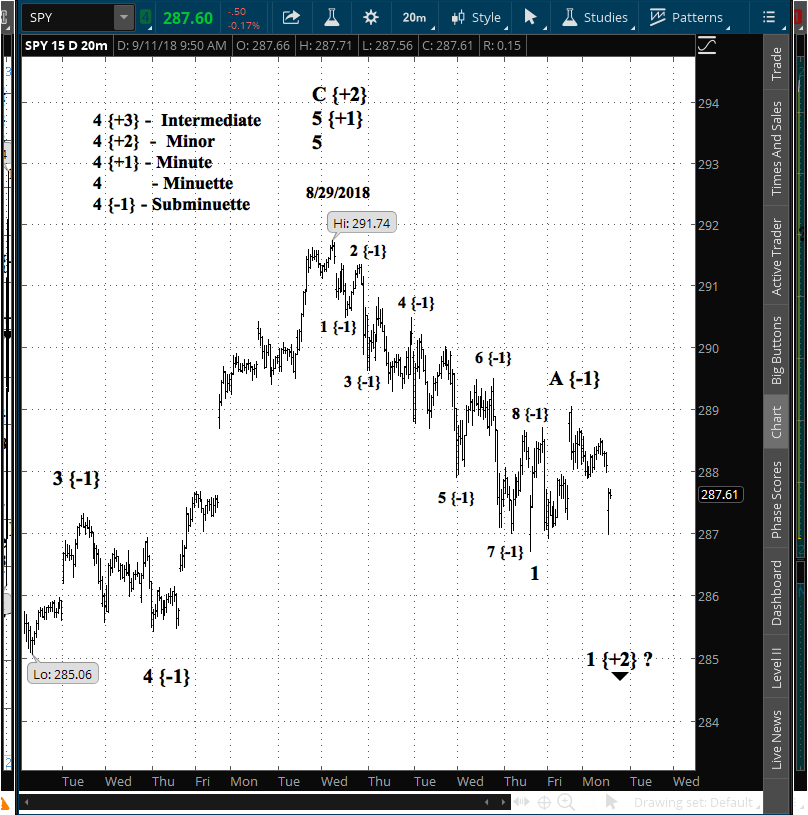
spy20180911
SPY, 15 days, 20-minute bars

I’ve revisited my Elliott wave analysis of SPY, the fund that tracks the S&P 500. The poorly differentiated nature of the waves within the decline  beginning Aug. 29 had left me scratching my head in puzzlement.

The answer, I believe, is to count the decline as an extended wave, which is said to occur within most impulse waves. I’ve rarely seen an extended 1st wave, and that threw me of. The leading Elliottician of our age, Robert Prechter, says that extensions occur most often in 3rd waves, and I’ve often seen them in the 5th.

Extensions occur in impulse waves — the main trend — rather than in countertrend corrections. That strengthens the case for the present decline being a 1st wave of Minor degree {+2} rather than an X wave continuation.

SPY is now in a 2nd wave correction in the Minuette degree, and when that is complete, should begin a 3rd wave that will provide a significant decline.

AAPL is slightly below the profit zone of my position, and AMD is in the zone. Both positions are based on working the odds implied by the implied volatility.

Once my new TastyWorks brokerage account is funded, I’ll be using it for odds plays, reserving my present TD Ameritrade account for Elliott wave plays. TD Ameritrade’s ThinkOrSwim platform has excellent charting and analytical features which TastyWorks does not yet have. Both platforms were developed Tom Sosnoff, a veteran options trader who has averred on occasion that he is no fan of charts and traditional technical analysis. So perhaps those features will be forever absent from TastyWorks.

By Tim Bovee, Portland, Oregon, Sept. 11, 2018

Read More »