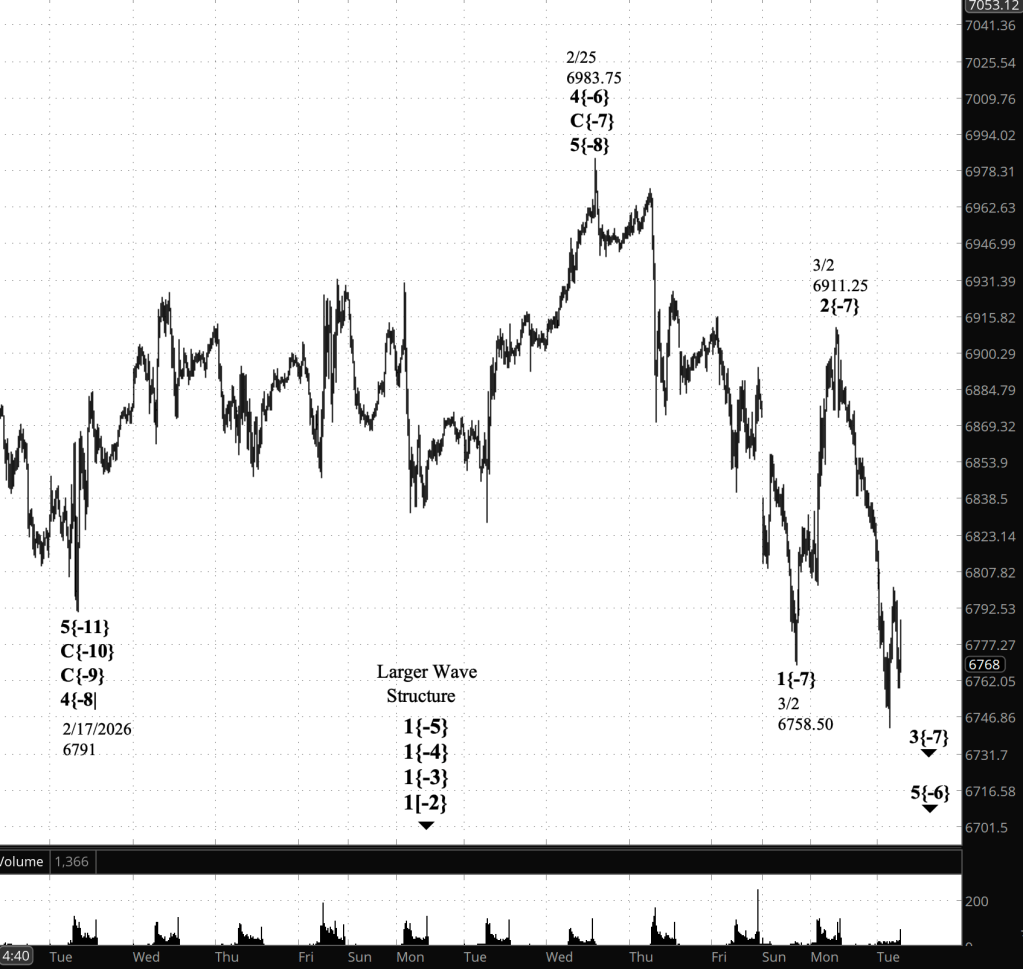
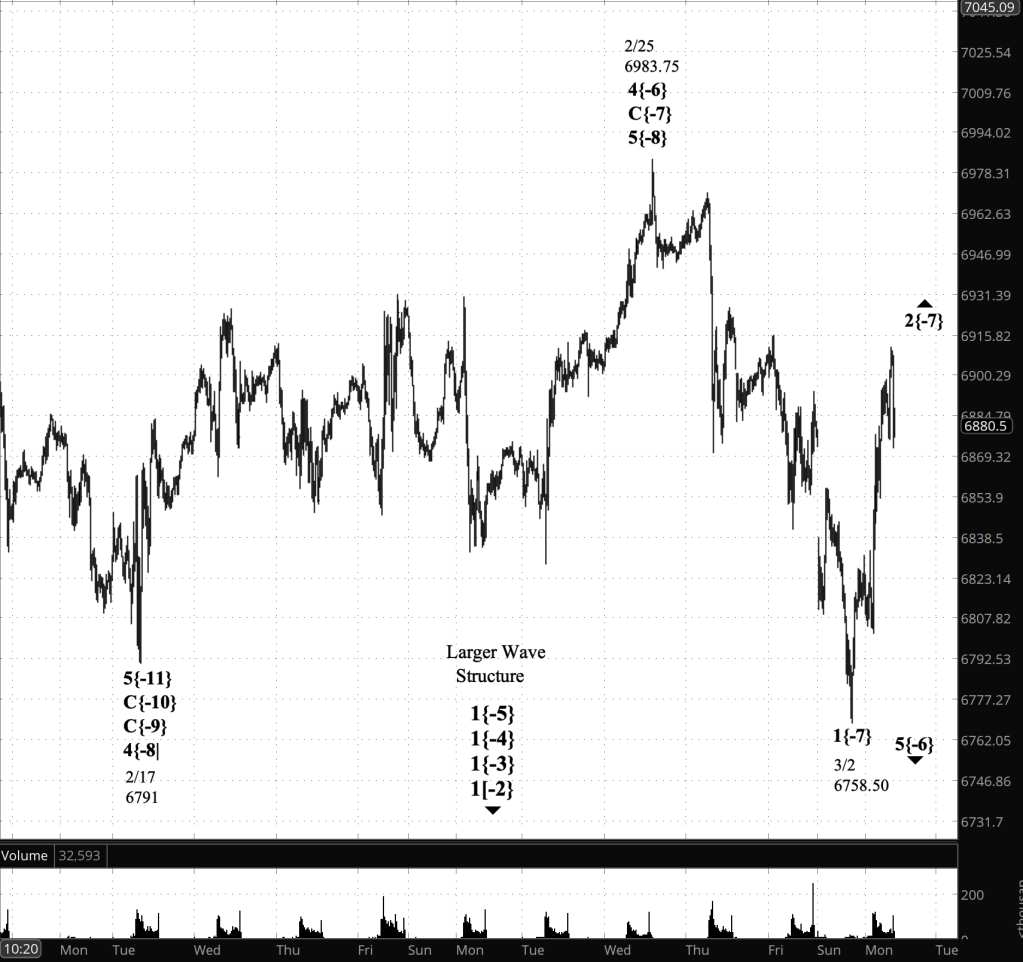
Trader’s Notebook: S&P 500

3:30 p.m. New York time.

Half an hour before the closing bell. The S&P 500 futures rose during the session, so far reaching a high of 6677.50.

Elliott Wave Theory. The rise has retraced more than half of the preceding decline. On the chart, the declne that began on November 20 from 6791.25 is wave 5{-7}. It completed its initial subwave, wave 1{-8} overnight at 6525.

From that point the rise began, wave 2{-8}, a rising correction within wave 5{-7}. begins and is in its firsr subwave, rising wave A{-9}.

See “Waves Now Underway”, below, for a full list of waves now underway, Nearly all of them a 1st waves that began on October 8, a massive end for 5th waves, the largest having begun in 1932. That ending wave was wave 5{+3} and wave 1{+3} began what will be a long journey on October 8, a bit more than a month ago.

9:35 a.m. New York time.

What’s happening now. The S&P 500 E-mini futures fell to 6525 overnight, and then worked its way higher into the 6990s.

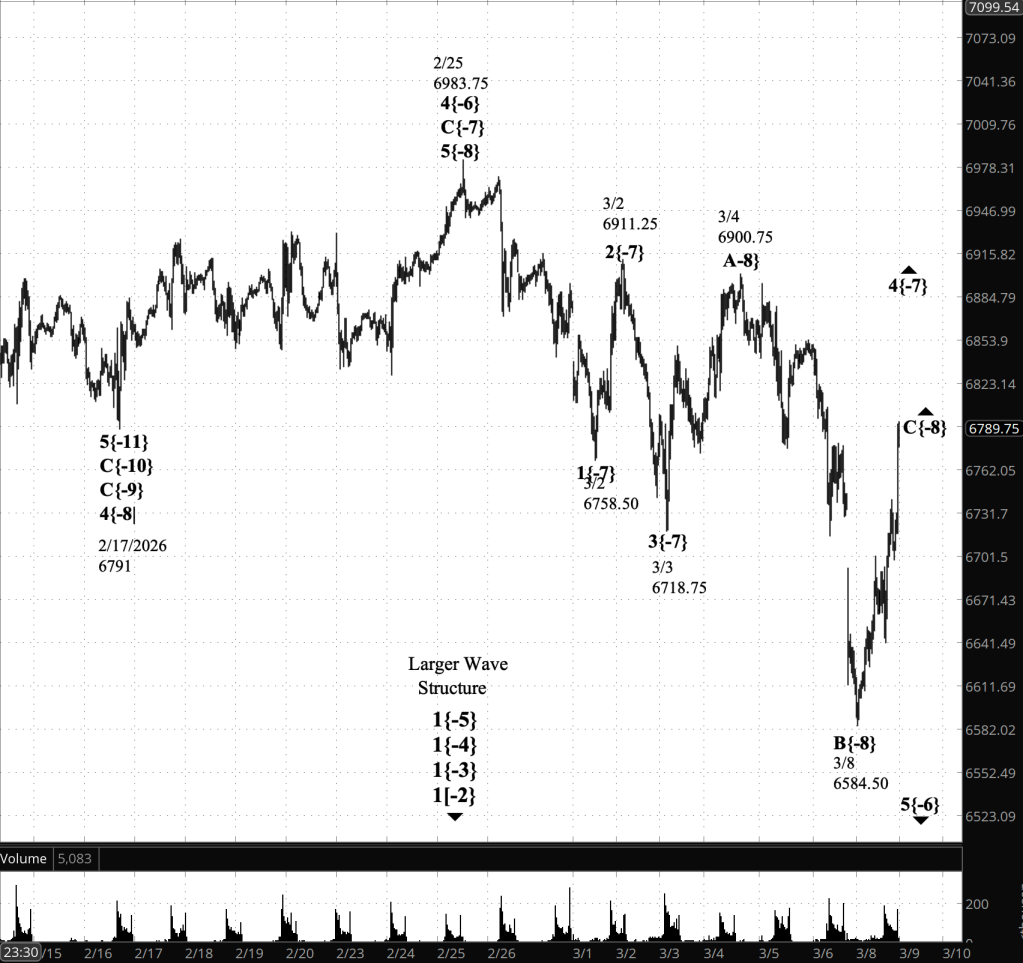
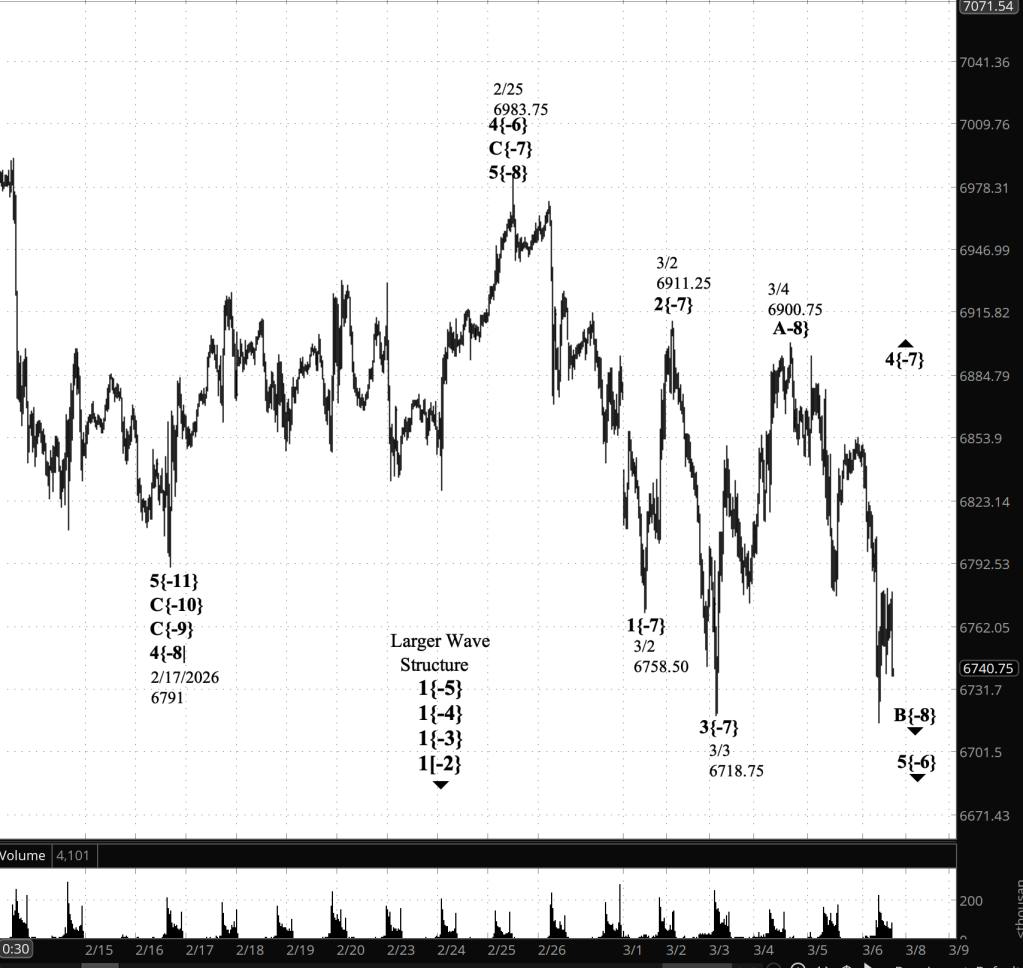
What does it mean? Elliott Wave Theory clearly counts the decline from yesterday’s high, 6781.25, as being the starting point of wave 5{-7} within wave 5{-6}. The subwave count count is a bit odd, with an overly long 1st wave and a lack of clarity regarding the division between subwaves 1 through 3..

It appears that the overnight low may have been an endpoint, either of wave 5{-7} or wave 1{-8}. Ambiguity abounds, as is often the case with Elliott Wave analysis.

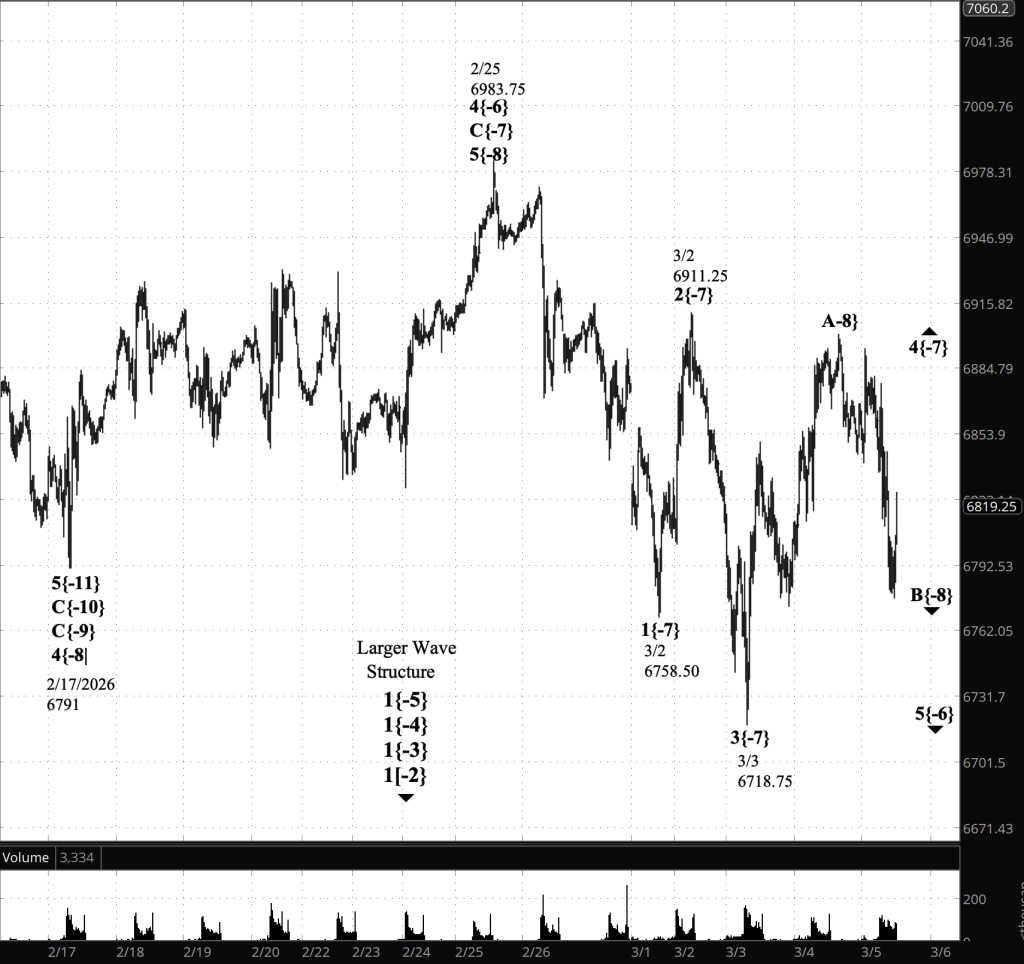
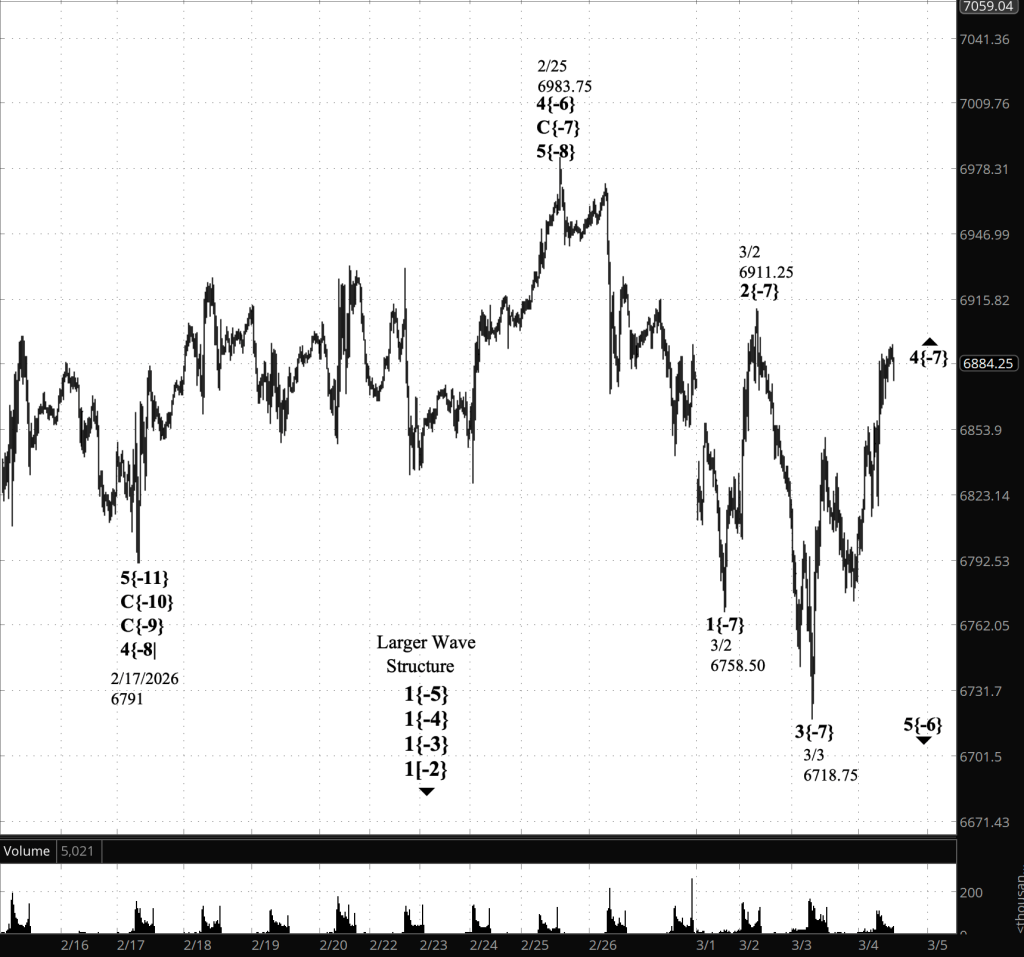
[S&P 500 E-mini futures at 9:35 a.m., 35-minute bars, with volume] 

Waves Now Underway

These are the waves currently in progress under my principal analysis. Each line on the list shows the wave number, with the subscript in curly brackets, the traditional degree name, the starting date, the starting price of the S&P 500 E-mini futures, and the direction of the wave.

Most of the waves began not long ago, on October 8, 2025. See my essay posted on October 12, 2025, “The End of the Rise from 1932? Elliott Wave Theory Says ‘Yes’”, for a discussion of how that happened.

  • 1{+4} Supermillennium, (unknown start date or start price) {down}
    • A hypothetical wave one degree higher than Supercyle, needed to make the wave analysis complete.
  • S&P 500 Index:
    • 1{+3} Supercycle, 10/8/2025, 6812.25 (down}
    • 1{+2} Cycle, 10/8/2025, 6812.25 (down}
    • 1{+1} Primary, 10/8/2025, 6812.25 (down}
    • 1{0} Intermediate, 10/8/2025, 6812.25 (down}
    • 1{-1} Minor, 10/8/2025, 6812.25 (down}
    • 1{-2} Minute, 10/8/2025, 6812.25 (down}
  • S&P 500 Futures
    • 1{-3} Minuette 10/8/2025, 6812.25 (down}
    • 1{-4} Subminutte 10/8/2025, 6812.25 (down}
    • 1{-5} Micro, 10/8/2025, 6812.25 (down}
    • 5{-6} Submicro, 10/29/2025, 6953.75 (down)
    • 5{-7} Minuscule, 11/20/2025, 6791.25 (down)
    • 2{-8} (none), 11/21/2025, 6525 (up)
    • A{-9} (none), 11/21/2025, 6525 (up)

Reading the chart. Price movements — waves – – in Elliott Wave Theory analysis are labeled with numbers within trending waves and letters with corrective waves. The subscripts — numbers in curly brackets — designate the wave’s degree, which, in Elliott Wave analysis, means the relative position of a wave within the larger and smaller structures that make up the chart. R.N. Elliott, who in the 1930s developed the form of analysis that bears his name, viewed the chart as a complex structure of smaller waves nested within larger waves, which in turn are nested within still larger waves. In mathematics it’s called a fractal structure, where at every scale the pattern is similar to the others.

Learning and other resources. Elliott Wave analysis provides context, not prophecy. As the 20th century semanticist Alfred Korzybski put it in his book Science and Sanity (1933), “The map is not the territory … The only usefulness of a map depends on similarity of structure between the empirical world and the map.” And I would add, in the ever-changing markets, we can judge that similarity of structure only after the fact.

See the menu page Analytical Methods for a rundown on where to go for information on Elliott Wave analysis.

By Tim Bovee, Portland, Oregon, November 20, 2025

Disclaimer

Tim Bovee, Private Trader tracks the analysis and trades of a private trader for his own accounts. Nothing in this blog constitutes a recommendation to buy or sell stocks, options or any other financial instrument. The only purpose of this blog is to provide education and entertainment.

No trader is ever 100 percent successful in his or her trades. Trading in the stock and option markets is risky and uncertain. Each trader must make trading decisions for his or her own account, and take responsibility for the consequences.

All content on Tim Bovee, Private Trader by Timothy K. Bovee is licensed under a Creative Commons Attribution-ShareAlike 4.0 International License.

License

Based on work at www.timbovee.com
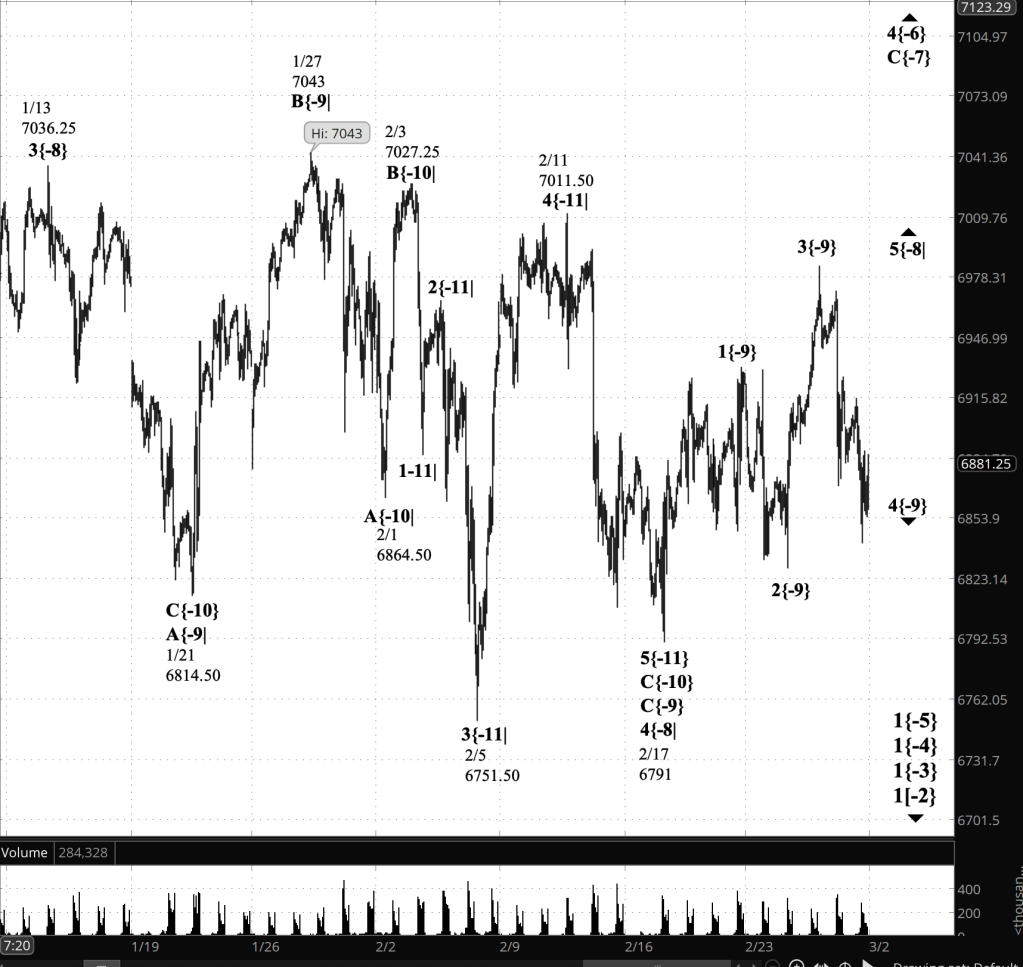
Trader’s Notebook: S&P 500

3:30 p.m. New York time.

Half an hour before the closing bell. The S&P 500 futures peaked early today at 6791.25 and then reversed, dropping rapidly into the 6570s.

Elliott Wave Theory: Wave C[-8} , the final subwave within the upward correction that began on November 18, wave 4{-7} ended at today’s peak, and wave 5{-7} began.

When wave 5{-7} ends, it will also be the end of wave 5{-6}, which began on October 29 from 6953.75. It will also be the end of downtrending wave 1{-5}, which began on October 8 from 6812.25.

With the end of wave 1[-5}, a 2nd-wave upward correction of significant size will begin, wave 2{-5}.

9:35 a.m. New York time.

What’s happening now. The S&P 500 E-mini futures rose overnight, reaching into the 6770s with the the release of the September Employment Situation Report a month or so late because of recent federal government shutdown.

What does it mean? The rise moved the Elliott Wave Theory analysis into the final subwave of the 4th-wave upward correction that began on November 18, ending falling wave B and starting rising wave C.

The C wave moved the price above the highest forecasts for wave 4, which had been expected at the most to reach into the 6720s.

On the other hand, the price so far has remained below 6801.50, the starting point of the prior wave, a 3rd wave. If wave 4 moves above that level, then it will violate a rule of Elliiott Wave Theory, requiring a re-analysis.

[S&P 500 E-mini futures at 3:30 p.m., 35-minute bars, with volume] 

Waves Now Underway

These are the waves currently in progress under my principal analysis. Each line on the list shows the wave number, with the subscript in curly brackets, the traditional degree name, the starting date, the starting price of the S&P 500 E-mini futures, and the direction of the wave.

  • 1{+4} Supermillennium, (unknown start date or start price) {down}
    • A hypothetical wave one degree higher than Supercyle, needed to make the wave analysis complete.
  • S&P 500 Index:
    • 1{+3} Supercycle, 10/8/2025, 6812.25 (down}
    • 1{+2} Cycle, 10/8/2025, 6812.25 (down}
    • 1{+1} Primary, 10/8/2025, 6812.25 (down}
    • 1{0} Intermediate, 10/8/2025, 6812.25 (down}
    • 1{-1} Minor, 10/8/2025, 6812.25 (down}
    • 1{-2} Minute, 10/8/2025, 6812.25 (down}
  • S&P 500 Futures
    • 1{-3} Minuette 10/8/2025, 6812.25 (down}
    • 1{-4} Subminutte 10/8/2025, 6812.25 (down}
    • 1{-5} Micro, 10/8/2025, 6812.25 (down}
    • 5{-6} Submicro, 10/29/2025, 6953.75 (down)
    • 5{-7} Minuscule, 11/20/2025, 6791.25 (down)

Reading the chart. Price movements — waves – – in Elliott Wave Theory analysis are labeled with numbers within trending waves and letters with corrective waves. The subscripts — numbers in curly brackets — designate the wave’s degree, which, in Elliott Wave analysis, means the relative position of a wave within the larger and smaller structures that make up the chart. R.N. Elliott, who in the 1930s developed the form of analysis that bears his name, viewed the chart as a complex structure of smaller waves nested within larger waves, which in turn are nested within still larger waves. In mathematics it’s called a fractal structure, where at every scale the pattern is similar to the others.

Learning and other resources. Elliott Wave analysis provides context, not prophecy. As the 20th century semanticist Alfred Korzybski put it in his book Science and Sanity (1933), “The map is not the territory … The only usefulness of a map depends on similarity of structure between the empirical world and the map.” And I would add, in the ever-changing markets, we can judge that similarity of structure only after the fact.

See the menu page Analytical Methods for a rundown on where to go for information on Elliott Wave analysis.

By Tim Bovee, Portland, Oregon, November 20, 2025

Disclaimer

Tim Bovee, Private Trader tracks the analysis and trades of a private trader for his own accounts. Nothing in this blog constitutes a recommendation to buy or sell stocks, options or any other financial instrument. The only purpose of this blog is to provide education and entertainment.

No trader is ever 100 percent successful in his or her trades. Trading in the stock and option markets is risky and uncertain. Each trader must make trading decisions for his or her own account, and take responsibility for the consequences.

All content on Tim Bovee, Private Trader by Timothy K. Bovee is licensed under a Creative Commons Attribution-ShareAlike 4.0 International License.

License

Based on work at www.timbovee.com
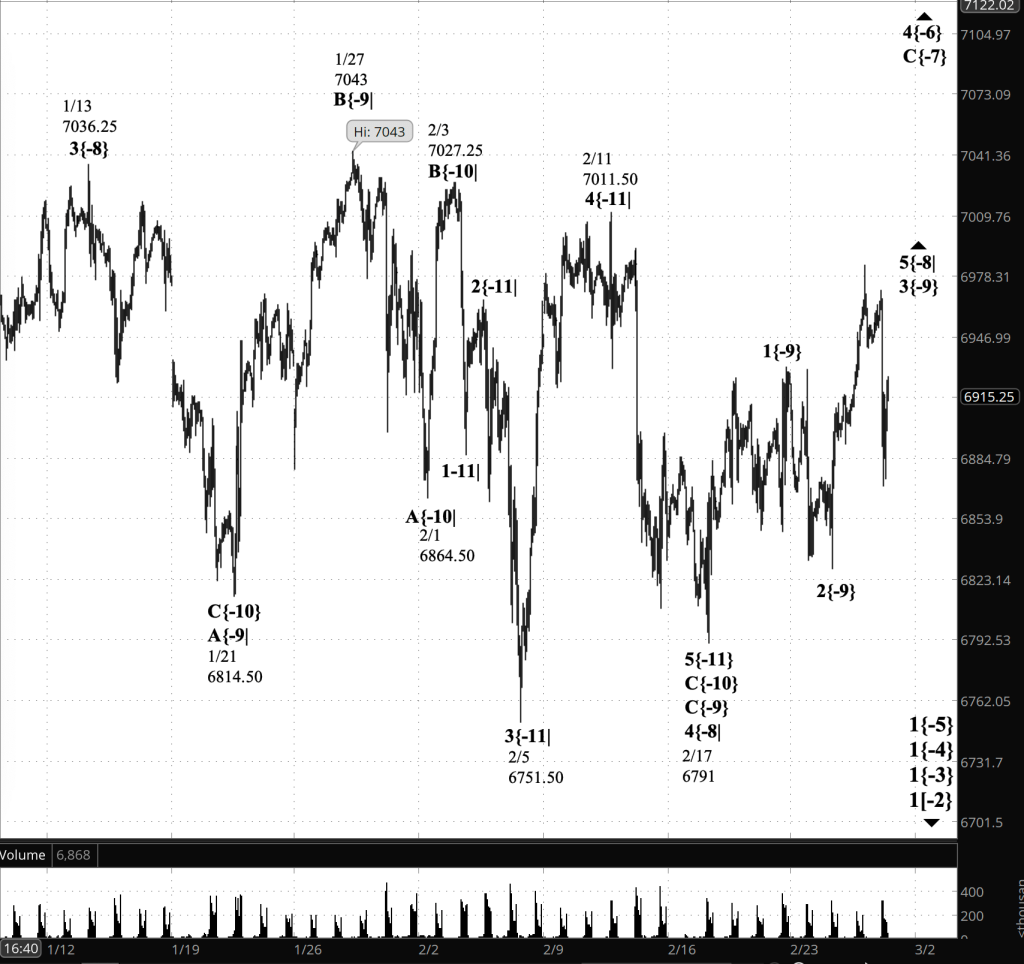
Trader’s Notebook: S&P 500

3:30 p.m. New York time

Half an hour before the closing bell. The S&P 500 futures continued to trade narrowly during the session, mainly in 6600s.

Elliiott Wave Theory: The patterns traced on the chart during the session strengthens the likelihood that the upward correction, wave 4{-7}, has begun. I have changed the chart to conform,

Internally, the initial subwave, rising wave A{-8}, appears to be compete and the middle subwave, falling wave B{-8} is underway. I’m hedging the opinion because I can’t rule out the possibility that the decline is a subwave within wave A{-8}.

How high is wave 4{-7} likely to carry the price? Based on the wave structure of the chart, most like end will be between the 6700s and 6730s. Could go a bit higher.

9:35 a.m. New York time.

What’s happening now. The S&P 500 E-mini futures rose overnight, from 6613.25 up into the 6660s and thern resumed its fall.

What does it mean? Elliott Wave Theory analysis continues to see downtrending wave 3{-7} as being underway.

As long as the price remains below 6801.50 — the starting point of wave 3{-7} — then I shall consider the downtrending wave to be continuing. If the price rises above that point, then wave 4{-7} has begun.

All of this has been playing out within downtrending wave 5{-6}, and one degree higher, with downtrending wave 1{-5}.

Today’s motivator, at present, for the public opinion mover that drives the market will occur at 2 p.m. New York time, when the Federal Open Market Committee publishes minutes of its October interest-rate-setting meeting. It will likely be seen by many as a clue for what the comittee will do at its next meeting, December 9-10.

[S&P 500 E-mini futures at 3:30 p.m., 35-minute bars, with volume] 

Waves Now Underway

These are the waves currently in progress under my principal analysis. Each line on the list shows the wave number, with the subscript in curly brackets, the traditional degree name, the starting date, the starting price of the S&P 500 E-mini futures, and the direction of the wave.

  • 1{+4} Supermillennium, (unknown start date or start price) {down}
    • A hypothetical wave one degree higher than Supercyle, needed to make the wave analysis complete.
  • S&P 500 Index:
    • 1{+3} Supercycle, 10/8/2025, 6812.25 (down}
    • 1{+2} Cycle, 10/8/2025, 6812.25 (down}
    • 1{+1} Primary, 10/8/2025, 6812.25 (down}
    • 1{0} Intermediate, 10/8/2025, 6812.25 (down}
    • 1{-1} Minor, 10/8/2025, 6812.25 (down}
    • 1{-2} Minute, 10/8/2025, 6812.25 (down}
  • S&P 500 Futures
    • 1{-3} Minuette 10/8/2025, 6812.25 (down}
    • 1{-4} Subminutte 10/8/2025, 6812.25 (down}
    • 1{-5} Micro, 10/8/2025, 6812.25 (down}
    • 5{-6} Submicro, 10/30/2025, 6853.75 (down)
    • 4{-7} Minscule, 11/18/2025, 6594(up)
    • B{-8} (no name), 11/18/2025, 6709 (down)

Reading the chart. Price movements — waves – – in Elliott Wave Theory analysis are labeled with numbers within trending waves and letters with corrective waves. The subscripts — numbers in curly brackets — designate the wave’s degree, which, in Elliott Wave analysis, means the relative position of a wave within the larger and smaller structures that make up the chart. R.N. Elliott, who in the 1930s developed the form of analysis that bears his name, viewed the chart as a complex structure of smaller waves nested within larger waves, which in turn are nested within still larger waves. In mathematics it’s called a fractal structure, where at every scale the pattern is similar to the others.

Learning and other resources. Elliott Wave analysis provides context, not prophecy. As the 20th century semanticist Alfred Korzybski put it in his book Science and Sanity (1933), “The map is not the territory … The only usefulness of a map depends on similarity of structure between the empirical world and the map.” And I would add, in the ever-changing markets, we can judge that similarity of structure only after the fact.

See the menu page Analytical Methods for a rundown on where to go for information on Elliott Wave analysis.

By Tim Bovee, Portland, Oregon, November 19, 2025

Disclaimer

Tim Bovee, Private Trader tracks the analysis and trades of a private trader for his own accounts. Nothing in this blog constitutes a recommendation to buy or sell stocks, options or any other financial instrument. The only purpose of this blog is to provide education and entertainment.

No trader is ever 100 percent successful in his or her trades. Trading in the stock and option markets is risky and uncertain. Each trader must make trading decisions for his or her own account, and take responsibility for the consequences.

All content on Tim Bovee, Private Trader by Timothy K. Bovee is licensed under a Creative Commons Attribution-ShareAlike 4.0 International License.

License

Based on work at www.timbovee.com
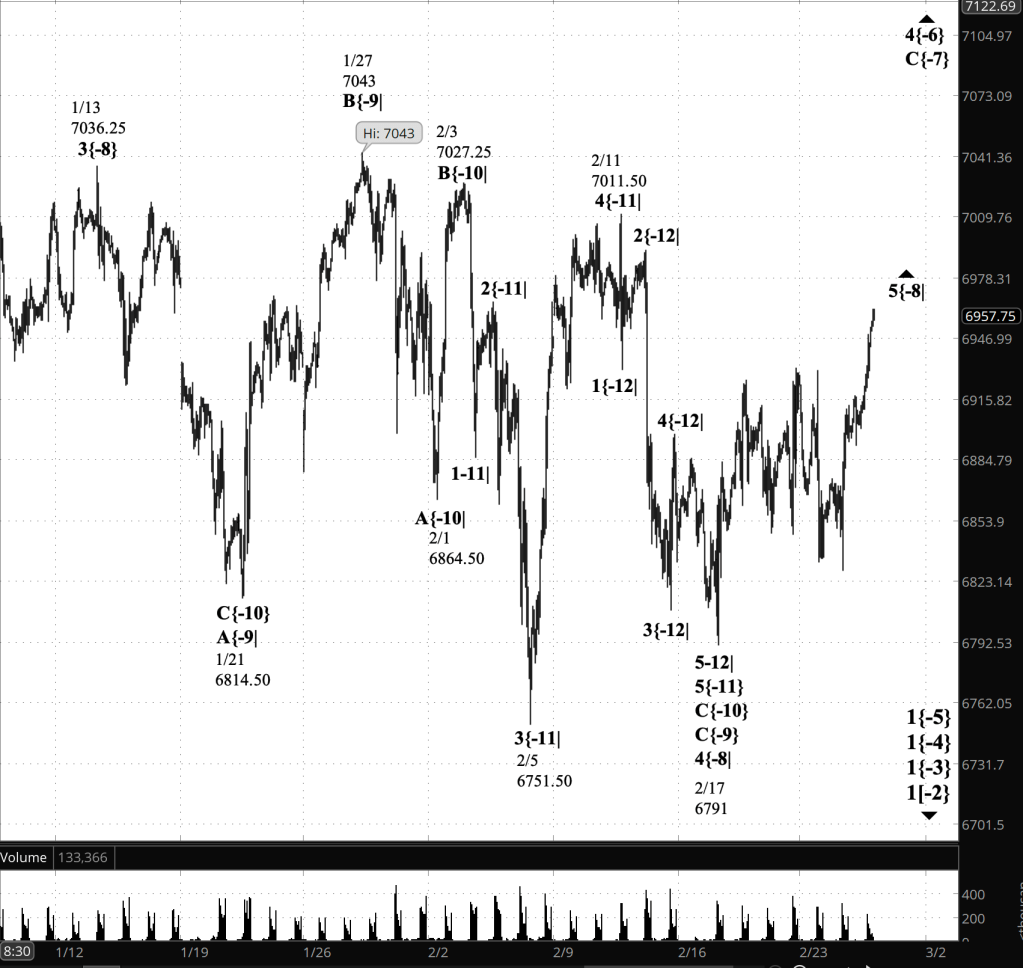
Trader’s Notebook: S&P 500

3:30 p.m. New York time

Half an hour before the closing bell. The S&P 500 futures rose during the session, returning to the 6800s.

Elliott Wave Theory. Wave 5{-7} continues its downward journey, interrupted by the occasional counter-trend subwave. That sort of subwave descrribes the present rise is.

9:35 a.m. New York time.

What’s happening now. The S&P 500 E-mini futures declined slightly overnight, from 6708.75 down to the 6630a.

What does it mean? Elliott Wave Theory analysis: Downtrending wave 3{-7} continues, a subwave of downtrending wave 5{-6}, itself a subwve of downtrending wave 1{-5}, within a series of larger downtrending waves.

As always, market prices will rise and fall, but with a line-up like that, I anticipate more falling than rising.

[S&P 500 E-mini futures at 3:30 p.m., 30-minute bars, with volume] 

Waves Now Underway

These are the waves currently in progress under my principal analysis. Each line on the list shows the wave number, with the subscript in curly brackets, the traditional degree name, the starting date, the starting price of the S&P 500 E-mini futures, and the direction of the wave.

  • 1{+4} Supermillennium, (unknown start date or start price) {down}
    • A hypothetical wave one degree higher than Supercyle, needed to make the wave analysis complete.
  • S&P 500 Index:
    • 1{+3} Supercycle, 10/8/2025, 6812.25 (down}
    • 1{+2} Cycle, 10/8/2025, 6812.25 (down}
    • 1{+1} Primary, 10/8/2025, 6812.25 (down}
    • 1{0} Intermediate, 10/8/2025, 6812.25 (down}
    • 1{-1} Minor, 10/8/2025, 6812.25 (down}
    • 1{-2} Minute, 10/8/2025, 6812.25 (down}
  • S&P 500 Futures
    • 1{-3} Minuette 10/8/2025, 6812.25 (down}
    • 1{-4} Subminutte 10/8/2025, 6812.25 (down}
    • 2{-5} Micro, 10/17/2025, 6571.25 (up}
    • 5{-6} Submicro, 10/30/2025, 6853.75 (down)
    • 3{-7} Minscule, 11/17/2025, 6801.50(down)
    • 1{-8} (no name), 11/17/2025, 6801.50 (down)

Reading the chart. Price movements — waves – – in Elliott Wave Theory analysis are labeled with numbers within trending waves and letters with corrective waves. The subscripts — numbers in curly brackets — designate the wave’s degree, which, in Elliott Wave analysis, means the relative position of a wave within the larger and smaller structures that make up the chart. R.N. Elliott, who in the 1930s developed the form of analysis that bears his name, viewed the chart as a complex structure of smaller waves nested within larger waves, which in turn are nested within still larger waves. In mathematics it’s called a fractal structure, where at every scale the pattern is similar to the others.

Learning and other resources. Elliott Wave analysis provides context, not prophecy. As the 20th century semanticist Alfred Korzybski put it in his book Science and Sanity (1933), “The map is not the territory … The only usefulness of a map depends on similarity of structure between the empirical world and the map.” And I would add, in the ever-changing markets, we can judge that similarity of structure only after the fact.

See the menu page Analytical Methods for a rundown on where to go for information on Elliott Wave analysis.

By Tim Bovee, Portland, Oregon, November 18, 2025

Disclaimer

Tim Bovee, Private Trader tracks the analysis and trades of a private trader for his own accounts. Nothing in this blog constitutes a recommendation to buy or sell stocks, options or any other financial instrument. The only purpose of this blog is to provide education and entertainment.

No trader is ever 100 percent successful in his or her trades. Trading in the stock and option markets is risky and uncertain. Each trader must make trading decisions for his or her own account, and take responsibility for the consequences.

All content on Tim Bovee, Private Trader by Timothy K. Bovee is licensed under a Creative Commons Attribution-ShareAlike 4.0 International License.

License

Based on work at www.timbovee.com
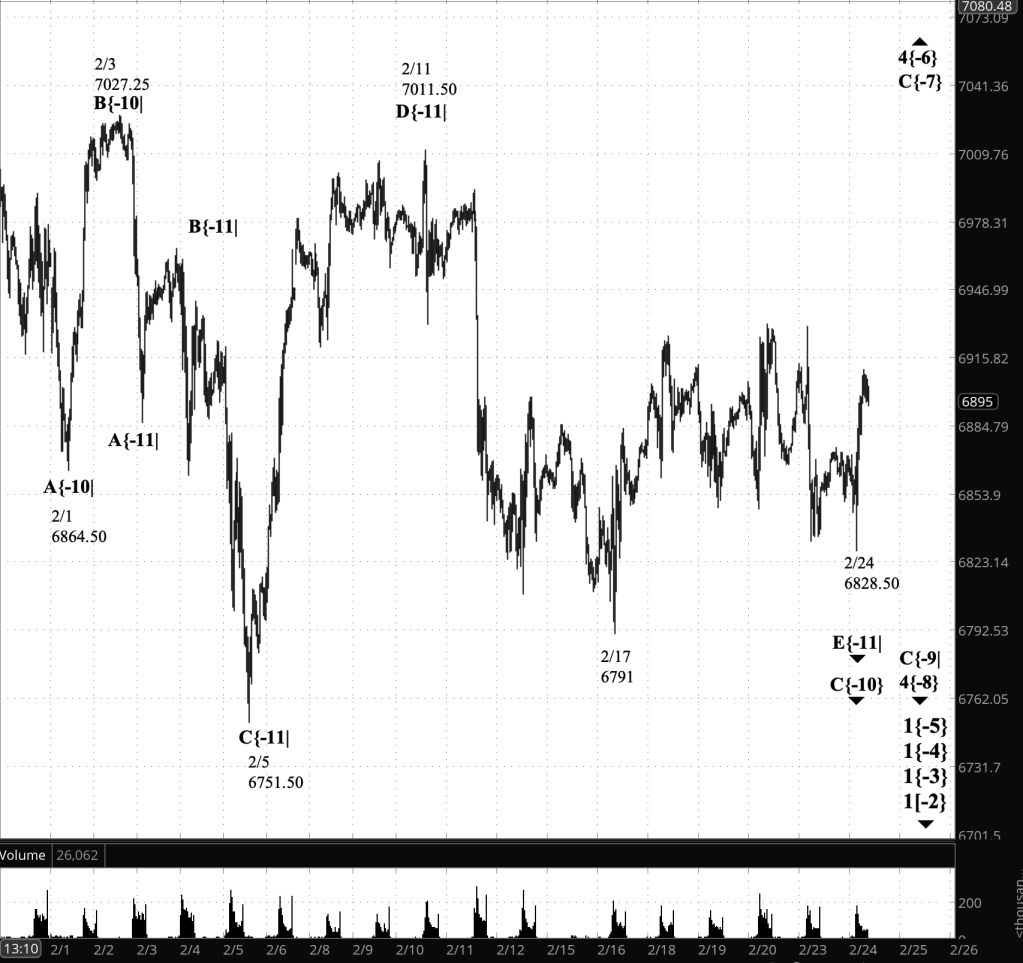
Trader’s Notebook: S&P 500

3:30 p.m. New York time

Half an hour before the closing bell. The S&P 500 futures continued falling throughout the session, so far reaching into the 6680s.

Elliott Wave Theory: The decline carried wave 2{-7} below the end of the prior 1st wave. The fall became sufficiently large to clarify that corrrective wave 2{-7} had ended and downtrending wave 3{-7} had begun. The {-7} degree is relatively small, and in comparison with other waves in the group, wave 3[-7] is almost always the largest wolf in the pack.

9:35 a.m. New York time.

What’s happening now. The S&P 500 E-mini futures declined after trading resumed overnight, from 6801.75. So far it has reached into the 6720s.

What does it mean? The decline puts the Elliott Wave Theory analysis into the often-seen dilemma: Is the change in direction the end of the rise, a 2nd-wave upward correction in this case, or a subwave of smaller degree that will soon turn and resume the 2nd wave’s rise.

Long story short: The decline isn’t far enough to verify that wave 2 has ended, in my opinion, so I’ve left the chart marked to show wave 2 is underway. There’s no firm rule. It’s more of an intuitive call.

This drama is taking place within declining wave 5{-6}, which began on October 30 from 6789.75. At the larger degrees, the direction is down and has been since October 8, when a series of 5th waves dating back to 1932, during the Great Depression, all reached completion, opening up what I expect to be a lengthy period when the downside dominates.

See my essay posted on October 12, “The End of the Rise from 1932? Elliott Wave Theory Says ‘Yes’”.

[S&P 500 E-mini futures at 3:30 p.m., 60-minute bars, with volume] 

Waves Now Underway

These are the waves currently in progress under my principal analysis. Each line on the list shows the wave number, with the subscript in curly brackets, the traditional degree name, the starting date, the starting price of the S&P 500 E-mini futures, and the direction of the wave.

  • 1{+4} Supermillennium, (unknown start date or start price) {down}
    • A hypothetical wave one degree higher than Supercyle, needed to make the wave analysis complete.
  • S&P 500 Index:
    • 1{+3} Supercycle, 10/8/2025, 6812.25 (down}
    • 1{+2} Cycle, 10/8/2025, 6812.25 (down}
    • 1{+1} Primary, 10/8/2025, 6812.25 (down}
    • 1{0} Intermediate, 10/8/2025, 6812.25 (down}
    • 1{-1} Minor, 10/8/2025, 6812.25 (down}
    • 1{-2} Minute, 10/8/2025, 6812.25 (down}
  • S&P 500 Futures
    • 1{-3} Minuette 10/8/2025, 6812.25 (down}
    • 1{-4} Subminutte 10/8/2025, 6812.25 (down}
    • 2{-5} Micro, 10/17/2025, 6571.25 (up}
    • 5{-6} Submicro, 10/30/2025, 6853.75 (down)
    • 3{-7} Minscule, 11/17/2025, 6801.50(down)
    • 1{-8} (no name), 11/17/2025, 6801.50 (down)

Reading the chart. Price movements — waves – – in Elliott Wave Theory analysis are labeled with numbers within trending waves and letters with corrective waves. The subscripts — numbers in curly brackets — designate the wave’s degree, which, in Elliott Wave analysis, means the relative position of a wave within the larger and smaller structures that make up the chart. R.N. Elliott, who in the 1930s developed the form of analysis that bears his name, viewed the chart as a complex structure of smaller waves nested within larger waves, which in turn are nested within still larger waves. In mathematics it’s called a fractal structure, where at every scale the pattern is similar to the others.

Learning and other resources. Elliott Wave analysis provides context, not prophecy. As the 20th century semanticist Alfred Korzybski put it in his book Science and Sanity (1933), “The map is not the territory … The only usefulness of a map depends on similarity of structure between the empirical world and the map.” And I would add, in the ever-changing markets, we can judge that similarity of structure only after the fact.

See the menu page Analytical Methods for a rundown on where to go for information on Elliott Wave analysis.

By Tim Bovee, Portland, Oregon, November 17, 2025

Disclaimer

Tim Bovee, Private Trader tracks the analysis and trades of a private trader for his own accounts. Nothing in this blog constitutes a recommendation to buy or sell stocks, options or any other financial instrument. The only purpose of this blog is to provide education and entertainment.

No trader is ever 100 percent successful in his or her trades. Trading in the stock and option markets is risky and uncertain. Each trader must make trading decisions for his or her own account, and take responsibility for the consequences.

All content on Tim Bovee, Private Trader by Timothy K. Bovee is licensed under a Creative Commons Attribution-ShareAlike 4.0 International License.

License

Based on work at www.timbovee.com

Trader’s Notebook: S&P 500

3:30 p.m. New York time

Half an hour before the closing bell.The S&P 500 futures reached a low of 6680.70 as the opening bell sounded and then rose through the session, so far reaching slightly above 6700.

Elliott Wave Theory: Wave 5{-8} ended at today’s low, and that was also the end of its parent wave, 1{-7}. A 2nd-wave upward correction, wave 2{-7} within downtrending wave 5{-6}, which began on October 30, now underway.

9:35 a.m. New York time.

What’s happening now. The S&P 500 E-mini futures continued to fall overnight, from 6775 so far into the 6670s.

What does it mean? Elliott Wave Theory analysis shows five clear waves since the present decline began on November 12. They are subwaves of what was labeled declining wave B in yesteray’s analysis.

A B wave has three subwaves, not five. And that anomaly requires a reassessment of the analysis.

The new principal analysis: Rising ave 4{-8} ended on November 11 at 6900.50,and downtrending wave 5{-8} began.Wave 5{-8} is in its 5th and finalsubwave, wave 5{-9}.

The entire structure lies within downtrending wave 1{-7}, which began on October 30, the first subwave within downtrending wave 5{-6}, which began simultaneously with wave 1.

This is the most bearish configuration the market can form in the short term: A set of multiple nested first waves inside a terminal 5th wave of a larger degree. Implication: More downside ahead.

[S&P 500 E-mini futures at 3:30 p.m., 50-minute bars, with volume] 

Waves Now Underway

These are the waves currently in progress under my principal analysis. Each line on the list shows the wave number, with the subscript in curly brackets, the traditional degree name, the starting date, the starting price of the S&P 500 E-mini futures, and the direction of the wave.

  • 1{+4} Supermillennium, (unknown start date or start price) {down}
    • A hypothetical wave one degree higher than Supercyle, needed to make the wave analysis complete.
  • S&P 500 Index:
    • 1{+3} Supercycle, 10/8/2025, 6812.25 (down}
    • 1{+2} Cycle, 10/8/2025, 6812.25 (down}
    • 1{+1} Primary, 10/8/2025, 6812.25 (down}
    • 1{0} Intermediate, 10/8/2025, 6812.25 (down}
    • 1{-1} Minor, 10/8/2025, 6812.25 (down}
    • 1{-2} Minute, 10/8/2025, 6812.25 (down}
  • S&P 500 Futures
    • 1{-3} Minuette 10/8/2025, 6812.25 (down}
    • 1{-4} Subminutte 10/8/2025, 6812.25 (down}
    • 2{-5} Micro, 10/17/2025, 6571.25 (up}
    • 5{-6} Submicro, 10/30/2025, 6853.75 (down)
    • 2{-7} Minscule, 11/14/2025, 6670.50 (up)
    • 5{-8} (no name), 11/12/2025, 6909.50 (down)

Reading the chart. Price movements — waves – – in Elliott Wave Theory analysis are labeled with numbers within trending waves and letters with corrective waves. The subscripts — numbers in curly brackets — designate the wave’s degree, which, in Elliott Wave analysis, means the relative position of a wave within the larger and smaller structures that make up the chart. R.N. Elliott, who in the 1930s developed the form of analysis that bears his name, viewed the chart as a complex structure of smaller waves nested within larger waves, which in turn are nested within still larger waves. In mathematics it’s called a fractal structure, where at every scale the pattern is similar to the others.

Learning and other resources. Elliott Wave analysis provides context, not prophecy. As the 20th century semanticist Alfred Korzybski put it in his book Science and Sanity (1933), “The map is not the territory … The only usefulness of a map depends on similarity of structure between the empirical world and the map.” And I would add, in the ever-changing markets, we can judge that similarity of structure only after the fact.

See the menu page Analytical Methods for a rundown on where to go for information on Elliott Wave analysis.

By Tim Bovee, Portland, Oregon, November 14, 2025

Disclaimer

Tim Bovee, Private Trader tracks the analysis and trades of a private trader for his own accounts. Nothing in this blog constitutes a recommendation to buy or sell stocks, options or any other financial instrument. The only purpose of this blog is to provide education and entertainment.

No trader is ever 100 percent successful in his or her trades. Trading in the stock and option markets is risky and uncertain. Each trader must make trading decisions for his or her own account, and take responsibility for the consequences.

All content on Tim Bovee, Private Trader by Timothy K. Bovee is licensed under a Creative Commons Attribution-ShareAlike 4.0 International License.

License

Based on work at www.timbovee.com

Trader’s Notebook: S&P 500

3:30 p.m. New York time

Half an hour before the closing bell. The S&P 500 futures continued to fall during the session, reaching into the 6750s.

Elliott Wave Theory. The decline puts the price at the low end of expectations, based on retracement Fibonacci retracement levels. I shall use the chart labels below, including the degree’s distance from Intermediate Degree.

The lower level marks the critical support for Wave B{-9} inside the developing 4{-8} correction.

A defended 6760 would enable a C{-9} advance toward 6840–6880 before completing 4{-8}.

A decisive break below 6760, especially under 6735, shifts probabilities toward a deeper negative-degree sequence, potentially filling the 6708 level and targeting the 6680–6660 region.

End-point guessing is not a precision activity in Elliott Wave Theory. It’s a forecasting tool, and just like the weather forecast, sometimes it’s right, and sometimes, not so much.

9:35 a.m. New York time.

What’s happening now. The S&P 500 E-mini futures reached a high overnight of 6892.50 and then declined, so far reaching into the 6840s

What does it mean? Elliott Wave Theory analysis sees the decline as a B wave, the middle subwave of an upward correction, wave 4.

How low can it go? The B wave is a zigzag, with five subwaves within wave A. Wave B is most likely to retrace between 38.2% and 50% of wave A (both Fibonacci levels). That works out to be between 6807 and 6778, more or less. There are a lot of variations in retracement length.

[S&P 500 E-mini futures at 3:30 p.m., 50-minute bars, with volume] 

Waves Now Underway

These are the waves currently in progress under my principal analysis. Each line on the list shows the wave number, with the subscript in curly brackets, the traditional degree name, the starting date, the starting price of the S&P 500 E-mini futures, and the direction of the wave.

  • 1{+4} Supermillennium, (unknown start date or start price) {down}
    • A hypothetical wave one degree higher than Supercyle, needed to make the wave analysis complete.
  • S&P 500 Index:
    • 1{+3} Supercycle, 10/8/2025, 6812.25 (down}
    • 1{+2} Cycle, 10/8/2025, 6812.25 (down}
    • 1{+1} Primary, 10/8/2025, 6812.25 (down}
    • 1{0} Intermediate, 10/8/2025, 6812.25 (down}
    • 1{-1} Minor, 10/8/2025, 6812.25 (down}
    • 1{-2} Minute, 10/8/2025, 6812.25 (down}
  • S&P 500 Futures
    • 1{-3} Minuette 10/8/2025, 6812.25 (down}
    • 1{-4} Subminutte 10/8/2025, 6812.25 (down}
    • 2{-5} Micro, 10/17/2025, 6571.25 (up}
    • 5{-6} Submicro, 10/30/2025, 6853.75 (down)
    • 1{-7} Minscule, 10/30/2025, 6853.75 (down)
    • 4{-8} (no name), 11/3/2025, 6909.50 (up)
    • B{-9} (no name), 11/12/2025, 6900.50 (down)

Reading the chart. Price movements — waves – – in Elliott Wave Theory analysis are labeled with numbers within trending waves and letters with corrective waves. The subscripts — numbers in curly brackets — designate the wave’s degree, which, in Elliott Wave analysis, means the relative position of a wave within the larger and smaller structures that make up the chart. R.N. Elliott, who in the 1930s developed the form of analysis that bears his name, viewed the chart as a complex structure of smaller waves nested within larger waves, which in turn are nested within still larger waves. In mathematics it’s called a fractal structure, where at every scale the pattern is similar to the others.

Learning and other resources. Elliott Wave analysis provides context, not prophecy. As the 20th century semanticist Alfred Korzybski put it in his book Science and Sanity (1933), “The map is not the territory … The only usefulness of a map depends on similarity of structure between the empirical world and the map.” And I would add, in the ever-changing markets, we can judge that similarity of structure only after the fact.

See the menu page Analytical Methods for a rundown on where to go for information on Elliott Wave analysis.

By Tim Bovee, Portland, Oregon, November 13, 2025

Disclaimer

Tim Bovee, Private Trader tracks the analysis and trades of a private trader for his own accounts. Nothing in this blog constitutes a recommendation to buy or sell stocks, options or any other financial instrument. The only purpose of this blog is to provide education and entertainment.

No trader is ever 100 percent successful in his or her trades. Trading in the stock and option markets is risky and uncertain. Each trader must make trading decisions for his or her own account, and take responsibility for the consequences.

All content on Tim Bovee, Private Trader by Timothy K. Bovee is licensed under a Creative Commons Attribution-ShareAlike 4.0 International License.

License

Based on work at www.timbovee.com

Trader’s Notebook: S&P 500

3:30 p.m. New York time

Half an hour before the closing bell. The S&P 500 futures began to fall after the late-overnight peak and continued the decline throughout the session.

Elliott Wave Theory. Wave A, the initial subwave within wave 4, an upward correction, ended at that peak, 7000.50. The middle subwave, declining wave B, is now underway as wave 4 continues and so far during the session has fallen to 6852.

I have modified the labels while it is early in the decline, and so that change comes with a caveat: It’s possible that rising wave A is still underway. If the price reverses quickly today or tomorrow, then we will return to the A-wave-continues scenario as the principal analysis.

9:35 a.m. New York time.

What’s happening now. The S&P 500 E-mini futures barely budged overnight, rising from 6869 to slightly above 6900, and then falling.

What does it mean? The Elliott Wave Theory analysis is unchanged from yesterday. The first subwave, wave A, of a 4th-wave upward correction continues and if typical, is likely to rise to around 6950. It’s also possible that the rise was truncated and that wave A ended at the overnight high.

[S&P 500 E-mini futures at 3:30 p.m., 45-minute bars, with volume] 

Waves Now Underway

These are the waves currently in progress under my principal analysis. Each line on the list shows the wave number, with the subscript in curly brackets, the traditional degree name, the starting date, the starting price of the S&P 500 E-mini futures, and the direction of the wave.

  • 1{+4} Supermillennium, (unknown start date or start price) {down}
    • A hypothetical wave one degree higher than Supercyle, needed to make the wave analysis complete.
  • S&P 500 Index:
    • 1{+3} Supercycle, 10/8/2025, 6812.25 (down}
    • 1{+2} Cycle, 10/8/2025, 6812.25 (down}
    • 1{+1} Primary, 10/8/2025, 6812.25 (down}
    • 1{0} Intermediate, 10/8/2025, 6812.25 (down}
    • 1{-1} Minor, 10/8/2025, 6812.25 (down}
    • 1{-2} Minute, 10/8/2025, 6812.25 (down}
  • S&P 500 Futures
    • 1{-3} Minuette 10/8/2025, 6812.25 (down}
    • 1{-4} Subminutte 10/8/2025, 6812.25 (down}
    • 2{-5} Micro, 10/17/2025, 6571.25 (up}
    • 5{-6} Submicro, 10/30/2025, 6853.75 (down)
    • 1{-7} Minscule, 10/30/2025, 6853.75 (down)
    • 4{-8} (no name), 11/3/2025, 6909.50 (up)
    • B{-9} (no name), 11/12/2025, 6900.50 (up)

Reading the chart. Price movements — waves – – in Elliott Wave Theory analysis are labeled with numbers within trending waves and letters with corrective waves. The subscripts — numbers in curly brackets — designate the wave’s degree, which, in Elliott Wave analysis, means the relative position of a wave within the larger and smaller structures that make up the chart. R.N. Elliott, who in the 1930s developed the form of analysis that bears his name, viewed the chart as a complex structure of smaller waves nested within larger waves, which in turn are nested within still larger waves. In mathematics it’s called a fractal structure, where at every scale the pattern is similar to the others.

Learning and other resources. Elliott Wave analysis provides context, not prophecy. As the 20th century semanticist Alfred Korzybski put it in his book Science and Sanity (1933), “The map is not the territory … The only usefulness of a map depends on similarity of structure between the empirical world and the map.” And I would add, in the ever-changing markets, we can judge that similarity of structure only after the fact.

See the menu page Analytical Methods for a rundown on where to go for information on Elliott Wave analysis.

By Tim Bovee, Portland, Oregon, November 12, 2025

Disclaimer

Tim Bovee, Private Trader tracks the analysis and trades of a private trader for his own accounts. Nothing in this blog constitutes a recommendation to buy or sell stocks, options or any other financial instrument. The only purpose of this blog is to provide education and entertainment.

No trader is ever 100 percent successful in his or her trades. Trading in the stock and option markets is risky and uncertain. Each trader must make trading decisions for his or her own account, and take responsibility for the consequences.

All content on Tim Bovee, Private Trader by Timothy K. Bovee is licensed under a Creative Commons Attribution-ShareAlike 4.0 International License.

License

Based on work at www.timbovee.com

Trader’s Notebook: S&P 500

3:30 p.m. New York time

Half an hour before the closing bell. The S&P 500 futures reversed from its decline, so far reaching into the 6870s.

Elliott Wave Theory: The decline is a subwave within wave A, the first leg of a 4th-wave upward correction that began on November 7.

9:35 a.m. New York time.

What’s happening now. The S&P 500 E-mini futures fell overnight, from a peak of 6867, so far reachng into the 6830s.

What does it mean? Elliott Wave Theory analysis sees the decline as a subwave within rising wave A{-9}, a subwave of rising corrective wave 4{-8}.

Comparing the lhe current A wave with other waves in the decline that began on October 30, a likely endpoint of wave A is in the 6950s. No guarantees, of course.

[S&P 500 E-mini futures at 3:30 a.m., 45-minute bars, with volume] 

Waves Now Underway

These are the waves currently in progress under my principal analysis. Each line on the list shows the wave number, with the subscript in curly brackets, the traditional degree name, the starting date, the starting price of the S&P 500 E-mini futures, and the direction of the wave.

  • 1{+4} Supermillennium, (unknown start date or start price) {down}
    • A hypothetical wave one degree higher than Supercyle, needed to make the wave analysis complete.
  • S&P 500 Index:
    • 1{+3} Supercycle, 10/8/2025, 6812.25 (down}
    • 1{+2} Cycle, 10/8/2025, 6812.25 (down}
    • 1{+1} Primary, 10/8/2025, 6812.25 (down}
    • 1{0} Intermediate, 10/8/2025, 6812.25 (down}
    • 1{-1} Minor, 10/8/2025, 6812.25 (down}
    • 1{-2} Minute, 10/8/2025, 6812.25 (down}
  • S&P 500 Futures
    • 1{-3} Minuette 10/8/2025, 6812.25 (down}
    • 1{-4} Subminutte 10/8/2025, 6812.25 (down}
    • 2{-5} Micro, 10/17/2025, 6571.25 (up}
    • 5{-6} Submicro, 10/30/2025, 6853.75 (down)
    • 1{-7} Minscule, 10/30/2025, 6853.75 (down)
    • 4{-8} (no name), 11/3/2025, 6909.50 (up)
    • A{-9} (no name), 11/5/2025, 6655.50 (up)

Reading the chart. Price movements — waves – – in Elliott Wave Theory analysis are labeled with numbers within trending waves and letters with corrective waves. The subscripts — numbers in curly brackets — designate the wave’s degree, which, in Elliott Wave analysis, means the relative position of a wave within the larger and smaller structures that make up the chart. R.N. Elliott, who in the 1930s developed the form of analysis that bears his name, viewed the chart as a complex structure of smaller waves nested within larger waves, which in turn are nested within still larger waves. In mathematics it’s called a fractal structure, where at every scale the pattern is similar to the others.

Learning and other resources. Elliott Wave analysis provides context, not prophecy. As the 20th century semanticist Alfred Korzybski put it in his book Science and Sanity (1933), “The map is not the territory … The only usefulness of a map depends on similarity of structure between the empirical world and the map.” And I would add, in the ever-changing markets, we can judge that similarity of structure only after the fact.

See the menu page Analytical Methods for a rundown on where to go for information on Elliott Wave analysis.

By Tim Bovee, Portland, Oregon, November 11, 2025

Disclaimer

Tim Bovee, Private Trader tracks the analysis and trades of a private trader for his own accounts. Nothing in this blog constitutes a recommendation to buy or sell stocks, options or any other financial instrument. The only purpose of this blog is to provide education and entertainment.

No trader is ever 100 percent successful in his or her trades. Trading in the stock and option markets is risky and uncertain. Each trader must make trading decisions for his or her own account, and take responsibility for the consequences.

All content on Tim Bovee, Private Trader by Timothy K. Bovee is licensed under a Creative Commons Attribution-ShareAlike 4.0 International License.

License

Based on work at www.timbovee.com

Trader’s Notebook: S&P 500

3:30 p.m. New YorkTime

Half an hour before the closing bell.The S&P 500 futures continued to climb during the session and so far has reached the 6860s. Elliott Wave Theory: Wave A continues, within the 4th-wave upward correction that began on November 7.

9:35 a.m. New York time.

What’s happening now. The S&P 500 E-mini futures fell to a low of 6772 shortly after trading resumed overnight on Sunday, and the rose into the 6820s.

What does it mean? Elliott Wave Theory analysis counts the rise as a continuation of the first subwave, wave A{-9} on the chart, within a 4th-wave upward correction, wave 4{-8} on the chart, that began on November 7. The 4th wave, if typical, will have three subwaves.

The first of those subwaves, wave A, has taken a five subwave pattern during its rise, making the correction a Zigzag pattern. Wave B will follow, with three subwaves, and theb wave C, with five subwaves. If the correction is typical, the end of wave C will also be the end of the 4th-wave correction, and the beginning of a downtrending wave 5, which will likely move below the end of the prior 3rd wave, 6655,50..

I’ve found that 5th waves are quirky beasts. They often come up short, ending above the end of wave 3, and sometimes that extend far below that level to a shocking extent.

[S&P 500 E-mini futures at 3:30 p.m., 40-minute bars, with volume] 

Waves Now Underway

These are the waves currently in progress under my principal analysis. Each line on the list shows the wave number, with the subscript in curly brackets, the traditional degree name, the starting date, the starting price of the S&P 500 E-mini futures, and the direction of the wave.

  • 1{+4} Supermillennium, (unknown start date or start price) {down}
    • A hypothetical wave one degree higher than Supercyle, needed to make the wave analysis complete.
  • S&P 500 Index:
    • 1{+3} Supercycle, 10/8/2025, 6812.25 (down}
    • 1{+2} Cycle, 10/8/2025, 6812.25 (down}
    • 1{+1} Primary, 10/8/2025, 6812.25 (down}
    • 1{0} Intermediate, 10/8/2025, 6812.25 (down}
    • 1{-1} Minor, 10/8/2025, 6812.25 (down}
    • 1{-2} Minute, 10/8/2025, 6812.25 (down}
  • S&P 500 Futures
    • 1{-3} Minuette 10/8/2025, 6812.25 (down}
    • 1{-4} Subminutte 10/8/2025, 6812.25 (down}
    • 2{-5} Micro, 10/17/2025, 6571.25 (up}
    • 5{-6} Submicro, 10/30/2025, 6853.75 (down)
    • 1{-7} Minscule, 10/30/2025, 6853.75 (down)
    • 4{-8} (no name), 11/3/2025, 6909.50 (up)
    • A{-9} (no name), 11/5/2025, 6655.50 (up)

Reading the chart. Price movements — waves – – in Elliott Wave Theory analysis are labeled with numbers within trending waves and letters with corrective waves. The subscripts — numbers in curly brackets — designate the wave’s degree, which, in Elliott Wave analysis, means the relative position of a wave within the larger and smaller structures that make up the chart. R.N. Elliott, who in the 1930s developed the form of analysis that bears his name, viewed the chart as a complex structure of smaller waves nested within larger waves, which in turn are nested within still larger waves. In mathematics it’s called a fractal structure, where at every scale the pattern is similar to the others.

Learning and other resources. Elliott Wave analysis provides context, not prophecy. As the 20th century semanticist Alfred Korzybski put it in his book Science and Sanity (1933), “The map is not the territory … The only usefulness of a map depends on similarity of structure between the empirical world and the map.” And I would add, in the ever-changing markets, we can judge that similarity of structure only after the fact.

See the menu page Analytical Methods for a rundown on where to go for information on Elliott Wave analysis.

By Tim Bovee, Portland, Oregon, November 10, 2025

Disclaimer

Tim Bovee, Private Trader tracks the analysis and trades of a private trader for his own accounts. Nothing in this blog constitutes a recommendation to buy or sell stocks, options or any other financial instrument. The only purpose of this blog is to provide education and entertainment.

No trader is ever 100 percent successful in his or her trades. Trading in the stock and option markets is risky and uncertain. Each trader must make trading decisions for his or her own account, and take responsibility for the consequences.

All content on Tim Bovee, Private Trader by Timothy K. Bovee is licensed under a Creative Commons Attribution-ShareAlike 4.0 International License.

License

Based on work at www.timbovee.com