Trader’s Notebook

3;30 p.m. New York time

Half an hour before the closing bell. The S&P 500 began the session slightly above 4000 on the futures and has fallen into the 3920s.

  • The decline provides further confirmation of this morning’s principal analysis: The upward correction, wave 2{-7}, ended on December 1, and a powerful downtrend, wave 3{-7}, is underway.

I’ve updated the chart.

9:35 a.m. New York time

What’s happening now? The S&P 500 E-mini futures traded sideways overnight after a four-day fall from 4110 to 3287.25.

What does it mean? A significant downtrend that began on December 1 continues and is in its early phase. I expect it to carry the price down into the 3200s and most likely lower.

What are the alternatives? There are two, and both assert that the downtrend has not yet begun.

  • Alternative #1: The decline from December 1 is a subwave within the final wave of an upward correction that began on October 13. The price will rise again, most likely above 4110, the prior peak within the correction.
  • Alternative #2: The upward correction is forming a compound correction, and the decline from December 1 is a wave linking the first corrective pattern, now complete, with a second corrective pattern, that has not yet begun. A compound correction can contain two or three corrective patterns.
  • A reversal to the upside would cast doubt on the principal analysis. The higher the price rises, the greater the likelihood that the upward correction is still underway and that one of the two alternatives provides a better map of the market.

In any case, the upward correction will be followed by a significant downtrend.

Chart note. As he was developing his method of analysis, R.N. Elliott noticed that each directional movement — each wave — stayed within a price channel, based on turning points of subwaves within the larger wave.

  • The price channel sets limits on the third and final wave within the upward correction that began on October 13.
  • The present analysis, that the downtrend has begun, was based on the price moving below the lower boundary of the price channel.
  • The channel links the starting points of the 3rd and 5th subwaves as the lower boundary, and draws a parallel line through the end of the 3rd wave as an upper boundary.
  • A preliminary version of the channel might have been been constructing by linking the starting points of the 1st and 3rd waves, with a parallel line drawn through the endpoint of the 3rd wave.

The channel is shown as a dashed line on the chart.

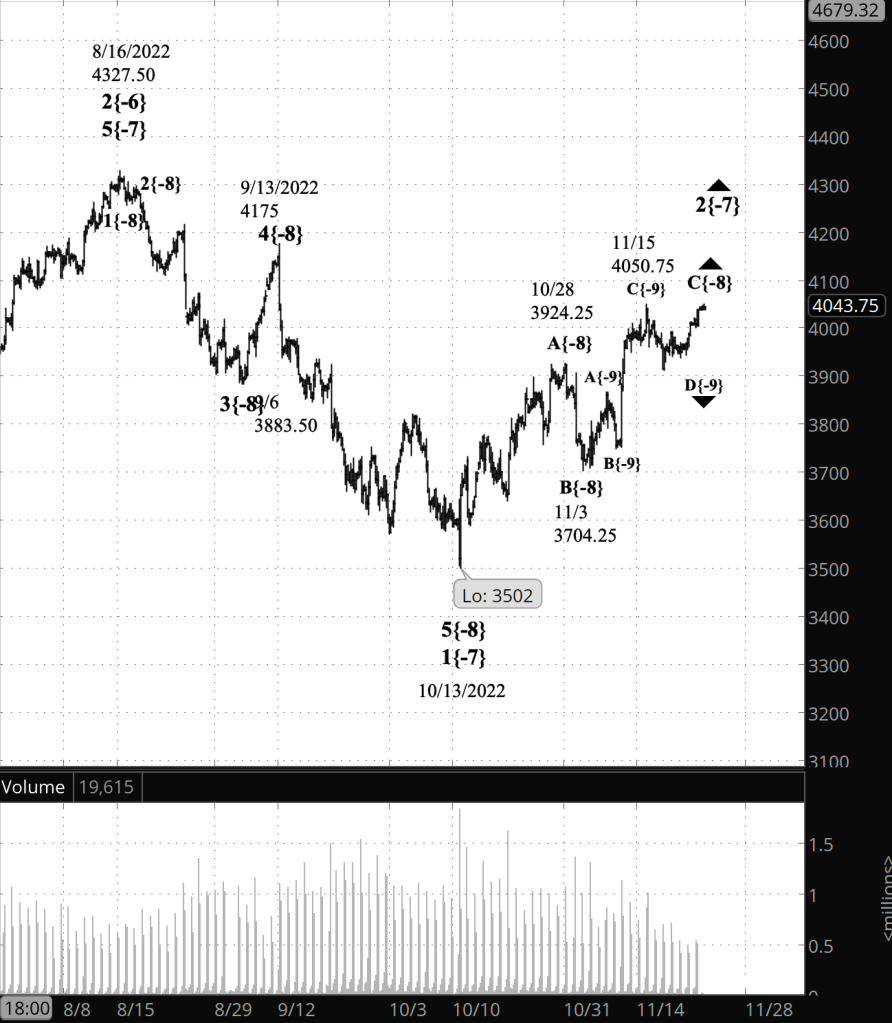
[S&P 500 E-mini futures at 3:30 p.m., 2-hour bars, with volume]

What does Elliott wave theory say? Under the principal analysis, the upward correction, wave 2{-7}, has ended, and a downtrend, wave 3{-7}, has begun.

  • Both waves are subwaves of wave 3{-6}, which began on August 16.
  • Third waves tend to show a great deal of energy and are usually the longest of the five waves that constitute a trend.
  • Wave 3{-7} will be followed by another upward correction, wave 4{-7}, and then a final push to the downside, wave 5{-7}.
  • A larger upward correction, wave 4{-6}, will then begin.

Under the alternative analysis, the upward correction is still underway and is in wave C{-8}, the third and final wave of the corrective pattern.

  • Under alternative #1, the decline is a 4th wave downward correction within wave C{-8} that will be followed by a rising 5th wave that will almost certainly reach above the December 1 high, 4110, and will complete the corrective pattern.
  • Under alternative #2, the decline is wave X{-8}, linking the first corrective pattern with a second corrective pattern, as wave 2{-7} forms a compound structure.

The bigger picture. Elliott’s most brilliant realization was that stock prices form fractal structures — waves drawing from sets of patterns within larger waves drawing from identical sets of patterns. The patterns are the same, from a chart with 1-minute bars to a chart with annual bars.

On my charts, following Elliott, I use numbers for the subwaves of trending waves and letters for the subwaves of corrective waves.

For the relative size of each wave — called its “degree”, its place in the fractal hierarchy — I use subscripts within curly brackets. Elliott named the degrees and used Roman numerals, upper and lower case, and circled numbers and letters to distinguish the degrees on the chart.

I find that the subscripts I use provide greater clarity in describing the relationship of one wave to another.

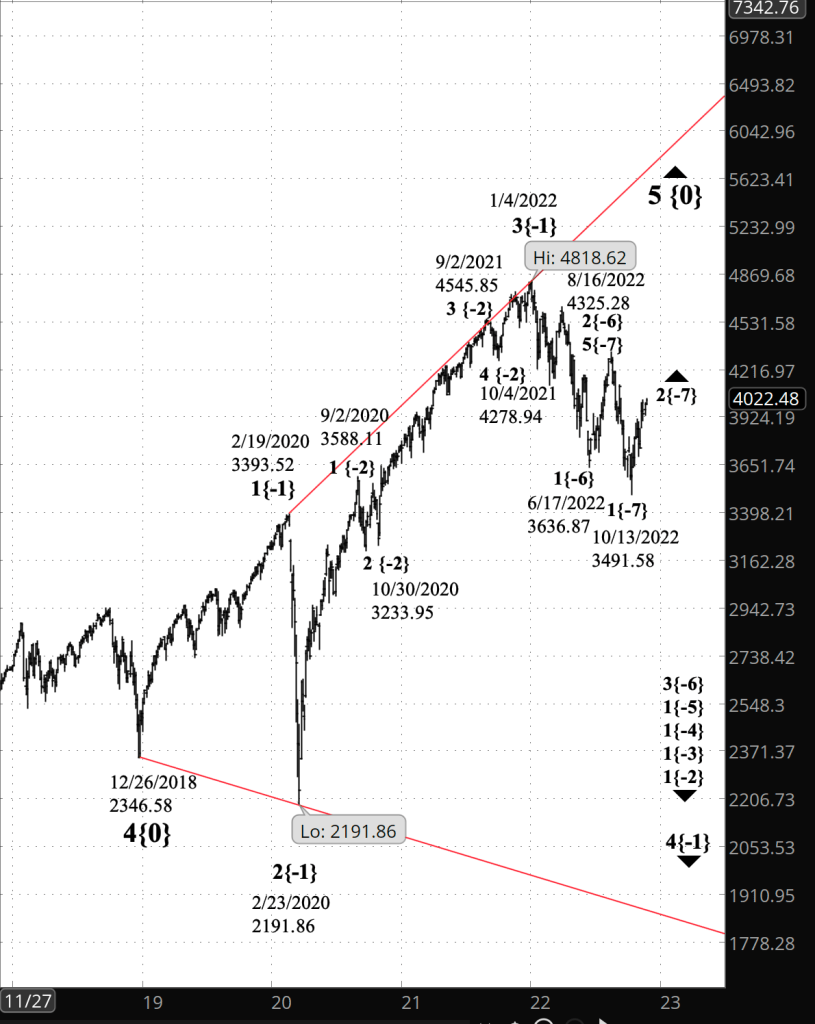
Within the fractal structures, wave 2{-7} and 3{-7} are subwaves of wave 3{-6}, which in turn is a subwave within a series of downtrending 1st waves of increasing size, reaching up to wave 1{-2}, which began on January 4. Wave 1{-2} is in turn a subwave of wave 4{-1}, the next to the last wave within an expanding Diagonal Triangle that began on December 26, 2018.

That fractal structure points to a lot of downwardness ahead, punctuated by occasional upward corrections.

We Are Here.

These are the waves currently in progress under my principal analysis. Each line on the list shows the wave number, with the subscript in curly brackets, the traditional degree name, the starting date, the starting price of the S&P 500 E-mini futures, and the direction of the wave.

  • S&P 500 Index:
  • 5{+3} Supercycle, 7/8/1932, 4.40 (up)
  • 5{+2} Cycle, 12/9/1974, 60.96 (up)
  • 5{+1} Primary, 3/6/2009, 666.79 (up)
  • 5{0} Intermediate, 12/26/2018, 2346.58 (up)
  • 4{-1} Minor, 1/4/2022 4818.62 (down)
  • 1{-2} Minute, 1/4/2022 4818.62 (down)
  • S&P 500 Futures and index:
  • 1{-3} Minuette, 1/4/2022, 4808.25 (down) (futures), 4818.62 (down) (index)
  • S&P 500 Futures:
  • 1{-4} Subminuette, 1/4/2022, 4808.25 (down)
  • 1{-5} Micro, 1/4/2022, 4808.25 (down)
  • 3{-6} Submicro, 8/16/2022, 4327.50 (down)
  • 3{-7} Minuscule, 12/1/2022, 4110 (down)
  • 1{-8} Subminuscule, 12/1/2022, 4110 (down)

Learning and other resources. Elliott wave analysis provides context, not prophecy. As the 20th century semanticist Alfred Korzybski put it in his book Science and Sanity (1933), “The map is not the territory … The only usefulness of a map depends on similarity of structure between the empirical world and the map.” And I would add, in the ever-changing markets, we can judge that similarity of structure only after the fact.

See the menu page Analytical Methods for a rundown on where to go for information on Elliott wave analysis.

By Tim Bovee, Portland, Oregon, December 6, 2022

Disclaimer

Tim Bovee, Private Trader tracks the analysis and trades of a private trader for his own accounts. Nothing in this blog constitutes a recommendation to buy or sell stocks, options or any other financial instrument. The only purpose of this blog is to provide education and entertainment.

No trader is ever 100 percent successful in his or her trades. Trading in the stock and option markets is risky and uncertain. Each trader must make trading decisions for his or her own account, and take responsibility for the consequences.

License
Creative Commons License

All content on Tim Bovee, Private Trader by Timothy K. Bovee is licensed under a Creative Commons Attribution-ShareAlike 4.0 International License.

Based on a work at www.timbovee.com.
Trader’s Notebook

3:30 p.m. New York time

The downtrend has begun. The S&P 500 futures confirmed that an upward correction that began on October 13 ended on December 1. It lasted 49 days and covered 608 points, from its starting point, 3502 to end end, 4110.

The downtrend is the middle wave of a larger downtrend that began on August 16, from 4327.50. All trends have five waves within them, and the middle wave — the third — is almost always the longest and most powerful. Internally, the middle wave is within its first wave of five, the first step of the decline.

In Elliott wave terminology:

  • The upward correction, wave 2{-7}, ended on December 1. It gave confirmation by moving below the price channel of the final wave within the correction, wave C{-8}.
  • The downtrend, wave 3{-7}, is the middle wave of the larger downtrend, wave 3{-6}, which began on August 16. Internally, it is in wave 1{-8}.

How low can this downtrend go?

  • It will almost certainly move below 3502, the end of the previous first wave in the correction, wave 1{-7}.
  • It is never shorter than both wave 1 and wave 5. Assuming that the future 5th wave will be shorter than the present 3rd wave, at a minimum wave 3{-7} will carry the price below3285, the starting points of wave 3{-7} minus 825, which is the length of wave 1{-7}.

And that’s just the bare minimum. I expect wave 3{-7} to move substantially below the 3200s.

And yet, alternatives. How could things go differently?

  • Sometimes, a price can move beyond the price channel boundary, and yet resume the trend. If that happened here, then the 2nd wave upward correction is still underway.
  • A corrective wave can form a compound structure, linking two or three corrective patterns together. It’s not common for that to happen on 2nd wave corrections, but it’s not unheard of. If wave 2{-7} is forming a compound correction, then December 1 was the beginning of wave X{-8}, connecting the corrective pattern just ended with a second corrective pattern.

Under both of those scenarios, the downtrend has not begun and still lies in our future.

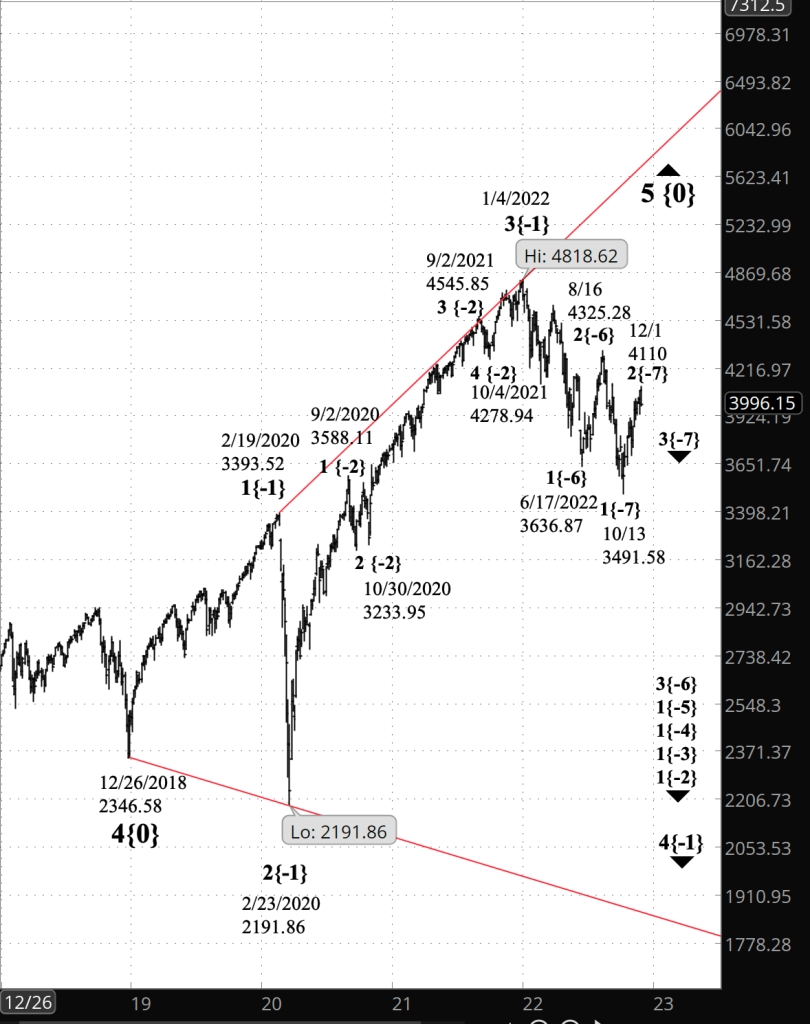
And there’s more downtrend ahead. Wave 3{-6} is the a building block of a series of increasingly larger downtrending 1st waves, all the way up to wave 1{-2}, four degrees higher. Wave 1{-2} is, in turn, the first wave of downward wave 4{-1}, the next to the last wave within an expanding Diagonal Triangle, wave 5{0}, which began on December 26, 2018.

[S&P 500 index at 3:15 p.m., 3-day bars]

9:35 a.m. New York time

What’s happening now? The S&P 500 E-mini futures fell slightly after the trading resumed overnight, from the 4070s to the 4040s.

What does it mean? The shortness of the movement leaves unresolved whether the upward correction that began on October 13 is still underway, or whether it ended on December 1 at 4110.

  • I’ve labeled the chart to show the upward correction as still being underway. A failure to move below the lower boundary of the price channel and a reversal upward would strengthen the case for this principal scenario. I expect the price to move above the prior high in the correction, 4110.
  • The alternative is to label the December 1 high as the end of the upward correction. A decline below the lower boundary of the price channel on the chart, around 3996 at present, would strengthen the case for this alternative scenario.

What happens next? Whichever scenario proves to be correct, once the upward correction is complete, the next move will be a powerful downtrend, the second downtrending wave within a larger downtrending wave that began on August 16.

  • A possible price target for the downtrend, if it began on December 1, is in the 3270s. Price targets are iffy things. The price could fall short of the target, or whiz right past it.

Chart note. I’ve placed tools on the chart to aid to understanding the context of the price movements.

  • The first is a price channel, two dotted black boundary lines, tracking the course of the final segment of the upward correction. In a perfect world, the price would end at the upper boundary and then reverse in a downtrend if the correction is still underway. Or it would continue to fall, through the lower boundary, if the downtrend began on December 1.
  • The second is a set of price reversal points, levels that have been shown to be where price movements tend to end and reverse. The levels are a retracement percentage of the downtrend that preceded the upward correction. The levels are in red on the chart, with the price on the left and the percentage of retracement on the right.

[S&P 500 E-mini futures at 3:30 p.m., 2-hour bars, with volume]

What does Elliott wave theory say? R.N. Elliott’s theory of how markets move, developed in the 1930s, is based on a few simple ideas.

  • A movement in one direction or another in called a “wave”.
  • A trending wave has five waves within it.
  • A corrective wave almost always has three waves within it (unless it takes the form of a triangle).
  • Each wave is a building block within a larger wave, and in turn is built from smaller waves, all of them following the same patterns.

In labeling waves, I give the wave number (1 through 5 for trending waves and A through C for corrective waves), followed by a subscript in curly brackets showing the relative size, the degree, of the waves.

Under the present analysis, these are the waves that matter:

  • Wave 2{-7}, which began on October 13, is a rising corrective wave, the first within a larger downtrending wave, 3{-6}, which began on August 16.
  • If wave 2{-7} is still underway, it is in its last legs: Wave C{-8} is a rising wave, the final wave within the correction. The C wave in turn is in its last building block, rising wave 5{-9}.
  • If wave 2{-7} ended on December 1, then declining wave 3{-7} is underway, a powerful downtrend that is the middle wave within a larger powerful downtrend, wave 3{-6}, which began on August 16.

So where are we now? Wave 2{-7} or wave 3{-7}? There’s no way to tell until the price does something decisive.

We Are Here.

These are the waves currently in progress under my principal analysis. Each line on the list shows the wave number, with the subscript in curly brackets, the traditional degree name, the starting date, the starting price of the S&P 500 E-mini futures, and the direction of the wave.

  • S&P 500 Index:
  • 5{+3} Supercycle, 7/8/1932, 4.40 (up)
  • 5{+2} Cycle, 12/9/1974, 60.96 (up)
  • 5{+1} Primary, 3/6/2009, 666.79 (up)
  • 5{0} Intermediate, 12/26/2018, 2346.58 (up)
  • 4{-1} Minor, 1/4/2022 4818.62 (down)
  • 1{-2} Minute, 1/4/2022 4818.62 (down)
  • S&P 500 Futures and index:
  • 1{-3} Minuette, 1/4/2022, 4808.25 (down) (futures), 4818.62 (down) (index)
  • S&P 500 Futures:
  • 1{-4} Subminuette, 1/4/2022, 4808.25 (down)
  • 1{-5} Micro, 1/4/2022, 4808.25 (down)
  • 3{-6} Submicro, 8/16/2022, 4327.50 (down)
  • 3{-7} Minuscule, 12/1/2022, 4110 (down)

Learning and other resources. Elliott wave analysis provides context, not prophecy. As the 20th century semanticist Alfred Korzybski put it in his book Science and Sanity (1933), “The map is not the territory … The only usefulness of a map depends on similarity of structure between the empirical world and the map.” And I would add, in the ever-changing markets, we can judge that similarity of structure only after the fact.

See the menu page Analytical Methods for a rundown on where to go for information on Elliott wave analysis.

By Tim Bovee, Portland, Oregon, December 5, 2022

Disclaimer

Tim Bovee, Private Trader tracks the analysis and trades of a private trader for his own accounts. Nothing in this blog constitutes a recommendation to buy or sell stocks, options or any other financial instrument. The only purpose of this blog is to provide education and entertainment.

No trader is ever 100 percent successful in his or her trades. Trading in the stock and option markets is risky and uncertain. Each trader must make trading decisions for his or her own account, and take responsibility for the consequences.

License
Creative Commons License

All content on Tim Bovee, Private Trader by Timothy K. Bovee is licensed under a Creative Commons Attribution-ShareAlike 4.0 International License.

Based on a work at www.timbovee.com.

Trader’s Notebook

3:30 p.m. New York time

Half an hour before the closing bell. The S&P 500 rose during the session, from an overnight low of 4006.75 on the futures back into the 4080s. The price remains below the December 1 high, 4110.

  • The higher the price rises, the more likely it is that the upward correction that began on October 13 is still underway.
  • A reversal downward that brought the price below 4006.75 would strengthen the case that the correction ended on December 1 and a powerful downtrend has begun.

9:35 a.m. New York time

What’s happening now? The S&P 500 E-mini futures fell sharply when the employment situation report was released an hour before the opening bell, covering 60 points in a single minute. The report said employers added 263,000 jobs in November, suggesting continuing strong demand for workers and therefore an ongoing risk of inflation.

What does it mean. The price remains above the lower boundary of the price channel set by the last leg of the correction, which began November 10. Until the price pierces that lower boundary, then a strong case can be made that the decline from the December 1 high is a pullback within the correction, which can be expected to reach new heights.

Is there an alternative? However, the rapidity of the decline strengthened the case that the December 1 high, 4110, was the end of the upward correction that had been underway since mid-October, and the beginning of a downtrend that will carry the price a significant distance lower, perhaps in to the 3200s.

Chart notes. After declining sharply, the price halted near 4012, which is the 61.8% Fibonacci retracement level, a point where price movements tend to encounter resistance. The lower boundary of the price channel is presently in the 3970s.

When working out his analytical system in the 1930s, R.N. Elliott used the term “waves” for market movements in a single direction. Under his system, each wave is built from still smaller waves and is itself a building block for a larger wave. The size of a wave relative to others is called its “degree”. On the chart, I label each waves with a number (for trending waves) or a letter (for correction waves), and add in a subscript number in curly brackets to show the degree.

[S&P 500 E-mini futures at 3:30 p.m., 4-hour bars, with volume]

What does Elliott wave theory say? If the upward correction is still underway, then these are the waves that matter.

  • The upward correction is wave 2{-7}. It began on October 13.
  • The correction contains three waves. The last of those waves, C{-8}, is underway.
  • The correction has taken the form of a Zigzag, which means that wave C{-8} contains five waves. It is presently in its next-to-the-last wave, 4{-10}.

If the correction ended at the December 1 peak, then that level, 4110, was the end of wave 2{-7} and a powerful downtrend has begun.

  • Wave 1{-8} is underway, the first of five waves within wave 3{-7}.
  • Downtrending wave 3{-7} will carry the price significantly below the start of the correction, at 3502. A possible price target for the downtrend suggests the price will reach into the 3200s.

The correction and that downtrend that follows are subwaves of a larger downtrend, wave 3{-6}, which began on August 16 from 4327.50 and which is in turn a subwave of wave 1{-5}, which began on January 4 from 4808.25.

We Are Here.

These are the waves currently in progress under my principal analysis. Each line on the list shows the wave number, with the subscript in curly brackets, the traditional degree name, the starting date, the starting price of the S&P 500 E-mini futures, and the direction of the wave.

  • S&P 500 Index:
  • 5{+3} Supercycle, 7/8/1932, 4.40 (up)
  • 5{+2} Cycle, 12/9/1974, 60.96 (up)
  • 5{+1} Primary, 3/6/2009, 666.79 (up)
  • 5{0} Intermediate, 12/26/2018, 2346.58 (up)
  • 4{-1} Minor, 1/4/2022 4818.62 (down)
  • 1{-2} Minute, 1/4/2022 4818.62 (down)
  • S&P 500 Futures and index:
  • 1{-3} Minuette, 1/4/2022, 4808.25 (down) (futures), 4818.62 (down) (index)
  • S&P 500 Futures:
  • 1{-4} Subminuette, 1/4/2022, 4808.25 (down)
  • 1{-5} Micro, 1/4/2022, 4808.25 (down)
  • 3{-6} Submicro, 8/16/2022, 4327.50 (down)
  • 2{-7} Minuscule, 10/13/2022, 3502 (up)
  • C{-8} Subminuscule, 11/3/2022, 3704.25 (up)

Learning and other resources. Elliott wave analysis provides context, not prophecy. As the 20th century semanticist Alfred Korzybski put it in his book Science and Sanity (1933), “The map is not the territory … The only usefulness of a map depends on similarity of structure between the empirical world and the map.” And I would add, in the ever-changing markets, we can judge that similarity of structure only after the fact.

See the menu page Analytical Methods for a rundown on where to go for information on Elliott wave analysis.

By Tim Bovee, Portland, Oregon, December 2, 2022

Disclaimer

Tim Bovee, Private Trader tracks the analysis and trades of a private trader for his own accounts. Nothing in this blog constitutes a recommendation to buy or sell stocks, options or any other financial instrument. The only purpose of this blog is to provide education and entertainment.

No trader is ever 100 percent successful in his or her trades. Trading in the stock and option markets is risky and uncertain. Each trader must make trading decisions for his or her own account, and take responsibility for the consequences.

License
Creative Commons License

All content on Tim Bovee, Private Trader by Timothy K. Bovee is licensed under a Creative Commons Attribution-ShareAlike 4.0 International License.

Based on a work at www.timbovee.com.

Trader’s Notebook, PM

Note: This morning’s post won’t allow me to update it. So, here’s a separate closing bell analysis.

3:30 p.m. New York time

Half an hour before the closing bell. The S&P 500 rose during the session, reaching 4110, moving through five waves.

Why does it matter? The final leg of the upward correction has traced five waves internally and may well have reached its end. If that proves to be the case, then the subsequent decline is the first step in what will become a powerful decline.

What is the structure? The rise that began on November 29 is the 5th and final subwave within the final wave of the upward correction that began on October 13. The rise was quite rapid. In Elliott wave terminology, it is wave 5{-9} within wave {-8}, the third wave within the correction, wave 2{-7}.

The five-wave structure within wave 5{-9} shows clearly on a chart with 10-minute bars. The subwaves are of the {-10} degree.

[S&P 500 E-mini futures at 1:40 p.m., 10-minute bars, with volume]

I’ve labeled the chart as through wave 5{-9} and it’s final wave, 5{-10} were complete. But are they really?

A major ambiguity within Elliott wave analysis is assigning waves to the correct degree within the whole fractal structure. The decline on this chart, which I’ve labeled as wave 3{-7}, the major downtrending wave, could in fact be a subwave within wave 5{-10}, at a smaller degree. If that proves to be the case, then expect a reversal and a move above 4110.

By Tim Bovee, Portland, Oregon, December 1, 2022

Disclaimer

Tim Bovee, Private Trader tracks the analysis and trades of a private trader for his own accounts. Nothing in this blog constitutes a recommendation to buy or sell stocks, options or any other financial instrument. The only purpose of this blog is to provide education and entertainment.

No trader is ever 100 percent successful in his or her trades. Trading in the stock and option markets is risky and uncertain. Each trader must make trading decisions for his or her own account, and take responsibility for the consequences.

License
Creative Commons License

All content on Tim Bovee, Private Trader by Timothy K. Bovee is licensed under a Creative Commons Attribution-ShareAlike 4.0 International License.

Based on a work at www.timbovee.com.

Trader’s Notebook

9:35 a.m. New York time

What’s happening now? The S&P 500 E-mini futures peaked at 4104.75 in overnight trading and then paused.

What does it mean? The upward correction that began on October 13 has entered its end game.

How high can it go? There are guidelines but no certain rules. The correction, a 2nd wave within a larger downtrend, is in its third and final leg. In Elliott wave parlance, a C wave. Within an upward correction of this type, C waves…

  • …often have about the same length as the first wave of the correction, an A wave. The A wave was 422.5 long. The C wave began at 3704.25. Add 422.50, and that gives a target of 4126.50, a bit more than 25 points above the overnight high.
  • …almost always move beyond the end of wave A. Done that. Wave A ended at 3924.25.
  • …sometimes end at certain retracement levels. The next such level up is the 78.6% retracement, at 4151.
  • …and tend to reach the upper price channel, presently around 4210 and rising.

There is a limit. Never, ever does a 2nd wave correction move beyond the start of the preceding 1st wave. That sets of a firm upper limit on the correction of 4327.50.

Any alternatives? There is one. A correction usually goes through three smaller waves — in an upward correction, up-down-up. But sometimes a correction will form a compound structure, linking together two or three corrective patterns. Compound corrections are rare in second waves but not entirely unheard of. Could happen.

Coming soon to a stock chart near you: Downtrend. Whether simple or compound, the correction will be followed by a powerful downtrend, the third wave within a downtrend that began on August 16.

  • It will certainly move below the starting point of the 2nd wave that came before, 3502. This is a firm rule.
  • Most likely, it will be longer than the 1st wave that came before. That 1st wave was 825.50 in length. If the overnight peak were to be the end of the correction, then a potential target would be 3278.75 or lower. The higher the 2nd wave goes, the higher that potential target. Methodology: Pick your peak for the correction, and subtract 825.50. That’s your new minimum target.

The only scenario that would allow the 3rd wave to be shorter than the 1st would be if the 5th wave were even shorter. The firm rule is that a 3rd wave can’t be shorter than both the 1st and 5th waves.

Chart note. R.N. Elliott, a depresssion-era accountant, worked his way through 75 years of stock data while developing the theory that bears his name and that is the basis of this analysis.

Elliott called each market movement in a single direction a “wave”. He found that there are two sorts of waves.

  • An impulse wave travels in the direction of the trend and has five waves within it.
  • A corrective wave travels in a direction contrary to the trend and has three waves within it.
  • There are less common patterns that sometimes show up, but impulse and corrective are the main ones.

Those internal waves were another important insight Elliott found in his work: Each wave is built from smaller waves, each of which is built from even smaller waves, all following the same patterns: Impulse and corrective. And each larger wave, in turn, is a building block within a still larger wave, all with the same patterns.

This is sometimes called a fractal pattern.

Using Elliott’s findings, once we know where we are within the subwaves of a larger wave, we can know what lies ahead. It’s like reaching a curve in the road. Without a map, we have no idea what lies ahead. With a map, we can see where we’ll be in the future, if we keep driving. Elliott’s studies provide the map.

On the chart, I’ve labeled the impulse waves with numbers and the corrective waves with letters. I’ve used subscripts, within curly brackets, to indicate the relative size of each wave — it’s position within the hierarchy of waves.

[S&P 500 E-mini futures at 9:35 a.m., 4-hour bars, with volume]

What waves matter? Today chart shows the S&P 500 futures within the downtrending wave that began on August 16. That wave is wave 3{-6}, the third wave within a larger wave, 1{-5}, which began on January 4.

At present, the waves to watch are:

  • The upward correction that is nearing its end, rising wave 2{-7}.
  • The third and probably final leg of the correction, rising wave C{-8}
  • The final wave within the C wave, wave 5{-9}.

When wave 5{-9} reaches its end, it will also be the end of waves C{-8} and 2{-7}.

The powerful downtrending wave 3{-7} will come next, as described above.

A change in labeling. I labeled the subwaves of wave C{-8} with letters. This was an error, because wave C{-8} is an impulse wave internally, built from five subwaves.

We Are Here.

These are the waves currently in progress under my principal analysis. Each line on the list shows the wave number, with the subscript in curly brackets, the traditional degree name, the starting date, the starting price of the S&P 500 E-mini futures, and the direction of the wave.

  • S&P 500 Index:
  • 5{+3} Supercycle, 7/8/1932, 4.40 (up)
  • 5{+2} Cycle, 12/9/1974, 60.96 (up)
  • 5{+1} Primary, 3/6/2009, 666.79 (up)
  • 5{0} Intermediate, 12/26/2018, 2346.58 (up)
  • 4{-1} Minor, 1/4/2022 4818.62 (down)
  • 1{-2} Minute, 1/4/2022 4818.62 (down)
  • S&P 500 Futures and index:
  • 1{-3} Minuette, 1/4/2022, 4808.25 (down) (futures), 4818.62 (down) (index)
  • S&P 500 Futures:
  • 1{-4} Subminuette, 1/4/2022, 4808.25 (down)
  • 1{-5} Micro, 1/4/2022, 4808.25 (down)
  • 3{-6} Submicro, 8/16/2022, 4327.50 (down)
  • 2{-7} Minuscule, 10/13/2022, 3502 (up)
  • C{-8} Subminuscule, 11/3/2022, 3704.25 (up)

Learning and other resources. Elliott wave analysis provides context, not prophecy. As the 20th century semanticist Alfred Korzybski put it in his book Science and Sanity (1933), “The map is not the territory … The only usefulness of a map depends on similarity of structure between the empirical world and the map.” And I would add, in the ever-changing markets, we can judge that similarity of structure only after the fact.

See the menu page Analytical Methods for a rundown on where to go for information on Elliott wave analysis.

By Tim Bovee, Portland, Oregon, December 1, 2022

Disclaimer

Tim Bovee, Private Trader tracks the analysis and trades of a private trader for his own accounts. Nothing in this blog constitutes a recommendation to buy or sell stocks, options or any other financial instrument. The only purpose of this blog is to provide education and entertainment.

No trader is ever 100 percent successful in his or her trades. Trading in the stock and option markets is risky and uncertain. Each trader must make trading decisions for his or her own account, and take responsibility for the consequences.

License
Creative Commons License

All content on Tim Bovee, Private Trader by Timothy K. Bovee is licensed under a Creative Commons Attribution-ShareAlike 4.0 International License.

Based on a work at www.timbovee.com.

Trader’s Notebook

3:30 p.m. New York time

Half an hour before the closing bell. The S&P 500 futures rose sharply at 1:30 p.m. when Federal Reserve President Jerome Powell said interest rate increases would continue but the pace would slow, perhaps as early as the December 13-14 Federal Open Market Committee meeting.

  • As inflation took hold, the FOMC began raising rates, first in March, by 25 basis, then again in May, 50 basis points, and then by 75 basis points the next four times the committee met.
  • Powell’s remark suggests a 50 basis point increase in December, perhaps, or perhaps early next year.

The S&P 500 futures responded by rising 87 basis points, to 4043, in an hour.

The price pushed past the 61.8% retracement of the downtrend Fibonacci retracement that began on August 16. The price has stalled twice at that level in November. Today the price broke through the November 15 high, 4050.75, reaching into the 4060s as the closing bell approached.

The final upward drive. The break beyond the 61.8% retracement, at 4013, suggests that the end of the correction has come one step nearer.

  • The final wave within the final wave of the correction is now underway.
  • On the chart, the wave labels are wave E{-9} within wave C{-8} within wave 2{-7}.
  • The alternative analysis presented this morning is no longer a contender.

9:35 a.m. New York time

What’s happening now? The S&P 500 E-mini futures rose into the 3960s and 3970s and continued to fluctuate around that level overnight. At 8:30 a.m., as the opening bell approached, the price took a sudden quick dip into the 3950s, coinciding with release of a sneak preview of Friday’s jobs numbers.

What does it mean? The upward correction that began on October 13 is nearing its end. It will be followed by a powerful decline into the 3400s or lower.

  • The retreat from the recent peak is the fourth part of a five part movement that on balance has brought the price higher. The fifth part will carry the price still higher.
  • The five parts of the rise are the building blocks of the third leg of the upward correction. When the third leg is complete, it will also mean that the correction is complete.
  • After the correction is done, the downtrend that began on August 16 will resume.

What are the alternatives? It’s possible that the recent peak was the end of the upward correction, and the movement that followed is the early stage of the resumed downtrend.

Elliott wave theory. The analysis is based on Elliott wave theory, a way of reading charts developed in the 1930s by R.N. Elliott, an accountant. Elliott called each movement on the chart, up or down, a “wave”. Although his Wave Principle has many observations, it is based on three key discoveries.

  • All market trends contain five waves, three in the direction of the trend and two corrections in the opposite direction.
  • Most market corrections contain three waves, although there are exceptions.
  • Most importantly, each wave in a trend or correction contains smaller waves and is itself part of a larger wave. And those waves, big or small, all trace the same patterns and can be analyzed in the same way.

Elliott’s theory gives every market movement a context. If we know the placement of a wave, we will know how far along a trend or correction has gone, how much remains, and how it will play out.

Chart notes. On the chart I follow Elliott by giving each wave a number, for waves within trends, or a letter, for waves within corrections. I use subscripts, in curly brackets, to denote the relative size — what Elliott called the “degree” — of each wave within the complex structure of the chart.

For this chart I have added red lines showing likely turning points, called Fibonacci retracement levels. They show how much of a trend that a correction has retraced.

  • On this chart, the price is between the 50% an 61.8% retracement levels. The present wave, labeled D{-9}, is likely to end around the 50% level — a price of3915 — and the next wave, E{-9}, may well carry the price up to the next Fibonacci turning point, the 78.6% retracement level — a price of 4151.

[S&P 500 E-mini futures at 3:30 p.m., 4-hour bars, with volume]

What does Elliott wave theory say? The three waves powering the action illustrate Elliott’s waves-within-waves idea.

  • The largest wave is the upward correction as a whole, wave 2{-7}.
  • Within it is the third and final leg of the three-wave correction, wave C{-8}.
  • And that third leg has a five wave structure and is presently in wave D{-9}, with the final wave, E{-9}, still to ome.

The alternative shows wave 2{-7} as having ended at the recent high, 4050.75.

Under both the principal scenario and its alternative, wave 2{-7} will be a followed by wave 3{-7}, a resumption of the downtrend.

  • Third waves are usually the most powerful of them all. Expect wave 3{-7} to produce an energetic decline.
  • All of the waves mentioned so far are parts of wave 3{-6}. a downtrend that began on August 16 from 4327.50.

It’s mainly down from here. Within the larger downtrend, wave 3{-6}, the next wave to come, wave 3{-7}, will be a downtrend within a downtrend. It will be followed by wave 4{-7}, a second upward correction, and then by wave 5{-7}, another resumption of the downtrend.

  • And at a larger level, we’ve been in a downtrend all year, within wave 1{-2}. which began on January 4, from slightly above 4800.

The message of Elliott wave analysis is clear: Expect prices to decline more than they rise well into next year and perhaps beyond. We won’t see that January 4 peak for awhile.

We Are Here.

These are the waves currently in progress under my principal analysis. Each line on the list shows the wave number, with the subscript in curly brackets, the traditional degree name, the starting date, the starting price of the S&P 500 E-mini futures, and the direction of the wave.

  • S&P 500 Index:
  • 5{+3} Supercycle, 7/8/1932, 4.40 (up)
  • 5{+2} Cycle, 12/9/1974, 60.96 (up)
  • 5{+1} Primary, 3/6/2009, 666.79 (up)
  • 5{0} Intermediate, 12/26/2018, 2346.58 (up)
  • 4{-1} Minor, 1/4/2022 4818.62 (down)
  • 1{-2} Minute, 1/4/2022 4818.62 (down)
  • S&P 500 Futures and index:
  • 1{-3} Minuette, 1/4/2022, 4808.25 (down) (futures), 4818.62 (down) (index)
  • S&P 500 Futures:
  • 1{-4} Subminuette, 1/4/2022, 4808.25 (down)
  • 1{-5} Micro, 1/4/2022, 4808.25 (down)
  • 3{-6} Submicro, 8/16/2022, 4327.50 (down)
  • 2{-7} Minuscule, 10/13/2022, 3502 (up)
  • C{-8} Subminuscule, 11/3/2022, 3704.25 (up)

Learning and other resources. Elliott wave analysis provides context, not prophecy. As the 20th century semanticist Alfred Korzybski put it in his book Science and Sanity (1933), “The map is not the territory … The only usefulness of a map depends on similarity of structure between the empirical world and the map.” And I would add, in the ever-changing markets, we can judge that similarity of structure only after the fact.

See the menu page Analytical Methods for a rundown on where to go for information on Elliott wave analysis.

By Tim Bovee, Portland, Oregon, November 30, 2022

Disclaimer

Tim Bovee, Private Trader tracks the analysis and trades of a private trader for his own accounts. Nothing in this blog constitutes a recommendation to buy or sell stocks, options or any other financial instrument. The only purpose of this blog is to provide education and entertainment.

No trader is ever 100 percent successful in his or her trades. Trading in the stock and option markets is risky and uncertain. Each trader must make trading decisions for his or her own account, and take responsibility for the consequences.

License
Creative Commons License

All content on Tim Bovee, Private Trader by Timothy K. Bovee is licensed under a Creative Commons Attribution-ShareAlike 4.0 International License.

Based on a work at www.timbovee.com.
Trader’s Notebook

3:30 p.m. New York time

Half an hour before the closing bell. The S&P 500 futures hit a low of 3941.25 during the session and then rose back into the 3960s before reversing back to the downside. No change in the analysis. I’ve updated the chart.

9:35 a.m. New York time

What’s happening now? The S&P 500 E-mini futures rose overnight into the 3990s and then retreated to the 3960s.

  • The high point of the rise that began last month remains an elusive goal.

What does it mean? That rise is an upward correction that began on October 13. It is in the last leg of a corrective pattern, and that last leg is in its next-to-the-last segment.

  • The rise is playing its endgame and a powerful decline is approaching.

What are the alternatives? Just possibly, that decline has already begun, on November 15 from the high point of the correction, 4050.75.

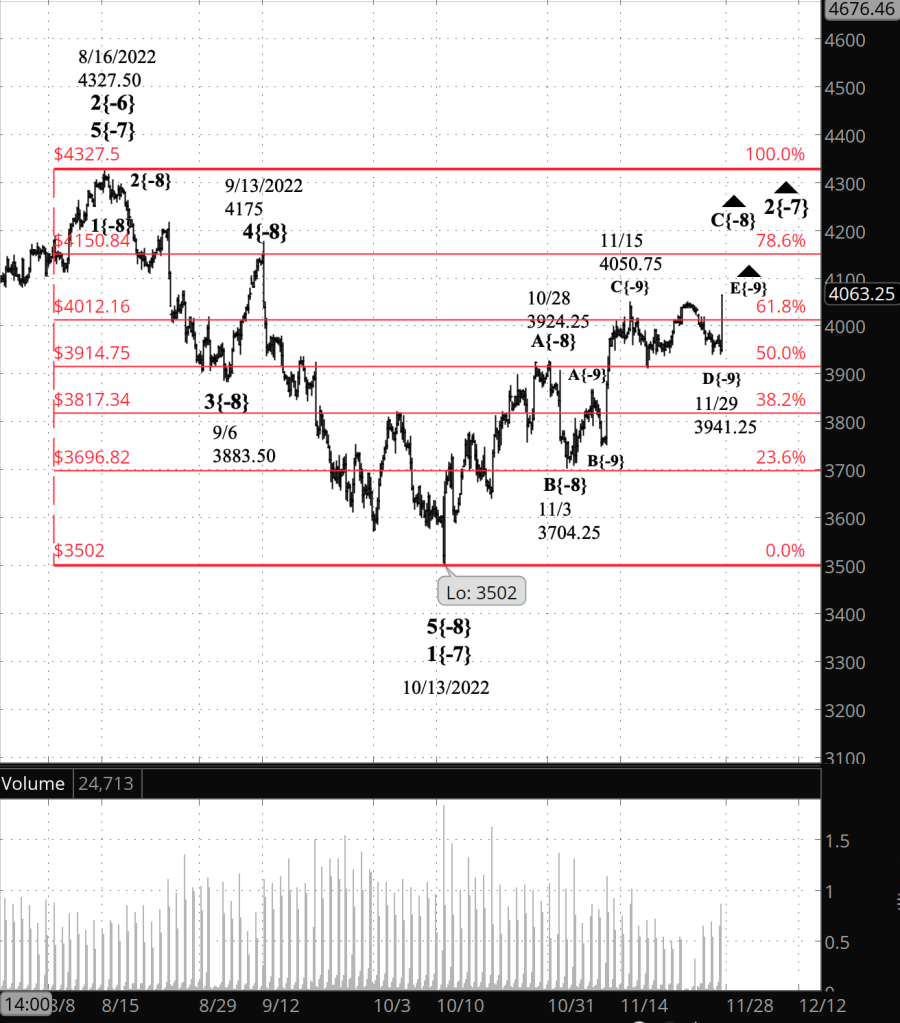
Chart notes. The 4050.75 level matters because it was a brief piercing of the 61.8% Fibonacci retracement level, a point where corrections reach their end. The Fibonacci retracement levels are shown on the chart in red.

  • A rise above the 61.8% retracement — 4012 — means that the last leg of the correction is in its final subwave.
  • A decline below the 50% retracement — 3915 — means that the correction has ended and the downtrend has begun.

[S&P 500 E-mini futures at 3:30 p.m., 4-hour bars, with volume]

What does Elliott wave theory say? Three waves are driving the action.

  • The upward correction is wave 2{-7}. It began on October 13 from 3502. It is the first of two corrections within wave 3{-6}, which began its downtrend on August 16 from 4327.50
  • The last leg of the correction is wave C{-8}. The chart shows it as still being on its upward journey, but it could have ended on November 15 at 4050.75.
  • Wave C{-8} will have five subwaves, and it now on the fourth subwave. Wave D{-9} is dropping, setting the stage for a an upward drive that will almost certainly break through the 4050.75 level.

What could change that scenario?

  • Compounding. Sometimes a correction adds additional corrective patterns. If that happens, then wave C{-8} will be followed by a connecting wave X{-8}, and then by the start of a second corrective pattern, wave A{-8}.
  • A compound correction can contain up to three corrective patterns.
  • But compounding is rare in a wave 2, the first correction inside of a trend. It’s more common in a wave 4, the second correction running against the trend.

Is compounding really that important? Ultimately, no. It will delay the end of the correction and so put off the start of more decline.

  • But compounded or not, as sure as night follows day, the wave 2 correction will be followed by wave 3, a powerful decline that will carry the price below 3502, almost certainly a great distance below that level.

More downside to come.

The downtrend that began on August 16 — wave 3{-6} — isn’t the end of the bear market. A wave is always a part of a larger wave, a child who has ancestors. And wave 3{-6} has a parent wave, a grandparent wave, and a bunch of greats. They’re all a crotchety bunch, looking to the downside.

  • The ancestors are all first waves, meaning each will end up with three downtrending waves and two upward corrections.
  • The downtrending ancestors go up to great-great-grandparent, wave 1{-2}, which began on January 4 from 4818.62 on the index.

After darkness comes the dawn.

No downtrend lasts forever. Will the downtrend that began on January 4 end this year? Never. Next year? Maybe. 2024? Seems likely.

  • Everything we see on the chart is part of wave 4{-1}, a declining next-to-the-last subwave of a five-wave expanding Diagonal Triangle that began on December 26, 2018.
  • When that 4th subwave is complete, a 5th and final subwave will kick off, a large uptrend that will eventually carry the price above the January 4 high, and almost certainly quite a bit higher than that level.
  • The triangle is wave 5{0}, the final wave within a large uptrend that began in 2009, during the Great Recession.

We Are Here.

These are the waves currently in progress under my principal analysis. Each line on the list shows the wave number, with the subscript in curly brackets, the traditional degree name, the starting date, the starting price of the S&P 500 E-mini futures, and the direction of the wave.

  • S&P 500 Index:
  • 5{+3} Supercycle, 7/8/1932, 4.40 (up)
  • 5{+2} Cycle, 12/9/1974, 60.96 (up)
  • 5{+1} Primary, 3/6/2009, 666.79 (up)
  • 5{0} Intermediate, 12/26/2018, 2346.58 (up)
  • 4{-1} Minor, 1/4/2022 4818.62 (down)
  • 1{-2} Minute, 1/4/2022 4818.62 (down)
  • S&P 500 Futures and index:
  • 1{-3} Minuette, 1/4/2022, 4808.25 (down) (futures), 4818.62 (down) (index)
  • S&P 500 Futures:
  • 1{-4} Subminuette, 1/4/2022, 4808.25 (down)
  • 1{-5} Micro, 1/4/2022, 4808.25 (down)
  • 3{-6} Submicro, 8/16/2022, 4327.50 (down)
  • 2{-7} Minuscule, 10/13/2022, 3502 (up)
  • C{-8} Subminuscule, 11/3/2022, 3704.25 (up)

Learning and other resources. Elliott wave analysis provides context, not prophecy. As the 20th century semanticist Alfred Korzybski put it in his book Science and Sanity (1933), “The map is not the territory … The only usefulness of a map depends on similarity of structure between the empirical world and the map.” And I would add, in the ever-changing markets, we can judge that similarity of structure only after the fact.

See the menu page Analytical Methods for a rundown on where to go for information on Elliott wave analysis.

By Tim Bovee, Portland, Oregon, November 29, 2022

Disclaimer

Tim Bovee, Private Trader tracks the analysis and trades of a private trader for his own accounts. Nothing in this blog constitutes a recommendation to buy or sell stocks, options or any other financial instrument. The only purpose of this blog is to provide education and entertainment.

No trader is ever 100 percent successful in his or her trades. Trading in the stock and option markets is risky and uncertain. Each trader must make trading decisions for his or her own account, and take responsibility for the consequences.

License
Creative Commons License

All content on Tim Bovee, Private Trader by Timothy K. Bovee is licensed under a Creative Commons Attribution-ShareAlike 4.0 International License.

Based on a work at www.timbovee.com.

Trader’s Notebook

3:30 p.m. New York time

Half an hour before the closing bell. The S&P 500 continued to fall during the session, reaching the 3960s on the futures. For the moment I’m staying with this morning’s principal analysis: The upward correction continues.

If the price drops below the 50% Fibonacci retracement level — at 3914.75 — and continues to fall, then I’ll switch to the alternative analysis: The upward correction ended at 4050.75 on October 15 and a downtrend has begun.

I’ve updated the chart.

9:35 a.m. New York time

What’s happening now? The S&P 500 E-mini futures gapped downward by 11 points, to 4020.25, when trading resumed Sunday evening. The price reached a low of 3392.25, moving below the 61.8% Fibonacci retracement level, before rising slightly.

What does it mean? The 61.8% retracement level — 4012.16 — is important, since corrections often end near there. The next higher Fibonacci retracement level is 78.6%, at 4150.84. The lack so far of a fall to the 50% retracement level suggests that the final leg of a two-week-old upward correction is still underway. The upward correction is the 2nd wave within a larger 3rd wave that began on August 16.

What is the alternative? The upward correction may have ended on November 15. The most recent high in the correction was 4050.75, on that date. That price is slightly above the 61.8% retracement. Under this scenario, the decline since the high point is the beginning of a significant downtrend. The internal count suggests that 4050.75 isn’t the end, but wave analysis always has ambiguities, and it’s possible — just barely — to see this alternative in the chart.

What happens next? A powerful downtrend, the 3rd wave within the larger 3rd wave, will follow the downward correction, most likely carrying the price into the 3400s and even below. The downtrend will be followed by another upward correction, a 4th wave, and then a further push to the downside, a 5th wave.

Batten down the hatches! In my personal trading I’m taking this downtrend quite seriously. I’ve put stop/losses on my stock holdings, and will lean to the bear side in my options trades. I’m putting the cash freed by my holdings into 13-week Treasury bills as a temporary home. The bills were yielding 4.41% annually as of Friday. My strategy is to stay out during the 3rd, 4th and 5th waves, and then re-enter one the parent 3rd wave is complete and a large upward correction has begun.

Chart notes. I’ve returned the Fibonacci ladder to the chart, in red, to better see the retracement levels that are important to analyzing this chart.

[S&P 500 E-mini futures at 3:30 p.m., 4-hour bars, with volume]

What does Elliott wave theory say? The upward correction that began on October 13 is wave 2{-7}. Within it, rising wave C{-8} is underway. A subwave of C{-8}, falling wave D{-9}, is underway. It will be followed by rising wave E{-8}, which will complete the larger wave C{-8} and most likely the correction as a whole. If wave 2{-7} forms a compound structure, then the end wave C{-8} will be followed by a connector, wave X{-8}, and then a second corrective pattern. Compound corrections can have up to three corrective patterns within them. Compounding is uncommon in 2nd waves.

Under the principal analysis, the correction is incomplete. Under the alternative analysis, wave 2{-7} ended on November 15.

When wave 2{-7} is completed, it will be followed by wave 3{-7}, a powerful downtrend. The principal analysis says that wave 3{-8} lies ahead. The alternative analysis says that it has already begun. An upward correction, wave 4{-7}, will follow, and then a final downtrend, wave 5{-7}, that is likely to push the price to still lower levels.

The end of wave 5{-7} will also be the end of the parent, downtrending wave 3{-6}, which encompasses all of the waves described above. An upward correction, wave 4{-6}, will follow, and then another large push to the downside, wave 5{-6}. Wave 3{-6} is already three months old, so I expect wave 5{-6} to carry us well into 2023, and 2024 is not an impossibility.

My personal trading strategy is to stay out of during the rest of wave 3{-6}, wave 4{-6} and wave 5{-6}, and to re-enter during the upward correction that will follow, wave 2{-5}.

We Are Here.

These are the waves currently in progress under my principal analysis. Each line on the list shows the wave number, with the subscript in curly brackets, the traditional degree name, the starting date, the starting price of the S&P 500 E-mini futures, and the direction of the wave.

  • S&P 500 Index:
  • 5{+3} Supercycle, 7/8/1932, 4.40 (up)
  • 5{+2} Cycle, 12/9/1974, 60.96 (up)
  • 5{+1} Primary, 3/6/2009, 666.79 (up)
  • 5{0} Intermediate, 12/26/2018, 2346.58 (up)
  • 4{-1} Minor, 1/4/2022 4818.62 (down)
  • 1{-2} Minute, 1/4/2022 4818.62 (down)
  • S&P 500 Futures and index:
  • 1{-3} Minuette, 1/4/2022, 4808.25 (down) (futures), 4818.62 (down) (index)
  • S&P 500 Futures:
  • 1{-4} Subminuette, 1/4/2022, 4808.25 (down)
  • 1{-5} Micro, 1/4/2022, 4808.25 (down)
  • 3{-6} Submicro, 8/16/2022, 4327.50 (down)
  • 2{-7} Minuscule, 10/13/2022, 3502 (up)
  • C{-8} Subminuscule, 11/3/2022, 3704.25 (up)

Learning and other resources. Elliott wave analysis provides context, not prophecy. As the 20th century semanticist Alfred Korzybski put it in his book Science and Sanity (1933), “The map is not the territory … The only usefulness of a map depends on similarity of structure between the empirical world and the map.” And I would add, in the ever-changing markets, we can judge that similarity of structure only after the fact.

See the menu page Analytical Methods for a rundown on where to go for information on Elliott wave analysis.

By Tim Bovee, Portland, Oregon, November 28, 2022

Disclaimer

Tim Bovee, Private Trader tracks the analysis and trades of a private trader for his own accounts. Nothing in this blog constitutes a recommendation to buy or sell stocks, options or any other financial instrument. The only purpose of this blog is to provide education and entertainment.

No trader is ever 100 percent successful in his or her trades. Trading in the stock and option markets is risky and uncertain. Each trader must make trading decisions for his or her own account, and take responsibility for the consequences.

License
Creative Commons License

All content on Tim Bovee, Private Trader by Timothy K. Bovee is licensed under a Creative Commons Attribution-ShareAlike 4.0 International License.

Based on a work at www.timbovee.com.

Trader’s Notebook

12:30 p.m. New York time

Half an hour before the closing bell. The S&P 500 continued to work its way lower during the session, to 4024.75 on the futures at the lowest point so far today. No change in the analysis. I’ve updated the upper chart.

9:35 a.m. New York time

An early closing bell. The U.S. markets will close early today, at 1 p.m., as is customary on the day following the Thanksgiving Day holiday. Regular session hours, 9:30 a.m. to 3:30 p.m., will resume on Monday. The S&P 500 futures trade both during the session and outside of regular hours.

What’s happening now? The S&P 500 E-mini futures declined in overnight trading, reaching into the 4030s as the opening bell approached. The price remained below the high so far, 4049.25, reached on November 15 by the upward correction that began on October 13.

What does it mean? The correction is in its final phase — the rising third wave — and within that structure, is in a declining wave, the fourth wave in a series of five. I expect the rising fifth wave, which will likely complete the correction, to rise above the 4049.25 high. The correction, when complete, will be followed by a powerful downtrend.

What are the alternative? The 4049.25 peak was the end of the fifth wave, of the final phase of the upward correction, and possibly of the correction as a whole.

Corollary #1: The decline after the peak is the first tentative step in a powerful downtrend that will cary the price below 3502, the starting point of the upward correction, and most likely significantly below that level.

Corollary #2: The upward correction is taking a compound form, containing two or three corrective patterns. In that case, the decline following the peak connects the first corrective pattern, with a second corrective pattern that still lies in future. When the compound correction is over, the powerful downtrend will begin.

The charts. The upper chart shows the S&P 500 futures from July of this year to the present. The lower chart shows the S&P 500 index from November 2017 to the present.

[S&P 500 E-mini futures at 9:35 a.m., 4-hour bars, with volume]

What does Elliott wave theory say? The upward correction that began on October 13 is wave 2{-7}.

Under the principal analysis, the correction is in wave 3{-8}, its final phase, and within wave 3{-8}, is in wave D{-9}, a declining wave that will be followed by rising wave E{-9}, the final wave of the corrective pattern and most likely of the wave 2{-7} correction itself. I expect wave E{-9} to exceed the 4049.25 peak, which is the end of rising wave C{-9}, the middle subwave of wave C{-8}.

The powerful downtrend that follows the correction will be wave 3{-7}, the middle wave of a larger downtrend, wave 3{-6}, which began on August 16.

Under the alternative analysis, the 4049.25 peak was the end of wave E{-9} and therefore of wave C{-8}. This see this as being less likely. Wave C{-8} must have five waves internally, since the correction has taken the form of a Zigzag. Although there is a shallow decline that could count as a fourth internal wave, it doesn’t seem deep enough to fulfill that roll. So as the principal analysis I am counting the 4049.25 peak as the wave C{-9} endpoint and placing the wave E{-9} endpoint as an alternative.

The two corollaries have to do with the nature of the decline that follows the 4049.25 peak. Corollary #1 sees it as the beginning of wave 3{-7}, a powerful downtrend. Corollary #2 sees it as a wave connecting two corrective patterns within the ongoing wave 2{-7} upward correction. The present decline is wave X{-8}, and it will be followed by a second corrective pattern, beginning with rising wave A{-8}.

In 2nd waves, simple corrections are far more common than compound corrections, which are mainly found in 4th wave corrections.

The parent wave of all of this, wave 3{-6}, lies within a series of increasingly larger 1st-wave downtrends, stretching from wave 1{-5} to wave 1{-2}. They all began on January 4 from 4818.62 on the index. They are all part of wave 4{-1}, the next-to-the-last wave within wave 5{0}, an expanding Diagonal Triangle that began on December 26, 2018.

Wave 4{-1} is a major decline that could carry the price into the 2500s and perhaps even below 2000. It will be followed by the final wave of the Triangle, wave 5{0}, an uptrending wave that will carry the price above the January 4 peak, 4818.62 on the index, into the mid-5600s and perhaps even higher.

[S&P 500 index at 9:35 a.m., 3-day bars]

We Are Here.

These are the waves currently in progress under my principal analysis. Each line on the list shows the wave number, with the subscript in curly brackets, the traditional degree name, the starting date, the starting price of the S&P 500 E-mini futures, and the direction of the wave.

  • S&P 500 Index:
  • 5{+3} Supercycle, 7/8/1932, 4.40 (up)
  • 5{+2} Cycle, 12/9/1974, 60.96 (up)
  • 5{+1} Primary, 3/6/2009, 666.79 (up)
  • 5{0} Intermediate, 12/26/2018, 2346.58 (up)
  • 4{-1} Minor, 1/4/2022 4818.62 (down)
  • 1{-2} Minute, 1/4/2022 4818.62 (down)
  • S&P 500 Futures and index:
  • 1{-3} Minuette, 1/4/2022, 4808.25 (down) (futures), 4818.62 (down) (index)
  • S&P 500 Futures:
  • 1{-4} Subminuette, 1/4/2022, 4808.25 (down)
  • 1{-5} Micro, 1/4/2022, 4808.25 (down)
  • 3{-6} Submicro, 8/16/2022, 4327.50 (down)
  • 2{-7} Minuscule, 10/13/2022, 3502 (up)
  • C{-8} Subminuscule, 11/3/2022, 3704.25 (up)

Learning and other resources. Elliott wave analysis provides context, not prophecy. As the 20th century semanticist Alfred Korzybski put it in his book Science and Sanity (1933), “The map is not the territory … The only usefulness of a map depends on similarity of structure between the empirical world and the map.” And I would add, in the ever-changing markets, we can judge that similarity of structure only after the fact.

See the menu page Analytical Methods for a rundown on where to go for information on Elliott wave analysis.

By Tim Bovee, Portland, Oregon, November 25, 2022

Disclaimer

Tim Bovee, Private Trader tracks the analysis and trades of a private trader for his own accounts. Nothing in this blog constitutes a recommendation to buy or sell stocks, options or any other financial instrument. The only purpose of this blog is to provide education and entertainment.

No trader is ever 100 percent successful in his or her trades. Trading in the stock and option markets is risky and uncertain. Each trader must make trading decisions for his or her own account, and take responsibility for the consequences.

License
Creative Commons License

All content on Tim Bovee, Private Trader by Timothy K. Bovee is licensed under a Creative Commons Attribution-ShareAlike 4.0 International License.

Based on a work at www.timbovee.com.
Trader’s Notebook

9:35 a.m. New York time

What’s happening now? The S&P 500 E-mini futures continued to rise overnight, reaching 4049.25 and then declining back into the 4030s. U.S. markets are closed today for a holiday, Thanksgiving Day, and so there will be no opening bell.

What does it mean? The correction that began on October 13 is still underway. The overnight high reversed 1-1/2 points below the correction peak so far, 4050.75, attained on November 15. Internally, the correction is in its rising third and last leg, and that rise is in the declining fourth subwave in a five-wave series.

What is the alternative? The November 17 low, 4039.50, was the end the fourth subwave and the rising fifth subwave is underway. When it is complete, it will mark the end of the third leg of the correction and most likely the end of the correction itself.

If the price moves above 4050.75, the prior correction peak, then I shall reanalyze the chart to see if the alternative scenario should be promoted to the principal scenario.

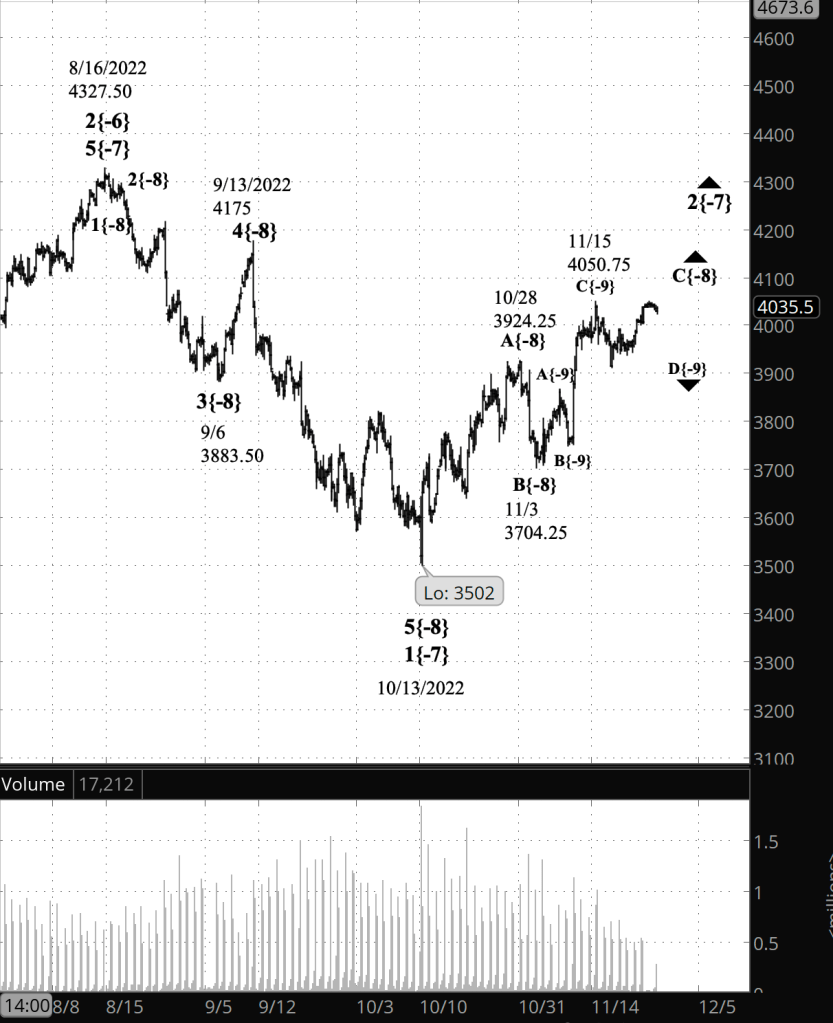
[S&P 500 E-mini futures at 9:35 a.m., 4-hour bars, with volume]

What does Elliott wave theory say? The correction is wave 2{-7}. It is in its 3rd leg, wave C{-8}.

Under the principal analysis, wave C{-8} is in its fourth subwave, wave D{-9}. The alternative analysis sees wave D{-9} as having ended and labels the rise since November 17 as wave E{-9}.

We Are Here.

These are the waves currently in progress under my principal analysis. Each line on the list shows the wave number, with the subscript in curly brackets, the traditional degree name, the starting date, the starting price of the S&P 500 E-mini futures, and the direction of the wave.

  • S&P 500 Index:
  • 5{+3} Supercycle, 7/8/1932, 4.40 (up)
  • 5{+2} Cycle, 12/9/1974, 60.96 (up)
  • 5{+1} Primary, 3/6/2009, 666.79 (up)
  • 5{0} Intermediate, 12/26/2018, 2346.58 (up)
  • 4{-1} Minor, 1/4/2022 4818.62 (down)
  • 1{-2} Minute, 1/4/2022 4818.62 (down)
  • S&P 500 Futures and index:
  • 1{-3} Minuette, 1/4/2022, 4808.25 (down) (futures), 4818.62 (down) (index)
  • S&P 500 Futures:
  • 1{-4} Subminuette, 1/4/2022, 4808.25 (down)
  • 1{-5} Micro, 1/4/2022, 4808.25 (down)
  • 3{-6} Submicro, 8/16/2022, 4327.50 (down)
  • 2{-7} Minuscule, 10/13/2022, 3502 (up)
  • C{-8} Subminuscule, 11/3/2022, 3704.25 (up)

Learning and other resources. Elliott wave analysis provides context, not prophecy. As the 20th century semanticist Alfred Korzybski put it in his book Science and Sanity (1933), “The map is not the territory … The only usefulness of a map depends on similarity of structure between the empirical world and the map.” And I would add, in the ever-changing markets, we can judge that similarity of structure only after the fact.

See the menu page Analytical Methods for a rundown on where to go for information on Elliott wave analysis.

By Tim Bovee, Portland, Oregon, November 24, 2022

Disclaimer

Tim Bovee, Private Trader tracks the analysis and trades of a private trader for his own accounts. Nothing in this blog constitutes a recommendation to buy or sell stocks, options or any other financial instrument. The only purpose of this blog is to provide education and entertainment.

No trader is ever 100 percent successful in his or her trades. Trading in the stock and option markets is risky and uncertain. Each trader must make trading decisions for his or her own account, and take responsibility for the consequences.

License
Creative Commons License

All content on Tim Bovee, Private Trader by Timothy K. Bovee is licensed under a Creative Commons Attribution-ShareAlike 4.0 International License.

Based on a work at www.timbovee.com.