Friday, February 26, 2021

3:30 p.m. New York time

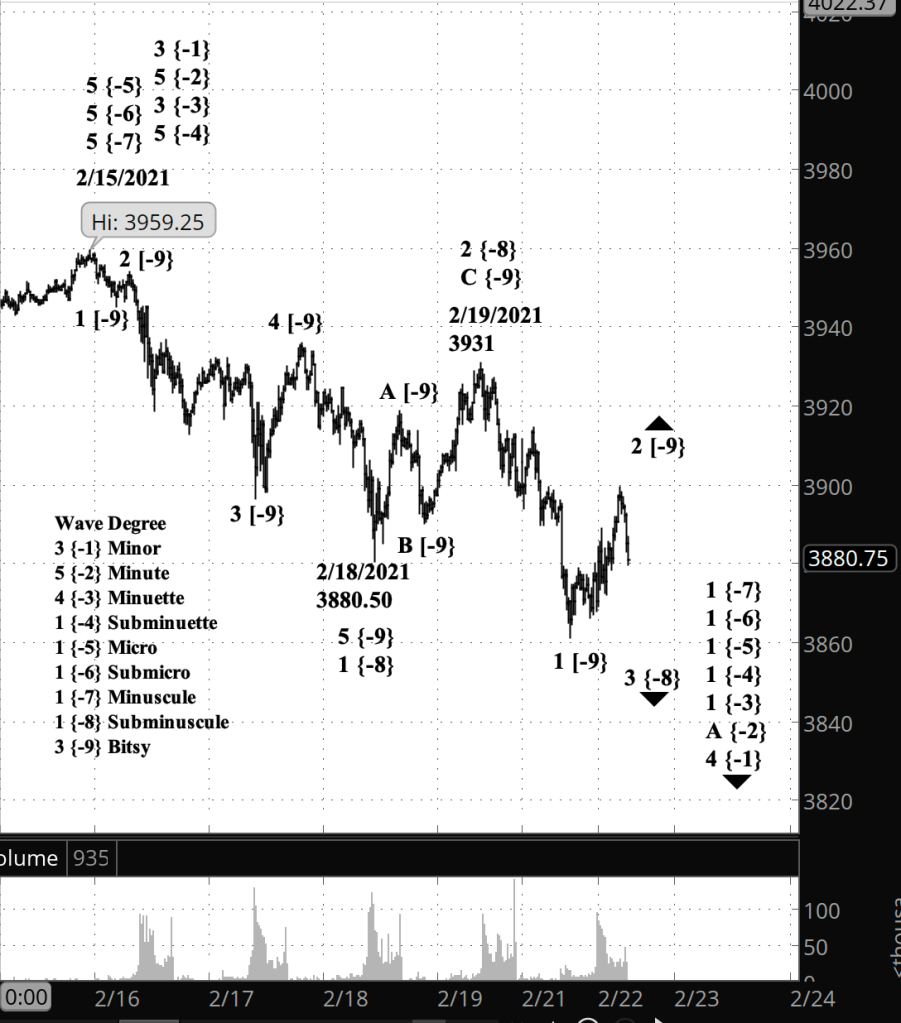
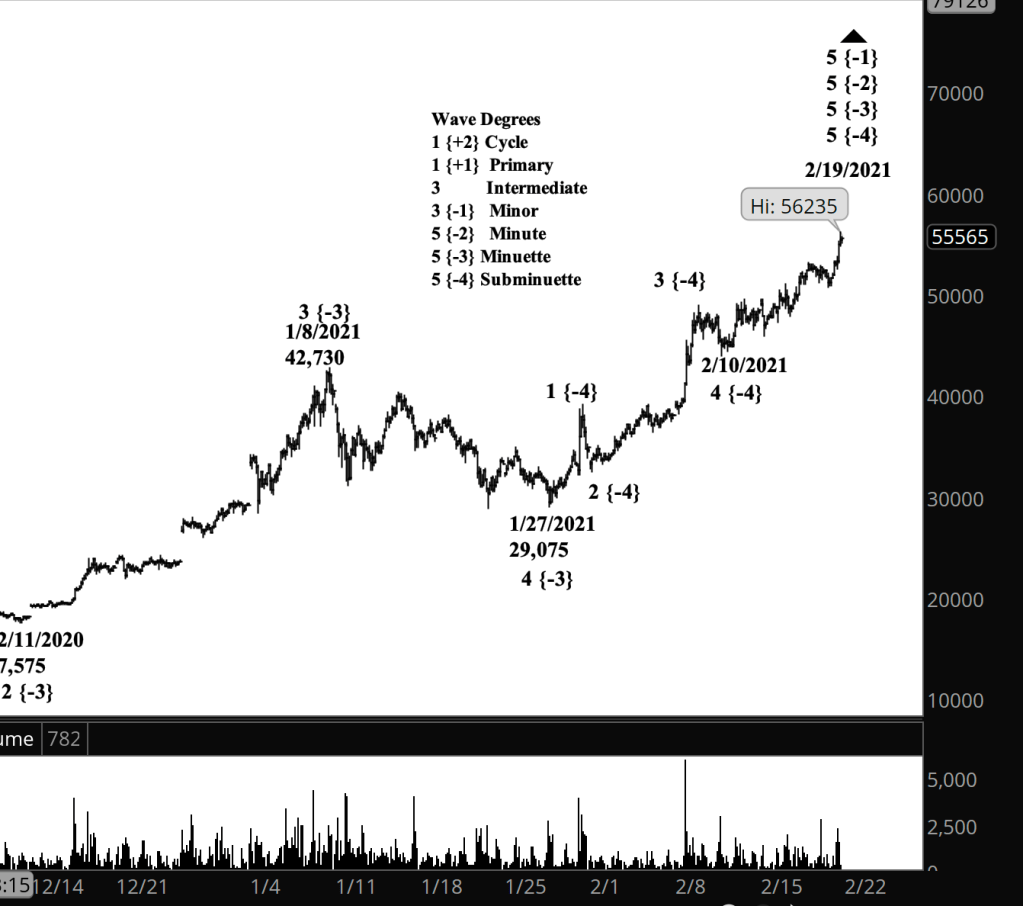
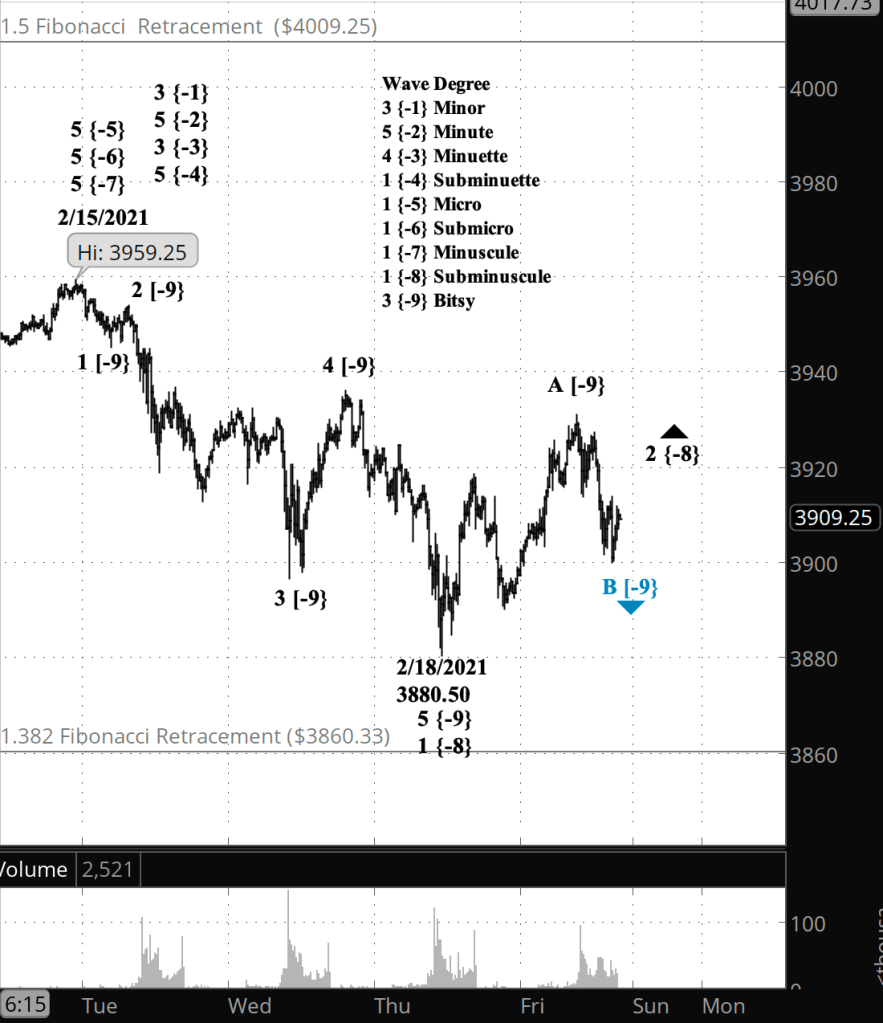
Half an hour before the closing bell. The S&P 500 continued in its sideways movement, staying above the day’s low, 3801.50 as it worked through the 4th wave of Subminuscule degree. I’ve updated the short-term chart from this morning. And here’s the long-term chart, showing the entirety of the rise from February 23, 2020, with the Diagonal Triangle marked in red. In the big picture, the next decline will carry down to the lower boundary of the triangle in a 4th wave, and then rise back to the upper boundary in a 5th and final wave.
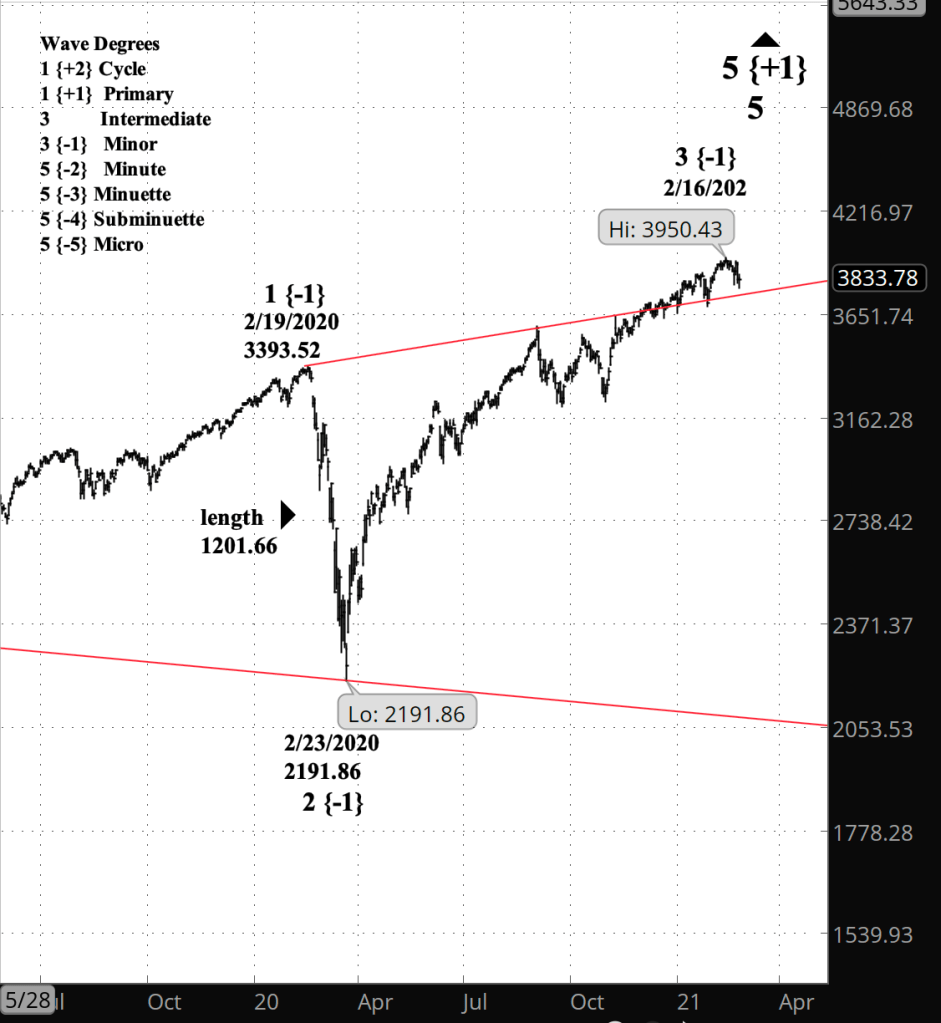
[S&P 500 index at 3:29 p.m., daily bars]

2:25 p.m. New York time

I’ve decided to hold my IWM short iron condor options position through the weekend and revisit exiting on Monday. I’ve updated the IWM Trade post with details and a chart.

9:55 a.m. New York time

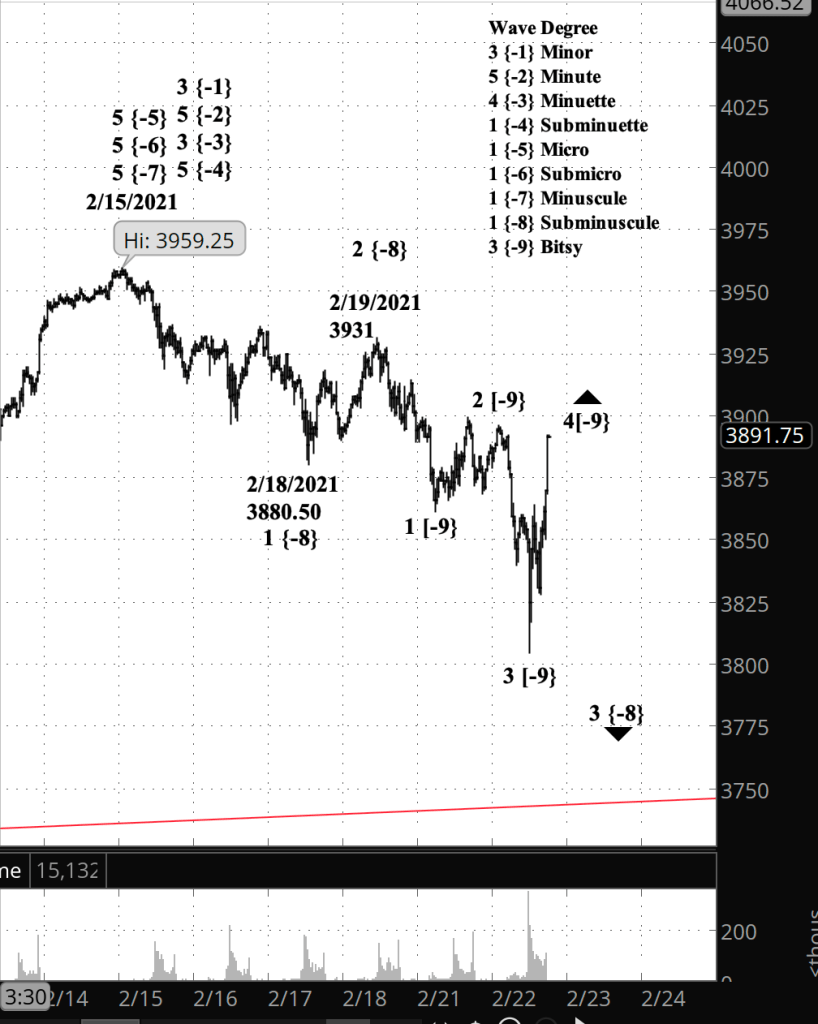
What’s happening now? The S&P 500 E-mini futures declined 3.25 points below the low of February 23, to 3801.50, and then began a sideways movement.

What does it mean? The break below the February 23 low confirms that a downtrend is under way, and that the price will carry lower. The sideways movement that followed is a shallow correction pattern, a pause that will be followed by further decline. The next milestone is the upper boundary of the expanding triangle that began in December 2018 (the red line on the chart), ending the overthrow condition that began on December 28, 2020.

What are the alternatives? What I’ve labeled a downtrend could in theory be a leg in an expanding triangle pattern that would carry the price above the high of December 24, 3934.50. I consider this to be a low probability. Another possibility is that wave 3 is not yet complete, that today’s low is the end of the 1st wave within wave 3 and the sideways pattern is the beginning of wave 2, which typically will retrace much of the 1st wave.
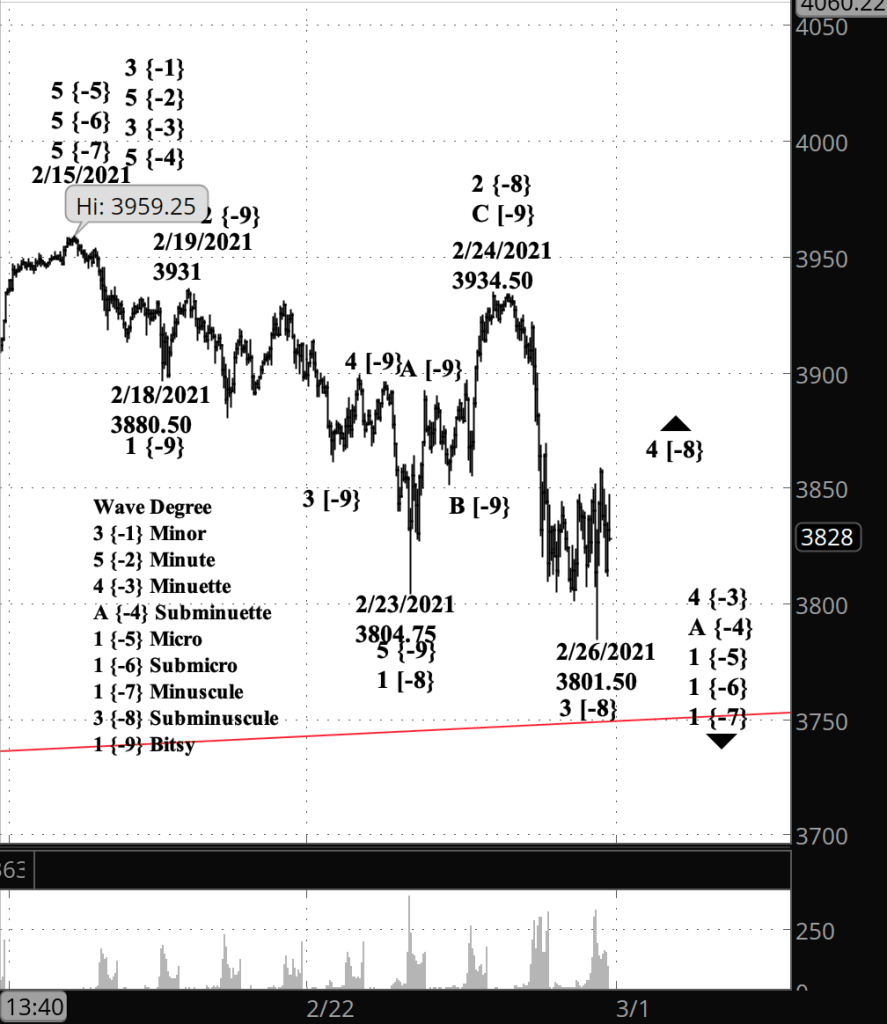
[S&P 500 E-mini futures at 3:30 p.m., 40-minute bars, with volume]

What does Elliott wave theory say? The sharp decline from February 25 was wave 3 of Subminuscule degree, and the sideways pattern that followed is a wave 4 correction, which is typically a shallow construction. This is all happening within a nested series of 1st waves, up to Micro degree, within wave A of Subminuette degree, which in turn is within wave 4 of Minuette degree. So in the longer run, the wave 4 correction of Minuette degree will be followed by wave 5 that will reach new highs.

My trades. My options position on IWM has 20 days until expiration, and in accordance with my rules, I shall be looking to exit if I can do so profitably. More on this later.

Read More »
Thursday, February 25, 2021

3:30 p.m. New York time

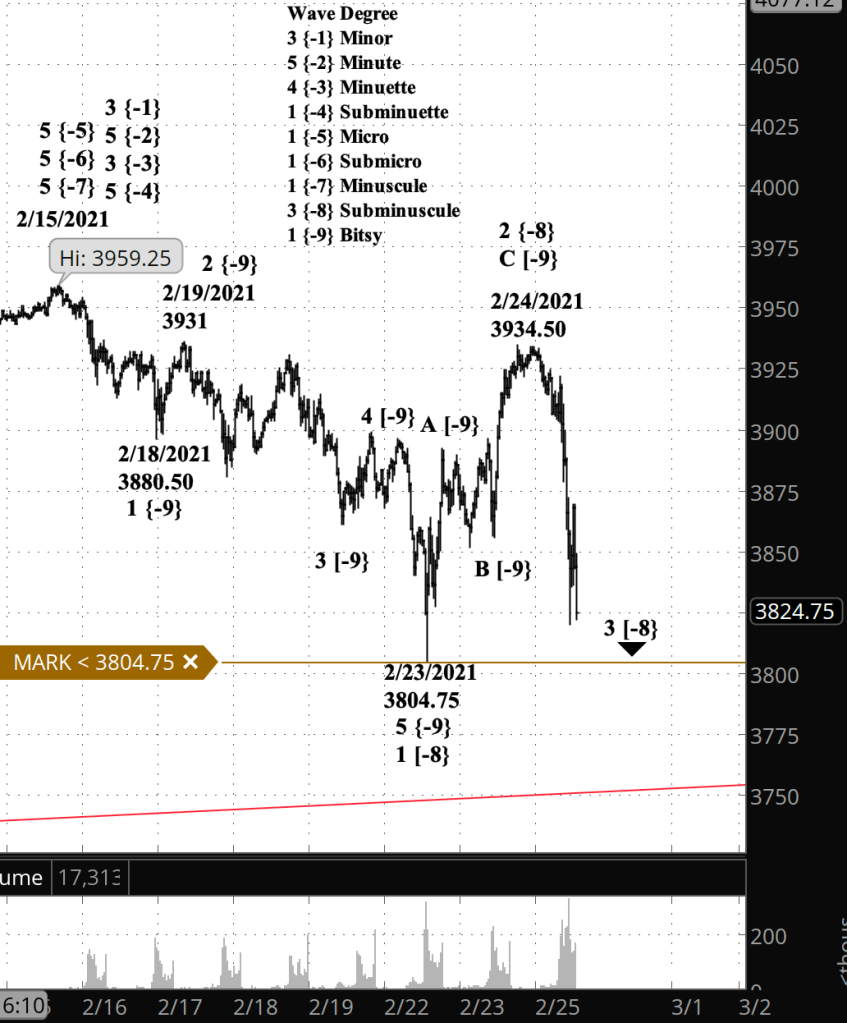
Half an hour before the closing bell. The S&P 500 fell to a low of 3820.25 during trading today, 15.5 points above the low of 3804.25 on February 23. A cross below that level will confirm that wave 3 of Subminuscule degree is underway. The updated chart below includes an alert showing the location of the 3804.25 mark. (Note that WordPress’ resizing function for the chart is, once again, not working on the update. So we all get to enjoy a supersized chart this afternoon.)

10:20 a.m. New York time

What’s happening now? The S&P 500 E-mini futures reached a high of 3934.50 in overnight trading and then reversed to the downside.

What does it mean? That high is above the previous high of 3931, attained on February 19. This has implications for the Elliott wave count.

What are the alternatives? See the Elliott wave theory section below.

[S&P 500 E-mini futures at 3:30 p.m., 35-minute bars, with volume]

What does Elliott wave theory say? A firm rule of Elliott wave analysis is that a 4th wave can’t exceed the end of wave 1. The end of the 1st wave in my count is 3931, and the end of the “4th wave” is 3934.50, which is 3.5 points higher. That means that the “4th wave” is no such thing. So what could it be?

In doing the recount, I have two requirements that must be met. I must ensure that no 4th wave moves beyond the end of wave 1. And in the the downtrend from the 3959.25 peak, reached on February 15, I must ensure that the 3rd wave isn’t the short of the three descending waves in the five-wave pattern. And as it turns out, it can be done, as the chart above shows.

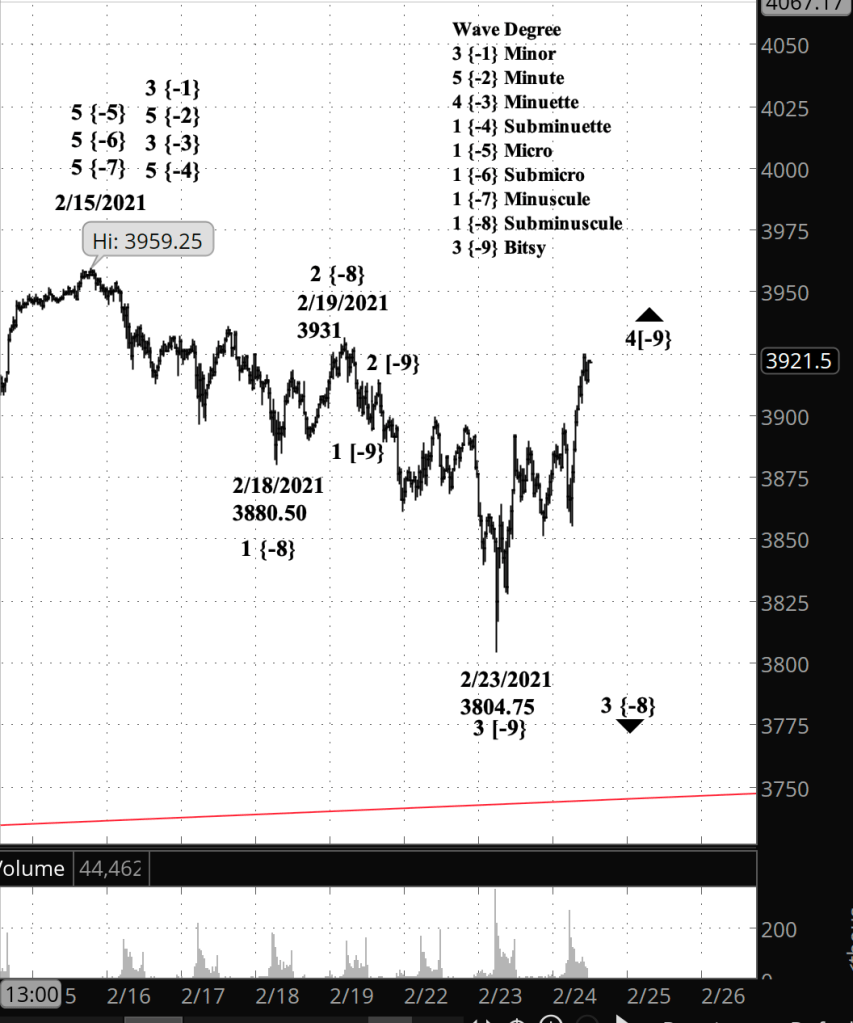
I reanalyzed the internals of the decline from 3959.25 to the low of 3804.75 reached on February 23 so that the low marks the end of wave 1 of Subminuette degree, and the rise that followed becomes Subminuette wave 2. (See my chart in yesterday’s post to compare the new count with the old one.) That eliminates the problematic 4th wave and provides a 3rd wave that is longer than the 1st wave, fulfilling the requirement that wave 3 can’t be runt of the litter.

Second waves tend to take back much of the preceding 1st wave, and I had remarked in an earlier post that the rise seemed far too steep for a 4th wave. The recount takes care of that difficulty with the form.

So what happens next? If the overnight high, 3934.50, is wave C within wave 2 of Subminuette degree, then the upward correction is over, and the price will fall below 3804.75, perhaps quite a bit below. However, I count only one wave so far within wave 2, and there should be three waves. So I would expect a wave B to the downside followed by wave C to the upside, which will complete wave 2.

And that points to a requirement that must be fulfilled by this new wave 2: A second wave cannot move beyond the start of wave 1. It must remain below the February 15 high of 3959.25, where wave 1 begins. And that’s OK. The structure has 24.75 points to work with before reaching that level. Plenty of room.

Read More »

Wednesday, February 24, 2021

3:30 p.m. New York time

Half an hour before the closing bell. The S&P 500 rose past sharply during the day, reaching a high of 3924.75 on the futures, 3928.39 on the index. I’ve updated the chart below adjusting some of the internal count to avoid wave 3 of Bitsy degree being the shortest wave, which is forbidden under the rules of Elliott wave analysis.

9:55 a.m. New York time

What’s happening now? The S&P 500 E-mini futures continued its upward correction in overnight trading.

What does it mean? Once the correction has ended, the price will resume the downtrend that began February 15, moving below yesterday’s low, 3804.75.

What are the alternatives? The correction can be analyzed as having been completed with the overnight high of 3874.50. I consider this to be the slightly less likely analysis.

[S&P 500 E-mini futures at 3:30 p.m., 30-minute bars, with volume]

What does Elliott wave theory say? The rise from February 23 is wave 4 of Bitsy degree. Fourth waves tend to be shallow, and this one is not, having come within 3 points of the start of Bitsy wave 3. So I don’t have a lot of confidence in the principle analysis compared to the alternate. In either case, once wave 4 is complete, the 5th wave that follows will move below the end of wave 3.

Read More »

Bitcoin Analysis

3:35 p.m. New York time

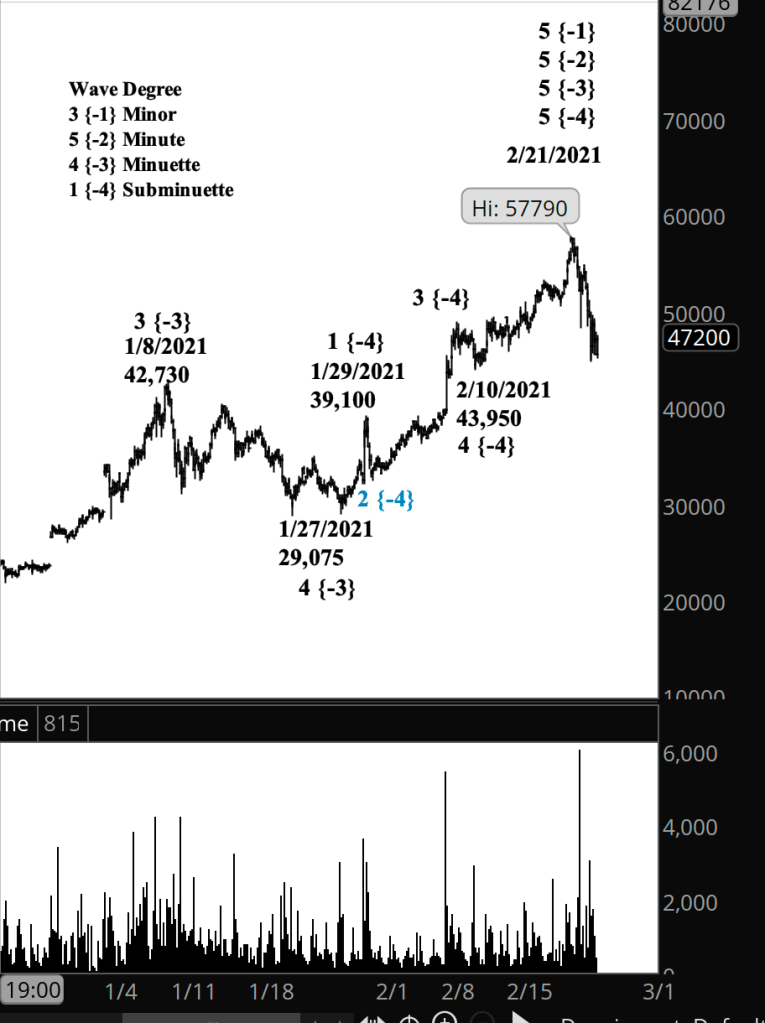
What’s happening now? Bitcoin futures today continued their decline from the high of 57,7890 set on February 21.

What does it mean? If the price stays below that high, then Bitcoin has begun a downward movement that as either a correction of the rise that began December 14, 2018 from 3120….

What are the alternatives? … or, it has begun a downward correction of the still incomplete rise that began on February 10 from 43,950.

[Bitcoin futures at 3:37 p.m., 2-hour bars, with volume]

What does Elliott wave theory say? If the price remains above the February 10 level of 43,950, then the rise did not end on February 21 and wave 5 of Subminuette degree is still underway. If the price moves below 43,950, then either the uptrend ended on February 21, or wave 5 of Subminuette degree is taking a Diagonal Triangle formation. If it is expanding, then the price will bounce between widening trend lines for five waves.

Read More »

Tesla Inc. (TSLA) Analysis

1:55 p.m. New York time

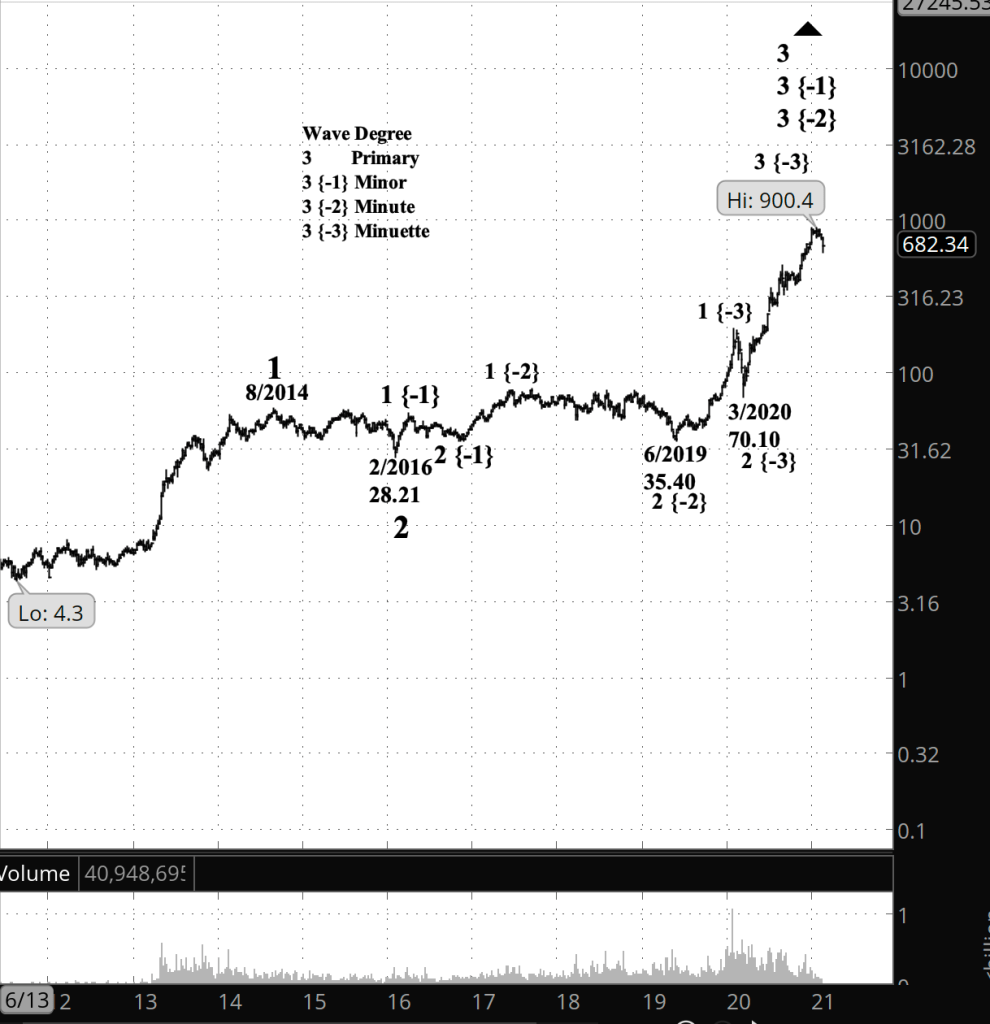
What’s happening now? TSLA accelerated its decline from a peak of 900.40 set on January 25, reach as low as 619 in afternoon trading.

What does it mean? The stock is in the early stages of a downward movement correcting the rise that began in June 2019.

What are the alternatives? The decline hasn’t been that large yet, and even though the rise from has met all of the requirements for completion, it’s possible that the present drop is a lower-level correction within the larger uptrend. The lower the price, the less likely the alternative scenario.

[TSLA at 1:49 a.m., weekly bars, with volume]

What does Elliott wave theory say? TSLA by my principle count has completed wave 3 of Minuette degree and has embarked on a wave 4 correction to the downside. This is happening within a series of 3rd waves all the way to Primary degree. The whole Primary degree movement is within an uptrending Intermediate degree that began in August 2011 from 4.30.

Returning to the Minuette degree: 4th waves tend to be shallow, so I expect the price to remain well above the beginning of wave 3 from 70.10 in March 2020. After the 4th wave is complete, then the price will push upward to new highs.

Read More »

Tuesday, February 23, 2021

3:40 p.m. New York time

I’ve posted an analysis of Bitcoin futures.

3:30 p.m. New York time

Half an hour before the closing bell. The S&P 500 reached a low of 3904.75, the end of wave 3 of Bitsy degree, and bounced in a wave 4 correction to the upside. Following wave 4 it will decline below 3904.05 in a 5th wave. I’ve updated the chart.

10:55 a.m. New York time

New analysis. I’ve posted an analysis of Tesla (TSLA).

9:40 a.m. New York time

What’s happening now? The S&P 500 E-mini futures continued to fall in overnight trading, reaching a low of 3840 in the middle portion of the decline that began on February 15 from 3959.25, and at a smaller level, the middle portion of the decline that began on February 19 from 3931.

What does it mean? What we’ve seen since mid-February are the early steps in what will develop into a significant decline of 1,000 points and more.

What are the alternatives? The alternative is that the rise that ended on February 15 isn’t over, and the price will reverse and set a new high. The lower the price goes, the less likely is the alternative.

[S&P 500 E-mini futures at 3:30 p.m., 25-minute bars, with volume]

What does Elliott wave theory say? The present decline is wave 3 of Bitsy degree within wave 3 of Subminuscule degree within wave 1 of Minuscule degree, the smallest of a series of 1st waves of increasingly larger degree, up to wave 1 of Minuette degree, and above that, wave A of Minute degree within wave 4 of Minor degree. At the Bitsy degree, it’s possible that the morning bump to the upside is the beginning of Bitsy wave 4, or it could be wave 2 correction within Bitsy 3. Time will clarify the chart.

Minor wave 4 is part of an expanding Diagonal Triangle that began December 26, 2018 and will eventually reach the lower boundary of that triangle, presently in the low 2000s.

Read More »

Bitcoin Analysis

3:10 a.m. New York time

What’s happening now? Bitcoin futures fell below 50,000, reaching as low as 49,320 and then retreating upward.

What does it mean? The decline could be a correction within the rise from January 27 that hit a high of 57,790 on February 21.

What are the alternatives? It could also be the beginning of a significant downward movement that will carry the price into 30,000s and perhaps lower.

[Bitcoin futures at 3:11 p.m., 140-minute bars, with volume]

What does Elliott wave theory say? Under the rules of Elliott wave analysis, wave 5 of Minuette degree as met the minimum internal requirement: A five wave upward movement in which the middle wave is not the shortest. That’s not a guarantee that wave 5 is complete. The present dip down could reverse and move to yet a new higher high, or it could continue downward. A drop below 43,950, the end of Minuette wave 4, would strength the case that the February 21 high marks a significant reversal point. A drop below 29, 075, the low set on January 27, the start of wave 5 of Minuette degree, would make the reversal theory even more likely.

Read More »

Monday, February 22, 2021

3:30 p.m. New York time

Half an hour before the closing bell. The S&P 500 reversed to the upside in trading today, and then reversed again, back to the downside. The analysis of this morning stands. I’ve updated the chart below.

I also posted a Bitcoin analysis.

Also, more resizing problems with the charts. Thanks, WordPress!

9:45 a.m. New York time

What’s happening now? The S&P 500 E-mini futures completed an upward correction within the decline that began on February 15 and has now resumed the downtrend.

What does it mean? The index and its derivatives are in the early stages of a downtrend that will eventually carry it around 2,000 points below its present levels.

What are the alternatives? If the price reverses and moves above the February 15 high — 3959.25 on the futures, 3950.43 on the index — then the uptrend that began on February 23, 2020 from 2191.86 on the index is still underway.

[S&P 500 E-mini futures at 3:30 p.m., 20-minute bars, with volume]

What does Elliott wave theory say? In overnight trading the futures moved below the February 18 low of 3880.50, which was the start of wave 1 of Subminuscule degree. Under the rules of Elliott wave analysis, if the price moves below the start of wave 1, then it’s not wave 2. That rule required that wave 2 be considered to have ended at the February 19 peak, 3931, as a result of the lower low.

All that has ensued since the February 15 peak are the early movements within a downward correction, wave 4 of Primary degree, and within it, from larger to smaller, an A wave of Minute degree and then a series of 1st waves, from Minuette down to Subminuscule.

The entire structure is within a Diagonal Triangle that began in December 2018, with each ensuing wave longer than the one that came before. So Primary wave 4 will eventually carry down to the lower boundary of the triangle, which presently in the 2080s and sinking daily.

Read More »

Bitcoin Analysis

3:15 p.m. New York time

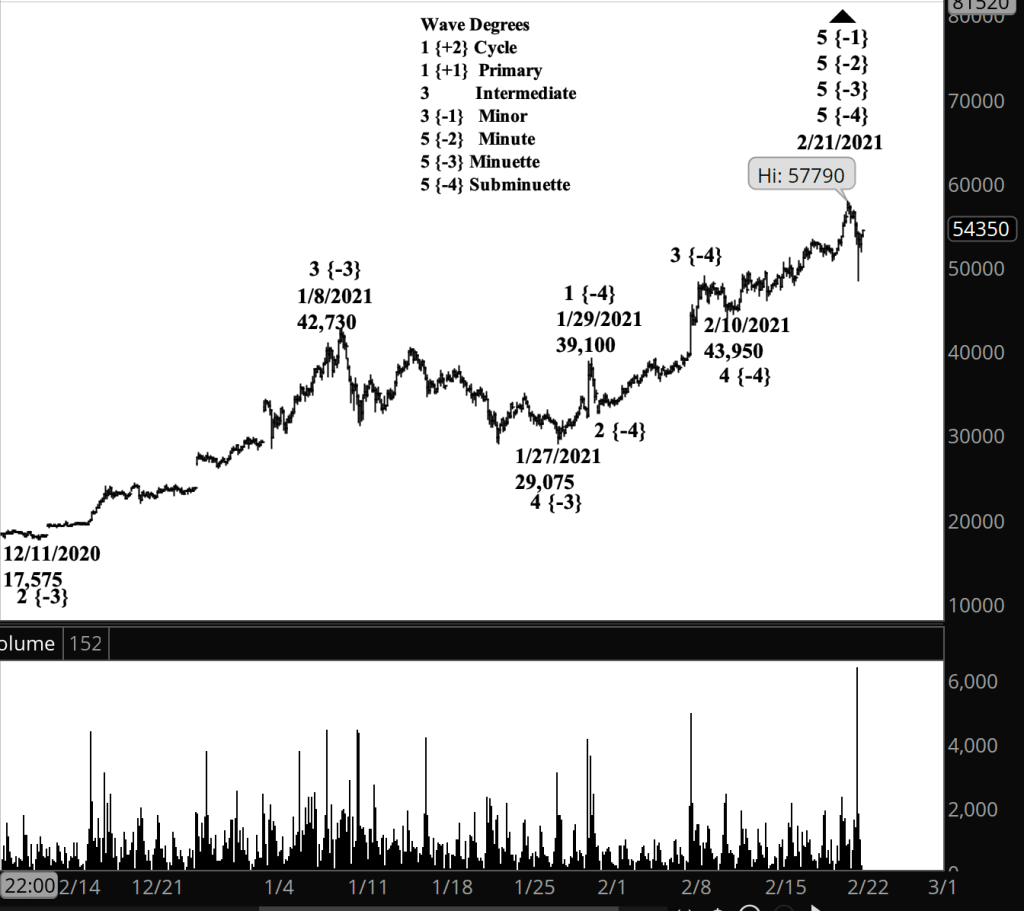
What’s happening now? Bitcoin futures continued the upward push that began on January 27 from 29,075, reach a high today (so far) of 56,235.

What does it mean? The rise since late January is the final leg of an uptrend that began on December 14, 2018 from 3120. It’s end will trigger a significant downward movement over the next few weeks and months, composed of the usual pattern of rises and falls.

What are the alternatives? The upward sprint from February 10 has fulfilled the minimum requirements of Elliott wave theory. Today’s high could be the end of the rise, or there could be more upside potential.

[Bitcoin futures, 135-minute bars, with volume]

What does Elliott wave theory say? The end of the rise will complete fifth waves all the way up to Primary degree, the degree that began in December 2018. If the ensuing decline is a correction, then the price over the long haul will remain above the December 2018 low of 3120. If the decline is a new downtrend, then the price will break below that level, although it will take significant time for that to happen.

Read More »

Friday, February 19, 2021

3:30 p.m. New York time

Half an hour before the closing bell. The S&P 500 completed the first leg, wave A of Bitsy degree, of the upward correction that began on February 18 and has embarked on the second leg, wave B of Bitsy degree. I expected the second wave to end above the start of the correction, 3880.50.

I’ve posted a Bitcoin futures analysis.

10:15 a.m. New York time

What’s happening now? The S&P 500 E-mini futures continues to rise in the first leg of a small scale upward correction within a larger downtrend that began on February 15.

What does it mean? The correction will remain below the February 15 peak of 3959.25 on the futures, 3950.43 on the index, and will be followed by further moves to the downside, of increasing significance.

What are the alternatives? If the price moves above the February 15 high, then the decline that followed is a correction within an ongoing uptrend.

[S&P 500 E-mini futures at 3:30 p.m., 15-minute bars, with volume]

What does Elliott wave theory say? Wave A of Bitsy degree has completed it’s 3rd wave internally and is correcting with wave 4. A final push upward will complete the 5th wave within Bitsy and begin declining Bitsy B, which will remain above the start of A, 3880.50 on the futures. A final wave C of Bitsy degree will push still higher while remaining below the February 15 high and will complete wave 2 of Subminuscule degree. The next move after Subminuscule 2 will be Subminuscule 3, a comparatively powerful wave at this small degree that will push below 3880.50, perhaps by quite a bit.

Read More »