Friday, January 8, 2021

3:30 p.m. New York time

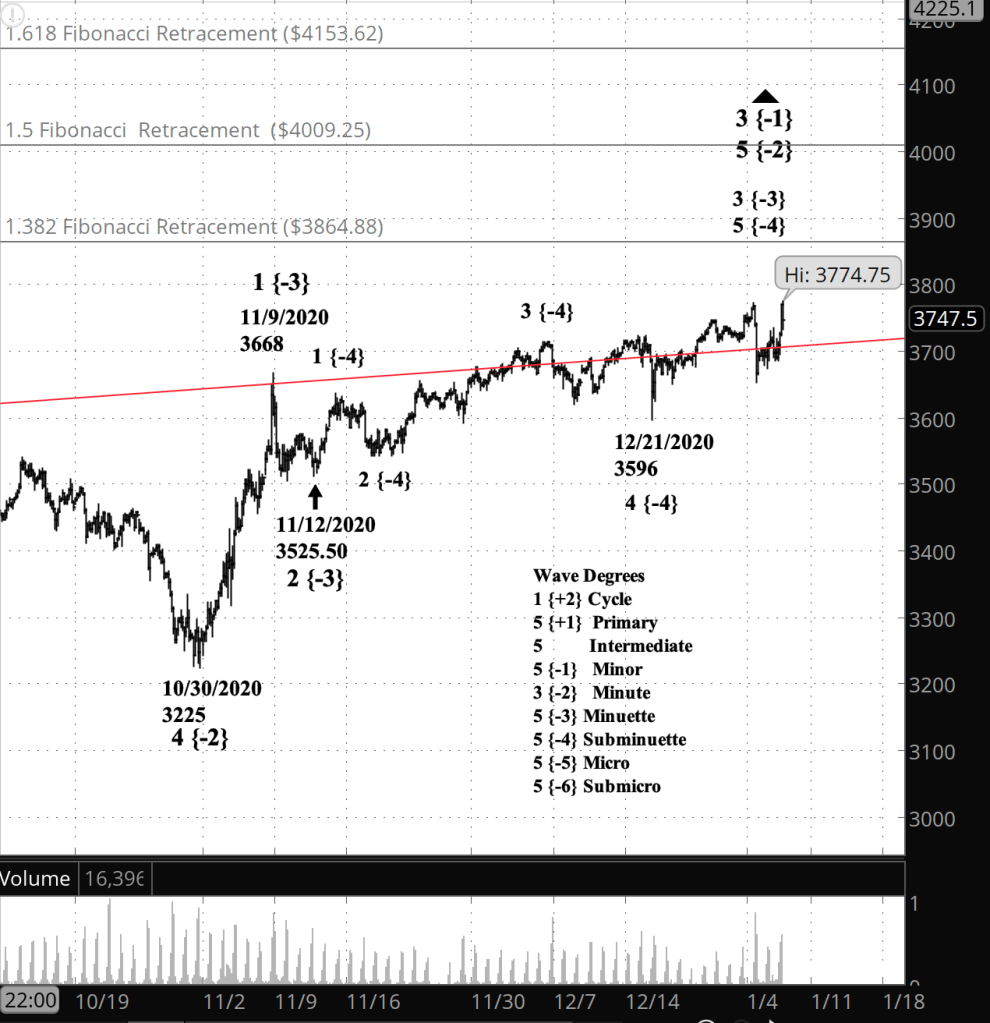
The S&P 500 E-mini futures are about eight points below their high of the day. I’ve updated the futures chart from this morning.

2:25 p.m. New York time

I mentioned this morning that I would make a decide whether to exit my short bear call options spreads on IWM today. The position expires on January 15, so by my rules I need to be out today or Monday.

Here are some numbers that frame the decision. The maximum loss calculated at entry was $1.08 per contract at expiration. The profit zone is a share price of $192 or below, marked on the chart with an alert. The present cost of exiting is $4.58 per contract.

(Apologies for the size of the chart. WordPress has gone into one of its recurring spells of graphs madness and won’t let me resize the image for a more normal presentation.)
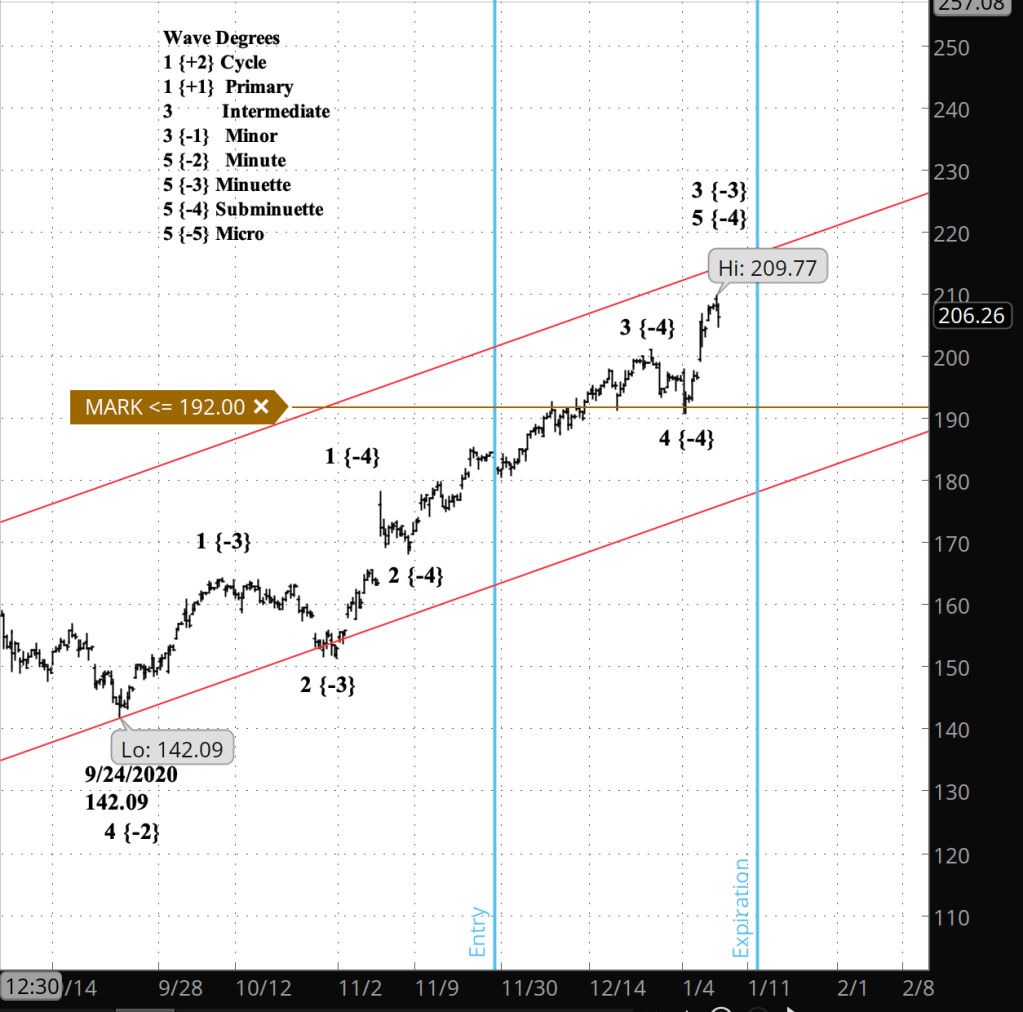
[IWM at 2:25 p.m., 3-hour bars]

If I exit now, the loss will be more than four times what I would pay at expiration. So — no brainer — I should continue to hold the position. The risk to holding is that the position could be assigned, leaving me with 100 short shares of IWM in my account. Not a tragedy but an inconvenience.

As IWM falls off from today’s high, 209.77, it could very well mean that wave 5 of Subminuette degree and its parent, wave 3 of Minuette degree have ended, and we have begun a Minuette wave 4 downward correction, which would benefit my position.

So, decision time. I shall continue to hold position until Monday, and decide then whether to exit or hold longer.

9:45 a.m. New York time

What’s happening now? The S&P 500 E-mini futures continued to rise overnight, to a high of 3817.75.

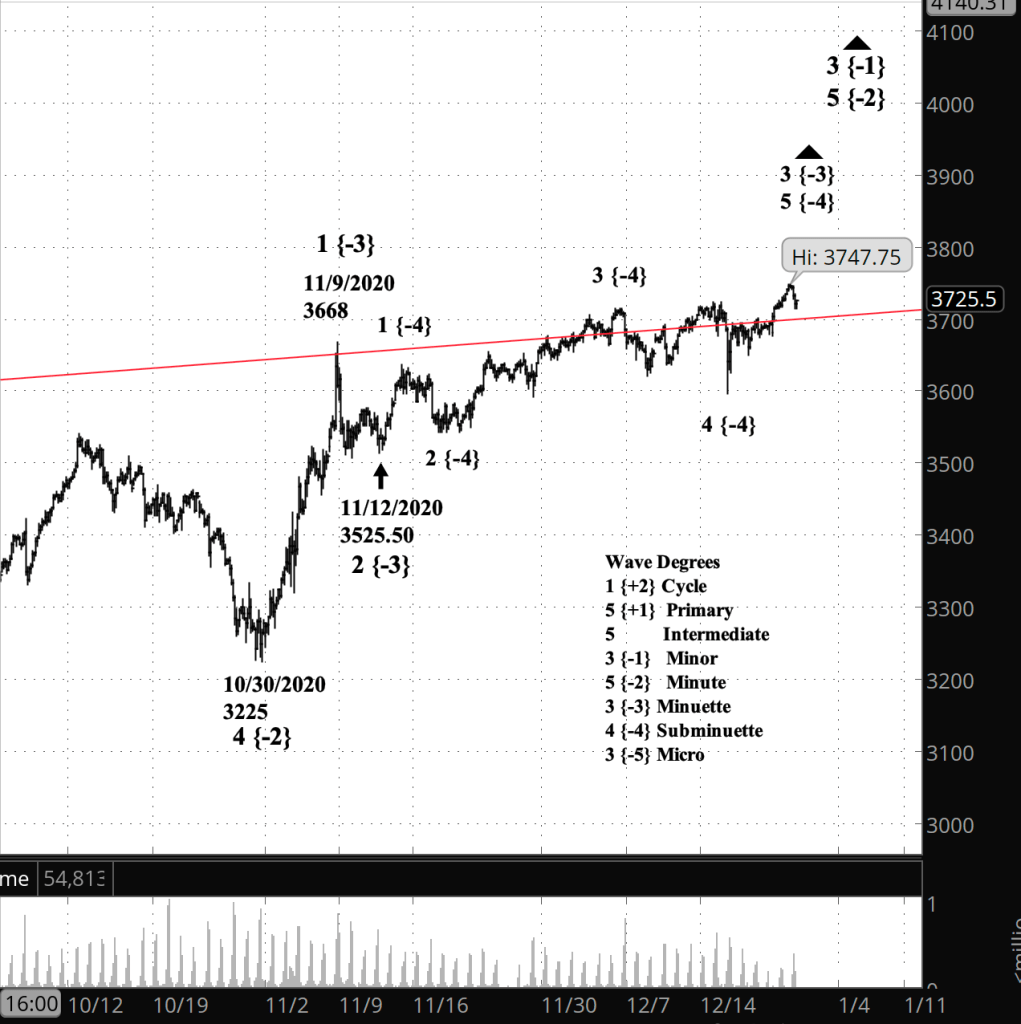
What does it mean? The rise is part of the end game of the upward movement that began October 30 from 3225. The current high is about 50 points below the lowest of three Fibonacci retracement levels that provide price targets. After the uptrend is complete, I expect a shallow correction and then another upward movement.
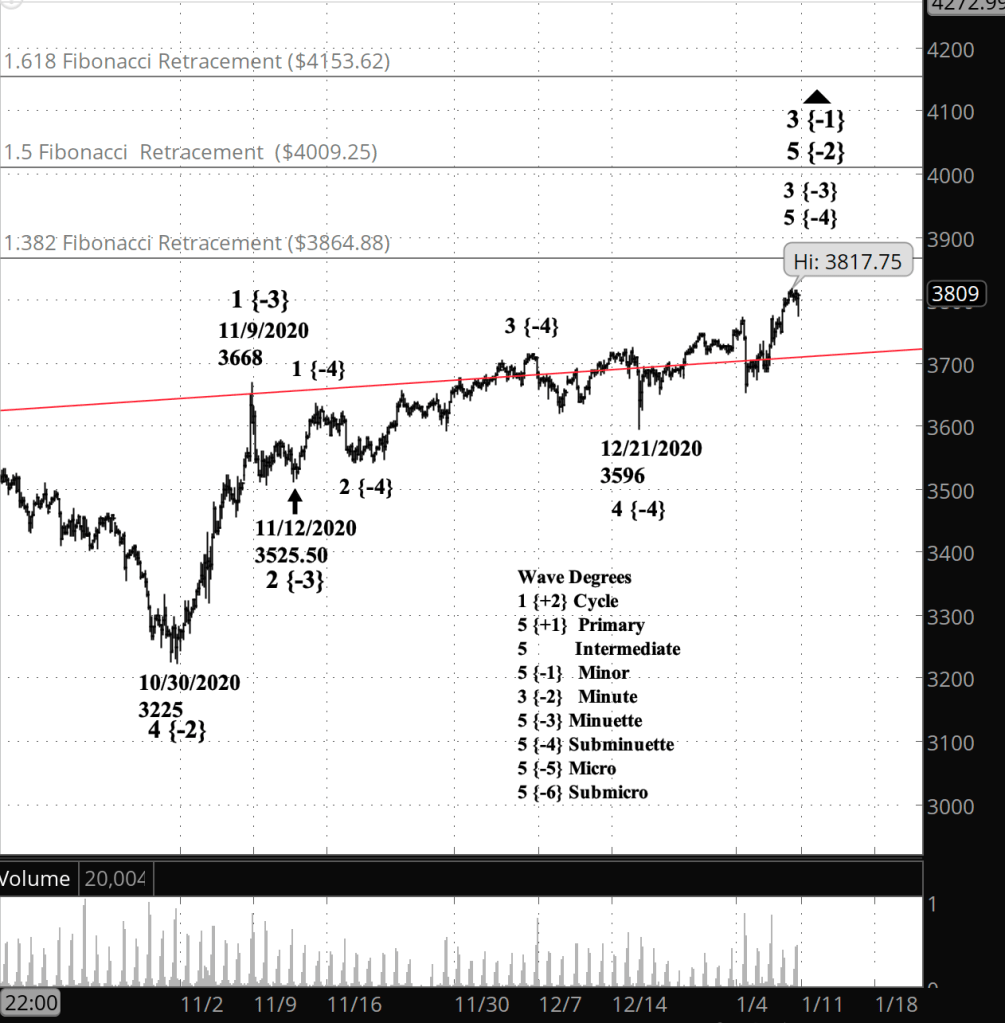
[S&P 500 E-mini futures at 3:30 p.m., 3-hour bars, with volume]

What does Elliott wave theory say? The rise that began October 30 is wave 5 of Minute degree. Internally, it is on wave 3 of Minuette degree, which in turn in wave 5 — the final wave — of Subminuette degree. Minuette 3 will be followed by a 4th wave correction, probably shallow and possibly time-consuming, if it turns into a compound structure.

My trading strategy. My short bear call spread options on IWM are in a losing position, with expiration only a week away. The question is, do I exit now or do I wait until Monday. I’ll make a decision on the question before the closing bell.

Read More »
Thursday, January 7, 2021

3:30 p.m. New York time

Half an hour before the closing bell. The S&P 500 price inched higher, reaching 3803.25 on the futures as the closing bell approached. I’ve updated the chart, below.

11 a.m. New York time

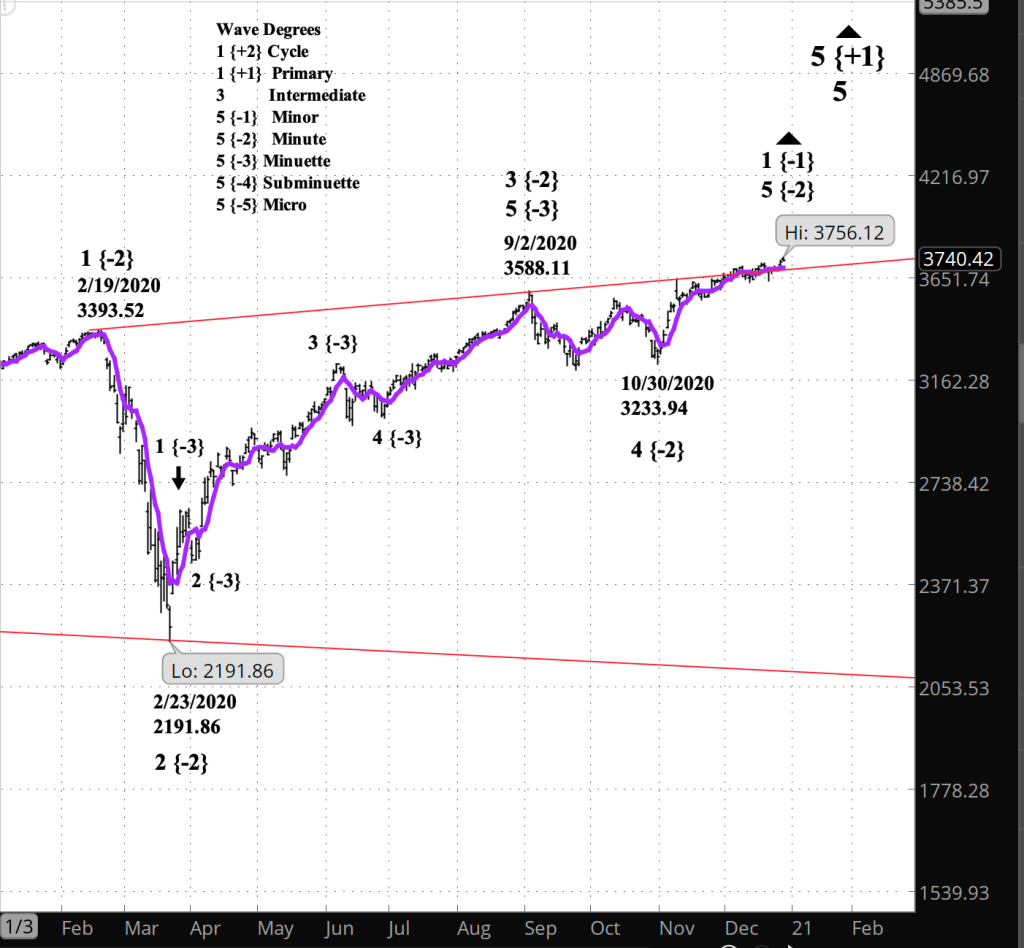
What’s happening now? The S&P 500 E-mini futures rose to within 65 points of the lowest of three Fibonacci retracement levels are my price targets for the rise that began in February. It has so far reached 3,800 as of this post.

What does it mean? Completion of the rise will mean that the middle wave, usually the strongest of the five-wave structure, has reached an end and will be followed by a decline, perhaps a shallow on.

[S&P 500 E-mini futures at 3:30 p.m., 3-hour bars, with volume]

What does Elliott wave theory say? Wave 3 of Minor degree began on February 23. The subwaves, from larger degree to smaller, are wave 5 of Minute degree, wave 3 of Minuette degree and wave 5 of Subminuette degree.

Completion of Minor wave 3 will be followed by Minor wave 4, the wave position that tends toward a shallow structure and one that link several corrective patterns together in a time-consuming compound correction.

Read More »

Wednesday, January 6, 2021

3:30 p.m. New York time

30-minutes before the closing bell. The S&P 500 high set earlier today still stands. I’ve updated the chart, below.

2:05 p.m. New York time

The S&P 500 exceeded the January 4 high, which means that my alternative analysis has come into play. My expectations for subsequent moves, once Minuette wave 3 is complete, are unchanged. I’ve updated the chart.

9:50 a.m. New York time

What’s happening now? The S&P 500 E-mini futures briefly peeked above the upper boundary of the Diagonal Triangle that has traced the course of the index and its derivatives since December 2018. The high, after the closing bell yesterday, was 3734, which is about 40 points below the January 4 turning point.

What does it mean? The S&P 500 is in the early stages of a declining correction that will carry down, probably, to the low 3500s.

What is the alternative? I won’t be entirely confident that the January 4 peak, 3773.25 on the futures, is in fact end of the rise since October 30 until I see the price push below the December 21 low, 3596. Also, even if the correction has has begun, it may well turn out to be a shallow one.

[S&P 500 E-mini futures at 3:30 p.m., 3-hour bars, with volume]

What does Elliott wave theory say? The January 4 peak marked the end of wave 3 of Minuette degree and the beginning of wave A of Subminuette degree within Minuette wave 4. The A wave will typically have five subwaves, at the Micro degree.

All of this is happening within rising wave 5 of Minute degree within rising wave 3 of Minor degree.

Fourth-wave corrections tend to be sideways moves and often will extend into compound patters. Minuette wave 4 may with us for awhile. It will be followed by Minuette wave 4, which may well rise to the 3860s, and as high as the 4150s.

Read More »

Tuesday, January 5, 2021

3:45 p.m. New York time

15-minutes before the closing bell. The S&P 500 E-mini futures moved slightly higher above the upper boundary of the Diagonal Triangle. I’ve updated the chart, below.

11:15 a.m. New York time

What’s happening now? The S&P 500 E-mini futures were trading along the upper boundary of the Diagonal Triangle that began in December 2018.

What does it mean? I count the movement as still having some upward potential remaining before hitting one of the three Fibonacci levels marked on the chart..

[S&P 500 E-mini futures at 3:45 p.m., 3-hour bars, with volume]

What does Elliott wave theory say? Now underway, wave 5 of Subminuette degree within wave3 of Minuette degree.

Read More »

Monday, January 4, 2021

3:30 p.m. New York time

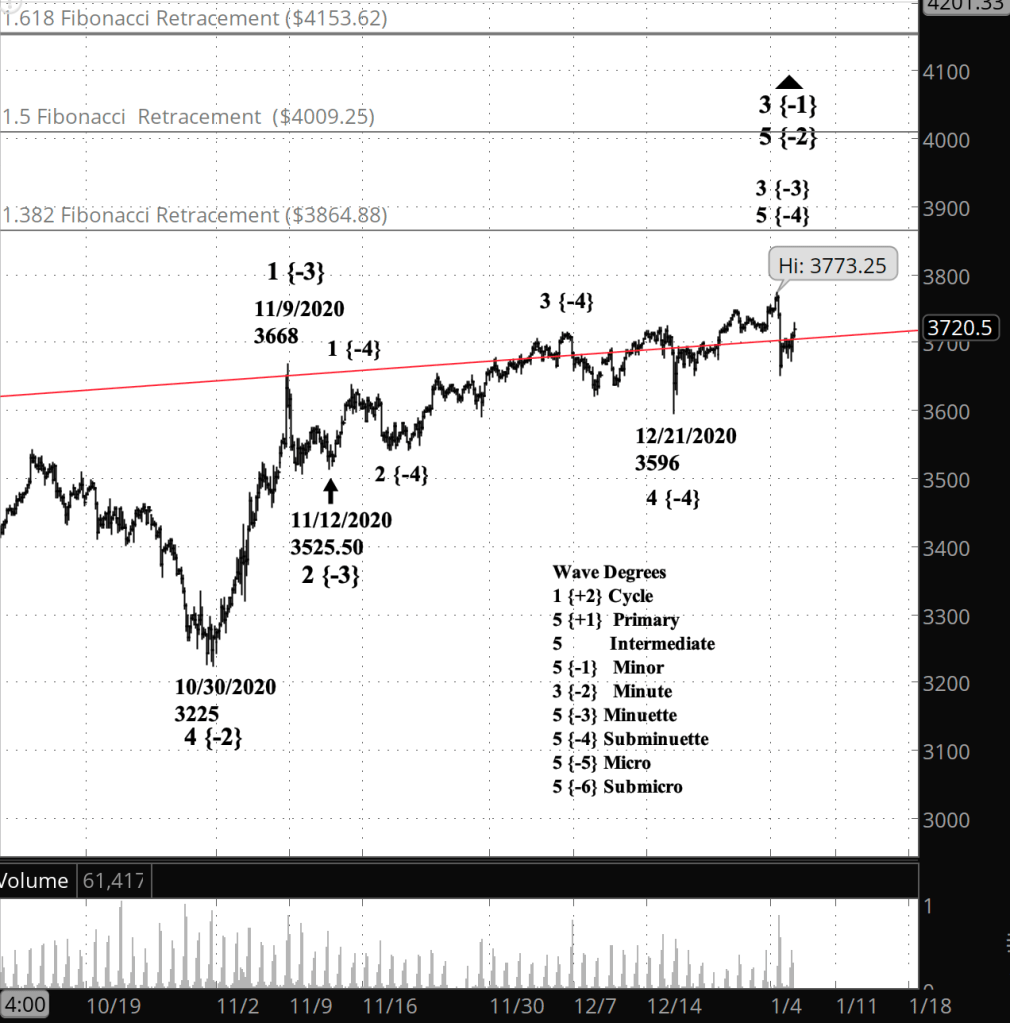
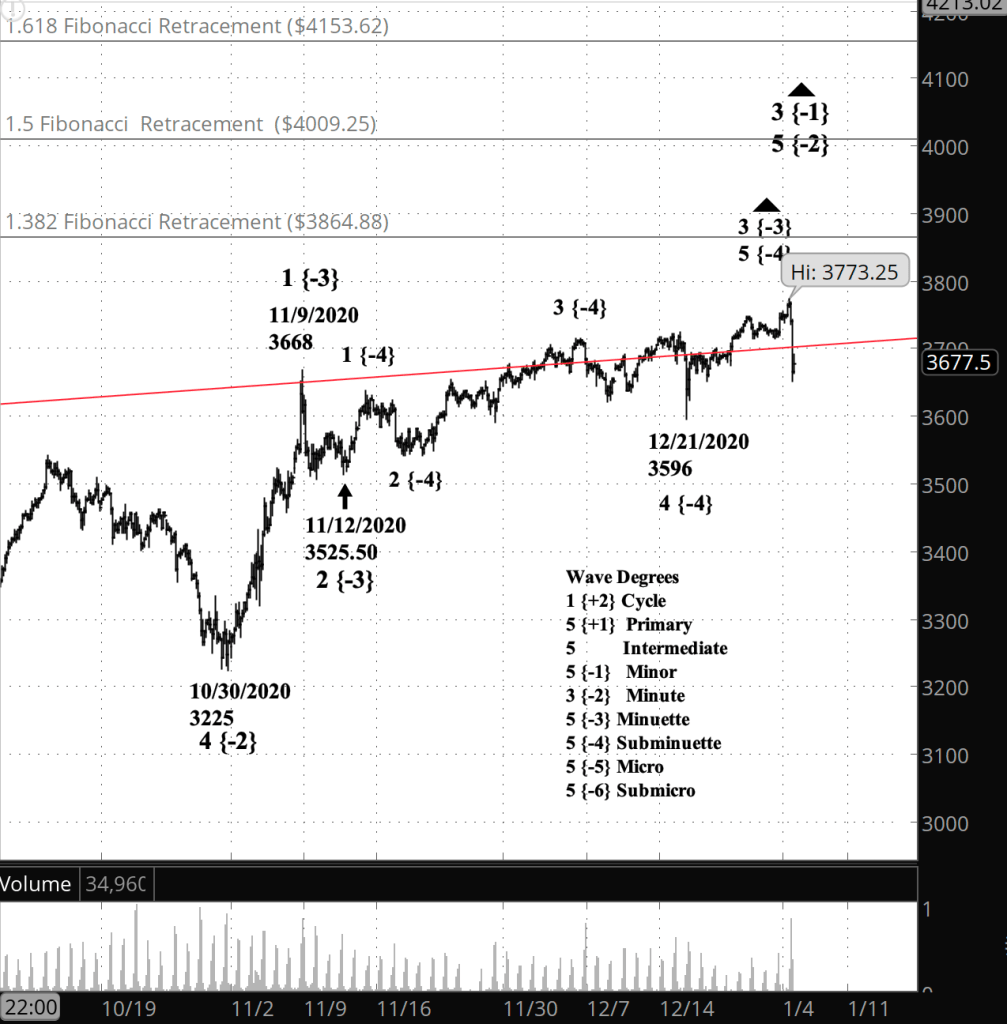
Half an hour before the closing bell. The S&P 500 and derivatives reversed from its peak and dropped 20 points. The E-mini futures peaked at 3773.53 early in the day and then fell to a daily low, so far, of 3652.50. The chart includes the Minor-degree Fibonacci retracement levels for the futures; the Fib’s use in setting targets was discussed below as it applies to the index.

[S&P 500 E-mini futures at 3:30 p.m., 3-hour bars, with volume]

9:45 a.m. New York time

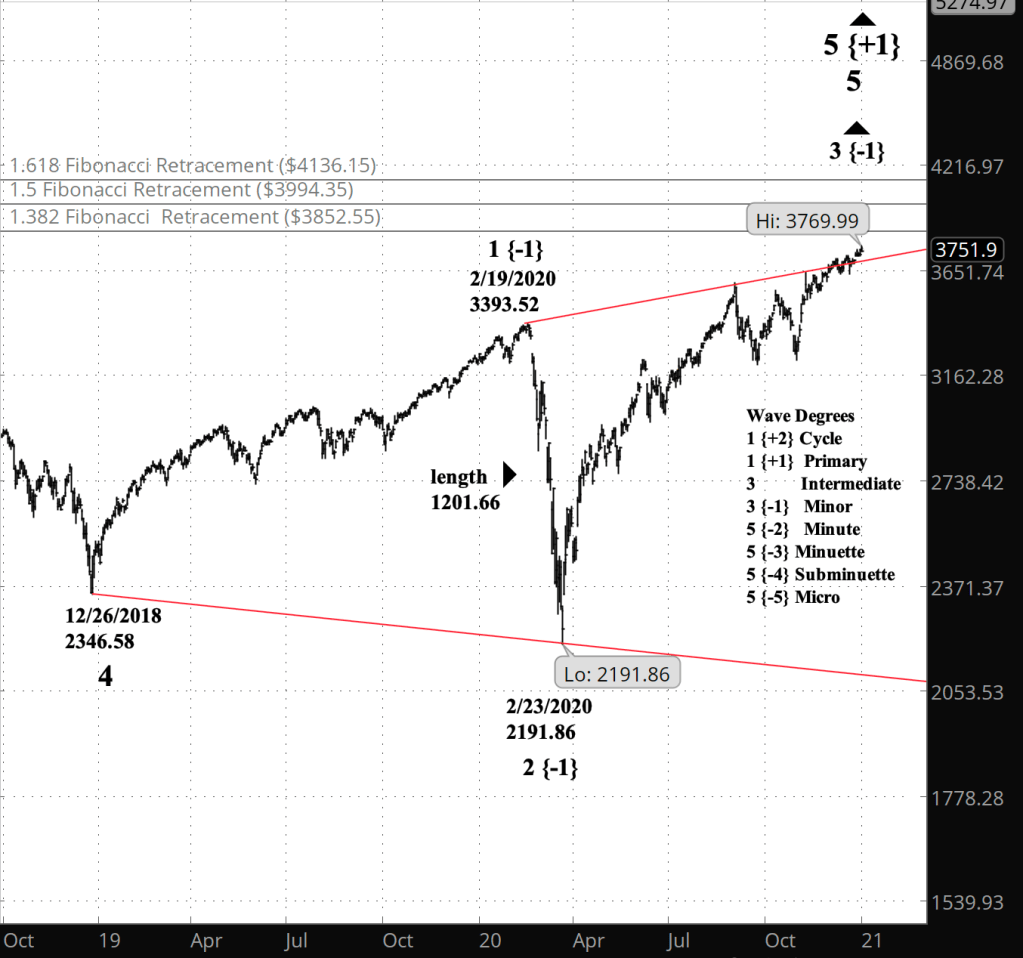
What’s happening now? On the first trading day of 2021, S&P 500 index and E-mini futures continued their rise. The index hit an early high of 3769.99 and the futures, of 3773.25.

What does it mean? The index and its derivatives are on the final leg of a near-term rise that began on December 21, and over the longer term, of a rise that began on February 23.

[S&P 500 index at 9:40 a.m., 3-hour bars]

What does Elliott wave theory say? As the price keeps bouncing up the mountain, let’s make an attempt to establish the peak. One method that’s part of Elliott wave analysis is the Fibonacci level. Often, a third wave will be longer than the preceding third wave by a number in the Fibonacci sequence, with 38.2%, 50% and 61.8% being the most common peaks beyond the length of wave 2.

Looking at the Minor level on the index chart, wave 2 was 1,201.66 points long. That gives us three possible peaks if one of them matches a common Fibonacci level:

  • 3,852.55 at 31.8% beyond the length of wave 2.
  • 3,994.35 at 50% beyond.
  • 4136.15 at 68.2% beyond.

I’ve marked the three levels on the chart, above. Now, the reality of Fibonacci levels is that they are rarely exact. There’s always a bit of fudge regarding where the price will land. So I’ll think of the target as being somewhere between 3,850 and 4,150.

My trading strategy. My short bear call options spreads on IWM expire on January 15, which by my rules means, win or lose, I’ll exit the position on Monday of next week, on January 11. IWM at present is trading at 196 plus change. The top of the profit zone is 192, so the position is a losing one at this point.

Read More »

Farewell, 2020

After the closing bell

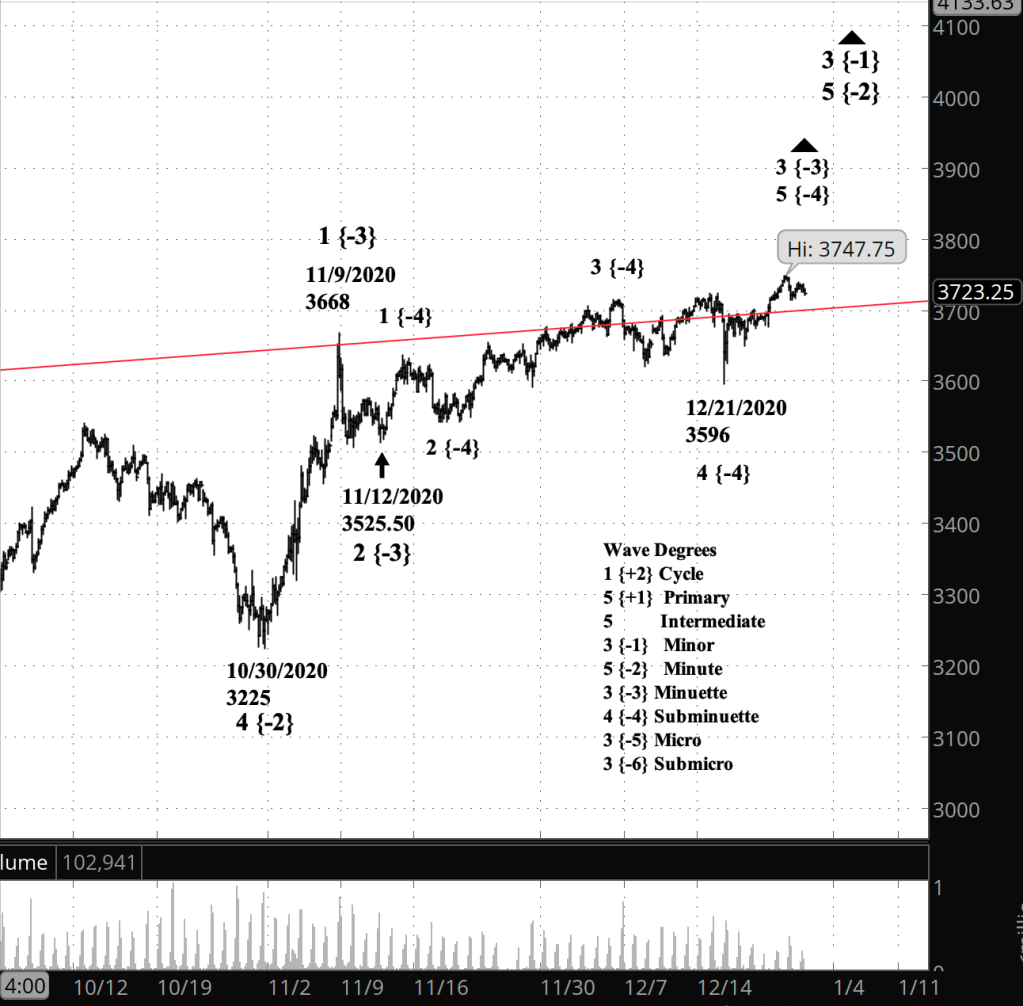
In the end, the S&P 500 and its derivatives bumped up slightly to set a new high. To me, it looks like the beginning of wave 5 of Micro degree within wave 5 of Subminuette degree.

[S&P 500 E-mini futures, 3-hour bars, with volume]

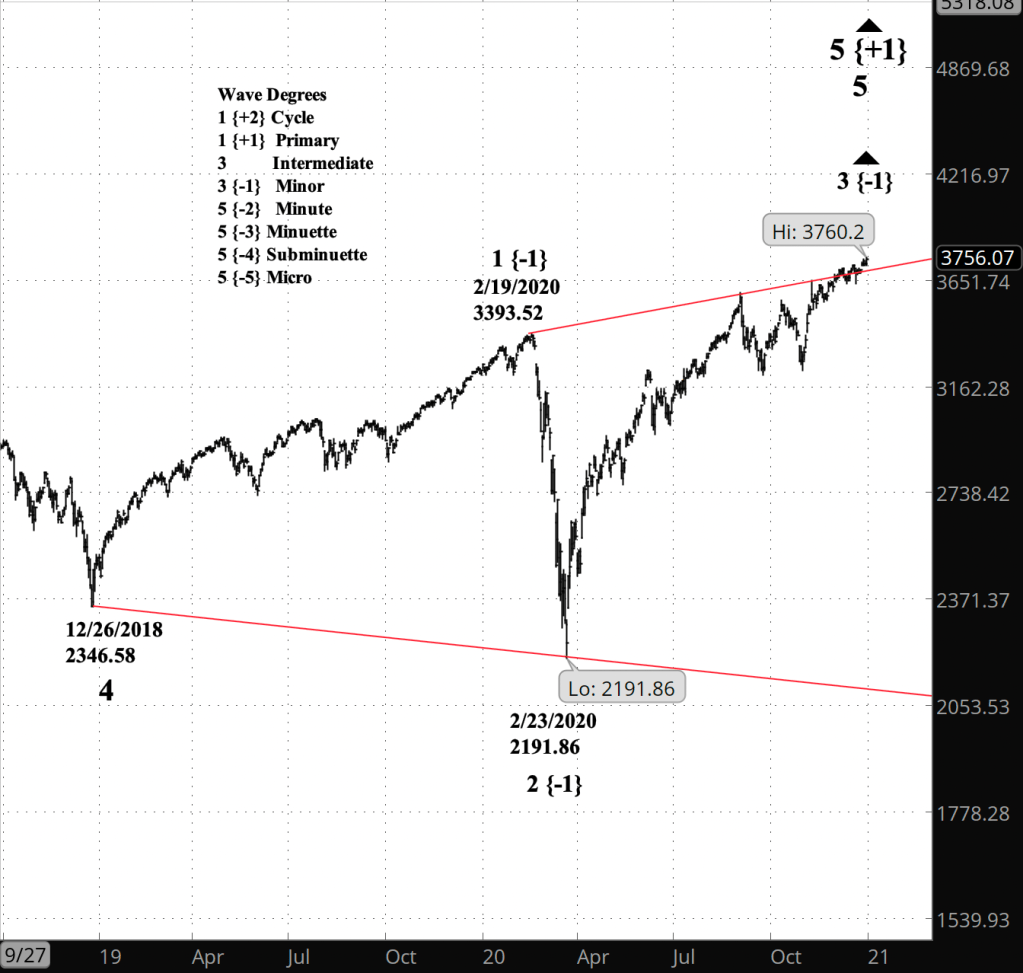
Stepping back to a broader view, we can see how far along the price has come since the present Diagonal Triangle began on December 26, 2018. The Triangle wave 5 of Intermediate degree, and each bounce up or down to a triangle boundary is a Minor wave. By my count, the S&P 500 is working on wave 5 of Minor degree. A Diagonal Triangle has five waves internally, so the end is near.

[S&P 500 index, daily bars]

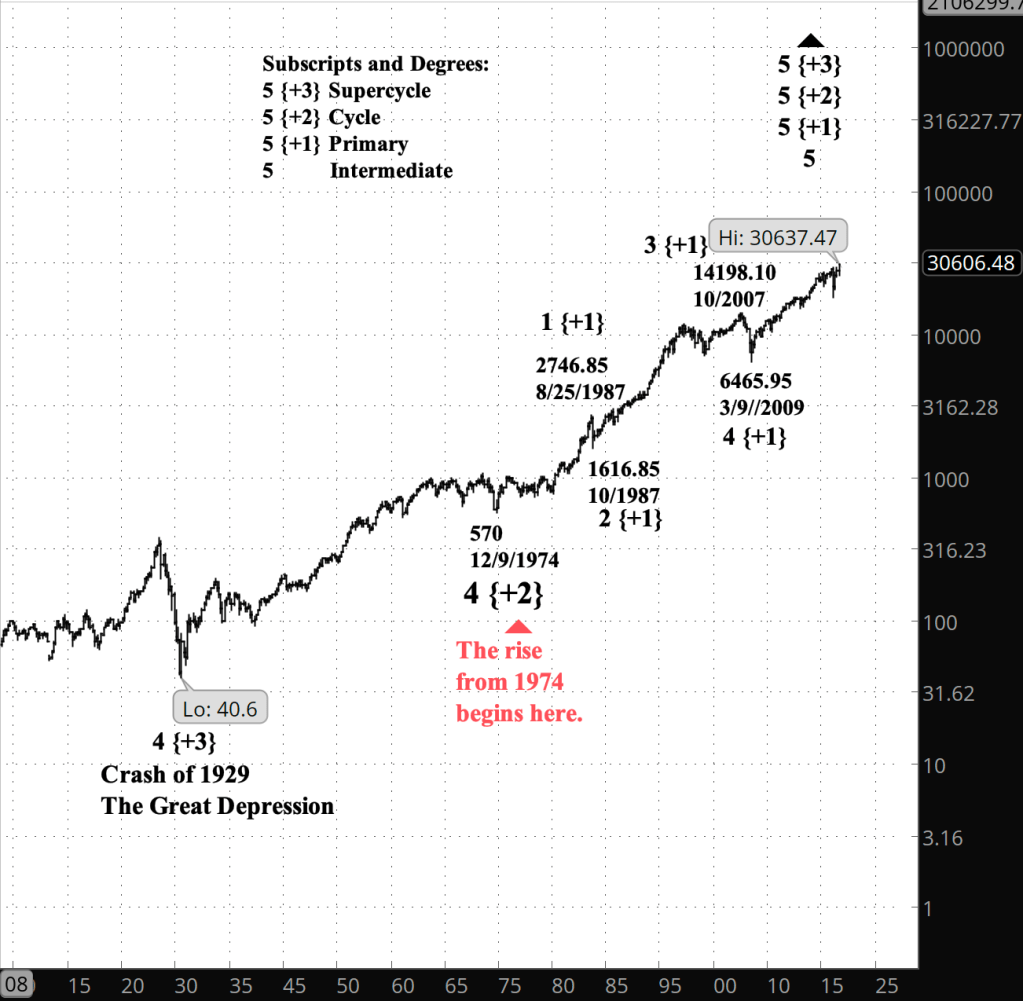
And finally, the long view, showing how we got to where we are: Intermediate wave 5 within Primary 5 within Cycle 5 within wave 5 of Supercycle degree. Looking back at the close-up chart at the top, I’m struck by the fact that the whole house of cards stretching back 91 years is poised to come tumbling down when today’s Submicro wave 5 within Micro 5 within Subminuette 5 within Minuette 5 within Minute 5 within Minor 5 reach an end. Perhaps even next year.

[Dow Jones Industrial Average, quarterly bars]

Of 2020, I doubt that any of us can say it was pleasant or easy. But when I look at this long-view chart, honestly, all of the crashes and crises and Sturm und Drang we’ve seen in 2020 — this year of roughhouse politics and plague — in the grand sweep of history seem fairly small in their impact on the markets. After all, we’ve been in an uptrend since the Black Tuesday crash of October 29, 1929, and that uptrend, despite all that has happened since, remains intact as 2020 comes to an end.

By Tim Bovee, Portland, Oregon, December 31, 2020

Read More »

Thursday, December 31, 2020

3:30 p.m. New York time

Half an hour before the closing bell. We’re ending the year with a seasonally boring session, as the S&P 500 index and its derivatives barely budged. The tiny upward hook at the right extremity of the chart might, just might, be the beginning of wave 5 of Micro degree, which when it is complete, will also mark the end of wave 5 of Subminuette degree and wave 3 of Minuette degree. I’ve updated the chart below.

Happy New Year, fellow traders!

9:50 a.m. New York time

Friday. Markets will be closed globally on Friday for the New Year’s holiday, including New York, London, Tokyo and Sydney.

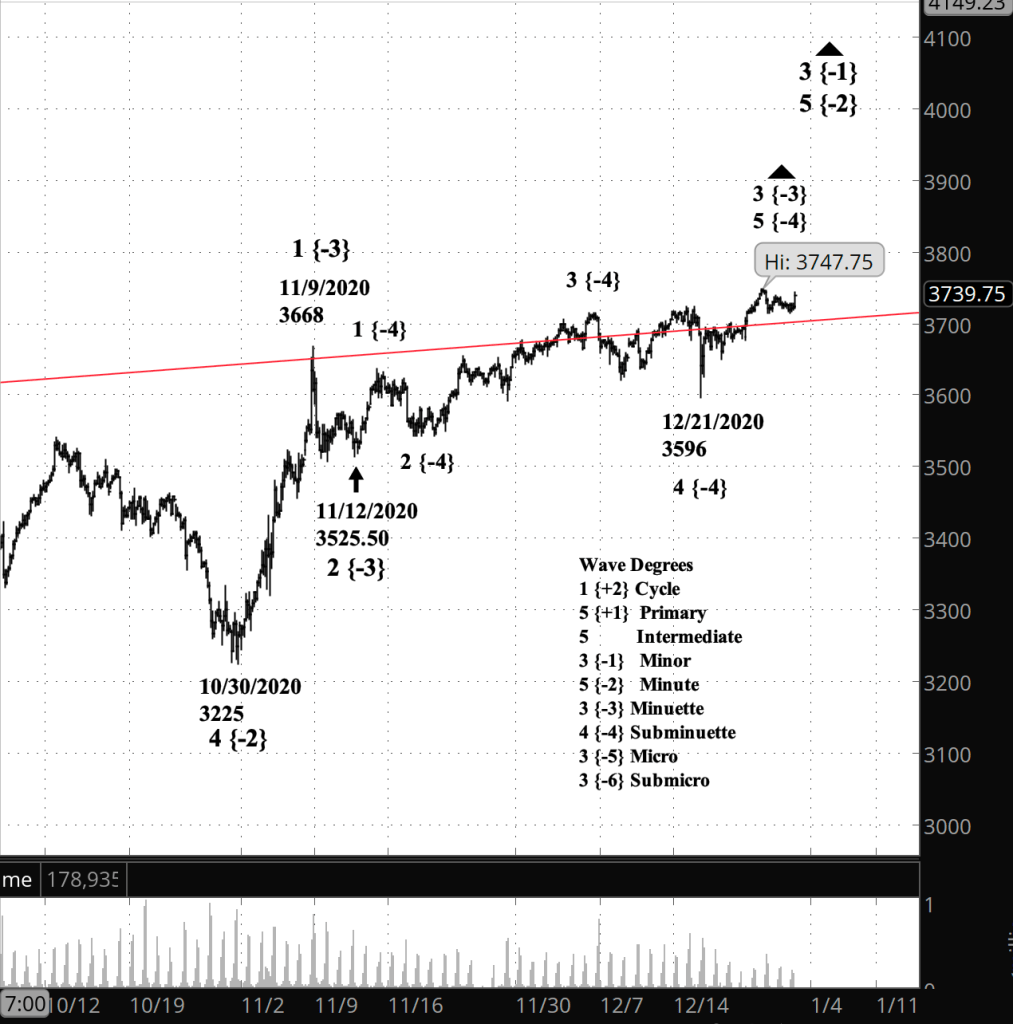
What’s happening now? The S&P 500 E-mini futures continue a lazy path along the upper boundary of the Diagonal Triangle that began in December 2018 and since then has defined the boundaries of the index’s price perambulations.

What does it mean? It’s a holiday week, so honestly, it means very little. The most recent high was set two days ago at 3747.25. If that’s the end of the upward move that began 10 days ago, then the price will decline, into the 3200s and then, in the winding way of market prices, even lower.

What is the alternative? The price could still go a bit higher, but the upside potential is limited.

[S&P 500 E-mini futures at 3:30 p.m., 3-hour bars, with volume]

What does Elliott wave theory say? The December 29 high could mark the end of wave 3 of Minuette degree and the subwave 5 of Subminuette degree. It seems more likely to me that the present doldrums is a 4th wave of Micro degree within Subminuette 5, which provides room for a 5th wave rise at the Micro level once the wave 4 correction is complete.

All of that is happening within Primary wave 5 of Intermediate wave 5 of Minor wave 1 of Minute wave 2

Read More »

Wednesday, December 30, 2020

3:30 p.m. New York time

Half an hour before the closing bell. The S&P 500 continues to stay within the confines it had established in overnight trading. I’ve updated the chart, below.

10:05 a.m. New York time

What’s happening now? The S&P 500 E-mini futures remain within yesterday’s range, trading in a narrow band overnight and in the first half hour after the opening bell.

What does it mean? The slight decline from Tuesday’s high, 3747.75, could be the first tentative steps of a correction, setting up for a final push to a new high.

What is the alternative? It could be the holiday doldrums. Volume and volatility contract near year’s end as trader’s globally take a holiday.

[S&P 500 E-mini futures at 3:30 p.m., 3-hour bars, with volume]

What does Elliott wave theory say? The rise from 3596 on December 21 appears to be a 3rd wave of Submicro degree, suggesting that there’s a bit more upside to go.

Read More »

Tuesday, December 29, 2020

3:30 p.m. New York time

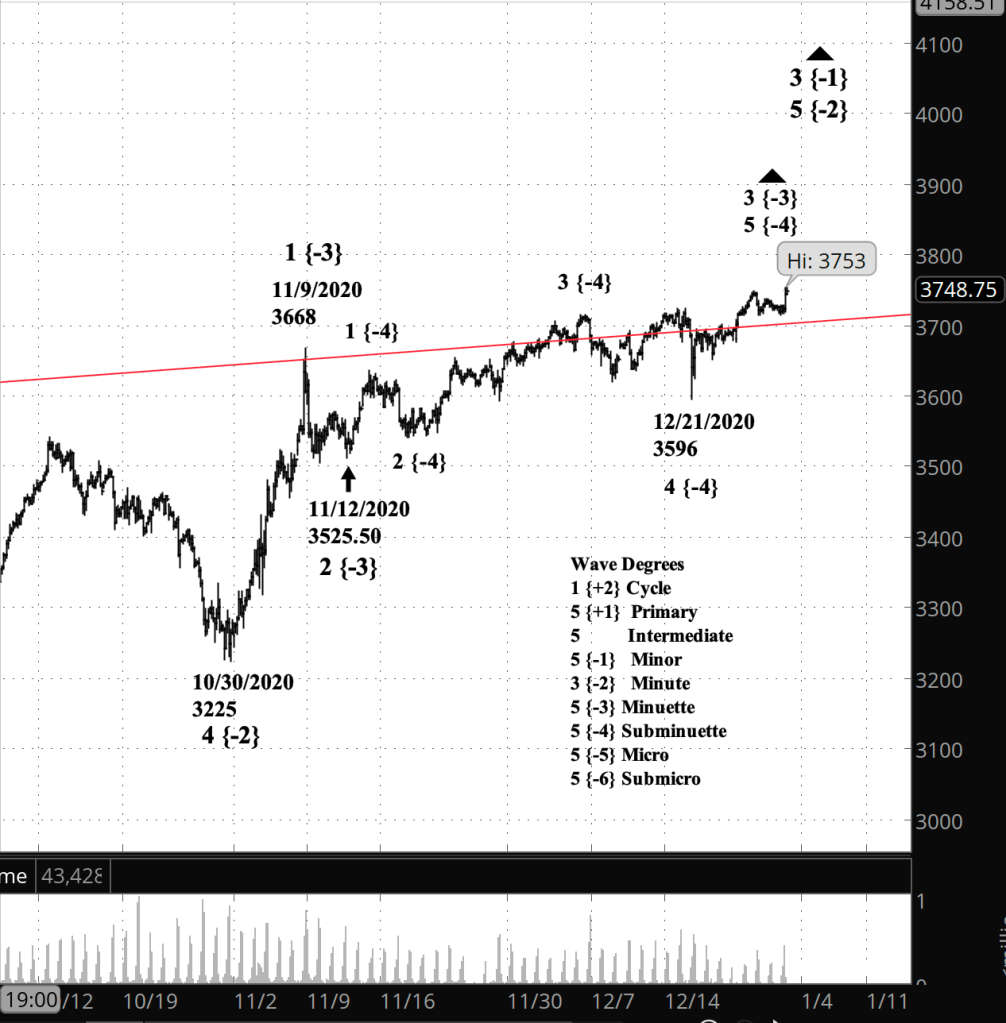
Half an hour before the closing bell. The overnight high of 3747.35 on the S&P 500 E-mini futures was unequalled during the trading session. The price dropped during the day by 20 points plus a little. A quick look at the rise today appears to be a 3rd wave of Micro degree within a 5th wave of Subminuette degree. Here’s a near-term chart of the futures.

[S&P 500 E-mini futures at 3:30 p.m., 3-hour bars, with volume]

10 a.m. New York time

What’s happening now? The S&P 500 index continues to rattle along the rising upper boundary of the Diagonal Triangle that began two years ago, rising above it in overnight trading by less than 20 points.

What does it mean? The index has been on the rise since October 30 in what is the concluding movement of the larger-scale uptrend that began February 23 from 2191.86. Once uptrend is complete, the next move will be a decline into the lower 2000s, or perhaps lower.

[S&P 500 index at 9:56 a.m., daily bars]

What does Elliott wave theory say? I re-analyzed the chart using a smoothing technique and have concluded that the S&P 500 is on wave 5 of Minuette degree. Its completion will end the first leg of the Diagonal Triangle, the 5th wave of Intermediate degree that began on December 26 from 2346.58.

To smooth the chart and make the subwaves clearer, I super-imposed a six-day simple moving average (the purple line), which bring clarity to the often random-looking fluctuations of the market. That smoothing made it clear that the index is now in its 5th wave rather than its 3rd.

The Diagonal Triangle, remote in time though its beginning might seem, is important because it defines the boundaries of the S&P 500’s movement for some time to come, perhaps years. The Triangle became a necessity under the rules of Elliott wave analysis in late February when the low point of the brief pandemic crash, Minuette wave 2, fell below the starting point of the preceding Minuette wave 1. This is normally not seen under the rules of Elliott wave analysis, but it can occur in an expanding Diagonal Triangle.

The Triangle will have 5 waves ultimately, bouncing from boundary to boundary in an expanding field. The completion of the rise from February 23 will be the end of wave 1 of Minuette degree within wave 5 of Minor degree within wave 5 of Intermediate degree. The next wave will be wave 2 of Minuette degree, which will carry down to the lower boundary, which is presently around 2106. Most likely it will take the form of a three-wave Zigzag, as is typical of 2nd waves.

Read More »

Monday, December 28, 2020

3:30 p.m. New York time

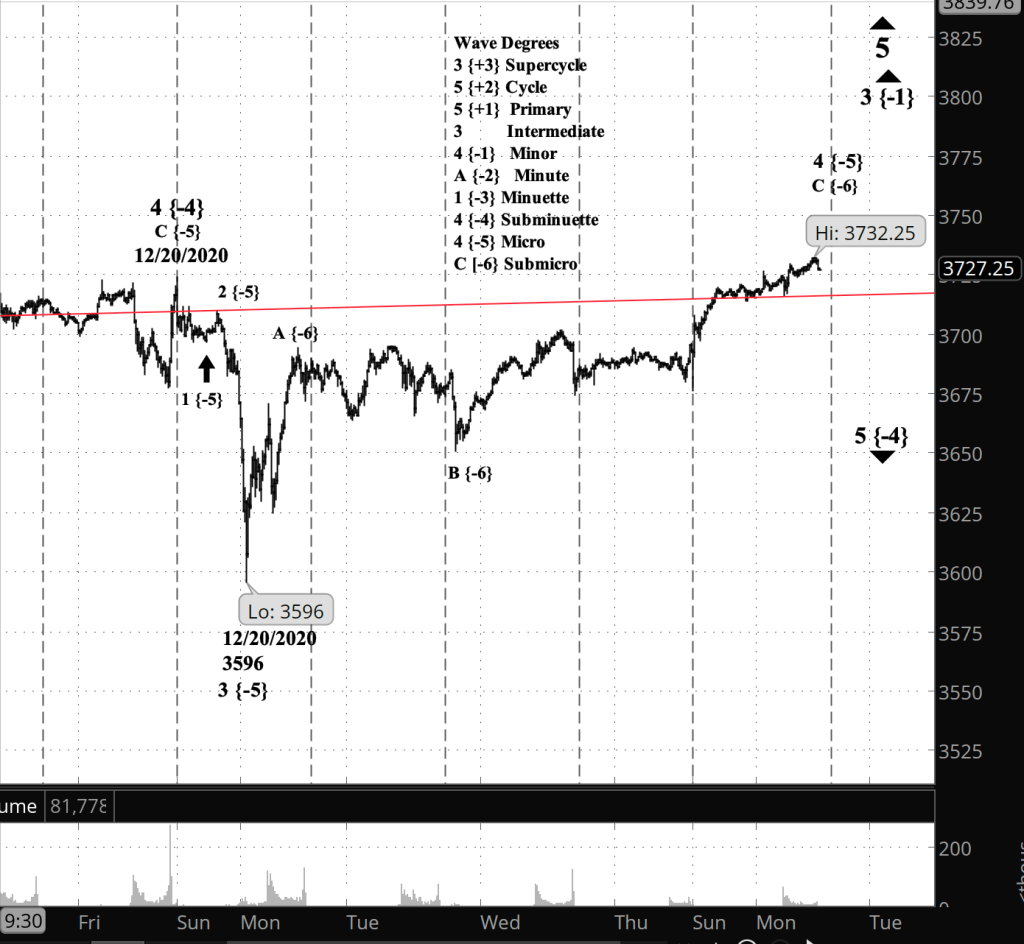
Half an hour before the closing bell. The S&P 500 continued to inch up throughout the today as it continued its rise as wave C of Submicro degree. The high half an hour before the close was 3740.51 on the index and 3732.25 on the futures. I’ve updated the futures chart, below.

9:55 a.m. New York time

What’s happening now? The S&P 500 E-mini futures price resumed its climb when trading began overnight on Sunday and is again tracing a path along the upper boundary of the Diagonal Triangle that began on December 26, 2018. The overnight high was 3726.50.

What does it mean? The index and its derivatives have been in an upward correction within a larger downtrend beginning at 3596 on December 20. The correction has been shallow rather than the dramatic, as is typical of waves in this position of a trend. If the correction ends at the overnight high, then the net move will be a resumption of the downtrend, carrying the price back into the 3500s.

What is the alternative? The correction could extend in a compound pattern, with a shallow downward separator movement followed by another corrective pattern.

[S&P 500 E-mini futures at 3:30 p.m., 15-minute bars, with volume]

What does Elliott wave theory say? Wave C of Submicro degree, when complete, fulfills the minimum requires of its parent, rising wave 4 of Micro degree. Completion of Micro 4 would mean the start of wave 5 of Micro degree, a downtrending movement that, when complete, will mark the end of a number of parent waves, up to wave A of Minute degree. This is all happening within wave 4 of Minor degree and its parent, wave 5 of Intermediate degree.

It’s possible that wave 4 of Micro degree, rather than ending with Submicro wave C, will extend in a compound pattern. Indeed, that is a common occurrence with 4th waves. If that is in fact what happens, then the movement after Submicro C will be a downtrending X wave, which will connect the completed corrective pattern to another corrective pattern.

Read More »