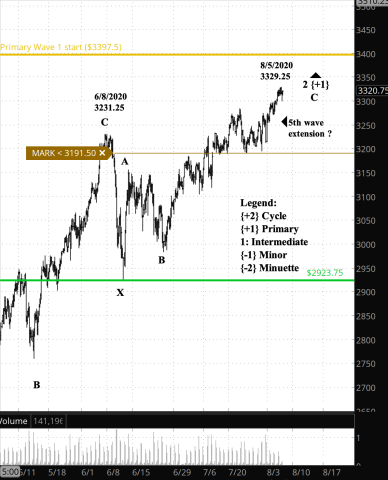
What’s happening now? The rise of S&P 500 E-mini futures this week internally looks very much like the final move up before the downtrend resumes.
What does it mean? By my analysis, the main trend has been downward since February 19. The upward movement that began in March has been a countertrend correction. The resumption of the main trend will carry the price down to a significantly lower low that we’ve seen so far this year.
S&P 500 E-mini futures, 4-hour bars
What does Elliott wave theory say? The most recent wave up within Intermediate wave C looks very much like a 5th wave extension at the Minor degree, composed of nine waves at the Minuette degree. If that is in fact what it is, then the rise is almost complete, and maybe ended at yesterday’s peak, 3329.25.
The end of wave C will almost certainly be the completion of the Primary wave 2 correction to the upside and the beginning of Primary wave 3’s powerful push to the downside.
How do I tell when it’s over? I’ve set an alert at 3191.50, the base of the 5th wave extension. When the price declines below that level, I’ll be notified. It will tell me to take a look at the chart and update my analysis.
What is the alternative? At the smaller degree, the extension may have a couple of more steps to go before it’s over. At the larger degree, Primary wave 2 could extend. It has traced a double Zigzag so far, and it could continue on to become a triple Zigzag, which would likely put off the start of Primary wave 3 for a month or more.
What’s happening now? The continued rise of the S&P 500 E-mini futures have lowered the odds that a significant decline has begun.
What does it mean? That downward move will be as the next major move on the chart, but not yet.
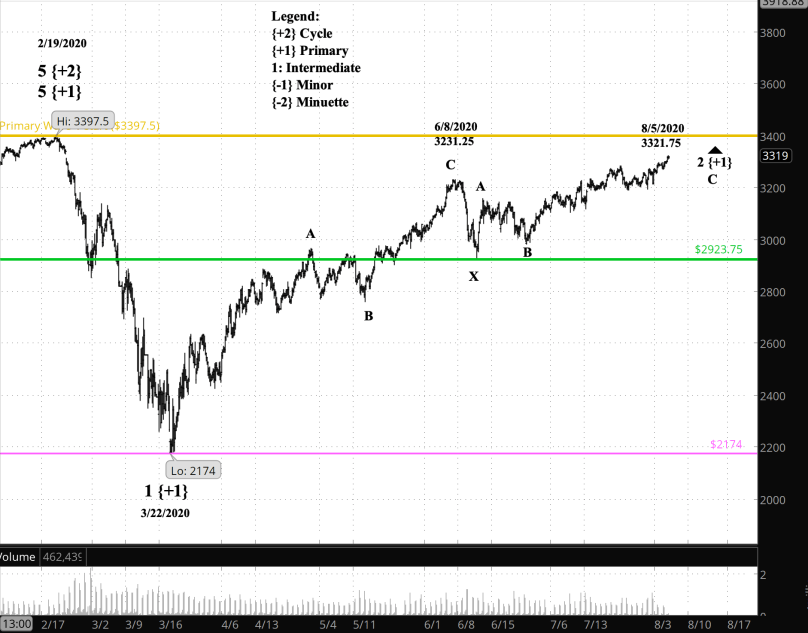
What does Elliott wave theory say? The rise increases the likelihood that Primary wave 2 is still underway. That’s the upward correction that began March 22 from 2174 and this morning reached a new high of 3321.75. I’m promoting my alternative count to the principle count.
Within Primary 2, my count places the price in the late stages of Intermediate wave C. The end of the C wave is likely to be the end of Primary 2.
The price must remain below 3397.50 (gold line), which was the starting point of Primary wave 1 back in February. A break above that level would force a recount of the entire chart since February.
A move below the bottom of the last X wave at 2923.75 (green line), which connects patterns in a compound corrective structure, would increase the odds that Primary wave 3 has begun.
A move below 2174 (purple line), the end of Primary wave 1, would provide certainty that Primary wave 3 has begun.
What is the alternative? It’s still possible that Primary wave 3 began on June 8 from 3231.25, which is my former principle count. It’s also possible that Primary 2 is underway and will extend of a third corrective pattern; the first two were Zigzags.
What about my trades? I’m back on hold with my trades until the chart shows, as my principle count, that Primary wave 3 is has begun.
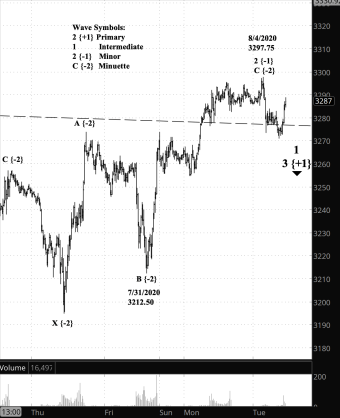
What’s happening now? The S&P 500 E-mini futures, in early morning trading, hit a peak of 3297.75, and then retreated, moving briefly below the upper boundary of the price channel before moving back above the boundary.
What does it mean? If the early morning high is indeed the end of the corrective rise that began July 31, then the ensuing decline will be significant enough to trade.
S&P 500 E-mini futures, 15-minute bars
What does Elliott wave theory say? See yesterday’s live post for a description of what lies ahead. The question isn’t where are we going but when are we going to start the downhill trip to the significant lows that are our destination.
The early morning peak today by my count completes wave C of Minuette degree within wave 2 of Minor degree. I base that on an internal count of wave C, which has completed five waves to the upside. By that count, the trip has begun. We’re on our way.
What is the alternative? It’s possible to count the wave C internals as having completed three waves, which leaves two waves to the upside before the Minor 2nd wave is complete. The car is packed, but we still have a few odds and ends to take care of before we hit the road.
I think my principle count fits the chart better, but a case can be made for the alternate.
What about my trades? A persistent drop below the upper boundary of the price channel is my signal to resume trading. We’re not there yet, but soon, soon.
The index dropped below the upper boundary of the price channel and I entered share positions of SDS, an exchange-traded fund that moves the opposite of the S&P 500. I.e., it’s a bear fund. My entry price was $17.09 per share. Shortly afterword, the price again moved above the channel boundary, so I halted my trading until the decline resumes.
9:35 a.m. New York time
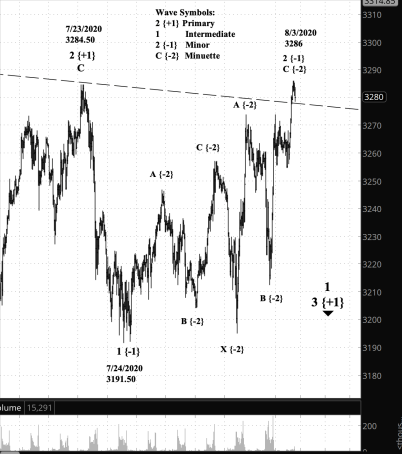
What’s happening now? The S&P 500 E-mini futures moved above the price channel of the decline that began in February, a movement known as a throw-over. The tip-off that a throw-over was likely came from the volume, which has been on the increase as the price approached the channel.
What does it mean? A throw-over is an exhaustion move, the last hoorah of a trend that will quickly reverse. I anticipate a decline that initially will move below 3200 and perhaps much lower as a the new trend kicks off.
S&P 500 E-mini futures, 30-minute bars
What does Elliott wave theory say? The channel at its upper boundary connects the starting points of Primary waves 1 and 3, with the width determined by the end point of Primary wave 2.
The throw-over at the upper boundary marks the end of a Minor wave 2 correction to the upside. It will be followed by a return to the dominant trend, to the downside, with Minor wave 3 within Intermediate wave 1 within Primary wave 3.
At the least Minor wave 3 will move below the starting point of the correction, 3191.50, attained on July 24, and will most likely move quite a bit lower.
It will be followed by Minor wave 4, most likely a sideways correction, and then Minor wave 5 to the downside, which will mark the end of Intermediate wave 1.
At that point things get interesting for traders. The next move will be Intermediate wave 2, an upward correction. Second waves often take back nearly all of the decline of the preceding wave of the same degree. This second wave will likely bring the price back to up to almost where it is today. The correction will be followed by Intermediate wave 3, which will carry the price down significantly, with the great energy that third waves tend to bring to the chart.
What is the alternative? I have seen cases where throw-overs move significantly beyond the channel boundary. Usually there’s a quick reversal. But not always, and that can be devastating for traders who jump in too soon. The upper limit of the correction is 3397.50, the start of wave 1. Under the Elliott rules, no second wave can move beyond the beginning of the first wave.
What about my trades? My signal to get in will be the cross below the upper boundary of the price channel. At that signal, I shall add to my bear positions on the S&P 500 (using the inverse exchange-traded fund SDS).
Minor wave 3 may well be a reasonable options play, and I shall consider entering bear call spread options positions at the cross back to within the channel. If I were to enter today, I would use the options expiring September 18 as a vehicle, with profitable positions to be exited no later than August 28 (“management day”). The entry period under my rules ends August 11, so there’s time to allow some caution in choosing my entry point.
What’s happening now? The S&P 500 E-mini futures are tracing a low-level correction to the upside within a larger decline that began July 23.
What does it mean? The blue chips are in the early stages of their resumption of the decline that began February 19 and have a long distance to go before that decline is complete.
S&P 500 E-mini futures, 45-minute bars
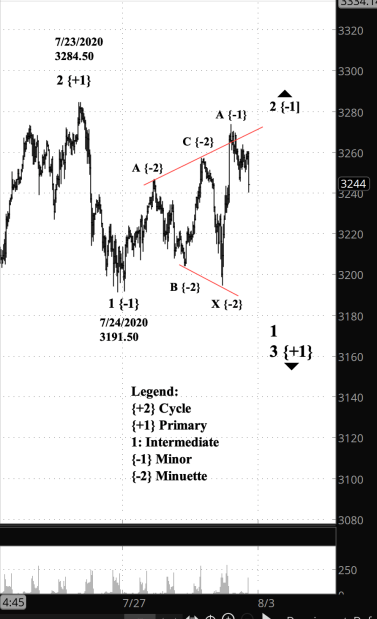
What does Elliott wave theory say? The week-old corrective movement, from 3191.50, is Minor wave 2 within Intermediate wave 1 of Primary wave 3, which began July 23. My principle count shows Minor 2 is taking the form of a compound corrective pattern, most likely a double Zigzag — two three-wave movements connected with an X-wave separator.
What is the alternative? Minor wave 2 can also be seen as an expanding triangle (marked in red), one of the horizontal family of triangles. However, horizontal triangles almost always happen in the next to the last wave of a movement: A 4th wave within the main trend or a B wave within a correction.
Turning Minor wave 2 into a 4th wave created distortions: Short 1st, 2nd and 3rd waves compared to the triangular 4th wave, with a high risk that the 3rd wave would be the shortest of the five, which is forbidden under the Elliott rules. The distortions were too great for my taste, and therefore I’ve relegated the expanding triangle count to an alternative. It’s still, possible, though. Horizontal triangles, while rare, aren’t entirely unknown in the second wave position.
On the chart: A triangle, my alternative count, has five legs, labelled A through E. The compound pattern, my principle count, ultimately will have seven legs, labelled A through C, X, and another A through C. The chart is labelled with my principle count, with the red lines showing the the triangle-like formation that underlies my alternative count.
What about my trades? I’m awaiting Intermediate wave 3 within Primary wave 3 before putting on new option trades. I’m holding my bearish stocks (SDS), which rode through the Primary wave 2 correction and haven’t yet returned to profitability.
Fun facts from the GDP report released this morning, in addition to the 9.5% decline from the previous quarter (down 32.9% over the past four quarters), by far the biggest drop ever.
We’re making quite a bit more money altogether thanks to the pandemic. “Current-dollar personal income increased $1.39 trillion in the second quarter, compared with an increase of $193.4 billion in the first quarter.”
We’re spending a lot less less. “Personal outlays decreased $1.57 trillion, after decreasing $232.5 billion. The decrease in outlays was led by a decrease in PCE for services.”
We’re a lot more frugal than we were three months ago. “Personal saving was $4.69 trillion in the second quarter, compared with $1.59 trillion in the first quarter. The personal saving rate—personal saving as a percentage of disposable personal income—was 25.7 percent in the second quarter, compared with 9.5 percent in the first quarter.”
So, bottom line, the death rate is up somewhat, and things have gotten very nasty politically, and masks are still a very good idea, even though they’re not pleasant when the weather’s warm, and some small businesses have closed and some large businesses are going into bankruptcy. But all and all, this pandemic has not turned out to be the total disaster we might have expected last February.
At least, not yet.
By Tim Bovee, Portland, Oregon, July 30, 2020
Disclaimer
Tim Bovee, Private Trader tracks the analysis and trades of a private trader for his own accounts. Nothing in this blog constitutes a recommendation to buy or sell stocks, options or any other financial instrument. The only purpose of this blog is to provide education and entertainment.
No trader is ever 100 percent successful in his or her trades. Trading in the stock and option markets is risky and uncertain. Each trader must make trading decisions for his or her own account, and take responsibility for the consequences.
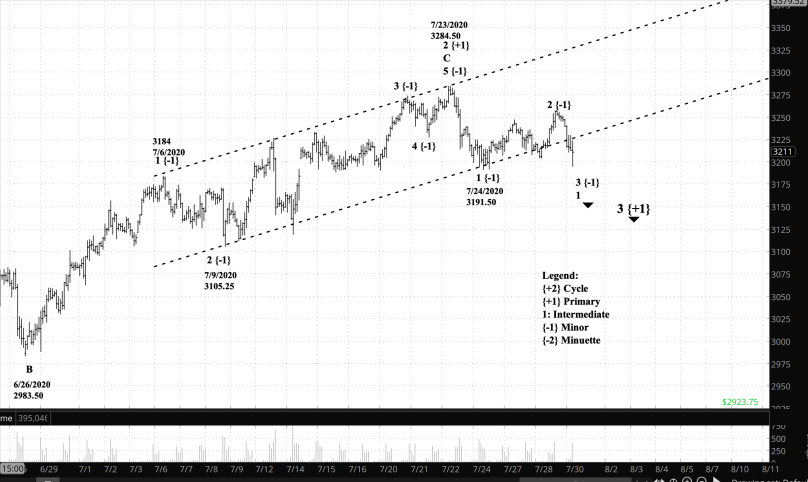
What’s happening now? The S&P 500 E-mini futures pushed downward in overnight trading and continued to fall after the opening bell, piercing the lower boundary of the Minor degree price channel and continuing on with a great deal of energy.
What does it mean? The energy of the fall and the degree to which the price has pierced the lower boundary has tilted in favor of my alternate analysis: The upward correction that began on March 22 from 2174 ended on July 23 at 3284.50.
S&P 500 E-mini futures, 2-hour bars
What does Elliott wave theory say? The July 24 peak is the beginning of Primary wave 3 to the downside, a movement that will have its ups and downs, as all movements do, but will eventually push well below the 2174 level that marked the end of Primary wave 1 to the downside, the first wave of the major decline that began February 19 at 3397.50.
I had initially read the July 24 peak as the end of Minor wave d within Primary wave 2. I now read it as the end of Minor wave 5 within Intermediate wave C.
Primary wave 3’s first move will be Intermediate wave 1, which will be followed by an upward correction that could come close to the first wave’s starting point. The correction, however, cannot move above 3284.50, where Intermediate wave 1 began.
Moreover, Intermediate wave 1 will be followed by an upward correction, perhaps again challenging the 3284.50 mark, before beginning what will prove to be a downward push of significance.
What is the alternative? It’s still possible, although less probable than I thought yesterday, that the July 23 peak is wave Minor wave 3. If a price reversal upward back into the price channel proves that to be the case, then yesterday’s analysis still stands and we are seeing Minor wave 5 of Intermediate wave C within Primary wave 2. If this is the case, then there will be one more wave up. At that point, either Primary wave 2 will end under the alternate analysis, or it will add a third component to the compound correction it has traced.
What about my trades? The question now, under the principle analysis, becomes, when is the best time to enter? And the answer for me is, near the later stage of Intermediate wave 2. I don’t want to get in now, because I know that I have two uptrends ahead of me: Minor and Intermediate, and both will typically approach the 3350 level. (That’s a tendency, not a rule, and they might not.) So, close watch, but not yet.
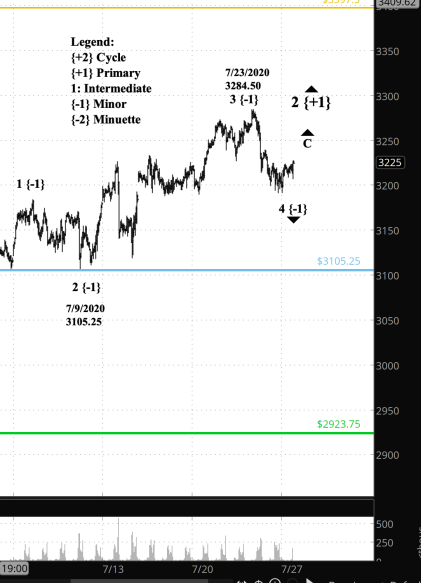
What’s happening now? The S&P 500 E-mini futures have bounced off of the lower boundary of the trend channel.
What does it mean? The bounce adds a bit more weight to my preferred analysis, which concludes that the upward correction that began in March is still underway.
S&P500 E-mini futures, 1-hour bars
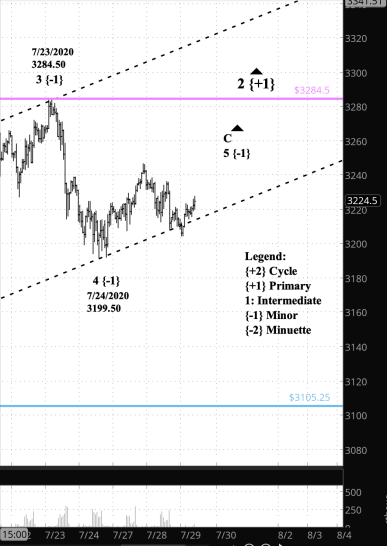
What does Elliott wave theory say? Under my preferred analysis, the decline from the peak of Minor wave 3, which was 3284.50 on July 23, traced three waves internally, leading to a Minor wave 4 beginning on from 3199.50 on July 24. The following Minor 5th wave, which is still underway, appears to have completed Minuette waves A and B, and to have begun Minuette wave C to the upside.
All of that is within Intermediate wave C of the Primary wave 2 correction that began March 22 from 2174.
If the preferred count is correct, then the price will move back up and most likely will break above 3284.50, the highest high within the correction so far. The upside potential is limited by the starting point, 3397.50, of Primary wave 1 on February 19. The price can’t move above that level under my preferred count.
What is the alternative? Nothing in the count so far is inconsistent with the July 23 peak beginning the end of Minor wave 5 and indeed of the entire Primary wave 2 correction. I think my primary analysis, that Primary 2 is still in force, fits the facts better, but it’s certainly debatable. If the alternative analysis is correct, then the price will quickly drop significantly below the trend line and will drop past 3105.25, the end of Minor wave 1 during the last portion of the Primary wave 2 compound correction (two Zigzag structures).
A change in nomenclature. I’ve been using “primary analysis” for what I consider to be the best conclusion from the chart, and “alternative analysis” for the next best read. But “primary” is also a degree of analysis within the Elliott system. So from today onward, I shall use “preferred analysis” rather than “primary”.
What about my trades? Awaiting the end of Primary wave 2 before I resume trading. I prefer to trade with the larger trend, which has been down since February.
What’s happening now? The S&P 500 E-mini futures reversed their decline near the end of New York trading yesterday and rose by around 50 points before reversing back down during European trading hours.
What does it mean? The reversal to the upside lends greater credence to my primary analysis, which sees the major rise since March as still underway.
S&P 500 E-mini futures, 1-hour bars
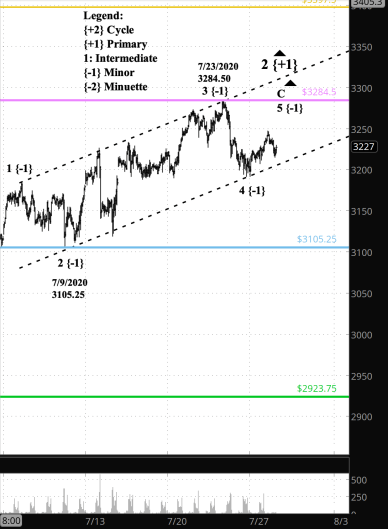
What does Elliott wave theory say? The downward movement is Minor wave 4, composed of three Minuette waves.. The reversal upward is Minor wave 5 within Intermediate wave C, which in turn is part of the Primary wave 2 upward correction that began on March 22. A move above 3284,50 (purple line), the peak of Minor wave 3, would confirm that the present wave is Minor 5.
The upside of Minor wave 5, now at 3223, is limited to 3397.50 (tan line). Any move above that level will force a major reworking of my analysis of everything that has happened since the crash began on February 19. The trend line shows an upside target by Aug. 3 of 3350, and that target rises the further out we go on the calendar.
What is the alternative? If I squint real hard and use my imagination I can count Minor wave 4 as having five waves, and if that’s the case then it is still possible that the 3284.50 peak is the end of Primary wave 2.
What about my trades? No new trades planned until Primary wave 2 is history.
What’s happening now? The S&P 500 E-mini futures rose by a very small amount when trading resumed Sunday night and fell sharply at the opening bell to 3210.
What does it mean? Uncertain. There has been no clear indicator as of yet that the decline from July 23 is the beginning of a major price drop, nor that it is the first part of a continuation of the correction.
S&P 500 E-mini futures, 1-hour bars
What does Elliott wave theory say? The labelling on my chart continues to assume that the Primary wave 2 correction is continuing. So far it has been a double Zigzag pattern, and the price is at present in Minor wave 4 within Intermediate wave C.
What is the alternative? A decline below the Minor 2nd wave low of July 9, at 3105.25, would tilt the analysis in favor of Primary wave 2 having ended on on July 23. A move above the Minor wave 3 high, 3284.50, on July 23 would til in favor of Primary wave 2 still bing underway.
What about my trades? I’m waiting for Primary wave 2 to end before I resume trading.

 Tim Bovee, Private Trader
You must be logged in to post a comment.