Trader’s Notebook

3:30 p.m. New York time

Half an hour before the closing bell. The S&P 500 futures continued to fall during the session, so far reaching into the 4080s, breaking past the 4098 low set on February 7. The decline past that level requires changes to this morning’s analyses, using Elliott wave analysis terminology.

Principal analysis:

  • Rising wave E{-10} has not yet begun.
  • Declining wave D{-10} is still underway.

Such an outcome was an alternative in my February 8 Trader’s Notebook.

Alternative analysis:

  • Today’s alternative, that wave 2{-7} ended on February 2, is still a potentially valid scenario.,

I’ve updated the chart.

9:35 a.m. New York time

What’s happening now? The S&P 500 E-mini futures rose overnight, reaching a high so far of 4170.25.

What does it mean? The upward correction that began on October 13, 2022 is on it’s final rise to completion. A move above the prior high within the correction, 4208.50, will confirm this principal analysis.

What is the alternative? The upward correction ended on February 2 at 4208.50. The present rise is a small correction within the early stages of a powerful downtrend that will carry the price below 3502, and most likely significantly below that level.

Chart note. Stock charts are complex, and Elliott wave analysis requires a complex notation to keep track of the directional movements, called “waves”. Every wave contains smaller waves within it, which contain still smaller waves. Every wave is in turn contained by larger waves, which are subwaves of still larger waves. That sort of arrangement is called a fractal structure.

To show where a wave fits in the fractal structure, it has a subscript, in curly brackets. The smaller the subscript number, lower the wave’s position within the fractal hierarchy.

Also, each wave has a number or letter showing where it fits in the pattern of which it is a part. The subwaves of trending waves are numbered, and of corrective waves, lettered.
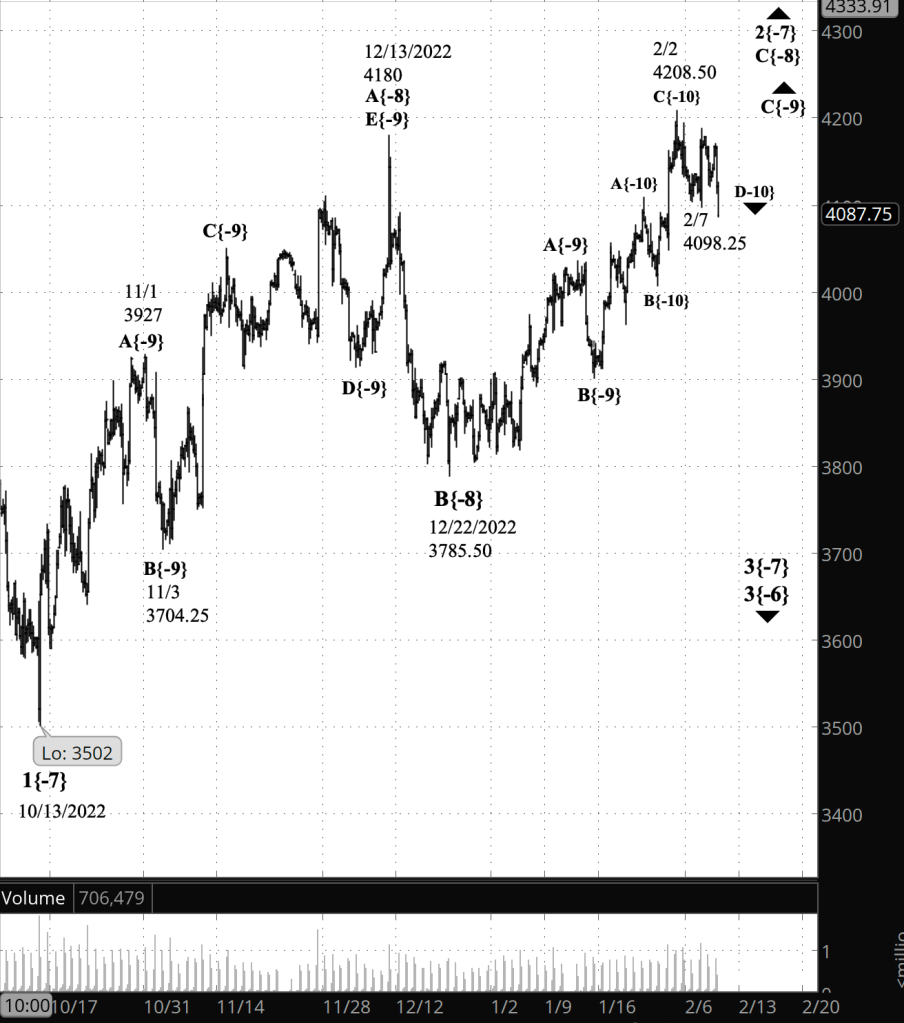
[S&P 500 E-mini futures at 3:30 p.m., 4-hour bars, with volume]

What does Elliott wave theory say? These are the waves that are in play.

Under the principal analysis:

  • An upward correction, wave 2{-7}, is now underway.
  • Wave 2{-7} is in its last stages: Wave C{-8}, the last of three waves, and within it, waves C{-9}, also the last of three waves, and wave E{-10}, the last of five waves.
  • A wave positioned like wave E{-10} can be expected to exceed the precedng wave C{-10} peak, 4208.50 in this case. A move above that level confirms the analysis.
  • Once wave E{-10} is complete, it will also be the completion of the larger waves that encompass it: C{-9}, C{-8}, and the correction itself, 2{-7}.
  • After wave 2{-7} is complete, a powerful downtrend, wave 3{-7} will begin and will carry the price below the wave 2{-7} starting point, 3502, and typically, quite a bit lower.

Under the alternative analysis:

  • The upward correction, wave 2{-7}, ended on February 2 at 4208.50.
  • Downtrending wave 3{-7}, described above, is now underway.

Both analyses:

  • Encompassing all of this is wave 3{-6}, which began on August 16, 2022.
  • Wave 3{-6} is in turn encompassed by a series of larger waves, the smaller within the larger, stretching up five degrees to wave 4{-1}, which began on January 4, 2022.
  • Wave 4{-1} is the next-to-the-last wave within a large expanding Diagonal Triangle, wave 5{0}, that began on December 26, 2018.

We Are Here.

These are the waves currently in progress under my principal analysis. Each line on the list shows the wave number, with the subscript in curly brackets, the traditional degree name, the starting date, the starting price of the S&P 500 E-mini futures, and the direction of the wave.

  • S&P 500 Index:
  • 5{+3} Supercycle, 7/8/1932, 4.40 (up)
  • 5{+2} Cycle, 12/9/1974, 60.96 (up)
  • 5{+1} Primary, 3/6/2009, 666.79 (up)
  • 5{0} Intermediate, 12/26/2018, 2346.58 (up)
  • S&P 500 Futures and index:
  • 4{-1} Minor, 1/4/2022, 4808.25 (down) (futures), 4818.62 (down) (index)
  • S&P 500 Futures:
  • 1{-2} Minute, 1/4/2022, 4808.25 (down)
  • 1{-3} Minuette, 1/4/2022, 4808.25 (down)
  • 1{-4} Subminuette, 1/4/2022, 4808.25 (down)
  • 1{-5} Micro, 1/4/2022, 4808.25 (down)
  • 3{-6} Submicro, 8/16/2022, 4327.50 (down)
  • 2{-7} Minuscule, 10/13/2022, 3502 (up)

Learning and other resources. Elliott wave analysis provides context, not prophecy. As the 20th century semanticist Alfred Korzybski put it in his book Science and Sanity (1933), “The map is not the territory … The only usefulness of a map depends on similarity of structure between the empirical world and the map.” And I would add, in the ever-changing markets, we can judge that similarity of structure only after the fact.

See the menu page Analytical Methods for a rundown on where to go for information on Elliott wave analysis.

By Tim Bovee, Portland, Oregon, February 9, 2023

Disclaimer

Tim Bovee, Private Trader tracks the analysis and trades of a private trader for his own accounts. Nothing in this blog constitutes a recommendation to buy or sell stocks, options or any other financial instrument. The only purpose of this blog is to provide education and entertainment.

No trader is ever 100 percent successful in his or her trades. Trading in the stock and option markets is risky and uncertain. Each trader must make trading decisions for his or her own account, and take responsibility for the consequences.

License
Creative Commons License

All content on Tim Bovee, Private Trader by Timothy K. Bovee is licensed under a Creative Commons Attribution-ShareAlike 4.0 International License.

Based on a work at www.timbovee.com.

Trader’s Notebook

3:30 p.m. New York time

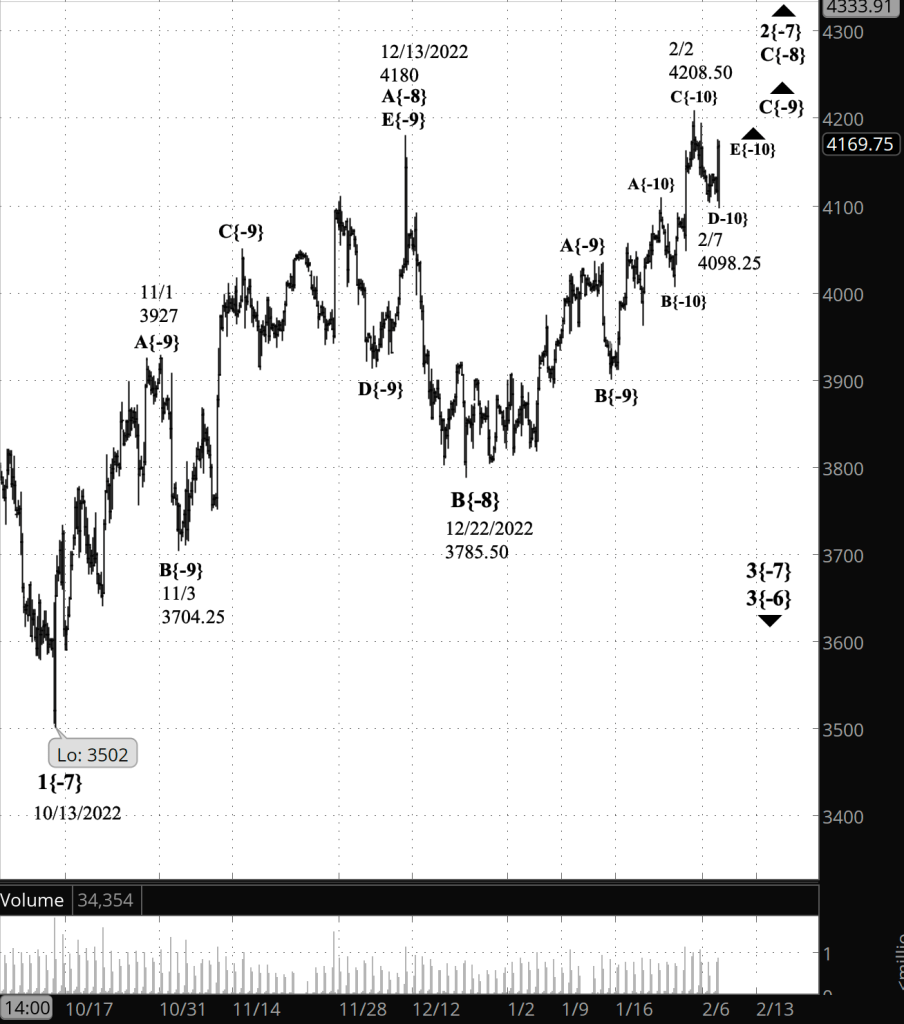
Half an hour before the closing bell. The S&P 500 futures continued to decline during the session, reaching a low so far of 4121.25. No change in this morning’s analysis. I’ve updated the chart.

9:35 a.m. New York time

What’s happening now? The S&P 500 E-mini futures fell overnight, returning to the 4150s and falling into the 4140s minutes after the opening bell.

What does it mean? The upward correction that began on October 13, 2022 continues and is in its final, rising phase, the last segment within the last leg of the three part pattern. A rise above 4208.50, the high so far within the correction, will confirm this principal analysis.

What are the alternatives? There are two.

Alternative #1: The declining next-to-the-last segment may still be in progress. Under this scenario, the February 7 rise is a subwave, and the price will decline a bit further before reversing and pushing above the correction high.

Alternative #2: The final segment within the final wave ended at the February 7 high, ending the upward correction. The next wave, a powerful downtrend, is taking its first tentative steps.

Chart note. Each wave has a subscript, in curly brackets, to indicate the wave’s place, its degree, within the fractal structure of the price movements. 

[S&P 500 E-mini futures at 3:30 p.m., 4-hour bars, with volume]

What does Elliott wave theory say? These are the waves that are the basis of the analyses.

Principal analysis:

  • The upward correction, wave 2{-7}, continues.
  • It is in the third of three parts, upward wave C{-8}…
  • … which in turn is in its third and final subwave, rising wave C{-9}.
  • Wave C{-9} has five subwaves and is in the fifth, wave E{-10}.
  • A wave in wave E{-10}’s position normally will exceed the endpoint of the prior upward wave, 4208.50, which is wave C{-10}. That peak was attained on February 2.
  • The end of the wave E{-10} will also be the end of waves C{-9}, C{-8} and of the upward correction, wave 2{-7}.
  • Wave 3{-7} will follow, a powerful downtrend that will carry the price below the starting point of the correction, 3502, and most likely significantly below that level.

Alternative #1:

  • Declining wave D{-10} is still underway and wave E{-10} has not yet begun.

Alternative #2:

  • The February 2 high marked the end of the correction, wave 2{-7}, and the subsequent downtrend, wave 3{-7}, has begun.

All analyses:

  • This is all happening within wave 3{-6}, which began on August 16, 2022.
  • Wave 3{-6} is encompassed by a series of larger waves, the smaller within the larger, stretching up five degrees to wave 4{-1}, which began on January 4, 2022.
  • Wave 4{-1} is the next-to-the-last wave within a large expanding Diagonal Triangle, wave 5{0}, that began on December 26, 2018.

We Are Here.

These are the waves currently in progress under my principal analysis. Each line on the list shows the wave number, with the subscript in curly brackets, the traditional degree name, the starting date, the starting price of the S&P 500 E-mini futures, and the direction of the wave.

  • S&P 500 Index:
  • 5{+3} Supercycle, 7/8/1932, 4.40 (up)
  • 5{+2} Cycle, 12/9/1974, 60.96 (up)
  • 5{+1} Primary, 3/6/2009, 666.79 (up)
  • 5{0} Intermediate, 12/26/2018, 2346.58 (up)
  • S&P 500 Futures and index:
  • 4{-1} Minor, 1/4/2022, 4808.25 (down) (futures), 4818.62 (down) (index)
  • S&P 500 Futures:
  • 1{-2} Minute, 1/4/2022, 4808.25 (down)
  • 1{-3} Minuette, 1/4/2022, 4808.25 (down)
  • 1{-4} Subminuette, 1/4/2022, 4808.25 (down)
  • 1{-5} Micro, 1/4/2022, 4808.25 (down)
  • 3{-6} Submicro, 8/16/2022, 4327.50 (down)
  • 2{-7} Minuscule, 10/13/2022, 3502 (up)

Learning and other resources. Elliott wave analysis provides context, not prophecy. As the 20th century semanticist Alfred Korzybski put it in his book Science and Sanity (1933), “The map is not the territory … The only usefulness of a map depends on similarity of structure between the empirical world and the map.” And I would add, in the ever-changing markets, we can judge that similarity of structure only after the fact.

See the menu page Analytical Methods for a rundown on where to go for information on Elliott wave analysis.

By Tim Bovee, Portland, Oregon, February 8, 2023

Disclaimer

Tim Bovee, Private Trader tracks the analysis and trades of a private trader for his own accounts. Nothing in this blog constitutes a recommendation to buy or sell stocks, options or any other financial instrument. The only purpose of this blog is to provide education and entertainment.

No trader is ever 100 percent successful in his or her trades. Trading in the stock and option markets is risky and uncertain. Each trader must make trading decisions for his or her own account, and take responsibility for the consequences.

License
Creative Commons License

All content on Tim Bovee, Private Trader by Timothy K. Bovee is licensed under a Creative Commons Attribution-ShareAlike 4.0 International License.

Based on a work at www.timbovee.com.
Trader’s Notebook

3:30 p.m. New York time

Half an hour before the closing bell. The S&P 500 futures rose sharply after Fed Chair Jerome Powell began speaking during an interview at The Economic Club of Washington, D.C. The price had hit a session low half an hour earlier, 4098.25, and then took off, so far reaching into the 4170s. The price so far has remained below 4208.50, the high point of the upward correction now underway.

The swift rise suggests that the next-to-the-last segment of the final leg of the correction, which began on October 13, 2022, ended at today’s low, and the final segment within the final leg is now underway. A rise past 4208.50 will confirm that analysis.

In Elliott wave analysis terminology, downward wave D{-9} ended today at 4098.25 and upward wave E{-9} has begun. A rise above the starting point of wave D{-9} — 4208.50 — will confirm that analysis. The end of wave E{-9} will also mark the end of its parent, wave C{-8}, and of the upward correction, wave 2{-7}. Downtrending wave 3{-7} will follow and will carry the price below 3502, the starting point of wave 2{-7}, and most likely significantly below that level.

An alternative analysis would have it that wave D{-9} is still underway and today’s rise is a subwave of the continuing downward movement.

I’ve updated the chart to show the revised analysis.

9:35 a.m. New York time

What’s happening now? The S&P 500 E-mini futures continued trading narrowly overnight, ranging from the 4110s to the 4130s. At the opening bell it briefly moved below 4110

What does it mean? The futures continue to trace out an upward correction that began on October 13, 2022. The final leg of the correction began on December 22, 2022. That final leg is in turn in its next-to-the-last segment, a downward movement, which may well have ended with the February 6 low of 4104. If that segment has indeed ended, then the rising, final segment of the final leg of the correction is now underway.

The end of the final segment will also be the end of the last leg of the correction and of the correction itself. A powerful downtrend will then begin.

What are the alternatives? The wave count within the final segment lacks clarity. It’s quite possible that the downward movement is still underway.

Chart notes. Each wave — directional movement — has a number (for subwaves within trends) or a letter (for subwaves within corrections). Each wave has a subscript, in curly brackets, to indicate the wave’s place, its degree, within the fractal structure of the price movements. This chart is tracking relatively small waves and so the subsceripts are negative numbers. The smaller the number, the smaller the degree.

[S&P 500 E-mini futures at 3:30 p.m., 4-hour bars, with volume]

What does Elliott wave theory say? Here are the waves that are important to the analysis.

Principal analysis:

  • The downward correction is wave 2{-7}.
  • The last leg of that correction is upward wave C{-8}.
  • The next-to-the-last segment within that last leg is wave D{-9}. It may have ended on February 6.
  • If the D wave has indeed ended, rising wave E{-9} is now underway and will likely exceed 4208.50, the D-wave’s starting point.

Alternative analysis:

  • There’s an equal likelihood that wave D{-9} is still on its downward journey.

So how do we distinguish between the two scenarios?

Wave D{-9} will have three waves internally, and there appear to be three waves on the chart. That’s the basis of the principal analysis, that wave D{-9} is complete and wave E{-9} has begun.

And yet, the first and second subwaves within D{-9}, which are waves A{-10} and B{-10}, are rather small reversals that happened very quickly and lack clear internal detail even on a five-minute chart. That leaves open the possibility that A{-10} and B{-10} are instead movements of a smaller degree, perhaps the {-11}th degree.

A rise closer to the 4180s would strengthen the case for the principal analysis. A fall below 4000 would strengthen the case for the alternative.

Both scenarios:

  • Everything described above is happening within wave 3{-6}, which began on August 16, 2022.
  • Wave 3{-6} is encompassed by a series of larger waves, the smaller within the larger, stretching up five degrees to wave 4{-1}, which began on January 4, 2022.
  • Wave 4{-1} is the next-to-the-last wave within a large expanding Diagonal Triangle, wave 5{0}, that began on December 26, 2018.

And there’s more. See the “We Are Here” list of current waves, below.

We Are Here.

These are the waves currently in progress under my principal analysis. Each line on the list shows the wave number, with the subscript in curly brackets, the traditional degree name, the starting date, the starting price of the S&P 500 E-mini futures, and the direction of the wave.

  • S&P 500 Index:
  • 5{+3} Supercycle, 7/8/1932, 4.40 (up)
  • 5{+2} Cycle, 12/9/1974, 60.96 (up)
  • 5{+1} Primary, 3/6/2009, 666.79 (up)
  • 5{0} Intermediate, 12/26/2018, 2346.58 (up)
  • S&P 500 Futures and index:
  • 4{-1} Minor, 1/4/2022, 4808.25 (down) (futures), 4818.62 (down) (index)
  • S&P 500 Futures:
  • 1{-2} Minute, 1/4/2022, 4808.25 (down)
  • 1{-3} Minuette, 1/4/2022, 4808.25 (down)
  • 1{-4} Subminuette, 1/4/2022, 4808.25 (down)
  • 1{-5} Micro, 1/4/2022, 4808.25 (down)
  • 3{-6} Submicro, 8/16/2022, 4327.50 (down)
  • 2{-7} Minuscule, 10/13/2022, 3502 (up)

Learning and other resources. Elliott wave analysis provides context, not prophecy. As the 20th century semanticist Alfred Korzybski put it in his book Science and Sanity (1933), “The map is not the territory … The only usefulness of a map depends on similarity of structure between the empirical world and the map.” And I would add, in the ever-changing markets, we can judge that similarity of structure only after the fact.

See the menu page Analytical Methods for a rundown on where to go for information on Elliott wave analysis.

By Tim Bovee, Portland, Oregon, February 7, 2023

Disclaimer

Tim Bovee, Private Trader tracks the analysis and trades of a private trader for his own accounts. Nothing in this blog constitutes a recommendation to buy or sell stocks, options or any other financial instrument. The only purpose of this blog is to provide education and entertainment.

No trader is ever 100 percent successful in his or her trades. Trading in the stock and option markets is risky and uncertain. Each trader must make trading decisions for his or her own account, and take responsibility for the consequences.

License
Creative Commons License

All content on Tim Bovee, Private Trader by Timothy K. Bovee is licensed under a Creative Commons Attribution-ShareAlike 4.0 International License.

Based on a work at www.timbovee.com.

Trader’s Notebook

3:30 p.m. New York time

Half an hour before the closing bell. The S&P 500 futures hit a low during the session of 4104 and then rose, although not to a great extent. No change in the analysis. I’ve updated the chart.

3:05 a.m. New York time

SPY options play exit. I’ve exited my short bear call options spread on SPY for a loss. I expected to the price to decline. Instead, it rose. I’ve updated the entry analysis with full results.

9:35 a.m. New York time

What’s happening now? The S&P 500 E-mini futures began to fall immediately upon reopening at 4134.25 overnight and continued falling as the opening bell approached, reaching as low so far as 4106.25,

What does it mean? The upward correction that began on October 13, 2022 continues. Internally it is in its last segment, and that segment in turn is in its next-to-the-last segment.

That smallest segment listed above will take days to complete (not weeks). When it is complete, most likely rising above 4208.50 — the end of the middle segment. When complete, that final segment will also mark the end of the correction, which will be followed by a powerful downtrend that will move below, 3502, and perhaps much lower.

What are the alternatives? None at present. As always, alternatives will appear.

Chart note. The waves on a chart form a complex structure, with larger waves containing smaller waves and also being part of still larger waves, with all waves producing the same patterns and following the same rules. The waves together form a fractal pattern. Each wave has a place — a degree — within the fractal hierarchy. On the chart, I use subscripts, within curly brackets, to show the degree. The smaller the number in the subscript, the smaller the degree.

[S&P 500 E-mini futures at 3:30 p.m., 4-hour bars, with volume]

What does Elliott wave theory say? These are the waves that are important to the analysis.

  • The upward correction is wave 2{-7}
  • Internally, it is in its final subwave of three: Wave C{-8}, which in turn is in its middle subwave, C{-9}.
  • The C{-9} wave will have five subwaves. The third, wave C{-10}, ended on February 2 at 4208.50, the high point so far in the correction, and downward wave D{-10} is now underway.
  • Wave D{-10} will be followed by upward wave E{-10} which, when correct, will mark the end of waves C{-9}, C{-8} and the correction itself, wave 2{-7}.
  • Downtrending wave 3{-7} will follow. Third waves tend to be powerful. This one will move below 3502, the starting point of the wave 2{-7} correction, and typically significantly below that level.

All of that is happening within wave 3{-6}, which began on August 16, 2022. Wave 3{-6} is one of a series of nested downtrending wave, moving up the fractal structure five degrees, to wave 4{-1}, which began on January 4, 2022 at 4808.25. Wave 4{-1} is the next-to-the-last wave within a large expanding Diagonal Triangle, wave 5{0}, that began on December 26, 2018.

We Are Here.

These are the waves currently in progress under my principal analysis. Each line on the list shows the wave number, with the subscript in curly brackets, the traditional degree name, the starting date, the starting price of the S&P 500 E-mini futures, and the direction of the wave.

  • S&P 500 Index:
  • 5{+3} Supercycle, 7/8/1932, 4.40 (up)
  • 5{+2} Cycle, 12/9/1974, 60.96 (up)
  • 5{+1} Primary, 3/6/2009, 666.79 (up)
  • 5{0} Intermediate, 12/26/2018, 2346.58 (up)
  • S&P 500 Futures and index:
  • 4{-1} Minor, 1/4/2022, 4808.25 (down) (futures), 4818.62 (down) (index)
  • S&P 500 Futures:
  • 1{-2} Minute, 1/4/2022, 4808.25 (down)
  • 1{-3} Minuette, 1/4/2022, 4808.25 (down)
  • 1{-4} Subminuette, 1/4/2022, 4808.25 (down)
  • 1{-5} Micro, 1/4/2022, 4808.25 (down)
  • 3{-6} Submicro, 8/16/2022, 4327.50 (down)
  • 2{-7} Minuscule, 10/13/2022, 3502 (up)

Learning and other resources. Elliott wave analysis provides context, not prophecy. As the 20th century semanticist Alfred Korzybski put it in his book Science and Sanity (1933), “The map is not the territory … The only usefulness of a map depends on similarity of structure between the empirical world and the map.” And I would add, in the ever-changing markets, we can judge that similarity of structure only after the fact.

See the menu page Analytical Methods for a rundown on where to go for information on Elliott wave analysis.

By Tim Bovee, Portland, Oregon, February 6, 2023

Disclaimer

Tim Bovee, Private Trader tracks the analysis and trades of a private trader for his own accounts. Nothing in this blog constitutes a recommendation to buy or sell stocks, options or any other financial instrument. The only purpose of this blog is to provide education and entertainment.

No trader is ever 100 percent successful in his or her trades. Trading in the stock and option markets is risky and uncertain. Each trader must make trading decisions for his or her own account, and take responsibility for the consequences.

License
Creative Commons License

All content on Tim Bovee, Private Trader by Timothy K. Bovee is licensed under a Creative Commons Attribution-ShareAlike 4.0 International License.

Based on a work at www.timbovee.com.

Trader’s Notebook

3:30 p.m. New York time

Half an hour before the closing bell. The S&P 500 futures rose back into the 4190s early in the session but then fell again, back into the 4130s. This morning’s analysis is unchanged: The middle segment of an upward correction that began on October 13, 2022 is still underway. In the terminology of Elliott wave analysis, wave C{-8} within wave 2{-7} continues. I’ve updated the chart.

9:35 a.m. New York time

What’s happening now? The S&P 500 E-mini futures declined sharply, from the 4170s to the 4130s, as the employment situation report showed non-farm payrolls growing at nearly triple the expected rate. In overnight trading, the price remained below the February 2 high, 4208.50.

What does it mean? The final segment of an upward correction that began on October 13, 2022 continues and is nearing its end. That final segment internally is a middle part within the final segment, the 3rd of five directional movements, or waves.

When the middle wave within the final segment is complete, it will be followed by a declining wave, and then a rise to new highs.

When that final segment is complete, it will be the end of the upward correction, and will be followed by an energetic downtrend that will carry the price at least 700 points lower, and most likely much lower than that.

What are the alternatives? The middle part of that final segment may have ended at the February 2 high, and the 4th wave within that segment may be underway. It will be followed by a rising 5th segment that will complete the upward correction.

Chart notes. In developing Elliott wave analysis in the 1930s, “waves” is the term R.N. Elliott used to describe directional movements on the chart. The waves on a chart form a complex structure, with larger waves containing smaller waves and also being part of still larger waves, with all waves producing the same patterns and following the same rules. Nowadays we call that a fractal structure.

Today we still follow Elliott’s practice of numbering waves within trending waves and using letters for waves within corrective waves. Each wave has a place — a degree — within the fractal hierarchy. I use subscripts, within curly brackets, to show the degree. The smaller the number in the subscript, the smaller the degree.

On today’s chart below, the waves I’m tracking are relatively small, and the degrees are negative numbers.

[S&P 500 E-mini futures at 3:30 p.m., 4-hour bars, with volume]

What does Elliott wave theory say? Here’s where the S&P 500 futures stand in the fractal hierarchy.

Under both the principal and the alternative analyses:

  • The upward correction is rising wave 2{-7},
  • One degree lower, wave 2{-7} is in its final segment, declining wave C{-8}.

Under the principal analysis:

  • Wave C{-8}, in turn, is in its middle segment, rising wave C{-9}.

Under the alternative analysis:

  • Wave C{-9} ended on February 2 — yesterday — at 4208.50
  • Declining wave D{-9} — the 4th of five subwaves within wave C{-8} — is now underway.

Wave C{-9} is the third of five subwaves within wave C{-8}. When the 5th subwave is complete, it will also be the end of wave C{-8} and of the upward correction, wave 2{-7}.

Downtrending wave 3{-7} will follow and will carry the price below 3502, the starting point of wave 2{-7}. Third waves are almost always the longest and most energetic of the trending waves, and I expect wave 3{-7} to move significantly below 3502.

All of that is happening within wave 3{-6}, which began on August 16, 2022. Wave 3{-6} is one of a series of nested downtrending wave, moving up the fractal structure five degrees, to wave 4{-1}, which began on January 4, 2022 at 4808.25. Wave 4{-1} is the next-to-the-last wave within a large expanding Diagonal Triangle, wave 5{0}, that began on December 26, 2018.

We Are Here.

These are the waves currently in progress under my principal analysis. Each line on the list shows the wave number, with the subscript in curly brackets, the traditional degree name, the starting date, the starting price of the S&P 500 E-mini futures, and the direction of the wave.

  • S&P 500 Index:
  • 5{+3} Supercycle, 7/8/1932, 4.40 (up)
  • 5{+2} Cycle, 12/9/1974, 60.96 (up)
  • 5{+1} Primary, 3/6/2009, 666.79 (up)
  • 5{0} Intermediate, 12/26/2018, 2346.58 (up)
  • S&P 500 Futures and index:
  • 4{-1} Minor, 1/4/2022, 4808.25 (down) (futures), 4818.62 (down) (index)
  • S&P 500 Futures:
  • 1{-2} Minute, 1/4/2022, 4808.25 (down)
  • 1{-3} Minuette, 1/4/2022, 4808.25 (down)
  • 1{-4} Subminuette, 1/4/2022, 4808.25 (down)
  • 1{-5} Micro, 1/4/2022, 4808.25 (down)
  • 3{-6} Submicro, 8/16/2022, 4327.50 (down)
  • 2{-7} Minuscule, 10/13/2022, 3502 (up)

Learning and other resources. Elliott wave analysis provides context, not prophecy. As the 20th century semanticist Alfred Korzybski put it in his book Science and Sanity (1933), “The map is not the territory … The only usefulness of a map depends on similarity of structure between the empirical world and the map.” And I would add, in the ever-changing markets, we can judge that similarity of structure only after the fact.

See the menu page Analytical Methods for a rundown on where to go for information on Elliott wave analysis.

By Tim Bovee, Portland, Oregon, February 3, 2023

Disclaimer

Tim Bovee, Private Trader tracks the analysis and trades of a private trader for his own accounts. Nothing in this blog constitutes a recommendation to buy or sell stocks, options or any other financial instrument. The only purpose of this blog is to provide education and entertainment.

No trader is ever 100 percent successful in his or her trades. Trading in the stock and option markets is risky and uncertain. Each trader must make trading decisions for his or her own account, and take responsibility for the consequences.

License
Creative Commons License

All content on Tim Bovee, Private Trader by Timothy K. Bovee is licensed under a Creative Commons Attribution-ShareAlike 4.0 International License.

Based on a work at www.timbovee.com.
Trader’s Notebook

3:30 p.m. New York time

Half an hour before the closing bell. The S&P 500 futures rose during the session, to 4208.50, and then pulled back, into the 4150s.

The upward correction that began on October 13, 2022 continues and is in its last segment, which began on December 22, 2022. That last segment, in turn, is in its middle portion, meaning more upside potential remains.

As an alternative, the session high could mark the end of the correction’s final segment and of the correction itself. Under this scenario, the subsequent decline is the start of a significant downtrend.

In Elliott wave terminology, the upward correction, wave 2{-7}, is still underway and is in its final subwave, wave C{-8}, which is in its middle wave of five, wave C{-9}.

Under the alternative analysis, the session high may mark the end of wave C{-8} and of the wave 2{-7}. I consider this scenario to be unlikely because the wave structure within wave C{-8}, at the {-9} degree, shows it has further to go before reaching its end.

The chart I posted at 11:50 a.m. had an error, showing wave B{-9} twice. I’ve corrected it to show that the present rise is wave C{-9}.

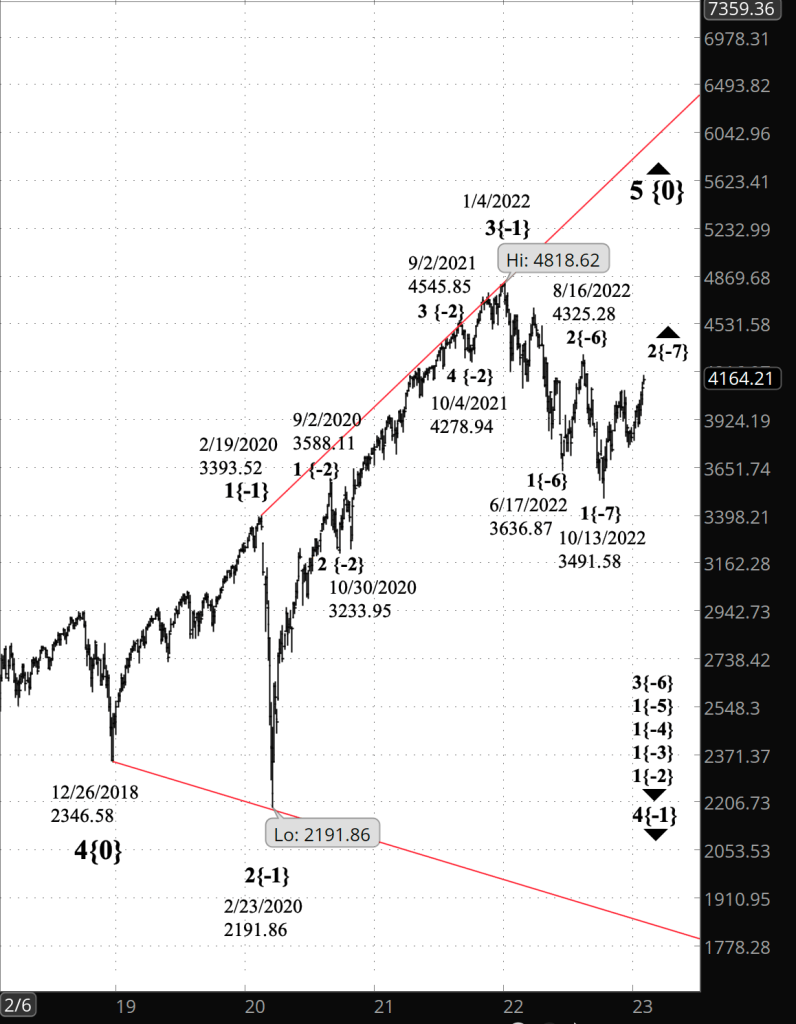
Although what is happening today looks large, it’s fairly small in comparison to wave 4{-1}, the downward movement that began on January 4, 2022, and even smaller in comparison to the vast expanding Diagonal Triangle, wave 5{0}, that encompasses all that is happening at present. Wave 5{0} began its work on December 26, 2018.

So today’s drama is but a momentary rush within a far larger saga.

[S&P 500 index at 3:25 p.m., 3-day bars]

The top chart, newly added, shows the entirety of the expanding Diagonal Triangle so far, using the S&P 500 index. It is labeled with the revised analysis.

The middle chart, initially posted at 11:30 a.m. and updated for this posting, shows the S&P 500 futures, including the upward correction and the downtrend that preceded it, labeled with the revised analysis.

The lower chart, posted at 9:35 a.m., shows the S&P 500 futures labeled with the former, now superseded analysis and has not been updated.

11:50 a.m. New York time

Chart reanalyzed. The S&P 500 futures moved above 4180 at the opening bell, invalidating the analysis of this morning and stretching back to late December. Here is the new analysis.

What’s happening now (revised). The futures rose into the 4190s early in the session.

What does it mean (revised)? An upward correction that began on October 13, 2022 is underway and is in its third and final segment.

What are the alternatives (revised)? There are alternatives, but I have more analysis to do before I’ve nailed them down. Tomorrow…

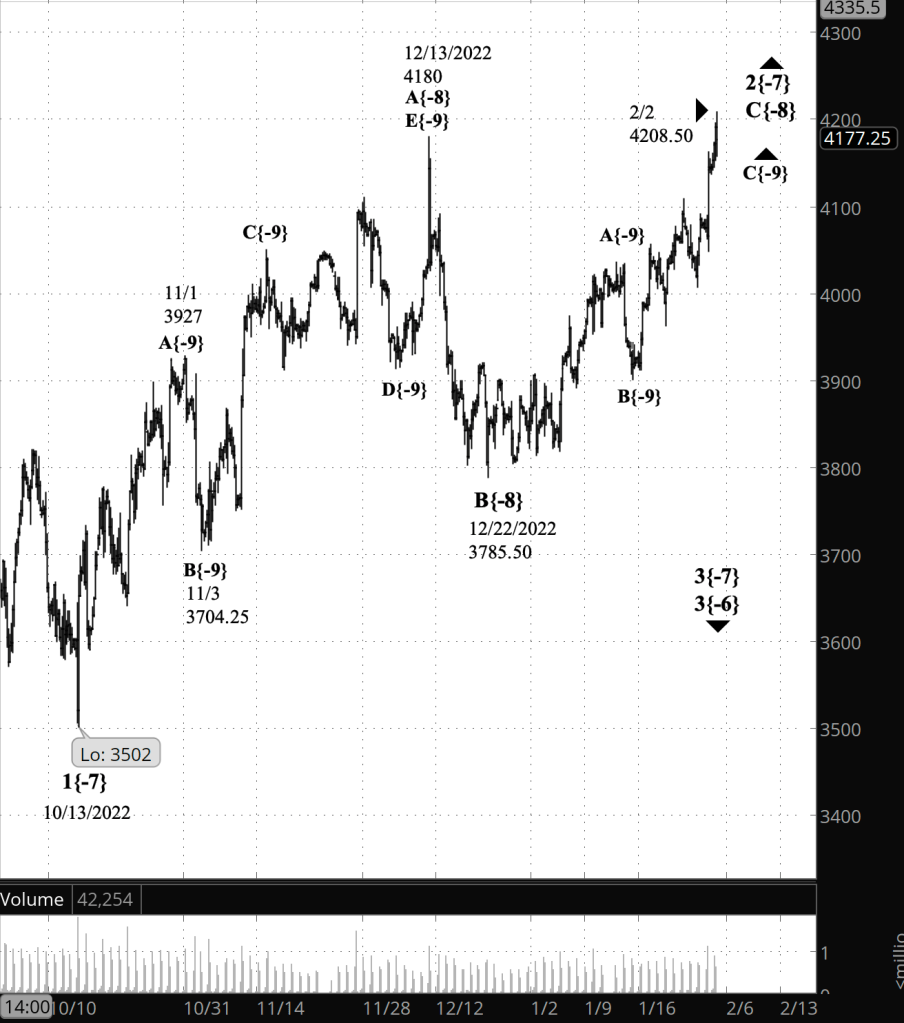
Chart note (revised). This chart shows the revised analysis. I’ve retained the former, now invalid, analysis from this morning.

[S&P 500 E-mini futures at 3:30 p.m., 4-hour bars, with volume]

What does Elliott wave analysis say (revised)? These are the waves that I’m tracking under the revised analysis.

Principal analysis: The upward correction, wave 2{-7}, began on October 13, 2022 from 3502. It is now in its third subwave, wave C{-8}. When wave C{-8} is complete, it will also be the end of the upward correction, wave 2{-7}, which will be followed by a significant downtrend, wave 3{-7}, which will carry the price down to 3502, the starting point of the upward correction, and likely significantly below that level.

9:35 a.m. New York time

What’s happening now? The S&P 500 E-mini futures rose overnight, reaching a high of 4176.25 so far.

What does it mean? The upward correction that began on December 22, 2022 continues. Under that scenario, the highest the price can rise at this point is 4180. Any movement above that point would invalidate the analysis that follows and would require a major reanalysis.

The yet unanswered question about today’s high is what it represents: The peak of the first segment of the upward correction, or of the correction as a whole. The principal analysis this morning continues to show it as being the end of the first segment of the correction.

What are the alternatives? There are two.

  • Alternative #1: The first segment of the upward correction, wave A{-10}, ended at the overnight high. The declining second segment, wave B{-10}, will follow.
  • Alternative #2: The third and final segment ended at the overnight high, and with it the entire upward correction. A downtrend is now underway and will carry the price below 3785.50, the starting point of the correction, and most likely significantly below that level.

If the price moves above 4180, the revised analysis would look something like this:

  • The December 13 peak becomes the first segment of an upward correction that began on October 13, 2022.
  • The decline that followed becomes the second segment of that correction, still underway.
  • The upward correction follows a downtrending wave that began on August 16, 2022 from 4327.50.

Chart note. I’ve placed a Fibonacci ladder on the chart, in red, showing how close the price has come to a 100% retracement of the downtrend the preceded the correction.

Directional movements — “waves” in the parlance of Elliott wave analysis — form a fractal pattern of smaller waves within larger waves, which in turn are building blocks of still larger waves. A wave’s position in the fractal hierarchy is called its “degree”. I show each wave’s degree with a numerical subscript within curly brackets. The smaller the subscript’s number, the smaller the degree. The chart shows relatively small waves, lasting for months rather than years, and so the subscript’s are negatives.

The following chart is from an earlier analysis, which has been replaced by a new analysis. See the chart above.

[S&P 500 E-mini futures at 9:35 a.m., 4-hour bars, with volume]

What does Elliott wave theory say? The waves I’m tracking are unchanged from yesterday, and their description, below, is only slightly modified.

Principal analysis: The upward correction is wave 2{-9} and is nearing the end of its first subwave, wave A{-10}. The Fibonacci ladder on the chart tracks the wave 2{-9}’s retracement of the downtrending wave that preceded it, wave 1{-9}.

Analysis #1: Wave A{-10}, the first subwave of wave 2{-9}, ended at today’s high. The second subwave, wave B{-10}, is now underway.

Analysis #2: Wave 2{-9} and its third and final subwave, wave C{-10} ended at today’s high. Wave 3{-9}, a downtrend, is now underway.

The three analyses are are all happening within wave 1{-8}, a downtrending wave with wave 2{-7}. Both began on December 13, 2022, from 4110. Those two waves, in turn, are subwaves of a nested series of downtrending waves of increasing size, up to wave 4{-1}, the next-to-the-last subwave of an expanding Diagonal Triangle, wave 5{0}, which began on December 26, 2018.

A reanalysis, should it become necessary, will have these waves:

  • The December 13, 2022 peak at 4180, now the end of wave 2{-7}, becomes the end of wave A{-8}, the first segment of an upward correction that began on October 13, 2022. Wave 2{-7} is still underway.
  • Declining wave B{-8} is now underway and is the second segment of the correction.,
  • The upward correction is a subwave of downtrending wave 3{-6}, which began on August 16, 2022 from 4327.50.

We Are Here.

These are the waves currently in progress under my principal analysis. Each line on the list shows the wave number, with the subscript in curly brackets, the traditional degree name, the starting date, the starting price of the S&P 500 E-mini futures, and the direction of the wave.

  • S&P 500 Index:
  • 5{+3} Supercycle, 7/8/1932, 4.40 (up)
  • 5{+2} Cycle, 12/9/1974, 60.96 (up)
  • 5{+1} Primary, 3/6/2009, 666.79 (up)
  • 5{0} Intermediate, 12/26/2018, 2346.58 (up)
  • S&P 500 Futures and index:
  • 4{-1} Minor, 1/4/2022, 4808.25 (down) (futures), 4818.62 (down) (index)
  • S&P 500 Futures:
  • 1{-2} Minute, 1/4/2022, 4808.25 (down)
  • 1{-3} Minuette, 1/4/2022, 4808.25 (down)
  • 1{-4} Subminuette, 1/4/2022, 4808.25 (down)
  • 1{-5} Micro, 1/4/2022, 4808.25 (down)
  • 3{-6} Submicro, 8/16/2022, 4327.50 (down)
  • 2{-7} Minuscule, 10/13/2022, 3502 (up)

Learning and other resources. Elliott wave analysis provides context, not prophecy. As the 20th century semanticist Alfred Korzybski put it in his book Science and Sanity (1933), “The map is not the territory … The only usefulness of a map depends on similarity of structure between the empirical world and the map.” And I would add, in the ever-changing markets, we can judge that similarity of structure only after the fact.

See the menu page Analytical Methods for a rundown on where to go for information on Elliott wave analysis.

By Tim Bovee, Portland, Oregon, February 2, 2023

Disclaimer

Tim Bovee, Private Trader tracks the analysis and trades of a private trader for his own accounts. Nothing in this blog constitutes a recommendation to buy or sell stocks, options or any other financial instrument. The only purpose of this blog is to provide education and entertainment.

No trader is ever 100 percent successful in his or her trades. Trading in the stock and option markets is risky and uncertain. Each trader must make trading decisions for his or her own account, and take responsibility for the consequences.

License
Creative Commons License

All content on Tim Bovee, Private Trader by Timothy K. Bovee is licensed under a Creative Commons Attribution-ShareAlike 4.0 International License.

Based on a work at www.timbovee.com.
Trader’s Notebook

3:30 p.m. New York time

Half an hour before the closing bell. The S&P 500 futures whipsawed between the 4040s and the 4080s after the Federal Open Market Committee announced a 25-basis-point increase in the Fed Funds rate. Fed Chair Jerome Powell’s news conference began at a low of 4048.50, and as he spoke the price shot up to 4144.50, remaining near that high point as the closing bell approached.

In terms of Elliott wave analysis,

  • The price remains a bit less than 30 points below 4180, the starting point of the preceding wave, 1{-9}. Under the Elliott wave rules, the price cannot move above that level. If it does, it forces a major reanalysis.
  • The rise confirms this morning’s principal analysis: An upward correction that began on December 22, 2022, wave 2{-9}, is still underway. Under that analysis, the correction is nearing the end of its first internal segment, wave A{-10}.
  • The rise also leaves the two alternative analyses in place, but the January 26 high, 4109.25, has been replaced by today’s high, 4144.25 so far.

The alternatives now read:

  • Alternative #1: The first segment of the upward correction, wave A{-10}, ended at the February 1 high (whatever it turns out to be). The declining second segment, wave B{-10}, will follow.
  • Alternative #2: The third and final segment ended at the February 1 high, and with it the entire upward correction. A downtrend is now underway and will carry the price below 3785.50, the starting point of the correction, and most likely significantly below that level.

I’ve updated the chart.

9:35 a.m. New York time

What’s happening now? The S&P 500 E-mini futures see-sawed in the 4070s and 4080s in overnight trading, remaining above an important resistance level. Trading today will be event driven. The Federal Open Market Committee announces it’s interest rate decision at 2 p.m., and Federal Reserve Chair Jerome Powell takes questions from reporters at 2:30 p.m.

What does it mean? The resistance price is 4029.30, the 61.8% Fibonacci retracement level within the upward correction that began on December 22, 2022 and is continuing the end game of its first segment. When that segment is complete, after exceeding the correction high so far, 4109.25, attained on January 26, it will be followed by a declining second segment that will remain above the correction’s starting point, 3785.50. I expect the correction to have three segments altogether.

What are the alternatives? The same two that have been with us for awhile.

Alternative #1: The first segment of the upward correction ended at the January 26 high. The declining second segment is now underway.

Alternative #2: The third and final segment ended at the January 26 high, and with it the entire upward correction. A downtrend is now underway and will carry the price below 3785.50, the starting point of the correction, and most likely significantly below that level.

Chart notes. Under Elliott wave theory, the ups and downs we see on the chart are called waves, built from smaller waves and in turn serving as building blocks for larger waves, in a complex fractal pattern. Bigger or smaller, all waves produce the same patterns and follow the same rules.

A wave’s placement within the fractal pattern is called it’s degree. I show the degree as a subscript after each wave’s number (in trending waves) or letter (in corrective waves) designator, setting off the subscript with curly brackets. The smaller the subscript number, the lower the size of the wave within the fractal structure.

I’ve superimposed a retracement ladder on the chart, in red, showing the Fibonacci retracement points. With the price above the 61.8% Fibonacci retracement, that level becomes an import level of support. If the price stays above it, then that buttresses the principal analysis. If it falls below it and stays down, that lends credence to the alternative analyses.

[S&P 500 E-mini futures at 3:30 p.m., 4-hour bars, with volume]

What does Elliott wave theory say? Unchanged from yesterday, and I’ve copied the text of this section, unchanged.

These are the waves I’m tracking in my analyses.

Principal analysis: The upward correction is wave 2{-9} and is nearing the end of its first subwave, wave A{-10}. The Fibonacci ladder on the chart tracks the wave 2{-9}’s retracement of the downtrending wave that preceded it, wave 1{-9}.

Analysis #1: Wave A{-10}, the first subwave of wave 2{-9}, ended on January 26. The second subwave, wave B{-10}, is now underway.

Analysis #2: Wave 2{-9} and its third and final subwave, wave C{-10} ended on January 26. Wave 3{-9}, a downtrend, is now underway.

The three analyses are playing out within wave 1{-8}, a downtrending wave with wave 2{-7}. Both began on December 13, 2022, from 4110. Those two waves, in turn, are subwaves of a nested series of downtrending waves of increasing size, up to wave 4{-1}, the next-to-the-last subwave of an expanding Diagonal Triangle, wave 5{0}, which began on December 26, 2018.

We Are Here.

These are the waves currently in progress under my principal analysis. Each line on the list shows the wave number, with the subscript in curly brackets, the traditional degree name, the starting date, the starting price of the S&P 500 E-mini futures, and the direction of the wave.

  • S&P 500 Index:
  • 5{+3} Supercycle, 7/8/1932, 4.40 (up)
  • 5{+2} Cycle, 12/9/1974, 60.96 (up)
  • 5{+1} Primary, 3/6/2009, 666.79 (up)
  • 5{0} Intermediate, 12/26/2018, 2346.58 (up)
  • S&P 500 Futures and index:
  • 4{-1} Minor, 1/4/2022, 4808.25 (down) (futures), 4818.62 (down) (index)
  • S&P 500 Futures:
  • 1{-2} Minute, 1/4/2022, 4808.25 (down)
  • 1{-3} Minuette, 1/4/2022, 4808.25 (down)
  • 1{-4} Subminuette, 1/4/2022, 4808.25 (down)
  • 1{-5} Micro, 1/4/2022, 4808.25 (down)
  • 3{-6} Submicro, 8/16/2022, 4327.50 (down)
  • 3{-7} Minuscule, 12/13/2022, 4110 (down)
  • 1{-8} Subminuscule, 12/13/2022, 4110 (down)

Learning and other resources. Elliott wave analysis provides context, not prophecy. As the 20th century semanticist Alfred Korzybski put it in his book Science and Sanity (1933), “The map is not the territory … The only usefulness of a map depends on similarity of structure between the empirical world and the map.” And I would add, in the ever-changing markets, we can judge that similarity of structure only after the fact.

See the menu page Analytical Methods for a rundown on where to go for information on Elliott wave analysis.

By Tim Bovee, Portland, Oregon, February 1, 2023

Disclaimer

Tim Bovee, Private Trader tracks the analysis and trades of a private trader for his own accounts. Nothing in this blog constitutes a recommendation to buy or sell stocks, options or any other financial instrument. The only purpose of this blog is to provide education and entertainment.

No trader is ever 100 percent successful in his or her trades. Trading in the stock and option markets is risky and uncertain. Each trader must make trading decisions for his or her own account, and take responsibility for the consequences.

License
Creative Commons License

All content on Tim Bovee, Private Trader by Timothy K. Bovee is licensed under a Creative Commons Attribution-ShareAlike 4.0 International License.

Based on a work at www.timbovee.com.
Trader’s Notebook

3:30 p.m. New York time

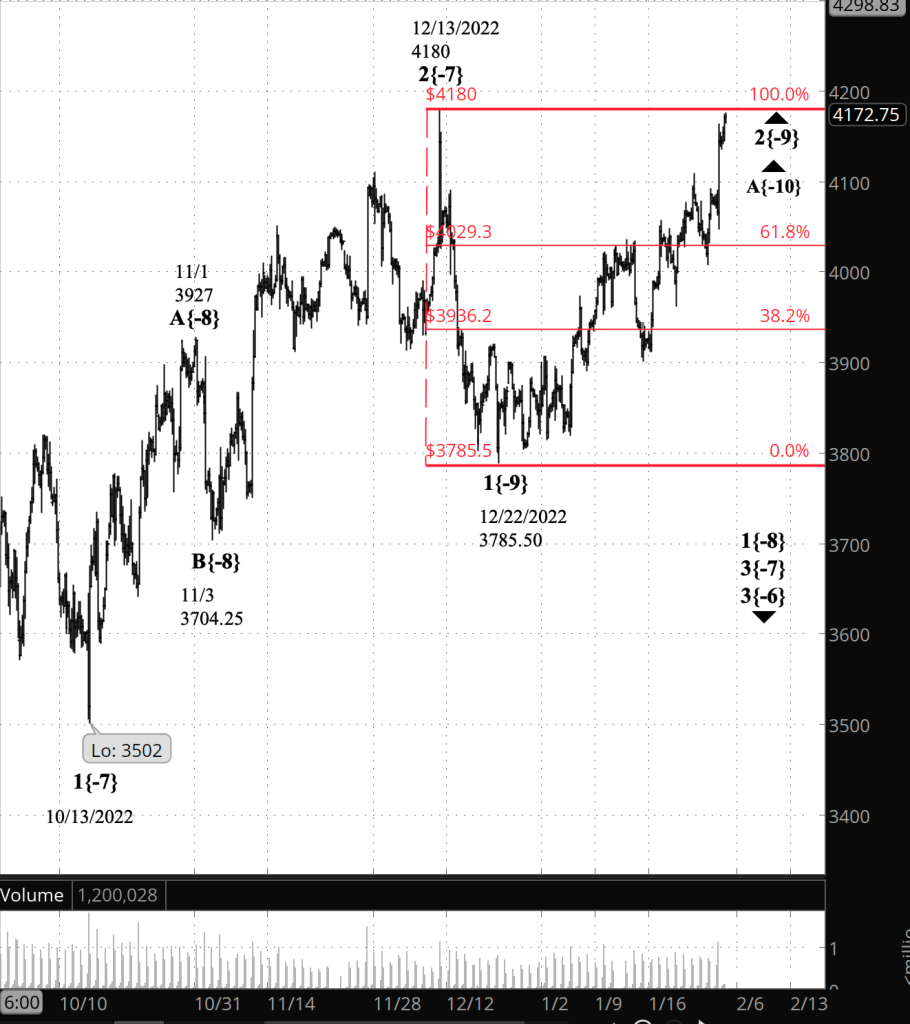
Half an hour before the closing bell. The S&P 500 futures rose during the session, reaching the 4070s and remaining below the January 26 high, 4109.25, which is the peak so far of the upward correction that began on December 22, 2022. No change in the analysis. I’ve updated the chart.

9:35 a.m. New York time

What’s happening now? The S&P 500 E-mini futures fell in overnight trading, reaching a low of 4007.50, and then reversed, rising back into the 4040s.

The decline brought the price below the 61.8% Fibonacci level, and a whipsaw brought it back above that resistance point. The rapid movement coincided with release of the 4th quarter Employment Cost Index, which, at 1%, was lower than the consensus expectation of 1.1% and the prior quarter result of 1.2%.

What does it mean? The upward correction that began on December 22 is nearing the end of its first segment. The 61.8% resistance level, 4029.30, is a key price in assessing the chart. If the futures stay above that level, then the principal analysis remains the most likely assessment. If price swiftly moves below that level, then the alternatives gain credence.

The correction’s first segment has reached a high of 4109.25 on January 26. A move above that level would discredit the alternative analyses.

What are the alternatives? There are two, both

Alternative #1: The first segment of the upward correction ended at the January 26 high. The declining second segment is now underway.

Alternative #2: The third and final segment ended at the January 26 high, and with it the entire upward correction. A downtrend is now underway and will carry the price below 3785.50, the starting point of the correction, and most likely significantly below that level.

Chart note. The chart continues to display the Fibonacci ladder for the upward correction — in red — showing the correction’s retracement of the downtrendng wave that preceded it.

The directional movements — “waves” — in Elliott wave analysis form a fractal structure, within which each wave contains smaller and is in turn contained by a larger wave. All waves, big and small, produce the same suite of patterns and follow the same rules.

To analyze a chart, each wave must be located within the fractal structure — which waves are contained by which larger waves, up and down the structure. In labeling this chart, I’ve given each wave a number for a subwave of trending waves and letter for a subwave of corrective waves. I designate the place within the fractal structure, the wave’s degree, with a subscript in curly brackets designating the wave’s relative size. The smaller the subscript number, the lower the wave’s degree.

[S&P 500 E-mini futures at 3:30 p.m., 4-hour bars, with volume]

What does Elliott wave theory say? These are the waves I’m tracking in my analyses.

Principal analysis: The upward correction is wave 2{-9} and is nearing the end of its first subwave, wave A{-10}. The Fibonacci ladder on the chart tracks the wave 2{-9}’s retracement of the downtrending wave that preceded it, wave 1{-9}.

Analysis #1: Wave A{-10}, the first subwave of wave 2{-9}, ended on January 26. The second subwave, wave B{-10}, is now underway.

Analysis #2: Wave 2{-9} and its third and final subwave, wave C{-10} ended on January 26. Wave 3{-9}, a downtrend, is now underway.

The three analyses are playing out within wave 1{-8}, a downtrending wave with wave 2{-7}. Both began on December 13, 2022, from 4110. Those two waves, in turn, are subwaves of a nested series of downtrending waves of increasing size, up to wave 4{-1}, the next-to-the-last subwave of an expanding Diagonal Triangle, wave 5{0}, which began on December 26, 2018.

We Are Here.

These are the waves currently in progress under my principal analysis. Each line on the list shows the wave number, with the subscript in curly brackets, the traditional degree name, the starting date, the starting price of the S&P 500 E-mini futures, and the direction of the wave.

  • S&P 500 Index:
  • 5{+3} Supercycle, 7/8/1932, 4.40 (up)
  • 5{+2} Cycle, 12/9/1974, 60.96 (up)
  • 5{+1} Primary, 3/6/2009, 666.79 (up)
  • 5{0} Intermediate, 12/26/2018, 2346.58 (up)
  • S&P 500 Futures and index:
  • 4{-1} Minor, 1/4/2022, 4808.25 (down) (futures), 4818.62 (down) (index)
  • S&P 500 Futures:
  • 1{-2} Minute, 1/4/2022, 4808.25 (down)
  • 1{-3} Minuette, 1/4/2022, 4808.25 (down)
  • 1{-4} Subminuette, 1/4/2022, 4808.25 (down)
  • 1{-5} Micro, 1/4/2022, 4808.25 (down)
  • 3{-6} Submicro, 8/16/2022, 4327.50 (down)
  • 3{-7} Minuscule, 12/13/2022, 4110 (down)
  • 1{-8} Subminuscule, 12/13/2022, 4110 (down)

Learning and other resources. Elliott wave analysis provides context, not prophecy. As the 20th century semanticist Alfred Korzybski put it in his book Science and Sanity (1933), “The map is not the territory … The only usefulness of a map depends on similarity of structure between the empirical world and the map.” And I would add, in the ever-changing markets, we can judge that similarity of structure only after the fact.

See the menu page Analytical Methods for a rundown on where to go for information on Elliott wave analysis.

By Tim Bovee, Portland, Oregon, January 31, 2023

Disclaimer

Tim Bovee, Private Trader tracks the analysis and trades of a private trader for his own accounts. Nothing in this blog constitutes a recommendation to buy or sell stocks, options or any other financial instrument. The only purpose of this blog is to provide education and entertainment.

No trader is ever 100 percent successful in his or her trades. Trading in the stock and option markets is risky and uncertain. Each trader must make trading decisions for his or her own account, and take responsibility for the consequences.

License
Creative Commons License

All content on Tim Bovee, Private Trader by Timothy K. Bovee is licensed under a Creative Commons Attribution-ShareAlike 4.0 International License.

Based on a work at www.timbovee.com.

Trader’s Notebook

3:30 p.m. New York time

Half an hour before the closing bell. The S&P 500 futures reached a high of 4078 early in the session and then declined, falling so far into the 4030s. The price remains slightly above the 61.8% Fibonacci retracement level, 4029.30, which is often a major resistance point.

No change in this morning’s analysis. I’ve updated the chart.

9:35 a.m. New York time

What’s happening now? The S&P 500 E-mini futures declined after trading resumed overnight, reaching a low so far of 4040, well below the January 27 high, 4109.25, but above the 61.8% Fibonacci retracement level, 4029.30.

What does it mean? The decline is a part of the first segment of an upward correction that began on December 22, which is still underway although nearing its end. Under this scenario, the price will quickly reverse and move higher. The further the price falls, the more likely it becomes that an alternative scenario better matches the chart.

What are the alternatives? The alternative scenarios consider the upward correction further advanced than does the principal analysis.

In Elliott wave analysis, each segment — a directional movement called a “wave” — has a characteristic called a “degree”, which places it within the complex fractal structure of waves containing smaller waves and being contained by larger waves, with all waves producing the same patterns and following the same rules.

A reading of how far advanced the correction is depends upon how we read the degree of each wave. And there is no reliable way to do that in advance. We only know the degrees for sure one a pattern is complete.

So consider the waves within the rise from December 22. In the principal analysis, I place those waves two degrees below the entire correction. In the alternatives, I move those waves one degree higher. Having done so, we have two alternatives.

Alternative #1: The correction is in its third and final segment, and the decline from January 27 is a subwave of that segment. The price will soon reverse and move higher. For the analysis to be correct, the price must remain below 4180, the starting point of the downtrending wave that preceded the correction.

Alternative #2: The January 27 high marks the end of the final segment of the correction, and of the correction itself. The decline that has followed is the first segment of a downtrend, which will carry the price below 3785.50, the starting point of the upward correction, and most likely significantly below that level.

Chart note. I’ve placed a Fibonacci retracement ladder on the chart, to better understand the upward correction’s retracement of the preceding downtrending wave. The 61.8% retracement level is a major decision point for prices, a place where they either reverse or breakthrough and continue onward. For this correction the 61.8% retracement is at 4029.30.

Either way, the movement brings clarity to the chart. A bounce back to the upside lends credence to the principal analysis and alternative #1. A breakthrough downward favors alternative #2.

I show the degree of each wave using a subscript, within curly brackets, showing the position of the wave in relation to a very large wave, the base, that began in December 2018 and that encompasses everything that has happened on the chart since that date. The upward correction has the subscript {-9}, meaning it is nine degrees below the base. The smaller the subscript number, the lower the degree.

[S&P 500 E-mini futures at 3:30 p.m., 4-hour bars, with volume]

What does Elliott wave theory say? The upward correction is wave 2{-9}, nine degrees below the base, wave 5{0}.

Under the principal analysis, wave 2{-9} is in its first subwave, A{-10}.

Under alternative #1, wave 2{-9} is in its third and final subwave, C{-10}.

Under alternative #2, wave 2{-9} ended on January 27 and downtrending wave 3{-9} began on that date. Wave 3{-9} is presently in its initial subwave, 1{-10}.

All of this is happening within downtrending wave 1{-8}, which began on December 13. Wave 1{-8} is a subwave within a series of nested downtrending waves of increasing size, running from wave 3{-7}, which also began on December 13, up to wave 4{-1}, which began on January 4, 2022.

Up an additional degree is the base, wave 5{0}, an expanding Diagonal Triangle that began on December 26, 2019. The present decline, wave 4{-1}, is the next to the last wave within the triangle. It will be followed by wave 5{-1}, which will rise above wave 4{-1}’s starting point, 4808.25 on the futures, and perhaps significantly above that level.

We Are Here.

These are the waves currently in progress under my principal analysis. Each line on the list shows the wave number, with the subscript in curly brackets, the traditional degree name, the starting date, the starting price of the S&P 500 E-mini futures, and the direction of the wave.

  • S&P 500 Index:
  • 5{+3} Supercycle, 7/8/1932, 4.40 (up)
  • 5{+2} Cycle, 12/9/1974, 60.96 (up)
  • 5{+1} Primary, 3/6/2009, 666.79 (up)
  • 5{0} Intermediate, 12/26/2018, 2346.58 (up)
  • S&P 500 Futures and index:
  • 4{-1} Minor, 1/4/2022, 4808.25 (down) (futures), 4818.62 (down) (index)
  • S&P 500 Futures:
  • 1{-2} Minute, 1/4/2022, 4808.25 (down)
  • 1{-3} Minuette, 1/4/2022, 4808.25 (down)
  • 1{-4} Subminuette, 1/4/2022, 4808.25 (down)
  • 1{-5} Micro, 1/4/2022, 4808.25 (down)
  • 3{-6} Submicro, 8/16/2022, 4327.50 (down)
  • 3{-7} Minuscule, 12/13/2022, 4110 (down)
  • 1{-8} Subminuscule, 12/13/2022, 4110 (down)

Learning and other resources. Elliott wave analysis provides context, not prophecy. As the 20th century semanticist Alfred Korzybski put it in his book Science and Sanity (1933), “The map is not the territory … The only usefulness of a map depends on similarity of structure between the empirical world and the map.” And I would add, in the ever-changing markets, we can judge that similarity of structure only after the fact.

See the menu page Analytical Methods for a rundown on where to go for information on Elliott wave analysis.

By Tim Bovee, Portland, Oregon, January 30, 2023

Disclaimer

Tim Bovee, Private Trader tracks the analysis and trades of a private trader for his own accounts. Nothing in this blog constitutes a recommendation to buy or sell stocks, options or any other financial instrument. The only purpose of this blog is to provide education and entertainment.

No trader is ever 100 percent successful in his or her trades. Trading in the stock and option markets is risky and uncertain. Each trader must make trading decisions for his or her own account, and take responsibility for the consequences.

License
Creative Commons License

All content on Tim Bovee, Private Trader by Timothy K. Bovee is licensed under a Creative Commons Attribution-ShareAlike 4.0 International License.

Based on a work at www.timbovee.com.
Trader’s Notebook

3:30 p.m. New York time

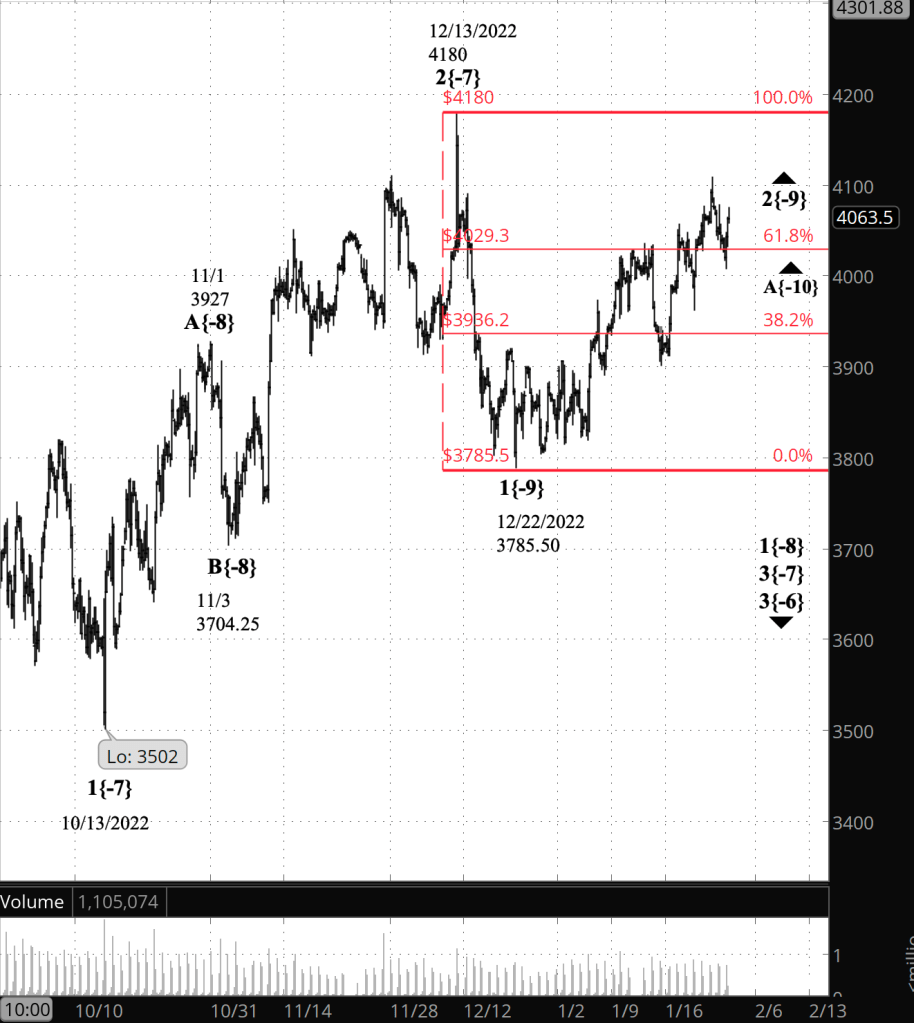
Half an hour before the closing bell. The S&P 500 futures continued to rise during the session, reaching above 4100. The 61.8% Fibonacci retracement level, mentioned in the Chart note below, is at 4029.30, so the price as moved a bit beyond, although such breakouts aren’t uncommon.

Nothing that has happened so far run against the principal analysis that has been with us for awhile: An upward correction, wave 2{-9}, is underway. The higher the price, the closer it comes to a level that would discredit that analysis and force a major re-analysis of the chart. Under the rules of Elliott wave analysis, a 2nd wave cannot move beyond the starting point of the 1st wave that preceded it. For wave 2{-9}, that sets an upper limit of 4180. If the price moves above that level, then the rise isn’t wave 2{-9} and something else is going on,

But, for now, no change in the analysis. I’ve updated the chart.

9:35 a.m. New York time

What’s happening now? The S&P 500 E-mini futures meandered sideways overnight, staying largely in the 4050s and 4060s.

What does it mean? The price remained below the high point of an upward correction that began on December 22, 2022 and is now in its final leg.

What are the alternatives? The indecisive trading has done nothing to give an edge to the principal analysis or one of the two alternatives, which are unchanged for a second day in a row.

Alternative #1: The first segment ended at the January 26 high.

Alternative #2: The third and final segment ended at the January 26 high, and with it the entire upward correction. 

Chart note. I’ve placed a Fibonacci ladder, in red, on the chart, showing the retracement levels that tend to be reversal points.The most reliable of these is the 61.8% retracement. The price has shot above that level twice, on January 23 and January 25, suggesting that the futures are approaching a reversal to the down side.

I’ve labeled the waves — directional movements — in my usual fashion: Subwaves of trending waves are labeled with numbers, and of corrective waves, with letters. The placement of a wave within the fractal hierarchy of the chart — its degree — is shown by a subscript, in curly brackets. The lower the subscript number, the smaller the degree.

[S&P 500 E-mini futures at 3:30 p.m., 4-hour bars, with volume]

What does Elliott wave theory say? These are the waves I’m tracking within the upward correction that began on December 22, 2022 — wave 2{-9}:

  • Principal analysis: Upward wave A{-10}, a subwave of 2{-9}, is still underway.
  • Alternative #1: Wave A{-10} ended yesterday and downward wave B{-10} is underway.
  • Alternative #2: Rising wave C{-10}, the final wave in the corrective pattern, ended yesterday, bringing wave 2{-9} to an end. Downtrending wave 3{-9} has begun and will carry the price below 3785.50 — the starting point of wave 2{-9} — and potentially much lower.

We Are Here.

These are the waves currently in progress under my principal analysis. Each line on the list shows the wave number, with the subscript in curly brackets, the traditional degree name, the starting date, the starting price of the S&P 500 E-mini futures, and the direction of the wave.

  • S&P 500 Index:
  • 5{+3} Supercycle, 7/8/1932, 4.40 (up)
  • 5{+2} Cycle, 12/9/1974, 60.96 (up)
  • 5{+1} Primary, 3/6/2009, 666.79 (up)
  • 5{0} Intermediate, 12/26/2018, 2346.58 (up)
  • 4{-1} Minor, 1/4/2022 4818.62 (down)
  • 1{-2} Minute, 1/4/2022 4818.62 (down)
  • S&P 500 Futures and index:
  • 1{-3} Minuette, 1/4/2022, 4808.25 (down) (futures), 4818.62 (down) (index)
  • S&P 500 Futures:
  • 1{-4} Subminuette, 1/4/2022, 4808.25 (down)
  • 1{-5} Micro, 1/4/2022, 4808.25 (down)
  • 3{-6} Submicro, 8/16/2022, 4327.50 (down)
  • 3{-7} Minuscule, 12/13/2022, 4110 (down)
  • 1{-8} Subminuscule, 12/13/2022, 4110 (down)

Learning and other resources. Elliott wave analysis provides context, not prophecy. As the 20th century semanticist Alfred Korzybski put it in his book Science and Sanity (1933), “The map is not the territory … The only usefulness of a map depends on similarity of structure between the empirical world and the map.” And I would add, in the ever-changing markets, we can judge that similarity of structure only after the fact.

See the menu page Analytical Methods for a rundown on where to go for information on Elliott wave analysis.

By Tim Bovee, Portland, Oregon, January 27, 2023

Disclaimer

Tim Bovee, Private Trader tracks the analysis and trades of a private trader for his own accounts. Nothing in this blog constitutes a recommendation to buy or sell stocks, options or any other financial instrument. The only purpose of this blog is to provide education and entertainment.

No trader is ever 100 percent successful in his or her trades. Trading in the stock and option markets is risky and uncertain. Each trader must make trading decisions for his or her own account, and take responsibility for the consequences.

License
Creative Commons License

All content on Tim Bovee, Private Trader by Timothy K. Bovee is licensed under a Creative Commons Attribution-ShareAlike 4.0 International License.

Based on a work at www.timbovee.com.