Trader’s Notebook

3:30 p.m. New York time

Half an hour before the closing bell. The S&P 500 futures continued to rise during the session, reaching into the 3880s. No change in the analysis. Waves now underway: Wave 3{-9} within wave 1{-8} within wave 3{-7}. All are downtrending.

The session high so far keeps the price below the starting point of wave 3{-9}, which 3919.75. A move above that level would require a reanalysis of the chart.

9:45 a.m. New York time

SPY options trade entry. I’m continuing to play the downtrend, entering a short bear call spread on SPY using options that trade for the last time on February 17. I’ve posted an analysis of the trade.

9:35 a.m. New York time

What’s happening now? The S&P 500 E-mini futures rose from yesterday’s session low, 3804.50, into the 3840s shortly after the opening bell.

What does it mean? The downtrend that began on December 21 continues and internally is in the first of five segments.

What are the alternatives? There are two, unchanged from yesterday.

Alternative #1: The larger upward correction that began on October 13 is is still underway and is in its final segment.

Alternative #2: The upward correction that began on October 13 is still underway and is taking the from of a compound correction, containing two or three corrective patterns.

[S&P 500 E-mini futures at 3:30 p.m., 180-minute bars, with volume]

What does Elliott wave theory say? These are the waves that matter for the near term

Principal analysis:

  • A downtrend that began on December 13, wave 3{-7}, is underway.
  • Internally, it is in wave 1{-8}, the first of five waves.
  • Wave 1{-8}, in turn, is in its middle segment, wave 3{-9}.

Both alternatives:

  • An upward correction that began on October 13, wave 2{-7}, is still underway.

Alternative #1:

  • The third and final wave of the correction, wave C{-8}, is underway.
  • Wave C{-8} is in the first wave of a downward correction, wave A{-9}.

Alternative #2:

  • The upward correction, wave 2{-7}, is taking a compound form, containing two or three corrective patterns.
  • The final wave of the first pattern — wave C{-8} — ended on December 13.
  • The decline that followed, still underway, is wave X{-8}, a wave connecting wave C{-8} and the first wave of the second corrective pattern — wave A{-8}.

We Are Here.

These are the waves currently in progress under my principal analysis. Each line on the list shows the wave number, with the subscript in curly brackets, the traditional degree name, the starting date, the starting price of the S&P 500 E-mini futures, and the direction of the wave.

  • S&P 500 Index:
  • 5{+3} Supercycle, 7/8/1932, 4.40 (up)
  • 5{+2} Cycle, 12/9/1974, 60.96 (up)
  • 5{+1} Primary, 3/6/2009, 666.79 (up)
  • 5{0} Intermediate, 12/26/2018, 2346.58 (up)
  • 4{-1} Minor, 1/4/2022 4818.62 (down)
  • 1{-2} Minute, 1/4/2022 4818.62 (down)
  • S&P 500 Futures and index:
  • 1{-3} Minuette, 1/4/2022, 4808.25 (down) (futures), 4818.62 (down) (index)
  • S&P 500 Futures:
  • 1{-4} Subminuette, 1/4/2022, 4808.25 (down)
  • 1{-5} Micro, 1/4/2022, 4808.25 (down)
  • 3{-6} Submicro, 8/16/2022, 4327.50 (down)
  • 3{-7} Minuscule, 12/1/2022, 4110 (down)
  • 1{-8} Subminuscule, 12/1/2022, 4110 (down)

Learning and other resources. Elliott wave analysis provides context, not prophecy. As the 20th century semanticist Alfred Korzybski put it in his book Science and Sanity (1933), “The map is not the territory … The only usefulness of a map depends on similarity of structure between the empirical world and the map.” And I would add, in the ever-changing markets, we can judge that similarity of structure only after the fact.

See the menu page Analytical Methods for a rundown on where to go for information on Elliott wave analysis.

By Tim Bovee, Portland, Oregon, December 29, 2022

Disclaimer

Tim Bovee, Private Trader tracks the analysis and trades of a private trader for his own accounts. Nothing in this blog constitutes a recommendation to buy or sell stocks, options or any other financial instrument. The only purpose of this blog is to provide education and entertainment.

No trader is ever 100 percent successful in his or her trades. Trading in the stock and option markets is risky and uncertain. Each trader must make trading decisions for his or her own account, and take responsibility for the consequences.

License
Creative Commons License

All content on Tim Bovee, Private Trader by Timothy K. Bovee is licensed under a Creative Commons Attribution-ShareAlike 4.0 International License.

Based on a work at www.timbovee.com.
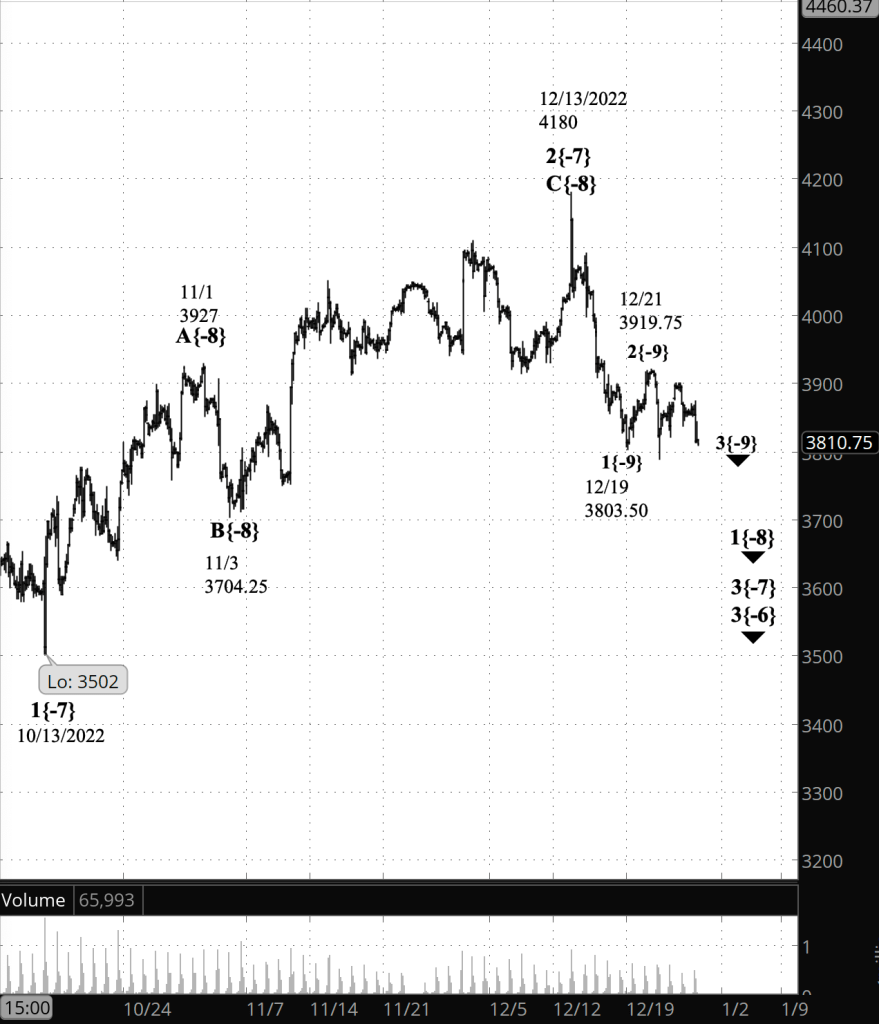
Trader’s Notebook

3:30 p.m. New York time

Half an hour before the closing bell. The S&P 500 futures has continued to fall during the session, so far reaching the 3808.25. The pattern is consistent with this morning’s Triple-3 analysis: A smaller downtrend, wave 3{-9}, within a larger downtrend, wave 3{-8}, within a still larger downtrend, wave 3{-7}, are all under way.

I’ve updated the chart.

1:25 p.m. New York time

SPY options trade exit. I’ve exited my short bear call options spread on SPY for half of maximum potential profit and have updated the trade analysis with full results.

9:35 a.m. New York time

What’s happening now? The S&P 500 E-mini futures traded in a narrow range overnight, remaining largely in the 3850s, with occasional forays higher and lower.

What does it mean? The downtrend that began on December 13 continues and is in its first leg. In turn, that middle segment, which likely will carry the price into the 3600s or below, has completed a small upward correction and is also in its middle segment.

What are the alternatives? There are three.

Looking first at the larger downtrend,

  • Alternative #1: The larger upward correction that began on October 13 is is still underway and is in its final segment. A fall below 3502, the correction’s starting point, would disprove this scenario.
  • Alternative #2: The upward correction that began on October 13 is still underway and is taking the from of a compound correction, containing two or three corrective patterns. The first corrective pattern ended on December 13, and the decline that followed will link the first corrective pattern to the second one. A decline below 3704.25, the starting point of the third leg of the correction, would make this scenario less likely.

A rise above 4180, the endpoint of larger upward correction under the principal analysis, would confirm either of these alternatives.

Looking at the smaller downtrend that is part of the larger one,

  • Alternative #3: The upward correction that began on December 19 may still be underway and is in its third segment.

A fall below 3803.50, the December 19 starting point, would come close to disproving this alternative.

[S&P 500 E-mini futures at 3:30 p.m., 170-minute bars, with volume]

What does Elliott wave theory say? Here are the waves that are important to today’s analysis.

The principal analysis,

  • The larger downtrend is wave 3{-7}, which began on December 1 from 4110.
  • Internally, it is in its initial leg, wave 1{-8}.
  • That initial leg is in its middle segment, wave 3{-9}, which began on December 21.

Alternatives #1 and #2,

  • A larger upward correction, wave 2[-7}, is still underway.

Alternative #1,

  • Wave C{-8}, a rising subwave within wave 2{-7}, is internally in a downward correction and the rise will soon resume.

Alternative #2,

  • The first corrective pattern within wave 2{-7} ended on December 13 with wave C{-8}, but wave 2[-7} is still underway.
  • The subsequent decline is wave X{-8}, connecting the now complete first corrective pattern with a future second corrective pattern.
  • Compound corrections can contain up to three corrective patterns.

Alternative #3,

  • The smaller correction is wave 2{-9} within wave 1{-8}, which in turn is a subwave of wave 3{-7}.
  • The first subwave within the correction, wave A{-10}, ended on December 21, and the second subwave, B{-10}, is now underway, as wave 2{-9} continues.

We Are Here.

These are the waves currently in progress under my principal analysis. Each line on the list shows the wave number, with the subscript in curly brackets, the traditional degree name, the starting date, the starting price of the S&P 500 E-mini futures, and the direction of the wave.

  • S&P 500 Index:
  • 5{+3} Supercycle, 7/8/1932, 4.40 (up)
  • 5{+2} Cycle, 12/9/1974, 60.96 (up)
  • 5{+1} Primary, 3/6/2009, 666.79 (up)
  • 5{0} Intermediate, 12/26/2018, 2346.58 (up)
  • 4{-1} Minor, 1/4/2022 4818.62 (down)
  • 1{-2} Minute, 1/4/2022 4818.62 (down)
  • S&P 500 Futures and index:
  • 1{-3} Minuette, 1/4/2022, 4808.25 (down) (futures), 4818.62 (down) (index)
  • S&P 500 Futures:
  • 1{-4} Subminuette, 1/4/2022, 4808.25 (down)
  • 1{-5} Micro, 1/4/2022, 4808.25 (down)
  • 3{-6} Submicro, 8/16/2022, 4327.50 (down)
  • 3{-7} Minuscule, 12/1/2022, 4110 (down)
  • 1{-8} Subminuscule, 12/1/2022, 4110 (down)

Learning and other resources. Elliott wave analysis provides context, not prophecy. As the 20th century semanticist Alfred Korzybski put it in his book Science and Sanity (1933), “The map is not the territory … The only usefulness of a map depends on similarity of structure between the empirical world and the map.” And I would add, in the ever-changing markets, we can judge that similarity of structure only after the fact.

See the menu page Analytical Methods for a rundown on where to go for information on Elliott wave analysis.

By Tim Bovee, Portland, Oregon, December 28, 2022

Disclaimer

Tim Bovee, Private Trader tracks the analysis and trades of a private trader for his own accounts. Nothing in this blog constitutes a recommendation to buy or sell stocks, options or any other financial instrument. The only purpose of this blog is to provide education and entertainment.

No trader is ever 100 percent successful in his or her trades. Trading in the stock and option markets is risky and uncertain. Each trader must make trading decisions for his or her own account, and take responsibility for the consequences.

License
Creative Commons License

All content on Tim Bovee, Private Trader by Timothy K. Bovee is licensed under a Creative Commons Attribution-ShareAlike 4.0 International License.

Based on a work at www.timbovee.com.
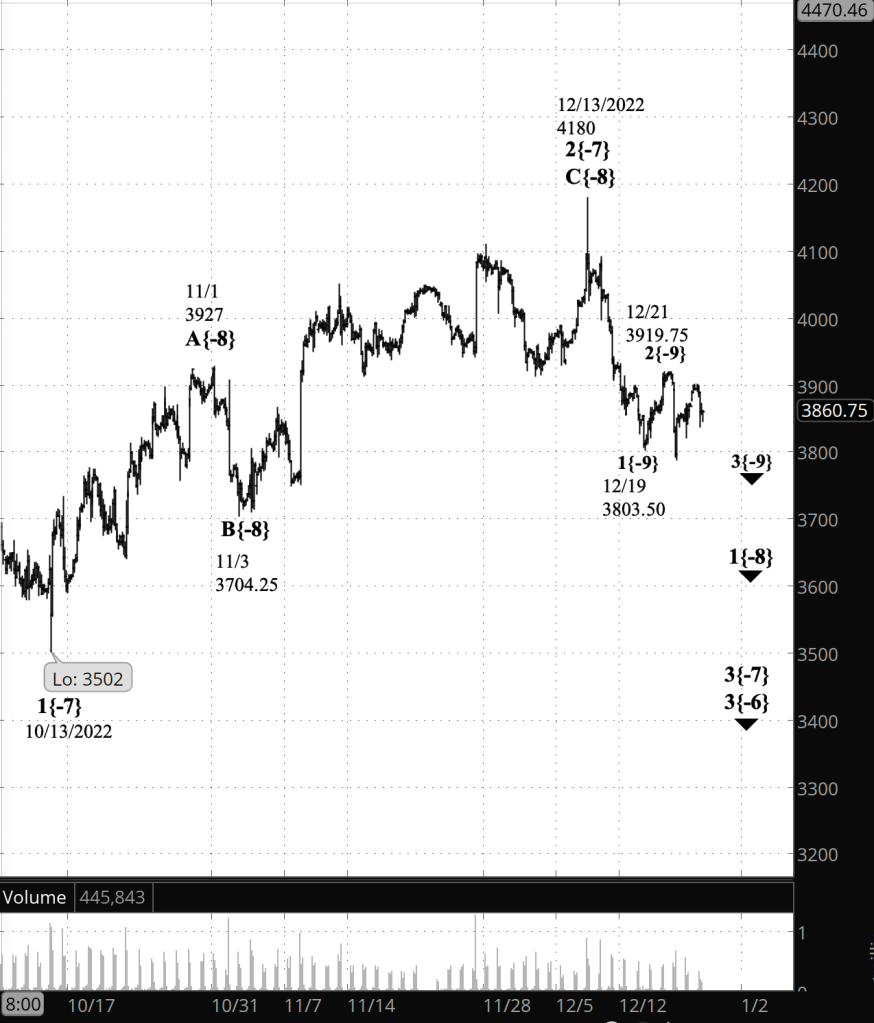
Trader’s Notebook

3:30 p.m. New York time

Half an hour before the closing bell. The S&P 500 futures reached a low for the day of 3871.25 during the the morning and then rose slightly, remaining below the Monday evening high, 3900.50. No change in this morning’s analysis. I’ve updated the near-term (upper) chart.

9:35 a.m. New York time

What’s happening now? The S&P 500 E-mini futures rose when trading resumed Monday evening, reaching 3900.50 and then pulling back to the 3840s.

What does it mean? The price stayed below the starting point of the downtrend that began on December 21 from 3919.75. The pattern is consistent with a small upward correction that has reached completion, followed by a small downtrend that is now underway. These low-level moves are happening within the third leg of the first leg of a larger downtrend that began on December 13 from 4180.

What are the alternatives? The same two that has been with us since mid-December:

  • Alternative #1: The larger upward correction that began on October 13 is is still underway and is in its final segment.
  • Alternative #2: The upward correction that began on October 13 is still underway and is taking the from of a compound correction, containing two or three corrective patterns. The first corrective pattern ended on December 13, and the decline that followed will link the first corrective pattern to the second one.

As the price continues to move lower, both of the alternatives continue to lose credibility.

[S&P 500 E-mini futures at 3:30 p.m., 150-minute bars, with volume]

What does Elliott wave theory say? These are the waves I’m following closely at this point.

Under the principal analysis,

  • The small upward correction that ended overnight was wave 2{-10}.
  • The downtrend that followed is wave 3{-10}.
  • Both are happening within downtrending wave 3{-9}, which began on December 21.
  • Moving up one degree, downtrending wave 1{-8} contains all of the smaller waves described above.
  • Wave 1{-8} is a subwave of wave 3{-7}, which began on December 13.

Under the alternative analyses,

  • Alternative #1: Wave 2{-7} is still underway and is its final subwave, wave C{-8}.
  • Alternative #2: Wave 2{-7}, a compound correction, has completed wave C{-8}, the final wave of its first corrective pattern. The decline from December 13 is wave X{-8}, connecting the completed wave C{-8} to the first wave, A{-8}, of its second corrective pattern.

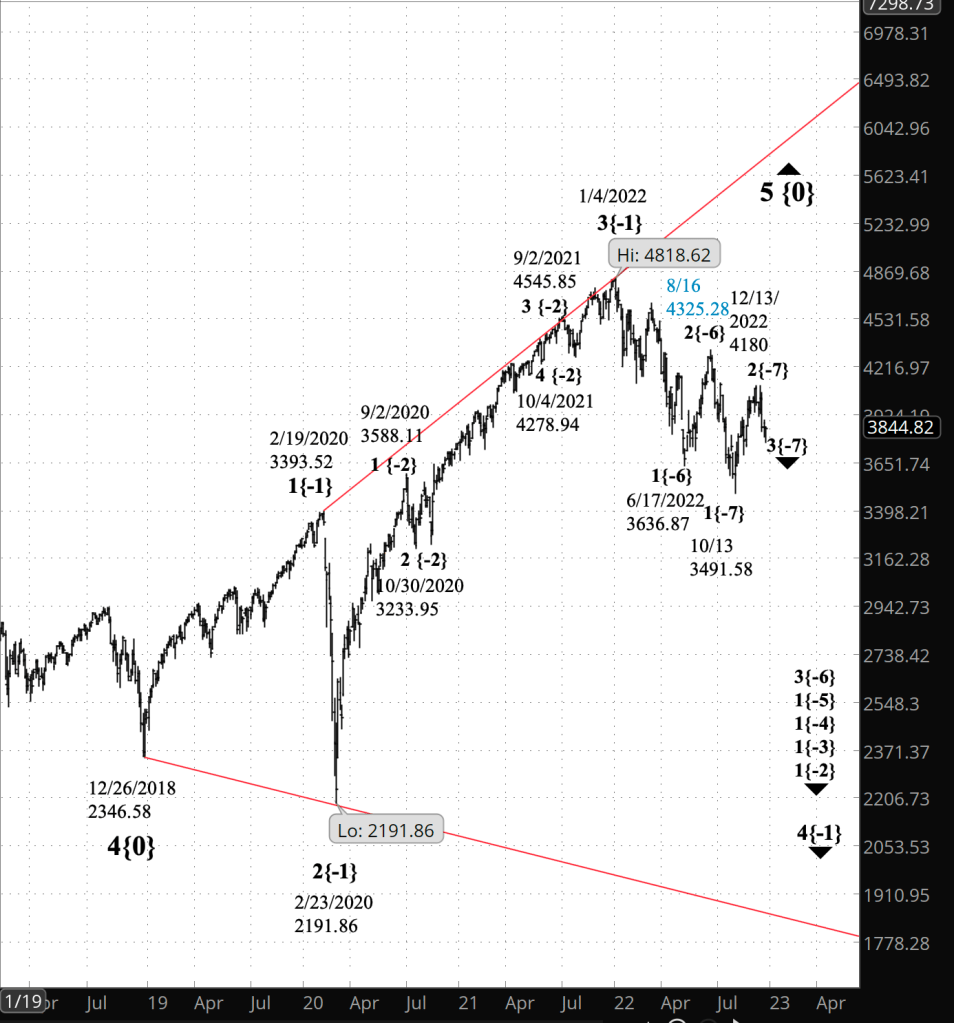
Bigger picture. Wave 3{-7} is a downtrend, and as is the case with all 3rd waves, it will be a powerful decline. That power is enhanced because wave 3{-7}’s parent wave is wave 3{-6}, which began on August 16. So we are presently seeing a triple 3rd: Three wave 3s nested within one another.

Wave 3{-6} is in turn a subwave of a series of 1st waves reaching up four degrees to wave 1{-2}, which began on January 4.

The 1st waves are subwaves of declining wave 4{-1} the next to the last wave within an expanding Diagonal Triangle, wave 5{0}, which began on December 26, 2018, from 2346.58.

The nature of an expanding Triangle is that the subsequent highs and lows are higher and lower than the extremes that came before. So I’m looking for a slow-motion roller-coaster ride as wave 4{-1} sinks to a new low within the Triangle and then wave 5{-1} rises to a new high.

The boundaries of the Diagonal Triangle are shown in red on the chart below.

[S&P 500 index at 9:25 a.m., 3-day bars]

We Are Here.

These are the waves currently in progress under my principal analysis. Each line on the list shows the wave number, with the subscript in curly brackets, the traditional degree name, the starting date, the starting price of the S&P 500 E-mini futures, and the direction of the wave.

  • S&P 500 Index:
  • 5{+3} Supercycle, 7/8/1932, 4.40 (up)
  • 5{+2} Cycle, 12/9/1974, 60.96 (up)
  • 5{+1} Primary, 3/6/2009, 666.79 (up)
  • 5{0} Intermediate, 12/26/2018, 2346.58 (up)
  • 4{-1} Minor, 1/4/2022 4818.62 (down)
  • 1{-2} Minute, 1/4/2022 4818.62 (down)
  • S&P 500 Futures and index:
  • 1{-3} Minuette, 1/4/2022, 4808.25 (down) (futures), 4818.62 (down) (index)
  • S&P 500 Futures:
  • 1{-4} Subminuette, 1/4/2022, 4808.25 (down)
  • 1{-5} Micro, 1/4/2022, 4808.25 (down)
  • 3{-6} Submicro, 8/16/2022, 4327.50 (down)
  • 3{-7} Minuscule, 12/1/2022, 4110 (down)
  • 1{-8} Subminuscule, 12/1/2022, 4110 (down)

Learning and other resources. Elliott wave analysis provides context, not prophecy. As the 20th century semanticist Alfred Korzybski put it in his book Science and Sanity (1933), “The map is not the territory … The only usefulness of a map depends on similarity of structure between the empirical world and the map.” And I would add, in the ever-changing markets, we can judge that similarity of structure only after the fact.

See the menu page Analytical Methods for a rundown on where to go for information on Elliott wave analysis.

By Tim Bovee, Portland, Oregon, December 27, 2022

Disclaimer

Tim Bovee, Private Trader tracks the analysis and trades of a private trader for his own accounts. Nothing in this blog constitutes a recommendation to buy or sell stocks, options or any other financial instrument. The only purpose of this blog is to provide education and entertainment.

No trader is ever 100 percent successful in his or her trades. Trading in the stock and option markets is risky and uncertain. Each trader must make trading decisions for his or her own account, and take responsibility for the consequences.

License
Creative Commons License

All content on Tim Bovee, Private Trader by Timothy K. Bovee is licensed under a Creative Commons Attribution-ShareAlike 4.0 International License.

Based on a work at www.timbovee.com.
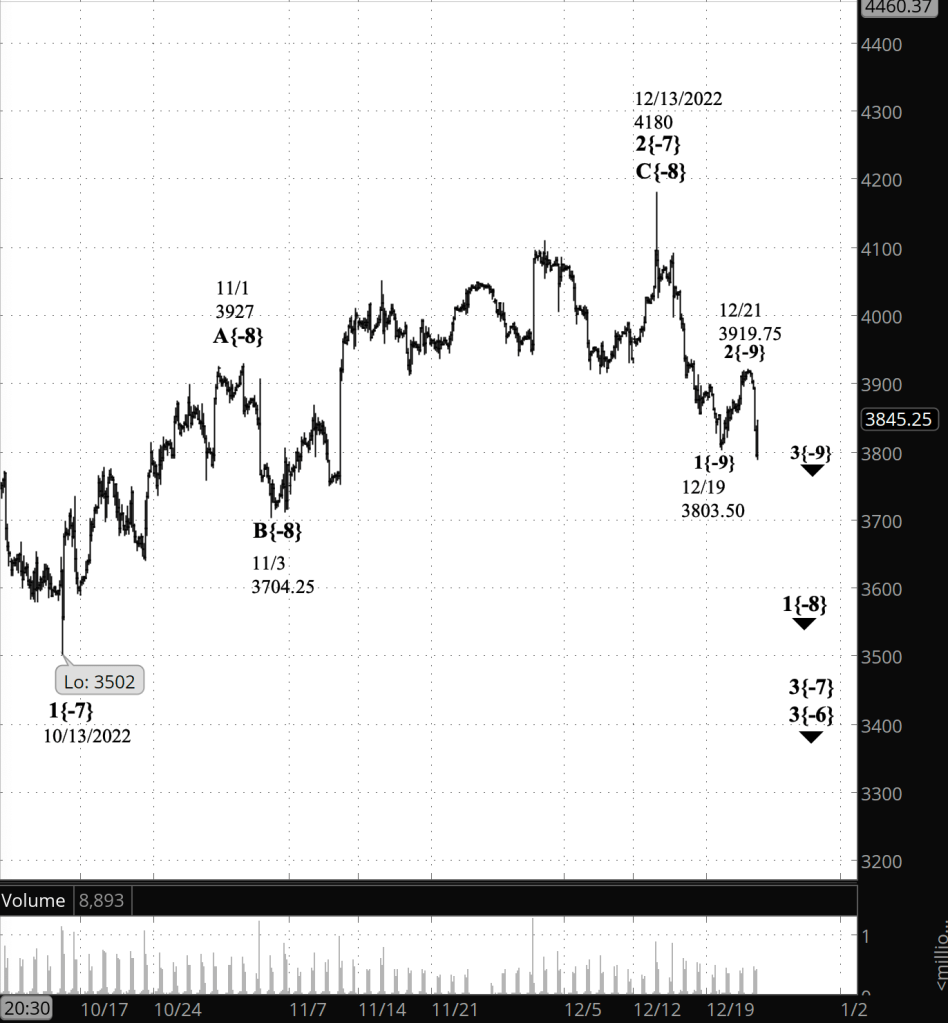
Trader’s Notebook

Holiday trading. The Christmas holiday falls on a weekend this year, on this coming Sunday, and U.S.markets, like many others around the world, will be closed on Monday in observance. The U.S. futures markets will open at 6 p.m. New York time on Monday.

3:30 p.m. New York time

Half an hour before the closing bell. The S&P 500 has risen during the session, from a low of 3821.25 on the futures shortly after the opening bell to a high so far of 3872.50 as the closing bell approached. The analysis remains unchanged. A downtrend, wave 3{-7}, is underway and is in its first leg, wave 1{-8}, which internally is in a smaller downtrend, wave 3{-9}, that began on December 21. I’ve updated the chart.

9:35 a.m. New York time

What’s happening now? The S&P 500 E-mini futures rose in overnight trading, remaining below the most recent downward reversal point, 3919.75.

What does it mean? The downtrend that began on December 21 continues. It is part of a larger downtrend that began on December 13.

What are the alternatives? There are several points of ambiguity that will be resolved over the next days and weeks.

  • Alternative #1: It’s possible that the smaller /upward correction that began on December 19 is still underway and is taking the form of a Triangle.
  • Alternative #2: The larger upward correction that began on October 13 is is still underway and is in its final segment.
  • Alternative #3: The upward correction that began on October 13 is still underway and is taking the from of a compound correction, containing two or three corrective patterns. The first corrective pattern ended on December 13, and the decline that followed will link the first corrective pattern to the second one.

Alternatives #2 and #3 are increasingly unlikely. Nonetheless, they can’t be ruled out entirely.

[S&P 500 E-mini futures at 3:30 p.m., 150-minute bars, with volume]

What does Elliott wave theory say? Here’s a description of the wave structure that is currently in play.

Under the principal analysis,

  • A downward correction, wave 3{-7}, began on December 13 and is still underway.
  • Wave 3{-7} is in its first subwave, wave 3{-8}.
  • Wave 3{-8}, in turn, has completed an small upward correction, wave 2{-9} and now is downtrending again in wave 3{-9}.

Under the alternative analyses,

  • Alternative #1: Wave 2{-9} is still underway and is taking the form of a Triangle, which will have five waves internally.
  • Alternative #2: Wave 2{-7} is still underway and is its final subwave, wave C{-8}.
  • Alternative #3: Wave 2{-7}, a compound correction, has completed wave C{-8}, the final wave of its first corrective pattern. The decline from December 13 is wave X{-8}, connecting the completed wave C{-8} to the first wave, A{-8}, of its second corrective pattern.

We Are Here.

These are the waves currently in progress under my principal analysis. Each line on the list shows the wave number, with the subscript in curly brackets, the traditional degree name, the starting date, the starting price of the S&P 500 E-mini futures, and the direction of the wave.

  • S&P 500 Index:
  • 5{+3} Supercycle, 7/8/1932, 4.40 (up)
  • 5{+2} Cycle, 12/9/1974, 60.96 (up)
  • 5{+1} Primary, 3/6/2009, 666.79 (up)
  • 5{0} Intermediate, 12/26/2018, 2346.58 (up)
  • 4{-1} Minor, 1/4/2022 4818.62 (down)
  • 1{-2} Minute, 1/4/2022 4818.62 (down)
  • S&P 500 Futures and index:
  • 1{-3} Minuette, 1/4/2022, 4808.25 (down) (futures), 4818.62 (down) (index)
  • S&P 500 Futures:
  • 1{-4} Subminuette, 1/4/2022, 4808.25 (down)
  • 1{-5} Micro, 1/4/2022, 4808.25 (down)
  • 3{-6} Submicro, 8/16/2022, 4327.50 (down)
  • 3{-7} Minuscule, 12/1/2022, 4110 (down)
  • 1{-8} Subminuscule, 12/1/2022, 4110 (down)

Learning and other resources. Elliott wave analysis provides context, not prophecy. As the 20th century semanticist Alfred Korzybski put it in his book Science and Sanity (1933), “The map is not the territory … The only usefulness of a map depends on similarity of structure between the empirical world and the map.” And I would add, in the ever-changing markets, we can judge that similarity of structure only after the fact.

See the menu page Analytical Methods for a rundown on where to go for information on Elliott wave analysis.

By Tim Bovee, Portland, Oregon, December 23, 2022

Disclaimer

Tim Bovee, Private Trader tracks the analysis and trades of a private trader for his own accounts. Nothing in this blog constitutes a recommendation to buy or sell stocks, options or any other financial instrument. The only purpose of this blog is to provide education and entertainment.

No trader is ever 100 percent successful in his or her trades. Trading in the stock and option markets is risky and uncertain. Each trader must make trading decisions for his or her own account, and take responsibility for the consequences.

License
Creative Commons License

All content on Tim Bovee, Private Trader by Timothy K. Bovee is licensed under a Creative Commons Attribution-ShareAlike 4.0 International License.

Based on a work at www.timbovee.com.

Trader’s Notebook

3:30 p.m. New York time

Half an hour before the closing bill. The S&P 500 fell during the session, reaching into the 3780s on the futures. The low for the session was below the starting point of a small upward correction that began December 19 from 3803.50 and ended December 21 at 3919.75.

The upward correction was wave 2{-9}, within the first wave, 1{-8}, of a larger downtrend, wave 3{-7}.

Under the rules of Elliott wave analysis, a 2nd wave never moves below its own starting point, as the price did during the session. Therefore, the most likely analysis is that wave 2{-9} ended at the peak from which the present decline began.

Wave 3{-9}, like all 3rd waves, can be expected to show exceptional energy appropriate for its size. The preceding 1st wave, waver 1{-9}, covered 376.5 points on the futures chart. The 3rd wave is almost always longer than the preceding 1st wave. So at a minimum, I expect wave 3{-9} to fall to the 3540s, and probably far lower.

Second waves usually take the form of a Zigzag, with five subwaves within the first segment of the three wave correction. Those five subwaves aren’t clearly visible, leaving room for an alternative analysis: Wave 2{-9} is still underway and is taking the form of a Triangle, with the present decline being the second subwave of the pattern. Triangles have five subwaves.

I’ve updated the chart.

9:35 a.m. New York time

What’s happening now? The S&P 500 E-mini futures rose overnight, carrying the price to 3919.75 in a rise that began on December 19 from 3803.50.

What does it mean? The rise is the first leg of a low-level upward correction within a downtrend that began on December 13. When the correction complete, it will be followed by a resumption of the downtrend.

What are the alternatives? The two that have been with us since the December 13 start of the downtrend:

Alternative #1: The final leg of the upward correction that began on October 13 is still underway. A decline below 3704.25, the beginning of that final leg, would invalidate this alternative.

Alternative #2: The upward correction is taking a compound form, with two or three corrective patterns within it. The December 13 high ended the first corrective pattern, and the decline that followed is a segment connecting the first, completed, corrective pattern with the future second corrective pattern.

A rise above 4180, the December 13 starting point of the downtrend, would validate either of the alternatives.

Chart notes. The chart shows the upward correction that began on October 13, which is complete, and the downtrend that followed, beginning on December, 13, which is still in its early stage.

The downtrend is what the developer of Elliott wave analysis in the 1930s, R.N. Elliott, called an “impulse wave”. Such waves contain five subwaves — three in the direction of the trend and two counter-trend corrections.

Elliott found that the directional movements of equity prices, which he called “waves”, all take the same forms and follow the same rules, be the waves big or small. And the wave structures are nested — waves within waves. So a larger downtrend can contain a complete smaller downtrend and can itself be a subwave of a still larger downtrend.

That nesting is clearly visible on the chart today.

The waves within a trend are numbered (within a correction, they’re lettered). And I use subscripts in curly brackets to label where in the complex nested structure a wave stands, which Elliott called a wave’s “degree”.. The smaller the subscript, the lower the degree.

[S&P 500 E-mini futures at 3:30 p.m., 150-minute bars, with volume]

What does Elliott wave theory say? Waves within waves.

The wave structure of the principal analysis looks like this:

  • The downtrend that began on December 13 is wave 3{-7} within a larger downtrend, wave 3{-6}, which began on August 16.
  • The decline since December 13 is wave 1{-8}, the ongoing first subwave within wave 3{-7}.
  • Wave 1{-8} completed its first wave internally on December 19. Wave 1{-8} contains a complete downtrend: wave 1{-9}.
  • Within wave {1-8}, the second subwave, an upward correction labeled wave 2{-9}, began on December 19.

The alternatives both see wave 2{-7}, the larger upward correction that preceded the downtrend, as still being underway.

Alternative #1:

  • The decline since December 13 is a wave within the wave C{-8}, the third and probably final wave of the larger upward correction, wave 2{-7}.

Alternative #2:

  • The December 13 high completed the final subwave, C{-8}, of the first corrective pattern within wave 2{-7}, which is taking a compound form contain two or three corrective patterns.
  • The decline since December 13 is wave X{-8}, connecting wave C{-8} within the now complete wave C{-8} within the now complete first corrective pattern with future wave A{-8}, the first wave of a second corrective pattern that has not yet begun.

We Are Here.

These are the waves currently in progress under my principal analysis. Each line on the list shows the wave number, with the subscript in curly brackets, the traditional degree name, the starting date, the starting price of the S&P 500 E-mini futures, and the direction of the wave.

  • S&P 500 Index:
  • 5{+3} Supercycle, 7/8/1932, 4.40 (up)
  • 5{+2} Cycle, 12/9/1974, 60.96 (up)
  • 5{+1} Primary, 3/6/2009, 666.79 (up)
  • 5{0} Intermediate, 12/26/2018, 2346.58 (up)
  • 4{-1} Minor, 1/4/2022 4818.62 (down)
  • 1{-2} Minute, 1/4/2022 4818.62 (down)
  • S&P 500 Futures and index:
  • 1{-3} Minuette, 1/4/2022, 4808.25 (down) (futures), 4818.62 (down) (index)
  • S&P 500 Futures:
  • 1{-4} Subminuette, 1/4/2022, 4808.25 (down)
  • 1{-5} Micro, 1/4/2022, 4808.25 (down)
  • 3{-6} Submicro, 8/16/2022, 4327.50 (down)
  • 3{-7} Minuscule, 12/1/2022, 4110 (down)
  • 1{-8} Subminuscule, 12/1/2022, 4110 (down)

Learning and other resources. Elliott wave analysis provides context, not prophecy. As the 20th century semanticist Alfred Korzybski put it in his book Science and Sanity (1933), “The map is not the territory … The only usefulness of a map depends on similarity of structure between the empirical world and the map.” And I would add, in the ever-changing markets, we can judge that similarity of structure only after the fact.

See the menu page Analytical Methods for a rundown on where to go for information on Elliott wave analysis.

By Tim Bovee, Portland, Oregon, December 22, 2022

Disclaimer

Tim Bovee, Private Trader tracks the analysis and trades of a private trader for his own accounts. Nothing in this blog constitutes a recommendation to buy or sell stocks, options or any other financial instrument. The only purpose of this blog is to provide education and entertainment.

No trader is ever 100 percent successful in his or her trades. Trading in the stock and option markets is risky and uncertain. Each trader must make trading decisions for his or her own account, and take responsibility for the consequences.

License
Creative Commons License

All content on Tim Bovee, Private Trader by Timothy K. Bovee is licensed under a Creative Commons Attribution-ShareAlike 4.0 International License.

Based on a work at www.timbovee.com.
Trader’s Notebook

3:30 p.m. New York time

Half an hour before the closing bell. The S&P 500 has risen during the session, reaching a high for the day so far of 3818.75 on the futures. That level is well below the starting point of the downtrend, 4180, on December 13, and is consistent with this morning’s analysis. The downtrend, wave 2{-7}, continues and is in its first subwave, 1{-8}. I’ve updated the chart.

9:35 a.m. New York time

What’s happening now? The S&P 500 E-mini futures rose slightly in overnight trading, reaching the 3880s.

What does it mean? This is a small move that has no serious impact on the analysis. The downtrend that began on December 13 continues and is in its first leg.

What are the alternatives? The two alternatives that have been with us for a week are still possible interpretations of the chart.

Alternative #1: The final leg of the upward correction that began on October 13 is still underway. A decline below 3704.25, the beginning of that final leg, would invalidate this alternative.

Alternative #2: The upward correction is taking a compound form, with two or three corrective patterns within it. The December 13 high ended the first corrective pattern, and the decline that followed is a segment connecting the first, completed, corrective pattern with the future second corrective pattern.

Chart note. Stock prices form fractal structures when plotted on a chart. This form of analysis called each directional movement a “wave”. Larger waves contain smaller waves, which in turn contain still smaller waves, and each larger wave is a subwave of a still larger wave. And all of those waves, big and small, form the same sets of patterns and follow the same rules.

The relative position of a wave within the fractal structure is called its “degree”. On the chart I indicate the relative degree of each wave with a subscript, contained within curly brackets. The smaller the subscript number, the smaller the wave’s degree.

[S&P 500 E-mini futures at 3:30 p.m., 150-minute bars, with volume]

What does Elliott wave theory say? These are the waves I’m tracking for the principal analysis.

  • The downtrend that began on December 13 is wave 3{-7}.
  • It’s first leg is wave 1{-8}.

For both alternatives:

  • The upward correction that began on October 13 is wave 2{-7}.

For Alternative #1:

  • The final wave within wave 2{-7} is wave C{-8}, which is still underway.
  • The decline that began on December 13 is a smaller correction with wave C{-8}.

For Alternative #2:

  • Wave C{-8} ended on December 13, completing the first corrective pattern within a compound correction, wave 2{-7}.
  • The decline that followed will connect wave C{-8} with the first wave of a second corrective pattern, wave A{-8}. The connecting wave is wave X{-8}.

The principal analysis at this point is very much about scale. Waves don’t come with signs saying “Hello! My degree is {-8}”. The best an analyst can do is to compare the duration and perhaps the size of the wave being considered with past waves of similar degree. The duration won’t be identical — there’s always a lot of variation — but it’ll be in the ballpark.

So what about the waves within wave 3{-7}, the downtrend that began on December 13? On the chart we can visibly see that three waves are complete and a fourth one is underway. Are they one degree smaller than wave 3{-7}, or something smaller still?

Framing it in wave terminology, is that rising rightmost wave on the chart wave 4{-9} (or smaller) within wave 1{-8}? Or is it wave 4{-8}?

To answer that question, I turn to wave 1{-7}, which ran from August 16 to October 13. It is the first wave within wave 3{-6}, which encompasses all of the waves described above.

Wave 1{-7} took 58 days to complete its course. Within it, the first subwave, 1{-8}, ran for 21 days.

Applying those figures to the present provides some useful guidelines.

If the present decline that began on December 13 is the first subwave within the larger downtrend, then a 21-day timespan would carry it until January 3. That makes it far more likely that the four waves we see on since December 13 are subwaves within wave 1{-8}. Indeed, the of those four waves lasted less than a day, so treating those four waves as being of degree {-8} would mean that wave 1{-8} the same day it began.

Applying the same analysis to wave 3{-7} gives some idea of how long the downtrend might last. As noted above, the wave 1{-7} that began on August 16 ran for 58 days.

Now, wave 3{-7} will most likely be the largest wave within the larger downtrend, wave 3{-6}. A 3rd wave is never the shortest wave in a trend. But that’s a question of how far the wave falls, not the time it takes to get the end.

If wave 3{-7} has the same duration as wave 1{-7}, then it will run until February 9, more or less. If it lasts twice as long — not an unusual ratio between 1st and 3rd waves — then it will last until around April 8.

Now, wave 3{-7} could last much longer, or it could end faster. There’s no way to know in advance what will happen. What is clear is that the present labeling of wave degrees, which says wave 1{-8} within wave 3{-7} is still underway, is a better fit with what has happened before. It’s more consistent with the durations of comparable waves within wave 3{-6}.

We Are Here.

These are the waves currently in progress under my principal analysis. Each line on the list shows the wave number, with the subscript in curly brackets, the traditional degree name, the starting date, the starting price of the S&P 500 E-mini futures, and the direction of the wave.

  • S&P 500 Index:
  • 5{+3} Supercycle, 7/8/1932, 4.40 (up)
  • 5{+2} Cycle, 12/9/1974, 60.96 (up)
  • 5{+1} Primary, 3/6/2009, 666.79 (up)
  • 5{0} Intermediate, 12/26/2018, 2346.58 (up)
  • 4{-1} Minor, 1/4/2022 4818.62 (down)
  • 1{-2} Minute, 1/4/2022 4818.62 (down)
  • S&P 500 Futures and index:
  • 1{-3} Minuette, 1/4/2022, 4808.25 (down) (futures), 4818.62 (down) (index)
  • S&P 500 Futures:
  • 1{-4} Subminuette, 1/4/2022, 4808.25 (down)
  • 1{-5} Micro, 1/4/2022, 4808.25 (down)
  • 3{-6} Submicro, 8/16/2022, 4327.50 (down)
  • 3{-7} Minuscule, 12/1/2022, 4110 (down)
  • 1{-8} Subminuscule, 12/1/2022, 4110 (down)

Learning and other resources. Elliott wave analysis provides context, not prophecy. As the 20th century semanticist Alfred Korzybski put it in his book Science and Sanity (1933), “The map is not the territory … The only usefulness of a map depends on similarity of structure between the empirical world and the map.” And I would add, in the ever-changing markets, we can judge that similarity of structure only after the fact.

See the menu page Analytical Methods for a rundown on where to go for information on Elliott wave analysis.

By Tim Bovee, Portland, Oregon, December 21, 2022

Disclaimer

Tim Bovee, Private Trader tracks the analysis and trades of a private trader for his own accounts. Nothing in this blog constitutes a recommendation to buy or sell stocks, options or any other financial instrument. The only purpose of this blog is to provide education and entertainment.

No trader is ever 100 percent successful in his or her trades. Trading in the stock and option markets is risky and uncertain. Each trader must make trading decisions for his or her own account, and take responsibility for the consequences.

License
Creative Commons License

All content on Tim Bovee, Private Trader by Timothy K. Bovee is licensed under a Creative Commons Attribution-ShareAlike 4.0 International License.

Based on a work at www.timbovee.com.

Trader’s Notebook

3:30 p.m. New York time

Half an hour before the closing bell. The S&P 500 futures continued to work higher during the session, reaching a high of 3866.50 as the closing bell approached. No change in the analysis. I’ve updated the chart.

9:35 a.m. New York time

What’s happening now? The S&P 500 E-mini futures continued to fall after Monday’s closing bell, reaching a low of 3803.50 before reversing, rising back into the 3840s overnight.

What does it mean? A downtrend that began December 13 continues its initial fall in the first of five segments that will carry the price well below 3502, the October 13 starting point of the upward correction that came before.

What are the alternatives? There are two, both dependent on the upward correction still being underway.

  • The final segment of the upward correction is still underway. The decline from December 13 is so far shallow enough that the price remains within the range of that final segment so far. Under this scenario, the end of the correction will be followed by a significant downtrend.
  • The upward correction is still underway and is forming a compound structure, containing two or three corrective patterns. The first corrective pattern ended on December 13, and the downward movement that has followed is a connector, linking the first corrective pattern, now complete, with a second corrective pattern that has not yet begun.

Chart note. I’ve brought the chart in closer so that it encompasses the upward correction and the decline that followed, Of particular importance is the October 13 starting point of the upward correction, 3502. If the price moves below that level, then the two alternative analyses described above are no longer viable. It would serve as a confirmation that the downtrend began on December 13.

The developer of Elliott wave analysis in the 1930s, R.N. Elliott, called a directional movement a “wave”. Some non-Elliott synonyms are a “leg” or a “segment”. Waves are nested, smaller waves within larger waves, which in turn are nested within still larger waves. The structure always makes me think of the Russian Matryoshka dolls

Just as the dolls all resemble each other, whatever their relative size, so Elliott waves show the same patterns and follow the same rules, whether a wave is a decades-long behemoth or a minutes-long day-trading chart.

On the chart I follow Elliott in numbering subwaves of impulse waves, in the direction of the trend, and using letters for the subwaves of corrections, running counter the trend. I distinguish the relative size of a wave — its “degree”, in Elliott’s terminology — with a subscript contained within curly brackets.

[S&P 500 E-mini futures at 3:30 p.m., 150-minute bars, with volume]

What does Elliott wave theory say? These are the waves I’m watching closely.

The principal analysis.

  • The downtrend that began on December 13 is wave 3{-7}.
  • One degree down, wave 3{-7} is in its initial segment, wave 1{-8}.

Alternative #1.

  • Wave 2{-7} began on October 13 and is still underway.
  • The December 13 peak marked the end of a subwave within wave C{-8}, the third wave within the upward correction.

Alternative #2.

  • The December 13 peak was the end of wave C{-8}, the final wave within the first corrective pattern in wave 2{-7}, which is taking a compound form.
  • The decline from December 13 is a connector, wave X{-8}. It links completed wave C{-8}, the last wave within the first corrective pattern, with wave A{-8}, the future first wave within the second corrective pattern.

Under both alternatives, the end of the upward correction, wave 2{-7}, will be followed by a significant downtrend, wave 3{-7}.

All of this is happening within wave 3{-6}, a larger downtrend that began on August 16.

We Are Here.

These are the waves currently in progress under my principal analysis. Each line on the list shows the wave number, with the subscript in curly brackets, the traditional degree name, the starting date, the starting price of the S&P 500 E-mini futures, and the direction of the wave.

  • S&P 500 Index:
  • 5{+3} Supercycle, 7/8/1932, 4.40 (up)
  • 5{+2} Cycle, 12/9/1974, 60.96 (up)
  • 5{+1} Primary, 3/6/2009, 666.79 (up)
  • 5{0} Intermediate, 12/26/2018, 2346.58 (up)
  • 4{-1} Minor, 1/4/2022 4818.62 (down)
  • 1{-2} Minute, 1/4/2022 4818.62 (down)
  • S&P 500 Futures and index:
  • 1{-3} Minuette, 1/4/2022, 4808.25 (down) (futures), 4818.62 (down) (index)
  • S&P 500 Futures:
  • 1{-4} Subminuette, 1/4/2022, 4808.25 (down)
  • 1{-5} Micro, 1/4/2022, 4808.25 (down)
  • 3{-6} Submicro, 8/16/2022, 4327.50 (down)
  • 3{-7} Minuscule, 12/1/2022, 4110 (down)
  • 1{-8} Subminuscule, 12/1/2022, 4110 (down)

Learning and other resources. Elliott wave analysis provides context, not prophecy. As the 20th century semanticist Alfred Korzybski put it in his book Science and Sanity (1933), “The map is not the territory … The only usefulness of a map depends on similarity of structure between the empirical world and the map.” And I would add, in the ever-changing markets, we can judge that similarity of structure only after the fact.

See the menu page Analytical Methods for a rundown on where to go for information on Elliott wave analysis.

By Tim Bovee, Portland, Oregon, December 20, 2022

Disclaimer

Tim Bovee, Private Trader tracks the analysis and trades of a private trader for his own accounts. Nothing in this blog constitutes a recommendation to buy or sell stocks, options or any other financial instrument. The only purpose of this blog is to provide education and entertainment.

No trader is ever 100 percent successful in his or her trades. Trading in the stock and option markets is risky and uncertain. Each trader must make trading decisions for his or her own account, and take responsibility for the consequences.

License
Creative Commons License

All content on Tim Bovee, Private Trader by Timothy K. Bovee is licensed under a Creative Commons Attribution-ShareAlike 4.0 International License.

Based on a work at www.timbovee.com.

SPY Trade

S&P 500 ETF Trust (SPY)

Lot 2022-5

Update 12/28/2022: I exited my short bear call vertical spread on SPY, 23 days before expiration, for a $1.30 debit per contract/share, a profit before fees of $130 per contract. Shares were trading at $378.22, down $5.26 from the entry level.

The Implied Volatility Rank at exit was 21.1%, down 4.3 points from the entry level.

I exited because the position reached 50% of maximum potential profit, my normal exit point for options trades.

Shares fell by 1.4% over nine days for a 56% annual rate. The options position produced a 100% return for a 4,056% annual rate.


I have entered a short bear call vertical spread on SPY, using options that trade for the last time 32 days hence, on January 20, 2023. The premium is a $2.60 credit per contract share and the stock at the time of entry was priced at $383.48.

The Implied Volatility Ratio stood at 25.4%.

Premium:$2.60Expire OTM
SPY-bear call spreadStrikeOddsDelta
Calls
Long406.0086.0%16
Break-even398.6078.5%23.5
Short396.0071.0%31

The premium is 52% of the width of the position’s short/long spread. The profit zone covers a 3.9% move to the upside and an unlimited move to the downside.

The risk/reward ratio is 2.8:1, with maximum risk of $740 and maximum reward of $260 per contract.

How I chose the trade. I placed the trade based on Elliott wave analysis showing that S&P 500 — the index upon which SPY is based — began a downtrend on December 13.

By Tim Bovee, Portland, Oregon, December 19, 2022

Disclaimer

Tim Bovee, Private Trader tracks the analysis and trades of a private trader for his own accounts. Nothing in this blog constitutes a recommendation to buy or sell stocks, options or any other financial instrument. The only purpose of this blog is to provide education and entertainment.

No trader is ever 100 percent successful in his or her trades. Trading in the stock and option markets is risky and uncertain. Each trader must make trading decisions for his or her own account, and take responsibility for the consequences.

License
Creative Commons License

All content on Tim Bovee, Private Trader by Timothy K. Bovee is licensed under a Creative Commons Attribution-ShareAlike 4.0 International License.

Based on a work at www.timbovee.com.

Trader’s Notebook

3:30 p.m. New York time

Half an hour before the closing bell. The S&P 500 continued to fall during the session, reaching below Friday’s low, 3855.25, into the 3820s. No change in the analysis. I’ve updated the chart.

10:35 a.m. New York time

SPY bear play entry. I’ve entered a short bear call vertical spread on SPY, using options that trade for the last time on January 20 last year, and have posted a full analysis of the trade.

9:55 a.m. New York time

DRI earnings play exit. DRI beat earnings and yet the price fell, contrary to the direction of my trade. I exited my short bull put options spread after holding the position over the weekend, for a small loss. I’ve updated the trade analysis with full results.

9:35 a.m. New York time

What’s happening now? The S&P 500 E-mini futures rose slightly in overnight trading, remaining above Friday’s low, 3855.25.

What does it mean? The downtrend that began on December 13 continues and internally is in its first of five segments. The overnight rise is a small upward correction within that first segment.

What are the alternatives? There are two.

Alternative #1: The upward correction that began on October 13 from 3502 is still underway and the downtrend has not yet begun. The decline that began on December 13 is the second segment within the third and final of the upward correction. This scenario will remain a possibility as long as the wave remains above 3704.25, the starting point of the correction’s final segment, which began on November 3.

Alternative #2: The upward correction is forming a compound structure that will contain two or three corrective patterns. The first pattern, a Zigzag, ended on December 13. The decline that followed is a segment connecting the now complete first corrective pattern with a future second corrective pattern. This possibility won’t be eliminated until the price drops below 3502, the starting point of the upward correction.

Chart notes. I’ve broadened the chart to include all of the downtrend that began on August 16, the parent trend within which the principal analysis and the two alternatives are happening.

The broader view serves two purposes:

  • It makes it clear that the decline from December 13, which looks massive on a chart focused on the end of the correction and the decline followed, is really fairly small in the general scheme of things. Reading a stock chart is in part about understanding the relative proportions.
  • It provides complete understanding of the timespans that govern my trading. I’m not a day trader, but I’m also not a long-term buy and hold trader. My time horizon is less than a year, often a couple of months or, sometimes, a couple of days. This chart breadth helps me understand the context in which I trade.

[S&P 500 E-mini futures at 3:30 p.m., 345-minute bars, with volume]

What does Elliott wave theory say? Here are the waves I’m focused on.

Looking first at the principal analysis:

  • The downtrend that began on December 13 is wave 3{-7}.
  • Internally, wave 3{-7} is in its first of five segments, wave 1{-8}.
  • The overnight rise, within wave 1{-8}, is a 4th wave, possibly wave 4{-10} or even smaller.

Looking at the alternatives:

  • The upward correction, which began on October 13, is wave 2{-7}.
  • Under Alternative #1, wave C{-8} within wave 2{-7} is still underway, and the decline that began on December 13 is a correction within wave 2{-7}.
  • Under Alternative #2, the December 13 high is the end of wave C{-8}, and the decline that began on that date is wave X{-8}, connecting the last subwave of the first corrective pattern with the first subwave, A{-8}, of the second corrective pattern.

All of this is happening within wave 3{-6}, a downtrend that began on August 16 from 4327.50.

On the chart and in the discussion above, numbers are used to label trending waves and letters to label corrective waves. The waves on a stock chart are complex, with each wave containing smaller waves and in turn, each wave is the subwave of a still larger wave.

Where a wave stands within that complex structure is called its “degree”, and I’ve numbered each degree with a subscript, contained in curly brackets. I begin the wave numbering at the degree called “Intermediate” by the developer of Elliott wave analysis in the 1930s, an accountant, R.N. Elliott. The subscript for the intermediate degree is {0}. Smaller degrees get a negative subscript, and larger ones, a positive subscript.

We Are Here.

These are the waves currently in progress under my principal analysis. Each line on the list shows the wave number, with the subscript in curly brackets, the traditional degree name, the starting date, the starting price of the S&P 500 E-mini futures, and the direction of the wave.

  • S&P 500 Index:
  • 5{+3} Supercycle, 7/8/1932, 4.40 (up)
  • 5{+2} Cycle, 12/9/1974, 60.96 (up)
  • 5{+1} Primary, 3/6/2009, 666.79 (up)
  • 5{0} Intermediate, 12/26/2018, 2346.58 (up)
  • 4{-1} Minor, 1/4/2022 4818.62 (down)
  • 1{-2} Minute, 1/4/2022 4818.62 (down)
  • S&P 500 Futures and index:
  • 1{-3} Minuette, 1/4/2022, 4808.25 (down) (futures), 4818.62 (down) (index)
  • S&P 500 Futures:
  • 1{-4} Subminuette, 1/4/2022, 4808.25 (down)
  • 1{-5} Micro, 1/4/2022, 4808.25 (down)
  • 3{-6} Submicro, 8/16/2022, 4327.50 (down)
  • 3{-7} Minuscule, 12/1/2022, 4110 (down)
  • 1{-8} Subminuscule, 12/1/2022, 4110 (down)

Learning and other resources. Elliott wave analysis provides context, not prophecy. As the 20th century semanticist Alfred Korzybski put it in his book Science and Sanity (1933), “The map is not the territory … The only usefulness of a map depends on similarity of structure between the empirical world and the map.” And I would add, in the ever-changing markets, we can judge that similarity of structure only after the fact.

See the menu page Analytical Methods for a rundown on where to go for information on Elliott wave analysis.

By Tim Bovee, Portland, Oregon, December 19, 2022

Disclaimer

Tim Bovee, Private Trader tracks the analysis and trades of a private trader for his own accounts. Nothing in this blog constitutes a recommendation to buy or sell stocks, options or any other financial instrument. The only purpose of this blog is to provide education and entertainment.

No trader is ever 100 percent successful in his or her trades. Trading in the stock and option markets is risky and uncertain. Each trader must make trading decisions for his or her own account, and take responsibility for the consequences.

License
Creative Commons License

All content on Tim Bovee, Private Trader by Timothy K. Bovee is licensed under a Creative Commons Attribution-ShareAlike 4.0 International License.

Based on a work at www.timbovee.com.
Trader’s Notebook

3:30 p.m. New York time

Half an hour before the closing bell. The S&P 500 futures have continued to fall during the session, reaching a low so far of 3855.25. No change in the analysis. I’ve updated the chart.

9:35 a.m. New York time

What’s happening now? The S&P 500 E-mini futures continued to fall in overnight trading. The price is now closer to the starting point of the upward correction that began on October 13, from 3502, than it is to the correction’s December 13 peak, 4180,

What does it mean? As has been the case for much of the week, the chart presents two possible interpretations of equal likelihood.

The one I’ve chosen as the principal analysis today sees the upward correction as having ended at the December 13.peak and a significant downtrend as having begun.

What are the alternatives? … and then, there’s…

Alternative #1, which sees the upward correction as still being underway, although it is nearing its end.

So, how to choose between them?

If the price moves below 3502, where the correction began, then it’s sort of a no-brainer — the correction ended on December 13 and the downtrend began on that date.

If the price moves below 3704.25, the beginning of the final segment within the upward correction, that’s a fairly good indication that the downtrend has begun.

Everything above that level? There’s still some uncertainty.

Alternative #2: This is the outlier among possible interpretations. Sometimes corrective waves contain more than one corrective structure. Rather than three waves and it’s done, the wave will trace out a connecting wave, and then go through a second three-wave corrective pattern. And sometimes it will add in a third corrective pattern. A corrective wave with two or three corrective patterns within it is called a compound correction. The present correction is the first within a larger downtrend that began on August 16, and compound corrections are more common within the second correction within a downtrend, so it’s unlikely. Nonetheless, it’s not unheard of and so counts as a genuine alternative scenario.

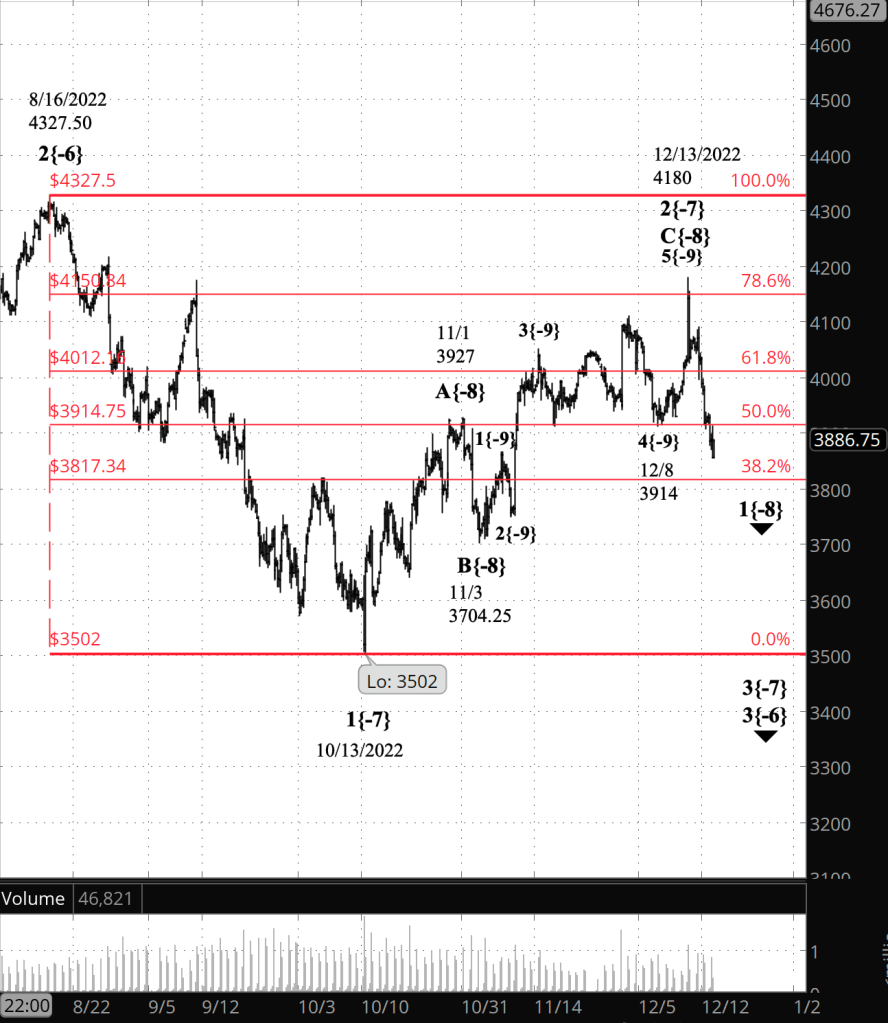
Chart note. The red structure superimposed on the chart shows levels where reversals or pauses commonly happen, based on how much of the prior trend a correction has retraced. The December 13 peak was slightly above the 78.6% retracement level, which weighs in favor of that peak being the end of the correction. The price fell back through the 61.8% retracement level without pausing, and then did it again with the 50% retracement level. For those reasons, I’m fairly confident that the downtrend has begun.

The retracement levels are based on Fibonacci numbers, a mathematical sequence. Click here for an explanation.

On the chart below, I’ve numbered waves within trending waves and used letters for subwaves within corrections. Waves are fractal in their structure. This means larger waves contain smaller waves, which in turn contain still smaller waves. And a larger waves is a subwave within a still larger wave. And all of those waves, big or small, adhere to the same set of patterns and follow the same rules.

Where a wave sits within the fractal structure of waves bigger and smaller is called its “degree”, meaning its relative size. I’ve used subscripts, in curly brackets, to show the relative degree of each wave on the chart.

[S&P 500 E-mini futures at 3:30 p.m., 4-hour bars, with volume]

What does Elliott wave theory say? Here are the waves that are important to today’s analysis.

Principal analysis:

  • The downtrend that began on December 13 is wave 3{-7}.
  • The current subwave within the downtrend is wave 1{-8}, the first of five waves. So, early days.

Alternative #1:

  • The upward correction, still underway, is wave 2{-7}.
  • The current subwave is wave C{-8}, the last of three subwaves.

Alternative #2:

  • The December 13 peak was the end of the first corrective pattern within an upward correction — waves A{-8}, B{-8} and C{-8} within wave 2[-7}.
  • The ensuing decline is wave X{-8}, which will connect the first corrective pattern with a second corrective pattern.

The principal analysis and the alternatives are happening within wave 3{-6}, a downtrend that began on August 16. That downtrend is a subwave of wave 1{-5}, a larger downtrend that began on January 4.

How far will the wave 3{-7} downtrend go? It’s anyone’s guess, really. Here’s what we know.

  • The downtrend is a 3rd wave, the middle wave, and is likely to be the most power of the five waves in the trend.
  • Wave 3{-7} will, at a minimum, move below the starting point of the correction, 3502.
  • The 3rd wave in a trend is never shorter than both the 1st wave that preceded it and the 5th wave that will follow.
  • The 1st wave — wave 1{-7} — was 825 points in length. Subtract that from the starting point of the wave 3{-7} downtrend, 4180, and we get 3355 as the likely minimum end point of wave 3{-7}. It’s likely to go much further.
  • However, as long as the future 5th is shorter than the present 3rd wave, then the structure is within the rules of Elliott wave analysis. So wave 3{-7} could be shorter than wave 1{-7}, and as long as the future wave 5{-7} is shorter still, then the analysis is valid.

How could this principal analysis be invalidated? If the price reverses and moves above the end point of wave 2{-7}, which is 4180, then the 2nd wave correction has not yet ended and the 3rd wave downtrend has not yet begun.

We Are Here.

These are the waves currently in progress under my principal analysis. Each line on the list shows the wave number, with the subscript in curly brackets, the traditional degree name, the starting date, the starting price of the S&P 500 E-mini futures, and the direction of the wave.

  • S&P 500 Index:
  • 5{+3} Supercycle, 7/8/1932, 4.40 (up)
  • 5{+2} Cycle, 12/9/1974, 60.96 (up)
  • 5{+1} Primary, 3/6/2009, 666.79 (up)
  • 5{0} Intermediate, 12/26/2018, 2346.58 (up)
  • 4{-1} Minor, 1/4/2022 4818.62 (down)
  • 1{-2} Minute, 1/4/2022 4818.62 (down)
  • S&P 500 Futures and index:
  • 1{-3} Minuette, 1/4/2022, 4808.25 (down) (futures), 4818.62 (down) (index)
  • S&P 500 Futures:
  • 1{-4} Subminuette, 1/4/2022, 4808.25 (down)
  • 1{-5} Micro, 1/4/2022, 4808.25 (down)
  • 3{-6} Submicro, 8/16/2022, 4327.50 (down)
  • 3{-7} Minuscule, 12/1/2022, 4110 (down)
  • 1{-8} Subminuscule, 12/1/2022, 4110 (down)

Learning and other resources. Elliott wave analysis provides context, not prophecy. As the 20th century semanticist Alfred Korzybski put it in his book Science and Sanity (1933), “The map is not the territory … The only usefulness of a map depends on similarity of structure between the empirical world and the map.” And I would add, in the ever-changing markets, we can judge that similarity of structure only after the fact.

See the menu page Analytical Methods for a rundown on where to go for information on Elliott wave analysis.

By Tim Bovee, Portland, Oregon, December 16, 2022

Disclaimer

Tim Bovee, Private Trader tracks the analysis and trades of a private trader for his own accounts. Nothing in this blog constitutes a recommendation to buy or sell stocks, options or any other financial instrument. The only purpose of this blog is to provide education and entertainment.

No trader is ever 100 percent successful in his or her trades. Trading in the stock and option markets is risky and uncertain. Each trader must make trading decisions for his or her own account, and take responsibility for the consequences.

License
Creative Commons License

All content on Tim Bovee, Private Trader by Timothy K. Bovee is licensed under a Creative Commons Attribution-ShareAlike 4.0 International License.

Based on a work at www.timbovee.com.