Trader’s Notebook

3:30 p.m. New York time

Half an hour before the closing bell. The S&P 500 fell a bit further early in the session, to 3580.25 on the futures, and then rose to 3649.50 before falling again, reaching below the morning’s low point. The rise was sufficiently high to be a final wave proportionate to the rest of the structure within the upward correction that began on October 5. There’s no certainly yet that the session marked the end of wave C{-11} within the upward correction, wave 4{-10}, nor is there certainty that the correction has not yet ended.

I’ve updated the chart, retaining the labeling from this morning’s analysis. The further the price falls, the more likely it is that wave 4{-10} ended today at 3649.50 and that wave 5{-10} has begun. If the price reverses without falling much further, then it becomes more likely that the session high was the peak of a subwave of an ongoing wave 4{-10}.

12:05 p.m. New York time

LVS options trade exit. I’ve exited my short bear call options spread on LVS for 100% of maximum potential loss and have updated the trade analysis with full results.

9:35 a.m. New York time

What’s happening now? The S&P 500 E-mini futures fell in overnight trading, reaching a low of 3584.25 before rising back into the 3620s.

What does it mean? The downtrend that began on October 5 continues and is now in the last leg of a small upward correction, which when complete will be followed by the final leg of the downtrend. A far larger upward correction will ensue.

What are the alternatives? The small upward correction ended on October 10 at 3667.50, and the final leg of the downtrend is now in its early stages.

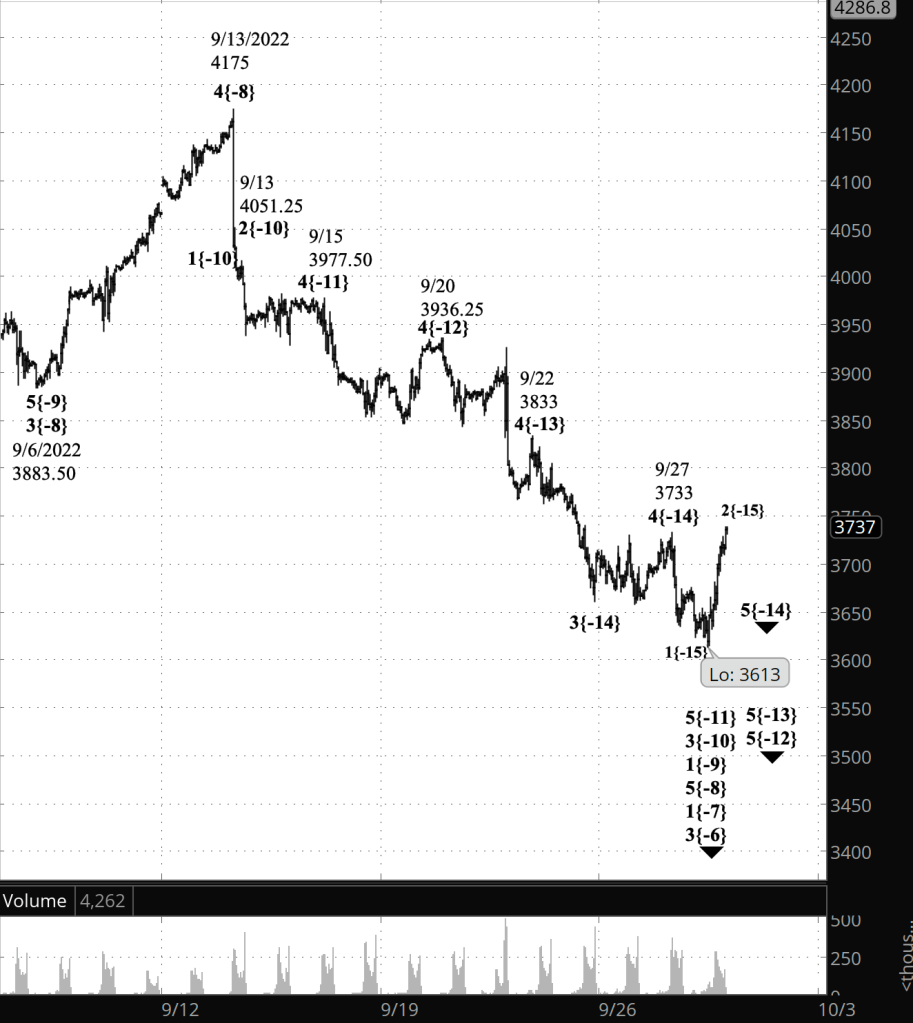
[S&P 500 E-mini futures at 9:35 a.m., 80-minute bars, with volume]

What does Elliott wave theory say? Under the principal analysis, a small upward correction, wave 4{-10} is under way and internally is in wave C{-11}, its final wave unless the correction forms a compound structure composed of two or three corrective patterns.

Under the alternative analysis, wave 4{-10} ended on October 10 and downtrending wave 5{-10} is now underway.

The price has moved below the starting point of wave 4{-10}, from 3668, not an unusual condition for a 4th wave. If wave C{-11} within wave 4{-10} is still underway, then the price will rise higher, likely reaching above 3667.50, the peak of wave A{-11}. If wave 5{-10} is underway, then the price will fall further, likely reaching or coming close to 3500, the lower boundary of the price channel (marked in red on the chart).

This is all happening within wave 5{-9}, whose end will mark the end of its parent, wave 5{-8}, and grand-parent, wave 1{-7}, which began on August 16 from 4327.50. Wave 2{-7}, an upward correction, will follow, retracing a portion of the decline from 4327.50 to the end of wave 1{-7].

Assuming that wave 1{-7} ends near the lower boundary of the price channel, around 3500, then a common 50% Fibonacci retracement in wave 2{-7} would carry the price back up to the 3910s, and an also common 61.8% retracement, up to the 4010s, levels last seen in mid-September.

We Are Here.

These are the waves currently in progress under my principal analysis. Each line on the list shows the wave number, with the subscript in curly brackets, the traditional degree name, the starting date, the starting price of the S&P 500 E-mini futures, and the direction of the wave.

  • S&P 500 Index:
  • 5{+3} Supercycle, 7/8/1932, 4.40 (up)
  • 5{+2} Cycle, 12/9/1974, 60.96 (up)
  • 5{+1} Primary, 3/6/2009, 666.79 (up)
  • 5{0} Intermediate, 12/26/2018, 2346.58 (up)
  • 4{-1} Minor, 1/4/2022 4818.62 (down)
  • 1{-2} Minute, 1/4/2022 4818.62 (down)
  • S&P 500 Futures and index:
  • 1{-3} Minuette, 1/4/2022, 4808.25 (down) (futures), 4818.62 (down) (index)
  • S&P 500 Futures:
  • 1{-4} Subminuette, 1/4/2022, 4808.25 (down)
  • 1{-5} Micro, 1/4/2022, 4808.25 (down)
  • 3{-6} Submicro, 8/16/2022, 4327.50 (down)
  • 1{-7} Minuscule, 8/16/2022, 4327.50 (down)
  • 5{-8} Subminuscule, 9/13/2022, 4175 (down)

Learning and other resources. Elliott wave analysis provides context, not prophecy. As the 20th century semanticist Alfred Korzybski put it in his book Science and Sanity (1933), “The map is not the territory … The only usefulness of a map depends on similarity of structure between the empirical world and the map.” And I would add, in the ever-changing markets, we can judge that similarity of structure only after the fact.

See the menu page Analytical Methods for a rundown on where to go for information on Elliott wave analysis.

By Tim Bovee, Portland, Oregon, October 11, 2022

Disclaimer

Tim Bovee, Private Trader tracks the analysis and trades of a private trader for his own accounts. Nothing in this blog constitutes a recommendation to buy or sell stocks, options or any other financial instrument. The only purpose of this blog is to provide education and entertainment.

No trader is ever 100 percent successful in his or her trades. Trading in the stock and option markets is risky and uncertain. Each trader must make trading decisions for his or her own account, and take responsibility for the consequences.

License
Creative Commons License

All content on Tim Bovee, Private Trader by Timothy K. Bovee is licensed under a Creative Commons Attribution-ShareAlike 4.0 International License.

Based on a work at www.timbovee.com.
Trader’s Notebook

3:30 p.m. New York time

Half an hour before the closing bell. The S&P 500 fell further during the session, to 3600 on the futures, and the rose back to the 3650s. The downtrend that began on October 5 continues and is now in its next-to-the-last leg, an upward correction that will be followed by a further decline.

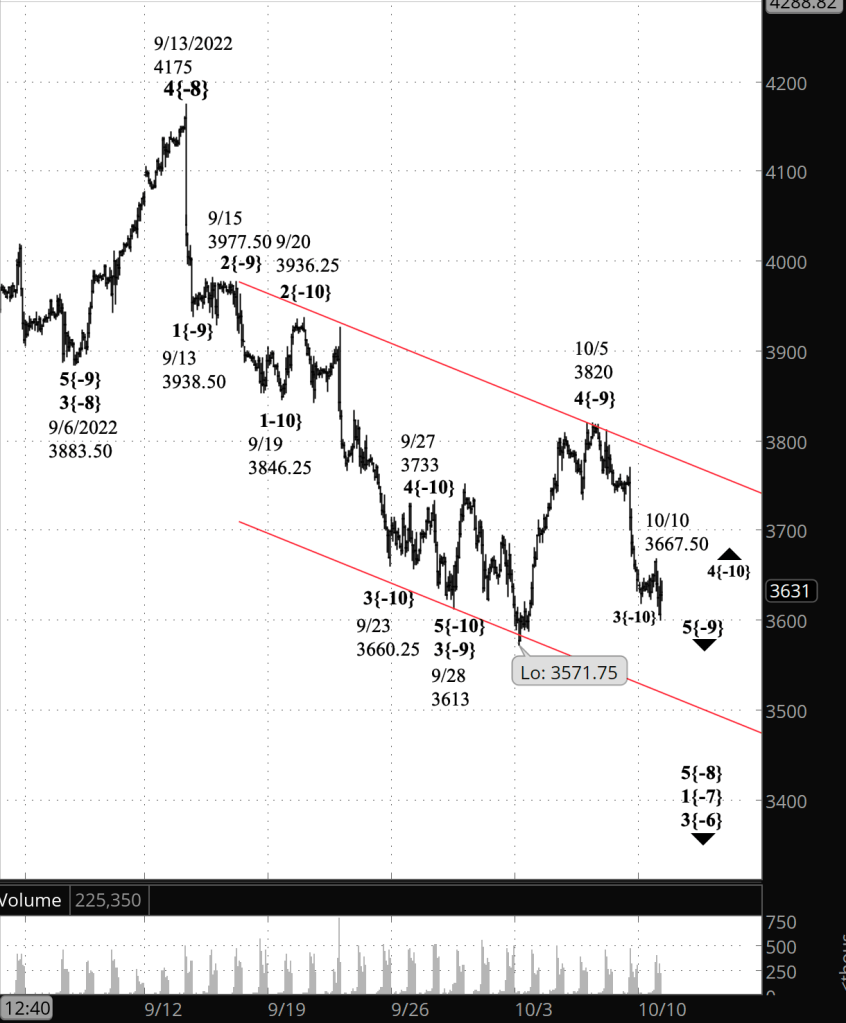
In Elliott wave terminology, downtrending wave 5{-9} is still underway and internally, is in wave 4{-10}, an upward correction. A 4th wave generally has three waves internally. I see it as being in its middle wave, B{-11}. True, the price has gone below the starting point of wave 4{-10}, but that’s not uncommon for 4th waves. By this analysis, the rise that followed the session low is either a subwave of wave B{-11}, or the start of the final wave, C{-11}.

Alternatively, if the price falls further to a noticeable extent, then wave 4{-10} ended at this morning’s high, 3667.50, and wave 5{-10}, the final wave within wave 5{-9} has begun.

I’ve updated the chart.

10:10 a.m. New York time

CORRECTION: In this morning’s post and also in Friday’s, I erroneously said that U.S. markets will be closed on Monday — today — for a holiday. The bond markets will be closed, but the stock markets are open.

9:35 a.m. New York time

What’s happening now? The S&P 500 E-mini futures gapped 22 points below Friday’s close when trading resumed Sunday night, opening at 3628.76. The price pushed a bit lower to 3618 and then reversed, rising back into the 3660s.

U.S. bond markets are closed today for a holiday, variously called Indigenous People’s Day or Columbus Day, depending upon which part of the country is doing the naming. The stock markets will be open. (This corrects an earlier post that said the stock market would be closed.)

What does it mean? The middle leg has ended within a downtrend that began on October 5 from 3820, and a small upward correction has begun. When the correction is complete, then the final leg of the downtrend will carry the price further down.

The price target, based on the price channel, shown in red on the chart, would be in the low 3500s. However, market movements don’t always stay within the price channels, so the price target is a maybe, not a certainty.

What are the alternatives? I’ve counted the upward correction as being one level down from the full downtrend. It’s possible to count it as being one level smaller, making it a correction within the middle leg of the downtrend.

I think the principal analysis is more likely because of how close the price has come to the lower boundary of the price channel. The alternative analysis gives more room for the downtrend to continue, and that would carry the price noticeably beyond the channel’s lower boundary.

[S&P 500 E-mini futures at 3:30 p.m., 80-minute bars, with volume]

What does Elliott wave theory say? The downtrend is wave 5{-9}, and the upward correction, under my principal analysis, is wave 4{-10}. Fourth waves usually have three subwaves, and the second subwave can move below the starting point of the correction –3618 in this case — without triggering a re-analysis.

Under the alternative analysis, the upward correction is wave 4{-11} within wave 3{-10}, which in turn is a subwave of wave 5{-9}.

In either case, the end of wave 5{-9} will also be the end of its parent wave, 5{-8}, which began on September 13 from 4175, and the start of an much larger upward correction, wave 2{-7}, correcting wave 1{-7}, which began on August 16 from 4327.50.

We Are Here.

These are the waves currently in progress under my principal analysis. Each line on the list shows the wave number, with the subscript in curly brackets, the traditional degree name, the starting date, the starting price of the S&P 500 E-mini futures, and the direction of the wave.

  • S&P 500 Index:
  • 5{+3} Supercycle, 7/8/1932, 4.40 (up)
  • 5{+2} Cycle, 12/9/1974, 60.96 (up)
  • 5{+1} Primary, 3/6/2009, 666.79 (up)
  • 5{0} Intermediate, 12/26/2018, 2346.58 (up)
  • 4{-1} Minor, 1/4/2022 4818.62 (down)
  • 1{-2} Minute, 1/4/2022 4818.62 (down)
  • S&P 500 Futures and index:
  • 1{-3} Minuette, 1/4/2022, 4808.25 (down) (futures), 4818.62 (down) (index)
  • S&P 500 Futures:
  • 1{-4} Subminuette, 1/4/2022, 4808.25 (down)
  • 1{-5} Micro, 1/4/2022, 4808.25 (down)
  • 3{-6} Submicro, 8/16/2022, 4327.50 (down)
  • 1{-7} Minuscule, 8/16/2022, 4327.50 (down)
  • 5{-8} Subminuscule, 9/13/2022, 4175 (down)

Learning and other resources. Elliott wave analysis provides context, not prophecy. As the 20th century semanticist Alfred Korzybski put it in his book Science and Sanity (1933), “The map is not the territory … The only usefulness of a map depends on similarity of structure between the empirical world and the map.” And I would add, in the ever-changing markets, we can judge that similarity of structure only after the fact.

See the menu page Analytical Methods for a rundown on where to go for information on Elliott wave analysis.

By Tim Bovee, Portland, Oregon, October 10, 2022

Disclaimer

Tim Bovee, Private Trader tracks the analysis and trades of a private trader for his own accounts. Nothing in this blog constitutes a recommendation to buy or sell stocks, options or any other financial instrument. The only purpose of this blog is to provide education and entertainment.

No trader is ever 100 percent successful in his or her trades. Trading in the stock and option markets is risky and uncertain. Each trader must make trading decisions for his or her own account, and take responsibility for the consequences.

License
Creative Commons License

All content on Tim Bovee, Private Trader by Timothy K. Bovee is licensed under a Creative Commons Attribution-ShareAlike 4.0 International License.

Based on a work at www.timbovee.com.

Trader’s Notebook

3:30 p.m. New York time

Half an hour before the closing bell. The S&P 500 has fallen continually during the session, reaching into the 3630s on the futures. Downtrending wave 5{-9} continues. This morning’s analysis remains unchanged. I’ve updated the chart.

2:35 p.m. New York time

Bond market holiday on Monday. U.S. bond markets will be closed on Monday for a holiday, Indigenous People’s Day or Columbus Day, depending upon the state. The stock exchanges will be open. (This corrects an earlier post that said stock markets would be closed.)

9:35 a.m. New York time

What’s happening now? The S&P 500 E-mini futures fell sharply before the opening bell, moments after a data release showing that the economy added 263,000 jobs in September.

What does it mean? The decline was sufficient to resolve the question that has dominated this analysis over the last few days: Has the upward correction that began on September 28 ended yet? And the answer is “Yes”. It ended on October 5, having reached 3820. The decline from that level had a reached a low so far of 3700.25 as the opening bell sounded.

The decline is the resumption of a larger downtrend that began on September 13 from 4175. I’ve placed a price channel on the chart showing a target of around 3500 for the present decline. As always in the ambiguous world of market charts, the price could wildly exceed that target, or it could come up short.

What are the alternatives? There are two.

Alternative #1: If the price reverses quickly and exceeds 3820, then the third leg of the upward correction is still underway and the resumption of the downtrend lies in the future.

Alternative #2: The three-wave corrective pattern that began on September 28 ended at the October 5 peak, and the upward correction is taking a compound form. The subsequent decline will connect the first corrective pattern with a second pattern that is yet to come, and even with a third pattern. After the compound correction is complete, the downtrend will resume.

[S&P 500 E-mini futures at 3:30 p.m., 75-minute bars, with volume]

What does Elliott wave theory say? Under the principal analysis, the downtrend now underway is wave 5{-9}, whose parent, wave 5{-8}, began on September 13. The preceding upward correction, wave 4{-9}, ended on October 5.

The price channel for wave 5{-8}, shown on the chart in red, connects the starting points of declining wave 3{-9} and 5{-9} as its upper boundary, with a lower boundary formed by a parallel line intersecting the end point of wave 3{-9}. Wave 5{-8} is downtrending, and so the lower boundary is a moving target for wave 5{-9}; the longer it takes the wave to reach the lower boundary, the lower that boundary has sunk.

Also, 5th waves, famously, are fickle creatures. Sometimes they hit the lower boundary precisely or nearly so, sometimes they are truncated and end before reaching the boundary, and sometimes they are extended and move far beyond the boundary.

Wave 5{-9} is the final wave within wave 5{-8} and one degree higher, within wave 1{-7}. So the end of wave 5{-9} will also be the end of waves 5{-8} and 1{-7}. Wave 2{-7}, a larger upward correction than the one ended this week, will ensue.

Second waves never move beyond the starting point of the preceding 1st wave, so the absolute cap for wave 2{-7} is 4327.50, attained on August 16. A typical retracement is one of the major Fibonacci levels, perhaps a 50% retracement, a bit shy of 4337, or a 61.8% retracement, back to 3900 or a bit higher, both assuming a low of 3500.

There are a lot of assumptions in those guesses, and they are not information that I would use for trading at this early stage. Nonetheless, they give an idea of the possible magnitude of wave 2{-7}; it wouldn’t be unusual for the price, in wave 2{-7}, to return to levels above the October 5 peak of wave 4{-9}.

Under alternative analysis #1, wave 4{-9} is still underway and the overnight decline is a subwave within wave C{-10} of the the rising correction.

Under alternative analysis #2, wave 4{-9} is taking a compound form. The first corrective pattern ended with wave C{-10} on October 5 and the subsequent decline is wave X{-10}, which will connect the first corrective pattern to a second corrective pattern.

All of this is happening within a far larger downtrend, wave 4{-1}, which began on January 4 from 4818.62 on the index.

We Are Here.

These are the waves currently in progress under my principal analysis. Each line on the list shows the wave number, with the subscript in curly brackets, the traditional degree name, the starting date, the starting price of the S&P 500 E-mini futures, and the direction of the wave.

  • S&P 500 Index:
  • 5{+3} Supercycle, 7/8/1932, 4.40 (up)
  • 5{+2} Cycle, 12/9/1974, 60.96 (up)
  • 5{+1} Primary, 3/6/2009, 666.79 (up)
  • 5{0} Intermediate, 12/26/2018, 2346.58 (up)
  • 4{-1} Minor, 1/4/2022 4818.62 (down)
  • 1{-2} Minute, 1/4/2022 4818.62 (down)
  • S&P 500 Futures and index:
  • 1{-3} Minuette, 1/4/2022, 4808.25 (down) (futures), 4818.62 (down) (index)
  • S&P 500 Futures:
  • 1{-4} Subminuette, 1/4/2022, 4808.25 (down)
  • 1{-5} Micro, 1/4/2022, 4808.25 (down)
  • 3{-6} Submicro, 8/16/2022, 4327.50 (down)
  • 1{-7} Minuscule, 8/16/2022, 4327.50 (down)
  • 5{-8} Subminuscule, 9/13/2022, 4175 (down)

Learning and other resources. Elliott wave analysis provides context, not prophecy. As the 20th century semanticist Alfred Korzybski put it in his book Science and Sanity (1933), “The map is not the territory … The only usefulness of a map depends on similarity of structure between the empirical world and the map.” And I would add, in the ever-changing markets, we can judge that similarity of structure only after the fact.

See the menu page Analytical Methods for a rundown on where to go for information on Elliott wave analysis.

By Tim Bovee, Portland, Oregon, October 7, 2022

Disclaimer

Tim Bovee, Private Trader tracks the analysis and trades of a private trader for his own accounts. Nothing in this blog constitutes a recommendation to buy or sell stocks, options or any other financial instrument. The only purpose of this blog is to provide education and entertainment.

No trader is ever 100 percent successful in his or her trades. Trading in the stock and option markets is risky and uncertain. Each trader must make trading decisions for his or her own account, and take responsibility for the consequences.

License
Creative Commons License

All content on Tim Bovee, Private Trader by Timothy K. Bovee is licensed under a Creative Commons Attribution-ShareAlike 4.0 International License.

Based on a work at www.timbovee.com.

Trader’s Notebook

3:30 p.m. New York time

Half an hour before the closing bell. The S&P 500 has remained below yesterday’s closing high during the session, rising to touch the upper price channel and then retreating to a slightly lower level than before.

The lower the price drops, the more likely this morning’s alternative #1 scenario becomes: The upward correction ended at yesterday’s high of 3820 on the futures. For now, I’m leaving the analysis unchanged from the morning’s principal scenario: The upward correction of the last few days is still underway.

I’ve updated the chart.

9:35 a.m. New York time

What’s happening now? The S&P 500 E-mini futures fell overnight from yesterdays high of 3820, and then rose again, remaining below that peak.

What does it mean? Different day, same song. The final leg of the upward correction that began on September 28 is still underway, although it is nearing completion. The subsequent decline and rise are movements of smaller scale within that final portion of the correction.

What are the alternatives? Or, equally likely — alternative #1 — the upward correction ended at yesterday’s peak, and the subsequent decline and rise are the first steps in a resumption of the downtrend that began on September 13.

Or, less likely — alternative #2 — the upward correction is taking a compound form, made up of two or three corrective patterns. The overnight decline and rise are movements within a downward movement that will connect the first corrective pattern, now complete, with a second correction pattern, which has not yet begun.

I’ve labeled the chart according to the principal analysis. The price channel, in red, has been set as though yesterday’s high was in fact the end of the correction. I think of it as a hypothetical price channel, since the real channel, which sets a lower target once the downtrend resumes, will need wait for the end of the correction.

[S&P 500 E-mini futures at 3:30 p.m., 70-minute bars, with volume]

What does Elliott wave theory say? Wave C{-10}, the final wave within wave 4{-9}, an upward correction that began on September 28 from 3613, is still underway. It set a high yesterday of 3820, and then pulled back slightly in a movement of lower degree within wave C{-10}. Wave 4{-9}, when complete, will be followed by wave 5{-9}, the final wave in a downtrend, wave 5{-8}, that began on September 13 from 4175.

A 4th wave cannot move beyond the end of the preceding 1st wave, setting an upward limit on wave 4{-9} of 3938.20, about 118 points above yesterday’s high. If the 5th wave that will follow wave 4{-9} adheres to the hypothetical price channel, which assumes that yesterday’s high was the end of the upward correction, then wave 5{-9} will come close to 3500 and will perhaps reach below it..

Under the 1st alternative analysis, wave 4{-9} ended at yesterday’s high and wave 5{-9} is underway.

Under the 2nd alternative analysis, wave 4{-9} is forming a compound correction, yesterday’s high was the end of the first corrective pattern, and the subsequent decline is wave X{-10}, connecting the first pattern with a second corrective pattern to come.

The parent wave of all of this Sturm und Drang, wave 5{-8}, is the final wave within wave 1{-7}, a downtrend that began on August 16 from 4325.28. Both the parent and the subwave will end simultaneously and wave 2{-7} will begin, an upward correction two degrees higher in size than our present concern, wave 4{-9}.

Wave 2{-7} will provide bulls some respite from the major bear trend that began on January 4 from 4818.62 on the index. That bear trend is wave 4{-1}, the penultimate wave within wave 5{0}, an expanding Diagonal Triangle that began on on December 26, 2018.

We Are Here.

These are the waves currently in progress under my principal analysis. Each line on the list shows the wave number, with the subscript in curly brackets, the traditional degree name, the starting date, the starting price of the S&P 500 E-mini futures, and the direction of the wave.

  • S&P 500 Index:
  • 5{+3} Supercycle, 7/8/1932, 4.40 (up)
  • 5{+2} Cycle, 12/9/1974, 60.96 (up)
  • 5{+1} Primary, 3/6/2009, 666.79 (up)
  • 5{0} Intermediate, 12/26/2018, 2346.58 (up)
  • 4{-1} Minor, 1/4/2022 4818.62 (down)
  • 1{-2} Minute, 1/4/2022 4818.62 (down)
  • S&P 500 Futures and index:
  • 1{-3} Minuette, 1/4/2022, 4808.25 (down) (futures), 4818.62 (down) (index)
  • S&P 500 Futures:
  • 1{-4} Subminuette, 1/4/2022, 4808.25 (down)
  • 1{-5} Micro, 1/4/2022, 4808.25 (down)
  • 3{-6} Submicro, 8/16/2022, 4325.28 (down)
  • 1{-7} Minuscule, 8/16/2022, 4325.28 (down)
  • 5{-8} Subminuscule, 9/13/2022, 4175 (down)

Learning and other resources. Elliott wave analysis provides context, not prophecy. As the 20th century semanticist Alfred Korzybski put it in his book Science and Sanity (1933), “The map is not the territory … The only usefulness of a map depends on similarity of structure between the empirical world and the map.” And I would add, in the ever-changing markets, we can judge that similarity of structure only after the fact.

See the menu page Analytical Methods for a rundown on where to go for information on Elliott wave analysis.

By Tim Bovee, Portland, Oregon, October 6, 2022

Disclaimer

Tim Bovee, Private Trader tracks the analysis and trades of a private trader for his own accounts. Nothing in this blog constitutes a recommendation to buy or sell stocks, options or any other financial instrument. The only purpose of this blog is to provide education and entertainment.

No trader is ever 100 percent successful in his or her trades. Trading in the stock and option markets is risky and uncertain. Each trader must make trading decisions for his or her own account, and take responsibility for the consequences.

License
Creative Commons License

All content on Tim Bovee, Private Trader by Timothy K. Bovee is licensed under a Creative Commons Attribution-ShareAlike 4.0 International License.

Based on a work at www.timbovee.com.

Trader’s Notebook

3:30 p.m. New York time

Half an hour before the closing bell. The S&P 500 futures declined and then rose during the session, breaking above the overnight high. The new high confirms the principal analysis from this morning: The third subwave, C{-10}, within an upward correction, wave 4{-9}, is still underway. I’ve updated the chart, leaving the upper boundary of the price channel where it was this morning, touching the overnight high, in order to illustrate the extent of the session’s breakout.

9:35 a.m. New York time

What’s happening now? The S&P 500 E-mini futures peaked at 3808.75 two minutes after yesterday’s closing bell sounded and then began an overnight decline that so far has reached the 3760s.

What does it mean? I see two choices of equal likelihood. For the principal analysis, appearing on the chart, I’ve arbitrarily chosen a scenario where the upward correction that began on September 28 has not yet reached its end, although it’s in its final stages.

What are the alternatives? There are two.

Alternative #1: Of equal likelihood with the principal analysis is a scenario that sees the 3808.75 peak as the end of the upward correction and the subsequent decline as the first tentative steps of a resumption of the downtrend that began on September 13.

Alternative #2: Also possible, although less likely, is a scenario that sees the 3808.75 peak as the end of the first corrective pattern within a compound correction that will contain two or three corrective patterns. This analysis sees the decline from the peak as the beginning of a connecting wave, which will be followed by a second corrective pattern.

If the price rises above yesterday’s peak, then the principal analysis is correct. If the price falls, then one of the alternatives is correct. The further the price falls, the more likely it is that alternative #1 matches the chart: The upward correction ended yesterday and the downtrend has resumed.

Note that the price channel on the chart assumes, for the sake of convenience, that 3808.75 was the end of the upward correction.

[S&P 500 E-mini futures at 3:30 p.m., 70-minute bars, with volume]

What does Elliott wave theory say? Under the principal analysis, the upward correction, wave 4{-9}, is still underway and is in its third and final leg, wave C{-10}.

The first alternative analysis has it that wave 4{-9} ended yesterday at 3808.75, and that price is the beginning of declining wave 5{-9}, the final wave within a larger downtrend, wave 5{-8}, that began on September 13 from 4175. This scenario matches the price channel on the chart. The channel’s upper boundary connects the starting points of waves 3 and 5, and we don’t yet know the starting point of wave 5, not as a certainty.

The second alternative sees the decline from the peak as wave X{-10}, a wave connecting the corrective pattern that ended yesterday with a future second pattern within a compound correction.

In any of the three possibilities presently on the table, wave 5{-9} will eventually begin, if it hasn’t already, and will carry the price down toward or below 3500.

But what happens next? The end of wave 5{-9} is also the end of wave 5{-8}, which began on September 13, and of its parent, wave 1{-7}, which began on August 16 from 4325.28. The fractal nature of a market chart means that any trend contains smaller trends and counter trends. Wave 1{-7} is the first wave within a larger downtrend, wave 3{-6}, which also began on August 16 from 4325.28. The wave that follows, wave 2{-7}, will be an upward correction that will take back a portion of the entire decline from 4325.38 to 3500 or wherever wave 5{-9} ends. It will be followed by downtrending wave 3{-7}, a powerful decline that will carry the price still lower, beyond the end of wave 5{-9}.

And so it goes, waves within waves, all the way the up the present set of downtrending waves to the largest of them all, wave 4{-1}, which began on January 4, 2022 from 4818.62.

Wave 4{-1} is the next-to-the-last wave within an expanding Diagonal Triangle, wave 5{0}, that began on December 26, 2018 from 2346.58 on the index. Prices will remain below wave 4{-1}’s starting point, 4818.62, until the wave is complete. Afterward, wave 5{-1} will likely carry the price to heights, above that wave 4{-1} beginning.

Until then markets will be downtrending, but with a lot of bullish opportunities in the mix as the price works its way downward. The thing to remember in interpreting the chart within wave 4{-1} is this: Waves 1, 3 and 5, bearish, and waves 2 and 4, bullish.

We Are Here.

These are the waves currently in progress under my principal analysis. Each line on the list shows the wave number, with the subscript in curly brackets, the traditional degree name, the starting date, the starting price of the S&P 500 E-mini futures, and the direction of the wave.

  • S&P 500 Index:
  • 5{+3} Supercycle, 7/8/1932, 4.40 (up)
  • 5{+2} Cycle, 12/9/1974, 60.96 (up)
  • 5{+1} Primary, 3/6/2009, 666.79 (up)
  • 5{0} Intermediate, 12/26/2018, 2346.58 (up)
  • 4{-1} Minor, 1/4/2022 4818.62 (down)
  • 1{-2} Minute, 1/4/2022 4818.62 (down)
  • S&P 500 Futures and index:
  • 1{-3} Minuette, 1/4/2022, 4808.25 (down) (futures), 4818.62 (down) (index)
  • S&P 500 Futures:
  • 1{-4} Subminuette, 1/4/2022, 4808.25 (down)
  • 1{-5} Micro, 1/4/2022, 4808.25 (down)
  • 3{-6} Submicro, 8/16/2022, 4325.28 (down)
  • 1{-7} Minuscule, 8/16/2022, 4325.28 (down)
  • 5{-8} Subminuscule, 9/13/2022, 4175 (down)

Learning and other resources. Elliott wave analysis provides context, not prophecy. As the 20th century semanticist Alfred Korzybski put it in his book Science and Sanity (1933), “The map is not the territory … The only usefulness of a map depends on similarity of structure between the empirical world and the map.” And I would add, in the ever-changing markets, we can judge that similarity of structure only after the fact.

See the menu page Analytical Methods for a rundown on where to go for information on Elliott wave analysis.

By Tim Bovee, Portland, Oregon, October 5, 2022

Disclaimer

Tim Bovee, Private Trader tracks the analysis and trades of a private trader for his own accounts. Nothing in this blog constitutes a recommendation to buy or sell stocks, options or any other financial instrument. The only purpose of this blog is to provide education and entertainment.

No trader is ever 100 percent successful in his or her trades. Trading in the stock and option markets is risky and uncertain. Each trader must make trading decisions for his or her own account, and take responsibility for the consequences.

License
Creative Commons License

All content on Tim Bovee, Private Trader by Timothy K. Bovee is licensed under a Creative Commons Attribution-ShareAlike 4.0 International License.

Based on a work at www.timbovee.com.
Trader’s Notebook

3:30 p.m. New York time

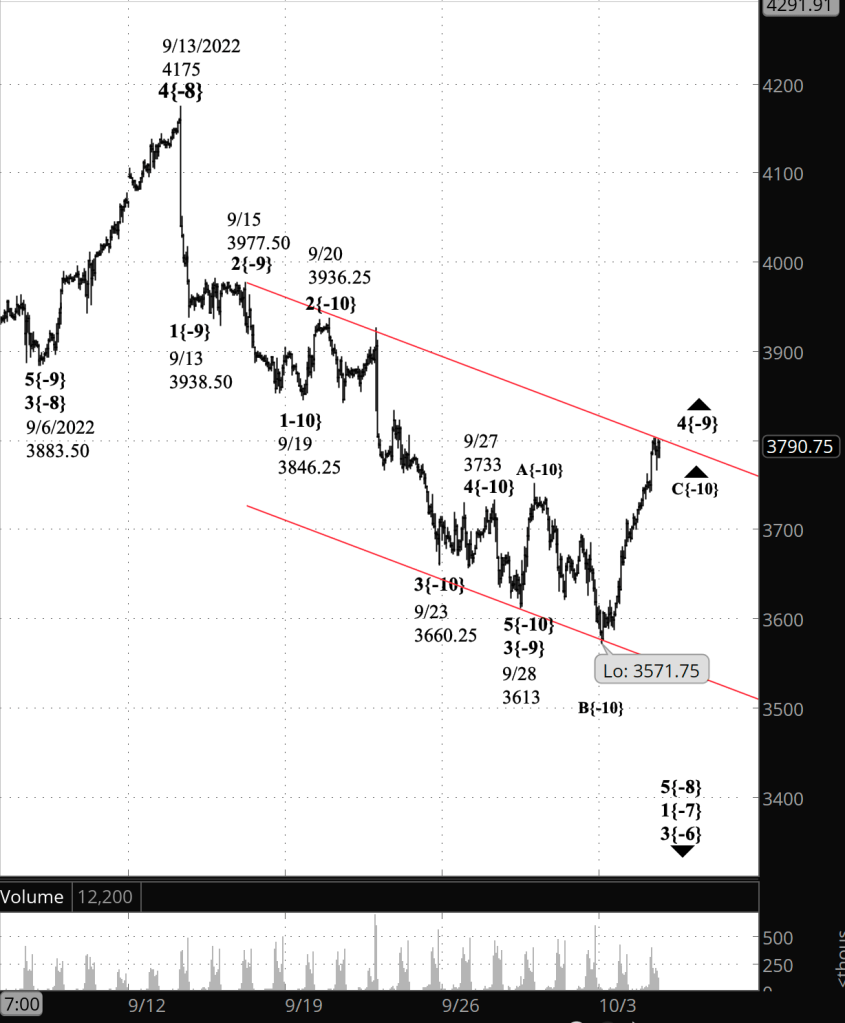
Half an hour before the closing bell. The S&P 500 continued to rise during the session, reaching just above 3800 and confirming the principal analysis from this morning.

I’ve updated the chart, including an adjustment to the price channel that places the upper boundary on today’s new high, with the understanding that this high may be just a stopping point before the price increases further.

The upper limit for a 4th wave is the end of the preceding 1st wave, which wave 1{-9), ending at 3938.50. If wave C{-10} should carry its parent, wave 4{-9}, above that level, then the analysis no longer matches the chart and will cry out for revision.

I’ve updated the chart, below.

9:35 a.m. New York time

What’s happening now? The S&P 500 E-mini futures continued to rise in overnight trading, reaching into the 3760s.

What does it mean? An upward correction that began on September 28 is still underway and is in its final leg. It has exceeded the price target that would be typical of a formation of its type, 3660.25 to 3733 in this case. The correction, when complete, will be followed by a resumption of the downtrend that began on September 13 from 4175, a move that likely will carry the price into the low 3500s and perhaps lower still.

I’ve placed a tentative price channel on the chart below, in red, that assumes the upward correction has ended at the overnight high. That’s probably not the case, but nonetheless, the channel gives some idea of how far the resumed downtrend is likely to fall.

What are the alternatives? The present task is to identify an endpoint of the the upward correction. There are several possibilities.

Alternative #1: The present high is the end of the upward correction. This scenario will be tentatively confirmed if the price reverses to the downside, the first leg of the resumed downtrend. (The price channel assumes this scenario, but the chart labeling reflects the principal analysis: The correction has further to go.)

Alternative #2: The correction takes a compound form, linking together two or three corrective patterns. This scenario will also be tentatively confirmed if the price reverses to the downside, except in this case, the decline will be a connector wave, linking the first corrective pattern with a second one to come.

The lower the price goes, the more likely alternative #1 is. A reversal upward from the low or mid-3600s suggests that alternative #2 is more likely.

[S&P 500 E-mini futures at 3:30 p.m., hourly bars, with volume]

What does Elliott wave theory say? The price channel now in place has an upper boundary linking the end of wave 2{-9} and the presumed (uncertain) end of wave 4{-9}, with a lower boundary passing through the end of wave 3{-9}.

The present upward correction, wave 4{-9}, is internally in late stage of wave C{-10}. This is a change from yesterday’s labeling, which placed the present rise as wave C{-11} within wave A{-10}, the first leg of the parent wave 4{-9}. The price channel suggested to me that raising the {-11} degree to {-10} better matched the reality on the chart.

The C wave in a three-wave correction must have five waves internally, and wave C{-10} has met that requirement.

Fourth waves tend to end within the range of the 4th wave within the preceding 3rd wave. Wave 4{-10} within wave 3{-9} ranged from 3660.25 to 3733. Wave 4{-9} has already exceeded that range, have reached a high of 3761.50.

Wave 4{-9}, when complete, will be followed by a resumption of its parent, wave 5{-8}, which began on September 13 from 4175. The price channel’s lower boundary gives an indication of how far wave 5{-9} might fall before reaching its end. Presently, the lower boundary is at 3571.75, and it moves lower every minute of every day. If the present wave 4{-9} peak is indeed the end, and if it takes wave 5{-9} four trading days to reach its completion, then the price target would be around 3500.

But 5th waves are inconsistent beasts. Sometimes they fall short of the price channel boundary, a condition called “truncation” in Elliott wave parlance, and sometimes they move far past the target, a condition called “extension”.

Under the principal analysis, wave C{-10} has not yet reached its end, and the upper boundary of the price channel will require adjustment for each new peak.

Under the first alternative, the present peak is the end of wave C{-10} and wave 5{-9} has already begun. If that’s the case, then the price channel stands as it is now.

Under the second alternative, the present peak, or a future peak, marks the end of the first corrective pattern within wave 4{-9} and willing followed by downward wave X{-10}, connecting the first pattern with a second one, in a compound correction that can take a wide variety of forms. Only after the compound correction is over will wave 5{-9} begin.

Wave 5{-8} is the smallest of a series of nested downtrending waves, reaching up seven degrees to wave 4{-1}, which began on January 4 from 4818.62 on the index.

Its parent is wave 5{0}, an expanding Diagonal Triangle that began on December 26, 2018 from 2346.58 on the index. Wave 4{-1} within wave 5{0} will be followed by wave 5{-1}, a large uptrend that will most likely carry the price to new highs, above the low 4800s. The end of wave 5{-1} will also complete wave 5{0} and a series of larger waves, up to wave 5{+3}, which began in 1932. A decades-long downward correction will follow. (See the We Are Here section below for a list of current waves from 5{-8} up to 5{+3}.)

We Are Here.

These are the waves currently in progress under my principal analysis. Each line on the list shows the wave number, with the subscript in curly brackets, the traditional degree name, the starting date, the starting price of the S&P 500 E-mini futures, and the direction of the wave.

  • S&P 500 Index:
  • 5{+3} Supercycle, 7/8/1932, 4.40 (up)
  • 5{+2} Cycle, 12/9/1974, 60.96 (up)
  • 5{+1} Primary, 3/6/2009, 666.79 (up)
  • 5{0} Intermediate, 12/26/2018, 2346.58 (up)
  • 4{-1} Minor, 1/4/2022 4818.62 (down)
  • 1{-2} Minute, 1/4/2022 4818.62 (down)
  • S&P 500 Futures and index:
  • 1{-3} Minuette, 1/4/2022, 4808.25 (down) (futures), 4818.62 (down) (index)
  • S&P 500 Futures:
  • 1{-4} Subminuette, 1/4/2022, 4808.25 (down)
  • 1{-5} Micro, 1/4/2022, 4808.25 (down)
  • 3{-6} Submicro, 8/16/2022, 4325.28 (down)
  • 1{-7} Minuscule, 8/16/2022, 4325.28 (down)
  • 5{-8} Subminuscule, 9/13/2022, 4175 (down)

Learning and other resources. Elliott wave analysis provides context, not prophecy. As the 20th century semanticist Alfred Korzybski put it in his book Science and Sanity (1933), “The map is not the territory … The only usefulness of a map depends on similarity of structure between the empirical world and the map.” And I would add, in the ever-changing markets, we can judge that similarity of structure only after the fact.

See the menu page Analytical Methods for a rundown on where to go for information on Elliott wave analysis.

By Tim Bovee, Portland, Oregon, October 4, 2022

Disclaimer

Tim Bovee, Private Trader tracks the analysis and trades of a private trader for his own accounts. Nothing in this blog constitutes a recommendation to buy or sell stocks, options or any other financial instrument. The only purpose of this blog is to provide education and entertainment.

No trader is ever 100 percent successful in his or her trades. Trading in the stock and option markets is risky and uncertain. Each trader must make trading decisions for his or her own account, and take responsibility for the consequences.

License
Creative Commons License

All content on Tim Bovee, Private Trader by Timothy K. Bovee is licensed under a Creative Commons Attribution-ShareAlike 4.0 International License.

Based on a work at www.timbovee.com.
Trader’s Notebook

3:30 p.m. New York time

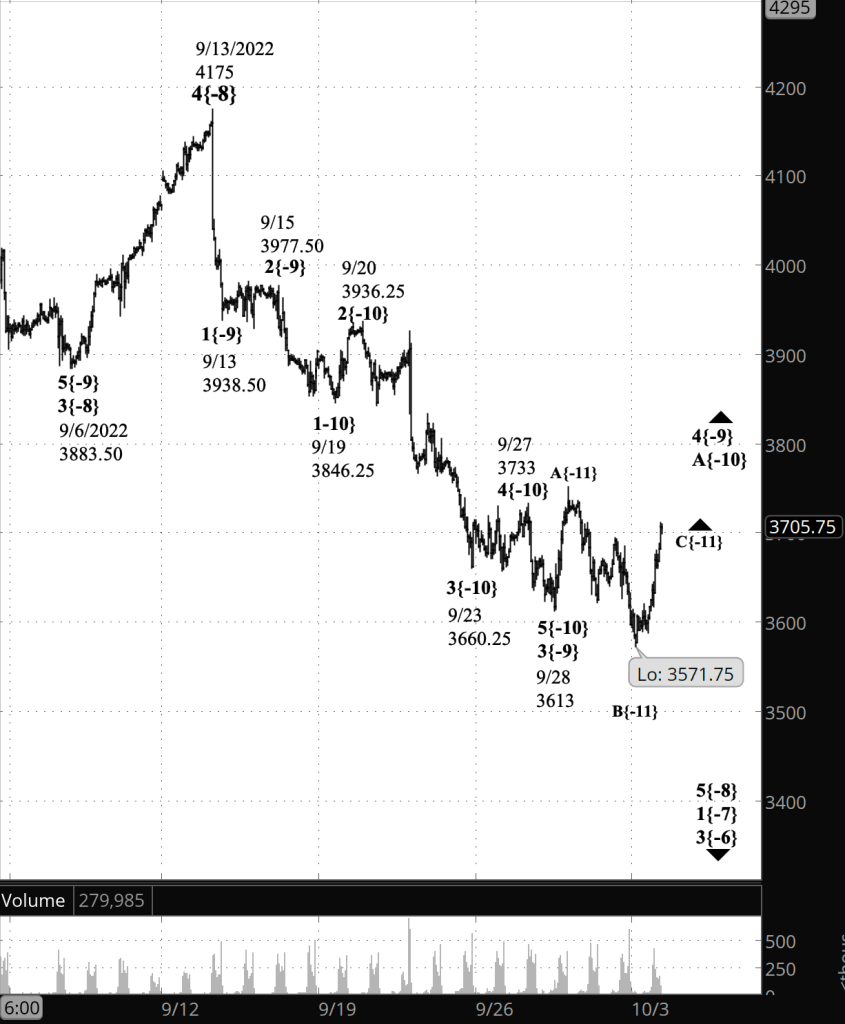
Half an hour before the closing bell. The S&P 500 continued to rise during the session, reaching into the 3710s on the futures. The upward reversal confirms this morning’s principal analysis and eliminates the alternative analysis. In Elliott wave terminology, wave C{-11} within wave A{-10} within wave 4{-9}, an upward correction, are underway. I’ve updated the chart.

9:35 a.m. New York time

What’s happening now? The S&P 500 E-mini futures fell overnight, to 3571.75, and then rose, reaching back into the 3640s.

What does it mean? The overnight low ended the second leg of an upward correction within the first leg of a larger upward correction.

What are the alternatives? If the price reverses and falls significantly lower, with five waves internally, then it means that the larger correction is in fact over and the downtrend has resumed, requiring a reanalysis of the decline from September 20.

[S&P 500 E-mini futures at 3:30 p.m., hourly bars, with volume]

What does Elliott wave theory say? Under the principal analysis, wave A{-10}, an upward correction within wave 4{-9}, has been underway since September 28. Wave A{-10} has three waves internally if the parent wave’s pattern in a Flat, or five waves if it is a Zigzag. It has completed two waves, A{-11} and B{-11}, and has begun wave C{-11}. If the pattern is a Flat, then the present wave C{-11} is the end of wave A{-10} and will be followed by a declining wave B{-10}. If the pattern is a Zigzag, then wave C{-11} will be followed by two more waves, waves D{-11} and E{-11}. After E{-11} is complete, then wave B{-11} will continue the larger wave 4{-9}.

The overnight price fell below the start of wave 4{-9}, and although such a fall below the starting point isn’t done in 2nd waves, it happens routinely in 4th waves. A short rising wave C{-11} and then a large decline would, however, trigger the alternative count: Wave 4{-9} ended on September 28, at the peak of what is now labeled wave A{-11} on the principal analysis, and wave 5{-9} has begun.

The recount would most likely put the end of wave 4{-10} at the peak of what is now wave A{-11} and label the ensuing decline as wave 5{-10}.

All of this is happening within downtrending wave 5{-8}, which began on September 13 from 4175, the low wave of a nested series of downtrending waves stretching up seven degrees, to declining wave 4{-1}, which began on January 4 from 4818.62, the next to the last wave within an expanding Diagonal Triangle, wave 5{0}, that began on December 26, 2018, from 2346.58 on the index. Wave 4{-1} will be followed by rising wave 5{-1}, which will carry the price above the January 4 start of wave 4{-1}, perhaps significantly higher.

We Are Here.

These are the waves currently in progress under my principal analysis. Each line on the list shows the wave number, with the subscript in curly brackets, the traditional degree name, the starting date, the starting price of the S&P 500 E-mini futures, and the direction of the wave.

  • S&P 500 Index:
  • 5{+3} Supercycle, 7/8/1932, 4.40 (up)
  • 5{+2} Cycle, 12/9/1974, 60.96 (up)
  • 5{+1} Primary, 3/6/2009, 666.79 (up)
  • 5{0} Intermediate, 12/26/2018, 2346.58 (up)
  • 4{-1} Minor, 1/4/2022 4818.62 (down)
  • 1{-2} Minute, 1/4/2022 4818.62 (down)
  • S&P 500 Futures and index:
  • 1{-3} Minuette, 1/4/2022, 4808.25 (down) (futures), 4818.62 (down) (index)
  • S&P 500 Futures:
  • 1{-4} Subminuette, 1/4/2022, 4808.25 (down)
  • 1{-5} Micro, 1/4/2022, 4808.25 (down)
  • 3{-6} Submicro, 8/16/2022, 4325.28 (down)
  • 1{-7} Minuscule, 8/16/2022, 4325.28 (down)
  • 5{-8} Subminuscule, 9/13/2022, 4175 (down)

Learning and other resources. Elliott wave analysis provides context, not prophecy. As the 20th century semanticist Alfred Korzybski put it in his book Science and Sanity (1933), “The map is not the territory … The only usefulness of a map depends on similarity of structure between the empirical world and the map.” And I would add, in the ever-changing markets, we can judge that similarity of structure only after the fact.

See the menu page Analytical Methods for a rundown on where to go for information on Elliott wave analysis.

By Tim Bovee, Portland, Oregon, October 3, 2022

Disclaimer

Tim Bovee, Private Trader tracks the analysis and trades of a private trader for his own accounts. Nothing in this blog constitutes a recommendation to buy or sell stocks, options or any other financial instrument. The only purpose of this blog is to provide education and entertainment.

No trader is ever 100 percent successful in his or her trades. Trading in the stock and option markets is risky and uncertain. Each trader must make trading decisions for his or her own account, and take responsibility for the consequences.

License
Creative Commons License

All content on Tim Bovee, Private Trader by Timothy K. Bovee is licensed under a Creative Commons Attribution-ShareAlike 4.0 International License.

Based on a work at www.timbovee.com.
Trader’s Notebook

3:30 p.m. New York time

Half an hour before the closing bell. The S&P 500 fell below Thursday’s low, 3660.25 on the futures. The shortness of the preceding rise and the depth of the fall suggest that wave B{-10} within an upward correction, wave 4{-9}, is still underway. This was the alternative scenario in this morning’s analysis, and I’ve changed the upper chart’s labeling to conform.

9:35 a.m. New York time

What’s happening now? The S&P 500 E-mini futures rose overnight into the 3690s and then declined back into the 3640s.

What does it mean? The first leg of an upward correction that began on September 28 is underway and appears to now be in its third internal wave.

What are the alternatives? The third internal wave seems to be overly small, and so it may well be a movement of an even smaller degree, perhaps continuing second internal wave.

[S&P 500 E-mini futures at 3:30 p.m., hourly bars, with volume]

What does Elliott wave theory say? By my principal analysis, upward wave C{-11} is underway. It is enclosed by upward wave A{-10} within an upward correction, wave 4{-9}. The alternative analysis speculates that wave C{-11} is actually part of the preceding downward wave, B{-11}, which is not yet complete.

This is all happening within a series of increasingly larger downtrending waves, nested like Russian matryoshka dolls. The waves range from 5{-8}, which began on September 13 from 4175 on the futures, up to descending wave 4{-1}, which began on January 4 from 4918.62 in the index. The entire series is contained within an expanding Diagonal Triangle, wave 5{0}, which began on December 26, 2018. Wave 4{-1} will be followed by an ascending wave, 5{-1}, that will carry the price to new highs and, when complete, will also be the endpoint of the Triangle.

This chart shows the Diagonal Triangle in its entirety so far. The red lines are the Triangle’s price-channel boundaries.

[S&P 500 index at 9:35 a.m., 3-day bars]

We Are Here.

These are the waves currently in progress under my principal analysis. Each line on the list shows the wave number, with the subscript in curly brackets, the traditional degree name, the starting date, the starting price of the S&P 500 E-mini futures, and the direction of the wave.

  • S&P 500 Index:
  • 5{+3} Supercycle, 7/8/1932, 4.40 (up)
  • 5{+2} Cycle, 12/9/1974, 60.96 (up)
  • 5{+1} Primary, 3/6/2009, 666.79 (up)
  • 5{0} Intermediate, 12/26/2018, 2346.58 (up)
  • 4{-1} Minor, 1/4/2022 4818.62 (down)
  • 1{-2} Minute, 1/4/2022 4818.62 (down)
  • S&P 500 Futures and index:
  • 1{-3} Minuette, 1/4/2022, 4808.25 (down) (futures), 4818.62 (down) (index)
  • S&P 500 Futures:
  • 1{-4} Subminuette, 1/4/2022, 4808.25 (down)
  • 1{-5} Micro, 1/4/2022, 4808.25 (down)
  • 3{-6} Submicro, 8/16/2022, 4325.28 (down)
  • 1{-7} Minuscule, 8/16/2022, 4325.28 (down)
  • 5{-8} Subminuscule, 9/13/2022, 4175 (down)

Learning and other resources. Elliott wave analysis provides context, not prophecy. As the 20th century semanticist Alfred Korzybski put it in his book Science and Sanity (1933), “The map is not the territory … The only usefulness of a map depends on similarity of structure between the empirical world and the map.” And I would add, in the ever-changing markets, we can judge that similarity of structure only after the fact.

See the menu page Analytical Methods for a rundown on where to go for information on Elliott wave analysis.

By Tim Bovee, Portland, Oregon, September 30, 2022

Disclaimer

Tim Bovee, Private Trader tracks the analysis and trades of a private trader for his own accounts. Nothing in this blog constitutes a recommendation to buy or sell stocks, options or any other financial instrument. The only purpose of this blog is to provide education and entertainment.

No trader is ever 100 percent successful in his or her trades. Trading in the stock and option markets is risky and uncertain. Each trader must make trading decisions for his or her own account, and take responsibility for the consequences.

License
Creative Commons License

All content on Tim Bovee, Private Trader by Timothy K. Bovee is licensed under a Creative Commons Attribution-ShareAlike 4.0 International License.

Based on a work at www.timbovee.com.

Trader’s Notebook

3:30 p.m. New York time

Half an hour before the closing bell. The S&P 500 fell during the day, continuing the decline from yesterday’s high, 3751.25 on the futures, into the 3620s. The second segment within the first leg of a three-leg upward correction is underway — Wave B{-11} within wave A{-10} within wave 4{-9}, which began on September 28 from 3613.

No change in the analysis. I’ve updated the chart.

9:35 a.m. New York time

What’s happening now? The S&P 500 E-mini futures declined in overnight trading, pulling back from yesterday’s session high, 3726.50.

What does it mean? The strength of yesterday’s rise forced a full re-analysis of the decline that began on September 13. Under the new analysis, an upward correction began yesterday and will retrace a portion of the decline that began on September 15. Yesterday’s rise is the initial leg of the first part of a three-part correction.

See the Elliott wave theory section below for details of the re-analysis.

What are the alternatives? It’s possible to consider yesterday’s rise to have completed the first part of the upward correction. The lack of visible internal structure within that rise persuades me that the principal analysis has the stronger case.

[S&P 500 E-mini futures at 3:30 p.m., 50-minute bars, with volume]

What does Elliott wave theory say? As I noted in yesterday’s closing post, the rapid price rise, wave 2{-15}, moved above the September 27 high, wave 1{-15}, and in doing so under the old analysis it broke a rule of Elliott wave theory: A 2nd wave can’t move above the start of the preceding 1st wave. To bring analysis back in line with the reality of the chart, I’ve done a full re-analysis.

Under the new principal analysis,

  • the September 27 high is wave 4{-10} (formerly wave 4{-14}),
  • the September 28 low is the end of wave 5{-10} and its parent, wave 3{-9} (formerly the end of wave 1{-15})
  • and the subsequent rise is wave A{-11} within wave A{-10} within wave 4{-9} (formerly wave 2{-15} within wave 4{-14}.

Under the new alternative analysis, the subsequent rise is the entirety of wave A{-10}.

The difficulty posted by the decline from September 13 is the initial wave, 1{-9}, which is 236.50 points in length, easily the longest wave within the entire decline to date. A valid count must ensure that no 3rd wave is the shortest of the three waves in the direction of a trend, wave 1, 3 and 5. To meet that requirement, the decline from September 15-19 following wave 2{-9} can’t be wave 3{-9} — it’s too short. So I’ve adopted the usual solution and pushed the wave degrees down one level, making that decline wave 1{-10} within wave 3{-9}, and following through later events with that same degree structure.

In my tinkering with the count, I was also able to avoid taking the wave degrees down to a such a small level as the prior count had required. All in all, it’s a much simpler description of the fractal structure, and brings the chart labeling back in in line with Elliott wave theory, not at all a trivial matter.

The larger picture is unchanged. Everything described above is happening within wave 5{-8}, a downtrend that began on September 13 from 4175. It lies within a series of nested waves, each larger than the wave it encloses, stretching up to wave 4{-1}, which began on January 4 from 4818.62 on the index, the next-to-the-last wave of a Diagonal Triangle, uptrending wave 5{0}, that began on December 26, 2018 from 2346.58 on the index.

We Are Here.

These are the waves currently in progress under my principal analysis. Each line on the list shows the wave number, with the subscript in curly brackets, the traditional degree name, the starting date, the starting price of the S&P 500 E-mini futures, and the direction of the wave.

  • S&P 500 Index:
  • 5{+3} Supercycle, 7/8/1932, 4.40 (up)
  • 5{+2} Cycle, 12/9/1974, 60.96 (up)
  • 5{+1} Primary, 3/6/2009, 666.79 (up)
  • 5{0} Intermediate, 12/26/2018, 2346.58 (up)
  • 4{-1} Minor, 1/4/2022 4818.62 (down)
  • 1{-2} Minute, 1/4/2022 4818.62 (down)
  • S&P 500 Futures and index:
  • 1{-3} Minuette, 1/4/2022, 4808.25 (down) (futures), 4818.62 (down) (index)
  • S&P 500 Futures:
  • 1{-4} Subminuette, 1/4/2022, 4808.25 (down)
  • 1{-5} Micro, 1/4/2022, 4808.25 (down)
  • 3{-6} Submicro, 8/16/2022, 4325.28 (down)
  • 1{-7} Minuscule, 8/16/2022, 4325.28 (down)
  • 5{-8} Subminuscule, 9/13/2022, 4175 (down)

Learning and other resources. Elliott wave analysis provides context, not prophecy. As the 20th century semanticist Alfred Korzybski put it in his book Science and Sanity (1933), “The map is not the territory … The only usefulness of a map depends on similarity of structure between the empirical world and the map.” And I would add, in the ever-changing markets, we can judge that similarity of structure only after the fact.

See the menu page Analytical Methods for a rundown on where to go for information on Elliott wave analysis.

By Tim Bovee, Portland, Oregon, September 29, 2022

Disclaimer

Tim Bovee, Private Trader tracks the analysis and trades of a private trader for his own accounts. Nothing in this blog constitutes a recommendation to buy or sell stocks, options or any other financial instrument. The only purpose of this blog is to provide education and entertainment.

No trader is ever 100 percent successful in his or her trades. Trading in the stock and option markets is risky and uncertain. Each trader must make trading decisions for his or her own account, and take responsibility for the consequences.

License
Creative Commons License

All content on Tim Bovee, Private Trader by Timothy K. Bovee is licensed under a Creative Commons Attribution-ShareAlike 4.0 International License.

Based on a work at www.timbovee.com.

Trader’s Notebook

3:30 p.m. New York time

Half an hour before the closing bell. The S&P 500 has continued to rise during the session, reaching into the 3730s on the futures. The rising wave 2{-15} has moved above the start of the preceding wave 1{-15}, from 3733, and so the structure of the parent, wave 5{-14} can’t be a Triangle, according to the rules of Elliott wave analysis. Something else is going on.

As the human foundling Valentine Michael Smith, raised by Martians in Robert Heinlein’s sci-fi classic Stranger in a Strange Land, was wont to say, “Waiting is”.

I’ve updated the chart.

9:35 a.m. New York time

What’s happening now? The S&P 500 E-mini futures declined to 3613 in overnight trading and then rose back into the 3680s.

What does it mean? The final segment of a downtrend that began on September 22 is underway and is still in its early stages. When complete, it will also end a series of larger downtrends and will be followed by an upward correction of the downtrend that began on September 13.

What is the alternative? It’s possible that the overnight low marks the end of an extremely short final segment in the downtrend that began on September 22. If that scenario plays out, then the upward correction has already begun.

[S&P 500 E-mini futures at 3:30 p.m., 45-minute bars, with volume]

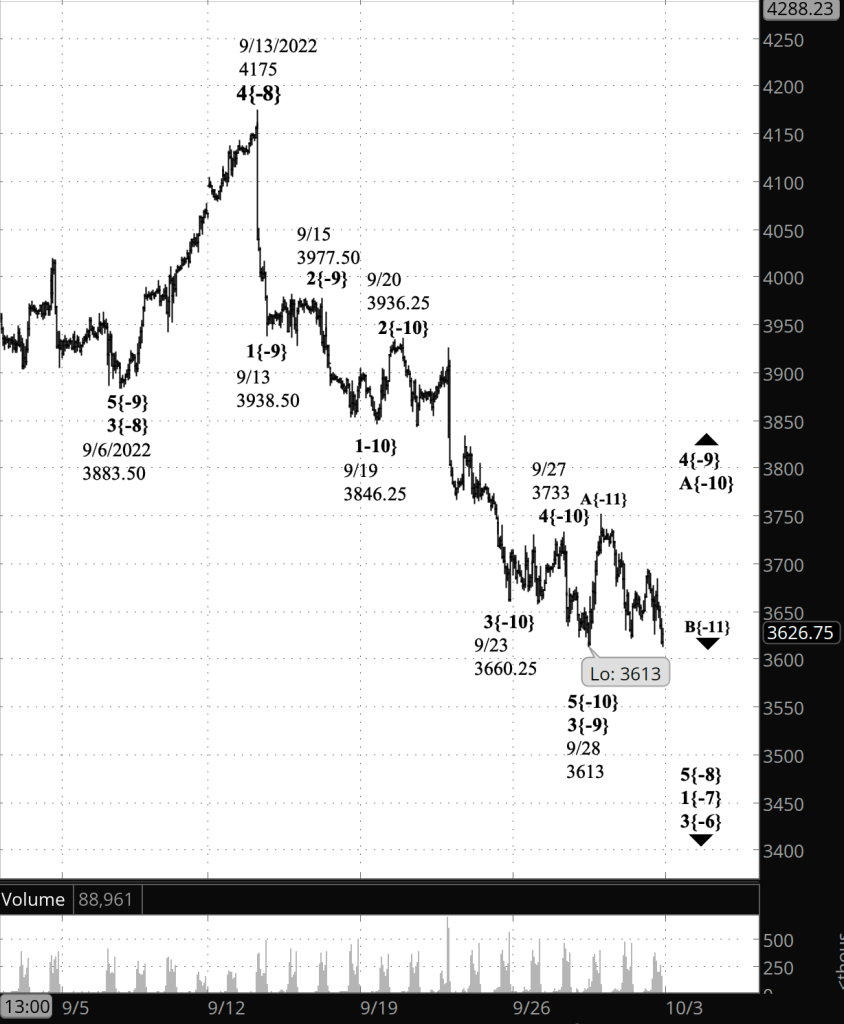
What does Elliott wave theory say? Under the principal analysis, wave 5{-13} is underway. It is the final subwave within wave wave 5{-12}, which in turn is the final subwave within wave 5{-11}, and that in turn is the final subwave within wave 3{-10}, which began on September 13. When wave 3{-10} is complete, it will be followed by an upward correction, wave 4{-10}, which will retrace a portion of the decline from 4051.25.

Under the alternative analysis, wave 5{-10} ended at the overnight low, 3613, and wave A{-11} within wave 4{-10} has begun.

There are ambiguities impacting both analyses. Wave 5{-14}’s first internal wave, wave 1{-15}, has three subwaves. That’s the form of either a downward correction, which doesn’t match the context on the chart, or of a Triangle form of some type, which does match the context. There is a blip of a wave which can bring internal count to five subwaves, but then wave 3{-15} is overly short — a 3rd wave can’t be shorter than both the 1st and 5th waves that surround it.

For the moment my best choice is to leave the internal structure of wave 5{-14} unresolved, in the certain expectation that the market will resolve all ambiguities as it progresses.

When wave 4{-10} is complete, it will be followed by downtrending wave 5{-10}, which will be the end of wave 1{-9}, which began on September 13 from 4175. All of this is occurring within a series waves within waves of increasing size, up to wave 4{-1}, which began on January 4 from 4818.62 on the index.

We Are Here.

These are the waves currently in progress under my principal analysis. Each line on the list shows the wave number, with the subscript in curly brackets, the traditional degree name, the starting date, the starting price of the S&P 500 E-mini futures, and the direction of the wave.

  • S&P 500 Index:
  • 5{+3} Supercycle, 7/8/1932, 4.40 (up)
  • 5{+2} Cycle, 12/9/1974, 60.96 (up)
  • 5{+1} Primary, 3/6/2009, 666.79 (up)
  • 5{0} Intermediate, 12/26/2018, 2346.58 (up)
  • 4{-1} Minor, 1/4/2022 4818.62 (down)
  • 1{-2} Minute, 1/4/2022 4818.62 (down)
  • S&P 500 Futures and index:
  • 1{-3} Minuette, 1/4/2022, 4808.25 (down) (futures), 4818.62 (down) (index)
  • S&P 500 Futures:
  • 1{-4} Subminuette, 1/4/2022, 4808.25 (down)
  • 1{-5} Micro, 1/4/2022, 4808.25 (down)
  • 3{-6} Submicro, 8/16/2022, 4325.28 (down)
  • 1{-7} Minuscule, 8/16/2022, 4325.28 (down)
  • 5{-8} Subminuscule, 9/13/2022, 4175 (down)
  • 1{-9} (no name), 9/13/2022, 4175 (down)
  • 3{-10} (no name), 9/13/2022, 4051.25 (down)
  • 5{-11} (no name), 9/15/2022, 3977.50 (down)

Learning and other resources. Elliott wave analysis provides context, not prophecy. As the 20th century semanticist Alfred Korzybski put it in his book Science and Sanity (1933), “The map is not the territory … The only usefulness of a map depends on similarity of structure between the empirical world and the map.” And I would add, in the ever-changing markets, we can judge that similarity of structure only after the fact.

See the menu page Analytical Methods for a rundown on where to go for information on Elliott wave analysis.

By Tim Bovee, Portland, Oregon, September 28, 2022

Disclaimer

Tim Bovee, Private Trader tracks the analysis and trades of a private trader for his own accounts. Nothing in this blog constitutes a recommendation to buy or sell stocks, options or any other financial instrument. The only purpose of this blog is to provide education and entertainment.

No trader is ever 100 percent successful in his or her trades. Trading in the stock and option markets is risky and uncertain. Each trader must make trading decisions for his or her own account, and take responsibility for the consequences.

License
Creative Commons License

All content on Tim Bovee, Private Trader by Timothy K. Bovee is licensed under a Creative Commons Attribution-ShareAlike 4.0 International License.

Based on a work at www.timbovee.com.