Update 1/25/2022: I exited my short bear call options spread on GE 52 days before expiration, for a $1.25 debit per contract/share, a profit before fees of $93 per contract. Shares were trading at $89.19, down $4.87 from the entry level.
The Implied Volatility Rank at exit was 49.3%, down 6.6 points from the entry level.
The stock fell sharply after earnings were published, and I exited at 43% of maximum potential profit, well above my 25% goal for earnings plays.
Shares declined by 5.2% over one day for a 1,890% annual rate. The options position produced a 74.4% return for a 27,156% annual rate.
I have entered a short bear all spread on GE, using options that trade for the last time 53 days hence, on March 18. The premium is a $2.18 credit per contract share and the stock at the time of entry was priced at $94.06.
The Implied Volatility Ratio stands at 55.9%
Premium:
$2.18
Expire OTM
GE-bear spread
Strike
Odds
Delta
Calls
Long
110.00
88.0%
16
Break-even
102.18
78.5%
26.5
Short
100.00
69.0%
37
The premium is 43% of the width of the positions short/long spread. The profit zone covers a 7.8% move to the upside and an unlimited move to the downside.
The risk/reward ratio is 3.6:1, with maximum risk of $782 and maximum reward of $218 per contract.
How I chose the trade. The trade was placed to coincide with GE’s earnings announcement, before the opening bell on the day after. The short strikes were set to coincide with the expected move of $4.39 either way, based on options pricing, which gives a price range of $89.54 to 98.32. I chose a bearish position because recent analyst revisions have suggested the greater possibility of a negative earnings surprise.
By Tim Bovee, Portland, Oregon, January 24, 2022
Disclaimer
Tim Bovee, Private Trader tracks the analysis and trades of a private trader for his own accounts. Nothing in this blog constitutes a recommendation to buy or sell stocks, options or any other financial instrument. The only purpose of this blog is to provide education and entertainment.
No trader is ever 100 percent successful in his or her trades. Trading in the stock and option markets is risky and uncertain. Each trader must make trading decisions for his or her own account, and take responsibility for the consequences.
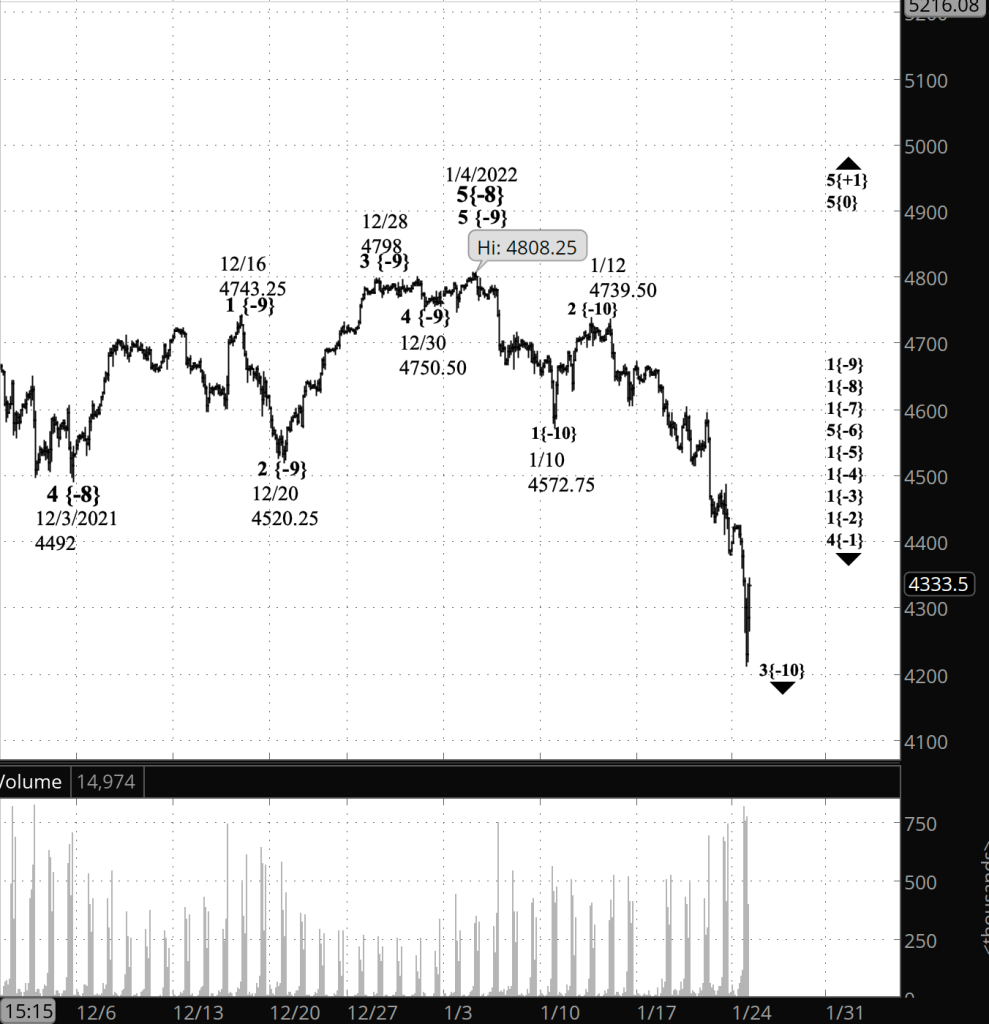
Half an hour before the closing bell. The S&P 500 fell sharply for the first three hours of the trading session, reaching a low of 4212.75 on the futures, 4222.62 on the index, and then reversed, climbing more than 120 points. The decline, wave 3{-10}, has met the requirements set forth in Elliott wave theory, and so the rise could be the first steps of wave 4{-10}. I’m leaving the chart marked as wave 3 underway, as I analyzed it this morning, and will defer declaring wave 4 to have begun until I see a bit more upside and some internal wave patterns to confirm it. I’ve updated the chart.
1:35 p.m. New York time
A note on share positions. Every share of stock that I own is underwater, and I plan to exit some of them in order to lower my losses. Based on my principal analysis of the S&P 500 chart, my plan is to wait for the 2nd wave, wave 2{-9} to carry price up toward the January 4 high and exit there. Wave wave 4{-10} should be starting its upward correction movement soon, and it it goes high enough, then I’ll exit as close as I can get to that wave’s endpoint.
1:30 p.m. New York time
GE bear call spread earnings play. I’ve entered a short bear call spread on GE timed to coincide with Tuesday’s earnings announcement before the opening bell, and have posted an analysis.
1:15 p.m. New York time
ACI short iron condor partial exit. The short put on my ACI iron condor was in-the-money the day before the stock goes ex-dividend, and that created a risk that the puts would be assigned, dumping short shares into my account. To avoid assignment, I’ve exited my ACI puts, leaving the calls in place as a short bear call spread. I’ve updated the analysis with results of the puts exit.
9:35 a.m. New York time
What’s happening now? The S&P 500 E-mini futures declined into the low 4300s in overnight trading.
What does it mean? The downtrend that began on January 4 from 4808.25 is still in its first leg and eventually has much further to fall, with the decline being interrupted, as is usual in the markets, by the occasional upward correction. The next correction might well retrace much of the decline but will remain below the January 4 high.
What’s the alternative? The decline from January 4 is an exceptionally robust downward correction within a long-running uptrend. When the correction ends, the price will reverse to the upside and eventually will reach news highs above 4808.25.
[S&P 500 E-mini futures at 3:30 p.m., 115-minute bars, with volume]
What does Elliott wave theory say? Under my principal analysis, which I consider to be by far the more likely scenario, the January 4 peak of wave 5{-8} has been followed by wave 1{-9} within wave 1{-8}. Internally, wave 1{-10} is in its 3rd wave, which reached 4311.50 before the opening bell.
Wave 1{-9} will be followed by an upward retracement, wave 2{-9}. Second waves often take back much of the previous decline and, typically, cause traders to question whether the downtrend is really underway. It’s a head-fake, and they become convinced of the downtrend only when the subsequent 3rd wave takes the prices still lower.
Under the alternative analysis, wave 5{-8} and larger 5th waves didn’t end on January 4, and the present decline is a downward correction that typically will consist of three waves.
The principal analysis will be proven wrong if the price breaks above 4808.25, the January 4 high. The alternative analysis will be proven wrong if the price remains below 4808.25 and reverses to lower lows.
Learning and other resources. Elliott wave analysis provides context, not prophecy. As the 20th century semanticist Alfred Korzybski put it this way in his book Science and Sanity (1933), “The map is not the territory … The only usefulness of a map depends on similarity of structure between the empirical world and the map.” And I would add, in the ever-changing markets, we can judge that similarity of structure only after the fact.
See the menu page Analytical Methods for a rundown on where to go for information on Elliott wave analysis.
By Tim Bovee, Portland, Oregon, January 24, 2022
Disclaimer
Tim Bovee, Private Trader tracks the analysis and trades of a private trader for his own accounts. Nothing in this blog constitutes a recommendation to buy or sell stocks, options or any other financial instrument. The only purpose of this blog is to provide education and entertainment.
No trader is ever 100 percent successful in his or her trades. Trading in the stock and option markets is risky and uncertain. Each trader must make trading decisions for his or her own account, and take responsibility for the consequences.
Update 3/16/2022: I exited my the put vertical spread within an iron condor on HAL, two days before expiration, for a $4.75 debit per contract/share, a loss before fees of $396 per contract. Shares were trading at $34.62, up $7.18 from the entry level.
The Implied Volatility Rank at exit was 66.6%, up 33.9 points from the entry level.
The call vertical spread within the iron condor is out of the money and can be expected to expire on Friday with no debit, for a profit before fees of $96 per contract share.
Assuming no debit on the calls, I expect the full iron condor to end with a $4.75 debit per contract share, a loss before fees of $300 per contract. I shall update the analysis after March 18 close with actual numbers.
I exited because the position is close to expiring and I wanted to avoid assignment, which would put shares of HAL in my account.
Assuming no debit on the calls, for the full iron condor shares rose by 26.2% over 54 days for a 177% annual rate. The options position produced a 63.2% loss for a -564% annual rate.
I have entered a short iron condor spread on HAL, using options that trade for the last time 56 days hence, on March 18. The premium is a $1.75 credit per contract share and the stock at the time of entry was priced at $27.44.
The Implied Volatility Ratio stands at 32.7%
Premium:
$1.75
Expire OTM
HAL-iron condor
Strike
Odds
Delta
Calls
Long
34.00
91.0%
14
Break-even
30.75
78.5%
28
Short
29.00
66.0%
42
Puts
Short
25.00
66.0%
27
Break-even
21.75
78.5%
16.5
Long
20.00
91.0%
6
The premium is 35% of the width of the position’s short and long spreads. The profit zone covers a 12.1% move to the upside and a 26.2 move to the downside.
The risk/reward ratio is 1.9:1, with maximum risk of $325 and maximum reward of $175 per contract.
How I chose the trade. The trade was placed to coincide with HAL’s earnings announcement, before the opening bell on January 24, after the weekend. The expected move was exceptionally narrow, at $0.36 either way, based on options pricing. So I went wider than the implied price range, $27.12 to $27.84.
By Tim Bovee, Portland, Oregon, January 21, 2022
Disclaimer
Tim Bovee, Private Trader tracks the analysis and trades of a private trader for his own accounts. Nothing in this blog constitutes a recommendation to buy or sell stocks, options or any other financial instrument. The only purpose of this blog is to provide education and entertainment.
No trader is ever 100 percent successful in his or her trades. Trading in the stock and option markets is risky and uncertain. Each trader must make trading decisions for his or her own account, and take responsibility for the consequences.
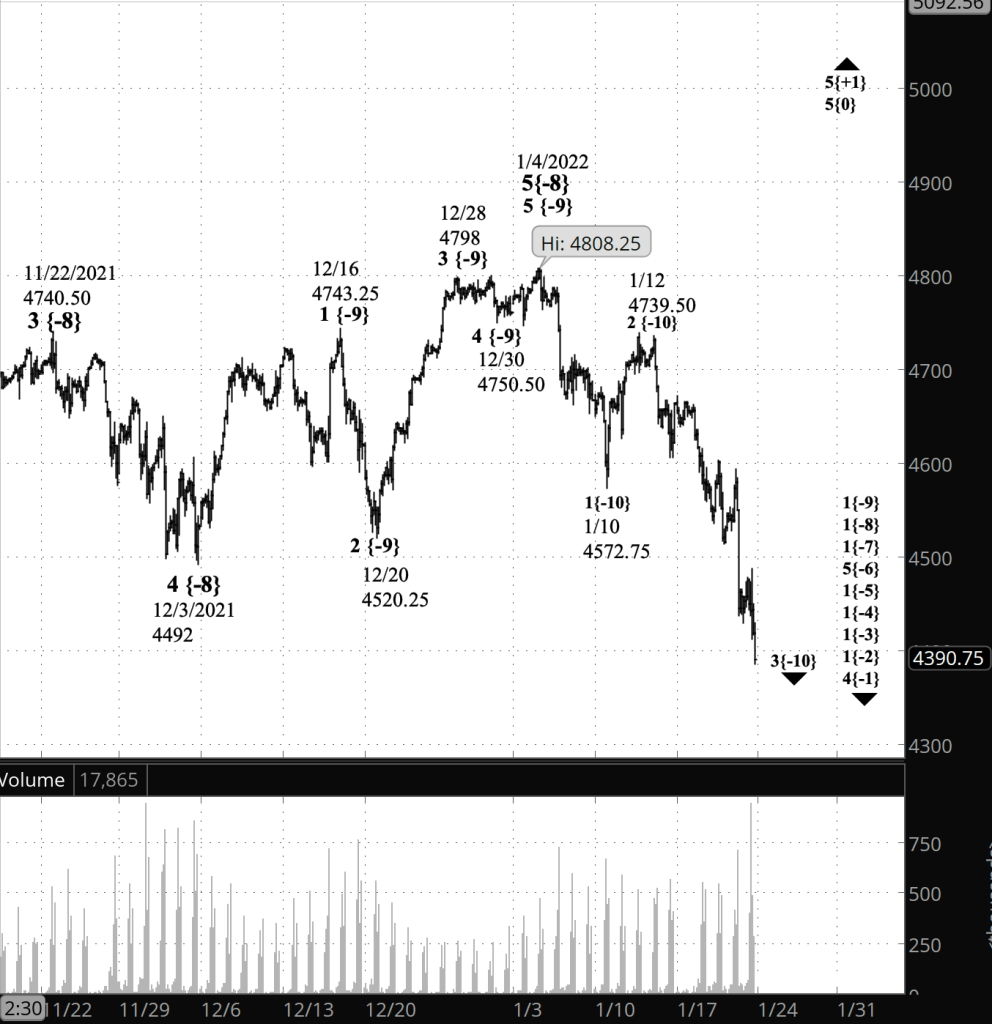
Half an hour before the closing bell. The S&P 500 continued to fall during the day, with the futures reaching the 4380s and the index, the 4390s. Downtrending wave 1{-9} continues. No change to the analysis. I’ve updated both charts.
What comes next? Wave 1{-9} is late in the 3rd or possibly 5th wave internally, meaning that the end is in site. When 1{-9} is complete, it will be followed by a 2nd wave correction that typically will retrace much of the prior 1st wave, perhaps reaching back into the 4700s. That upward correction will be followed by a powerful downtrending wave 3{-9}, which will be a strong signal to traders that the bull years may have come to an end. The ensuing wave 4{-9} will typically be a largely sideways correction, and then wave 5{-9} will decline still further, completing the parent wave 1{-8}. After that, wave 2{-9} again carries the prices upward, most likely higher than they are now, before an even more power wave 3{-8} brings things crashing down.
11:15 a.m. New York time
HAL earnings play entry. I’ve opened a short iron condor options position on HAL in anticipation of its earnings announcement on Monday before the opening bell. I’ve posted an analysis of the trade.
10:55 a.m. New York time
MU earnings play exit. I exited a short iron condor options position on MU that I entered last December in two parts. The first came near the end of December, to avoid assignment of the in-the-money calls when the stock went ex-dividend. I held on to the puts, in the form of a bull put spread, until the last trading day. The put options at the last moment gained some value, raising the certain prospect of assignment, and I exited. I’ve updated the analysis with results for the remaining bull put spread and for the iron condor as a whole.
9:35 a.m. New York time
What’s happening now? The S&P 500 E-mini futures fell to 4429.50 in overnight trading, reaching below the December 3 low of 4492.
What does it mean? The January 4 peak at 4808.25 ended an uptrend that began on September 30 from 4293.75 and a new downtrend has begun that will eventually reach 2000 and below.
What’s the alternative? The correction that began from the January 4 peak is still underway and will be followed by a rise to new heights, above 4808.25.
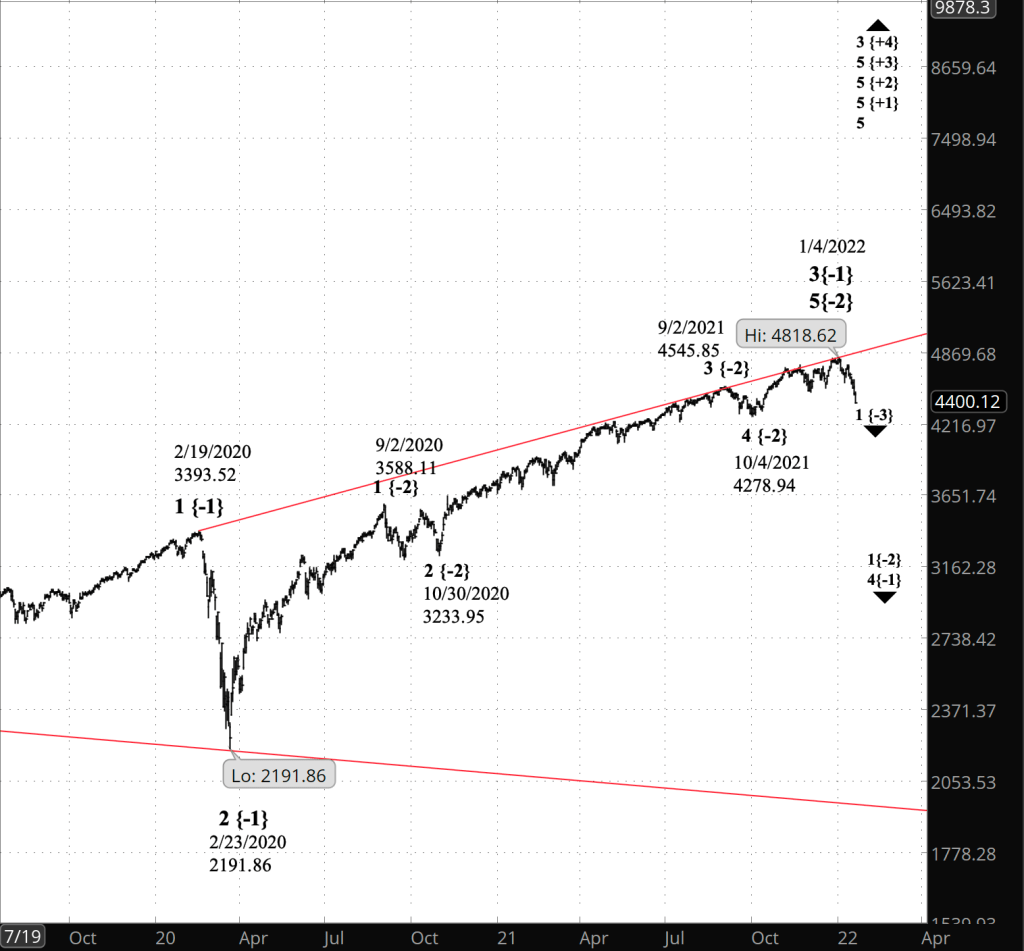
Charts. The upper chart is a near-term view of the S&P 500 futures, going back to mid-November 2021. The lower chart is a long-term view of the S&P 500 index, going back to mid-July 2019, showing the February 2020 crash early in the pandemic.
[S&P 500 E-mini futures at 3:30 p.m., 135-minute bars, with volume]
[S&P 500 index at 3:27 p.m., hourly bars]
What does Elliott wave theory say? I’ve said written on several occasions that if the price moved below 4492, the start of wave 5{-8}, then I would take that as a strong signal that a new downtrend had begun. The move below 4492 in overnight trading demanded a new downtrend the principal analysis.
The secondary analysis is where we’ve been since January 4 — a 4th wave downward correction of the {-9} degree that was in its C wave and nearing its end. This still remains as a viable options because there’s no rule in Elliott that says that a 4th wave can’t move below the beginning of the preceding 1st wave. It seems inelegant, but there you go. Sometimes the markets present an odd aesthetic.
Under my principal analysis, the January 4 peak completed 5th wave cascading up from wave 5{-8}, which began on August 19, 2021, all the way to wave 5{-2}, which began October 4, 2021. The end of wave 5{-2} in turn marks the end of its parent, wave 3{-1}, which began on February 23, 2020 at the end of the early pandemic crash.
The red lines on the long-term chart mark the boundaries of an expanding Diagonal Triangle that began in December 2018. Wave 4{-1} will eventually reach the lower boundary of the triangle, which is presently in the 1960s. Since the triangle is expanding, the lower boundary will decline further each day and so will be noticeably lower by the time the market arrives at that boundary.
It will be an epic decline, and then it will reverse in Wave 5{-1}, which will carry the price back to the every rising upper boundary. At that point, the triangle will be complete, cascading up the fractal wave structure to wave 3{+4}, which began in the late 17th century, according to Robert Prechter‘s analysis. The ensuing wave 4{+4} decline will be of a magnitude no person alive today has ever seen.
Learning and other resources. Elliott wave analysis provides context, not prophecy. As the 20th century semanticist Alfred Korzybski put it this way in his book Science and Sanity (1933), “The map is not the territory … The only usefulness of a map depends on similarity of structure between the empirical world and the map.” And I would add, in the ever-changing markets, we can judge that similarity of structure only after the fact.
See the menu page Analytical Methods for a rundown on where to go for information on Elliott wave analysis.
By Tim Bovee, Portland, Oregon, January 21, 2022
Disclaimer
Tim Bovee, Private Trader tracks the analysis and trades of a private trader for his own accounts. Nothing in this blog constitutes a recommendation to buy or sell stocks, options or any other financial instrument. The only purpose of this blog is to provide education and entertainment.
No trader is ever 100 percent successful in his or her trades. Trading in the stock and option markets is risky and uncertain. Each trader must make trading decisions for his or her own account, and take responsibility for the consequences.
Update 3/18/2022: I exited my short iron condor options spread on NFLX when it expired, for no debit per contract/share, a profit before fees of $405 per contract.
However, at expiry the in-the-money options — a vertical spread within the iron condor — were converted to shares, both long and short. My brokerage for options trading, TastyWorks (best in the business for active traders in my opinion), bought the short shares and sold the long shares for a net loss, as is normal when options expire. The loss was the maximum possible for a $10 spread between strike prices.
At the March 18 close, shares were trading at $380.60, down $136.90 from the entry level.
The Implied Volatility Rank at exit was 49.4%, down 37.1 points from the entry level.
As always when options are assigned, exercised or expire, there are three sets of results: For the options, for the shares, and a combination of the two.
The shares transactions followed the strike prices; shares were bought for $450 a share, and sold for $440 a share, for a $10 loss per shares before fees. Since an options contract is for 100 shares, the loss on the position created by expiration was $1,000.
However, when I entered the options position, I received a $4.05 premium for each contract/share, or $405 per contract. So when the options and the shares are combined, my credit was $444.50 and my debit was $450, for a $595 loss total on the 100 shares.
The earnings play fell into trouble immediately after the company announced its results. As I noted upon entry, options pricing implied a $34.36 move either way, and I chose to use an iron condor position to profit from a move in either direction within that range, and actually, I padded it, for a profit zone running from $483.14 to $561.86.When trading resumed after earnings were published, NFLX opened at $400.43, and hasn’t returned to the position’s profit zone since that time.The potential loss occasionally moved to less than the maximum potential loss from time to time, but I could never get a fill, and in the end holding the position until expiration proved to be the best way to minimize the loss.
Shares declined by 26.5% over 57 days for a -169% annual rate.
The options position produced a 100% return for a +640% annual rate.
The shares positionproduced a 2.2% loss for a -811% annual rate
The combined options and shares positions produced a -1.3% loss for a -8% annual rate.
I have entered a short iron condor spread on NFLX, using options that trade for the last time 57 days hence, on March 18. The premium is a $4.05 credit per contract share and the stock at the time of entry was priced at $517.50.
The Implied Volatility Ratio stands at 86.5%
Premium:
$4.05
Expire OTM
NFLX-iron condor
Strike
Odds
Delta
Calls
Long
575.00
78.0%
27
Break-even
569.05
76.0%
29
Short
565.00
74.0%
31
Puts
Short
450.00
78.0%
18
Break-even
444.05
79.5%
16.5
Long
440.00
81.0%
15
The premium is 40.5% of the width of the positions short/long spreads. The profit zone covers a 10% move to the upside and a 16.5% move to downside. I skewed the position in order to give greater protection to a downside move.
The risk/reward ratio is 1.5:1, with maximum risk of $595 and maximum reward of $405 per contract.
How I chose the trade. The trade was placed to coincide with NFLX’s earnings announcement, after the closing bell on the day of entry. The short strikes were set beyond the expected move of $34.36 either way, based on options pricing, which would give a price range of $483.14 to $561.86. NFLX has a history of breaking beyond expectations, and I’ve been burnt before by that tendency. So the position, as designed, is profitable between $450 and $565, providing more cushion for an overly large post-announcement move. And as a I said above, it’s skewed to the downside.
By Tim Bovee, Portland, Oregon, January 20, 2022
Disclaimer
Tim Bovee, Private Trader tracks the analysis and trades of a private trader for his own accounts. Nothing in this blog constitutes a recommendation to buy or sell stocks, options or any other financial instrument. The only purpose of this blog is to provide education and entertainment.
No trader is ever 100 percent successful in his or her trades. Trading in the stock and option markets is risky and uncertain. Each trader must make trading decisions for his or her own account, and take responsibility for the consequences.
Earnings play exit. During the session I exited my short iron condor position on DAL, for a 24% return over eight days. I’ve updated the trade analysis with details of the exit.
3:50 p.m. New York time
Earnings play exit. I’ve exited my short iron condor position on WFC after seven days, for a 17.4% return. I’ve updated the trade analysis with full details.
3:30 p.m. New York time
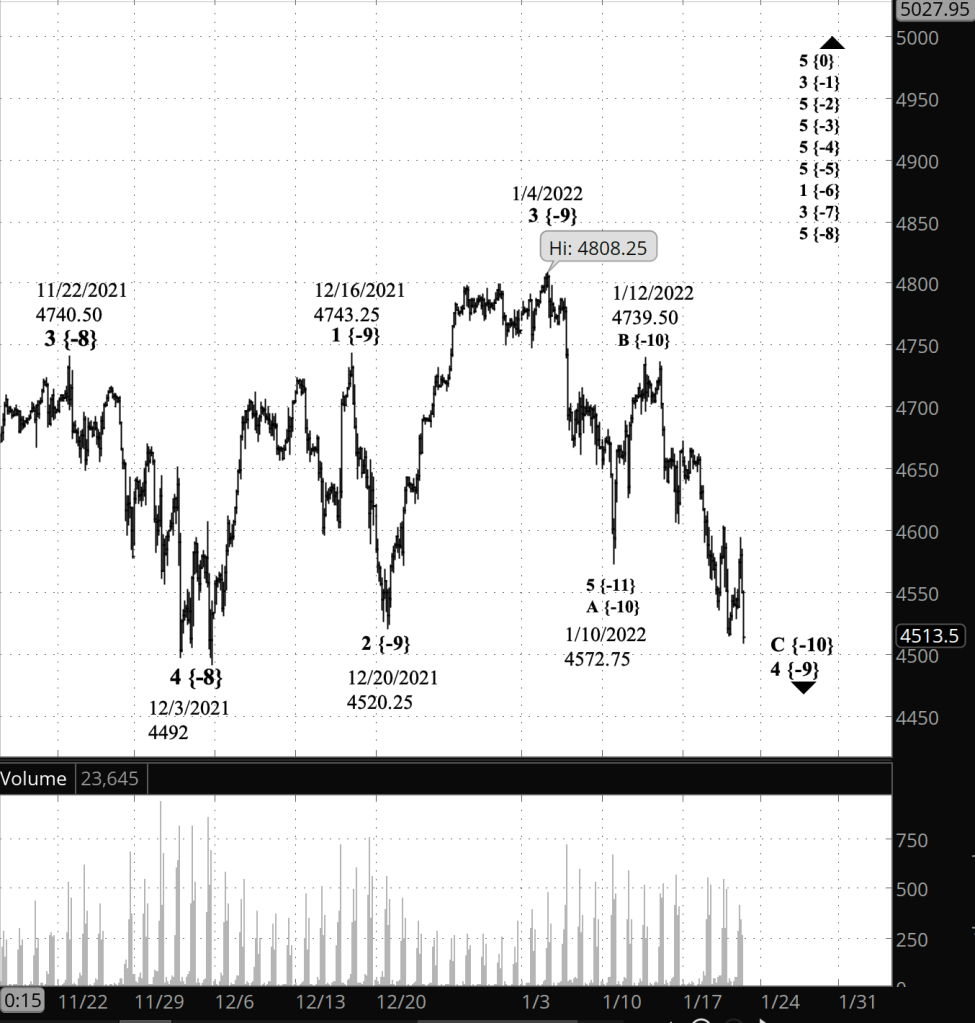
Half an hour before the closing bell. The S&P 500 futures reversed and moved a few points below the overnight now, to 4510.25 so far. This morning’s first alternative analysis is correct. Wave C{-10} within wave 4{-9} is still underway. I’ve updated the chart.
10:35 a.m. New York time
Earnings play entry. I’ve entered a short iron condor options position on NFLX, timed to coincide with the company’s earnings announcement after the closing bell. I’ve posted an analysis of the trade.
9:35 a.m. New York time
What’s happening now? The S&P 500 E-mini futures declined overnight to 4514.50, below the December 20 low of 4520.25 and then rose by 50 points before the opening bell.
What does it mean? The last leg of the downward correction that began on January 4 from 4808.25 has met all requirements for completion. The overnight low could be the end of the correction …
What’s the alternative? … or, as the first alternative, the price could reverse and it could decline further. As I did yesterday, I’ve marked the chart to comply with the principal analysis. But I think this first alternative is equally likely.
As a second alternative, the pattern of the decline from the high of January 4 is also consistent with the beginning of a new downtrend. This would require adjusting the wave number for January 4. The ambiguities in the lead-up to that high make it possible this alternative will play out.
A decline below 4492 — the low of December 3 — would confirm this second alternative. A rise above 4808.25 — the high of January 4 — would confirm the principal analysis.
[S&P 500 E-mini futures at 3:30 p.m., 135-minute bars, with volume]
What does Elliott wave theory say? Under the principal analysis, wave C{-10} within wave 4{-9} ended overnight, and wave 5{-9} began its ascent to new highs.
Under the first alternative, wave C{-10} has a few more very low level internal waves to complete before it is done. I count the final downward movement that ended last night as wave 5{-12} within wave 5{-11} within wave C{-10}.
Both the principal analysis and the first alternative are taking place within wave 5{-8}, which began on December 3 from 4492, and the January 4 peak was the end of wave 3{-9} within wave 3{-8}.
Under the second alternative, the January 4 peak marked the end of wave 5{-8}, and the decline since then, internally movements of 5, 3 and 5 waves, marks waves 1, 2 and 3 — all of the {-10} degree — within downtrending wave 1{-9}.
Learning and other resources. Elliott wave analysis provides context, not prophecy. As the 20th century semanticist Alfred Korzybski put it this way in his book Science and Sanity (1933), “The map is not the territory … The only usefulness of a map depends on similarity of structure between the empirical world and the map.” And I would add, in the ever-changing markets, we can judge that similarity of structure only after the fact.
See the menu page Analytical Methods for a rundown on where to go for information on Elliott wave analysis.
By Tim Bovee, Portland, Oregon, January 20, 2022
Disclaimer
Tim Bovee, Private Trader tracks the analysis and trades of a private trader for his own accounts. Nothing in this blog constitutes a recommendation to buy or sell stocks, options or any other financial instrument. The only purpose of this blog is to provide education and entertainment.
No trader is ever 100 percent successful in his or her trades. Trading in the stock and option markets is risky and uncertain. Each trader must make trading decisions for his or her own account, and take responsibility for the consequences.
Update 2/1/2022: I exited my short iron condor position on UNP, 17 days before expiration, for a $1.71 debit per contract/share, a profit before fees of $14 per contract. Shares were trading at $245.34, up $5.76 from the entry level.
The Implied Volatility Rank at exit was 30.3, down 26.3 points from the entry level.
I exited because the position reached profitability with fewer than 21 days left before expiration, my normal practice for exiting positions that haven’t reached 25% of maximum potential profit.
Shares declined by 2.4% over 13 days for a +68% annual rate. The options position produced an 8.2% return for a +230% annual rate.
I have entered a short iron condor spread on UNP, using options that trade for the last time #30 days hence, on February 18. The premium is a $1.85 credit per contract share and the stock at the time of entry was priced at $239.58.
The Implied Volatility Ratio stands at 56.6%
Premium:
$1.85
Expire OTM
UNP-iron condor
Strike
Odds
Delta
Calls
Long
255.00
90.0%
13
Break-even
251.85
84.5%
18.5
Short
250.00
79.0%
24
Puts
Short
225.00
73.0%
25
Break-even
221.85
76.0%
21.5
Long
220.00
79.0%
18
The premium is 37% of the width of the positions short/long spreads. The profit zone covers a 5.1% move to the upside and an 8.0% move to the downside.
The risk/reward ratio is 1.7:1, with maximum risk of $315 and maximum reward of $185 per contract.
How I chose the trade. The trade was placed to coincide with UNP’s earnings announcement, before the opening bell on the day after entry. The short strikes were set to coincide with the expected move of $11.73 either way, based on options pricing, which gives a price range of $227.30 to $250.76.
By Tim Bovee, Portland, Oregon, January 19, 2022
Disclaimer
Tim Bovee, Private Trader tracks the analysis and trades of a private trader for his own accounts. Nothing in this blog constitutes a recommendation to buy or sell stocks, options or any other financial instrument. The only purpose of this blog is to provide education and entertainment.
No trader is ever 100 percent successful in his or her trades. Trading in the stock and option markets is risky and uncertain. Each trader must make trading decisions for his or her own account, and take responsibility for the consequences.
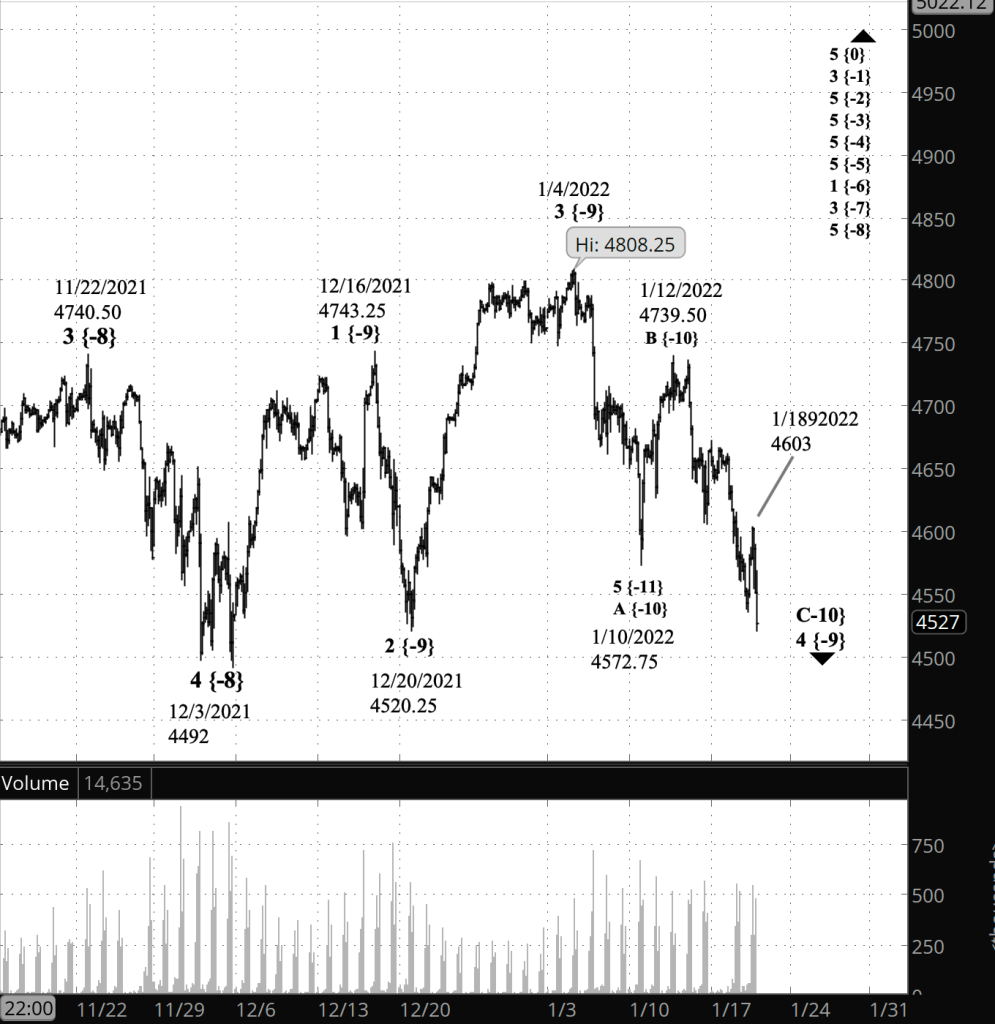
At the close. The S&P 500 futures declined further in the final minutes of the trading session, reaching a low of 4521.25 as the closing bell sounded. The price moved lower that yesterday’s reversal point, 4535.50, refuting my principal analysis and validating the first alternative: The overnight rise is a low-level rise within the larger, ongoing downward correction. The present decline is the 5th wave within wave C{-10} within the wave 4{-9} downward correction. I’ve updated the chart.
3:30 p.m. New York time
Half an hour before the closing bell. The S&P 500 futures peaked, at 4603, nine minutes after the opening bell, and then declined, remaining above yesterday’s 4535.50 reversal point. The pattern is consistent with a 2nd wave downward correction within uptrending wave 5{-9}, which began at yesterday’s low. No change in the analysis. I’ve updated the chart below.
12:55 p.m. New York time
Earnings play entry. I’ve entered a short iron condor earnings play on UNP and have posted an analysis of the options trade.
12:30 p.m. New York time
Earnings play exit. I’ve exited my short iron condor earnings play on TFC for a 34.3% profit in five days (including a weekend) and have updated the trade analysis with full results.
9:35 a.m. New York time
What’s happening now? The S&P 500 E-mini futures fell further in overnight trading, to a low of 4535.50, and then reversed to the upside.
What does it mean? The low marks the completion of the downward correction that began on January 4 from 4808.25, and the beginning of an uptrend that will carry price above that level to new highs.
What are the alternative? Alternative #1: The overnight rise is a low-level rise within the larger, ongoing downward correction. Alternative #2: The decline from January 4 was the first leg of a new downtrend that eventually will carry the price back toward 4000 and perhaps still lower.
[S&P 500 E-mini futures at 4:15 p.m., 135-minute bars, with volume]
What does Elliott wave theory say? Under my principal analysis, wave 4{-9} ended last night at 4535.50, and the subsequent rise is wave 1{-10} within wave 5{-9}, which will move beyond 4808.25, the January 4 high that ended wave 3{-9}, and perhaps significantly beyond it, since there are no limits to how far 5th waves can travel. This scenario brings higher prices quite soon and is at odds with the conventional wisdom in the financial media, which is anything but bullish.
The first alternative analysis sees the overnight rise as a subwave of an ongoing wave 5{-11} within wave C{-10} within wave 4{-9}. Wave C will end when the 5th subwave is complete, but not yet. This scenario brings higher prices, but not quite as quickly as is the case with the principal analysis.
The second alternative analysis, which I’ve had on the alternatives list for awhile, sees the January 4 high as the end of wave 5{-9} and the beginning of a downtrend that will carry the price to the low 4000s and perhaps still lower. This scenario would feel something like a mini-crash and is most in line with what I’m reading these days in the financial media, which is quite bearish.
Learning and other resources. Elliott wave analysis provides context, not prophecy. As the 20th century semanticist Alfred Korzybski put it this way in his book Science and Sanity (1933), “The map is not the territory … The only usefulness of a map depends on similarity of structure between the empirical world and the map.” And I would add, in the ever-changing markets, we can judge that similarity of structure only after the fact.
See the menu page Analytical Methods for a rundown on where to go for information on Elliott wave analysis.
By Tim Bovee, Portland, Oregon, January 19, 2022
Disclaimer
Tim Bovee, Private Trader tracks the analysis and trades of a private trader for his own accounts. Nothing in this blog constitutes a recommendation to buy or sell stocks, options or any other financial instrument. The only purpose of this blog is to provide education and entertainment.
No trader is ever 100 percent successful in his or her trades. Trading in the stock and option markets is risky and uncertain. Each trader must make trading decisions for his or her own account, and take responsibility for the consequences.
Update 2/18/2022: This update describes the exit of the call portion of an iron condor. I shall first give results for the calls — a bear call vertical spread — and then combine those results with those from the puts for results from the entire iron condor.
I exited the bear call vertical spread on MS on the last trading day before expiration, for a $0.12 debit per contract/share, a profit before fees of $91 per contract. Shares were trading at $94.25, down $0.51 from the entry level.
The Implied Volatility Rank at exit was 61.2%, up 8.3 points from the entry level.
I exited because the vertical spread was within 75 cents of becoming in-the-money. A move during the day to $95 or or higher would have risked assignment along with the associated fees.
Shares declined by 0.5% over 31 days for a -6% annual rate. The options in the vertical spread produced a 758.2% return for a 8,929% annual rate.
Turning now to the iron condor position, combining the put vertical and the call vertical.
I exited my short iron condor position on MS 31 days before expiration, for a $4.02 debit per contract/share, a loss before fees of $214 per contract. Shares were trading at $94.25, down $0.51 from the entry level.
The Implied Volatility Rank at exit was 61.2%, up 8.3 points from the entry level.
I exited for the reasons described above for the calls and in the 2/11/2022 update, below, for the puts.
Shares declined by 0.5% over 31 days for a -6% annual rate. The iron condor options position produced a -53.2% return for a -627% annual rate.
Update 2/11/2022: This update describes the exit of the put portion of an iron condor, which is made up of two vertical position built from calls and the other from puts. I shall post another update when the put position ends, most likely expiring without value, meaning I get to keep the whole $103 credit I received upon entry. That update will describe the exit both of the put position and, putting the put and call verticals back together, the exit of the original iron condor.
The stock underlying my short iron condor position on MS soared above the zone of profitability. In order to avoid exercise, I have exited the short call vertical spread that defines the upper boundary, seven days before expiration, at the cost of a $3.90 credit per contract/share, a loss before fees of $305 per contract. Shares were trading at $105.70, up $10.94 from the entry level.
The Implied Volatility Rank at exit was 35.5%, down 17.4 points from the entry level.
After the price soared, the cost of exiting was greater than my maximum risk. Today for the first time the cost moved below maximum risk, and so I exited.
Shares rose by 11.5% over 24 days for a +176% annual rate. The options position produced a 78.2% loss for a -1,189% annual rate.
I have entered a short iron condor spread on MS, using options that trade for the last time 31 days hence, on February 18. The premium is a $1.88 credit per contract share and the stock at the time of entry was priced at $94.76.
The Implied Volatility Ratio stands at 52.9%
Premium:
$1.88
Expire OTM
MS-iron condor
Strike
Odds
Delta
Calls
Long
105.00
89.0%
14
Break-even
101.88
82.0%
21
Short
100.00
75.0%
28
Puts
Short
90.00
68.0%
30
Break-even
86.88
75.1%
23
Long
85.00
82.2%
16
The premium is 37.6% of the width of the position’s short/long spreads. The profit zone covers a 7.5% move to the upside and a 9.1% move to the downside.
The risk/reward ratio is 1.7:1, with maximum risk of $312 and maximum reward of $188 per contract.
How I chose the trade. The trade was placed to coincide with MS’s earnings announcement, before the opening bell on the day after entry. The short strikes were set to coincided with an expected move of $2.96 either way, based on options pricing, which gives a price range of $91.80 to $97.72.
By Tim Bovee, Portland, Oregon, January 18, 2022
Disclaimer
Tim Bovee, Private Trader tracks the analysis and trades of a private trader for his own accounts. Nothing in this blog constitutes a recommendation to buy or sell stocks, options or any other financial instrument. The only purpose of this blog is to provide education and entertainment.
No trader is ever 100 percent successful in his or her trades. Trading in the stock and option markets is risky and uncertain. Each trader must make trading decisions for his or her own account, and take responsibility for the consequences.
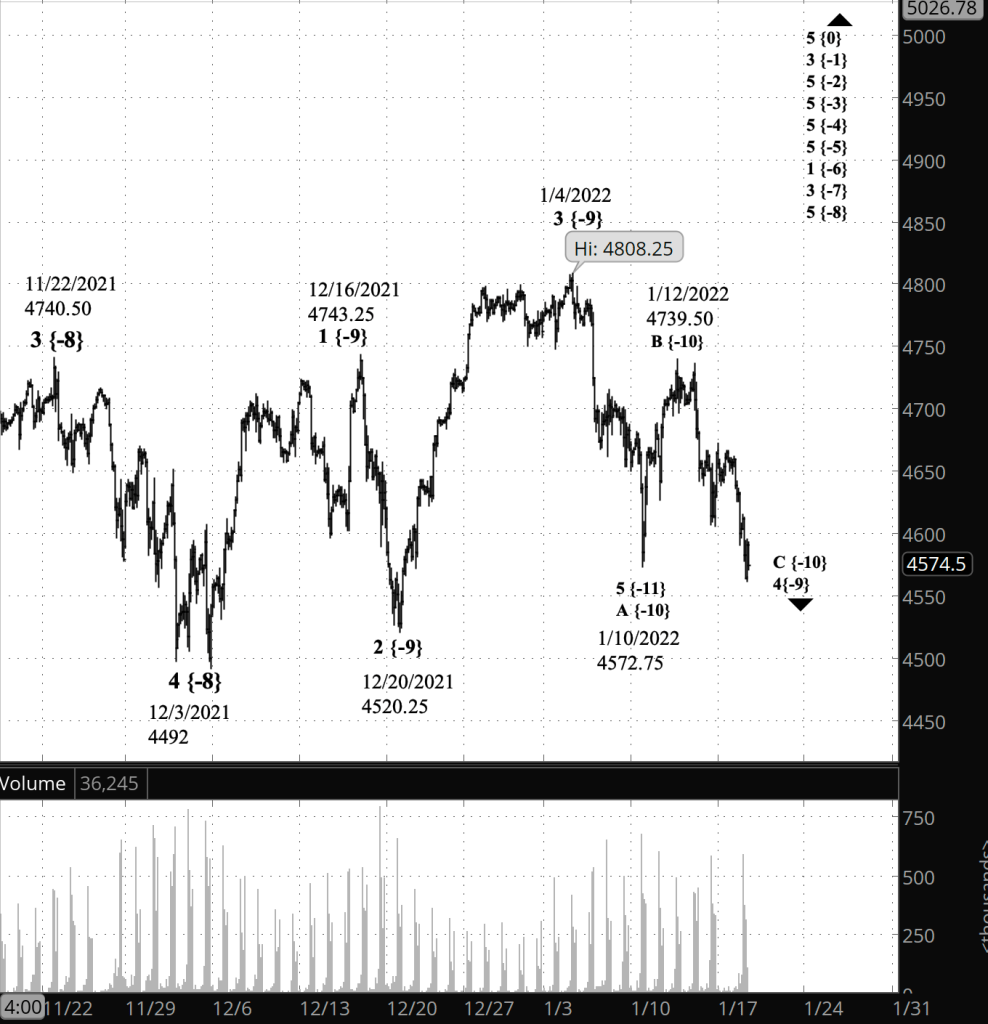
Half an hour before the closing bell. The S&P 500 futures continued to decline throughout the day, as wave C{-10} within wave 4{-9} fell below the end point of the previous wave A{-10}. No change in the analysis. I’ve updated the chart.
10:45 a.m. New York time
Another trade. I’ve entered a short iron condor earnings play on MS and have posted an analysis of the trade.
My trade. I’ve exited my short iron condor earnings play on LW for a 35.2% profit and have updated the analysis with full results.
9:35 a.m. New York time
What’s happening now? The S&P 500 E-mini futures fell in overnight trading, reaching 4590.25 so far.
What does it mean? The decline is the final leg of a downward correction that began on January 4 from 4808.25. It will be followed by a rise above that level to new heights.
What are the alternatives? There are two, the same as those outlined in detail in yesterday’s post. A third, that the low, 4606, attained on January 14 ended the downward correction (Alternative #2 in yesterday’s post), is no longer a valid alternative, since the price has dropped below that level.
The alternatives:
A resumption of the downtrend that began on January 14, carrying the price below the December 20 low of 4520.25.
A compound correction. The rise from January 10 to January 12 connects two corrective patterns. The first was the decline from January 4 to January 10, and the second began on January 12.
[S&P 500 E-mini futures at 3:30 p.m., 2-hour bars, with volume]
What does Elliott wave theory say? Under the principal analysis, within wave 4{-9}, wave C{-10}, which began on January 12, is still underway and is in its 5th wave internally.
Under the first alternative, within wave 1{-9}, wave 3{-10} began on January 12 following an upward correction, the first steps of a larger decline.
Under the second alternative, within wave 4{-9}, one downward corrective pattern ended on January 10, the connecting wave X{-10} ended on January 12, and the first wave of a second corrective pattern within wave 4{-9} is now underway.
Learning and other resources. Elliott wave analysis provides context, not prophecy. As the 20th century semanticist Alfred Korzybski put it this way in his book Science and Sanity (1933), “The map is not the territory … The only usefulness of a map depends on similarity of structure between the empirical world and the map.” And I would add, in the ever-changing markets, we can judge that similarity of structure only after the fact.
See the menu page Analytical Methods for a rundown on where to go for information on Elliott wave analysis.
By Tim Bovee, Portland, Oregon, January 18, 2022
Disclaimer
Tim Bovee, Private Trader tracks the analysis and trades of a private trader for his own accounts. Nothing in this blog constitutes a recommendation to buy or sell stocks, options or any other financial instrument. The only purpose of this blog is to provide education and entertainment.
No trader is ever 100 percent successful in his or her trades. Trading in the stock and option markets is risky and uncertain. Each trader must make trading decisions for his or her own account, and take responsibility for the consequences.

 Tim Bovee, Private Trader
You must be logged in to post a comment.