Live: Wednesday, June 6, 2018

3 p.m. New York time

No trades today.

10:40 a.m. New York time

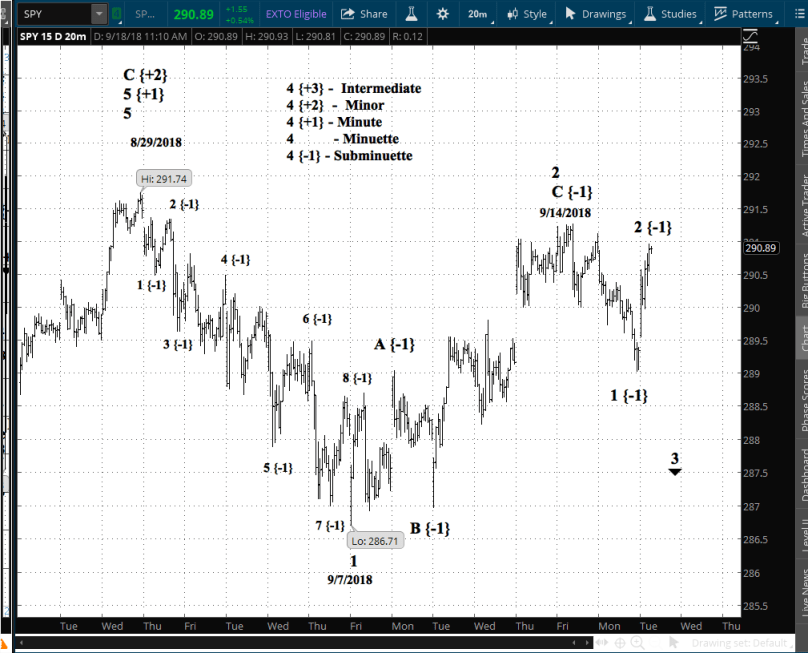
SPY opened a bit higher this morning compared to the prior day’s range, and then began declining. At this point there has been no change in the  Elliott wave analysis or the Fisher Transform signals. The price continues to work its way through the 3rd wave up at the Micro degree, and the Fisher remains mixed, signaling an uptrend on the daily chart and a downtrend on the monthly.

Unless either of those analyses changes, I plan no trades today.

I have updated the entry analyses for my two SPY positions (here and here) to include risk and reward as dollars per contract, in line with yesterday’s discussion of calculating share equivalent returns.. Those numbers are also used in calculating the risk/reward ratio.

By Tim Bovee, Portland, Oregon, June 6, 2018

Read More »

Live: Tuesday, June 5, 2018

3:05 p.m. New York time

I placed no trades today.

11:45 a.m. New York time

No change in the chart.No immediate trades in sight.

SPY has dropped off a little from yesterday’s peak. Elliott wave analysis shows that peak might have been the end of the 3rd wave of the Submicro degree, but not necessarily. It could have further to go.

The daily and monthly Fisher Transform signals on SPY remain at odds, uptrending for the daily and downtrending for the monthly. The 20-minute chart and 3-hour chart have both moved to downtrending, although I don’t use those in my decision-making

In other words, boring. So in the absence of anything interesting, let’s talk trading.

One thing I always remember about options is that they are a proxy for the underlying stock or ETF shares. They’re a leveraged trade, each contract allowing me to control a 100 shares of stock for a fraction of cost.

That’s important when it comes to assessing a position. If I were trading the shares themselves, I would have far more money at risk. By trading options, I am able to take most of that money, put it safely in Treasury notes and only put a portion at risk. By that way of thinking, though, the true profit and loss are the options result as a percentage of the share price at the time of entry. I call it it “share-equivalent result”.

Some traders have set exit points that limit their losses to a certain percent, 3% being a commonly used one. Losses in an options positions, compared to the options entry, very quickly exceed that. I would argue, however, that my share-equivalent position is the proper basis to use, by taking the dollar profit or loss on the options and calculating their percentage of the stock buy-price at the time I entered or exited the options position (entry or exit depending upon whether the position is long or short).

I have two options positions, both on SPY ((here and here). Both positions are in abysmal shape. Take the first one, a bear call spread short the June $264 strike and long the $271 strike.

It’s a short position, so the options premium when I opened it is my sales price and what I get for it when I exit is my purchase price; at present that would be bought for $659 per 100-share contract and sold for $292 per contract, a loss of 126%. The share price itself is $274.57 at the time of this calculation and at entry it was $262.50.

The shares themselves have gained 4.4% since I entered the position, the equivalent in a short sale of a 4.4% loss.

Had I sold short 100 shares of SPY, I would have bought at $27,457. My present options dollar loss on the position is $366. And the bottom line, my share-equivalent loss is $366 / $27,457 = 1.3%.

That’s what leverage gives us. And a thing of beauty it is.

Of course, when I trade options its always as a short/long pair, the long option putting a floor on my maximum loss. In the case of the trade under discussion, the maximum loss is $408, or a share-equivalent loss of 1.5%.

My goal in trading is to limit my maximum loss to $500 per position. In this case, a $500 loss would be a share-equivalent loss of 1.8%.

By trading options positions the way I do, my maximum loss is far more conservative than it is with share traders who set a 3% stop/loss. And note that while the share controlled by the positionI had a $27.457 value, only $408 would be at risk. The remaining $27,049 would be safely parked in other, less risky assets.

Options, if properly hedged, are among the most conservative trading vehicles in existence.

Nassim Nicholas Taleb, in my view the most useful thinker of our age on the subject of risk, in his book Fooled by Randomness: The Hidden Role of Chance in Life and the Markets quotes his avatar Nero Tulip: “I love taking small losses. I just need my winners to be large.”

In practical terms, the low share-equivalent losses on my positions mean that the pressure to exit is really quite low. I can afford to wait, and shall.

By Tim Bovee, Portland, Oregon, June 5, 2018

Read More »

Live: Monday, June 4, 2018

3:10 a.m. New York time

No significant change from this morning, and I placed no trades.

11 a.m. New York time

The chart is in its Elliott wave essence unchanged from Friday. It’s higher, but the count is entirely consistent with the chart posted before the weekend: SPY, tracking the S&P 500, rising a C wave to the upside at the Micro and Minuette levels. Dropping down to the Submicro level, I count it as a 3rd wave within the Micro degree C wave.

The chart, taken at 10:30 a.m. New York time, encompasses 30 days with one-hour bars.

20180604

Under Elliott doctrine, once the Submicro 3rd is complete, thee will be a 4th wave correction, most likely sideways under the Rule of Alteration, and then a 5th wave to complete the movement.

The daily and monthly Fisher Transform signals remain at odds, uptrending for the daily and downtrending for the monthly.

With the options in my position expiring June 18, the over-riding consideration is rolling the position forward to later expiry. If the uptrend continues, then I want out by Wednesday, possibly Tuesday. If the uptrend reverses, then I can go as late as Friday, June 8, or even Monday, June 11.

And so it shall go. Decisions ahead.

By Tim Bovee, Portland, Oregon, June 4, 2018

Read More »

The Week Ahead: Global Trade


trade-wars

International trade statistics are the only potential market-moving report of the week, perhaps especially notable because they provide fresh numbers to feed into the analysis and politics of the trade dispute between the Trump administration and the U.S.’ North American and European trading partners. The report will be published Wednesday at 8:30 a.m. New York time.

Also, my favorite big-picture report: The Federal Reserve will publish the 1st quarter Financial Accounts of the United States (Z.1) on Thursday at noon. As a quarterly report it’s not a leader, nor is it a market-mover, but the sheer breadth of information it contains makes it a read for traders who bring longer-term thinking to their analysis.

Read More »

Live: Friday, June 1, 2018

3:15 p.m. New York time

The Elliott wave count allows for today’s high to be the peak of the C wave of Micro degree, although it doesn’t guarantee that it won’t go higher. I am holding my positions and shall see what happens on Monday.

As of the time of this update, the Fisher Transform remains in uptrend mode on both the daily and monthly charts.

2:40 p.m. New York time

Here’s an updated chart of SPY with revised Elliott wave analysis. I place wave C of the Micro degree as still unfolding in a 4th wave correctIon.

The chart spans from May 2 to the present with 30-minute bars.

spy20180601

10:55 a.m. New York time

As it did yesterday, the Fisher Transform on the SPY daily chart (left) crossed over to uptrending. Yesterday, it reversed back to downtrending before the market close. The price today has withdrawn from its peak; whether that will be enough to reverse the signal is anyone’s guess at this point.

The important point on the chart is that the high so far today has exceeded the $273.38 peak of wave 2 at the Miniscule degree (2 {-4}), which tells me that the wave count may need to be revised. I shall post a revised version later today.

For now, I’m staying my options positions (here and here) and the shares posution (the inverse S&P 500 fund SPXU) until the chart gains some clarity.

By Tim Bovee, Portland, Oregon, June 1, 2018

Read More »

Live: Thursday, May 31, 2018

3:10 p.m. New York time

SPY’s price fell a bit during the day and the Fisher Transform flipped back to downtrending, negating the need to make any trading decision today. I placed no trades.

10:15 a.m. New York time

The Fisher Transform on the daily chart (left) crossed over to uptrending this morning, although the indicator remains downtrending on the monthly chart (right).

spy20180531a

My method is to let the Fisher signal when it’s time for a decision, although the decision itself is based on Elliott wave analysis. My options positions on SPY  (here and here) expire June 15, so the more sensitive daily chart signal must be taken very seriously indeed.

Having said that, the Elliott wave analysis shows impulse wave 3 at the Subminuette level remains in progress. An alternate count would interpret the chart as an ongoing 2nd wave correction at that level — perhaps a C wave. In either case, Elliott shows the direction is down.

I have labelled the count after the May 22 peak as {-4}, which is one degree below the Submicro level. Since the recent high, of $273.11, is below the wave 2 {-4} high of $273.13, both the impulse wave and corrective wave counts remain valid possibilities. Time will resolve the ambiguity.

My shares in the inverse S&P 500 fund SPXU have no expiration, and I am playing them at the Minuette level, which remains in the 3rd wave down.

The chart covers 20 days with 30-minute bars.

spy20180531b

At this point I plan to hold on to the options positions in the expectation that the downtrend will continue. That resolve will change with a significant reversal to the upside, and most certainly if the monthly-chart Fisher Transform should move to uptrending.

By Tim Bovee, Portland, Oregon, May 31, 2018

Read More »

Live: Wednesday, May 30, 2018

3:20 p.m. New York time

I placed no trades today.

10:05 a.m. New York time

In Elliott wave terms, SPY continues its 3rd wave down at the Subminuette level. Within that movement I see Tuesday’s low as being the 3rd wave a lesser degree, perhaps Micro, perhaps a degree below that. Today’s bump back to the upside at the opening would be an A wave within a 4th wave correction within that lower degree.

As one of my favorite sci-fi writers puts it,

“Wait a bit, Tyek,” Farad’n said. “There are wheels within wheels here.”

 —Children of Dune, by Frank Herbert.

The continuation of the Subminuette 3rd wave counsels holding on to my positions: SPY options (here and here) and shares in the inverse S&P 500 fund SPXU,

The continuation of the Fisher Transform in downtrending mode on both the daily and monthly charts buttresses that counsel.

By Tim Bovee, Portland, Oregon, May 30, 2018

Read More »

Live: Tuesday, May 29, 2018

3:30 p.m. New York time

SPY has declined below the May 15 low, breaking past the sideways patten set the day before.

I placed no trades today.

9:55 a.m. New York time

SPY has been tracing low-degree sideways corrective pattern since May 14, and this morning’s opening decline remains within the range of that pattern.

The low as of this writing is $269.90, from which it has retreated to $270.34. The prior low in the pattern, on May 15, was $270.03. Basically, our three-day weekend has changed nothing.

I see no trades today. Here are links to the opening analyses for my positions: SPY options (here and here) and shares in the inverse S&P 500 fund SPXU,

Here’s a fresh the Elliott wave chart. The only change is that I have returned the composite labeling to that proposed by R.N. Elliott — a-b-c-x-a-b-c — all of the same degree, rather than using the a-b-c-W-a-b-c nomenclature of Robert Prechter, which puts the W one degree higher.

The chart spans 20 days with 30-minute bars.

spy20180529

By Tim Bovee, Portland, Oregon, May 29, 2018

Read More »

The Week Ahead: Jobs, GDP, income, outlays, global trade, Volcker Rule

U.S. markets will be closed on Monday for the Memorial Day holiday, which traditionally marks the start of the summer vacation season. Monday is a banking holiday in the U.K., but other major forex markets, Tokyo and Sydney, will be open for business as usual.

After the long weekend comes a short week with an economic reporting landscape dotted with peak events.

The employment situation report will be released Friday at 8:30 a.m. New York time. As always, the ADP employment report, on Wednesday at 8:15 a.m., will provide a sneak preview.

Also on Wednesday, we’ll get a revision providing a second look at the 1st quarter gross domestic product, out at 8:30 a.m.

A third peak in the landscape is personal income and outlays, a look at the extent to which we’re able to live within our means, to be published on Thursday at 8:30 a.m.

And fourthly, international trade in goods on Wednesday at 8:30 a.m.

In Fedworld, the Federal Reserve Board meets Wednesday at 3 p.m. to consider easing Volcker Rule restrictions on banks’ proprietary trading. A recent Reuters article by Pete Schroeder explains the meeting.

The Federal Reserve Beige Book, a narrative description of conditions in each of the Fed’s 12 regions will be published Wednesday at 2 p.m.

Fed Gov. Lael Brainard will speak about the outlook for economic and monetary policy at the Forecasters Club of New York, on Thursday at 1 p.m.

Read More »

Live: Friday, May 25, 2018

3:20 p.m. New York time

The chart is barely changed from this morning. I placed no trades today.

Look for The Week Ahead on Saturday. The U.S. markets will be closed on Monday, which is also a bank holiday in London. Financial institutions will be open as usual in Tokyo and Sydney.

10:20 a.m. New York time

No trades are likely today. SPY’s Elliott wave count remains consistent with the analysis posted on Wednesday. The Fisher Transform on both the daily and monthly charts continues to be downtrending.

I am carrying three positions, SPY options (here and here) and shares in the inverse S&P 500 fund SPXU, which  did a 4x reverse split on Thursday, May 24. I shall update.the SPXU analysis with a recalculated base shortly.

By Tim Bovee, Portland, Oregon, May 25, 2018

Read More »