Trader’s Notebook

3:30 p.m. New York time

Half an hour before the closing bell. The S&P 500 has declined during the day from its morning high of 4188 on the futures. The middle leg of a rise that began on July 14 continues and is nearing its end. No change in the analysis. I’ve updated the chart.

9:35 a.m. New York time

What’s happening now? The S&P 500 E-mini futures rose after trading resumed overnight, moving above the prior high to 4177.50.

What does it mean? The last leg of an uptrend that began on July 18 is now it middle and most energetic segment. When complete, it will be followed by a downward correction and then a rise that most likely will reach a higher high. This is happening within a larger upward correction that began on June 17

What are the alternatives? None at the present. Ambiguities will, I’m sure, develop.
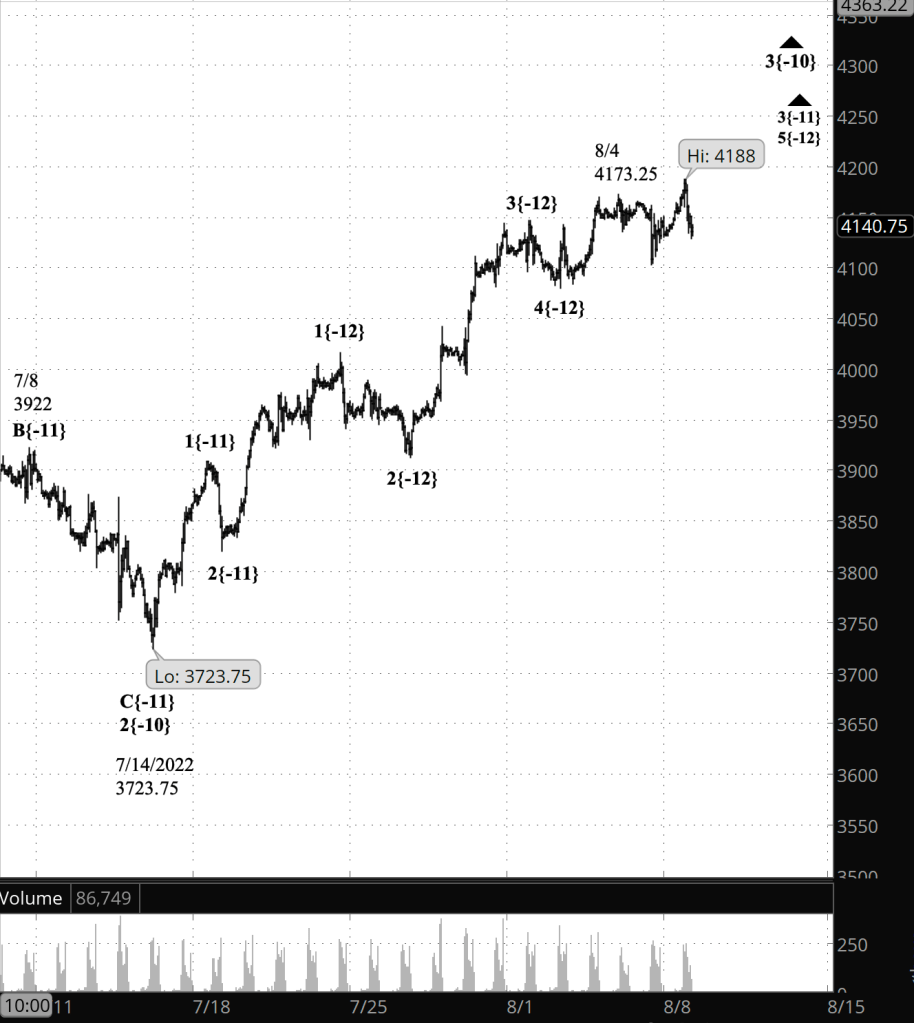
[S&P 500 E-mini futures at 3:30 p.m., 60-minute bars, with volume]

What does Elliott wave theory say? The rise that began on July 14, wave 3{-10}, is now in its middle and most energetic wave, 3{-11}, which in turn is in its final segment, wave 5{-12}.

We Are Here.

These are the waves currently in progress under my principal analysis. Each line on the list shows the wave number, with the subscript in curly brackets, the traditional degree name, the starting date, the starting price of the S&P 500 E-mini futures, and the direction of the wave.

  • S&P 500 Index:
  • 5{+3} Supercycle, 7/8/1932, 4.40 (up)
  • 5{+2} Cycle, 12/9/1974, 60.96 (up)
  • 5{+1} Primary, 3/6/2009, 666.79 (up)
  • 5{0} Intermediate, 12/26/2018, 2346.58 (up)
  • 4{-1} Minor, 1/4/2022 4818.62 (down)
  • 1{-2} Minute, 1/4/2022 4818.62 (down)
  • S&P 500 Futures and index:
  • 1{-3} Minuette, 1/4/2022, 4808.25 (down) (futures), 4818.62 (down) (index)
  • S&P 500 Futures:
  • 1{-4} Subminuette, 1/4/2022, 4808.25 (down)
  • 1{-5} Micro, 1/4/2022, 4808.25 (down)
  • 1{-6} Submicro, 1/4/2022, 4808.25 (down)
  • 2{-7} Minuscule, 6/17/2022, 4631 (up)
  • A{-8} Subminuscule, 6/17/2022, 4509 (up)
  • 1{-9} Bitsy, 6/17/2022, 4202.25 (up)
  • 3{-10} Subbitsy, 7/14/2022, 4189 (up)
  • 3{-11} Deci, 7/2022, 4164 (up)

Learning and other resources. Elliott wave analysis provides context, not prophecy. As the 20th century semanticist Alfred Korzybski put it in his book Science and Sanity (1933), “The map is not the territory … The only usefulness of a map depends on similarity of structure between the empirical world and the map.” And I would add, in the ever-changing markets, we can judge that similarity of structure only after the fact.

See the menu page Analytical Methods for a rundown on where to go for information on Elliott wave analysis.

By Tim Bovee, Portland, Oregon, August 8, 2022

Disclaimer

Tim Bovee, Private Trader tracks the analysis and trades of a private trader for his own accounts. Nothing in this blog constitutes a recommendation to buy or sell stocks, options or any other financial instrument. The only purpose of this blog is to provide education and entertainment.

No trader is ever 100 percent successful in his or her trades. Trading in the stock and option markets is risky and uncertain. Each trader must make trading decisions for his or her own account, and take responsibility for the consequences.

License
Creative Commons License

All content on Tim Bovee, Private Trader by Timothy K. Bovee is licensed under a Creative Commons Attribution-ShareAlike 4.0 International License.

Based on a work at www.timbovee.com.

Trader’s Notebook

3:30 p.m. New York time

Half an hour before the closing bell. The S&P 500 has traded lower during the session, reaching 4103.75 on the futures, nearly 70 points below yesterday’s high. Wave 4{-11}, a downward correction continues within uptrending wave 3{-10}, which began on July 14. No change in the analysis. I’ve updated the upper chart.

10:25 a.m. New York time

ZG earnings play exit. ZG failed to meet earnings expectations by a large margin, and I’ve exited my short bull put options spread for 40.2% of maximum potential loss. I’ve updated the trade analysis with full results.

9:35 a.m. New York time

What’s happening now? The S&P 500 E-mini futures fell overnight, leaving yesterday’s high, 4173.25, unchallenged.

What does it mean? The rise from July has met all of the requirements for the final leg within a five-step trend. At this point the price has fishing for a peak. If yesterday’s high was the peak, then the middle leg of the larger rise from July 18 is complete and after a correction, the final leg of that rise will reach for a higher peak.

What is the alternative? The middle leg of the rise from July 18 is not yet over and the overnight decline is a smaller correction within that rise.

[S&P 500 E-mini futures at 3:30 p.m., 160-minute bars, with volume]

What does Elliott wave theory say? The fractal nature of market movements is well illustrated within this chart: Waves within waves within waves, each forming the same patterns adhering to the same rules.

Under my principal analysis, the five-wave trend that began on July 18 has completed its middle wave, 3{-12} and begun a downward correction, wave 4{-12}. This is happening with the parent, wave 3{-11} within wave 3{-10} within wave 1{-9}, which began on June 17 from 3639. It is the smallest of a series of increasingly larger rising 1st waves that began on that date.

Under the alternative analysis, wave 3{-12} has not yet completed its rise and will soon move above the prior high, 4173.25.

[S&P 500 index at 9:33 a.m., 3-day bars]

The bigger picture. The S&P 500 index has been forming an expanding Diagonal Triangle since December 26, 2018, from a low that date of 2346.58. The 2nd wave of the triangle — wave 2{-1} — ended on February 23, 2020, the low of the early pandemic crash. The rise that followed is wave 3{-1}. It ended last January 4. The decline that followed is wave 4{-1}. In an expanding Diagonal Triangle, the price tends to retrace 66% to 81% of the preceding 3rd wave, giving a target range between 3085 to 2691. That’s a tendency, not a rule, and the price could well fall even lower, perhaps as low as the triangle’s lower boundary, presently just above 1900.

We Are Here.

These are the waves currently in progress under my principal analysis. Each line on the list shows the wave number, with the subscript in curly brackets, the traditional degree name, the starting date, the starting price of the S&P 500 E-mini futures, and the direction of the wave.

  • S&P 500 Index:
  • 5{+3} Supercycle, 7/8/1932, 4.40 (up)
  • 5{+2} Cycle, 12/9/1974, 60.96 (up)
  • 5{+1} Primary, 3/6/2009, 666.79 (up)
  • 5{0} Intermediate, 12/26/2018, 2346.58 (up)
  • 4{-1} Minor, 1/4/2022 4818.62 (down)
  • 1{-2} Minute, 1/4/2022 4818.62 (down)
  • S&P 500 Futures and index:
  • 1{-3} Minuette, 1/4/2022, 4808.25 (down) (futures), 4818.62 (down) (index)
  • S&P 500 Futures:
  • 1{-4} Subminuette, 1/4/2022, 4808.25 (down)
  • 1{-5} Micro, 1/4/2022, 4808.25 (down)
  • 1{-6} Submicro, 1/4/2022, 4808.25 (down)
  • 5{-7} Minuscule, 3/29/2022, 4631 (down)
  • 5{-8} Subminuscule, 4/21/2022, 4509 (down)
  • 5{-9} Bitsy, 5/30/2022, 4202.25 (down)

Learning and other resources. Elliott wave analysis provides context, not prophecy. As the 20th century semanticist Alfred Korzybski put it in his book Science and Sanity (1933), “The map is not the territory … The only usefulness of a map depends on similarity of structure between the empirical world and the map.” And I would add, in the ever-changing markets, we can judge that similarity of structure only after the fact.

See the menu page Analytical Methods for a rundown on where to go for information on Elliott wave analysis.

By Tim Bovee, Portland, Oregon, August 5, 2022

Disclaimer

Tim Bovee, Private Trader tracks the analysis and trades of a private trader for his own accounts. Nothing in this blog constitutes a recommendation to buy or sell stocks, options or any other financial instrument. The only purpose of this blog is to provide education and entertainment.

No trader is ever 100 percent successful in his or her trades. Trading in the stock and option markets is risky and uncertain. Each trader must make trading decisions for his or her own account, and take responsibility for the consequences.

License
Creative Commons License

All content on Tim Bovee, Private Trader by Timothy K. Bovee is licensed under a Creative Commons Attribution-ShareAlike 4.0 International License.

Based on a work at www.timbovee.com.

ZG Trade

Zillow Group (ZG)

Update 8/5/2022: I exited my short bull put vertical spread on ZG, 42 days before expiration, for a $1.61 debit per contract/share, a loss before fees of $19 per contract. Shares were trading at $36.26, down $1.28 from the entry level.

The Implied Volatility Rank at exit was 40.2%, down 25.4 points from the entry level.

ZG missed analysts’ earnings expectations by 81% — they had expected earnings of $0.157 per share prior to the announcement. The company reported earnings of $0.03 per share. I exited at 40.2% of maximum potential loss.

Shares fell by 3.4% over one day for a -1,244% annual rate. The options position produced an 11.8% loss for a -4308% annual rate.


I have entered a short bull put vertical spread on ZG, using options that trade for the last time 42 days hence, on September 16. The premium is a $1.42 credit per contract share and the stock at the time of entry was priced at $37.54.

The Implied Volatility Ratio stood at 65.6%.

Premium:$1.42Expire OTM
ZG-bull put spreadStrikeOddsDelta
Puts
Long30.0075.0%17
Break-even36.4265.5%15.5
Short35.0056.0%14

The premium is 56.8% of the width of the position’s short/long spread. The profit zone covers a 3% move to the downside and an unlimited move to the upside.

The risk/reward ratio is 2.5:1, with maximum risk of $358 and maximum reward of $142 per contract.

How I chose the trade. The trade was placed to coincide with ZG’s earnings announcement, after the closing bell on the day of entry. The short strikes were set to coincide with the expected move of $1.37 either way, based on options pricing, which gives a price range of $36.29 to $39.03. The Zacks Investment Research earnings surprise predictor gave ZG a score of 18.79%, with a rank of 3 (hold).

By Tim Bovee, Portland, Oregon, August 4, 2022

Disclaimer

Tim Bovee, Private Trader tracks the analysis and trades of a private trader for his own accounts. Nothing in this blog constitutes a recommendation to buy or sell stocks, options or any other financial instrument. The only purpose of this blog is to provide education and entertainment.

No trader is ever 100 percent successful in his or her trades. Trading in the stock and option markets is risky and uncertain. Each trader must make trading decisions for his or her own account, and take responsibility for the consequences.

License
Creative Commons License

All content on Tim Bovee, Private Trader by Timothy K. Bovee is licensed under a Creative Commons Attribution-ShareAlike 4.0 International License.

Based on a work at www.timbovee.com.
Trader’s Notebook

3:30 p.m. New York time

Half an hour before the closing bell. The S&P 500 has traded in a narrow range during the session, remaining below the overnight high, 4173.25 on the futures. No change in the revised analysis posted at 11:45 a.m., below. I’ve updated the middle chart, showing the futures.

1:50 p.m. New York time

ZG earnings play entry. I’ve entered a short bull put vertical spread on ZG, using options that trade for the last time on September 16, and have posted an analysis of the trade.

11:45 a.m. New York time

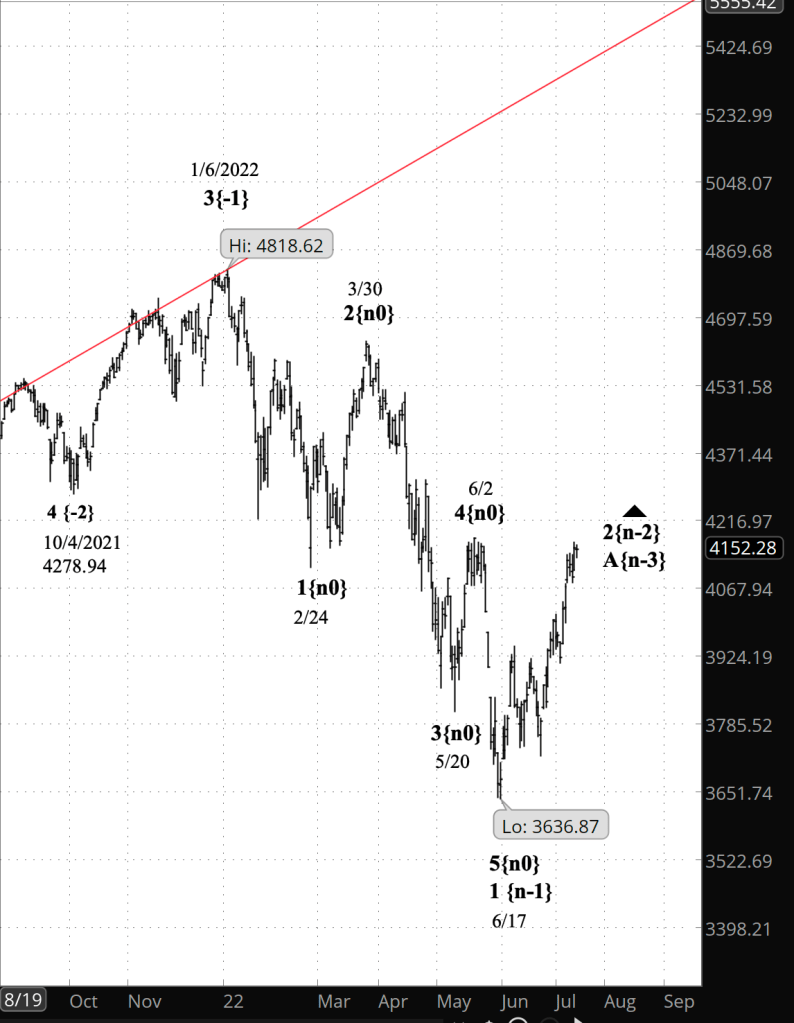
S&P 500 re-analysis. As noted this morning, the S&P 500 broke a rule of Elliott wave analysis. I have re-analyzed the S&P 500 to better match the charts. I began at the beginning, the January 6 peak that has defined everything that has happened since.

[S&P 500 index at 11 a.m., daily bars]

The chart shows a clear five-wave decline, with the 5th wave ending on July 17. The 5th wave is the final wave in a trend, so June 17 was a low of great significance.

The uncertainty on any chart is the proper degree labeling: Where does a wave fit, in size, compared to what has come before it. So for this first chart, I used placeholder degree numbering: 1{n0} as a base, 2{n-1} as a degree below it, and so forth.

That gave me two touchstones for analyzing the chart: The January 6 high and the July 17 low. The pattern showed a downtrend followed by an upward correction.

The next task was to assign degrees to the turning points on the chart. For that, I turned to a more detailed view, the S&P 500 E-mini futures.

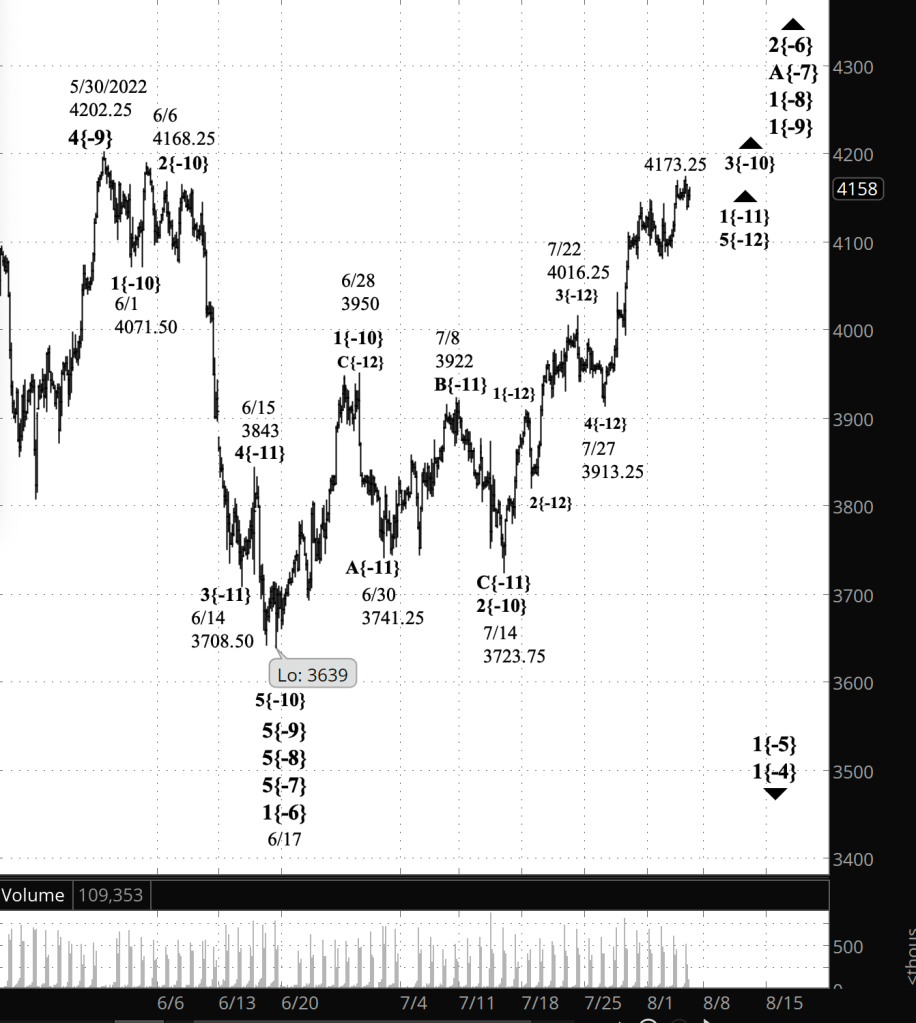
[S&P 500 E-mini futures at 3:30 p.m., 160-minute bars, with volume]

Any degree assignment is a hunch at best. In this case, the rise that began on June 17 would be consistent with a Zigzag, the kind of correction most often seen in second waves. It would also be consistent with an uptrend following the end of a downtrend. So the choices were upward wave 2, which would mean the June 17 low ended a 1st wave, or an uptrending 1st wave, which would mean the low ended a 5th wave.

The magnitude of things suggested to me that the rise was a second wave. All of the waves from degree {-7} and lower were 5th waves. Therefore, wave 1{-6} seemed to be the best choice for the wave ending on June 17, and wave 2{-6} for the subsequent upward correction.

Under the new principal analysis, the rise from June 17 is wave A{-7}, the first wave of upward correction wave 2{-6}. Wave A{-7} is presently in its initial wave of five in a Zig-zag pattern: Wave {-8}.

I’ve retained the old analysis below for comparison with the new analysis, above.

9:35 a.m. New York time

What’s happening now? The S&P 500 E-mini futures rose slightly higher today, to 4173.25.

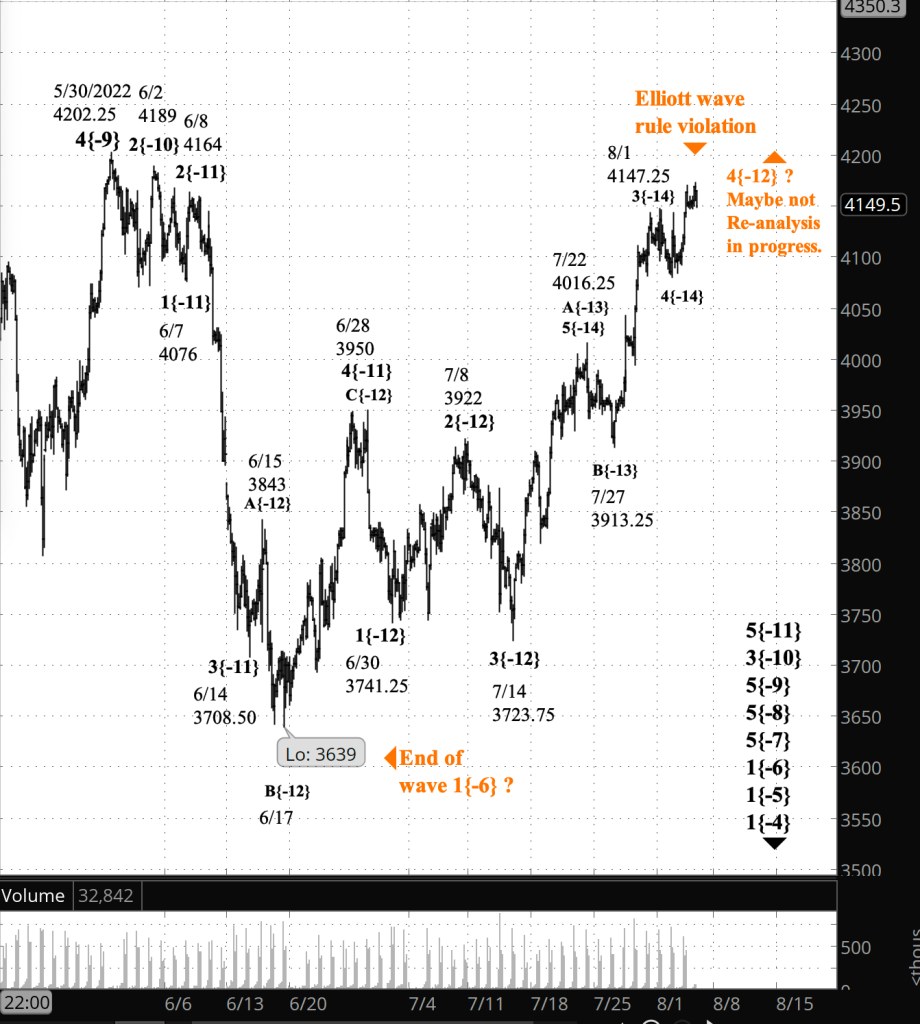
What does it mean? That level is above the beginning on June 8 of the present downtrend, from 4164. That breaks a rule of Elliott wave analysis, and I’ll be re-analyzing the chart today.

What are the alternatives? The principal analysis having been thrown into disarray, there are no clear alternatives. They’ll remain unknown until the re-analysis is complete.

The chart. I’ve marked the rule violation and noted a likely re-analysis points, using red labels.

[S&P 500 E-mini futures at 9:35 a.m., 160-minute bars, with volume]

What does Elliott wave theory say? The rule discovered by R.N. Elliott states that a 4th wave cannot move above the start of the preceding 1st wave within the same trend. Wave 1{-12} began on June 8 from 4164. Wave 4{-1} reached a high in overnight trading of 4173.25.

When the map no longer matches the territory, it’s time to redraw the map.

That will take more time than remains before the time I normally post this analysis, at 9:35 New York time. I hope to have a re-analyzed chart by this afternoon’s update. Right now, my best guess is that the downtrend, wave 1{-6}, which began on January 4 from 4808.25, may have ended on June 17 at 36.39, and the rise since then has been an upward correction, wave 2{-6}.

Note that if my best guess is correct, the wave numbers degrees have changed but the pattern has not: The S&P 500 is still in upward correction within a downtrend. More later after the re-analysis.

We Are Here.

These are the waves currently in progress under my principal analysis. Each line on the list shows the wave number, with the subscript in curly brackets, the traditional degree name, the starting date, the starting price of the S&P 500 E-mini futures, and the direction of the wave.

  • S&P 500 Index:
  • 5{+3} Supercycle, 7/8/1932, 4.40 (up)
  • 5{+2} Cycle, 12/9/1974, 60.96 (up)
  • 5{+1} Primary, 3/6/2009, 666.79 (up)
  • 5{0} Intermediate, 12/26/2018, 2346.58 (up)
  • 4{-1} Minor, 1/4/2022 4818.62 (down)
  • 1{-2} Minute, 1/4/2022 4818.62 (down)
  • S&P 500 Futures and index:
  • 1{-3} Minuette, 1/4/2022, 4808.25 (down) (futures), 4818.62 (down) (index)
  • S&P 500 Futures:
  • 1{-4} Subminuette, 1/4/2022, 4808.25 (down)
  • 1{-5} Micro, 1/4/2022, 4808.25 (down)
  • 2{-6} Submicro, 6/17/2022, 4808.25 (up)
  • A{-7} Minuscule, 6/17/2022, 4631 (up)
  • 1{-8} Subminuscule, 6/17/2022, 4509 (up)
  • 1{-9} Bitsy, 6/17/2022, 4202.25 (up)
  • 3{-10} Subbitsy, 7/14/2022, 4189 (up)
  • 1{-11} Deci, 7//2022, 4164 (up)

Learning and other resources. Elliott wave analysis provides context, not prophecy. As the 20th century semanticist Alfred Korzybski put it in his book Science and Sanity (1933), “The map is not the territory … The only usefulness of a map depends on similarity of structure between the empirical world and the map.” And I would add, in the ever-changing markets, we can judge that similarity of structure only after the fact.

See the menu page Analytical Methods for a rundown on where to go for information on Elliott wave analysis.

By Tim Bovee, Portland, Oregon, August 4, 2022

Disclaimer

Tim Bovee, Private Trader tracks the analysis and trades of a private trader for his own accounts. Nothing in this blog constitutes a recommendation to buy or sell stocks, options or any other financial instrument. The only purpose of this blog is to provide education and entertainment.

No trader is ever 100 percent successful in his or her trades. Trading in the stock and option markets is risky and uncertain. Each trader must make trading decisions for his or her own account, and take responsibility for the consequences.

License
Creative Commons License

All content on Tim Bovee, Private Trader by Timothy K. Bovee is licensed under a Creative Commons Attribution-ShareAlike 4.0 International License.

Based on a work at www.timbovee.com.
Trader’s Notebook

3:30 p.m. New York time

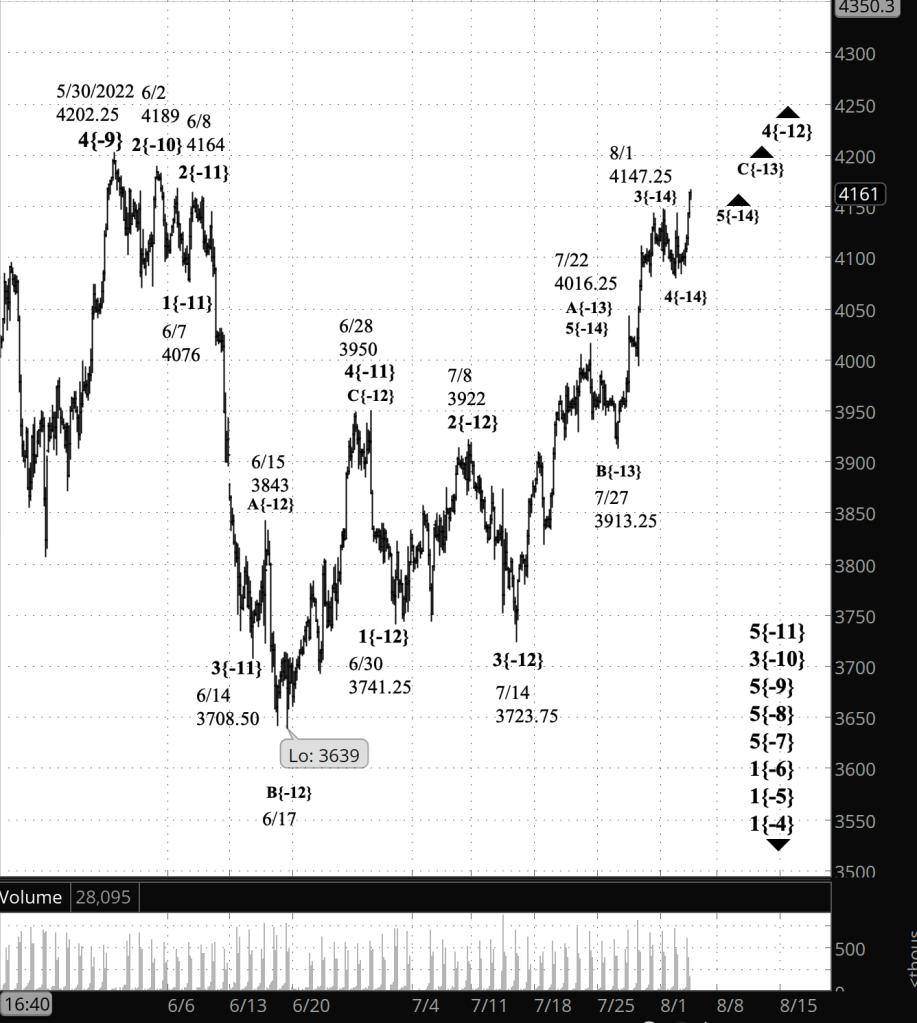
Half an hour before the closing bell. The S&P 500 exceeded Monday’s high, 4147.25, reaching into the 4160s. I count that rise as the final leg of the third segment of the upward corrective pattern that began on July 14. The present wave is 5{-14} within wave C{-13} within wave 4{-12}. Chart updated.

2:05 p.m. New York time

AMD earnings play exit. I’ve exited my short bull put options spread on AMD for 33.9% of maximum potential loss and have updated the trade analysis with full results.

9:35 a.m. New York time

What’s happening now? The S&P 500 E-mini futures rose slightly in overnight trading, fluctuating between the mid-4090s and the mid-4120s.

What does it mean? An upward correction that began July 14 is in its final stages. The rise that began overnight is likely to carry the price above the August 1 high, 4147.25. Afterward, the downtrend that began on June 8 will carry the price back down to the 3700s and below.

What is the alternative? Some corrections form a compound structure, linking several corrective patterns together. If that happens, then the present corrective pattern will be followed by a connecting wave and then a second corrective pattern, delaying resumption of the downtrend.

[S&P 500 E-mini futures at 3:30 p.m., 160-minute bars, with volume]

What does Elliott wave theory say? Within the upward correction, wave 4{-12}, the final leg, wave C{-13}, is underway. Internally, wave C{-13} is in its final wave, 5{-14}. When complete, the downtrend will resume with wave 5{-15}.

If the alternative analysis plays out, wave C{-13} will be followed by a connecting wave X{-13} and then a second corrective pattern within wave 4{-12}.

We Are Here.

These are the waves currently in progress under my principal analysis. Each line on the list shows the wave number, with the subscript in curly brackets, the traditional degree name, the starting date, the starting price of the S&P 500 E-mini futures, and the direction of the wave.

  • S&P 500 Index:
  • 5{+3} Supercycle, 7/8/1932, 4.40 (up)
  • 5{+2} Cycle, 12/9/1974, 60.96 (up)
  • 5{+1} Primary, 3/6/2009, 666.79 (up)
  • 5{0} Intermediate, 12/26/2018, 2346.58 (up)
  • 4{-1} Minor, 1/4/2022 4818.62 (down)
  • 1{-2} Minute, 1/4/2022 4818.62 (down)
  • S&P 500 Futures and index:
  • 1{-3} Minuette, 1/4/2022, 4808.25 (down) (futures), 4818.62 (down) (index)
  • S&P 500 Futures:
  • 1{-4} Subminuette, 1/4/2022, 4808.25 (down)
  • 1{-5} Micro, 1/4/2022, 4808.25 (down)
  • 1{-6} Submicro, 1/4/2022, 4808.25 (down)
  • 5{-7} Minuscule, 3/29/2022, 4631 (down)
  • 5{-8} Subminuscule, 4/21/2022, 4509 (down)
  • 5{-9} Bitsy, 5/30/2022, 4202.25 (down)
  • 3{-10} Subbitsy, 6/2/2022, 4189 (down)
  • 5{-11} Deci, 6/8/2022, 4164 (down)

Learning and other resources. Elliott wave analysis provides context, not prophecy. As the 20th century semanticist Alfred Korzybski put it in his book Science and Sanity (1933), “The map is not the territory … The only usefulness of a map depends on similarity of structure between the empirical world and the map.” And I would add, in the ever-changing markets, we can judge that similarity of structure only after the fact.

See the menu page Analytical Methods for a rundown on where to go for information on Elliott wave analysis.

By Tim Bovee, Portland, Oregon, August 3, 2022

Disclaimer

Tim Bovee, Private Trader tracks the analysis and trades of a private trader for his own accounts. Nothing in this blog constitutes a recommendation to buy or sell stocks, options or any other financial instrument. The only purpose of this blog is to provide education and entertainment.

No trader is ever 100 percent successful in his or her trades. Trading in the stock and option markets is risky and uncertain. Each trader must make trading decisions for his or her own account, and take responsibility for the consequences.

License
Creative Commons License

All content on Tim Bovee, Private Trader by Timothy K. Bovee is licensed under a Creative Commons Attribution-ShareAlike 4.0 International License.

Based on a work at www.timbovee.com.
AMD Trade

Advanced Micro Devices Inc. (AMD)

Lot 2022-2

Update 8/3/2022: I exited my short bull put vertical spread on AMD, 44 days before expiration, for a $1.30 debit per contract/share, a loss before fees of $14 per contract. Shares were trading at $97.30, down $2.90 from the entry level.

The Implied Volatility Rank at exit was 29.2%, down 24.7 points from the entry level.

I exited on the day after entry because the position was showing a loss, at 33.9% of maximum allowed under my hedge limiting downside risk. Earnings beat analysts’ consensus estimate by 11%. The revenues forecast, however, was slightly below expectations, so the share price — always forward looking — adjusted to match.

Shares fell by 2.9% over one day for a -1,056% annual rate. The options position produced a 10.8% loss for a -3931% annual rate.


I have entered a short bull put vertical spread on AMD, using options that trade for the last time 45 days hence, on September 16. The premium is a $1.16 credit per contract share and the stock at the time of entry was priced at $100.20.

The Implied Volatility Ratio stood at 53.90%.

Premium:$1.16Expire OTM
AMD-bull put spreadStrikeOddsDelta
Puts
Long85.0077.0%18
Break-even91.1672.5%22
Short90.0068.0%26

The premium is 46.4% of the width of the position’s short/long spread. The profit zone covers a 9% move to the downside and an unlimited move to the upside.

The risk/reward ratio is 3.3:1, with maximum risk of $384 and maximum reward of $116 per contract.

How I chose the trade. The trade was placed to coincide with AMD’s earnings announcement, after the closing bell on the day of entry. The short strikes were set to coincide with the expected move of $7.20 either way, based on options pricing, which gives a price range of $91.05 to $104.01. The Zacks Investment Research earnings surprise predictor gave AMD a score of 1.66%, with a rank of 3 (neutral).

By Tim Bovee, Portland, Oregon, August 2, 2022

Disclaimer

Tim Bovee, Private Trader tracks the analysis and trades of a private trader for his own accounts. Nothing in this blog constitutes a recommendation to buy or sell stocks, options or any other financial instrument. The only purpose of this blog is to provide education and entertainment.

No trader is ever 100 percent successful in his or her trades. Trading in the stock and option markets is risky and uncertain. Each trader must make trading decisions for his or her own account, and take responsibility for the consequences.

License
Creative Commons License

All content on Tim Bovee, Private Trader by Timothy K. Bovee is licensed under a Creative Commons Attribution-ShareAlike 4.0 International License.

Based on a work at www.timbovee.com.
Trader’s Notebook

3:30 p.m. New York time

Half an hour before the closing bell. The S&P 500 rose again after the overnight decline, remaining below Monday’s high, 4147.50, on the futures. No change in the analysis. The upward correction, wave 4{-12}, continues. I’ve updated the chart.

1:25 p.m. New York time

AMD earnings play entry. I’ve entered a bull put vertical spread on AMD, using options that trade for the last time on September 16, and have posted a trade analysis.

10:20 a.m. New York time

MOS earnings play exit. I’ve exited my bull put vertical spread on MOS for 49.4% of maximum potential loss and have updated the trade analysis with results.

9:35 a.m. New York time

What’s happening now? The S&P 500 E-mini futures continued to move lower at a leisurely pace, reaching down into the 4080s.

What does it mean? Under my principal analysis, the upward correction that began on July 14 is still underway and internally is in the third leg of a three-part corrective pattern. The reversal is a correction within the third leg and will be followed by a rise above Monday’s high, 4147.25. Afterward, the price will fall back into the 3700s or lower.

What are the alternatives? The further the price falls, the more likely it is that the alternative analysis matches the chart: The upward correction ended on Monday at 4147.25. The downtrend has resumed and will carry the price back to the 3700s or lower.

[S&P 500 E-mini futures at 3:30 p.m., 160-minute bars, with volume]

What does Elliott wave theory say? Nothing new. The chart is singing the same tune it has sung for the past few days.

The upward correction that began on July 14, wave 4{-12} is still underway and is in the third wave, C{-13}, of three-wave corrective pattern. If wave 4{-12} forms a simple structure, containing one corrective pattern, then wave C{-13} will mark the end of wave 4{-12} and the correction. Wave 5{-12} to the downside will follow, resuming the downtrend that began on June 8, wave 5{-11}.

If wave 4{-12} forms a compound pattern, then wave C{-13} will be followed by a connecting wave, X{-13} and then a second corrective pattern. A compound correction can contain as many as three corrective patterns. Once the compound correction is over, wave 5{-12} to the downside will begin.

The alternative analysis says that wave 5{-12} began on Friday, from the day’s high, 4147.25. That high was where wave C{-13} and its parent, wave 4{-12}, both ended.

This is all happening within downtrending wave 5{-11}, which which is nested within a series of over larger waves, like Russian matryoshka dolls, as listed below in the “We Are Here” section.

Credit:Russian-Matroshka_no_bg.jpg: User:Fanghongderivative work: Greyhood (talk) – Russian-Matroshka_no_bg.jpg, CC BY-SA 3.0, https://commons.wikimedia.org/w/index.php?curid=13676809

We Are Here.

These are the waves currently in progress under my principal analysis. Each line on the list shows the wave number, with the subscript in curly brackets, the traditional degree name, the starting date, the starting price of the S&P 500 E-mini futures, and the direction of the wave.

  • S&P 500 Index:
  • 5{+3} Supercycle, 7/8/1932, 4.40 (up)
  • 5{+2} Cycle, 12/9/1974, 60.96 (up)
  • 5{+1} Primary, 3/6/2009, 666.79 (up)
  • 5{0} Intermediate, 12/26/2018, 2346.58 (up)
  • 4{-1} Minor, 1/4/2022 4818.62 (down)
  • 1{-2} Minute, 1/4/2022 4818.62 (down)
  • S&P 500 Futures and index:
  • 1{-3} Minuette, 1/4/2022, 4808.25 (down) (futures), 4818.62 (down) (index)
  • S&P 500 Futures:
  • 1{-4} Subminuette, 1/4/2022, 4808.25 (down)
  • 1{-5} Micro, 1/4/2022, 4808.25 (down)
  • 1{-6} Submicro, 1/4/2022, 4808.25 (down)
  • 5{-7} Minuscule, 3/29/2022, 4631 (down)
  • 5{-8} Subminuscule, 4/21/2022, 4509 (down)
  • 5{-9} Bitsy, 5/30/2022, 4202.25 (down)
  • 3{-10} Subbitsy, 6/2/2022, 4189 (down)
  • 5{-11} Deci, 6/8/2022, 4164 (down)

Learning and other resources. Elliott wave analysis provides context, not prophecy. As the 20th century semanticist Alfred Korzybski put it in his book Science and Sanity (1933), “The map is not the territory … The only usefulness of a map depends on similarity of structure between the empirical world and the map.” And I would add, in the ever-changing markets, we can judge that similarity of structure only after the fact.

See the menu page Analytical Methods for a rundown on where to go for information on Elliott wave analysis.

By Tim Bovee, Portland, Oregon, August 2, 2022

Disclaimer

Tim Bovee, Private Trader tracks the analysis and trades of a private trader for his own accounts. Nothing in this blog constitutes a recommendation to buy or sell stocks, options or any other financial instrument. The only purpose of this blog is to provide education and entertainment.

No trader is ever 100 percent successful in his or her trades. Trading in the stock and option markets is risky and uncertain. Each trader must make trading decisions for his or her own account, and take responsibility for the consequences.

License
Creative Commons License

All content on Tim Bovee, Private Trader by Timothy K. Bovee is licensed under a Creative Commons Attribution-ShareAlike 4.0 International License.

Based on a work at www.timbovee.com.

MOS Trade

The Mosaic Co. (MOS)

Lot 2022-2

Update 8/2/2022: I exited my short bull put vertical spread on MOS, 26 days before expiration, for a $1.71 debit per contract/share, a loss before fees of $19 per contract. Shares were trading at $50.37, down $0.90 from the entry level.

The Implied Volatility Rank at exit was 64.3%, up 5.8 points from the entry level.

I exited on the day after entry because the position was unprofitable, trading for 49.4 of maximum potential loss. My practice for losing trades is to get out and move on. Analysts had expected earnings of $3.92 per share. They actually came in at $3.64 per share, a 7.1% miss.

Shares fell by 1.8% over one day for a -641% annual rate. The options position produced an 11.1% return for a -4056% annual rate.


I have entered a short bull put vertical spread on MOS, using options that trade for the last time 47 days hence, on September 17. The premium is a $1.52 credit per contract share and the stock at the time of entry was priced at $51.27.

The Implied Volatility Ratio stood at 58.5%.

Premium:$1.52Expire OTM
MOS-bull put spreadStrikeOddsDelta
Puts
Long44.0074.0%26
Break-even50.5265.0%31.5
Short49.0056.0%37

The premium is 60.8% of the width of the position’s short/long spread. The profit zone covers a 1.5% move to the downside and an unlimited move to the upside.

The risk/reward ratio is 2.3:1, with maximum risk of $348 and maximum reward of $152 per contract.

How I chose the trade. The trade was placed to coincide with MOS’s earnings announcement, after the closing bell on the day of entry. The short strikes were set to coincide with the expected move of $2.98 either way, based on options pricing, which gives a price range of $49.68 to $55.64. The Zacks Investment Research earnings surprise predictor gave MOS a score of 7.09%, with a rank of 3 (neutral).

By Tim Bovee, Portland, Oregon, August 1, 2022

Disclaimer

Tim Bovee, Private Trader tracks the analysis and trades of a private trader for his own accounts. Nothing in this blog constitutes a recommendation to buy or sell stocks, options or any other financial instrument. The only purpose of this blog is to provide education and entertainment.

No trader is ever 100 percent successful in his or her trades. Trading in the stock and option markets is risky and uncertain. Each trader must make trading decisions for his or her own account, and take responsibility for the consequences.

License
Creative Commons License

All content on Tim Bovee, Private Trader by Timothy K. Bovee is licensed under a Creative Commons Attribution-ShareAlike 4.0 International License.

Based on a work at www.timbovee.com.

Trader’s Notebook

3:30 p.m. New York time

Half an hour before the closing bell. The S&P 500 moved slightly higher during the session, to 4147.25 on the futures, but has generally remained below that level.in the 4130s and 4120s. The higher high adds backing to this morning’s principal analysis: The upward correction that began on July 14 is still underway. In Elliott wave terminology: Wave 4{-12} is still underway, and internally it is nearing the end of the final wave, C{-13} of a corrective pattern.

I’ve updated the chart.

10:35 a.m. New York time

MOS earnings play entry. I’ve entered a short bull put vertical spread position on MOS, using options that trade for the last time on September 17, and have posted an analysis of the trade.

9:35 a.m. New York time

What’s happening now? The S&P 500 E-mini futures remained below Friday’s high, 4144, when trading resumed overnight, fluctuating within and below the 4110s.

What does it mean? Under my principal analysis, the upward correction that began on July 14 is still underway and has an additional push to the upside left before reaching completion.

What are the alternatives? The upward correction ended on Friday at 4144 and the subsequent decline is the first tentative step in the resumption of the downtrend that began on June 28 from 4164.

[S&P 500 E-mini futures at 3:30 p.m., 150-minute bars, with volume]

What does Elliott wave theory say? Under the principal analysis, wave 4{-12}, an upward correction that began on July 14 from 3723.75, is still underway. Friday’s high marked a stopping point within wave 5{-14}, the final wave within the correction’s third internal segment, wave C{-13}. After a small downward correction, wave 2{-15}, wave 5{-14} will carry wave C{-13} to new heights and completion.

Wave C{-13} will be the end of wave 4{-12}, unless the correction takes a compound structure, linking together two or three corrective patterns. If wave 4{-12} forms a simple structure — one corrective pattern — then wave 5{-12} will follow the end of wave C{-13} and its parent, wave 4{-12}, carrying the price down into the 3700s or 3600s, and perhaps even lower. If wave 4{-12} forms a compound structure, then wave C{-13} will be followed by a connecting wave, X{-13}, and then another corrective pattern as wave 4{-12} continues.

Under the alternative analysis, Friday’s high marked the end of wave 5{-14} within wave C{-13}, and therefore the end of the upward correction, wave 4{-12}. Under this scenario, wave 5{-12} has begun its downward journey. At the smallest level, the alternative counts Friday’s high as the end of wave 5{-15} within wave 5{-14}.

All of this is happening within downtrending wave 5{-11}, which began on June 28 from 4164, within a nested series of increasingly larger downtrending waves stretching up to wave 4{-1}, which began on January 4 from 4818.62. Its parent, uptrending wave 5{0}, began on December 26, 2018 from 2346.58. See the “We Are Here” section for a full list of presently ongoing waves.

We Are Here.

These are the waves currently in progress under my principal analysis. Each line on the list shows the wave number, with the subscript in curly brackets, the traditional degree name, the starting date, the starting price of the S&P 500 E-mini futures, and the direction of the wave.

  • S&P 500 Index:
  • 5{+3} Supercycle, 7/8/1932, 4.40 (up)
  • 5{+2} Cycle, 12/9/1974, 60.96 (up)
  • 5{+1} Primary, 3/6/2009, 666.79 (up)
  • 5{0} Intermediate, 12/26/2018, 2346.58 (up)
  • 4{-1} Minor, 1/4/2022 4818.62 (down)
  • 1{-2} Minute, 1/4/2022 4818.62 (down)
  • S&P 500 Futures and index:
  • 1{-3} Minuette, 1/4/2022, 4808.25 (down) (futures), 4818.62 (down) (index)
  • S&P 500 Futures:
  • 1{-4} Subminuette, 1/4/2022, 4808.25 (down)
  • 1{-5} Micro, 1/4/2022, 4808.25 (down)
  • 1{-6} Submicro, 1/4/2022, 4808.25 (down)
  • 5{-7} Minuscule, 3/29/2022, 4631 (down)
  • 5{-8} Subminuscule, 4/21/2022, 4509 (down)
  • 5{-9} Bitsy, 5/30/2022, 4202.25 (down)
  • 3{-10} Subbitsy, 6/2/2022, 4189 (down)
  • 5{-11} Deci, 6/8/2022, 4164 (down)

Learning and other resources. Elliott wave analysis provides context, not prophecy. As the 20th century semanticist Alfred Korzybski put it in his book Science and Sanity (1933), “The map is not the territory … The only usefulness of a map depends on similarity of structure between the empirical world and the map.” And I would add, in the ever-changing markets, we can judge that similarity of structure only after the fact.

See the menu page Analytical Methods for a rundown on where to go for information on Elliott wave analysis.

By Tim Bovee, Portland, Oregon, August 1, 2022

Disclaimer

Tim Bovee, Private Trader tracks the analysis and trades of a private trader for his own accounts. Nothing in this blog constitutes a recommendation to buy or sell stocks, options or any other financial instrument. The only purpose of this blog is to provide education and entertainment.

No trader is ever 100 percent successful in his or her trades. Trading in the stock and option markets is risky and uncertain. Each trader must make trading decisions for his or her own account, and take responsibility for the consequences.

License
Creative Commons License

All content on Tim Bovee, Private Trader by Timothy K. Bovee is licensed under a Creative Commons Attribution-ShareAlike 4.0 International License.

Based on a work at www.timbovee.com.
Trader’s Notebook

4 p.m. New York time

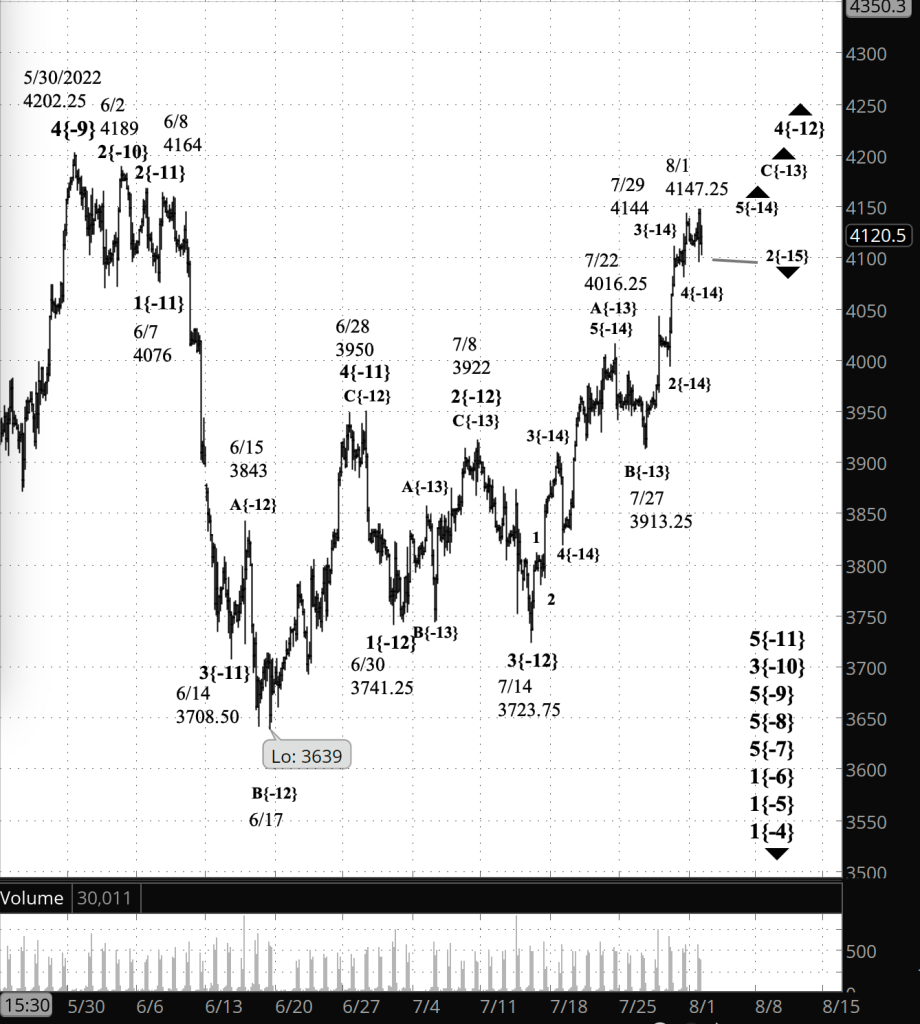
End of the session. The S&P 500 futures ended the session at 4144, a level last seen on June 9, which saw a high 25 cents above today’s peak. I’ve updated the chart.

3:30 p.m. New York time

Half an hour before the closing bell. The S&P 500 has continued to rise during the trading session, reaching into the 4140s on the futures.

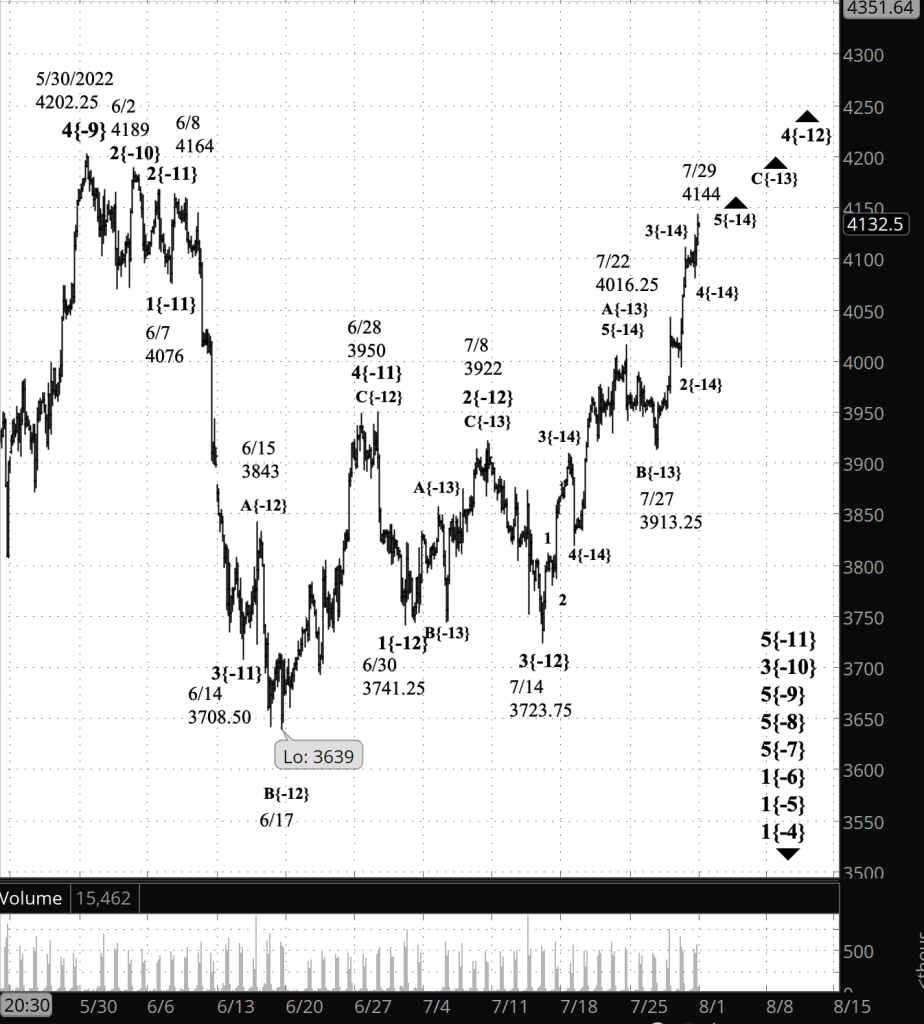
Under my principal analysis, yesterday’s high was the end of the middle wave within the rising last leg of a larger rising corrective pattern that began on July 14. The pull back was the small correction within the last leg, and the consequent rise is the final segment.

In Elliott wave terminology: Within wave C{-13}, yesterday’s high ended wave 3{-14}, the downward retracement was wave 4{-14}, and the subsequent rise in today’s session is wave 5{-14}, the final wave within the C wave. This is all happening with wave 4{-12}, the upward correction that began on July 14.

Bottom line: At this point we’re fishing for a top. Any fresh high can be seen as the end of wave 5{-14} and its parent and grandparent waves, C{-13} and most likely 4{-12}

No change in the analysis. I’ve updated the chart.

1:50 p.m. New York time

AAPL earnings play exit. I’ve exited my short bull put vertical spread on AAPL for 53.5% of maximum potential profit and have updated the trade analysis with full results.

9:35 a.m. New York time

What’s happening now? The S&P 500 E-mini futures continued to rise after yesterday’s closing bell, reaching a high of 4111 and then pulling back slightly.

What does it mean? By my count, the overnight high marks the end of the middle segment within the final leg of a corrective pattern that began on July 14. The middle segment will be followed by a pullback and then a push higher.

What is the alternative? It’s possible that the small pullback isn’t the end of the middle segment and that it will push higher before it’s done.

[S&P 500 E-mini futures at 4 p.m., 150-minute bars, with volume]

What does Elliott wave theory say? Under the principal analysis, the overnight high marks the end of rising wave 3{-14}, the middle of five waves within rising wave C{-13}, which in turn is the final wave of a three-wave corrective pattern and perhaps of the entire upward correction, wave 4{-12}, which began on July 14. Wave 3{-14} is followed by a wave 4{-14} pull back, which in turn will be followed by rising wave 5{-14}, which will bring waves C{-13} and its parent, wave 4{-12}, to completion.

Some 4th waves form compound corrections, connecting two or three corrective patterns. Most have only a single corrective pattern.

The alternative analysis recognizes that the pull back from yesterday’s high may not be wave 4{-14} but instead could be a movement of smaller degree. If that turns out to be the case, then wave 3{-14} has more upside ahead of it before it reaches completion.

In either vase, wave 4{-12} will be followed by wave 5{-12}, the final component of a downtrend, wave 5{-11}, that began on June 28.

We Are Here.

These are the waves currently in progress under my principal analysis. Each line on the list shows the wave number, with the subscript in curly brackets, the traditional degree name, the starting date, the starting price of the S&P 500 E-mini futures, and the direction of the wave.

  • S&P 500 Index:
  • 5{+3} Supercycle, 7/8/1932, 4.40 (up)
  • 5{+2} Cycle, 12/9/1974, 60.96 (up)
  • 5{+1} Primary, 3/6/2009, 666.79 (up)
  • 5{0} Intermediate, 12/26/2018, 2346.58 (up)
  • 4{-1} Minor, 1/4/2022 4818.62 (down)
  • 1{-2} Minute, 1/4/2022 4818.62 (down)
  • S&P 500 Futures and index:
  • 1{-3} Minuette, 1/4/2022, 4808.25 (down) (futures), 4818.62 (down) (index)
  • S&P 500 Futures:
  • 1{-4} Subminuette, 1/4/2022, 4808.25 (down)
  • 1{-5} Micro, 1/4/2022, 4808.25 (down)
  • 1{-6} Submicro, 1/4/2022, 4808.25 (down)
  • 5{-7} Minuscule, 3/29/2022, 4631 (down)
  • 5{-8} Subminuscule, 4/21/2022, 4509 (down)
  • 5{-9} Bitsy, 5/30/2022, 4202.25 (down)
  • 3{-10} Subbitsy, 6/2/2022, 4189 (down)
  • 5{-11} Deci, 6/8/2022, 4164 (down)

Learning and other resources. Elliott wave analysis provides context, not prophecy. As the 20th century semanticist Alfred Korzybski put it in his book Science and Sanity (1933), “The map is not the territory … The only usefulness of a map depends on similarity of structure between the empirical world and the map.” And I would add, in the ever-changing markets, we can judge that similarity of structure only after the fact.

See the menu page Analytical Methods for a rundown on where to go for information on Elliott wave analysis.

By Tim Bovee, Portland, Oregon, July 29, 2022

Disclaimer

Tim Bovee, Private Trader tracks the analysis and trades of a private trader for his own accounts. Nothing in this blog constitutes a recommendation to buy or sell stocks, options or any other financial instrument. The only purpose of this blog is to provide education and entertainment.

No trader is ever 100 percent successful in his or her trades. Trading in the stock and option markets is risky and uncertain. Each trader must make trading decisions for his or her own account, and take responsibility for the consequences.

License
Creative Commons License

All content on Tim Bovee, Private Trader by Timothy K. Bovee is licensed under a Creative Commons Attribution-ShareAlike 4.0 International License.

Based on a work at www.timbovee.com.