Update 7/29/2022: I exited my short bull put vertical spread on AAPL, 21 days before expiration, for a $0.93 debit per contract/share, a profit before fees of $107 per contract. Shares were trading at $161.24, up $6.12 from the entry level.
The Implied Volatility Rank at exit was 35.8%, down 5.4 points from the entry level.
I exited on the day after entry because the position reached 53.5% of maximum potential profit, well above my normal exit point for earnings plays, 25% of max.
Shares rose by 3.9% over one day for a +1,440% annual rate. The options position produced a 115.1% return for a +41,995% annual rate.
I have entered a short bull put vertical spread on AAPL, using options that trade for the last time 22 days hence, on August 19. The premium is a $2.00 credit per contract share and the stock at the time of entry was priced at $155.12.
The Implied Volatility Ratio stood at 41.2%.
Premium:
$2.00
Expire OTM
AAPL-bull put spread
Strike
Odds
Delta
Puts
Long
145.00
76.0%
22
Break-even
154.50
66.5%
31.5
Short
152.50
57.0%
41
The premium is 53.3% of the width of the position’s short/long spread. The profit zone covers a 0.4% move to the downside and an unlimited move to the upside.
The risk/reward ratio is 2.8:1, with maximum risk of $550 and maximum reward of $200 per contract.
How I chose the trade. The trade was placed to coincide with AAPL’s earnings announcement, after the closing bell on the day of entry. The short strikes were set to coincide with the expected move of $4.70 either way, based on options pricing, which gives a price range of $152.20 to $161.60.
By Tim Bovee, Portland, Oregon, July 28, 2022
Disclaimer
Tim Bovee, Private Trader tracks the analysis and trades of a private trader for his own accounts. Nothing in this blog constitutes a recommendation to buy or sell stocks, options or any other financial instrument. The only purpose of this blog is to provide education and entertainment.
No trader is ever 100 percent successful in his or her trades. Trading in the stock and option markets is risky and uncertain. Each trader must make trading decisions for his or her own account, and take responsibility for the consequences.
Half an hour before the closing bell. The S&P 500 rose throughout the day, with the futures reaching into the 4070s. The final leg of the upward corrective pattern that began on July 14 is still underway. In Elliott wave terminology, the correction is wave 4{-12}, and internally, it is in wave 3{-13}, the middle wave of a five-wave series. Third waves tend to be the strongest of the series, and today’s powerful push certainly illustrates that fact.
No change in the analysis. I’ve updated the chart below.
10:45 a.m. New York time
AAPL earnings play entry. I’ve entered a short bull put vertical spread on AAPL, using options that trade for the last time on August. 19, and have posted an analysis of the trade.
10:20 a.m. New York time
CHRW, EQT earnings plays exits. I’ve exited two short bull put vertical spreads, a day after entering the options positions, and have updated the analyses with full results. The trades were on CHRW and EQT.
9:35 a.m. New York time
What’s happening now? The S&P 500 E-mini futures declined slightly overnight, rising slightly at the opening bell.
What does it mean? The pull back is the first of two within the rising final leg of an upward correction that began on July 14.
What is the alternative? It’s possible that the first leg of the correction is still underway. The higher the price rises today, the less likely the alternative will be.
[S&P 500 E-mini futures at 3:30 p.m., 140-minute bars, with volume]
What does Elliott wave theory say? Under the principal analysis, the upward correction, wave 4{-12}, is in its final segment, wave C{-13}. The C wave will have five waves internally, and I’m counting the overnight pullback as the second of those five waves.
Under the alternative analysis, the correction’s first wave, A{-13}, is still underway, and the pullback from July 22 and the subsequent rise are movements within that wave. The higher the price moves, the less proportional internal structure of wave A{-13} becomes and the less likely it is that the alternative analysis will match the chart.
In any case, wave C{-13} will most likely mark the end of the wave 4{-12} correction. If the correction forms a compound structure, linking two three corrective patterns together, then wave 4{-12} will have longer to go before reaching its end.
Wave 4{-12} will be followed by a resumption of the downtrend, wave 5{-11}, that began on June 28, in the form of wave 5{-12}, which will likely carry the price into the 3600s or lower.
We Are Here.
These are the waves currently in progress under my principal analysis. Each line on the list shows the wave number, with the subscript in curly brackets, the traditional degree name, the starting date, the starting price of the S&P 500 E-mini futures, and the direction of the wave.
Learning and other resources. Elliott wave analysis provides context, not prophecy. As the 20th century semanticist Alfred Korzybski put it in his book Science and Sanity (1933), “The map is not the territory … The only usefulness of a map depends on similarity of structure between the empirical world and the map.” And I would add, in the ever-changing markets, we can judge that similarity of structure only after the fact.
See the menu page Analytical Methods for a rundown on where to go for information on Elliott wave analysis.
By Tim Bovee, Portland, Oregon, July x, 2022
Disclaimer
Tim Bovee, Private Trader tracks the analysis and trades of a private trader for his own accounts. Nothing in this blog constitutes a recommendation to buy or sell stocks, options or any other financial instrument. The only purpose of this blog is to provide education and entertainment.
No trader is ever 100 percent successful in his or her trades. Trading in the stock and option markets is risky and uncertain. Each trader must make trading decisions for his or her own account, and take responsibility for the consequences.
Update 7/28/2022: I exited my short bull put vertical spread on CHRW, 22 days before expiration, for a $0.98 debit per contract/share, a profit before fees of $33 per contract. Shares were trading at $103.74, up $3.70 from the entry level.
The Implied Volatility Rank at exit was 62.5%, down 2.7 points from the entry level.
I exited on the day after entry because the position reached 25% of maximum potential profit, my normal exit point for earnings plays.
Shares rose by 3.7% over one day for a +1,350% annual rate. The options position produced a 33.7% return for a +12,291% annual rate.
I have entered a short bull put vertical spread on CHRW, using options that trade for the last time 23 days hence, on August 19. The premium is a $1.31 credit per contract share and the stock at the time of entry was priced at $100.04.
The Implied Volatility Ratio stood at 69.9%.
Premium:
$1.31
Expire OTM
CHRW-bull put spread
Strike
Odds
Delta
Puts
Long
92.50
77.0%
21
Break-even
98.81
68.0%
29
Short
97.50
59.0%
37
The premium is 52.4% of the width of the position’s short/long spread. The profit zone covers a 1.2% move to the downside and an unlimited move to the upside.
The risk/reward ratio is 2.8:1, with maximum risk of $369 and maximum reward of $131 per contract.
How I chose the trade. The trade was placed to coincide with CHRW’s earnings announcement, after the closing bell on the day of entry. The short strikes were set to coincide with the expected move of $5.65 either way, based on options pricing, which gives a price range of $94.18 to $104.48.
By Tim Bovee, Portland, Oregon, July 27, 2022
Disclaimer
Tim Bovee, Private Trader tracks the analysis and trades of a private trader for his own accounts. Nothing in this blog constitutes a recommendation to buy or sell stocks, options or any other financial instrument. The only purpose of this blog is to provide education and entertainment.
No trader is ever 100 percent successful in his or her trades. Trading in the stock and option markets is risky and uncertain. Each trader must make trading decisions for his or her own account, and take responsibility for the consequences.
Update 7/28/2022: I exited my short bull put vertical spread on EQT, 22 days before expiration, for a $1.05 debit per contract/share, a profit before fees of $20 per contract. Shares were trading at $46.25, up $1.01 from the entry level.
The Implied Volatility Rank at exit was 48.8%, up 2.7 points from the entry level.
The position failed to reach my target, 25% of maximum potential profit, and so I took the profit that was available, which was 16% of max.
Shares rose by 2.2% over one day for a +815% annual rate. The options position produced a 19.0% return for a +6,952% annual rate.
I have entered a short bull put vertical spread on EQT, using options that trade for the last time 23 days hence, on August 19. The premium is a $1.25 credit per contract share and the stock at the time of entry was priced at $45.24.
The Implied Volatility Ratio stood at 46.1%.
Premium:
$1.25
Expire OTM
EQT-bull put spread
Strike
Odds
Delta
Puts
Long
38.00
81.0%
15
Break-even
44.25
70.0%
25
Short
43.00
59.0%
35
The premium is 50% of the width of the position’s short/long spread. The profit zone covers a 2.2% move to the downside and an unlimited move to the upside.
The risk/reward ratio is 3:1, with maximum risk of $375 and maximum reward of $125 per contract.
How I chose the trade. The trade was placed to coincide with EQT’s earnings announcement, after the closing bell on the day of entry. The short strikes were set to coincide with the expected move of $4.67 either way, based on options pricing, which gives a price range of $40.48 to $49.82.
By Tim Bovee, Portland, Oregon, July 27, 2022
Disclaimer
Tim Bovee, Private Trader tracks the analysis and trades of a private trader for his own accounts. Nothing in this blog constitutes a recommendation to buy or sell stocks, options or any other financial instrument. The only purpose of this blog is to provide education and entertainment.
No trader is ever 100 percent successful in his or her trades. Trading in the stock and option markets is risky and uncertain. Each trader must make trading decisions for his or her own account, and take responsibility for the consequences.
Half an hour before the closing bell. The S&P 500 shot above Friday’s high, 4016.25 on the futures, into the 4040s, in a move that began before the Federal Open Market Committee increased the Fed Funds Rate by 75 basis points. Although the movement was triggered by an event, the market response must still fit within the rules and norms of Elliott wave analysis.
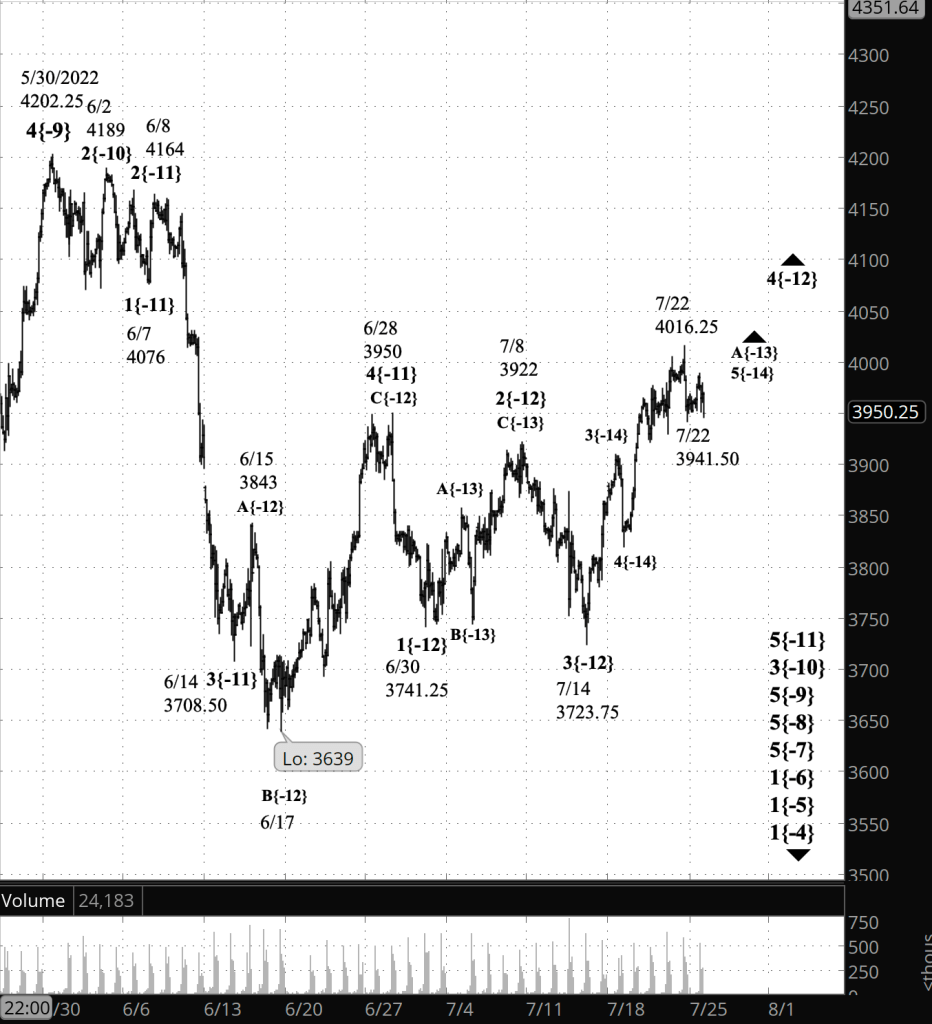
As indeed this response does. The rise above Friday’s high triggers the alternative analysis from this morning. It’s ambiguous, but the power of the rise tilts the analysis in favor of the third wave of the upward correction having begun from the overnight low, 3913.25.
In Elliott wave terminology: An upward correction, wave 4{-12}, which began on July 14, is still underway. Wave A{-13} within it ended on July 22 at 4016.25. Wave B{-13} ended today, July 27, at 3919.27, just a few cents above the usual range for a B-wave (as discussed in this morning’s analysis). Wave C{-13} is now underway. A C wave often about the same length as the preceding A wave. That would suggest that wave C{-13} will rise by 292.50 points, to 4202.75 — more or less; it’s a tendency, not a rule.
I’ve retained this morning’s chart for comparison and have posted a new one.
[New principal analysis: S&P 500 E-mini futures at 3:30 p.m., 135-minute bars, with volume]
2:40 p.m. New York time
BG earnings play exit. I’ve exited my short bull put vertical spread on BG for 45.3% of maximum potential loss and have updated the trade analysis with full results. https://timbovee.com/2022/07/26/bg-trade/
2:20 p.m. New York time
CHRW and EQT earnings plays entries. I’ve entered short bull put vertical spreads on CHRW and EQT, using options that trade for the last time on August 19, and have posted analyses of each trade: CHRW, EQT.
9:35 a.m. New York time
What’s happening now? The S&P 500 E-mini futures rose slightly in overnight trading, remaining in the mid-3900s.
What does it mean? The descending middle leg of the upward correction that began on July 14 is underway. If it’s typical, it will end somewhere between 3905 and 3795. It will be followed by an ascending final leg of the corrective pattern that most likely will rise above 4016.25, the price where the correction’s first leg ended.
What is the alternative? It’s possible that the price will rise above 4016.25 without falling any lower. If it does, then it will present the analysis with a huge ambiguity: Is the first leg of the correction still underway, or was rise the third leg of the correction following an unusually short second leg?
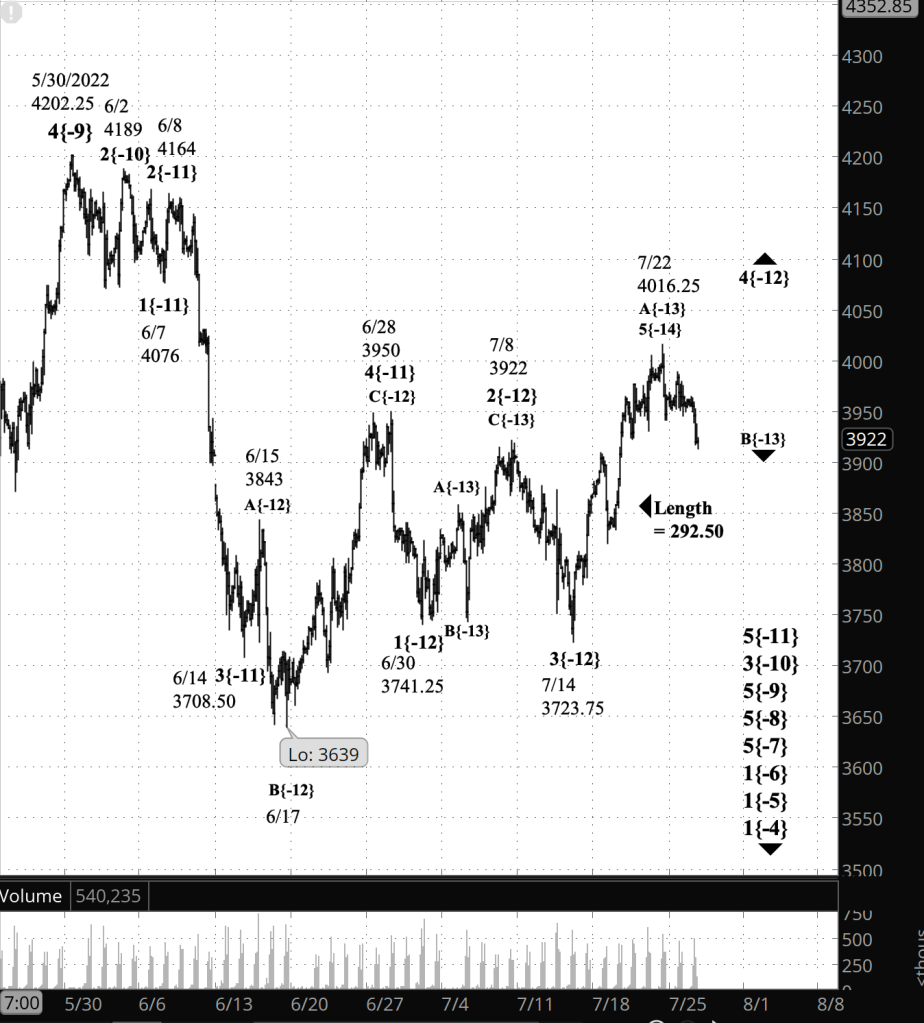
The chart. On the S&P 500 futures chart below, I’ve marked the most likely range for the descending middle leg of the correction to end, using dashed lines for the upper boundary, 3905.10, and the lower boundary, 3795.17. More on this in the Elliott wave theory section below.
[Outdated principal analysis: S&P 500 E-mini futures at 9:35 a.m., 135-minute bars, with volume
What does Elliott wave theory say? The decline from July 22 is wave B{-13} within an upward correction, wave 4{-12}. The correction began on July 14 from 3723.75.
Wave B{-13} will be followed by an upward wave C{-13}, which most likely will move above the end of wave A{-13}, at 4016.25.
How far wave B{-13} is likely to decline depends upon what form the overall correction is taking. The two most common forms are the Zigzag and the Flat, which with three waves internally. The type of form among those two is defined by the number of waves one degree lower within the A wave. If wave A has five waves internally, then the correction is a Zigzag. If wave A has three waves, then the correction is a Flat.
Wave A{-13} is, quite frankly, a bit messy. I can count it either way, but five-wave count seems less messy to me than does a three-wave count. So I consider wave 4{-12} to be a Zigzag.
In Zigzags, the B wave tends to retrace between 38% and 79% of the preceding A wave. Wave A{-13} has a length of 292.50. Therefore, wave B{-13} will end between 111.15 to 231.08 points below the end of wave A{-13}, giving price targets in the range of 3905.10 to 3795.17. Futures prices move in 25-cent intervals, so there will be some rounding on the chart as wave B{-13} progresses. And there is no guarantee that this Zigzag will behave typically. The 38% to 79% retracement is a tendency, not a rule.
Wherever it ends, wave B{-13} will be followed by ascending wave C{-13}, which typically will move above the end point of the preceding A wave: 4016.25.
Most likely, wave C{-13} will be the end of wave 4{-12}, which will be followed by wave 5{-12}, a resumption of the 5{-11} downtrend that began on June 28. An exception would be if wave 4{-12} formed a compound structure, linking two or three corrective waves together and delaying the start of wave 5{-12}.
We Are Here.
These are the waves currently in progress under my principal analysis. Each line on the list shows the wave number, with the subscript in curly brackets, the traditional degree name, the starting date, the starting price of the S&P 500 E-mini futures, and the direction of the wave.
Learning and other resources. Elliott wave analysis provides context, not prophecy. As the 20th century semanticist Alfred Korzybski put it in his book Science and Sanity (1933), “The map is not the territory … The only usefulness of a map depends on similarity of structure between the empirical world and the map.” And I would add, in the ever-changing markets, we can judge that similarity of structure only after the fact.
See the menu page Analytical Methods for a rundown on where to go for information on Elliott wave analysis.
By Tim Bovee, Portland, Oregon, July 27, 2022
Disclaimer
Tim Bovee, Private Trader tracks the analysis and trades of a private trader for his own accounts. Nothing in this blog constitutes a recommendation to buy or sell stocks, options or any other financial instrument. The only purpose of this blog is to provide education and entertainment.
No trader is ever 100 percent successful in his or her trades. Trading in the stock and option markets is risky and uncertain. Each trader must make trading decisions for his or her own account, and take responsibility for the consequences.
Update 7/27/2022: I exited my short bull put vertical spread on BG, 23 days before expiration, for a $1.78 debit per contract/share, a loss before fees of $71 per contract. Shares were trading at $90.39, down $5.03 from the entry level.
The Implied Volatility Rank at exit was 63.6%, down 29.5 points from the entry level.
I exited on the day after entry, at 45.3% of maximum potential loss, because I’ve rarely seen a losing position return to profitability. In my view, better to take the loss and move on.Analysts expected earnings of $3.40 per share; instead, the report was for 2.97 per share, a 43-cent miss.
Shares declined by 5.3% over one day for a -1,924% annual rate. The options position produced a -39.9% loss for a -14,559% annual rate.
I have entered a short bull put vertical spread on BG, using options that trade for the last time 24 days hence, on August 19. The premium is a $1.07 credit per contract share and the stock at the time of entry was priced at $95.42.
The Implied Volatility Ratio stood at 93.1%.
Premium:
$1.07
Expire OTM
BG-bull put spread
Strike
Odds
Delta
Puts
Long
85.00
80.0%
17
Break-even
91.07
72.5%
24
Short
90.00
65.0%
31
The premium is 42.8% of the width of the position’s short/long spread. The profit zone covers a 4.6% move to the downside and an unlimited move to the upside.
The risk/reward ratio is 3.7:1, with maximum risk of $393 and maximum reward of $107 per contract.
How I chose the trade. The trade was placed to coincide with BG’s earnings announcement, before the opening bell on the day after entry. The short strikes were set to coincide with the expected move of $7.43 either way, based on options pricing, which gives a price range of $86.91 to $101.77.
By Tim Bovee, Portland, Oregon, July 26, 2022
Disclaimer
Tim Bovee, Private Trader tracks the analysis and trades of a private trader for his own accounts. Nothing in this blog constitutes a recommendation to buy or sell stocks, options or any other financial instrument. The only purpose of this blog is to provide education and entertainment.
No trader is ever 100 percent successful in his or her trades. Trading in the stock and option markets is risky and uncertain. Each trader must make trading decisions for his or her own account, and take responsibility for the consequences.
Half an hour before the closing bell. After a quiet night the S&P 500 futures began to to fall during session, from the 3950s to the 3910s, reaching levels last seen a week earlier.
That decline is enough to give this morning’s alternative analysis the edge, and I’ve promoted it to primary analysis: The first leg of the upward correction that began on July 14 ended on July 22 at 4016.25, and the middle leg of the correction is now underway.
In Elliott wave terminology: The upward correction is wave 4{-12}, and within it wave A{-13} was completed on July 22, and wave B{-13} began from that point.
Wave 4{-12} appears to be taking the form of a Zigzag, which means that the B wave will retrace 38% to 79% of the preceding A wave. Wave A{-13} was 292.50 in length, so wave B{-13} will cover 111.15 to 231.08 points, giving price targets in the range of 3905.10 to 3795.17. Futures prices move in 25-cent intervals, so there will be some rounding on the chart as wave B{-13} progresses.
Wave B{-13} will have three waves internally, at the {-14} degree.
3:05 p.m. New York time
UPS earnings play exit. I’ve exited my short bull put options spread on UPS for 56.2% f maximum potential loss and have updated the trade analysis with full results.
2:30 p.m. New York time
BG earnings play entry. I’ve entered a short bull put spread on BG, using options that trade for the last time on 9/19, and have posted an analysis of the trade.
11 a.m. New York time
MCD earnings play exit. I’ve exited my short bull put options spread on MCD for 17.2% of maximum potential profit and have updated the trade analysis with full results.
9:35 a.m. New York time
What’s happening now? The S&P 500 E-mini futures were caged in a narrow range overnight, remaining below Friday’s high (4016.25) and above that day’s low (3941.50).
What does it mean? The chart remains ambiguous. As the principal analysis, I’ve marked the chart to show that within the upward correction that began on July 14, the first leg is underway.
What is the alternative? The alternative is of equal likelihood: The first leg of the correction ended on June 22 at 4016.25.
[S&P 500 E-mini futures at 3:30 p.m., 135-minute bars, with volume]
What does Elliott wave theory say? The upward correction is wave 4{-12}, and under the principal analysis, it’s first internal wave, rising A{-13} is underway. Under the alternative analysis, wave A{-13} ended on July 22 and descending wave B{-13} — the middle of a three-wave corrective pattern — is now underway.
The chart can be read either way, so basically, choosing between the principal analysis and the alternative is the flip of a coin.
It’s possible that wave 4{-12} will form a compound structure, connecting two or three corrective patterns before reaching its end. Among the two positions of corrective waves, compound corrections are more common in 4th waves than in 2nd waves. In both cases, most corrections are simple, with a single corrective pattern.
Whatever the form of wave 4{-12}, it will be followed by wave 5{-12}, a resumption of the wave 5{-11} downtrend that began on June 28. Wave 5{-12} will carry the price down into the 3700s, probably 3600s and perhaps even lower.
We Are Here.
These are the waves currently in progress under my principal analysis. Each line on the list shows the wave number, with the subscript in curly brackets, the traditional degree name, the starting date, the starting price of the S&P 500 E-mini futures, and the direction of the wave.
Learning and other resources. Elliott wave analysis provides context, not prophecy. As the 20th century semanticist Alfred Korzybski put it in his book Science and Sanity (1933), “The map is not the territory … The only usefulness of a map depends on similarity of structure between the empirical world and the map.” And I would add, in the ever-changing markets, we can judge that similarity of structure only after the fact.
See the menu page Analytical Methods for a rundown on where to go for information on Elliott wave analysis.
By Tim Bovee, Portland, Oregon, July 26, 2022
Disclaimer
Tim Bovee, Private Trader tracks the analysis and trades of a private trader for his own accounts. Nothing in this blog constitutes a recommendation to buy or sell stocks, options or any other financial instrument. The only purpose of this blog is to provide education and entertainment.
No trader is ever 100 percent successful in his or her trades. Trading in the stock and option markets is risky and uncertain. Each trader must make trading decisions for his or her own account, and take responsibility for the consequences.
Update 7/26/2022: I exited my short bull put vertical spread on UPS, 24 days before expiration, for a $2.05 debit per contract/share, a loss before fees of $70 per contract. Shares were trading at $180.39, $8.19 from the entry level.
The Implied Volatility Rank at exit was 31.0%, down 33.0 points from the entry level.
I exited on the day after entry, for 56.2% of maximum potential loss, because experience has shown me that waiting to exit from a losing position generally means greater losses, over the short-term at least. I am a short-term trader. Earnings beat the estimates by 15 cents per share. Nonetheless, the share price headed south.
Shares fell by 4.3% over one day for a -1,585% annual rate. The options position produced a 34.1% loss for a -12,463% annual rate.
I have entered a short bull put vertical spread on UPS, using options that trade for the last time 25 days hence, on August 19. The premium is a $1.35 credit per contract share and the stock at the time of entry was priced at $188.58.
The Implied Volatility Ratio stood at 64.0%.
Premium:
$1.35
Expire OTM
UPS-bull put spread
Strike
Odds
Delta
Puts
Long
175.00
73.0%
23
Break-even
181.35
69.0%
27
Short
180.00
65.0%
31
The premium is 54.0% of the width of the position’s short/long spread. The profit zone covers a 3.8% move to the downside and an unlimited move to the upside.
The risk/reward ratio is 2.7:1, with maximum risk of $365 and maximum reward of $135 per contract.
How I chose the trade. The trade was placed to coincide with UPS’s earnings announcement, before the opening bell on the day after entry. The short strikes were set to coincide with the expected move of $9.16 either way, based on options pricing, which gives a price range of $179.42 to $197.74.
By Tim Bovee, Portland, Oregon, July 25, 2022
Disclaimer
Tim Bovee, Private Trader tracks the analysis and trades of a private trader for his own accounts. Nothing in this blog constitutes a recommendation to buy or sell stocks, options or any other financial instrument. The only purpose of this blog is to provide education and entertainment.
No trader is ever 100 percent successful in his or her trades. Trading in the stock and option markets is risky and uncertain. Each trader must make trading decisions for his or her own account, and take responsibility for the consequences.
Update 7/26/2022: I exited my short bull put vertical spread on MCD, 33 days before expiration, for a $1.11 debit per contract/share, a profit before fees of $23 per contract. Shares were trading at $254.08, up $1.9 from the entry level.
The Implied Volatility Rank at exit was 33.0%, down 11.7 points from the entry level.
I exited on the day after entry as the position reached 17.2% of maximum potential profit, a bit less than my normal exit point for earnings plays, 25% of max. My goal is to get out of a position the next trading day after entry, and so I was willing to accept less than my goal in order to accomplish that result.
Shares rose by 1.9% over one day for a +676% annual rate. The options position produced a 20.7% return for a +7,563% annual rate.
I have entered a short bull put vertical spread on MCD, using options that trade for the last time 25 days hence, on August 19. The premium is a $1.34 credit per contract share and the stock at the time of entry was priced at $249.46.
The Implied Volatility Ratio stood at 44.78%.
Premium:
$1.34
Expire OTM
MCD-bull put spread
Strike
Odds
Delta
Puts
Long
240.00
71.0%
27
Break-even
246.34
65.5%
32
Short
245.00
60.0%
37
The premium is 53.6% of the width of the position’s short/long spread. The profit zone covers a 1.3% move to the downside and an unlimited move to the upside.
The risk/reward ratio is 2.7:1, with maximum risk of $366 and maximum reward of $134 per contract.
How I chose the trade. The trade was placed to coincide with MCD’s earnings announcement, before the opening bell on the day after entry. The short strikes were set to coincide with the expected move of $5.75 either way, based on options pricing, which gives a price range of $243.71 to $255.21.
By Tim Bovee, Portland, Oregon, July 25, 2022
Disclaimer
Tim Bovee, Private Trader tracks the analysis and trades of a private trader for his own accounts. Nothing in this blog constitutes a recommendation to buy or sell stocks, options or any other financial instrument. The only purpose of this blog is to provide education and entertainment.
No trader is ever 100 percent successful in his or her trades. Trading in the stock and option markets is risky and uncertain. Each trader must make trading decisions for his or her own account, and take responsibility for the consequences.
Half an hour before the closing bell. The S&P 500 has traded in a narrow range, remaining below Friday’s high, 4016.25, and above that day’s low, 3941.50. No change in this morning’s analysis. I’ve updated the chart, below.
2:05 p.m. New York time
MCD, UPS earnings plays entered. I’ve entered two short bear put vertical spreads, using options that trade for the last time on August 19. I’ve posted trade analyses for MCD and UPS.
9:35 a.m. New York time
What’s happening now? The S&P 500 E-mini futures rose overnight from the mid-3900s back into the upper 3900s. The price remained below Friday’s high, 4016.25.
What does it mean? The nature of Friday’s high remains uncertain. For my primary analysis, I’ve chosen to treat it as a stopping point within the first leg of an upward correction that began on July 14. Under this scenario, the overnight rise is a step leading to a new high.
What is the alternative? Of equal likelihood, Friday’s high could mark the end of the first leg of the upward correction, and the subsequent decline and rise are the early stages of the correction’s middle leg.
[S&P 500 E-mini futures at 3:30 p.m., 125-minute bars, with volume]
What does Elliott wave theory say? Under the principal analysis, wave A{-13} began on July 14 and is still underway. It is the first segment of an upward correction, wave 4{-12}.
Under the alternative analysis, wave A{-13} ended at Friday’s high, 4016.25, and from that point wave B{-13} began its decline.
In either case, the future rising wave C{-13} will likely be the final wave within the upward correction. The end of the correction, wave 4{-12}, will also be the beginning of wave 5{-12}, a resumption of the downtrend, wave 5{-11}, that began on June 28 from 3950. Wave 5{-12} will eventually carry the price back down to the 3700s or 3600s, and perhaps even lower.
It’s possible that wave 4{-12} will form a compound structure containing two or three corrective patterns. Most 4th wave corrections form simple structures, with with a single corrective pattern.
Wave 5{-11} is the final wave of a larger downtrend, wave 3{-10}, which in turn is part of a series of waves a increasingly greater magnitude, listed below in the “We Are Here” section.
We Are Here.
These are the waves currently in progress under my principal analysis. Each line on the list shows the wave number, with the subscript in curly brackets, the traditional degree name, the starting date, the starting price of the S&P 500 E-mini futures, and the direction of the wave.
Learning and other resources. Elliott wave analysis provides context, not prophecy. As the 20th century semanticist Alfred Korzybski put it in his book Science and Sanity (1933), “The map is not the territory … The only usefulness of a map depends on similarity of structure between the empirical world and the map.” And I would add, in the ever-changing markets, we can judge that similarity of structure only after the fact.
See the menu page Analytical Methods for a rundown on where to go for information on Elliott wave analysis.
By Tim Bovee, Portland, Oregon, July 25, 2022
Disclaimer
Tim Bovee, Private Trader tracks the analysis and trades of a private trader for his own accounts. Nothing in this blog constitutes a recommendation to buy or sell stocks, options or any other financial instrument. The only purpose of this blog is to provide education and entertainment.
No trader is ever 100 percent successful in his or her trades. Trading in the stock and option markets is risky and uncertain. Each trader must make trading decisions for his or her own account, and take responsibility for the consequences.


 Tim Bovee, Private Trader
You must be logged in to post a comment.