Update 4/29/2022: I exited my short bull put vertical spread on KO, 50 days before expiration, for a $1.53 debit per contract/share, a loss before fees of $43 per contract. Shares were trading at $64.82, down $1.19 from the entry level.
The Implied Volatility Rank at exit was 68.4%, up 14 points from the entry level.
I exited because the position for a loss after seven days because there was no sign of improvement on the chart and I wanted to avoid higher losses.
Shares decline by 1.8% over seven days for a -94% annual rate. The options position produced a 28.1% loss for a 1,466% annual rate.
I have entered a short bull put options spread on KO, using options that trade for the last time 56 days hence, on June 17. The premium is a $1.10 credit per contract share and the stock at the time of entry was priced at $66.01.
The Implied Volatility Ratio stood at 54.4%.
Premium:
$1.10
Expire OTM
KO-bull put spread
Strike
Odds
Delta
Calls/Puts
Puts
60.00
61.0%
16
Break-even
66.10
58.0%
28
Short
65.00
55.0%
40
The premium is 44.0% of the width of the position’s short/long spread. The profit zone covers less than a quarter of a percent of a move to the downside and an unlimited move to the upside.
The risk/reward ratio is 3.5:1, with maximum risk of $390 and maximum reward of $110 per contract.
How I chose the trade. The trade was placed to coincide with KO’s earnings announcement, before the opening bell on Monday, April 25, after the weekend. The short strike was set to coincide with the expected move of $1.77 either way, based on options pricing, which gives a price range of $64.66 to $67.14.
By Tim Bovee, Portland, Oregon, April 22, 2022
Disclaimer
Tim Bovee, Private Trader tracks the analysis and trades of a private trader for his own accounts. Nothing in this blog constitutes a recommendation to buy or sell stocks, options or any other financial instrument. The only purpose of this blog is to provide education and entertainment.
No trader is ever 100 percent successful in his or her trades. Trading in the stock and option markets is risky and uncertain. Each trader must make trading decisions for his or her own account, and take responsibility for the consequences.
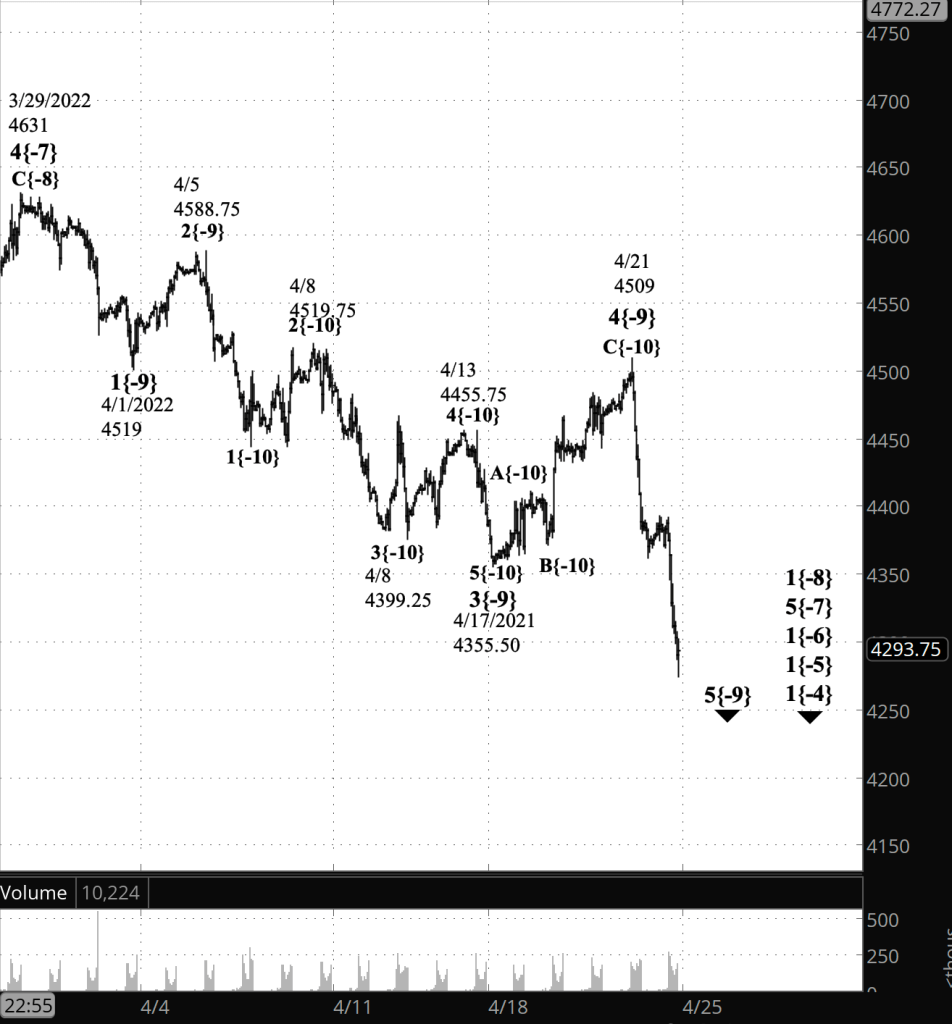
Half an hour before the closing bell. The S&P 500 has declined throughout the day, reaching a low on the futures so far, 4274.50. No change in the revised analysis. Downtrending wave 5{-9} continues. I’ve updated the upper chart.
1:40 p.m. New York time
PG earnings play final exit. I exited the short calls in my bear call options spread on PG two days ago and exited the long calls today, completing my exit from the position. Overall, it was a small loss. I’ve updated the trade analysis with results from the long calls exit and the exit from the full spread.
11:40 a.m. New York time
Revised analysis of the S&P 500. The S&P 500 has dropped below 4355.50 on the futures, requiring a reanalysis of the upward correction that began on April 17 and the decline that began on April 21.
Under the new analysis, the upward correction ended on April 21, and the downtrend that began on March 29 resumed and can be expected to carry the price lower by a significant amount.
[REVISED ANALYSIS: S&P 500 E-Mini futures at 3:30 p.m., 55-minute bars, with volume]
In Elliott wave terms: Rising wave 4{-9} ended on April 21 at 4509 and wave 5{-9} began its decline. All of this is happening within wave 1{-8}, which began on March 29 from 4631.
This morning’s analysis analyzed the decline as wave B{-10} within an ongoing wave 4{-9} correction. However, when the price dropped below 4355.50, the end of wave 3{-9}, it became clear that wave 4{-9} was no longer underway. It is a firm rule of Elliott wave analysis that a 4th wave cannot move beyond the end of the preceding 3rd wave. The chart broke that rule, so the decline couldn’t be part of wave 4{-9}.
Under my revised analysis, wave 4{-9} ended on April 21 at 4509 after completing three waves internally. Wave A{-10} had three waves within it; B{-10} three waves; and C{-10} five waves, the definition of a Flat correction.
There is no limit to how far wave 5{-9} can decline, beyond the limits of proportionality with other waves of that same degree. The preceding wave 3{-9} was 233.25 points long on the futures. If wave 5{-9} were to turn out to be the same length, it would carry the price down to the high 4200s. Wave 3{-9} is not the shortest in the set, even if wave 5{-9} is longer, so it could fall further, or it could come up short.
10 a.m. New York time
KO earnings play entry. I’ve entered a short bull put options spread on KO and have posted an analysis of the trade.
9:35 a.m. New York time
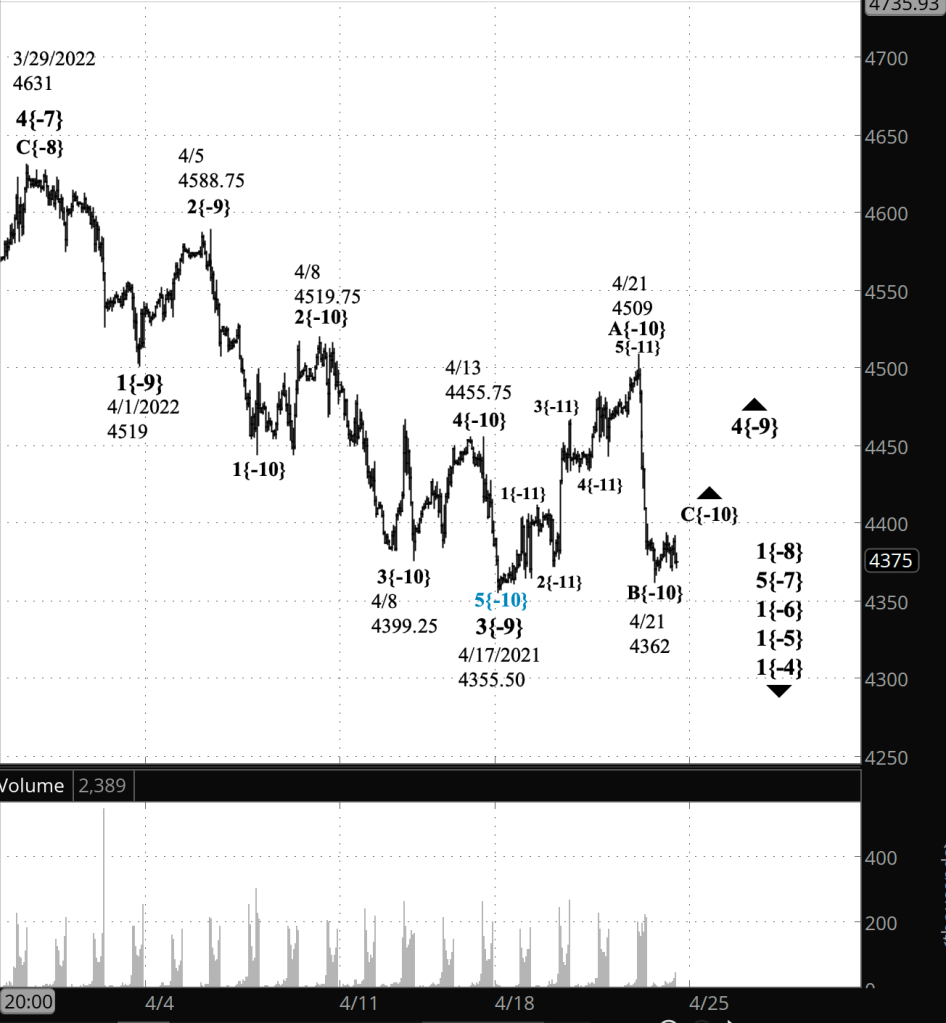
What’s happening now? The S&P 500 E-mini futures rose slightly in overnight trading after falling 147 points in 11 hours, to 4362 and then rose slightly.
What does it mean? The rapid fall was the middle section of a three-part upward corrective structure that began on April 17 from 4355.50. The bounce is the beginning of the third part of the structure, which can be expected to rise back into the low 4500s.
What’s the alternative? It’s possible that the decline isn’t yet complete. If that’s the case, then the price will fall a little further before returning to the low 4500s.
[FORMER ANALYSIS: S&P 500 E-mini futures at 9:35 a.m., 55-minute bars, with volume]
What does Elliott wave theory say? Thursday’s dramatic fall was wave B{-10} within wave 4{-9}, an upward correction that began on April 17. The correction is taking the form of a Zigzag — five waves within wave A{-10}, three within B{-10} and five within the future C{-10}. The velocity of wave B{-10} was so high that the internals aren’t visible on even a 30-minute chart. However, a 2-minute chart clearly shows five waves.
Under the principal analysis, wave B{-10} is complete and wave C{-10} has begun its rise back toward where wave A{-10} ended and B{-10} began. Typically, the C wave will move beyond the end of the preceding A wave — 4509. However, a firm rule in Elliott prohibits it from moving beyond the end of the preceding 1st wave, which is 4519 in this case. So if C{-10} pushes to a new high within the correction, it will remain below 4519.
Under the alternative analysis, wave B{-10} hasn’t yet completed its decline. However, it can’t fall much further. Under the rules of Elliott wave analysis, a B wave can’t move below the start of wave A, 4355.50 in this case.
We Are Here.
These are the waves currently in progress under my principal analysis. Each line on the list shows the wave number, with the subscript in curly brackets, the traditional degree name, the starting date, the starting price of the S&P 500 E-mini futures, and the direction of the wave.
Learning and other resources. Elliott wave analysis provides context, not prophecy. As the 20th century semanticist Alfred Korzybski put it in his book Science and Sanity (1933), “The map is not the territory … The only usefulness of a map depends on similarity of structure between the empirical world and the map.” And I would add, in the ever-changing markets, we can judge that similarity of structure only after the fact.
See the menu page Analytical Methods for a rundown on where to go for information on Elliott wave analysis.
By Tim Bovee, Portland, Oregon, April 22, 2022
Disclaimer
Tim Bovee, Private Trader tracks the analysis and trades of a private trader for his own accounts. Nothing in this blog constitutes a recommendation to buy or sell stocks, options or any other financial instrument. The only purpose of this blog is to provide education and entertainment.
No trader is ever 100 percent successful in his or her trades. Trading in the stock and option markets is risky and uncertain. Each trader must make trading decisions for his or her own account, and take responsibility for the consequences.
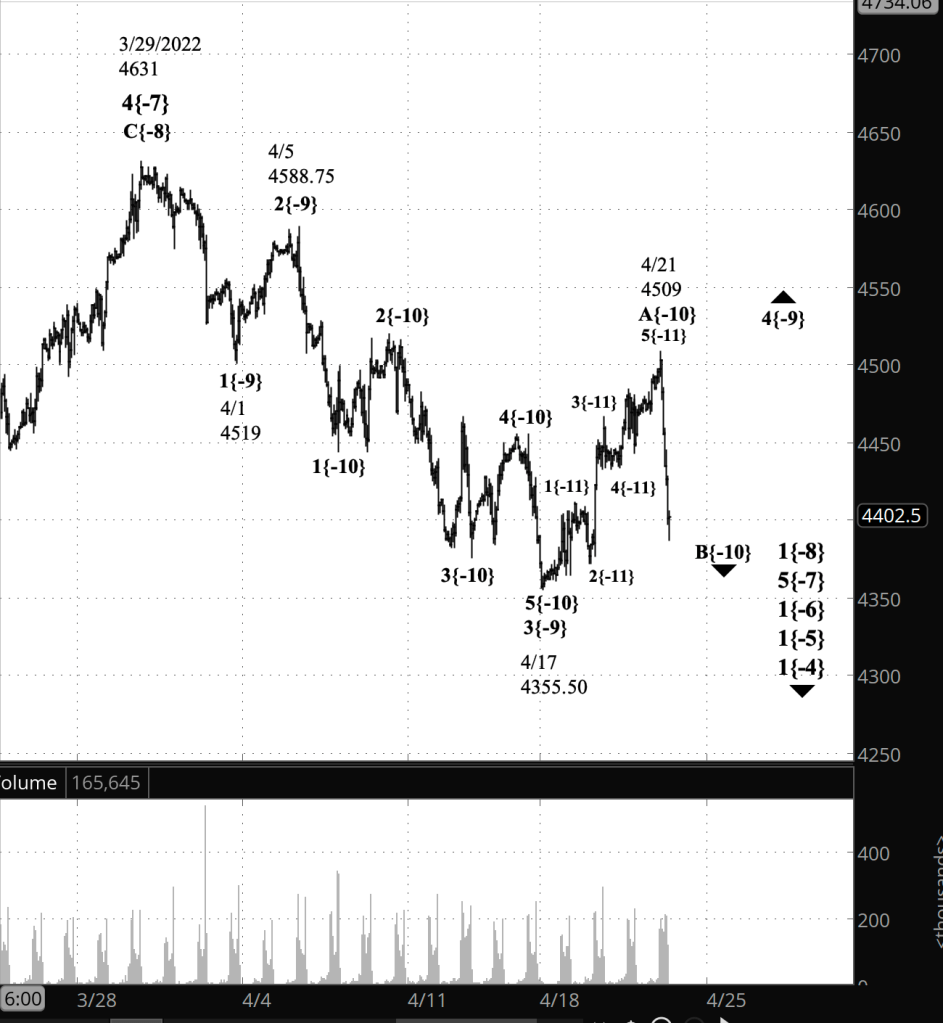
Half an hour before the closing bell. The S&P 500 peaked at 9:35 a.m., at 4509 on the futures, and then began a rapid decline, the middle leg of the upward correction that began on April 17.
Declining wave B{-10} within wave 4{-9} is now underway. The correction is taking the form of a Zigzag, and a B wave in a Zigzag often will retrace up to 78% of the preceding A wave, which gives a target of 4389.27, about where the price is as I write this sentence (at 3:17 p.m.). B waves never move below the start of the preceding A wave, which would be 4355.50 in this case.
Wave B{-10} will be followed by a C wave that will likely carry the price higher than the end of the preceding A wave, at 4509. But not much higher. A 4th wave never moves beyond the end of the preceding 1st wave — 4519 in this case. If it does, then the chart will demand a re-analysis.
9:55 a.m. New York time
DOW earnings play exit. I’ve exited my short bull put options spread for 50.9% of maximum potential profit and have updated the trade analysis with results.
9:35 a.m. New York time
What’s happening now? The S&P 500 E-mini futures rose in overnight trading, reaching the neighborhood of 4500 at the opening bell.
What does it mean? The upward correction that began on April 17 continues. The first leg of the correction had met all of the requirements for completion in yesterday’s session. However, a brief decline quickly reversed, proving it to have been a decline within an ongoing upward movement.
What’s the alternative? None at the moment. The task at this point is to identify the end of the first leg of the correction, and that depends upon the internal structure of the rise that began yesterday. More below in the Elliott wave theory discussion.
[S&P 500 E-mini futures at 3:30 p.m., hourly bars, with volume]
What does Elliott wave theory say? My market close analysis saw the first wave, A{-10} within the upward correction, wave 4{-9}, as having ended at the peak before the price turned down. The correction is taking the form of a Zigzag, and the A-wave in that form has five waves internally. However, the price swiftly reversed to the upside in overnight trading, and wave 5{-11} within wave A{-10} is still underway. Under my revised scenario, yesterday’s peak was the end of wave 1{-12} within wave 5{-11}, the dip was wave 2{-12}, and the resumption of the rise — where we are this morning — is wave 3{-12}.
We Are Here.
These are the waves currently in progress under my principal analysis. Each line on the list shows the wave number, with the subscript in curly brackets, the traditional degree name, the starting date, the starting price of the S&P 500 E-mini futures, and the direction of the wave.
Learning and other resources. Elliott wave analysis provides context, not prophecy. As the 20th century semanticist Alfred Korzybski put it in his book Science and Sanity (1933), “The map is not the territory … The only usefulness of a map depends on similarity of structure between the empirical world and the map.” And I would add, in the ever-changing markets, we can judge that similarity of structure only after the fact.
See the menu page Analytical Methods for a rundown on where to go for information on Elliott wave analysis.
By Tim Bovee, Portland, Oregon, April 21, 2022
Disclaimer
Tim Bovee, Private Trader tracks the analysis and trades of a private trader for his own accounts. Nothing in this blog constitutes a recommendation to buy or sell stocks, options or any other financial instrument. The only purpose of this blog is to provide education and entertainment.
No trader is ever 100 percent successful in his or her trades. Trading in the stock and option markets is risky and uncertain. Each trader must make trading decisions for his or her own account, and take responsibility for the consequences.
Update 4/29/2022: I exited my short bear call vertical spread on UAL, 21 days before expiration, for a $2.81 debit per contract/share, a loss before fees of $166 per contract. Shares were trading at $52.12, up $5.53 from the entry level.
The Implied Volatility Rank at exit was 38.0%, up 4.0 points from the entry level.
I exited 21 days before expiration, for 73.0% of maximum potential loss, because the position was unprofitable, and I saw no signs on the chart that would suggest the position would turn profitable. At 21 days to expiration a short position has generally gotten the maximum benefit from price decay, measured by Theta (Θ).
Shares rose by 11.9% over nine days for a +481% annual rate. The options position produced a 59.1% loss for a -2,396% annual rate.
I have entered a short bear call vertical spread on UAL, using options that trade for the last time 30 days hence, on May 20. The premium is a $1.15 credit per contract share and the stock at the time of entry was priced at $46.59.
The Implied Volatility Ratio stood at 34.0%.
Premium:
$1.15
Expire OTM
UAL-bear call spread
Strike
Odds
Delta
Calls
Long
54.00
87.2%
Break-even
50.15
77.1%
19.5
Short
49.00
67.0%
39
The premium is 46.0% of the width of the position’s short/long spread. The profit zone covers a 7.6% move to the upside and an unlimited move to the downside.
The risk/reward ratio is 3.3:1, with maximum risk of $385 and maximum reward of $115 per contract.
How I chose the trade. The trade was placed to coincide with UAL’s earnings announcement, after the closing bell on the day of entry. The short strikes were set to coincide with the expected move of $2.29 either way, based on options pricing, which gives a price range of $44.41 to $48.47.
By Tim Bovee, Portland, Oregon, April 20, 2022
Disclaimer
Tim Bovee, Private Trader tracks the analysis and trades of a private trader for his own accounts. Nothing in this blog constitutes a recommendation to buy or sell stocks, options or any other financial instrument. The only purpose of this blog is to provide education and entertainment.
No trader is ever 100 percent successful in his or her trades. Trading in the stock and option markets is risky and uncertain. Each trader must make trading decisions for his or her own account, and take responsibility for the consequences.
Update 4/21/2022: I exited my short bull put vertical spread on DOW, 29 days before expiration, for a $0.52 debit per contract/share, a profit before fees of $54 per contract. Shares were trading at $70.03, up $2.50 from the entry level.
The Implied Volatility Rank at exit was 20.7, down 16.1 points from the entry level.
I exited because the position at 50.9% of maximum potential profit, well above my normal exit point for earnings plays, 25% of max.
Shares rose by 3.7% over one day for a +1,351% annual rate. The options position produced a 103.8% return for a +37,904% annual rate.
I have entered a short bull put options spread on DOW, using options that trade for the last time 30 days hence, on May 20. The premium is a $1.06 credit per contract share and the stock at the time of entry was priced at $67.53.
The Implied Volatility Ratio stood at 36.8%.
Premium:
$1.06
Expire OTM
DOW-bull put spread
Strike
Odds
Delta
Puts
Long
61.00
83.0%
15
Break-even
67.06
70.0%
26.5
Short
66.00
57.0%
38
The premium is 42.4% of the width of the position’s short/long spread. The profit zone covers a 0.7% move to the downside and an unlimited move to the upside.
The risk/reward ratio is 3.7:1, with maximum risk of $394 and maximum reward of $106 per contract.
How I chose the trade. The trade was placed to coincide with DOW’s earnings announcement, after the open bell on the day after entry. The short strikes were set to coincide with the expected move of $2.06 either way, based on options pricing, which gives a price range of $65.47 to $69.59.
By Tim Bovee, Portland, Oregon, April 20, 2022
Disclaimer
Tim Bovee, Private Trader tracks the analysis and trades of a private trader for his own accounts. Nothing in this blog constitutes a recommendation to buy or sell stocks, options or any other financial instrument. The only purpose of this blog is to provide education and entertainment.
No trader is ever 100 percent successful in his or her trades. Trading in the stock and option markets is risky and uncertain. Each trader must make trading decisions for his or her own account, and take responsibility for the consequences.
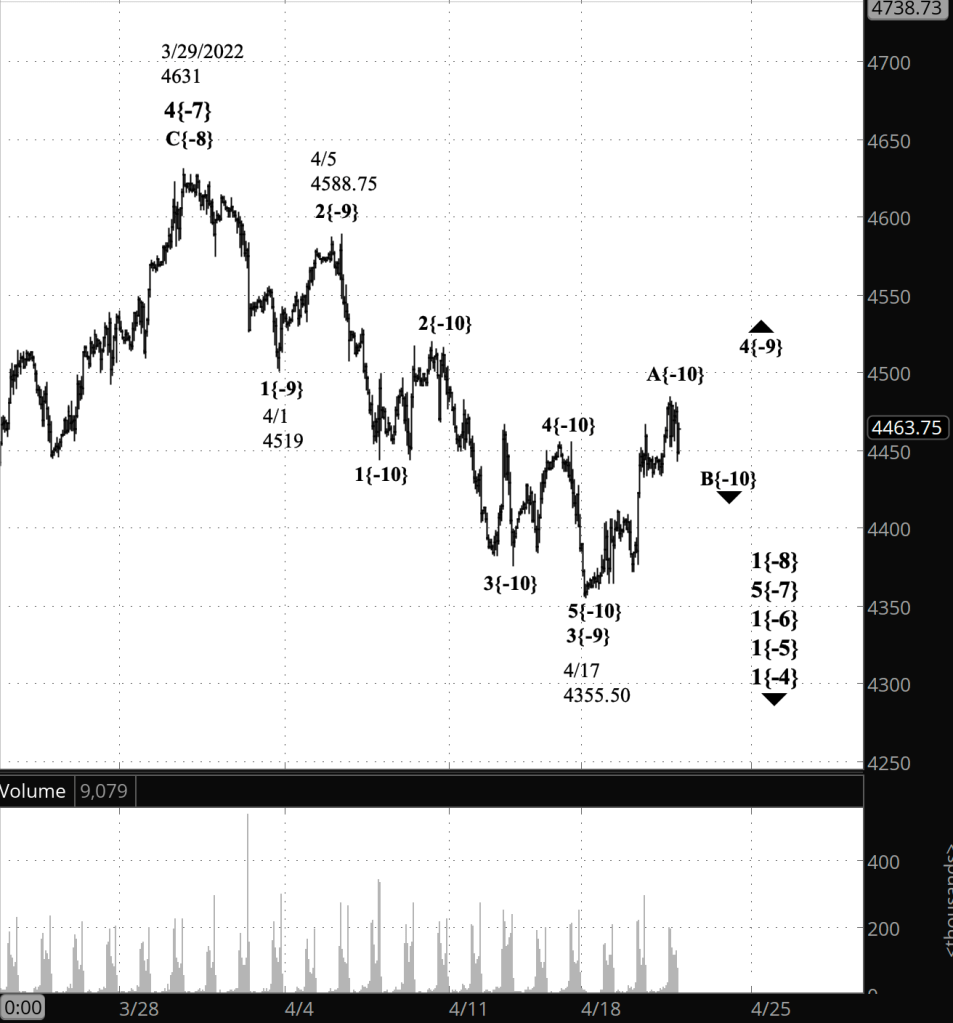
Half an hour before the closing bell. The S&P 500 completed the first leg of the upward correction that began on April 17, peaking today at 4484.25 on the futures and then reversing. Downward wave B{-10} within upward wave 4{-9} is now underway. No change in the analysis. I’ve updated the chart.
2:10 p.m. New York time
UAL earnings play entry. I’ve entered a short bear call options spread on UAL and have posted a trade analysis.
2 p.m. New York time
DOW earnings play entry. I’ve entered a short bull put options spread on DOW and have posted a trade analysis.
1:25 p.m. New York time
PG earnings play partial exit. I exited the short calls in my bear call options spread on PG when the price rose after earnings were published. PG goes ex-dividend on Thursday, April 21, putting the short calls as risk of assignment. I’ve updated the trade analysis with results for the short calls and shall update it again after exiting the long calls.
9:35 a.m. New York time
What’s happening now? The S&P 500 E-mini futures continued higher in overnight trading and is presently in the 5th leg of the rise.
What does it mean? The upward correction that began on April 17 is still underway. The 5th leg, when complete, will mark the end of the first part of what will likely be a three-part corrective pattern. The analysis of the size of the correction compared to other movements has changed from yesterday’s analysis.
What’s the alternative? None at present.
[S&P 500 E-mini futures at 3:30 p.m., hourly bars, with volume]
What does Elliott wave theory say? I’ve moved the degree of the correction two degrees larger. Under my present analysis, the price is in wave A{-10}, the first wave within wave 4{-9}, an upward correction, within downtrending wave 1{-8}, which is the first wave of a downtrend that began on March 29 from 4631.
All of this is happening within a far larger downtrend, several degrees higher, wave 1{-6}, which began on January 4 from 4808.25. Basically, the upward correction is no big deal, just a tiny turn upward in an overwhelmingly downward trend. My trading tends to be short-term, so I look at the details, such as wave A{-10}. If you’re time horizon is longer — if you’re surfing the Elliott waves of high degree — then your focus will be on the wave 1{-6} decline from early January and its parent waves, all the way up to wave 4{-1}, which began on January 4 from the low 4800s.
Wave 4{-9} is most likely taking the form of a Zigzag, which has five waves within its A wave, three within B and five within C — 5-3-5 for short. The other common corrective pattern is the Flat: 3-3-5. So the present A-wave rise will be followed by a B-wave decline, which often will take back 38% to 79% of the preceding A wave, and then a C wave that will reach new heights.
Under yesterday’s analysis, wave 1{-11} began at 4455.75 and wave 2{-11}, at 4355.50. A firm rule of Elliott wave analysis is that a 2nd wave can’t move beyond the start of the preceding 1st wave. When the price did just that, rising to 4480.50 in overnight trading, it signaled that the degree labeling didn’t match the reality the chart and required re-analysis.
Today’s new count is yesterday’s alternative analysis. Often with a price movement, it’s difficult to accurately place a wave within the right degree. I often use the word “fractal” to describe the basic nature of the market’s patterns. What that means is that each wave is part of a larger wave, which in turn is part of a still larger wave, and all the way up to great waves that take a century or more to complete, and each wave composed of subwaves, which in turn have subwaves, all the way down to the tick, a single movment in the price caused by a single trade. So within this structure, what I called wave A{-12} within wave 2{-11} in yesterday’s analysis turned out to be wave A{-10} within wave 4{-9}.
Unlike a 2nd wave, a 4th wave can move above the start of the preceding 1st wave, which in the case of the revised analysis, is the start of wave 1{-9} on April 1 from 4519.
An interesting conundrum, one of many reasons why I consider Elliott wave analysis to be an art, not a science.
We Are Here.
These are the waves currently in progress under my principal analysis. Each line on the list shows the wave number, with the subscript in curly brackets, the traditional degree name, the starting date, the starting price of the S&P 500 E-mini futures, and the direction of the wave.
Learning and other resources. Elliott wave analysis provides context, not prophecy. As the 20th century semanticist Alfred Korzybski put it in his book Science and Sanity (1933), “The map is not the territory … The only usefulness of a map depends on similarity of structure between the empirical world and the map.” And I would add, in the ever-changing markets, we can judge that similarity of structure only after the fact.
See the menu page Analytical Methods for a rundown on where to go for information on Elliott wave analysis.
By Tim Bovee, Portland, Oregon, April 20, 2022
Disclaimer
Tim Bovee, Private Trader tracks the analysis and trades of a private trader for his own accounts. Nothing in this blog constitutes a recommendation to buy or sell stocks, options or any other financial instrument. The only purpose of this blog is to provide education and entertainment.
No trader is ever 100 percent successful in his or her trades. Trading in the stock and option markets is risky and uncertain. Each trader must make trading decisions for his or her own account, and take responsibility for the consequences.
Update 4/22/2022:I exited the long calls remaining in my bear call spread on PG, two days after exiting the in-the-money puts to avoid assignment when the stock went ex-dividend. I shall give the info for the long calls exit, and then put the long and short calls back together as results for the full bear call spread.
First, the long calls.
The entry price for the long calls was a $2.62 credit per contract/share, and I exited for a $0.88 debit per contract share, a profit of $174 for each contract. Shares rose by $5.42 above entry to $162.82.
The implied volatility ratio stood at 3.79%, down 14.2 points from entry
Shares rose by 3.4% over 3 days for a +419% annual rate. The options position produced a 197.7% profit for a +24,057% annual rate.
And now, the full bear all vertical spread.
The entry price for the vertical spread was a $4.92 credit per contract/share, and I exited for a $5.78 debit per contract share, a loss of $86.00 for each contract. Shares rose by $5.42 above entry to $162.82.
The implied volatility ratio stood at 3.79%, down 14.2 points from entry
Shares rose by 3.4% over 3 days for a +419% annual rate. The options position produced a 14.9% loss for a -1,810% annual rate.
Update 4/20/2022: PG rose after earnings were published before the opening bell, pushing the short call strike in my bear call spread into the money. PG goes ex-dividend the day after the earnings announcement, and I sold the short call portion of my vertical spread to avoid the chance of assignment. I retain the long call options, which will profit if the price continues to rise.
Long calls lose value through time decay, and so my incentive is to exit what remains of the trade as soon as soon as it shows a profit.
I shall update this analysis with results for the entire bear call spread after exiting the long calls that remain.
Short call results:
The entry price for the short calls was a $2.30 credit per contract/share, and I exited for a $4.90 debit per contract share, a loss of $260 for each contract. Shares rose by $6.19 above entry to $163.59.
The implied volatility ratio stood at 22.6%, down 29.5 points from entry
Shares rose by 3.9% over one day for a +1,436% annual rate. The options position produced a 53.1% loss for a -19,367% annual rate.
I have entered a short bear call spread on PG, using options that trade for the last time 31 days hence, on May 20. The premium is a $1.42 credit per contract share and the stock at the time of entry was priced at $157.40.
The Implied Volatility Ratio stood at 52.1%.
Premium:
$1.42
Expire OTM
PG-bear call spread
Strike
Odds
Delta
Calls
Long
165.00
84.0%
19
Break-even
161.42
74.5%
28.5
Short
160.00
65.0%
38
The premium is 56.8% of the width of the position’s short/long spread. The profit zone covers a 2.6% move to the upside and an unlimited move to the downside.
The risk/reward ratio is 2.5:1, with maximum risk of $358 and maximum reward of $142 per contract.
How I chose the trade. The trade was placed to coincide with PG’s earnings announcement, after the opening bell on the day after entry. The short strikes were set to coincide with the expected move of $3.30 either way, based on options pricing, which gives a price range of $154.10 to $160.70.
By Tim Bovee, Portland, Oregon, April 19, 2022
Disclaimer
Tim Bovee, Private Trader tracks the analysis and trades of a private trader for his own accounts. Nothing in this blog constitutes a recommendation to buy or sell stocks, options or any other financial instrument. The only purpose of this blog is to provide education and entertainment.
No trader is ever 100 percent successful in his or her trades. Trading in the stock and option markets is risky and uncertain. Each trader must make trading decisions for his or her own account, and take responsibility for the consequences.
Half an hour before the closing bell. The S&P 500 has risen during the trading session as a low level upward correction that began on April 17 continues. So far the price has reached more than 100 points above the upward movement’s starting point, 4355.50. No change in the analysis. I’ve updated the chart.
11:30 a.m. New York time
PG earnings play entry. I’ve entered a short bear call options spread on PG timed to coincide with the company’s earnings announcement Wednesday morning before the opening bell and have posted a trade analysis.
11:25 a.m. New York time
WBA earnings play exit. I’ve exited my short iron condor on WBA for 3.5% of maximum potential profit and have updated the trade analysis with results.
10:55 a.m. New York time
JNJ earnings play exit. I’ve exited my short bull put vertical spread on JNJ for 28.8% of maximum potential profit and have updated the trade analysis with results.
9:37 a.m. New York time
What’s happening now? The S&P 500 E-mini futures declined during the overnight session following a small rise.
What does it mean? The downtrend that began on April 5 continues in its last phase.
What’s the alternative? The downtrend that began on April 5 ended on April 17 and the subsequent rise is a correction within that downtrend.
[S&P 500 E-mini futures at 3:30 p.m., hourly bars, with volume]
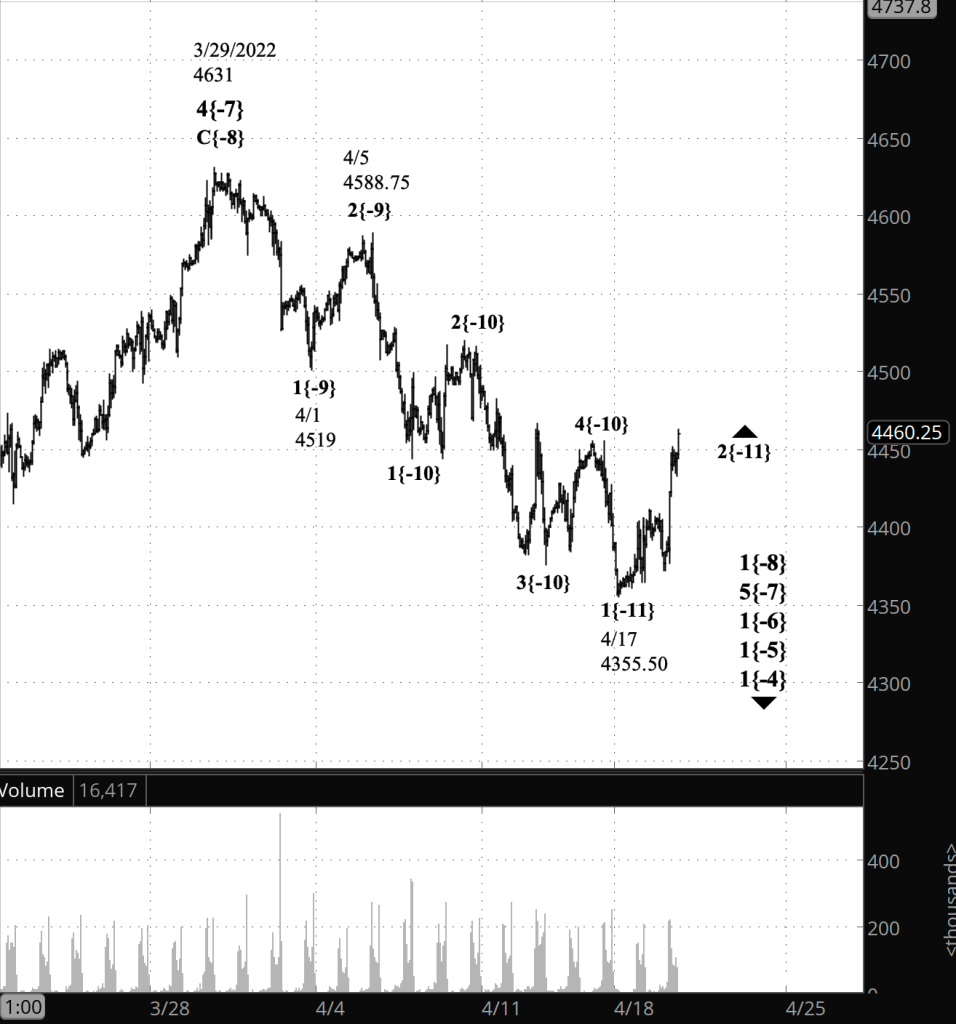
What does Elliott wave theory say? I’ve moved the chart closer in after yesterday’s broad view, in order to see the details of downtrending wave 5{-7}, which began on March 29 from 4631.
Internally, wave 5{-7} is in its 1st wave, 1{-8}, which in turn is in its middle wave, 3{-9}. Under my principal analysis, the upward correction that began on April 17 is of a very low degree, wave 2{-11} within wave 5{-10} within wave 3{-9}.
Under my alternative analysis, the rise that began on April 17 is second correction, wave 4{-9}, within wave 1{-8}. The wave 4{-9} correction is presently in its first wave, A{-10}.
Under my alternative analysis, the rise from April 17 is wave 4{-9}, an upward correction that is presently in its first wave, A{-10}.
At this point the two scenarios have an equal likelihood.
We Are Here.
These are the waves currently in progress under my principal analysis. Each line on the list shows the wave number, with the subscript in curly brackets, the traditional degree name, the starting date, the starting price of the S&P 500 E-mini futures, and the direction of the wave.
Learning and other resources. Elliott wave analysis provides context, not prophecy. As the 20th century semanticist Alfred Korzybski put it in his book Science and Sanity (1933), “The map is not the territory … The only usefulness of a map depends on similarity of structure between the empirical world and the map.” And I would add, in the ever-changing markets, we can judge that similarity of structure only after the fact.
See the menu page Analytical Methods for a rundown on where to go for information on Elliott wave analysis.
By Tim Bovee, Portland, Oregon, April 19, 2022
Disclaimer
Tim Bovee, Private Trader tracks the analysis and trades of a private trader for his own accounts. Nothing in this blog constitutes a recommendation to buy or sell stocks, options or any other financial instrument. The only purpose of this blog is to provide education and entertainment.
No trader is ever 100 percent successful in his or her trades. Trading in the stock and option markets is risky and uncertain. Each trader must make trading decisions for his or her own account, and take responsibility for the consequences.
Update 4/19/2022: I exited my short bull put vertical spread on JNJ, 31 days before expiration, for an $0.84 debit per contract/share, a profit before fees of $34 per contract. Shares were trading at $183.00, up $2.70 from the entry level.
The Implied Volatility Rank at exit was 32.3%, down 10.7 points from the entry level.
I exited because the position reached 28.8% of maximum potential profit, slightly above my normal exit point for earnings plays of 25% of max.
Shares rose by 1.5% over one day for a +547% annual rate. The options position produced a 40.5% return for a +14,774% annual rate.
I have entered a short bull put spread on JNJ, using options that trade for the last time 32 days hence, on May 20. The premium is a $1.18 credit per contract share and the stock at the time of entry was priced at $180.30.
The Implied Volatility Ratio stood at 43.0%.
Premium:
$1.18
Expire OTM
JNJ-bull put spread
Strike
Odds
Delta
Puts
Long
172.50
73.0%
24
Break-even
178.68
65.5%
31.5
Short
177.50
58.0%
39
The premium is 47.2% of the width of the position’s short/long spread. The profit zone covers a 0.9% move to the downside and an unlimited move to the upside.
The risk/reward ratio is 3.2:1, with maximum risk of $382 and maximum reward of $118 per contract.
How I chose the trade. The trade was placed to coincide with JNJ’s earnings announcement, before the opening bell the day after the day of entry. The short strikes were set to coincide with the expected move of $2.95 either way, based on options pricing, which gives a price range of $177.35 to $183.25.
By Tim Bovee, Portland, Oregon, April 18, 2022
Disclaimer
Tim Bovee, Private Trader tracks the analysis and trades of a private trader for his own accounts. Nothing in this blog constitutes a recommendation to buy or sell stocks, options or any other financial instrument. The only purpose of this blog is to provide education and entertainment.
No trader is ever 100 percent successful in his or her trades. Trading in the stock and option markets is risky and uncertain. Each trader must make trading decisions for his or her own account, and take responsibility for the consequences.
Half an hour before the closing bell. The S&P 500 continued its decline throughout the day, reaching a low so far of 4355.50 on the futures. No change in the analysis. I’ve updated the chart.
11:25 a.m. New York time
JNJ earnings play entry. I’ve entered a short bull put options spread on JNJ in anticipation of the company’s earnings announcement Tuesday before the opening bell and have posted an analysis of the trade.
11 a.m. New York time
SCHW earnings play exit. I’ve exited my short bear call options spread on SCHW after earnings were published for 87.3% of maximum potential profit and have updated the trade analysis with results.
9:35 a.m. New York time
What’s happening now? The S&P 500 E-mini futures continued to fall after trading resumed Sunday evening.
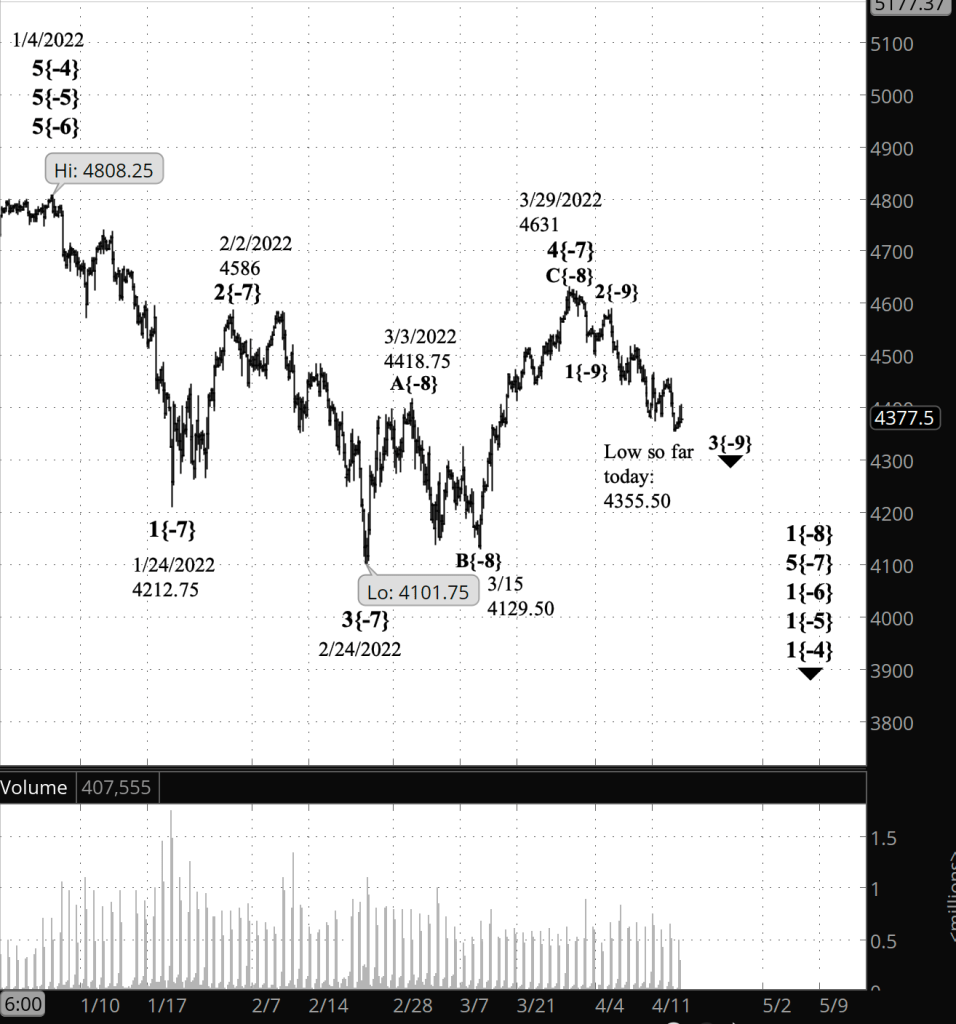
What does it mean? The downtrend that began on January 4 from 4808.25 continues, as does the smaller downtrend that began on March 29 from 4631. The smaller downtrend, when complete, will be followed by an upward correction of a downtrend.
What’s the alternative? The available alternatives at this point have to do with how small the decline is in comparison to other movements in its environment. I’ve reduced the ups and downs since March 29 by one level. More on this in the Elliott wave theory section below.
[S&P 500 E-mini futures at 3:30 p.m., 4-hour bars, with volume]
What does Elliott wave theory say? Under my principal analysis, wave 3{-9} within wave 1{-8} within wave 5{-7} is now underway.
I’ve often spoken of the ambiguity in assigning degrees to wave series, determining where they fit in the fractal structure of a trend, where each degree, constructed in the same manner as its parents and children, provides very little information to guide placement in the hierarchy wave wave structures.
What I have labeled as wave 3{-9} in this chart was labeled wave 5{-8} in Friday’s Trader’s Notebook. There is in Elliott a rule of proportionality: Waves of the same degree tend to be roughly the same in both magnitude — how much they rise and fall — and in duration — how long they last. By that standard, the {-8} degree waves within the downtrend that began March 29 are minuscule, and brief, compared to the stately {-8} waves within the upward correction that lasted from February 24 to March 29. And it’s possible that what I’ve labeled as the {-9} degree in this chart will turn out to be degree {-10}.
The demotion of the the former {-8} degree to {-9} makes the two wave sets more proportional to each other, and also brings clarity to the chart.
Wave 3{-9} will be followed by a small upward correction, wave 4{-9}, and then a resumption of the downtrend, wave 5{-9}. The end of wave 5{-9} will also end wave 1{-8}, which began on March 29 from 4631, along with its parent wave, downtrending 5{-7}.
Wave 1{-8} will be followed by a wave 2{-8} upward correction that, most likely, will take the form of a Zigzag. Here’s what we know about that futures wave 2{-8}: It will remain below 4631, because it is a firm rule in Elliott wave analysis that no 2nd wave moves beyond the beginning of the preceding 1st wave. As noted above, 2nd waves are usually Zigzag, although there are exceptions. Wave 2{-8} will have a three-wave corrective pattern internally, at the {-9} degree: Wave A to the upside, a downward wave B that likely will retrace between 38% and 79% of wave A, and finally a wave C that will rise higher than wave A did.
Once that corrective pattern has ended, most likely wave 3{-8} will follow, a resumption of the downtrend that will show great power, as 3rd waves do, carrying the price a significant distance lower.
Alternatively, wave C{-9} will be followed by a connecting wave, X{-9}, and then by a second corrective pattern. I’ve seen this more often in 4th wave, but it’s a possibility in 2nd waves as well.
We Are Here.
These are the waves currently in progress under my principal analysis. Each line on the list shows the wave number, with the subscript in curly brackets, the traditional degree name, the starting date, the starting price of the S&P 500 E-mini futures, and the direction of the wave.
Learning and other resources. Elliott wave analysis provides context, not prophecy. As the 20th century semanticist Alfred Korzybski put it in his book Science and Sanity (1933), “The map is not the territory … The only usefulness of a map depends on similarity of structure between the empirical world and the map.” And I would add, in the ever-changing markets, we can judge that similarity of structure only after the fact.
See the menu page Analytical Methods for a rundown on where to go for information on Elliott wave analysis.
By Tim Bovee, Portland, Oregon, April 18, 2022
Disclaimer
Tim Bovee, Private Trader tracks the analysis and trades of a private trader for his own accounts. Nothing in this blog constitutes a recommendation to buy or sell stocks, options or any other financial instrument. The only purpose of this blog is to provide education and entertainment.
No trader is ever 100 percent successful in his or her trades. Trading in the stock and option markets is risky and uncertain. Each trader must make trading decisions for his or her own account, and take responsibility for the consequences.

 Tim Bovee, Private Trader
You must be logged in to post a comment.