How to Play Earnings

It’s hard to believe that Private Trader has been around for more than a decade. The first post, on November 4, 2009, was a watchlist of stocks, and the next day, I wrote up my trade in one of them, a bull put spread on CSCO.

I had dabbled in active management of trades since the mid-1980s, but in 2009 I started to get very serious about trading after my contract job managing projects disappeared at the start of the Great Recessions. There were no jobs, and trading was one way to help put rice in the rice cooker.

Long-term readers will recall that over those years, from time to time, I’d try out various ways of trading earnings announcements using options. It was an appealing idea. Most of the options strategies I use — spreads and iron condors entered 45 days out from expiration — stay on the books for nearly a month before I exit. Earnings plays, at their best, are two-day positions, in before the announcement and out at first opportunity afterward. It keeps my capital churning, and that’s ideally what makes profits.

No earnings play method that I’ve tried so far has really worked out to my satisfaction. So, one by one, I’d abandon them and mope along with my monthly spreads and iron condors, many of them profitable, but the pace of trading left me with a lot of idle time.

So my interest was piqued when Nick Battista, of the TastyTrade team, posted a graphic on Twitter showing the expected moves of three stocks after their earnings announcements that same day. Curious, I asked him what he had based the expected moves on, and he was generous enough to reply.

An aside. I’ve followed TastyTrade, an online network devoted to analyzing trading strategies and teaching people about options, since its inception in 2011, and even before that, I had traveled from Portland, Oregon to Chicago to attend a presentation and training session conducted by Tom Sosnoff, a veteran of the Chicago options exchange and head of the team that designed ThinkOrSwim, at one time the best trading platform for options (and it’s still very, very good).

I’ve learned more about trading options from Tom and TastyTrade than from all of my efforts before they hit the ‘net. They don’t know me from Adam (I did meet Sosnoff, briefly, long ago), but I consider them to be my mentors.

So, back to earnings plays. Nick in our Twitter exchange briefly described his use of options pricing to calculate the expected move.

After our brief exchange, I immediately rushed to the TastyTrade site to search out more details, and found them in an episode dating back to last February, a 10-minute airing of “Options Jive” in which Tom Sosnoff and Tony Battista talked about the details of calculating expected move.

The method works by taking the value of three positions and weighting them according to their distance from the at-the-money (ATM) mark.

  1. Using the options closest to expiration…
  2. take the price of an ATM short straddle and multiply it by 60% (0.6)…
  3. take the price of strangle one strike price away from ATM, and multiply it by 30% (0.3)…
  4. and take the price of a strange two strikes away from ATM, and multiply it by 10% (0.1).
  5. The expected move is the average of the weighted prices — add them together and divide by 3.
  6. Note that the expected move doesn’t anticipate the direction of the move — could be up, could be down.
  7. Trades are best placed at a time as close to the earnings announcement as is feasible.

Expiration dates most of the time won’t match the date of entry into an earnings play. Nick Battista’s practice is to discount the expected move by 5% times the number of days, minus one, remaining until expiration, and that’s a practice that I shall adopt.

Sosnoff in the “Options Jive” video says that the method works out 68% of the time. The reality of trading is that no estimate of outcomes is 100%, and being right 68% of the time, I’ve found, gives me the edge I need to stay profitable.

TastyTrade’s affiliated trading platform, TastyWorks, displays the expected move based on this method, absent the time discount, in the corner of each options grid.

So how should I use this? As regular readers know, I don’t trade without rules. I post them in the “Trading Rules” page linked to on the menu bar at the top of each page.

Here’s my first attempt at rules for how to trade expected earnings.

  1. Enter a position on the final trading day before the earnings announcement. (I need to determine how much price change there is prior to the day before.)
  2. Select highly liquid stocks with options having an implied volatility rank of 30% or higher.
  3. In selecting the options expiration date, it’s important to weigh the price received for the options vs. the speed of time decay, which helps the value. Also, monthly options have narrower bid/ask spreads than do the weeklies. (I don’t have a firm rule on how far out from expirations the options should be. For normal spreads, the optimal buying period is 45 days from expiration.)
  4. Optionally, pick a direction for the expected move. There are many ways to do this. I use Elliott wave analysis, and sometimes check out the Zacks Rank and Expected Surprise Prediction percentage.
  5. Directional strategies: For lower risk (and lower returns), short bull put spreads if a rise is expected, short bear call spreads if a fall is expected. For higher risk (and higher returns), short puts if a rise is expected, short calls if a fall is expected.
  6. If no direction is picked, use a non-directional strategy: For lower risk, iron condors. For higher risk, strangles.
  7. The short strikes for each strategy should be far enough out of the money to enclose the expected move.
  8. Exit at the earliest profitable opportunity.

And that’s it. A trade that’s over in two days or so, backed by a statistically sound rationale.

It’s earnings season, and I’ll be looking at LEN and JBL on Wednesday, and FDX and DRI on Thursday, and as I do with my slower options strategies, I shall post about the trades on PrivateTrader.

By Tim Bovee, Portland, Oregon, December 10, 2021

Disclaimer

Tim Bovee, Private Trader tracks the analysis and trades of a private trader for his own accounts. Nothing in this blog constitutes a recommendation to buy or sell stocks, options or any other financial instrument. The only purpose of this blog is to provide education and entertainment.

No trader is ever 100 percent successful in his or her trades. Trading in the stock and option markets is risky and uncertain. Each trader must make trading decisions for his or her own account, and take responsibility for the consequences.

License
Creative Commons License

All content on Tim Bovee, Private Trader by Timothy K. Bovee is licensed under a Creative Commons Attribution-ShareAlike 4.0 International License.

Based on a work at www.timbovee.com.
SP500 Analysis

4:40 p.m. New York time

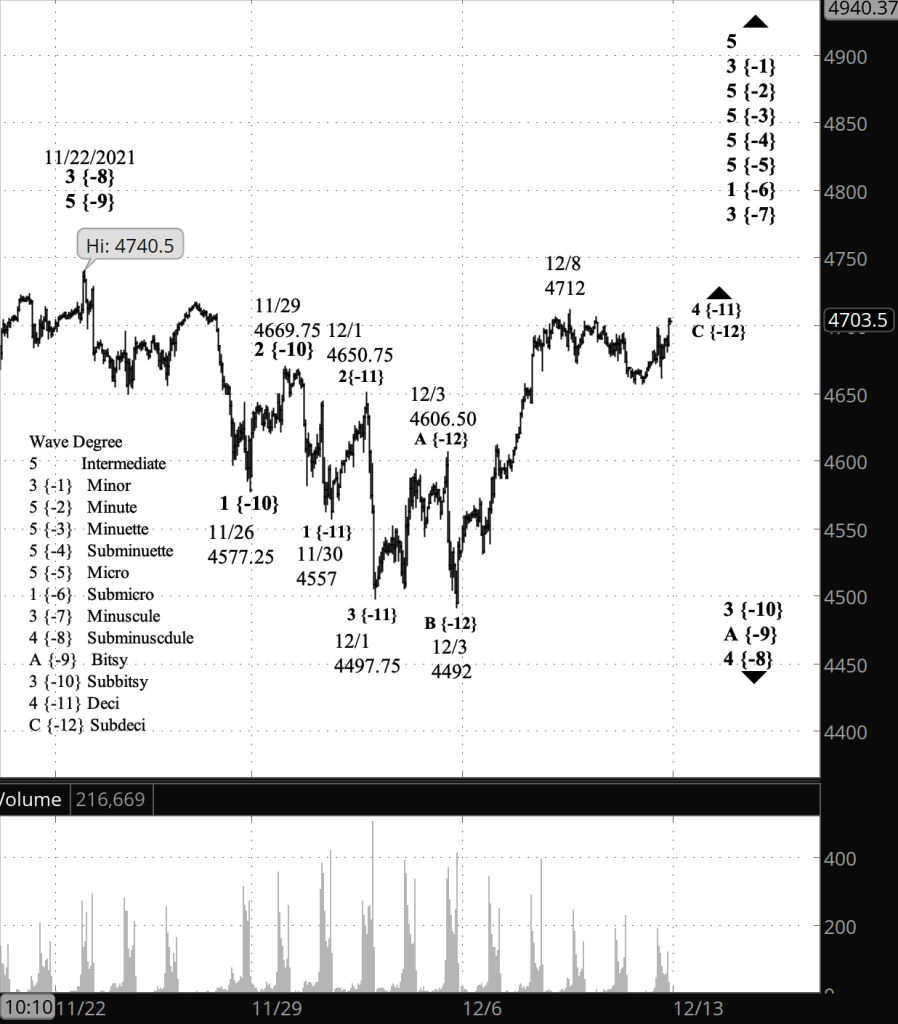
After the closing bell. The S&P 500 E-mini futures rose above the morning high, to 4705.25. The all-time high was set on November 22, at 4740.50. The index set a high today of 4713.57, below the all-time high of 4743.83 set on November 19. I’ve updated the upper chart. The analysis, as before, is unchanged.

3:30 p.m. New York time

Half an hour before the closing bell. The S&P 500 has remained below its morning high most of the day, trading in a narrow range. No change in the analysis. I’ve updated the upper chart.

9:35 a.m. New York time

What’s happening now? The S&P 500 E-mini futures rose in overnight trading, reaching 4699 at the opening bell, 13 points below the December 8 reversal point.

What does it mean? The upward correction that began on December 1 is still underway, although in its late phase, and has the potential to exceed the December 8 high, 4712. However, it will remain below the November 22 peak of 4740.50. Once the correction has ended, the downtrend will resume and the price will decline to below the correction’s starting point, 4497.75, perhaps significantly below.

What’s the alternative? It’s possible the correction will form a compound structure. Once it ends, the price will decline but will remain above the correction’s starting point, and then will rise in the first leg of a second corrective pattern.

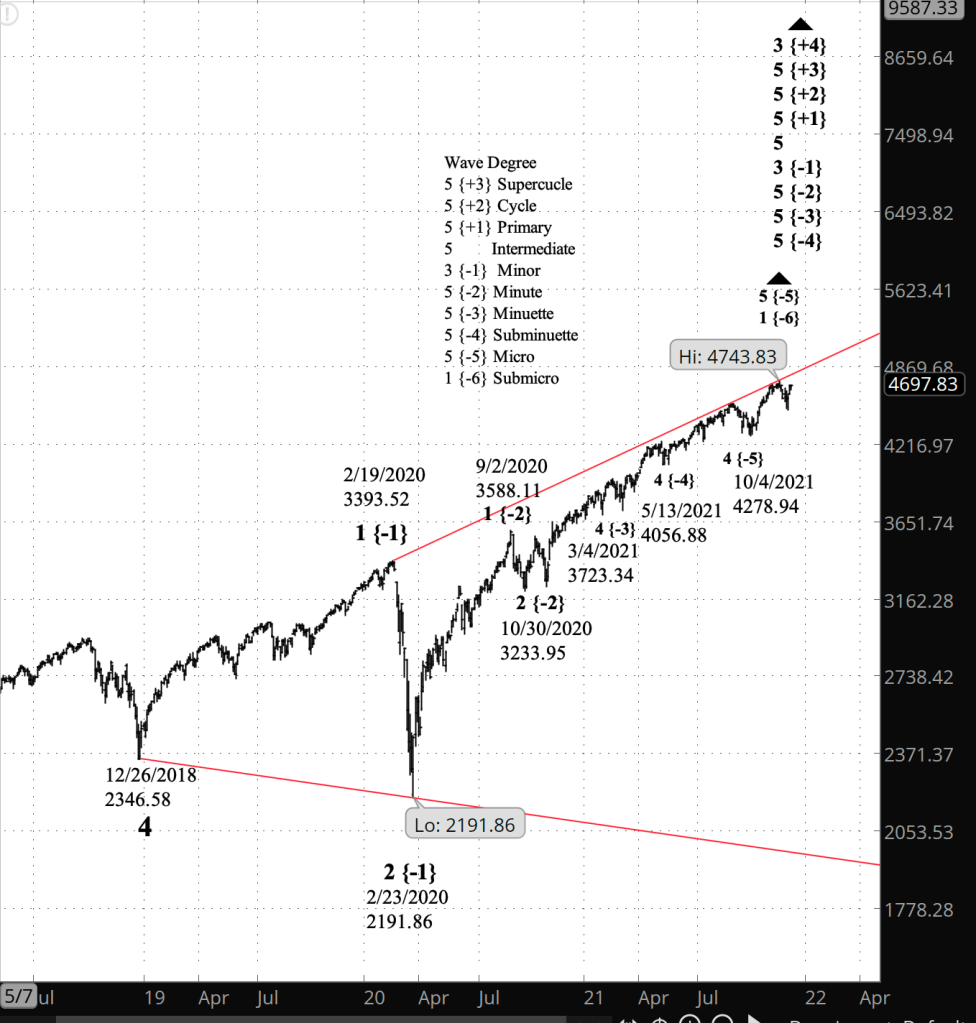
Big picture. The S&P 500 index price remains close to the upper boundary of an expanding Diagonal Triangle that began in December 2018, and the latest leg of the rise that began in February 2020, at the end of the early pandemic crash, is still underway.

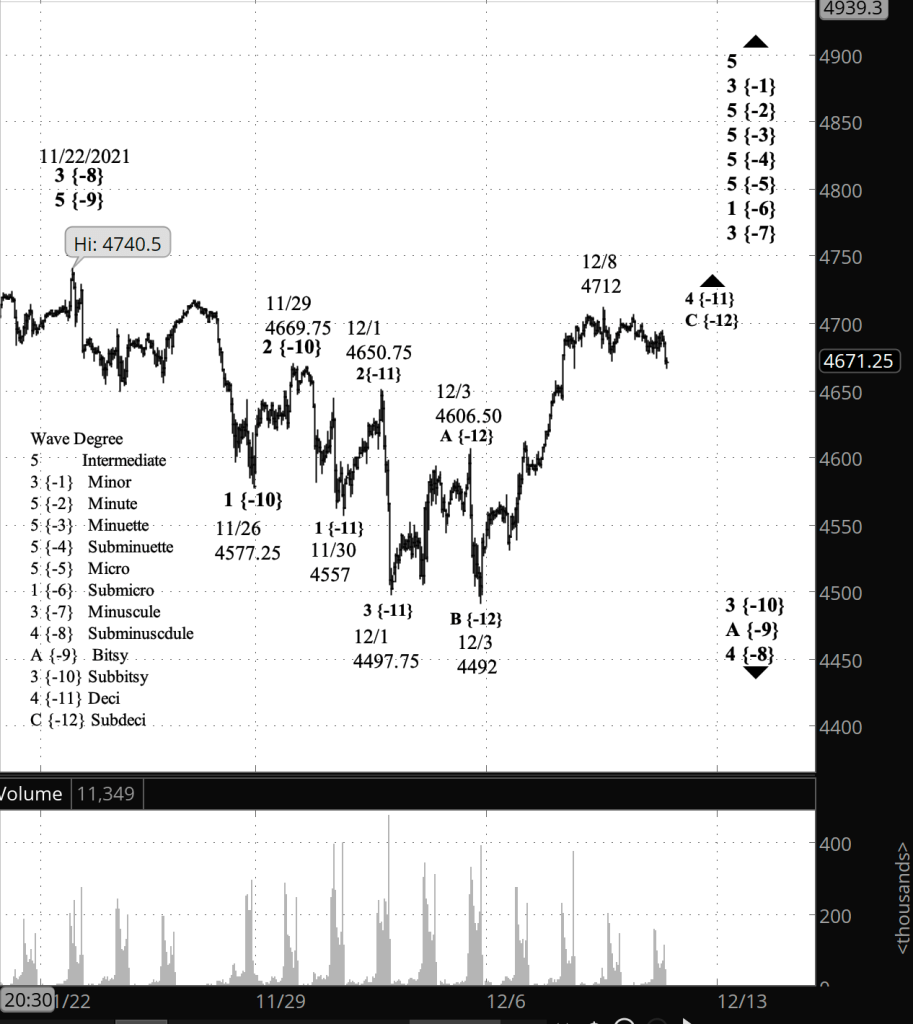
Charts. The upper chart shows the near-term view, stretching back to mid-November. The lower chart shows the Diagonal Triangle in its entirety and stretches back to early May 2018.

[S&P 500 E-mini futures at 4:40 p.m., 50-minute bars, with volume]
[S&P 500 index at 9:32 a.m., 2-day bars]

What does Elliott wave theory say? Under my principal analysis, wave C of Subdeci degree — subscript {-12} — is beginning its last wave internally. The end of wave C will also mark the end of wave 4 of Deci degree {-11} and the beginning of a 5th wave that will carry the price below the starting point of the 4th wave, 4497.75. The completion of Deci wave 5 will also be the end of its parent, wave A of Bitsy degree {-9}, the first leg of a larger, downward correction, wave 4 of Submicro degree {-8}, which began on November 22.

Under my alternative analysis, Deci wave 4 will form a compound structure, with wave C of Subdeci degree being followed by a downtrending X wave that will remain above the 4th-wave starting point, and then by a second compound pattern, typically either a Flat or a Zigzag.

Over the long-term, within the expanding Diagonal Triangle that began in December 2018, wave 3 of Minor degree {-1] within wave 5 of Intermediate degree (no subscript) is still underway. Minor 3 began on February 23, 2020, after the crash that marked the beginning of the pandemic, from 2191.86. Internally, its child wave, the 5th of Minute degree, has been underway since October 30, 2020. Once Minor 3 is complete, the subsequent 4th wave should carry price down to the lower boundary of the triangle, presently around 1980 and declining further each day.

Learning and other resources. Elliott wave analysis provides context, not prophecy. As the 20th century semanticist Alfred Korzybski put it in his book Science and Sanity (1933), “The map is not the territory … The only usefulness of a map depends on similarity of structure between the empirical world and the map.” And I would add, in the ever-changing markets, we can judge that similarity of structure only after the fact.

See the menu page Analytical Methods for a rundown on where to go for information on Elliott wave analysis.

By Tim Bovee, Portland, Oregon, December 10, 2021

Disclaimer

Tim Bovee, Private Trader tracks the analysis and trades of a private trader for his own accounts. Nothing in this blog constitutes a recommendation to buy or sell stocks, options or any other financial instrument. The only purpose of this blog is to provide education and entertainment.

No trader is ever 100 percent successful in his or her trades. Trading in the stock and option markets is risky and uncertain. Each trader must make trading decisions for his or her own account, and take responsibility for the consequences.

License
Creative Commons License

All content on Tim Bovee, Private Trader by Timothy K. Bovee is licensed under a Creative Commons Attribution-ShareAlike 4.0 International License.

Based on a work at www.timbovee.com.
SP500 Analysis

3:30 p.m. New York time

Half an hour before the closing bell. The S&P 500 moved below its prior low of the overnight session, to 4666.50 so far. The lower the the price goes, the high likelihood that the high of December 8, 4712, marked the end of the upward corrective pattern that began on December 1. No change in the analysis. I’ve updated the chart.

9:35 a.m. New York time

What’s happening now? The S&P 500 E-mini futures declined in overnight trading, reaching a low of 34.5 points below yesterday’s high.

What does it mean? The upward movement that began on December 3 — the final leg of the correction that began two days earlier — is still underway. I expect it to make a final push to the upside that will remain below the November 22 high of 4740.50. That final push will be followed by a decline that reaches below the start of the correction, 4497.75, continuing the downtrend that began on November 22.

What’s the alternative? Two points carry alternative analyses. First, the high of December 8 could possibly be the end of the correction. Secondly, the corrective pattern, when complete, could be followed by a downward movement that will remain above 4497.75, and then a second corrective pattern in a compound structure.

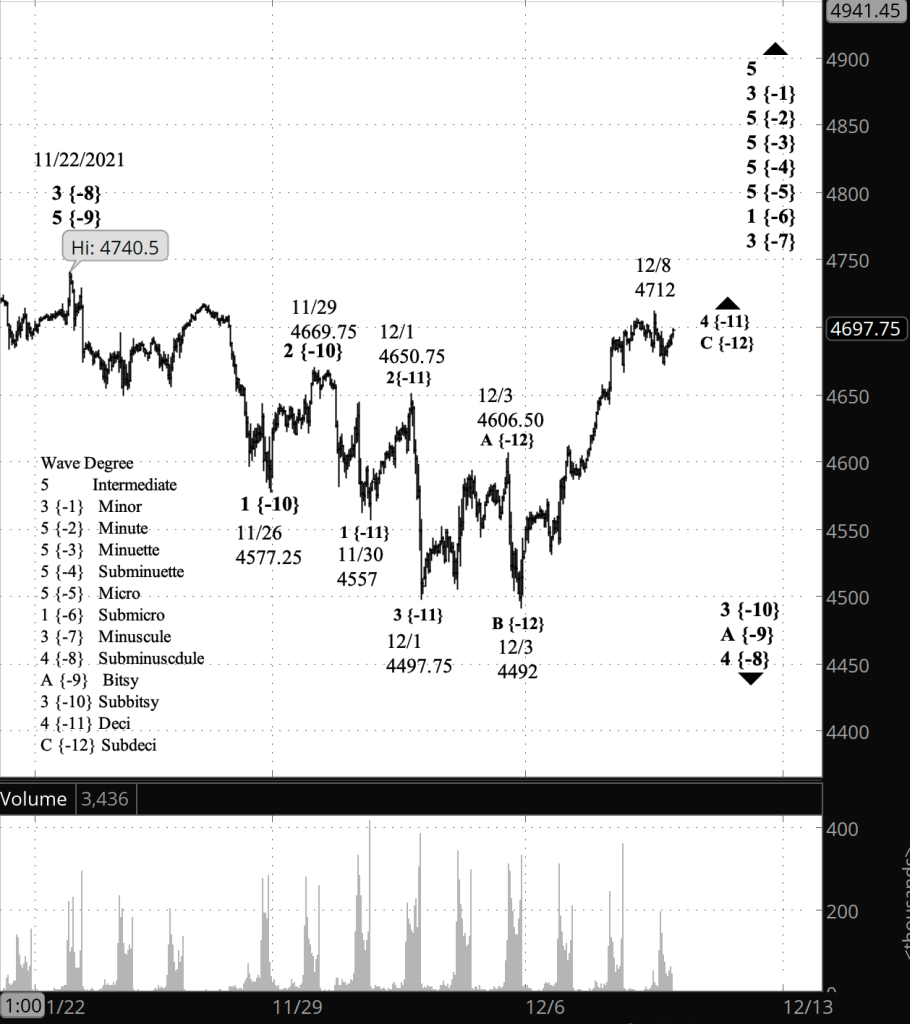
[S&P 500 E-mini futures at 3:30 p.m., 45-minute bars, with volume]

What does Elliott wave theory say? Under my principal analysis, the price presently in wave C of Subdeci degree — subscript {-12} — within wave 4 of Deci degree {-11}, which is an upward correction within declining wave 3 of of Subbitsy degree {-10} within wave A of Bitsy degree {-9} within wave 4 of Subminuscule degree {-8}, which began on October 6.

Under the first alternative analysis, wave C of Subdeci degree and its parent 4th wave ended with the December 8 peak, and wave 5 of Deci degree is in the early stages of its decline.

Under the second alternative analysis, wave C of Subdeci degree is still under — the same as in the principal analysis. It will be followed by an X wave to the downside and then a second corrective pattern, usually another Flat or perhaps a Zigzag.

Learning and other resources. Elliott wave analysis provides context, not prophecy. As the 20th century semanticist Alfred Korzybski put it in his book Science and Sanity (1933), “The map is not the territory … The only usefulness of a map depends on similarity of structure between the empirical world and the map.” And I would add, in the ever-changing markets, we can judge that similarity of structure only after the fact.

See the menu page Analytical Methods for a rundown on where to go for information on Elliott wave analysis.

By Tim Bovee, Portland, Oregon, December 9, 2021

Disclaimer

Tim Bovee, Private Trader tracks the analysis and trades of a private trader for his own accounts. Nothing in this blog constitutes a recommendation to buy or sell stocks, options or any other financial instrument. The only purpose of this blog is to provide education and entertainment.

No trader is ever 100 percent successful in his or her trades. Trading in the stock and option markets is risky and uncertain. Each trader must make trading decisions for his or her own account, and take responsibility for the consequences.

License
Creative Commons License

All content on Tim Bovee, Private Trader by Timothy K. Bovee is licensed under a Creative Commons Attribution-ShareAlike 4.0 International License.

Based on a work at www.timbovee.com.
SPY Trade

SPDR S&P 500 ETF Trust (SPY)

Lot 2

Update 12/20/2021: I exited my short bear call spread position on SPY 32 days before expiration, for a $0.57 debit per contract/share, a profit before fees of $75 per contract. Shares were trading at $453.80, down $14.75 from the entry level.

The Implied Volatility Rank at exit was 53.9%, up 18.9 points from the entry level.

Under my rules, I planned to exit this position when it had reached 50% or better of maximum potential profit. The exit came at 53.8% of max.

Shares declined by 3.1% over 12 days for a -96% annual rate. The options position produced a 131.6% return for a +4,002% annual rate.


I have entered a short bear call spread on SPY, using options that trade for the last time 44 days hence, on January 21. The premium is a $1.32 credit per contract share and the stock at the time of entry was priced at $468.45

The Implied Volatility Ratio stands at 35%.

Premium:$1.32Expire OTM
SPY-bull spreadStrikeOddsDelta
Puts
Long478.0069.0%35
Break-even476.3266.0%37.5
Short475.0063.0%40

The premium is 88% of the width of the positions short/long spread. The profit zone covers a 1.7% move to the upside.

The risk/reward ratio is 1.3:1, with maximum risk of $168 and maximum reward of $132 per contract.

How I chose the trade. The exchange-traded fund underlying the trade, SPY, very closely tracks the S&P 500 futures and index, which I track in my daily posts. By that analysis, $473.54 on SPY is a peak, attained on November 22, that, according to my Elliott wave analysis, won’t be crossed by the present wave C rise that began on December 3. So based on that analysis, I allowed myself very little space on the upside, since I see nearly all of the potential as being to the downside.

By Tim Bovee, Portland, Oregon, December 8, 2021

Disclaimer

Tim Bovee, Private Trader tracks the analysis and trades of a private trader for his own accounts. Nothing in this blog constitutes a recommendation to buy or sell stocks, options or any other financial instrument. The only purpose of this blog is to provide education and entertainment.

No trader is ever 100 percent successful in his or her trades. Trading in the stock and option markets is risky and uncertain. Each trader must make trading decisions for his or her own account, and take responsibility for the consequences.

License
Creative Commons License

All content on Tim Bovee, Private Trader by Timothy K. Bovee is licensed under a Creative Commons Attribution-ShareAlike 4.0 International License.

Based on a work at www.timbovee.com.
SP500 Analysis

3:30 p.m. New York time

Half an hour before the closing bells. The S&P 500 traded has traded in a narrow range during the session, remaining below the overnight high of 4712 on the futures. My analysis is unchanged. I’ve updated the chart.

2:30 p.m. New York time

My trades. I’ve entered a short bear call options spread on SPY and posted an analysis.

9:35 a.m. New York time

What’s happening now? The S&P 500 E-mini futures continued to rise in overnight trading, reaching 4712 before the opening bell.

What does it mean? The third leg of a correction that began December 1 is still underway. It will be followed by a decline that likely will reach below 4497.75, perhaps significantly so.

What’s the alternative? The end of the corrective pattern will be followed by a decline that remains above 4497.75, and then by a second uptrending corrective pattern.

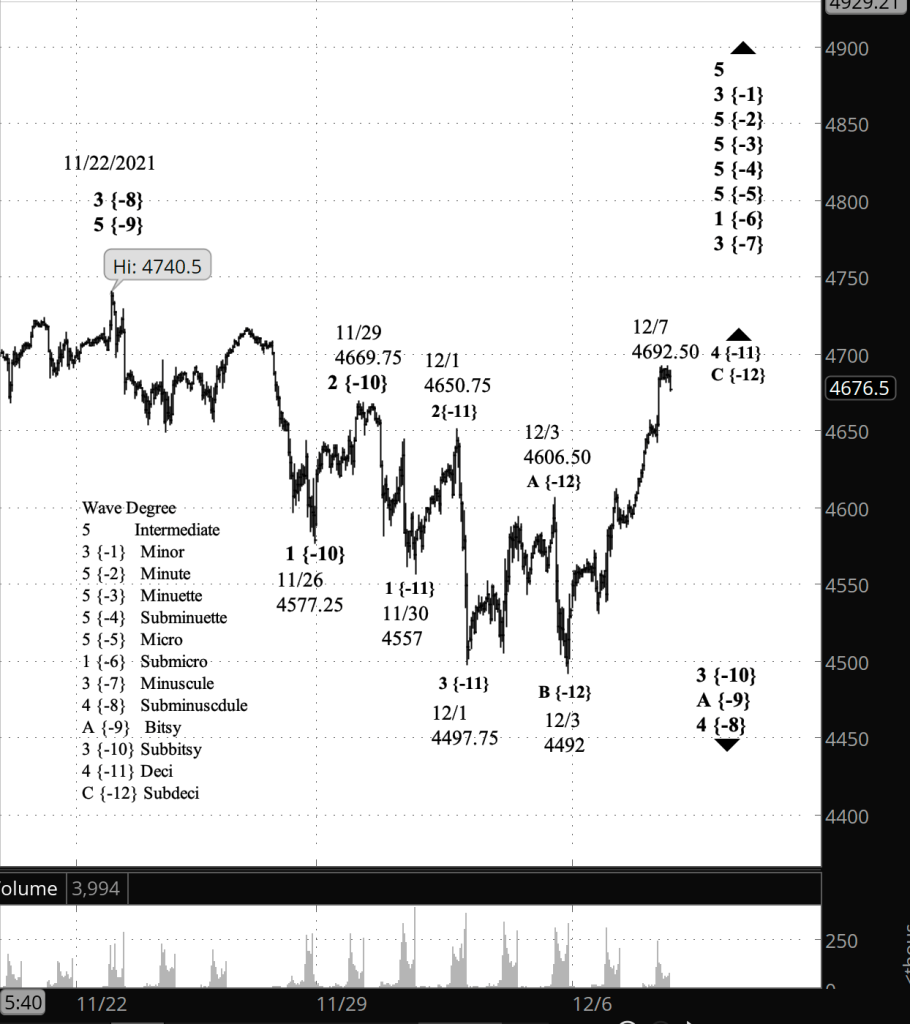
[S&P 500 E-mini futures at 3:30 p.m., 40-minute bars, with volume]

What does Elliott wave theory say? The present rise is uptrending wave C of Subdeci degree — subscript {-12} — within uptrending wave 4 of Deci degree {-11}.

Under my principal analysis, the end of wave C will also mark the end of its parent 4th wave and the beginning of downtrending wave 5 of Deci degree, which typically will reach beyond the start of wave 4, which began on December 1 from 4497.75. A 5th wave sometimes comes up short — “truncated” is the term of art.

Under my alternative analysis, wave C of Subdeci degree will be followed by a declining X wave and then a new corrective pattern. The X wave will remain above the December 1 low.

Learning and other resources. Elliott wave analysis provides context, not prophecy. As the 20th century semanticist Alfred Korzybski put it in his book Science and Sanity (1933), “The map is not the territory … The only usefulness of a map depends on similarity of structure between the empirical world and the map.” And I would add, in the ever-changing markets, we can judge that similarity of structure only after the fact.

See the menu page Analytical Methods for a rundown on where to go for information on Elliott wave analysis.

By Tim Bovee, Portland, Oregon, December 8, 2021

Disclaimer

Tim Bovee, Private Trader tracks the analysis and trades of a private trader for his own accounts. Nothing in this blog constitutes a recommendation to buy or sell stocks, options or any other financial instrument. The only purpose of this blog is to provide education and entertainment.

No trader is ever 100 percent successful in his or her trades. Trading in the stock and option markets is risky and uncertain. Each trader must make trading decisions for his or her own account, and take responsibility for the consequences.

License
Creative Commons License

All content on Tim Bovee, Private Trader by Timothy K. Bovee is licensed under a Creative Commons Attribution-ShareAlike 4.0 International License.

Based on a work at www.timbovee.com.
SP500 Analysis

3:30 p.m. New York time

Half an hour before the closing bell. The S&P 500 rose slightly early in the session and then settled into a very narrow range, less than 5 points wide on the futures for most of the day. No change in the analysis. I’ve updated the chart.

9:35 a.m. New York time

What’s happening now? The S&P 500 E-mini futures rose in overnight trading, reach 4656.75 at the opening bell.

What does it mean? The rise is the final portion of an upward correction and will be followed by a decline that likely will reach below the correction’s starting point, 4497.57, as the larger downtrend resumes.

What’s the alternative? If the correction develops into a compound structure, the end of the present wife will be followed by a decline and rise that likely will remain above the correction’s starting point, and then a second corrective pattern. In some cases compound corrections will link together three corrective patterns.

[S&P 500 E-mini futures at 3:30 p.m., 40-minute bars, with volume]

What does Elliott wave theory say? The present rise is, from smaller to larger, wave C of Subdeci degree within uptrending wave 4 of Deci degree within downtrending wave wave A of Subbitsy degree within downtrending wave 4 of Subminuscule degree, which began its descent from the November 22 high of 4740.50.

Under the principal analysis, Subdeci wave C will end its parent 4th wave and will be followed by downtrending wave 5 of Deci degree. The 5th wave, when complete, will mark the end of Subbitsy wave A.

Under the alternative analysis, wave C will be followed by an X wave — down and then up again — and then by a second corrective pattern.

Learning and other resources. Elliott wave analysis provides context, not prophecy. As the 20th century semanticist Alfred Korzybski put it in his book Science and Sanity (1933), “The map is not the territory … The only usefulness of a map depends on similarity of structure between the empirical world and the map.” And I would add, in the ever-changing markets, we can judge that similarity of structure only after the fact.

See the menu page Analytical Methods for a rundown on where to go for information on Elliott wave analysis.

By Tim Bovee, Portland, Oregon, December 7, 2021

Disclaimer

Tim Bovee, Private Trader tracks the analysis and trades of a private trader for his own accounts. Nothing in this blog constitutes a recommendation to buy or sell stocks, options or any other financial instrument. The only purpose of this blog is to provide education and entertainment.

No trader is ever 100 percent successful in his or her trades. Trading in the stock and option markets is risky and uncertain. Each trader must make trading decisions for his or her own account, and take responsibility for the consequences.

License
Creative Commons License

All content on Tim Bovee, Private Trader by Timothy K. Bovee is licensed under a Creative Commons Attribution-ShareAlike 4.0 International License.

Based on a work at www.timbovee.com.
SP500 Analysis

3:30 p.m. New York time

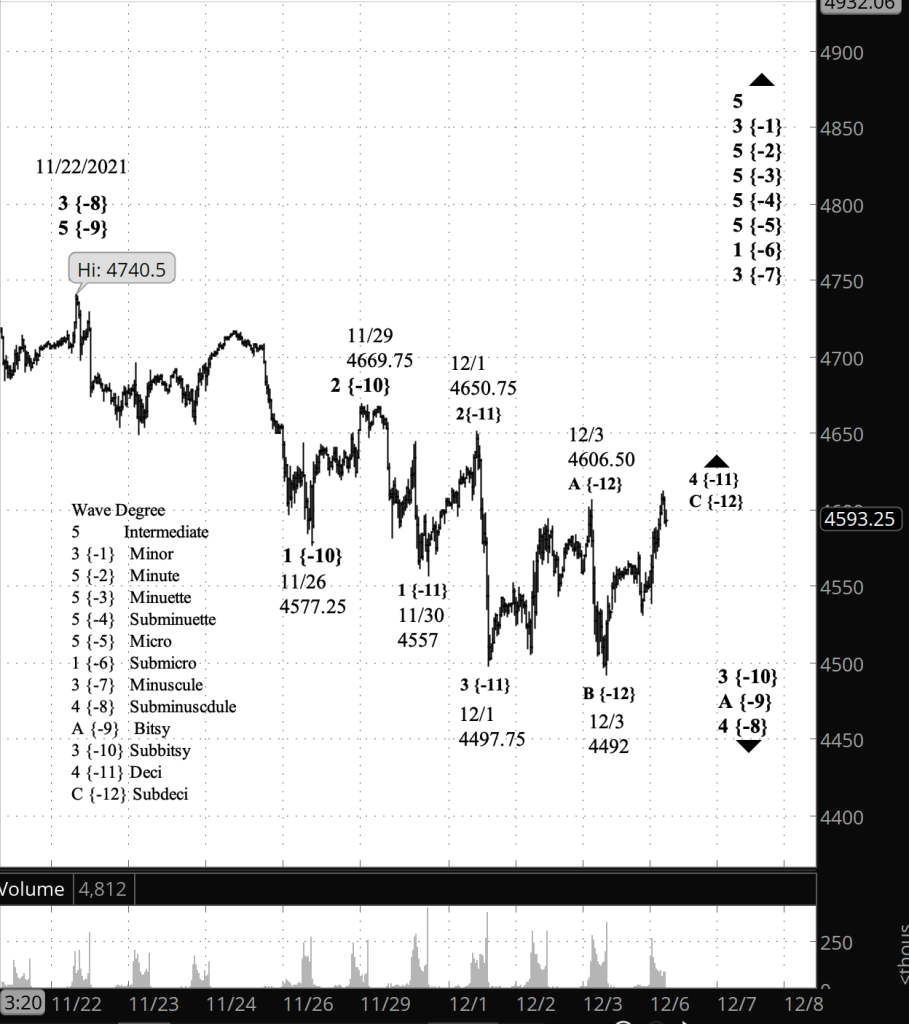
Half an hour before the closing bell. The rise from the December 3 low has exceeded that day’s earlier high, confirming that the 4th wave correction of Subbitsy degree is still underway. Today’s rise is wave C within the 4th wave. By exceeding the beginning of the preceding wave A, it confirmed that the pattern of the correction is a Flat.

The end of Deci wave C will also be the end of its parent, Subbitsy wave 4 and will be followed by a 5th wave decline, most likely below the end of wave 3, 4497.75.

The relabeling of the 4th wave means that wave 3 of Subbitsy degree ended on December 1 at 4497.75.

There are a number of wheels within wheels on this chart. The smallest wheel is an upward final corrective subwave of Deci degree (C wave) in the direction of a larger upward correction of Subbitsy degree (4th wave). They are embraced by a downtrending first corrective subwave, of Bitsy degree (A wave), which in turn lies within a larger downward correction of Subminuscule degree (4th wave). So it’s a Russian matryoshka nesting doll filled with corrective waves. The biggest doll, containing all the smaller dolls, is a rising impulse wave of Minuscule degree (3rd wave), which began on October 4, 2021.

That’s the new principal analysis. The new alternative analysis has to do with what comes next. Fourth waves especially are prone to extensions, compound corrections that glue two or three corrective patterns together. If wave 4 of Subbitsy degree develops into a compound correction, the present wave C will be followed by a downtrending X wave and then by the A wave of the corrective pattern, which could be a Flat, a Zigzag or a Triangle of some sort.

I’ve left this morning’s chart in place for comparison and added in this new chart reflecting the revised analysis.

[S&P 500 E-mini futures at 3:30 p.m., 35-minute bars, with volume]

9:35 a.m. New York time

What’s happening now? The S&P 500 E-mini futures turned downward after trading resumed Sunday evening. The rise from Friday’s low, 4492, peaked in the early morning hours today at 4570, declined slightly, and then rose at the opening bell, remaining below the earlier peak.

What does it mean? The rise is an upward correction within the decline that began December 3 from 4606.50. The present shape of the chart presents an ambiguity: Either the correction is over and the downtrend has resumed, or the rising first leg of the correction is over, to be followed by a downward move back toward Friday’s low and then another upward movement that will carry the price closer to the 4606.50 mark, the start of the decline.

I consider both to be of nearly equal probability. A decline below 4492 would mean the correction is over, and a new rise beginning above 4492 to a higher point within the correction would argue that the correction is still underway.

[S&P 500 E-mini futures at 9:35 a.m., 35-minute bars, with volume]

What does Elliott wave theory say? Both alternatives are looking within the decline that began on December 3, wave 5 of Deci degree — subscript {-11}. That downtrending impulse wave is in turn within wave 3 of Subbitsy degree {-10} within wave A of Bitsy degree {-9} within a wave 4 correction of Subminuette degree {-8}.

Wave 4 corrections tend to take the Flat pattern, and in a Flat, the A wave has three subwaves. So the end of wave 5 of Deci degree will mark the end of wave 3 of Subbitsy degree, which in turn will be the end of the parent wave A wave. The subsequent B wave also has three internal waves, and the final C wave has five waves internally.

If the correction is over, then the overnight peak was the end of wave C of Subdeci degree {-12}, and if the correction is still underway, then the peak ended wave A of Subdeci degree.

One thing that has bothered me about the chart since the decline that began on November 22 is that the first wave of the downward movement, wave 1 of Subbitsy degree, is larger than I normally see in 1st waves. A long 1st wave increases the risk that a firm rule of Elliott wave analysis will be violated. The rule is: Wave 3 cannot be shorter than both wave 1 and wave 5.

Wave 3 as of the December 3 low was longer than wave 1 — 177.75 vs. 163.25 — removing that concern as the chart develops.

Learning and other resources. Elliott wave analysis provides context, not prophecy. As the 20th century semanticist Alfred Korzybski put it in his book Science and Sanity (1933), “The map is not the territory … The only usefulness of a map depends on similarity of structure between the empirical world and the map.” And I would add, in the ever-changing markets, we can judge that similarity of structure only after the fact.

See the menu page Analytical Methods for a rundown on where to go for information on Elliott wave analysis.

By Tim Bovee, Portland, Oregon, December 6, 2021

Disclaimer

Tim Bovee, Private Trader tracks the analysis and trades of a private trader for his own accounts. Nothing in this blog constitutes a recommendation to buy or sell stocks, options or any other financial instrument. The only purpose of this blog is to provide education and entertainment.

No trader is ever 100 percent successful in his or her trades. Trading in the stock and option markets is risky and uncertain. Each trader must make trading decisions for his or her own account, and take responsibility for the consequences.

License
Creative Commons License

All content on Tim Bovee, Private Trader by Timothy K. Bovee is licensed under a Creative Commons Attribution-ShareAlike 4.0 International License.

Based on a work at www.timbovee.com.
SP500 Analysis

3:30 p.m. New York time

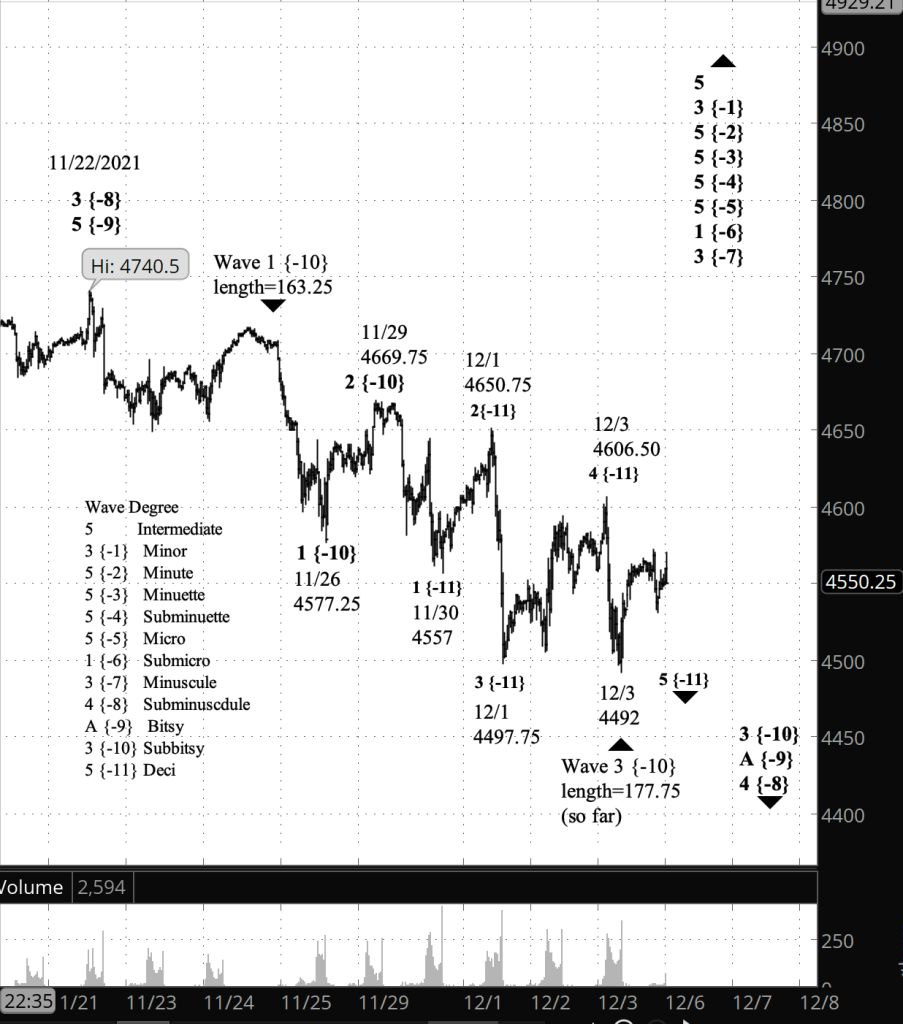
Half an hour before the closing bell. When the price today fell below the December 1 low, it validated the alternative analysis from this morning.

The recount was needed because the decline was labeled a 2nd wave, of Subbitsy degree, under this morning’s principal scenario. It dropped below the December 1 low, which was the beginning of the preceding 1st wave. Under the rules of Elliott wave analysis, if a “2nd wave” moves beyond the start of the preceding 1st wave, then it’s not a 2nd wave.

I’ve done a recount, but the B wave problem is back and as labelled, wave B breaks a rule of Elliott wave analysis by failing to retrace at least 90% of wave A.

I’ve updated the upper chart, with the rule-breaking labelled, and will figure this out over the weekend.

9:35 a.m. New York time

What’s happening now? The S&P 500 E-mini futures continued to work its way upward in overnight trading, reaching 4606.50 at the opening bell.

What does it mean? Under my principal analysis, the rise is early portion of the middle leg of a downtrending correction that began on November 22.

What’s the alternative? An alternative analysis sees the rise as part of an ongoing first leg of that correction.

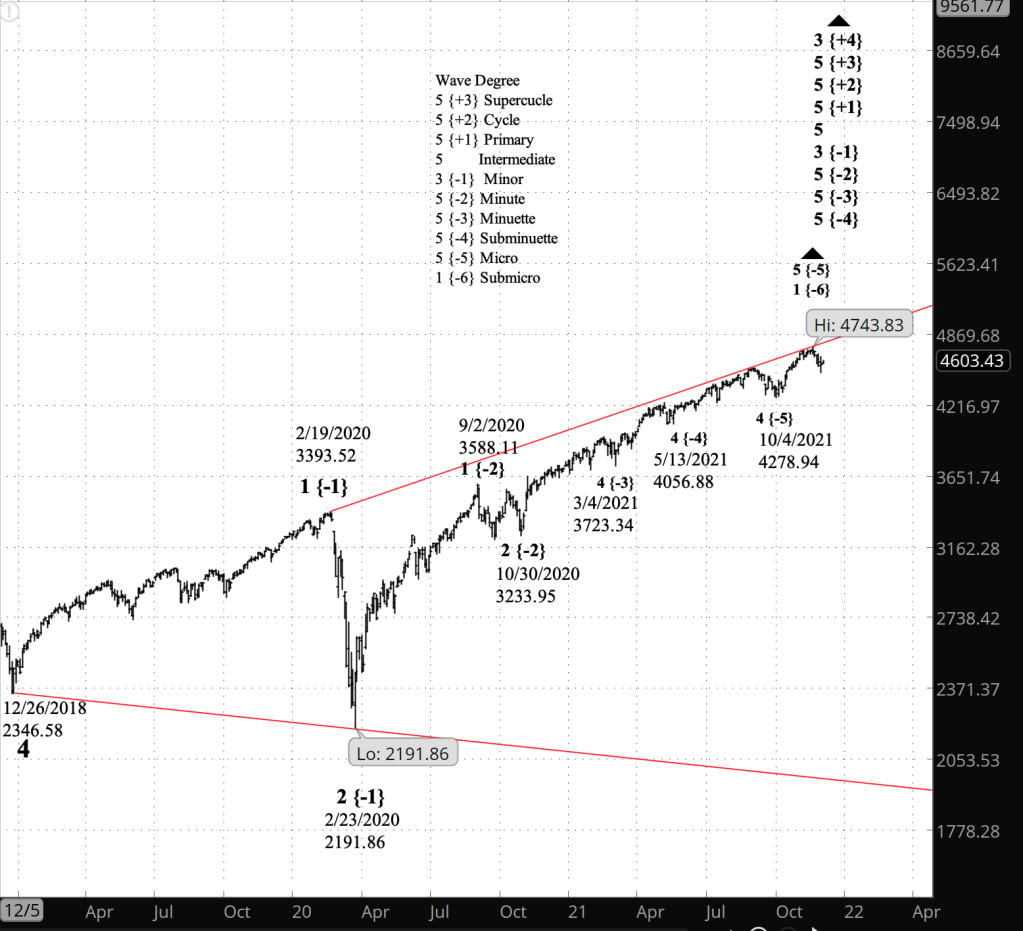
Charts. The upper chart is a close-up view of the futures from the November 22 peak onward. The lower chart shows the S&P 500 index for the past three years, including the entirety, so far, of the expanding Diagonal Triangle that began on December 26, 2018 and that is still in progress.

[S&P 500 E-mini futures at 3:30 p.m., 30-minute bars, with volume]
[S&P 500 index at 9:34 a.m., 2-day bars]

What does Elliott wave theory say? Under the principal analysis, the present rise is wave 1 of Subbitsy degree — subscript {-10} on the chart — within wave 1 of Bitsy degree {-9} within wave 4 of Subminuscule degree {-8}.

The alternative analysis sees the price as being in wave 3 of Deci degree {-11} within wave 5 of Subbitsy degree within wave A of Bitsy degree within wave 4 of Subminuscule degree.

More succinctly, the principal analysis sees the correction as being further along than does the alternative analysis.

Subminuscule wave 4 will be followed by a 5th wave that will complete its parent, Minuscule wave 3 — subscript {-7} — beginning Minuscule 4, a larger downward correction, to be followed by a 5th wave rise to new heights, above the peak of 4740.50 attained on November 22.

Working our way up to higher levels, the end of Minuscule 5 will also end the parent wave 1 of Submicro degree {-6}, resulting in 2nd wave correction at that level, and then three more waves to completion. The Submicro degree is key to the market’s present situation, since its completion will also trigger 5th wave completions up to Minute degree {-2}. And the completion of the Minute degree series — three more waves after wave 2 — will complete wave 3 of Minor degree {-1}, the market rise that began on February 23, 2021, at the end of the early pandemic crash. All of this is happening within wave 5 of Intermediate degree, which has no subscript on the chart. Intermediate 5 is the entirety of the expanding Diagonal Triangle that began the day after Christmas in 2018.

Learning and other resources. Elliott wave analysis provides context, not prophecy. As the 20th century semanticist Alfred Korzybski put it in his book Science and Sanity (1933), “The map is not the territory … The only usefulness of a map depends on similarity of structure between the empirical world and the map.” And I would add, in the ever-changing markets, we can judge that similarity of structure only after the fact.

See the menu page Analytical Methods for a rundown on where to go for information on Elliott wave analysis.

By Tim Bovee, Portland, Oregon, December 3, 2021

Disclaimer

Tim Bovee, Private Trader tracks the analysis and trades of a private trader for his own accounts. Nothing in this blog constitutes a recommendation to buy or sell stocks, options or any other financial instrument. The only purpose of this blog is to provide education and entertainment.

No trader is ever 100 percent successful in his or her trades. Trading in the stock and option markets is risky and uncertain. Each trader must make trading decisions for his or her own account, and take responsibility for the consequences.

License
Creative Commons License

All content on Tim Bovee, Private Trader by Timothy K. Bovee is licensed under a Creative Commons Attribution-ShareAlike 4.0 International License.

Based on a work at www.timbovee.com.
SP500 Analysis

3:30 p.m. New York time

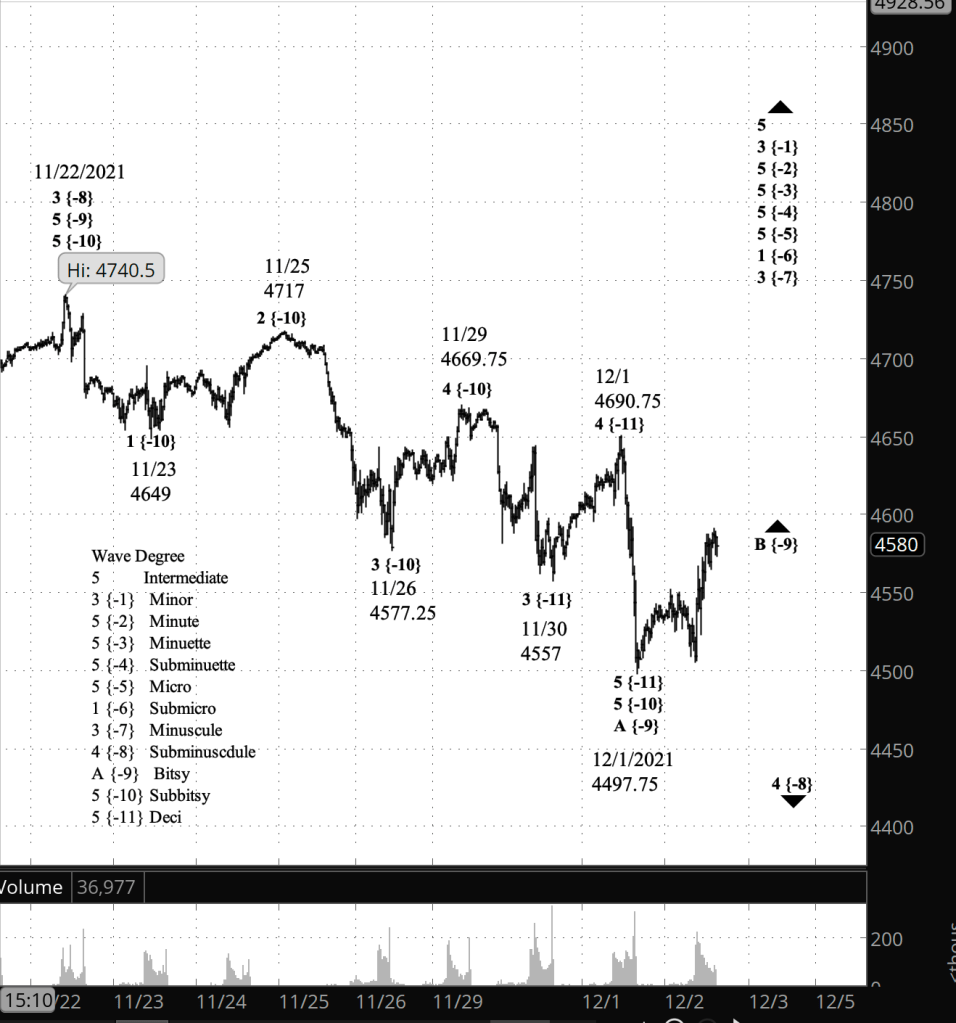
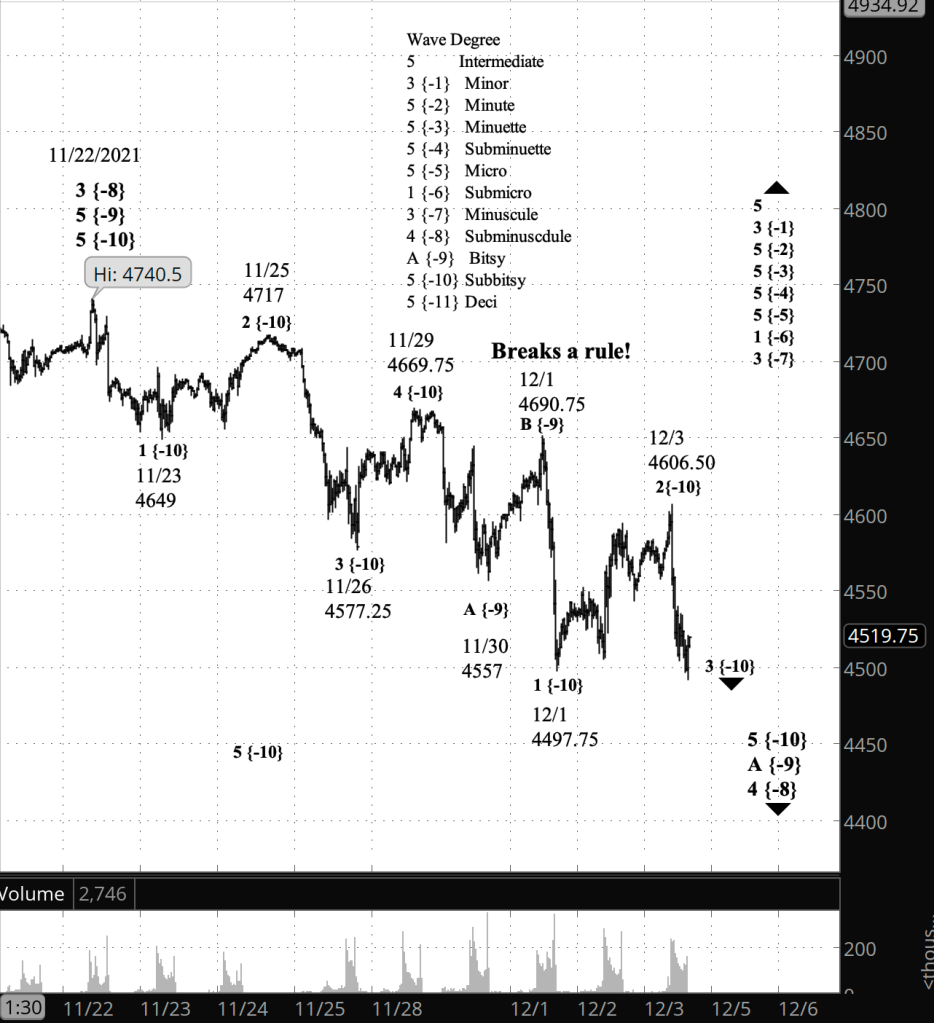
Half an hour before the closing bell. The futures continued to rise during the trading day in what appeared to be a three-wave pattern. Under my principal analysis, the decline to 4497.75 on December 1 completed wave A of Bitsy degree — subscript {-9} — and Bitsy wave B has begun, all within wave 4 of Subminuscule degree {-8}.

Under the alternative analysis, the reversal point ended wave 3 of Subbitsy degree and Subbitsy wave 4 has begun, all within Bitsy wave A within Subminuscule wave 4. The Subminuscule 4th wave correction will trade a Flat corrective pattern if its typical, and that brings us right back to the B-wave problem discussed Wednesday and Tuesday.

A reminder of the Elliott wave rule and tendency governing B waves in a Flat: The B wave must retrace at least 90% of the preceding A wave, and it usually will retrace 100% to 138% of the A wave.

If the chart in coming days adheres to those standards at the Bitsy degree level, then the principal analysis is correct. If it reverses and moves lower, then the alternative analysis is correct.

I’ve added an additional chart for late in the session, leaving this morning’s early in the session chart unchanged.

[S&P 500 E-mini futures at 3:30 p.m., 25-minute bars, with volume]

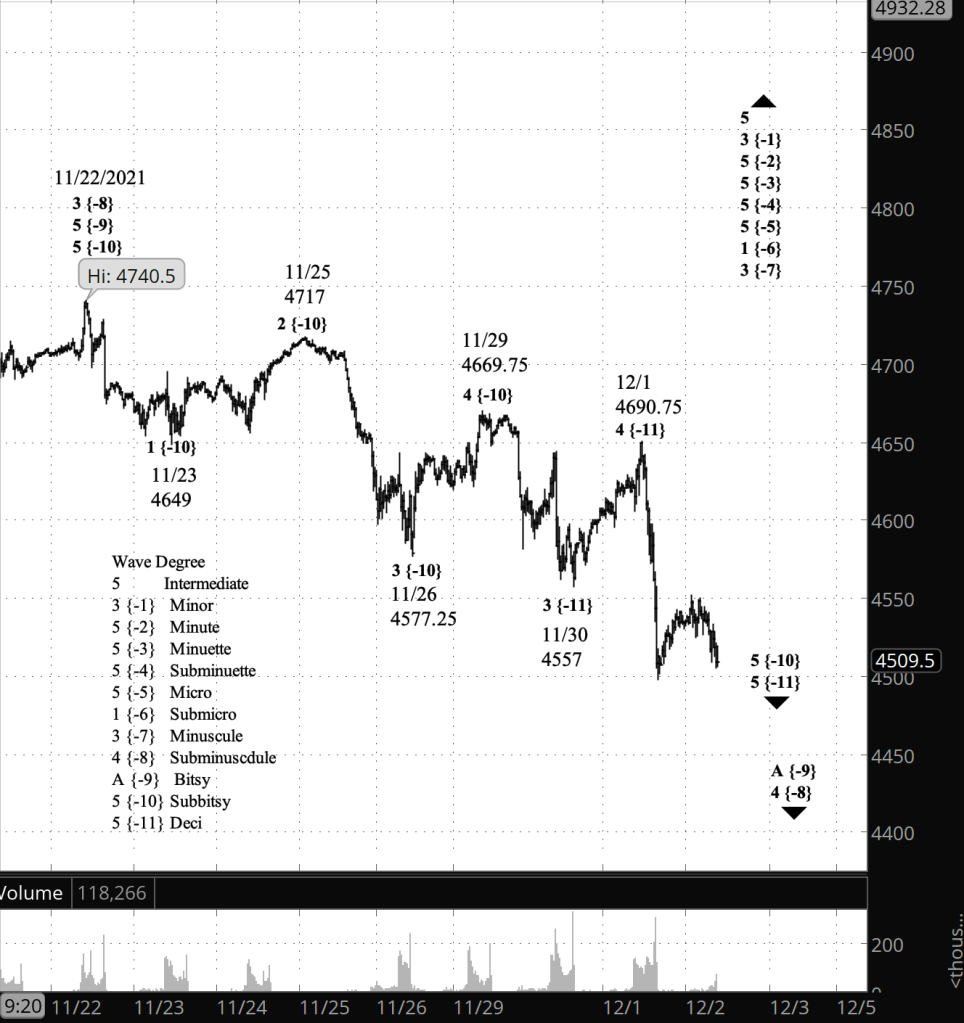
9:35 a.m. New York time

What’s happening now? The S&P 500 E-mini futures fell sharply beginning yesterday afternoon and continuing overnight, halting the decline and rising slightly as the opening bell approached.

What does it mean? I’ve reworked my principal analysis to accommodate the Elliott wave rule violation discussed in yesterday’s post. The details are low confidence. The key take-away is that the first leg of a downward correction of the rise that began October 6 is nearing completion and will be followed by a second leg to the upside. More details in the Elliott wave theory section below.

What’s the alternative? The decline from yesterday can be seen as the middle wave of the correction’s first leg, rather than the final leg as I have it. If the alternative is correct, there will be a low-level upward correction, followed by a further declne.

[S&P 500 E-mini futures at 9:35 a.m., 25-minute bars, with volume]

What does Elliott wave theory say? The two prior posts — December 1 and November 30 — focused on the B-wave problem. My principal analysis on those days showed a 4th wave falling quite short of a 90% retracement of the preceding A wave, such a retracement being a requirement for B waves in a Flat pattern, according to Elliott wave theory.

My reworking of the analysis gets rid of the problem in the usual Elliott wave fashion, by relabelling some waves as being of a lower degree. There are other approaches, but I’ve chosen this one because it seems closest to the “normal” look-and-feel of the structure.

Under the new principal analysis, the price is in wave 5 of Deci degree — subscript {-11} — within wave 5 of Subbitsy degree {-10} within wave A of Bitsy degree {-9} within wave 4 of Subminuscule degree {-8}, the last and largest wave in the series being a downward correction of wave 4 of Subminuscule degree, which began on October 6 from 4273.75 and ended on November 22 at 4740.50.

The alternative analysis reworks the count in such a way that the decline that began yesterday is wave 3 of Subbitsy degree. Doing it that way creates an overly large wave 1 of Subbitsy degree, in my opinion, and the proper look-and-feel — an aesthetic judgment of the waves — is a component of Elliott wave analysis.

Learning and other resources. Elliott wave analysis provides context, not prophecy. As the 20th century semanticist Alfred Korzybski put it in his book Science and Sanity (1933), “The map is not the territory … The only usefulness of a map depends on similarity of structure between the empirical world and the map.” And I would add, in the ever-changing markets, we can judge that similarity of structure only after the fact.

See the menu page Analytical Methods for a rundown on where to go for information on Elliott wave analysis.

By Tim Bovee, Portland, Oregon, December 2, 2021

Disclaimer

Tim Bovee, Private Trader tracks the analysis and trades of a private trader for his own accounts. Nothing in this blog constitutes a recommendation to buy or sell stocks, options or any other financial instrument. The only purpose of this blog is to provide education and entertainment.

No trader is ever 100 percent successful in his or her trades. Trading in the stock and option markets is risky and uncertain. Each trader must make trading decisions for his or her own account, and take responsibility for the consequences.

License
Creative Commons License

All content on Tim Bovee, Private Trader by Timothy K. Bovee is licensed under a Creative Commons Attribution-ShareAlike 4.0 International License.

Based on a work at www.timbovee.com.
SP500 Analysis

3:30 p.m. New York time

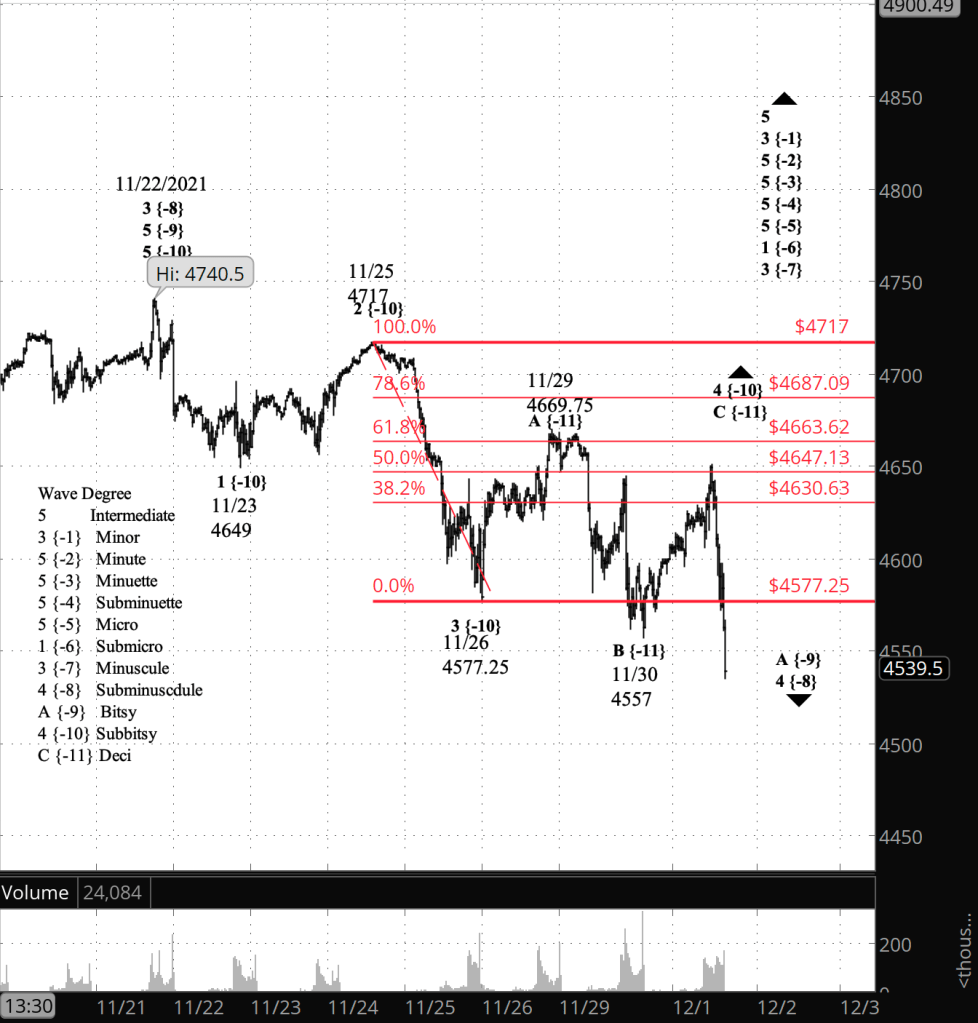
Half an hour before the closing bell. The futures reversed this afternoon and fell sharply. The movement threatens to leave my present analysis in violation of a rule of Elliott wave analysis. The present wave is C of Deci degree — subscript {-11} — within wave 4 of Subminuscule degree {-10}. The rules require that a C wave in wave 4 retrace at least 90% of the preceding 3rd wave, as I discussed in yesterday’s S&P 500 post. This wave 4 has retraced about 62% the length of the preceding wave 3. So far. If it’s over, then wave C has come up short and the entire count will need to be revisited. If wave C still has some distance to travel, then there’s a chance that it will end up in compliance with the rule.

Wave C can’t be complete under the rules of Elliott wave analysis. It’s possible that what we’re seeing is a Diagonal Triangle, but this early in the pattern the analysis is uncertain.twi

I’ve updated the chart, with this morning’s labelling unchanged.

9:35 a.m. New York time

What’s happening now? The S&P 500 E-mini futures rose in overnight trading, and at the opening was close to a 38.2% retracement of the decline that began on November 25.

What does it mean? The extent of the overnight rise lends credence to the view that the third and final leg of an upward correction has begun. The correction began on November 26, and the 3rd leg, on November 30.

What’s the alternative? The correction may not end at the 3rd leg but instead might well add another corrective pattern, forming a compound structure.

[S&P 500 E-mini futures at 3:30 p.m., 25-minute bars, with volume]

What does Elliott wave theory say? The present location is uptrending wave C of Deci degree — subscript {-11} — within uptrending wave 4 of Subbitsy degree {-10} within downtrending wave A of Bitsy degree {-9} within downtrending wave 4 of Subminuscule degree {-8}.

Putting it another way, the price is within the last leg of a rising 4th wave correction within the first leg of a falling 4th wave correction. Both 4th waves will be followed by 5th waves, descending in the case of the smaller 4th wave and ascending in the case of the larger one.

The alternative analysis addresses the possibility that the smaller 4th wave develops into a compound correction, where two or three corrective patterns are linked together by a connector wave (to be labelled an X wave if it occurs).

Learning and other resources. Elliott wave analysis provides context, not prophecy. As the 20th century semanticist Alfred Korzybski put it in his book Science and Sanity (1933), “The map is not the territory … The only usefulness of a map depends on similarity of structure between the empirical world and the map.” And I would add, in the ever-changing markets, we can judge that similarity of structure only after the fact.

See the menu page Analytical Methods for a rundown on where to go for information on Elliott wave analysis.

By Tim Bovee, Portland, Oregon, December 1, 2021

Disclaimer

Tim Bovee, Private Trader tracks the analysis and trades of a private trader for his own accounts. Nothing in this blog constitutes a recommendation to buy or sell stocks, options or any other financial instrument. The only purpose of this blog is to provide education and entertainment.

No trader is ever 100 percent successful in his or her trades. Trading in the stock and option markets is risky and uncertain. Each trader must make trading decisions for his or her own account, and take responsibility for the consequences.

License
Creative Commons License

All content on Tim Bovee, Private Trader by Timothy K. Bovee is licensed under a Creative Commons Attribution-ShareAlike 4.0 International License.

Based on a work at www.timbovee.com.