BABA Analysis

Alibaba Group Holding Ltd. (BABA)

1:40 p.m. New York time

What’s happening now? BABA dropped off from its Tuesday high, 174.15, with an opening gap this morning.

What does it mean? The price has completed a 1st wave up within an upward correction a long downtrend and is now falling in a downward correction within the upward correction.

What’s the alternative? The low of 152.80 on August 23 marked the end of a major decline, and the present upward movement is the beginning of a major uptrend that will eventually move above the October 2020 high of 319.32.

Chart note. The subscripts in the wave labels are relative to one another and are unrelated to the Elliott wave theory nomenclature of wave degrees.

[BABA at 1:40 p.m., 30-minute bars]

What does Elliott wave theory say? By my principal count, the present decline is wave 2 {-4} within uptrending wave A {-3}, the first wave of the wave 4 {-2} upward correction that began on August 23. Fourth waves tend to be shallow, so I don’t expect a great deal of upside from this one. Wave 4 {-2} will be followed by a 5th wave of the same degree that will push the price to below 152.80, the August 23 low.

By my alternative count, the August 23 low marked the end of the correction, and the rise from August 23 is the beginning of a new wave to the upside that will eventually break above 319.32, the all-time high for BABA set on October 27, 2020

Learning and other resources. Elliott wave analysis provides context, not prophecy. As the 20th century semanticist Alfred Korzybski put it in his book Science and Sanity (1933), “The map is not the territory … The only usefulness of a map depends on similarity of structure between the empirical world and the map.” And I would add, we can judge that similarity of structure only after the fact.

See the menu page Analytical Methods for a rundown on where to go for information on Elliott wave analysis.

By Tim Bovee, Portland, Oregon, August 25, 2021

Disclaimer

Tim Bovee, Private Trader tracks the analysis and trades of a private trader for his own accounts. Nothing in this blog constitutes a recommendation to buy or sell stocks, options or any other financial instrument. The only purpose of this blog is to provide education and entertainment.

No trader is ever 100 percent successful in his or her trades. Trading in the stock and option markets is risky and uncertain. Each trader must make trading decisions for his or her own account, and take responsibility for the consequences.

License
Creative Commons License

All content on Tim Bovee, Private Trader by Timothy K. Bovee is licensed under a Creative Commons Attribution-ShareAlike 4.0 International License.

Based on a work at www.timbovee.com.

SP500 Analysis

3:30 p.m. New York time

Half an hour before the closing bell. The S&P 500 rose to a new high in trading today, 4497.25 so far on the futures, and 4501.08 on the index. The wave 4 correction of Bitsy degree has ended, and wave 5 of Bitsy degree is underway. I’ve updated the chart.

1:45 p.m. New York time

Other analysis. BABA dropped off from its Tuesday high, 174.15, with an opening gap this morning. The price has completed a 1st wave up within an upward correction a long downtrend and is now falling in a downward correction within the upward correction. I’ve posted an analysis.

9:50 a.m. New York time

What’s happening now? The S&P 500 E-mini futures continued their sideways course overnight, remaining below yesterdays high of 4492 on the futures, 4492.81 on the index.

What does it mean? The movement is a low-level correction that will be followed by a rise to new heights.

What’s the alternative? Yesterday’s high marked the end of the rise of August 19, triggering a series of completions up to the rise that began on May 19.

[S&P 500 E-mini futures at 3:30 p.m., hourly bars, with volume]

What does Elliott wave theory say? The sideways movement from yesterday is wave 4 of Bitsy degree, following the peak at 4492 that marked the end of Bitsy wave 3. Fourth wave corrections tend to be shallow, and this 4th wave so far is adhering to that tendency. It will be followed by wave 5 of Bitsy degree, which will break above the previous peak of 4492, with no formal limits on how high it can go. Ideally, it would hit the upper boundary of the price channel, but that’s a bit of a stretch for a wave of such a small degree.

The end of Bitsy wave 5 triggers completion of a series of 5th waves of greater degree, up three levels to Submicro degree, which in turn completes wave 3 of Micro degree, which began on May 19 at 4055.50 on the index. The ensuing wave 4 of Micro degree will be shallow correction, albeit of far more impactful size than the Bitsy-degree correction we’ve seen since yesterday.

The less likely alternative: Yesterday’s peak at 4492 was the end of wave 5 of Bitsy degree and of the parent waves discussed above, and the sideways movement is a very muddy, tentative step in what will prove to be a significant decline correcting the Minor-degree wave 3 rise that began on February 23, 2020 from 2191.86 on the index.

Learning and other resources. Elliott wave analysis provides context, not prophecy. As the 20th century semanticist Alfred Korzybski put it in his book Science and Sanity (1933), “The map is not the territory … The only usefulness of a map depends on similarity of structure between the empirical world and the map.” And I would add, we can judge that similarity of structure only after the fact.

See the menu page Analytical Methods for a rundown on where to go for information on Elliott wave analysis.

By Tim Bovee, Portland, Oregon, August 25, 2021

Disclaimer

Tim Bovee, Private Trader tracks the analysis and trades of a private trader for his own accounts. Nothing in this blog constitutes a recommendation to buy or sell stocks, options or any other financial instrument. The only purpose of this blog is to provide education and entertainment.

No trader is ever 100 percent successful in his or her trades. Trading in the stock and option markets is risky and uncertain. Each trader must make trading decisions for his or her own account, and take responsibility for the consequences.

License
Creative Commons License

All content on Tim Bovee, Private Trader by Timothy K. Bovee is licensed under a Creative Commons Attribution-ShareAlike 4.0 International License.

Based on a work at www.timbovee.com.

BABA Analysis

Alibaba Group Holding Ltd. (BABA)

11 a.m. New York time

Elliott wave analysis updated. I’ve updated the Elliott wave analysis with a paragraph on the internals of wave 5 {-2}. Also, I’ve updated the chart.

10:40 a.m. New York time

What’s happening now? BABA rose sharply, with an opening gap, in this morning’s trading.

What does it mean? Big picture, BABA has been in decline since October of last year and has fallen to a bit more than 20 points above the December 2018 low. On the chart, I’ve treated the subsequent decline as a correction within a long-term rise, for reasons discussed in the Elliott wave analysis section.

What’s the alternative? The decline could be understood as the beginning of a long-term downtrend. I’ve rejected that for reasons discussed in the Elliott wave analysis section.

The chart In the chart below I’ve added in a 6-day moving average, in red, to clarify the subwaves. The wave labels on the chart are relative to each other and don’t correlate with the Elliott wave-naming system.

[BABA at 11 a.m., daily bars]

What does Elliott wave theory say? The nature of the decline is revealed by the internal count within the three waves. If the count is 3-3-5, then it’s a correction. I read the chart as 3-3-5 and have labeled the subwaves. The count within wave B {-1} is a bit ambiguous, but under the Elliott wave rules, B waves tend to have three waves internally. So from that structure, I conclude that the decline that began October 27, 2020 is a correction within an uptrend and will be followed, eventually, with many ups and downs, by a rise to new heights.

Under my principal analysis, the rise from 2018 is still underway. The alternative would be to consider the October 2020 peak to be the end of the rise that began in 2018. For this to work, I would have to break the first wave of the decline into five subwaves. It’s possible most of the time, if I squint real hard, to make that work. In this chart, I think it’s an unlikely conclusion to draw from the evidence.

The question comes down to whether wave 5 {-2} is complete. Fifth waves tend to extend, and that might well be the case here. So there may be more downside ahead before the rise begins. The shortness of the 3rd wave within 5 {-2} is troubling, since under the rules of Elliott wave analysis, a 3rd wave cannot be the shortest wave within a trend. And indeed, wave 1 {-3} is 32.63 points long, and wave 3 {0-3} is 36.93 points long. So it’s a legitimate count within an extension, but just barely. I consider that to be a caution flag.

Learning and other resources. Elliott wave analysis provides context, not prophecy. As the 20th century semanticist Alfred Korzybski put it in his book Science and Sanity (1933), “The map is not the territory … The only usefulness of a map depends on similarity of structure between the empirical world and the map.” And I would add, we can judge that similarity of structure only after the fact.

See the menu page Analytical Methods for a rundown on where to go for information on Elliott wave analysis.

By Tim Bovee, Portland, Oregon, August 24, 2021

Disclaimer

Tim Bovee, Private Trader tracks the analysis and trades of a private trader for his own accounts. Nothing in this blog constitutes a recommendation to buy or sell stocks, options or any other financial instrument. The only purpose of this blog is to provide education and entertainment.

No trader is ever 100 percent successful in his or her trades. Trading in the stock and option markets is risky and uncertain. Each trader must make trading decisions for his or her own account, and take responsibility for the consequences.

License
Creative Commons License

All content on Tim Bovee, Private Trader by Timothy K. Bovee is licensed under a Creative Commons Attribution-ShareAlike 4.0 International License.

Based on a work at www.timbovee.com.

SP500 Analysis

3:30 p.m. New York time

Half an hour before the closing bell. The S&P 500 spent the day in a narrow range, staying below the early morning high of 4992 on the futures, 4492.81 on the index. No change in the analysis. I’ve updated the chart.

Also posted. See my analysis of BABA, posted this morning.

9:40 a.m. New York time

What’s happening now? The S&P 500 E-mini futures rose to 4492 in early morning trading and then pulled back slightly.

What does it mean? My principal analysis treats the peak as the end of the third wave of a five-wave uptrend that began on August 19. It will be followed by a shallow correction and then a final push to higher highs.

What’s the alternative? Equally plausible, the alternative is that the third wave is still underway and the subsequent correction lies in the futures.

[S&P 500 E-mini futures at 3:30 p.m., hourly bars, with volume]

What does Elliott wave theory say? Under the principal analysis, used on the chart, the overnight high marks the end of wave 3 of Bitsy degree within a series of 5th waves: In ascending order, Subminuscule, Minuscule and Submicro degrees. All of this is within wave 3 of Micro degree, which began its rise on May 19 from 4055.50

The subsequent decline begins a correction, wave 4 of Bitsy degree, which will be shallow and will be followed by Bitsy wave 5 which will attain new heights and mark the end of the 5th waves and of wave 3 of Micro degree.

Under the alternative analysis, wave 3 of Bitsy degree is still underway. That will be confirmed if the price rises above 4492 without having completed a correction of at least three waves internally.

Learning and other resources. Elliott wave analysis provides context, not prophecy. As the 20th century semanticist Alfred Korzybski put it in his book Science and Sanity (1933), “The map is not the territory … The only usefulness of a map depends on similarity of structure between the empirical world and the map.” And I would add, we can judge that similarity of structure only after the fact.

See the menu page Analytical Methods for a rundown on where to go for information on Elliott wave analysis.

By Tim Bovee, Portland, Oregon, August 24, 2021

Disclaimer

Tim Bovee, Private Trader tracks the analysis and trades of a private trader for his own accounts. Nothing in this blog constitutes a recommendation to buy or sell stocks, options or any other financial instrument. The only purpose of this blog is to provide education and entertainment.

No trader is ever 100 percent successful in his or her trades. Trading in the stock and option markets is risky and uncertain. Each trader must make trading decisions for his or her own account, and take responsibility for the consequences.

License
Creative Commons License

All content on Tim Bovee, Private Trader by Timothy K. Bovee is licensed under a Creative Commons Attribution-ShareAlike 4.0 International License.

Based on a work at www.timbovee.com.

SP500 Analysis

3:30 p.m. New York time

Half an hour before the closing bell. The S&P 500 has continued its rise throughout the day, reaching highs of 4485.75 on the futures, 4489.88 on the index. No change to the recount analysis posted at noon. I’ve updated the upper chart.

1:35 p.m. New York time

My trades. I’ve exited my AMD options position for a wash and updated the entry analysis with my reasoning for doing so.

12 noon New York time

A new high forces a recount. My alternative analysis proved to be the path the market took this morning, as the price pushed to new highs, so far reaching 4482.25 on the futures and 4486.08 on the index. The new highs mean that the decline from August 16 was a correction within an ongoing uptrend, wave 3 of Micro degree.

The new count: The August 16 high was the peak of wave 3 of Subminuscule degree, the decline to August 19 was Subminuscule wave 4, and the ensuing rise from that low, which is now underway, is wave 5 of Subminuscule degree. All of this is happening within, in ascending order, wave 5 of Minuscule degree within wave 5 of Submicro degree within wave 3 of Micro degree.

[Revised analysis: S&P 500 E-mini futures as 3:30 p.m., hourly bars, with volume]

9:40 a.m. New York time

What’s happening now? The S&P 500 E-mini futures continued to rise after trading resumed Sunday afternoon, reaching a high of 4455 shortly before midnight and then moved higher after the opening bell, reaching above 4460.

What does it mean? Under my principal analysis, an upward correction of the decline that ended August 19 is now underway. It is occurring within a larger downward correction that began from the August 16 peak of 4476.50.

What’s the alternative? If the present rise exceeds the August 16 peak, then the long rise that began on February 23, 2020 from 2191.86 on the index is still underway and the decline after August 16 was a downward correction within that large-scale uptrend.

[Outdated analysis: S&P 500 E-mini futures at 9:30 a.m., 30-minute bars, with volume]

What does Elliott wave theory say? Under my principal analysis, the August 16-19 decline is wave 1 of Subminuscule degree and the subsequent rise is Subminuscule wave 2, within in ascending order wave 1 of MInuscule degree within wave A of Submicro within wave 4 of Micro degree, a downward correction of the MIcro-degree rise that began on May 11.

Under the alternative analysis, which is triggered if the price exceeds 4476.50 on the futures and 4480.26 on the index, wave 3 of Micro degree is still underway and the fall from August 16 is a correction within that wave.

Learning and other resources. Elliott wave analysis provides context, not prophecy. As the 20th century semanticist Alfred Korzybski put it in his book Science and Sanity (1933), “The map is not the territory … The only usefulness of a map depends on similarity of structure between the empirical world and the map.” And I would add, we can judge that similarity of structure only after the fact.

See the menu page Analytical Methods for a rundown on where to go for information on Elliott wave analysis.

By Tim Bovee, Portland, Oregon, August 23, 2021

Disclaimer

Tim Bovee, Private Trader tracks the analysis and trades of a private trader for his own accounts. Nothing in this blog constitutes a recommendation to buy or sell stocks, options or any other financial instrument. The only purpose of this blog is to provide education and entertainment.

No trader is ever 100 percent successful in his or her trades. Trading in the stock and option markets is risky and uncertain. Each trader must make trading decisions for his or her own account, and take responsibility for the consequences.

License
Creative Commons License

All content on Tim Bovee, Private Trader by Timothy K. Bovee is licensed under a Creative Commons Attribution-ShareAlike 4.0 International License.

Based on a work at www.timbovee.com.

Shares Trading Rules

I’ve added an updated shares section to the Trading Rules drop-down on the menu. Here’s what it says:

Lower Risk: Shares

Shares are considered to be lower risk than options because they can be traded without leverage and are generally have lower volatility.

On the other other hand, options positions can be positioned in a way that limits the possible loss if the price moves against the trader. Shares can drop to zero. I’ve had it happen.

The one tool that shares offer to mitigate that risk is the stop-loss; setting a price at which shares will be sold if the market price reaches that level.

I use a trailing-stop loss. For long shares, if I set a, say, 3% stop-loss, and the price of the shares rises, then the stop-loss will also rise, reamining 3% below the peak price.

I will use 3% occasionally as a very short-term insurance to limit loss, but my normal practice is to give shares room to maneuver. For that purpose, I use a 20% trailing stop. I’ve based based choice on three research papers:

Han, Yufeng and Zhou, Guofu and Zhu, Yingzi, Taming Momentum Crashes: A Simple Stop-Loss Strategy (September 24, 2016). Available at SSRN: https://ssrn.com/abstract=2407199 or http://dx.doi.org/10.2139/ssrn.2407199

Yusupov, Garib and Shorrason, Bergsveinn, Performance of Stop-Loss Rules vs. Buy-and-Hold Strategy (2009). Available at Lund University: https://www.lunduniversity.lu.se/lup/publication/1474565

Kaminski, Kathryn and Lo, Andrew W., When Do Stop-Loss Rules Stop Losses? (January 3, 2007). EFA 2007 Ljubljana Meetings Paper. Available at SSRN: https://ssrn.com/abstract=968338 or http://dx.doi.org/10.2139/ssrn.968338

By Tim Bovee, August 22, 2021, Portland, Oregon

Disclaimer

Tim Bovee, Private Trader tracks the analysis and trades of a private trader for his own accounts. Nothing in this blog constitutes a recommendation to buy or sell stocks, options or any other financial instrument. The only purpose of this blog is to provide education and entertainment.

No trader is ever 100 percent successful in his or her trades. Trading in the stock and option markets is risky and uncertain. Each trader must make trading decisions for his or her own account, and take responsibility for the consequences.

License
Creative Commons License

All content on Tim Bovee, Private Trader by Timothy K. Bovee is licensed under a Creative Commons Attribution-ShareAlike 4.0 International License.

Based on a work at www.timbovee.com.
SP500 Analysis

3:30 p.m. New York time

Half an hour before the closing bell. The S&P 500 continued its rise during the day. No change in the analysis. Chart updated.

9:40 a.m. New York time

What’s happening now? The S&P 500 E-mini futures rose overnight in the third leg of an upward correction within a larger downtrend.

What does it mean? Corrections of this sort tend to come with three legs, and so this low-level correction is nearing an end.

What is the alternative? Corrections sometimes take more complex patterns, and so although the third leg typically marks the final stage of a corrective pattern, this low-level correction could prove to be complex.

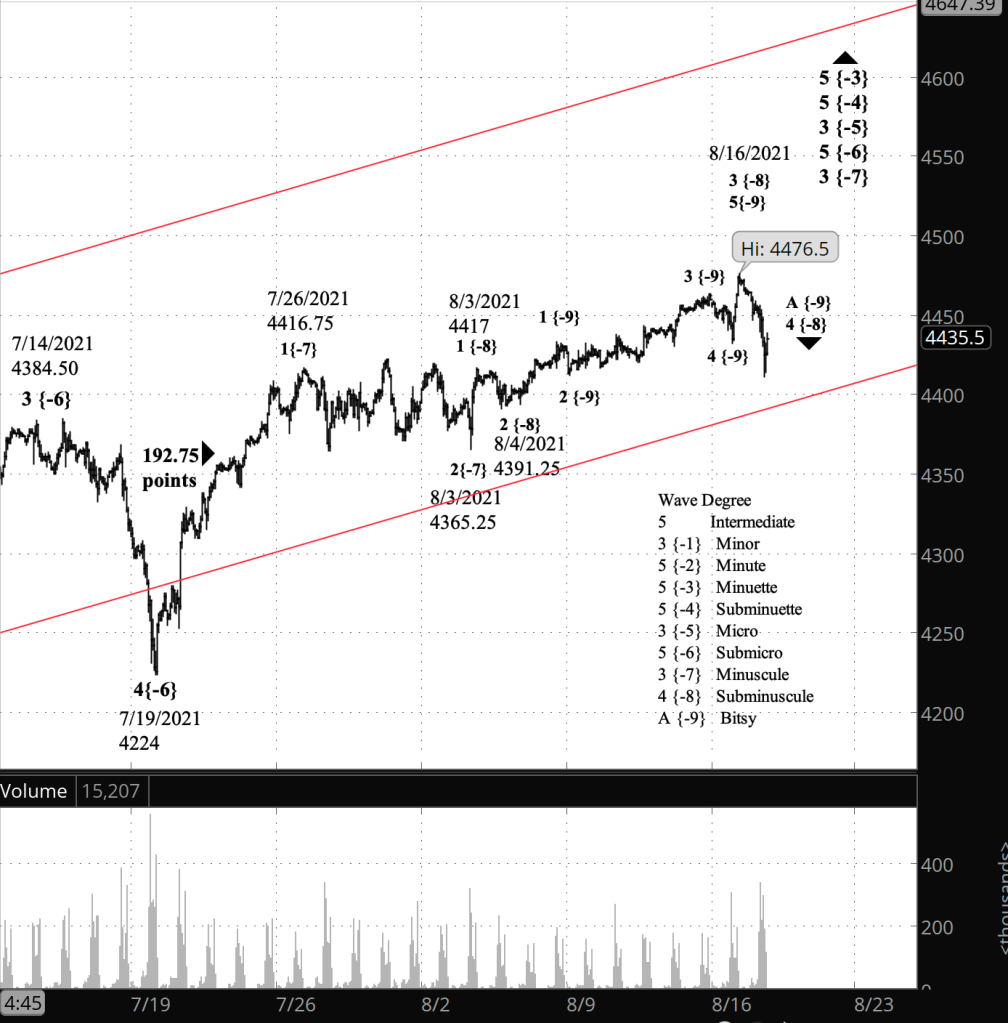
[S&P 500 E-mini futures at 3:30 p.m., 30-minute bars, with volume]

What does Elliott wave theory say? Under my principal analysis, the rise is wave C of Bitsy degree within wave 2 of Subminuscule degree within wave 1 of Minuscule degree wave within an 4th-wave downward correction of Submicro degree that began on July 19. That 4th wave will be followed by a Submicro wave 5 to the upside that will reach new heights. Closer in, the present wave 2 of Subminuscule degree will be followed by a powerful 3rd wave to the downside.

Although 2nd waves tend to take the simple three-wave form, there is nothing in the rules of Elliott wave analysis that prevents a 2nd wave from extending in more complex patterns. That applies to wave 2 the Subminuscule degree. The higher Submicro degree is a 4th wave, and such corrections often display complex patterns. So Submicro wave 4 potentially could take some time to reach completion.

Learning and other resources. Elliott wave analysis provides context, not prophecy. As the 20th century semanticist Alfred Korzybski put it in his book Science and Sanity (1933), “The map is not the territory … The only usefulness of a map depends on similarity of structure between the empirical world and the map.” And I would add, we can judge that similarity of structure only after the fact.

See the menu page Analytical Methods for a rundown on where to go for information on Elliott wave analysis.

By Tim Bovee, Portland, Oregon, August 20, 2021

Disclaimer

Tim Bovee, Private Trader tracks the analysis and trades of a private trader for his own accounts. Nothing in this blog constitutes a recommendation to buy or sell stocks, options or any other financial instrument. The only purpose of this blog is to provide education and entertainment.

No trader is ever 100 percent successful in his or her trades. Trading in the stock and option markets is risky and uncertain. Each trader must make trading decisions for his or her own account, and take responsibility for the consequences.

License
Creative Commons License

All content on Tim Bovee, Private Trader by Timothy K. Bovee is licensed under a Creative Commons Attribution-ShareAlike 4.0 International License.

Based on a work at www.timbovee.com.
SP500 Analysis

3:30 p.m. New York time

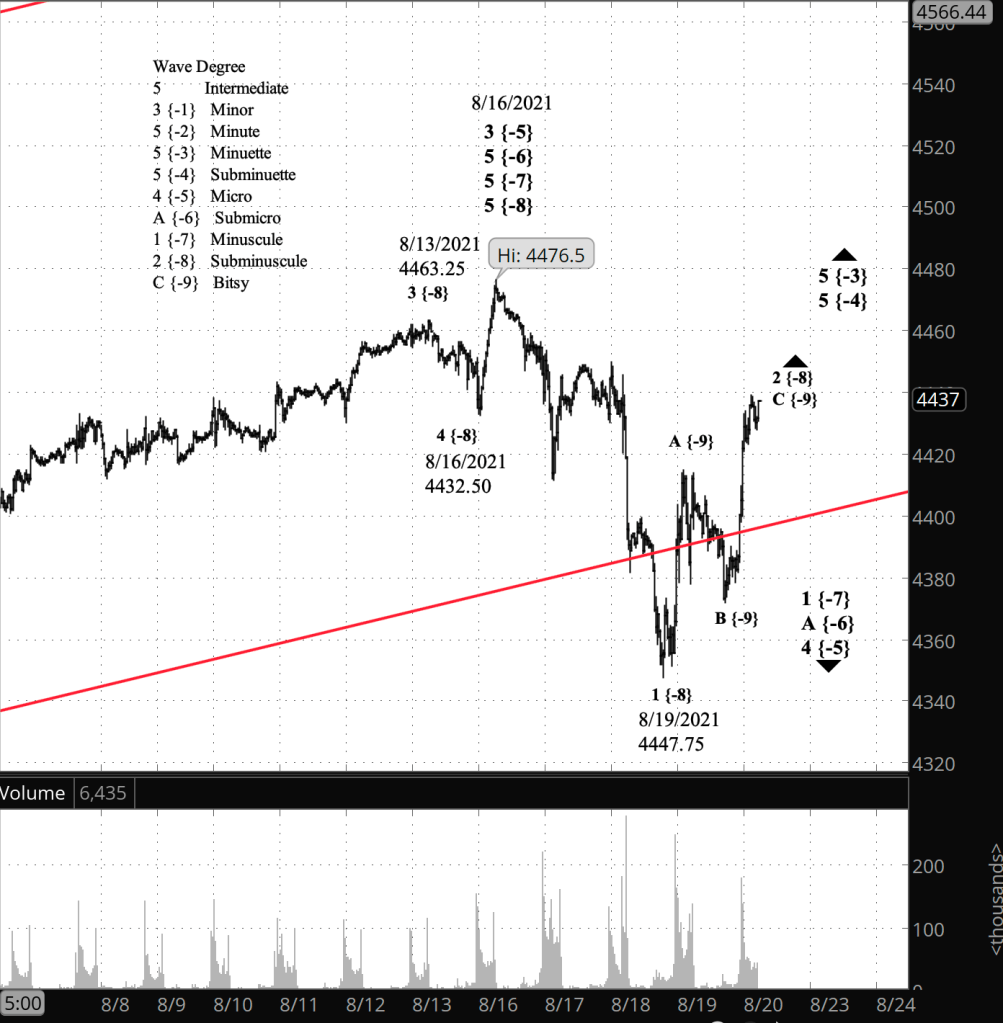
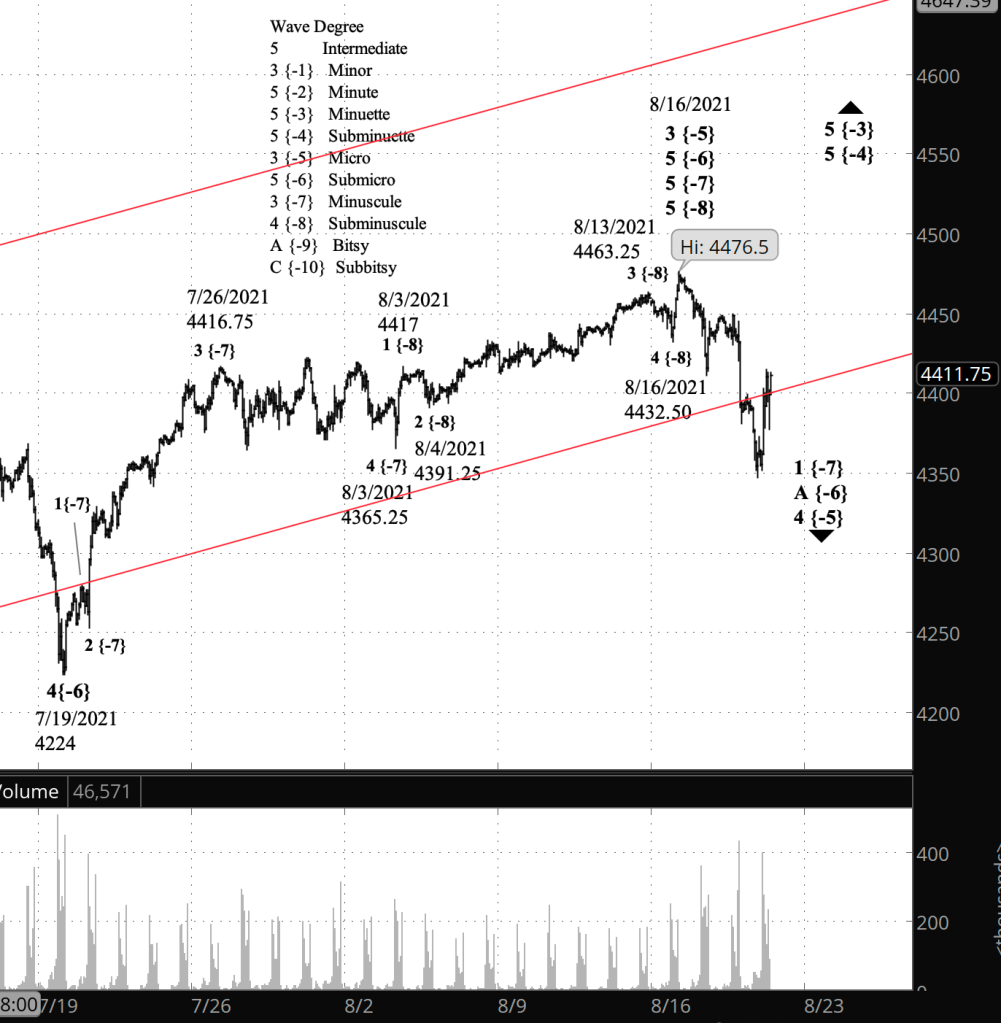
Half an hour before the closing bell. The S&P 500 completed a downward movement of five waves and began an upward movement that so far has completed one wave, and is presently in a counter-trend declining second wave. The structure is within wave 1 of Minuscule degree within wave A of Submicro degree within wave 4 of Micro degree. I’ve updated the top chart. No change to the analysis.

10:30 a.m. New York time

What’s happening now? In the last half hour of trading yesterday, the S&P 500 took a dive from 4445.50 on the E-mini futures, falling nearly 100 points before coming to rest early this morning at 4347.25, below the lower boundary of the price channel marking the rise from March 25.

What does it mean? The strength of the decline suggests the beginning of a reversal from a significant top, and I’ve redone my analysis from yesterday to fit that scenario.

What’s the alternative? However, although the price burst through the lower boundary of the price channel, it wasn’t so deep a fall as to break all norms, and it could well be a dramatic correction within a continuing uptrend. Also, from the larger point of the view of the rise that began in February of last year, this drop is barely a dent in the uptrend.

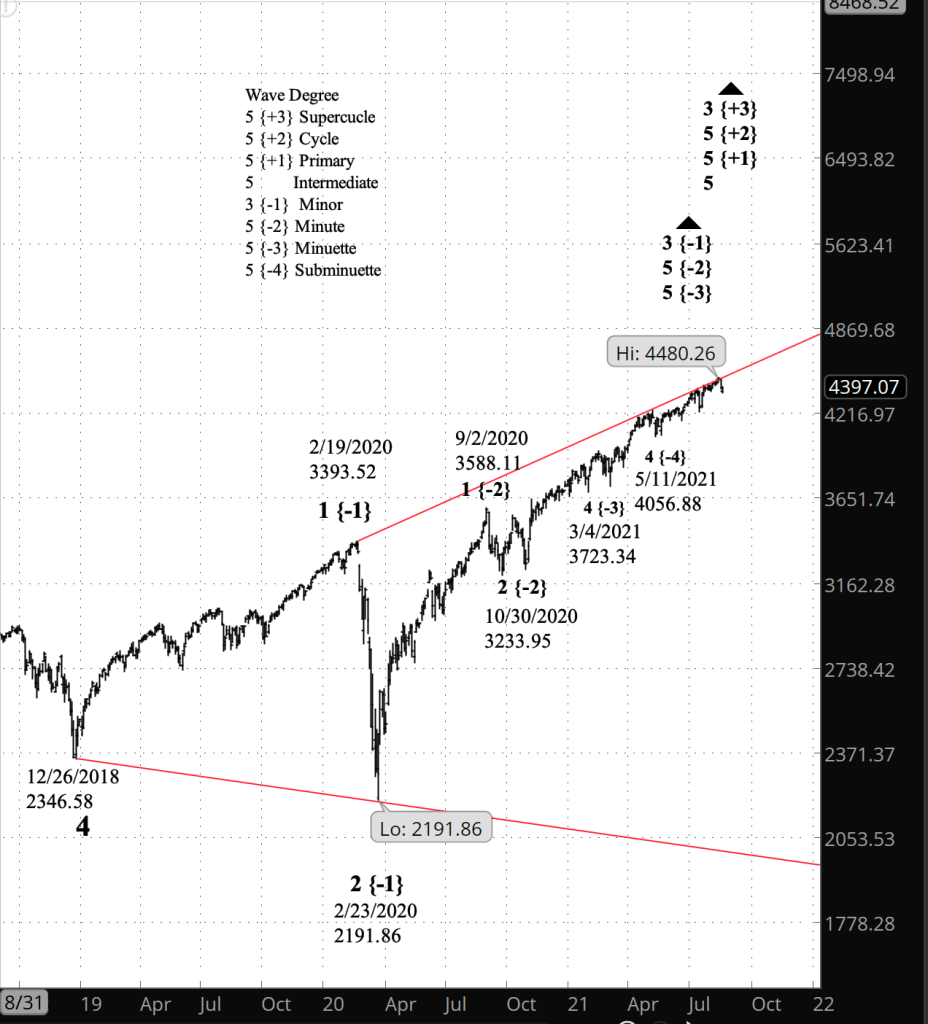
Charts. I’m doing two today, a near-term chart (top chart), showing the re-analysis of the rise from July 19, and a long-term chart (bottom chart) showing the decline from yesterday within the context of the Diagonal Triangle that began in December 2018.

[S&P 500 E-mini futures at 3:30 p.m., 70-minute bars, with volume]
[S&P 500 index at 10:26 a.m., 2-day bars]

What does Elliott wave theory say? For the principal analysis to work, the peak of August 16, at 4476.50 on the futures, 4480.26 on the index.

For the sharp from yesterday and overnight to work as the beginning of a significant downtrend, the August 16 peak must mark the end of a 5th wave, rather than the 3rd wave I had in yesterday’s analysis. I accomplished that by recounting the rise from July 19 to July 26, breaking it up into wave 1 through 3 of Minuscule degree, rather than a single wave 1. The waves are poorly defined in this energetic movement, but the recount can be made to work.

Under the principal scenario, in ascending order, the August 16 peak marked the end of wave 5 of Subminuscule degree within wave 5 of Minuscule degree within wave 5 of Submicro degree within wave 3 of Micro degree, which began on May 19 from 4055.50.

So the decline from the August 16 high is wave 4 of Micro degree, a correction within a series of ongoing uptrends, in ascending order: Wave 5 of Subminuette degree within wave 5 of Minuette degree within wave 5 of Minute degree within waver 3 of Minor degree within 5th waves of Intermediate, Primary and Cycle degrees within wave 5 of Supercycle degree, which began in 1932.

Under the principal analysis, wave 4 of Micro degree will be followed by a push to new highs as wave 5 of Micro degree and its parent waves, up to Minor degree. Within the Diagonal Triangle that began in December 2018, we are now on wave 3 of Minor degree. That 3rd wave began from the early pandemic low of 2191.86 on February 23, 2020. A Diagonal Triangle has five waves altogether, and Minor wave 3 is not yet complete. When it is, Minor wave 4 will work its way down to the lower boundary of the Diagonal Triangle, which is presently just above 2000 and declining.

Under the alternative analysis, the August 16 peak remains as the end of a low-degree 3rd wave.

Learning and other resources. Elliott wave analysis provides context, not prophecy. As the 20th century semanticist Alfred Korzybski put it in his book Science and Sanity (1933), “The map is not the territory … The only usefulness of a map depends on similarity of structure between the empirical world and the map.” And I would add, we can judge that similarity of structure only after the fact.

See the menu page Analytical Methods for a rundown on where to go for information on Elliott wave analysis.

By Tim Bovee, Portland, Oregon, August 19, 2021

Disclaimer

Tim Bovee, Private Trader tracks the analysis and trades of a private trader for his own accounts. Nothing in this blog constitutes a recommendation to buy or sell stocks, options or any other financial instrument. The only purpose of this blog is to provide education and entertainment.

No trader is ever 100 percent successful in his or her trades. Trading in the stock and option markets is risky and uncertain. Each trader must make trading decisions for his or her own account, and take responsibility for the consequences.

License
Creative Commons License

All content on Tim Bovee, Private Trader by Timothy K. Bovee is licensed under a Creative Commons Attribution-ShareAlike 4.0 International License.

Based on a work at www.timbovee.com.
SP500 Analysis

3:30 p.m. New York time

Half an hour before the closing bell. The S&P 500 fell slightly during the day, a movement that, under my principal analysis, is the 3rd leg of a low-level correction. No change to the analysis. Chart updated.

9:35 a.m. New York time

What’s happening now? The S&P 500 E-mini futures completed the first leg of a downward correction of the rise that began August 4, and the subsequent small rise completed the second leg, which moves opposite the trend of the correction.

What does it mean? The shallow correction will be followed by a renewal of the uptrend that began on July 19 that will bring the price to new highs.

What’s the alternative? The fall and reversal from the August 16 high may be a first leg within the first leg of the correction. I.e., it may be one level smaller than my principle analysis shows. This has no impact on the larger analysis of more upside ahead.

[S&P 500 E-mini futures at 3:30 p.m., hourly bars, with volume]

What does Elliott wave theory say? By my principal analysis, the high of August 16 ended wave 3 of Subminuscule degree and marked the start of Subminuscule wave 4. The first wave down, wave A of Bitsy degree, had three poorly delineated subwaves, indicating that the corrective pattern will be a Flat. The completion of Subminuscule wave 4 will be followed by a rising Subminuscule wave 5, which will carry the price to new heights.

My alternative analysis pushes wave A down one degree, to the Subbitsy level, making it internal to wave A of Bitsy degree. From the point of view of the aesthetics of the chart, it’s an attractive prospect, since it would provide a clear delineation within Bitsy wave A. I can easily envision promoting this count to the principal analysis.

Learning and other resources. Elliott wave analysis provides context, not prophecy. As the 20th century semanticist Alfred Korzybski put it in his book Science and Sanity (1933), “The map is not the territory … The only usefulness of a map depends on similarity of structure between the empirical world and the map.” And I would add, we can judge that similarity of structure only after the fact.

See the menu page Analytical Methods for a rundown on where to go for information on Elliott wave analysis.

By Tim Bovee, Portland, Oregon, August 18, 2021

Disclaimer

Tim Bovee, Private Trader tracks the analysis and trades of a private trader for his own accounts. Nothing in this blog constitutes a recommendation to buy or sell stocks, options or any other financial instrument. The only purpose of this blog is to provide education and entertainment.

No trader is ever 100 percent successful in his or her trades. Trading in the stock and option markets is risky and uncertain. Each trader must make trading decisions for his or her own account, and take responsibility for the consequences.

License
Creative Commons License

All content on Tim Bovee, Private Trader by Timothy K. Bovee is licensed under a Creative Commons Attribution-ShareAlike 4.0 International License.

Based on a work at www.timbovee.com.
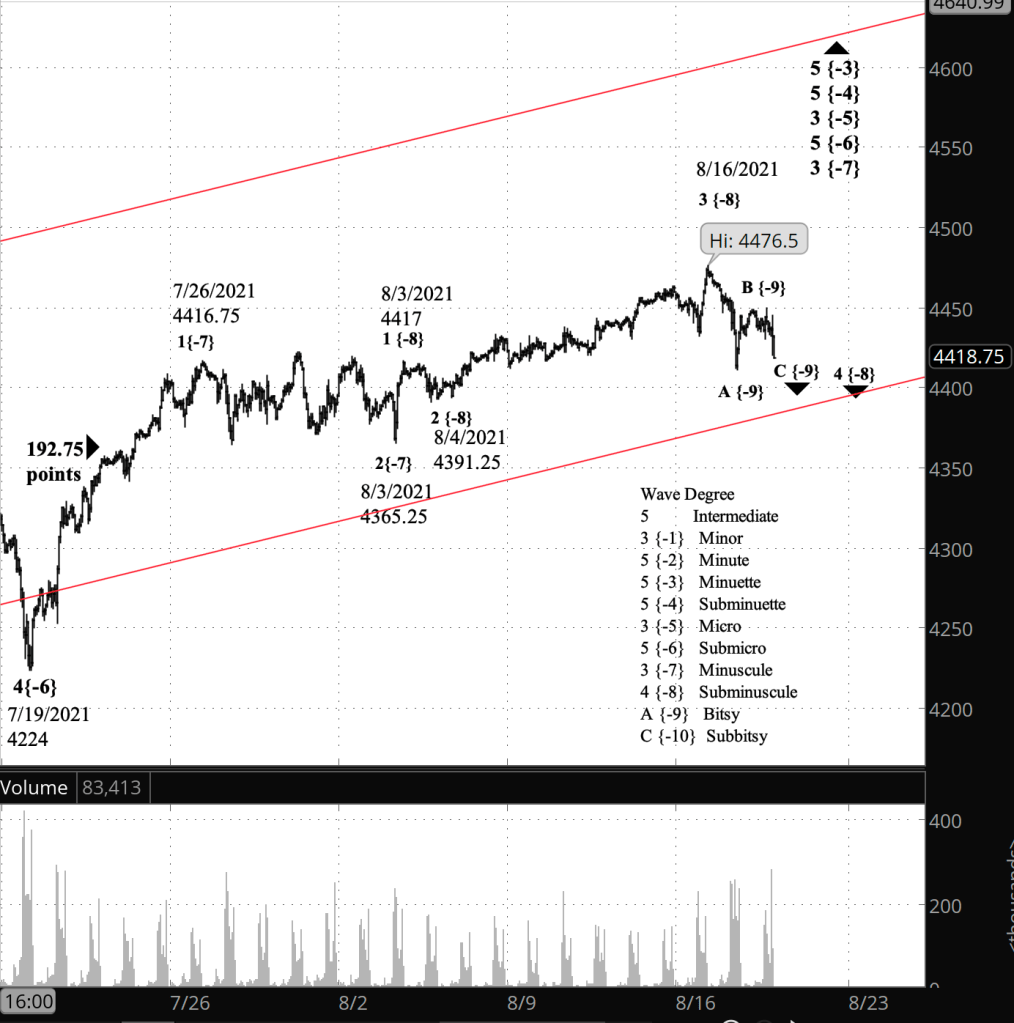
SP500 Analysis

3:30 p.m. New York time

Half an hour before the closing bell. The S&P 500 continued a sharp from yesterday’s peak, as a downward correction took hold. The decline is wave A of Bitsy degree, the first wave of what will probably be a Flat correction, wave 4 of Subminuscule degree. I’ve updated the chart.

2:20 p.m. New York time

My Trades. I’ve exited my bear call options spread position on FXI for a 182% profit and have updated the analysis with results.

9:40 a.m. New York time

What’s happening now? The S&P 500 E-mini futures fell from yesterday’s peak of 4476.50

What does it mean? By my principal count the decline is the beginning of a correction of the rise that began August. 4 from 4391.25 that will most likely be a shallow one.

What’s the alternative? The decline may be a correction at a smaller level within an ongoing rise that began yeterday.

[S&P 500 E-mini futures at 3:30 p.m., 75-minute bars, with volume]

What does Elliott wave theory say? By my principal count, yesterday’s high marked the end of wave 5 of Bitsy degree and of its parent, wave 3 of Subminuscule degree. The subsequent correction, wave 4 of Subminuscule degree, will be a shallow, sideways movement, as is common with 4th waves.

By the alternative count, wave 5 of Bitsy degree is continuing its uptrend, and the decline is a correction of Subbitsy degree — one degree lower — within Bitsy wave 5.

All of this is happening within wave 3 of Minuscule degree, which began on August 3, within wave 5 of Submicro degree, which began on July 19 from 4224.

Completion of Minuscule wave 3 will mark the start of a 4th wave correction, most likely shallow but of greater significance than the recent pullbacks. The last Minuscule degree correction was wave 2, lasting from July 26 to August 3.

Learning and other resources. Elliott wave analysis provides context, not prophecy. As the 20th century semanticist Alfred Korzybski put it in his book Science and Sanity (1933), “The map is not the territory … The only usefulness of a map depends on similarity of structure between the empirical world and the map.” And I would add, we can judge that similarity of structure only after the fact.

See the menu page Analytical Methods for a rundown on where to go for information on Elliott wave analysis.

By Tim Bovee, Portland, Oregon, August 17, 2021

Disclaimer

Tim Bovee, Private Trader tracks the analysis and trades of a private trader for his own accounts. Nothing in this blog constitutes a recommendation to buy or sell stocks, options or any other financial instrument. The only purpose of this blog is to provide education and entertainment.

No trader is ever 100 percent successful in his or her trades. Trading in the stock and option markets is risky and uncertain. Each trader must make trading decisions for his or her own account, and take responsibility for the consequences.

License
Creative Commons License

All content on Tim Bovee, Private Trader by Timothy K. Bovee is licensed under a Creative Commons Attribution-ShareAlike 4.0 International License.

Based on a work at www.timbovee.com.