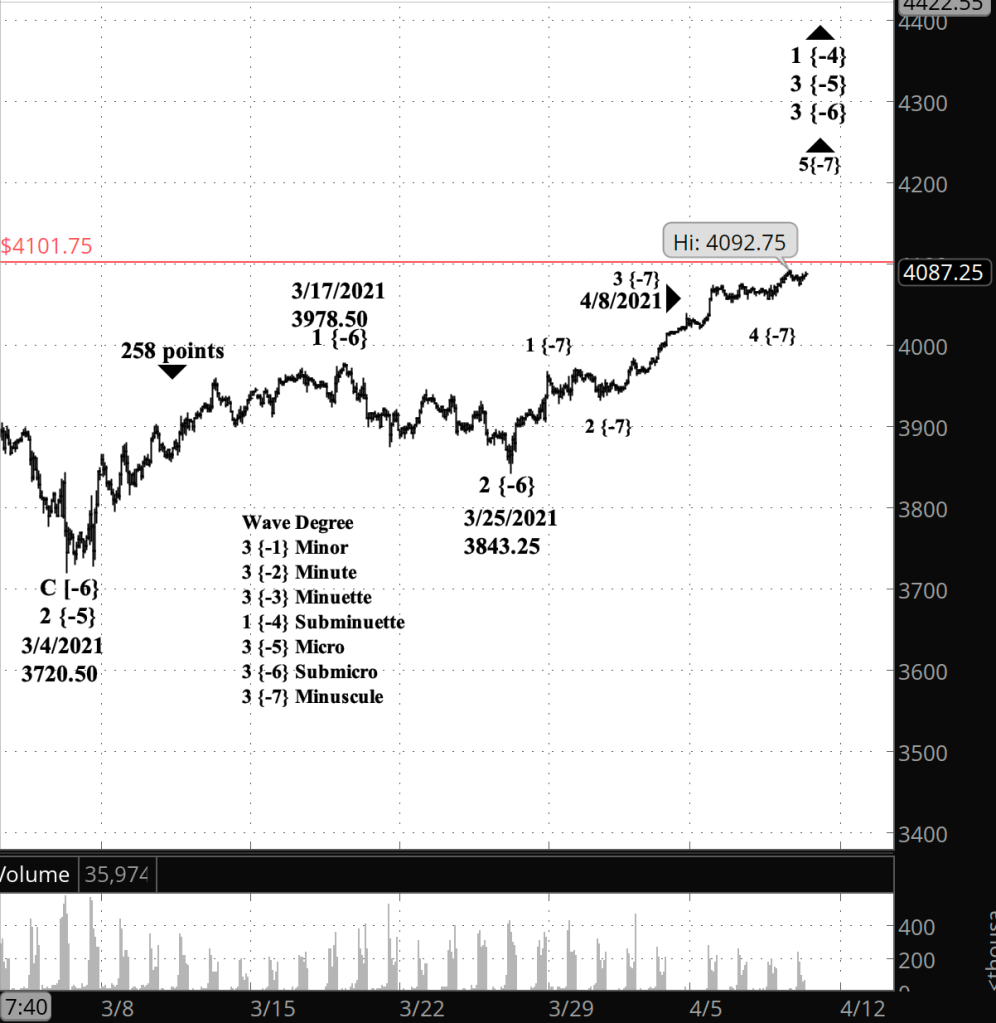
Half an hour before the closing bell. The S&P 500 continued trading in a very narrow range. No change in the analysis. Chart updated.
10:35 a.m. New York time
What’s happening now? The S&P 500 E-mini futures completed their sideways correction in overnight trading, reaching higher to 4092.75 as they began the final leg of the rise that began on March 25.
What does it mean? The rise from March 25 is still underway. When complete, a larger, still shallow, correction will begin.
What are the alternatives? The correction that began a few days ago could be underway, perhaps extending into a compound structure with several corrective patterns linked together.
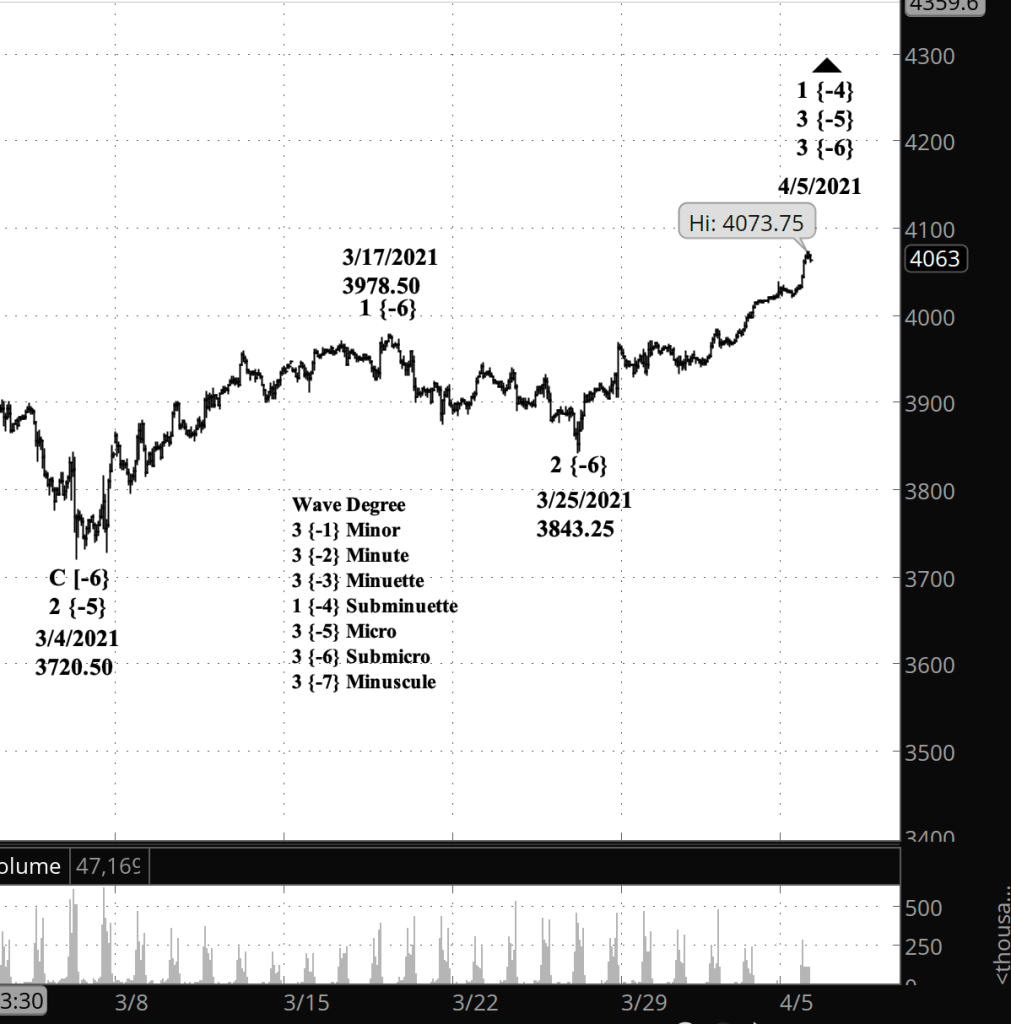
[S&P 500 E-mini futures at 3:30 p.m., 80-minute bars, with volume]
What does Elliott wave theory say? Under the principle analysis, wave 4 of Minuscule degree reached its end early this morning, before the opening bell, and began Minuscule wave 5, the final wave of the rise that began March 25. Completion of Minuscule 5 will also mark the end of the parent, wave 3 of Submicro degree, which will be followed by a 4th wave correction.
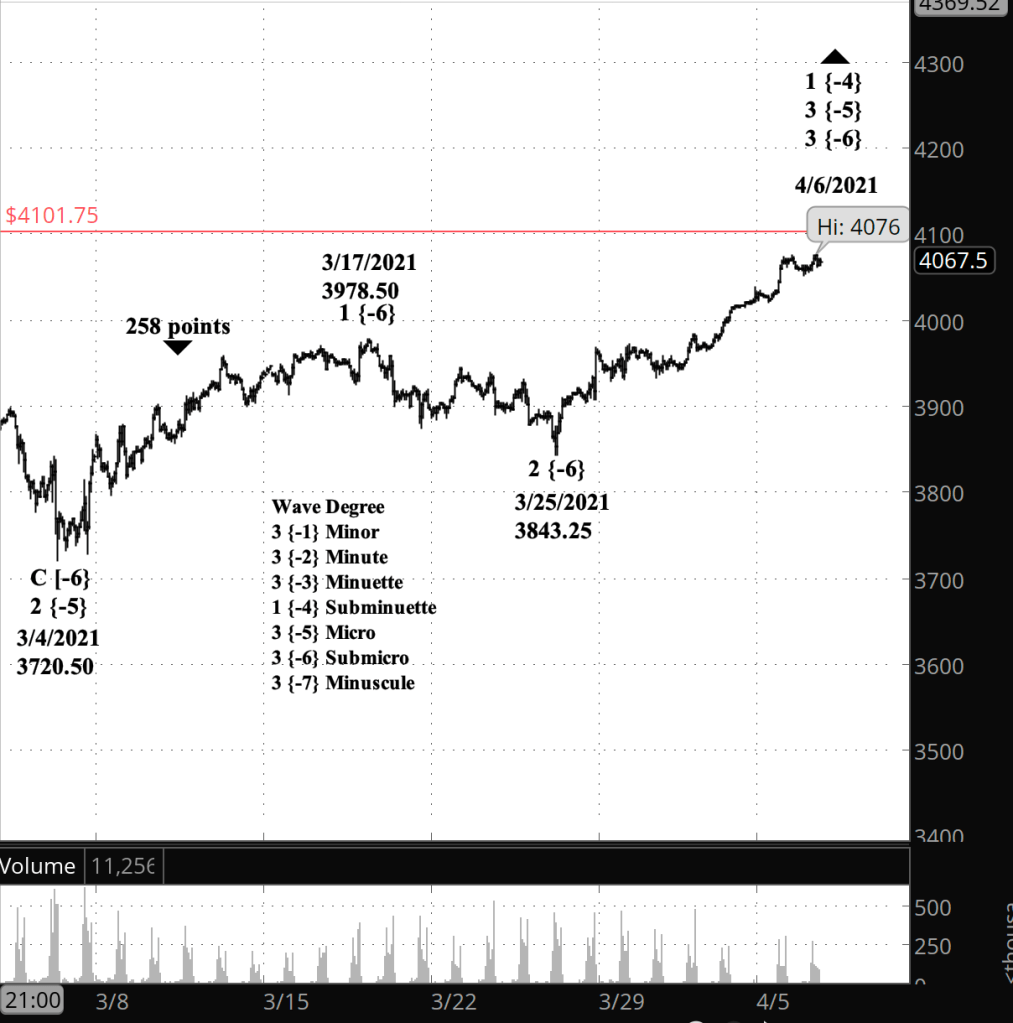
As noted in yesterday’s analysis, if Minuscule wave 5 moves above the 4101.75 level (the red line), then Submicro wave 3 will be longer than its preceding 1st wave of the same degree, which covered 258 points beginning to end.
Under the alternative analysis, Minuscule wave 4 is still underway. The early morning high under this scenario coulding a connecting X wave in a compounder correction with two corrective patterns.
The low within Minuscule wave 4 was 4056.50. If the price should dip beneath that level, then I would consider the alternative analysis to be correct.
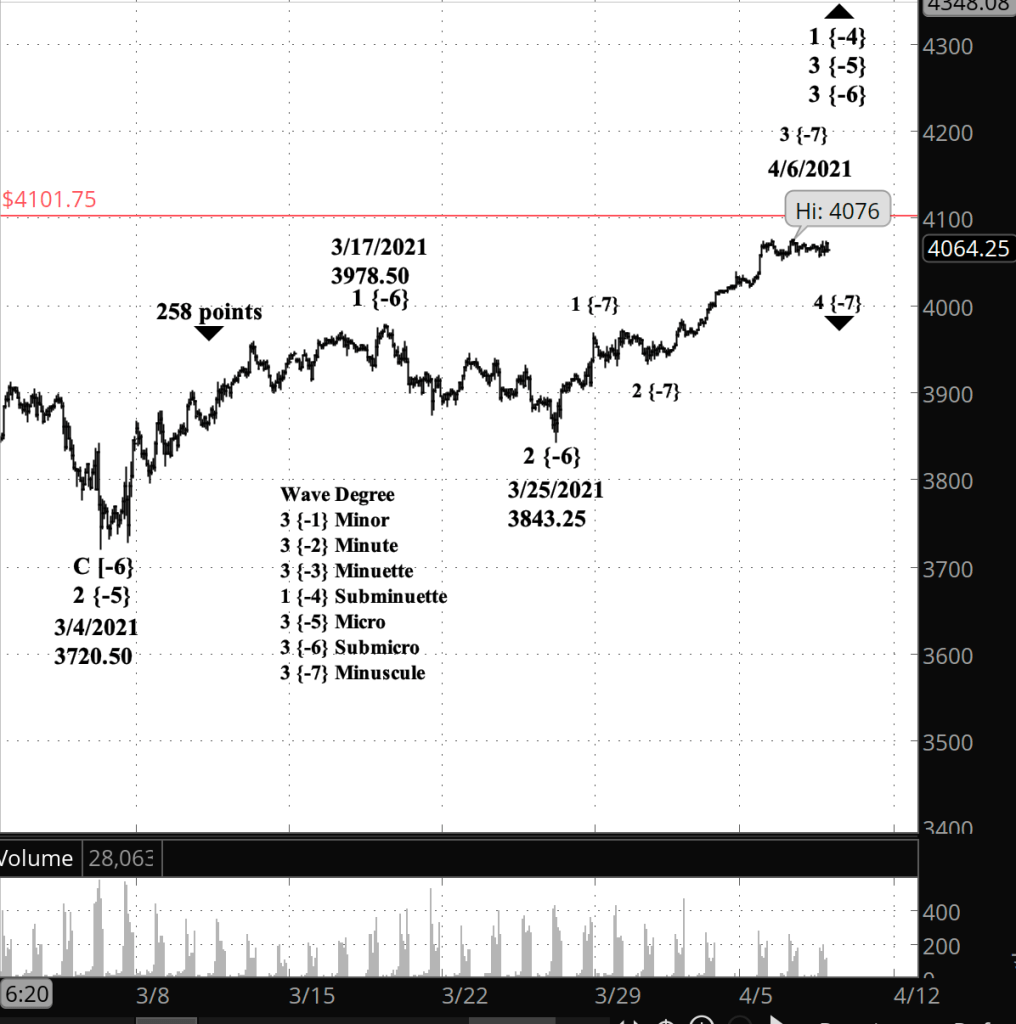
Half an hour before the closing bell. The S&P 500 continues to trade in a narrow range, working its way through wave 4 of Submicro degree. I’ve updated the chart.
9:50 a.m. New York time
What’s happening now? The S&P 500 E-mini futures began a sideways correction after Tuesday’s high, the second correction within the rise that began on March 25 from 3843.25.
What does it mean? The uptrend from late March is in its final stages. It will be followed by a larger shallow downward correction within the rise that began March 4 from 3720.50.
What are the alternatives? It’s possible that a correction did not begin with Tuesday’s high and that the price will move higher before the correction begins.
[S&P 500 E-mini futures at 3:300 p.m., 80-minute bars, with volume]
What does Elliott wave theory say? The rise from March 25 is wave 3 of Submicro degree, and within it Tuesday’s peak marked the end of wave 3 of Minuscule degree. The present Minuscule wave 4 will be followed by a 5th wave push to the upside that will at the least exceed 4101.75, perhaps by a significant distance.
There is no limit on how far a 5th wave can go, as long as it doesn’t leave the preceding 3rd wave as the shortest of the three movements in the direction the trends, waves 1, 3 and 5.
If that Minuscule 5th wave moves above 4101.75, then its parent wave 3 of Submicro degree will be longer than the preceding Submicro wave 1, removing all limits on how far Submicro 5 can rise, except for the need that it be proportional with other movements of the same degree.
If Minuscule 5 stays below 4101.75, then Minuscule wave 1 will be longer than wave 3, and wave 5 will be limited to the length of wave 1, which is 258 points.
It’s less complex than it might seem: Under Elliott wave analysis, a 1st wave or a 5th wave of a series must be shorter than the 3rd wave. It’s one of the strictly no-compromise, no fudging rules in Elliott.
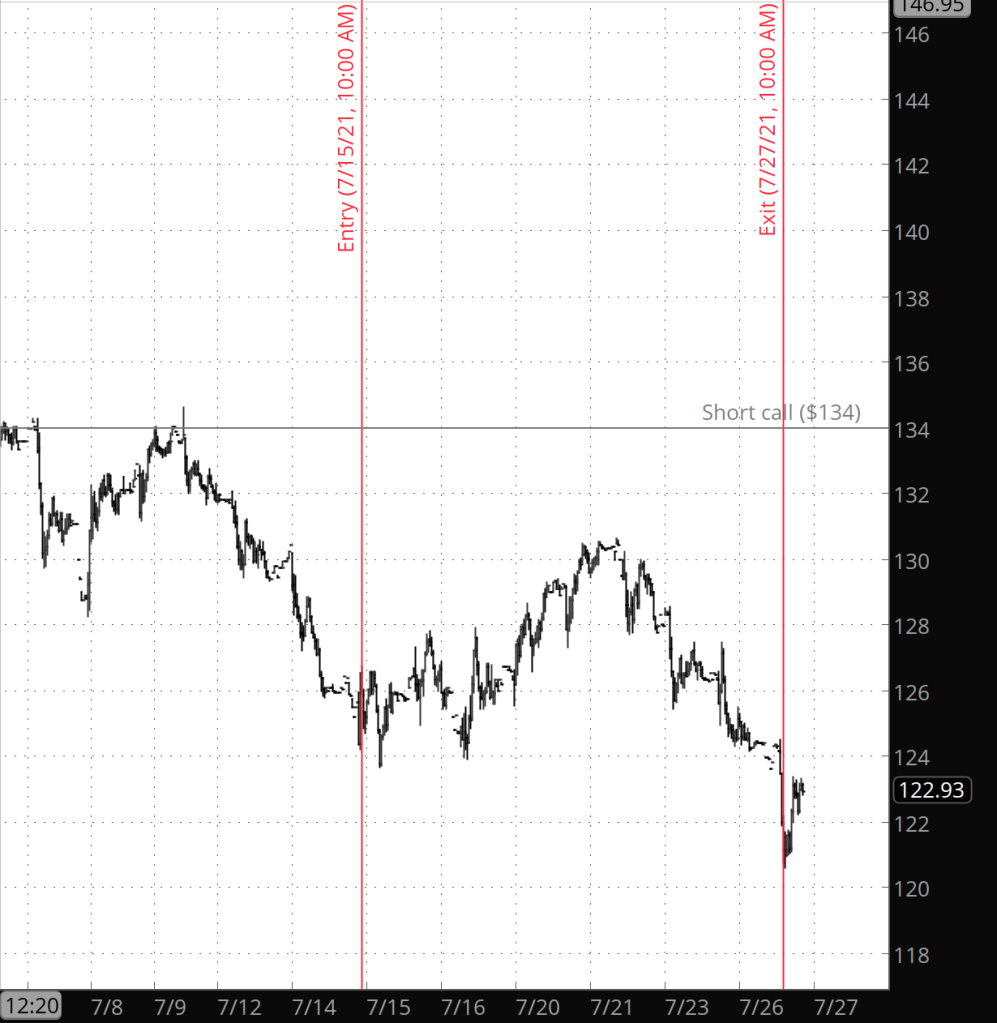
Update 7/27/2021: I exited my short bear call spread position on XBI 24 days before expiration, for a $0.38 debit per contract/share, a profit before fees of $0.92 per contract. Shares were trading at $122.05, down $2.70 from the entry level.
My decision to exit was based on the price reaching more than 50%.of maximum potential profit, as required by my trading rules. The price remained below my short call strike, $34, throughout the life of the position.The entry and exit dates are shown by vertical red lines on the chart, with a horizontal gray line marking short call strike price.
[XBI at 2:15 p.m., 20-minute bars]
Shares declined by 2.2% over nine days for a -65.8% annual rate. The options position produced a 121.1% return for a 3,682% annual rate.
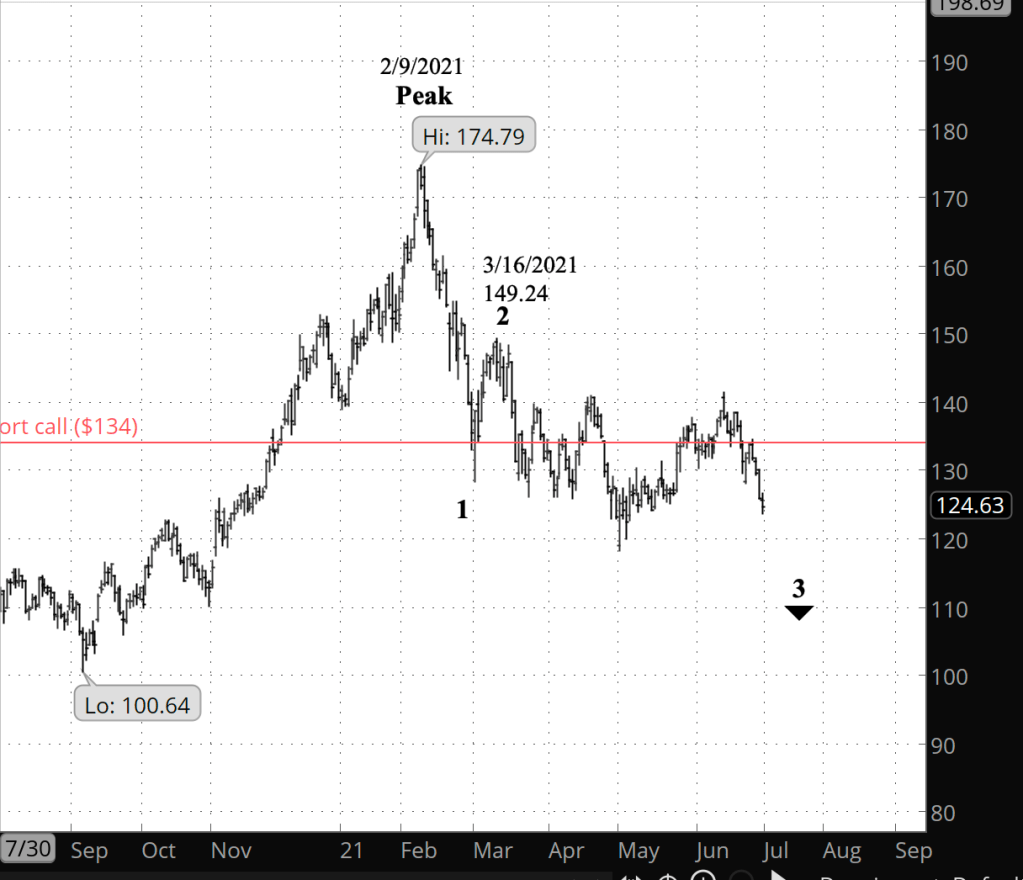
I have entered a short bear call spread on XBI, using options that trade for the last time 36 days hence, on August 20. The premium is a $0.84 credit per contract share and the stock at the time of entry was priced at $124.75.
The implied volatility rank (IVR) stands at 30%.
Premium:
$0.84
Expire OTM
XBI-bear call spread
Strike
Odds
Delta
Puts
Long
140.00
91.0%
11
Break-even
133.16
86.0%
17
Short
134.00
81.0%
23
The premium is 28% of the width of the position’s wing. The profit zone covers a 6.7% move to the upside.
The risk/reward ratio is 6.1:1, with maximum risk of $516 and maximum reward of $84 per contract.
[XBI, daily bars]
Elliott wave analysis places XBI in a 3rd wave downtrend, and if that analysis holds up, then the price is unlikely to revisit the $134 level, which marks the top of my profit zone.
By Tim Bovee, Portland, Oregon, July 15, 2021
Disclaimer
Tim Bovee, Private Trader tracks the analysis and trades of a private trader for his own accounts. Nothing in this blog constitutes a recommendation to buy or sell stocks, options or any other financial instrument. The only purpose of this blog is to provide education and entertainment.
No trader is ever 100 percent successful in his or her trades. Trading in the stock and option markets is risky and uncertain. Each trader must make trading decisions for his or her own account, and take responsibility for the consequences.
I have entered a short bear call spread on NIO, using options that trade for the last time 45 days hence, on May 21. The premium is a $0.75 credit per contract share and the stock at the time of entry was priced at $40.07.
The implied volatility rank (IVR) stands at 31.9%.
Premium:
$0.75
Expire OTM
NIO-bear call spread
Strike
Odds
Delta
Calls
Long
47.00
78.0%
30
Break-even
43.25
74.0%
35
Short
44.00
70.0%
39
The premium is 50% of the width of the position’s wing. The profit zone covers a 9.8% move to the upside, with no downside limit.
The risk/reward ratio is 3:1, with maximum risk of $225 and maximum reward of $75 per contract.
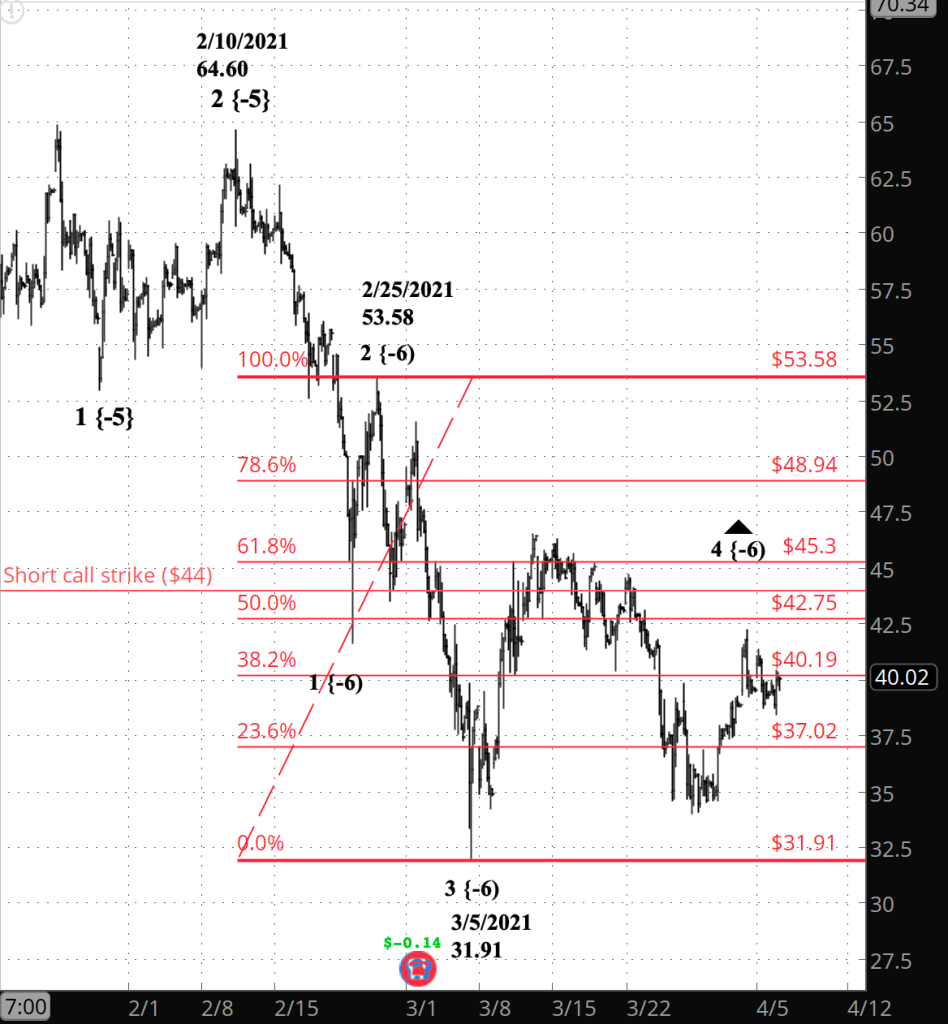
Elliott wave analysis. NIO is in a 4th wave that began March 5 and internally has begun its C wave to the upside. As a 4th wave it will most likely take the form of a Flat, meaning it will be shallow. Wave 4 has already retraced about 62% of the preceding wave 3.
The next move after wave 4 will be either a 5th wave to the downside — the position is bearish and will profit all the way down — or a continuation of wave 4, in which case the price will likely stay within the same range as we’re seeing now, which is profitable.
The short call strike price, at $44, is slightly below the start of wave 3, at $53.58. That’s a risk I took to make the premium worthwhile, and with a 45-day lifespan there should be ample opportunity for any move above that to level to reverse back into the profit zone, given that my analysis shows the most likely tendency is to the downside.
[NIO at entry, 2-hour bars, with Fibonacci retracement]
By Tim Bovee, Portland, Oregon, April 6, 2021
Disclaimer
Tim Bovee, Private Trader tracks the analysis and trades of a private trader for his own accounts. Nothing in this blog constitutes a recommendation to buy or sell stocks, options or any other financial instrument. The only purpose of this blog is to provide education and entertainment.
No trader is ever 100 percent successful in his or her trades. Trading in the stock and option markets is risky and uncertain. Each trader must make trading decisions for his or her own account, and take responsibility for the consequences.
Half an hour before the closing bell. The S&P 500 inched up to a new high today, 4076 on the futures and 4086.23 on the index. The present wave 3 of Submicro degree is still shorter than the preceding wave 1. Although it’s not a requirement, wave 3 is normally the longest. The 1st wave was 258 points long, and the price, marked on the chart, where the 3rd wave equals the 1st is 4101.75. Failure to rise above that level would a reanalysis of the wave count. I’ve updated the chart.
2:20 p.m. New York time
Trade entered. I’ve entered a bear call options spread on NIO and have posted the analysis.
1:45 p.m. New York time
Trade selected. I’ve decided to go with NIO out of my three potential options trades. BIDU is a bit less liquid than the other two, and SNAP has some ambiguities on the chart that make it hard for me to analyze its prospects. Plus, NIO was also my last trade, so I have a well-analyzed chart to work from. I’ve submitted the order for a bear call spread and will post the analysis once I get a fill.
9:45 a.m. New York time
What’s happening now? The S&P 500 E-mini futures traded within a very narrow range overnight, staying slightly below yesterday’s high, 4074.50.
What does it mean? The pause in the rise that has driven the market since late March may be the start another correction within the upward movement. When the correction is complete, the next move will be a push to the upside, completing the rise from 3843.25 that began on March 25.
What are the alternatives? The overnight pause may be a lower level movement, and if that’s the case, then the rise that began on March 25 will quickly resume.
[S&P 500 E-mini futures at 3:30 p.m., 75-minute bars, with volume]
What does Elliott wave theory say? The rise that began on March 25 is wave 3 of Submicro degree, and the correction that follows, either now under the principle analysis or later under the alternative, will be Submicro 4. I expect it to be a shallow correction, and it will be followed by Submicro 5, which will complete the parent, wave 3 of Micro degree.
Micro 3 will be followed by another, larger 4th wave correction and then another, larger push to the upside that will complete the yet higher wave (grandparent?), wave 1 of Subminuette degree.
Trading. Today is the optimal day for me to enter a trade in options that expire 45 days out, on May 21. The U.S. tech company SNAP and two Chinese companies, the automaker NIO (the Tesla of China) and the internet services giant BIDU, are the only prospective trades with implied volatility ranks of 30% or greater. I’ll be analyzing all three today to pick which short options spread position I’ll enter.
Half an hour before the closing bell. The S&P 500 continued its upward push today, continuing to show the energy typical of a 3rd wave. The high so far today is 4073.75 on the futures, 230.5 points above the start of rise, wave 3 of Submicro degree. The index high so far is 4083.42. I’ve updated the chart below.
9:50 a.m. New York time
What’s happening now? The S&P 500 E-mini futures continued their rise in overnight trading, reaching 4048.25 after the opening bell.
What does it mean? The continuing rise is the middle wave within an uptrend that began March 4. When complete, the middle wave will be followed by a shallow correction, and then a push to higher highs.
[S&P 500 E-mini futures at 3:30 p.m., 75-minute bars, with volume]
What does Elliott wave theory say? The rise since March 25 is wave 3 of Submicro degree within wave 3 of Micro degree, which began on March 4. A 3rd wave within a 3rd wave has a great deal of power. Submicro 3 will be followed by Submicro 4, and 4th wave corrections tend to be a shallow, sideways correction, a Flat form in Elliott wave terminology. The preceding 2nd wave correction was directional, called a Zigzag form in Elliott wave analysis, and under the rules of Elliott waves 2 and 4 must have different forms.
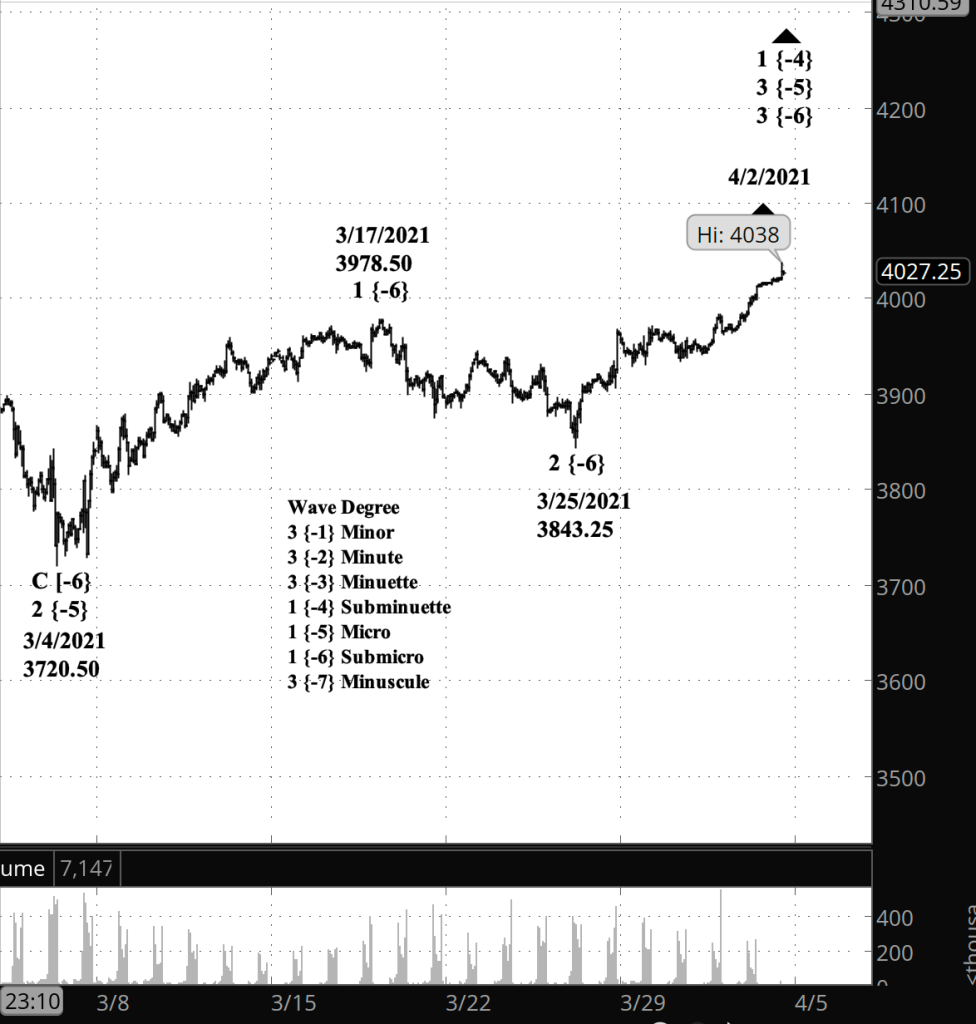
What’s happening now? Although the U.S. stock markets are closed for a holiday, the S&P 500 E-mini futures continued to trade overnight, rising 25.5 points from the close of Thursday’s session, to 4038. This will be the final update today.
What does it mean? The uptrend that began March 25 from 3843.25 is still underway.
[S&P 500 E-mini futures at 9:50 a.m., 70-minute bars, with volume]
What does Elliott wave theory say? The near-term uptrend is wave 3 of Submicro degree within a rising series of parent waves stretching up to wave 3 of Supercycle degree, which began in 1932. Submicro 3 will be followed by a shallow 4th wave correction and then a final 5th wave push higher that, when complete, will signal the start of a downtrend, all the up to the Supercycle degree.
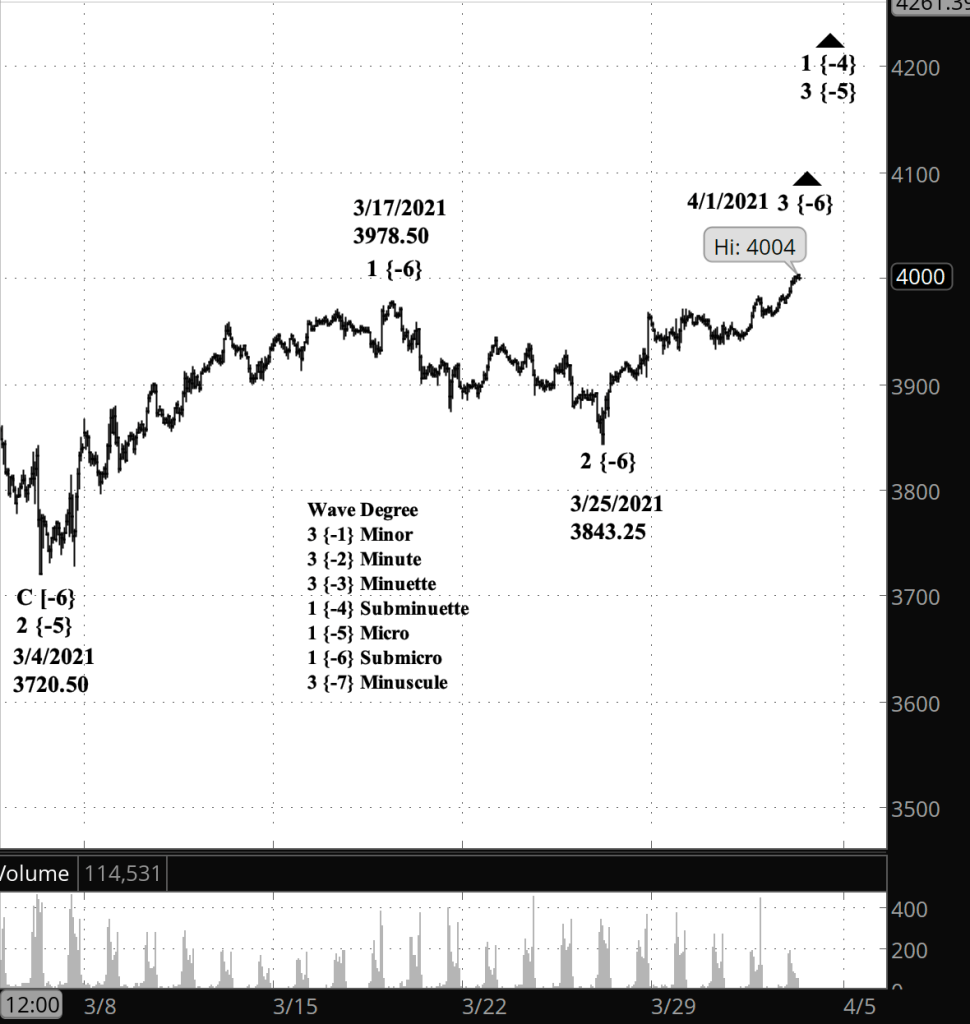
Half an hour before the closing bell. The S&P 500 continued its upward crawl, reaching a high so far today of 4004 on the E-mini futures, 4014.34 on the index. No change to the analysis. I’ve updated the chart below.
10 a.m. New York time
Calendar note: The U.S. stock markets will be closed on Friday for the Easter holiday. The bond and futures markets will close early on Friday, at 12 noon New York time.
What’s happening now? The S&P 500 rose to a new high at the opening, 3991.50 on the E-mini futures and 4002.42 on the index.
What does it mean? The uptrend that began on March 25 is continuing, the final leg of a larger uptrend that began on March 4.
What are the alternatives? At this point I have none. I’ve relabeled the chart to conform to my principle analysis.
[S&P 500 E-mini futures at 3:30 p.m., hourly bars, with volume]
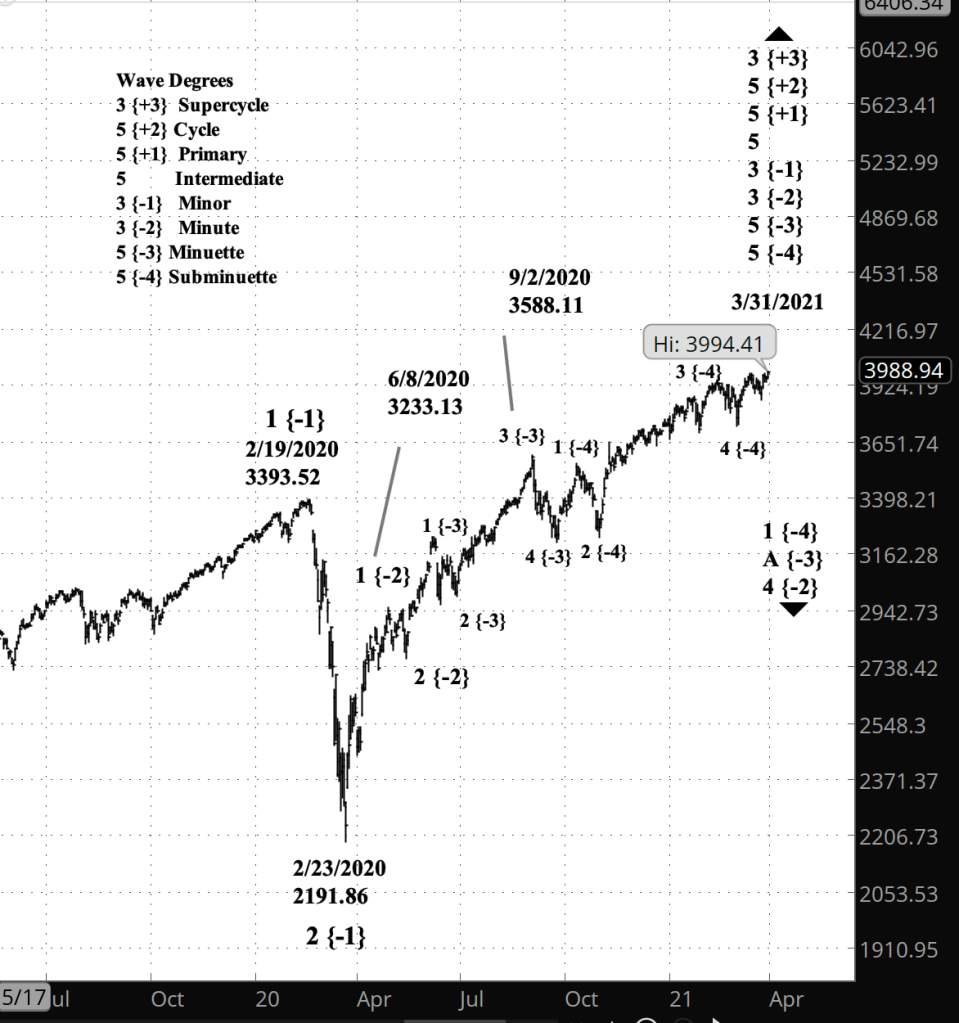
What does Elliott wave theory say? On the chart I’ve labelled the present wave as the 3rd of Submicro {-6} degree within wave 3 of Micro {-5} degree, selecting the degree to conform in duration with my labelling prior to the beginning of Micro 3. This is all happening within wave 5 of Subminuette {-4} degree, which began on October 30, 2020, part of the major uptrend that began on February 23, 2020 as wave 3 of Primary {-3} degree
Half an hour before the closing bell. The S&P 500 broke above the high of March 17, so far to 3983.75 on the futures and 3994.41 on the index, following the course of my alternative analysis. That means that the uptrend is still in place. Rather than changing the chart below from this morning, I’ve added in a long-term chart to show where we now stand and shall update the short-term chart for Thursday morning’s post.
Bottom line: The uptrend is still in place. We are presently in wave 5 of Subminuette degree.
[S&P 500 index at 3:32 a.m., daily bars]
9:40 a.m. New York time
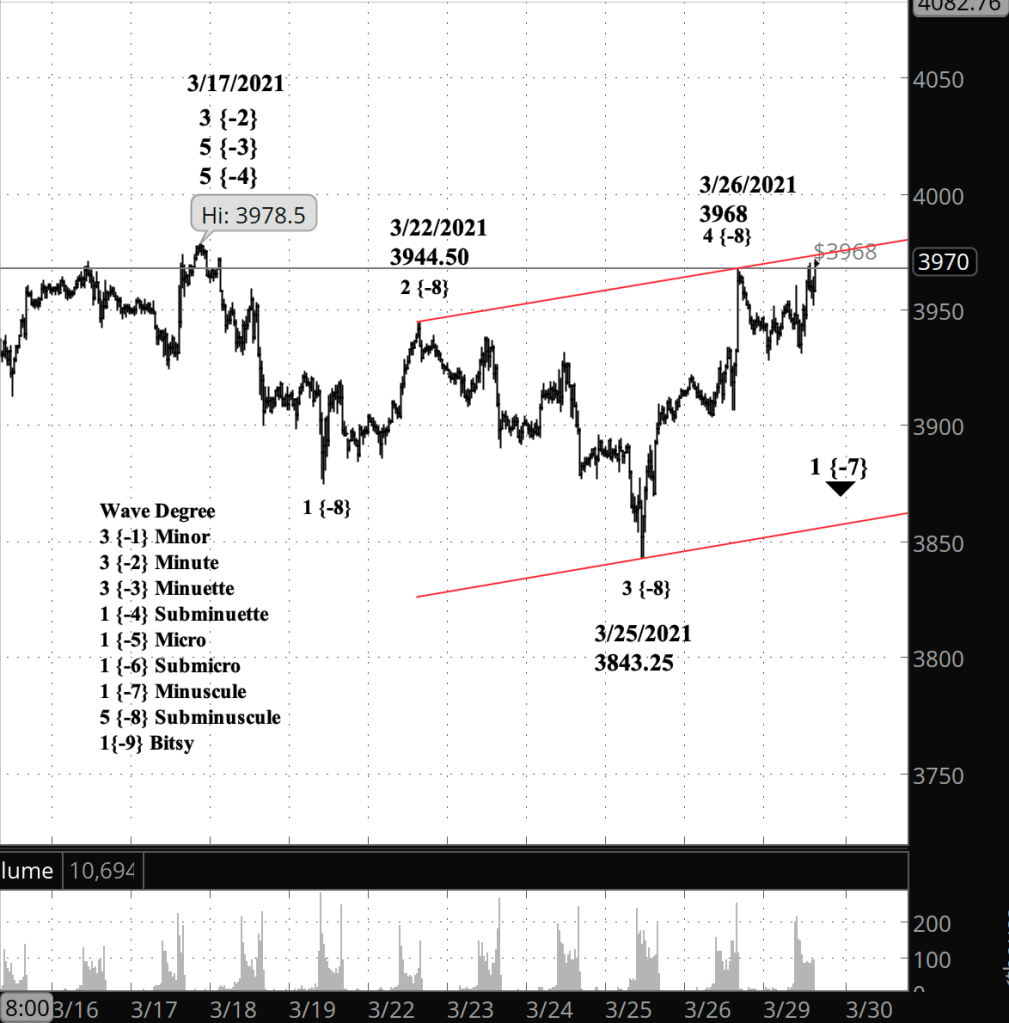
What’s happening now? The S&P 500 E-mini futures continued their so-far-shallow decline from yesterday’s peak.
What does it mean? By my principle analysis, the decline is the early stage of a significant decline from the March 17 peak, 3978.50 on the futures, 3983.87 on the index.
What are the alternatives? If the price should rise above the March 17 peak, then it would invalidate my principle analysis, showing that the uptrend that began in February 2020 is still underway. If the price moves above yesterday’s high, 3971.25 on the futures, then the upward correction that began March 25 is still underway.
[S&P 500 E-mini futures at 9:36 a.m., 30-minute bars, with volume]
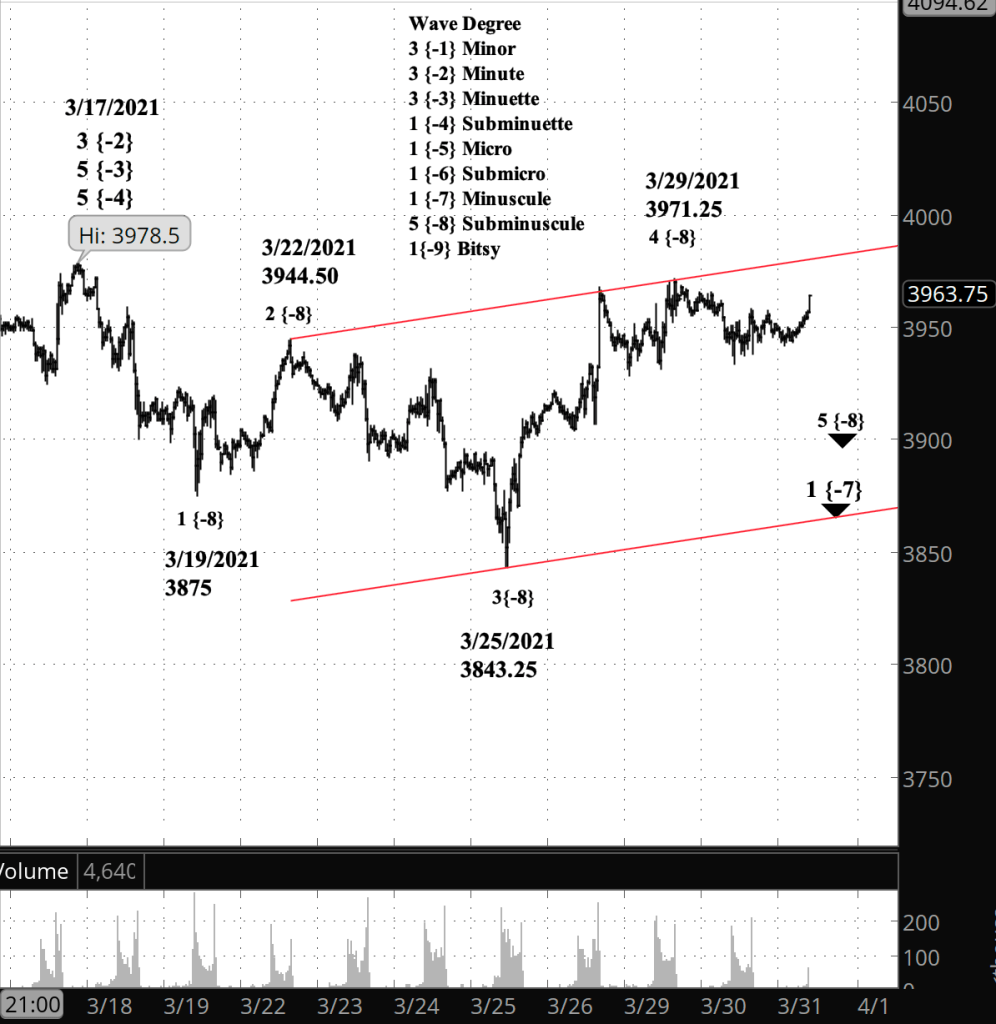
What does Elliott wave theory say? Yesterday’s peak was the end of wave 4 and the beginning of wave 5, both of Subminuscule degree, within wave 1 of Minuscule degree, and first waves up several degrees, to Subminuette degree. These are motive ways, moving in the direction of the main trend, which is down. First waves tend to be undramatic, and the following 2nd wave generally takes back much of the ground covered by wave 1. The true drama — “capitulation”, in the language of trading — comes with the 3rd wave.
I’ve added a price channel (red lines) for the Subminuscule degree, with an upper boundary defined by the start of wave 3 and wave 5, and a lower boundary defined by the end of wave 3.
Half an hour before the closing bell. The S&P 500 dawdled throughout the day, remaining so far within a range of less than 30 points. No change to the analysis. I’ve updated the chart below.
10 a.m. New York time
What’s happening now? The S&P 500 E-mini futures dropped off from yesterday’s peak.
What does it mean? Yesterday’s ambiguities in the chart remain. I’m retaining my principle analysis, which puts the end of the correction at yesterday’s peak.
What are the alternatives? Alternatively, yesterday’s peak marks the end of a leg within correction and the correction is continuing.
[S&P 500 E-mini futures at 3:30 p.m., 30-minute bars, with volume]
What does Elliott wave theory say? Unchanged from yesterday. The alternatives I tried out either violated rules of Elliott wave analysis or were misshapen in ways that detracted from their credibility. Ending wave 4 of Subminuscule degree at the March 29 high of 3971.25 seems to be the most straightforward reading of the chart. Under this analysis yesteday marked the beginning of wave 5 of Subminuscule degree.
If the price resumes its rise and moves above the March 17 high of 3978.50, the end of the rise of Minuette degree, then the entire analysis of the rise from February of last year will need to be revisited.
If the price falls below 3843.25, the low of March 25, then then Subminuscule wave 5 is confirmed.
Half an hour before the closing bell. The S&P 500 moved above Friday’s high of 3968 on the index, to 3970.25., and a high of 3978.19 on the index, to 3968. I dislike this chart immensely. Wave 2 of Subminuscule degree seems overly shallow for a 2nd wave, and wave 4 seems overly robust. And there’s the whole breaking past the end of wave 3, which isn’t strictly forbidden, but it certainly casts doubt on the count.
I think the most likely alternative is that wave 4 of Subminuette degree is still underway, and the rise from February 23, 2020 is not yet complete. I’ve left the chart numbering as it was, and will present a renumbered version in Tuesday’s post. I’ve updated the priceline in the chart below, but not the wave numbers.
9:35 a.m. New York time
What’s happening now? The S&P 500 E-mini futures declined from Friday’s peak, 3968, in overnight trading, reaching 3928.75 today hours before the opening bell.
What does it mean? The decline adds weight to the idea idea that Friday’s peak marked the end of the upward correction that began on March 25 and the beginning of a downtrend that will end in the 3850s or below.
What are the alternatives? First alternative: The decline from Friday could be followed by a second corrective pattern, and if that proves to be the case, then the correction is still underway. More on this in the Elliott wave section, below.
Second alternative: And if the price moves above Friday’s peak, then the chart will demand a recount showing that the rise that began on February 23, 2020 is sitill in progress.
[S&P 500 E-mini futures at 9:34 a.m., 30-minute bars, with volume]
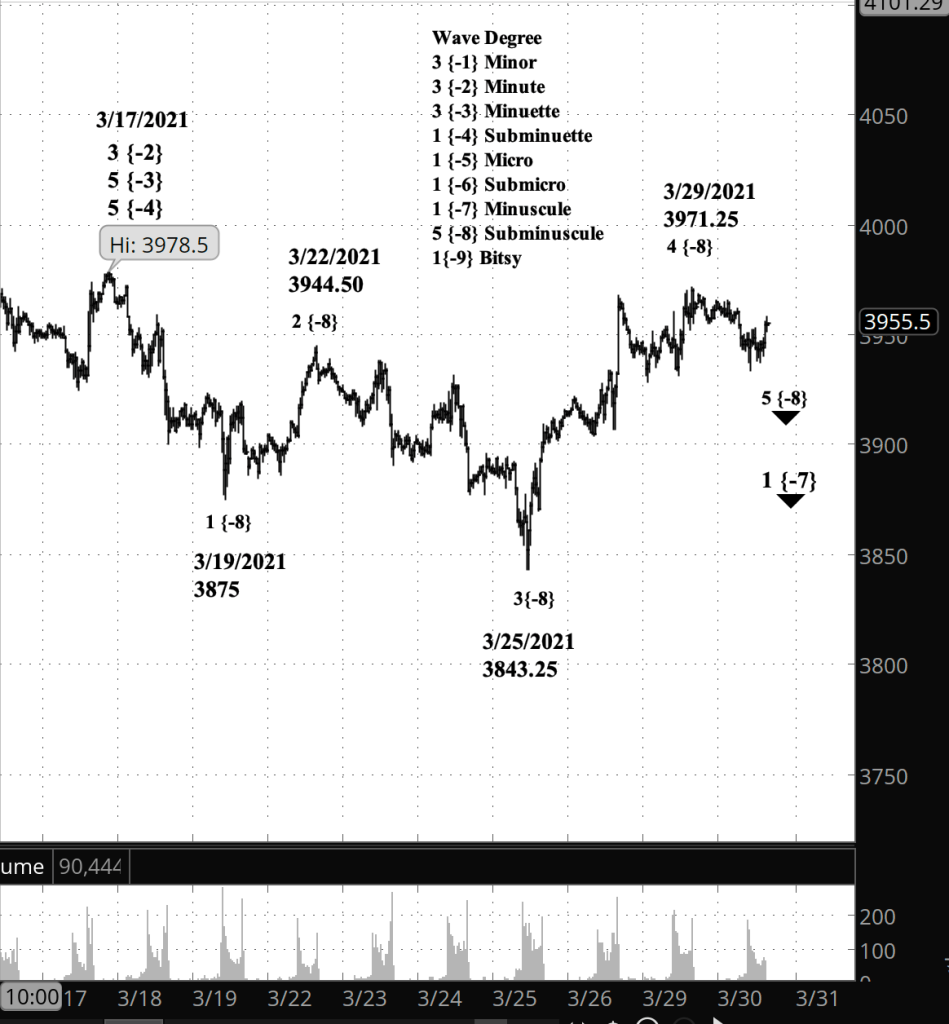
What does Elliott wave theory say? By my principle count, Friday’s high was the end of wave 4 of Subminuscule degree and the beginning of wave 5. My first alternate count has wave 4 still in progress, with the decline since Friday being an X wave, which separates two corrective patterns within a compound correction structure.
How to tell the difference? If wave 5 is underway, then the first downward wave, the 1st of Bitsy degree, will have five waves internally. It will be a standard impulse wave. If wave 4 is extending into a compound structure, then the X wave will have three subwaves in its downward move: A down, B up and C down. At this low level I think we’ll know which is happening within a day or two.
On the assumption that my principle analysis is correct, that wave 5 of Subminuscule degree began on March 26, I’ve added in a price channel (red lines) for the Minuscule wave 1 downtrend that began on March 17, connecting the beginnings of Subminuscule waves 3 and 5 for the upper boundary and the end of Subminuscule wave 3 for the lower boundary.
It’s an uptrending channel for the internals of a downtrending wave. If Subminuscule wave 5 stays within the channel boundaries, then it will be truncated, failing to move below the end of the preceding wave 3. It would not be surprising if wave 5 broke through the boundary in a throw-over move, the kind of move that in 5th wave can sometimes turnout to be quite dramatic in the extent to which it moves beyond the boundary. For 5th waves, the channel boundary is often nothing more than a gentle suggestion.

 Tim Bovee, Private Trader
You must be logged in to post a comment.