Friday, March 12, 2021

3:30 p.m. New York time

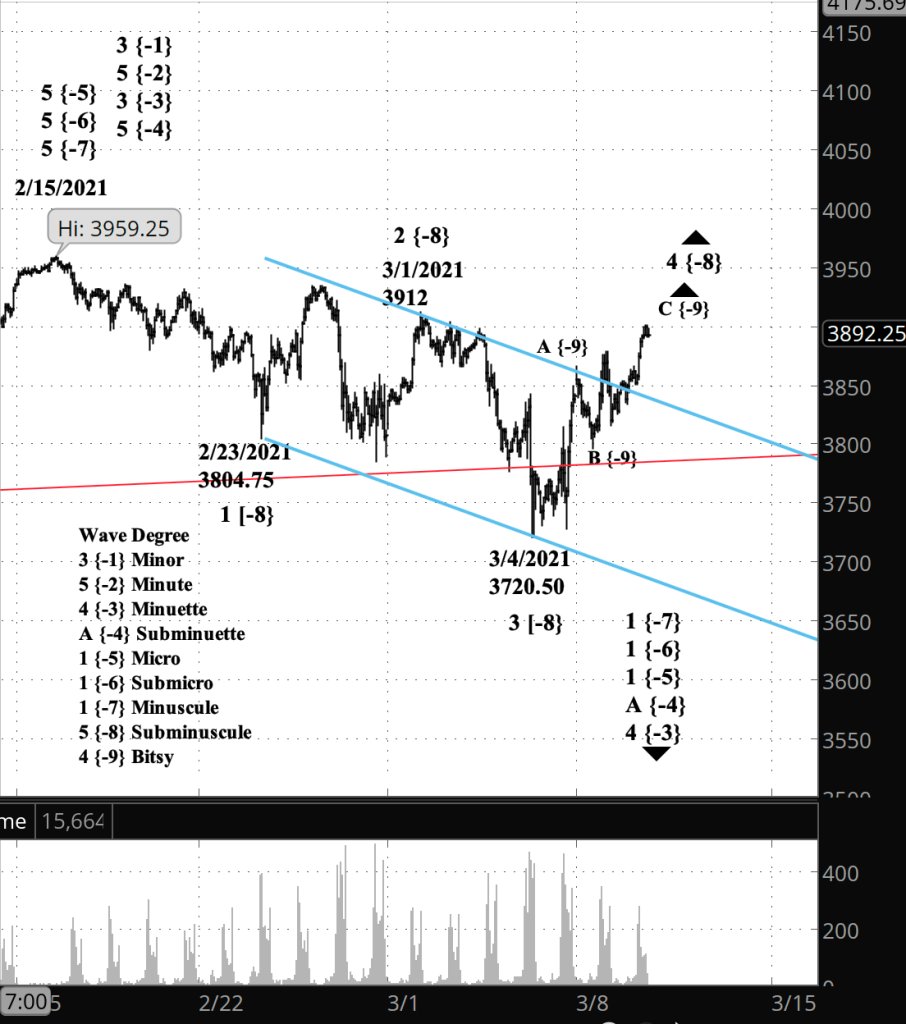
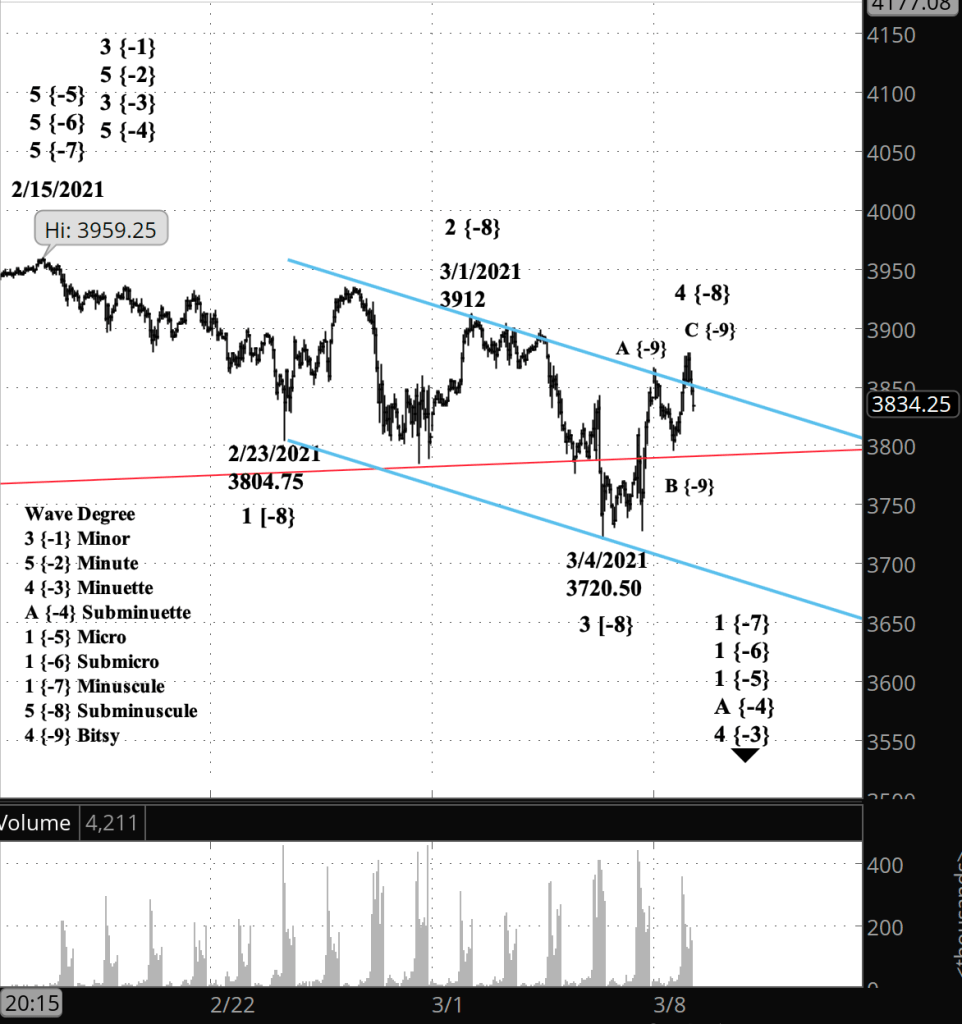
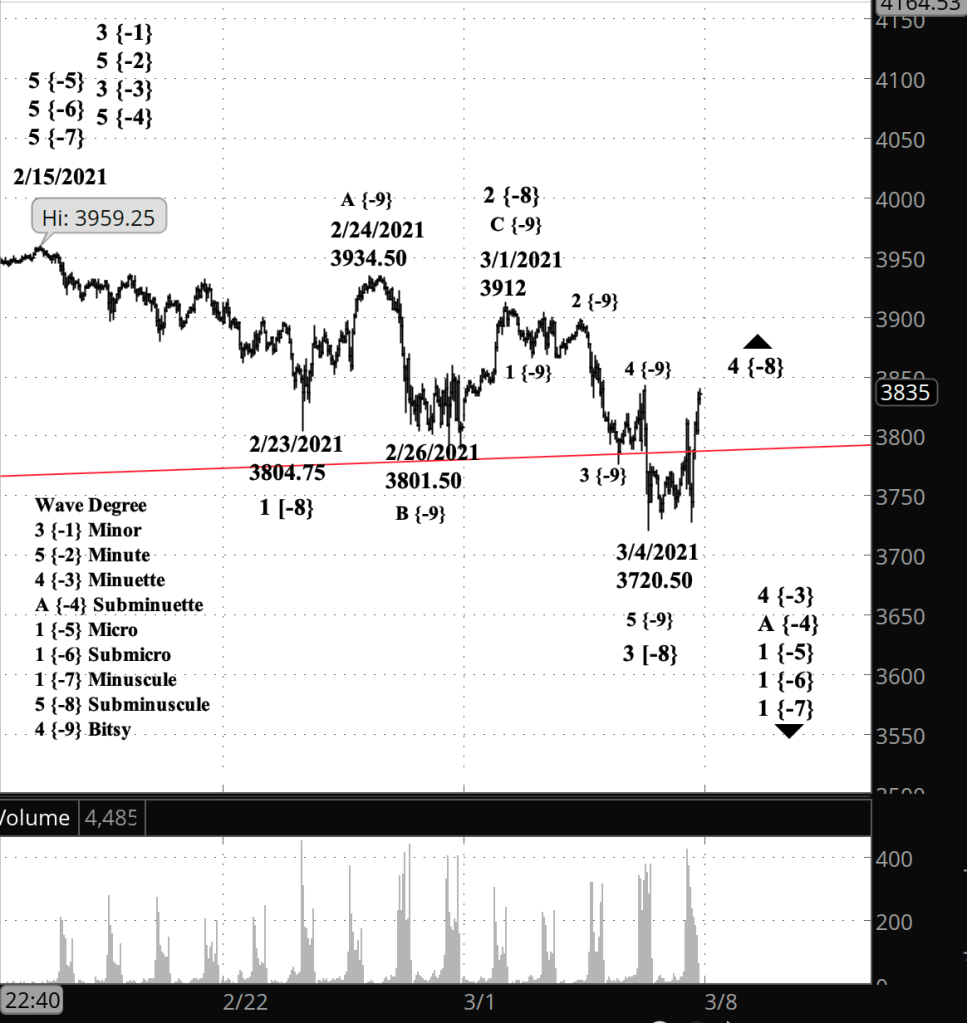
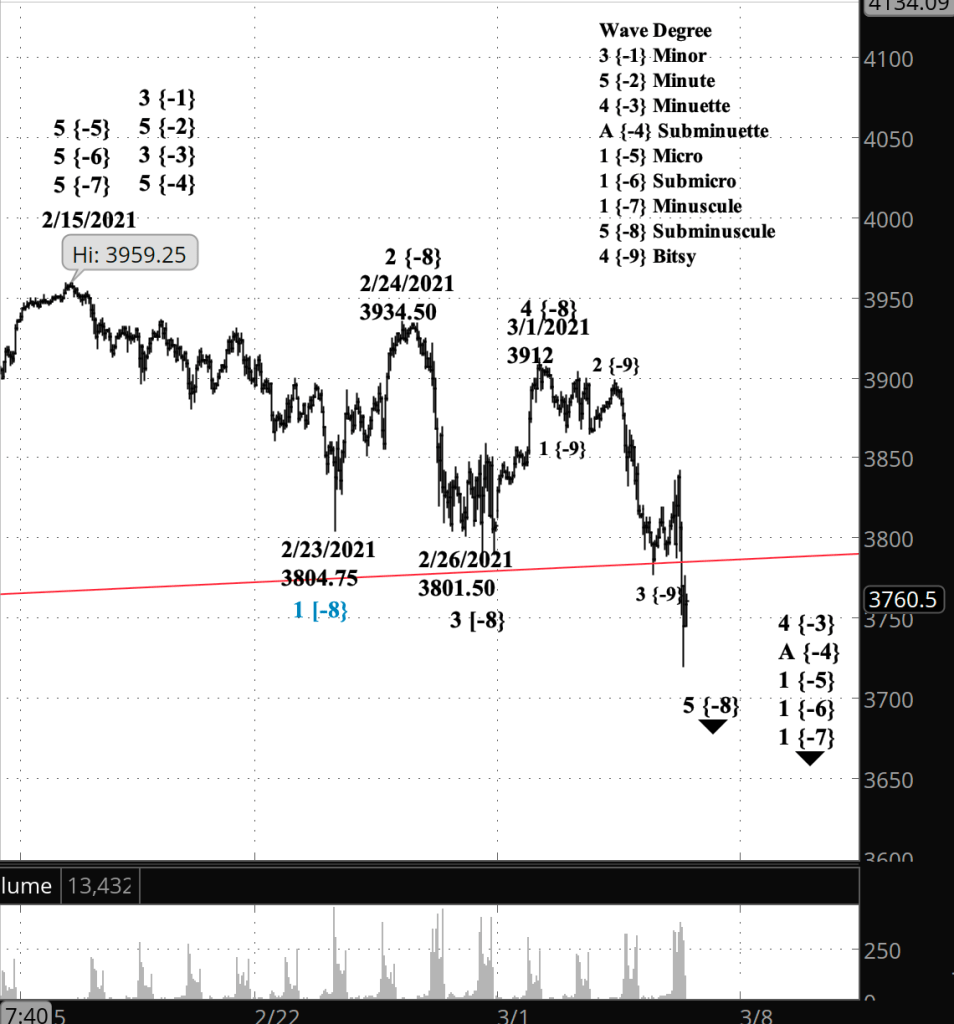
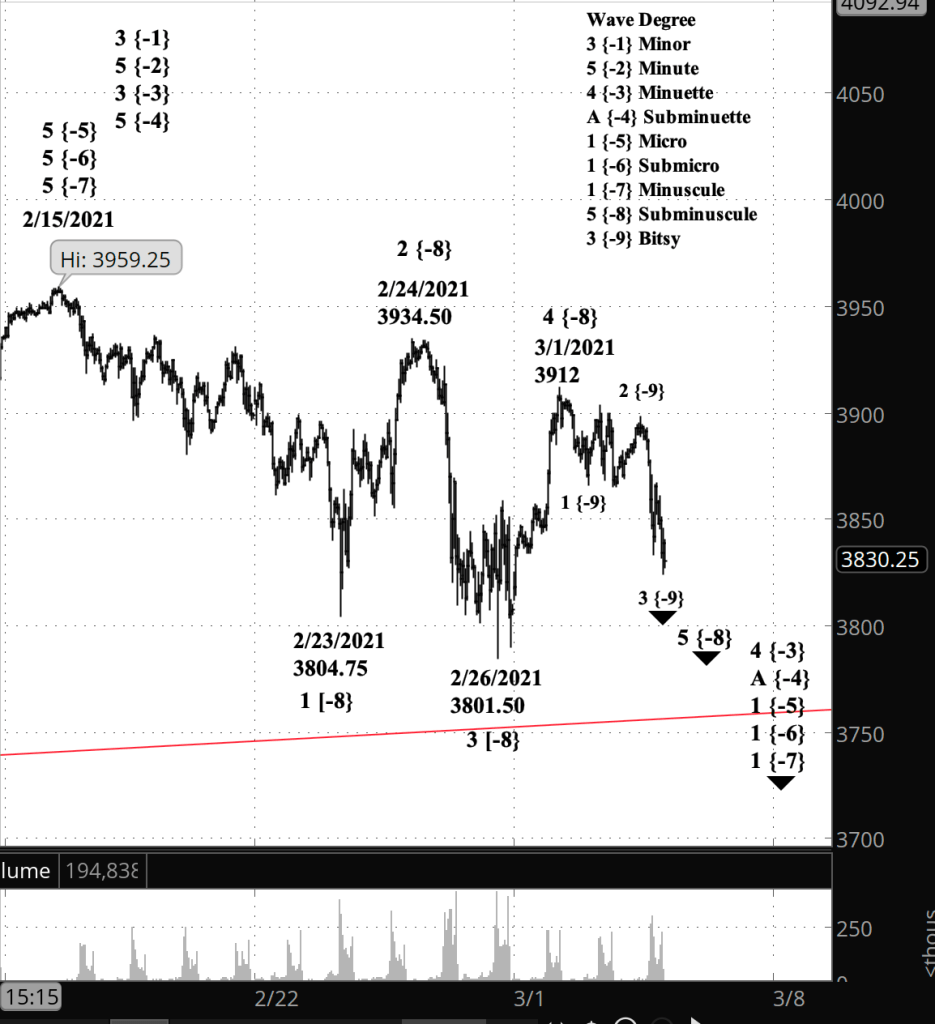
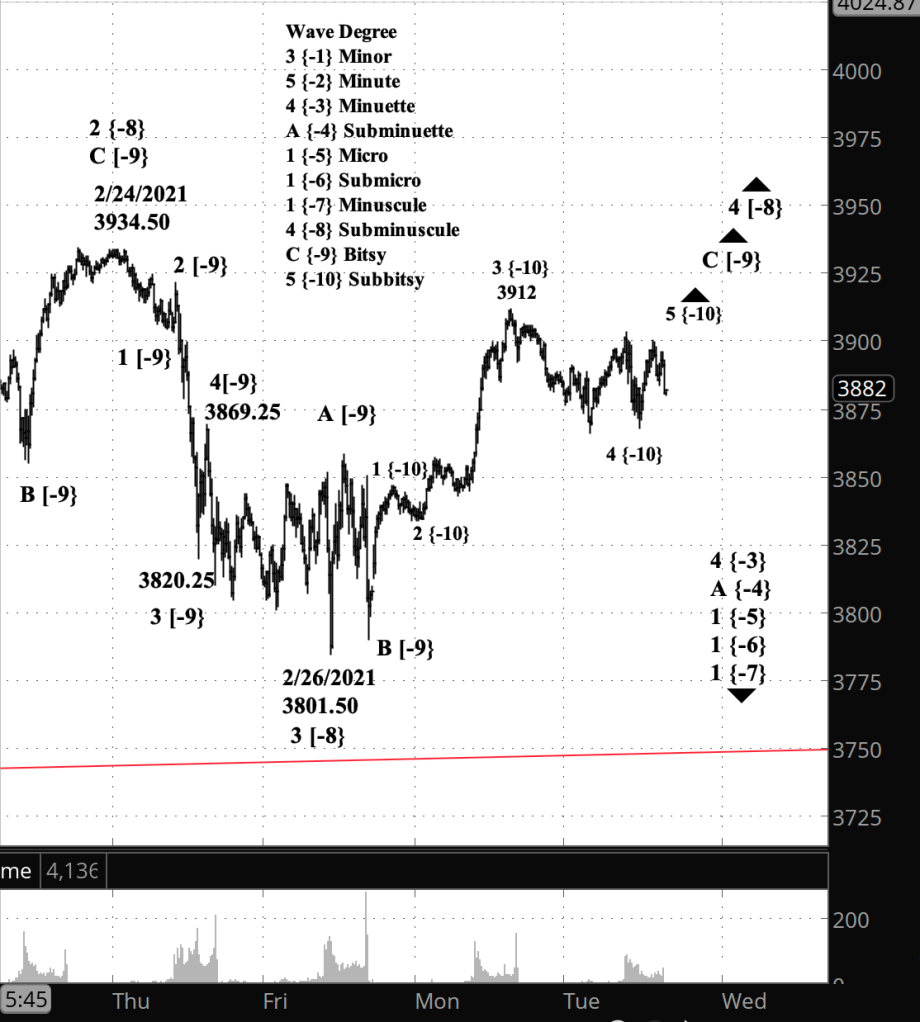
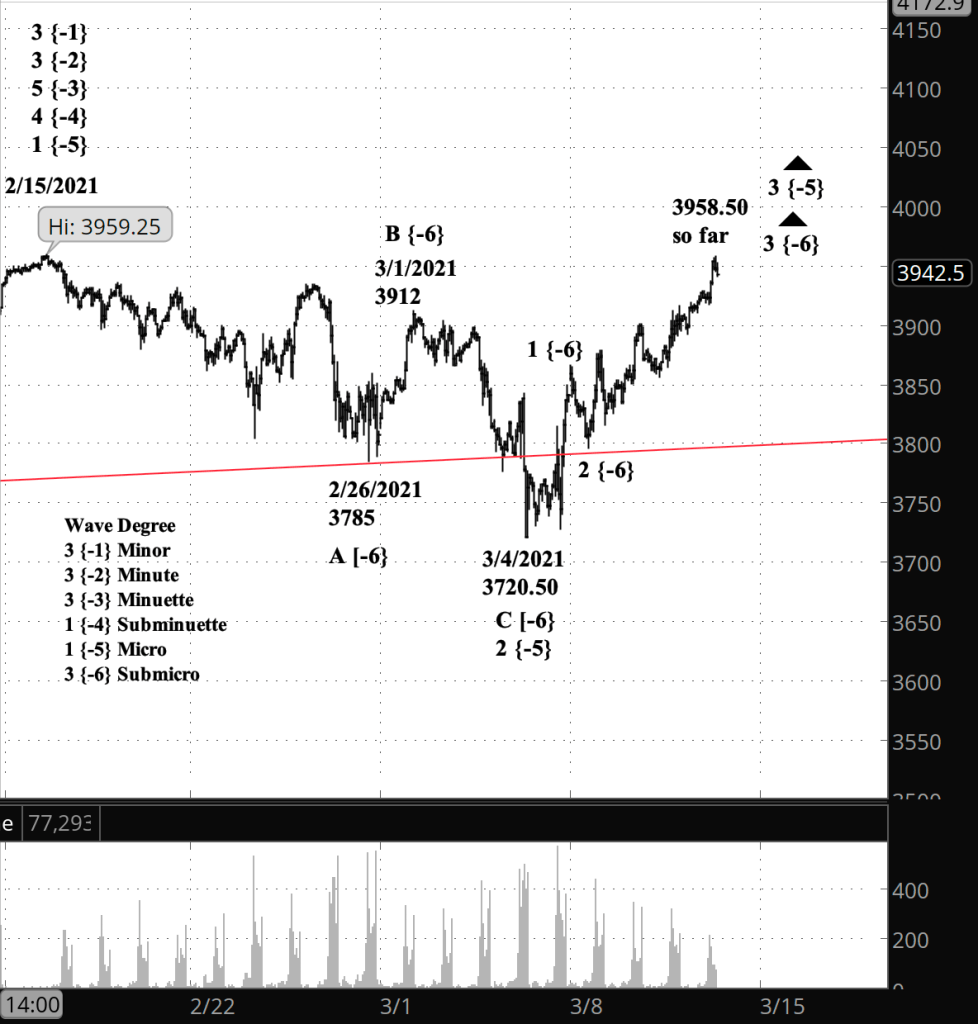
Half an hour before the closing bell. The S&P 500 E-mini futures completed the first very small scale downward movement (an A wave) in a correction that began March 11, and then rose very slightly (a B wave) in a shallow upward movement. The structure is within the 4th wave of Subminuscule degree, which appears to be shaping up as a shallow Flat pattern. I’ve updated the short-term chart, the first of the two charts below.

10:10 a.m. New York time

What’s happening now? The S&P 500 E-mini futures continued to move sideways in overnight trading as it went through a small correction within the rise since March 4.

What does it mean? The correction will be followed in short order by a further rise will almost certainly penetrate yesterday’s high of 3958.50. The completion of that further rise will trigger a correction of a larger degree, which will be followed by another upward move.

What are the alternatives? The rise could fall short of that prior high and still be within the rules of Elliott wave analysis, in condition called a “truncation”.
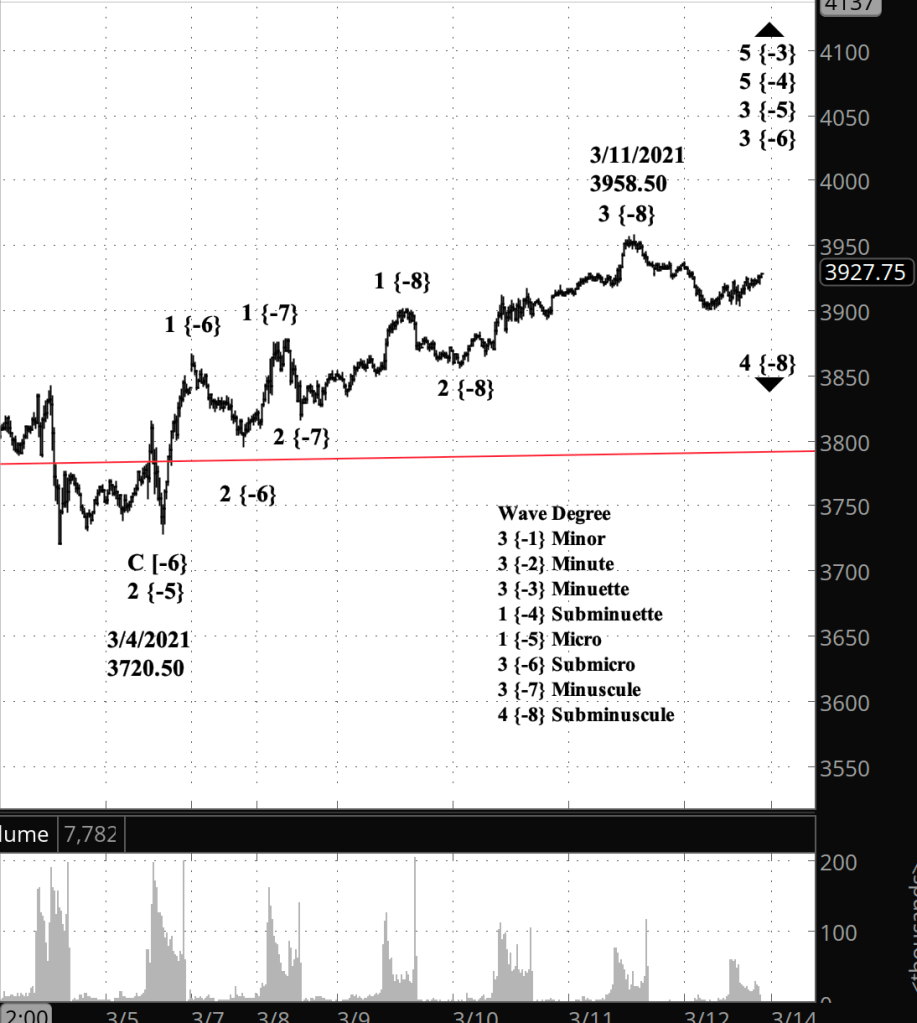
[S&P 500 E-mini futures at 3:30 p.m., 20-minute bars, with volume]
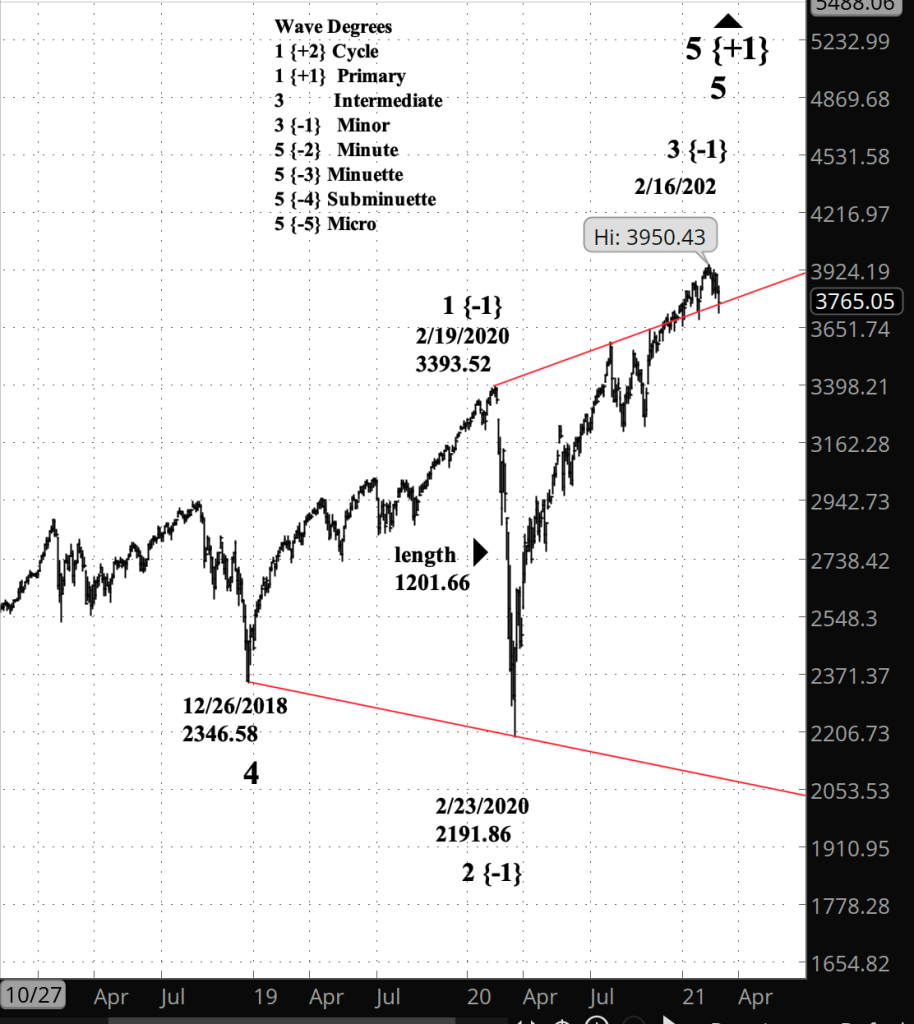
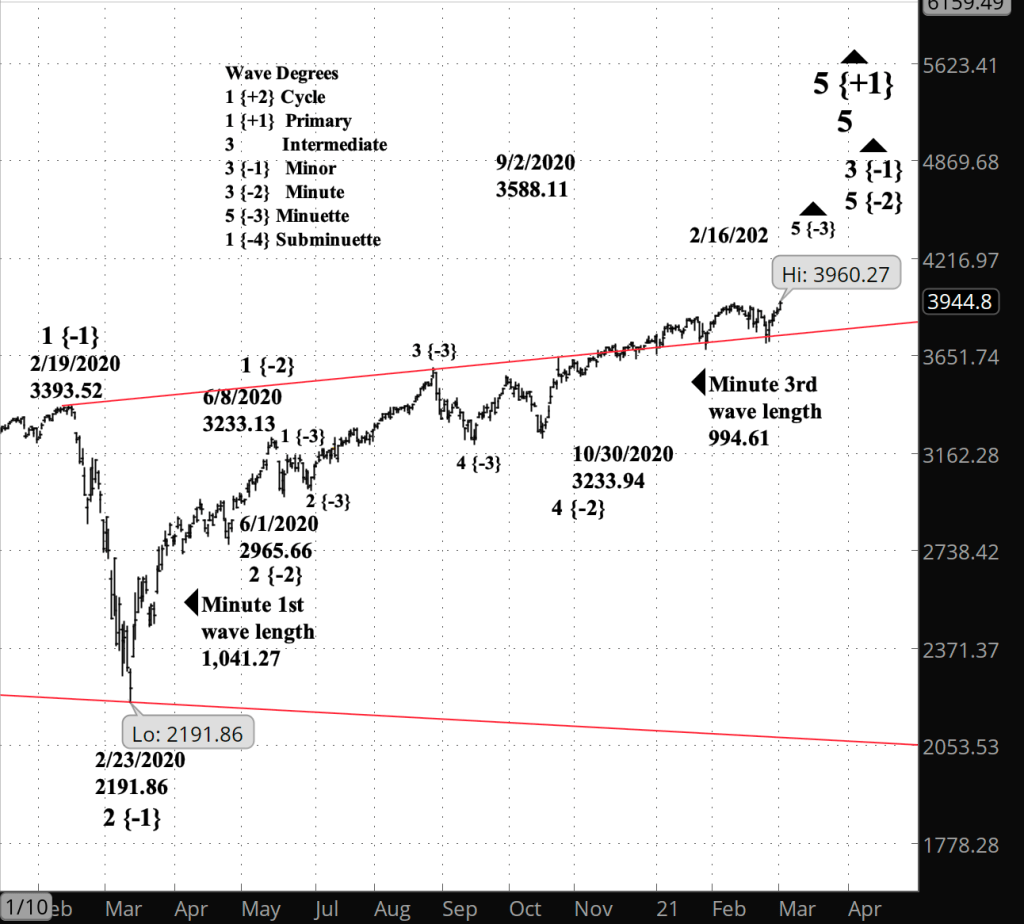
[S&P 500 index at 10:06 a.m., 2-day bars]

What does Elliott wave theory say? Yesterday’s breakout signaled that the Minor wave uptrend that began February 23, 2020 is still underway.

The short-term upper chart shows a typical motive wave in the direction of the main trend, with the usual waves within waves pattern that characterize the markets. The small, sideways correction is wave 4 of Subminuscule degree within a series of uptrending wave, from Minuscule up to Supercycle, which covers quite a bit territory. The Minuscule wave began on March 8, four days ago. The Supercycle wave began on October 5, 1929.

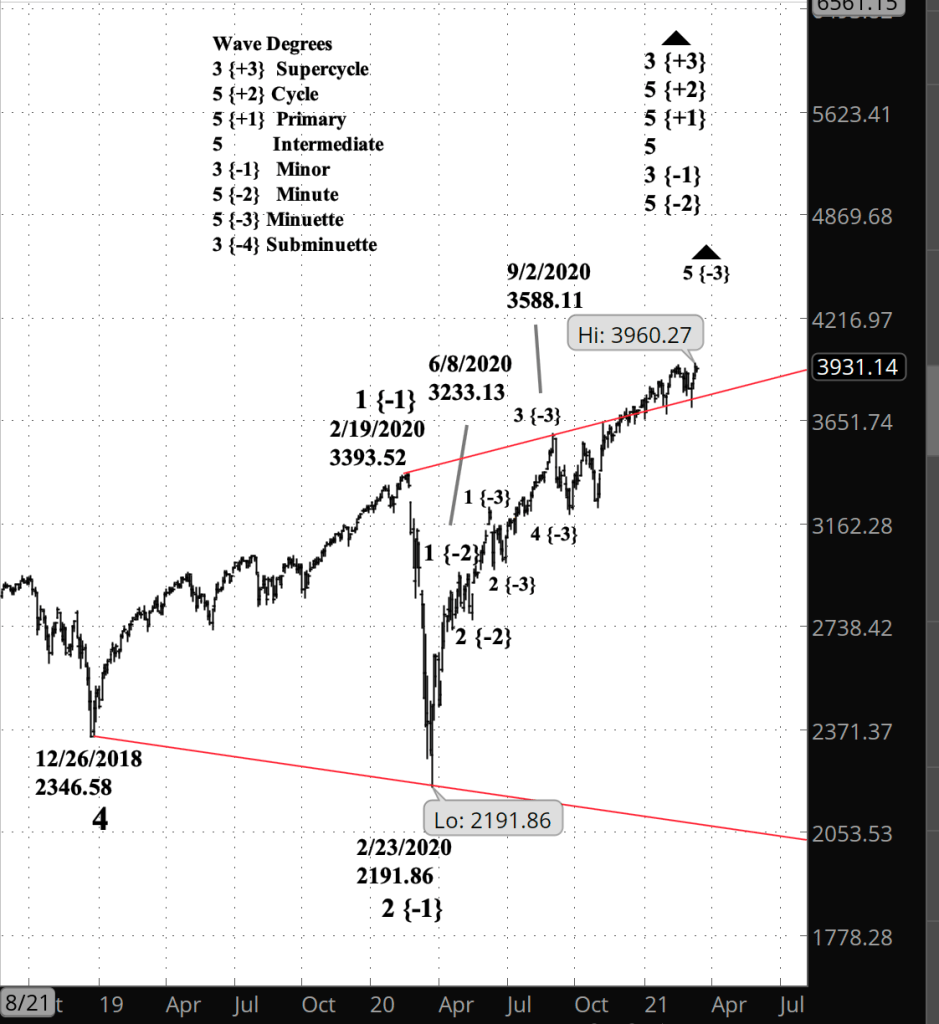
To summarize the big picture on the lower chart, the rise that began on February 23, 2020 from 2346.58 is Minor wave 3. Within it, working from smaller to larger, the S&P 500 index is moving through Minuette wave 5 of Minute wave 5. Minor wave 3 is part of Intermediate wave 5 within Primary wave 1 within Cycle wave 1.

So what does all of that mean for the Expanding Diagonal Triangle that began on December 26, 2018, the red lines on the long-term chart that a reader of Private Trader has aptly described as a megaphone? And the answer is, no impact. The price broke above the upper boundary of the triangle last December and has continued to bounce along the line ever since. The bouncing will end with the completion of wave 3 of Minor degree. The next movement will be wave 4, which by the rules of Elliott wave analysis will eventually reach the lower boundary, presently around 2080 but sinking further each day. If wave 4 instead proves to be a shallow correction, then the analysis that resulted in the Diagonal Triangle will need to be revised.

After Minor wave 4 is complete, if the triangle remains intact, then the next move will Minor wave 5, which will return to the upper boundary, presently in the 3390s but rising each day. Completion of the 5th wave of Minor degree will mark the end of the Diagonal Triangle and the end of the parent wave, Primary wave 5, and moving the ladder of degrees, also the completion of Cycle wave 5 within Supercycle wave 3.

For perspective: Cycle wave 5 began on December 9, 1974 from a price of 570. (Three figures — 570 — is correct, not a typo.) So given that high degree, the decline that follows the end of Cycle wave 5 will be with us, almost certainly, for decades, and given the fractal nature of the Elliott waves that we use to describe the market, will provide plenty of opportunity for both bull and bear trades.

Read More »
Thursday, March 11, 2021

3:05 p.m. New York time

A new analysis. Although the S&P 500 index has broken above its February 15 high, showing that the year-long uptrend is continuing, the S&P 500 futures remain below that high, creating a discrepancies. Both the index and the futures are derivatives of a collection of corporate equities. The index is derived from the price of the stocks, and the futures are derived from the index.

For the following Elliott wave analysis I’ve taken the index as definitive, assuming that the futures will follow, since the index is one step closer to the stocks from which both products are derived.

Note that wave 3 of Minute degree, which began on June 1, 2020, is shorter than the preceding 1st wave. That means that either Minute wave 3 will continue to rise until it’s longer than Minute 1, or if wave 3 comes up short, then the future wave 5 of Minute degree can be no longer than Minute 1.

First, the big picture. The rise since March 4 is wave of Minuette degree within wave 5 of Minute degree within wave 3 of Minor degree. The Minor 3rd wave began on February 23, 2020 and so far has reached a peak on the index of 3960.27.

[S&P 500 index at 3 p.m., daily bars]

Second, the smaller picture. The wave 2 correction of Micro degree began on March 4 from 3720.50 on the futures and has so far reached a high of 3958.50, still below the end of wave 1 on February 15, at 3959.25. The subsequent rise is wave 3 of Micro degree, and within it, wave 3 of Submicro degree.

[S&P 500 futures at 3:01 p.m., 65 minute bars, with volume]

I’ve left this morning’s chart below, with its now invalidated analysis, unchanged so it can be used for comparison.

2 p.m. New York time

Break-out. The S&P 500 index has risen above its high of February 15, invalidating Elliott wave analysis that saw the subsequent decline as the beginning of a downtrend. The rise from February 23, 2020, beginning from 2191.86, is still underway. The February 15 high on the index was 3950.43. The highest point in today’s index is 3960.27. The S&P 500 futures remain below their February 15 high, which was 3959.25. The highest point in today’s futures trading is 3958.50.

9:35 a.m. New York time

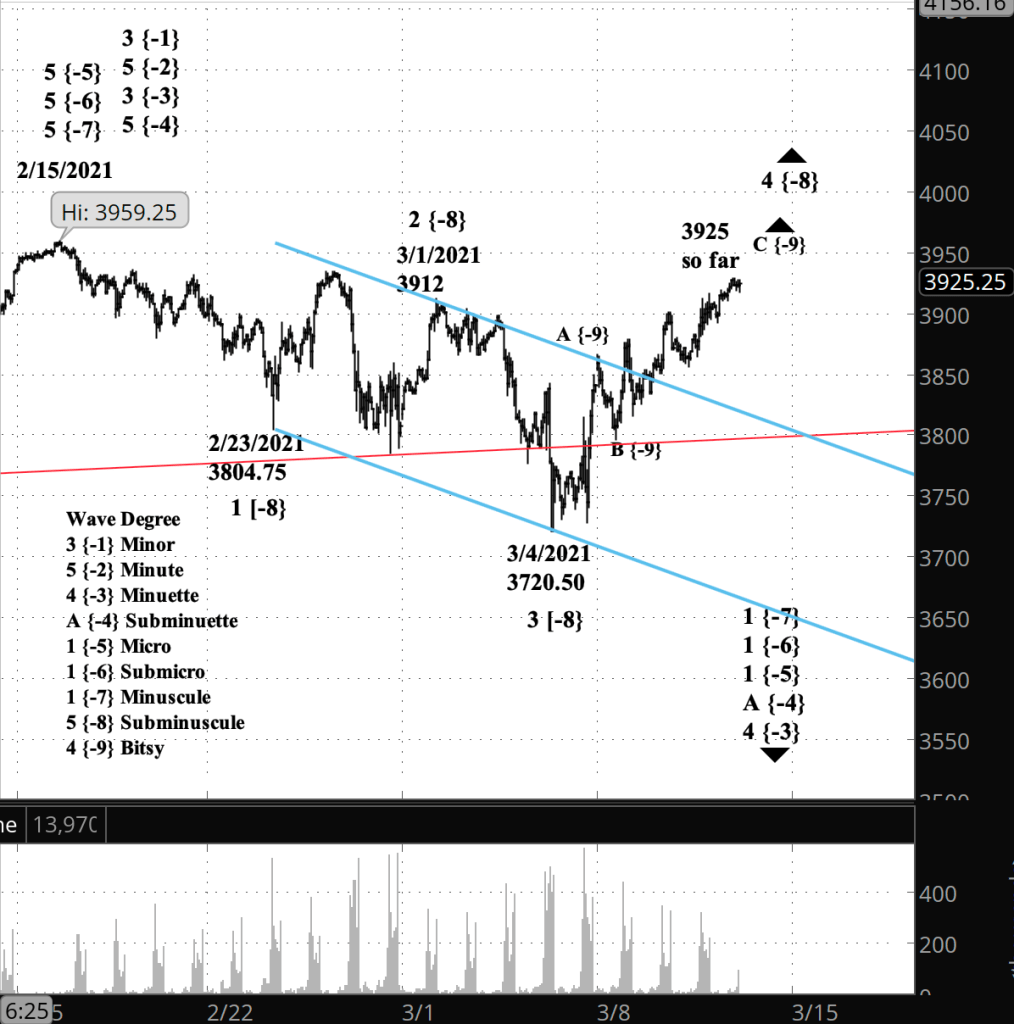
What’s happening now? The S&P 500 E-mini futures continued their relentless rise in the low-level upward correction that began on March 4, reaching a high of 3925 in overnight trading.

What does it mean? If the price reverses to the downside before reaching 3959.25, then the downward movement that began on February 15 from that level will resume, falling below 3720.50, perhaps significantly so.

What are the alternatives? If the price exceeds 3959.25, then the upward movement did not end on February 15 but is still underway, and we can expect a series of higher highs.

[Outdated analysis: S&P 500 E-mini futures at 9:34 a.m., 65-minute bars, with volume]

What does Elliott wave theory say? The upward correction under the principle analysis is wave 4 of Subminuscule degree, and within it, wave C of Bitsy degree is in its 4th day. Big picture: The February 15 peak marked the end of the 5th wave all the way up to Subminuette degree and the beginning of a major decline reaching all the way up to Minor degree.

However, if the alternate count proves to be valid, then the February peak marks the end of wave 3 of Subminuette degree, and the subsequent decline is a wave 4 correction at the Subminuette level.

As is always the case with Elliott wave analysis, and indeed, with life, nothing is ever certain.

Read More »

Wednesday, March 10, 2021

3:30 p.m. New York time

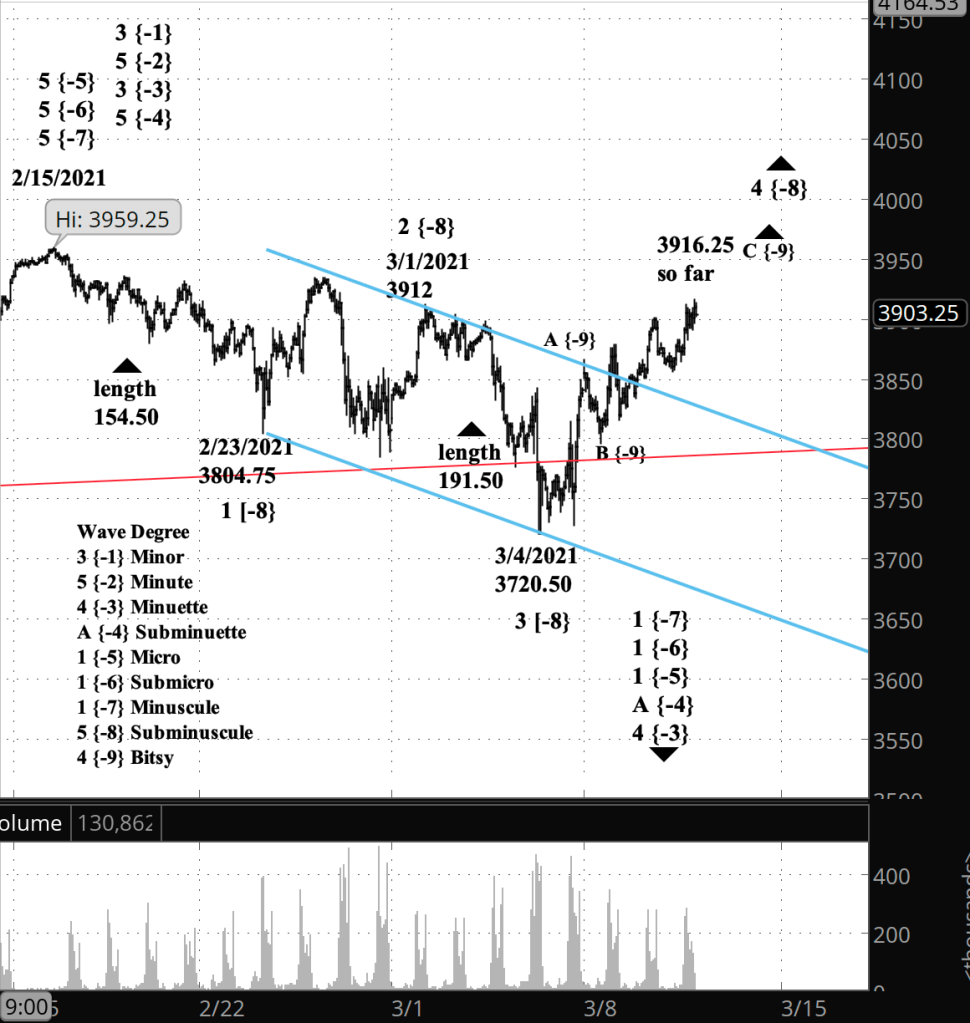
Half an hour before the closing bell. The S&P 500 continued its rise, reaching a high of 3916.25 so far. That level is below the starting point of the downtrend, 3959.25. I’ve updated the chart below.

10:50 a.m. New York time

What’s happening now? The S&P 500 E-mini futures continued to rise in the final leg of an upward correction, reaching a high so far today of 3911.50, which is 47.75 points below the starting point of a downtrend on February 15.

What does it mean? The completion of the upward correction will be followed by an energetic resumption of the downtrend.

What are the alternatives? If the price moves above 3959.25, the beginning the downtrend, then the principle analysis is invalid and must be redone to account for a continuation of the uptrend that began in February

[S&P 500 E-mini futures at 3:30 p.m., hourly bars, with volume]

What does Elliott wave theory say? If the price rises another 48 points, then the 4th wave of Subminuscule degree will exceed the beginning of wave 1 of Subminiscule degree. This isn’t allowed in Elliott wave theory. Should it happen, then all of the drama since the February 15 peak has been a downward correction within an uptrending 5th wave in the rise since February 23 of last year. I count that year-long rise as having completed it’s 5th wave of Minor degree. However, all that has happened since the February 15 peak last month has been movements of small degree, seven and eight levels below Minor degree.

The 3rd wave of Subminuscule degree is longer than the 1st wave, so there’s no danger that this structure will violate the Elliott wave analysis rule that says the 3rd wave cannot be the shortest wave in the direction of the trend.

Elliott wave analysis doesn’t produce predictions. It’s not a crystal ball. Instead, it provides a language for describing the state of the chart at any given moment. So we must wait and see whether that February 15 peak stands or is exceeded.

Read More »

NIO Trade

Nio Ltd. (NIO)

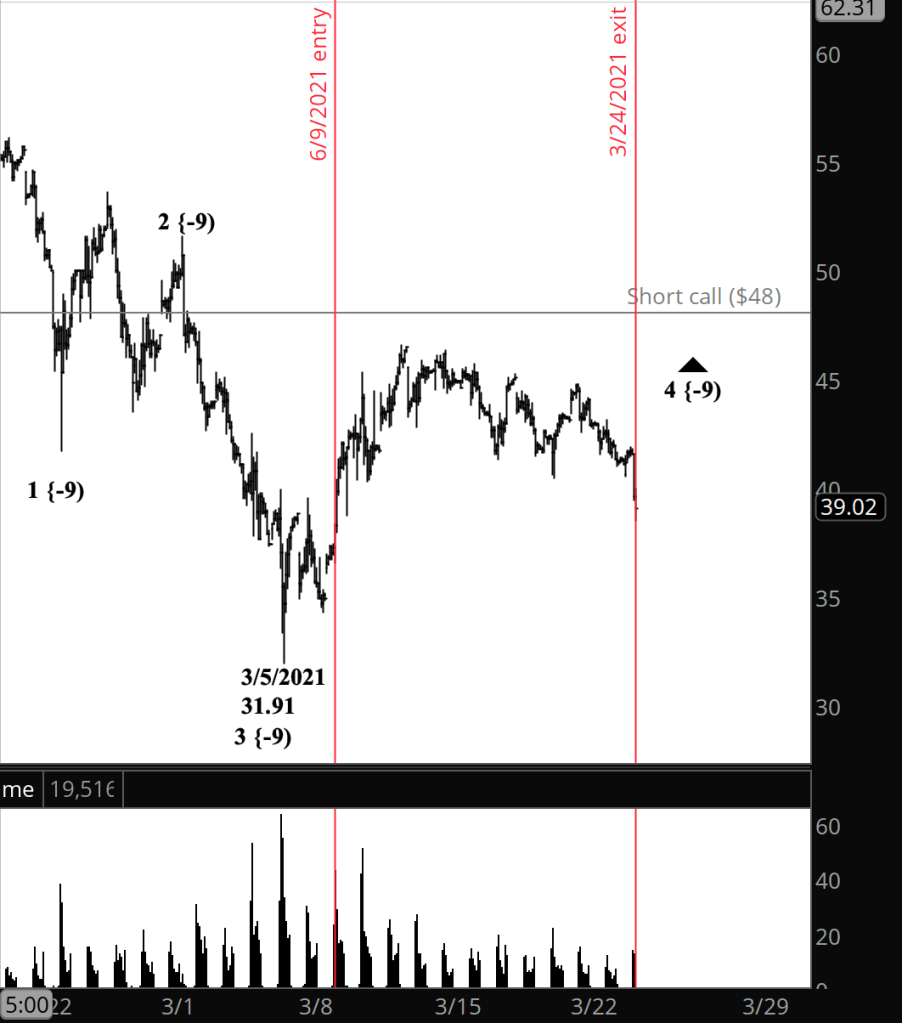
Update 3/24/2021: I exited my short iron condor options position on NIO 23 days before expiration, for a $0.55 debit per contract/share, a profit before fees of $1.10 per contract/share. Shares were trading at $40.38, down $1.44 from the entry level.

I ended the position according to my rule requiring exit when the price reaches 50% of maximum potential profit.

Shares rose by 3.7% over 15 days for a 90% annual rate. The options position produced a 100% return for a 2,433% annual rate.

[NIO, hourly bars, with volume]

NIO rose in the first five days that I held the position and trended sideways thereafter. The rise remained below the $48 strike price of the short call, keeping the position in its profit zone throughout the holding period. My entry point was early in wave 4, and the price behavior was typical of 4th wave corrections — shallow and lacking drama.


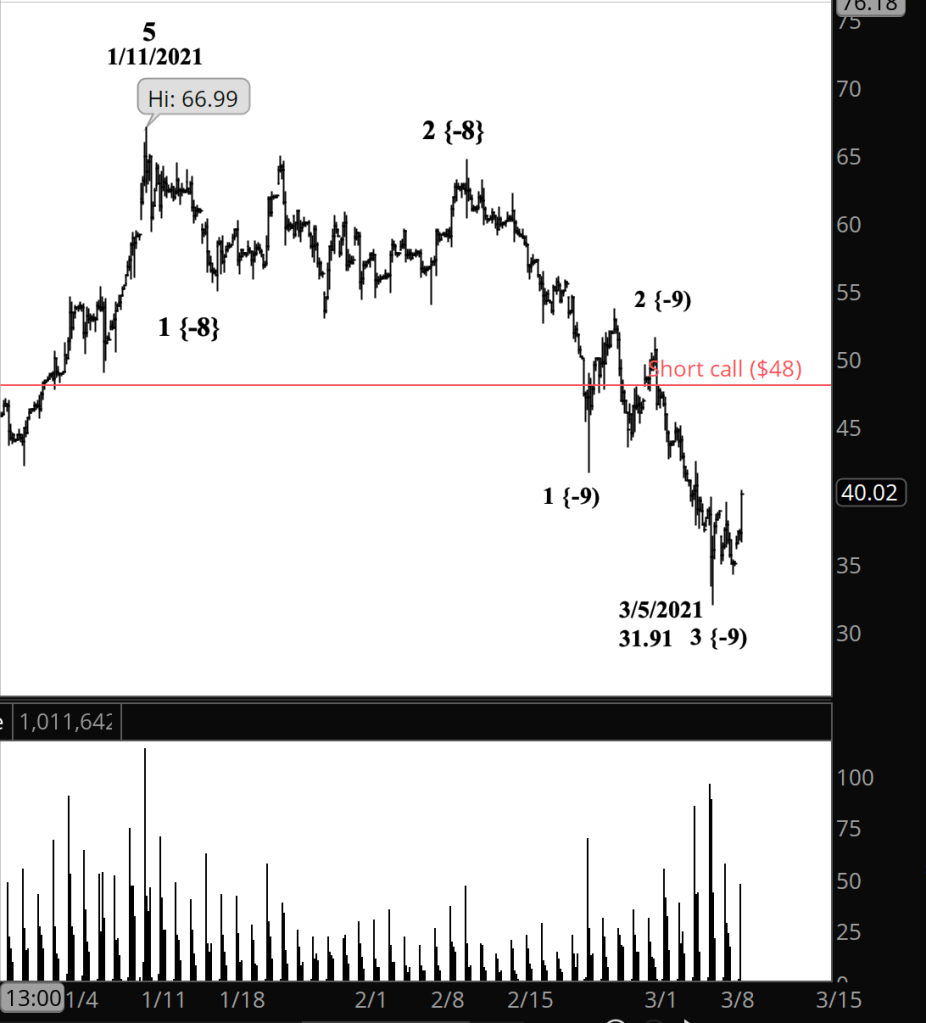
I have entered a short iron condor spread on NIO, using options that trade for the last time 38 days hence, on April 16. The premium is a $1.10 credit per contract share and the stock at the time of entry was priced at $38.94.

The implied volatility rank (IVR) stands at 42.3.

Premium: $1.10 Expire OTM  
NIO-iron condor Strike Odds Delta
Long 55.00 90.0% 18
Break-even 49.10 85.5% 23.5
Short 48.00 81.0% 29
Puts      
Short 23.00 85.0% 8
Break-even 21.10 87.0% 6.5
Long 20.00 89.0% 5

The risk/reward ratio is 3.5:1, with maximum risk of $390 and maximum reward of $110 per contract.The premium is 22% of the width of the position’s wings.
The profit zone covers a 38% move to the upside and a 68% move to the downside, for total range of 106%.

I skewed the entry to the downside based on Elliott wave analysis showing that wave 3 of Bitsy degree appears to have ended four days ago, and that wave 4, likely a shallow correction, is now underway.


[NIO at 10:29 a.m., 2-hour bars, with volume]

The trade was made in a period of low implied volatility. Among equities that meet my liquidity requirements, no ETFs were above my 30% threshold, and the only stocks that passed the test were Chinese companies, which carry additional risk in the form of currency fluctuation and regulatory surprises. Nonetheless, it’s a short-term trade, and that works in my favor, so I decided the risks were acceptable.

By Tim Bovee, Portland, Oregon, March 9, 2021

Read More »

Tuesday, March 9, 2021

3:30 p.m. New York time

Half an hour before the closing bell. The S&P 500 continued to rise during the trading session, reaching a high on the futures of 3901.25 with half an hour to go. The price has moved above yesterday’s high, and so the alternative analysis prevails and the correction, presently wave C of Bitsy degree within wave 4 of Subminuscule degree, is still underway. I’ve updated the chart.

10:40 a.m. New York time

Trade updated. I’ve updated the NIO analysis with a chart and a discussion of decision to enter the trade.

10:30 a.m. New York time

Trade posted. I’ve entered a short iron condor options spread on NIO and have posted the analysis.

9:50 a.m. New York time

What’s happening now? The S&P 500 E-mini futures, having fallen yesterday below the upper boundary of the channel, reversed overnight and recrossed to above the trend, although remaining below yesterday’s high of 3878.75.

What does it mean? Yesterday’s high marks the end of the low-degree upward correction that began on March 4 from 3720.50. A move below the end of the last downtrending wave, 3720.50, confirms the analysis. The downtrending wave may move below 3700, perhaps significantly so.

What are the alternatives? If the price moves above yesterday’s high, 3878.75, then the primary analysis is invalidated and the upward correction is still underway. The decline and rise from yesterday could be a continuation of the final wave of the corrective pattern, a Flat, or a separator wave between two corrective patterns, a compound structure.

[S&P 500 E-mini futures at 3:30 p.m. hourly bars, with volume]

What does Elliott wave theory say? By the primary count, yesterday’s high was the completion of wave 4 of Subminuscule degree. The decline that followed was wave 1 of Bitsy degree within downtrending wave 5 of Subminuscule degree, and the rise is wave 2, an upward correction of Bitsy degree. By the alternative count, yesterday’s high was either wave 2 within wave C of Bitsy degree, or an X wave separating two patterns in a compound structure.

My trades. Yesterday I attempted to enter a short iron condor position on NIO, and couldn’t get a fill at a price I liked. I’m trying again today.

Read More »

Monday, March 8, 2021

3:30 p.m. New York time

Half an hour before the closing bell. The S&P 500s moved past the upper boundary of a channel for the Subminuscule degree (blue line) and then dropped back into the channel, perhaps signaling, although not for a certainty, an end to the final wave of the upward correction. If that is indeed a valid signal, then the Subminuscule 5th wave has begun, with a target somewhere below 3720.50 on the futures. I’ve updated the chart below. The price remains above the upper boundary of the Diagonal Triangle that began in December 2018 (red line).

9:50 a.m. New York time

What’s happening now? The S&P 500 E-mini futures continued their upward correction, entering the final portion of the three-wave pattern.

What does it mean? Completion of the pattern opens two possibilities. The first is that the correction comes to an end with that their wave.

What are the alternatives? The alternative is that the correction extends with the addition of a second pattern.

[S&P 500 E-mini futures at 3:30 p.m., 55-minute bars, with volume]

What does Elliott wave theory say? The correction is wave 4 of Subminuscule degree, and within it, wave C of Bitsy degree began today in overnight trading. Under my principle analysis, the end of wave C will also end its parent wave 4, and wave 5 of Subminuscule will resume the downtrend that began February 15 from 3959.25, moving below 3720.50, perhaps significantly below that level. Under my alternative analysis, wave C of Bitsy degree will be followed by an X wave, which will separate the just completed corrective pattern from a corrective pattern that will follow. In this alternative case, the following pattern can be a shallow Flat or a more directional Zigzag. There’s no way to tell at this point.

Read More »

Friday, March 5, 2021

3:30 p.m. New York time

Half an hour before the closing bell. The S&P 500 continued its 4th wave upward correction, reaching 3839 at its highest point, with the trading day not yet ended. I’ve updated the chart.

10:05 a.m. New York time

What’s happening now? The S&P 500 E-mini futures completed a small downward move and began an upward correction, that briefly carried the price back above the upper boundary of a Diagonal Triangle that began in December 2018 before dropping below the boundary again, while remaining above yesterday’s low, 3720.50.

What does it mean? The correction is the second one within the low-level downtrend that began February 15, and so it will typically be a shallow correction, perhaps fluctuating along the triangle’s upper boundary.

What are the alternatives? A price rise above 3912, the March 1 beginning of present leg of the decline will trigger a full chart reanalysis.

[S&P 500 E-mini futures at 3:30 p.m., 50-minute bars, with volume]

What does Elliott wave theory say? We’ve reached a point filled with ambiguity, a not unheard of condition at transition points, and we shall have to wait for those ambiguities to be resolved. The big difficulty, as is often the case, is the pesky 3rd wave problem. The 3rd wave cannot be the shortEST of the three moving in the direction of the trend: Waves 1, 3 and 5. That is a firm rule in Elliott wave analysis.

And so, I renumbered the 2nd wave correction of Subminuette degree to avoid having the 3rd wave be the shortest. Nonetheless, the 1st wave at 215.50 points long has a greater length than the 3rd wave at 191.50 points long. So either the future 5th wave of Subminuette degree will need to be shorter than 191.50, or the 3rd wave is not yet over and will require reanalysis.

My trades. Having exited yesterday from my short iron condor options position on IWM, I’m looking for my next trade. The next series coming up are the options expiring April 16. By my rules, the ideal entry date was March 2 (45 days before expiration), and the acceptable range of dates for entry ends on March 9. The market is low volatility at this point. I prefer an implied volatility rank of 30% or higher, 25% at an absolute minimum. No liquid exchange traded funds meet that criteria, and only two stocks: NIO and JD, both of them Chinese companies whose shares carry higher currency and regulatory risks. So no entry today. I’ll take a look again Monday and Tuesday of next week in the hope of some improvement.

Read More »

Thursday, March 4, 2021

3:30 p.m. New York time

Half an hour before the closing bell. For the first time since January 6, the S&P 500 fell below the upper boundary of the Diagonal Triangle that began on December 2018 and has defined the future movement of the price for more than three years. That serves as yet another confirmation that a major downtrend is underway. I’ve updated the chart from this morning and added a big-picture chart.

[S&P 500 index at 3:27 p.m., 2-hour bars]

2:10 p.m. New York time

My trades. I’ve posted an update with results of my short iron condor options position on IWM. It can be found here.

1:15 p.m. New York time

My trades. I’ve exited my short iron condor position on IWM for a profit and shall update the trade analysis shortly with results and how the trade performed in relation to my Elliott wave analysis.

10:10 a.m. New York time

What’s happening now? The S&P 500 E-mini futures declined overnight, reaching a low of 3777.50 and then beginning a sideways movement. The decline from Wednesday’s overnight peak of 3895 covered 117.50 points.

What does it mean? The price moved below 3801.50, which was the low February 26, thereby confirming that the upward correction of late February had ended and the downtrend had resumed. Although the downtrend is in its early stage, it is a a time of small beginnings the portend large events. In other words, hang on tight. It will be an interesting roller coaster ride.

What are the alternatives? I see none at this point.

[S&P 500 E-mini futures at 3:30 p.m., 50-minute bars, with volume]

What does Elliott wave theory say? The downward movement that began on Wednesday is wave 3 of Bitsy degree, a very small movement with large implications. It is was typical of third waves in that it covered a lot of ground quickly. Although Bitsy 3 is small, it’s movement below the end of the previous 3rd wave of the same degree confirms that the wave 2 upward correction was completed on March 3. The 3rd wave ended this morning and the price began working through the 4th wave of Bitsy degree, which appears to be tracing a shallow corrective pattern called a Flat. Bitsy 4 will be followed by a 5th wave resumption of the downtrend, a decline that can either be short and quick or can stretch out and cover quite a large distance.

The movement is occurring within Bitsy’s parent degree, wave 5 of Subminuscule degree, which began on February 15 from 3959.25. The completion of Subminuscule 5 will mark the end of a series of nested 1st waves reaching three degrees higher, up to wave 1 of Micro degree, and above that, wave A of Subminuette degree and, up another degree, wave 4 of Minuette degree. So the completion of wave 5 of Subminuscule degree will trigger a nested series of upward 2nd wave corrections.

Read More »

Wednesday, March 3, 2021

3:30 p.m. New York time

Half an hour before the closing bell. The S&P 500 continued to decline throughout the day in the early stages of what will develop into a significant downtrend. The decline is wave 5 of Subminuscule degree, and within that wave the price is working through wave 3 of Bitsy degree. I’ve updated the chart below.

9:45 a.m. New York time

What’s happening now? The S&P 500 E-mini futures have completed an upward correction and in overnight trading resumed their downtrend.

What does it mean? The early stages of the downtrend will carry the price below 3801.50, the low of February 26, and ultimately, months from now, down to around 2000, the lower boundary of the massive Diagonal Triangle that began in December 2018.

What are the alternatives? It’s possible that the correction is forming a compound pattern, gluing together several corrective forms, and if so, it will continue awhile longer, delaying the resumption of the decline. Confirmation of the downtrend won’t kick in until the price moves below 3801.50.

[S&P 500 E-mini futures at 3:30 p.m., 45-minute bars, with volume]

What does Elliott wave theory say? The upward corrective movement was wave 4 of Subminuscule degree, whose high point was 3812. The resumption of the downtrend is wave 5 of Subminuscule degree, all of this happening within wave 1 of Minuscule degree, the smallest of a nested series of 1st waves up to Micro degree.

The completion of Subminuscule 5 will also mark the end of the 1st waves up to Micro degree and the beginning of a 2nd wave correction of Micro degree. Second waves have a tendency to retrace a great deal of the preceding 1st wave of the same degree. On this chart, Micro wave 1 peaked on February 15 at 3959.25, and I expect the future 2nd wave to approach 3900 and perhaps even exceed it. It will be followed by an energetic 3rd wave decline that will move well below the end of Micro wave 1, which has not yet occurred.

So, looking ahead in summary: A drop below 3801.50 by an unknown amount, an upward retracement, approaching and perhaps exceeding 3900 while remaining below 3959.25, and then a dramatic decline to a level that is below anything we’ve seen since February.

Read More »

Tuesday, March 2, 2021

3:30 p.m. New York time

Half an hour before the closing bell. The S&P 500 declined slightly and then rose again during the day, staying within the range of the overnight high and low. That sideways trend suggests that the wave 4 correction of Subminuscule degree is still underway, and within it, wave C of Bitsy degree, and down further, wave 5 of Subbitsy degree. I’ve updated the chart below.

9:05 a.m. New York time

What’s happening now? The S&P 500 E-mini futures continue an upward correction that began on February 26 from 3801.50 and by my analysis are in the last phase of the rise. The high so far today is 3903.50.

What does it mean? The end of the correction will be followed by a resumption of the downtrend that began on February 15 from 3959.25 on the futures.

What are the alternatives? If the price rises above 3959.25, then the corrective pattern that began from that price on February 15 ended earlier than my analysis shows, and I would reassess the chart. I consider this to be a lower likelihood.

[S&P 500 E-mini futures at 3:30 p.m., 15-minute bars, with volume]

What does Elliott wave theory say? The rise from February 26 internally is in wave C of Bitsy degree within wave 4 of Subminuscule degree — were talking very small degrees here, so small that I had to make up the name “Bitsy” for the degree that stands nine levels below Intermediate degree.

And now, a new made-up name, “Subbitsy”, for the degree 10 levels below Intermediate. Within wave C of Bitsy degree, the price has completed four waves of Subbitsy degree and this morning about 4 a.m. began wave 5 of Subbitsy degree. That 5th wave remains below the peak of Subbitsy wave 3, which was at 3912. And although the 5th wave is the end of the rise, and although upward waves generally exceed the previous upward wave in the series, there is no rule in Elliott that requires a 5th wave to exceed the prior 3rd wave. It can fall short, a condition called “truncation” in the Elliott wave terminology.

Truncated or not, the end of Subbitsy 5 will also be the end of Bitsy C and, probably, Subminuscule 4, and the beginning of Subminuscule 5 to the downside, which will fall below, perhaps well below, 3801.50, the end of the previous 3rd wave of Subminuscule degree.

I hedged the end of Subminuscule 4 in the graf above with “probably” because corrective waves sometimes will form combinations of patterns, connecting two Flats, for example, or a Flat and a Diagonal. Fourth waves are especially prone to this. So if Subminuscule 4 forms a simple corrective pattern, then it will end with the Bitsy C peak. If it forms a combination of patterns, then there will be a downward X wave separating the patterns, and then another upward correction pattern.

Read More »