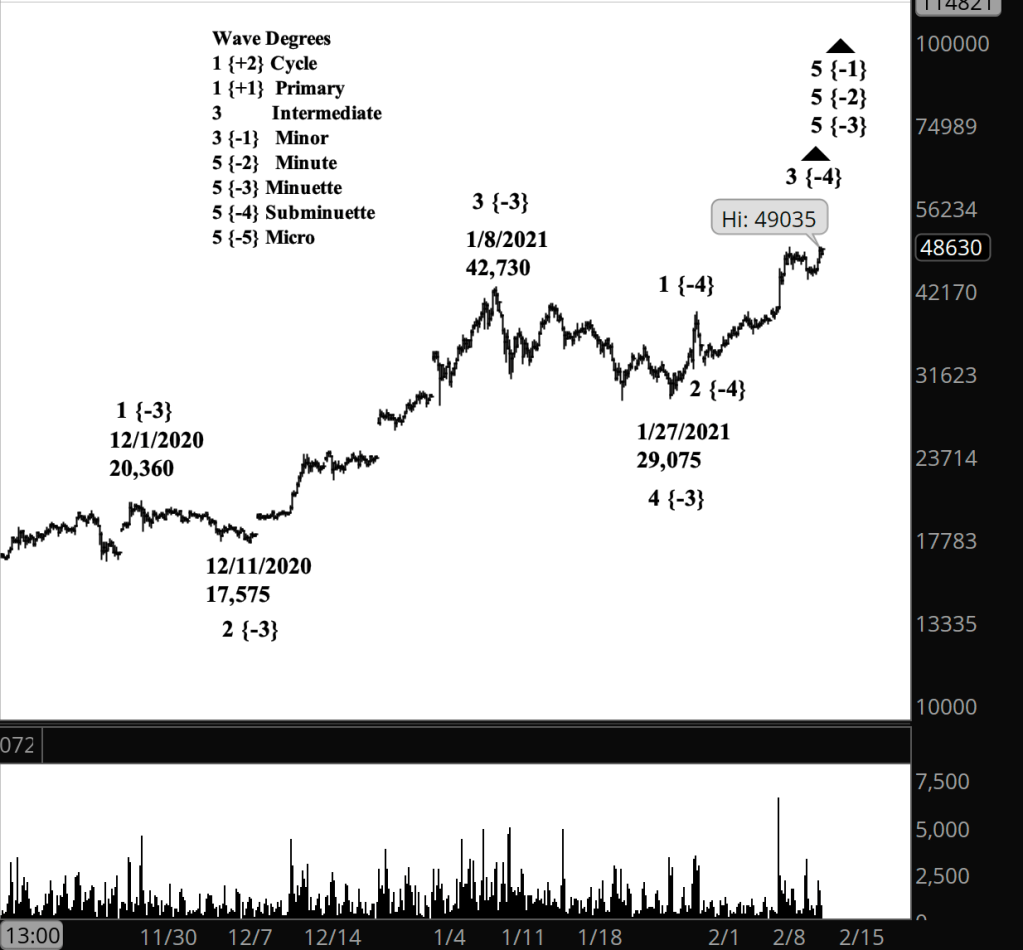
What’s happening now? Bitcoin futures rose slightly to a new high as it continued a sideways pause that began December 8.
What does it mean? By my primary count, the price is continuing an upward movement within a late-stage uptrend that began March 13, 2020 from 4,210. It has just completed a shallow correction before the final upward push.
What are the alternatives? The rise has met the requirements of that final upward push. However, there is nothing in Elliott wave analysis that requires the final upward move to be truncated. Often such movements can cover a large distance.
[Bitcoin futures at 3:21 p.m., 3-hour bars, with volume]
What does Elliott wave theory say? Today’s high is within wave 3 of Subminuette degree within wave 5 of Minuette degree. The completion of Minuette 5 will cascade up the degrees and will mark the end of wave 5 of Minor degree, which began April 13, 2020.
Fifth waves can be truncated under Elliott, they can trace the normal five waves in the direction of the trend, or they can extend for a large distance. There is no way to know for sure at this point which sort of 5th wave is in the cards.
Half an hour before the closing bell. The S&P 500 continued small-degree movements during the day. This morning’s analysis stands. I’ve update the chart below.
9:35 a.m. New York time
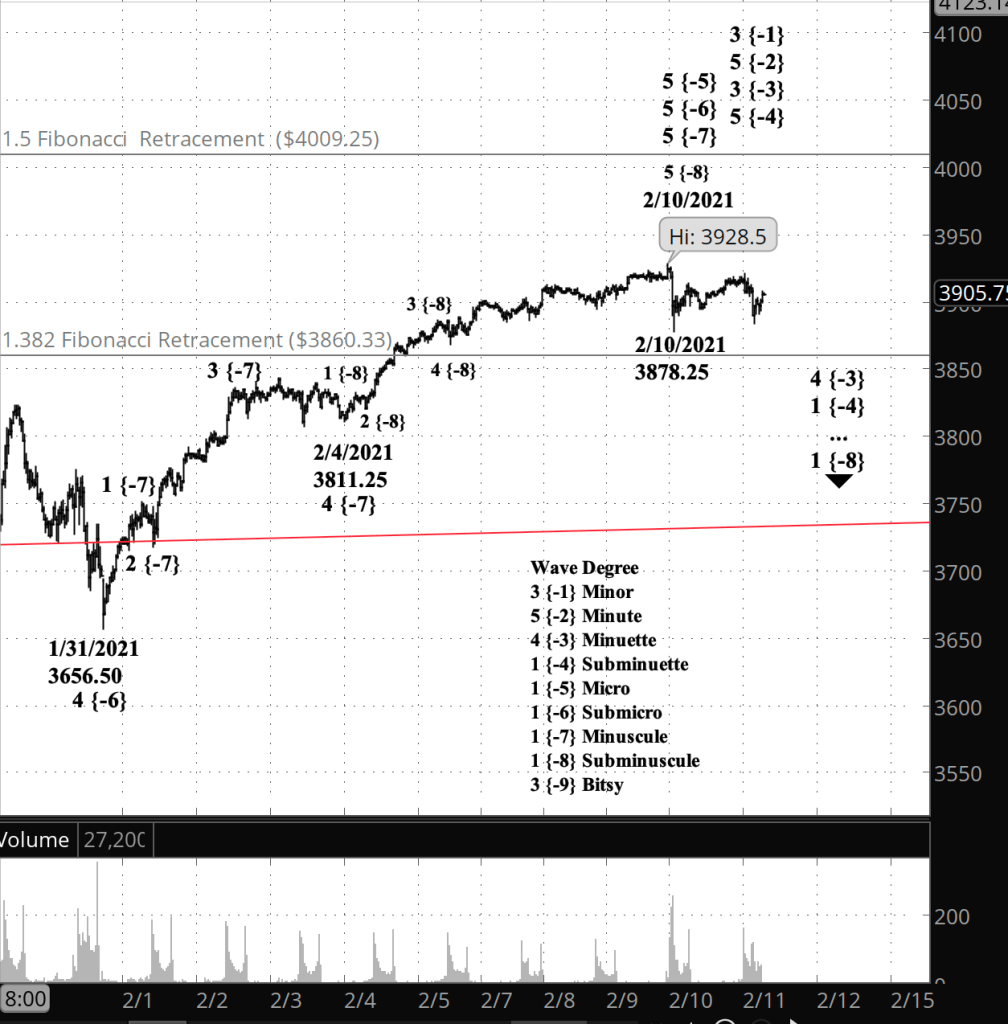
What’s happening now? The S&P 500 E-mini futures rose from its February 10 low, 3878.25, and at the opening bell was trading at 3916.25, which is 12.5 points below the February 10 high, 3928.50.
What does it mean? By my principle count, the February 10 high ended the rise from January 31, and the subsequent decline and bounce are the early steps in a downtrend that will correct that rise and eventually far larger uptrends. In other words, it’s a big deal for traders.
What are the alternatives? If the price remains below 3928.50, then principle count stands. If it moves above, then the rise from the end of January is still underway and the downtrend has not yet begun.
(Another giant chart, as the WordPress editor’s resizing function fails.)
[S&P 500 E-mini futures at 3:30 p.m., 30-minute bars, with volume]
What does Elliott wave theory say? Under the principle count, the February 10 high completes the 5th wave of Subminuscule degree, and cascades up through the parent waves to a completion of wave 5 of Subminuette degree, wave 3 of Minuette degree, wave 5 of Minute degree and wave 3 of Minor degree. The decline that began yesterday is the beginning of wave 1 of a very small degree, the first building block of what will be a major decline.
Under the alternative count, the decline is a low-degree correction within wave 5 of Subminuscule degree as the uptrend continues.
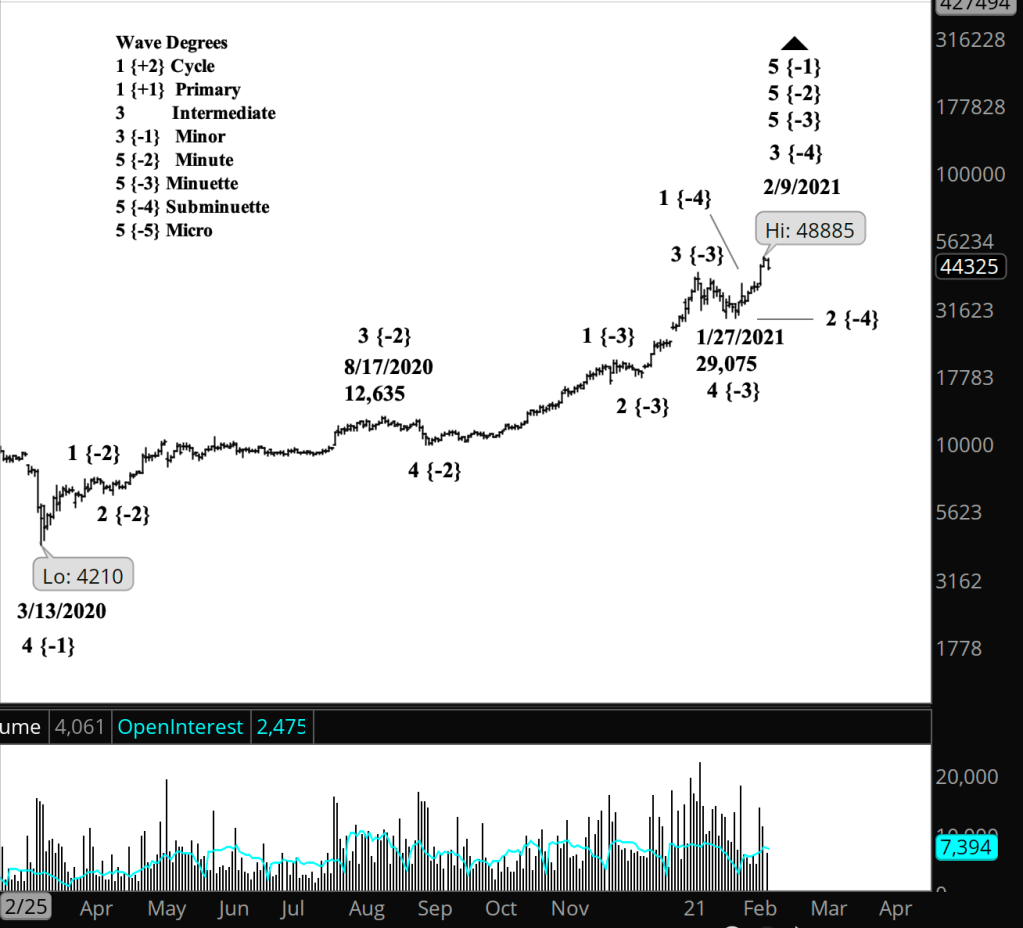
What’s happening now? Bitcoin futures reached a higher high of 48,885 on February 9 and then pulled back. A trader I admire today suggested that the high was a signal to buy Bitcoin.
What does it mean? Bitcoin has been in an uptrend since January 27, from 29,075, a 68% rise in 13 days. By my count the uptrend is present in its middle stages, meaning there is a, probably shallow, correction ahead, followed by a push to higher highs. Once that rise is complete, it will mark the beginning of a significant decline, correcting the rise from March 13, from 4210.
What are the alternatives? Elliott wave counts are often ambiguous. It’s possible that today’s high is the end of the rise and the beginning of the correction, although by my count that’s not the case.
[Bitcoin futures at 9:46 a.m., daily bars, with volume]
What does Elliott wave theory say? By my principle count, Bitcoin is in wave 3 of Subminuette degree within wave 5 of Minuette degree within wave 5 of Minute degree. All of that is unfolding within wave 5 of Minor degree, which began on March 13, 2020.
So is the trader I admire right? I never recommend trades and am not doing so here. However, for an active trader interested in short-term results and nimble at making exit calls, 5th waves can be great opportunities. They sometimes extend for quite a long time. Under the rules of Elliott wave analysis, a 3rd wave can’t be shortest wave of the three waves moving in the direction of the trend (1st, 3rd and 5th). Wave 3 of Minute degree is already longer than Minute wave 1, so with Minute wave 5, in theory, the sky is the limit.
Or not. Minor wave 5 could be a truncated stump of a wave, and the correction could begin within a few days. Elliott wave analysis isn’t a prediction tool. It provides “You Are Here” marker and assesses the possible moves that lie ahead. Useful information, but anyone looking for predictions would do better to buy a crystal ball.
Half an hour before the closing bell. The S&P 500 fell quickly in the morning, falling 50 points to 3878.25in 15 minutes of trading. That movement strengthens the case for the principle analysis. Chart updated.
9:40 a.m. New York time
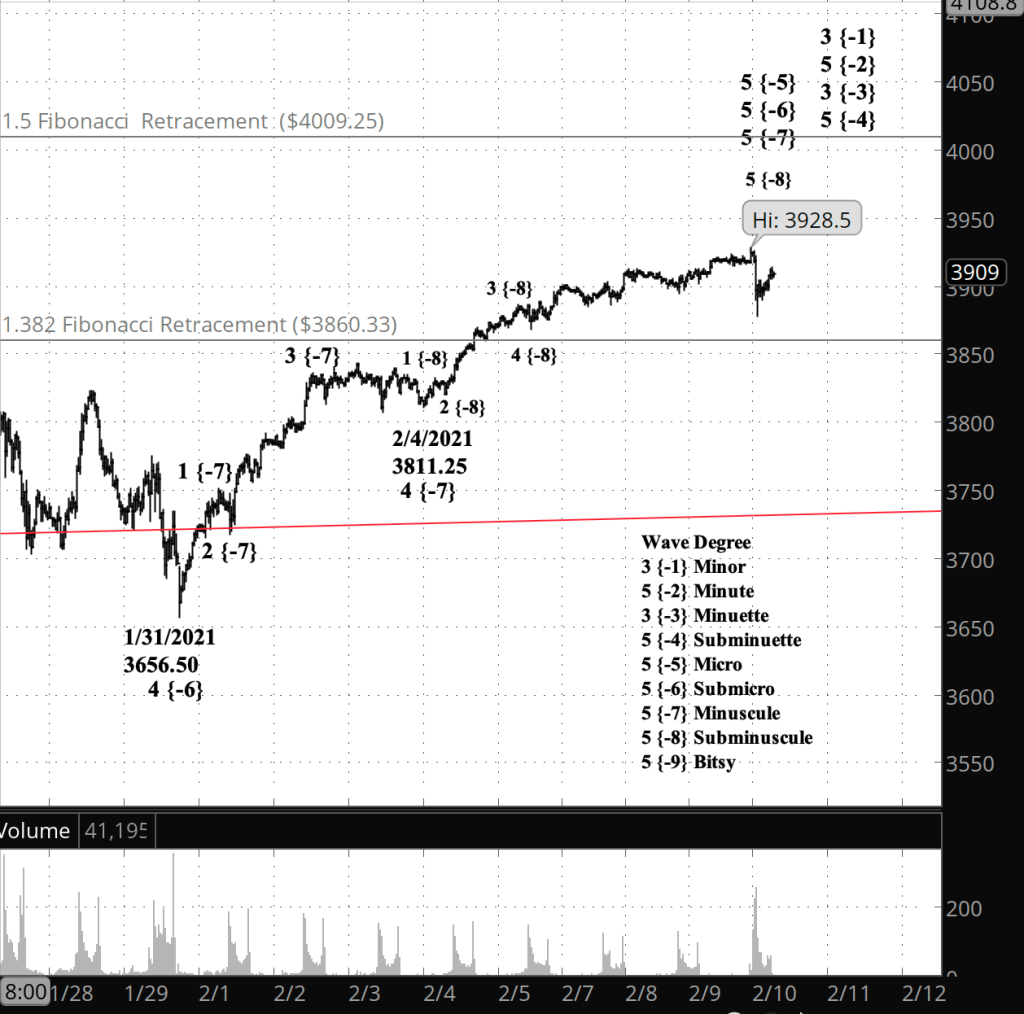
What’s happening now? The S&P 500 E-mini futures shot up to a higher high of 3928.50 in the hour before the opening bell. The price had moved above yesterday’s high in a sideways movement but rose to that new high in four minutes of trading before the index opened.
What does it mean? The rise from January 31 continued after yesterday’s pullback, a scenario described in yesterday’s alternate analysis. When the rise is complete, the S&P 500 will reverse into a downtrend that will eventually drain the optimism from the marketplace. The brevity of the upward at 8:30 a.m. New York time suggests the possibility of an exhaustion move, a sudden move in the direction of the trend that marks its end.
What are the alternatives? The principle and alternate analyses are the same as yesterday. Principle: The higher high marks the end of the upward trend. Secondary: A retracement before the upward trend continues.
(Once again the WordPress editor refuses to size charts properly. So, big chart.)
[S&P 500 E-mini futures at 3:32 p.m. New York time, 30-minute bars, with volume]
What does Elliott wave theory say? The 8:30 a.m. spike under my principle analysis completes wave 5 of Subminuscule degree within wave 5 of Minuscule degree, and 5th waves up to Minute degree, which is one degree lower than wave 3 of Minor degree. However, there is nothing in Elliott that guarantees that Subminuscule 5 is complete, and also doesn’t guarantee that it’s not yet complete. Ambiguity rules.
An earlier version of this post, published prematurely, showed an incomplete analysis that differs significantly in its conclusions from this final version.
3:30 p.m. New York time
Half an hour before the closing bell. The S&P 500 rose to 3912.25 on the futures, two points below the overnight high. If it remains below that high, then the primary analysis prevails. If it moves above that high, then the alternative analysis prevails. I’ve updated the chart below.
10:20 a.m. New York time
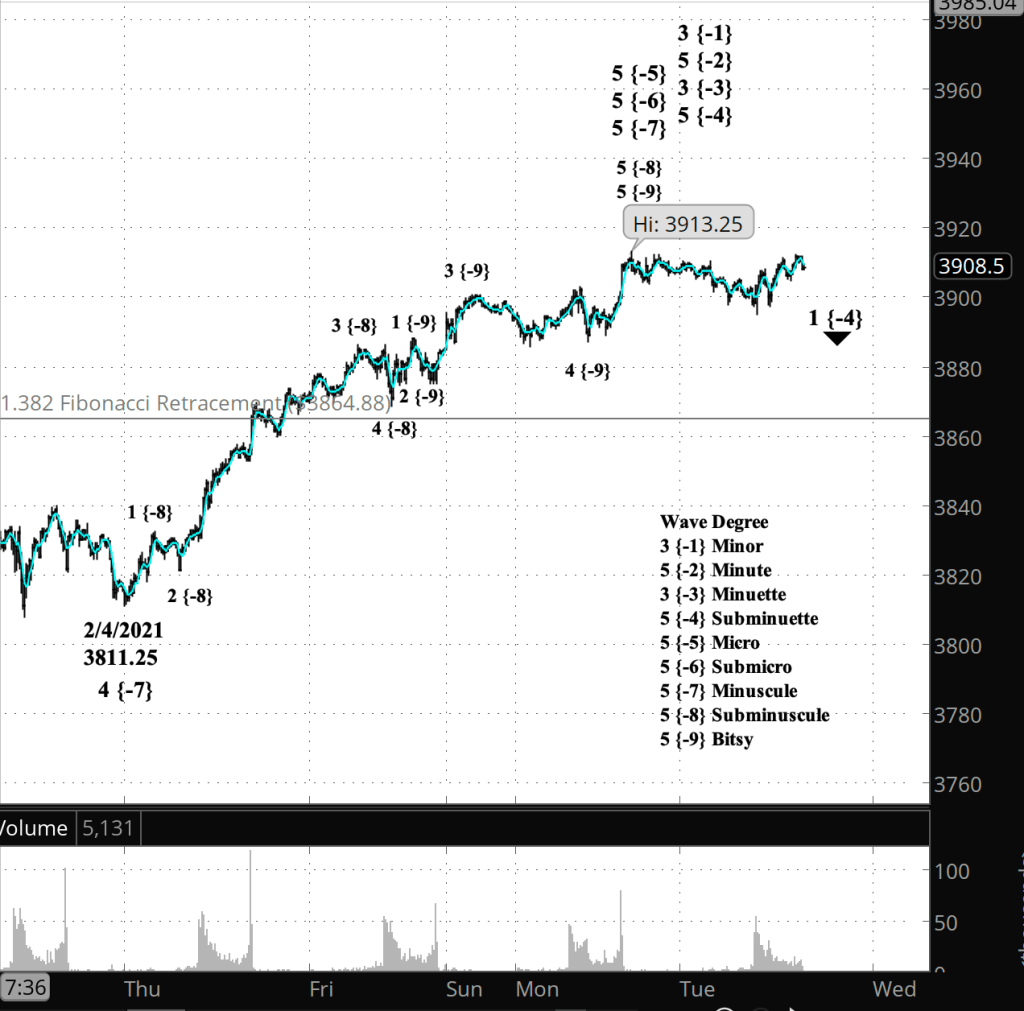
What’s happening now? The S&P 500 E-mini futures stretched up to a higher high in overnight trading, 3913.25 on the futures and 3915.77 on the index.
What does it mean? I see the high as having completed the final wave of the five waves in a movement in the direction of the trend. The completion of the rise will cascade up the degrees and will initiate a significant deadline in price.
What are the alternatives? Market movements are often (usually?) ambiguous, and today’s new high is no exception. The final wave may be extending, leading to still higher highs before it is complete.
[S&P 500 E-mini futures at 3:30 p.m., 12-minute bars, with volume]
What does Elliott wave theory say? I’ve superimposed a 4-day simple moving average on the chart to smooth out the fluctuations so as to make it easier to pick out the waves of Subminuscule degree, marked with the {-8} subscript on the chart. I’ve had to make up a name for waves smaller than Subminuscule and have chosen “Bitsy”, as in the children’s word “itsy-bitsy”. By my count, the overnight high completes wave 5 of Bitsy degree within wave 5 of Subminuscule degree. Under my principle count, the decline that follows is the tentative beginning, not of a correction, but of a new downtrend.
The completion of Bitsy 5 within Subminuscule 5 will trigger completion of the rise all the way up to Subminuette degree, and will be completion of wave 3 of Minuette degree.
Half an hour before the closing bell.The S&P 500 moved to a slightly higher high — 3903 on the futures and 3909.92 with 30-minutes left in the regular trading session. It’s low for the day was only 16 points on the futures, 17 points and a fraction on the index. A drowsy day on Wall Street. I’ve updated the chart below.
9:45 a.m. New York time
What’s happening now? The S&P 500 E-mini futures reached a higher high in overnight trading and then pulled back in a shallow, short-term correction. The high is 3900.50 on the futures and 3905.74 on the index.
What does it mean? By my count the S&P 500 has one more push to the upside before the larger trend begins a decline.
What are the alternatives? There’s no built-in limit to the upward move. It could rise quite a distance before the uptrend is exhausted. The excellent pattern recognition software in our brains tend see each higher high as the end of the trend, but it’s not necessarily so.
[S&P 500 E-mini futures at 3:30 p.m., 20-minute bars, with volume]
What does Elliott wave theory say? The last push up to the higher high is a very small level, wave 5 of Subminuscule degree, and internally, one degree lower, I think wave 5 is it’s 4th wave, with a final upward movement ahead.
Working our way up the degree ladder, Subminuscule 5 is a subwave of wave 5 of Minscule degree within wave 5 of Submicro degree within wave 5 of Micro degree within wave 5 of Subminuette degree with wave within wave 3 of Minuette degree. So completion of the tiny wave below Subminuscule, so small a degree that it lacks a name, will trigger completion of a series 5th waves up to Subminuettee degree, which began on December 21.
Half an hour before the closing bell. The S&P 500 rose a bit higher, to 3888.25 on the futures, 3894.56 on the index. I’ve updated the shorter-term chart posted this morning, and am adding, here, a longer-term chart showing the full Diagonal triangle that began in December 2018.
[S&P 500 index at 3:26 a.m., daily bars]
10:15 a.m. New York time
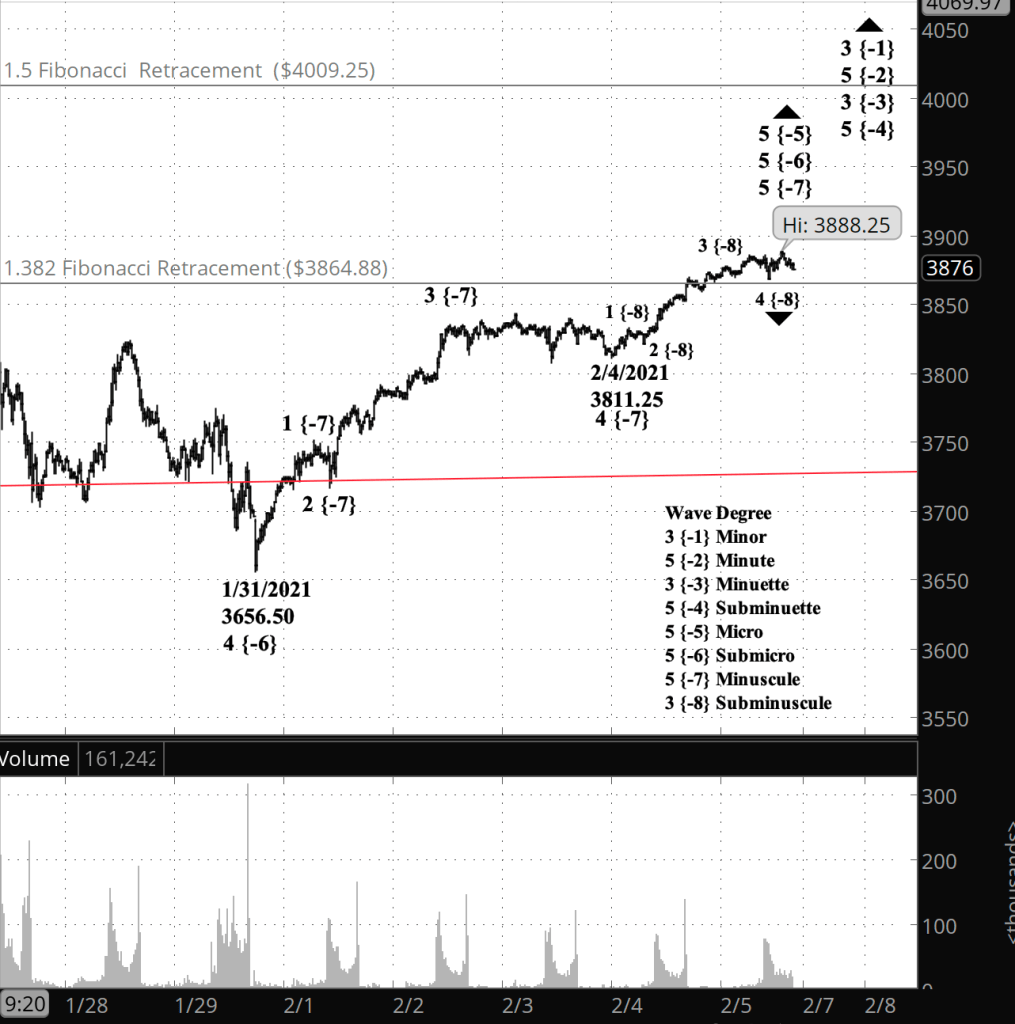
What’s happening now? The S&P 500 E-mini futures continued to rise in overnight trading, piercing the 1.382 Fibonacci retracement of the sharp decline in February 2020. The highest level so far today is 3886.25.
What does it mean? The rise by my count is final movement in the low-level uptrend that began on January 21 from 3656.50.
What are the alternatives? The alternatives lie in the question, how far along is the rise that began February 4, the beginning of the present very low level movement. By my count it is midway through the rise, but other counts are defensible. So there’s some ambiguity in the chart.
Trading strategy. My short iron condor position on IWM has followed the S&P 500, rising sharply and moving above the upper boundary of my profit zone, at 220. The position is three weeks away from mandatory exit under my rules, which happens 21 days before expiration. I’ll wait a bit in the hope of gaining greater clarity as to the extent of the rise.
[S&P 500 E-mini futures at 3:30 p.m., 20-minute bars, with volume]
What does Elliott wave theory say? I’ll concentrate on the rise since February 4, the beginning of wave 5 of Minuscule degree within wave 5 of Submicro degree … and all the way up to wave 5 of Subminuette degree. The completion of the very low-level 5th wave that began on the February 4 will cascade up the degrees to a turning point of significance to traders.
Internally, I count Minuscule 5 as having completed wave 3 of Subminuscule degree and embarked on wave 4.
One thing to remember is that 5th waves sometimes extend, and that could give the price significant upside, perhaps to the next major Fibonacci retracement level, the 1.5, at 4009.25. More often, however, 5th waves complete their five internal waves and exit the stage.
Submicro wave 5 has taken a day to complete three of its five internal waves.
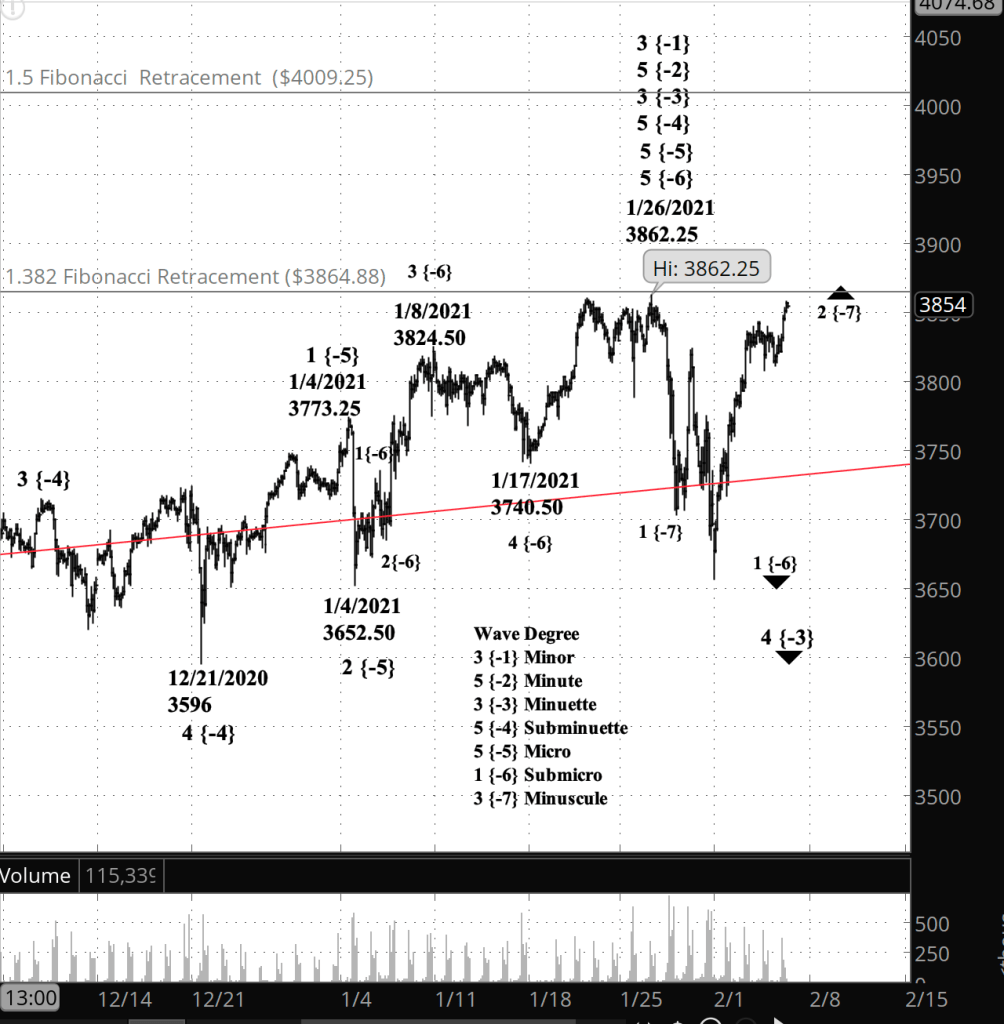
The last half hour. In the last half hour of the regular trading session, the S&P 500 moved to a new high, triggering my alternate analysis. Here’s a chart showing the push up to 3869.75 on the E-mini futures, 3872.42 on the index. I’ve renumbered the waves as follows: The end of wave 4 of Submicro degree moves from January 17 to January 31, and the rise from January 31 is relabelled as wave 5 of Submicro degree, which is still in progress.
[S&P 500 E-mini futures at 4:31 p.m., 2-hour bars, with volume]
3:30 p.m. New York time
Half an hour before the closing bell. The S&P 500 rose during the regular trading session, reaching a high during the day of 3857.75 on the E-mini futures, 3684.81 on the index.The price in either case remained below the high set on January 26 of 3862.25 on the futures, 3870.90 on the index, and so I continue to count the rise from January 31 as an upward correction within downtrending wave 1 of Submicro degree. I’ve updated the chart.
10 a.m. New York time
What’s happening now? The S&P 500 E-mini futures continued to dawdle along the same levels as yesterday, staying between 3811 and 3841 in overnight trading.
What does it mean? Unchanged from Wednesday: The upward correction that began on January 27 has reached an end, and the next move will be an enthusiastic decline that will carry the price below 3656.
What are the alternatives? Also unchanged: A pause is a balance between buy and sell orders. If the buy side strengthens, then the correction will continue its upward course. A move above 3862.25 on the E-mini futures (3870.90 on the index) would force a re-analysis of the chart.
(The chart below shows the analysis before today’s new high triggered the alternative analysis. See the chart above for the new wave numbering.)
Also, the WordPress image resizing function is still broken, so… giant chart.)
[S&P 500 E-mini futures at 3:30 p.m., 2-hour bars, with volume]
What does Elliott wave theory say? And also unchanged: The present wave is C of Minuscule degree, the final subwave of wave 2 of Submicro degree. If the correction is indeed over, the next move will be wave 3 of Submicro degree, a declining wave in the direction of the trend. Third waves typically are the most powerful of the waves that make up a trending move.
I exited my iron condor options spread position on IWM 15 days before expiration, for a $1.99 credit per contract/share, a profit before fees of $56 per contract. Shares were trading at $213.56, up $1.40 from the entry level. The implied volatility rate stood at 20.1%, 4.1 points below the 24.2% entry rate.
[IWM at 2:04 p.m., 20-minute bars, with volume]
My decision to exit was based on Elliott wave analysis. At entry I had interpreted the chart to mean that price had reached the end of an upward correction — wave 4 of Subminuscule degree — when in fact the price followed an alternate interpretation, that the peak was actually ended the first wave (A) of the rise, The options position grew increasingly less profitable as the price climbed to 226.79, the Subminuscule 4. The price then began to works its way down in a resumption of the main trend, wave 5 of Subminuscule degree. At that point analysis told me the price would become profitable, eventually. The only question was one of timing — would it return to profitability before the options expired, a question of duration upon which Elliott can offer no advice. The position returned to profitability today, as Subminuscule 5 fell sharply, and I exited. The two vertical lines on the chart mark when I entered and when exited.
The position was skewed toward the downside, meaning I had set the upper short strike price at 220, or delta 36, rather than unskewed delta 16, which would have been around 236. Had I built an unskewed structure, the position would have remained profitable throughout. Skewing gave greater potential profit, a necessity to make the trade worthwhile during a low implied volatility period.
Shares rose by 0.7% over 29 days for a 11.3% annual rate. The options position produced a 14.1% return for a 177.1% annual rate.
Update 2/26/2021
This is 20 days prior to options expiration for this short iron condor spread on IWM. By my rules I would normally close the position today. It is unprofitable, although trading within the profit zone, below the short call strike price of 220..
I’ve decided to hedge my rule and hold the position over the weekend, based on Elliott wave analysis. IWM is now in a 4th wave of Subminuscule degree. The 5th wave that will follow shortly will bring the price further down into the profit zone, reducing the cost of exit to profitability. Or so my theory goes.
Here’s the chart, IWM at 2:25 p.m., 5-minute bars, with volume:
Analysis 2/3/2021
I have entered a short iron condor spread on IWM, using options that trade for the last time 44 days hence, on March 19. The premium is a $2.27 credit per contract share and the stock at the time of entry was priced at $212.14.
The implied volatility rank (IVR) stands at 24.2.
Premium:
$2.27
Expire OTM
IWM-iron condor
Strike
Odds
Delta
Long
225.00
76.0%
26
Break-even
222.27
71.5%
31
Short
220.00
67.0%
36
Puts
Short
188.00
81.0%
16
Break-even
185.27
83.0%
14
Long
183.00
85.0%
12
The premium is 45.4% of the width of the position’s wing.
The profit zone covers a 4.8% move to the upside and a 14.5% move to the downside, for a total range of 19.3%.
The risk/reward ratio is 1.2:1, with maximum risk of $273 and maximum reward of $227 per contract.
Strategy. I set the wings of the iron condor based on Elliott wave analysis of the IWM chart, which shows the January 25 high, $217.91, to be the peak of an uptrend, and the subsequent decline to be the beginning of either a new downtrend. I set the short put, the lower boundary of my profit zone, below the end of wave 1 to the downside, at 203.25 set on January 29. The subsequent upward move is a wave 2 correction.
Half an hour before the closing bell. The S&P 500 dropped quickly by 27 points to 3804 in the first hours after the opening bell, and then returned to its overnight range. A small whiff of storm and fury, signifying nothing. I’ve updated the chart below.
10:55 a.m. New York time
I’ve entered a short iron condor position on IWM, with the options expiring March 19, and posted an analysis, IWM Trade.
Note the new titling convention. Going forward I’ll be using “Analysis” in the title when I analyze but don’t trade, as with the recent GME analyses I’ve posted. I’ll be using “Trade” in the title when I enter a position.
9:35 a.m. New York time
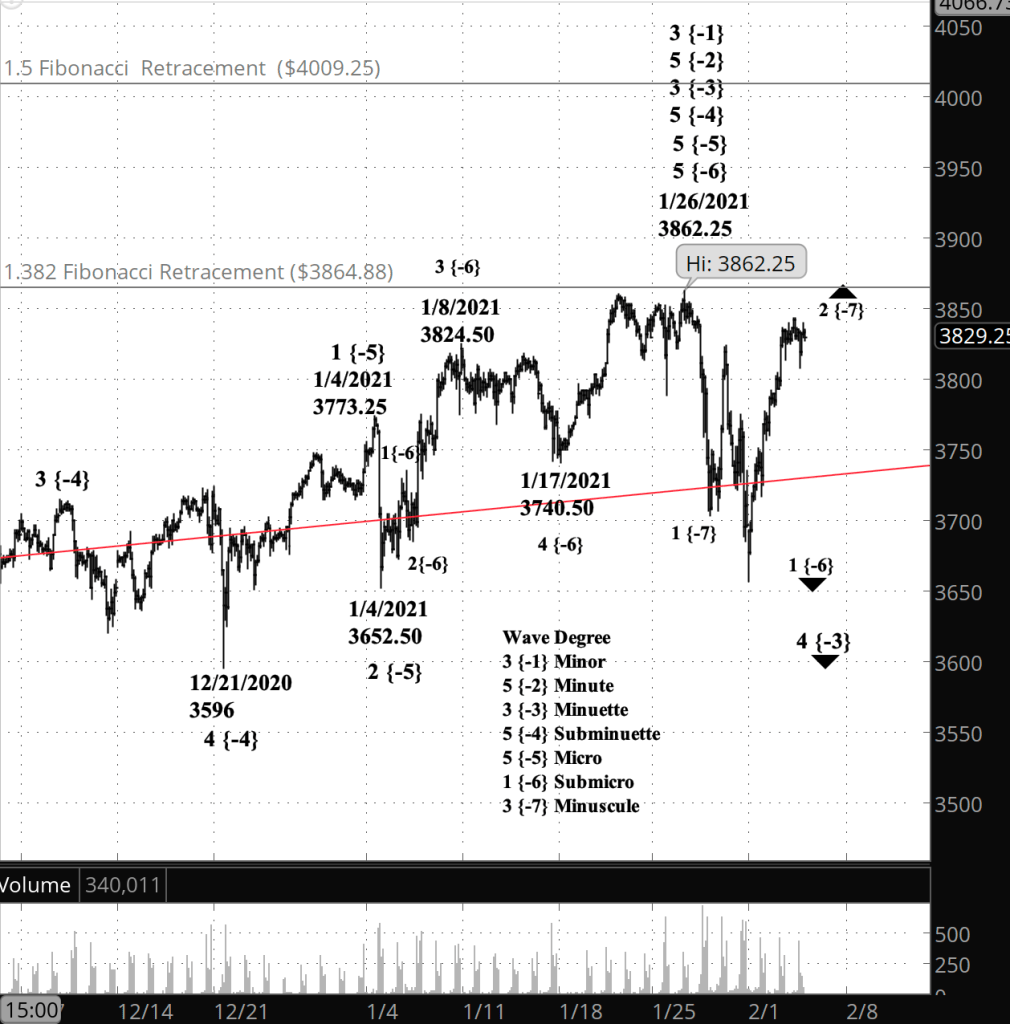
What’s happening now? The S&P 500 E-mini futures barely budged overnight, trading within a 20-point range around 3830. The price declined slightly with the opening bell.
What does it mean? The pause suggests that the upward correction that began on January 27 has reached an end, and the next move will be an enthusiastic decline that will carry the price below 3656.
What are the alternatives? A pause is a balance between buy and sell orders. If the buy side strengthens, then the correction will continue its upward course. A move above 3862.25 on the E-mini futures (3870.90 on the index) would force a re-analysis of the chart.
[S&P 500 E-mini futures at 3:30 p.m., 2-hour bars, with volume]
What does Elliott wave theory say? The present wave is C of Minuscule degree, the final subwave of wave 2 of Submicro degree. If the correction is indeed over, the next move will be wave 3 of Submicro degree, a declining wave in the direction of the trend. Third waves typically are the most powerful of the waves that make up a trending move.
My trading strategy. I choose my options trades from among liquid exchange-traded funds having implied volatility ranks of 25 or above. It’s a lower volatility period in the markets, so I have only one choice: SLV with a rank of 41. There has been a sudden upward gap in SLV that has introduced directional uncertainty for the near term, so I’ll focus on the next lower acceptable symbol, IWM, at 24.1 and attempt to build a trade with sufficient potential for profit.





 Tim Bovee, Private Trader
You must be logged in to post a comment.