Live: Thursday, June 4, 2020

10:40 a.m. New York time

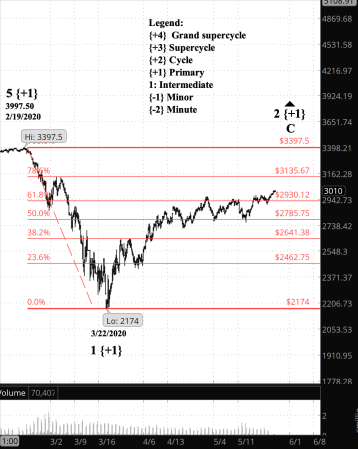
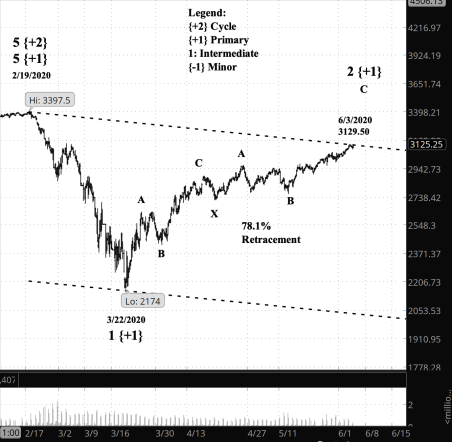
What’s happening now? The S&P 500 E-mini futures yesterday, throughout the day, kept bumping up high for the rise since March 22, pulling back after peaking at 3129.50. In the chart I’ve drawn the channel as though that peak were the end of correction to the upside, but the reality is that I can’t rule out a bit more upside remaining.

What does it mean? The rise has retraced 78.1% of the decline from February 19 to March 22. If there is a more rise remaining, it will be a fairly short movement, stopping short of 3397.50. If 3129.50 is indeed the peak of the rise, then the next move will be down. What I’ll be looking for is a drop that shows some commitment — the short of drop where you look at the chart and without analysis, say, Something has changed. A decline below 2760.25, where the present leg up of the correction, will increase the odds that the correction is over.

By the way, note the volume at the bottom of the chart, how much it has fallen off during the correction, a sign that the energy of the upward movement is fading.
Screen Shot 2020-06-04 at 7.36.08 AM

What does Elliott wave theory say? The meaning of the 3129.50 point depends upon how we interpret the internals of the wave that led to that peak: Intermediate wave C within the Primary wave 2 upward correction.

My count yesterday placed index nearing the end of Minute wave 3 within Intermediate C. If that’s correct then there will be a small pullback and then a final Minor wave 5 rise above that prior peak.

What is the alternative? I noted yesterday that I found the wave pattern to be somewhat ambiguous, and that the present position might be well Minor wave 5. If that’s the case, then 3129.50 could indeed mark the end of the Primary wave 2 correction. The resumption of the downtrend, Primary wave 3, will be energetic and without ambiguity as it pushes down to the lower boundary of the channel, almost certainly below 2000.
Read More »

Live: Wednesday, June 3, 2020

10:45 a.m. New York time

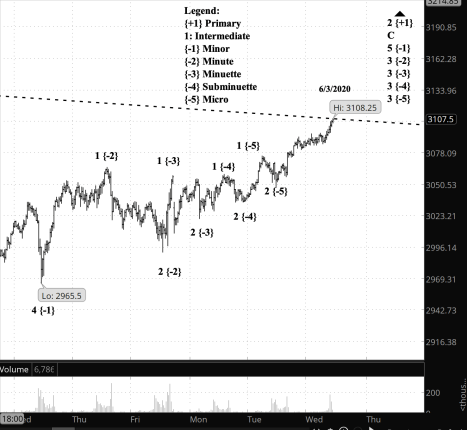
What’s happening now? The S&P 500 E-mini futures moved up to yet another higher high, 3108.25 so far, which is 32.75 points above the previous higher high set on Tuesday.

What does it mean? The upward correction that began March 22 continues. How close to complete it might be depends upon how we interpret the present leg up within that correction, which began May 27 at 2965.5

Screen Shot 2020-06-03 at 7.40.12 AM

What does Elliott wave theory say? How close the index is to a reversal depends upon how we count the waves internal to the rise from May 27, which is Minor wave 5. Within that wave, honestly, the structure is a bit messy, with ambiguities that are common to the paths traced by the markets.

I count our present positions as being:

  • Micro wave 3
  • of Subminuette 3
  • of Minuette 3
  • of Minute 3
  • of Minor 5
  • within Intermediate wave C
  • of the Primary wave 2 correction.

In other words, the middle wave of the Minor degree is stretching out quite bit. There are other ways of counting, but this one seems to best fit the form of the chart as of this moment. The sticking point is wave 3, which must never be the shortest of a five-wave impulse pattern. When a count shows it to be the shortest, then the count is wrong and standard practice is to move down a degree in order to make the 3rd wave length longer. This why Elliott wave analysis is more art than science.

Read More »

Live: Tuesday, June 2, 2020

10 a.m. New York time

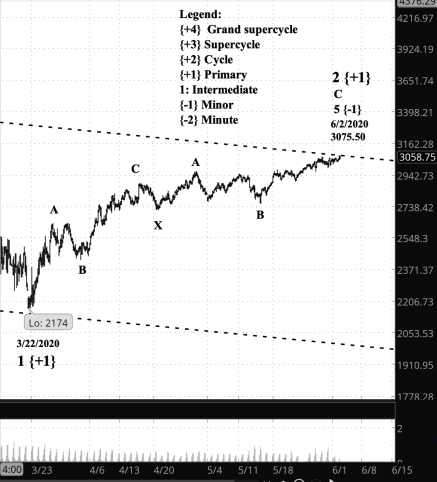
What’s happening now? Early this morning, before the opening bell, the S&P 500 E-mini futures exceeded its high of March 28 by 10 points, reaching 3075.50 before retreating a little.

What does it mean? The analysis is unchanged from yesterday. The final upward push of a correction to the decline that began February 19 is underway and nearing its end, or perhaps has already ended. I’ve drawn the channel on the chart based on the assumption that 3075.50 is the correction peak, but that’s not necessarily the case. It’s a what-if framing, not a certainty.

Screen Shot 2020-06-02 at 6.58.58 AM

What does Elliott wave theory say? By my count the final wave up of the correction, Intermediate wave C within Primary wave 2 within Cycle wave 1, began on May 14 and has covered 315.25 points, a rise of 11.4%. It has covered sufficient ground to be considered complete. When Primary 2 is done, it will be followed by a very significant decline, Primary wave 3.


Read More »

Live: Monday, June 1, 2020

9:45 a.m. New York time

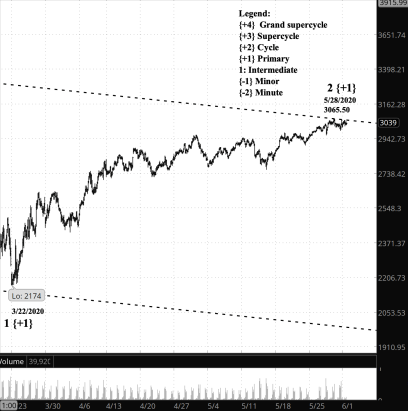
What’s happening now? The S&P 500 E-mini futures remain below the May 28 peak of 3065.50.

What does it mean? The lack of a new high leaves open the possibility that the rise from March 22 is complete.

Screen Shot 2020-06-01 at 6.44.02 AM

What does Elliott wave theory say? I’ve marked today’s chart showing a channel that assumes that the Primary wave 2 correction to the upside is complete. The price remains very close to the upper boundary of the channel but remans below it. If the correction is indeed over, the price will begin to fall down toward the lower boundary of the channel, which at present stands at 2000, more than 1,000 points below the present price.

What is the alternative? The channel’s upper boundary now stands at 3057, which is 24 points above the present price. So it’s a very short rise to the boundary, and if it is pierced, then it strengthens the case that Primary wave 2 is still in force, and there will be another movement to the upside before it reaches its conclusion.

What about my trades? No options are in my account at present. My shares in SDS profit when the S&P 500 goes down and lose when it rises. Now? Losing.

Learning and other resources. Elliott Wave International has long been the leading analytical house based on Elliott wave theory. They make available a number of free educational materials and other resources, in addition to their for-pay subscriptions.

I recommend two books, both by people associated with EWI.

First, Elliott Wave Principle by Robert Prechter and A.J. Frost is the book that, along with Prechter’s analyses, that created the revival of Elliott wave theory. I first read it in 1984, and it has had a profound influenced on my thinking about markets ever since.

Second, I’ve found Visual Guide to Elliott Wave Trading by Wayne Gorman and Jeffrey Kennedy, both of EWI, to be a useful book that relates Elliott wave theory to practical trading. The authors are hands-on Elliotticians, and for an active trader, that’s exactly what’s needed — less theory and more how-to. The first chapter of the book gives a very nice thumbnail run down of what Elliott wave theory is all about.

Terminology. Here are some links to information about some of the technical jargon I use.

Charts. On my charts, waves have a subscript showing the degree above or below the Intermediate degree. Here are the subscripts and the degree each represents:

  • {+3} Supercycle
  • {+2} Cycle
  • {+1} Primary
  • No subscript: Intermediate
  • {-1} Minor
  • {-2} Minute
  • {-3} Minuette

By Tim Bovee, Portland, Oregon, June 1, 2020

Disclaimer

Tim Bovee, Private Trader tracks the analysis and trades of a private trader for his own accounts. Nothing in this blog constitutes a recommendation to buy or sell stocks, options or any other financial instrument. The only purpose of this blog is to provide education and entertainment.

No trader is ever 100 percent successful in his or her trades. Trading in the stock and option markets is risky and uncertain. Each trader must make trading decisions for his or her own account, and take responsibility for the consequences.

License
Creative Commons License

All content on Tim Bovee, Private Trader by Timothy K. Bovee is licensed under a Creative Commons Attribution-ShareAlike 4.0 International License.

Based on a work at www.timbovee.com.

Live: Friday, May 29, 2020

9:40 a.m. New York time

What’s happening now? The S&P 500 E-mini futures retreated from yesterday’s peak of 3065.50.

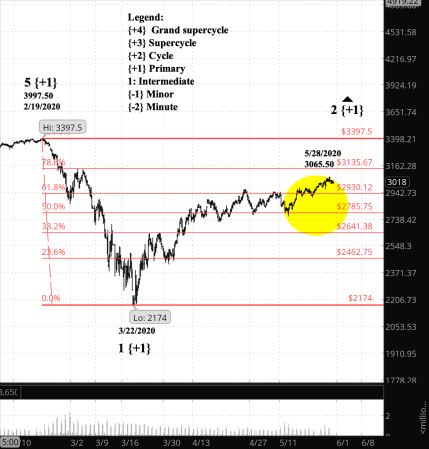
What does it mean? The price is approaching another Fibonacci stopping point, a 78.6% retracement of the decline from February 19 to March 22.

Screen Shot 2020-05-29 at 6.37.44 AM

What does Elliott wave theory say? I count the most recent push upward (highlighted in yellow) as a C wave showing a clear five waves to the upside. The 5th wave internal to wave C may not yet be complete, but it is nearing its end. There are two possibilities for what happens next: Either the end of wave C marks the end of Primary wave 2’s correction of the Primary wave 1 decline that began February 19, or the C wave will be followed by a wave down, an X wave, and then a third corrective pattern in the compound correction that is Primary 2.

Read More »

Live: Thursday, May 28, 2020

10:20 a.m. New York time

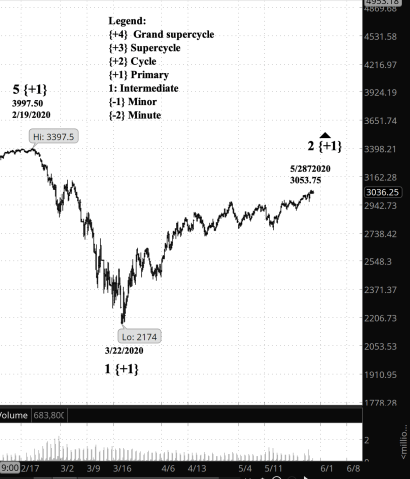
What’s happening now? The S&P 500 E-mini futures resumed their rise, peaking last night at 3053.75 before withdrawing slightly.

What does it mean? The correction that began March 22 is still under way, having risen 879.50 points in 58 days.

Screen Shot 2020-05-28 at 7.19.05 AM

What does Elliott wave theory say? The S&P 500 is in the 2nd wave upward correction of Primary degree within a 1st wave downward trend of Cycle. The rise last night means that among the options proposed in yesterday’s analysis for the subwaves of Primary 2 — 3rd wave or 5th wave — the 3rd wave hypothesis won.

What is the alternative? A move above 3997.50, the beginning of Cycle wave 1, would invalidate idea that the entire decline since February 19 is the beginning of a correction at degrees greater than Cycle.

What about my trades? No options are in my account at present. I’m waiting for Primary wave 3 to begin before entering. My shares in SDS profit when the S&P 500 goes down and loses when it rises. They are presently losing but since shares have no expiration so I intend to hold them through Primary 3.

Learning and other resources. Elliott Wave International has long been the leading analytical house based on Elliott wave theory. They make available a number of free educational materials and other resources, in addition to their for-pay subscriptions.

I recommend two books, both by people associated with EWI.

First, Elliott Wave Principle by Robert Prechter and A.J. Frost is the book that, along with Prechter’s analyses, that created the revival of Elliott wave theory. I first read it in 1984, and it has had a profound influenced on my thinking about markets ever since.

Second, I’ve found Visual Guide to Elliott Wave Trading by Wayne Gorman and Jeffrey Kennedy, both of EWI, to be a useful book that relates Elliott wave theory to practical trading. The authors are hands-on Elliotticians, and for an active trader, that’s exactly what’s needed — less theory and more how-to. The first chapter of the book gives a very nice thumbnail run down of what Elliott wave theory is all about.

Terminology. Here are some links to information about some of the technical jargon I use.

Charts. On my charts, waves have a subscript showing the degree above or below the Intermediate degree. Here are the subscripts and the degree each represents:

  • {+3} Supercycle
  • {+2} Cycle
  • {+1} Primary
  • No subscript: Intermediate
  • {-1} Minor
  • {-2} Minute
  • {-3} Minuette

By Tim Bovee, Portland, Oregon, May 28, 2020

Disclaimer

Tim Bovee, Private Trader tracks the analysis and trades of a private trader for his own accounts. Nothing in this blog constitutes a recommendation to buy or sell stocks, options or any other financial instrument. The only purpose of this blog is to provide education and entertainment.

No trader is ever 100 percent successful in his or her trades. Trading in the stock and option markets is risky and uncertain. Each trader must make trading decisions for his or her own account, and take responsibility for the consequences.

License
Creative Commons License

All content on Tim Bovee, Private Trader by Timothy K. Bovee is licensed under a Creative Commons Attribution-ShareAlike 4.0 International License.

Based on a work at www.timbovee.com.

Live: Wednesday, May 27, 2020

10:10 a.m. New York time

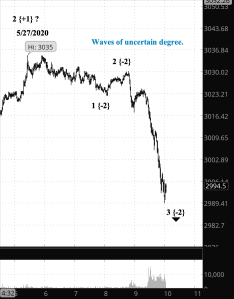
What’s happening now? The S&P 500 E-mini futures peaked overnight at 3035 and then began an energetic decline.

What does it mean? It could be that 3035 marks the end of the correction that began on March 22. Maybe. There are still some ambiguities.

Screen Shot 2020-05-27 at 7.04.39 AM

What does Elliott wave theory say? The possibly final leg of Primary wave 2 to the upside appears to have met the requirements, with sufficient ambiguity for me to add a question mark. If the 3035 high indeed is the end of Primary wave 2, then the subsequent decline is the very early stage, at the Minute or perhaps Minuette degrees, of a powerful Primary 3 decline. The final Intermediate wave C of Primary wave 2 covered 131.25 points, or 4.5%.


What is the alternative? I’m uncertain whether the peak is a 3rd wave or a 5th terminus. If 5th, then the correction is likely over. If 3rd, then there’s more upside to go.

What about my trades? No options are in my account at present. My shares in SDS profit when the S&P 500 goes down and loses when it rises.

Learning and other resources. Elliott Wave International has long been the leading analytical house based on Elliott wave theory. They make available a number of free educational materials and other resources, in addition to their for-pay subscriptions.

I recommend two books, both by people associated with EWI.

First, Elliott Wave Principle by Robert Prechter and A.J. Frost is the book that, along with Prechter’s analyses, that created the revival of Elliott wave theory. I first read it in 1984, and it has had a profound influenced on my thinking about markets ever since.

Second, I’ve found Visual Guide to Elliott Wave Trading by Wayne Gorman and Jeffrey Kennedy, both of EWI, to be a useful book that relates Elliott wave theory to practical trading. The authors are hands-on Elliotticians, and for an active trader, that’s exactly what’s needed — less theory and more how-to. The first chapter of the book gives a very nice thumbnail run down of what Elliott wave theory is all about.

Terminology. Here are some links to information about some of the technical jargon I use.

Charts. On my charts, waves have a subscript showing the degree above or below the Intermediate degree. Here are the subscripts and the degree each represents:

  • {+3} Supercycle
  • {+2} Cycle
  • {+1} Primary
  • No subscript: Intermediate
  • {-1} Minor
  • {-2} Minute
  • {-3} Minuette

By Tim Bovee, Portland, Oregon, May 27, 2020

Disclaimer

Tim Bovee, Private Trader tracks the analysis and trades of a private trader for his own accounts. Nothing in this blog constitutes a recommendation to buy or sell stocks, options or any other financial instrument. The only purpose of this blog is to provide education and entertainment.

No trader is ever 100 percent successful in his or her trades. Trading in the stock and option markets is risky and uncertain. Each trader must make trading decisions for his or her own account, and take responsibility for the consequences.

License
Creative Commons License

All content on Tim Bovee, Private Trader by Timothy K. Bovee is licensed under a Creative Commons Attribution-ShareAlike 4.0 International License.

Based on a work at www.timbovee.com.

Live: Tuesday, May 26, 2020

9:50 a.m. New York time

What’s happening now? The E-mini S&P 500 futures continued their rise as the end of the upward correction that began March 22 mounts a final push before it reaches its end.

What does it mean? The upward correction will be followed by a renewed decline that will carry the price down beyond 2174, most likely significantly so.

Screen Shot 2020-05-26 at 6.41.35 AM

What does Elliott wave theory say? So far the rise, Primary wave 2, has retraced a bit more than 61.8% of the decline that began on February 19, a Fibonacci level that is often the stopping point for trends, although not always. The rise reached a peak this morning, as of this writing, of 3019.75. The rise will fall short of 3397.50, the beginning of the decline.

Typically in a bear market 2nd wave the public mood reaches a point where the consensus is that the market has turned bullish.

I don’t see that happening yet. For example, the Advance/Decline line, a metric that compares advancing stocks to declining stocks. At the outset of the bear market, on February 19, the A/D line was 92,432. The low point so far was 69,753 and it presently sits at 80,870. Yes, optimism is returning, but without a lot of enthusiasm. That suggests to me that there is more upside to Primary 2 before Primary 3 comes along and dashes all bullish hopes.

Read More »

Live: Monday, May 25, 2020

9:45 a.m. New York time

What’s happening now? The U.S. stock and options markets are closed today for the Memorial Day holiday, but the S&P 500 E-mini future contracts are trading. The index continued to rise in what I expect to be the final wave up before a significant downturn. The movement began on May 22 at 2903.75 and has peaked so far today at 2986.25.

Screen Shot 2020-05-25 at 6.41.58 AM

What does it mean? The movement has more upside in its journey. The present peak is only 2.8% above its starting point, and two comparable movements within the large upward correction that began March 22 have 7.8% and 21.2%.

What does Elliott wave theory say? The present wave up is an Intermediate C wave by my count, and they tend to be energetic. The comparables in the section above were the two other C waves that we’ve seen in compound Primary wave 2 correction to the upside.

Read More »

Live: Friday, May 22, 2020

10 a.m. New York time

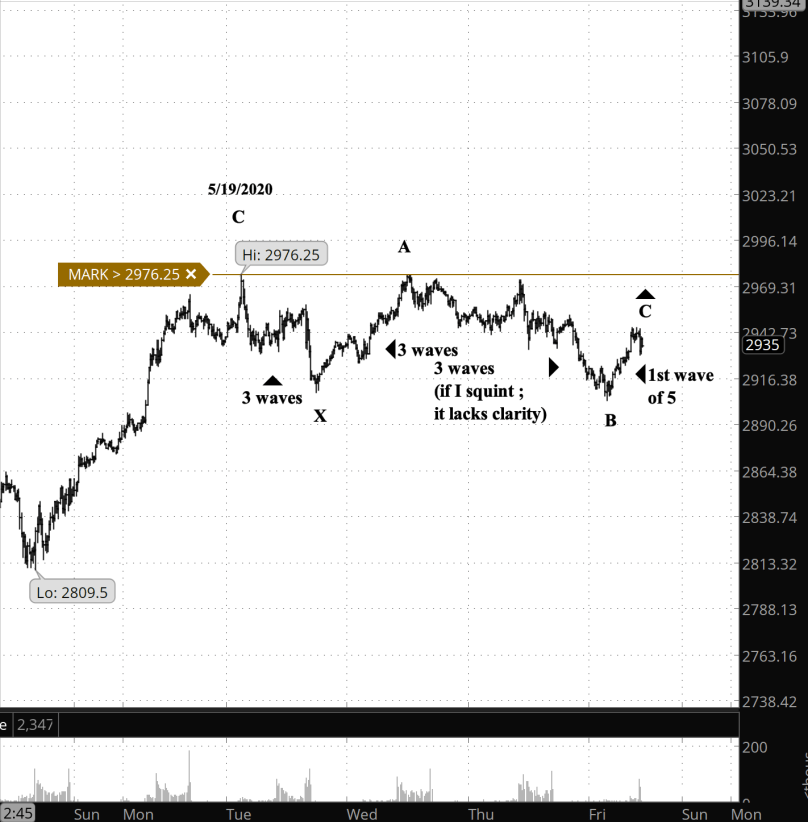
What’s happening now? The E-mini S&P 500 futures continue to move sideways after peaking at 2976.25 on May 19.

What does it mean? The chart suggests that the upward correction, which began March 22, is still underway but approaching an end.

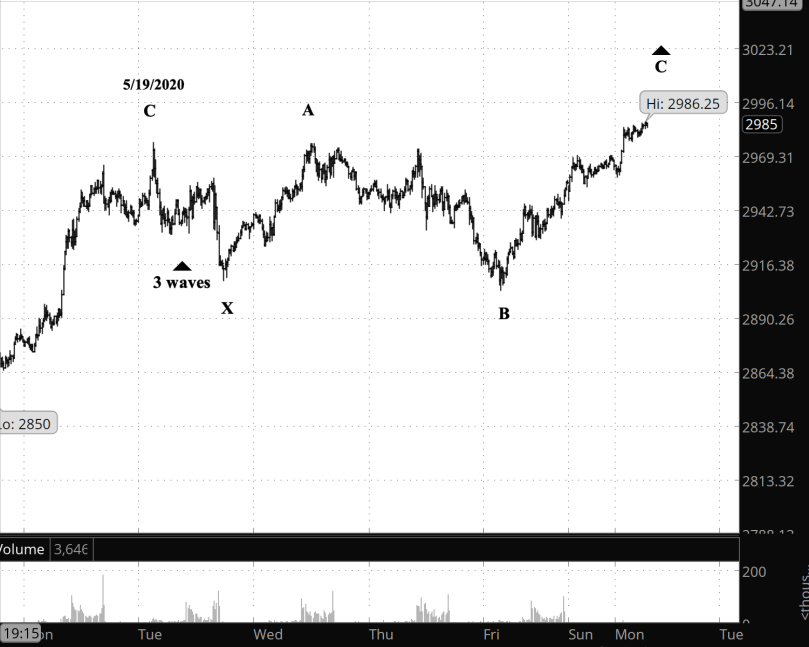
What does Elliott wave theory say? The tip off is the number of subwaves in the first wave down after the May 19 peak. It’s three waves, meaning in this context that it’s an X wave (of Intermediate degree) separating the two corrective patterns that came before with a third corrective pattern that will finally put an end to wave 2 of Primary degree. The X wave is followed by a three-wave pattern, an A wave, another sign that the correction lives on.

Screen Shot 2020-05-22 at 7.01.55 AM

What is the alternative? I see no clear alternative at this point. Let’s see what happens wave C by my count.

Read More »